HOPE
Producing and motivation on pursuing alternative ways
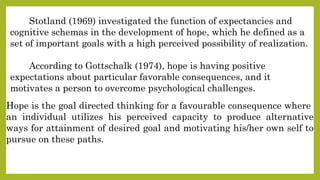
Hope is the goal directed thinking for a favourable consequence where
an individual utilizes his perceived capacity to produce alternative
ways for attainment of desired goal and motivating his/her own self to
pursue on these paths.
Stotland (1969) investigated the function of expectancies and
cognitive schemas in the development of hope, which he defined as a
set of important goals with a high perceived possibility of realization.
According to Gottschalk (1974), hope is having positive
expectations about particular favorable consequences, and it
motivates a person to overcome psychological challenges.
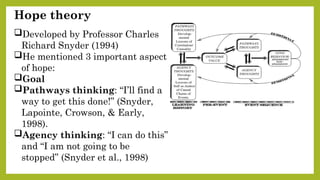
Hope theory
Developed by Professor Charles
Richard Snyder (1994)
He mentioned 3 important aspect
of hope:
Goal
Pathways thinking: “I’ll find a
way to get this done!” (Snyder,
Lapointe, Crowson, & Early,
1998).
Agency thinking: “I can do this”
and “I am not going to be
stopped” (Snyder et al., 1998)
Self report inventories: the adult Trait Hope Scale (Snyder, Harris,
et al., 1991); The State Hope Scale (Snyder et al., 1996); and The
Children’s Hope Scale (for ages 8 to 16) (Snyder, Hoza, et al., 1997)
Snyder (1994) proposes that hope has no hereditary contributions
but rather is entirely a learned cognitive set about goal-directed
thinking.
Strong attachment to caregivers is crucial for imparting
hope(Shorey, Snyder, Yang, & Lewin, 2003)
Traumatic events across the course of childhood is lessening of hope
(Rodriguez-Hanley & Snyder, 2000)
Snyder suggested hope has a neurological basis such as BAS and
BIS of central nervous system. (Pickering, & Gray,1999)
Benefits of Hope
Academic Performance: Higher Hope Scale scores at the start of
college have been shown to predict better overall grade point
averages and whether students will continue school (Snyder,
Shorey, et al., 2002)
Health and Well being: In the area of adjustment, higher Hope
Scale scores have related to various indices of elevated happiness,
satisfaction, positive emotions, getting along with others, etc.
(Snyder, Harris, et aI., 1991). Hope can be used as a resource to
keep anxiety from overpowering and incapacitating the patient.
(Michael, 2000)
Psychotherapy & hope therapy: McNeal (1998) conducted a
study of children and adolescents’ hope before and after they had
received psychological treatment in a residential setting. He found
that significantly higher levels of hope were developed during that
period.
Hope therapy aims to help clients formulate clear goals, produce
numerous pathways to these, motivate themselves to pursue their
goals and reframe obstacles as challenges to be overcome. (Snyder,
2000)
Collective Hope
Collective hope reflects the level of goal-directed thinking of a
large group of people. (Snyder & Feldman, 2000)
Snyder and Feldman (2000) have applied the notion of collective
hope more generally to the topics of disarmament, preservation of
environmental resources, health insurance, and government.
Thank you

hope a positive cognitive state and quality

  • 1.
    HOPE Producing and motivationon pursuing alternative ways
  • 2.
    Hope is thegoal directed thinking for a favourable consequence where an individual utilizes his perceived capacity to produce alternative ways for attainment of desired goal and motivating his/her own self to pursue on these paths. Stotland (1969) investigated the function of expectancies and cognitive schemas in the development of hope, which he defined as a set of important goals with a high perceived possibility of realization. According to Gottschalk (1974), hope is having positive expectations about particular favorable consequences, and it motivates a person to overcome psychological challenges.
  • 3.
    Hope theory Developed byProfessor Charles Richard Snyder (1994) He mentioned 3 important aspect of hope: Goal Pathways thinking: “I’ll find a way to get this done!” (Snyder, Lapointe, Crowson, & Early, 1998). Agency thinking: “I can do this” and “I am not going to be stopped” (Snyder et al., 1998)
  • 4.
    Self report inventories:the adult Trait Hope Scale (Snyder, Harris, et al., 1991); The State Hope Scale (Snyder et al., 1996); and The Children’s Hope Scale (for ages 8 to 16) (Snyder, Hoza, et al., 1997) Snyder (1994) proposes that hope has no hereditary contributions but rather is entirely a learned cognitive set about goal-directed thinking. Strong attachment to caregivers is crucial for imparting hope(Shorey, Snyder, Yang, & Lewin, 2003) Traumatic events across the course of childhood is lessening of hope (Rodriguez-Hanley & Snyder, 2000) Snyder suggested hope has a neurological basis such as BAS and BIS of central nervous system. (Pickering, & Gray,1999)
  • 5.
    Benefits of Hope AcademicPerformance: Higher Hope Scale scores at the start of college have been shown to predict better overall grade point averages and whether students will continue school (Snyder, Shorey, et al., 2002) Health and Well being: In the area of adjustment, higher Hope Scale scores have related to various indices of elevated happiness, satisfaction, positive emotions, getting along with others, etc. (Snyder, Harris, et aI., 1991). Hope can be used as a resource to keep anxiety from overpowering and incapacitating the patient. (Michael, 2000)
  • 6.
    Psychotherapy & hopetherapy: McNeal (1998) conducted a study of children and adolescents’ hope before and after they had received psychological treatment in a residential setting. He found that significantly higher levels of hope were developed during that period. Hope therapy aims to help clients formulate clear goals, produce numerous pathways to these, motivate themselves to pursue their goals and reframe obstacles as challenges to be overcome. (Snyder, 2000)
  • 7.
    Collective Hope Collective hopereflects the level of goal-directed thinking of a large group of people. (Snyder & Feldman, 2000) Snyder and Feldman (2000) have applied the notion of collective hope more generally to the topics of disarmament, preservation of environmental resources, health insurance, and government.
  • 8.