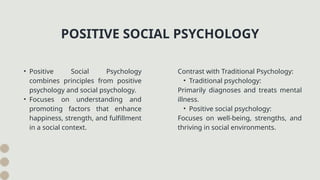
• Positive SocialPsychology
combines principles from positive
psychology and social psychology.
• Focuses on understanding and
promoting factors that enhance
happiness, strength, and fulfillment
in a social context.
POSITIVE SOCIAL PSYCHOLOGY
Contrast with Traditional Psychology:
• Traditional psychology:
Primarily diagnoses and treats mental
illness.
• Positive social psychology:
Focuses on well-being, strengths, and
thriving in social environments.
3.
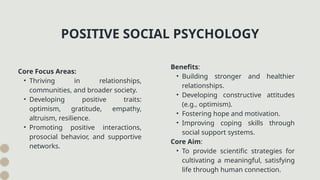
Core Focus Areas:
•Thriving in relationships,
communities, and broader society.
• Developing positive traits:
optimism, gratitude, empathy,
altruism, resilience.
• Promoting positive interactions,
prosocial behavior, and supportive
networks.
POSITIVE SOCIAL PSYCHOLOGY
Benefits:
• Building stronger and healthier
relationships.
• Developing constructive attitudes
(e.g., optimism).
• Fostering hope and motivation.
• Improving coping skills through
social support systems.
Core Aim:
• To provide scientific strategies for
cultivating a meaningful, satisfying
life through human connection.
4.
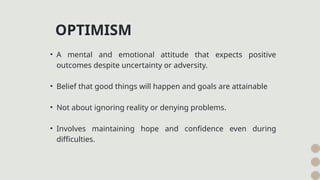
• A mentaland emotional attitude that expects positive
outcomes despite uncertainty or adversity.
• Belief that good things will happen and goals are attainable
• Not about ignoring reality or denying problems.
• Involves maintaining hope and confidence even during
difficulties.
OPTIMISM
5.
Key Traits ofOptimistic People:
• Key Traits of Optimistic People:
• Stay motivated.
• Persist in the face of failure.
• Cope better with stress.
OPTIMISM
Benefits of Optimism:
• Psychological resilience.
• Improved physical health.
• Higher life satisfaction.
• Stronger relationships.
6.
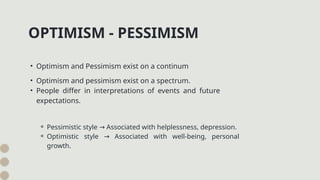
OPTIMISM - PESSIMISM
•Optimism and Pessimism exist on a continum
• Optimism and pessimism exist on a spectrum.
• People differ in interpretations of events and future
expectations.
⚬ Pessimistic style Associated with helplessness, depression.
→
⚬ Optimistic style Associated with well-being, personal
→
growth.
7.
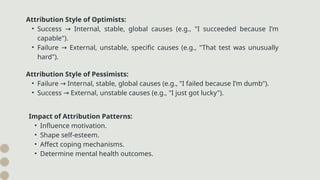
Attribution Style ofOptimists:
• Success Internal, stable, global causes (e.g., "I succeeded because I’m
→
capable").
• Failure External, unstable, specific causes (e.g., "That test was unusually
→
hard").
Attribution Style of Pessimists:
• Failure Internal, stable, global causes (e.g., "I failed because I’m dumb").
→
• Success External, unstable causes (e.g., "I just got lucky").
→
Impact of Attribution Patterns:
• Influence motivation.
• Shape self-esteem.
• Affect coping mechanisms.
• Determine mental health outcomes.
8.
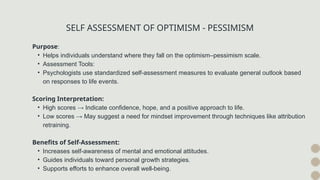
SELF ASSESSMENT OFOPTIMISM - PESSIMISM
Purpose:
• Helps individuals understand where they fall on the optimism–pessimism scale.
• Assessment Tools:
• Psychologists use standardized self-assessment measures to evaluate general outlook based
on responses to life events.
Scoring Interpretation:
• High scores → Indicate confidence, hope, and a positive approach to life.
• Low scores → May suggest a need for mindset improvement through techniques like attribution
retraining.
Benefits of Self-Assessment:
• Increases self-awareness of mental and emotional attitudes.
• Guides individuals toward personal growth strategies.
• Supports efforts to enhance overall well-being.
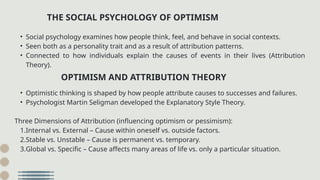
• Social psychologyexamines how people think, feel, and behave in social contexts.
• Seen both as a personality trait and as a result of attribution patterns.
• Connected to how individuals explain the causes of events in their lives (Attribution
Theory).
THE SOCIAL PSYCHOLOGY OF OPTIMISM
OPTIMISM AND ATTRIBUTION THEORY
• Optimistic thinking is shaped by how people attribute causes to successes and failures.
• Psychologist Martin Seligman developed the Explanatory Style Theory.
Three Dimensions of Attribution (influencing optimism or pessimism):
1.Internal vs. External – Cause within oneself vs. outside factors.
2.Stable vs. Unstable – Cause is permanent vs. temporary.
3.Global vs. Specific – Cause affects many areas of life vs. only a particular situation.
11.
• The causeis due to outside
forces (e.g., luck, task
difficulty, others' actions).
• Example: “I failed because the
exam was unfair.”
• Optimists tend to use
external attributions for
negative events, protecting
their self-image.
TYPES OF ATTRIBUTION
Internal Attribution
• The cause is within the person
(e.g., ability, effort, attitude).
• Example: “I did well on the test
because I studied hard.”
• Optimists use internal
attributions for positive events.
• Pessimists often use internal
attributions for negative events,
which can harm self-esteem.
External Attribution
12.
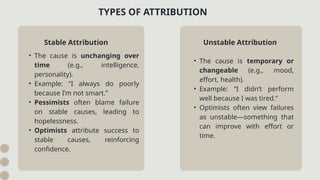
• The causeis temporary or
changeable (e.g., mood,
effort, health).
• Example: “I didn’t perform
well because I was tired.”
• Optimists often view failures
as unstable—something that
can improve with effort or
time.
TYPES OF ATTRIBUTION
Stable Attribution
• The cause is unchanging over
time (e.g., intelligence,
personality).
• Example: “I always do poorly
because I’m not smart.”
• Pessimists often blame failure
on stable causes, leading to
hopelessness.
• Optimists attribute success to
stable causes, reinforcing
confidence.
Unstable Attribution
13.
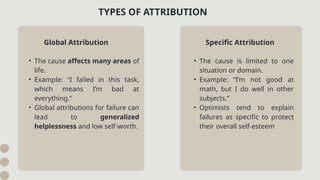
• The causeis limited to one
situation or domain.
• Example: “I’m not good at
math, but I do well in other
subjects.”
• Optimists tend to explain
failures as specific to protect
their overall self-esteem
TYPES OF ATTRIBUTION
Global Attribution
• The cause affects many areas of
life.
• Example: “I failed in this task,
which means I’m bad at
everything.”
• Global attributions for failure can
lead to generalized
helplessness and low self-worth.
Specific Attribution
14.
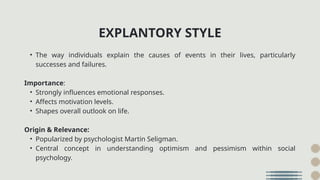
• The wayindividuals explain the causes of events in their lives, particularly
successes and failures.
Importance:
• Strongly influences emotional responses.
• Affects motivation levels.
• Shapes overall outlook on life.
Origin & Relevance:
• Popularized by psychologist Martin Seligman.
• Central concept in understanding optimism and pessimism within social
psychology.
EXPLANTORY STYLE
15.
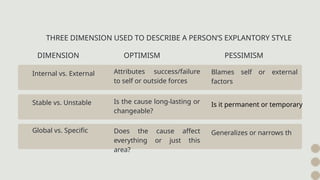
THREE DIMENSION USEDTO DESCRIBE A PERSON’S EXPLANTORY STYLE
Internal vs. External
Stable vs. Unstable
Global vs. Specific
DIMENSION OPTIMISM PESSIMISM
Attributes success/failure
to self or outside forces
Blames self or external
factors
Is the cause long-lasting or
changeable?
Is it permanent or temporary
Does the cause affect
everything or just this
area?
Generalizes or narrows th
16.
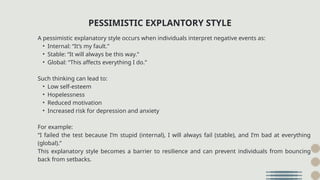
A pessimistic explanatorystyle occurs when individuals interpret negative events as:
• Internal: “It’s my fault.”
• Stable: “It will always be this way.”
• Global: “This affects everything I do.”
Such thinking can lead to:
• Low self-esteem
• Hopelessness
• Reduced motivation
• Increased risk for depression and anxiety
For example:
“I failed the test because I’m stupid (internal), I will always fail (stable), and I’m bad at everything
(global).”
This explanatory style becomes a barrier to resilience and can prevent individuals from bouncing
back from setbacks.
PESSIMISTIC EXPLANTORY STYLE
17.
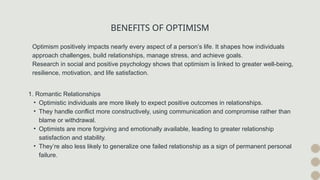
BENEFITS OF OPTIMISM
Optimismpositively impacts nearly every aspect of a person’s life. It shapes how individuals
approach challenges, build relationships, manage stress, and achieve goals.
Research in social and positive psychology shows that optimism is linked to greater well-being,
resilience, motivation, and life satisfaction.
1. Romantic Relationships
• Optimistic individuals are more likely to expect positive outcomes in relationships.
• They handle conflict more constructively, using communication and compromise rather than
blame or withdrawal.
• Optimists are more forgiving and emotionally available, leading to greater relationship
satisfaction and stability.
• They’re also less likely to generalize one failed relationship as a sign of permanent personal
failure.
18.
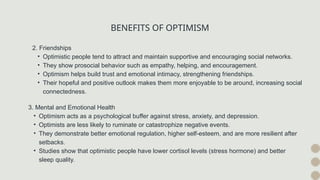
BENEFITS OF OPTIMISM
2.Friendships
• Optimistic people tend to attract and maintain supportive and encouraging social networks.
• They show prosocial behavior such as empathy, helping, and encouragement.
• Optimism helps build trust and emotional intimacy, strengthening friendships.
• Their hopeful and positive outlook makes them more enjoyable to be around, increasing social
connectedness.
3. Mental and Emotional Health
• Optimism acts as a psychological buffer against stress, anxiety, and depression.
• Optimists are less likely to ruminate or catastrophize negative events.
• They demonstrate better emotional regulation, higher self-esteem, and are more resilient after
setbacks.
• Studies show that optimistic people have lower cortisol levels (stress hormone) and better
sleep quality.
19.
BENEFITS OF OPTIMISM
4.Work
• Optimism contributes to higher job satisfaction, productivity, and motivation.
• Optimists are more likely to set challenging goals and persist in achieving them.
• They view setbacks (e.g., missed deadlines, conflicts) as temporary and solvable, which
enhances problem-solving and teamwork.
• This outlook makes them strong leaders and effective team members.
5. College Life
• In academic settings, optimism helps students cope with stress, maintain motivation, and
bounce back from poor grades or setbacks.
• Optimistic students believe effort leads to success, so they’re more likely to study harder and
seek help when needed.
• They report higher satisfaction with college life, stronger peer relationships, and greater
academic achievement
20.
COPING STRATEGIES
1. Problem-FocusedCoping
• This strategy involves directly addressing the source of stress to
remove or reduce it.
• It is action-oriented and goal-directed.
• Examples:
⚬ Making a study plan to improve grades
⚬ Resolving conflict with a friend
⚬ Seeking information or help to solve a problem
Optimists often use problem-focused coping when they believe the
situation is changeable.
21.
COPING STRATEGIES
2. Emotion-FocusedCoping
• This strategy involves managing the emotional response to a stressor rather
than changing the problem itself.
• It’s often used when the situation is out of the person’s control.
• Examples:
⚬ Talking to someone about your feelings
⚬ Practicing relaxation or meditation
⚬ Accepting the situation as it is
Optimists tend to use healthy emotion-focused coping, like positive reframing or
acceptance, instead of avoidance or denial.
22.
Positive coaching involvespsychological strategies aimed at
enhancing well-being, performance, and resilience. One
powerful technique in this approach is Attribution Retraining,
which helps individuals shift from a pessimistic explanatory
style to a more optimistic one. This can improve motivation,
self-confidence, and overall mental health.
POSITIVE COACHING EXERCISES
23.
1. Attribution RetrainingIntervention
Attribution retraining is a cognitive-behavioral strategy designed to help individuals reframe the
causes of negative events in a way that promotes hope, resilience, and growth.
Goal:
To replace negative, fixed, and internal explanations with more flexible, external, and changeable
ones.
How It Works:
• Helps people identify their typical attributional style.
• Encourages reflection on past events and how they explained success or failure.
• Teaches them to attribute failure to external, unstable, and specific factors (e.g., lack of
preparation rather than lack of ability).
• Promotes attribution of success to internal, stable, and global causes (e.g., intelligence, effort).
Benefits:
• Reduces hopelessness and self-blame
• Increases self-efficacy
• Enhances emotional regulation and motivation
24.
2. Attribution Retrainingin the Academic Domain
In the academic setting, many students attribute poor performance to stable and internal factors
like “I’m not smart” or “I’ll never be good at math.” This pessimistic thinking can lower motivation
and lead to learned helplessness.
Intervention Strategy:
• Teach students to reinterpret failure as a result of controllable factors like study habits, test
anxiety, or effort.
• Encourage them to see success as evidence of ability and growth.
Example Exercise:
A student fails a math test.
Old attribution: “I’m terrible at math” (internal, stable, global)
New attribution: “I didn’t review enough this time. I can do better with more practice” (external,
unstable, specific)
Outcomes:
• Improved academic confidence
• Greater resilience after setbacks
• Increased persistence and achievement
25.
3. Attribution Retrainingin the Romantic Relationship Domain
In romantic relationships, individuals with pessimistic attribution styles often blame themselves for
breakups or believe they are inherently “unlovable.” This can damage future relationship success
and self-worth.
Intervention Strategy:
• Help individuals reframe relationship failures using external, unstable, and specific
explanations.
• Support them in identifying contextual or mutual issues rather than self-blame.
Example Exercise:
A person is heartbroken after a breakup.
Old attribution: “I wasn’t good enough. I always mess things up.” (internal, stable, global)
New attribution: “We had different goals, and the timing wasn’t right. It doesn’t mean I’m
unlovable.” (external, unstable, specific)
Outcomes:
• Reduced self-criticism and emotional distress
• More realistic and hopeful view of future relationships
• Improved relationship patterns and self-esteem
26.
• People fromdifferent cultures think and feel differently about
their future.
• In Western cultures (like the U.S. and Canada), individuals often
show an optimistic bias—they believe that good things are
more likely to happen to them than to others.
• In contrast, Eastern cultures (like Japan and China) tend to show
a pessimistic bias, especially for positive outcomes, due to
values like modesty and self-criticism.
• These differences highlight how culture shapes our
expectations, mindset, and approach to well-being.
CULTURE CAPSULE: EAST–WEST DIFFERENCES AND
THE OPTIMISTIC BIAS
27.
Optimistic Bias
Optimistic biasrefers to the tendency of individuals to believe that they are more
likely than others to experience positive events, and less likely to experience
negative events. It reflects a general belief that “good things will happen to me.”
In Western cultures (e.g., the U.S., Canada, Europe), optimistic bias is very
common. People in these cultures:
• Predict greater personal success than for others
• Believe they are less at risk of experiencing failure, illness, or accidents
• Tend to maintain self-enhancing beliefs to protect self-esteem
This bias is linked to individualistic values, where self-confidence and
independence are emphasized. It promotes motivation, self-worth, and
achievement orientation.
28.
Pessimistic Bias
In contrast,Eastern cultures (e.g., Japan, China, Korea) are more likely to show a
pessimistic bias, especially for positive events. This means:
• Individuals may underestimate their chances of experiencing good outcomes
• There’s a greater focus on avoiding failure than on seeking success
• Self-criticism is used as a tool for self-improvement
Eastern cultures often value modesty, humility, and social harmony, which
discourages overly positive self-views. This reflects a collectivist mindset, where
the group’s success is often prioritized over the individual’s.
29.
Pathway thinking refersto the ability to generate multiple strategies or routes to reach a
desired goal.
• People with strong pathway thinking can:
⚬ Identify alternative solutions when faced with obstacles
⚬ Maintain clarity on their goals
⚬ Adapt and persist even when plans go wrong
For example:
A student who wants to pass an exam may create multiple plans—attending group studies,
revising notes, seeking a tutor—rather than giving up after failing once.
Pathway thinking is essential for:
• Problem-solving
• Resilience
• Academic and career success
It helps people maintain hope, because they can always see another way forward, even when
one path fails.
PATHWAY THINKING
30.
Agency thinking refersto the motivation or determination
to pursue a goal, even when it's difficult.
Together, agency and pathway thinking form the cognitive
framework of hope, which is a vital part of positive well-
being.
AGENCY THINKING