Chroma Meter CL-200A
Even measures new light sources such as
LED lighting and organic EL lighting
Ideal for measuring
color temperature
A compact, lightweight instrument
with a detachable receptor. Includes
convenient, easy-to-use software.
NEW
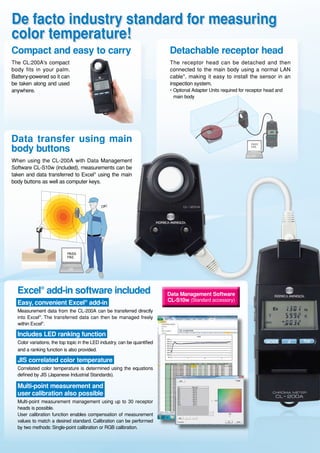
Compact and easy to carry
The CL:200A's compact
body fits in your palm.
Battery-powered so it can
be taken along and used
anywhere.
Detachable receptor head
The receptor head can be detached and then
connected to the main body using a normal LAN
cable*, making it easy to install the sensor in an
inspection system.
* Optional Adapter Units required for receptor head and 		
	 main body
Data transfer using main
body buttons
When using the CL-200A with Data Management
Software CL-S10w (included), measurements can be
taken and data transferred to Excel®
using the main
body buttons as well as computer keys.
Easy, convenient Excel®
add-in
Measurement data from the CL-200A can be transferred directly
into Excel®
. The transferred data can then be managed freely
within Excel®
.
Includes LED ranking function
Color variations, the top topic in the LED industry, can be quantified
and a ranking function is also provided.
JIS correlated color temperature
Correlated color temperature is determined using the equations
defined by JIS (Japanese Industrial Standards).
Multi-point measurement and
user calibration also possible
Multi-point measurement management using up to 30 receptor
heads is possible.
User calibration function enables compensation of measurement
values to match a desired standard. Calibration can be performed
by two methods: Single-point calibration or RGB calibration.
Excel®
add-in software included
PASS
FAIL
PASS
FAIL
OK!
Data Management Software
CL-S10w (Standard accessory)
De facto industry standard for measuring
color temperature!
Application
examples
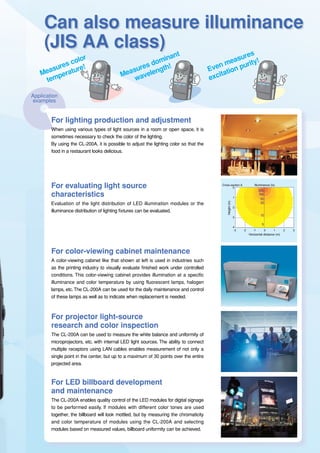
For lighting production and adjustment
When using various types of light sources in a room or open space, it is
sometimes necessary to check the color of the lighting.
By using the CL-200A, it is possible to adjust the lighting color so that the
food in a restaurant looks delicious.
For evaluating light source
characteristics
Evaluation of the light distribution of LED illumination modules or the
illuminance distribution of lighting fixtures can be evaluated.
For color-viewing cabinet maintenance
A color-viewing cabinet like that shown at left is used in industries such
as the printing industry to visually evaluate finished work under controlled
conditions. This color-viewing cabinet provides illumination at a specific
illuminance and color temperature by using fluorescent lamps, halogen
lamps, etc.The CL-200A can be used for the daily maintenance and control
of these lamps as well as to indicate when replacement is needed.
For projector light-source			
research and color inspection
The CL-200A can be used to measure the white balance and uniformity of
microprojectors, etc. with internal LED light sources. The ability to connect
multiple receptors using LAN cables enables measurement of not only a
single point in the center, but up to a maximum of 30 points over the entire
projected area.
For LED billboard development
and maintenance
The CL-200A enables quality control of the LED modules for digital signage
to be performed easily. If modules with different color tones are used
together, the billboard will look mottled, but by measuring the chromaticity
and color temperature of modules using the CL-200A and selecting
modules based on measured values, billboard uniformity can be achieved.
Cross-section A Illuminance (lx)
Horizontal distance (m)
Height(m) 0
0
1
1
2
2
3
3
4
-1-2-3
300
100
50
10
30
5
Colors mix to create white light!
Blue light emitted by LED element
Yellow light emitted by phosphor
Package
Electrode
LED element
Phosphor
PASS
FAIL
PASS
FAIL
PASS
FAIL
Measures color
temperature! Even measures
excitation purity!
Measures dominant
wavelength!
Can also measure illuminance
(JIS AA class)
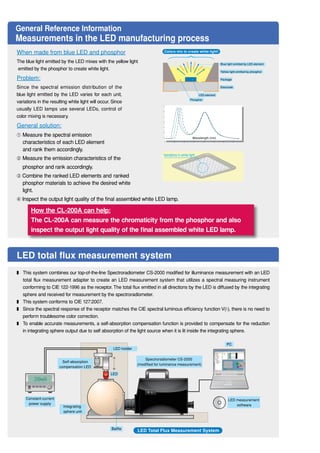
For accurate measurements of color temperature, use the CL-200A!
Measurement accuracies of CL-200A and photographic color meter
When measuring light sources with non-continuous spectrums such as LEDs, etc., accurate illumination color temperature is
particularly required.The CL-200A can measure color temperature accurately.
CL-200A
The CL-200A has sensors that closely match the color-matching functions defined by the CIE (International Commission on
Illumination), enabling precise color measurement.The measurement results can be displayed in various color notations such
as "Correlated color temperature and uv" according to the application.
Photographic color meter
In order to take more beautiful pictures, it is sometimes necessary to attach filters in front of the camera lens to compensate
for the color of the light illuminating the subject. A photographic color meter is a meter used to select the appropriate filters,
with the sensitivity of its sensors adjusted to match that of the film or digital camera sensor. In addition, because it uses
photographic color temperature, which is calculated based mostly on the blue/red balance of the illumination, large errors
may occur if it is used to measure light sources with non-continuous spectrums.					
	 [Actual measurement data for daylight-color LED bulb]
Color temperature and correlated color temperature
Color temperature
When an ideal blackbody* is heated, it begins to emit light, and as the temperature increases the color of the emitted light
changes from red to yellow to white. Since the color of the emitted light is determined by the temperature of the blackbody,
the color of the light emitted by the blackbody can be expressed as the absolute temperature of the blackbody (in Kelvin).
This color notation scale is called "color temperature". For example, a 7000K color would be the color of the light emitted by
a blackbody heated to 7000K. Figure 1 shows the color of light emitted by a blackbody at various temperatures plotted on an
xy chromaticity diagram. This curve is called the "blackbody locus"; "color temperature" expresses a color on this blackbody
locus.
Correlated color temperature
Since the color of white light emitted by illumination equipment and displays is generally close to the blackbody locus, the
color of such light sources is normally expressed using "color temperature".
However, the color of such light sources is not directly on the blackbody locus. Because of this, a way to enable similar
color expression for colors within a larger region close to the blackbody locus was devised. This is called "correlated color
temperature", and the larger region is shown by the isotherms on the xy chromaticity diagram in Figure 2.
To accurately express the correlated color temperature of a light-source color, it is necessary to state not only the correlated
color temperature but the difference from the blackbody locus, normally in terms of uv.
0.50
0.40
0.45
0.35
0.30
0.25
0.20
0.25 0.30 0.35 0.40 0.45 0.50 0.55
50000
+0.02uv+0.01uv0.00uv­0.01uv­0.02uv
30000
20000
15000
13000
10000
9000
8000
7000
6000
5000
4500
4000
3500
3000
2500
y
0.90
0.80
0.70
0.60
0.50
0.40
0.30
0.20
0.10
0.00
0.10 0.20 0.30 0.40 0.50 0.60 0.70 x
520
530
540
550
560
570
590
600
610
620
650
680∼780
510
500
490
480
470
460
450 380∼440
200025003000
3500
4000
4500
10000
* *
*
*
**
B
C
A
D55
D65
D75
580
1500
Figure 1: Blackbody locus on xy
chromaticity diagram
Figure 2: Closeup of blackbody locus
on xy chromaticity diagram showing
correlated color temperature region
Measured color temperature
Color-temperature difference from
standard-instrument measured value
Our company's standard instrument 5045 0
CL-200A 5011 -34
Photographic color meter 5600 555
*Blackbody
An ideal radiator. A body which completely
absorbs all incident electromagnetic
radiation. Although a perfect blackbody does
not actually exist, coal is a familiar object
that acts similarly.
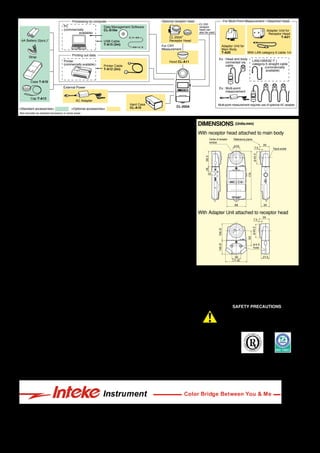
When made from blue LED and phosphor
The blue light emitted by the LED mixes with the yellow light							
emitted by the phosphor to create white light.
Problem:
Since the spectral emission distribution of the
blue light emitted by the LED varies for each unit,
variations in the resulting white light will occur. Since
usually LED lamps use several LEDs, control of
color mixing is necessary.
General solution:
➀	Measure the spectral emission 			
	 characteristics of each LED element 		
	 and rank them accordingly.
➁	Measure the emission characteristics of the
	 phosphor and rank accordingly.
➂ Combine the ranked LED elements and 	ranked 			
	 phosphor materials to achieve the desired white 			
	 light.
➃ Inspect the output light quality of the final assembled white LED lamp.
How the CL-200A can help:
The CL-200A can measure the chromaticity from the phosphor and also
inspect the output light quality of the final assembled white LED lamp.
LED total flux measurement system
❚	 This system combines our top-of-the-line Spectroradiometer CS-2000 modified for illuminance measurement with an LED
total flux measurement adapter to create an LED measurement system that utilizes a spectral measuring instrument
conforming to CIE 122-1996 as the receptor.The total flux emitted in all directions by the LED is diffused by the integrating
sphere and received for measurement by the spectroradiometer.
❚	 This system conforms to CIE 127:2007.
❚	 Since the spectral response of the receptor matches the CIE spectral luminous efficiency function V(λ), there is no need to
perform troublesome color correction.
❚	 To enable accurate measurements, a self-absorption compensation function is provided to compensate for the reduction
in integrating sphere output due to self absorption of the light source when it is lit inside the integrating sphere.
General Reference Information
Measurements in the LED manufacturing process
LED Total Flux Measurement System
PC
Baffle
LED
LED holder
Integrating
sphere unit
Self-absorption
compensation LED
Constant-current
power supply
Spectroradiometer CS-2000
(modified for luminance measurement)
LED measurement
software
Colors mix to create white light!
Blue light emitted by LED element
Yellow light emitted by phosphor
Package
Electrode
LED element
Phosphor
Wavelength (nm)
Variations in white light
©2010 KONICA MINOLTA SENSING,INC.
For correct use and for your safety, be sure to read the instruction
manual before using the instrument.
Always connect the instrument to the specified power supply
voltage. Improper connection may cause a fire or electric shock.
Be sure to use the specified batteries. Using improper batteries
may cause a fire or electric shock.
SAFETY PRECAUTIONS
Certificate No : JQA-E-80027
Registration Date : March 12, 1997
Certificate No :YKA 0937154
Registration Date : March 3, 1995
For correct use and for your safety, be sure to read the instruction
manual before using the instrument.
Always connect the instrument to the specified power supply
voltage. Improper connection may cause a fire or electric shock.
Be sure to use the specified batteries. Using improper batteries
may cause a fire or electric shock.
SAFETY PRECAUTIONS
DIMENSIONS (Units:mm)
With receptor head attached to main body
With Adapter Unit attached to receptor head
9242-4876-12 BAGAPK➀ Printed in Japan
Main specifications of Chroma Meter CL-200A
Model Chroma Meter CL-200A
Luminance meter
class
Conforms to requirements for Class AA of JIS C 1609-1: 2006 "Illuminance
meters Part 1: General measuring instruments"
Relative spectral
response
Closely matches CIE Standard Observer curves x( ), y( ), and z( )
Within 6% (fi') of the CIE spectral luminous efficency V( )
Cosine response (f2) Ev: Within 3%
Receptor Silicon photocell
Measuring function Tristimulus values: XYZ
Chromaticity: Evxy; Evu'v'; Ev, Dominant wavelength, Excitation purity
Correlated color temperature: EvTcp uv; Tcp(JIS method; available only with
CL-S10w)
Color difference: (XYZ), (Evxy), (Evu'v'), Ev u'v'(Target: 1)
Other function User calibration function, Data hold function, Multi-point measurement (2 to 30 points)
Measuring range 0.1 to 99,990 lx, 0.01 to 9,999 fcd (Chromaticity : 5 lx, 0.5 fcd or above) in
four automatically selected ranges (lx or fcd is switchable)
Accuracy Ev (Linearity): ±2%±1digit of displayed value
xy: ±0.002		 (800 lx, Standard Illuminant A measured)
Repeatability Ev: 0.5%+1digit (2σ),
xy: ±0.0005	 (800 lx, Standard Illuminant A measured)
Temperature drift Ev: ±3% ±1digit of displayed value, xy: ±0.003 (Based on Konica Minolta's
standard measurement conditions)
Humidity drift Ev: ±3% ±1digit of displayed value, xy: ±0.003 (Based on Konica Minolta's
standard measurement conditions)
Response time 0.5 sec. (continuous measurement)
Digital output USB
Display 4-significant-digit LCD with back-light illumination
Operating temperature/
humidity range
-10 to 40˚C, relative humidity 85% or less (at 35˚C) with no condensation
Storage temperature
/ humidity range
-20 to 55˚C, relative humidity 85% or less (at 35˚C) with no condensation
Power source 2 AA-size batteries / AC adapter (optional)
Battery life 72 hours or longer (When alkaline batteries are used) in continuous measurement
Dimensions 69×174×35mm (2-6/16×6-14/16×1-7/13in.)
Weight 215g (7.6 oz.) not including batteries
Standard
accessories
Case T-A10, Cap T-A13, Strap, AA Batteries (2)*, Data Manegement Software
CL-S10w, USB cable T-A15 *Not included as standard accessory in some areas.
Optional
accessories
Receptor Head, Adaptor Unit for Main Body T-A20, Adapter Unit for Receptor Head T-A21,
AC Adapter AC-A308 (For 1 to 10 receptor heads),
AC Adapter AC-A311 (For 1 to 30 receptor heads),
Printer Cable T-A12, Hood CL-A11, Hard Case CL-A10
Main specifications of Data Management Software CL-S10w
Type Add-in for Excel®
* Excel is required to use this add-in.
Operating
environment
One of the following environments with Excel®
installed:
Windows®
XP 	+ Excel®
2003 (English, Japanese, or Simplified Chinese)
Windows®
7 	 + Excel®
2007 (English, Japanese, or Simplified Chinese)
* 	For details on system requirements for above versions of Windows®
and/or Excel®
,
refer to their respective specifications.
* 	Languages in parenthesis ( ) are the OS language.
Compatible instruments CL-200A, CL-200* * Some functions not usable with CL-200.
•	KONICA MINOLTA and the Konica Minolta logo and the symbol mark, and
"The essentials of imaging" are registered trademarks or trademarks of
KONICA MINOLTA HOLDINGS, INC.
•	Windows®
and Excel®
are trademarks of Microsoft Corporation in the USA
and other countries.
•	The specifications and drawings given here are subject to change without
prior notice.
•	Screens shown are for illustration purpose only.
- --
<Standard accessories>
*Not included as standard accessory in some areas.
<Optional accessories>
CL-200A
AA Battery (2pcs.)*
Strap
Case T-A10
Cap T-A13
PC
(commercially
available)
Printer
(commercially available)
Data Management Software
CL-S10w
Processing by computer
Printing out data
USB Cable
T-A15 (2m)
Printer Cable
T-A12 (2m)
AC Adapter
External Power
CL-200A*
Receptor Head
Hood CL-A11
Optional receptor head
For CRT
Measurement
Adaptor Unit for
Main Body
T-A20
Adapter Unit for
Receptor Head
T-A21
With LAN category-5 cable 1m
For Multi-Point Measurement / Detached Head
LAN(10BASE-T )
category-5 straight cable
(commercially
available)
Multi-point measurement requires use of optional AC adapter.Hard Case
CL-A10
*CL-200
receptor
head can
also be used.
Ex.: Multi-point
measurement
Ex.: Head and body
connected via
cable
Reference planeCenter of receptor
window
Tripod socket7.5
7.5
(71.8)
30
(56.3)(46.3)
φ4.5
hole
φ45.2
50
35
69 30
35
27.5
174
φ25
φ45.2
56.318
13
25
SYSTEM DIAGRAM
Tel:(0755) 86354826 / 86354829 Fax:(0755)299182559 Mobile:13723487970
Website:http:// www.inteke.com E-mail:inteke@gmail.com / inteke@vip.163.com

Konica Minolta Chroma Meter CL-200A

  • 1.
    Chroma Meter CL-200A Evenmeasures new light sources such as LED lighting and organic EL lighting Ideal for measuring color temperature A compact, lightweight instrument with a detachable receptor. Includes convenient, easy-to-use software. NEW
  • 2.
    Compact and easyto carry The CL:200A's compact body fits in your palm. Battery-powered so it can be taken along and used anywhere. Detachable receptor head The receptor head can be detached and then connected to the main body using a normal LAN cable*, making it easy to install the sensor in an inspection system. * Optional Adapter Units required for receptor head and main body Data transfer using main body buttons When using the CL-200A with Data Management Software CL-S10w (included), measurements can be taken and data transferred to Excel® using the main body buttons as well as computer keys. Easy, convenient Excel® add-in Measurement data from the CL-200A can be transferred directly into Excel® . The transferred data can then be managed freely within Excel® . Includes LED ranking function Color variations, the top topic in the LED industry, can be quantified and a ranking function is also provided. JIS correlated color temperature Correlated color temperature is determined using the equations defined by JIS (Japanese Industrial Standards). Multi-point measurement and user calibration also possible Multi-point measurement management using up to 30 receptor heads is possible. User calibration function enables compensation of measurement values to match a desired standard. Calibration can be performed by two methods: Single-point calibration or RGB calibration. Excel® add-in software included PASS FAIL PASS FAIL OK! Data Management Software CL-S10w (Standard accessory) De facto industry standard for measuring color temperature!
  • 3.
    Application examples For lighting productionand adjustment When using various types of light sources in a room or open space, it is sometimes necessary to check the color of the lighting. By using the CL-200A, it is possible to adjust the lighting color so that the food in a restaurant looks delicious. For evaluating light source characteristics Evaluation of the light distribution of LED illumination modules or the illuminance distribution of lighting fixtures can be evaluated. For color-viewing cabinet maintenance A color-viewing cabinet like that shown at left is used in industries such as the printing industry to visually evaluate finished work under controlled conditions. This color-viewing cabinet provides illumination at a specific illuminance and color temperature by using fluorescent lamps, halogen lamps, etc.The CL-200A can be used for the daily maintenance and control of these lamps as well as to indicate when replacement is needed. For projector light-source research and color inspection The CL-200A can be used to measure the white balance and uniformity of microprojectors, etc. with internal LED light sources. The ability to connect multiple receptors using LAN cables enables measurement of not only a single point in the center, but up to a maximum of 30 points over the entire projected area. For LED billboard development and maintenance The CL-200A enables quality control of the LED modules for digital signage to be performed easily. If modules with different color tones are used together, the billboard will look mottled, but by measuring the chromaticity and color temperature of modules using the CL-200A and selecting modules based on measured values, billboard uniformity can be achieved. Cross-section A Illuminance (lx) Horizontal distance (m) Height(m) 0 0 1 1 2 2 3 3 4 -1-2-3 300 100 50 10 30 5 Colors mix to create white light! Blue light emitted by LED element Yellow light emitted by phosphor Package Electrode LED element Phosphor PASS FAIL PASS FAIL PASS FAIL Measures color temperature! Even measures excitation purity! Measures dominant wavelength! Can also measure illuminance (JIS AA class)
  • 4.
    For accurate measurementsof color temperature, use the CL-200A! Measurement accuracies of CL-200A and photographic color meter When measuring light sources with non-continuous spectrums such as LEDs, etc., accurate illumination color temperature is particularly required.The CL-200A can measure color temperature accurately. CL-200A The CL-200A has sensors that closely match the color-matching functions defined by the CIE (International Commission on Illumination), enabling precise color measurement.The measurement results can be displayed in various color notations such as "Correlated color temperature and uv" according to the application. Photographic color meter In order to take more beautiful pictures, it is sometimes necessary to attach filters in front of the camera lens to compensate for the color of the light illuminating the subject. A photographic color meter is a meter used to select the appropriate filters, with the sensitivity of its sensors adjusted to match that of the film or digital camera sensor. In addition, because it uses photographic color temperature, which is calculated based mostly on the blue/red balance of the illumination, large errors may occur if it is used to measure light sources with non-continuous spectrums. [Actual measurement data for daylight-color LED bulb] Color temperature and correlated color temperature Color temperature When an ideal blackbody* is heated, it begins to emit light, and as the temperature increases the color of the emitted light changes from red to yellow to white. Since the color of the emitted light is determined by the temperature of the blackbody, the color of the light emitted by the blackbody can be expressed as the absolute temperature of the blackbody (in Kelvin). This color notation scale is called "color temperature". For example, a 7000K color would be the color of the light emitted by a blackbody heated to 7000K. Figure 1 shows the color of light emitted by a blackbody at various temperatures plotted on an xy chromaticity diagram. This curve is called the "blackbody locus"; "color temperature" expresses a color on this blackbody locus. Correlated color temperature Since the color of white light emitted by illumination equipment and displays is generally close to the blackbody locus, the color of such light sources is normally expressed using "color temperature". However, the color of such light sources is not directly on the blackbody locus. Because of this, a way to enable similar color expression for colors within a larger region close to the blackbody locus was devised. This is called "correlated color temperature", and the larger region is shown by the isotherms on the xy chromaticity diagram in Figure 2. To accurately express the correlated color temperature of a light-source color, it is necessary to state not only the correlated color temperature but the difference from the blackbody locus, normally in terms of uv. 0.50 0.40 0.45 0.35 0.30 0.25 0.20 0.25 0.30 0.35 0.40 0.45 0.50 0.55 50000 +0.02uv+0.01uv0.00uv­0.01uv­0.02uv 30000 20000 15000 13000 10000 9000 8000 7000 6000 5000 4500 4000 3500 3000 2500 y 0.90 0.80 0.70 0.60 0.50 0.40 0.30 0.20 0.10 0.00 0.10 0.20 0.30 0.40 0.50 0.60 0.70 x 520 530 540 550 560 570 590 600 610 620 650 680∼780 510 500 490 480 470 460 450 380∼440 200025003000 3500 4000 4500 10000 * * * * ** B C A D55 D65 D75 580 1500 Figure 1: Blackbody locus on xy chromaticity diagram Figure 2: Closeup of blackbody locus on xy chromaticity diagram showing correlated color temperature region Measured color temperature Color-temperature difference from standard-instrument measured value Our company's standard instrument 5045 0 CL-200A 5011 -34 Photographic color meter 5600 555 *Blackbody An ideal radiator. A body which completely absorbs all incident electromagnetic radiation. Although a perfect blackbody does not actually exist, coal is a familiar object that acts similarly.
  • 5.
    When made fromblue LED and phosphor The blue light emitted by the LED mixes with the yellow light emitted by the phosphor to create white light. Problem: Since the spectral emission distribution of the blue light emitted by the LED varies for each unit, variations in the resulting white light will occur. Since usually LED lamps use several LEDs, control of color mixing is necessary. General solution: ➀ Measure the spectral emission characteristics of each LED element and rank them accordingly. ➁ Measure the emission characteristics of the phosphor and rank accordingly. ➂ Combine the ranked LED elements and ranked phosphor materials to achieve the desired white light. ➃ Inspect the output light quality of the final assembled white LED lamp. How the CL-200A can help: The CL-200A can measure the chromaticity from the phosphor and also inspect the output light quality of the final assembled white LED lamp. LED total flux measurement system ❚ This system combines our top-of-the-line Spectroradiometer CS-2000 modified for illuminance measurement with an LED total flux measurement adapter to create an LED measurement system that utilizes a spectral measuring instrument conforming to CIE 122-1996 as the receptor.The total flux emitted in all directions by the LED is diffused by the integrating sphere and received for measurement by the spectroradiometer. ❚ This system conforms to CIE 127:2007. ❚ Since the spectral response of the receptor matches the CIE spectral luminous efficiency function V(λ), there is no need to perform troublesome color correction. ❚ To enable accurate measurements, a self-absorption compensation function is provided to compensate for the reduction in integrating sphere output due to self absorption of the light source when it is lit inside the integrating sphere. General Reference Information Measurements in the LED manufacturing process LED Total Flux Measurement System PC Baffle LED LED holder Integrating sphere unit Self-absorption compensation LED Constant-current power supply Spectroradiometer CS-2000 (modified for luminance measurement) LED measurement software Colors mix to create white light! Blue light emitted by LED element Yellow light emitted by phosphor Package Electrode LED element Phosphor Wavelength (nm) Variations in white light
  • 6.
    ©2010 KONICA MINOLTASENSING,INC. For correct use and for your safety, be sure to read the instruction manual before using the instrument. Always connect the instrument to the specified power supply voltage. Improper connection may cause a fire or electric shock. Be sure to use the specified batteries. Using improper batteries may cause a fire or electric shock. SAFETY PRECAUTIONS Certificate No : JQA-E-80027 Registration Date : March 12, 1997 Certificate No :YKA 0937154 Registration Date : March 3, 1995 For correct use and for your safety, be sure to read the instruction manual before using the instrument. Always connect the instrument to the specified power supply voltage. Improper connection may cause a fire or electric shock. Be sure to use the specified batteries. Using improper batteries may cause a fire or electric shock. SAFETY PRECAUTIONS DIMENSIONS (Units:mm) With receptor head attached to main body With Adapter Unit attached to receptor head 9242-4876-12 BAGAPK➀ Printed in Japan Main specifications of Chroma Meter CL-200A Model Chroma Meter CL-200A Luminance meter class Conforms to requirements for Class AA of JIS C 1609-1: 2006 "Illuminance meters Part 1: General measuring instruments" Relative spectral response Closely matches CIE Standard Observer curves x( ), y( ), and z( ) Within 6% (fi') of the CIE spectral luminous efficency V( ) Cosine response (f2) Ev: Within 3% Receptor Silicon photocell Measuring function Tristimulus values: XYZ Chromaticity: Evxy; Evu'v'; Ev, Dominant wavelength, Excitation purity Correlated color temperature: EvTcp uv; Tcp(JIS method; available only with CL-S10w) Color difference: (XYZ), (Evxy), (Evu'v'), Ev u'v'(Target: 1) Other function User calibration function, Data hold function, Multi-point measurement (2 to 30 points) Measuring range 0.1 to 99,990 lx, 0.01 to 9,999 fcd (Chromaticity : 5 lx, 0.5 fcd or above) in four automatically selected ranges (lx or fcd is switchable) Accuracy Ev (Linearity): ±2%±1digit of displayed value xy: ±0.002 (800 lx, Standard Illuminant A measured) Repeatability Ev: 0.5%+1digit (2σ), xy: ±0.0005 (800 lx, Standard Illuminant A measured) Temperature drift Ev: ±3% ±1digit of displayed value, xy: ±0.003 (Based on Konica Minolta's standard measurement conditions) Humidity drift Ev: ±3% ±1digit of displayed value, xy: ±0.003 (Based on Konica Minolta's standard measurement conditions) Response time 0.5 sec. (continuous measurement) Digital output USB Display 4-significant-digit LCD with back-light illumination Operating temperature/ humidity range -10 to 40˚C, relative humidity 85% or less (at 35˚C) with no condensation Storage temperature / humidity range -20 to 55˚C, relative humidity 85% or less (at 35˚C) with no condensation Power source 2 AA-size batteries / AC adapter (optional) Battery life 72 hours or longer (When alkaline batteries are used) in continuous measurement Dimensions 69×174×35mm (2-6/16×6-14/16×1-7/13in.) Weight 215g (7.6 oz.) not including batteries Standard accessories Case T-A10, Cap T-A13, Strap, AA Batteries (2)*, Data Manegement Software CL-S10w, USB cable T-A15 *Not included as standard accessory in some areas. Optional accessories Receptor Head, Adaptor Unit for Main Body T-A20, Adapter Unit for Receptor Head T-A21, AC Adapter AC-A308 (For 1 to 10 receptor heads), AC Adapter AC-A311 (For 1 to 30 receptor heads), Printer Cable T-A12, Hood CL-A11, Hard Case CL-A10 Main specifications of Data Management Software CL-S10w Type Add-in for Excel® * Excel is required to use this add-in. Operating environment One of the following environments with Excel® installed: Windows® XP + Excel® 2003 (English, Japanese, or Simplified Chinese) Windows® 7 + Excel® 2007 (English, Japanese, or Simplified Chinese) * For details on system requirements for above versions of Windows® and/or Excel® , refer to their respective specifications. * Languages in parenthesis ( ) are the OS language. Compatible instruments CL-200A, CL-200* * Some functions not usable with CL-200. • KONICA MINOLTA and the Konica Minolta logo and the symbol mark, and "The essentials of imaging" are registered trademarks or trademarks of KONICA MINOLTA HOLDINGS, INC. • Windows® and Excel® are trademarks of Microsoft Corporation in the USA and other countries. • The specifications and drawings given here are subject to change without prior notice. • Screens shown are for illustration purpose only. - -- <Standard accessories> *Not included as standard accessory in some areas. <Optional accessories> CL-200A AA Battery (2pcs.)* Strap Case T-A10 Cap T-A13 PC (commercially available) Printer (commercially available) Data Management Software CL-S10w Processing by computer Printing out data USB Cable T-A15 (2m) Printer Cable T-A12 (2m) AC Adapter External Power CL-200A* Receptor Head Hood CL-A11 Optional receptor head For CRT Measurement Adaptor Unit for Main Body T-A20 Adapter Unit for Receptor Head T-A21 With LAN category-5 cable 1m For Multi-Point Measurement / Detached Head LAN(10BASE-T ) category-5 straight cable (commercially available) Multi-point measurement requires use of optional AC adapter.Hard Case CL-A10 *CL-200 receptor head can also be used. Ex.: Multi-point measurement Ex.: Head and body connected via cable Reference planeCenter of receptor window Tripod socket7.5 7.5 (71.8) 30 (56.3)(46.3) φ4.5 hole φ45.2 50 35 69 30 35 27.5 174 φ25 φ45.2 56.318 13 25 SYSTEM DIAGRAM Tel:(0755) 86354826 / 86354829 Fax:(0755)299182559 Mobile:13723487970 Website:http:// www.inteke.com E-mail:inteke@gmail.com / inteke@vip.163.com