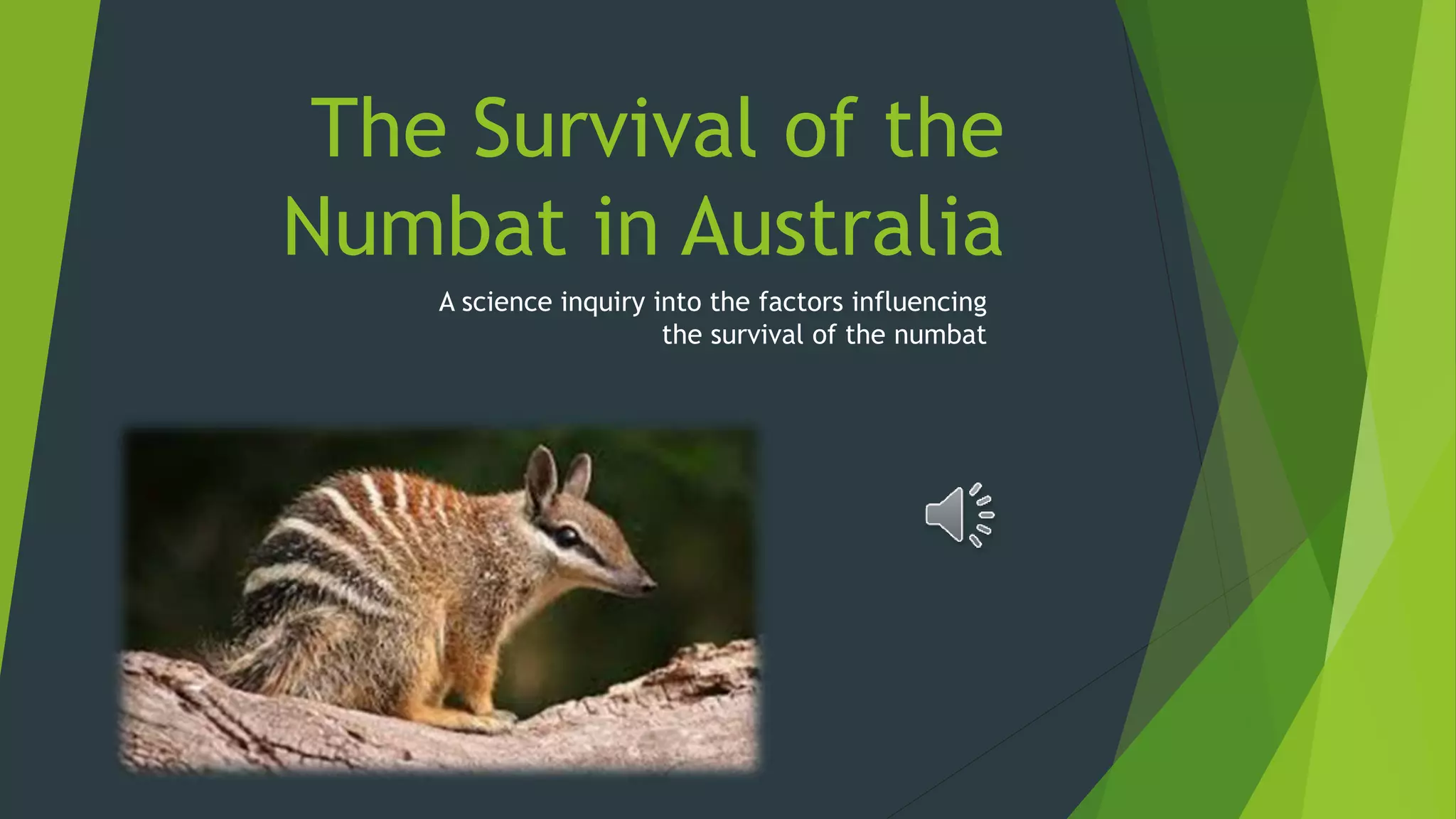
A science inquiry into the factors influencing
the survival of the numbat
The Survival of the
Numbat in Australia
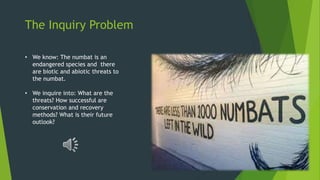
The Inquiry Problem
• We know: The numbat is an
endangered species and there
are biotic and abiotic threats to
the numbat.
• We inquire into: What are the
threats? How successful are
conservation and recovery
methods? What is their future
outlook?
Research Questions
o What are the leading biotic (naturally occurring) and abiotic
(human influenced) threats to the Numbat?
o What measures have been put in place to prevent the species
from becoming extinct?
o How successful are the current recovery and conservation
efforts?
o What is the future forecast for Numbat populations?
Key findings – Threats to the numbat
Foxes
and Cats
Land
Clearing
Climate
Change
Fire
Predation
Loss/Destruction
of habitat and
food source.
Key findings – Recovery/protection effort
Key findings – Success of
Fox baiting
program and
fenced sanctuaries
working to reduce
predation.
Captive breeding
and translocation
supporting
population
increases and
genetic diversity.
Habitat
enhancement
/Burning off
providing
safe places
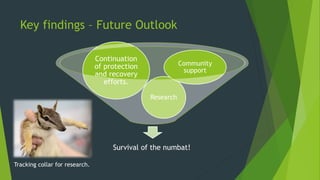
Key findings – Future Outlook
Survival of the numbat!
Research
Continuation
of protection
and recovery
efforts.
Community
support
Tracking collar for research.
Why you should care!
 Termite control
 Unique creature - last living
species in its family
 State emblem
 Eco-tourism
 Conservation projects can also
assist other species
 Aboriginal Cultural History -
Dreamtime
Call to Action – What can we do?
 Ensure our cats are de-sexed and contained
 Provide/leave numbats with habitat- fallen logs, shrubs etc
 Consider the numbats habitat before clearing land on property
 Donate to Project Numbat or Perth Zoo
 Continue research
 Educate the community
Local Community
Scientific Community
Reflection
What new knowledge had I gained?
 Using inquiry learning to support curriculum
 Engage students in learning
 Developing a sense of ownership/responsibility
References
Evans-Bullock, L. (2012). From Numbats make me happy [Digital photograph]. Retrieved from http://3.bp.blogspot.com/-
ZjAr06RdSww/T2sBC3hQGAI/AAAAAAAAAt4/EsXDuday6W4/s1600/IMG_5425.JPG
Flannery, T. (2012). The numbat is also on the brink of extinction [Digital photograph]. Retrieved
from http://www.smh.com.au/national/dead-and-dying-our-great-mammal-crisis-20121116-29hi9.html
Friend, J. A. (1994). Recovery plan for the numbat (Myrmecobius fasciatus): 1995-2004. WA, Australia: Department of Conservation
and Land Management.
Friend, J.A., & Thomas, N.D. (1994). Reintroduction and the numbat recovery programme. In Serena, M (ed.), Reintroduction
biology of Australian and New Zealand fauna (pp. 189-198). Chipping Norton, NSW: Surrey Beatty.
Government of Western Australia. (2013). Numbat with a radio-collar prior to release [Digital photograph]. Retrieved from
http://perthzoo.wa.gov.au/conservation/native-species-breeding-programs/numbat/
Jones, M., Dickman, C., & Archer, M. (Eds.). (2003). Predators with pouches: The biology of carnivorous marsupials. Collingwood,
Australia: CSIRO Publishing.
Melanippos. (2014). Numbat habitat study [Digital photograph]. Retrieved from
http://fc01.deviantart.net/fs30/f/2008/157/5/0/Numbat_habitat_study_by_melanippos.png
Threatened Species Scientific Committee (TSSC). (2014) Approved conservation advice for Myrmecobius fasciatus (numbat).
Retrieved from http://www.environment.gov.au/biodiversity/threatened/species/pubs/294-conservation-advice.pdf

Kneale,jessica,17141679,edc171,assignment2B

  • 1.
    A science inquiryinto the factors influencing the survival of the numbat The Survival of the Numbat in Australia
  • 2.
    The Inquiry Problem •We know: The numbat is an endangered species and there are biotic and abiotic threats to the numbat. • We inquire into: What are the threats? How successful are conservation and recovery methods? What is their future outlook?
  • 3.
    Research Questions o Whatare the leading biotic (naturally occurring) and abiotic (human influenced) threats to the Numbat? o What measures have been put in place to prevent the species from becoming extinct? o How successful are the current recovery and conservation efforts? o What is the future forecast for Numbat populations?
  • 4.
    Key findings –Threats to the numbat Foxes and Cats Land Clearing Climate Change Fire Predation Loss/Destruction of habitat and food source.
  • 5.
    Key findings –Recovery/protection effort
  • 6.
    Key findings –Success of Fox baiting program and fenced sanctuaries working to reduce predation. Captive breeding and translocation supporting population increases and genetic diversity. Habitat enhancement /Burning off providing safe places
  • 7.
    Key findings –Future Outlook Survival of the numbat! Research Continuation of protection and recovery efforts. Community support Tracking collar for research.
  • 8.
    Why you shouldcare!  Termite control  Unique creature - last living species in its family  State emblem  Eco-tourism  Conservation projects can also assist other species  Aboriginal Cultural History - Dreamtime
  • 9.
    Call to Action– What can we do?  Ensure our cats are de-sexed and contained  Provide/leave numbats with habitat- fallen logs, shrubs etc  Consider the numbats habitat before clearing land on property  Donate to Project Numbat or Perth Zoo  Continue research  Educate the community Local Community Scientific Community
  • 10.
    Reflection What new knowledgehad I gained?  Using inquiry learning to support curriculum  Engage students in learning  Developing a sense of ownership/responsibility
  • 11.
    References Evans-Bullock, L. (2012).From Numbats make me happy [Digital photograph]. Retrieved from http://3.bp.blogspot.com/- ZjAr06RdSww/T2sBC3hQGAI/AAAAAAAAAt4/EsXDuday6W4/s1600/IMG_5425.JPG Flannery, T. (2012). The numbat is also on the brink of extinction [Digital photograph]. Retrieved from http://www.smh.com.au/national/dead-and-dying-our-great-mammal-crisis-20121116-29hi9.html Friend, J. A. (1994). Recovery plan for the numbat (Myrmecobius fasciatus): 1995-2004. WA, Australia: Department of Conservation and Land Management. Friend, J.A., & Thomas, N.D. (1994). Reintroduction and the numbat recovery programme. In Serena, M (ed.), Reintroduction biology of Australian and New Zealand fauna (pp. 189-198). Chipping Norton, NSW: Surrey Beatty. Government of Western Australia. (2013). Numbat with a radio-collar prior to release [Digital photograph]. Retrieved from http://perthzoo.wa.gov.au/conservation/native-species-breeding-programs/numbat/ Jones, M., Dickman, C., & Archer, M. (Eds.). (2003). Predators with pouches: The biology of carnivorous marsupials. Collingwood, Australia: CSIRO Publishing. Melanippos. (2014). Numbat habitat study [Digital photograph]. Retrieved from http://fc01.deviantart.net/fs30/f/2008/157/5/0/Numbat_habitat_study_by_melanippos.png Threatened Species Scientific Committee (TSSC). (2014) Approved conservation advice for Myrmecobius fasciatus (numbat). Retrieved from http://www.environment.gov.au/biodiversity/threatened/species/pubs/294-conservation-advice.pdf

Editor's Notes

  • #2 In this presentation we will be looking at the factors affecting the survival of the numbat in Australia.
  • #3 The Numbat is an endangered species with only two natural populations and several sanctuary populations left in Australia. This inquiry investigates the biotic and abiotic threats to the numbat and the conservation and recovery methods which have been used to prevent the extinction of this beautiful creature. The report also investigates the success of conservation and recovery efforts and the proposed future outlook of the numbat.
  • #4 The research Questions proposed are designed to give the inquiry a sequential format. First I researched the biotic threats which are naturally occurring for example wild fires or natural predators, and abiotic threats which are human influenced, introduced species or land clearing for example. I then researched the conservation and rehabilitation measures which have been used to prevent the species extinction. The success of these was then reported on. Which brought a final future forecast of the numbat’s survival.
  • #5 With the help of radio tracking collars Red foxes and feral cats were identified as the most influential threat to the numbat. The numbat’s habitat and food supply is heavily impacted by fire, land clearing and climate change.
  • #6 There have been a number of protection and rehabilitation programs operating, including fox baiting, fencing sanctuaries, habitat enhancement at release sites, captive breeding programs and community awareness programs. The fox baiting has been identified as an integral strategy for the reduction of threats to the numbat. The Community awareness programs are also noteworthy due to the financial support given by the community which allows for the other programs to continue to operate and develop.
  • #7 The fox baiting program was proven very successful however a rise in feral cat predation occurred post abatement. Fenced sanctuaries have provided numbats safe cat and fox free habitats therefore reducing predation. With community support, captive breeding and translocation ensure genetic diversity is maintained and numbat populations are increased in the wild. Habitat enhancement provides safe places for numbats to avoid predation. Moderated intensity burns are also used to prevent wild fire destroying habitat. These recovery methods all support each other in providing the numbat safe environments and a viable population to breed with.
  • #8 The future outlook on the survival of the numbat is positive with the continuation of three elements. First, community support which aids other programs financially by donating and environmentally helping to protect habitats from destruction and prevent their domestic cats from preying on numbats. Secondly the need for current programs and efforts to continue supporting the recovery and protection of the numbat. Lastly, research is required to ensure programs are enhanced and functioning at the most productive level so funds are spent efficiently.
  • #9 The numbat is important for a number of reasons. First we have termite control, with the average adult numbat consuming 20 000 termites per day. The numbat is also the Western Australian State Emblem and an important aspect of the states Eco-Tourism campaign to attract people to see the unique animals of Australia. A number of other native species can also benefit from numbat conservation efforts, the Bush-tailed possum for example would benefit from fox control in the south-west. The numbat is also culturally significant to the local Nyungar people who have dreamtime stories about the numbat and it’s unique stripes. They previously hunted the numbat for food pre colonisation.
  • #10 At a local level we can ensure domestic cats are de-sexed and contained so they can not breed, become feral or prey on native species. We can also help to protect and enhance numbat habitat by providing logs and considering the numbat before clearing land on property. Another major way of supporting the numbat is by donating to Project Numbat or Perth Zoo to aid their programs. The research community can help the numbats by continuing the research into methods which support numbat recovery, and educate the community on the numbats plight for survival.
  • #11 While studying this topic I learned how inquiry can be used to support curriculum by engaging students in their learning and developing cross-curricular capabilities throughout the inquiry. There is a significant hidden curriculum in the inquiry process of investigating a sustainability issue. The children would hopefully develop a sense of ownership and responsibility for their inquiry subject. The numbat for example.