Memory Management 
Feng Qin 
CSE Dept., The Ohio State University
Group Discussion 
• Applications of Information Flow 
Checking Mechanisms?
Outline 
• Background 
– Linux Kernel Memory Management 
• ION Memory Management
Kernel Memory Management 
• Physical memory 
• It is not easy: 
– Often kernel cannot sleep 
– Not easy to handle memory errors 
4/25/2012 CSE662: Operating Systems Laboratory 4
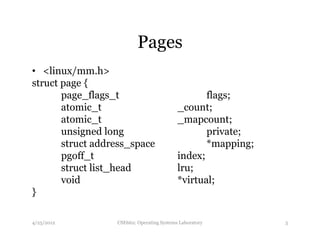
Pages 
• <linux/mm.h> 
struct page { 
page_flags_t flags; 
atomic_t _count; 
atomic_t _mapcount; 
unsigned long private; 
struct address_space *mapping; 
pgoff_t index; 
struct list_head lru; 
void *virtual; 
} 
4/25/2012 CSE662: Operating Systems Laboratory 5
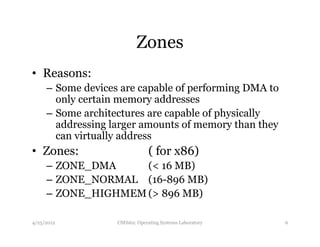
Zones 
• Reasons: 
– Some devices are capable of performing DMA to 
only certain memory addresses 
– Some architectures are capable of physically 
addressing larger amounts of memory than they 
can virtually address 
• Zones: ( for x86) 
– ZONE_DMA (< 16 MB) 
– ZONE_NORMAL (16-896 MB) 
– ZONE_HIGHMEM(> 896 MB) 
4/25/2012 CSE662: Operating Systems Laboratory 6
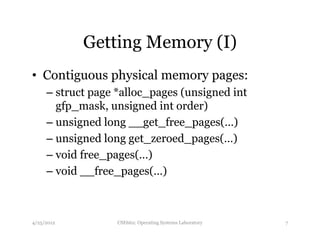
Getting Memory (I) 
• Contiguous physical memory pages: 
– struct page *alloc_pages (unsigned int 
gfp_mask, unsigned int order) 
– unsigned long __get_free_pages(…) 
– unsigned long get_zeroed_pages(…) 
– void free_pages(…) 
– void __free_pages(…) 
4/25/2012 CSE662: Operating Systems Laboratory 7
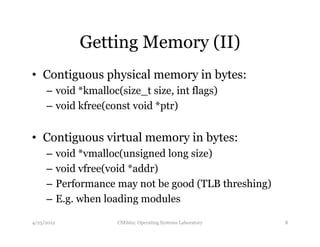
Getting Memory (II) 
• Contiguous physical memory in bytes: 
– void *kmalloc(size_t size, int flags) 
– void kfree(const void *ptr) 
• Contiguous virtual memory in bytes: 
– void *vmalloc(unsigned long size) 
– void vfree(void *addr) 
– Performance may not be good (TLB threshing) 
– E.g. when loading modules 
4/25/2012 CSE662: Operating Systems Laboratory 8
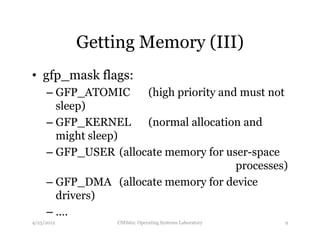
Getting Memory (III) 
• gfp_mask flags: 
– GFP_ATOMIC (high priority and must not 
sleep) 
– GFP_KERNEL (normal allocation and 
might sleep) 
– GFP_USER (allocate memory for user-space 
processes) 
– GFP_DMA (allocate memory for device 
drivers) 
– …. 
4/25/2012 CSE662: Operating Systems Laboratory 9
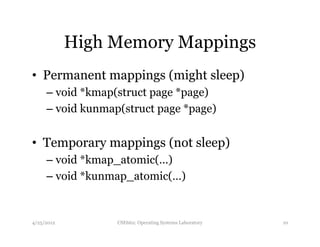
High Memory Mappings 
• Permanent mappings (might sleep) 
– void *kmap(struct page *page) 
– void kunmap(struct page *page) 
• Temporary mappings (not sleep) 
– void *kmap_atomic(…) 
– void *kunmap_atomic(…) 
4/25/2012 CSE662: Operating Systems Laboratory 10
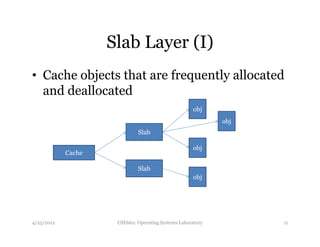
Slab Layer (I) 
• Cache objects that are frequently allocated 
and deallocated 
Cache 
Slab 
Slab 
obj 
obj 
obj 
obj 
4/25/2012 CSE662: Operating Systems Laboratory 11
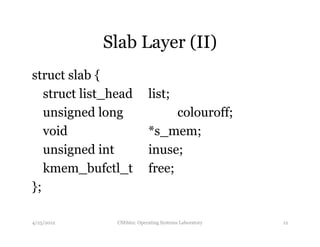
Slab Layer (II) 
struct slab { 
struct list_head list; 
unsigned long colouroff; 
void *s_mem; 
unsigned int inuse; 
kmem_bufctl_t free; 
}; 
4/25/2012 CSE662: Operating Systems Laboratory 12
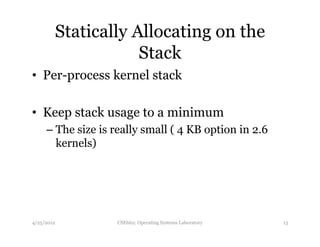
Statically Allocating on the 
Stack 
• Per-process kernel stack 
• Keep stack usage to a minimum 
– The size is really small ( 4 KB option in 2.6 
kernels) 
4/25/2012 CSE662: Operating Systems Laboratory 13
Per-CPU Allocations 
• In modern SMP architectures 
• Benefits: 
– Reduce locking 
– Avoid cache invalidation 
• Usage example: 
unsigned long my_percpu[NR_CPUS]; 
cpu = get_cpu(); 
my_percpu[cpu]; 
put_cpu(); 
4/25/2012 CSE662: Operating Systems Laboratory 14
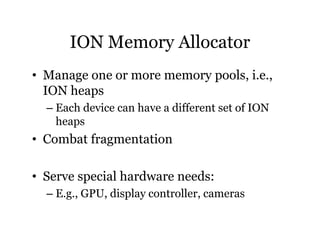
ION Memory Allocator 
• Manage one or more memory pools, i.e., 
ION heaps 
– Each device can have a different set of ION 
heaps 
• Combat fragmentation 
• Serve special hardware needs: 
– E.g., GPU, display controller, cameras
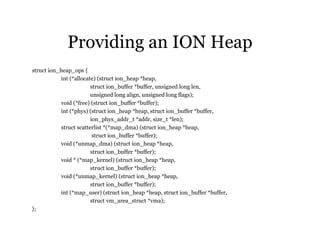
Providing an ION Heap 
struct ion_heap_ops { 
int (*allocate) (struct ion_heap *heap, 
struct ion_buffer *buffer, unsigned long len, 
unsigned long align, unsigned long flags); 
void (*free) (struct ion_buffer *buffer); 
int (*phys) (struct ion_heap *heap, struct ion_buffer *buffer, 
ion_phys_addr_t *addr, size_t *len); 
struct scatterlist *(*map_dma) (struct ion_heap *heap, 
struct ion_buffer *buffer); 
void (*unmap_dma) (struct ion_heap *heap, 
struct ion_buffer *buffer); 
void * (*map_kernel) (struct ion_heap *heap, 
struct ion_buffer *buffer); 
void (*unmap_kernel) (struct ion_heap *heap, 
struct ion_buffer *buffer); 
int (*map_user) (struct ion_heap *heap, struct ion_buffer *buffer, 
struct vm_area_struct *vma); 
};
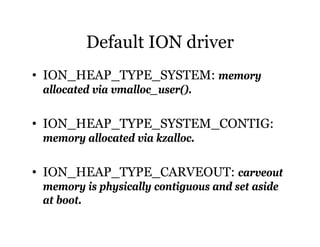
Default ION driver 
• ION_HEAP_TYPE_SYSTEM: memory 
allocated via vmalloc_user(). 
• ION_HEAP_TYPE_SYSTEM_CONTIG: 
memory allocated via kzalloc. 
• ION_HEAP_TYPE_CARVEOUT: carveout 
memory is physically contiguous and set aside 
at boot.
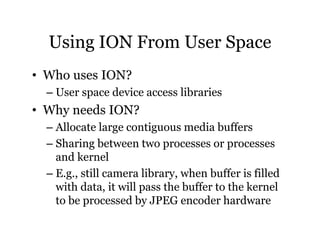
Using ION From User Space 
• Who uses ION? 
– User space device access libraries 
• Why needs ION? 
– Allocate large contiguous media buffers 
– Sharing between two processes or processes 
and kernel 
– E.g., still camera library, when buffer is filled 
with data, it will pass the buffer to the kernel 
to be processed by JPEG encoder hardware
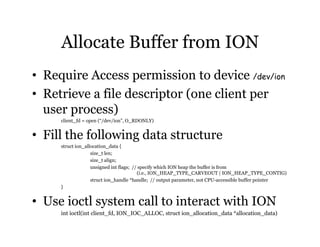
Allocate Buffer from ION 
• Require Access permission to device /dev/ion 
• Retrieve a file descriptor (one client per 
user process) 
client_fd = open (“/dev/ion”, O_RDONLY) 
• Fill the following data structure 
struct ion_allocation_data { 
size_t len; 
size_t align; 
unsigned int flags; // specify which ION heap the buffer is from 
(i.e., ION_HEAP_TYPE_CARVEOUT | ION_HEAP_TYPE_CONTIG) 
struct ion_handle *handle; // output parameter, not CPU-accessible buffer pointer 
} 
• Use ioctl system call to interact with ION 
int ioctl(int client_fd, ION_IOC_ALLOC, struct ion_allocation_data *allocation_data)
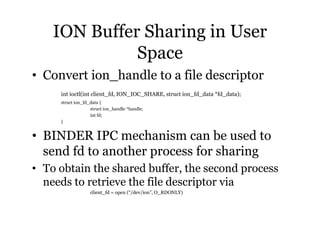
ION Buffer Sharing in User 
Space 
• Convert ion_handle to a file descriptor 
int ioctl(int client_fd, ION_IOC_SHARE, struct ion_fd_data *fd_data); 
struct ion_fd_data { 
struct ion_handle *handle; 
int fd; 
} 
• BINDER IPC mechanism can be used to 
send fd to another process for sharing 
• To obtain the shared buffer, the second process 
needs to retrieve the file descriptor via 
client_fd = open (“/dev/ion”, O_RDONLY)
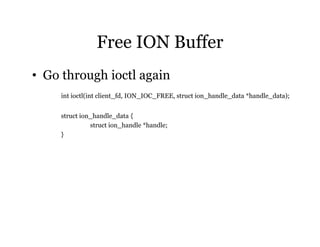
Free ION Buffer 
• Go through ioctl again 
int ioctl(int client_fd, ION_IOC_FREE, struct ion_handle_data *handle_data); 
struct ion_handle_data { 
struct ion_handle *handle; 
}
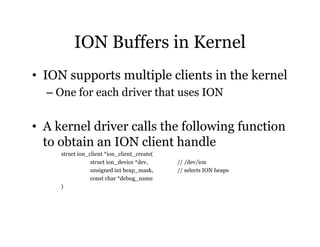
ION Buffers in Kernel 
• ION supports multiple clients in the kernel 
– One for each driver that uses ION 
• A kernel driver calls the following function 
to obtain an ION client handle 
struct ion_client *ion_client_create( 
struct ion_device *dev, // /dev/ion 
unsigned int heap_mask, // selects ION heaps 
const char *debug_name 
)
Sharing ION Buffer between 
User Space and Kernel (I) 
• User process 
– Allocates the ION buffer 
– Obtains a file descriptor using 
ION_IOC_SHARE 
– Pass the file descriptor to a kernel driver
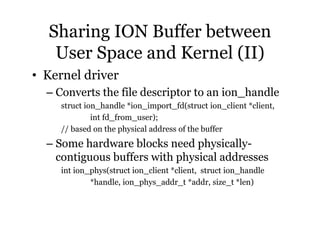
Sharing ION Buffer between 
User Space and Kernel (II) 
• Kernel driver 
– Converts the file descriptor to an ion_handle 
struct ion_handle *ion_import_fd(struct ion_client *client, 
int fd_from_user); 
// based on the physical address of the buffer 
– Some hardware blocks need physically-contiguous 
buffers with physical addresses 
int ion_phys(struct ion_client *client, struct ion_handle 
*handle, ion_phys_addr_t *addr, size_t *len)
Source Code Cross References 
• Linux kernel 
– http://lxr.linux.no/ 
• Android 
– http://androidxref.com/source/xref/

kkMemory management

  • 1.
    Memory Management FengQin CSE Dept., The Ohio State University
  • 2.
    Group Discussion •Applications of Information Flow Checking Mechanisms?
  • 3.
    Outline • Background – Linux Kernel Memory Management • ION Memory Management
  • 4.
    Kernel Memory Management • Physical memory • It is not easy: – Often kernel cannot sleep – Not easy to handle memory errors 4/25/2012 CSE662: Operating Systems Laboratory 4
  • 5.
    Pages • <linux/mm.h> struct page { page_flags_t flags; atomic_t _count; atomic_t _mapcount; unsigned long private; struct address_space *mapping; pgoff_t index; struct list_head lru; void *virtual; } 4/25/2012 CSE662: Operating Systems Laboratory 5
  • 6.
    Zones • Reasons: – Some devices are capable of performing DMA to only certain memory addresses – Some architectures are capable of physically addressing larger amounts of memory than they can virtually address • Zones: ( for x86) – ZONE_DMA (< 16 MB) – ZONE_NORMAL (16-896 MB) – ZONE_HIGHMEM(> 896 MB) 4/25/2012 CSE662: Operating Systems Laboratory 6
  • 7.
    Getting Memory (I) • Contiguous physical memory pages: – struct page *alloc_pages (unsigned int gfp_mask, unsigned int order) – unsigned long __get_free_pages(…) – unsigned long get_zeroed_pages(…) – void free_pages(…) – void __free_pages(…) 4/25/2012 CSE662: Operating Systems Laboratory 7
  • 8.
    Getting Memory (II) • Contiguous physical memory in bytes: – void *kmalloc(size_t size, int flags) – void kfree(const void *ptr) • Contiguous virtual memory in bytes: – void *vmalloc(unsigned long size) – void vfree(void *addr) – Performance may not be good (TLB threshing) – E.g. when loading modules 4/25/2012 CSE662: Operating Systems Laboratory 8
  • 9.
    Getting Memory (III) • gfp_mask flags: – GFP_ATOMIC (high priority and must not sleep) – GFP_KERNEL (normal allocation and might sleep) – GFP_USER (allocate memory for user-space processes) – GFP_DMA (allocate memory for device drivers) – …. 4/25/2012 CSE662: Operating Systems Laboratory 9
  • 10.
    High Memory Mappings • Permanent mappings (might sleep) – void *kmap(struct page *page) – void kunmap(struct page *page) • Temporary mappings (not sleep) – void *kmap_atomic(…) – void *kunmap_atomic(…) 4/25/2012 CSE662: Operating Systems Laboratory 10
  • 11.
    Slab Layer (I) • Cache objects that are frequently allocated and deallocated Cache Slab Slab obj obj obj obj 4/25/2012 CSE662: Operating Systems Laboratory 11
  • 12.
    Slab Layer (II) struct slab { struct list_head list; unsigned long colouroff; void *s_mem; unsigned int inuse; kmem_bufctl_t free; }; 4/25/2012 CSE662: Operating Systems Laboratory 12
  • 13.
    Statically Allocating onthe Stack • Per-process kernel stack • Keep stack usage to a minimum – The size is really small ( 4 KB option in 2.6 kernels) 4/25/2012 CSE662: Operating Systems Laboratory 13
  • 14.
    Per-CPU Allocations •In modern SMP architectures • Benefits: – Reduce locking – Avoid cache invalidation • Usage example: unsigned long my_percpu[NR_CPUS]; cpu = get_cpu(); my_percpu[cpu]; put_cpu(); 4/25/2012 CSE662: Operating Systems Laboratory 14
  • 15.
    ION Memory Allocator • Manage one or more memory pools, i.e., ION heaps – Each device can have a different set of ION heaps • Combat fragmentation • Serve special hardware needs: – E.g., GPU, display controller, cameras
  • 16.
    Providing an IONHeap struct ion_heap_ops { int (*allocate) (struct ion_heap *heap, struct ion_buffer *buffer, unsigned long len, unsigned long align, unsigned long flags); void (*free) (struct ion_buffer *buffer); int (*phys) (struct ion_heap *heap, struct ion_buffer *buffer, ion_phys_addr_t *addr, size_t *len); struct scatterlist *(*map_dma) (struct ion_heap *heap, struct ion_buffer *buffer); void (*unmap_dma) (struct ion_heap *heap, struct ion_buffer *buffer); void * (*map_kernel) (struct ion_heap *heap, struct ion_buffer *buffer); void (*unmap_kernel) (struct ion_heap *heap, struct ion_buffer *buffer); int (*map_user) (struct ion_heap *heap, struct ion_buffer *buffer, struct vm_area_struct *vma); };
  • 17.
    Default ION driver • ION_HEAP_TYPE_SYSTEM: memory allocated via vmalloc_user(). • ION_HEAP_TYPE_SYSTEM_CONTIG: memory allocated via kzalloc. • ION_HEAP_TYPE_CARVEOUT: carveout memory is physically contiguous and set aside at boot.
  • 18.
    Using ION FromUser Space • Who uses ION? – User space device access libraries • Why needs ION? – Allocate large contiguous media buffers – Sharing between two processes or processes and kernel – E.g., still camera library, when buffer is filled with data, it will pass the buffer to the kernel to be processed by JPEG encoder hardware
  • 19.
    Allocate Buffer fromION • Require Access permission to device /dev/ion • Retrieve a file descriptor (one client per user process) client_fd = open (“/dev/ion”, O_RDONLY) • Fill the following data structure struct ion_allocation_data { size_t len; size_t align; unsigned int flags; // specify which ION heap the buffer is from (i.e., ION_HEAP_TYPE_CARVEOUT | ION_HEAP_TYPE_CONTIG) struct ion_handle *handle; // output parameter, not CPU-accessible buffer pointer } • Use ioctl system call to interact with ION int ioctl(int client_fd, ION_IOC_ALLOC, struct ion_allocation_data *allocation_data)
  • 20.
    ION Buffer Sharingin User Space • Convert ion_handle to a file descriptor int ioctl(int client_fd, ION_IOC_SHARE, struct ion_fd_data *fd_data); struct ion_fd_data { struct ion_handle *handle; int fd; } • BINDER IPC mechanism can be used to send fd to another process for sharing • To obtain the shared buffer, the second process needs to retrieve the file descriptor via client_fd = open (“/dev/ion”, O_RDONLY)
  • 21.
    Free ION Buffer • Go through ioctl again int ioctl(int client_fd, ION_IOC_FREE, struct ion_handle_data *handle_data); struct ion_handle_data { struct ion_handle *handle; }
  • 22.
    ION Buffers inKernel • ION supports multiple clients in the kernel – One for each driver that uses ION • A kernel driver calls the following function to obtain an ION client handle struct ion_client *ion_client_create( struct ion_device *dev, // /dev/ion unsigned int heap_mask, // selects ION heaps const char *debug_name )
  • 23.
    Sharing ION Bufferbetween User Space and Kernel (I) • User process – Allocates the ION buffer – Obtains a file descriptor using ION_IOC_SHARE – Pass the file descriptor to a kernel driver
  • 24.
    Sharing ION Bufferbetween User Space and Kernel (II) • Kernel driver – Converts the file descriptor to an ion_handle struct ion_handle *ion_import_fd(struct ion_client *client, int fd_from_user); // based on the physical address of the buffer – Some hardware blocks need physically-contiguous buffers with physical addresses int ion_phys(struct ion_client *client, struct ion_handle *handle, ion_phys_addr_t *addr, size_t *len)
  • 25.
    Source Code CrossReferences • Linux kernel – http://lxr.linux.no/ • Android – http://androidxref.com/source/xref/