1 
Tourism in China 
Presented by 
Derek Yue
2 
Agenda 
Tourism Development in China 
 History 
 Figures 
 Hotel industry 
 CNTA 
 Latest development in tourism statistics in China 
 TSA in China
Background history 
3 
1949 – 1974 
 China was closed-door 
 Only selected foreign visitors 
Late 1970s 
 Leadership decide to promote tourism 
 Lifting travel restrictions, investment in transport 
 …as a means to earn foreign exchange
4 
Visitor arrivals 
1981: 7.7 million 
2007: 130 million 
Averaged annual growth rate: 11%
5 
Tourism receipt 
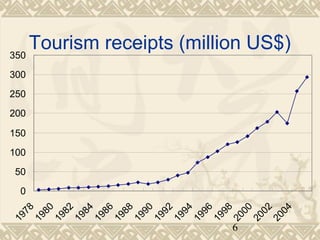
1981: US$8 billion 
2007: US$420 billlion 
Averaged annual growth rate: 20% 
 Increase in visitor arrivals 
 Increase in per capita spending
Tourism receipts (million US$) 
6 
350 
300 
250 
200 
150 
100 
50 
0 
1978 
1980 
1982 
1984 
1986 
1988 
1990 
1992 
1994 
1996 
1998 
2000 
2002 
2004
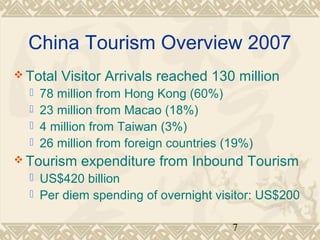
China Tourism Overview 2007 
Total Visitor Arrivals reached 130 million 
 78 million from Hong Kong (60%) 
 23 million from Macao (18%) 
 4 million from Taiwan (3%) 
 26 million from foreign countries (19%) 
Tourism expenditure from Inbound Tourism 
 US$420 billion 
 Per diem spending of overnight visitor: US$200 
7
8 
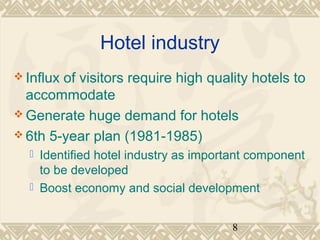
Hotel industry 
Influx of visitors require high quality hotels to 
accommodate 
Generate huge demand for hotels 
6th 5-year plan (1981-1985) 
 Identified hotel industry as important component 
to be developed 
 Boost economy and social development
9 
Hotel industry 
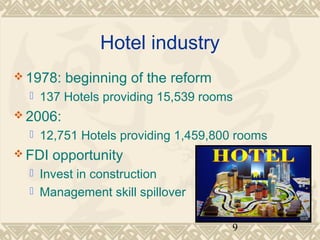
1978: beginning of the reform 
 137 Hotels providing 15,539 rooms 
2006: 
 12,751 Hotels providing 1,459,800 rooms 
FDI opportunity 
 Invest in construction 
 Management skill spillover
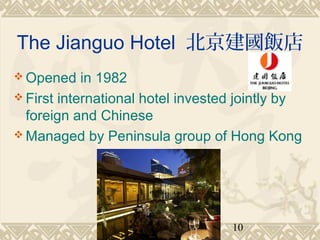
The Jianguo Hotel 北京建國飯店 
Opened in 1982 
First international hotel invested jointly by 
foreign and Chinese 
Managed by Peninsula group of Hong Kong 
10
Spillover of management skills 
Management system of Hong Kong experts 
with local staff: a blend of international 
standard with local culture 
Vertical management: 
 Clearly defined responsibilities at different levels 
11
Spillover of management skills 
12 
 First 5 years of operation 
 Top and middle management by Hong Kong experts 
 After 5 years.. 
 Proportion of Hong Kong managers decrease 
 After 10 years… 
 Peninsula group retreat 
 Completely run by local staff 
 Becomes a leader of hotel industry 
 Other hotels sent managers to learn from its experience
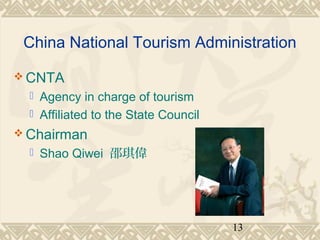
China National Tourism Administration 
13 
CNTA 
 Agency in charge of tourism 
 Affiliated to the State Council 
Chairman 
 Shao Qiwei 邵琪偉
Functions of CNTA 
 Plan & Coordinate development of tourism 
industry 
 Implementation of market development strategies 
 Optimize use of tourism resources 
 Ensure tourism service quality 
 Promote international communication and 
cooperation 
 Policy on travel to Hong Kong, Macao and Taiwan 
 Oversee the education and training 
14
15 
Latest Development 
5th UNWTO International 
Conference on Tourism Statistics 
30 March – 2 April 2009
17 
UNWTO 
World Tourism Organization 
Specialized agency of the United Nations 
Promote and develop tourism statistics
Economic contribution of Tourism 
Tourism as a service domain that comprise 
a wide range of economic activities across 
different industry 
Status of buyer (visitor or local) determine 
tourism related or not 
18
Tourism Satellite Account 
As a distinctive method to measure 
19 
 Value-added 
 Employment creation 
TSA divides economic activities into tourism 
and non-tourism activities 
Direct contribution can be measured and 
compared with traditional industries
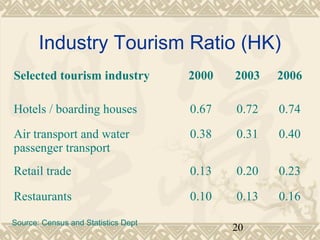
Industry Tourism Ratio (HK) 
Selected tourism industry 2000 2003 2006 
Hotels / boarding houses 0.67 0.72 0.74 
Air transport and water 
0.38 0.31 0.40 
passenger transport 
Retail trade 0.13 0.20 0.23 
Restaurants 0.10 0.13 0.16 
20 
Source: Census and Statistics Dept
China – Moving towards TSA 
Presentation by CNTA at Conference 
“Provincial and National TSA development 
in China” 
21
Provincial TSA development 
22 
Jiangsu Province 
 Pilot run of TSA (reference year 2002) 
 Tourism value-added making up 4.2% of GDP 
 Proportion of tourism employment: 8.5% 
Beijing Municipality (reference year 2004) 
 Tourism Value-added making up 6.7% of GDP 
 Proportion of tourism development 11.7%
23 
Ultimate goal 
Develop TSA for national level 
 More and more trial run 
 Yantai in Shandong Province 
Comply UNWTO standard 
Fully understand economic contribution and 
significance of tourism in Chinese economy
24 
Q&A

Kina

  • 1.
    1 Tourism inChina Presented by Derek Yue
  • 2.
    2 Agenda TourismDevelopment in China  History  Figures  Hotel industry  CNTA  Latest development in tourism statistics in China  TSA in China
  • 3.
    Background history 3 1949 – 1974  China was closed-door  Only selected foreign visitors Late 1970s  Leadership decide to promote tourism  Lifting travel restrictions, investment in transport  …as a means to earn foreign exchange
  • 4.
    4 Visitor arrivals 1981: 7.7 million 2007: 130 million Averaged annual growth rate: 11%
  • 5.
    5 Tourism receipt 1981: US$8 billion 2007: US$420 billlion Averaged annual growth rate: 20%  Increase in visitor arrivals  Increase in per capita spending
  • 6.
    Tourism receipts (millionUS$) 6 350 300 250 200 150 100 50 0 1978 1980 1982 1984 1986 1988 1990 1992 1994 1996 1998 2000 2002 2004
  • 7.
    China Tourism Overview2007 Total Visitor Arrivals reached 130 million  78 million from Hong Kong (60%)  23 million from Macao (18%)  4 million from Taiwan (3%)  26 million from foreign countries (19%) Tourism expenditure from Inbound Tourism  US$420 billion  Per diem spending of overnight visitor: US$200 7
  • 8.
    8 Hotel industry Influx of visitors require high quality hotels to accommodate Generate huge demand for hotels 6th 5-year plan (1981-1985)  Identified hotel industry as important component to be developed  Boost economy and social development
  • 9.
    9 Hotel industry 1978: beginning of the reform  137 Hotels providing 15,539 rooms 2006:  12,751 Hotels providing 1,459,800 rooms FDI opportunity  Invest in construction  Management skill spillover
  • 10.
    The Jianguo Hotel北京建國飯店 Opened in 1982 First international hotel invested jointly by foreign and Chinese Managed by Peninsula group of Hong Kong 10
  • 11.
    Spillover of managementskills Management system of Hong Kong experts with local staff: a blend of international standard with local culture Vertical management:  Clearly defined responsibilities at different levels 11
  • 12.
    Spillover of managementskills 12  First 5 years of operation  Top and middle management by Hong Kong experts  After 5 years..  Proportion of Hong Kong managers decrease  After 10 years…  Peninsula group retreat  Completely run by local staff  Becomes a leader of hotel industry  Other hotels sent managers to learn from its experience
  • 13.
    China National TourismAdministration 13 CNTA  Agency in charge of tourism  Affiliated to the State Council Chairman  Shao Qiwei 邵琪偉
  • 14.
    Functions of CNTA  Plan & Coordinate development of tourism industry  Implementation of market development strategies  Optimize use of tourism resources  Ensure tourism service quality  Promote international communication and cooperation  Policy on travel to Hong Kong, Macao and Taiwan  Oversee the education and training 14
  • 15.
    15 Latest Development 5th UNWTO International Conference on Tourism Statistics 30 March – 2 April 2009
  • 17.
    17 UNWTO WorldTourism Organization Specialized agency of the United Nations Promote and develop tourism statistics
  • 18.
    Economic contribution ofTourism Tourism as a service domain that comprise a wide range of economic activities across different industry Status of buyer (visitor or local) determine tourism related or not 18
  • 19.
    Tourism Satellite Account As a distinctive method to measure 19  Value-added  Employment creation TSA divides economic activities into tourism and non-tourism activities Direct contribution can be measured and compared with traditional industries
  • 20.
    Industry Tourism Ratio(HK) Selected tourism industry 2000 2003 2006 Hotels / boarding houses 0.67 0.72 0.74 Air transport and water 0.38 0.31 0.40 passenger transport Retail trade 0.13 0.20 0.23 Restaurants 0.10 0.13 0.16 20 Source: Census and Statistics Dept
  • 21.
    China – Movingtowards TSA Presentation by CNTA at Conference “Provincial and National TSA development in China” 21
  • 22.
    Provincial TSA development 22 Jiangsu Province  Pilot run of TSA (reference year 2002)  Tourism value-added making up 4.2% of GDP  Proportion of tourism employment: 8.5% Beijing Municipality (reference year 2004)  Tourism Value-added making up 6.7% of GDP  Proportion of tourism development 11.7%
  • 23.
    23 Ultimate goal Develop TSA for national level  More and more trial run  Yantai in Shandong Province Comply UNWTO standard Fully understand economic contribution and significance of tourism in Chinese economy
  • 24.

Editor's Notes

  • #14 The China National Tourism Administration (CNTA) is the Chinese government authority responsible for the development of tourism in the country. The CNTA is subordinate to the State Council. Its headquarters are in Beijing, with regional branches in various provinces. CNTA does not have the authority of a full department within the Chinese government to enforce regulations but in other respects it acts as a ministry. Provincial CNTA offices in each Chinese province report to the central HQ in Beijing. CNTA has several overseas offices called CNTO (China National Tourism Offices) that are charged with promoting tourism to China. In Europe, there are CNTO offices in London and Paris
  • #20 Satellite Account: expansion of the analytical ability of national accounting (refernce to National System of Accounts in 1993)
  • #24 The preparation of tourism satellite account, according to Yantai tourism Bureau on 15th this month, will be officially initiated in a few days as a provincial trial in Yantai city to better assessing the development level of tourism economy in Yantai city.On the preparation of the tourism satellite account, tourism industry is treated as an integrated part of local national economic accounting system, offering a comprehensive and scientific measurement of the contribution rate made by tourism industry to regional economy, financial revenue and employment of Yantai. Upon completion, tourism-related enterprises in the fields of transportation, employment, catering and other relevant enterprises will make clear the contribution made by tourism industry to their own development, providing guiding reference for further development.The account takes into consideration two aspects, i.e. the demand of economic activities and the supply of tourism products, covering not only the overall demand of tourism industry on material and service products, but also the establishment of production scale of production sectors, such as transportation, hotel and catering, whole sale and retail, management of tourist attractions, residential service and travel agency.As a provincial pilot city applying tourism satellite account, Yantai City carried out 16 major supplementary investigations based on current statistic data and data collected from the second National Economic Census. At present, the investigation programs under tourism satellite account on inbound tourists’ expenses, domestic tourists’ expenses and the tour-group expense structure of travel agency have been completed and the entire plan is estimated to be completed in two years.