STELLAR
Workshop with VTS #2
FRAMING in your paraphrase
Tuesday, March 12, 2018
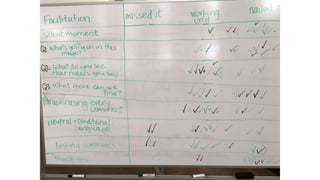
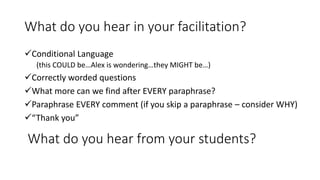
What do you hear in your facilitation?
Conditional Language
(this COULD be…Alex is wondering…they MIGHT be…)
Correctly worded questions
What more can we find after EVERY paraphrase?
Paraphrase EVERY comment (if you skip a paraphrase – consider WHY)
“Thank you”
What do you hear from your students?
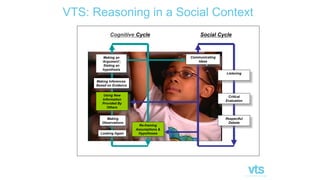
VTS: Reasoning in a Social Context
Communicating
Ideas
Looking Again
Making
Observations
Making Inferences
Based on Evidence
Respectful
Debate
Listening
Re-framing
Assumptions &
Hypotheses
Using New
Information
Provided By
Others
Cognitive Cycle Social Cycle
Making an
‘Argument’;
Stating an
hypothesis
Critical
Evaluation
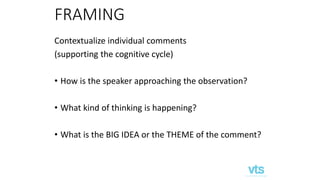
FRAMING
Contextualize individual comments
(supporting the cognitive cycle)
• How is the speaker approaching the observation?
• What kind of thinking is happening?
• What is the BIG IDEA or the THEME of the comment?
Copyright © 2014 Visual Thinking Strategies
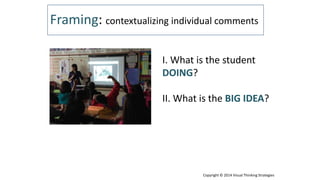
Framing: contextualizing individual comments
I. What is the student
DOING?
II. What is the BIG IDEA?
You are:
noticing
clarifying
elaborating
wondering
speculating
creating a story
identifying
finding evidence
revising
comparing
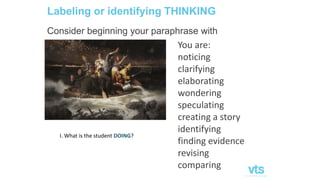
Labeling or identifying THINKING
Consider beginning your paraphrase with
I. What is the student DOING?
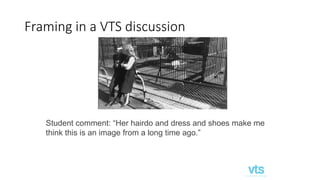
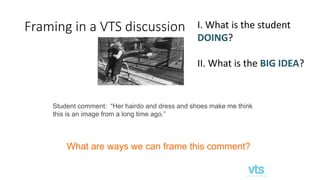
Framing in a VTS discussion
Student comment: “Her hairdo and dress and shoes make me
think this is an image from a long time ago.”
Framing in a VTS discussion
Student comment: “Her hairdo and dress and shoes make me think
this is an image from a long time ago.”
What are ways we can frame this comment?
I. What is the student
DOING?
II. What is the BIG IDEA?
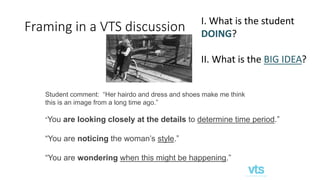
Framing in a VTS discussion
Student comment: “Her hairdo and dress and shoes make me think
this is an image from a long time ago.”
“You are looking closely at the details to determine time period.”
“You are noticing the woman’s style.”
“You are wondering when this might be happening.”
I. What is the student
DOING?
II. What is the BIG IDEA?
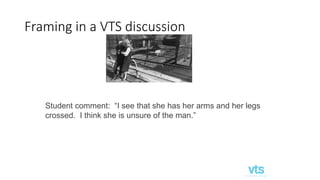
Framing in a VTS discussion
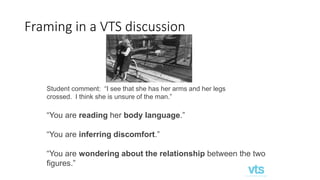
Student comment: “I see that she has her arms and her legs
crossed. I think she is unsure of the man.”
Framing in a VTS discussion
Student comment: “I see that she has her arms and her legs
crossed. I think she is unsure of the man.”
What are ways we can frame this comment?
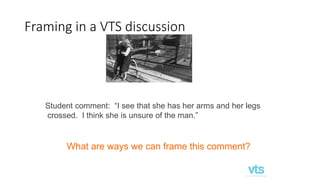
Framing in a VTS discussion
Student comment: “I see that she has her arms and her legs
crossed. I think she is unsure of the man.”
“You are reading her body language.”
“You are inferring discomfort.”
“You are wondering about the relationship between the two
figures.”
Framing in a VTS discussion
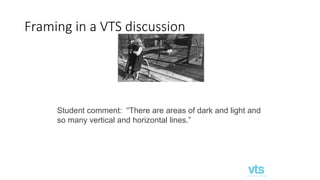
Student comment: “There are areas of dark and light and
so many vertical and horizontal lines.”
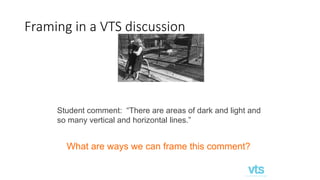
Framing in a VTS discussion
Student comment: “There are areas of dark and light and
so many vertical and horizontal lines.”
What are ways we can frame this comment?
Framing in a VTS discussion
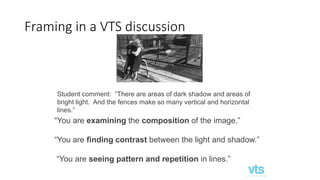
Student comment: “There are areas of dark shadow and areas of
bright light. And the fences make so many vertical and horizontal
lines.”
“You are examining the composition of the image.”
“You are finding contrast between the light and shadow.”
“You are seeing pattern and repetition in lines.”
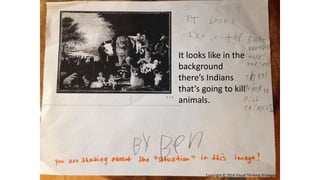
It looks like in the
background
there’s Indians
that’s going to kill
animals.
Copyright © 2014 Visual Thinking Strategies
STELLAR & VTS
NEXT: Workshop with VTS #3
Tuesday, April 3
7p-8p

Kim, 2018.03.13

  • 1.
    STELLAR Workshop with VTS#2 FRAMING in your paraphrase Tuesday, March 12, 2018
  • 3.
    What do youhear in your facilitation? Conditional Language (this COULD be…Alex is wondering…they MIGHT be…) Correctly worded questions What more can we find after EVERY paraphrase? Paraphrase EVERY comment (if you skip a paraphrase – consider WHY) “Thank you” What do you hear from your students?
  • 4.
    VTS: Reasoning ina Social Context Communicating Ideas Looking Again Making Observations Making Inferences Based on Evidence Respectful Debate Listening Re-framing Assumptions & Hypotheses Using New Information Provided By Others Cognitive Cycle Social Cycle Making an ‘Argument’; Stating an hypothesis Critical Evaluation
  • 5.
    FRAMING Contextualize individual comments (supportingthe cognitive cycle) • How is the speaker approaching the observation? • What kind of thinking is happening? • What is the BIG IDEA or the THEME of the comment?
  • 6.
    Copyright © 2014Visual Thinking Strategies Framing: contextualizing individual comments I. What is the student DOING? II. What is the BIG IDEA?
  • 7.
    You are: noticing clarifying elaborating wondering speculating creating astory identifying finding evidence revising comparing Labeling or identifying THINKING Consider beginning your paraphrase with I. What is the student DOING?
  • 9.
    Framing in aVTS discussion Student comment: “Her hairdo and dress and shoes make me think this is an image from a long time ago.”
  • 10.
    Framing in aVTS discussion Student comment: “Her hairdo and dress and shoes make me think this is an image from a long time ago.” What are ways we can frame this comment? I. What is the student DOING? II. What is the BIG IDEA?
  • 11.
    Framing in aVTS discussion Student comment: “Her hairdo and dress and shoes make me think this is an image from a long time ago.” “You are looking closely at the details to determine time period.” “You are noticing the woman’s style.” “You are wondering when this might be happening.” I. What is the student DOING? II. What is the BIG IDEA?
  • 12.
    Framing in aVTS discussion Student comment: “I see that she has her arms and her legs crossed. I think she is unsure of the man.”
  • 13.
    Framing in aVTS discussion Student comment: “I see that she has her arms and her legs crossed. I think she is unsure of the man.” What are ways we can frame this comment?
  • 14.
    Framing in aVTS discussion Student comment: “I see that she has her arms and her legs crossed. I think she is unsure of the man.” “You are reading her body language.” “You are inferring discomfort.” “You are wondering about the relationship between the two figures.”
  • 15.
    Framing in aVTS discussion Student comment: “There are areas of dark and light and so many vertical and horizontal lines.”
  • 16.
    Framing in aVTS discussion Student comment: “There are areas of dark and light and so many vertical and horizontal lines.” What are ways we can frame this comment?
  • 17.
    Framing in aVTS discussion Student comment: “There are areas of dark shadow and areas of bright light. And the fences make so many vertical and horizontal lines.” “You are examining the composition of the image.” “You are finding contrast between the light and shadow.” “You are seeing pattern and repetition in lines.”
  • 18.
    It looks likein the background there’s Indians that’s going to kill animals. Copyright © 2014 Visual Thinking Strategies
  • 19.
    STELLAR & VTS NEXT:Workshop with VTS #3 Tuesday, April 3 7p-8p

Editor's Notes