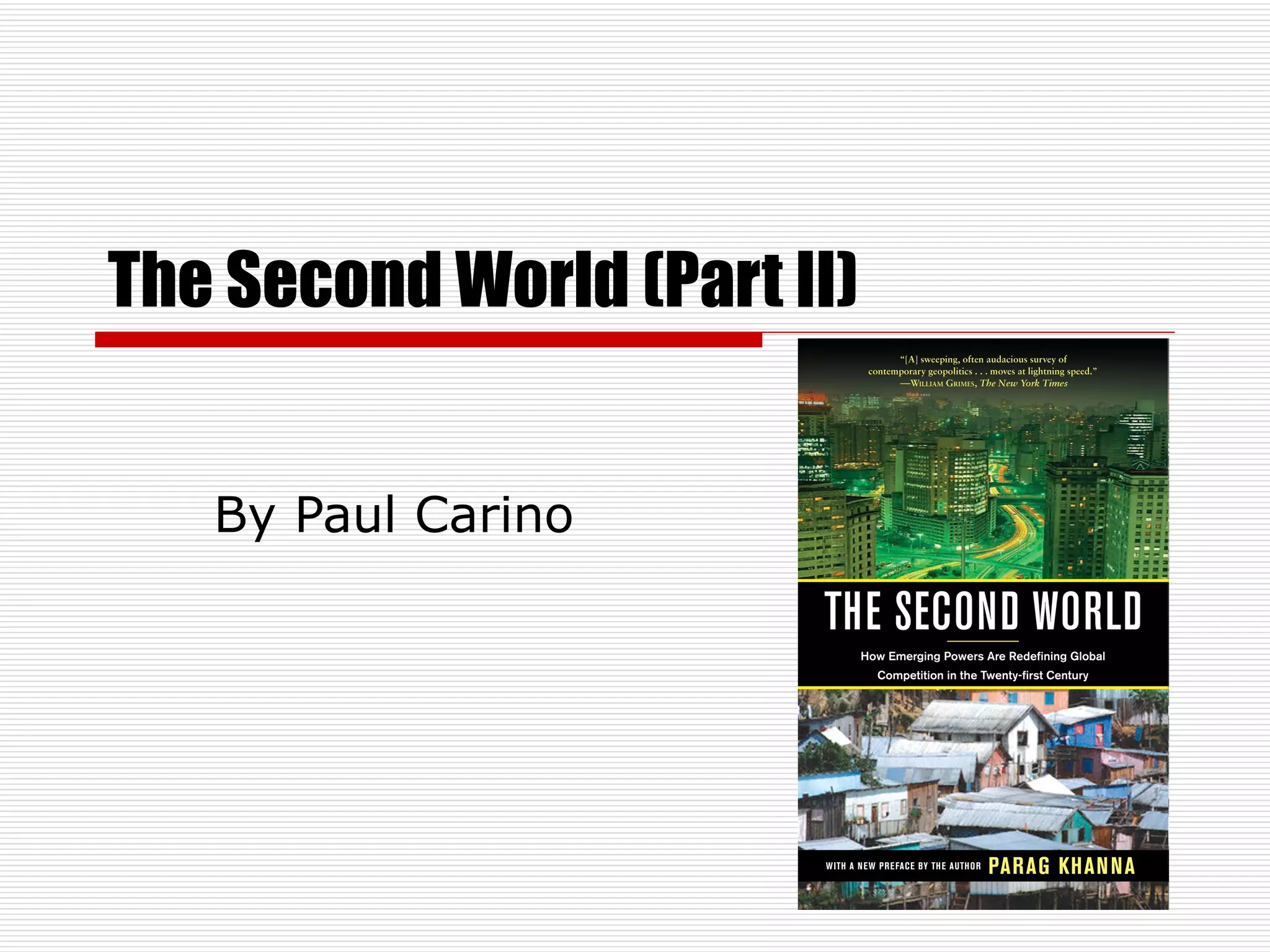
The Second World (Part II) By Paul Carino
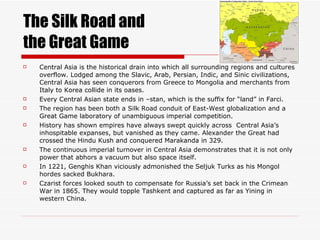
The Silk Road and  the Great Game Central Asia is the historical drain into which all surrounding regions and cultures overflow. Lodged among the Slavic, Arab, Persian, Indic, and Sinic civilizations, Central Asia has seen conquerors from Greece to Mongolia and merchants from Italy to Korea collide in its oases. Every Central Asian state ends in –stan, which is the suffix for “land” in Farci.  The region has been both a Silk Road conduit of East-West globalization and a Great Game laboratory of unambiguous imperial competition. History has shown empires have always swept quickly across  Central Asia’s inhospitable expanses, but vanished as they came. Alexander the Great had crossed the Hindu Kush and conquered Marakanda in 329. The continuous imperial turnover in Central Asia demonstrates that it is not only power that abhors a vacuum but also space itself.  In 1221, Genghis Khan viciously admonished the Seljuk Turks as his Mongol hordes sacked Bukhara. Czarist forces looked south to compensate for Russia’s set back in the Crimean War in 1865. They would topple Tashkent and captured as far as Yining in western China.
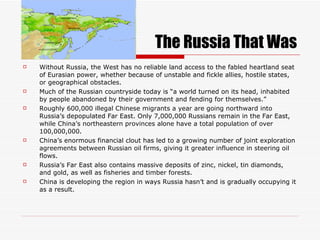
The Russia That Was Without Russia, the West has no reliable land access to the fabled heartland seat of Eurasian power, whether because of unstable and fickle allies, hostile states, or geographical obstacles. Much of the Russian countryside today is “a world turned on its head, inhabited by people abandoned by their government and fending for themselves.” Roughly 600,000 illegal Chinese migrants a year are going northward into Russia’s depopulated Far East. Only 7,000,000 Russians remain in the Far East, while China’s northeastern provinces alone have a total population of over 100,000,000. China’s enormous financial clout has led to a growing number of joint exploration agreements between Russian oil firms, giving it greater influence in steering oil flows. Russia’s Far East also contains massive deposits of zinc, nickel, tin diamonds, and gold, as well as fisheries and timber forests.  China is developing the region in ways Russia hasn’t and is gradually occupying it as a result.
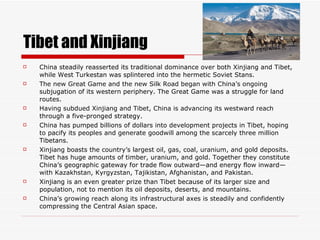
Tibet and Xinjiang China steadily reasserted its traditional dominance over both Xinjiang and Tibet, while West Turkestan was splintered into the hermetic Soviet Stans. The new Great Game and the new Silk Road began with China’s ongoing subjugation of its western periphery. The Great Game was a struggle for land routes. Having subdued Xinjiang and Tibet, China is advancing its westward reach through a five-pronged strategy.  China has pumped billions of dollars into development projects in Tibet, hoping to pacify its peoples and generate goodwill among the scarcely three million Tibetans. Xinjiang boasts the country’s largest oil, gas, coal, uranium, and gold deposits. Tibet has huge amounts of timber, uranium, and gold. Together they constitute China’s geographic gateway for trade flow outward—and energy flow inward—with Kazakhstan, Kyrgyzstan, Tajikistan, Afghanistan, and Pakistan. Xinjiang is an even greater prize than Tibet because of its larger size and population, not to mention its oil deposits, deserts, and mountains.  China’s growing reach along its infrastructural axes is steadily and confidently compressing the Central Asian space.
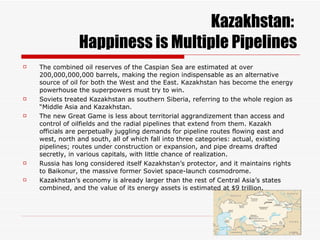
Kazakhstan:  Happiness is Multiple Pipelines The combined oil reserves of the Caspian Sea are estimated at over 200,000,000,000 barrels, making the region indispensable as an alternative source of oil for both the West and the East. Kazakhstan has become the energy powerhouse the superpowers must try to win. Soviets treated Kazakhstan as southern Siberia, referring to the whole region as “Middle Asia and Kazakhstan. The new Great Game is less about territorial aggrandizement than access and control of oilfields and the radial pipelines that extend from them. Kazakh officials are perpetually juggling demands for pipeline routes flowing east and west, north and south, all of which fall into three categories: actual, existing pipelines; routes under construction or expansion, and pipe dreams drafted secretly, in various capitals, with little chance of realization. Russia has long considered itself Kazakhstan’s protector, and it maintains rights to Baikonur, the massive former Soviet space-launch cosmodrome. Kazakhstan’s economy is already larger than the rest of Central Asia’s states combined, and the value of its energy assets is estimated at $9 trillion.
Sources  - The Second World The Silk Road and the Great Game Page 66, paragraph 2-3 Page 67, paragraph 2-3 Page 69, paragraph 2 The Russia That Was Page 71, paragraph 1-2 Page 72, paragraph 2 Page 73, paragraph 1 Tibet and Xinjiang Page 78, paragraph 1-2 Page 79, paragraph 1-2 Page 80, paragraph 3 Page 81, paragraph 2 Kazakhstan: Happiness is Multiple Pipelines Page 85, paragraph 1-2 Page 86, paragraph 2 Page 89, paragraph 4

Khanna

  • 1.
    The Second World(Part II) By Paul Carino
  • 2.
    The Silk Roadand the Great Game Central Asia is the historical drain into which all surrounding regions and cultures overflow. Lodged among the Slavic, Arab, Persian, Indic, and Sinic civilizations, Central Asia has seen conquerors from Greece to Mongolia and merchants from Italy to Korea collide in its oases. Every Central Asian state ends in –stan, which is the suffix for “land” in Farci. The region has been both a Silk Road conduit of East-West globalization and a Great Game laboratory of unambiguous imperial competition. History has shown empires have always swept quickly across Central Asia’s inhospitable expanses, but vanished as they came. Alexander the Great had crossed the Hindu Kush and conquered Marakanda in 329. The continuous imperial turnover in Central Asia demonstrates that it is not only power that abhors a vacuum but also space itself. In 1221, Genghis Khan viciously admonished the Seljuk Turks as his Mongol hordes sacked Bukhara. Czarist forces looked south to compensate for Russia’s set back in the Crimean War in 1865. They would topple Tashkent and captured as far as Yining in western China.
  • 3.
    The Russia ThatWas Without Russia, the West has no reliable land access to the fabled heartland seat of Eurasian power, whether because of unstable and fickle allies, hostile states, or geographical obstacles. Much of the Russian countryside today is “a world turned on its head, inhabited by people abandoned by their government and fending for themselves.” Roughly 600,000 illegal Chinese migrants a year are going northward into Russia’s depopulated Far East. Only 7,000,000 Russians remain in the Far East, while China’s northeastern provinces alone have a total population of over 100,000,000. China’s enormous financial clout has led to a growing number of joint exploration agreements between Russian oil firms, giving it greater influence in steering oil flows. Russia’s Far East also contains massive deposits of zinc, nickel, tin diamonds, and gold, as well as fisheries and timber forests. China is developing the region in ways Russia hasn’t and is gradually occupying it as a result.
  • 4.
    Tibet and XinjiangChina steadily reasserted its traditional dominance over both Xinjiang and Tibet, while West Turkestan was splintered into the hermetic Soviet Stans. The new Great Game and the new Silk Road began with China’s ongoing subjugation of its western periphery. The Great Game was a struggle for land routes. Having subdued Xinjiang and Tibet, China is advancing its westward reach through a five-pronged strategy. China has pumped billions of dollars into development projects in Tibet, hoping to pacify its peoples and generate goodwill among the scarcely three million Tibetans. Xinjiang boasts the country’s largest oil, gas, coal, uranium, and gold deposits. Tibet has huge amounts of timber, uranium, and gold. Together they constitute China’s geographic gateway for trade flow outward—and energy flow inward—with Kazakhstan, Kyrgyzstan, Tajikistan, Afghanistan, and Pakistan. Xinjiang is an even greater prize than Tibet because of its larger size and population, not to mention its oil deposits, deserts, and mountains. China’s growing reach along its infrastructural axes is steadily and confidently compressing the Central Asian space.
  • 5.
    Kazakhstan: Happinessis Multiple Pipelines The combined oil reserves of the Caspian Sea are estimated at over 200,000,000,000 barrels, making the region indispensable as an alternative source of oil for both the West and the East. Kazakhstan has become the energy powerhouse the superpowers must try to win. Soviets treated Kazakhstan as southern Siberia, referring to the whole region as “Middle Asia and Kazakhstan. The new Great Game is less about territorial aggrandizement than access and control of oilfields and the radial pipelines that extend from them. Kazakh officials are perpetually juggling demands for pipeline routes flowing east and west, north and south, all of which fall into three categories: actual, existing pipelines; routes under construction or expansion, and pipe dreams drafted secretly, in various capitals, with little chance of realization. Russia has long considered itself Kazakhstan’s protector, and it maintains rights to Baikonur, the massive former Soviet space-launch cosmodrome. Kazakhstan’s economy is already larger than the rest of Central Asia’s states combined, and the value of its energy assets is estimated at $9 trillion.
  • 6.
    Sources -The Second World The Silk Road and the Great Game Page 66, paragraph 2-3 Page 67, paragraph 2-3 Page 69, paragraph 2 The Russia That Was Page 71, paragraph 1-2 Page 72, paragraph 2 Page 73, paragraph 1 Tibet and Xinjiang Page 78, paragraph 1-2 Page 79, paragraph 1-2 Page 80, paragraph 3 Page 81, paragraph 2 Kazakhstan: Happiness is Multiple Pipelines Page 85, paragraph 1-2 Page 86, paragraph 2 Page 89, paragraph 4