The Second WorldBy Clinton Schooler
The Great GameThe term ‘The Great Game’ originated in the 19th century to describe the conflict between the British and Russian Empires’ rivalry towards gaining influence in central AsiaThe term is used today to describe a ‘New Great Game,’ which involves a struggle for influence in central Asia between the West (countries of NATO) and the East (countries of SCO)The conflicts between the two sides of the Great Games have always been linked to economic benefitsThe Great Game that Khanna describes in his book ‘The Second World’ is over influence of countries that are rich in oil production
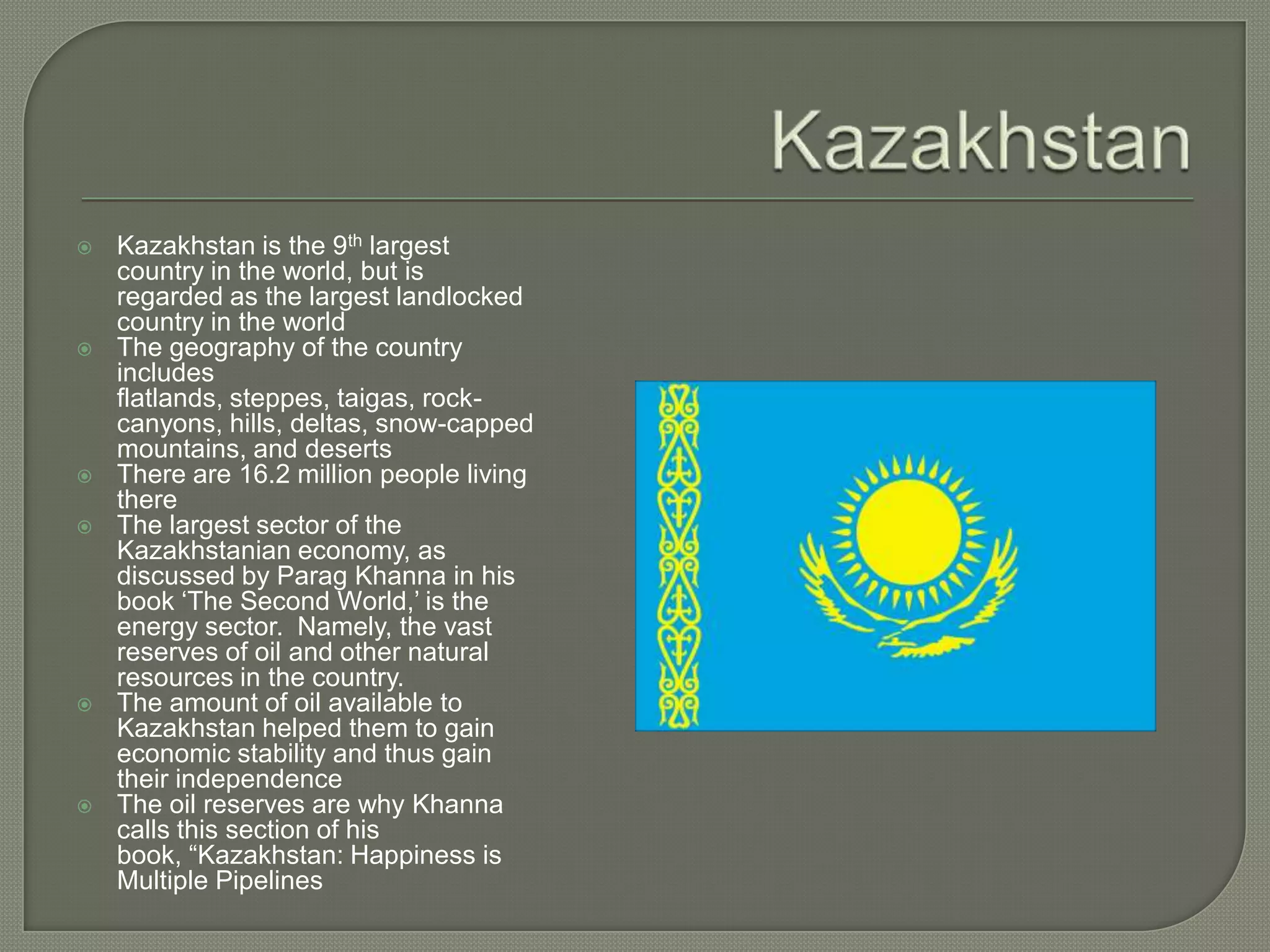
KazakhstanKazakhstan is the 9th largest country in the world, but is regarded as the largest landlocked country in the worldThe geography of the country includes flatlands, steppes, taigas, rock-canyons, hills, deltas, snow-capped mountains, and desertsThere are 16.2 million people living thereThe largest sector of the Kazakhstanian economy, as discussed by Parag Khanna in his book ‘The Second World,’ is the energy sector.  Namely, the vast reserves of oil and other natural resources in the country.The amount of oil available to Kazakhstan helped them to gain economic stability and thus gain their independenceThe oil reserves are why Khanna calls this section of his book, “Kazakhstan: Happiness is Multiple Pipelines
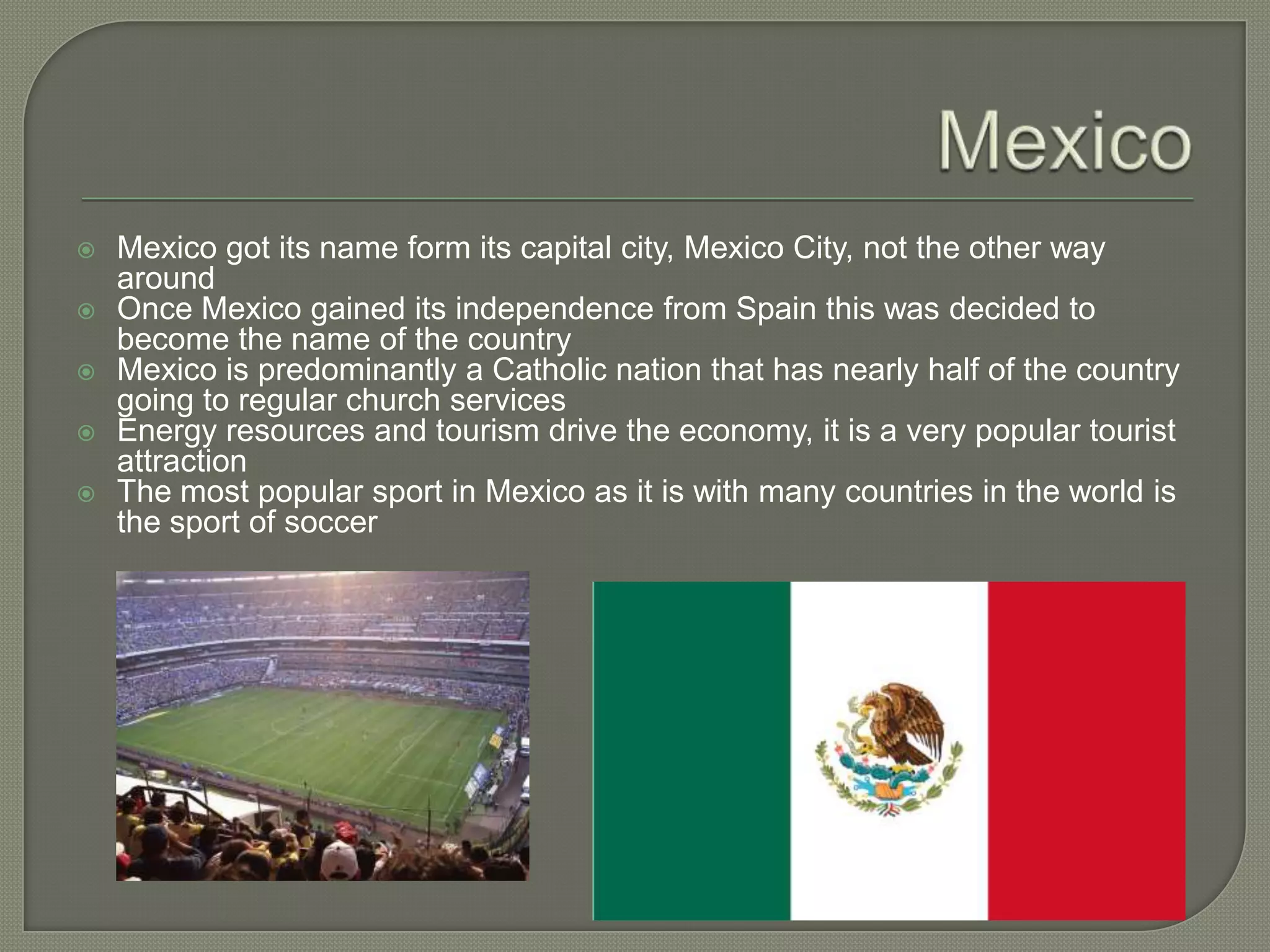
MexicoMexico got its name form its capital city, Mexico City, not the other way aroundOnce Mexico gained its independence from Spain this was decided to become the name of the countryMexico is predominantly a Catholic nation that has nearly half of the country going to regular church servicesEnergy resources and tourism drive the economy, it is a very popular tourist attractionThe most popular sport in Mexico as it is with many countries in the world is the sport of soccer
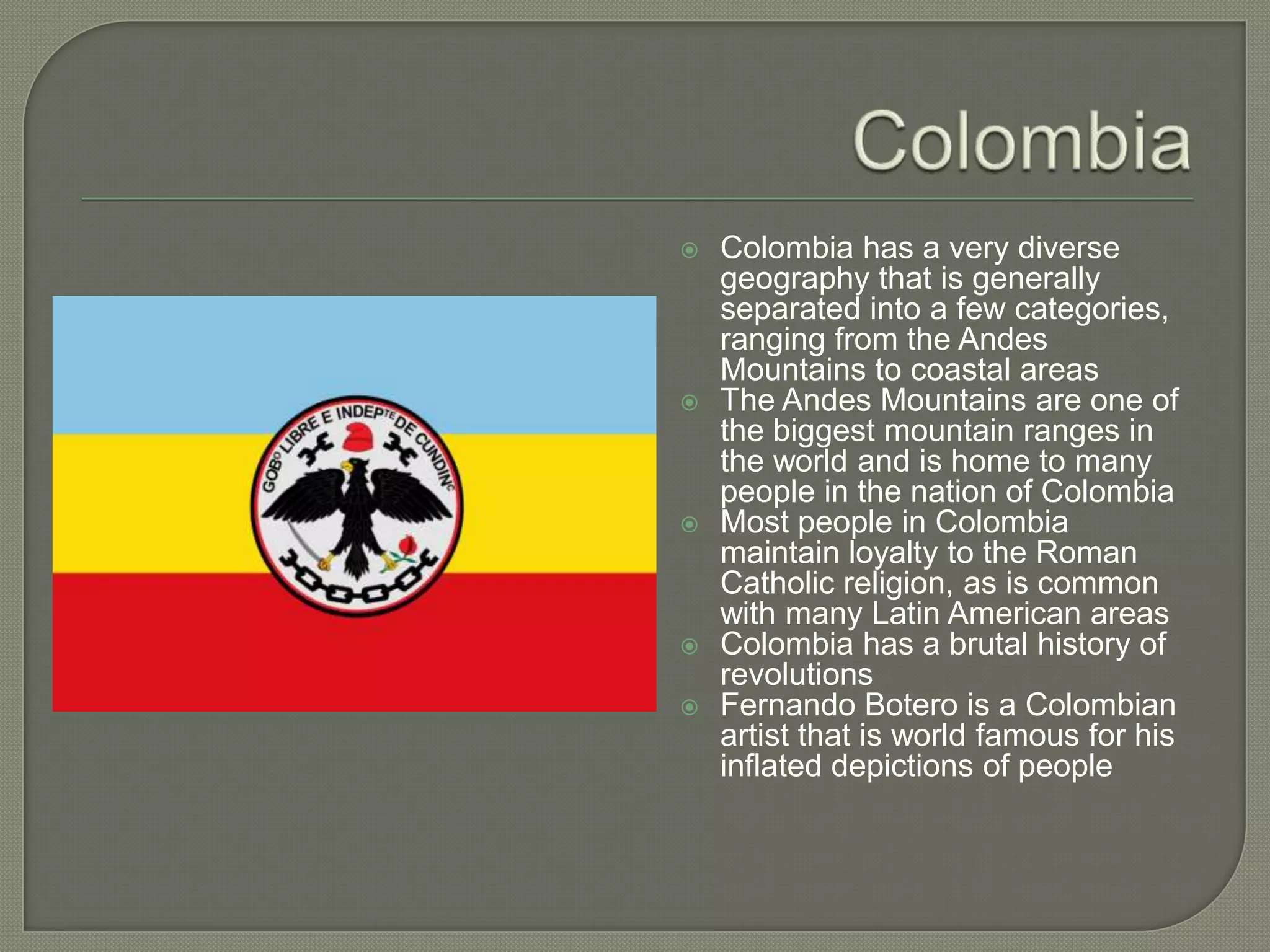
ColombiaColombia has a very diverse geography that is generally separated into a few categories, ranging from the Andes Mountains to coastal areasThe Andes Mountains are one of the biggest mountain ranges in the world and is home to many people in the nation of ColombiaMost people in Colombia maintain loyalty to the Roman Catholic religion, as is common with many Latin American areasColombia has a brutal history of revolutions Fernando Botero is a Colombian artist that is world famous for his inflated depictions of people
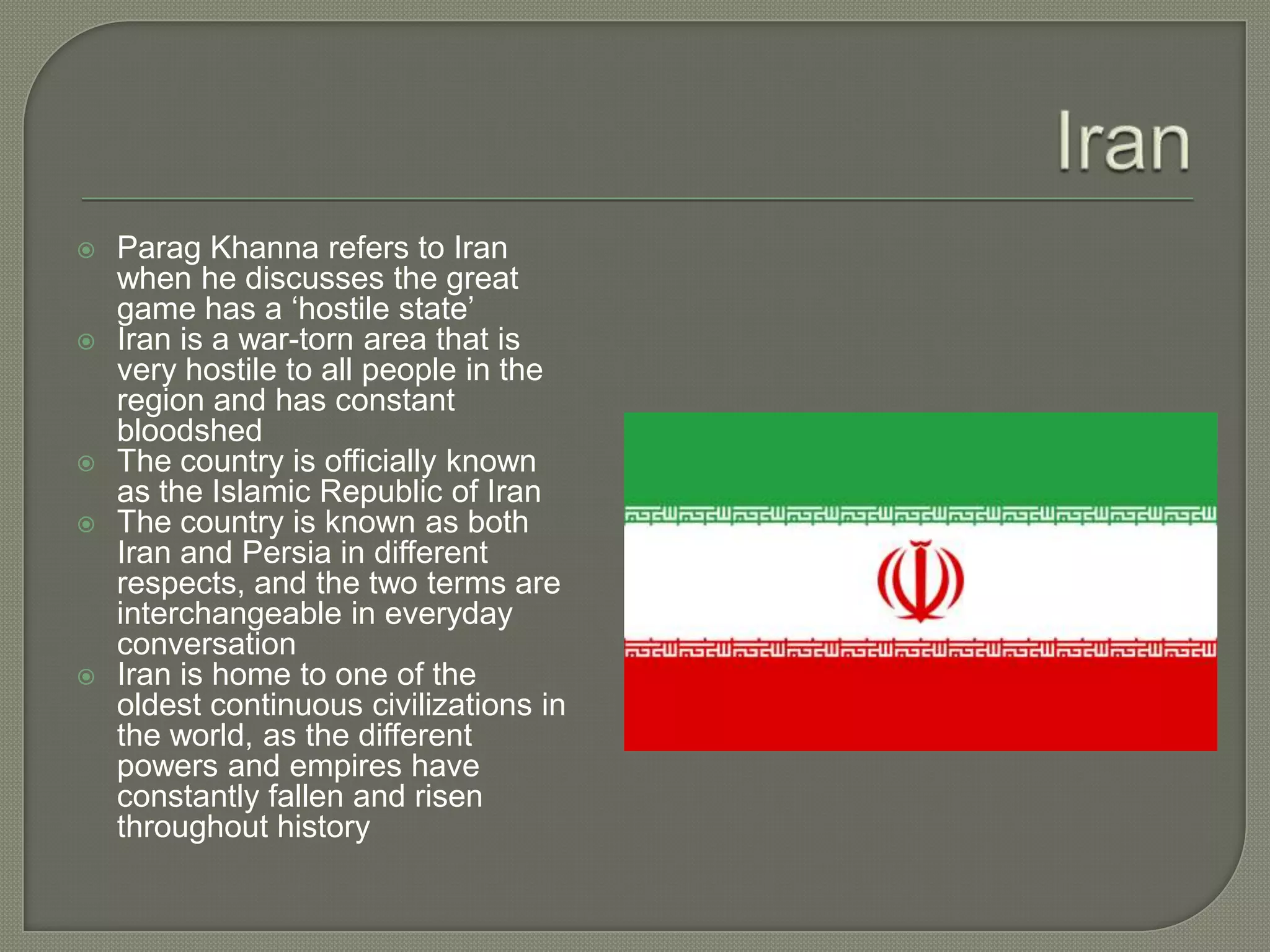
IranParag Khanna refers to Iran when he discusses the great game has a ‘hostile state’Iran is a war-torn area that is very hostile to all people in the region and has constant bloodshedThe country is officially known as the Islamic Republic of IranThe country is known as both Iran and Persia in different respects, and the two terms are interchangeable in everyday conversationIran is home to one of the oldest continuous civilizations in the world, as the different powers and empires have constantly fallen and risen throughout history
SourcesKhanna, Parag. The Second World: Empires and Influence in the New Global Order. New York: Random House Publishing, INC., 2008. 71-78. Print.Wikipedia.org

Assignment 3: The second world part 2

  • 1.
    The Second WorldByClinton Schooler
  • 2.
    The Great GameTheterm ‘The Great Game’ originated in the 19th century to describe the conflict between the British and Russian Empires’ rivalry towards gaining influence in central AsiaThe term is used today to describe a ‘New Great Game,’ which involves a struggle for influence in central Asia between the West (countries of NATO) and the East (countries of SCO)The conflicts between the two sides of the Great Games have always been linked to economic benefitsThe Great Game that Khanna describes in his book ‘The Second World’ is over influence of countries that are rich in oil production
  • 3.
    KazakhstanKazakhstan is the9th largest country in the world, but is regarded as the largest landlocked country in the worldThe geography of the country includes flatlands, steppes, taigas, rock-canyons, hills, deltas, snow-capped mountains, and desertsThere are 16.2 million people living thereThe largest sector of the Kazakhstanian economy, as discussed by Parag Khanna in his book ‘The Second World,’ is the energy sector. Namely, the vast reserves of oil and other natural resources in the country.The amount of oil available to Kazakhstan helped them to gain economic stability and thus gain their independenceThe oil reserves are why Khanna calls this section of his book, “Kazakhstan: Happiness is Multiple Pipelines
  • 4.
    MexicoMexico got itsname form its capital city, Mexico City, not the other way aroundOnce Mexico gained its independence from Spain this was decided to become the name of the countryMexico is predominantly a Catholic nation that has nearly half of the country going to regular church servicesEnergy resources and tourism drive the economy, it is a very popular tourist attractionThe most popular sport in Mexico as it is with many countries in the world is the sport of soccer
  • 5.
    ColombiaColombia has avery diverse geography that is generally separated into a few categories, ranging from the Andes Mountains to coastal areasThe Andes Mountains are one of the biggest mountain ranges in the world and is home to many people in the nation of ColombiaMost people in Colombia maintain loyalty to the Roman Catholic religion, as is common with many Latin American areasColombia has a brutal history of revolutions Fernando Botero is a Colombian artist that is world famous for his inflated depictions of people
  • 6.
    IranParag Khanna refersto Iran when he discusses the great game has a ‘hostile state’Iran is a war-torn area that is very hostile to all people in the region and has constant bloodshedThe country is officially known as the Islamic Republic of IranThe country is known as both Iran and Persia in different respects, and the two terms are interchangeable in everyday conversationIran is home to one of the oldest continuous civilizations in the world, as the different powers and empires have constantly fallen and risen throughout history
  • 7.
    SourcesKhanna, Parag. The SecondWorld: Empires and Influence in the New Global Order. New York: Random House Publishing, INC., 2008. 71-78. Print.Wikipedia.org