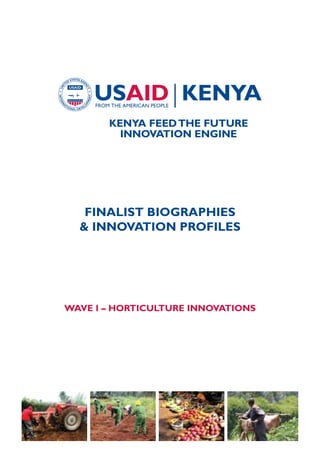
FINALIST BIOGRAPHIES
& INNOVATION PROFILES
WAVE I – HORTICULTURE INNOVATIONS
Based on the 2009 national population census,
46% of Kenya’s total population lives in poverty.
In particular, female-headed households
experience lower income and higher poverty
incidences. 2 million children under 5 years old
are stunted and approximately 1.5 to 2 million
Kenyans require food aid each year. Poverty and
malnutrition in the country is the combined
result of low agricultural productivity, high
population growth,a variety of cultural challenges
accelerating urbanization, unpredictable climate
change, degradation of natural ecosystems and
habitats, sub-optimal governance and inadequate
infrastructure.
Although the challenges are daunting, Kenya’s
agricultural sector exhibits considerable potential
and resilience. Presently, Kenya’s agricultural
sector employs over 75% of the workforce,
directly and indirectly, accounting for roughly
51% of gross domestic product.Additionally, the
sector has the capacity for significant growth if
constraints in water, agricultural input, transport,
access to finance and extension can be addressed.
The Kenya Feed the Future Innovation Engine
serves as a platform through which innovative
private sector-oriented solutions are proactively
sourced, incubated and scaled-up for wide-
spread impact. The Innovation Engine supports
experimentation and rewards proven success,
seeking projects that represent game-changing
methodologies and approaches that, at their
maturity, materially and beneficially affect a
significant number of Kenyan households.
The Innovation Engine supports selected
innovations through a combination of catalytic
grant-funding and short-term technical
assistance at various stages from “proof of
concept” through “pilot roll-out” to “transition
to scale-up”. At each stage in the innovation
process, independent review is undertaken to
verify outcomes and test reliability of results.
The Innovation Engine leverages other public
and private resources to grow innovations to
scale, and cultivates and broadly disseminates
innovative practices for the benefit of Kenyan
institutions.
In March 2013, the Innovation Engine announced
its first open and competitive call for innovations
in agriculture and nutrition, in conjunction with
the USAID/Kenya Horticulture Competitiveness
Project. Selected from a pool of 188 initial
applications received from both within and
outside Kenya, 19 shortlisted finalists submitted
in-depth proposals and delivered innovator
pitches to the Innovation Engine’s Investment
Advisory Committee in August.
USAID Kenya, through the Innovation Engine,
will support 7 of these finalists - 6 at proof of
concept and 1 at pilot rollout respectively, to
validate and introduce innovative interventions
to address soil fertility, biological pest control,
fusion farming,postharvest storage as well as use
of information and communications technology
towards supply chain management and providing
farmer information services.
The Innovation Engine announced its second call
for proposals in January 2014. This solicitation
wave includes special focus funding windows for
innovations relating to nutrition-led agriculture,
strengthening the dry land economy as well as
youth employment and inclusion. Full details
of this call can be accessed on the Innovation
Engine website - http://www.kfie.net.
ABOUTTHE KENYA FEEDTHE FUTURE INNOVATION ENGINE
CONTENTS
About the Kenya Feed the Future Innovation Engine	 3
Mfarm Limited	 4
Wanda Organic Limited	 5
Virtual City Limited	 6
University of Nairobi	 7
Quest Agriculture Limited	 8
The Real IPM Company Limited	 9
Lachlan Kenya Limited	 10
3
About the Innovation
Smallholder horticulture farmers face a huge challenge accessing markets and credit. Low
production,poorpost-harvest handling of produce,insufficient storagefacilities,poorinfrastructure,
and congested markets limit small-scale farmers’ participation in the formal economy. These
farmers tend to sell their produce quickly at the farm gate, to avoid spending time and money
trying to reach the best value markets or procuring storage facilities in order to manage sales.This
leaves them at the mercy of the unfair trading practices of unscrupulous middlemen who offer
prices way below the fair market value.
Mfarm’s innovation is a market-driven, highly-scalable, user-driven, agent-facilitated, collective
crop-selling platform largely focused on the horticulture value chain. It provides a sustainable
market solution for smallholder farmers through a network of agents who supply produce to
wholesalers under contract.The mobile technology-based model aims to provide a market for the
produce of every farmer through a network of conveniently-located produce procurement agents
paying a fair price to the farmer. The project will establish a mechanism for cash-on-delivery
payment to smallholder farmers,and certify farmers in order to facilitate supply to export markets
constrained by traceability regulations, among other interventions.The innovation is expected to
improve livelihoods by revolutionizing fresh produce trade between smallholder farmers and
wholesale market participants,improving farming practices,and ensuring a transparent value chain.
MFARM LIMITED
•	 Innovation title: Wholesale markets through 	
	 networking agents utilizing mobile technology
•	 Innovation stage: Proof of Concept (Stage I)
• 	Innovation deployment location: High Rainfall
	 Zone I (Homa Bay) and Semi-Arid Zone II (Machakos)
Innovation Champion
Ms. Marion Atieno Moon is the Founder and
Managing Director of Wanda Organic. A Bachelor
of Arts (Business Management) graduate, Marion is
a dynamic, self-driven entrepreneur with over five
years’ experience marketing large corporates in
Kenya and Uganda. She is the visionary and driving
force behind the realization of Wanda Organic’s
mission: to impact, directly or indirectly, at least
25% of the 5 million farmers that the Government
of Kenya works with. She plans to achieve this by
working closely with both the private and public
sector.
Marion is a Fellow of the Acumen Fund East Africa
(Class of 2013) – a program comprised of individuals
who are driving ground-breaking projects with large
WANDA ORGANIC LIMITED
•	 Innovation title: Organic Fertilizers for smallholder 	
	farmers
•	 Innovation stage: Proof of concept (Stage I)
•	 Innovation deployment location: Semi-arid Zone II 	
	 (Machakos and Makueni)
social impact. Recently, under the 2013 Innovation
to Impact initiative,GrowthAfrica andVillage Capital
funded Wanda Organic to the tune of US$25000
following the firm’s peer selection as one of two
companies lauded for running green enterprises.The
program selected Wanda as one of the awardees
after a 16-week intensive training aimed at helping
entrepreneurs move from having a product or
service, to building a business to support effective
and continuous delivery to the identified target
segment. Marion’s view is that it is imperative that
as the Government of Kenya facilitates the increased
use of chemical fertilizers, this is balanced with the
promotion of the use of organic fertilizers and other
soil resources. She strongly believes that Kenya
needs to grow its organic farming sector.
Innovation Champions
Ms. Jamila Abass is CEO and Co-founder of
MFarm Ltd. Jamila, who graduated with a BSc
in Computer Science from the University of
Abdelmalek Essaadi in Morocco in 2009, is
responsible for driving the business and has led
MFarm to successful proof of concept. Prior to
this, Jamila developed medical records systems
for Kenya Medical Research Institute (KEMRI/
University of Washington) and implemented
open source systems. In 2010, she participated in
the Massachusetts Institute of Technology (MIT)/
Nokia mobile technology entrepreneurship
program, and in 2012 became one of the first
African entrepreneurs to be admitted to the
Unreasonable Institute’s International Fellowship
Program, where she trained in entrepreneurship.
Ms. Susan Oguya is Chief Operations Officer
at Mfarm Ltd. She co-founded the organization
while working as a mobile application developer
at Safaricom Academy. Susan graduated from
Strathmore University with a degree in Business
and Information Technology in 2010, and secured
the Global Social Benefit Incubator Scholarship
at Santa Clara University in March 2012. She has
had work placements in product marketing at
Microsoft and microfinance and entrepreneurship
training at Kianda Foundation.
4 5
About the Innovation
There are already efforts addressing the soil infertility agenda,the most prominent of which is Integrated
Soil Fertility Management (ISFM) by the Africa Soil Health Consortium. ISFM consists of Improved Seed
+ Fertilizer + Manure (Organic Resource).Various players in the agricultural sector have adopted this
formula and the technology has been successfully tested and is currently being passed on to smallholder
farmers through research initiatives at the Kenya Agriculture Research Institute (KARI). However, there
are challenges with the availability and quality of the organic resource accessible by these farmers.
By supplying Plantmate Organic Fertilizer, which is produced from plant and animal wastes and Prime
EC Foliar Plant Food, an emulsion soil enricher,Wanda Organic aims to address these challenges and
instigate a ripple effect by maximizing the effects of the organic resource.The two products are widely
used in Southeast Asia, Indochina, China, and Australia. The organization imports and markets these
recently-developed organic fertilizers into the market, raises awareness about the numerous benefits
of such solutions, and builds demand for them. The intention is to set up local, strategically-located
production facilities in Kenya and East Africa, where Wanda Organic has secured the exclusive rights
for the technology. The innovative product comprises the breakthrough results of over 40 years in
biotechnological research.The formula facilitates healthy plant growth and also improves soil fertility.
Farmers will begin to embrace more progressive and sustainable agricultural practices that have proven
to increase yields, reduce crop cycles, suppress diseases and improve soil health with the use of these
products. By adopting these new technologies, farmers can increase their productivity and profitability.
Innovation Champion
Dr. Jane Ambuko is the Head of the Horticulture
Unit at the University of Nairobi’s Department
of Plant Science and Crop Protection. Since
2008, Jane has lectured, carried out research
and outreach at the University, and coordinated
students’ research projects, as well as the Msc
Horticulture Program. Over the years, through a
number of research grants she has won, she has
supported several graduate students’ research
and played the role of mentor. Her outstanding
VIRTUAL CITY LIMITED
•	 Innovation title: Initiative to transform horticulture 	
	 supply chain
•	 Innovation stage: Proof of concept (Stage I)
•	 Innovation deployment location: High Rainfall Zone I
	 ( and Semi-Arid Zone II
authorship/co-authorship of six papers in
referred journals and over 20 conference papers
locally and internationally has earned Jane the
prestigious AWARD Fellowship (African Women
in Agricultural Research and Development, 2013
-2014) and the Norman Borlaug Fellowship
(2012-2013). Activities of the two fellowships
have helped her foster collaborative activities and
created linkages with other local and international
institutions.
UNIVERSITY OF NAIROBI
•	 Innovation title: Innovative Cooling Option for 	
	 Smallholder Farmers
•	 Innovation stage: Proof of concept (Stage I)
•	 Innovation deployment location: High Rainfall
	 Zone I (Nyamira) and Semi-Arid Zone II (Makueni).
6 7
About the Innovation
Kenya’s horticulture sector faces a number of significant supply chain and marketing challenges that
hurt smallholder farmers and discourage private sector efforts to invest in improvements. These
include poor market linkages, information and power asymmetries, high costs, low traceability from
farm to market, and cash flow challenges.
Agrimanagr is a produce-purchasing innovation that provides transparency and integrity in the supply
chain.The technology accurately tracks production and quality for individual farmers, ensuring that
they are properly paid and rewarded for exactly what they deliver. It provides buyers with complete
visibility into the supply chain, quick electronic reconciliations, and a powerful platform to efficiently
provide extension services, mobile money payments, among others. Agrimanagr represents a major
departure from current practice in most Kenyan agricultural where the typical set-up involves an
inaccurate manual weighing scale and a buying process that provides many opportunities for errors
and fraud.
About the Innovation
It is estimated that 30% to 50% of horticultural commodities are lost between production and
retail sites.This is two to three times the losses that occur in developed countries.The losses
mean lost income, labor, inputs, and natural resources for smallholder farmers. Temperature
control is the single most important factor in the preservation of perishable food; the rate of
deterioration of perishables increases an approximated two to three-fold with every 10°C
increase in temperature in the commodity’s physiological temperature range.While most farmers
may be aware of the benefits of maintaining a cold chain for perishable commodities, most of
them,especially smallholder farmers,lack capital to invest in standard refrigeration equipment and
cold storage rooms.As a result,they are forced to sell perishable commodities as soon as they are
harvested through middlemen or brokers who often exploit them.
Our innovation is a cooling and cool-storage technology, especially useful for perishable
horticultural commodities.The CoolBot is an inexpensive controller for a standard window or
split-unit air conditioner unit that enables these units to cool rooms down to optimal storage
temperatures of 0 to 150
C,without ice accumulation on the evaporator coils.In combination with
a well-insulated room constructed from local materials,this locally-available,relatively-inexpensive
cooling system makes cold storage a viable option for smallholder farmers.The technology will
initially target farmers who are organized in producer/commodity groups, market groups or
cooperatives, and can therefore benefit from economies of scale. With these facilities, farmers
can store their produce for prolonged periods thus extending the marketing period.The potential
for bringing cooling power to rural communities is evident, and the intention is to continue this
research through the Innovation Engine project.
Innovation Champion
Mr. John Waibochi is the Founder and CEO of
the Virtual Group of Companies. In 2010, the
company won the Nokia Growth EconomyVenture
Challenge - which came with a US$1,000,000 cash
prize - beating competition from 54 other countries
to take the prize and putting him squarely on the
world map as a top tech entrepreneur. The firm
has also received a US$1.5 million convertible
loan from the Acumen Fund for the development
of a mobile-based agricultural application to help
small-scale farmers market their produce. John’s
innovations have also earned him/the firm other
honors such as the World Summit Award Mobile
2010; Moran of the Order of the Burning Spear;
Africa Enterprise Challenge Fund; Legatum Africa
Award for Entrepreneurship;and the Dale Carnegie
Highest Award for Achievement.
An Electrical Engineer trained at Michigan
State University, John has worked in the mobile
communication sector in Kenya since 1994. He
launched Virtual City in 1999. Virtual City has
become a formidable force in East Africa because
it is not only transforming logistics management for
big companies, but because it is addressing the real
issues by pioneering mobile business management
solutions for smaller traders. Virtual City is a
mobile supply chain and knowledge management
company. According to John, when it comes to
mobile’s next-big-thing, Kenya is the country to
watch because of its early and leading adoption of
m-commerce, large investments in terrestrial and
submarine fiber, the government’s strategy to grow
the Business Process Outsourcing sector and lastly,
the position of Nairobi as the “unofficial” business
capital of the East African community’s common
market. Acquiring high-level technological talent is
what keeps him up at night.While there are enough
entry-level programmers in Kenya for Virtual City
to take its pick, a business as successful as this
creates a hungry demand for top talent. John’s
goal is to consistently develop innovative mobility
solutions that simplify lives.
8 9
QUEST AGRICULTURE LIMITED
•	 Innovation title: Innovative and Inclusive Training and 		
	 Extension Services for Production of Sustainable 		
	 Safe Food in Kenya (INTENSE)
•	 Innovation stage: Proof of concept (Stage I)
•	 Innovation deployment location: Semi-Arid Zone II 		
	 (Meru)
Innovation Champion
Ms. Louise Labuschagne is Co-Director of The
Real IPM Company (K) Ltd. Integrated Pest
Management is the core business of this Thika-
based joint venture between Louise and Henry
Wainwright, her husband.
Louise has extensive practical field experience
in developing IPM protocols for fruit, vegetable
and flower crops in Europe andAfrica,which have
resulted in substantial reductions in pesticide use
by commercial growers.
She has been instrumental in the development
of commercial mass-production capabilities for
indigenous natural enemies and bio-pesticides in
THE REAL IPM COMPANY LIMITED
•	 Innovation title: Biological Control of fruit fly
•	 Innovation stage: Proof of concept (Stage I)
•	 Innovation deployment location: Semi-Arid Zone II 	
	 (Machakos, Meru, Embu, and Makueni)
Kenya, from the initial bio-prospecting surveys to
registration and commercialization.
Louiseisproactiveinidentifyingnewopportunities
for biological control agents capable of replacing
pesticides in crops as diverse as coffee, bananas,
flowers, nuts, vegetables and fruit. She continues
to learn from practical successes in small-scale
vegetable production, including rearing of
beneficial insects for release in farmers’ fields.
British by descent, Louise provides technical
consultancies to several UK supermarkets on
Integrated Pest Management issues.
About the Innovation
Rural,low-income,smallholder farmers face myriad challenges related to access to inputs,technical
assistance, extension services and sustainable markets.This has resulted in a big knowledge gap in
modern farming techniques and provision of farm inputs, negatively impacting productivity as well
as soil fertility, thereby resulting in a vicious cycle of poverty. In 2012, export horticulture suffered
a big blow when Kenya was blacklisted by the European Union states due to increased instances
of positive Maximum Residue Limit (MRL) results, sounding the death knell to the livelihoods of
many small scale farmers if remedial measures are not undertaken.
Quest Agriculture’s innovation involves the use of a mobile soil-testing kit to test soils for farmer
groups located in the geographical area of the agrovet and give instant results on the farm.This
elliminates the hassle of transporting soils to laboratories located miles away.The soil test costs
just 30% of the fee in classical laboratories.
Each field is registered into the Quest Agriculture Website by Global Positioning System (GPS)
to promote traceability.The agrovet will make fertilizer recommendations based on the soil test
results and Quest Agriculture will supply the agrovet with custom-blended fertilizers specific to
the smallholder farmer’s land and crop type.
About the Innovation
Fruit fly infestations damage high-value horticultural crops seriously threatening the income,
food security and livelihood of millions of families that produce and trade in fruits and
vegetables. For instance, mangoes suffer up to 80% losses from fruit fly infestation and there
can be a complete ban on exports due to infestations. Other fruit crops such as avocado and
passion fruit are a unique source of various nutritional benefits and have also been identified as
effective vehicles for small-scale farmer livelihoods and integration into the value addition chain.
All these crops are susceptible to attack by the fruit fly, which threatens to impact on their
potential for poverty alleviation.
Real IPM (Kenya) Ltd is working with the International Centre of Insect Physiology and Ecology
(ICIPE) to market an isolate of Metarhizium anisopliae ICIPE 69 - a fungus which kills fruit fly.Field
trials in South Africa have given excellent results in controlling the pest in apple orchards.
The program involves soil applications of the fungus as well as regular foliar sprays.This is combined
with a method for auto-dissemination of the fungus through pheromone-baited inoculation
stations.
Innovation Champion
Mr. Fredrick Muthuri is the Group Managing
Director of Quest Agriculture Ltd. He holds a
BSc in Chemistry and Botany and has experience
in statistical analysis, supply chain management,
agro industries, soil chemistry, training, project
management and appraisal, environmental
assessment and Hazard Analysis and Critical
Control Points (HACCP).
He has over 15 years of experience gained mainly
in multinational companies such as Unilever Ltd.
Quest Laboratories Ltd. was launched in 2002
in Nairobi Kenya. Within eight years, Fredrick
had grown the company from a staff of two
(comprising him and his brother) to over 25
staff including agriculturalists, plant pathologists,
horticulturalists, soil scientists, lab technicians,
and other highly-qualified professionals. By 2010,
the company had a 10,000-strong customer base
with plans to reach up to 100,000 farmers in the
next few years.
Quest Agriculture Ltd. started operations with
the provision of analytic services to the industrial
and agricultural sectors of the economy. In
2005, the company expanded into provision of
Quality and Environmental services, carrying
out assessment and training in ISO systems.The
Company has international accreditation.
Innovation Champion
Mr. Richard Stone-Wigg is the Founder and CEO of
Lachlan Kenya Ltd.Richard has a BSc Honors Degree
in Agriculture from the University of Aberdeen and
has been working in the sector in Kenya, East Africa
as well as Central Africa for the past 26 years. His
experience covers the technical development,
positioning and marketing of both crop protection
and crop nutrition products as well setting up
distribution systems to get these new molecules to
market. After 14 years of working with a large
multinational manufacturer and supplier to East
Africa, in 2000, Richard set up the local distribution
company,Lachlan Kenya Ltd.The company has grown
to a 50-strong work force and has recently opened
branch offices and shops in Kenya as well as a sister
company in Northern Tanzania.
Richard is the visionary and driving force behind
Lachlan’s ‘Fusion Farming’ mission to educate and
encourage environmentally-intelligent farming. By
sourcing and offering unique pest control, biological,
LACHLAN KENYA LIMITED
•	 Innovation title: Fusion farming technology in potato 		
	 farming
•	 Innovation stage: Pilot Rollout (Stage II)
•	 Innovation deployment location: High Rainfall ZoneI 	
	 (Bomet) and Semi-Arid Zone II (Meru)
botanical and nutrition products in tried and tested
synergistic programs, Lachlan has been able to
introduce products and concepts to farmers, both
large and small, to enable them to benefit from
advanced technologies that can otherwise be too
costly for the African rain-fed systems.The concepts
and programs are tested and developed at Lachlan’s
own trial site before release. By combining targeted
crop nutrition with eco-friendly chemistry in a
synergistic way, Lachlan has been able to reduce the
costs of plant protection.Through innovative use of
the latest nutritional formulations the firm is helping
ensure sustainable, quality yields even in adverse
growing conditions that include stress from low soil
pH and lack of moisture, to heat or frost damage.
Richard’s drive is to get this knowledge - which is
often extensively used by commercial growers - out
to small scale growers where growing programs can
have a real impact on their livelihoods and Kenya’s
food security.
FINALISTS: Stage I - Proof of Concept
Act for the Future
•	 InnovationTitle: Appropriate Innovations in
Agriculture forYikitaa community
•	 Innovation Champion: Mr. Nzuki Waita
First Access Limited
•	 InnovationTitle: First Access Financial Profile
•	 Innovation Champion: Ms. Nicole Stubbs
Grow Strong
•	 InnovationTitle: Renewable Energy Cold
Storage System
•	 Innovation Champion: Ms. Amy Lint
Jomo Kenyatta University of Agriculture and
Technology
•	 InnovationTitle: Utilization of Solar Energy
for Greenhouse Cooling
•	 Innovation Champion: Dr.Arnold Watako
Kenya Agricultural Research Institute
•	 InnovationTitle: Promotion and
Commercialization of Guava 	
•	 Innovation Champion: Dr. Lusike Wasilwa
Kenya Biologics Limited
•	 InnovationTitle: Mass Trapping of
Diamondback Moth for Smallholder Farmers
•	 Innovation Champion: Dr. Nikolai van Beek
Sanergy Limited
•	 InnovationTitle: Market Introduction of
Biosolid Based Organic Fertilizers
•	 Innovation Champion: Mr.AniVallabhaneni
Sunflower Pump Limited
•	 InnovationTitle: Solar Tracking for Low-Cost
Irrigation
•	 Innovation Champion: Mr.Toby Hammond
The Real IPM Company Limited
•	 InnovationTitle: Zero Residues for Green
bean and PeaVegetables Exports
•	 Innovation Champion: Dr. Henry 		
Wainwright
FINALISTS: Stage 2 - Pilot Rollout
Esoko East Africa Limited
•	 InnovationTitle: Integrated Mobile
Information Communication Services
•	 Innovation Champion: Ms. Laura Drewett
Kickstart International
•	 InnovationTitle: Agro-preneurship for the
Poor
•	 Innovation Champion: Mr. Guy Redding
Syngenta Foundation for Sustainable
Agriculture /Kenya Horticultural Exporters
(1977) Limited
•	 InnovationTitle: Integrated Mobile Platform
for Outgrower Schemes
•	 Innovation Champion: Mr. Fritz Brugger
About the Innovation
The estimated potato crop area in Kenya is 120,000 to 150,000 hectares grown by 800,000 (mostly
small-scale) farmers. This is far below the country’s potential.Yet, potatoes are considered the crop
most adapted to climate change in the highland areas. Given the relatively high water requirement and
disease prevalence in maize, potatoes could become a more important staple food supplement in many
areas. Factors limiting production include poor-quality seed, soil diseases and nematodes that have built
from repeated plantings on the same soils.
‘Viazi Power’ is based on the principals of Fusion Farming.The program aims to help small-scale framers
achieve sustainable yields,even in adverse conditions and where the use of basal fertilizers is limited due
to poor cash flow and other constraints.The concept involves taking the best of synthetic chemical and
bagged fertilizer products and combining their application with the best “bio-control” products, in a
holistic fusion of seed treatment and foliar application that enables sustainable,environmentally-friendly
farming.This approach helps farmers increase yield and crop quality at a sustainable cost while preserving
soil fertility, and helping to generate economic yields in adverse environmental conditions and poor
soils.
10 11
Kenya Feed the Future Innovation Engine
Land O’Lakes, Inc. | International Development
Block A, 2nd floor, Peponi Plaza, off Peponi Road,Westlands
P.O. Box 45006 G.P.O. 00100, Nairobi, Kenya
Telephone: +254 (0)722 517 149, +254 20 232 9639
+ 254 20 232 9749, +254 20 232 7831
www.kfie.net

KFIE Innovator Bios

  • 1.
    FINALIST BIOGRAPHIES & INNOVATIONPROFILES WAVE I – HORTICULTURE INNOVATIONS
  • 2.
    Based on the2009 national population census, 46% of Kenya’s total population lives in poverty. In particular, female-headed households experience lower income and higher poverty incidences. 2 million children under 5 years old are stunted and approximately 1.5 to 2 million Kenyans require food aid each year. Poverty and malnutrition in the country is the combined result of low agricultural productivity, high population growth,a variety of cultural challenges accelerating urbanization, unpredictable climate change, degradation of natural ecosystems and habitats, sub-optimal governance and inadequate infrastructure. Although the challenges are daunting, Kenya’s agricultural sector exhibits considerable potential and resilience. Presently, Kenya’s agricultural sector employs over 75% of the workforce, directly and indirectly, accounting for roughly 51% of gross domestic product.Additionally, the sector has the capacity for significant growth if constraints in water, agricultural input, transport, access to finance and extension can be addressed. The Kenya Feed the Future Innovation Engine serves as a platform through which innovative private sector-oriented solutions are proactively sourced, incubated and scaled-up for wide- spread impact. The Innovation Engine supports experimentation and rewards proven success, seeking projects that represent game-changing methodologies and approaches that, at their maturity, materially and beneficially affect a significant number of Kenyan households. The Innovation Engine supports selected innovations through a combination of catalytic grant-funding and short-term technical assistance at various stages from “proof of concept” through “pilot roll-out” to “transition to scale-up”. At each stage in the innovation process, independent review is undertaken to verify outcomes and test reliability of results. The Innovation Engine leverages other public and private resources to grow innovations to scale, and cultivates and broadly disseminates innovative practices for the benefit of Kenyan institutions. In March 2013, the Innovation Engine announced its first open and competitive call for innovations in agriculture and nutrition, in conjunction with the USAID/Kenya Horticulture Competitiveness Project. Selected from a pool of 188 initial applications received from both within and outside Kenya, 19 shortlisted finalists submitted in-depth proposals and delivered innovator pitches to the Innovation Engine’s Investment Advisory Committee in August. USAID Kenya, through the Innovation Engine, will support 7 of these finalists - 6 at proof of concept and 1 at pilot rollout respectively, to validate and introduce innovative interventions to address soil fertility, biological pest control, fusion farming,postharvest storage as well as use of information and communications technology towards supply chain management and providing farmer information services. The Innovation Engine announced its second call for proposals in January 2014. This solicitation wave includes special focus funding windows for innovations relating to nutrition-led agriculture, strengthening the dry land economy as well as youth employment and inclusion. Full details of this call can be accessed on the Innovation Engine website - http://www.kfie.net. ABOUTTHE KENYA FEEDTHE FUTURE INNOVATION ENGINE CONTENTS About the Kenya Feed the Future Innovation Engine 3 Mfarm Limited 4 Wanda Organic Limited 5 Virtual City Limited 6 University of Nairobi 7 Quest Agriculture Limited 8 The Real IPM Company Limited 9 Lachlan Kenya Limited 10 3
  • 3.
    About the Innovation Smallholderhorticulture farmers face a huge challenge accessing markets and credit. Low production,poorpost-harvest handling of produce,insufficient storagefacilities,poorinfrastructure, and congested markets limit small-scale farmers’ participation in the formal economy. These farmers tend to sell their produce quickly at the farm gate, to avoid spending time and money trying to reach the best value markets or procuring storage facilities in order to manage sales.This leaves them at the mercy of the unfair trading practices of unscrupulous middlemen who offer prices way below the fair market value. Mfarm’s innovation is a market-driven, highly-scalable, user-driven, agent-facilitated, collective crop-selling platform largely focused on the horticulture value chain. It provides a sustainable market solution for smallholder farmers through a network of agents who supply produce to wholesalers under contract.The mobile technology-based model aims to provide a market for the produce of every farmer through a network of conveniently-located produce procurement agents paying a fair price to the farmer. The project will establish a mechanism for cash-on-delivery payment to smallholder farmers,and certify farmers in order to facilitate supply to export markets constrained by traceability regulations, among other interventions.The innovation is expected to improve livelihoods by revolutionizing fresh produce trade between smallholder farmers and wholesale market participants,improving farming practices,and ensuring a transparent value chain. MFARM LIMITED • Innovation title: Wholesale markets through networking agents utilizing mobile technology • Innovation stage: Proof of Concept (Stage I) • Innovation deployment location: High Rainfall Zone I (Homa Bay) and Semi-Arid Zone II (Machakos) Innovation Champion Ms. Marion Atieno Moon is the Founder and Managing Director of Wanda Organic. A Bachelor of Arts (Business Management) graduate, Marion is a dynamic, self-driven entrepreneur with over five years’ experience marketing large corporates in Kenya and Uganda. She is the visionary and driving force behind the realization of Wanda Organic’s mission: to impact, directly or indirectly, at least 25% of the 5 million farmers that the Government of Kenya works with. She plans to achieve this by working closely with both the private and public sector. Marion is a Fellow of the Acumen Fund East Africa (Class of 2013) – a program comprised of individuals who are driving ground-breaking projects with large WANDA ORGANIC LIMITED • Innovation title: Organic Fertilizers for smallholder farmers • Innovation stage: Proof of concept (Stage I) • Innovation deployment location: Semi-arid Zone II (Machakos and Makueni) social impact. Recently, under the 2013 Innovation to Impact initiative,GrowthAfrica andVillage Capital funded Wanda Organic to the tune of US$25000 following the firm’s peer selection as one of two companies lauded for running green enterprises.The program selected Wanda as one of the awardees after a 16-week intensive training aimed at helping entrepreneurs move from having a product or service, to building a business to support effective and continuous delivery to the identified target segment. Marion’s view is that it is imperative that as the Government of Kenya facilitates the increased use of chemical fertilizers, this is balanced with the promotion of the use of organic fertilizers and other soil resources. She strongly believes that Kenya needs to grow its organic farming sector. Innovation Champions Ms. Jamila Abass is CEO and Co-founder of MFarm Ltd. Jamila, who graduated with a BSc in Computer Science from the University of Abdelmalek Essaadi in Morocco in 2009, is responsible for driving the business and has led MFarm to successful proof of concept. Prior to this, Jamila developed medical records systems for Kenya Medical Research Institute (KEMRI/ University of Washington) and implemented open source systems. In 2010, she participated in the Massachusetts Institute of Technology (MIT)/ Nokia mobile technology entrepreneurship program, and in 2012 became one of the first African entrepreneurs to be admitted to the Unreasonable Institute’s International Fellowship Program, where she trained in entrepreneurship. Ms. Susan Oguya is Chief Operations Officer at Mfarm Ltd. She co-founded the organization while working as a mobile application developer at Safaricom Academy. Susan graduated from Strathmore University with a degree in Business and Information Technology in 2010, and secured the Global Social Benefit Incubator Scholarship at Santa Clara University in March 2012. She has had work placements in product marketing at Microsoft and microfinance and entrepreneurship training at Kianda Foundation. 4 5 About the Innovation There are already efforts addressing the soil infertility agenda,the most prominent of which is Integrated Soil Fertility Management (ISFM) by the Africa Soil Health Consortium. ISFM consists of Improved Seed + Fertilizer + Manure (Organic Resource).Various players in the agricultural sector have adopted this formula and the technology has been successfully tested and is currently being passed on to smallholder farmers through research initiatives at the Kenya Agriculture Research Institute (KARI). However, there are challenges with the availability and quality of the organic resource accessible by these farmers. By supplying Plantmate Organic Fertilizer, which is produced from plant and animal wastes and Prime EC Foliar Plant Food, an emulsion soil enricher,Wanda Organic aims to address these challenges and instigate a ripple effect by maximizing the effects of the organic resource.The two products are widely used in Southeast Asia, Indochina, China, and Australia. The organization imports and markets these recently-developed organic fertilizers into the market, raises awareness about the numerous benefits of such solutions, and builds demand for them. The intention is to set up local, strategically-located production facilities in Kenya and East Africa, where Wanda Organic has secured the exclusive rights for the technology. The innovative product comprises the breakthrough results of over 40 years in biotechnological research.The formula facilitates healthy plant growth and also improves soil fertility. Farmers will begin to embrace more progressive and sustainable agricultural practices that have proven to increase yields, reduce crop cycles, suppress diseases and improve soil health with the use of these products. By adopting these new technologies, farmers can increase their productivity and profitability.
  • 4.
    Innovation Champion Dr. JaneAmbuko is the Head of the Horticulture Unit at the University of Nairobi’s Department of Plant Science and Crop Protection. Since 2008, Jane has lectured, carried out research and outreach at the University, and coordinated students’ research projects, as well as the Msc Horticulture Program. Over the years, through a number of research grants she has won, she has supported several graduate students’ research and played the role of mentor. Her outstanding VIRTUAL CITY LIMITED • Innovation title: Initiative to transform horticulture supply chain • Innovation stage: Proof of concept (Stage I) • Innovation deployment location: High Rainfall Zone I ( and Semi-Arid Zone II authorship/co-authorship of six papers in referred journals and over 20 conference papers locally and internationally has earned Jane the prestigious AWARD Fellowship (African Women in Agricultural Research and Development, 2013 -2014) and the Norman Borlaug Fellowship (2012-2013). Activities of the two fellowships have helped her foster collaborative activities and created linkages with other local and international institutions. UNIVERSITY OF NAIROBI • Innovation title: Innovative Cooling Option for Smallholder Farmers • Innovation stage: Proof of concept (Stage I) • Innovation deployment location: High Rainfall Zone I (Nyamira) and Semi-Arid Zone II (Makueni). 6 7 About the Innovation Kenya’s horticulture sector faces a number of significant supply chain and marketing challenges that hurt smallholder farmers and discourage private sector efforts to invest in improvements. These include poor market linkages, information and power asymmetries, high costs, low traceability from farm to market, and cash flow challenges. Agrimanagr is a produce-purchasing innovation that provides transparency and integrity in the supply chain.The technology accurately tracks production and quality for individual farmers, ensuring that they are properly paid and rewarded for exactly what they deliver. It provides buyers with complete visibility into the supply chain, quick electronic reconciliations, and a powerful platform to efficiently provide extension services, mobile money payments, among others. Agrimanagr represents a major departure from current practice in most Kenyan agricultural where the typical set-up involves an inaccurate manual weighing scale and a buying process that provides many opportunities for errors and fraud. About the Innovation It is estimated that 30% to 50% of horticultural commodities are lost between production and retail sites.This is two to three times the losses that occur in developed countries.The losses mean lost income, labor, inputs, and natural resources for smallholder farmers. Temperature control is the single most important factor in the preservation of perishable food; the rate of deterioration of perishables increases an approximated two to three-fold with every 10°C increase in temperature in the commodity’s physiological temperature range.While most farmers may be aware of the benefits of maintaining a cold chain for perishable commodities, most of them,especially smallholder farmers,lack capital to invest in standard refrigeration equipment and cold storage rooms.As a result,they are forced to sell perishable commodities as soon as they are harvested through middlemen or brokers who often exploit them. Our innovation is a cooling and cool-storage technology, especially useful for perishable horticultural commodities.The CoolBot is an inexpensive controller for a standard window or split-unit air conditioner unit that enables these units to cool rooms down to optimal storage temperatures of 0 to 150 C,without ice accumulation on the evaporator coils.In combination with a well-insulated room constructed from local materials,this locally-available,relatively-inexpensive cooling system makes cold storage a viable option for smallholder farmers.The technology will initially target farmers who are organized in producer/commodity groups, market groups or cooperatives, and can therefore benefit from economies of scale. With these facilities, farmers can store their produce for prolonged periods thus extending the marketing period.The potential for bringing cooling power to rural communities is evident, and the intention is to continue this research through the Innovation Engine project. Innovation Champion Mr. John Waibochi is the Founder and CEO of the Virtual Group of Companies. In 2010, the company won the Nokia Growth EconomyVenture Challenge - which came with a US$1,000,000 cash prize - beating competition from 54 other countries to take the prize and putting him squarely on the world map as a top tech entrepreneur. The firm has also received a US$1.5 million convertible loan from the Acumen Fund for the development of a mobile-based agricultural application to help small-scale farmers market their produce. John’s innovations have also earned him/the firm other honors such as the World Summit Award Mobile 2010; Moran of the Order of the Burning Spear; Africa Enterprise Challenge Fund; Legatum Africa Award for Entrepreneurship;and the Dale Carnegie Highest Award for Achievement. An Electrical Engineer trained at Michigan State University, John has worked in the mobile communication sector in Kenya since 1994. He launched Virtual City in 1999. Virtual City has become a formidable force in East Africa because it is not only transforming logistics management for big companies, but because it is addressing the real issues by pioneering mobile business management solutions for smaller traders. Virtual City is a mobile supply chain and knowledge management company. According to John, when it comes to mobile’s next-big-thing, Kenya is the country to watch because of its early and leading adoption of m-commerce, large investments in terrestrial and submarine fiber, the government’s strategy to grow the Business Process Outsourcing sector and lastly, the position of Nairobi as the “unofficial” business capital of the East African community’s common market. Acquiring high-level technological talent is what keeps him up at night.While there are enough entry-level programmers in Kenya for Virtual City to take its pick, a business as successful as this creates a hungry demand for top talent. John’s goal is to consistently develop innovative mobility solutions that simplify lives.
  • 5.
    8 9 QUEST AGRICULTURELIMITED • Innovation title: Innovative and Inclusive Training and Extension Services for Production of Sustainable Safe Food in Kenya (INTENSE) • Innovation stage: Proof of concept (Stage I) • Innovation deployment location: Semi-Arid Zone II (Meru) Innovation Champion Ms. Louise Labuschagne is Co-Director of The Real IPM Company (K) Ltd. Integrated Pest Management is the core business of this Thika- based joint venture between Louise and Henry Wainwright, her husband. Louise has extensive practical field experience in developing IPM protocols for fruit, vegetable and flower crops in Europe andAfrica,which have resulted in substantial reductions in pesticide use by commercial growers. She has been instrumental in the development of commercial mass-production capabilities for indigenous natural enemies and bio-pesticides in THE REAL IPM COMPANY LIMITED • Innovation title: Biological Control of fruit fly • Innovation stage: Proof of concept (Stage I) • Innovation deployment location: Semi-Arid Zone II (Machakos, Meru, Embu, and Makueni) Kenya, from the initial bio-prospecting surveys to registration and commercialization. Louiseisproactiveinidentifyingnewopportunities for biological control agents capable of replacing pesticides in crops as diverse as coffee, bananas, flowers, nuts, vegetables and fruit. She continues to learn from practical successes in small-scale vegetable production, including rearing of beneficial insects for release in farmers’ fields. British by descent, Louise provides technical consultancies to several UK supermarkets on Integrated Pest Management issues. About the Innovation Rural,low-income,smallholder farmers face myriad challenges related to access to inputs,technical assistance, extension services and sustainable markets.This has resulted in a big knowledge gap in modern farming techniques and provision of farm inputs, negatively impacting productivity as well as soil fertility, thereby resulting in a vicious cycle of poverty. In 2012, export horticulture suffered a big blow when Kenya was blacklisted by the European Union states due to increased instances of positive Maximum Residue Limit (MRL) results, sounding the death knell to the livelihoods of many small scale farmers if remedial measures are not undertaken. Quest Agriculture’s innovation involves the use of a mobile soil-testing kit to test soils for farmer groups located in the geographical area of the agrovet and give instant results on the farm.This elliminates the hassle of transporting soils to laboratories located miles away.The soil test costs just 30% of the fee in classical laboratories. Each field is registered into the Quest Agriculture Website by Global Positioning System (GPS) to promote traceability.The agrovet will make fertilizer recommendations based on the soil test results and Quest Agriculture will supply the agrovet with custom-blended fertilizers specific to the smallholder farmer’s land and crop type. About the Innovation Fruit fly infestations damage high-value horticultural crops seriously threatening the income, food security and livelihood of millions of families that produce and trade in fruits and vegetables. For instance, mangoes suffer up to 80% losses from fruit fly infestation and there can be a complete ban on exports due to infestations. Other fruit crops such as avocado and passion fruit are a unique source of various nutritional benefits and have also been identified as effective vehicles for small-scale farmer livelihoods and integration into the value addition chain. All these crops are susceptible to attack by the fruit fly, which threatens to impact on their potential for poverty alleviation. Real IPM (Kenya) Ltd is working with the International Centre of Insect Physiology and Ecology (ICIPE) to market an isolate of Metarhizium anisopliae ICIPE 69 - a fungus which kills fruit fly.Field trials in South Africa have given excellent results in controlling the pest in apple orchards. The program involves soil applications of the fungus as well as regular foliar sprays.This is combined with a method for auto-dissemination of the fungus through pheromone-baited inoculation stations. Innovation Champion Mr. Fredrick Muthuri is the Group Managing Director of Quest Agriculture Ltd. He holds a BSc in Chemistry and Botany and has experience in statistical analysis, supply chain management, agro industries, soil chemistry, training, project management and appraisal, environmental assessment and Hazard Analysis and Critical Control Points (HACCP). He has over 15 years of experience gained mainly in multinational companies such as Unilever Ltd. Quest Laboratories Ltd. was launched in 2002 in Nairobi Kenya. Within eight years, Fredrick had grown the company from a staff of two (comprising him and his brother) to over 25 staff including agriculturalists, plant pathologists, horticulturalists, soil scientists, lab technicians, and other highly-qualified professionals. By 2010, the company had a 10,000-strong customer base with plans to reach up to 100,000 farmers in the next few years. Quest Agriculture Ltd. started operations with the provision of analytic services to the industrial and agricultural sectors of the economy. In 2005, the company expanded into provision of Quality and Environmental services, carrying out assessment and training in ISO systems.The Company has international accreditation.
  • 6.
    Innovation Champion Mr. RichardStone-Wigg is the Founder and CEO of Lachlan Kenya Ltd.Richard has a BSc Honors Degree in Agriculture from the University of Aberdeen and has been working in the sector in Kenya, East Africa as well as Central Africa for the past 26 years. His experience covers the technical development, positioning and marketing of both crop protection and crop nutrition products as well setting up distribution systems to get these new molecules to market. After 14 years of working with a large multinational manufacturer and supplier to East Africa, in 2000, Richard set up the local distribution company,Lachlan Kenya Ltd.The company has grown to a 50-strong work force and has recently opened branch offices and shops in Kenya as well as a sister company in Northern Tanzania. Richard is the visionary and driving force behind Lachlan’s ‘Fusion Farming’ mission to educate and encourage environmentally-intelligent farming. By sourcing and offering unique pest control, biological, LACHLAN KENYA LIMITED • Innovation title: Fusion farming technology in potato farming • Innovation stage: Pilot Rollout (Stage II) • Innovation deployment location: High Rainfall ZoneI (Bomet) and Semi-Arid Zone II (Meru) botanical and nutrition products in tried and tested synergistic programs, Lachlan has been able to introduce products and concepts to farmers, both large and small, to enable them to benefit from advanced technologies that can otherwise be too costly for the African rain-fed systems.The concepts and programs are tested and developed at Lachlan’s own trial site before release. By combining targeted crop nutrition with eco-friendly chemistry in a synergistic way, Lachlan has been able to reduce the costs of plant protection.Through innovative use of the latest nutritional formulations the firm is helping ensure sustainable, quality yields even in adverse growing conditions that include stress from low soil pH and lack of moisture, to heat or frost damage. Richard’s drive is to get this knowledge - which is often extensively used by commercial growers - out to small scale growers where growing programs can have a real impact on their livelihoods and Kenya’s food security. FINALISTS: Stage I - Proof of Concept Act for the Future • InnovationTitle: Appropriate Innovations in Agriculture forYikitaa community • Innovation Champion: Mr. Nzuki Waita First Access Limited • InnovationTitle: First Access Financial Profile • Innovation Champion: Ms. Nicole Stubbs Grow Strong • InnovationTitle: Renewable Energy Cold Storage System • Innovation Champion: Ms. Amy Lint Jomo Kenyatta University of Agriculture and Technology • InnovationTitle: Utilization of Solar Energy for Greenhouse Cooling • Innovation Champion: Dr.Arnold Watako Kenya Agricultural Research Institute • InnovationTitle: Promotion and Commercialization of Guava • Innovation Champion: Dr. Lusike Wasilwa Kenya Biologics Limited • InnovationTitle: Mass Trapping of Diamondback Moth for Smallholder Farmers • Innovation Champion: Dr. Nikolai van Beek Sanergy Limited • InnovationTitle: Market Introduction of Biosolid Based Organic Fertilizers • Innovation Champion: Mr.AniVallabhaneni Sunflower Pump Limited • InnovationTitle: Solar Tracking for Low-Cost Irrigation • Innovation Champion: Mr.Toby Hammond The Real IPM Company Limited • InnovationTitle: Zero Residues for Green bean and PeaVegetables Exports • Innovation Champion: Dr. Henry Wainwright FINALISTS: Stage 2 - Pilot Rollout Esoko East Africa Limited • InnovationTitle: Integrated Mobile Information Communication Services • Innovation Champion: Ms. Laura Drewett Kickstart International • InnovationTitle: Agro-preneurship for the Poor • Innovation Champion: Mr. Guy Redding Syngenta Foundation for Sustainable Agriculture /Kenya Horticultural Exporters (1977) Limited • InnovationTitle: Integrated Mobile Platform for Outgrower Schemes • Innovation Champion: Mr. Fritz Brugger About the Innovation The estimated potato crop area in Kenya is 120,000 to 150,000 hectares grown by 800,000 (mostly small-scale) farmers. This is far below the country’s potential.Yet, potatoes are considered the crop most adapted to climate change in the highland areas. Given the relatively high water requirement and disease prevalence in maize, potatoes could become a more important staple food supplement in many areas. Factors limiting production include poor-quality seed, soil diseases and nematodes that have built from repeated plantings on the same soils. ‘Viazi Power’ is based on the principals of Fusion Farming.The program aims to help small-scale framers achieve sustainable yields,even in adverse conditions and where the use of basal fertilizers is limited due to poor cash flow and other constraints.The concept involves taking the best of synthetic chemical and bagged fertilizer products and combining their application with the best “bio-control” products, in a holistic fusion of seed treatment and foliar application that enables sustainable,environmentally-friendly farming.This approach helps farmers increase yield and crop quality at a sustainable cost while preserving soil fertility, and helping to generate economic yields in adverse environmental conditions and poor soils. 10 11
  • 7.
    Kenya Feed theFuture Innovation Engine Land O’Lakes, Inc. | International Development Block A, 2nd floor, Peponi Plaza, off Peponi Road,Westlands P.O. Box 45006 G.P.O. 00100, Nairobi, Kenya Telephone: +254 (0)722 517 149, +254 20 232 9639 + 254 20 232 9749, +254 20 232 7831 www.kfie.net