The Linux Foundation
Overview and Training 2018
OPEN '18, Ter Elst, Kontich , 07.06.2018
Speaker: Klaus Behrla,
Business Development Director - Training, EMEAR Region,
The Linux Foundation
The Linux Foundation Overview
June 7, 2018
Agenda
1. The Linux Foundation
2. Demand for Talent
3. Training and Certification
4. Authorized Training Partner Program
Intro to the Linux Foundation
Linux Foundation History
˃ The Linux Foundation was started in 2000 under the Open Source
Development Labs (OSDL) and became the organization it is today when
OSDL merged with the Free Standards Group (FSG) in 2007.
˃ The Linux Foundation is home to the largest open source projects in the world
and sponsors the work of Linux creator Linus Torvalds.
˃ The Linux Foundation is supported by leading technology firms and
developers from around the world.
˃ The Linux Foundation provides infrastructure, legal management, events,
training and certification, for open source projects in order grow and sustain
them.
   
The Linux Foundation is creating the greatest shared
technology investment in history by enabling open
source collaboration across companies, developers,
and users.
We are the organization of choice to build
ecosystems that accelerate open technology
development and commercial adoption.
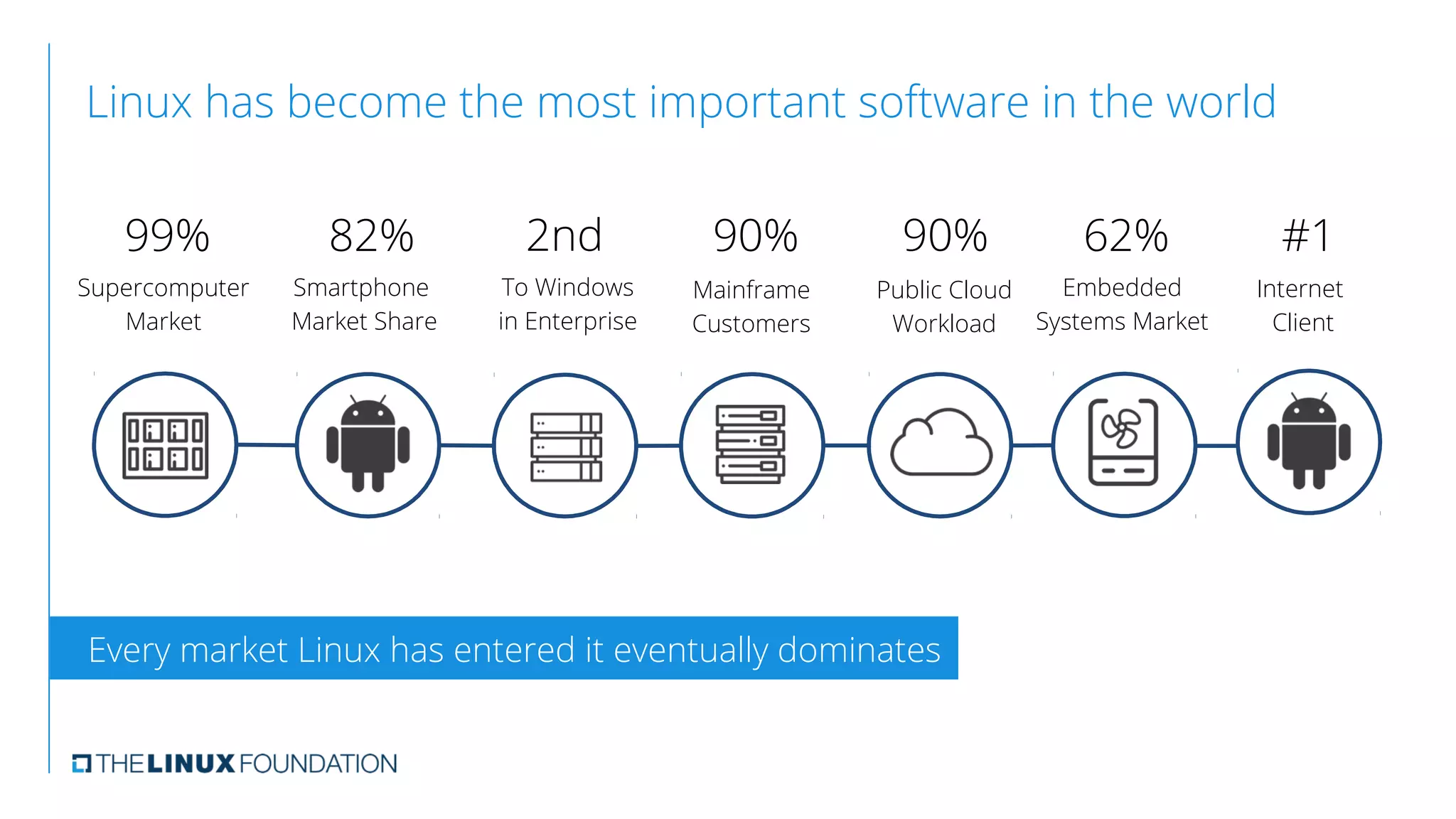
Linux has become the most important software in the world
99%
Supercomputer
Market
62%
Embedded
Systems Market
90%
Mainframe
Customers
90%
Public Cloud
Workload
Every market Linux has entered it eventually dominates
82%
Smartphone
Market Share
2nd
To Windows
in Enterprise
#1
Internet
Client
Today the Linux Foundation is Much More than Linux…
Security
We securing the
internet as home to
world’s largest
certificate authority
securing100M web
sites.
Networking
We are home to 8 of
the top 10 open
source networking
projects in the world
backed by the
majority of global
network providers.
Cloud
We are creating a
portability layer for
the cloud, driving
standards and
developing reference
tools for cloud native
development.
Automotive
Our Automotive
Grade Linux platform
is backed by 12
automakers and is
either in or slated for
production in millions
of vehicles worldwide.
Blockchain
We are creating a
permanent, secure
distributed ledger that
makes it easier to
create cost-efficient,
decentralized business
networks.
Web
We are providing the
application
development
framework for next
generation web,
mobile, serverless,
and IoT applications.
Edge/Embedded
We are creating
projects used in
building the majority of
embedded Linux
distributions and
rationalizing edge
computing.
The Linux Foundation is a critical part of the tech ecosystem
800+
Members From
41 Countries
80%
of Fortune100
Tech & Telecom
25,000+
Developers
Contributing Code
100+
Open Source
Projects
$15.7B
Shared
Value
We have seen unprecedented growth in our projects
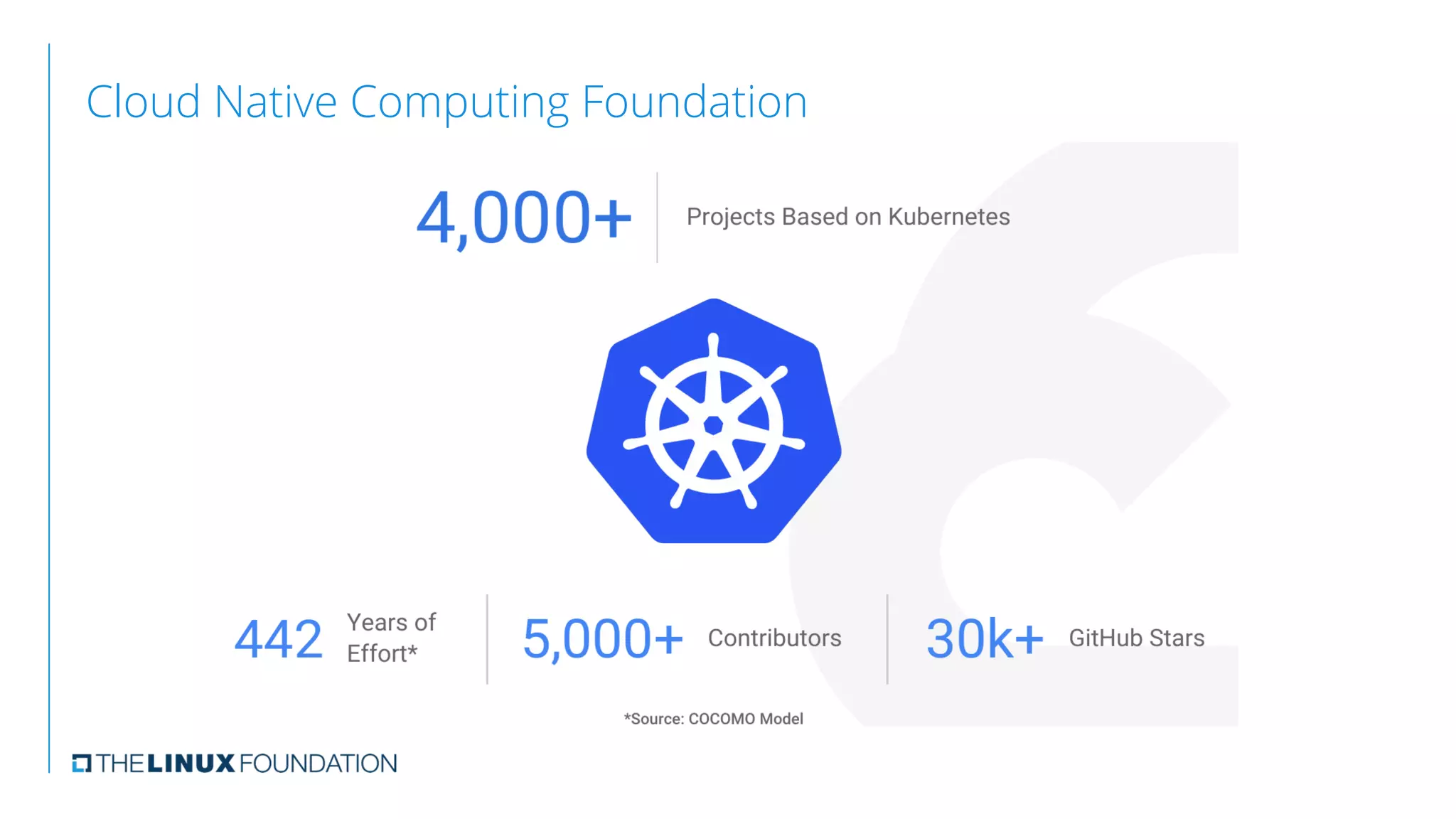
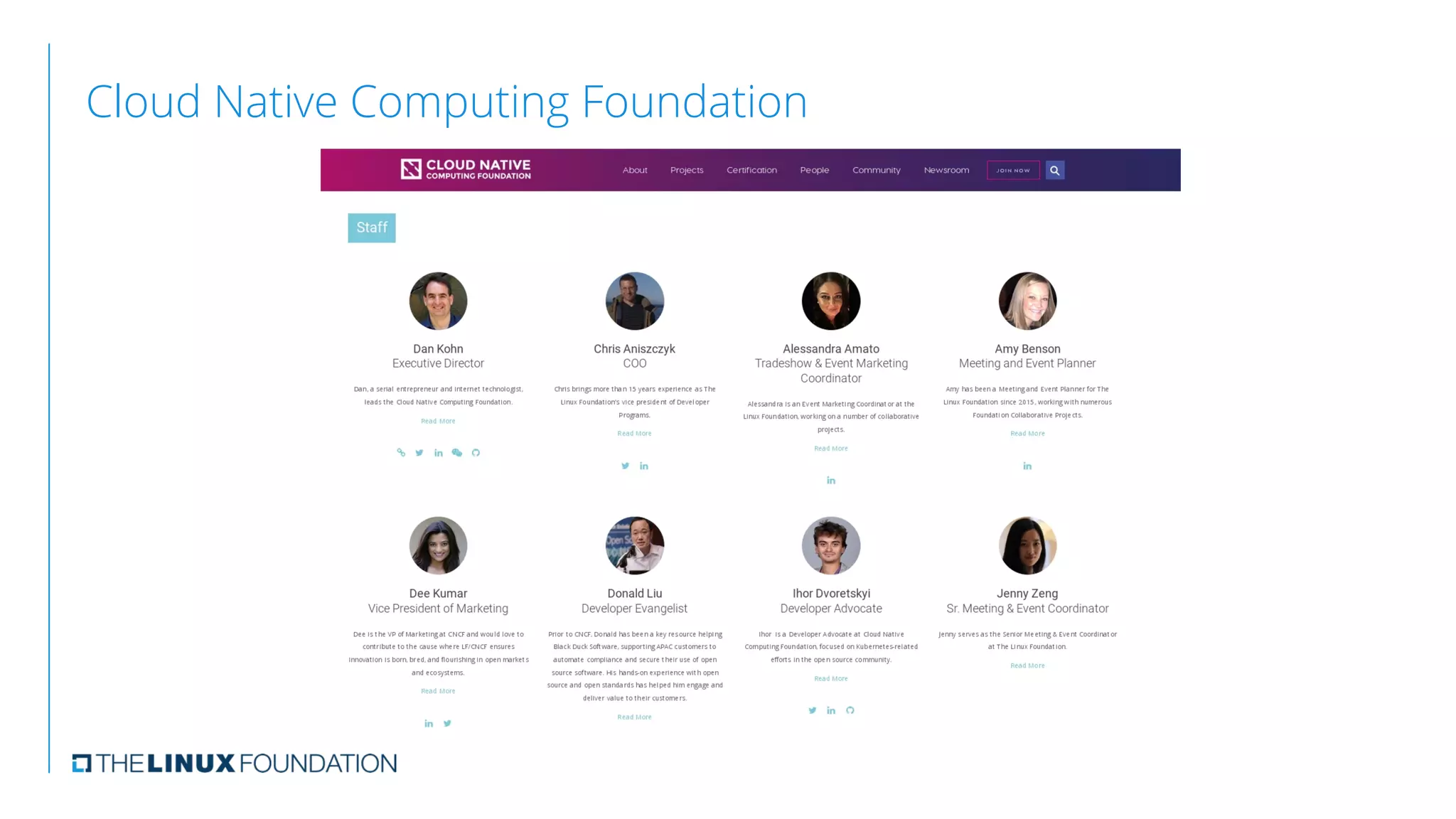
Cloud Native Computing Foundation
   
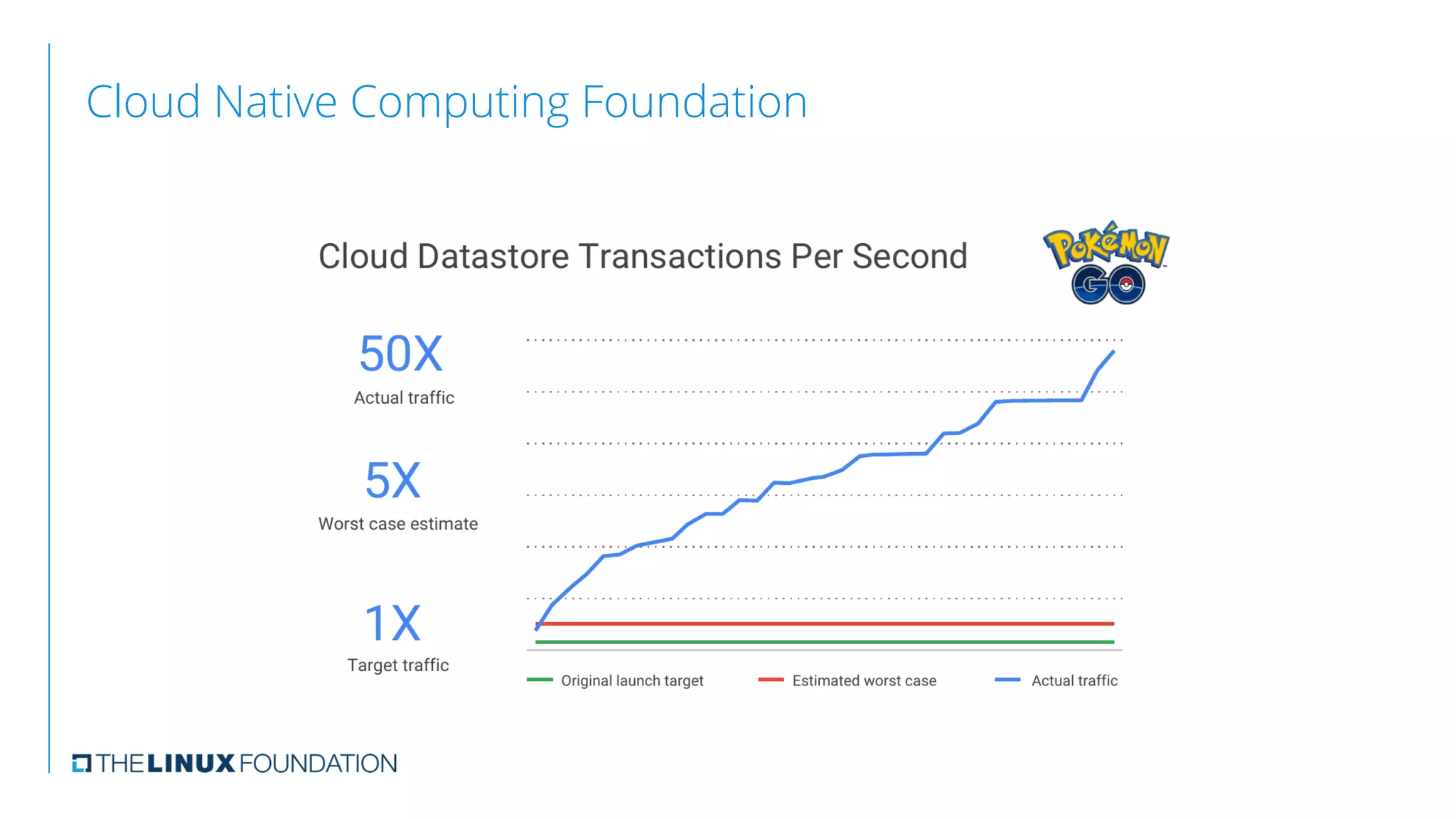
Cloud Native Computing Foundation
   
Cloud Native Computing Foundation
   
Cloud Native Computing Foundation
   
Cloud Native Computing Foundation
   
Cloud Native Computing Foundation
   
Cloud Native Computing Foundation
   
Cloud Native Computing Foundation
   
Cloud Native Computing Foundation
   
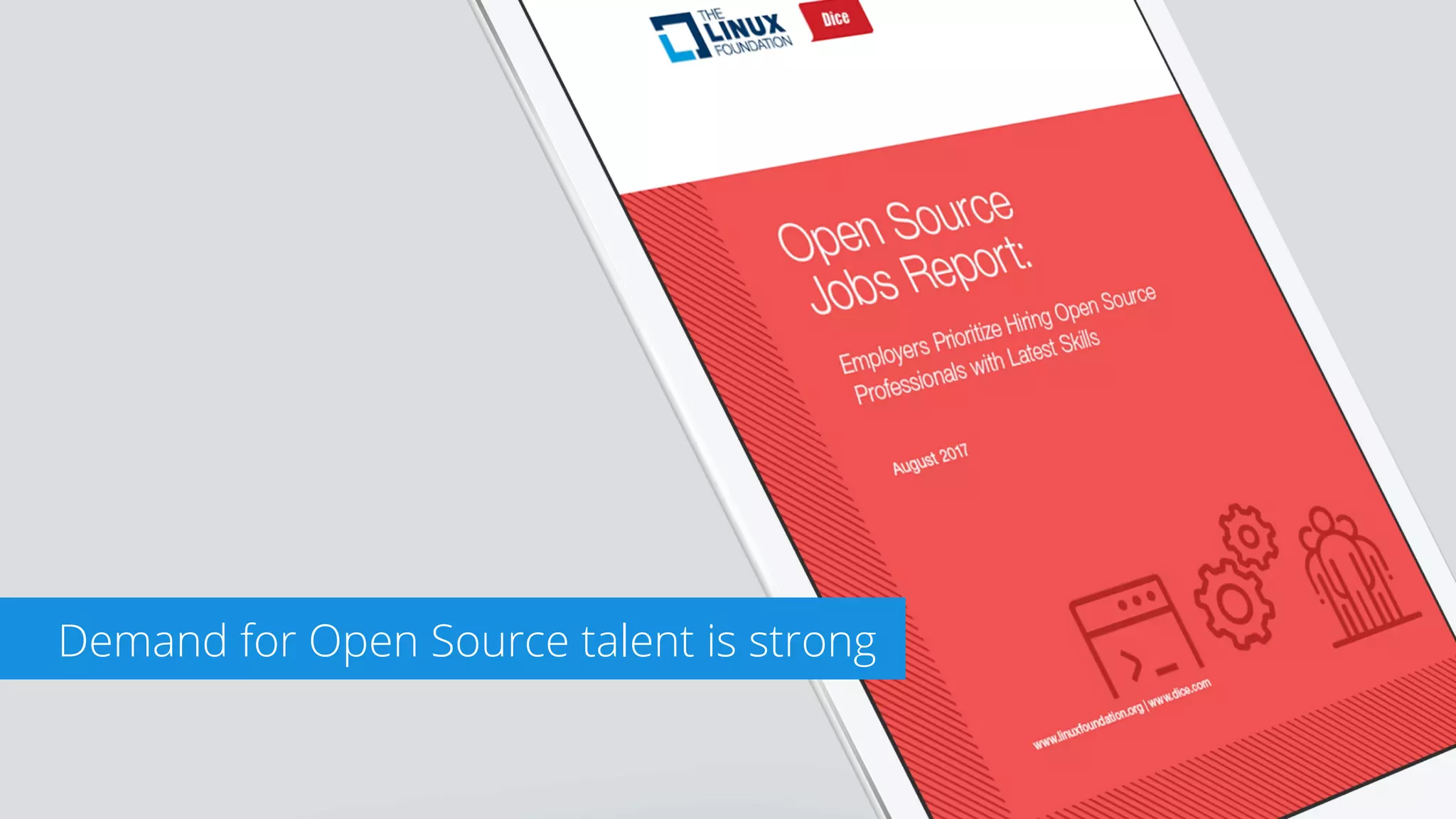
Demand for Open Source talent is strong
linuxfoundation.org/publications/open-source-jobs-report-2017/
The Linux Foundation Training and Certification
Early Training/Certification Accelerates Path#ofindividuals
Time
Early availability of
developer ‘how tos’
accelerates adoption
Early availability of
SysAdmin Training and
Certification draws talent
in early and gives
employers the confidence
to deploy faster
Developers
DevOps/Admins
The Linux Foundation has a platform to build a talent funnel
Massive Open Online Courses
Self-Paced E-Learning
Classroom-Led
Certification Testing
Custom Instruction
We Accelerate Innovation Through Low Cost Training
862,000
Educated Through
Free Courses
Dozens
of Diversity Interns
in 2017
250
Annual Scholarships
for Students
50
Need-Based
Scholarships in 2017
We provide e-learning, skills based certification, and on site training
LF Training Capabilities
Experienced staff in place to quickly develop and deploy high quality online, self-
paced content (with Instructor led as an option): both Free and Paid
Working with LF (and non-LF) hosted projects to accelerate talent development:
Cloud
Networking
Systems Administration
Security
Open Source Developer Compliance
Linux Internals
We have a cutting edge user and
developer catalog
Training from the developers of open source technology
Example User Training
Courses
˃ Introduction to Linux (free through EdX)
˃ Introduction to Cloud Infrastructure
Technologies (free through EdX)
˃ Essentials of System Administration
˃ Linux Networking and Administration
˃ Linux Security Fundamentals
˃ OpenStack Administration Fundamentals
˃ Open Source Virtualization
Example Developer
Training
˃ Compliance Basics for Developers
˃ Introduction to Linux, Open Source
Development, and GIT
˃ Developing Applications For Linux
˃ Inside Android: An Intro to Android
Internals
˃ Linux Kernel Internals and Development
˃ Developing Linux Device Drivers
˃ Linux Kernel Debugging and Security
˃ Embedded Linux Development
We are growing fast for the most up-to-date courses visit – tlftraining.org
Coming Soon in 2018
Hyperledger/
Blockchain
Implementing Fabric
Fabric Operator
Sawtooth Developer
Sawtooth Operator
Additional Offerings
Intro to Linux on Azure
DevOps for Network Engineers
Cybersecurity for Developers
Networking
Intro to SDN Technologies
Intro to OPNFV
Intro to ONAP
Advanced OPNFV
Advanced ONAP
LF Certification Capabilities
˃ 100% online, performance-based exam platform
˃ Deep track record - exams for multiple projects
˃ Experienced staff can work with experts to build and deploy exams
˃ Focus is on entry level Certification, allows specialized providers to thrive
Kubernetes Certification Programs
˃ Certified Kubernetes Administrator (CKA) Program
˃ Certified Kubernetes Application Developer (CKAD) Program
˃ Kubernetes Certified Service Provider
Your Career Path Training Gateway
Kernel
Development
› LFD301 Introduction to Linux, Open Source
Development, and GIT
› LFD415 Inside Android: An Intro to Android
Internals
› LFD420 Linux Kernel Internals and Development
› LFD430 Developing Linux Device Drivers
› LFD432 Optimizing Linux Device Drivers for
› Power Efficiency
› LFD440 Linux Kernel Debugging and Security
Embedded
Development
› LFD301 Introduction to Linux, Open Source
Development, and GIT
› LFD435 Developing Embedded Linux
› Device Drivers
› LFD450 Embedded Linux Development
› LFD460 Embedded Linux Development with
› Yocto Project
Application
Development
› LFD401 Developing Applications For Linux
› LFS171 Blockchain for Business - An Introduction
to Hyperledger Technologies
› LFS232 Cloud Foundry for Developers
› LFS254 Containers for Developers and
› Quality Assurance
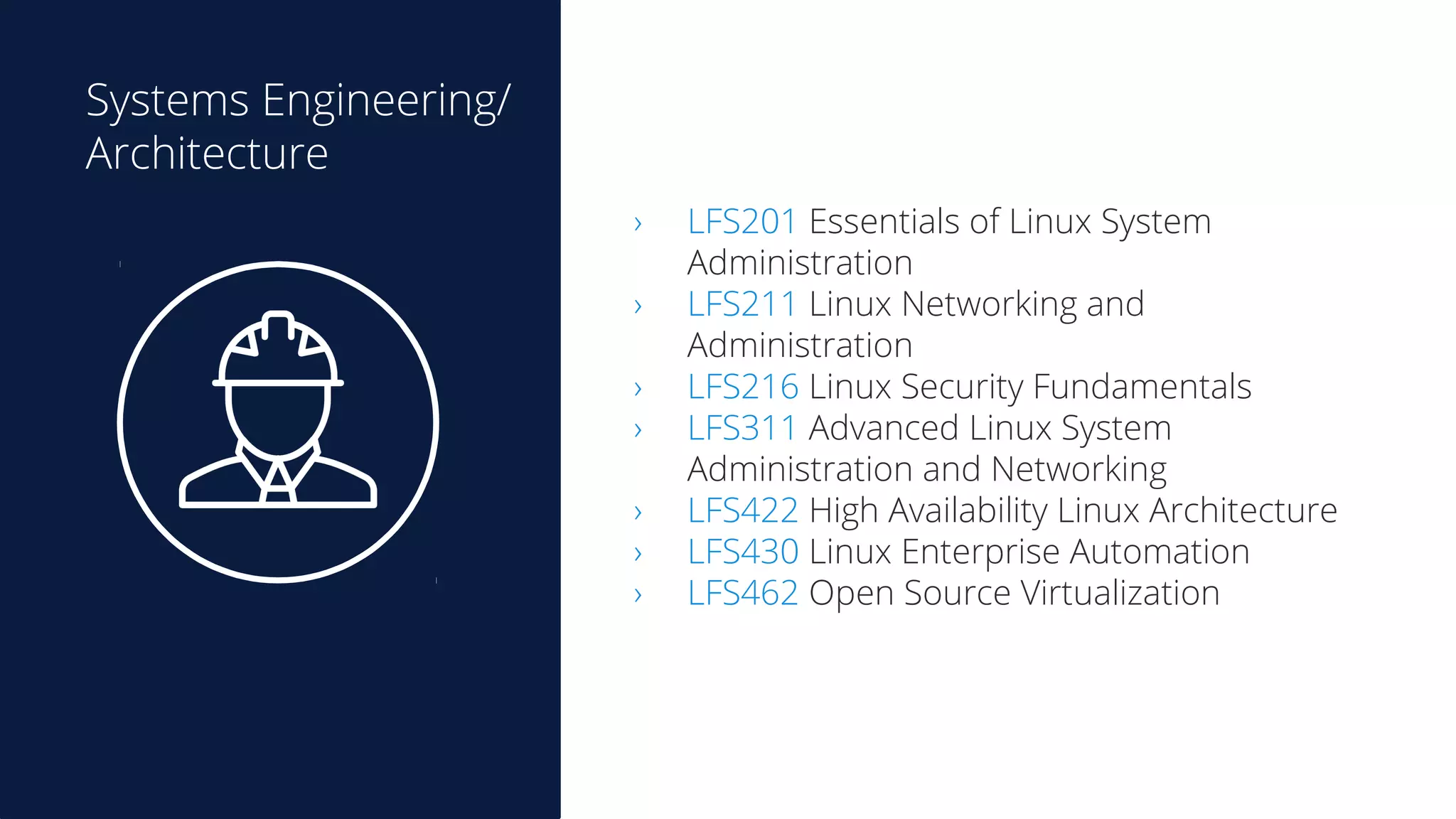
Systems Engineering/
Architecture
› LFS201 Essentials of Linux System
Administration
› LFS211 Linux Networking and
Administration
› LFS216 Linux Security Fundamentals
› LFS311 Advanced Linux System
Administration and Networking
› LFS422 High Availability Linux Architecture
› LFS430 Linux Enterprise Automation
› LFS462 Open Source Virtualization
System
Administration
› LFS101 Introduction to Linux
› LFS158 Introduction to Kubernetes
› LFS201 Essentials of Linux System Administration
› LFS205 Administering Linux on Azure
› LFS211 Linux Networking and Administration
› LFS216 Linux Security Fundamentals
› LFS258 Kubernetes Fundamentals
› LFS300 Fundamentals of Linux
› LFS301 Linux System Administration
› LFS305 Deploying and Managing Linux on Azure
› LFS311 Advanced Linux System Administration
and Networking
› LFS416 Linux Security
› LFS422 High Availability Linux Architecture
› LFS426 Linux Performance Tuning
› LFS430 Linux Enterprise Automation
› LFS458 Kubernetes Administration
› LFS462 Open Source Virtualization
DevOps/
Site Reliability › LFS158 Introduction to Kubernetes
› LFS161 Introduction to DevOps:
Transforming and Improving Operations
› LFS201 Essentials of Linux System
Administration
› LFS216 Linux Security Fundamentals
› LFS253 Containers Fundamentals
› LFS254 Containers for Developers and
Quality Assurance
› LFS258 Kubernetes Fundamentals
› LFS261 Implementing Continuous Delivery
› LFS458 Kubernetes Administration
Cloud &
Containers
› LFS132 Introduction to Cloud Foundry and
Cloud Native Software Architecture
› LFS151 Introduction to Cloud Infrastructure
Technologies
› LFS152 Introduction to OpenStack
› LFS201 Essentials of Linux System
› Administration
› LFS216 Linux Security Fundamentals
› LFS232 Cloud Foundry for Developers
› LFS252 OpenStack Administration
› Fundamentals
› LFS452 Essentials of OpenStack
› Administration
› LFS457 Advanced OpenStack
› Administration
Networking
LFS201 Essentials of Linux System
› Administration
› LFS211 Linux Networking and
Administration
› LFS265 Software Defined Networking
Fundamentals
› LFS465 Software Defined Networking with
OpenDaylight
Blockchain
› LFS171 Blockchain for Business - An
Introduction to Hyperledger Technologies
8/14/201
7
The Linux Foundation Internal Use Only 40
Becoming a Linux Foundation ATP
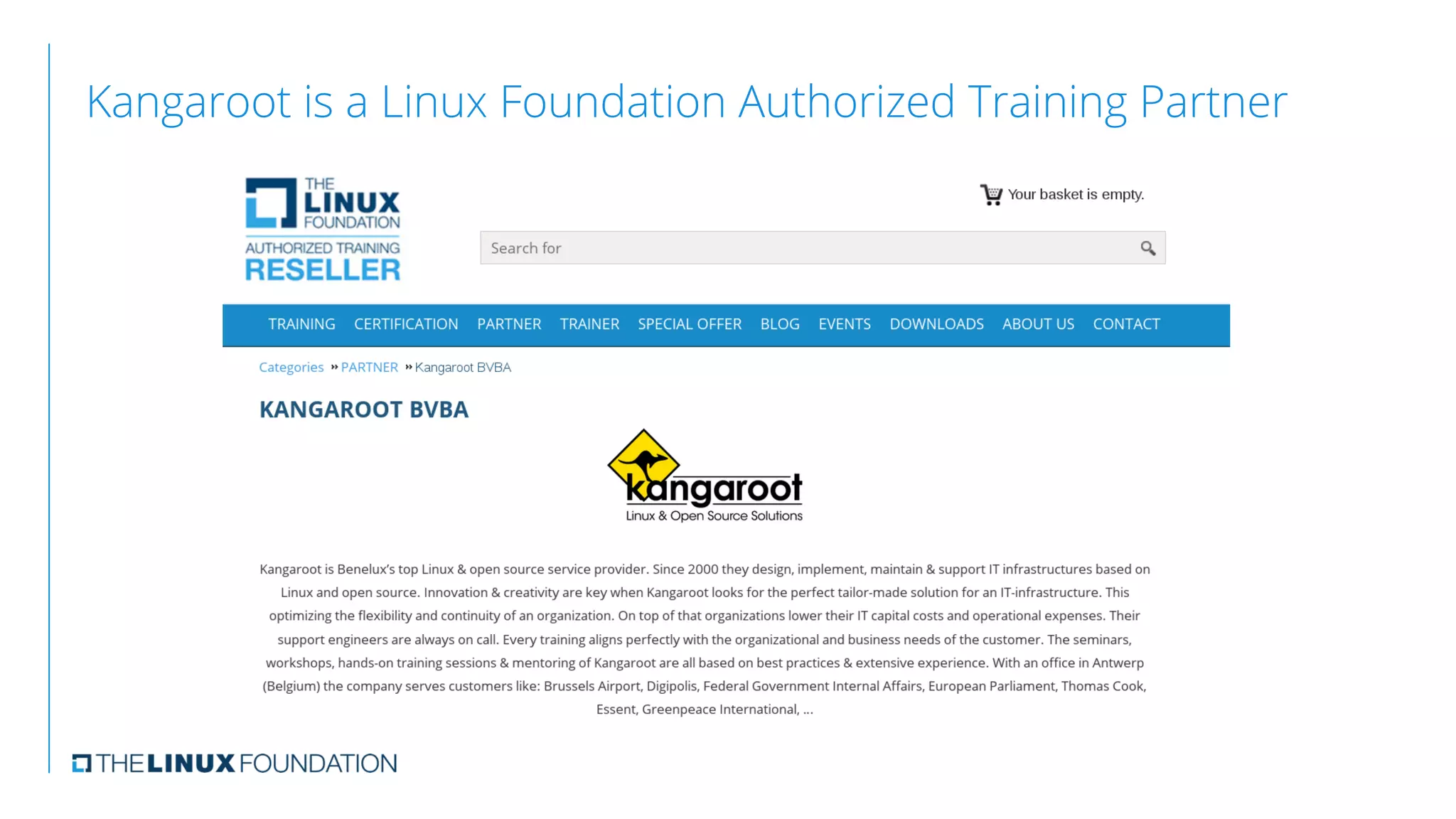
Kangaroot is a Linux Foundation Authorized Training Partner
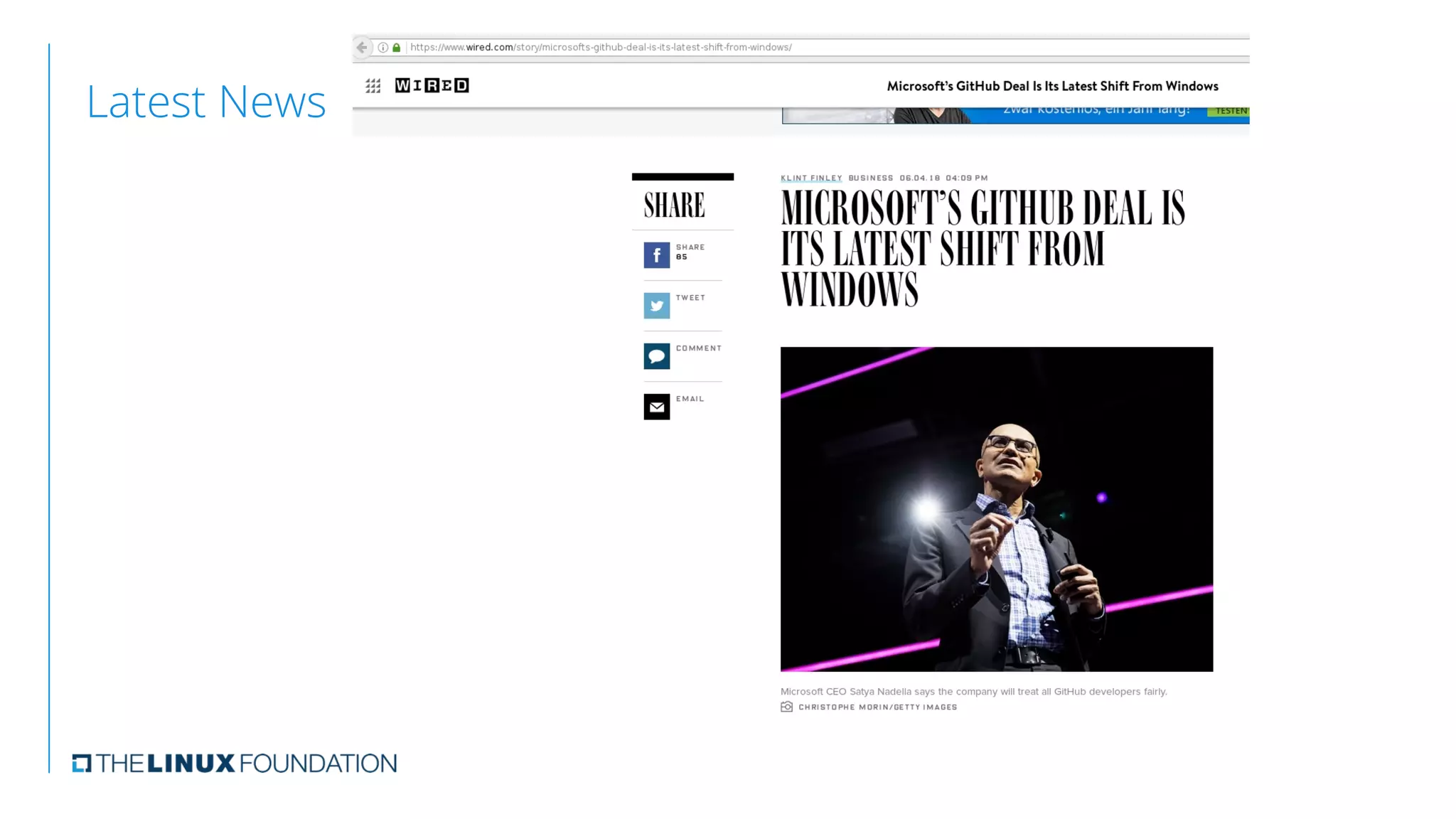
Latest News
Latest News
Latest News
The LF is working with others to increase Linux knowledge
for all audiences
One example is the Microsoft MCSA Azure
Certification “MCSA Linux on Azure”
The LF is working with others to increase Linux knowledge
for all audiences
Purpose of MCSA Linux on Azure:
This certification demonstrates the ability to
design, architect, implement, and maintain
complex cloud-enabled Linux®
solutions that
leverage Microsoft Azure open source
capabilities. It also validates your Linux system
administration skills to show that you are fluent
in today's cloud-native world.
The LF is working with others to increase Linux knowledge
for all audiences

Candidates have to pass two exams to get
the MCSA Linux on Azure:

1. Linux Foundation Certified System
Administrator (LFCS)

2. Implementing Microsoft Azure
Infrastructure Solutions (Exam 70-533)

Cooperation between Microsoft and the LF on training
Results of the cooperation on training between
Microsoft Subsidiaries (Germany, Central&Eastern
Europe, Western Europe and Middle East Africa)
and the Linux Foundation Training EMEAR region:
More than 150 Microsoft employees, mostly
Technical Sellers, have been trained on the Linux
Foundation course “Deploying and Managing Linux
on Azure” (LFS305)
Cooperation between Microsoft and the LF on training
Results of the cooperation on training between
Microsoft Germany and the Linux Foundation
Training in the EMEAR region:
Microsoft Germany created a pilot project to prepare
employees of Microsoft partner companies with
effective and appropriate webcast training and other
measures to become Linux Foundation Certified
System Administrators (LFCS) and to pass the
MCSA: Linux on Azure certification.
Microsoft Open Source Momentum
Growing Cloud Business with leading OSS ISVs
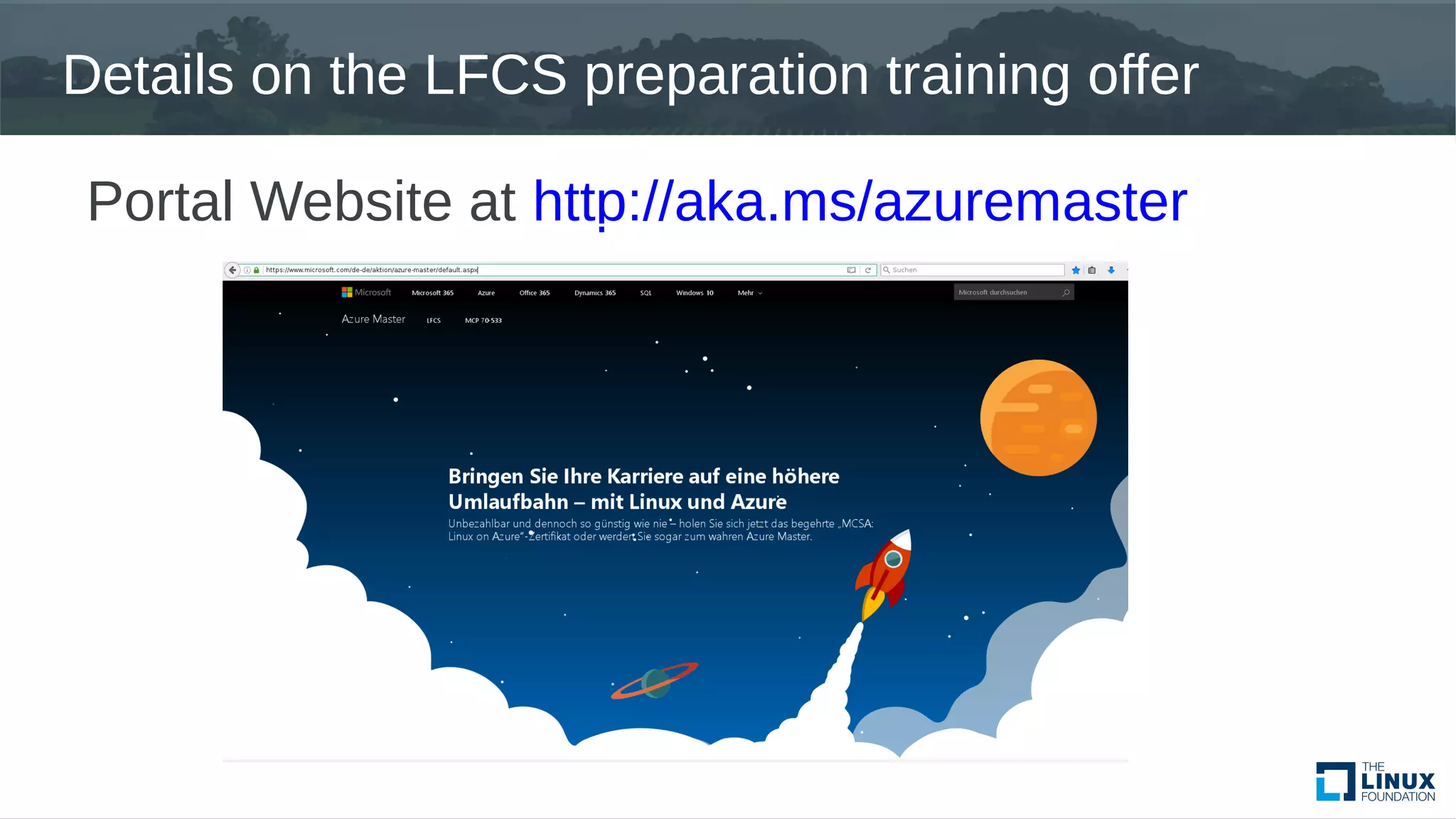
Details on the LFCS preparation training offer
Portal Website at http://aka.ms/azuremaster
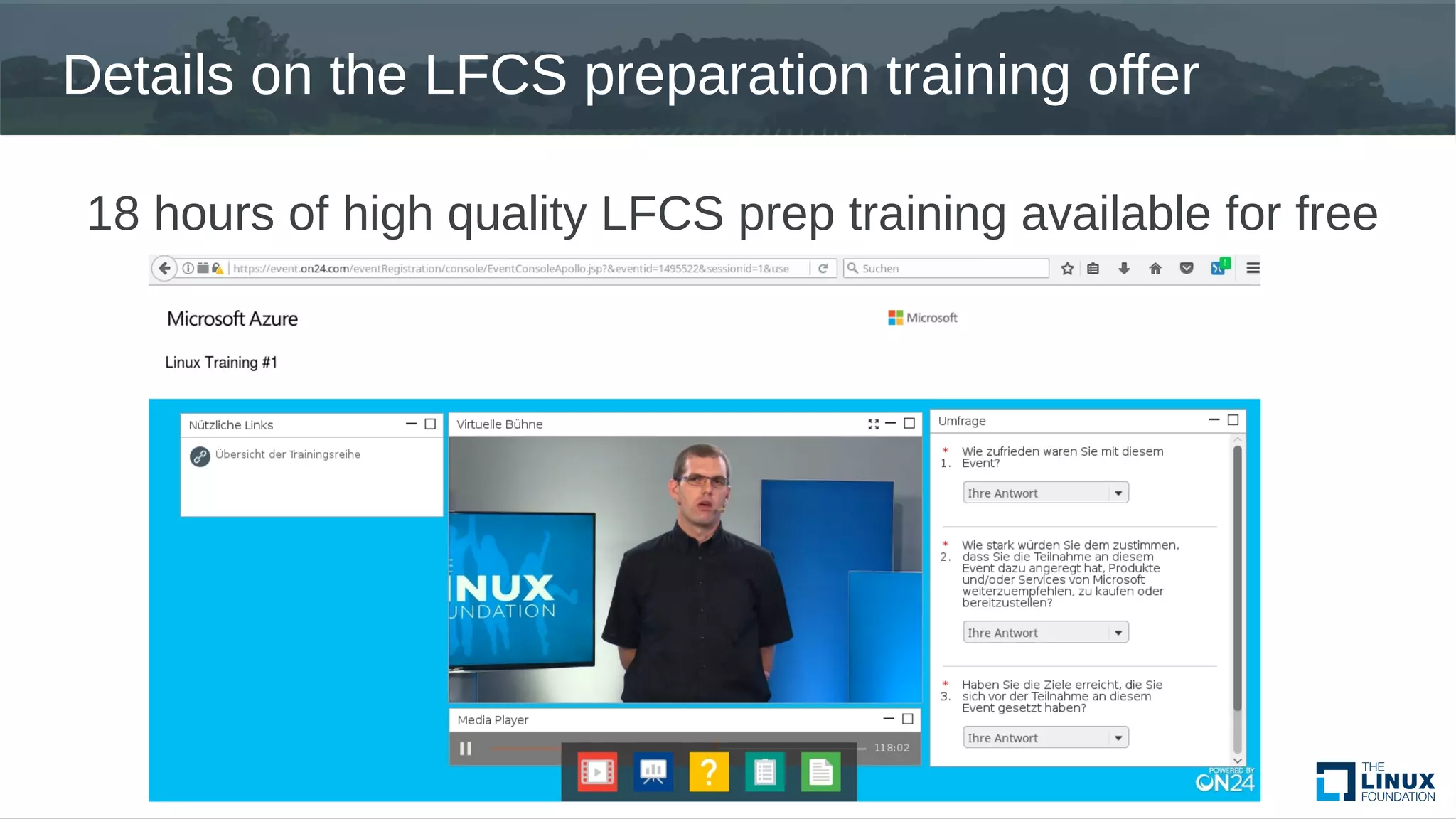
Details on the LFCS preparation training offer
18 hours of high quality LFCS prep training available for free
Details on the LFCS preparation training offer
18 hours of high quality LFCS prep training available for free
Benefits to the ecosystem
Microsoft has continued to broaden and
deepen its commitment to Linux and Open
Source and there are great cultural and
organizational changes going on.
Benefits to the ecosystem
And that means transformation of the partner
network towards adopting and implementing
Linux, Open Source and Cloud Native solutions
with the support of The Linux Foundation which
will help improve the ecosystem.
The Leader in Professional Open Source
Management
The Linux Foundation Training
Regional Contact:
Klaus Behrla
Business Development Director - Training,
EMEAR Region
Email: klaus.behrla@trainlux.eu
Legal Notices
58
The Linux Foundation, The Linux Foundation logos, and other marks that may be used herein are owned by The Linux Foundation or its affiliated entities, and
are subject to The Linux Foundation’s Trademark Usage Policy at www.linuxfoundation.org/trademark-usage, as may be modified from time to time.
Linux is a registered trademark of Linus Torvalds. Please see the Linux Mark Institute’s trademark usage page at lmi.linuxfoundation.org for details regarding
use of this trademark.
Some marks that may be used herein are owned by projects operating as separately incorporated entities managed by The Linux Foundation, and have their
own trademarks, policies and usage guidelines.
TWITTER, TWEET, RETWEET and the Twitter logo are trademarks of Twitter, Inc. or its affiliates.
Facebook and the “f” logo are trademarks of Facebook or its affiliates.
LinkedIn, the LinkedIn logo, the IN logo and InMail are registered trademarks or trademarks of LinkedIn Corporation and its affiliates in the United States
and/or other countries.
YouTube and the YouTube icon are trademarks of YouTube or its affiliates.
All other trademarks are the property of their respective owners. Use of such marks herein does not represent affiliation with or authorization, sponsorship or
approval by such owners unless otherwise expressly specified.
The Linux Foundation is subject to other policies, including without limitation its Privacy Policy at www.linuxfoundation.org/privacy and its Antitrust Policy at
www.linuxfoundation.org/antitrust-policy. each as may be modified from time to time. More information about The Linux Foundation’s policies is available at
www.linuxfoundation.org.
Please email legal@linuxfoundation.org with any questions about The Linux Foundation’s policies or the notices set forth on this slide.

Keynote The Linux Foundation at #OPEN18

  • 1.
    The Linux Foundation Overviewand Training 2018 OPEN '18, Ter Elst, Kontich , 07.06.2018 Speaker: Klaus Behrla, Business Development Director - Training, EMEAR Region, The Linux Foundation
  • 2.
    The Linux FoundationOverview June 7, 2018
  • 3.
    Agenda 1. The LinuxFoundation 2. Demand for Talent 3. Training and Certification 4. Authorized Training Partner Program
  • 4.
    Intro to theLinux Foundation
  • 5.
    Linux Foundation History ˃The Linux Foundation was started in 2000 under the Open Source Development Labs (OSDL) and became the organization it is today when OSDL merged with the Free Standards Group (FSG) in 2007. ˃ The Linux Foundation is home to the largest open source projects in the world and sponsors the work of Linux creator Linus Torvalds. ˃ The Linux Foundation is supported by leading technology firms and developers from around the world. ˃ The Linux Foundation provides infrastructure, legal management, events, training and certification, for open source projects in order grow and sustain them.    
  • 6.
    The Linux Foundationis creating the greatest shared technology investment in history by enabling open source collaboration across companies, developers, and users. We are the organization of choice to build ecosystems that accelerate open technology development and commercial adoption.
  • 7.
    Linux has becomethe most important software in the world 99% Supercomputer Market 62% Embedded Systems Market 90% Mainframe Customers 90% Public Cloud Workload Every market Linux has entered it eventually dominates 82% Smartphone Market Share 2nd To Windows in Enterprise #1 Internet Client
  • 8.
    Today the LinuxFoundation is Much More than Linux… Security We securing the internet as home to world’s largest certificate authority securing100M web sites. Networking We are home to 8 of the top 10 open source networking projects in the world backed by the majority of global network providers. Cloud We are creating a portability layer for the cloud, driving standards and developing reference tools for cloud native development. Automotive Our Automotive Grade Linux platform is backed by 12 automakers and is either in or slated for production in millions of vehicles worldwide. Blockchain We are creating a permanent, secure distributed ledger that makes it easier to create cost-efficient, decentralized business networks. Web We are providing the application development framework for next generation web, mobile, serverless, and IoT applications. Edge/Embedded We are creating projects used in building the majority of embedded Linux distributions and rationalizing edge computing.
  • 9.
    The Linux Foundationis a critical part of the tech ecosystem 800+ Members From 41 Countries 80% of Fortune100 Tech & Telecom 25,000+ Developers Contributing Code 100+ Open Source Projects $15.7B Shared Value We have seen unprecedented growth in our projects
  • 10.
    Cloud Native ComputingFoundation    
  • 11.
    Cloud Native ComputingFoundation    
  • 12.
    Cloud Native ComputingFoundation    
  • 13.
    Cloud Native ComputingFoundation    
  • 14.
    Cloud Native ComputingFoundation    
  • 15.
    Cloud Native ComputingFoundation    
  • 16.
    Cloud Native ComputingFoundation    
  • 17.
    Cloud Native ComputingFoundation    
  • 18.
    Cloud Native ComputingFoundation    
  • 19.
    Demand for OpenSource talent is strong
  • 20.
  • 21.
    The Linux FoundationTraining and Certification
  • 22.
    Early Training/Certification AcceleratesPath#ofindividuals Time Early availability of developer ‘how tos’ accelerates adoption Early availability of SysAdmin Training and Certification draws talent in early and gives employers the confidence to deploy faster Developers DevOps/Admins
  • 23.
    The Linux Foundationhas a platform to build a talent funnel Massive Open Online Courses Self-Paced E-Learning Classroom-Led Certification Testing Custom Instruction
  • 24.
    We Accelerate InnovationThrough Low Cost Training 862,000 Educated Through Free Courses Dozens of Diversity Interns in 2017 250 Annual Scholarships for Students 50 Need-Based Scholarships in 2017 We provide e-learning, skills based certification, and on site training
  • 25.
    LF Training Capabilities Experiencedstaff in place to quickly develop and deploy high quality online, self- paced content (with Instructor led as an option): both Free and Paid Working with LF (and non-LF) hosted projects to accelerate talent development:
  • 26.
    Cloud Networking Systems Administration Security Open SourceDeveloper Compliance Linux Internals We have a cutting edge user and developer catalog Training from the developers of open source technology Example User Training Courses ˃ Introduction to Linux (free through EdX) ˃ Introduction to Cloud Infrastructure Technologies (free through EdX) ˃ Essentials of System Administration ˃ Linux Networking and Administration ˃ Linux Security Fundamentals ˃ OpenStack Administration Fundamentals ˃ Open Source Virtualization Example Developer Training ˃ Compliance Basics for Developers ˃ Introduction to Linux, Open Source Development, and GIT ˃ Developing Applications For Linux ˃ Inside Android: An Intro to Android Internals ˃ Linux Kernel Internals and Development ˃ Developing Linux Device Drivers ˃ Linux Kernel Debugging and Security ˃ Embedded Linux Development We are growing fast for the most up-to-date courses visit – tlftraining.org
  • 27.
    Coming Soon in2018 Hyperledger/ Blockchain Implementing Fabric Fabric Operator Sawtooth Developer Sawtooth Operator Additional Offerings Intro to Linux on Azure DevOps for Network Engineers Cybersecurity for Developers Networking Intro to SDN Technologies Intro to OPNFV Intro to ONAP Advanced OPNFV Advanced ONAP
  • 28.
    LF Certification Capabilities ˃100% online, performance-based exam platform ˃ Deep track record - exams for multiple projects ˃ Experienced staff can work with experts to build and deploy exams ˃ Focus is on entry level Certification, allows specialized providers to thrive
  • 29.
    Kubernetes Certification Programs ˃Certified Kubernetes Administrator (CKA) Program ˃ Certified Kubernetes Application Developer (CKAD) Program ˃ Kubernetes Certified Service Provider
  • 30.
    Your Career PathTraining Gateway
  • 31.
    Kernel Development › LFD301 Introductionto Linux, Open Source Development, and GIT › LFD415 Inside Android: An Intro to Android Internals › LFD420 Linux Kernel Internals and Development › LFD430 Developing Linux Device Drivers › LFD432 Optimizing Linux Device Drivers for › Power Efficiency › LFD440 Linux Kernel Debugging and Security
  • 32.
    Embedded Development › LFD301 Introductionto Linux, Open Source Development, and GIT › LFD435 Developing Embedded Linux › Device Drivers › LFD450 Embedded Linux Development › LFD460 Embedded Linux Development with › Yocto Project
  • 33.
    Application Development › LFD401 DevelopingApplications For Linux › LFS171 Blockchain for Business - An Introduction to Hyperledger Technologies › LFS232 Cloud Foundry for Developers › LFS254 Containers for Developers and › Quality Assurance
  • 34.
    Systems Engineering/ Architecture › LFS201Essentials of Linux System Administration › LFS211 Linux Networking and Administration › LFS216 Linux Security Fundamentals › LFS311 Advanced Linux System Administration and Networking › LFS422 High Availability Linux Architecture › LFS430 Linux Enterprise Automation › LFS462 Open Source Virtualization
  • 35.
    System Administration › LFS101 Introductionto Linux › LFS158 Introduction to Kubernetes › LFS201 Essentials of Linux System Administration › LFS205 Administering Linux on Azure › LFS211 Linux Networking and Administration › LFS216 Linux Security Fundamentals › LFS258 Kubernetes Fundamentals › LFS300 Fundamentals of Linux › LFS301 Linux System Administration › LFS305 Deploying and Managing Linux on Azure › LFS311 Advanced Linux System Administration and Networking › LFS416 Linux Security › LFS422 High Availability Linux Architecture › LFS426 Linux Performance Tuning › LFS430 Linux Enterprise Automation › LFS458 Kubernetes Administration › LFS462 Open Source Virtualization
  • 36.
    DevOps/ Site Reliability ›LFS158 Introduction to Kubernetes › LFS161 Introduction to DevOps: Transforming and Improving Operations › LFS201 Essentials of Linux System Administration › LFS216 Linux Security Fundamentals › LFS253 Containers Fundamentals › LFS254 Containers for Developers and Quality Assurance › LFS258 Kubernetes Fundamentals › LFS261 Implementing Continuous Delivery › LFS458 Kubernetes Administration
  • 37.
    Cloud & Containers › LFS132Introduction to Cloud Foundry and Cloud Native Software Architecture › LFS151 Introduction to Cloud Infrastructure Technologies › LFS152 Introduction to OpenStack › LFS201 Essentials of Linux System › Administration › LFS216 Linux Security Fundamentals › LFS232 Cloud Foundry for Developers › LFS252 OpenStack Administration › Fundamentals › LFS452 Essentials of OpenStack › Administration › LFS457 Advanced OpenStack › Administration
  • 38.
    Networking LFS201 Essentials ofLinux System › Administration › LFS211 Linux Networking and Administration › LFS265 Software Defined Networking Fundamentals › LFS465 Software Defined Networking with OpenDaylight
  • 39.
    Blockchain › LFS171 Blockchainfor Business - An Introduction to Hyperledger Technologies
  • 40.
    8/14/201 7 The Linux FoundationInternal Use Only 40 Becoming a Linux Foundation ATP
  • 41.
    Kangaroot is aLinux Foundation Authorized Training Partner
  • 42.
  • 43.
  • 44.
  • 45.
    The LF isworking with others to increase Linux knowledge for all audiences One example is the Microsoft MCSA Azure Certification “MCSA Linux on Azure”
  • 46.
    The LF isworking with others to increase Linux knowledge for all audiences Purpose of MCSA Linux on Azure: This certification demonstrates the ability to design, architect, implement, and maintain complex cloud-enabled Linux® solutions that leverage Microsoft Azure open source capabilities. It also validates your Linux system administration skills to show that you are fluent in today's cloud-native world.
  • 47.
    The LF isworking with others to increase Linux knowledge for all audiences  Candidates have to pass two exams to get the MCSA Linux on Azure:  1. Linux Foundation Certified System Administrator (LFCS)  2. Implementing Microsoft Azure Infrastructure Solutions (Exam 70-533) 
  • 48.
    Cooperation between Microsoftand the LF on training Results of the cooperation on training between Microsoft Subsidiaries (Germany, Central&Eastern Europe, Western Europe and Middle East Africa) and the Linux Foundation Training EMEAR region: More than 150 Microsoft employees, mostly Technical Sellers, have been trained on the Linux Foundation course “Deploying and Managing Linux on Azure” (LFS305)
  • 49.
    Cooperation between Microsoftand the LF on training Results of the cooperation on training between Microsoft Germany and the Linux Foundation Training in the EMEAR region: Microsoft Germany created a pilot project to prepare employees of Microsoft partner companies with effective and appropriate webcast training and other measures to become Linux Foundation Certified System Administrators (LFCS) and to pass the MCSA: Linux on Azure certification.
  • 50.
  • 51.
    Growing Cloud Businesswith leading OSS ISVs
  • 52.
    Details on theLFCS preparation training offer Portal Website at http://aka.ms/azuremaster
  • 53.
    Details on theLFCS preparation training offer 18 hours of high quality LFCS prep training available for free
  • 54.
    Details on theLFCS preparation training offer 18 hours of high quality LFCS prep training available for free
  • 55.
    Benefits to theecosystem Microsoft has continued to broaden and deepen its commitment to Linux and Open Source and there are great cultural and organizational changes going on.
  • 56.
    Benefits to theecosystem And that means transformation of the partner network towards adopting and implementing Linux, Open Source and Cloud Native solutions with the support of The Linux Foundation which will help improve the ecosystem.
  • 57.
    The Leader inProfessional Open Source Management The Linux Foundation Training Regional Contact: Klaus Behrla Business Development Director - Training, EMEAR Region Email: klaus.behrla@trainlux.eu
  • 58.
    Legal Notices 58 The LinuxFoundation, The Linux Foundation logos, and other marks that may be used herein are owned by The Linux Foundation or its affiliated entities, and are subject to The Linux Foundation’s Trademark Usage Policy at www.linuxfoundation.org/trademark-usage, as may be modified from time to time. Linux is a registered trademark of Linus Torvalds. Please see the Linux Mark Institute’s trademark usage page at lmi.linuxfoundation.org for details regarding use of this trademark. Some marks that may be used herein are owned by projects operating as separately incorporated entities managed by The Linux Foundation, and have their own trademarks, policies and usage guidelines. TWITTER, TWEET, RETWEET and the Twitter logo are trademarks of Twitter, Inc. or its affiliates. Facebook and the “f” logo are trademarks of Facebook or its affiliates. LinkedIn, the LinkedIn logo, the IN logo and InMail are registered trademarks or trademarks of LinkedIn Corporation and its affiliates in the United States and/or other countries. YouTube and the YouTube icon are trademarks of YouTube or its affiliates. All other trademarks are the property of their respective owners. Use of such marks herein does not represent affiliation with or authorization, sponsorship or approval by such owners unless otherwise expressly specified. The Linux Foundation is subject to other policies, including without limitation its Privacy Policy at www.linuxfoundation.org/privacy and its Antitrust Policy at www.linuxfoundation.org/antitrust-policy. each as may be modified from time to time. More information about The Linux Foundation’s policies is available at www.linuxfoundation.org. Please email legal@linuxfoundation.org with any questions about The Linux Foundation’s policies or the notices set forth on this slide.