OpenChain Webinar Series
An Overview of Joint Development Foundation
OpenChain Specification Submission to ISO/IEC/JTC1
Seth Newberry – General Manager of Standards - JDF
August 17, 2020
Open Source and Open Standards
• Open Standards are specifications made available to the public, which
are developed and maintained via an neutral, consensus-driven
process. Open Standards facilitate interoperability and data exchange
among different products or services and are intended for
widespread adoption.
• Open source software is defined by the OSI’s Open Source Definition.
In practice, we generally care more about communities that form to
work on open source software in a public, transparent collaboration
where the code evolves over time to address new use cases, features,
requirements, and gaps.
2020 Joint Development Foundation 2
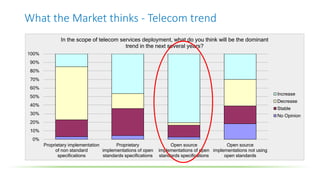
What the Market thinks - Telecom trend
0%
10%
20%
30%
40%
50%
60%
70%
80%
90%
100%
Proprietary implementation
of non standard
specifications
Proprietary
implementations of open
standards specifications
Open source
implementations of open
standards specifications
Open source
implementations not using
open standards
In the scope of telecom services deployment, what do you think will be the dominant
trend in the next several years?
Increase
Decrease
Stable
No Opinion
JDF Value Proposition
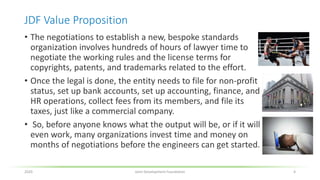
• The negotiations to establish a new, bespoke standards
organization involves hundreds of hours of lawyer time to
negotiate the working rules and the license terms for
copyrights, patents, and trademarks related to the effort.
• Once the legal is done, the entity needs to file for non-profit
status, set up bank accounts, set up accounting, finance, and
HR operations, collect fees from its members, and file its
taxes, just like a commercial company.
• So, before anyone knows what the output will be, or if it will
even work, many organizations invest time and money on
months of negotiations before the engineers can get started.
2020 Joint Development Foundation 4
JDF Value Proposition
• JDF provides a “standards organization in a box.” Just pick a few menu
options, give the effort a name and off you go creating specifications.
• JDF replaces custom negotiation with a “check the box” model. The
model allows JDF projects to be customized to meet the needs of the
community, without resorting to time-consuming line-by-line
negotiations.
• And once those terms are in place, the new project is formed as a
“subsidiary” entity under the non-profit JDF umbrella, eliminating the
setup of a bespoke legal non-profit. You can be up and running in a
few weeks.
• The cost of this effort is so low that a specification project can be
established without any funding needed for the creation or ongoing
entity management.
2020 Joint Development Foundation 5
JDF Community Specifications
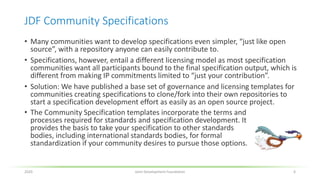
• Many communities want to develop specifications even simpler, “just like open
source”, with a repository anyone can easily contribute to.
• Specifications, however, entail a different licensing model as most specification
communities want all participants bound to the final specification output, which is
different from making IP commitments limited to “just your contribution”.
• Solution: We have published a base set of governance and licensing templates for
communities creating specifications to clone/fork into their own repositories to
start a specification development effort as easily as an open source project.
2020 Joint Development Foundation 6
• The Community Specification templates incorporate the terms and
processes required for standards and specification development. It
provides the basis to take your specification to other standards
bodies, including international standards bodies, for formal
standardization if your community desires to pursue those options.
JDF Community Specifications
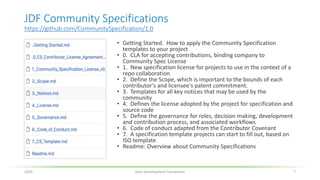
https://github.com/CommunitySpecification/1.0
• Getting Started. How to apply the Community Specification
templates to your project
• 0. CLA for accepting contributions, binding company to
Community Spec License
• 1. New specification license for projects to use in the context of a
repo collaboration
• 2. Define the Scope, which is important to the bounds of each
contributor's and licensee's patent commitment.
• 3. Templates for all key notices that may be used by the
community
• 4. Defines the license adopted by the project for specification and
source code
• 5. Define the governance for roles, decision making, development
and contribution process, and associated workflows
• 6. Code of conduct adapted from the Contributor Covenant
• 7. A specification template projects can start to fill out, based on
ISO template
• Readme: Overview about Community Specifications
2020 Joint Development Foundation 7
ISO Publicly Available Specifications (PAS)
• ISO is an international organization with a membership of 164 national
standards bodies. Its standards are among the most universally recognized
throughout the world.
• The IEC (International Electrotechnical Commission) is the world’s leading
organization for the preparation and publication of International Standards
for all electrical, electronic, and related technologies.
• ISO and IEC joined together to create ISO/IEC JTC 1, which is the
international group dedicated to developing worldwide Information and
Technology (ICT) standards.
• The Publicly Available Specification (“PAS”) process was created by a
collaboration between ISO/IEC JTC 1 to allow for transposition of technical
specifications from recognized standards bodies, which will enable them to
become an ISO/IEC recognized standard.
• And once ISO/IEC JTC 1 approves a PAS submission, it becomes an
international standard.
2020 Joint Development Foundation 8
Getting a Specification ready to submit to JTC1
• ISO has an incredibly specific and arcane format for
the physical appearance of the document.
• Typically JDF takes the source document from the LF
project and converts it into a compliant format. We
have a specialist editor to perform that work.
2020 Joint Development Foundation 9
• JDF-I project sets up a Working Group for each Specification from
each Project. That allows us to define inbound and outbound
copyright licenses with the objective of ensuring a contiguous, bi-
directional pipeline that ensures ownership and maintenance of the
Specification by OpenChain.
• LF Project Spec > JDF-I WG > JTC1.
Open Chain @ ISO
• Open Chain submitted its Specification to JTC1 in February 2020.
• The OpenChain PAS submission is in Geneva and being processed. It
has appeared in the ISO database with information that the DIS ballot
will launch on 2020-06-30 and conclude on 2020-09-22. Prior to this
there was an eight week period when National Standards Bodies can
translate the document into their native language.
• We can expect to see a comments document that may require some
changes to the specification. ISO tends to act at the last minute, so
expect to see questions around mid-Sept.
• OpenChain can make changes mid-stream as well if we discover
errata.
2020 Joint Development Foundation 10
SPDX is On-Deck
• The Linux Foundation SPDX (version 2.2.1) is our second specification
to be submitted through the JDF to ISO/IEC JTC 1 for approval.
• In brief, the Software Package Data Exchange (SPDX) is an open
standard for communicating software bill of material information,
including components, licenses, copyrights, and security references.
• The document is much longer (150 pages) and is in the very final fine-
tuning stage. We expect to send it into JTC1 late this week.
2020 Joint Development Foundation 11
Thank You
• JDF is always interested in helping projects add a Specification to their body
of work.
• Contact us if you think you might see an opportunity or a need in your
communities.
• We are happy to help however we can.
• Thank you for listening
Seth Newberry
snewberry@contractor.linuxfoundation.org
2020 Joint Development Foundation 12

OpenChain Webinar #10 - Joint Development Foundation - 2020-08-17

  • 1.
    OpenChain Webinar Series AnOverview of Joint Development Foundation OpenChain Specification Submission to ISO/IEC/JTC1 Seth Newberry – General Manager of Standards - JDF August 17, 2020
  • 2.
    Open Source andOpen Standards • Open Standards are specifications made available to the public, which are developed and maintained via an neutral, consensus-driven process. Open Standards facilitate interoperability and data exchange among different products or services and are intended for widespread adoption. • Open source software is defined by the OSI’s Open Source Definition. In practice, we generally care more about communities that form to work on open source software in a public, transparent collaboration where the code evolves over time to address new use cases, features, requirements, and gaps. 2020 Joint Development Foundation 2
  • 3.
    What the Marketthinks - Telecom trend 0% 10% 20% 30% 40% 50% 60% 70% 80% 90% 100% Proprietary implementation of non standard specifications Proprietary implementations of open standards specifications Open source implementations of open standards specifications Open source implementations not using open standards In the scope of telecom services deployment, what do you think will be the dominant trend in the next several years? Increase Decrease Stable No Opinion
  • 4.
    JDF Value Proposition •The negotiations to establish a new, bespoke standards organization involves hundreds of hours of lawyer time to negotiate the working rules and the license terms for copyrights, patents, and trademarks related to the effort. • Once the legal is done, the entity needs to file for non-profit status, set up bank accounts, set up accounting, finance, and HR operations, collect fees from its members, and file its taxes, just like a commercial company. • So, before anyone knows what the output will be, or if it will even work, many organizations invest time and money on months of negotiations before the engineers can get started. 2020 Joint Development Foundation 4
  • 5.
    JDF Value Proposition •JDF provides a “standards organization in a box.” Just pick a few menu options, give the effort a name and off you go creating specifications. • JDF replaces custom negotiation with a “check the box” model. The model allows JDF projects to be customized to meet the needs of the community, without resorting to time-consuming line-by-line negotiations. • And once those terms are in place, the new project is formed as a “subsidiary” entity under the non-profit JDF umbrella, eliminating the setup of a bespoke legal non-profit. You can be up and running in a few weeks. • The cost of this effort is so low that a specification project can be established without any funding needed for the creation or ongoing entity management. 2020 Joint Development Foundation 5
  • 6.
    JDF Community Specifications •Many communities want to develop specifications even simpler, “just like open source”, with a repository anyone can easily contribute to. • Specifications, however, entail a different licensing model as most specification communities want all participants bound to the final specification output, which is different from making IP commitments limited to “just your contribution”. • Solution: We have published a base set of governance and licensing templates for communities creating specifications to clone/fork into their own repositories to start a specification development effort as easily as an open source project. 2020 Joint Development Foundation 6 • The Community Specification templates incorporate the terms and processes required for standards and specification development. It provides the basis to take your specification to other standards bodies, including international standards bodies, for formal standardization if your community desires to pursue those options.
  • 7.
    JDF Community Specifications https://github.com/CommunitySpecification/1.0 •Getting Started. How to apply the Community Specification templates to your project • 0. CLA for accepting contributions, binding company to Community Spec License • 1. New specification license for projects to use in the context of a repo collaboration • 2. Define the Scope, which is important to the bounds of each contributor's and licensee's patent commitment. • 3. Templates for all key notices that may be used by the community • 4. Defines the license adopted by the project for specification and source code • 5. Define the governance for roles, decision making, development and contribution process, and associated workflows • 6. Code of conduct adapted from the Contributor Covenant • 7. A specification template projects can start to fill out, based on ISO template • Readme: Overview about Community Specifications 2020 Joint Development Foundation 7
  • 8.
    ISO Publicly AvailableSpecifications (PAS) • ISO is an international organization with a membership of 164 national standards bodies. Its standards are among the most universally recognized throughout the world. • The IEC (International Electrotechnical Commission) is the world’s leading organization for the preparation and publication of International Standards for all electrical, electronic, and related technologies. • ISO and IEC joined together to create ISO/IEC JTC 1, which is the international group dedicated to developing worldwide Information and Technology (ICT) standards. • The Publicly Available Specification (“PAS”) process was created by a collaboration between ISO/IEC JTC 1 to allow for transposition of technical specifications from recognized standards bodies, which will enable them to become an ISO/IEC recognized standard. • And once ISO/IEC JTC 1 approves a PAS submission, it becomes an international standard. 2020 Joint Development Foundation 8
  • 9.
    Getting a Specificationready to submit to JTC1 • ISO has an incredibly specific and arcane format for the physical appearance of the document. • Typically JDF takes the source document from the LF project and converts it into a compliant format. We have a specialist editor to perform that work. 2020 Joint Development Foundation 9 • JDF-I project sets up a Working Group for each Specification from each Project. That allows us to define inbound and outbound copyright licenses with the objective of ensuring a contiguous, bi- directional pipeline that ensures ownership and maintenance of the Specification by OpenChain. • LF Project Spec > JDF-I WG > JTC1.
  • 10.
    Open Chain @ISO • Open Chain submitted its Specification to JTC1 in February 2020. • The OpenChain PAS submission is in Geneva and being processed. It has appeared in the ISO database with information that the DIS ballot will launch on 2020-06-30 and conclude on 2020-09-22. Prior to this there was an eight week period when National Standards Bodies can translate the document into their native language. • We can expect to see a comments document that may require some changes to the specification. ISO tends to act at the last minute, so expect to see questions around mid-Sept. • OpenChain can make changes mid-stream as well if we discover errata. 2020 Joint Development Foundation 10
  • 11.
    SPDX is On-Deck •The Linux Foundation SPDX (version 2.2.1) is our second specification to be submitted through the JDF to ISO/IEC JTC 1 for approval. • In brief, the Software Package Data Exchange (SPDX) is an open standard for communicating software bill of material information, including components, licenses, copyrights, and security references. • The document is much longer (150 pages) and is in the very final fine- tuning stage. We expect to send it into JTC1 late this week. 2020 Joint Development Foundation 11
  • 12.
    Thank You • JDFis always interested in helping projects add a Specification to their body of work. • Contact us if you think you might see an opportunity or a need in your communities. • We are happy to help however we can. • Thank you for listening Seth Newberry snewberry@contractor.linuxfoundation.org 2020 Joint Development Foundation 12