KEY TRENDS OF STRATEGIC SOURCING
• Executive summary
• Role of Analytics
• Defining digital procurement
• Digital Technologies and Capabilities
• The digital imperative
• Trends in procurement
• Post COVID era
• Conclusion
Executive summary
The sourcing ecosystem across all organizations has grown
significantly in recent years. More and more outsourcing projects have
been initiated and realized, creating significant complexity alongside
the requirement for agility and flexibility. In parallel, governance and
regulatory costs in financial institutions have increased. In
consequence, the sourcing operating models used in organizations are
no longer fit for purpose.
Today, organizations face many diverse and ever- changing trends and
moves in sourcing, which have a high impact on the sourcing
operating model. Instead of implementing all actions, organizations
need to focus and prioritize so that they can achieve effective
transformations and benefits for their business
To realize and maximize the potential benefits of the sourcing trends
and moves available, the Deloitte “Sourcing Trend Management”
approach provides proven methods and tools to target actions
and provide the greatest benefit to organizations. Our approach leads
organizations towards a more efficient, less complex and less cost-
intensive sourcing operating model.
Key Trends in strategic sourcing
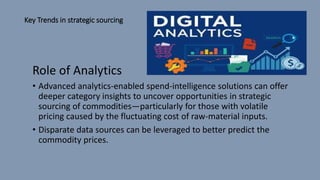
Role of Analytics
• Advanced analytics-enabled spend-intelligence solutions can offer
deeper category insights to uncover opportunities in strategic
sourcing of commodities—particularly for those with volatile
pricing caused by the fluctuating cost of raw-material inputs.
• Disparate data sources can be leveraged to better predict the
commodity prices.
Defining digital procurement
Digital procurement is the application of disruptive technologies that enable
Strategic Sourcing (S2C) to become predictive, Transactional Procurement
(P2P) to become automated, and Supplier Management (SM) to become
proactive.
• Categorize and manage spend in real time, leveraging machine learning
• Predict demand with artificial intelligence
• Know landed cost for any commodity for all alternate countries of origin
• Predict future sources of supply
• Act on timely alerts from all negotiated agreements (e.g., indexed pricing,
penalties, renewals) through smart contracts
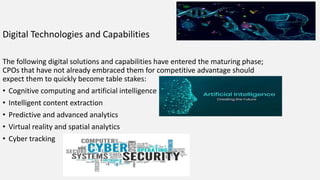
Digital Technologies and Capabilities
The following digital solutions and capabilities have entered the maturing phase;
CPOs that have not already embraced them for competitive advantage should
expect them to quickly become table stakes:
• Cognitive computing and artificial intelligence
• Intelligent content extraction
• Predictive and advanced analytics
• Virtual reality and spatial analytics
• Cyber tracking
• There is no end in sight to the growing pace of technological innovation fueling
an expanding pipeline of digital procurement solutions.
• Procurement leaders should expect a rapid pace of change and continued
evolution of the procurement function.
• Leaders that are able to adopt these solutions have the opportunity to execute on
their main missions with radically greater insight and efficiency.
Trends in procurement
• Procurement’s contribution to the overall organizational strategy will create competitive
advantage
Leading procurement functions will become part of an organization’s value stream and will be
more influential in contributing to the overall business strategy, growth agenda, and competitive
advantage,” EY says, adding that procurement leaders will be expanding their remit from a focus on
cost leadership to enabling innovation, agility, and supply certainty
• Procurement will be a smaller, more agile function that partners directly with business units
More activity will take place in the organization’s “virtual center,” EY predicts, and with people
who are geographically embedded within business units—thus meeting the need for increased
collaboration
• “Touchless” procurement will gain in popularity over the next 24 months.
Captured via IoT, procurement data will be used to support real-time
tracking and monitoring of outcomes through continuous feedback
loops across assets. “Asset-intensive industries will effectively link this
data across the enterprise and connect to suppliers.
• COVID will continue to create problem areas
Of course, this all comes with the caveat that in some parts of the
world, and the U.S. in particular, the COVID crisis is holding steady or
even getting worse, and that will continue to have a major impact on
procurement efforts around the globe, according to Spend Matters.
Post COVID era
The COVID-19 pandemic has put an enormous strain on global supply chains, at times halting
manufacturing while shutting down airports and seaports, interrupting delivery of raw materials
and finished goods. At the pandemic’s onset, procurement departments switched to crisis-
management mode to help companies alleviate disruptions, including sourcing personal protective
gear for employees and helping smaller suppliers manage their cash flow.
Our analysis suggests that procurement could gain the most by focusing its strategic initiatives in five key
areas
• strengthening supply-chain resilience
• zero-basing the design of category value-creation strategies
• investing in supplier partnerships and innovation
• transforming to an agile operating model
By proactively making these changes, procurement leaders can not only counter some of the worst
effects of the crisis, but can also set themselves up to prosper in the future.
Conclusion
Organizations must determine the right mix of resilience that they want
to build into their products and revisit their supply chain strategy to
ensure that resilience is embedded into research and development,
product design, and planning. By focusing on building resilience
comprehensively, and ensuring it is not seen as an afterthought,
organizations can be better prepared for whatever the future brings

Key trend in strategic sourcing

  • 1.
    KEY TRENDS OFSTRATEGIC SOURCING
  • 2.
    • Executive summary •Role of Analytics • Defining digital procurement • Digital Technologies and Capabilities • The digital imperative • Trends in procurement • Post COVID era • Conclusion
  • 3.
    Executive summary The sourcingecosystem across all organizations has grown significantly in recent years. More and more outsourcing projects have been initiated and realized, creating significant complexity alongside the requirement for agility and flexibility. In parallel, governance and regulatory costs in financial institutions have increased. In consequence, the sourcing operating models used in organizations are no longer fit for purpose.
  • 4.
    Today, organizations facemany diverse and ever- changing trends and moves in sourcing, which have a high impact on the sourcing operating model. Instead of implementing all actions, organizations need to focus and prioritize so that they can achieve effective transformations and benefits for their business To realize and maximize the potential benefits of the sourcing trends and moves available, the Deloitte “Sourcing Trend Management” approach provides proven methods and tools to target actions and provide the greatest benefit to organizations. Our approach leads organizations towards a more efficient, less complex and less cost- intensive sourcing operating model.
  • 5.
    Key Trends instrategic sourcing Role of Analytics • Advanced analytics-enabled spend-intelligence solutions can offer deeper category insights to uncover opportunities in strategic sourcing of commodities—particularly for those with volatile pricing caused by the fluctuating cost of raw-material inputs. • Disparate data sources can be leveraged to better predict the commodity prices.
  • 6.
    Defining digital procurement Digitalprocurement is the application of disruptive technologies that enable Strategic Sourcing (S2C) to become predictive, Transactional Procurement (P2P) to become automated, and Supplier Management (SM) to become proactive. • Categorize and manage spend in real time, leveraging machine learning • Predict demand with artificial intelligence • Know landed cost for any commodity for all alternate countries of origin • Predict future sources of supply • Act on timely alerts from all negotiated agreements (e.g., indexed pricing, penalties, renewals) through smart contracts
  • 7.
    Digital Technologies andCapabilities The following digital solutions and capabilities have entered the maturing phase; CPOs that have not already embraced them for competitive advantage should expect them to quickly become table stakes: • Cognitive computing and artificial intelligence • Intelligent content extraction • Predictive and advanced analytics • Virtual reality and spatial analytics • Cyber tracking
  • 8.
    • There isno end in sight to the growing pace of technological innovation fueling an expanding pipeline of digital procurement solutions. • Procurement leaders should expect a rapid pace of change and continued evolution of the procurement function. • Leaders that are able to adopt these solutions have the opportunity to execute on their main missions with radically greater insight and efficiency.
  • 9.
    Trends in procurement •Procurement’s contribution to the overall organizational strategy will create competitive advantage Leading procurement functions will become part of an organization’s value stream and will be more influential in contributing to the overall business strategy, growth agenda, and competitive advantage,” EY says, adding that procurement leaders will be expanding their remit from a focus on cost leadership to enabling innovation, agility, and supply certainty • Procurement will be a smaller, more agile function that partners directly with business units More activity will take place in the organization’s “virtual center,” EY predicts, and with people who are geographically embedded within business units—thus meeting the need for increased collaboration
  • 10.
    • “Touchless” procurementwill gain in popularity over the next 24 months. Captured via IoT, procurement data will be used to support real-time tracking and monitoring of outcomes through continuous feedback loops across assets. “Asset-intensive industries will effectively link this data across the enterprise and connect to suppliers. • COVID will continue to create problem areas Of course, this all comes with the caveat that in some parts of the world, and the U.S. in particular, the COVID crisis is holding steady or even getting worse, and that will continue to have a major impact on procurement efforts around the globe, according to Spend Matters.
  • 11.
    Post COVID era TheCOVID-19 pandemic has put an enormous strain on global supply chains, at times halting manufacturing while shutting down airports and seaports, interrupting delivery of raw materials and finished goods. At the pandemic’s onset, procurement departments switched to crisis- management mode to help companies alleviate disruptions, including sourcing personal protective gear for employees and helping smaller suppliers manage their cash flow. Our analysis suggests that procurement could gain the most by focusing its strategic initiatives in five key areas • strengthening supply-chain resilience • zero-basing the design of category value-creation strategies • investing in supplier partnerships and innovation • transforming to an agile operating model By proactively making these changes, procurement leaders can not only counter some of the worst effects of the crisis, but can also set themselves up to prosper in the future.
  • 12.
    Conclusion Organizations must determinethe right mix of resilience that they want to build into their products and revisit their supply chain strategy to ensure that resilience is embedded into research and development, product design, and planning. By focusing on building resilience comprehensively, and ensuring it is not seen as an afterthought, organizations can be better prepared for whatever the future brings