Key Elements of the Epistemology of Engineering Design
1.
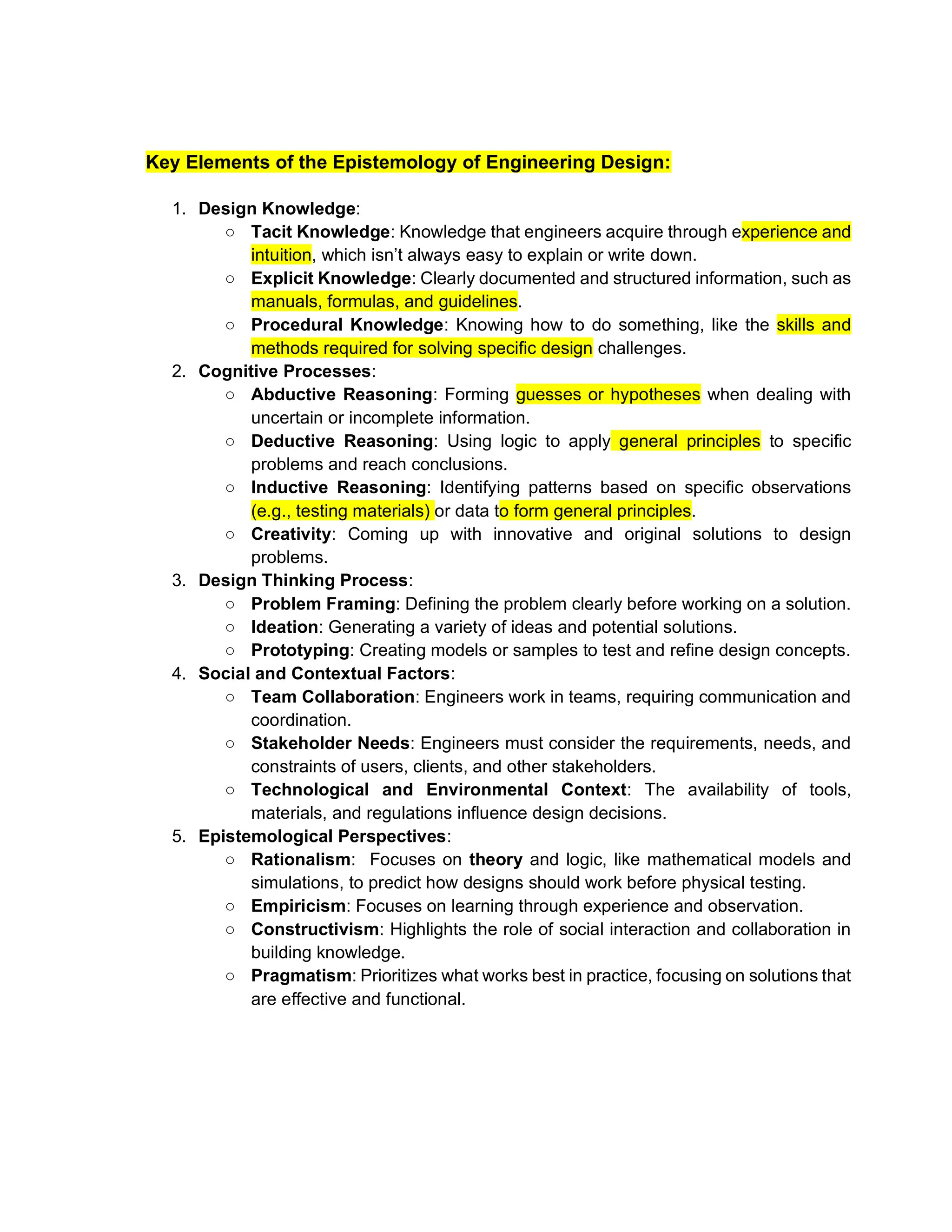
Key Elements ofthe Epistemology of Engineering Design:
1. Design Knowledge:
○ Tacit Knowledge: Knowledge that engineers acquire through experience and
intuition, which isn’t always easy to explain or write down.
○ Explicit Knowledge: Clearly documented and structured information, such as
manuals, formulas, and guidelines.
○ Procedural Knowledge: Knowing how to do something, like the skills and
methods required for solving specific design challenges.
2. Cognitive Processes:
○ Abductive Reasoning: Forming guesses or hypotheses when dealing with
uncertain or incomplete information.
○ Deductive Reasoning: Using logic to apply general principles to specific
problems and reach conclusions.
○ Inductive Reasoning: Identifying patterns based on specific observations
(e.g., testing materials) or data to form general principles.
○ Creativity: Coming up with innovative and original solutions to design
problems.
3. Design Thinking Process:
○ Problem Framing: Defining the problem clearly before working on a solution.
○ Ideation: Generating a variety of ideas and potential solutions.
○ Prototyping: Creating models or samples to test and refine design concepts.
4. Social and Contextual Factors:
○ Team Collaboration: Engineers work in teams, requiring communication and
coordination.
○ Stakeholder Needs: Engineers must consider the requirements, needs, and
constraints of users, clients, and other stakeholders.
○ Technological and Environmental Context: The availability of tools,
materials, and regulations influence design decisions.
5. Epistemological Perspectives:
○ Rationalism: Focuses on theory and logic, like mathematical models and
simulations, to predict how designs should work before physical testing.
○ Empiricism: Focuses on learning through experience and observation.
○ Constructivism: Highlights the role of social interaction and collaboration in
building knowledge.
○ Pragmatism: Prioritizes what works best in practice, focusing on solutions that
are effective and functional.