Webinar
From Delivery to Impact: How Programs and Portfolios
Create Strategic Value
Consulting and Training Company E5
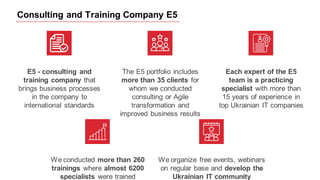
E5 - consulting and
training company that
brings business processes
in the company to
international standards
The E5 portfolio includes
more than 35 clients for
whom we conducted
consulting or Agile
transformation and
improved business results
Each expert of the E5
team is a practicing
specialist with more than
15 years of experience in
top Ukrainian IT companies
We conducted more than 260
trainings where almost 6200
specialists were trained
We organize free events, webinars
on regular base and develop the
Ukrainian IT community
Some
of
our
clients
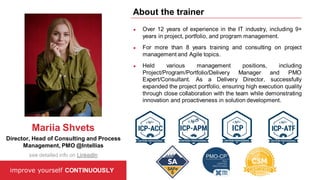
● Over 12 years of experience in the IT industry, including 9+
years in project, portfolio, and program management.
● For more than 8 years training and consulting on project
management and Agile topics.
● Held various management positions, including
Project/Program/Portfolio/Delivery Manager and PMO
Expert/Consultant. As a Delivery Director, successfully
expanded the project portfolio, ensuring high execution quality
through close collaboration with the team while demonstrating
innovation and proactiveness in solution development.
improve yourself CONTINUOUSLY
About the trainer
Director, Head of Consulting and Process
Management, PMO @Intellias
Mariia Shvets
see detailed info on LinkedIn
improve yourself CONTINUOUSLY
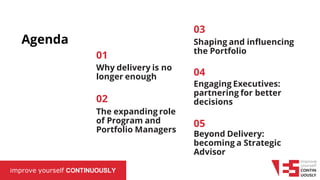
Agenda
01
Why delivery is no
longer enough
02
The expanding role
of Program and
Portfolio Managers
04
Engaging Executives:
partnering for better
decisions
05
Beyond Delivery:
becoming a Strategic
Advisor
03
Shaping and influencing
the Portfolio
1. Why delivery is no
longer enough
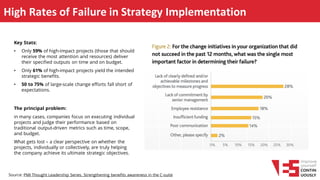
High Rates of Failure in Strategy Implementation
Source: PMI Thought Leadership Series. Strengthening benefits awareness in the C-suite
Key Stats:
• Only 59% of high-impact projects (those that should
receive the most attention and resources) deliver
their specified outputs on time and on budget.
• Only 61% of high-impact projects yield the intended
strategic benefits.
• 50 to 75% of large-scale change efforts fall short of
expectations.
The principal problem:
in many cases, companies focus on executing individual
projects and judge their performance based on
traditional output-driven metrics such as time, scope,
and budget.
What gets lost – a clear perspective on whether the
projects, individually or collectively, are truly helping
the company achieve its ultimate strategic objectives.
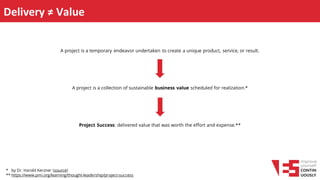
Delivery ≠ Value
A project is a collection of sustainable business value scheduled for realization.*
A project is a temporary endeavor undertaken to create a unique product, service, or result.
Project Success: delivered value that was worth the effort and expense.**
* by Dr. Harold Kerzner (source)
** https://www.pmi.org/learning/thought-leadership/project-success
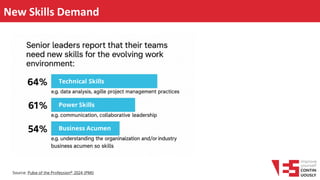
New Skills Demand
Source: Pulse of the Profession® 2024 (PMI)
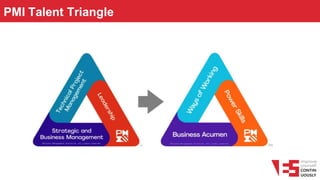
Technical Skills
Power Skills
Business Acumen
2. The expanding role of
Program and Portfolio
Managers
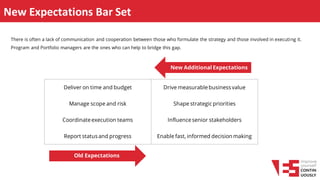
New Expectations Bar Set
There is often a lack of communication and cooperation between those who formulate the strategy and those involved in executing it.
Program and Portfolio managers are the ones who can help to bridge this gap.
Deliver on time and budget Drive measurablebusiness value
Manage scope and risk Shape strategic priorities
Coordinateexecution teams Influencesenior stakeholders
Report status and progress Enable fast, informed decision making
Old Expectations
New Additional Expectations
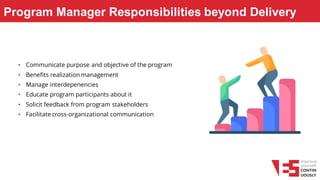
Program Manager Responsibilities beyond Delivery
• Communicate purpose and objective of the program
• Benefits realization management
• Manage interdepenencies
• Educate program participants about it
• Solicit feedback from program stakeholders
• Facilitate cross-organizational communication
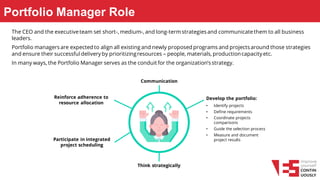
Portfolio Manager Role
The CEO and the executiveteam set short-, medium-, and long-termstrategies and communicatethem to all business
leaders.
Portfolio managersare expected to align all existing and newly proposed programs and projects around those strategies
and ensure their successful delivery by prioritizingresources – people, materials, productioncapacity etc.
In many ways, the Portfolio Manager serves as the conduit for the organization’s strategy.
Communication
Think strategically
Develop the portfolio:
• Identify projects
• Define requirements
• Coordinate projects
comparisons
• Guide the selection process
• Measure and document
project results
Reinforce adherence to
resource allocation
Participate in integrated
project scheduling
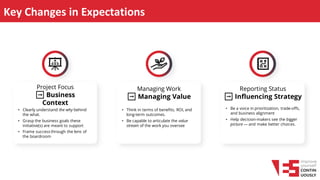
Key Changes in Expectations
• Clearly understand the why behind
the what.
• Grasp the business goals these
initiative(s) are meant to support
• Frame success through the lens of
the boardroom
Project Focus
➡️ Business
Context
• Be a voice in prioritization, trade-offs,
and business alignment
• Help decision-makers see the bigger
picture — and make better choices.
Reporting Status
➡️ Influencing Strategy
• Think in terms of benefits, ROI, and
long-term outcomes.
• Be capable to articulate the value
stream of the work you oversee
Managing Work
➡️ Managing Value
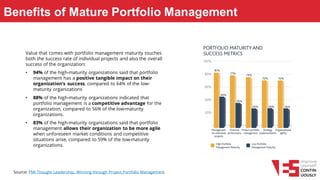
Benefits of Mature Portfolio Management
Value that comes with portfolio management maturity touches
both the success rate of individual projects and also the overall
success of the organization:
• 94% of the high-maturity organizations said that portfolio
management has a positive tangible impact on their
organization’s success, compared to 64% of the low-
maturity organizations
• 88% of the high-maturity organizations indicated that
portfolio management is a competitive advantage for the
organization, compared to 56% of the low-maturity
organizations.
• 83% of the high-maturity organizations said that portfolio
management allows their organization to be more agile
when unforeseen market conditions and competitive
situations arise, compared to 59% of the low-maturity
organizations.
Source: PMI Thought Leadership. Winning through Project Portfolio Management
3. Shaping and
influencing the
portfolio
Linking Delivery and Strategy
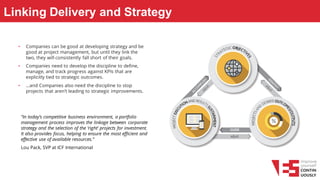
• Companies can be good at developing strategy and be
good at project management, but until they link the
two, they will consistently fall short of their goals.
• Companies need to develop the discipline to define,
manage, and track progress against KPIs that are
explicitly tied to strategic outcomes.
• …and Companies also need the discipline to stop
projects that aren’t leading to strategic improvements.
“In today’s competitive business environment, a portfolio
management process improves the linkage between corporate
strategy and the selection of the ‘right’ projects for investment.
It also provides focus, helping to ensure the most efficient and
effective use of available resources.”
Lou Pack, SVP at ICF International
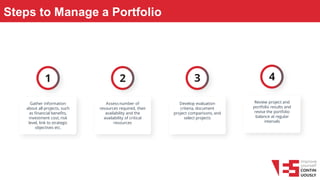
Steps to Manage a Portfolio
Gather information
about all projects, such
as financial benefits,
investment cost, risk
level, link to strategic
objectives etc.
1 2
Assess number of
resources required, their
availability and the
availability of critical
resources
Develop evaluation
criteria, document
project comparisons, and
select projects
3
Review project and
portfolio results and
revise the portfolio
balance at regular
intervals
4
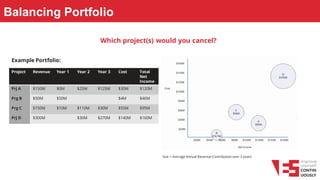
Balancing Portfolio
Which project(s) would you cancel?
Size = Average Annual Revenue Contributionover 3 years
Project Revenue Year 1 Year 2 Year 3 Cost Total
Net
Income
Prj A $150M $0M $25M $125M $30M $120M
Prg B $50M $50M $4M $46M
Prg C $150M $10M $110M $30M $55M $95M
Prj D $300M $30M $270M $140M $160M
Example Portfolio:
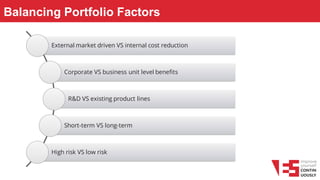
Balancing Portfolio Factors
External market driven VS internal cost reduction
Corporate VS business unit level benefits
R&D VS existing product lines
Short-term VS long-term
High risk VS low risk
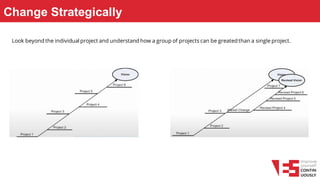
Change Strategically
Look beyond the individual project and understand how a group of projects can be greated than a single project.
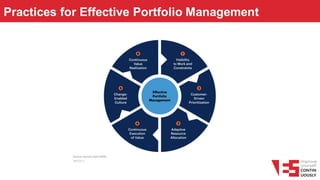
Practices for Effective Portfolio Management
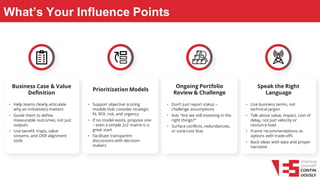
What’s Your Influence Points
• Help teams clearly articulate
why an initiative(s) matters
• Guide them to define
measurable outcomes, not just
outputs
• Use benefit maps, value
streams, and OKR alignment
tools
Business Case & Value
Definition
• Support objective scoring
models that consider strategic
fit, ROI, risk, and urgency
• If no model exists, propose one
– even a simple 2x2 matrix is a
great start
• Facilitate transparent
discussions with decision-
makers
Prioritization Models
• Don’t just report status –
challenge assumptions
• Ask: “Are we still investing in the
right things?”
• Surface conflicts, redundancies,
or sunk-cost bias
Ongoing Portfolio
Review & Challenge
• Use business terms, not
technical jargon
• Talk about value, impact, cost of
delay, not just velocity or
resource load
• Frame recommendations as
options with trade-offs
• Back ideas with data and proper
narrative
Speak the Right
Language
4. Engaging executives:
partnering for better
decisions
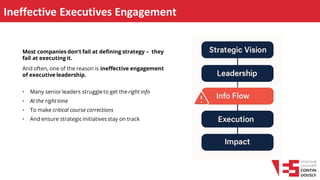
Ineffective Executives Engagement
• Many senior leaders struggleto get the right info
• At the right time
• To make critical course corrections
• And ensure strategic initiativesstay on track
Most companies don’t fail at defining strategy – they
fail at executing it.
And often, one of the reason is ineffective engagement
of executive leadership.
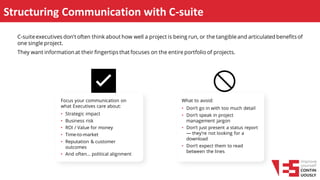
Structuring Communication with C-suite
C-suiteexecutives don’t often think about how well a project is being run, or the tangibleand articulated benefits of
one single project.
They want information at their fingertips that focuses on the entire portfolio of projects.
✅
Focus your communication on
what Executives care about:
• Strategic impact
• Business risk
• ROI / Value for money
• Time-to-market
• Reputation & customer
outcomes
• And often… political alignment
🚫
What to avoid:
• Don’t go in with too much detail
• Don’t speak in project
management jargon
• Don’t just present a status report
— they’re not looking for a
download
• Don’t expect them to read
between the lines
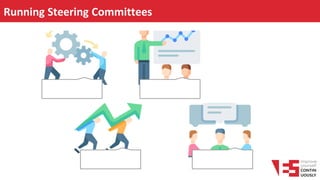
Running Steering Committees
Be the translator between
operational complexity and
business impact
Prepare with simple
visuals, clear options, and a
single-slide summary
Help the group move
toward decisions – not just
discussion
Know when to ask for a
decision vs. when to
influence thinking
XXX
Executives don’t need more information.
They need better insight.
5. Beyond Delivery:
becoming a Strategic
Advisor
PMI Talent Triangle
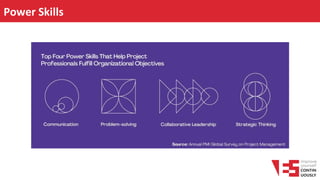
Power Skills
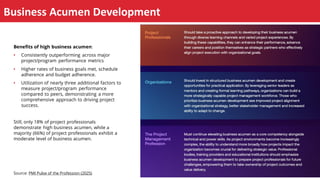
Business Acumen Development
Source: PMI Pulse of the Profession (2025)
Benefits of high business acumen:
• Consistently outperforming across major
project/program performance metrics
• Higher rates of business goals met, schedule
adherence and budget adherence.
• Utilization of nearly three additional factors to
measure project/program performance
compared to peers, demonstrating a more
comprehensive approach to driving project
success.
Still, only 18% of project professionals
demonstrate high business acumen, while a
majority (66%) of project professionals exhibit a
moderate level of business acumen.
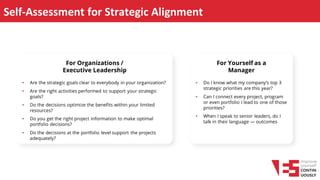
Self-Assessment for Strategic Alignment
• Are the strategic goals clear to everybody in your organization?
• Are the right activities performed to support your strategic
goals?
• Do the decisions optimize the benefits within your limited
resources?
• Do you get the right project information to make optimal
portfolio decisions?
• Do the decisions at the portfolio level support the projects
adequately?
For Organizations /
Executive Leadership
• Do I know what my company’s top 3
strategic priorities are this year?
• Can I connect every project, program
or even portfolio I lead to one of those
priorities?
• When I speak to senior leaders, do I
talk in their language — outcomes,
risks, ROI?
For Yourself as a
Manager
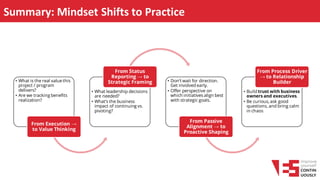
Summary: Mindset Shifts to Practice
• What is the real value this
project / program
delivers?
• Are we tracking benefits
realization?
From Execution →
to Value Thinking
• What leadership decisions
are needed?
• What’s the business
impact of continuing vs.
pivoting?
From Status
Reporting → to
Strategic Framing • Don’t wait for direction.
Get involved early.
• Offer perspective on
which initiatives align best
with strategic goals.
From Passive
Alignment → to
Proactive Shaping
• Build trust with business
owners and executives.
• Be curious, ask good
questions, and bring calm
in chaos
From Process Driver
→ to Relationship
Builder
Questions?
info@e-5.com.ua
+38 096 798 7788
www.e5.ua
E5ConsultingAndTraining
E5
EFive Training

Виклики програмного та портфельного менеджменту: як їх долати | Вебінар

  • 1.
    Webinar From Delivery toImpact: How Programs and Portfolios Create Strategic Value
  • 2.
    Consulting and TrainingCompany E5 E5 - consulting and training company that brings business processes in the company to international standards The E5 portfolio includes more than 35 clients for whom we conducted consulting or Agile transformation and improved business results Each expert of the E5 team is a practicing specialist with more than 15 years of experience in top Ukrainian IT companies We conducted more than 260 trainings where almost 6200 specialists were trained We organize free events, webinars on regular base and develop the Ukrainian IT community
  • 3.
  • 4.
    ● Over 12years of experience in the IT industry, including 9+ years in project, portfolio, and program management. ● For more than 8 years training and consulting on project management and Agile topics. ● Held various management positions, including Project/Program/Portfolio/Delivery Manager and PMO Expert/Consultant. As a Delivery Director, successfully expanded the project portfolio, ensuring high execution quality through close collaboration with the team while demonstrating innovation and proactiveness in solution development. improve yourself CONTINUOUSLY About the trainer Director, Head of Consulting and Process Management, PMO @Intellias Mariia Shvets see detailed info on LinkedIn
  • 5.
    improve yourself CONTINUOUSLY Agenda 01 Whydelivery is no longer enough 02 The expanding role of Program and Portfolio Managers 04 Engaging Executives: partnering for better decisions 05 Beyond Delivery: becoming a Strategic Advisor 03 Shaping and influencing the Portfolio
  • 6.
    1. Why deliveryis no longer enough
  • 7.
    High Rates ofFailure in Strategy Implementation Source: PMI Thought Leadership Series. Strengthening benefits awareness in the C-suite Key Stats: • Only 59% of high-impact projects (those that should receive the most attention and resources) deliver their specified outputs on time and on budget. • Only 61% of high-impact projects yield the intended strategic benefits. • 50 to 75% of large-scale change efforts fall short of expectations. The principal problem: in many cases, companies focus on executing individual projects and judge their performance based on traditional output-driven metrics such as time, scope, and budget. What gets lost – a clear perspective on whether the projects, individually or collectively, are truly helping the company achieve its ultimate strategic objectives.
  • 8.
    Delivery ≠ Value Aproject is a collection of sustainable business value scheduled for realization.* A project is a temporary endeavor undertaken to create a unique product, service, or result. Project Success: delivered value that was worth the effort and expense.** * by Dr. Harold Kerzner (source) ** https://www.pmi.org/learning/thought-leadership/project-success
  • 9.
    New Skills Demand Source:Pulse of the Profession® 2024 (PMI) Technical Skills Power Skills Business Acumen
  • 10.
    2. The expandingrole of Program and Portfolio Managers
  • 11.
    New Expectations BarSet There is often a lack of communication and cooperation between those who formulate the strategy and those involved in executing it. Program and Portfolio managers are the ones who can help to bridge this gap. Deliver on time and budget Drive measurablebusiness value Manage scope and risk Shape strategic priorities Coordinateexecution teams Influencesenior stakeholders Report status and progress Enable fast, informed decision making Old Expectations New Additional Expectations
  • 12.
    Program Manager Responsibilitiesbeyond Delivery • Communicate purpose and objective of the program • Benefits realization management • Manage interdepenencies • Educate program participants about it • Solicit feedback from program stakeholders • Facilitate cross-organizational communication
  • 13.
    Portfolio Manager Role TheCEO and the executiveteam set short-, medium-, and long-termstrategies and communicatethem to all business leaders. Portfolio managersare expected to align all existing and newly proposed programs and projects around those strategies and ensure their successful delivery by prioritizingresources – people, materials, productioncapacity etc. In many ways, the Portfolio Manager serves as the conduit for the organization’s strategy. Communication Think strategically Develop the portfolio: • Identify projects • Define requirements • Coordinate projects comparisons • Guide the selection process • Measure and document project results Reinforce adherence to resource allocation Participate in integrated project scheduling
  • 14.
    Key Changes inExpectations • Clearly understand the why behind the what. • Grasp the business goals these initiative(s) are meant to support • Frame success through the lens of the boardroom Project Focus ➡️ Business Context • Be a voice in prioritization, trade-offs, and business alignment • Help decision-makers see the bigger picture — and make better choices. Reporting Status ➡️ Influencing Strategy • Think in terms of benefits, ROI, and long-term outcomes. • Be capable to articulate the value stream of the work you oversee Managing Work ➡️ Managing Value
  • 15.
    Benefits of MaturePortfolio Management Value that comes with portfolio management maturity touches both the success rate of individual projects and also the overall success of the organization: • 94% of the high-maturity organizations said that portfolio management has a positive tangible impact on their organization’s success, compared to 64% of the low- maturity organizations • 88% of the high-maturity organizations indicated that portfolio management is a competitive advantage for the organization, compared to 56% of the low-maturity organizations. • 83% of the high-maturity organizations said that portfolio management allows their organization to be more agile when unforeseen market conditions and competitive situations arise, compared to 59% of the low-maturity organizations. Source: PMI Thought Leadership. Winning through Project Portfolio Management
  • 16.
  • 17.
    Linking Delivery andStrategy • Companies can be good at developing strategy and be good at project management, but until they link the two, they will consistently fall short of their goals. • Companies need to develop the discipline to define, manage, and track progress against KPIs that are explicitly tied to strategic outcomes. • …and Companies also need the discipline to stop projects that aren’t leading to strategic improvements. “In today’s competitive business environment, a portfolio management process improves the linkage between corporate strategy and the selection of the ‘right’ projects for investment. It also provides focus, helping to ensure the most efficient and effective use of available resources.” Lou Pack, SVP at ICF International
  • 18.
    Steps to Managea Portfolio Gather information about all projects, such as financial benefits, investment cost, risk level, link to strategic objectives etc. 1 2 Assess number of resources required, their availability and the availability of critical resources Develop evaluation criteria, document project comparisons, and select projects 3 Review project and portfolio results and revise the portfolio balance at regular intervals 4
  • 19.
    Balancing Portfolio Which project(s)would you cancel? Size = Average Annual Revenue Contributionover 3 years Project Revenue Year 1 Year 2 Year 3 Cost Total Net Income Prj A $150M $0M $25M $125M $30M $120M Prg B $50M $50M $4M $46M Prg C $150M $10M $110M $30M $55M $95M Prj D $300M $30M $270M $140M $160M Example Portfolio:
  • 20.
    Balancing Portfolio Factors Externalmarket driven VS internal cost reduction Corporate VS business unit level benefits R&D VS existing product lines Short-term VS long-term High risk VS low risk
  • 21.
    Change Strategically Look beyondthe individual project and understand how a group of projects can be greated than a single project.
  • 22.
    Practices for EffectivePortfolio Management
  • 23.
    What’s Your InfluencePoints • Help teams clearly articulate why an initiative(s) matters • Guide them to define measurable outcomes, not just outputs • Use benefit maps, value streams, and OKR alignment tools Business Case & Value Definition • Support objective scoring models that consider strategic fit, ROI, risk, and urgency • If no model exists, propose one – even a simple 2x2 matrix is a great start • Facilitate transparent discussions with decision- makers Prioritization Models • Don’t just report status – challenge assumptions • Ask: “Are we still investing in the right things?” • Surface conflicts, redundancies, or sunk-cost bias Ongoing Portfolio Review & Challenge • Use business terms, not technical jargon • Talk about value, impact, cost of delay, not just velocity or resource load • Frame recommendations as options with trade-offs • Back ideas with data and proper narrative Speak the Right Language
  • 24.
  • 25.
    Ineffective Executives Engagement •Many senior leaders struggleto get the right info • At the right time • To make critical course corrections • And ensure strategic initiativesstay on track Most companies don’t fail at defining strategy – they fail at executing it. And often, one of the reason is ineffective engagement of executive leadership.
  • 26.
    Structuring Communication withC-suite C-suiteexecutives don’t often think about how well a project is being run, or the tangibleand articulated benefits of one single project. They want information at their fingertips that focuses on the entire portfolio of projects. ✅ Focus your communication on what Executives care about: • Strategic impact • Business risk • ROI / Value for money • Time-to-market • Reputation & customer outcomes • And often… political alignment 🚫 What to avoid: • Don’t go in with too much detail • Don’t speak in project management jargon • Don’t just present a status report — they’re not looking for a download • Don’t expect them to read between the lines
  • 27.
    Running Steering Committees Bethe translator between operational complexity and business impact Prepare with simple visuals, clear options, and a single-slide summary Help the group move toward decisions – not just discussion Know when to ask for a decision vs. when to influence thinking
  • 28.
    XXX Executives don’t needmore information. They need better insight.
  • 29.
    5. Beyond Delivery: becominga Strategic Advisor
  • 30.
  • 31.
  • 32.
    Business Acumen Development Source:PMI Pulse of the Profession (2025) Benefits of high business acumen: • Consistently outperforming across major project/program performance metrics • Higher rates of business goals met, schedule adherence and budget adherence. • Utilization of nearly three additional factors to measure project/program performance compared to peers, demonstrating a more comprehensive approach to driving project success. Still, only 18% of project professionals demonstrate high business acumen, while a majority (66%) of project professionals exhibit a moderate level of business acumen.
  • 33.
    Self-Assessment for StrategicAlignment • Are the strategic goals clear to everybody in your organization? • Are the right activities performed to support your strategic goals? • Do the decisions optimize the benefits within your limited resources? • Do you get the right project information to make optimal portfolio decisions? • Do the decisions at the portfolio level support the projects adequately? For Organizations / Executive Leadership • Do I know what my company’s top 3 strategic priorities are this year? • Can I connect every project, program or even portfolio I lead to one of those priorities? • When I speak to senior leaders, do I talk in their language — outcomes, risks, ROI? For Yourself as a Manager
  • 34.
    Summary: Mindset Shiftsto Practice • What is the real value this project / program delivers? • Are we tracking benefits realization? From Execution → to Value Thinking • What leadership decisions are needed? • What’s the business impact of continuing vs. pivoting? From Status Reporting → to Strategic Framing • Don’t wait for direction. Get involved early. • Offer perspective on which initiatives align best with strategic goals. From Passive Alignment → to Proactive Shaping • Build trust with business owners and executives. • Be curious, ask good questions, and bring calm in chaos From Process Driver → to Relationship Builder
  • 35.
    Questions? info@e-5.com.ua +38 096 7987788 www.e5.ua E5ConsultingAndTraining E5 EFive Training