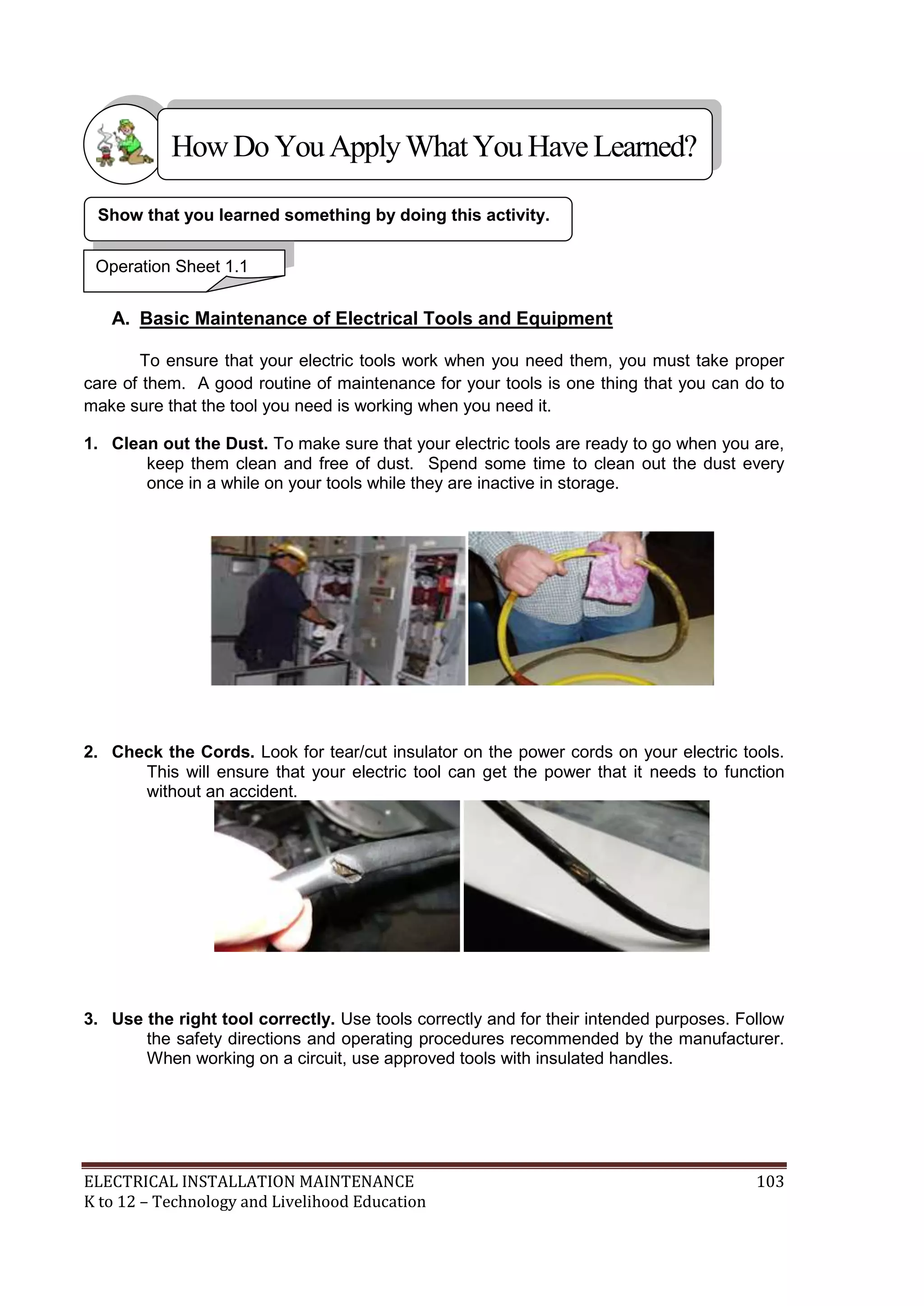
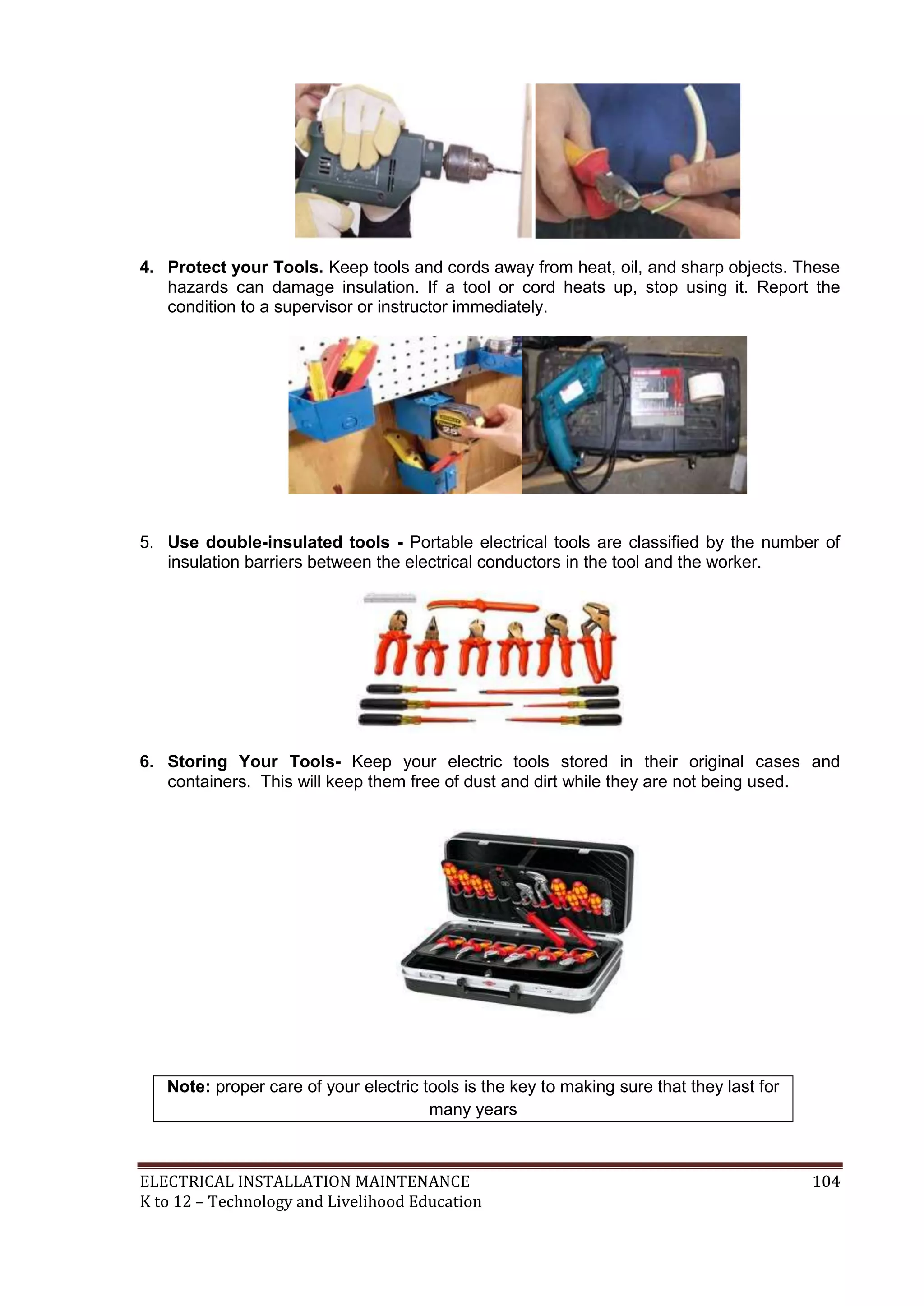
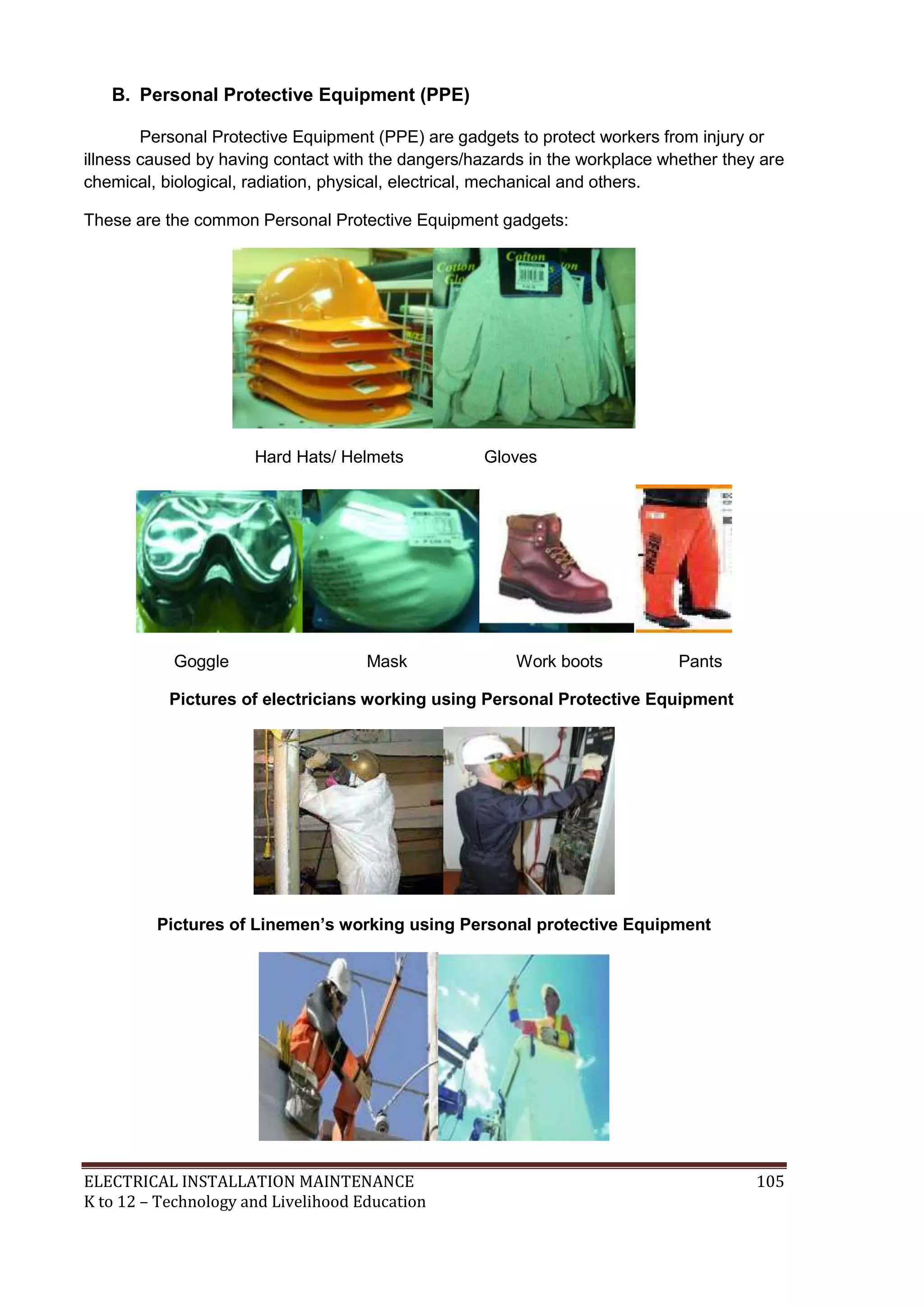
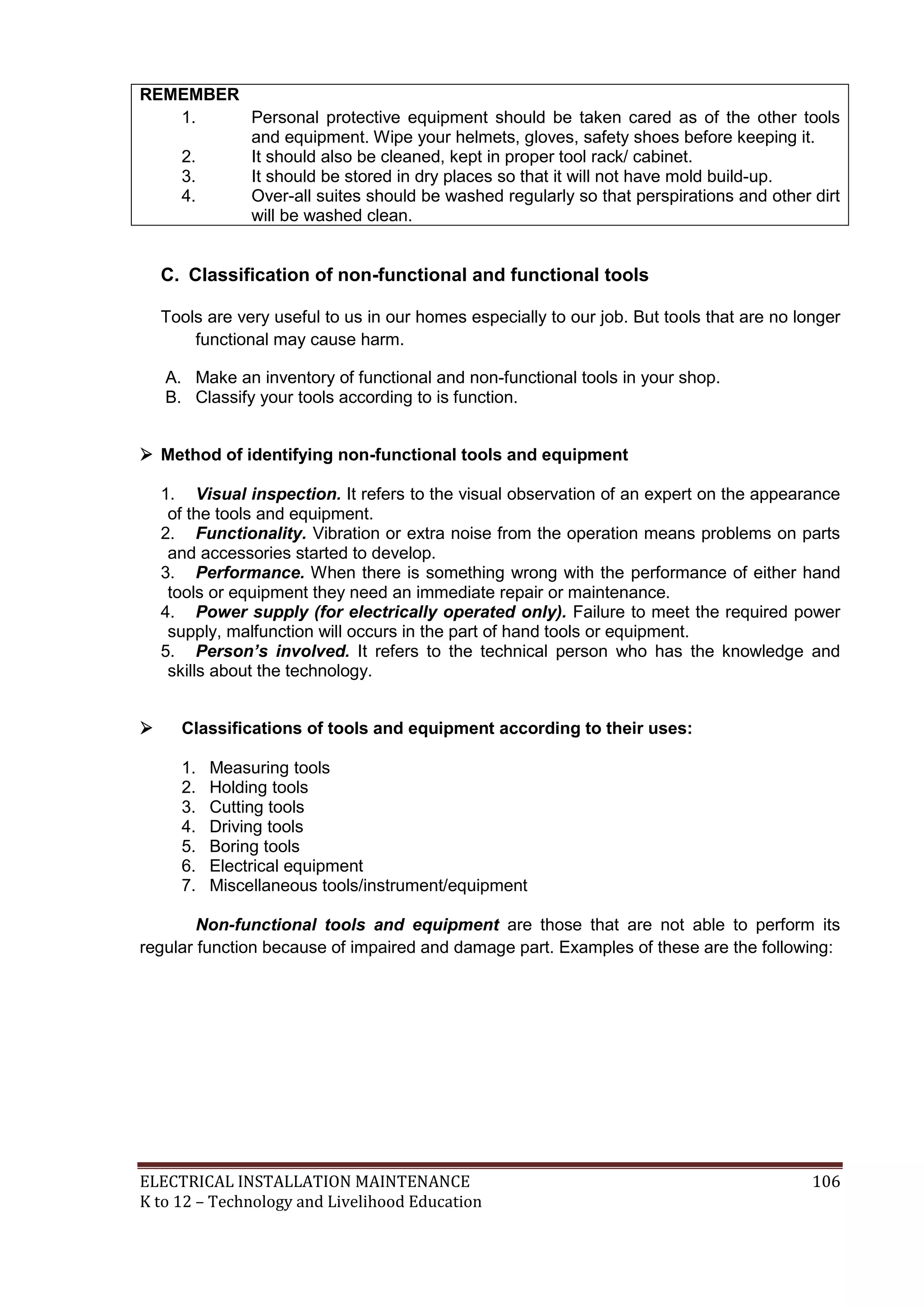
Republic of the Philippines
DEPARTMENT OF EDUCATION

K to 12 Basic Education Curriculum
Technology and Livelihood Education
Learning Module

ELECTRICAL INSTALLATION AND
MAINTENANCE
EXPLORATORY COURSE
Grades 7 and Grade 8
TABLE OF CONTENTS
What Is This Module About ? ................................................................................... 2
How Do You Use This Module ............................................................................... 4
LESSON 1 – Prepare Electrical Supplies, Materials and Tools……….5 - 45
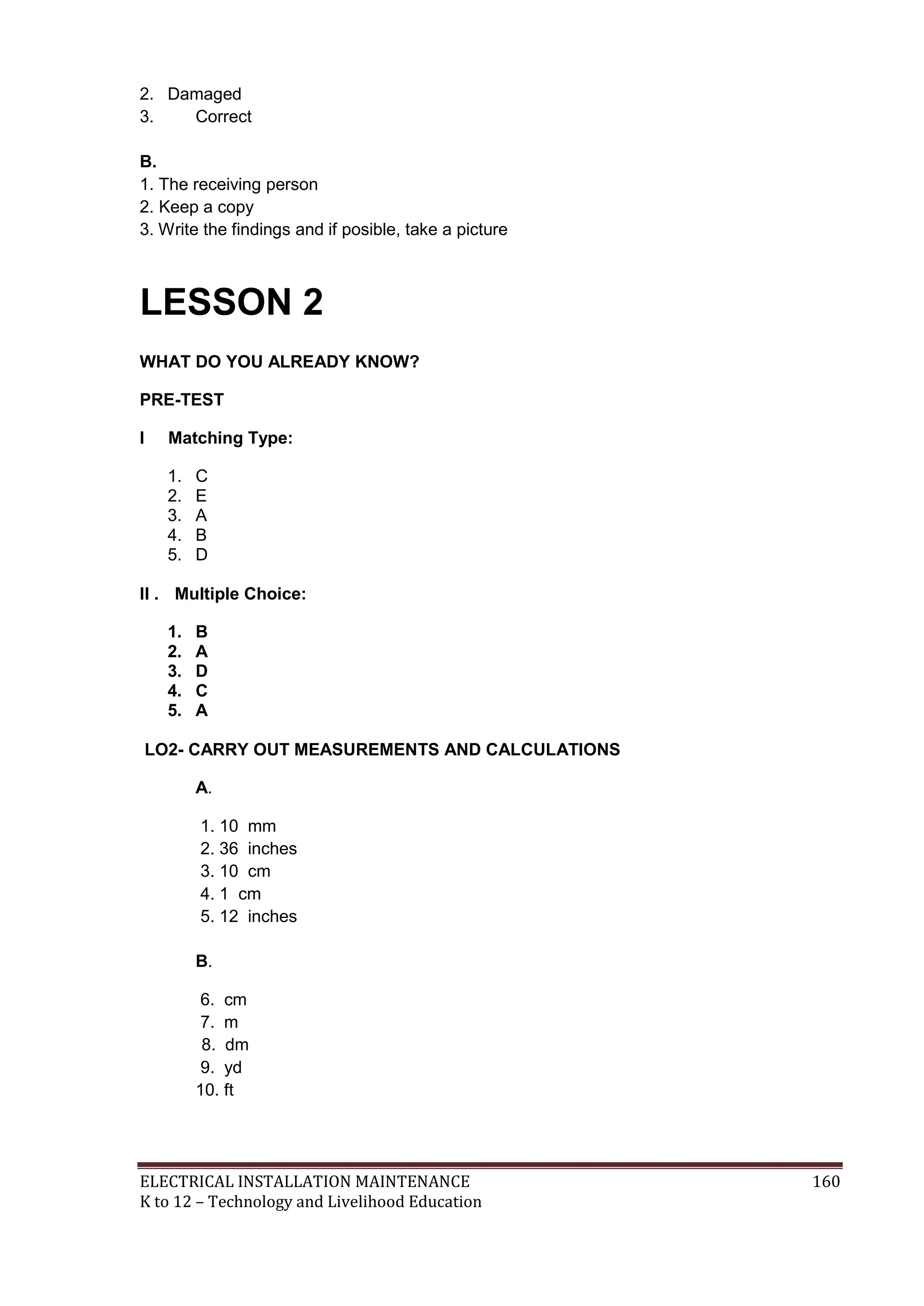
LESSON 2 – Perform Mensuration and Calculation …………...……46 - 74
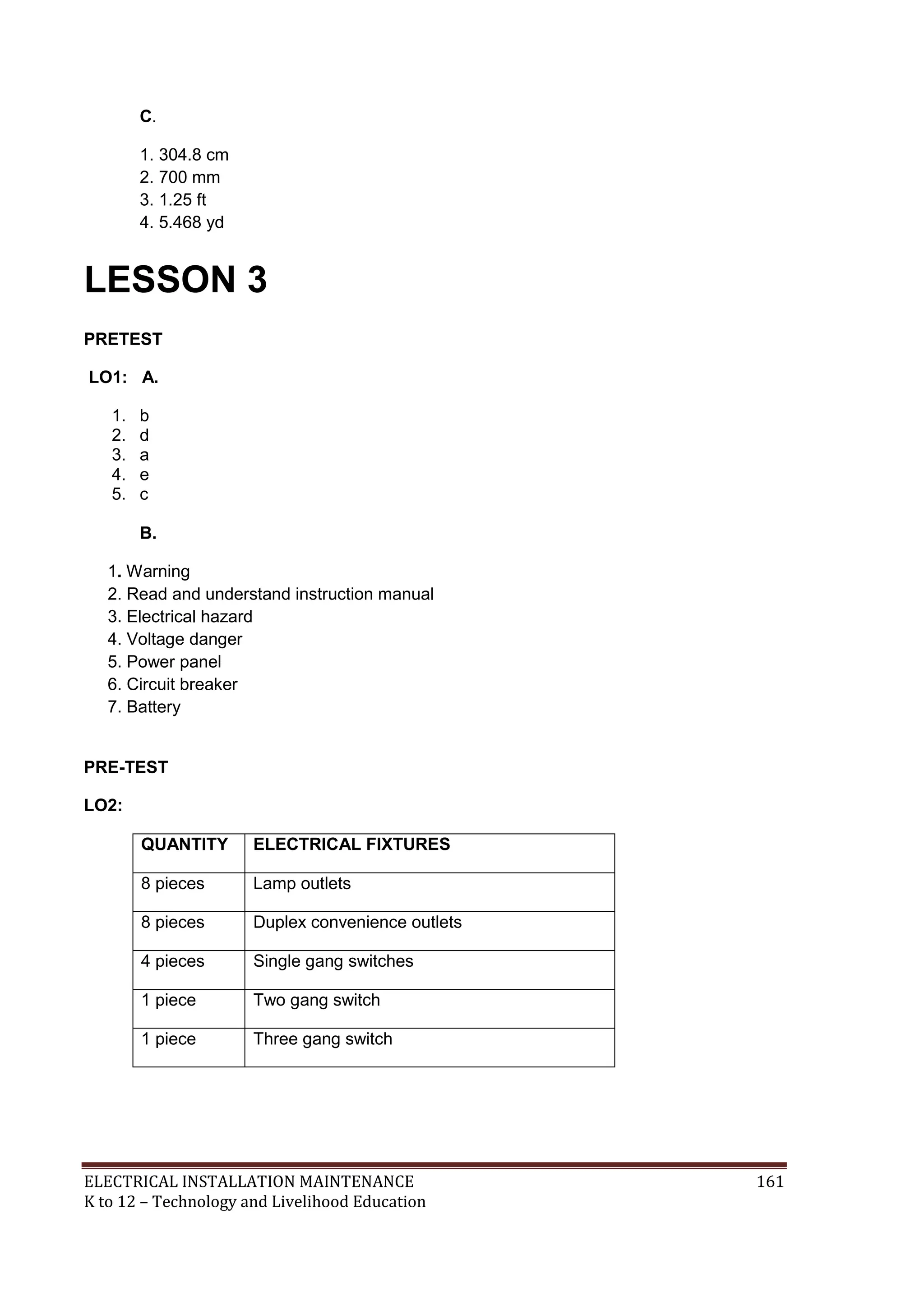
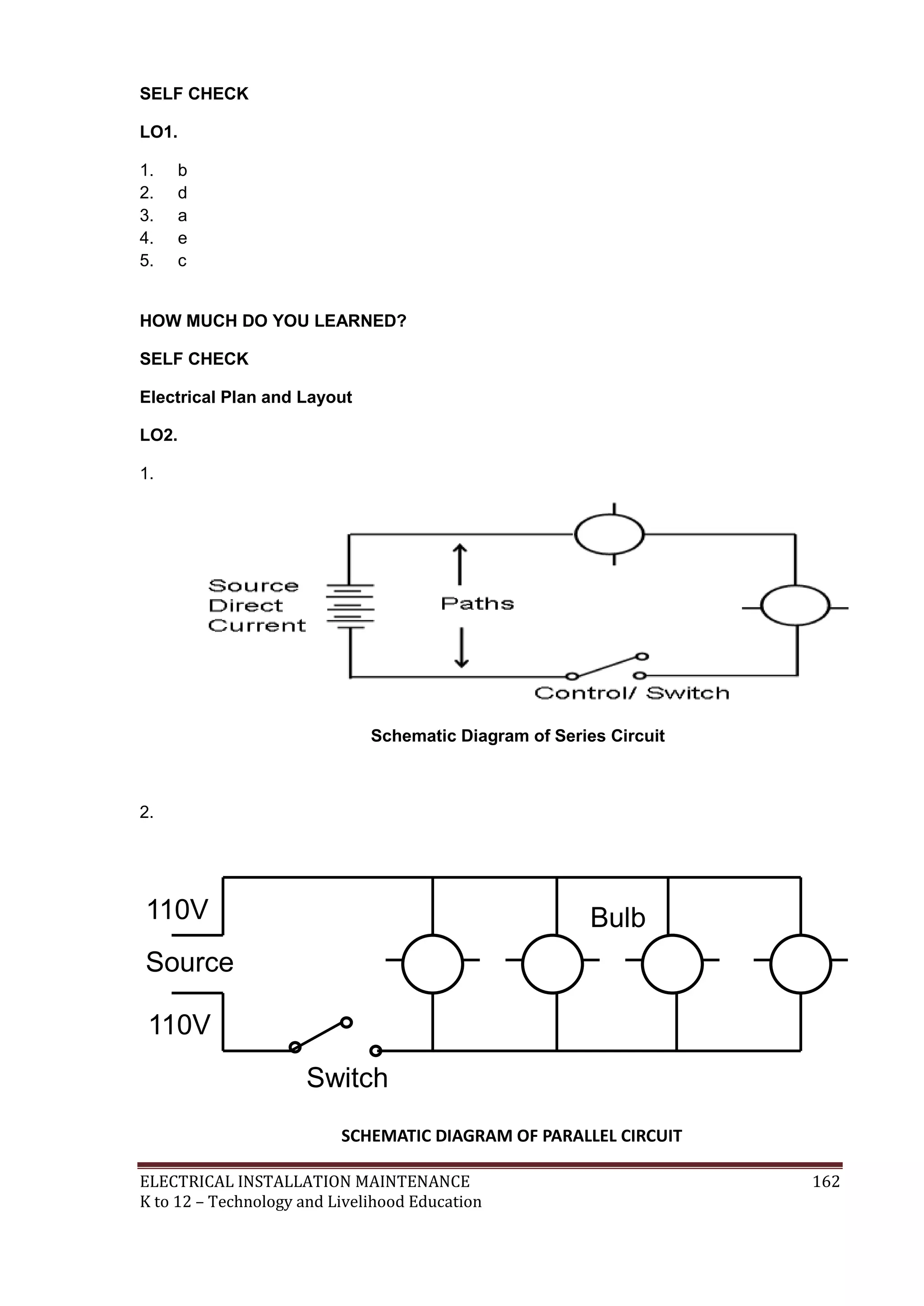
LESSON 3 – Interpret Technical Drawing and Plans…………....….75 - 93
LESSON 4 – Maintain Tools and Equipment …………………..….94 - 127
LESSON 5 – Practice Occupational Safety and Health……………. 128 - 158
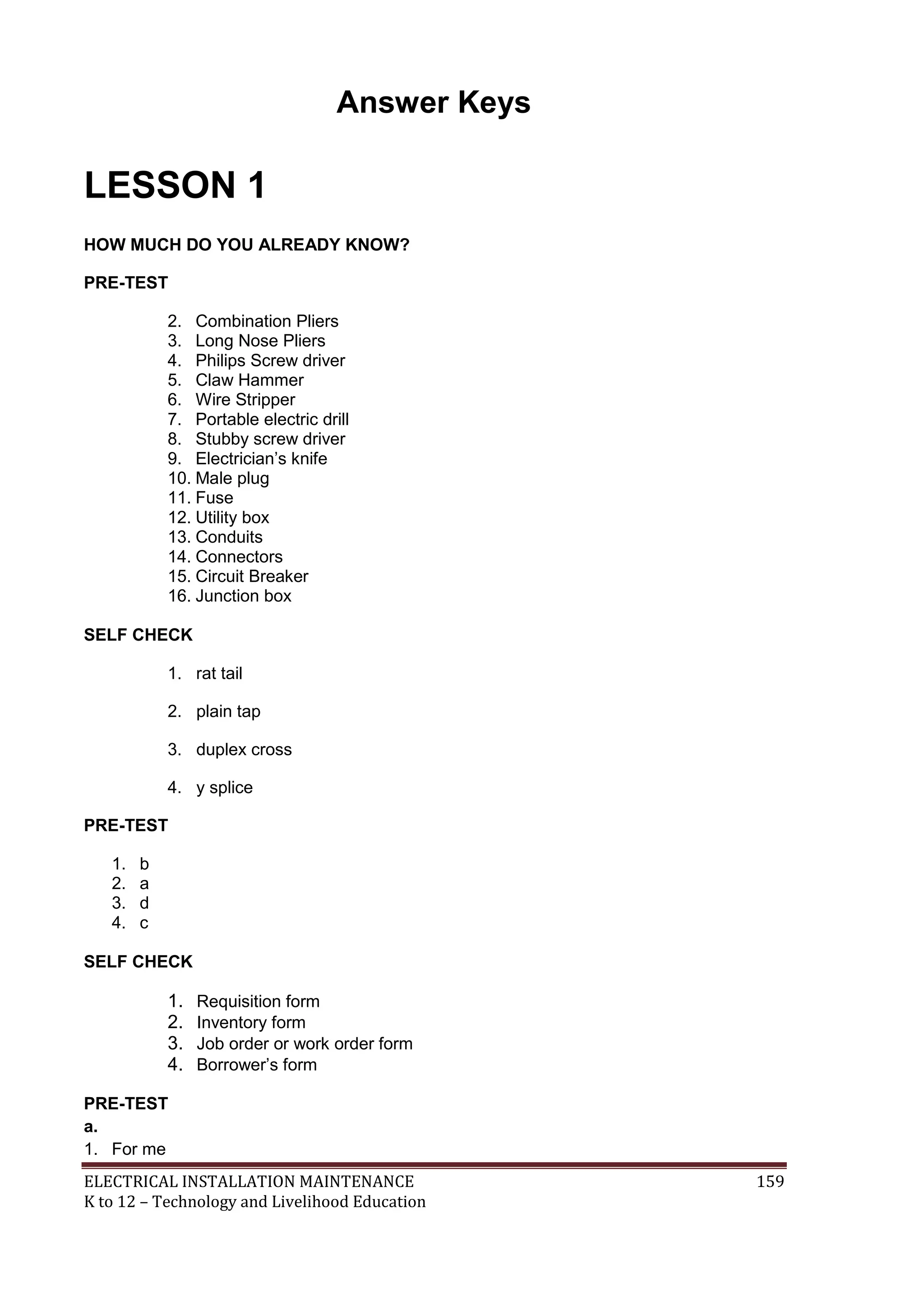
ANSWER KEYS ................................................................................................ 159 - 169
Acknowledgment........................................................................................................... 170

ELECTRICAL INSTALLATION MAINTENANCE
K to 12 – Technology and Livelihood Education

1
What Is This Module About?
Welcome to the world of Electrical Installation and Maintenance!
This Module is an exploratory course which leads you to Electrical Installation
and Maintenance National Certificate Level II ( NC II)1. It covers
5
common
competencies that a Grade 7 / Grade 8 Technology and Livelihood Education (TLE) student
like you ought to possess, namely:
1)
2)
3)
4)
5)

Prepare electrical supplies, materials, and tools;
Perform mensuration and calculations;
Interpret technical drawings and plans;
Maintain tools and equipment; and
Practice occupational health and safety

These 5 common competencies are covered separately in 5 Lessons. As shown
below, each Lesson is directed to the attainment of one or two learning outcomes:
Lesson 1 – Prepare electrical supplies, materials, and tools
LO1. Identify electrical supplies, materials, and tools needed in electrical/wiring
installation
LO 2. Request appropriate supplies, materials, and tools for a specific job
LO 3. Receive and inspect electrical supplies, materials and tools
Lesson 2 – Perform Mensuration and Calculations
LO 1. Select measuring tools and instruments
LO 2. Carry out Measurements and Calculations
Lesson 3 – Interpret Technical Drawing and Plans
LO1. Analyze signs, symbols and data
LO2. Interpret technical drawings and plans
Lesson 4 – Maintain Tools and Equipment
LO 1. Check condition of tools and equipment
LO 2 Perform basic preventive maintenance
LO 3 Store tools and equipment

1NATIONAL

CERTIFICATE (NC) is a certification issued to individuals who achieved all the required units of competency for a national
qualification as defined under the Training Regulations. NCs are aligned to specific levels within the PTQF. (TESDA Board Resolution
No. 2004-13, Training Regulations Framework)
NATIONAL CERTIFICATE LEVEL refers to the four (4) qualification levels defined in the Philippine TVET Qualifications Framework
(PTQF) where the worker with:
a. NC I performs a routine and predictable tasks; has little judgment; and, works under supervision;
b. NC II performs prescribed range of functions involving known routines and procedures; has limited choice and complexity of
functions, and has little accountability;

ELECTRICAL INSTALLATION MAINTENANCE
K to 12 – Technology and Livelihood Education

2
Lesson 5 – Practice Occupational Health and Safety
LO 1. Identify hazards and risks
LO 2 Evaluate risks and hazards
LO 3 Control hazards and risks

Your success in this exploratory course on Electrical Installation and Maintenance
is shown in your ability to perform the performance standards found in each learning
outcome.

ELECTRICAL INSTALLATION MAINTENANCE
K to 12 – Technology and Livelihood Education

3
How Do You Use This Module?
This Module has 5 Lessons. Each Lesson has the following parts.












Learning Outcomes
Performance Standards
Materials/Resources
Definition of Terms
What Do You Already Know?
What Do You Need to Know?
How Much Have You Learned?
How Do You Apply What You Learned?
How Well Did You Perform?
How Do You Extend Your Learning?
References

To get the most from this Module, you need to do the following:
1. Begin by reading and understanding the Learning Outcome/s and Performance
Standards. These tell you what you should know and be able to do at the end of this
Module.
2. Find out what you already know by taking the Pretest then check your answer
against the Answer Key. If you get 99 to 100% of the items correctly, you may
proceed to the next Lesson. This means that you need not go through the Lesson
because you already know what it is about. If you failed to get 99 to 100% correctly,
go through the Lesson again and review especially those items which you failed to
get.
3. Do the required Learning Activities. They begin
with one or more Information
Sheets. An Information Sheet contains important notes or basic information that you
need to know.
After reading the Information Sheet, test yourself on how much you learned
by means of the Self-check. Refer to the Answer Key for correction. Do not hesitate
to go back to the Information Sheet when you do not get all test items correctly.
This will ensure your mastery of basic information.
4. Demonstrate what you learned by doing what the Activity / Operation /Job Sheet
directs you to do.
5. You must be able to apply what you have learned in another activity or in real life
situation.
6. Accomplish the Scoring Rubrics for you to know how well you performed.
Each Lesson also provides you with references and definition of key terms for your guide.
They can be of great help. Use them fully.

If you have questions, ask your teacher for assistance.

ELECTRICAL INSTALLATION MAINTENANCE
K to 12 – Technology and Livelihood Education

4
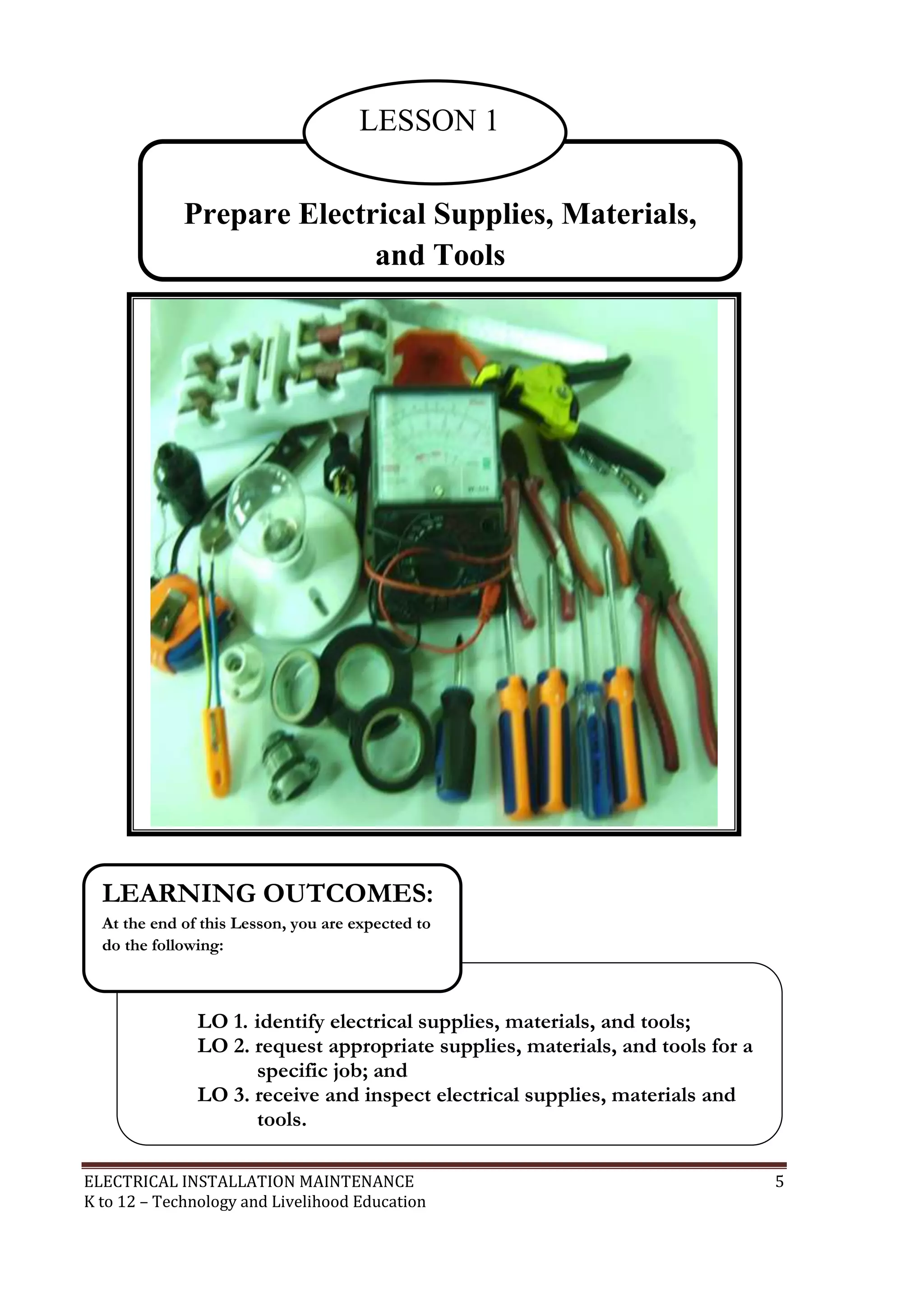
LESSON 1
Prepare Electrical Supplies, Materials,
and Tools

LEARNING OUTCOMES:
At the end of this Lesson, you are expected to
do the following:

LO 1. identify electrical supplies, materials, and tools;
LO 2. request appropriate supplies, materials, and tools for a
specific job; and
LO 3. receive and inspect electrical supplies, materials and
tools.
ELECTRICAL INSTALLATION MAINTENANCE
K to 12 – Technology and Livelihood Education

5
Definition of Terms
Ampere - a unit of measure of electric current
Circuit - the path of electric current from the source to the components and goes
back to the source
Kilowatt - a unit of power which is equivalent to 1000w
Conductor - a wire or a cord which provides path for current flow
Resistance - the quality of electric current measured in ohms that resist the flow of
current
Hot wire - a wire through which current flows
Insulator – material used to cover electric wires which may be made from plastic,
rubber, or asbestos.
Tools - are implements used to modify raw materials for human use
Corrugated plastic conduit (CPC) - commonly known as flexible non-metallic
conduit or the “moldflex”
Metallic Conduits- metal raceways that was classified into four; rigid steel conduit
(RSC), intermediate metallic conduit or tubing (IMC or IMT), electrical metallic
conduit or tubing (EMC or EMT) and the flexible metallic conduit (FMC)
Non-metallic conduits- plastic conduits or raceways designed to be a channel of
wire that are classified as; rigid non-metallic conduit or the PVC, the flexible nonmetallic or CPC, and the surface plastic molding
Connectors and Adapters - accessories that are used to connect from boxes to
conduits or raceways to the other boxes in the electrical system

ELECTRICAL INSTALLATION MAINTENANCE
K to 12 – Technology and Livelihood Education

6
LEARNING OUTCOME 1
Prepare electrical supplies, materials, and tools
PERFORMANCE STANDARDS





Tools and materials are identified as per job requirement.
Tools are classified according to its function as per job requirement.
Materials are classified according to its uses on a specific project.
Tools and materials are selected.

Materials/ Resources
1. Utility box
2. Connectors

8. Electrical Wires
9. Corrugated Plastic Conduit (CPC)

3.
4.
5.
6.
7.

10. Receptacles
11. Fuse Panel/ Safety switch
12. Square boxes
13. PVC conduit
14. Switches

Male Plug
Fuse
Junction Box
Conduits
Circuit Breaker

15. Switch Plates
16. Cut-out boxes

TOOLS:
1.
2.
3.
4.
5.
6.
7.
8.

Long Nose Pliers
Stubby Screw Driver
Wire Stripper
Portable Electric Drill
Philips Screw Driver
Combination Pliers
Hammer
Electrician’s Knife

9. Hacksaw
10. Diagonal cutting pliers
11. Half-round file
12. Round file
13. Spirit level

ELECTRICAL INSTALLATION MAINTENANCE
K to 12 – Technology and Livelihood Education

7
What Do You Already Know?
Let us determine how much you already know about preparing electrical supplies,
materials and tools. Take this test.

Pretest LO 1

Directions: Read the statement carefully and identify what is being described or defined.
Choose your answer from the words inside the box.

Long Nose Pliers

Circuit Breaker

Hammer

Electrician’s Knife

Utility box

Portable Electric Drill

Philips Screw Driver

Connectors

Wire Stripper

Male Plug

Fuse Combination Pliers

Junction Box

Stubby Screw Driver

Conduits

______________1. This is used for griping, holding, cutting electrical wires and cables
and even small nails. Usually used by linemen in doing heavy tasks.
______________2. Used for cutting and holding fine wires. This can reach tight space or
small opening where other pliers cannot reach and also used in making terminal loops of
copper wires.
______________3. This has a cross tip resembling a positive (+) sign. It is used to drive
screws with cross slot heads.
______________4. This is tools used in driving or pounding and pulling out nails.
______________5. A tool used for removing insulation of medium sized wires ranging
from gauge #10 to gauge #16.
______________6. A small drilling machine with a chuck capacity of ¼‖ to 3/8‖. It is used
in making holes on metal sheets and concrete walls.
______________7. Comes in either Standard or Philips screw driver with short shank or
blade and shorted handle used to turn screws in tight space where standard screw driver
cannot be used.
ELECTRICAL INSTALLATION MAINTENANCE
K to 12 – Technology and Livelihood Education

8
______________8. Used by linemen to remove insulation of wire and cables in low and
high voltage transmission lines.
______________9. Is a device inserted to a convenience outlet to conduct electric
current. A flat cord is attached to it on one end and the other end is connected to a
current consuming instrument or appliance.
______________10. This is a circuit protective device that automatically blows and cut
the current when an over load or short circuit happens.
______________11. This is a rectangular shaped metallic or plastic (PVC) material in
which flush type convenience outlet and switch are attached.
______________12. Are electrical materials used as the passage of wires for protection
and Insulation.
______________13. Are used to attach metallic or non-metallic conduit to the junction
or utility boxes.
______________14. This is a protective device used to automatically cut off the current
when trouble in the circuit such as short circuit or over load occurs.
______________15. Is an octagonal shaped electrical material where the connections or
joints of wires are being done. It is also where the flush type lamp holder is attached.

Now check your answers using the Answer Key. If you got 90100% of the items correctly, proceed to the next Learning Outcome. If
not, do the next activity/ies again to gain knowledge and skills
required for mastery.

ELECTRICAL INSTALLATION MAINTENANCE
K to 12 – Technology and Livelihood Education

9
What Do You Need To Know?
Read the Information Sheet 1.1 very well then find out how much you can
remember and how much you learned by doing Self-check .

Information Sheet 1.1
Electrical Tools and Equipment
Electrical task can be accomplished systematically to save time, effort, and
resources. Most of the work cannot be done using bare hands. To do the task, electrical
tools or equipment are needed to perform the job. This lesson will discuss the function/use of
each tool or equipment used in electrical wiring installations.
The following are common electrical tools and equipment needed in the installation
of electrical wiring.

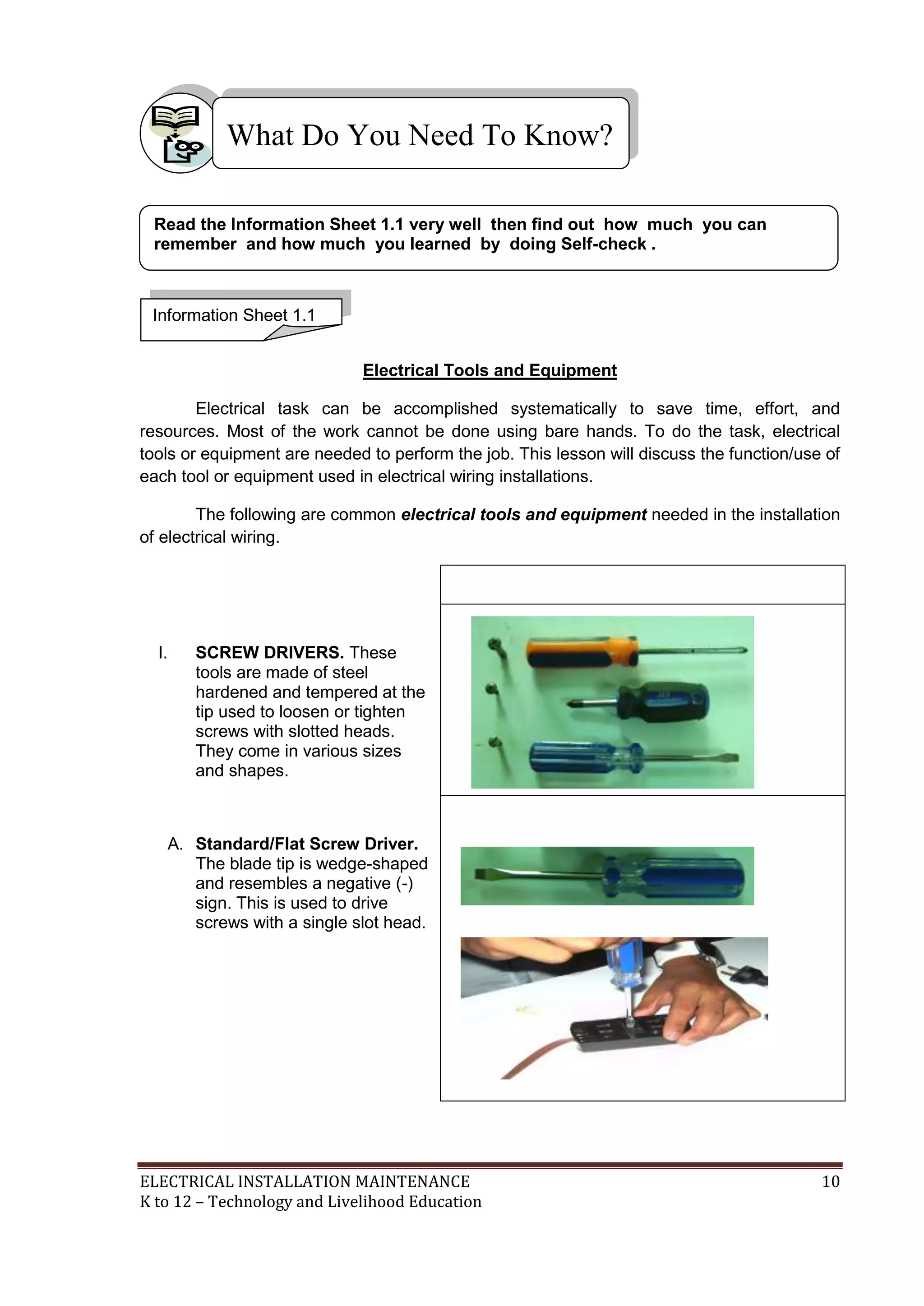
I.

SCREW DRIVERS. These
tools are made of steel
hardened and tempered at the
tip used to loosen or tighten
screws with slotted heads.
They come in various sizes
and shapes.

A. Standard/Flat Screw Driver.
The blade tip is wedge-shaped
and resembles a negative (-)
sign. This is used to drive
screws with a single slot head.

ELECTRICAL INSTALLATION MAINTENANCE
K to 12 – Technology and Livelihood Education

10
B. Philips Screw Driver. This
has a cross tip resembling a
positive (+) sign. This is used
to drive screws with cross slot
heads.

C. Stubby Screw Driver. It
comes in either Standard or
Philips screw driver with short
shank or blade and a shorted
handle used to turn screws in
tight space where standard
screw driver cannot be used.

D. Allen Screw Driver/Wrench.
This could be in the shape of a
screw driver or a wrench. Its
function is to drive screw with
hexagonal slot head.

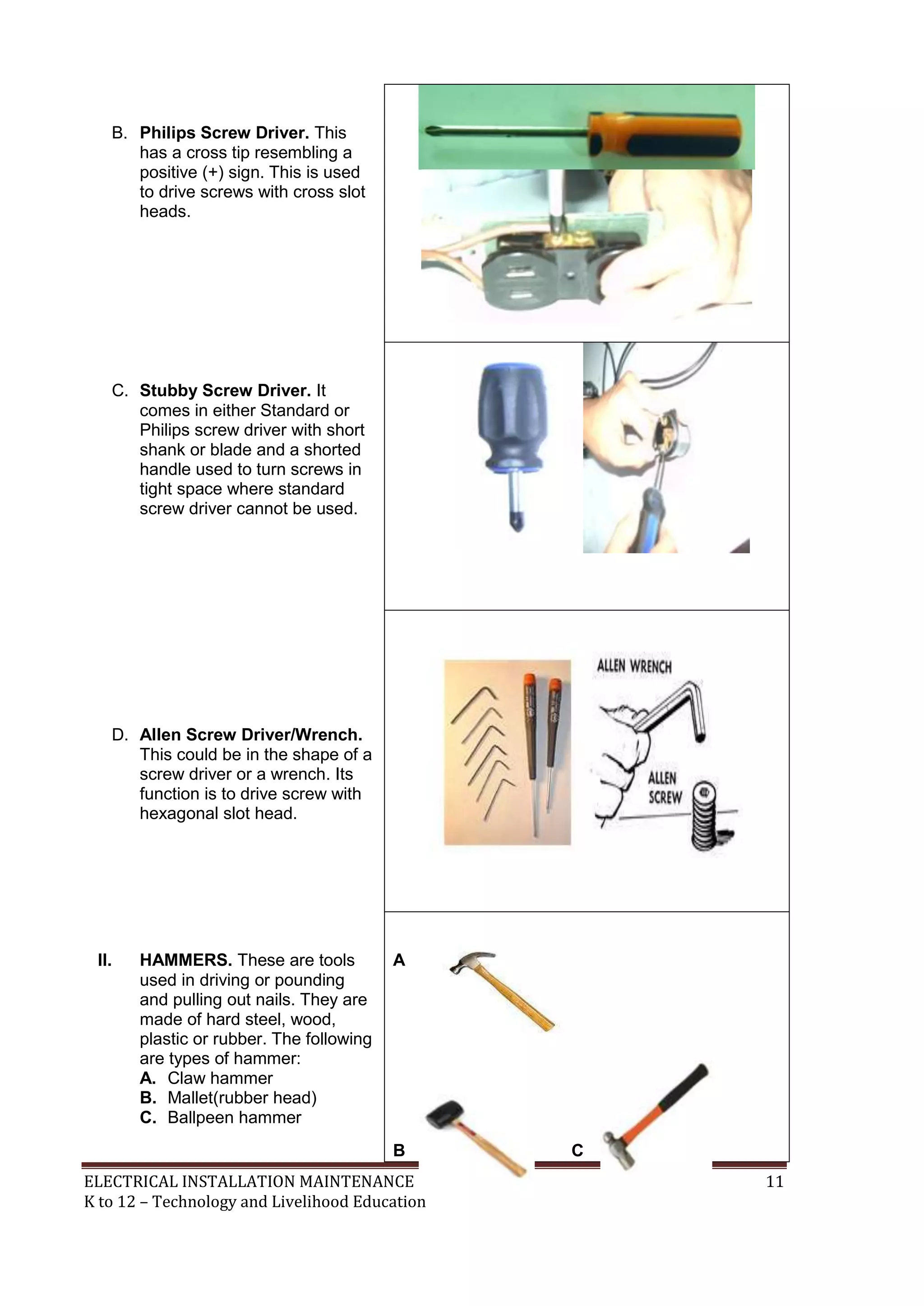
II.

HAMMERS. These are tools
used in driving or pounding
and pulling out nails. They are
made of hard steel, wood,
plastic or rubber. The following
are types of hammer:
A. Claw hammer
B. Mallet(rubber head)
C. Ballpeen hammer

A

B
ELECTRICAL INSTALLATION MAINTENANCE
K to 12 – Technology and Livelihood Education

C
11
III.

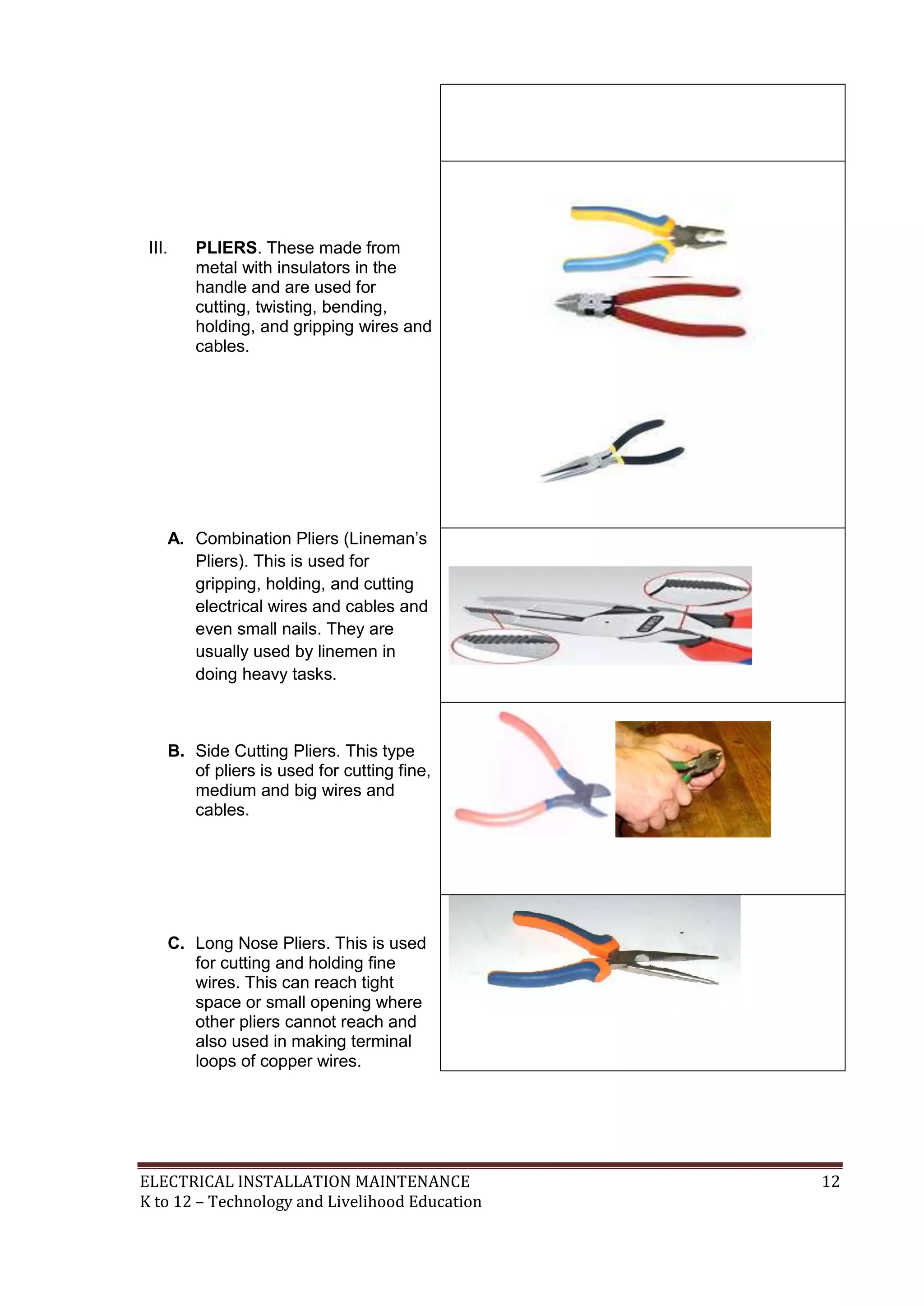
PLIERS. These made from
metal with insulators in the
handle and are used for
cutting, twisting, bending,
holding, and gripping wires and
cables.

A. Combination Pliers (Lineman’s
Pliers). This is used for
gripping, holding, and cutting
electrical wires and cables and
even small nails. They are
usually used by linemen in
doing heavy tasks.

B. Side Cutting Pliers. This type
of pliers is used for cutting fine,
medium and big wires and
cables.

C. Long Nose Pliers. This is used
for cutting and holding fine
wires. This can reach tight
space or small opening where
other pliers cannot reach and
also used in making terminal
loops of copper wires.

ELECTRICAL INSTALLATION MAINTENANCE
K to 12 – Technology and Livelihood Education

12
IV.

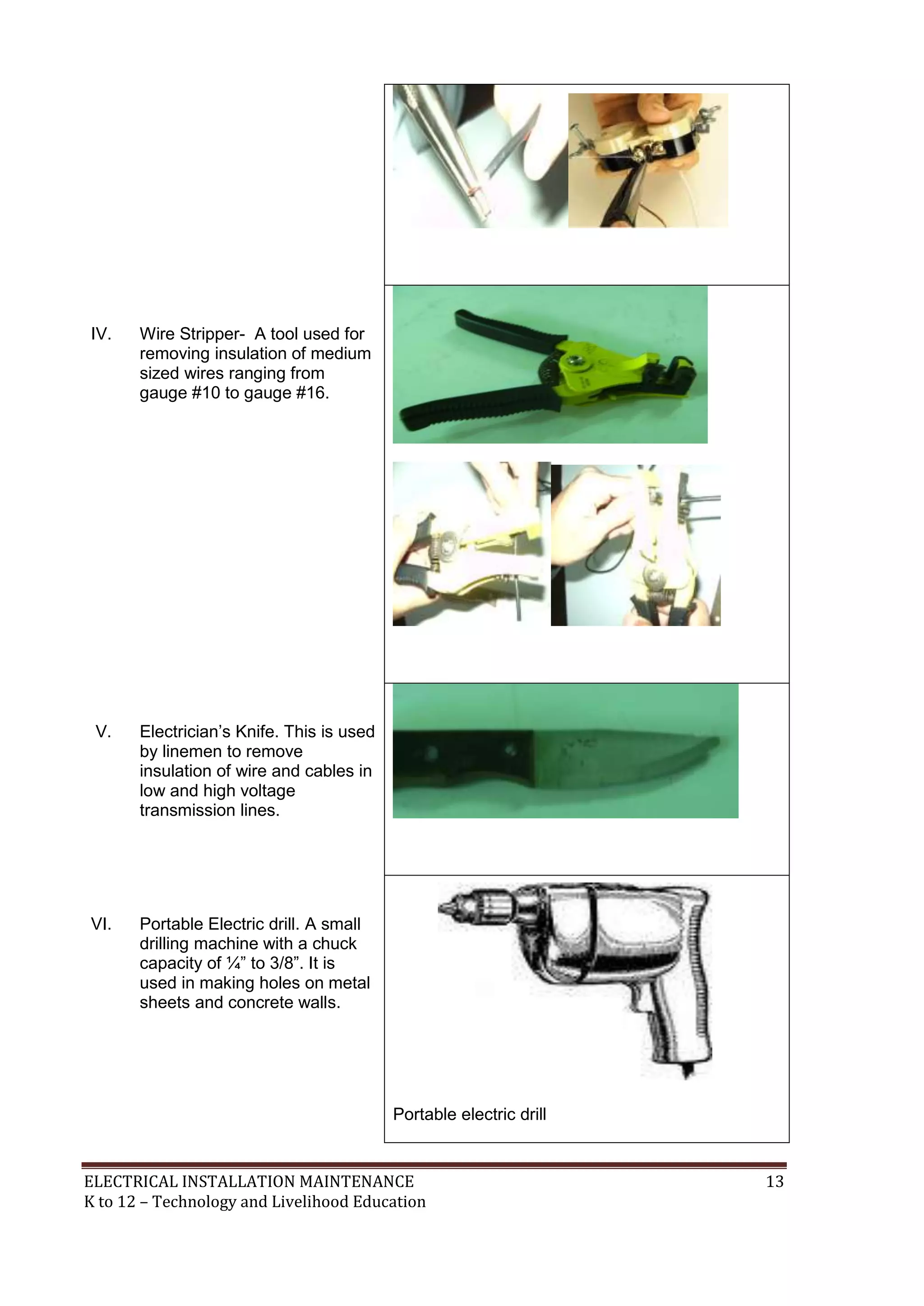
Wire Stripper- A tool used for
removing insulation of medium
sized wires ranging from
gauge #10 to gauge #16.

V.

Electrician’s Knife. This is used
by linemen to remove
insulation of wire and cables in
low and high voltage
transmission lines.

VI.

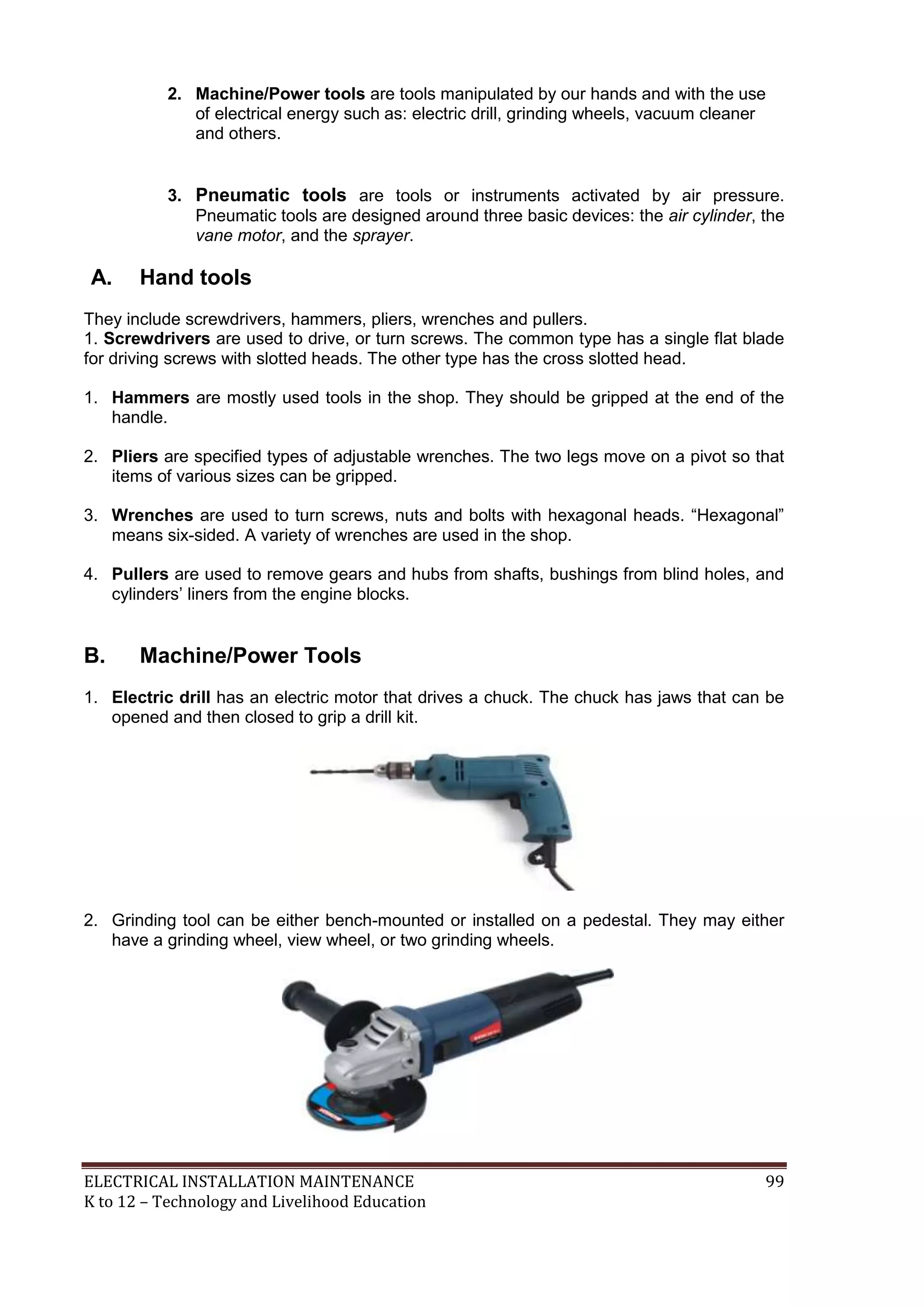
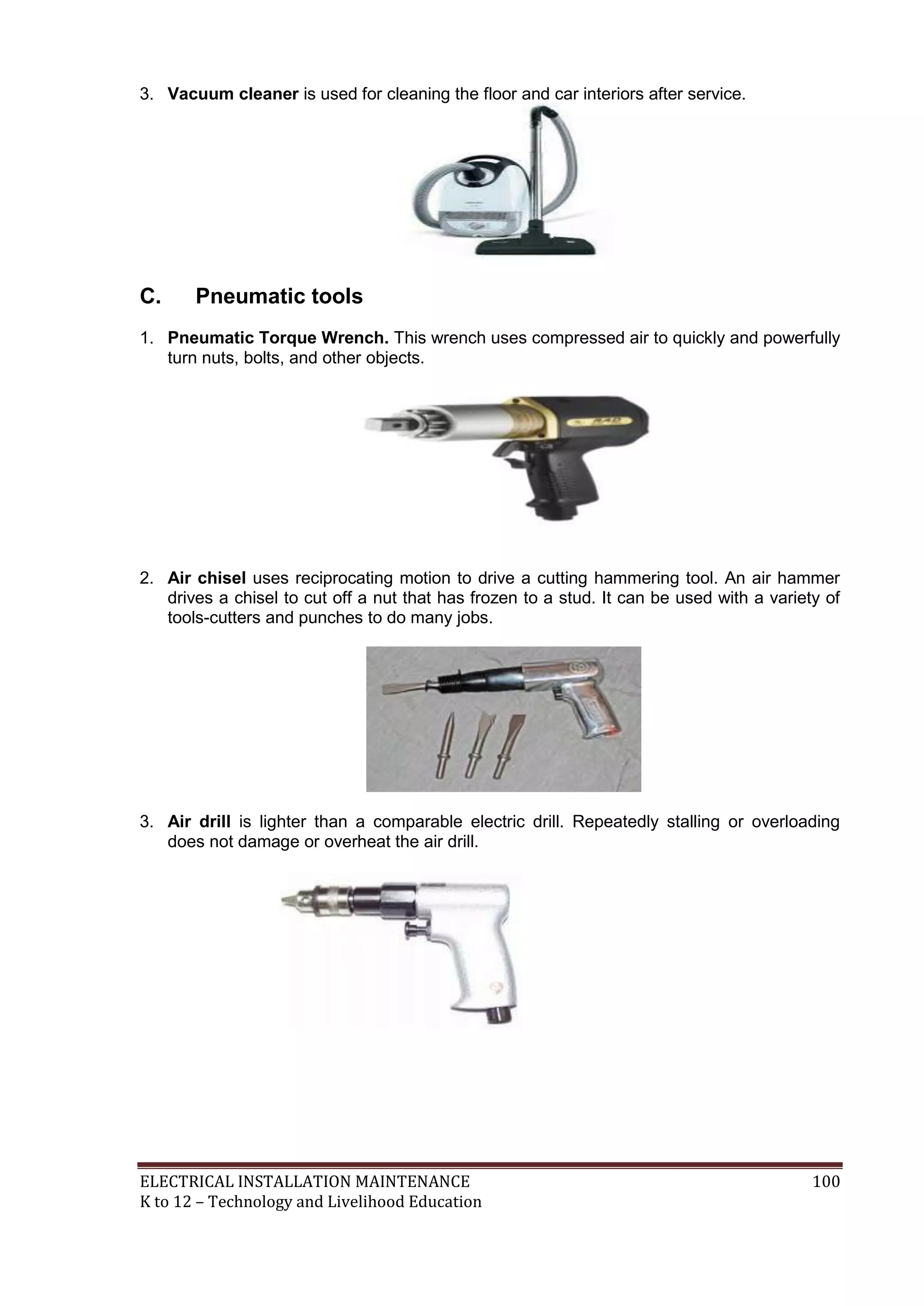
Portable Electric drill. A small
drilling machine with a chuck
capacity of ¼‖ to 3/8‖. It is
used in making holes on metal
sheets and concrete walls.

Portable electric drill

ELECTRICAL INSTALLATION MAINTENANCE
K to 12 – Technology and Livelihood Education

13
VII.

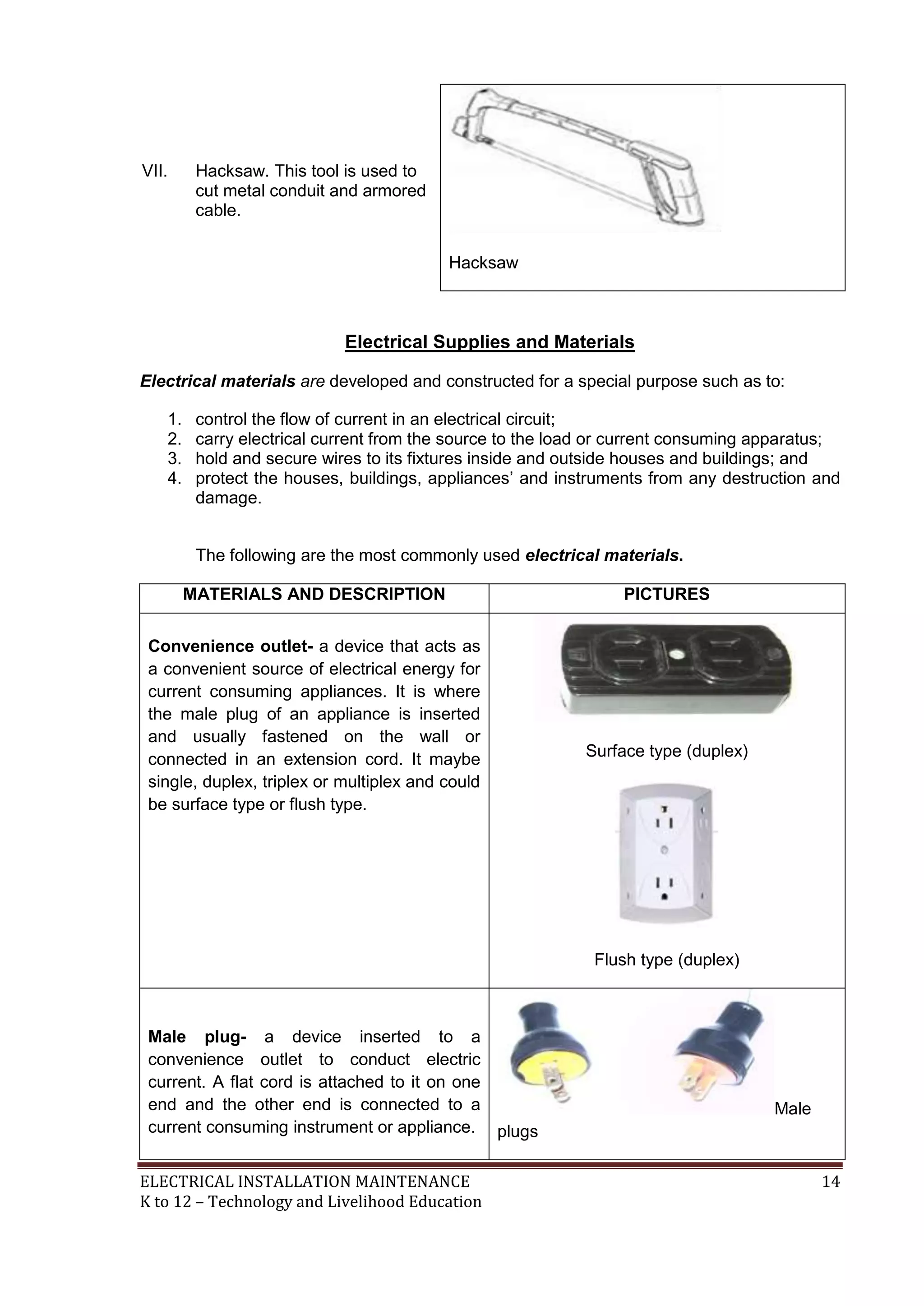
Hacksaw. This tool is used to
cut metal conduit and armored
cable.
Hacksaw

Electrical Supplies and Materials
Electrical materials are developed and constructed for a special purpose such as to:
1.
2.
3.
4.

control the flow of current in an electrical circuit;
carry electrical current from the source to the load or current consuming apparatus;
hold and secure wires to its fixtures inside and outside houses and buildings; and
protect the houses, buildings, appliances’ and instruments from any destruction and
damage.
The following are the most commonly used electrical materials.
MATERIALS AND DESCRIPTION

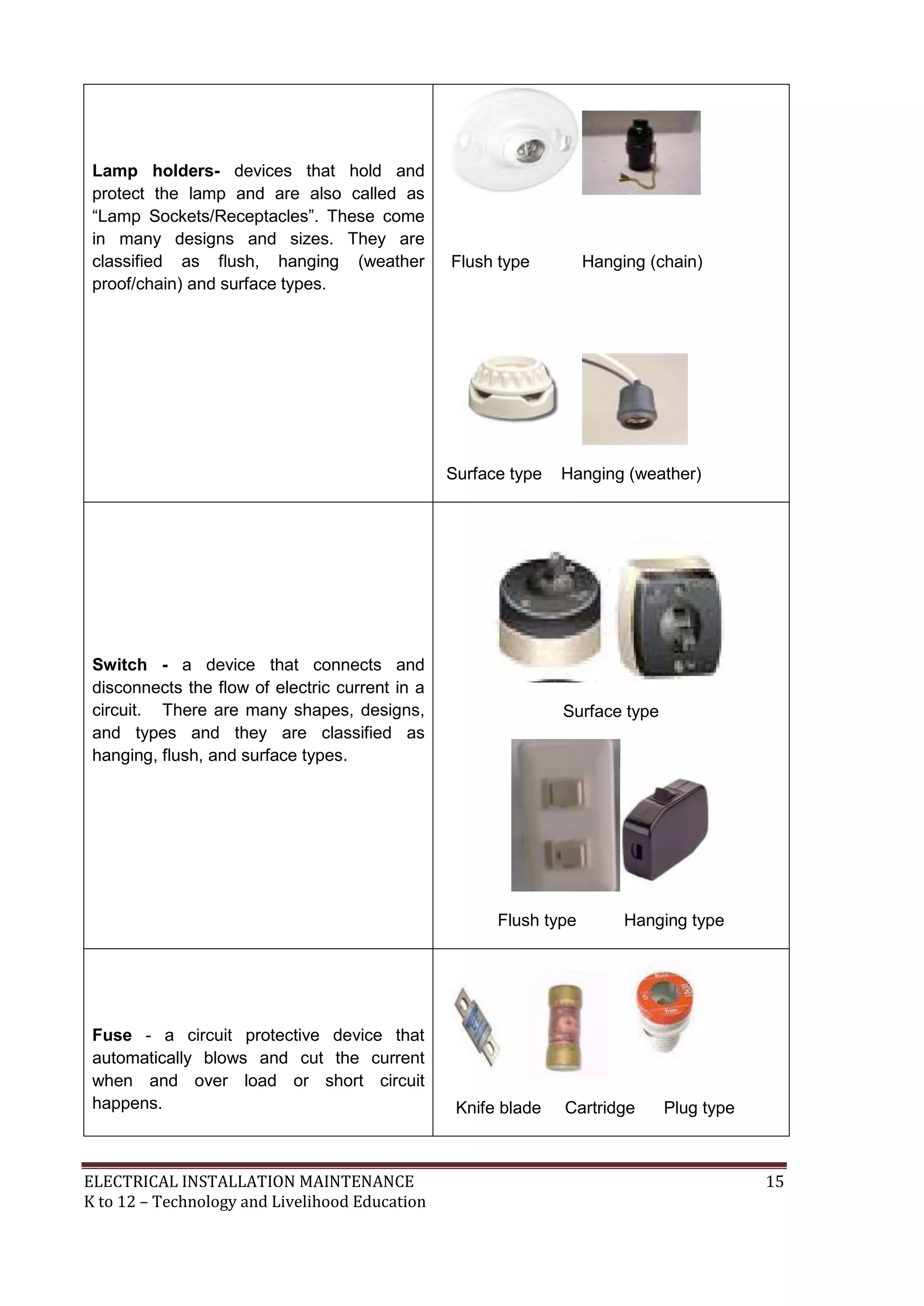
Convenience outlet- a device that acts as
a convenient source of electrical energy for
current consuming appliances. It is where
the male plug of an appliance is inserted
and usually fastened on the wall or
connected in an extension cord. It maybe
single, duplex, triplex or multiplex and could
be surface type or flush type.

PICTURES

Surface type (duplex)

Flush type (duplex)

Male plug- a device inserted to a
convenience outlet to conduct electric
current. A flat cord is attached to it on one
end and the other end is connected to a
current consuming instrument or appliance. plugs
ELECTRICAL INSTALLATION MAINTENANCE
K to 12 – Technology and Livelihood Education

Male

14
Lamp holders- devices that hold and
protect the lamp and are also called as
―Lamp Sockets/Receptacles‖. These come
in many designs and sizes. They are
classified as flush, hanging (weather
proof/chain) and surface types.

Flush type

Surface type

Switch - a device that connects and
disconnects the flow of electric current in a
circuit. There are many shapes, designs,
and types and they are classified as
hanging, flush, and surface types.

Hanging (chain)

Hanging (weather)

Surface type

Flush type

Fuse - a circuit protective device that
automatically blows and cut the current
when and over load or short circuit
happens.

ELECTRICAL INSTALLATION MAINTENANCE
K to 12 – Technology and Livelihood Education

Knife blade

Hanging type

Cartridge

Plug type

15
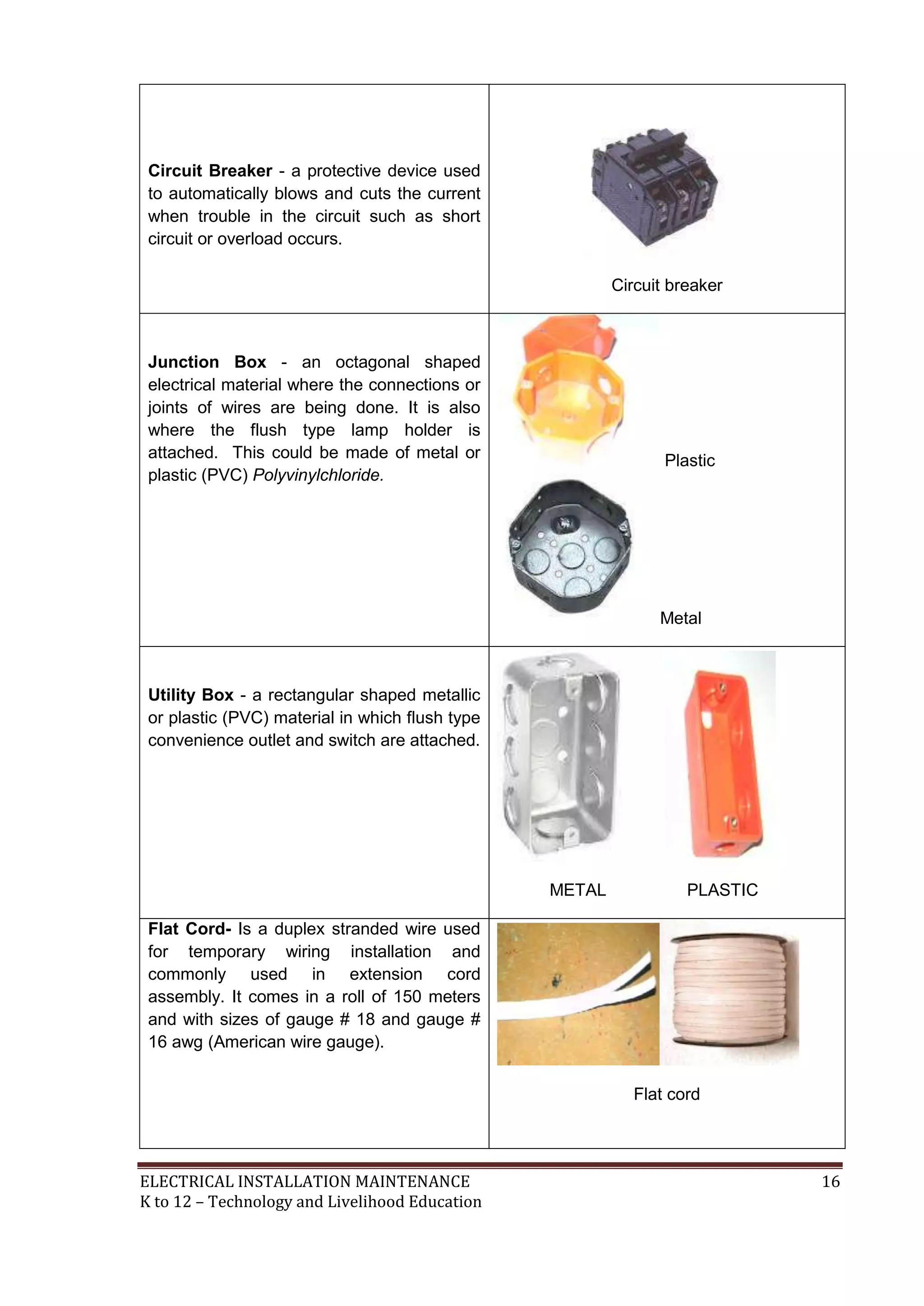
Circuit Breaker - a protective device used
to automatically blows and cuts the current
when trouble in the circuit such as short
circuit or overload occurs.
Circuit breaker

Junction Box - an octagonal shaped
electrical material where the connections or
joints of wires are being done. It is also
where the flush type lamp holder is
attached. This could be made of metal or
plastic (PVC) Polyvinylchloride.

Plastic

Metal

Utility Box - a rectangular shaped metallic
or plastic (PVC) material in which flush type
convenience outlet and switch are attached.

METAL

PLASTIC

Flat Cord- Is a duplex stranded wire used
for temporary wiring installation and
commonly used in extension cord
assembly. It comes in a roll of 150 meters
and with sizes of gauge # 18 and gauge #
16 awg (American wire gauge).
Flat cord

ELECTRICAL INSTALLATION MAINTENANCE
K to 12 – Technology and Livelihood Education

16
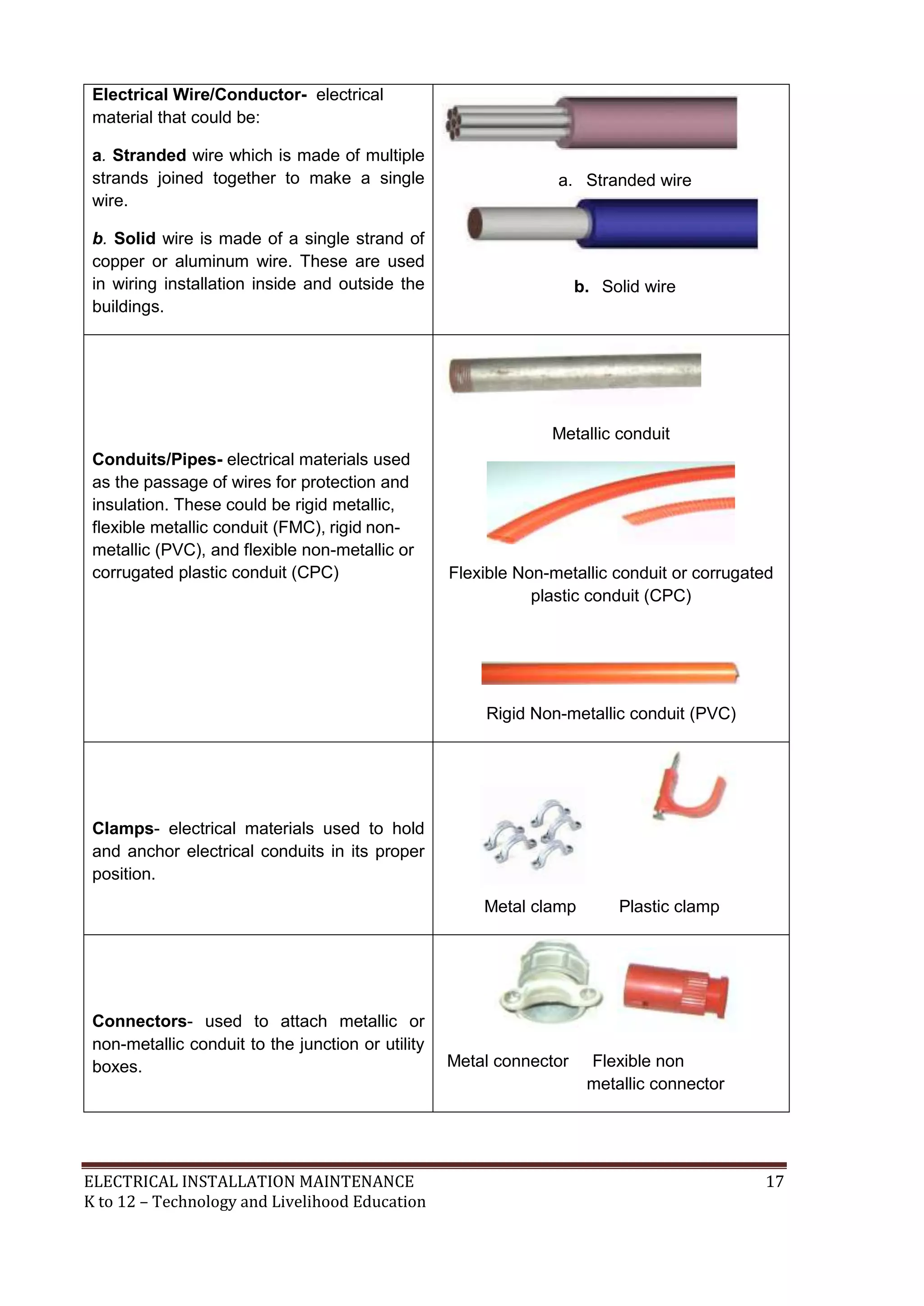
Electrical Wire/Conductor- electrical
material that could be:
a. Stranded wire which is made of multiple
strands joined together to make a single
wire.

a. Stranded wire

b. Solid wire is made of a single strand of
copper or aluminum wire. These are used
in wiring installation inside and outside the
buildings.

b. Solid wire

Metallic conduit
Conduits/Pipes- electrical materials used
as the passage of wires for protection and
insulation. These could be rigid metallic,
flexible metallic conduit (FMC), rigid nonmetallic (PVC), and flexible non-metallic or
corrugated plastic conduit (CPC)

Flexible Non-metallic conduit or corrugated
plastic conduit (CPC)

Rigid Non-metallic conduit (PVC)

Clamps- electrical materials used to hold
and anchor electrical conduits in its proper
position.
Metal clamp

Connectors- used to attach metallic or
non-metallic conduit to the junction or utility
boxes.

ELECTRICAL INSTALLATION MAINTENANCE
K to 12 – Technology and Livelihood Education

Metal connector

Plastic clamp

Flexible non
metallic connector

17
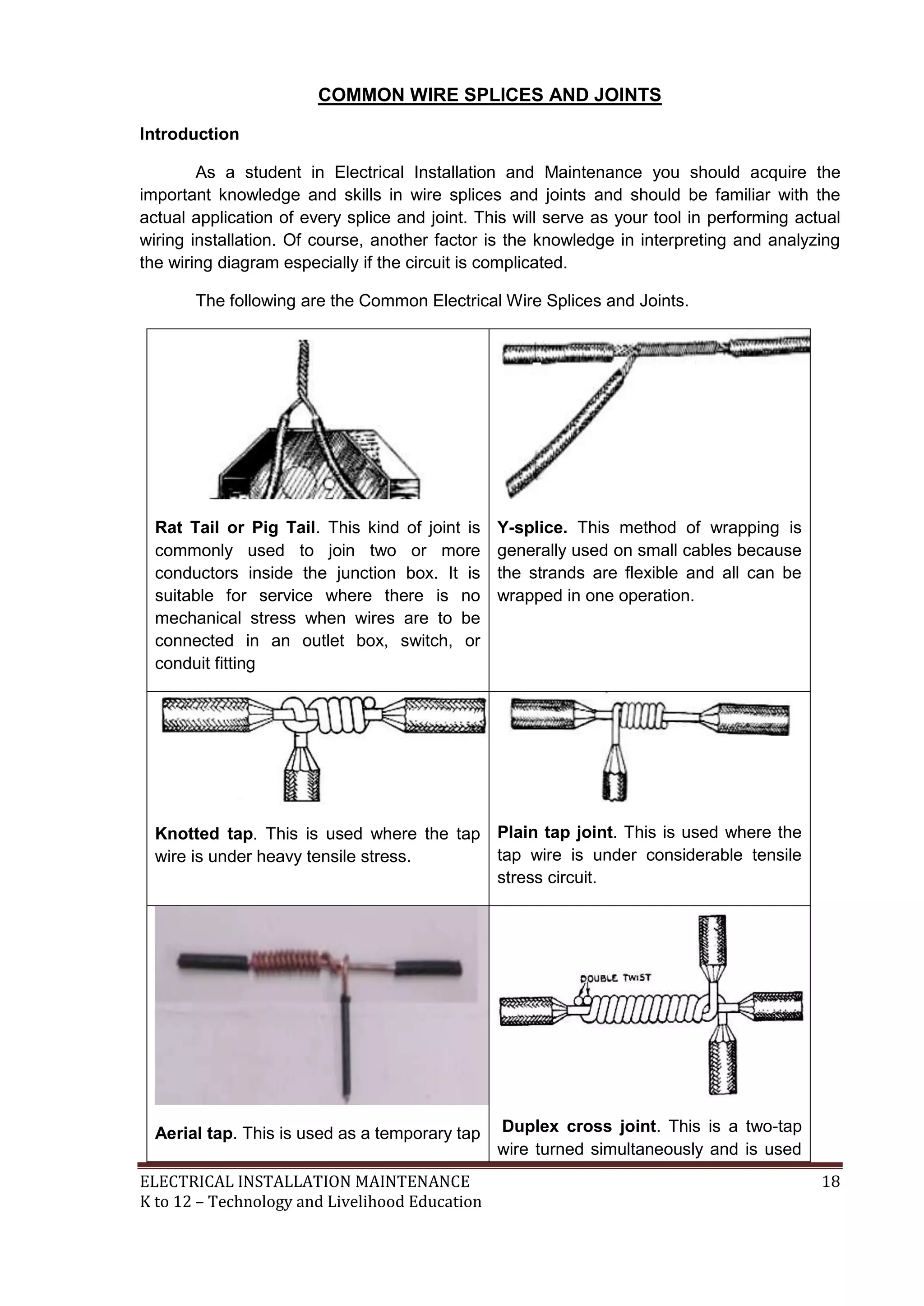
COMMON WIRE SPLICES AND JOINTS
Introduction
As a student in Electrical Installation and Maintenance you should acquire the
important knowledge and skills in wire splices and joints and should be familiar with the
actual application of every splice and joint. This will serve as your tool in performing actual
wiring installation. Of course, another factor is the knowledge in interpreting and analyzing
the wiring diagram especially if the circuit is complicated.
The following are the Common Electrical Wire Splices and Joints.

Rat Tail or Pig Tail. This kind of joint is
commonly used to join two or more
conductors inside the junction box. It is
suitable for service where there is no
mechanical stress when wires are to be
connected in an outlet box, switch, or
conduit fitting

Y-splice. This method of wrapping is
generally used on small cables because
the strands are flexible and all can be
wrapped in one operation.

Knotted tap. This is used where the tap Plain tap joint. This is used where the
tap wire is under considerable tensile
wire is under heavy tensile stress.
stress circuit.

Aerial tap. This is used as a temporary tap
ELECTRICAL INSTALLATION MAINTENANCE
K to 12 – Technology and Livelihood Education

Duplex cross joint. This is a two-tap
wire turned simultaneously and is used
18
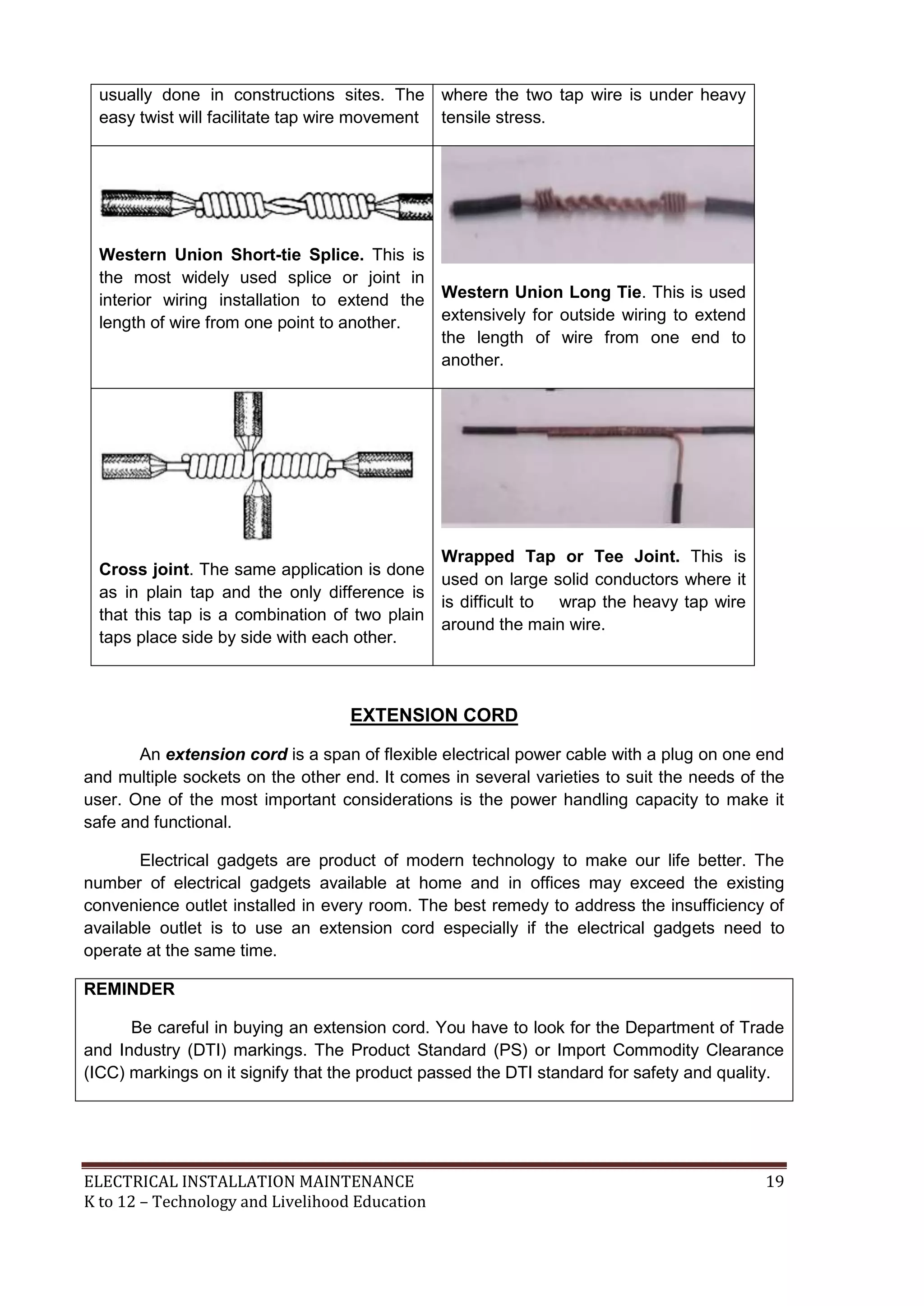
usually done in constructions sites. The where the two tap wire is under heavy
easy twist will facilitate tap wire movement tensile stress.

Western Union Short-tie Splice. This is
the most widely used splice or joint in
interior wiring installation to extend the Western Union Long Tie. This is used
extensively for outside wiring to extend
length of wire from one point to another.
the length of wire from one end to
another.

Wrapped Tap or Tee Joint. This is
Cross joint. The same application is done
used on large solid conductors where it
as in plain tap and the only difference is
is difficult to wrap the heavy tap wire
that this tap is a combination of two plain
around the main wire.
taps place side by side with each other.

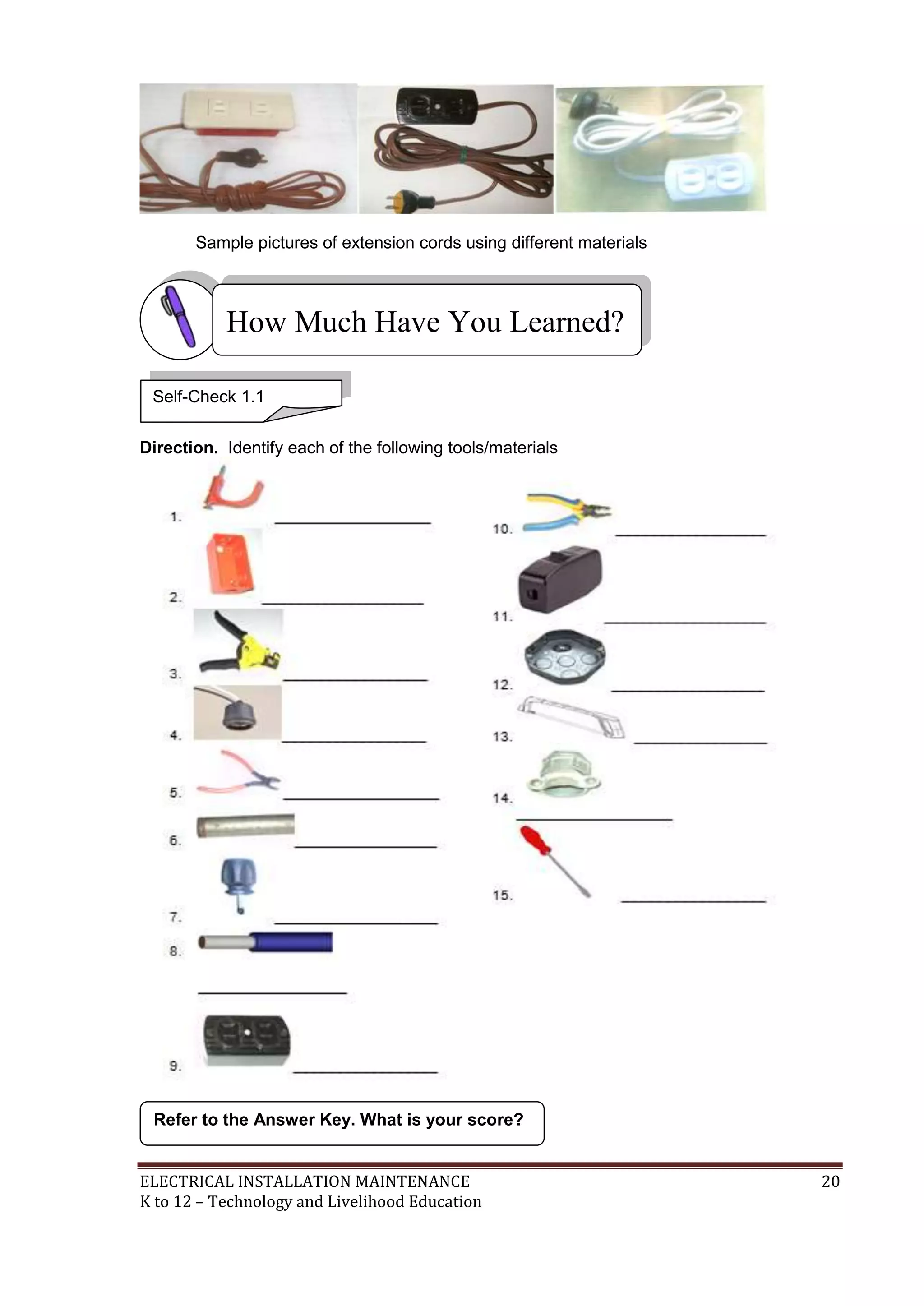
EXTENSION CORD
An extension cord is a span of flexible electrical power cable with a plug on one end
and multiple sockets on the other end. It comes in several varieties to suit the needs of the
user. One of the most important considerations is the power handling capacity to make it
safe and functional.
Electrical gadgets are product of modern technology to make our life better. The
number of electrical gadgets available at home and in offices may exceed the existing
convenience outlet installed in every room. The best remedy to address the insufficiency of
available outlet is to use an extension cord especially if the electrical gadgets need to
operate at the same time.
REMINDER
Be careful in buying an extension cord. You have to look for the Department of Trade
and Industry (DTI) markings. The Product Standard (PS) or Import Commodity Clearance
(ICC) markings on it signify that the product passed the DTI standard for safety and quality.

ELECTRICAL INSTALLATION MAINTENANCE
K to 12 – Technology and Livelihood Education

19
Sample pictures of extension cords using different materials

How Much Have You Learned?
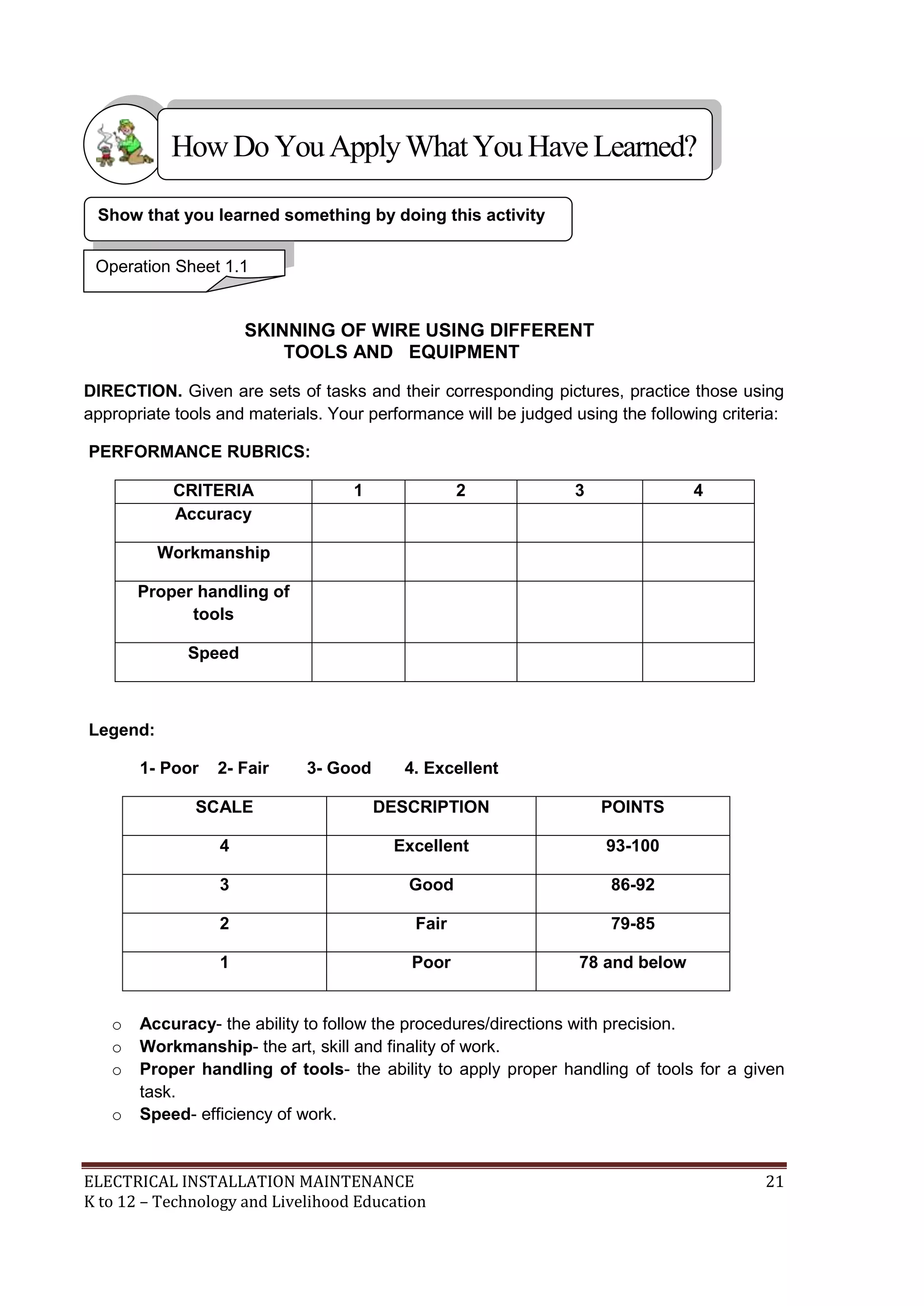
Self-Check 1.1
Direction. Identify each of the following tools/materials

Refer to the Answer Key. What is your score?

ELECTRICAL INSTALLATION MAINTENANCE
K to 12 – Technology and Livelihood Education

20
How Do You Apply What You Have Learned?
Show that you learned something by doing this activity
Operation Sheet 1.1

SKINNING OF WIRE USING DIFFERENT
TOOLS AND EQUIPMENT
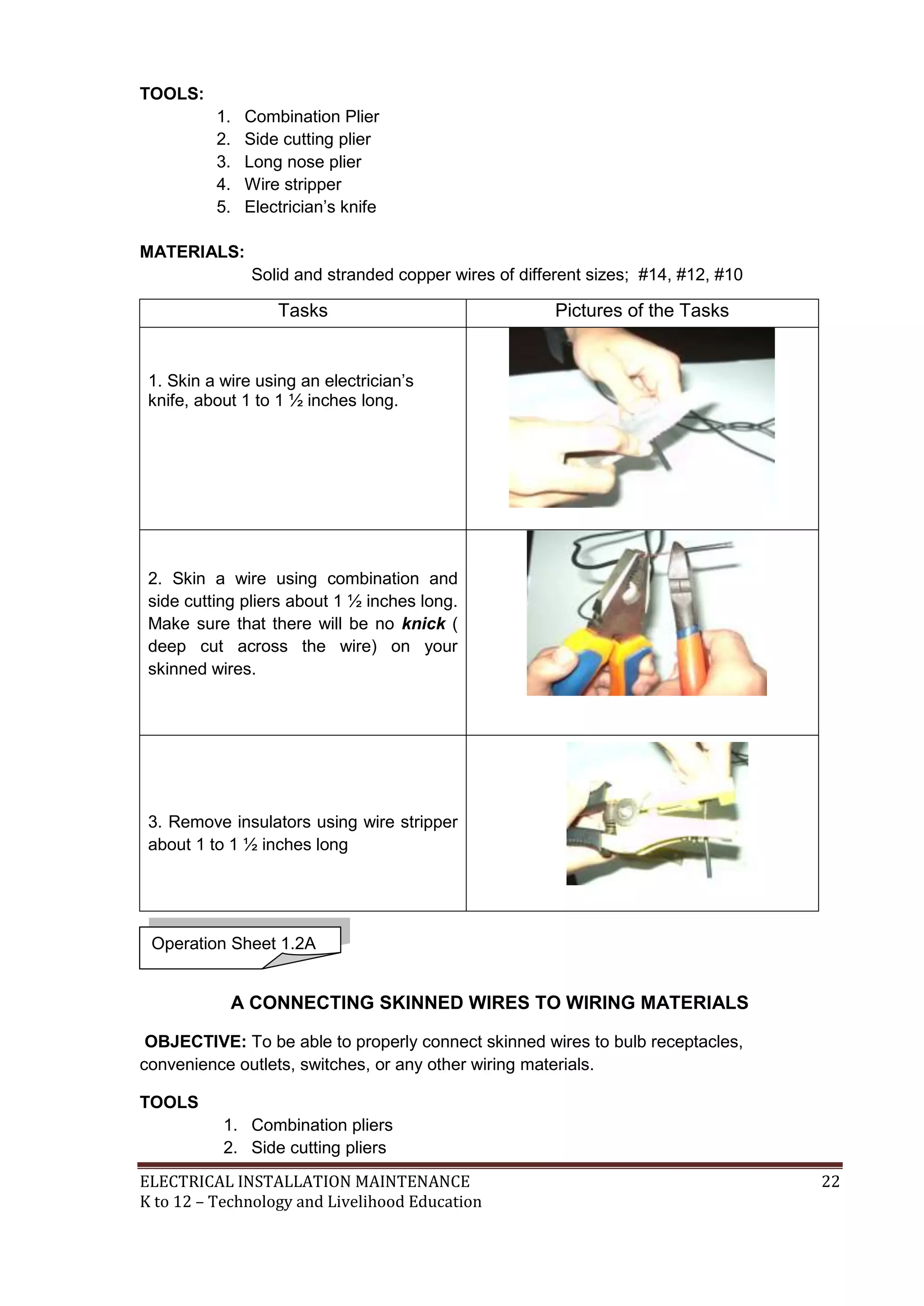
DIRECTION. Given are sets of tasks and their corresponding pictures, practice those using
appropriate tools and materials. Your performance will be judged using the following criteria:
PERFORMANCE RUBRICS:
CRITERIA
Accuracy

1

2

3

4

Workmanship
Proper handling of
tools
Speed

Legend:
1- Poor

2- Fair

3- Good

4. Excellent

SCALE

Excellent

93-100

3

Good

86-92

2

Fair

79-85

1

o

POINTS

4

o
o
o

DESCRIPTION

Poor

78 and below

Accuracy- the ability to follow the procedures/directions with precision.
Workmanship- the art, skill and finality of work.
Proper handling of tools- the ability to apply proper handling of tools for a given
task.
Speed- efficiency of work.

ELECTRICAL INSTALLATION MAINTENANCE
K to 12 – Technology and Livelihood Education

21
TOOLS:
1.
2.
3.
4.
5.

Combination Plier
Side cutting plier
Long nose plier
Wire stripper
Electrician’s knife

MATERIALS:
Solid and stranded copper wires of different sizes; #14, #12, #10

Tasks

Pictures of the Tasks

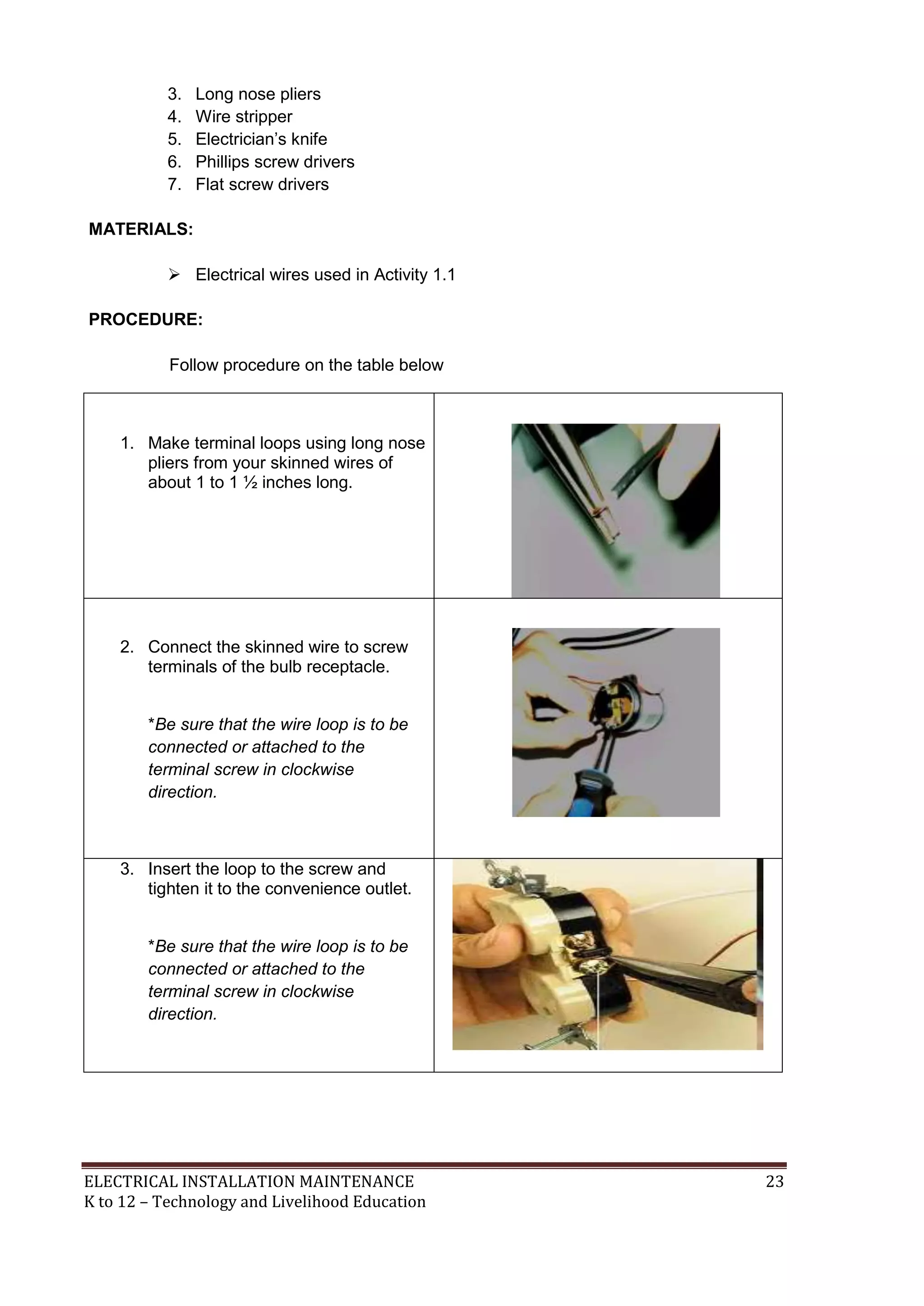
1. Skin a wire using an electrician’s
knife, about 1 to 1 ½ inches long.

2. Skin a wire using combination and
side cutting pliers about 1 ½ inches long.
Make sure that there will be no knick (
deep cut across the wire) on your
skinned wires.

3. Remove insulators using wire stripper
about 1 to 1 ½ inches long

Operation Sheet 1.2A

A CONNECTING SKINNED WIRES TO WIRING MATERIALS
OBJECTIVE: To be able to properly connect skinned wires to bulb receptacles,
convenience outlets, switches, or any other wiring materials.
TOOLS
1. Combination pliers
2. Side cutting pliers
ELECTRICAL INSTALLATION MAINTENANCE
K to 12 – Technology and Livelihood Education

22
3.
4.
5.
6.
7.

Long nose pliers
Wire stripper
Electrician’s knife
Phillips screw drivers
Flat screw drivers

MATERIALS:
 Electrical wires used in Activity 1.1
PROCEDURE:
Follow procedure on the table below

1. Make terminal loops using long nose
pliers from your skinned wires of
about 1 to 1 ½ inches long.

2. Connect the skinned wire to screw
terminals of the bulb receptacle.
*Be sure that the wire loop is to be
connected or attached to the
terminal screw in clockwise
direction.

3. Insert the loop to the screw and
tighten it to the convenience outlet.
*Be sure that the wire loop is to be
connected or attached to the
terminal screw in clockwise
direction.

ELECTRICAL INSTALLATION MAINTENANCE
K to 12 – Technology and Livelihood Education

23
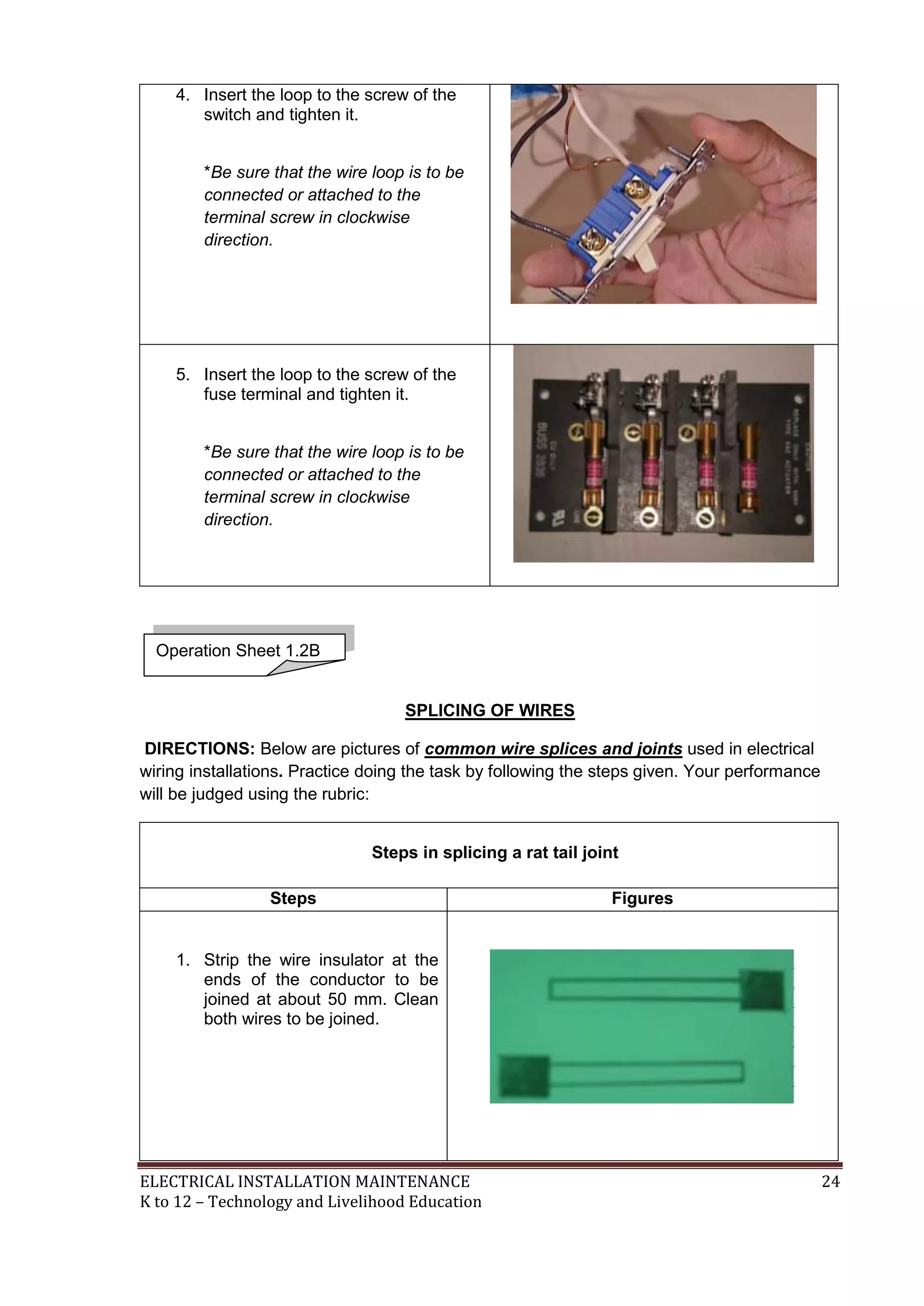
4. Insert the loop to the screw of the
switch and tighten it.
*Be sure that the wire loop is to be
connected or attached to the
terminal screw in clockwise
direction.

5. Insert the loop to the screw of the
fuse terminal and tighten it.
*Be sure that the wire loop is to be
connected or attached to the
terminal screw in clockwise
direction.

Operation Sheet 1.2B

SPLICING OF WIRES
DIRECTIONS: Below are pictures of common wire splices and joints used in electrical
wiring installations. Practice doing the task by following the steps given. Your performance
will be judged using the rubric:
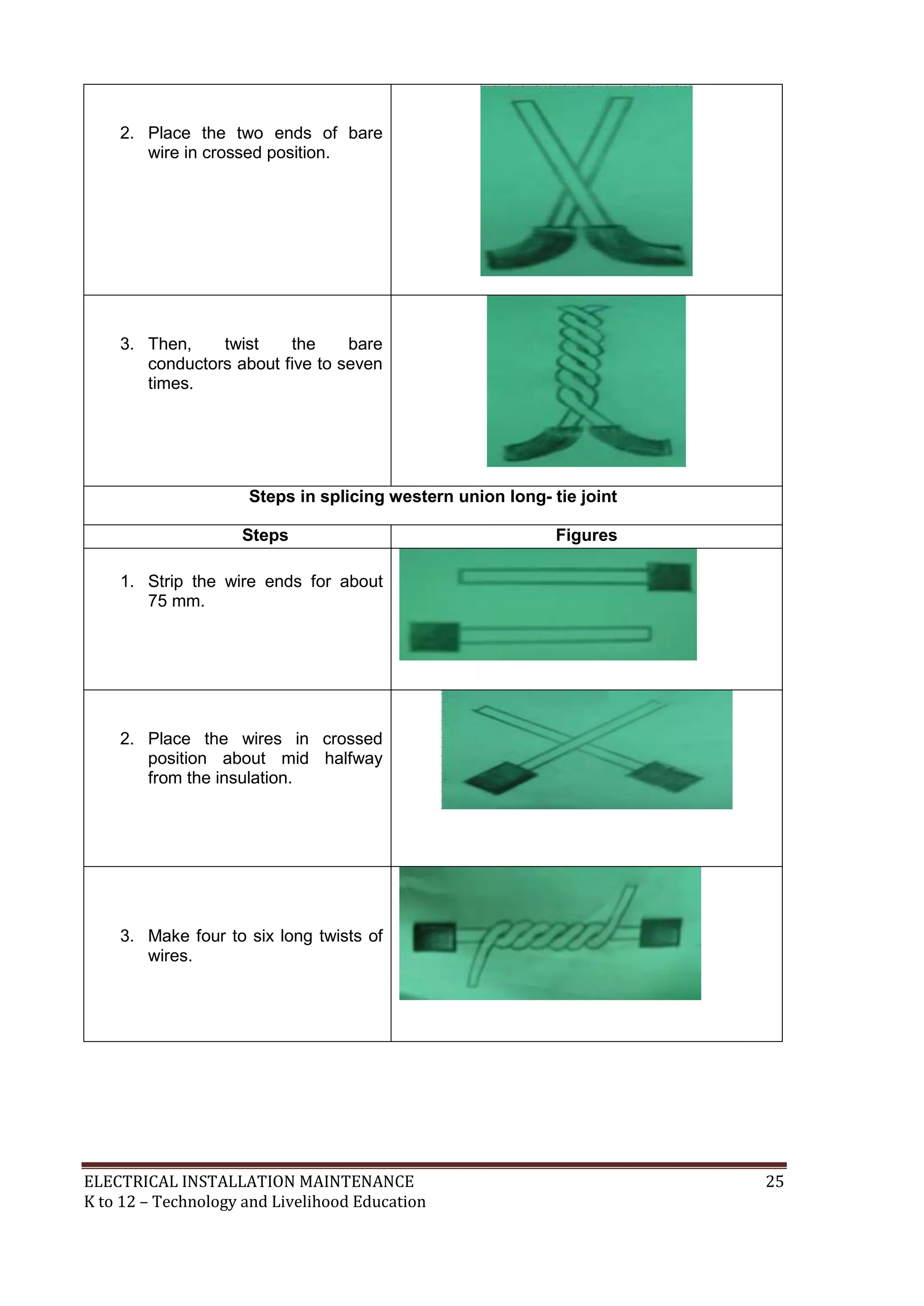
Steps in splicing a rat tail joint
Steps

Figures

1. Strip the wire insulator at the
ends of the conductor to be
joined at about 50 mm. Clean
both wires to be joined.

ELECTRICAL INSTALLATION MAINTENANCE
K to 12 – Technology and Livelihood Education

24
2. Place the two ends of bare
wire in crossed position.

3. Then,
twist
the
bare
conductors about five to seven
times.

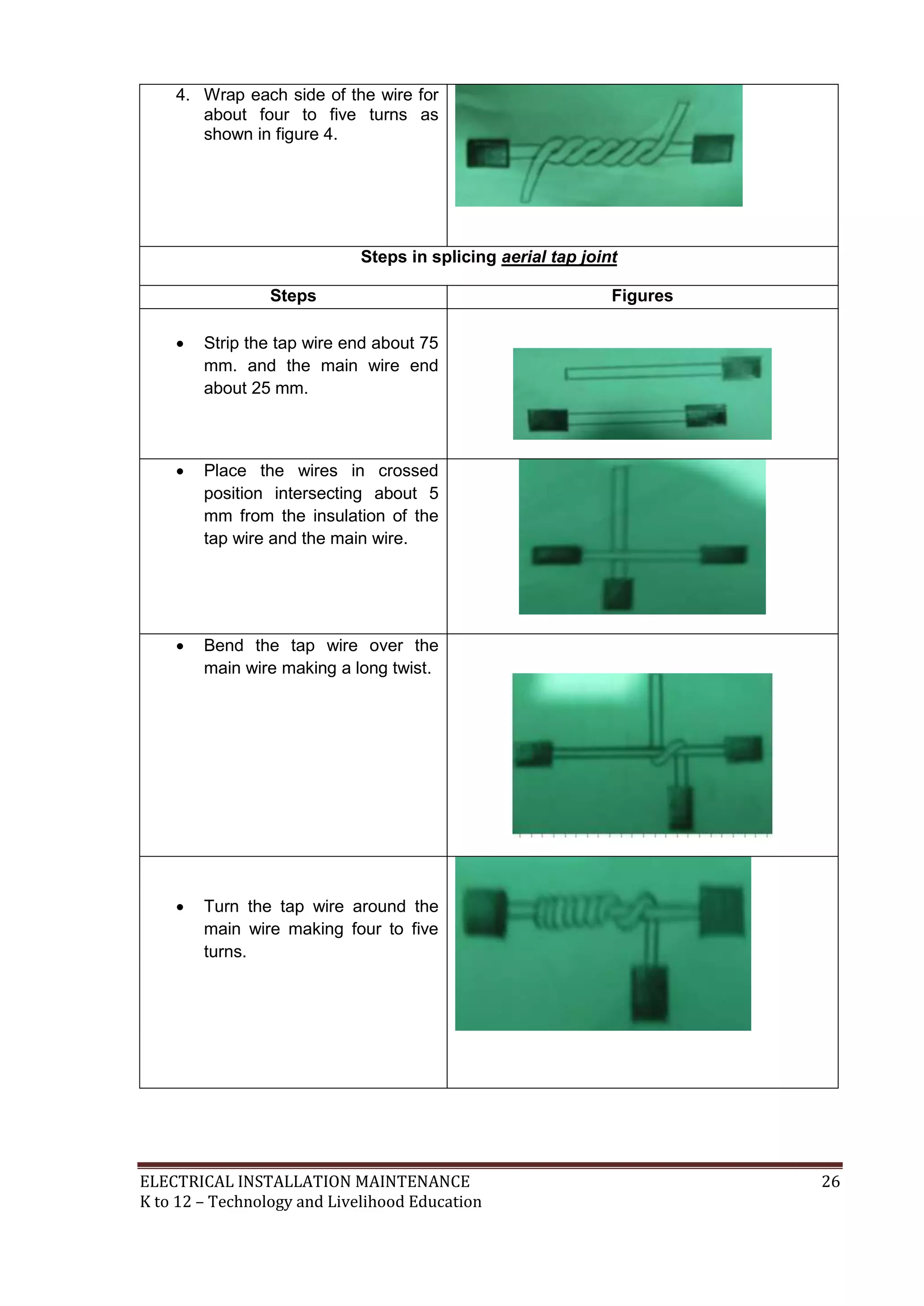
Steps in splicing western union long- tie joint
Steps

Figures

1. Strip the wire ends for about
75 mm.

2. Place the wires in crossed
position about mid halfway
from the insulation.

3. Make four to six long twists of
wires.

ELECTRICAL INSTALLATION MAINTENANCE
K to 12 – Technology and Livelihood Education

25
4. Wrap each side of the wire for
about four to five turns as
shown in figure 4.

Steps in splicing aerial tap joint
Steps


Strip the tap wire end about 75
mm. and the main wire end
about 25 mm.



Place the wires in crossed
position intersecting about 5
mm from the insulation of the
tap wire and the main wire.



Bend the tap wire over the
main wire making a long twist.



Figures

Turn the tap wire around the
main wire making four to five
turns.

ELECTRICAL INSTALLATION MAINTENANCE
K to 12 – Technology and Livelihood Education

26
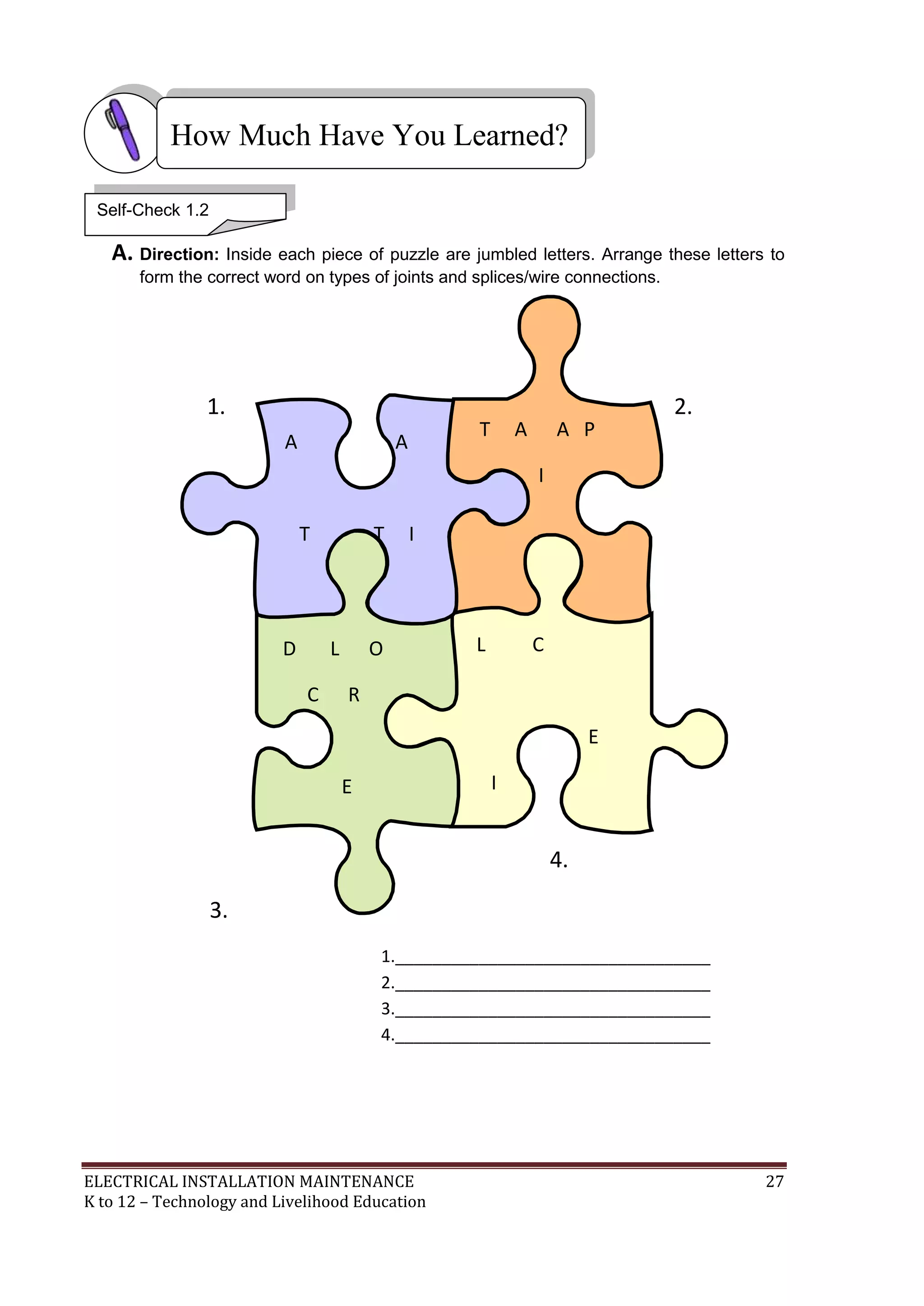
How Much Have You Learned?
Self-Check 1.2

A. Direction: Inside each piece of puzzle are jumbled letters. Arrange these letters to
form the correct word on types of joints and splices/wire connections.

1.
A

T

A

A

A P

2.

I
T

T

I
N

L
D

R
L

O

C

L
L

P

C

N

R
E
I

E

U

3.

P
S

X

S
Y

S

4.
P

1.__________________________________
2.__________________________________
3.__________________________________
4.__________________________________

ELECTRICAL INSTALLATION MAINTENANCE
K to 12 – Technology and Livelihood Education

27
How Do You Apply What You Have Learned?
Show that you learned something by doing this activity.
Operation Sheet 1.3A

INTRODUCTION
Underwriter’s knot is one of the skills needed in making an extension cord. It is
neither a joint nor a splice but a knot that is made in an extension cord. Its purpose is to
relieve the strain on small wires of the cord and binding screws of convenience outlets and
male plug.
For you to make a quality and safe output you have to strictly follow the given
procedure in making an underwriter’s knot. Below is the procedure.
You will be rated by the use of this performance rubics.
PERFORMANCE RUBRICS:
CRITERIA
Accuracy
Workmanship
Proper handling of
tools
Speed

Legend:
1- poor 2- fair
SCALE
4
3
2
1

1

2

3- good
4. Excellent
DESCRIPTION
Excellent
Good
Fair
Poor

3

4

POINTS
93-100
86-92
79-85
78 and below

Materials:
 Flat cord no.18 AWG
Tools:
 Side cutting
 long nose
 combination pliers
 Wire stripper/electrician’s knife
ELECTRICAL INSTALLATION MAINTENANCE
K to 12 – Technology and Livelihood Education

28
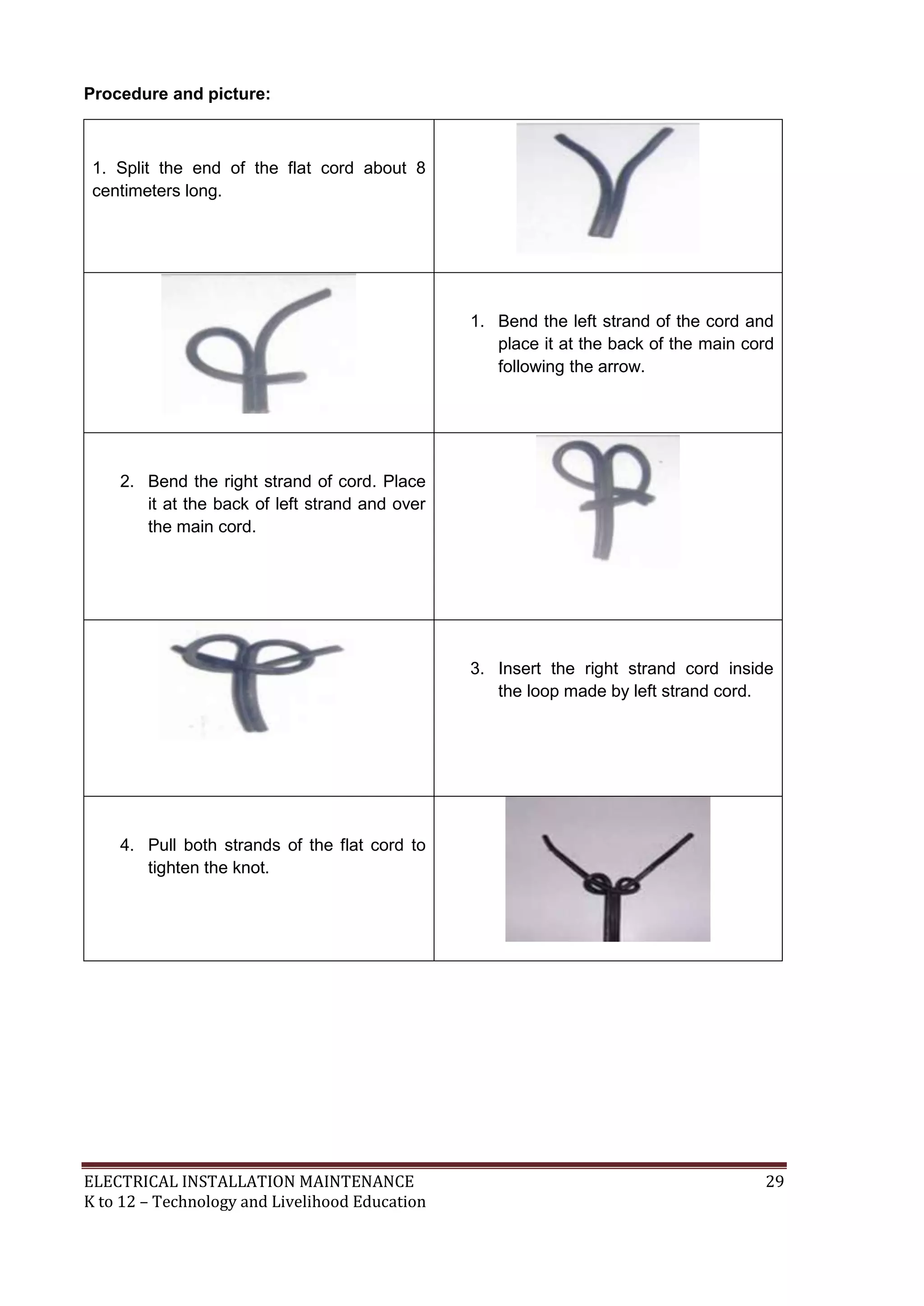
Procedure and picture:

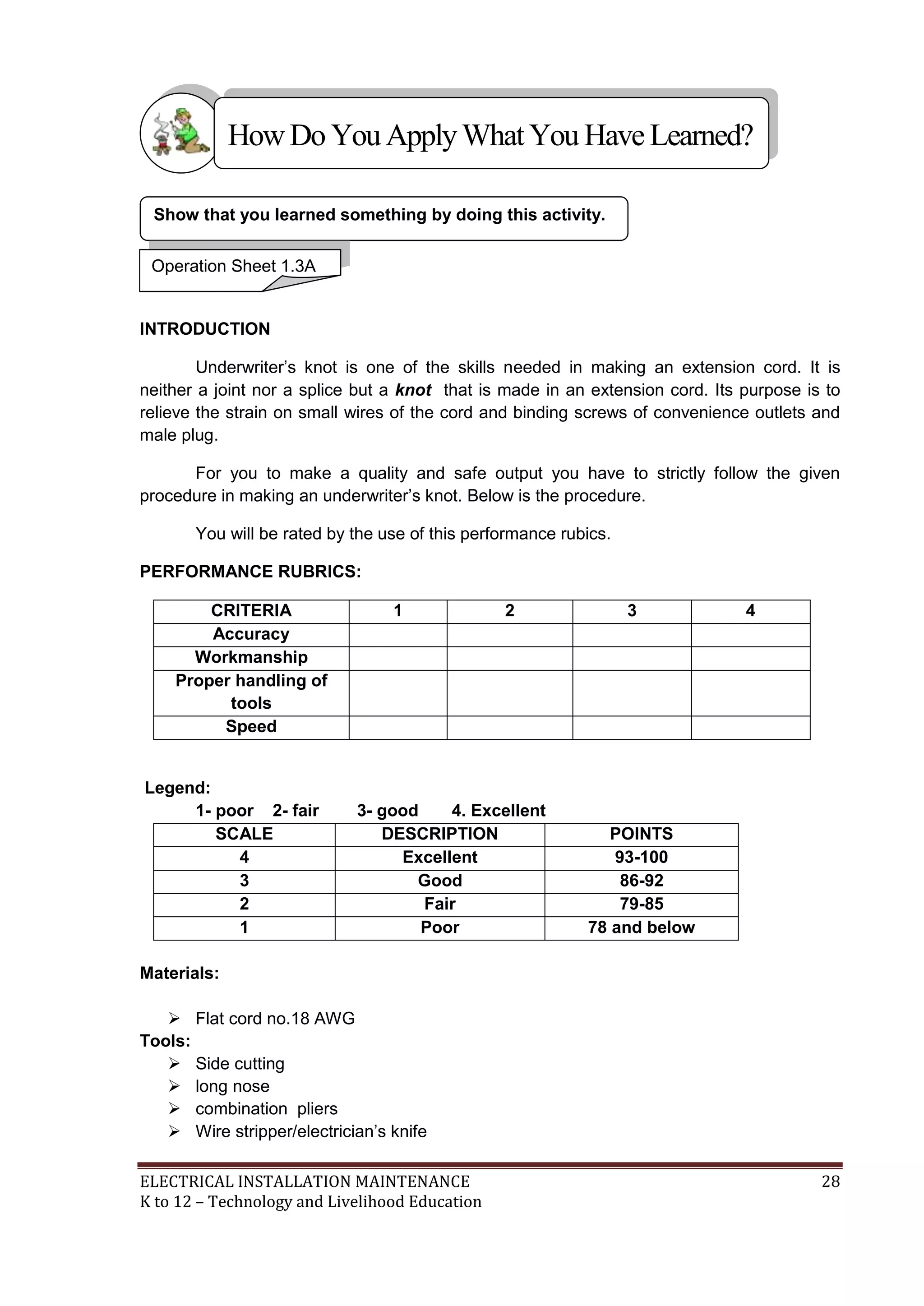
1. Split the end of the flat cord about 8
centimeters long.

1. Bend the left strand of the cord and
place it at the back of the main cord
following the arrow.

2. Bend the right strand of cord. Place
it at the back of left strand and over
the main cord.

3. Insert the right strand cord inside
the loop made by left strand cord.

4. Pull both strands of the flat cord to
tighten the knot.

ELECTRICAL INSTALLATION MAINTENANCE
K to 12 – Technology and Livelihood Education

29
Operation Sheet 1.3B

PROJECT PLAN IN MAKING AN EXTENSION CORD
INTRODUCTION
You might be wondering why there are several projects which are not completely
done. Well, there are several reasons why this happens. It might be out of budget or not
properly planned. So, this Lesson will help you achieve the desired quality project.
A project plan is necessary before undertaking any project because it serves as
your guide in accomplishing an activity. It will give you an idea what needs to be done, how
much to spend and what procedures to undertake.
A well prepared project plan saves time and cost of materials. Below is a sample
project plan of an extension cord. This format can also be used in preparing a plan for other
projects in the future.

Project Plan - (Making an extension cord)
Name of Student:_________________________ Year & Section:__________________
I. Name of Project: Extension Cord Assembly Date Started: ___________________
Date Finished: __________________

II. Objective:
a. Demonstrate how to make an extension cord.
b. Observe safety measures while doing the project.
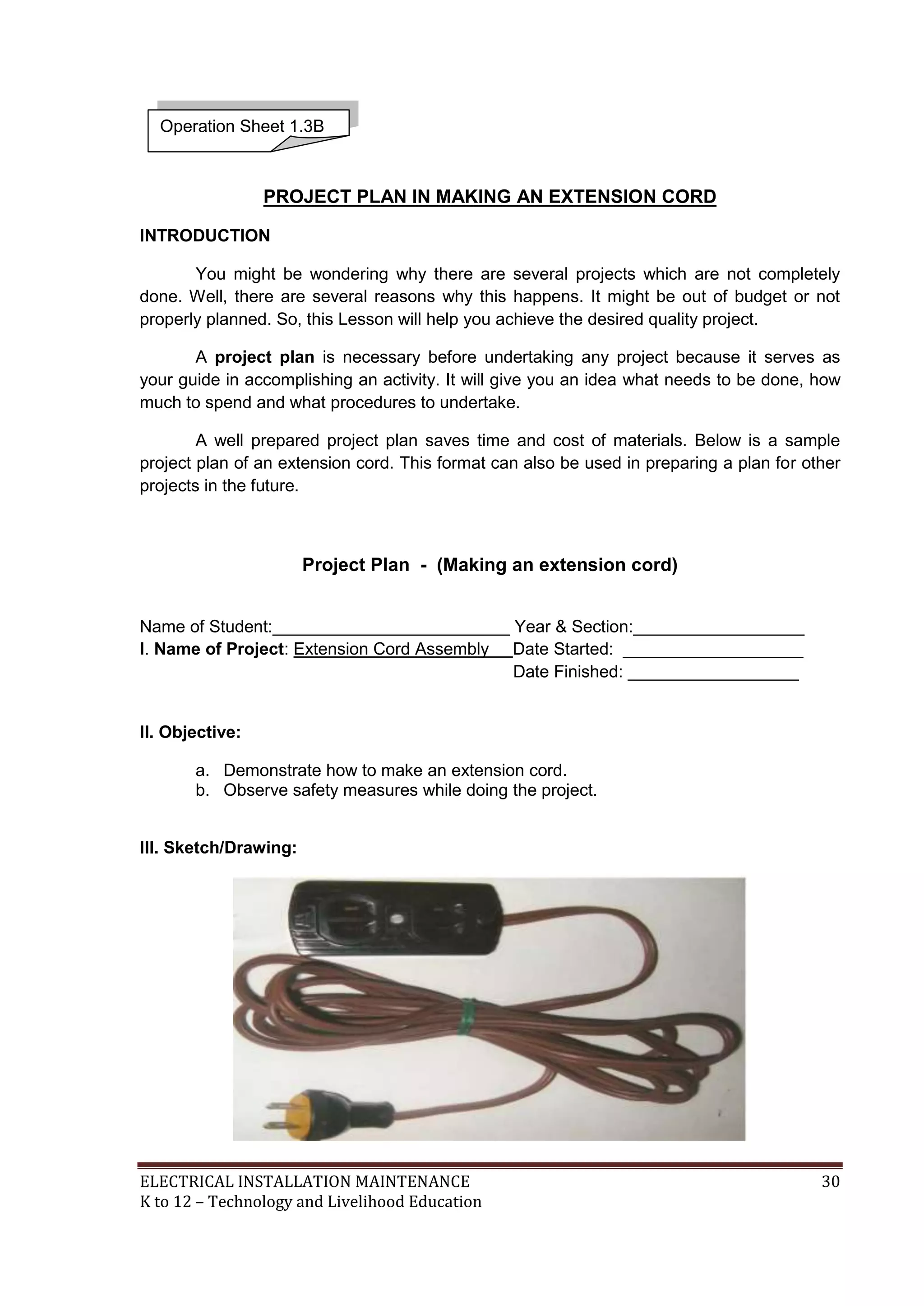
III. Sketch/Drawing:

ELECTRICAL INSTALLATION MAINTENANCE
K to 12 – Technology and Livelihood Education

30
IV. Materials Needed:
Qty.

Unit

Description

Unit Cost

Total Cost

1

pc.

Convenience Outlet (surface type Php 40.00
duplex)

Php 40.00

3

meters

Flat Cord # 18 AWG

Php 12.00

Php 36.00

1

pc.

Male Plug

Php 15.00

Php 15.00

2

Pcs.

Eyelet Wire Connectors

Php

Php

1.50

3.00

TOTAL COST OF MATERIALS

Php 94.00

+ cost of labor (approximately 20%-30% of cost of materials)

Php 28.00
(30%)

SELLING COST

PHP 122.00

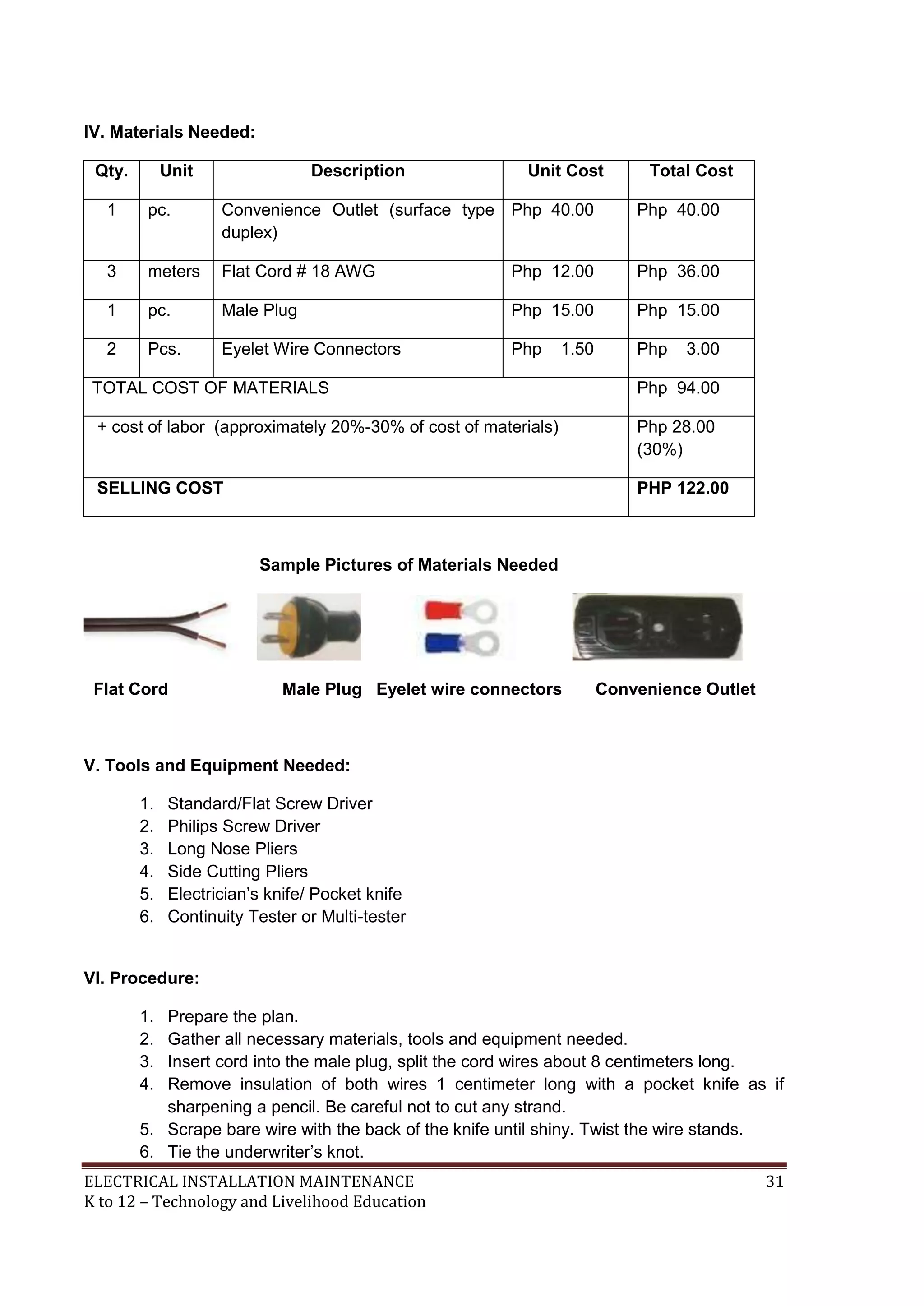
Sample Pictures of Materials Needed

Flat Cord

Male Plug Eyelet wire connectors

Convenience Outlet

V. Tools and Equipment Needed:
1.
2.
3.
4.
5.
6.

Standard/Flat Screw Driver
Philips Screw Driver
Long Nose Pliers
Side Cutting Pliers
Electrician’s knife/ Pocket knife
Continuity Tester or Multi-tester

VI. Procedure:
1.
2.
3.
4.

Prepare the plan.
Gather all necessary materials, tools and equipment needed.
Insert cord into the male plug, split the cord wires about 8 centimeters long.
Remove insulation of both wires 1 centimeter long with a pocket knife as if
sharpening a pencil. Be careful not to cut any strand.
5. Scrape bare wire with the back of the knife until shiny. Twist the wire stands.
6. Tie the underwriter’s knot.
ELECTRICAL INSTALLATION MAINTENANCE
K to 12 – Technology and Livelihood Education

31
7. Make a loop on terminal wires and connect the wires to the screw of the male
plug. The loop should go with the thread clockwise direction.
8. Split the cord wires at the other end about 4 centimeters long, then follow
procedure no. 4.
9. Connect the wires to the connectors.
10. Open the convenience outlet then remove the screw.
11. Insert the wire connectors to the screws, tighten it and return the cover.
12. Check the continuity and test the extension cord.

How Well Did You Perform?
Find out by accomplishing the Scoring Rubric honestly and sincerely.
Remember it is your learning at stake!
Criteria for Assessment:
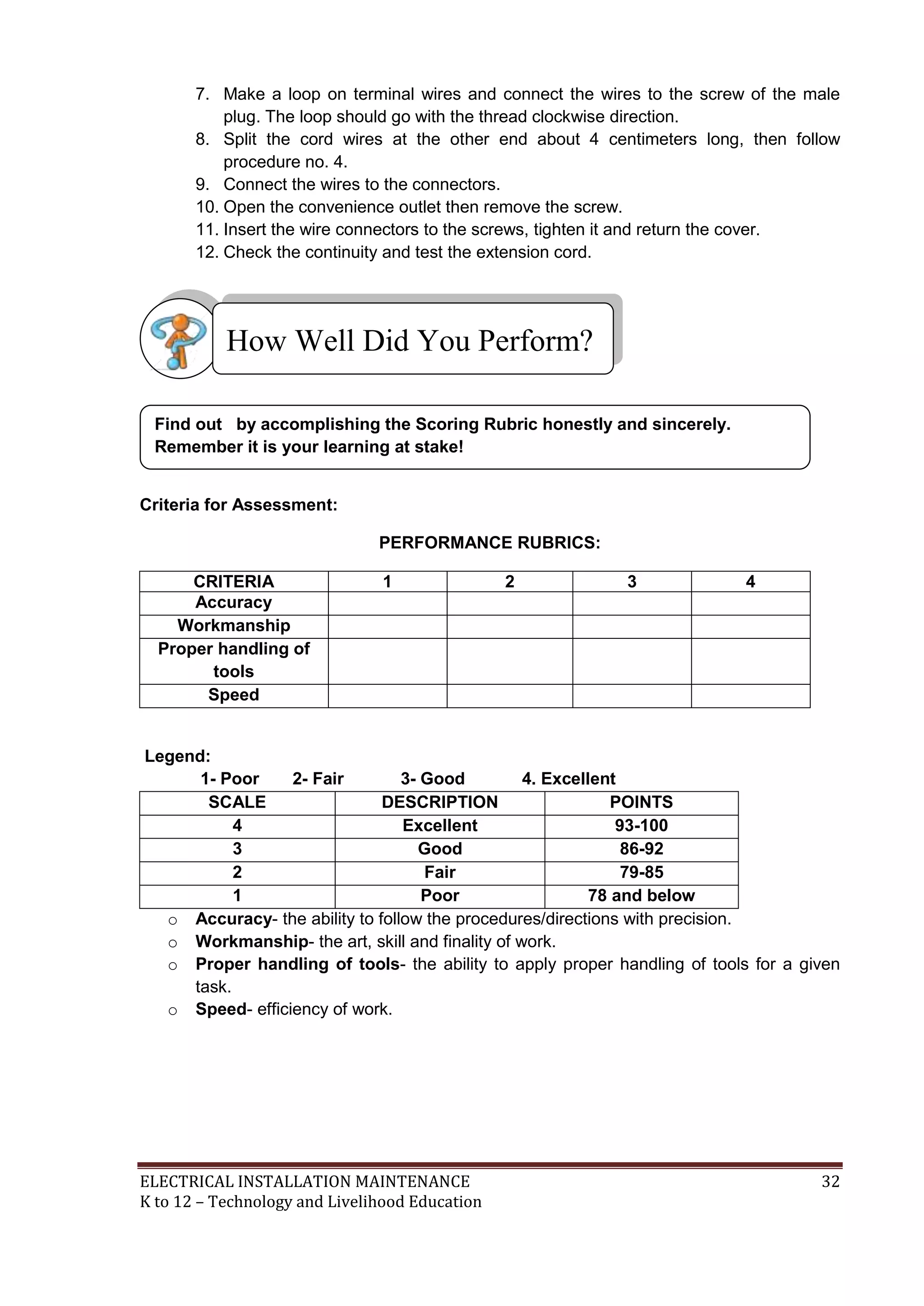
PERFORMANCE RUBRICS:
CRITERIA
Accuracy
Workmanship
Proper handling of
tools
Speed

1

2

3

4

Legend:
1- Poor
2- Fair
3- Good
4. Excellent
SCALE
DESCRIPTION
POINTS
4
Excellent
93-100
3
Good
86-92
2
Fair
79-85
1
Poor
78 and below
o Accuracy- the ability to follow the procedures/directions with precision.
o Workmanship- the art, skill and finality of work.
o Proper handling of tools- the ability to apply proper handling of tools for a given
task.
o Speed- efficiency of work.

ELECTRICAL INSTALLATION MAINTENANCE
K to 12 – Technology and Livelihood Education

32
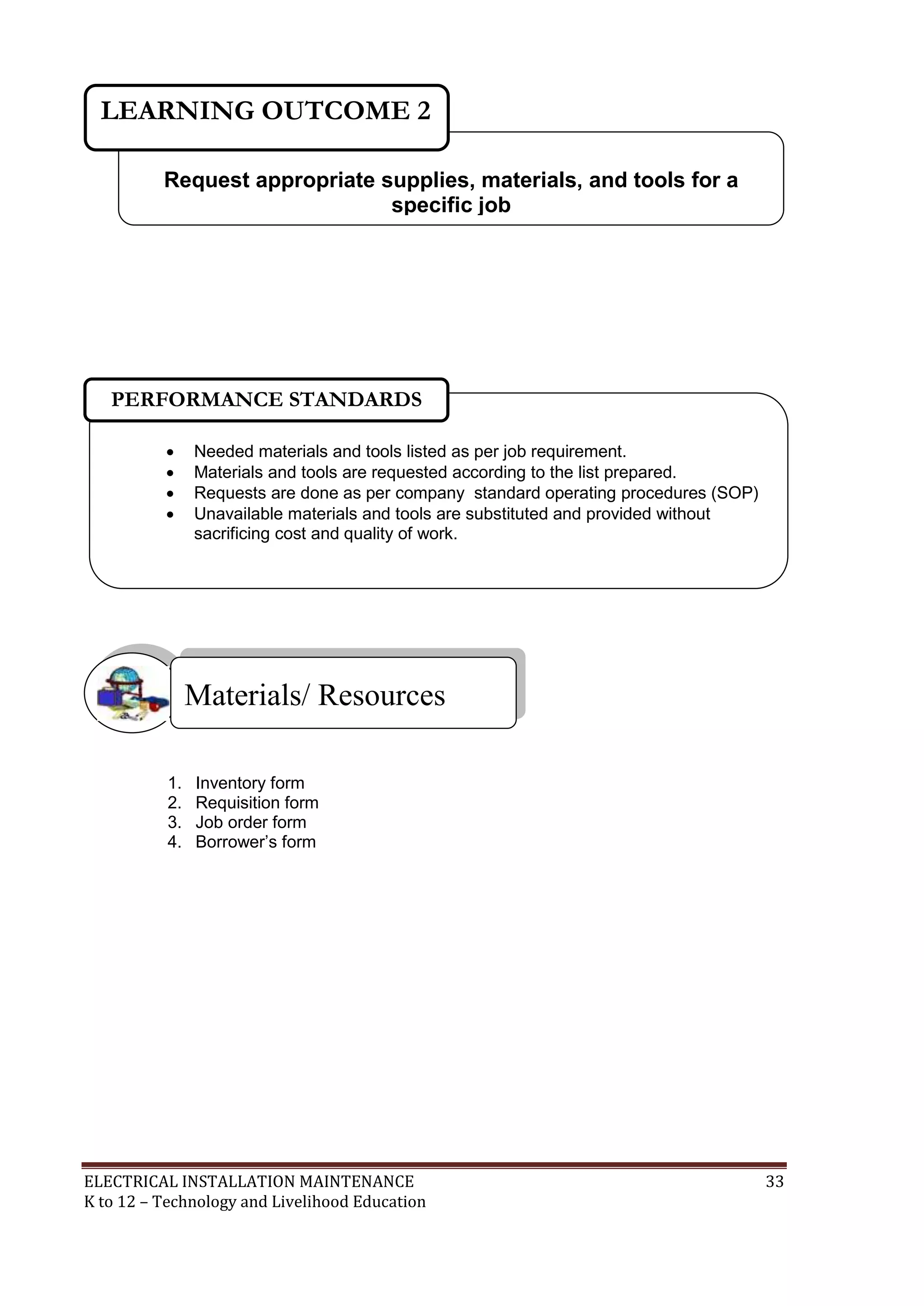
LEARNING OUTCOME 2
Request appropriate supplies, materials, and tools for a
specific job

PERFORMANCE STANDARDS





Needed materials and tools listed as per job requirement.
Materials and tools are requested according to the list prepared.
Requests are done as per company standard operating procedures (SOP)
Unavailable materials and tools are substituted and provided without
sacrificing cost and quality of work.



Materials/ Resources
1.
2.
3.
4.

Inventory form
Requisition form
Job order form
Borrower’s form

ELECTRICAL INSTALLATION MAINTENANCE
K to 12 – Technology and Livelihood Education

33
What Do You Already Know?
Let us determine how much you already know about requesting appropriate
supplies, materials, and tools for a specific job. Take this test.

Pretest LO 2
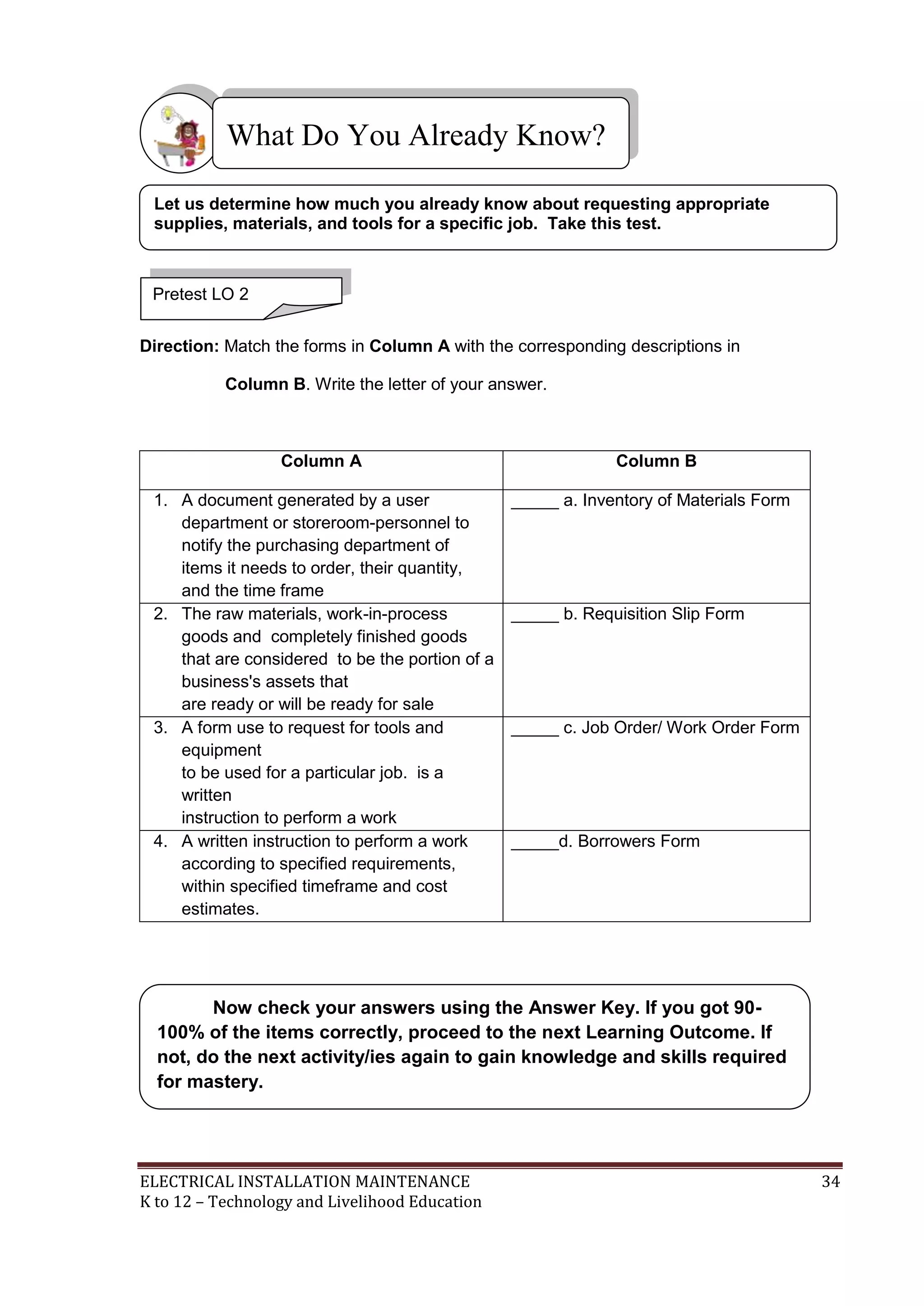
Direction: Match the forms in Column A with the corresponding descriptions in
Column B. Write the letter of your answer.

Column A
1. A document generated by a user
department or storeroom-personnel to
notify the purchasing department of
items it needs to order, their quantity,
and the time frame
2. The raw materials, work-in-process
goods and completely finished goods
that are considered to be the portion of a
business's assets that
are ready or will be ready for sale
3. A form use to request for tools and
equipment
to be used for a particular job. is a
written
instruction to perform a work
4. A written instruction to perform a work
according to specified requirements,
within specified timeframe and cost
estimates.

Column B
_____ a. Inventory of Materials Form

_____ b. Requisition Slip Form

_____ c. Job Order/ Work Order Form

_____d. Borrowers Form

Now check your answers using the Answer Key. If you got 90100% of the items correctly, proceed to the next Learning Outcome. If
not, do the next activity/ies again to gain knowledge and skills required
for mastery.

ELECTRICAL INSTALLATION MAINTENANCE
K to 12 – Technology and Livelihood Education

34
What Do You Need To Know?
Read the Information Sheet 2.1 very well then find out how much you can
remember and how much you learned by doing Self-check 1.1.

Information Sheet 2.1

DIFFERENT TYPES OF FORMS
Correctness of the entry of different forms used in electrical work is necessary in
order to acquire right, complete and accurate number of materials and tools needed in a
specific electrical job. Here are samples of different forms used in electrical work.
1. Purchase requisition is a document generated by a user department or storeroompersonnel to notify the purchasing department items it needs to order, their quantity, and the
timeframe. It may also contain the authorization to proceed with the purchase. This is also
called purchase request or requisition.

REQUISITION SLIP FORM
Name:
Project:
Location:
Classification:
Purpose:
NO.
QUANTITY

_______________
REQUISITIONER

UNIT

______________
TEACHER

ELECTRICAL INSTALLATION MAINTENANCE
K to 12 – Technology and Livelihood Education

DESCRIPTION

_____________
HEAD

UNIT
COST

TOTAL
COST

_____________
PRINCIPAL

35
2. Inventory are raw materials, work-in-process goods and completely finished goods
that are considered to be the portion of a business's assets that are ready or will be
ready for sale. Inventory represents one of the most important assets that most
businesses possess, because the turnover of inventory represents one of the primary
sources of revenue generation and subsequent earnings for the company's
shareholders/owners.

INVENTORY OF MATERIALS FORM
Name:
Section:
School:
Shop lab.:
Purpose:
Tools/
Equipment

Qty.

________________
REQUISITIONER

No. of
Functional

No. of not
Functional
but
Repairable

______________
TEACHER

No. of
Condemnable

No. of
Borrowed

No. of
Missing

________________ _______________
HEAD
PRINCIPAL

Date:_______________________

ELECTRICAL INSTALLATION MAINTENANCE
K to 12 – Technology and Livelihood Education

36
3. Job order or Work Order form is a written instruction to perform a work according to
specified requirements, within specified timeframe and cost estimates.
SAMPLE OF JOB ORDER FORM OR WORK ORDER FORM

ELECTRICAL INSTALLATION MAINTENANCE
K to 12 – Technology and Livelihood Education

37
4. BORROWER’S FORM is a form used to request for tools and equipment needed for
a particular job. It indicates the department that the borrower is connected, the date,
the job that is to be done, who is the person to approve the request, when it was
returned and if it was in good condition.
EQUIPMENT BORROWERS FORM
(Revised 31August2010; Accomplish in duplicate)
REQUEST NO: __________________ (do not fill up this item)
DATE: _________________________
MR / MS ______________________
___________________________
____________________
(Please encircle)
SURNAME
GIVEN NAME
MIDDLE
______________________ ______________________ _____________________
ADDRESS:
CONTACT NO.
E-MAIL ADDRESS:
Please check:
□ Student
Student No. _______ ______________
Subject: _____________________
□ Dept Faculty
Employee No. ____________________
□ Dept.
REPS/Staff
Department College:___________________________________________
□ Others
Office Address. ______________________________________________
Accompanying DGE-TCAGP Member: _________________________________________________
PURPOSE: __________________________________________________________________________
INTENDED PERIOD OF USE: ________________ to __________________ LOCATION:
_________________
CHECKLIST OF REQUESTED ITEMS *:

* If more than 8 items, provide another attachment.
** Do not fill this part; to be countersigned by authorized staff upon receipt and return.

RECOMMENDING APPROVAL (for DGE students): ________________________________
Thesis Adviser/Faculty-in-Charge)
Borrower’s Name in Print and Signature
This is to certify that:
Date: ___________________________________ 1. I have read, understood, and agreed to the “Terms of
(Fill this portion only during the time of borrowing.) Use for AG&ST Equipment” (back of this page).
2. I received the above listed equipment(s) completely and
APPROVED:
in good order.
________________________________
3 JR.. I swear to use the above listed equipment(s) with
due
JUAN DELA CRUZ JR., Dr. Eng.
care and diligence.
AG&ST Lab Coordinator
4. In case of damage or loss, I shall be responsible for
repair or replacement:
APPROVED:
_______________________________________
JUAN DELA CRUZ JR., Dr. Eng.
Chair, DGE and Director, TCAGP

________________________________
(Borrower’s Name over printed name)

---------------------------------------------------------------------------------------------------------------------------------To be accomplished upon return of equipment
Date returned: _________________________
All items in good condition? ____ YES ____ NO, (If no, please attach damage report)
Any missing item? _____ YES ____ NO, Please describe: ________________________________
Received by: _________________________________

ELECTRICAL INSTALLATION MAINTENANCE
K to 12 – Technology and Livelihood Education

38
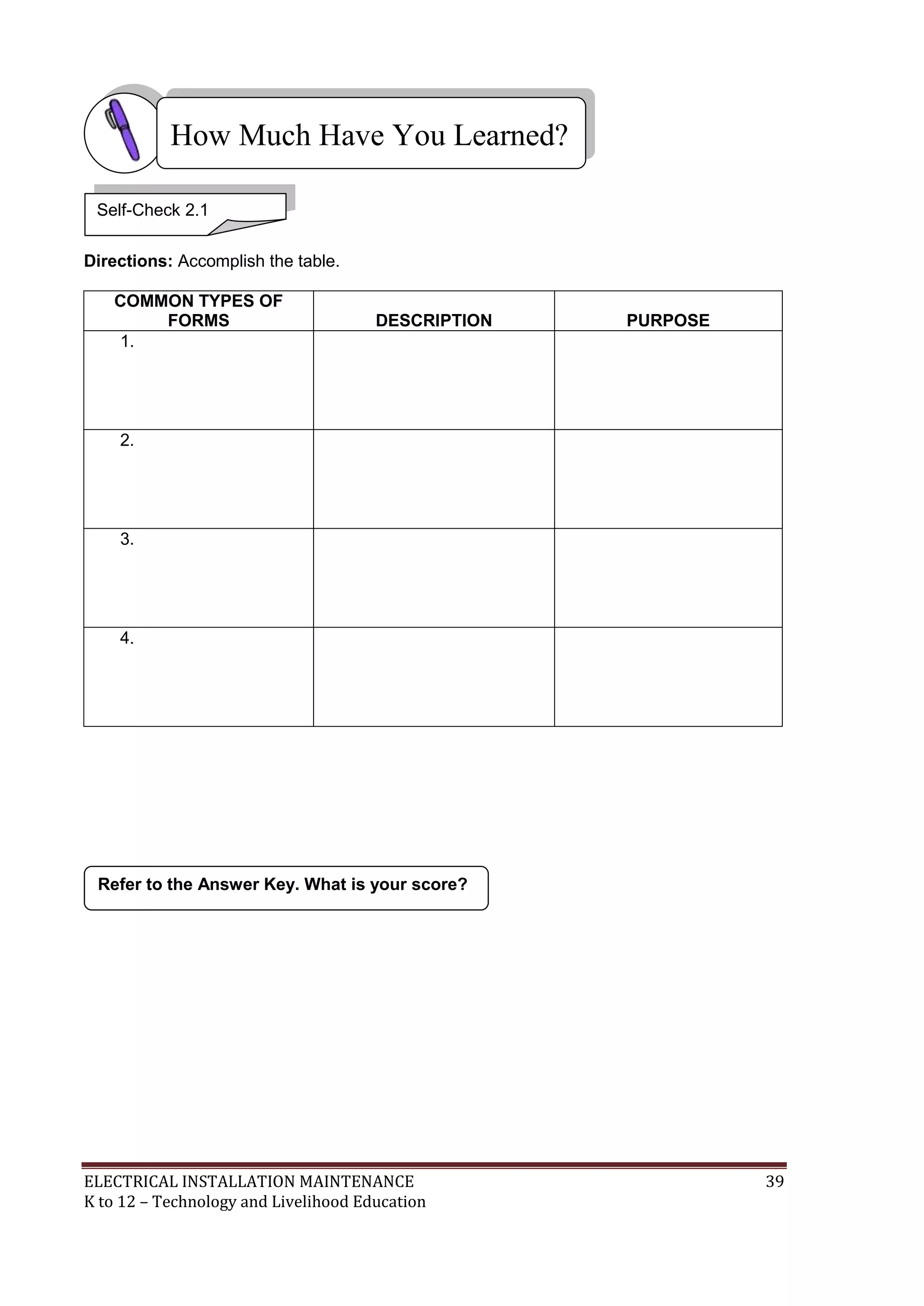
How Much Have You Learned?
Self-Check 2.1
Directions: Accomplish the table.
COMMON TYPES OF
FORMS
1.

DESCRIPTION

PURPOSE

2.

3.

4.

Refer to the Answer Key. What is your score?

ELECTRICAL INSTALLATION MAINTENANCE
K to 12 – Technology and Livelihood Education

39
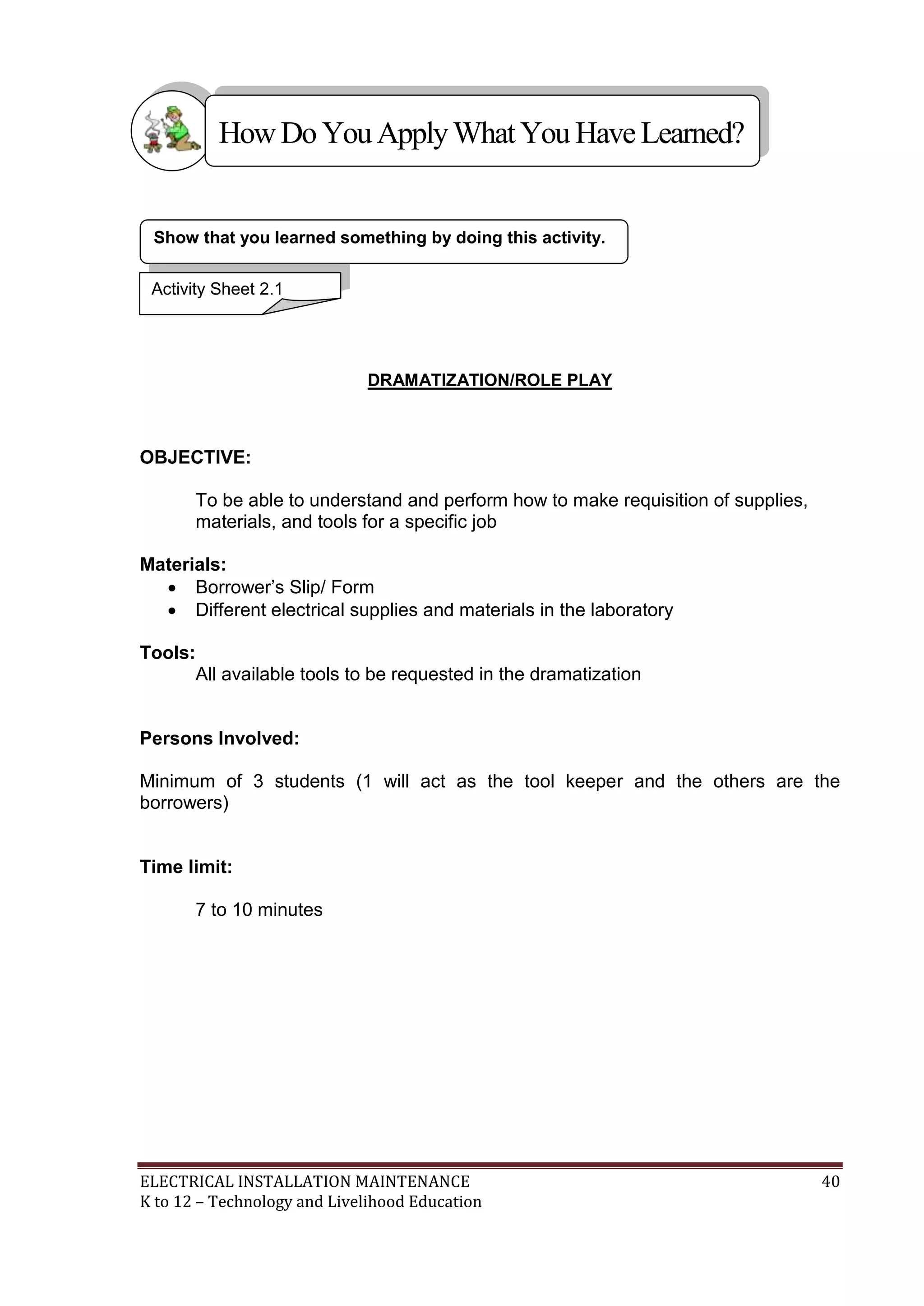
How Do You Apply What You Have Learned?

Show that you learned something by doing this activity.
Activity Sheet 2.1

DRAMATIZATION/ROLE PLAY

OBJECTIVE:
To be able to understand and perform how to make requisition of supplies,
materials, and tools for a specific job
Materials:
 Borrower’s Slip/ Form
 Different electrical supplies and materials in the laboratory
Tools:
All available tools to be requested in the dramatization

Persons Involved:
Minimum of 3 students (1 will act as the tool keeper and the others are the
borrowers)

Time limit:
7 to 10 minutes

ELECTRICAL INSTALLATION MAINTENANCE
K to 12 – Technology and Livelihood Education

40
LEARNING OUTCOME 3
Receive and inspect electrical supplies, materials, and tools

PERFORMANCE STANDARDS


Received and inspected materials and tools as per quantity and
specification based on requisition.
Tools and materials are checked for damages and manufacturing defects.
Materials and tools received are handled with appropriate safety devices.
Materials and tools are set aside to appropriate location nearest to the
workplace.







Materials/ Resources
1. Sample of official receipt form
2. Delivery receipt form

What Do You Already Know?
Let us determine how much you already know about receiving and inspecting
electrical supplies, materials, and tools. Take this test.

Pretest LO 3
Direction:
A. Complete the missing word to complete the three key words in receiving a
shipment or supplies and materials:
1. Is it _____________________?
2. Is it _____________________?
3. Is the piece count _________?

ELECTRICAL INSTALLATION MAINTENANCE
K to 12 – Technology and Livelihood Education

41
B. Answer the following questions and write the correct answer on the space provided.
1. Who is responsible for requesting inspection for damaged goods and
packaging? ________________________________
2. What should you do with the copy of your request for inspection?
_______________________________________________
3. What should a person do with the findings of the inspection?
________________________________________________

Now check your answers using the Answer Key. If you got 90-100% of
the items correctly, proceed to the next Learning Outcome. If not, do the next
activity/ies again to gain knowledge and skills required for mastery.

What Do You Need To Know?
Read the Information Sheet 3.1 very well then find out how much you can
remember and how much you learned by doing Self-check 3.1.

Information Sheet 3.1

RECEIVING AND INSPECTING FREIGHT SHIPMENTS
One of the tasks of a supply officer or logistics officer is the purchase of the
company’s supplies, materials and anything that the company needs. But his duty does not
end in just purchasing but also in receiving the deliveries of what he purchased.
In receiving the deliveries, understand that you need to ensure that the right
materials and supplies were delivered and all in good condition without defects.
A. When you receive a shipment, ask the shipper the following questions:
1. Is it for me? Check the delivery receipt for the consignee's name and address. If
your agency has more than one location, make sure the goods are for this exact
address. Check the freight to see if it is the same as described on the delivery
receipt. Look at the label on each item to make sure the shipment belongs to you.

ELECTRICAL INSTALLATION MAINTENANCE
K to 12 – Technology and Livelihood Education

42
2. Is it damaged? Do not sign the receipt before inspecting for damage. Check for
holes, water, stains, and tears. Pick up cartons if you can. Check for rattling. Listen
for something broken inside. Check to see if any package has been opened or if the
sealing tape has been tampered with.
3. Is the piece count correct? Count the pieces and match the number on the
delivery receipt to the number you have counted. If the shipment is on a pallet,
check to make sure the pallet is solid with no voids inside the stack. If the shipment
is shrink or stretch wrapped, make sure the wrap hasn't been cut and pieces
removed. Sign only for the type of unit you receive. For example: two pallets. Don't
sign for the number of packages that are supposed to be on the pallet. However, if
time permits or the pallet is not banded or shrink wrapped, count the packages, and
only then sign for the number of packages.
B. If your delivery doesn't check out, do one of the following:
1. Refuse shipment if it isn't yours, if the shipment does not meet the terms specified by
your agency, or is damaged to the point where it no longer has a value.
2. If yours, and only partially damaged or short, accept it and note exceptions on the
delivery receipt.
C. How to note exceptions:
1. Damage Notations: Be specific. Describe the damage accurately. Pinpoint the
locations of all defects. If you can see the damage, have the driver wait while you
open and inspect the packages. Write down the number and identity of the damaged
pieces. This is called a "joint inventory."
2. Shortage Notations: If part of shipment is missing, write the number of pieces
actually delivered on the delivery receipt and circle it. Then write down the number of
pieces missing and note them as "short."
3. Signatures: Write down all exceptions on both copies of the delivery receipt. Have
the driver sign both copies of the delivery receipt in his full name (not initials or
nicknames). After the driver signs, you sign also. Write your agency's name, your
full name, the date, and the time of day.
D. Follow these steps when requesting an inspection:
1. The receiving person is responsible for requesting the carrier to inspect the damaged
goods and packaging. The formal request should be made by phone right after
discovering any loss or damage.
2. After the phone request, make a request for inspection by the carrier in writing. Note
the date and time of your previous phone call and the person contacted. Keep a
copy of your request letter on file.

ELECTRICAL INSTALLATION MAINTENANCE
K to 12 – Technology and Livelihood Education

43
3. Once contacted about damage or shortage, the carrier may waive inspection and tell
you so. If so, write down the name of the person who waived the inspection, and the
date and time of waiver. Then conduct your own detailed inspection. Write up your
findings in a report and attach it to the file. If you can, take photographs to confirm
your inspection report.

How Much Have You Learned?
Self-Check 3.1
a. Complete the missing word to complete the three key words in receiving a
shipment or supplies and materials:
1. Is it _____________________?
2. Is it _____________________?
3. Is the piece count _________?
b. Answer the following questions and write the correct answer on the space
provided.
1. Who is responsible for requesting inspection for damaged goods and
packaging? ________________________________
2. What should you do with the copy of your request for inspection?
_________________________________________________
3. What should a person do with the findings of the inspection?
_________________________________________________

Refer to the Answer Key. What is your score?

ELECTRICAL INSTALLATION MAINTENANCE
K to 12 – Technology and Livelihood Education

44
How Do You Apply What You Have Learned?
Show that you learned something by doing this activity.

Activity Sheet 3.1
DRAMATIZATION ON RECEIVING SUPPLIES, MATERIALS, TOOLS AND EQUIPMENT
I.

OBJECTIVE
To practice how to receive and inspect supplies and materials for a specific job

II. PERSONS INVOLVED
1 student to act as supply officer/ tool and 1 student will act as delivery personnel
III. SITUATION
The delivery man arrived to deliver the electrical supplies and materials. The supply
officer (the other student) will inspect before receiving the supplies and materials.

Congratulations! You did a great job! Rest
and relax a while then move on to the next
lesson. Good luck!

REFERENCES





Philippine Electrical Code. 2000 Edition.
Cardenas, Elpidio.1989, Fundamental and Elements of Electricity.
Philippines: national Bookstore.
http://sam.dgs.ca.gov/TOC/3800/3861.htm
http://electrical.about.com/od/electricaltools/tp/top16electricaltools.htm

ELECTRICAL INSTALLATION MAINTENANCE
K to 12 – Technology and Livelihood Education

45
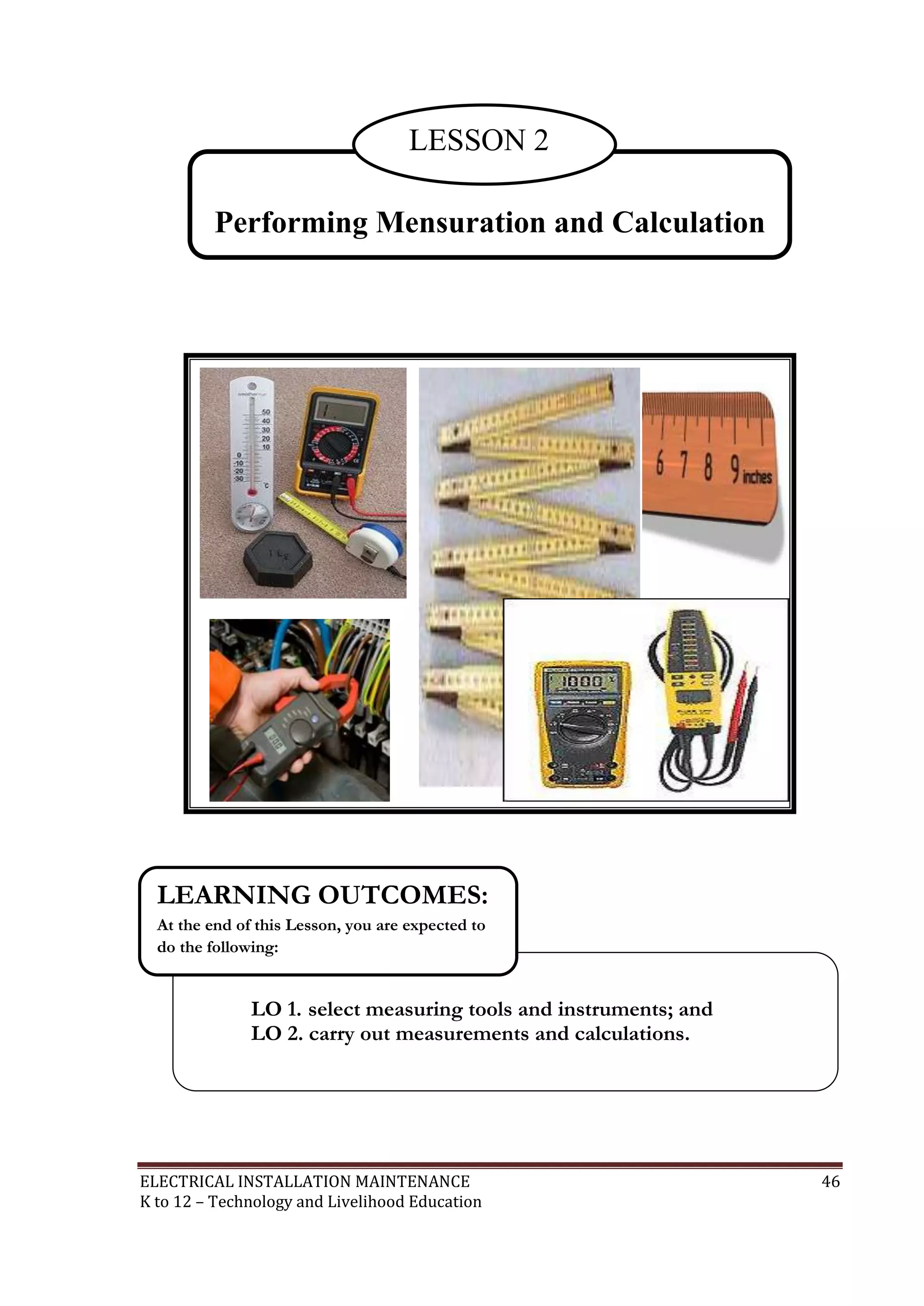
LESSON 2
Performing Mensuration and Calculation

LEARNING OUTCOMES:
At the end of this Lesson, you are expected to
do the following:

LO 1. select measuring tools and instruments; and
LO 2. carry out measurements and calculations.

ELECTRICAL INSTALLATION MAINTENANCE
K to 12 – Technology and Livelihood Education

46
Definition of Terms
Amperage (Amps) - a unit of measurement of electrical current flow
Ampere - a unit of measurement which describes the amount of electric current
passing a certain point at a particular time
Centimeter - hundredth of a meter
Inch - a portion of a foot, which is an English unit of linear measurement
Megger - an instrument used to measure the insulation resistance of conductors or
wire. It gives measurement in ohms or meg-ohms
Millimeter - one-thousandth of a meter
Multi-tester - an electrical measuring instrument used to measure the voltage, the
resistance or the current of a circuit. It is connected either through parallel or series
with the circuit depending on what to measure
Ohm - the unit of measurement used to express resistance
Ohmmeter - an instrument used to measure resistance in ohms
Volt - a unit of measurement of electrical pressure or voltage
Voltmeter - an instrument specially designed for measuring voltage
Wire Gauge - used to measure the diameter of magnetic wire

ELECTRICAL INSTALLATION MAINTENANCE
K to 12 – Technology and Livelihood Education

47
LEARNING OUTCOME 1
Select Measuring Tools and Instruments

PERFORMANCE STANDARDS


Measuring tools and instruments are selected/ classified as per object to be
measured on job requirements.



Measurements are obtained according to job requirements.



Computation of resistance, current, and voltage using Ohms Law are
obtained.



Materials/ Resources
1.
2.
3.
4.
5.
6.
7.

Ruler
Push-pull tape rule
Multi-meter
zigzag rule
Wire gauge
Micrometer caliper
Vernier caliper

8. Activity Sheets

ELECTRICAL INSTALLATION MAINTENANCE
K to 12 – Technology and Livelihood Education

48
What Do You Already Know?
Let us determine how much you already know about selecting measuring tools
and instruments. Take this test.

Pretest LO 1
I.

Direction: Match the electrical measuring tools and instruments in Column A
to their descriptions in Column B. Write the letter of your answer in the space
provided before each number.

Column A

_____1.

Column B

A. Voltmeter

B. Volt-ohmmeter
_____2.

C. Micrometer
_____3.

D. Clamp Ammeter
_____4.

E. Wire gauge

_____5.

ELECTRICAL INSTALLATION MAINTENANCE
K to 12 – Technology and Livelihood Education

49
II.
Multiple Choice:
Direction: Choose the correct answer and write only the letter on your answer
sheet.
1. An instrument used to measure the amount of electrical current intensity in a
circuit.
a. Voltmeter
b. Ammeter
c. Micrometer
d. Ohmmeter
2. A pocket sized tool used to test the line wire or circuit if there is current in it.
a. Test light
b. Wire gauge
c. Ruler
d. Pull-push rule
3. A measuring tool used to measure the length of an object in centimeter and
inches.
a. Test light
b. Wire gauge
c. Ruler
d. Pull-push rule
4. It is used to measure the diameter of wires/conductors in circular mils. It can
measure small and big sizes of wires and cables.
a. Voltmeter
b. Ammeter
c. Micrometer
d. Ohmmeter
5. It is used to measure the voltage, resistance and current of a circuit. It connected
in parallel or series with the circuit depending on what to measure.
a. Volt-Ohm-Milliammeter
b. Micrometer
c. Ohmmeter
d. Ammeter

Now check your answers using the Answer Key. If you got 90-100% of
the items correctly, proceed to the next Learning Outcome. If not, do the next
activity/ies again to gain knowledge and skills required for mastery.

ELECTRICAL INSTALLATION MAINTENANCE
K to 12 – Technology and Livelihood Education

50
What Do You Need To Know?
Read the Information Sheet 1.1 very well then find out how much you can
remember and how much you learned by doing Self-check 1.1.

Information Sheet 1.1

MEASURING TOOLS AND INSTRUMENTS
Measurement is the process or the result of determining the ratio of a physical
quantity, such as a length, time, temperature, etc., to a unit of measurement, such as the
meter, second or degree Celsius. The science of measurement is called metrology.
The English word measurement originates from the Latin mēnsūra and the
verbmetiri through the Middle French mesure.

Electrical measuring tools and instruments are sensitive and delicate so extra care is
necessary in handling them. These are used to measure currents, voltages, resistances,
wattages and other important elements in electrical works. This topic, will tackle the
function/use of each measuring tool and instrument used in doing a electrical task. Different
kinds of measuring tools and precision measuring instruments are as follows:
Measuring tool/instrument

Description

Test Light is a pocket size tool used to test the
line wire or circuit if there is current in it.

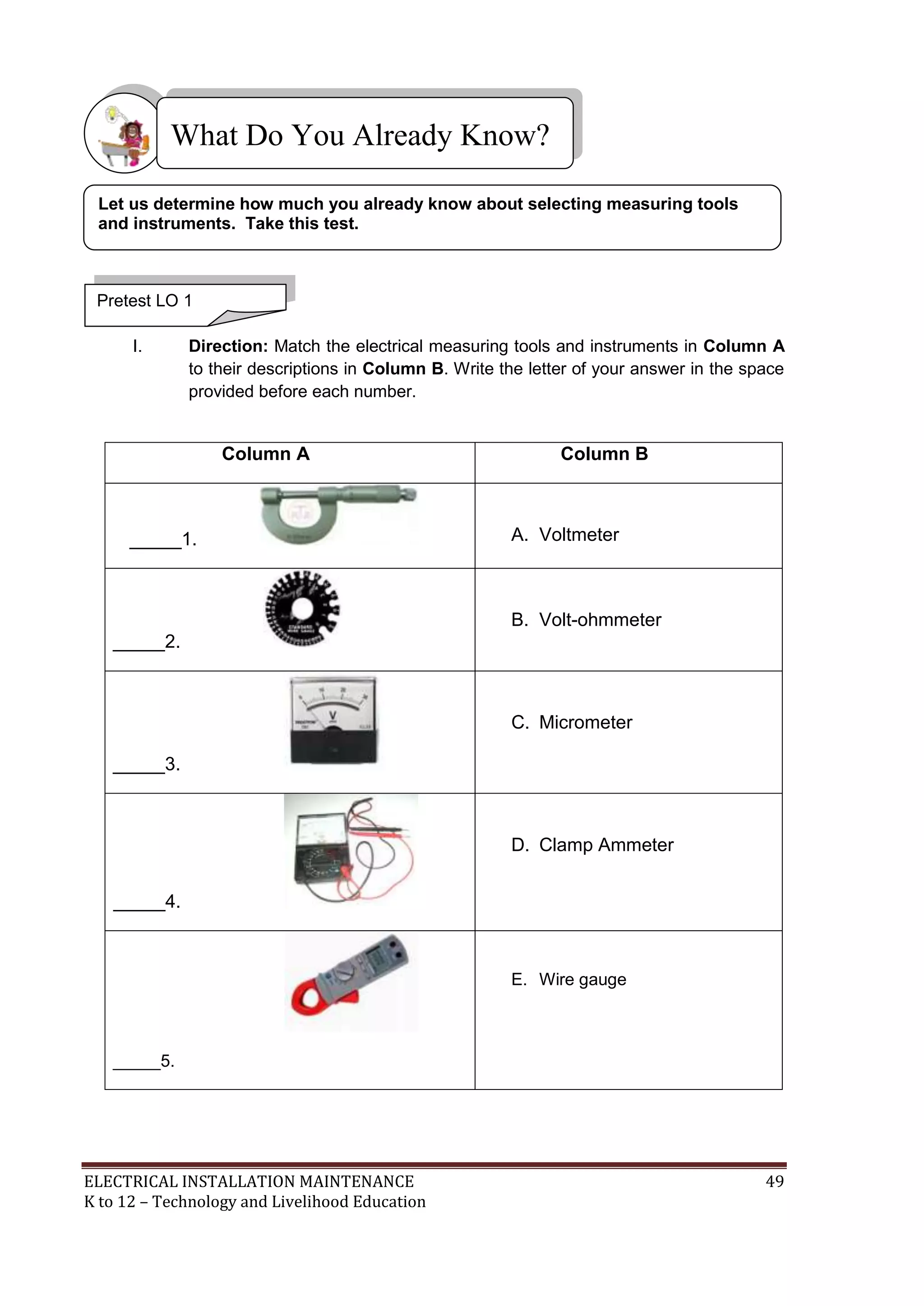
Micrometer is used to measure the diameter of
wires/conductors in circular mils. It can
measure small and big sizes of wires and
cables.

ELECTRICAL INSTALLATION MAINTENANCE
K to 12 – Technology and Livelihood Education

51
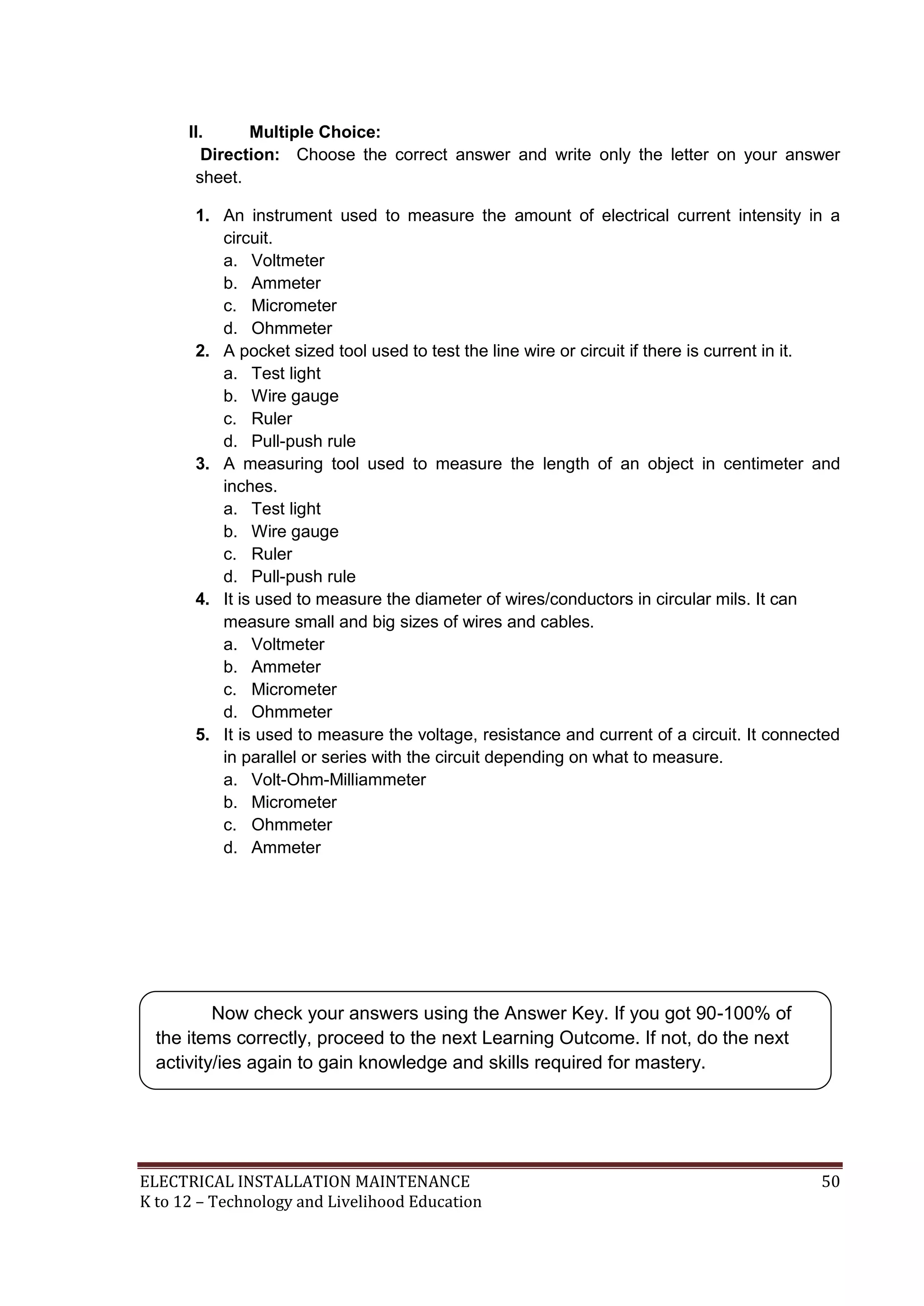
Wire Gauge is used in determining the size of
wires/conductors. The gauge ranges from 0 to
60 awg ( American wire gauge).

Ruler/foot rule is a measuring tool used to
measure length, width and thickness of short
flat object and in sketching straight lines

*A ruler/rule is a tool used in, for
example, geometry, technical
drawing,
engineering, and carpentry, to measure lengths
or distances or to draw straight lines. Strictly
speaking, the ruler is the instrument used
to rule straight lines and the calibrated
instrument used for determining length called
a measure. However, common usage calls both
instruments rulers and
the
special
name straight edge is used for an unmarked
rule.

Pull-Push Rule is a measuring tool used to
measure the length of an object in centimeter
and inches
.

ELECTRICAL INSTALLATION MAINTENANCE
K to 12 – Technology and Livelihood Education

52
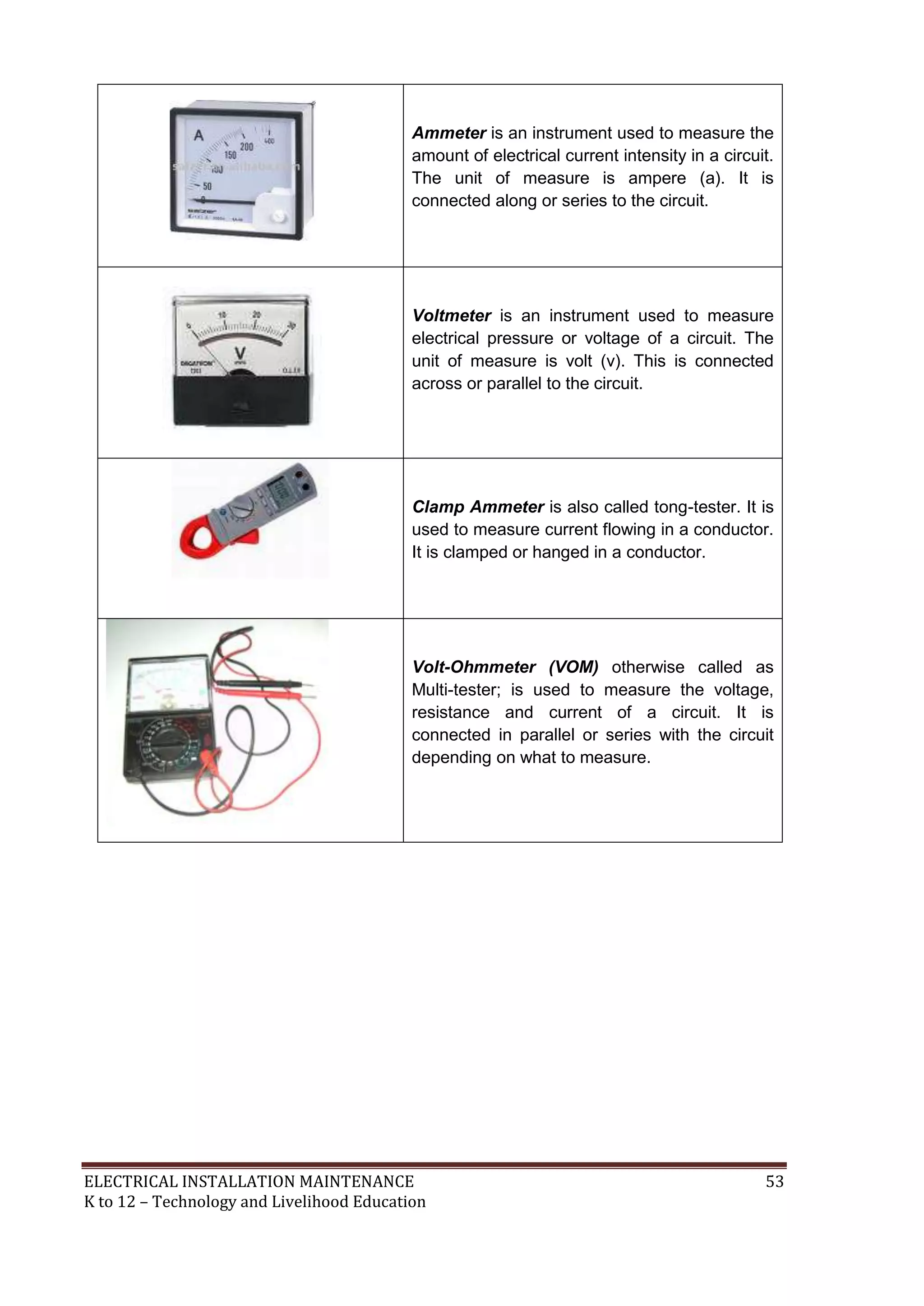
Ammeter is an instrument used to measure the
amount of electrical current intensity in a circuit.
The unit of measure is ampere (a). It is
connected along or series to the circuit.

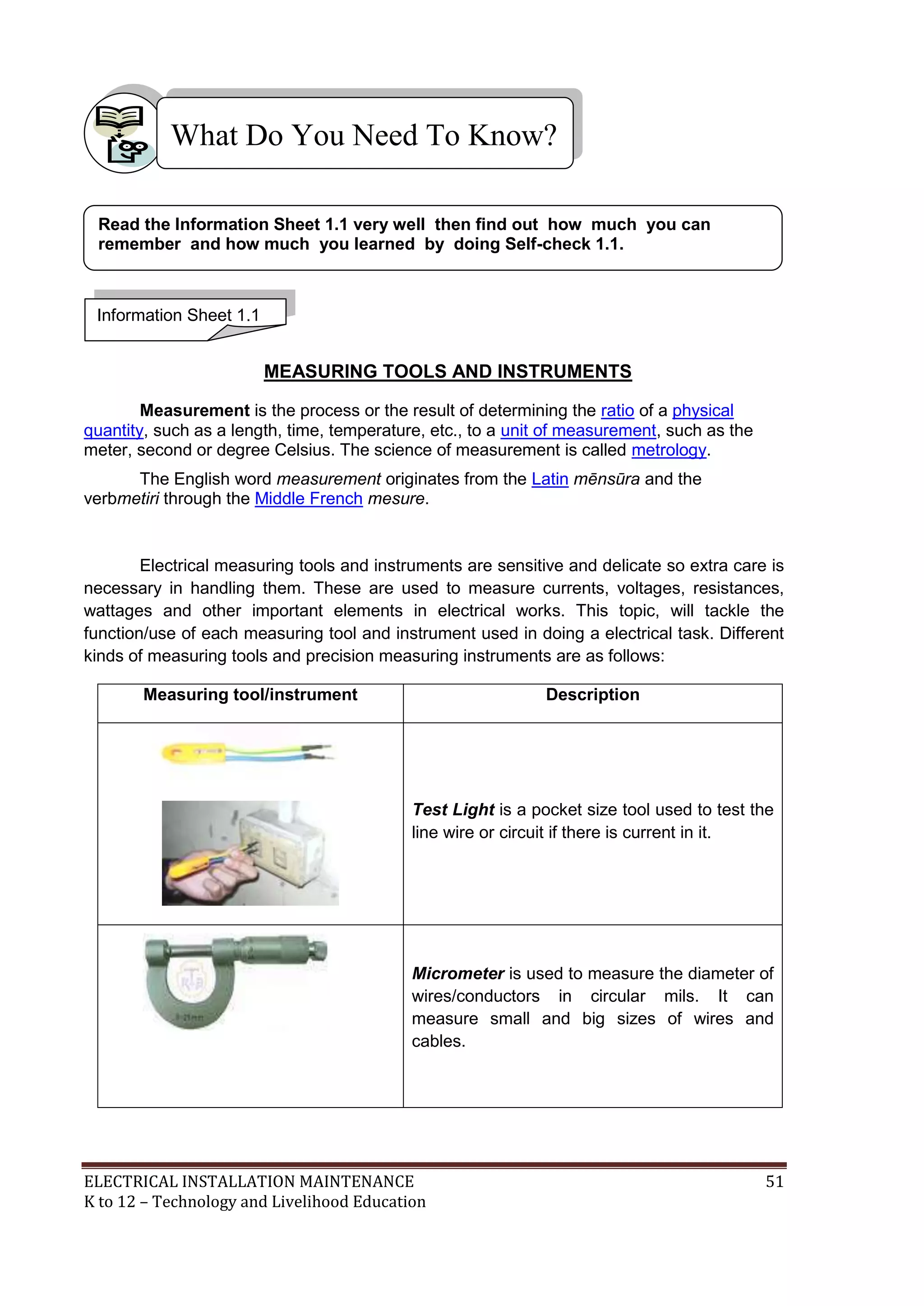
Voltmeter is an instrument used to measure
electrical pressure or voltage of a circuit. The
unit of measure is volt (v). This is connected
across or parallel to the circuit.

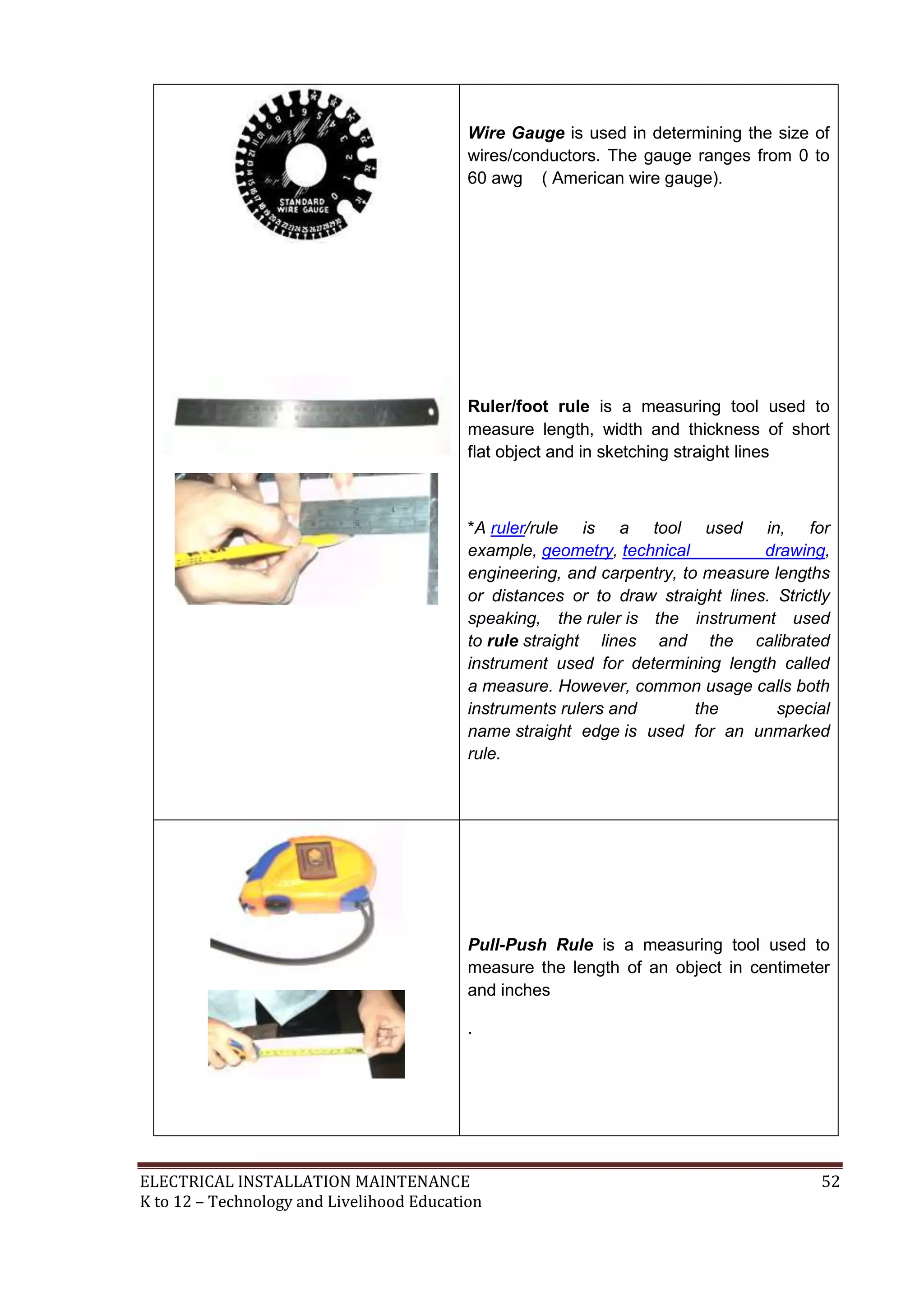
Clamp Ammeter is also called tong-tester. It is
used to measure current flowing in a conductor.
It is clamped or hanged in a conductor.

Volt-Ohmmeter (VOM) otherwise called as
Multi-tester; is used to measure the voltage,
resistance and current of a circuit. It is
connected in parallel or series with the circuit
depending on what to measure.

ELECTRICAL INSTALLATION MAINTENANCE
K to 12 – Technology and Livelihood Education

53
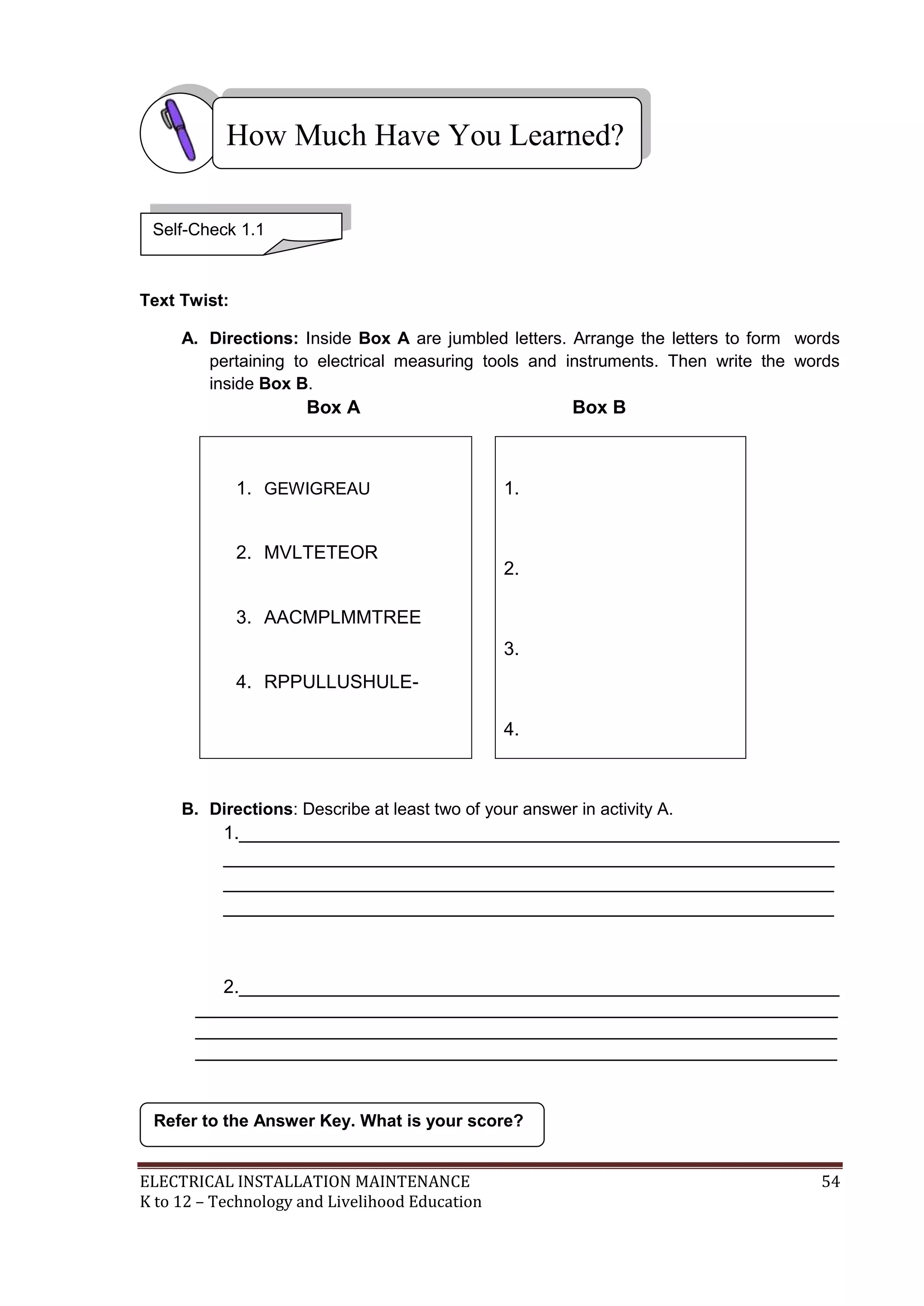
How Much Have You Learned?
Self-Check 1.1

Text Twist:
A. Directions: Inside Box A are jumbled letters. Arrange the letters to form words
pertaining to electrical measuring tools and instruments. Then write the words
inside Box B.

Box A

1. GEWIGREAU

2. MVLTETEOR

Box B

1.

2.

3. AACMPLMMTREE
3.
4. RPPULLUSHULE4.

B. Directions: Describe at least two of your answer in activity A.

1.__________________________________________________________
___________________________________________________________
___________________________________________________________
___________________________________________________________

2.__________________________________________________________
______________________________________________________________
______________________________________________________________
______________________________________________________________

Refer to the Answer Key. What is your score?

ELECTRICAL INSTALLATION MAINTENANCE
K to 12 – Technology and Livelihood Education

54
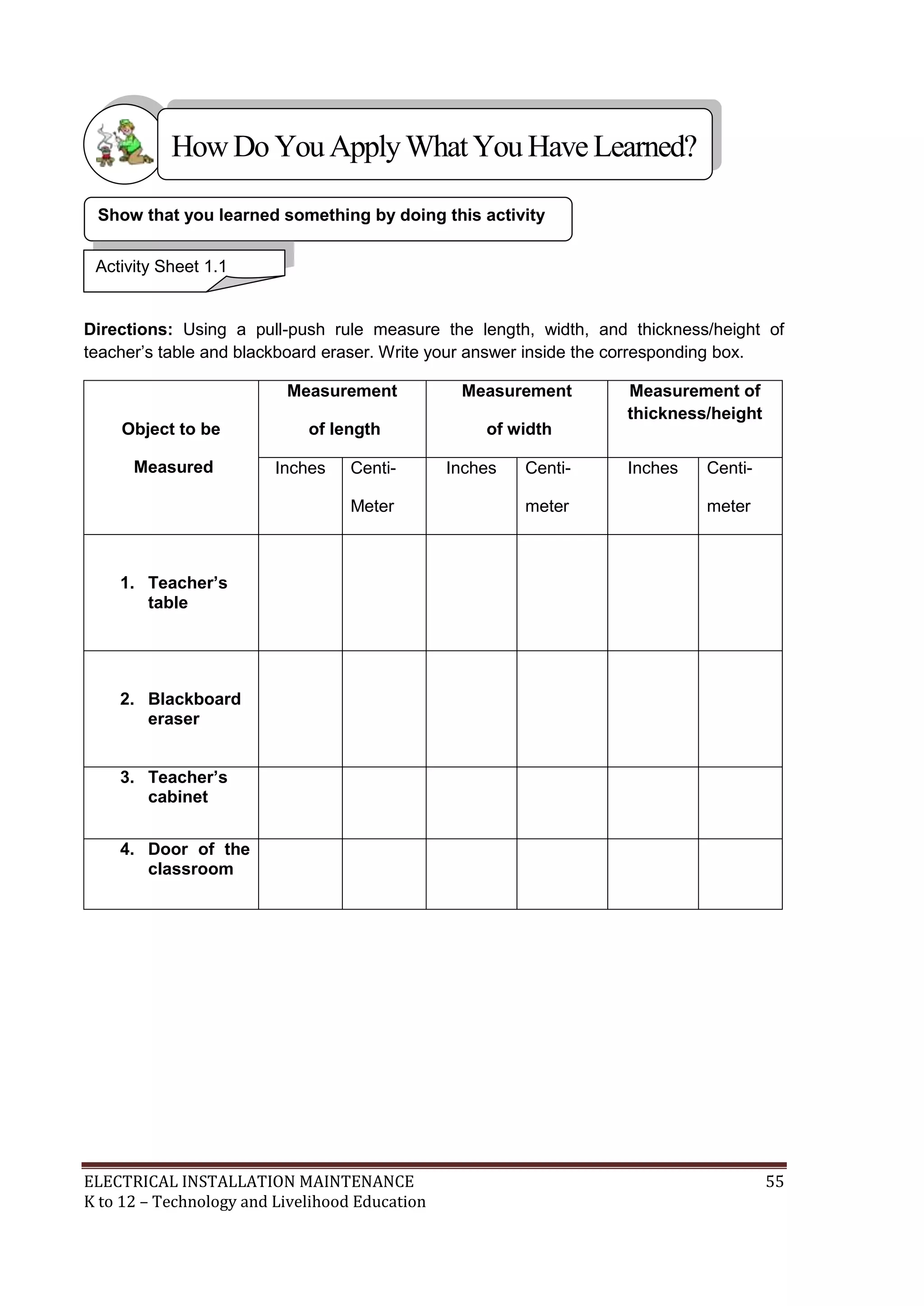
How Do You Apply What You Have Learned?
Show that you learned something by doing this activity
Activity Sheet 1.1

Directions: Using a pull-push rule measure the length, width, and thickness/height of
teacher’s table and blackboard eraser. Write your answer inside the corresponding box.
Measurement
Object to be
Measured

Measurement

of length

of width

Inches

CentiMeter

Inches

Centimeter

Measurement of
thickness/height
Inches

Centimeter

1. Teacher’s
table

2. Blackboard
eraser
3. Teacher’s
cabinet
4. Door of the
classroom

ELECTRICAL INSTALLATION MAINTENANCE
K to 12 – Technology and Livelihood Education

55
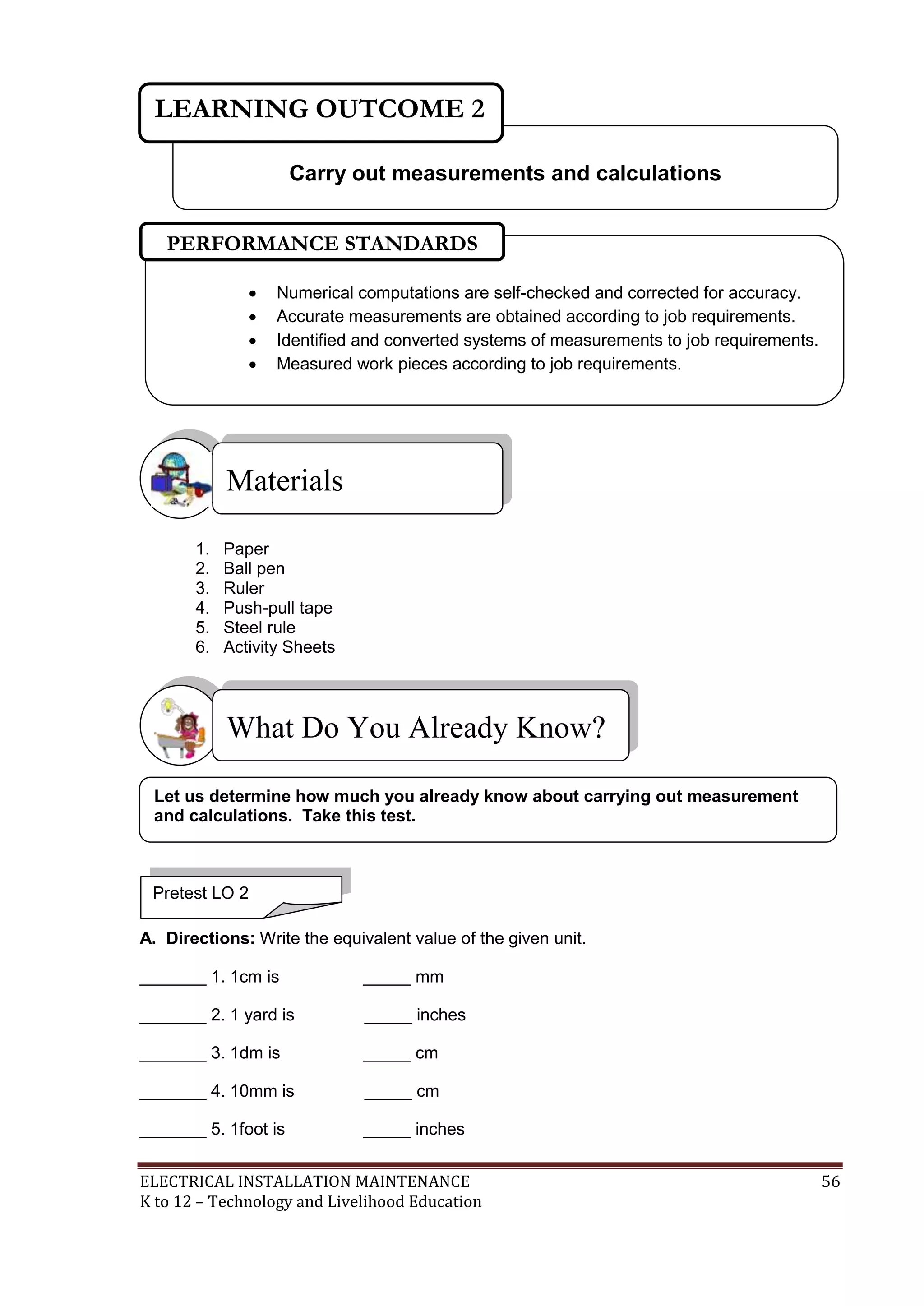
LEARNING OUTCOME 2
Carry out measurements and calculations
PERFORMANCE STANDARDS





Numerical computations are self-checked and corrected for accuracy.
Accurate measurements are obtained according to job requirements.
Identified and converted systems of measurements to job requirements.
Measured work pieces according to job requirements.

Materials
1.
2.
3.
4.
5.
6.

Paper
Ball pen
Ruler
Push-pull tape
Steel rule
Activity Sheets

What Do You Already Know?
Let us determine how much you already know about carrying out measurement
and calculations. Take this test.

Pretest LO 2
A. Directions: Write the equivalent value of the given unit.
_______ 1. 1cm is

_____ mm

_______ 2. 1 yard is

_____ inches

_______ 3. 1dm is

_____ cm

_______ 4. 10mm is

_____ cm

_______ 5. 1foot is

_____ inches

ELECTRICAL INSTALLATION MAINTENANCE
K to 12 – Technology and Livelihood Education

56
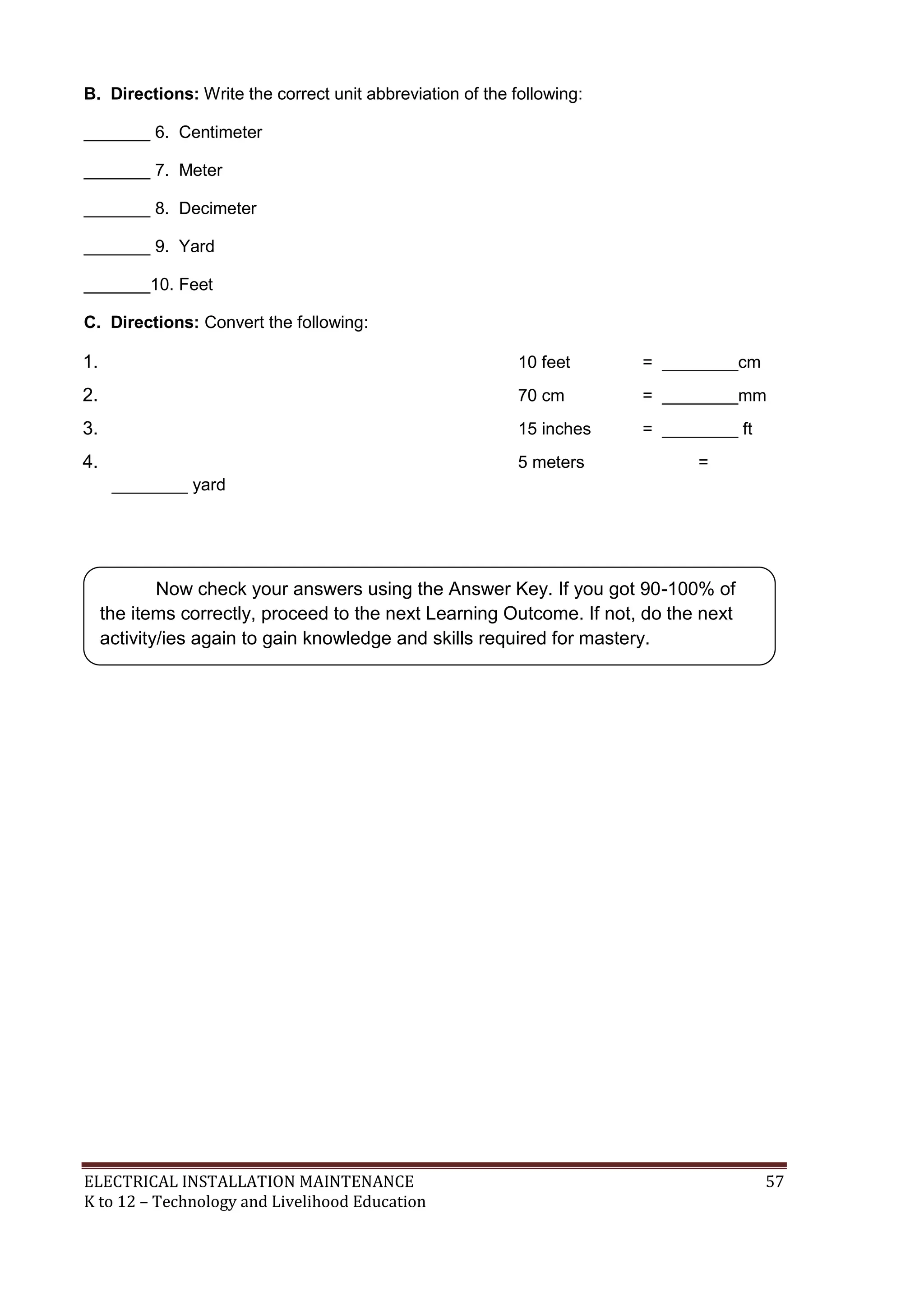
B. Directions: Write the correct unit abbreviation of the following:
_______ 6. Centimeter
_______ 7. Meter
_______ 8. Decimeter
_______ 9. Yard
_______10. Feet
C. Directions: Convert the following:

1.

10 feet

= ________cm

2.

70 cm

= ________mm

3.

15 inches

= ________ ft

4.

5 meters

=

________ yard

Now check your answers using the Answer Key. If you got 90-100% of
the items correctly, proceed to the next Learning Outcome. If not, do the next
activity/ies again to gain knowledge and skills required for mastery.

ELECTRICAL INSTALLATION MAINTENANCE
K to 12 – Technology and Livelihood Education

57
What Do You Need To Know?
Read the Information Sheet 2.1 very well then find out how much you can
remember and how much you learned by doing Self-check 2.1.

Information Sheet 2.1

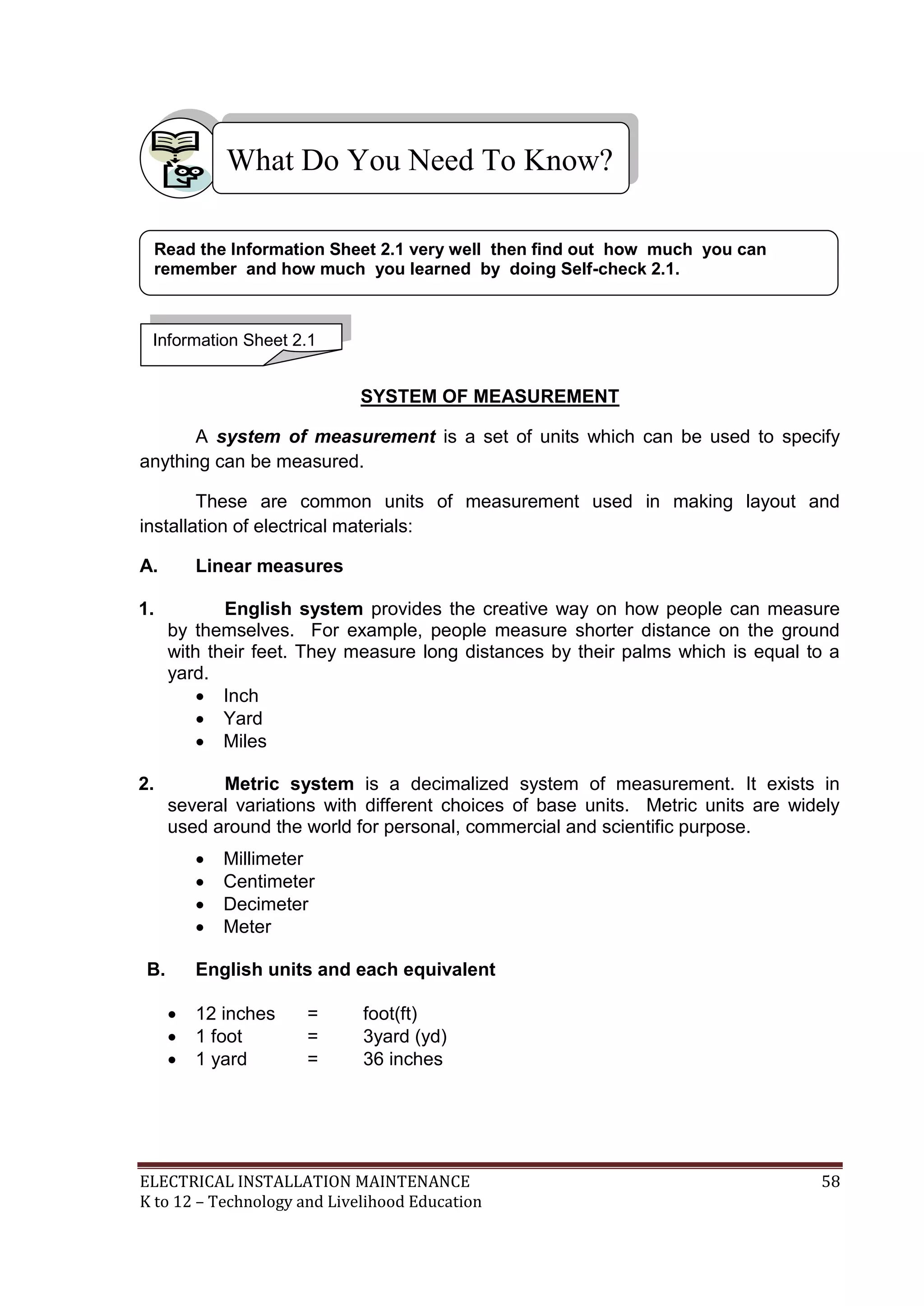
SYSTEM OF MEASUREMENT
A system of measurement is a set of units which can be used to specify
anything can be measured.
These are common units of measurement used in making layout and
installation of electrical materials:
A.

Linear measures

1.

English system provides the creative way on how people can measure
by themselves. For example, people measure shorter distance on the ground
with their feet. They measure long distances by their palms which is equal to a
yard.
 Inch
 Yard
 Miles

2.

Metric system is a decimalized system of measurement. It exists in
several variations with different choices of base units. Metric units are widely
used around the world for personal, commercial and scientific purpose.





B.

Millimeter
Centimeter
Decimeter
Meter

English units and each equivalent




12 inches
1 foot
1 yard

=
=
=

foot(ft)
3yard (yd)
36 inches

ELECTRICAL INSTALLATION MAINTENANCE
K to 12 – Technology and Livelihood Education

58
C.

Metric units and each equivalent




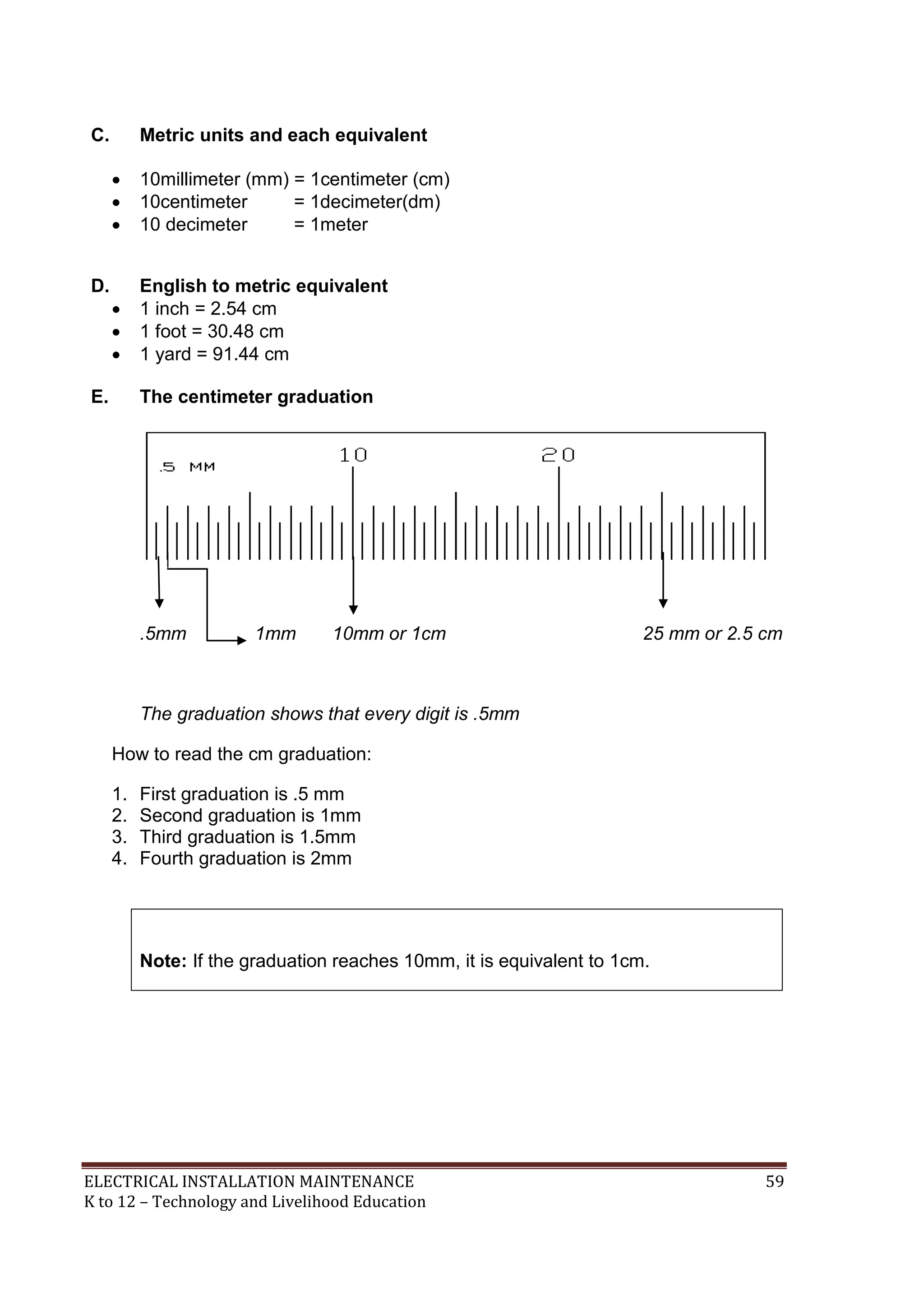
10millimeter (mm) = 1centimeter (cm)
10centimeter
= 1decimeter(dm)
10 decimeter
= 1meter





English to metric equivalent
1 inch = 2.54 cm
1 foot = 30.48 cm
1 yard = 91.44 cm

D.

E.

The centimeter graduation

.5mm

1mm

10mm or 1cm

25 mm or 2.5 cm

The graduation shows that every digit is .5mm
How to read the cm graduation:
1.
2.
3.
4.

First graduation is .5 mm
Second graduation is 1mm
Third graduation is 1.5mm
Fourth graduation is 2mm

Note: If the graduation reaches 10mm, it is equivalent to 1cm.

ELECTRICAL INSTALLATION MAINTENANCE
K to 12 – Technology and Livelihood Education

59
F.

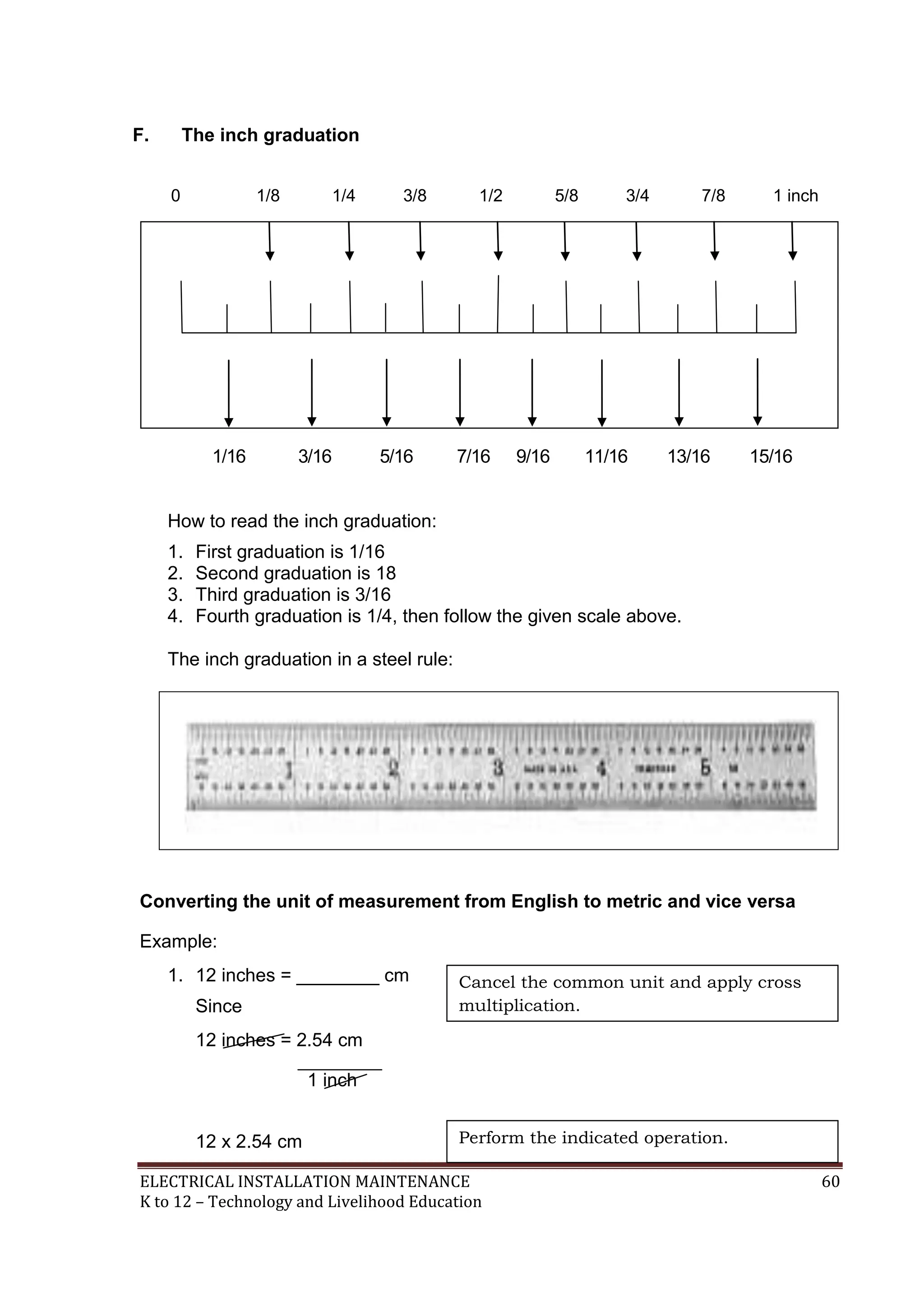
The inch graduation
0

1/8

1/16

1/4

3/16

3/8

5/16

1/2

7/16

5/8

9/16

3/4

11/16

7/8

13/16

1 inch

15/16

How to read the inch graduation:
1.
2.
3.
4.

First graduation is 1/16
Second graduation is 18
Third graduation is 3/16
Fourth graduation is 1/4, then follow the given scale above.

The inch graduation in a steel rule:

Converting the unit of measurement from English to metric and vice versa
Example:
1. 12 inches = ________ cm
Since

Cancel the common unit and apply cross
multiplication.

12 inches = 2.54 cm
1 inch
12 x 2.54 cm

Perform the indicated operation.

ELECTRICAL INSTALLATION MAINTENANCE
K to 12 – Technology and Livelihood Education

60
1
Therefore: 12 inches = 30.48 cm

2. 6 feet = ________ inches
Since
6 feet = 12 inches
1 feet
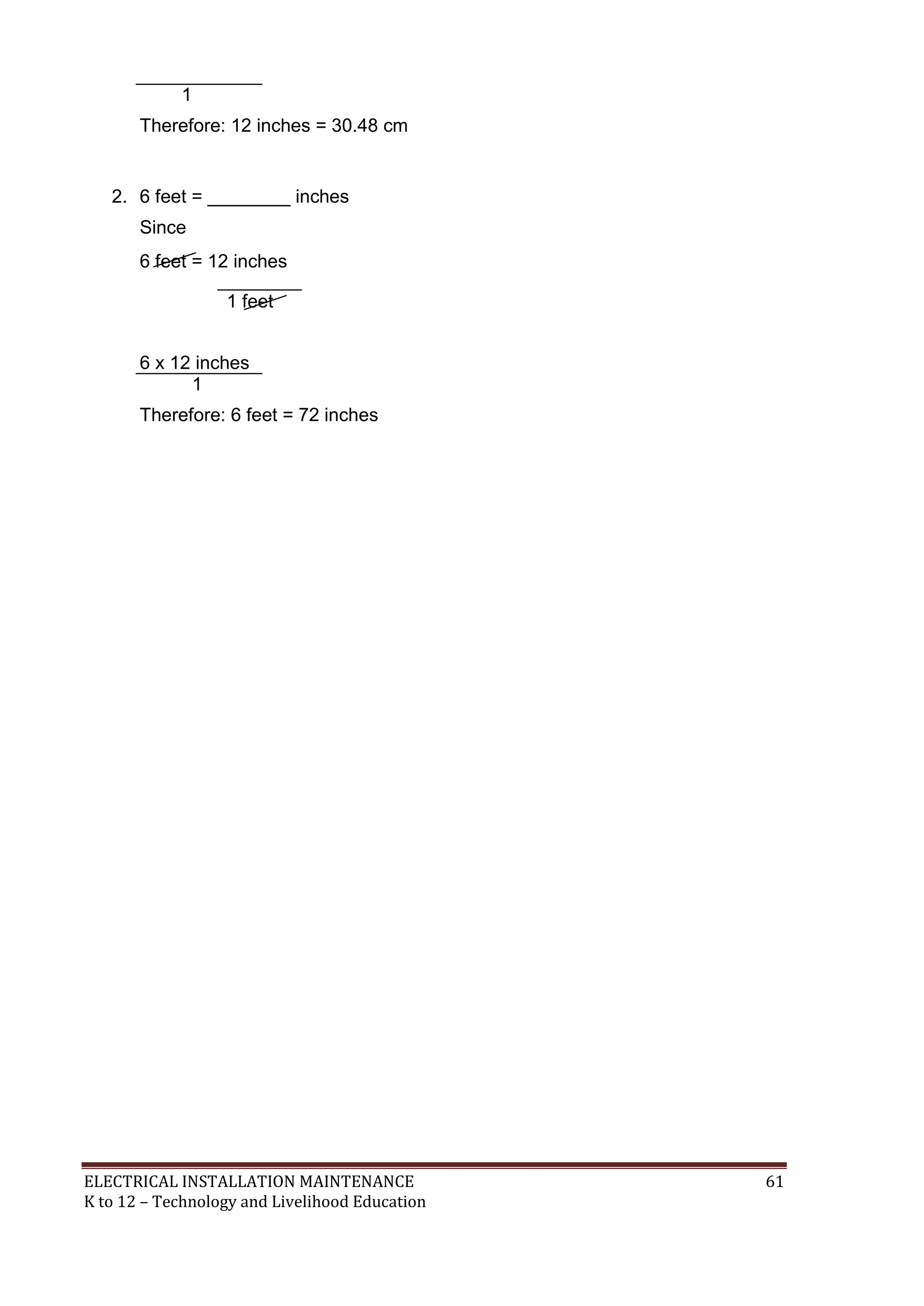
6 x 12 inches
1
Therefore: 6 feet = 72 inches

ELECTRICAL INSTALLATION MAINTENANCE
K to 12 – Technology and Livelihood Education

61
THE MULTITESTER
INTRODUCTION
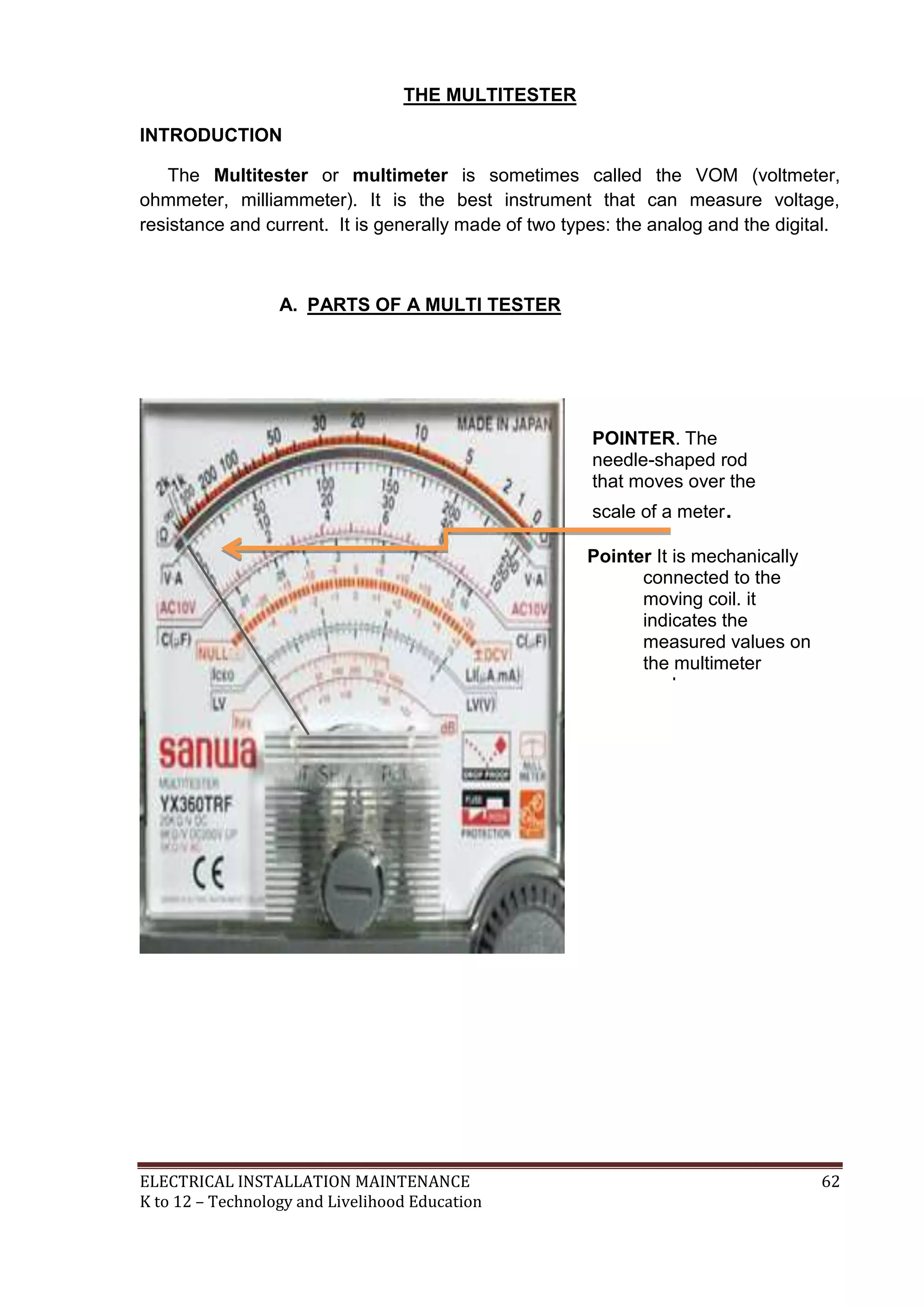
The Multitester or multimeter is sometimes called the VOM (voltmeter,
ohmmeter, milliammeter). It is the best instrument that can measure voltage,
resistance and current. It is generally made of two types: the analog and the digital.

A. PARTS OF A MULTI TESTER

POINTER. The
needle-shaped rod
that moves over the
scale of a meter.
Pointer It is mechanically
connected to the
moving coil. it
indicates the
measured values on
the multimeter
scale.

ELECTRICAL INSTALLATION MAINTENANCE
K to 12 – Technology and Livelihood Education

62
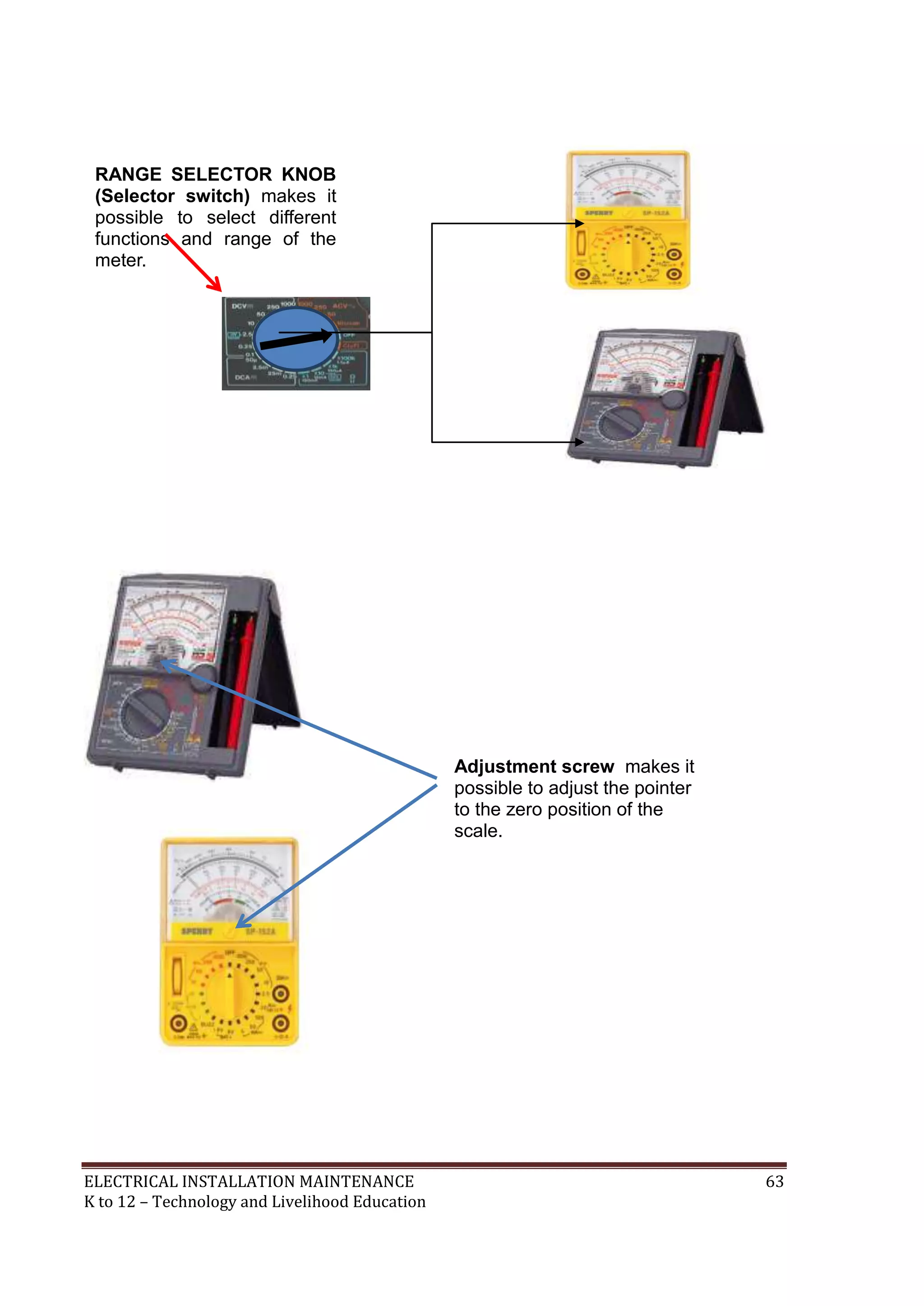
RANGE SELECTOR KNOB
(Selector switch) makes it
possible to select different
functions and range of the
meter.

Adjustment screw makes it
possible to adjust the pointer
to the zero position of the
scale.

ELECTRICAL INSTALLATION MAINTENANCE
K to 12 – Technology and Livelihood Education

63
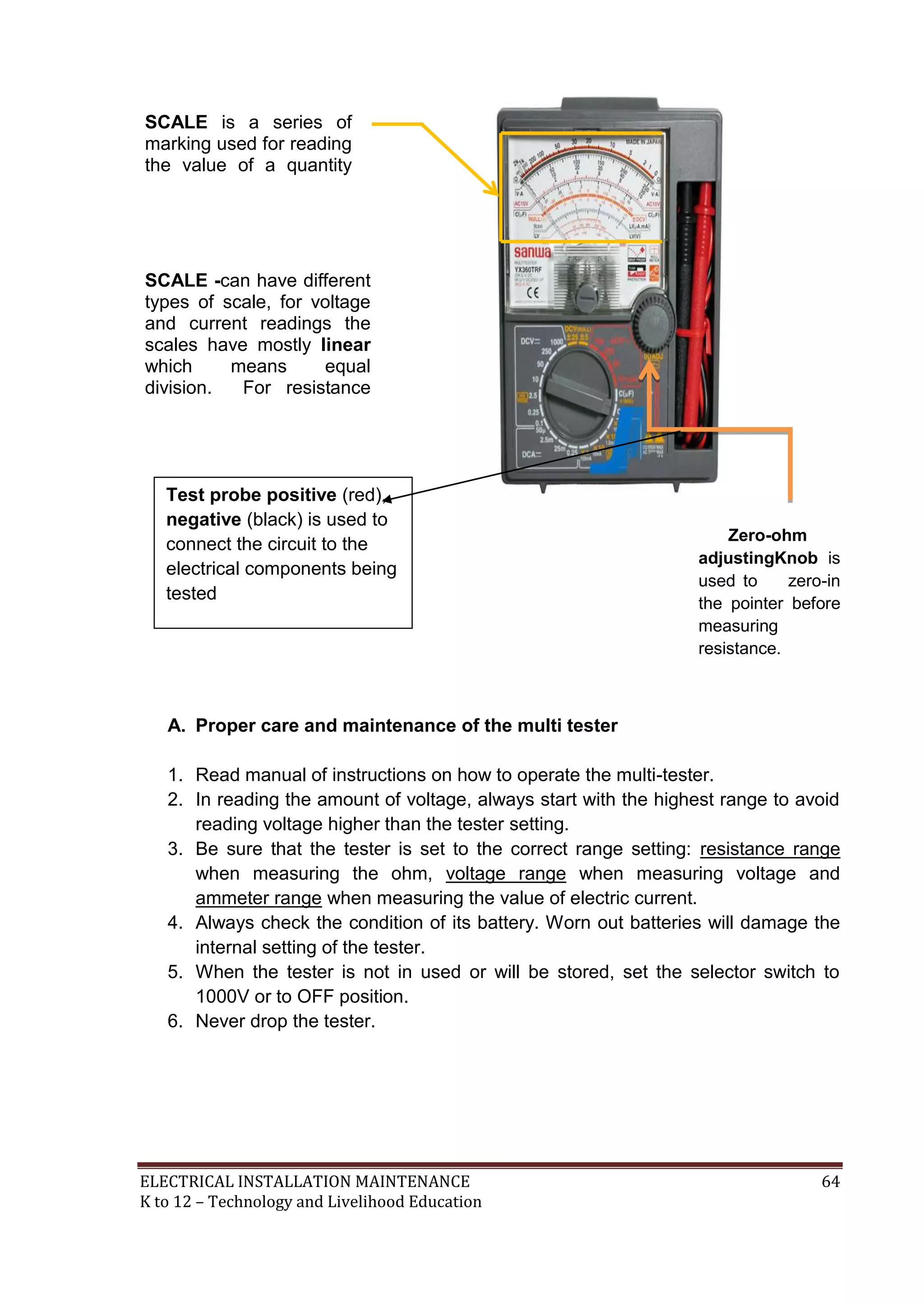
SCALE is a series of
marking used for reading
the value of a quantity
setting.

SCALE -can have different
types of scale, for voltage
and current readings the
scales have mostly linear
which
means
equal
division.
For resistance
readings, the scale have
logarithmic which means
unequal divisions.
Test probe positive (red),
negative (black) is used to
connect the circuit to the
electrical components being
tested

Zero-ohm
adjustingKnob is
used to
zero-in
the pointer before
measuring
resistance.

A. Proper care and maintenance of the multi tester
1. Read manual of instructions on how to operate the multi-tester.
2. In reading the amount of voltage, always start with the highest range to avoid
reading voltage higher than the tester setting.
3. Be sure that the tester is set to the correct range setting: resistance range
when measuring the ohm, voltage range when measuring voltage and
ammeter range when measuring the value of electric current.
4. Always check the condition of its battery. Worn out batteries will damage the
internal setting of the tester.
5. When the tester is not in used or will be stored, set the selector switch to
1000V or to OFF position.
6. Never drop the tester.

ELECTRICAL INSTALLATION MAINTENANCE
K to 12 – Technology and Livelihood Education

64
B. How to read the meter scale of the multi tester
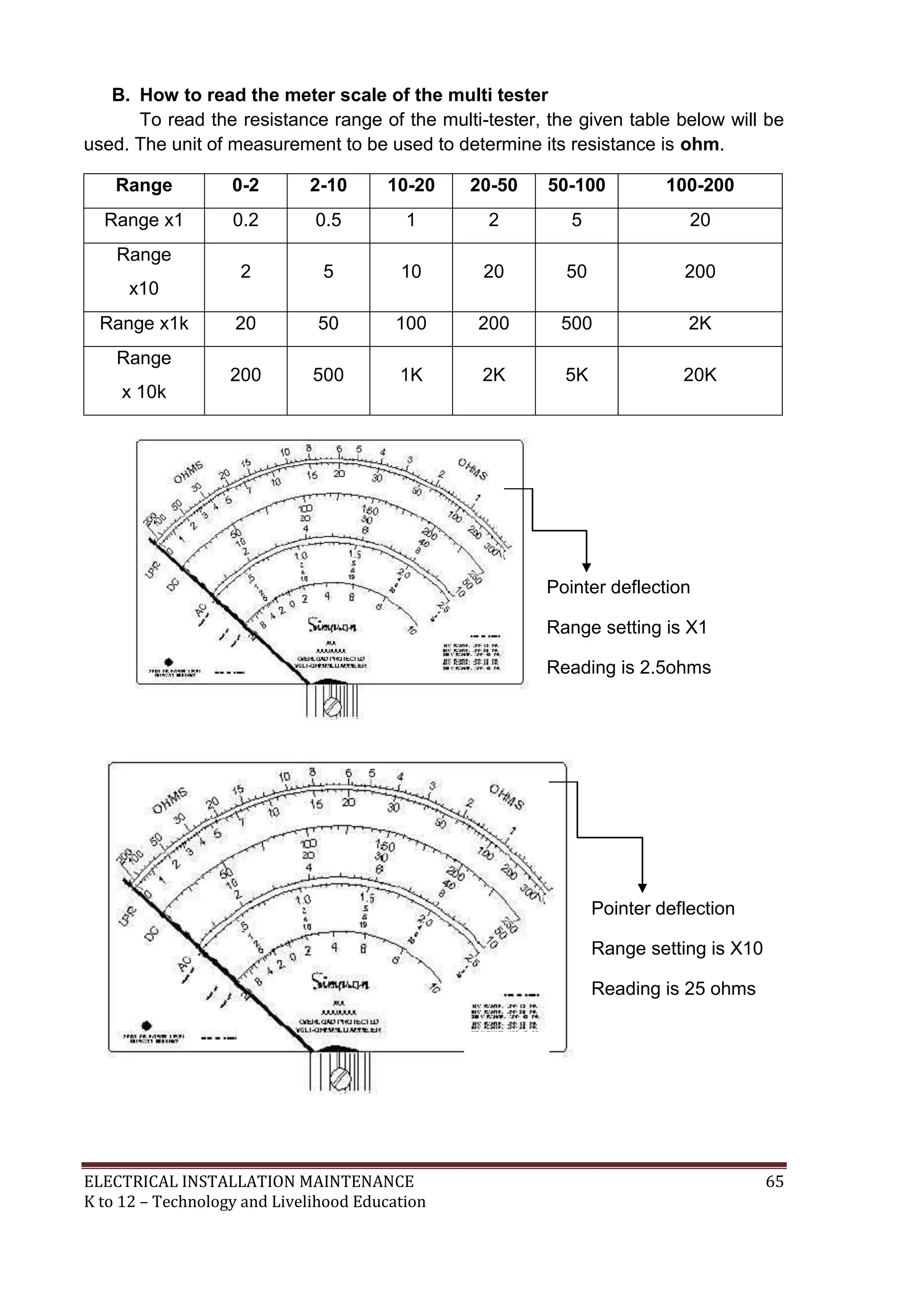
To read the resistance range of the multi-tester, the given table below will be
used. The unit of measurement to be used to determine its resistance is ohm.
Range

0-2

2-10

10-20

20-50

50-100

100-200

Range x1

0.2

0.5

1

2

5

20

2

5

10

20

50

200

20

50

100

200

500

2K

200

500

1K

2K

5K

20K

Range
x10
Range x1k
Range
x 10k

Pointer deflection
Range setting is X1
Reading is 2.5ohms

Pointer deflection
Range setting is X10
Reading is 25 ohms

ELECTRICAL INSTALLATION MAINTENANCE
K to 12 – Technology and Livelihood Education

65
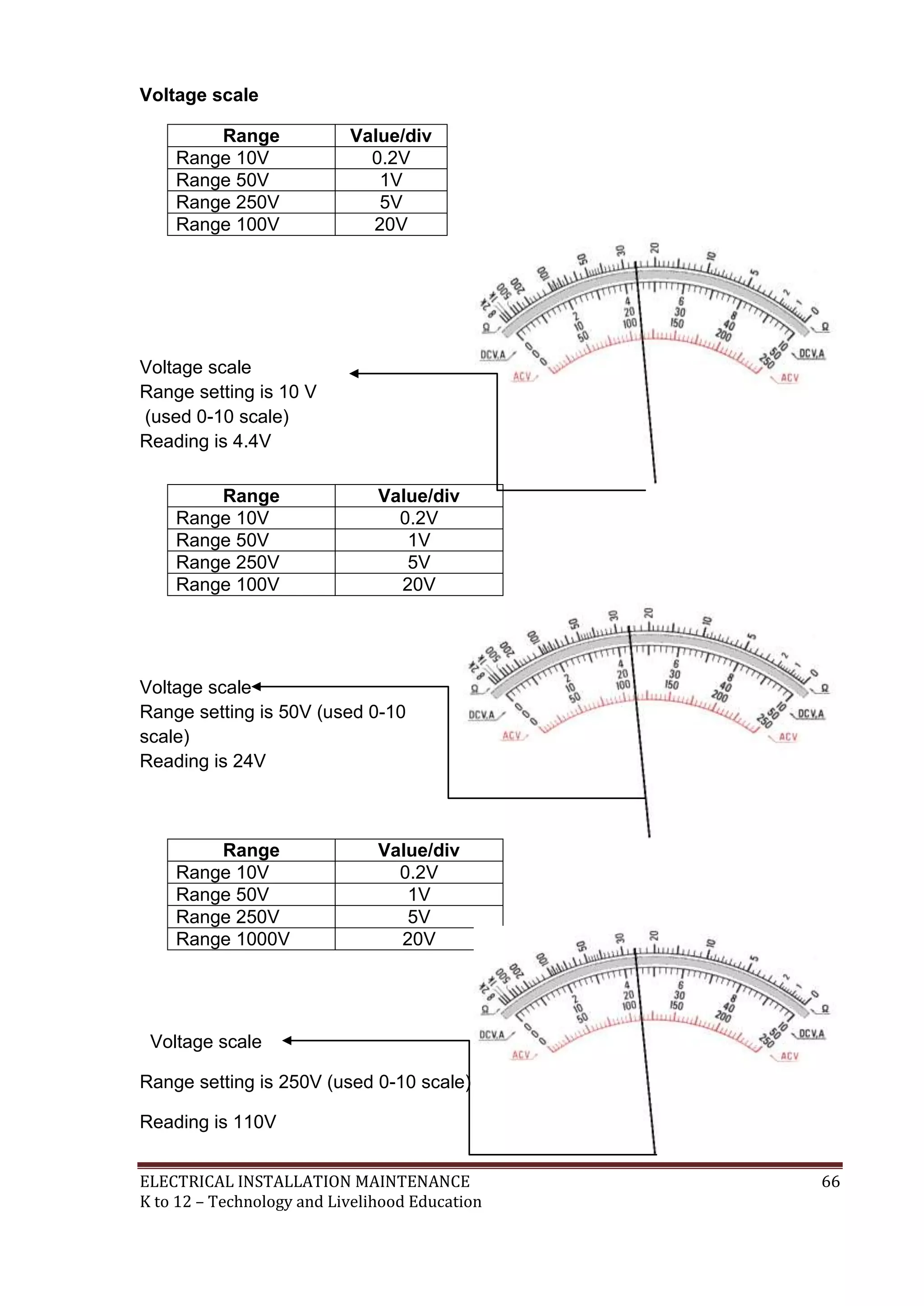
Voltage scale
Range
Range 10V
Range 50V
Range 250V
Range 100V

Value/div
0.2V
1V
5V
20V

Voltage scale
Range setting is 10 V
(used 0-10 scale)
Reading is 4.4V
Range
Range 10V
Range 50V
Range 250V
Range 100V

Value/div
0.2V
1V
5V
20V

Voltage scale
Range setting is 50V (used 0-10
scale)
Reading is 24V

Range
Range 10V
Range 50V
Range 250V
Range 1000V

Value/div
0.2V
1V
5V
20V

Voltage scale
Range setting is 250V (used 0-10 scale)
Reading is 110V
ELECTRICAL INSTALLATION MAINTENANCE
K to 12 – Technology and Livelihood Education

66
How Much Have You Learned?
Self-Check 2.1

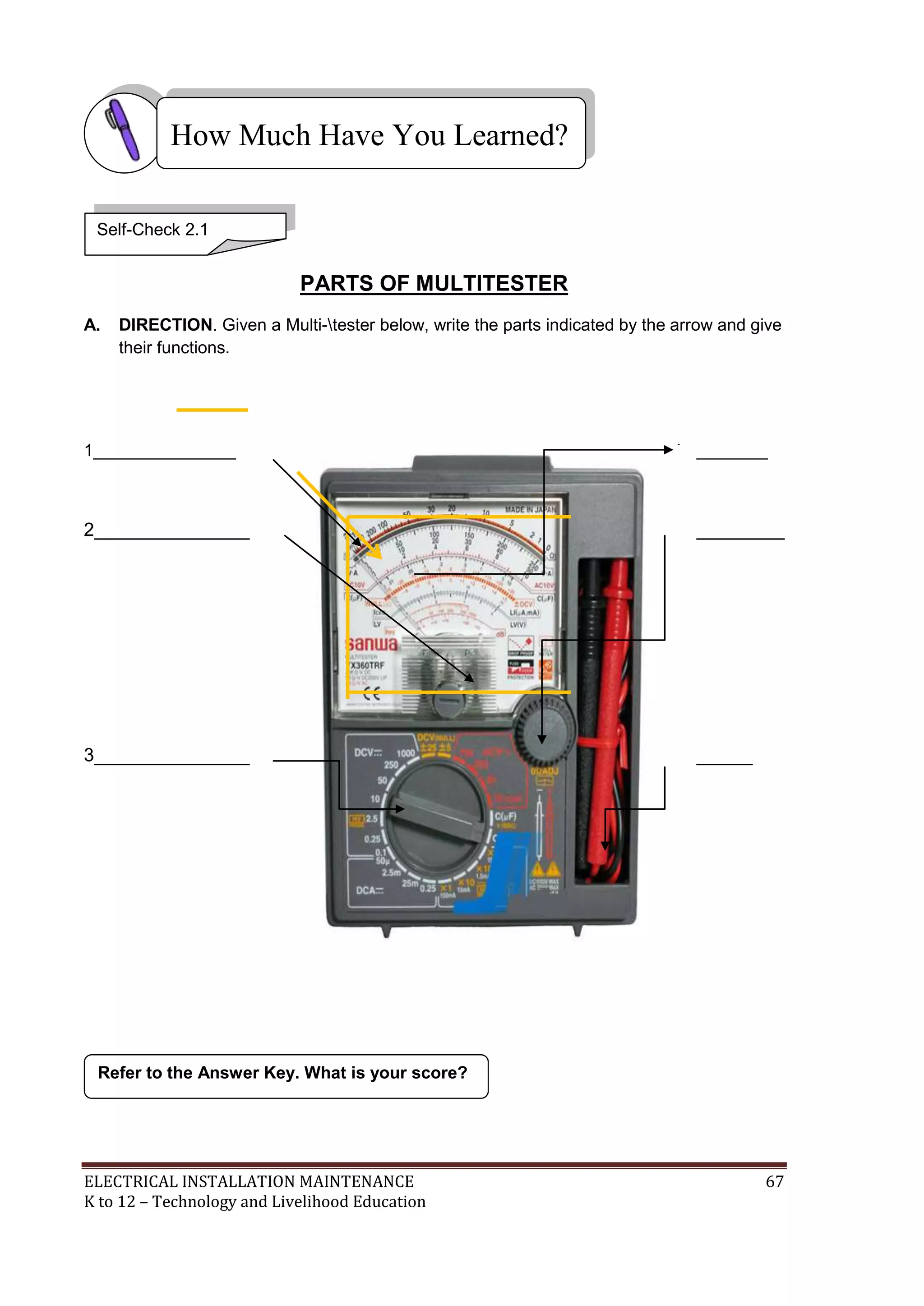
PARTS OF MULTITESTER
A.

DIRECTION. Given a Multi-tester below, write the parts indicated by the arrow and give
their functions.

1_______________

2_______________

3_______________

4_________

5____________

6________

Refer to the Answer Key. What is your score?

ELECTRICAL INSTALLATION MAINTENANCE
K to 12 – Technology and Livelihood Education

67
How Do You Apply What You Have Learned?
Show that you learned something by doing this activity
Job Sheet 2.1

I. USE MEASURING TOOLS
Supplies and Materials
 Sheet of paper
 Pencil

Tools and Equipment





Steel rule
Bench rule
Metric rule
Foot rule

Direction: Using any of the given measuring tools, read the actual measurement of
the given samples. Write your answer on the space provided.
Sample

Actual measurement in centimeter

Teacher’s Table

Length of eraser

Height of cabinet

ELECTRICAL INSTALLATION MAINTENANCE
K to 12 – Technology and Livelihood Education

68
II.

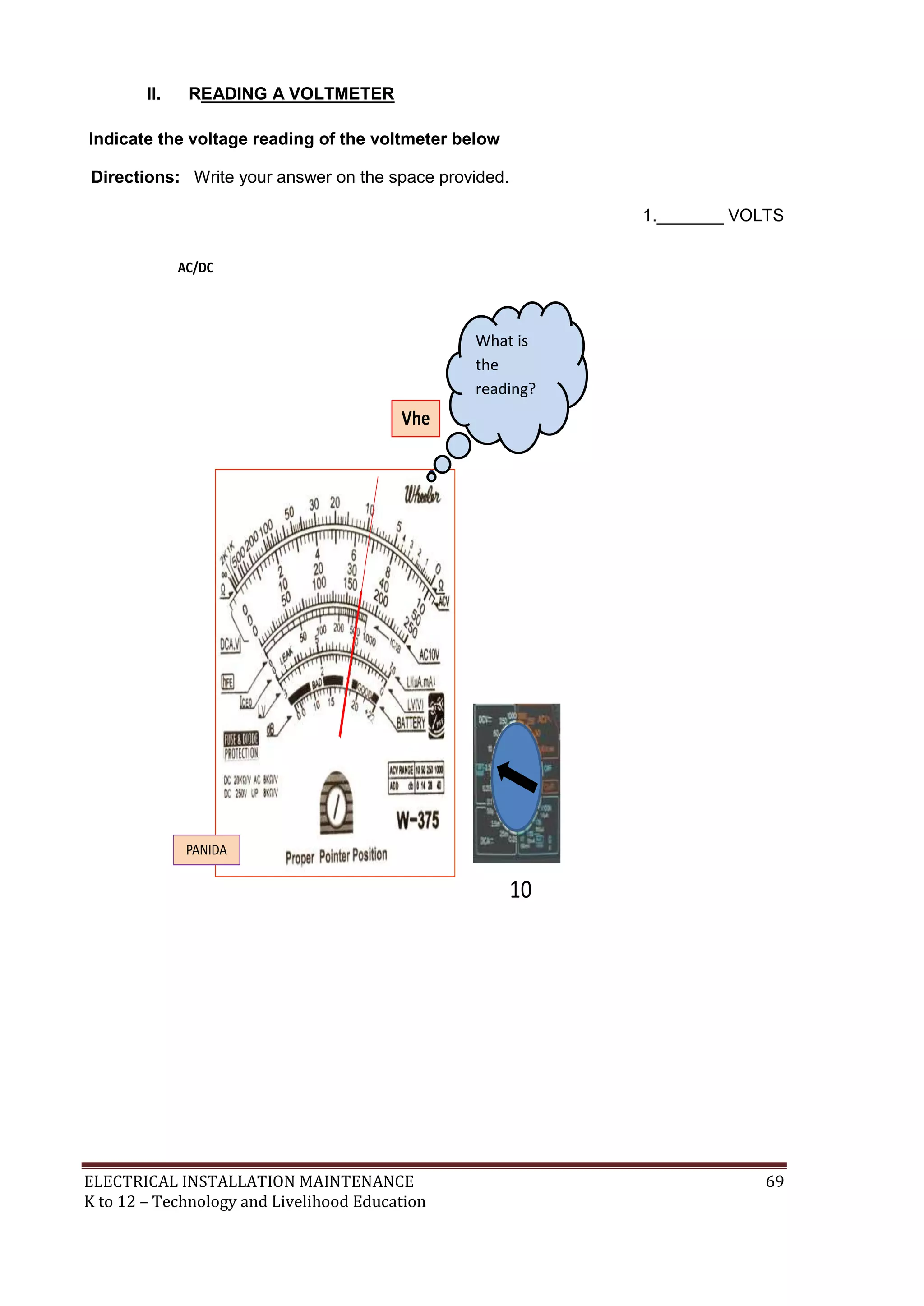
READING A VOLTMETER

Indicate the voltage reading of the voltmeter below
Directions: Write your answer on the space provided.
1._______ VOLTS

What is
the
reading?

ELECTRICAL INSTALLATION MAINTENANCE
K to 12 – Technology and Livelihood Education

69
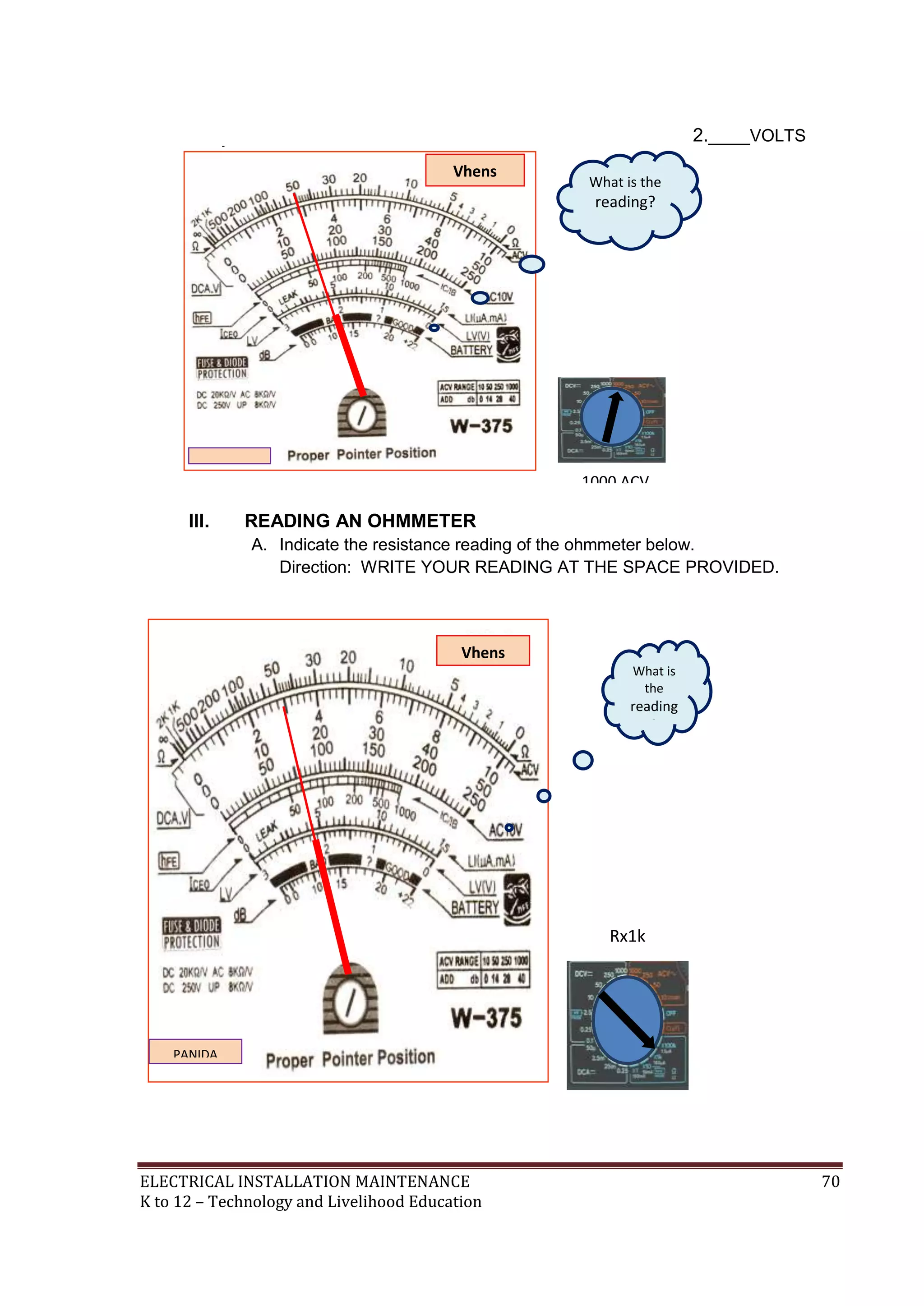
2.____VOLTS
AC/DC
Voltage
Reading

Vhens

reading?

PANIDA
TECH.
III.

What is the

1000 ACV

READING AN OHMMETER
A. Indicate the resistance reading of the ohmmeter below.
Direction: WRITE YOUR READING AT THE SPACE PROVIDED.

Resistanc
e
Reading

Vhens
What is
the

reading
?

Rx1k

PANIDA

TECH.

ELECTRICAL INSTALLATION MAINTENANCE
K to 12 – Technology and Livelihood Education

70
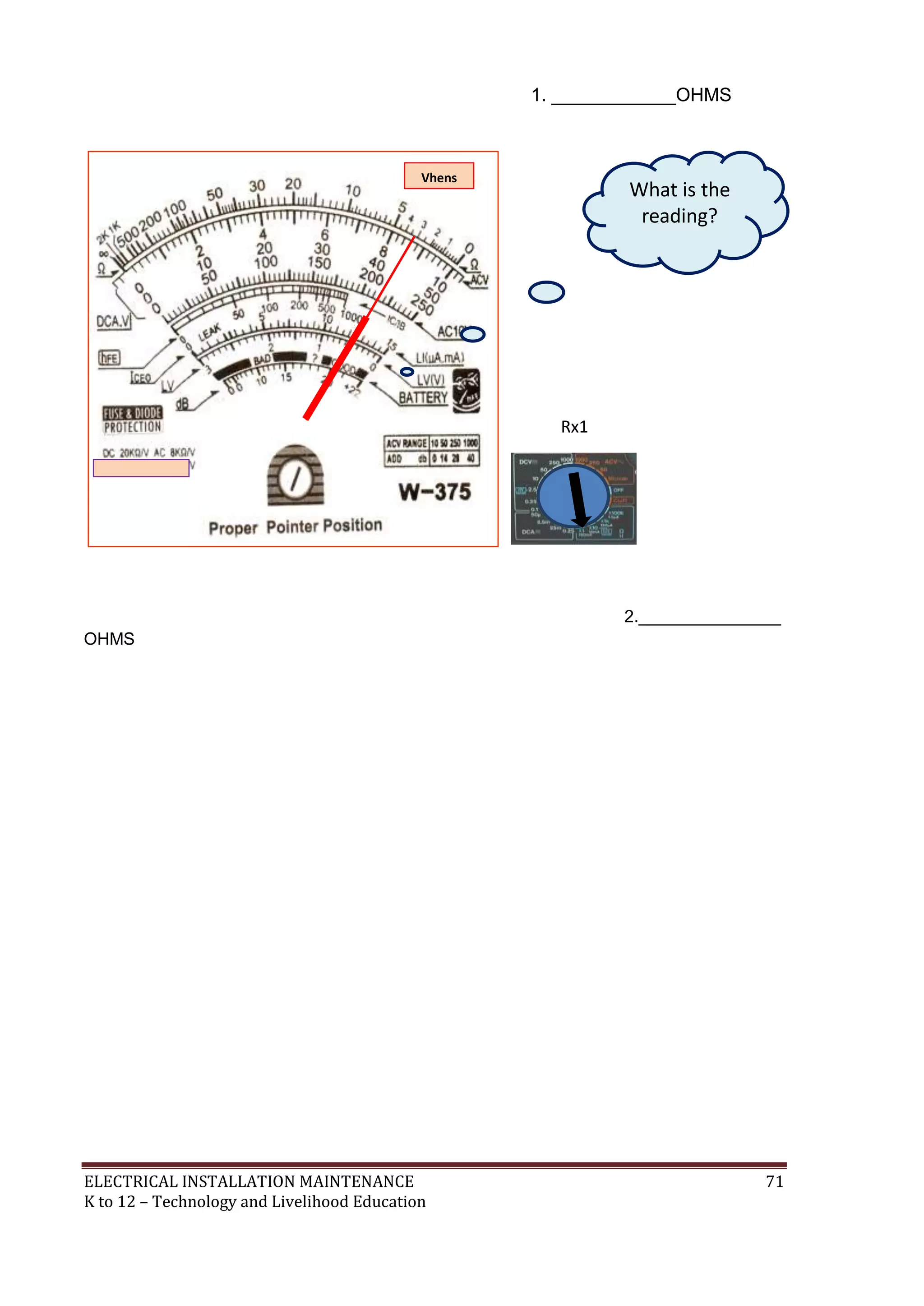
1. ____________OHMS

Resistanc
e Reading

Vhens

What is the
reading?

Rx1
PANIDA
TECH.

2._______________
OHMS

ELECTRICAL INSTALLATION MAINTENANCE
K to 12 – Technology and Livelihood Education

71
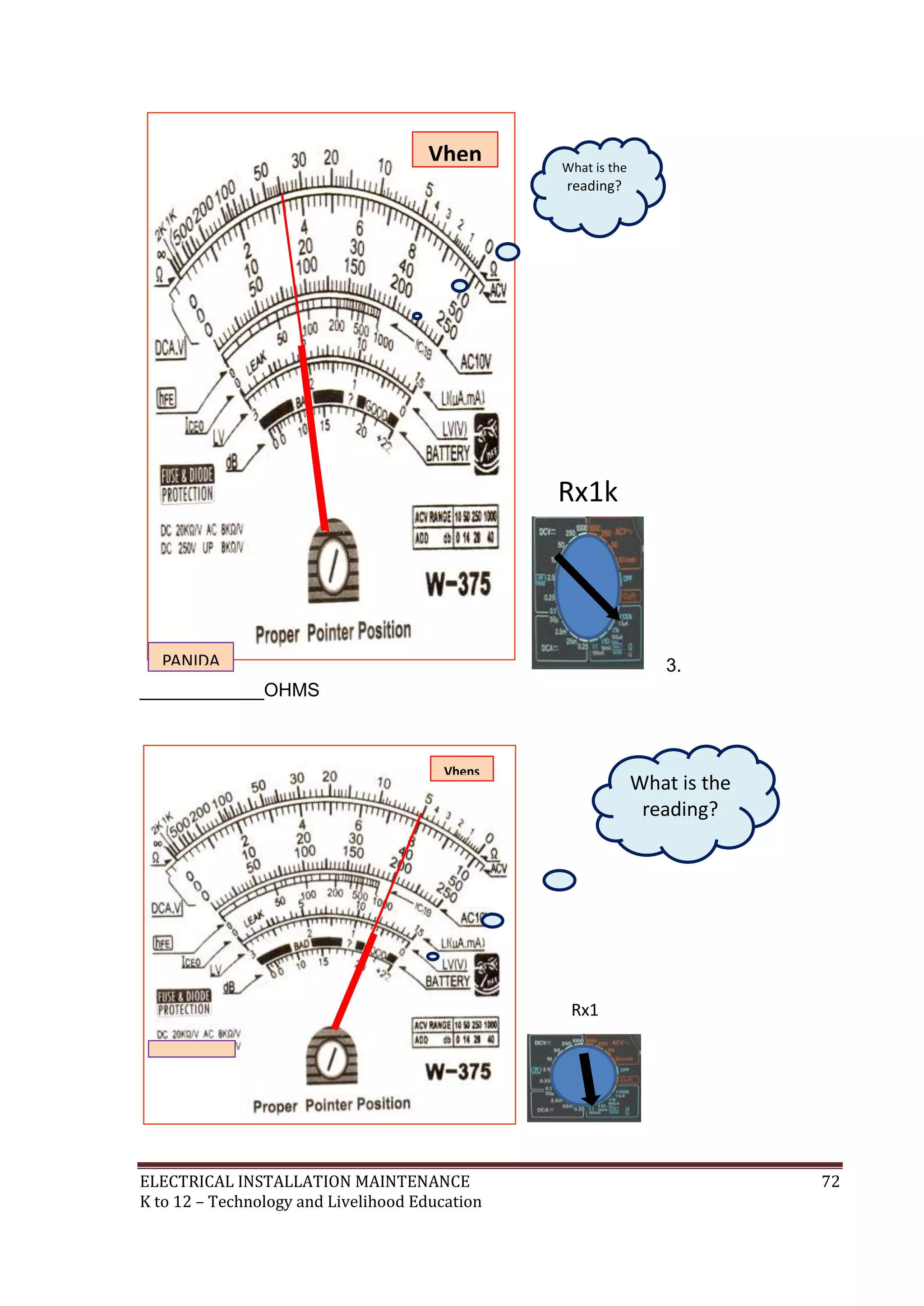
Resistan
ce
Reading

Vhen
s

What is the

reading?

Rx1k

PANIDA
TECH.
____________OHMS

Resistan
ce
Reading

3.

Vhens

What is the
reading?

Rx1
PANIDA
TECH.

ELECTRICAL INSTALLATION MAINTENANCE
K to 12 – Technology and Livelihood Education

72
4.__________OHMS

IV.

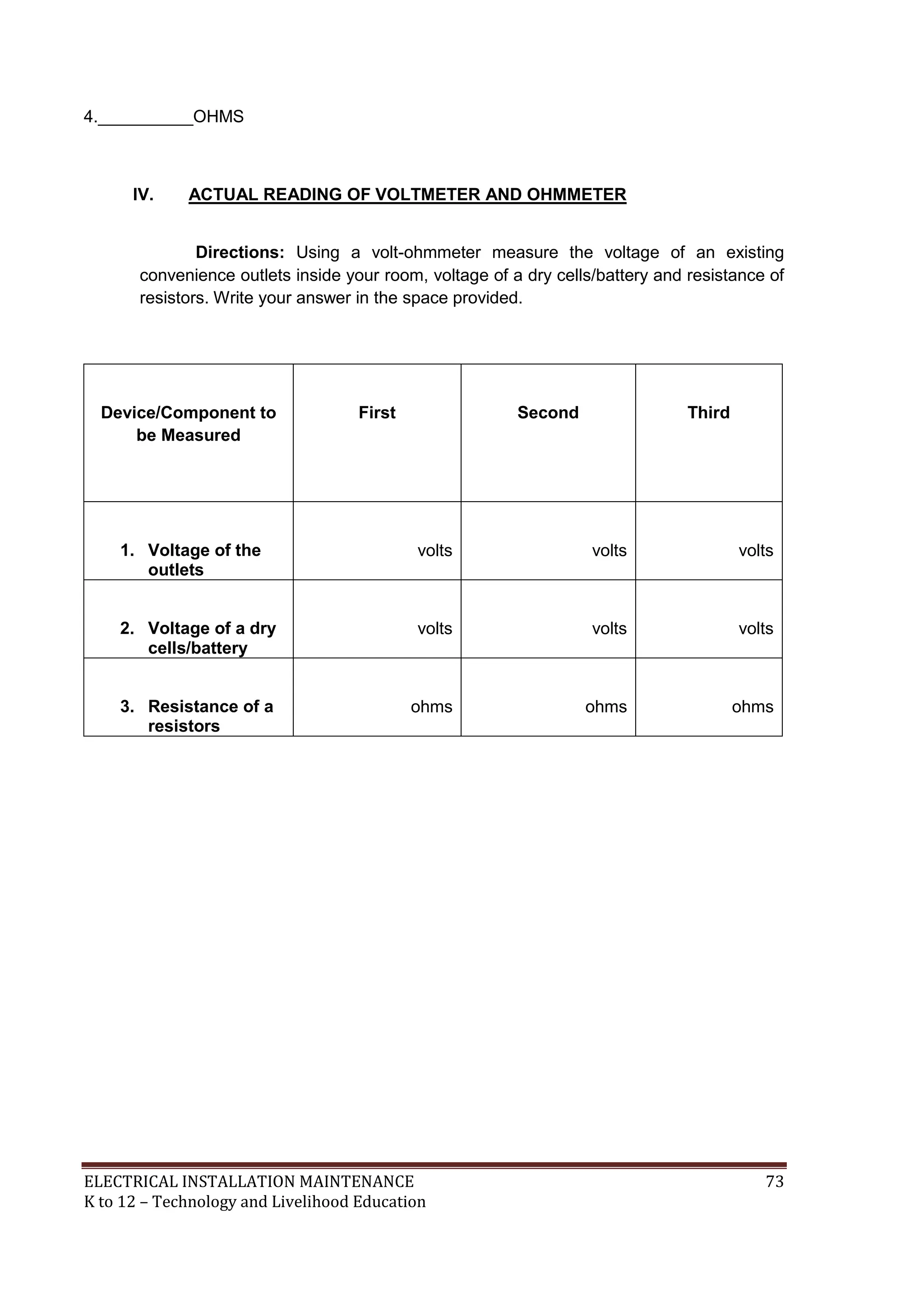
ACTUAL READING OF VOLTMETER AND OHMMETER

Directions: Using a volt-ohmmeter measure the voltage of an existing
convenience outlets inside your room, voltage of a dry cells/battery and resistance of
resistors. Write your answer in the space provided.

Device/Component to
be Measured

First

Second

Third

1. Voltage of the
outlets

volts

volts

volts

2. Voltage of a dry
cells/battery

volts

volts

volts

3. Resistance of a
resistors

ohms

ohms

ohms

ELECTRICAL INSTALLATION MAINTENANCE
K to 12 – Technology and Livelihood Education

73
Congratulations! You did a great job! Rest and
relax a while then move on to the next lesson.
Good luck!

REFERENCES







Philippine Electrical Code. Year 2000 Edition.
Cardenas, Elpidio. 1989, Fundamental and Elements of Electricity.
Philippines:National Bookstore.
Enriquez, Michael Q., Gantalao, Fred T. and Lasala, Rommel M. 2004,
Simple Electronics. Philippines: Andes Mountain Printers.
Velasco, Benjamin S. 1994, Electronic Components Testing Simplified.
Philippines: National Bookstore: 1994.
http://sam.dgs.ca.gov/TOC/3800/3861.htm
http://electrical.about.com/od/electricaltools/tp/top16electricaltools.htm

ELECTRICAL INSTALLATION MAINTENANCE
K to 12 – Technology and Livelihood Education

74
LESSON 3
Interpret Technical Drawings and Plans

LEARNING OUTCOMES:
At the end of this Lesson, you are expected to
do the following:

LO 1. analyze signs, symbols and data; and
LO 2. interpret technical drawings and plans.

ELECTRICAL INSTALLATION MAINTENANCE
K to 12 – Technology and Livelihood Education

75
Definition of Terms
Ampere (I) - the unit of electrical current (coulombs per second)
Caution - indicates some precautionary measures against potential hazardous
situation which, if not avoided, may result to a minor or moderate injury
Danger - specifies hazardous situation which, if not avoided, will result to a serious
injury or even death
Isometric - a kind of drawing which shows the object in 3 dimensional views
Joule (J) - a metric unit of energy: watt per second. 1 Kw hr = 2,655,000 ft-lb = 1.341
hp-hr = 3413 Btu = 3,600,000 joules
Kilovolt-ampere (KVA) - a measurement of apparent electric power
Kilowatt hour (Kwhr) - a unit of electrical energy or work performed
Ohm - the unit of electrical resistance (volts/ampere)
Orthographic - a drawing which shows the front top and side view of the object
Volt (E) - the unit of electric pressure or electromotive force which will produce a
current of 1 ampere through a resistance of 1 ohm
Watts (W) and kilowatts (KW) - are units of electric power

ELECTRICAL INSTALLATION MAINTENANCE
K to 12 – Technology and Livelihood Education

76
LEARNING OUTCOME 1
Analyze signs, symbols and data
PERFORMANCE STANDARDS



Electrical symbols and signs are identified according to job specifications.
Electrical symbols and signs are determined according to classification or as
appropriate in drawing.

Materials/ Resources
1.
2.
3.
4.

Oslo paper
Drawing Pencil
Ruler
Black pen

5. Electrical symbols
6. Various Company/ industry warning signs
7. Cartolina
8. Illustration board

What Do You Already Know?
Let us determine how much you already know about analyzing signs, symbols
and data. Take this test.
Pretest LO 1

Analyze signs and symbols
a. Direction: Match the electrical symbols in Column A with the corresponding
description in column B. Write the letter of your answer in the space provided
before each number.
Column A
Column B
_______1.

a. Push button

_______2.

b. Switch

_______3.

c. Wires connected

ELECTRICAL INSTALLATION MAINTENANCE
K to 12 – Technology and Livelihood Education

77
_______4.

d. Incandescent lamp

_______5.

e. Battery

b. Identify what are the meaning of different signs enumerated below. Write your
answer at the box provided for you.

.

_____________________

_____________________
_____________________
_____________________

_____________________
_____________________

_____________________

Now check your answers using the Answer Key. If you got 90-100% of
the items correctly, proceed to the next Learning Outcome. If not, do the next
activity/ies again to gain knowledge and skills required for mastery.

ELECTRICAL INSTALLATION MAINTENANCE
K to 12 – Technology and Livelihood Education

78
What Do You Need To Know?
Read the Information Sheet 1.1 very well then find out how much you can
remember and how much you learned by doing Self-check 1.1.

Information Sheet 1.1
COMMON ELECTRICAL SYMBOLS
Electrical Symbols are small drawings or pictograms used to represent various
electrical devices in a diagram or plan of an electrical circuit. These symbols are used in
sketching schematic diagrams and electrical plans for numerous types of electrical works.
Practically any electrical fixture found in a house has a symbol that coincides to said fixture
on an electrical wiring diagram. These are very useful guide for an electrician or electrical
contractor, thus, making the wiring easier to install as well.
The following are common electrical symbols used in sketching wiring plan and
diagram.
Symbol

Description

Symbol

Description

Conductor/Wire

Ammeter

Terminal

Voltmeter

Switch

Galvanometer

Fuse

Wattmeter

Connected Wires

Wires Not Connected

Circuit Breaker

Push Button

Cell

Bell

ELECTRICAL INSTALLATION MAINTENANCE
K to 12 – Technology and Livelihood Education

79
Battery

Buzzer

Resistor

Speaker

Capacitor

Antenna

Diode

Male plug

Ground

Service Entrance (3
wires)

Lightning Arrester

Duplex Convenience
Outlet

Kilowatt-Hour Meter

Range Outlet

Power Panel Board

Special Purpose Outlet

Lighting Panel Board

Weatherproof Outlet

Incandescent Lamp

Floor Outlet

Fluorescent Lamp

S1

Single Pole Switch

ELECTRICAL SIGNS
Your power tool with its manual may contain "WARNING ICONS" (a picture symbol
intended to alert you to, and/or to instruct you how to avoid a potentially hazardous
condition). Knowing and understanding these symbols will help you operate your tool better
and more safely.

ELECTRICAL INSTALLATION MAINTENANCE
K to 12 – Technology and Livelihood Education

80
Electrical signs and stickers alert students, workers, and visitors to electrical hazards in
the area. Alerting workers to high voltage areas, electrical hazards, power lines and other
electrical equipment in the area, can help prevent fires and injuries. Proper electrical signs
can inform workers of the dangers in the area.
CAUTION indicates some precautionary
measures against potential hazardous
situation which, if not avoided, may result to
a minor or moderate injury.

SAFETY ALERT indicates that a person
should observe extra awareness

PROHIBITION means that any activity is not
allowed as stated by the symbol.

DANGER specifies hazardous situation
which, if not avoided, will result to a serious
injury or even death.

WARNING specifies a potentially hazardous
situation which, if not avoided, could result to
serious injury or even death.

READ AND UNDERSTAND
INSTRUCTION MANUAL means that a
person should make some reading before
doing any activity.

WEAR EYE PROTECTION indicates that a
person should wear safety goggles or any
related protection for the eyes.

ELECTRICAL INSTALLATION MAINTENANCE
K to 12 – Technology and Livelihood Education

81
ELECTRICAL HAZARD indicates that
electrical hazard is present in the area.

VOLTAGE DANGER indicates high voltage
in the area and surrounding equipment.

How Much Have You Learned?
Self-Check 1.1
Analyze electrical symbols and signs.
A.

Directions: Match the electrical symbols in Column A to their corresponding
descriptions in Column B. Write the letter of your answer in the space provided
before each number.
Column A
Column B
_______1.

a. Push button

_______2.

b. Switch

_______3.

c. Wires connected

_______4.

d. Incandescent lamp

_______5.

e. Battery

ELECTRICAL INSTALLATION MAINTENANCE
K to 12 – Technology and Livelihood Education

82
B.

Directions Fill out the grid with at least five (5) electrical symbols and write their
descriptions.
Symbols

Description

1.

2.

3.

4.

5.

Refer to the Answer Key. What is your score?

ELECTRICAL INSTALLATION MAINTENANCE
K to 12 – Technology and Livelihood Education

83
How Do You Apply What You Have Learned?
Show that you learned something by doing this activity.
Activity Sheet 1.1
a. Direction: Locate and box the different electrical signs below.
X
P
X
X
X
W
O
O
O
O
O
O
V

X
R
X
C
A
U
T
I
O
N
H
O
H

X
O
X
R
X
X
X
X
S
H
L
H
H

H
H
N
X
W
S
S
S
S
T
J
P
J

H
I
S
A
F
E
T
Y
A
L
E
R
T

H
B
B
B
B
M
M
G
M
M
M
O
M

B
I
X
X
X
X
E
X
X
X
X
H
X

B
T
S
W
L
D
J
J
J
J
R
I
S

O
I
S
W
A
R
N
I
N
G
R
B
S

O
O
S
N
L
R
J
L
L
L
R
A
S

O
N
G
J
J
J
N
L
L
L
R
R
S

O
E
J
J
J
L
L
L
L
L
R
R
S

R
S
S
S
X
X
L
X
X
X
X
X
S

b. Direction: Draw the electrical signs of the following:

1. Safety alert

2. Prohibition

3. Voltage danger

4. Warning

5. Electrical hazard

ELECTRICAL INSTALLATION MAINTENANCE
K to 12 – Technology and Livelihood Education

84
LEARNING OUTCOME 2
Interpret technical drawings and plans

PERFORMANCE STANDARDS




Necessary tools, materials and equipment are identified according to the
plan.
Components, assemblies or object are recognized as per job requirement.
Dimensions and specification are identified according to job requirements.

Materials/Resources
1.
2.
3.
4.

Bulb receptacles – 4 pcs.
Toggle switch 2 pcs.
Electrical lay-out
Ruler

ELECTRICAL INSTALLATION MAINTENANCE
K to 12 – Technology and Livelihood Education

85
What Do You Already Know?
Let us determine how much you already know about interpreting technical
drawings and plans. Take this test.
Pretest LO 2
Directions: Below is a drawing of an electrical plan. Enumerate the number of
outlets, bulbs, one-gang switch, two-gang switch and three-gang switch.

Number of electrical fixtures found in the electrical plan
QUANTITY

ELECTRICAL FIXTURES
Lamp outlets
Duplex convenience outlets
Single gang switches
Two gang switch
Three gang switch

Now check your answers using the Answer Key. If you got 90-100% of
the items correctly, proceed to the next Learning Outcome. If not, do the next
activity/ies again to gain knowledge and skills required for mastery.
ELECTRICAL INSTALLATION MAINTENANCE
K to 12 – Technology and Livelihood Education

86
What Do You Need To Know?
Read the Information Sheet 1.1 very well then find out how much you can
remember and how much you learned by doing Self-check 1.1.

Information Sheet 2.1
ELECTRICAL WIRING DIAGRAM
The flow of current in a conductor or wire can be represented by diagram. There are
two types of diagram: pictorial diagram and schematic diagram.

A.

Pictorial diagram is a sketch of electrical circuit that shows the external appearance
of each component. It is much like a photograph of the circuit and uses simple
images of parts.

Sample Pictorial diagram of one bulb controlled by single pole switch using 9 volt
battery source.

B.

Schematic diagram is a sketch showing the components of the circuit using
standard electrical symbols. It shows the actual number of components and
how the wiring is routed but not the actual location.

ELECTRICAL INSTALLATION MAINTENANCE
K to 12 – Technology and Livelihood Education

87
Diagram A

Diagram B

Sample schematic diagrams of one bulb controlled by single pole switch using direct
current (Diagram A) and alternating current (Diagram B) source.

C.

Types of Circuit
1. Series Circuit is a circuit in which lamps are arranged in a chain, so that the
current has only one path to take. The current is the same through each load.
Example of this is the Christmas lights. It consists of a number of bulbs that are
connected side by side to meet the voltage requirement which is 220 volts for
alternating current.

Pictorial diagram of Christmas light in series circuit

Schematic diagram of three bulbs connected in series controlled by a single
pole switch.

ELECTRICAL INSTALLATION MAINTENANCE
K to 12 – Technology and Livelihood Education

88
2. Parallel Circuit is a circuit in which lamps are connected across the wires. The
voltage across each load on parallel circuit is the same. The advantage of using
parallel circuit is that even if one of the lamps fails, still the remaining lamps will
function.

Pictorial diagram of two bulbs connected in parallel circuit controlled by a
single pole switch.

Schematic diagram of three bulbs connected in parallel circuit controlled by a
single pole switch.

ELECTRICAL PLAN
Electrical plan is a graphical presentation of electrical wiring connections to install
in a particular house or building. It indicates the position of electrical fixtures such as
convenience outlets, switches, lightings, door bells, and others to be installed.
Sample electrical plan of
Single family dwelling

ELECTRICAL INSTALLATION MAINTENANCE
K to 12 – Technology and Livelihood Education

89
Number of electrical fixtures found in the electrical plan:
QUANTITY

ELECTRICAL FIXTURES

8 pieces

Lamp outlets

8 pieces

Duplex convenience outlets

4 pieces

Single gang switches

1 piece

Two gang switch

1 piece

Three gang switch

ELECTRICAL INSTALLATION MAINTENANCE
K to 12 – Technology and Livelihood Education

90
How Much Have You Learned?
Self-Check 2.1
Directions: Draw the schematic diagram of the following:
1. Two bulbs connected in series controlled by a single pole switch using direct current.
2. Four bulbs connected in parallel controlled by a single pole switch using alternating
current.
1.

2.

Refer to the Answer Key. What is your score?

ELECTRICAL INSTALLATION MAINTENANCE
K to 12 – Technology and Livelihood Education

91
How Do You Apply What You Have Learned?
Show that you learned something by doing this activity.
Activity Sheet 2.1

Directions: Based on the electrical plan below count the number of electrical fixtures and
then write it in table provided after the drawing.

Number of electrical fixtures found in the electrical plan:
QUANTITY

ELECTRICAL FIXTURES
Lamp outlets
Duplex convenience outlet
Single gang switches
Two gang switches
Three gang switches

ELECTRICAL INSTALLATION MAINTENANCE
K to 12 – Technology and Livelihood Education

92
Congratulations! You did a great job! Rest and
relax a while then move on to the next lesson.
Good luck!

REFERENCES
LO1


LO 2




Azares, Efren F. and Recana, Cirilo B. 1999, Practical Electricity III;
Philippines: Adriana Publishing:.
Agpaoa, Feleciano. 1991, Interior and Exterior Wiring Troubleshooting;
Philippines National Bookstore.
Azares, Efren F. and Recana, Cirilo B. 1999, Practical Electricity III;
Philippines: Adriana Publishing:.
Agpaoa, Feleciano. 1991, Interior and Exterior Wiring Troubleshooting;
Philippines National Bookstore.
Acorda, Aidaida V. and Robles, Rosemarie D. Drafting I & II

ELECTRICAL INSTALLATION MAINTENANCE
K to 12 – Technology and Livelihood Education

93
LESSON 4
Maintain Tools and Equipment

LEARNING OUTCOMES:
At the end of this Lesson, you are expected to
do the following:

LO 1. check condition of tools and equipment;
LO 2. perform basic preventive maintenance; and
LO 3. store tools and equipment.

ELECTRICAL INSTALLATION MAINTENANCE
K to 12 – Technology and Livelihood Education

94
Definition of Terms
5S - Sort, Systematize, Sweep, Sanitize, and Self-Discipline
Functional tools and equipment - those that are in good condition and can perform
its regular functions
Lubricant - a substance introduced to lessen friction between moving surfaces; also
functions to transport external particle
Lubrication additives- many of the physical properties of various oils and greases
Non-functional tools and equipment - those that are not able to perform its regular
function because of impaired and damage part
Nonpolar solvents - solvents which do not dissolve/are insoluble in water
Pneumatic tool - instrument activated by air pressure
Polar solvents - solvents which dissolve/are soluble in water
Solvent - a component of a solution that dissolves solute and is usually present in
large proportion or amount
Sorting - to sort everything in a work area

ELECTRICAL INSTALLATION MAINTENANCE
K to 12 – Technology and Livelihood Education

95
LEARNING OUTCOME 1
Check conditions of tools and equipment
PERFORMANCE STANDARDS





Tools and equipment are identified according to classification/ specification and
job requirements.
Non-functional tools and equipment are segregated and labeled according to
classification
Safety of tools and equipment are observed in accordance with manufacturer’s
instructions
Conditions of PPE are checked in accordance with manufacturer’s instructions.



Materials/ Resources
1. Checklist of tools and materials
2. Functional tools in the shop
3. Non-functional tools in the shop

ELECTRICAL INSTALLATION MAINTENANCE
K to 12 – Technology and Livelihood Education

96
What Do You Already Know?
Let us determine how much you already know about checking conditions of tools
and equipment. Take this test.

Pretest LO 1
Directions: Read each statement and identify what is being described. Choose your
answer inside the circle and write them in the space provided before each number.

Hand tools
Pneumatic floor jack
Screwdrivers
Wrenches
Personal Protective Equipment (PPE)
Pullers
Vacuum cleaner
Air drill
Pneumatic Torque Wrench
Machine/Power tools

___________1. Uses compressed air to flow into the jack cylinder and causes the ram
to extend and raise the vehicle.
___________2. These are tools manipulated by our hands without using electrical
energy.
__________3. Are used to drive, or turn screws. The common type has a single flat
blade for driving screws with slotted heads. The other type has the
cross slotted head.
___________4. A tool used to turn screws, nuts and bolts with hexagonal heads.
―Hexagonal‖ means six-sided. A variety of wrenches are used in the
shop.
ELECTRICAL INSTALLATION MAINTENANCE
K to 12 – Technology and Livelihood Education

97
___________5. A tool used to remove gears and hubs from shafts, bushings from blind
holes, and cylinders’ liners from the engine blocks.
____________6. This is used for cleaning the floor and car interiors after service.
____________7. This is lighter than a comparable electric drill. Repeatedly stalling or
overloading does not damage or overheat the air drill.
____________8. A gadget that protects workers from injury or illness caused by
having contact with the dangers/hazards in the workplace, Used by
linemen to remove insulation of wire and cables in low and high
voltage transmission lines.
____________9. This wrench uses compressed air to quickly and powerfully turn nuts,
bolts, and other objects.
___________10. These are tools manipulated by our hands and with the use of
electrical energy

Now check your answers using the Answer Key. If you got 90-100% of
the items correctly, proceed to the next Learning Outcome. If not, do the next
activity/ies again to gain knowledge and skills required for mastery.

What Do You Need To Know?
Read the Information Sheet 1.1 very well then find out how much you can
remember and how much you learned by doing Self-check 1.1.

Information Sheet 1.1

Classification of Tools and Equipment
A tool is a device that can be used to produce an item or accomplish a task, but that
is not consumed in the process. It can be considered as extension of the human hand thus
increasing speed, power, and accuracy and on the other hands equipment includes any
machine powered by electricity.
1. Hand tools are tools manipulated by hands without using electrical energy
such as: puller, hacksaw, pull-push rule, pliers, hammer, and others.

ELECTRICAL INSTALLATION MAINTENANCE
K to 12 – Technology and Livelihood Education

98
2. Machine/Power tools are tools manipulated by our hands and with the use
of electrical energy such as: electric drill, grinding wheels, vacuum cleaner
and others.

3. Pneumatic tools are tools or instruments activated by air pressure.
Pneumatic tools are designed around three basic devices: the air cylinder, the
vane motor, and the sprayer.

A.

Hand tools

They include screwdrivers, hammers, pliers, wrenches and pullers.
1. Screwdrivers are used to drive, or turn screws. The common type has a single flat blade
for driving screws with slotted heads. The other type has the cross slotted head.
1. Hammers are mostly used tools in the shop. They should be gripped at the end of the
handle.
2. Pliers are specified types of adjustable wrenches. The two legs move on a pivot so that
items of various sizes can be gripped.
3. Wrenches are used to turn screws, nuts and bolts with hexagonal heads. ―Hexagonal‖
means six-sided. A variety of wrenches are used in the shop.
4. Pullers are used to remove gears and hubs from shafts, bushings from blind holes, and
cylinders’ liners from the engine blocks.

B.

Machine/Power Tools

1. Electric drill has an electric motor that drives a chuck. The chuck has jaws that can be
opened and then closed to grip a drill kit.

2. Grinding tool can be either bench-mounted or installed on a pedestal. They may either
have a grinding wheel, view wheel, or two grinding wheels.

ELECTRICAL INSTALLATION MAINTENANCE
K to 12 – Technology and Livelihood Education

99
3. Vacuum cleaner is used for cleaning the floor and car interiors after service.

C.

Pneumatic tools

1. Pneumatic Torque Wrench. This wrench uses compressed air to quickly and powerfully
turn nuts, bolts, and other objects.

2. Air chisel uses reciprocating motion to drive a cutting hammering tool. An air hammer
drives a chisel to cut off a nut that has frozen to a stud. It can be used with a variety of
tools-cutters and punches to do many jobs.

3. Air drill is lighter than a comparable electric drill. Repeatedly stalling or overloading
does not damage or overheat the air drill.

ELECTRICAL INSTALLATION MAINTENANCE
K to 12 – Technology and Livelihood Education

100
4. Air racket uses the sockets and attachments from a standard socket set.

5. Pneumatic floor jack uses compressed air to flow into the jack cylinder and causes the
ram to extend and raise the vehicle.

ELECTRICAL INSTALLATION MAINTENANCE
K to 12 – Technology and Livelihood Education

101
How Much Have You Learned?
Self-Check 1.1

Directions: Inside the tools box are hand, pneumatic, and power tools. Identify and write
them in their corresponding column provided below.

Air Chisel

Hammers
Air Racket

Air Drill
Electric drill
Vacuum Cleaner
Grinding wheels
Wrenches
Screwdrivers
Pullers
Hand tools

Power tools

Pneumatic tools

1.

1.

1.

2.

2.

2.

3.

3.

3.

4.

4.

4.

Refer to the Answer Key. What is your score?

ELECTRICAL INSTALLATION MAINTENANCE
K to 12 – Technology and Livelihood Education

102
How Do You Apply What You Have Learned?
Show that you learned something by doing this activity.
Operation Sheet 1.1

A. Basic Maintenance of Electrical Tools and Equipment
To ensure that your electric tools work when you need them, you must take proper
care of them. A good routine of maintenance for your tools is one thing that you can do to
make sure that the tool you need is working when you need it.
1. Clean out the Dust. To make sure that your electric tools are ready to go when you are,
keep them clean and free of dust. Spend some time to clean out the dust every
once in a while on your tools while they are inactive in storage.

2. Check the Cords. Look for tear/cut insulator on the power cords on your electric tools.
This will ensure that your electric tool can get the power that it needs to function
without an accident.

3. Use the right tool correctly. Use tools correctly and for their intended purposes. Follow
the safety directions and operating procedures recommended by the manufacturer.
When working on a circuit, use approved tools with insulated handles.

ELECTRICAL INSTALLATION MAINTENANCE
K to 12 – Technology and Livelihood Education

103
4. Protect your Tools. Keep tools and cords away from heat, oil, and sharp objects. These
hazards can damage insulation. If a tool or cord heats up, stop using it. Report the
condition to a supervisor or instructor immediately.

5. Use double-insulated tools - Portable electrical tools are classified by the number of
insulation barriers between the electrical conductors in the tool and the worker.

6. Storing Your Tools- Keep your electric tools stored in their original cases and
containers. This will keep them free of dust and dirt while they are not being used.

Note: proper care of your electric tools is the key to making sure that they last for
many years

ELECTRICAL INSTALLATION MAINTENANCE
K to 12 – Technology and Livelihood Education

104
B. Personal Protective Equipment (PPE)
Personal Protective Equipment (PPE) are gadgets to protect workers from injury or
illness caused by having contact with the dangers/hazards in the workplace whether they are
chemical, biological, radiation, physical, electrical, mechanical and others.
These are the common Personal Protective Equipment gadgets:

Hard Hats/ Helmets

Goggle

Mask

Gloves

Work boots

Pants

Pictures of electricians working using Personal Protective Equipment

Pictures of Linemen’s working using Personal protective Equipment

ELECTRICAL INSTALLATION MAINTENANCE
K to 12 – Technology and Livelihood Education

105
REMEMBER
1.
Personal protective equipment should be taken cared as of the other tools
and equipment. Wipe your helmets, gloves, safety shoes before keeping it.
2.
It should also be cleaned, kept in proper tool rack/ cabinet.
3.
It should be stored in dry places so that it will not have mold build-up.
4.
Over-all suites should be washed regularly so that perspirations and other dirt
will be washed clean.

C. Classification of non-functional and functional tools
Tools are very useful to us in our homes especially to our job. But tools that are no longer
functional may cause harm.
A. Make an inventory of functional and non-functional tools in your shop.
B. Classify your tools according to is function.
 Method of identifying non-functional tools and equipment
1. Visual inspection. It refers to the visual observation of an expert on the appearance
of the tools and equipment.
2. Functionality. Vibration or extra noise from the operation means problems on parts
and accessories started to develop.
3. Performance. When there is something wrong with the performance of either hand
tools or equipment they need an immediate repair or maintenance.
4. Power supply (for electrically operated only). Failure to meet the required power
supply, malfunction will occurs in the part of hand tools or equipment.
5. Person’s involved. It refers to the technical person who has the knowledge and
skills about the technology.


Classifications of tools and equipment according to their uses:
1.
2.
3.
4.
5.
6.
7.

Measuring tools
Holding tools
Cutting tools
Driving tools
Boring tools
Electrical equipment
Miscellaneous tools/instrument/equipment

Non-functional tools and equipment are those that are not able to perform its
regular function because of impaired and damage part. Examples of these are the following:

ELECTRICAL INSTALLATION MAINTENANCE
K to 12 – Technology and Livelihood Education

106
Hammer with a broken handle

Screw driver with a broken handle

Long Nose
damage jaw

Pliers with

A broken/cut foot rule

Electrical equipment with damage cord
ELECTRICAL INSTALLATION MAINTENANCE
K to 12 – Technology and Livelihood Education

107
Functional tools and equipment are those that are in good condition and can
perform its regular functions. Examples of these are the following:

Standard screw driver

Philips Screw Driver

Combination pliers

Long Nose Pliers

Wire Stripper

ELECTRICAL INSTALLATION MAINTENANCE
K to 12 – Technology and Livelihood Education

Portable Electric Drill

108
LEARNING OUTCOME 2
Perform basic preventive maintenance
PERFORMANCE STANDARDS







Lubricants are identified according to types of equipment.
Tools and equipment are lubricated according to preventive
maintenance schedule or manufacturer’s specifications.
Measuring instruments are checked and calibrated in accordance
with manufacturer’s instructions.
Tools are cleaned and lubricated according to standard
procedures.
Defective equipment and tools are inspected and replaced
according to manufacturer’s specification.
Work place is cleaned and kept in safe state in line with OSHC
regulations.



Materials/Resources
1.
2.
3.
4.
5.
6.
7.

Lubricating oils
Lubricating spray
Kerosene
Detergent
Gasoline
Clean rugs
Paint brushes

ELECTRICAL INSTALLATION MAINTENANCE
K to 12 – Technology and Livelihood Education

109
What Do You Already Know?
Let us determine how much you already know about performing basic preventive
maintenance. Take this test.

Pretest LO 2
A. Directions: Match the cleaning solvents in Column A with their corresponding
uses in Column B. Write the letter of your answer in the space provided before each
number.
Column A
____1. Gasoline

Column B
a. It is used to wash dust in the
floor, walls.

____2. Kerosene

b. It is used to wash/clean
benches, tables, cabinets,
etc.

____3. Thinner

c. It is used to remove dust,
grease oil, paint, etc.
d. It is used to wash greasy
tools/ equipment.
e. It is used to remove spilled
paint on the floor, walls and
tools.

____4. Water
____5. Detergent Soap and water

B. Directions: Choose the best answer from the choices given and write letter of your
answer on the space before each number.
_________1. An action to clean your work place thoroughly so that there is no dust on
floor, machines and equipment?
a. sorting

b. sweeping

c. sanitizing

d. self-discipline

_________2. A condition of training people to follow cleaning disciplines
independently.
a. sorting

b. sweeping

c. sanitizing

d. self-discipline

_________3. An action to identify and eliminate all unnecessary items from your work
place and dispose them.
a. sorting

b. sweeping

c. sanitizing

d. self-discipline

_________4. An action to arrange or put every necessary item in good order so that
s they can be easily picked for use. ‖ A place for everything, everything is
in place‖
ELECTRICAL INSTALLATION MAINTENANCE
K to 12 – Technology and Livelihood Education

110
a. sweeping

b. systematizing

c. sanitizing

d. sorting

_________5. A condition of maintaining high standard of cleaning and workshop
organization at all times.
a. sweeping

b. systematizing

c. sanitizing

d. sorting

Now check your answers using the Answer Key. If you got 90-100% of
the items correctly, proceed to the next Learning Outcome. If not, do the next
activity/ies again to gain knowledge and skills required for mastery.

ELECTRICAL INSTALLATION MAINTENANCE
K to 12 – Technology and Livelihood Education

111
What Do You Need To Know?
Read the Information Sheet 2.1 very well then find out how much you can
remember and how much you learned by doing Self-check 2.1.

Information Sheet 2.1
A lubricant is a substance introduced to lessen friction between moving surfaces. It
may also transport external particles. The property of reducing friction is known as lubricity.

Types and Uses of lubricants

Anti-rust lubricant spray:
o
o
o
o
o

loosen rusted part
cleans and protect
drives out moisture
stops squeaks
free sticky mechanisms

Wire Pulling Lubricant:
o
o
o

does not damage insulation
cling to wire and dries to a
slippery film
suitable for use with wire or cable
covered with rubber (t, thw, thhn,
etc)

All Purpose Anti Rust Lubricant:
o anti-rust
o lubricating
o rust removal
o decontamination
o conductance
Lubricant Oil and Engine Oil:
o
o
o

lubricating the gear
cleans and protect
drives out moisture

ELECTRICAL INSTALLATION MAINTENANCE
K to 12 – Technology and Livelihood Education

112
Silicon Lubricant:
o
o
o
o
o

heat stable
lubricates
protects
reduces friction
water repellent

Reminders
A good lubricant possesses the following characteristics:







High boiling point.
Low freezing point.
High viscosity index.
Thermal stability.
Corrosion prevention.
High resistance to oxidation.

Types and Kinds of Cleaning Solvents
Solvent is a component of a solution that dissolves solute and is usually present in
large proportion or amount. It can be classified as polar and nonpolar. Polar solvents are
solvents which dissolve/are soluble in water; while nonpolar solvents are solvents which do
not dissolve/are insoluble in water.
Solvents are usually used for cleaning in workshops. They are water, gasoline,
kerosene, thinner and detergent soap.

The table below shows the kinds of cleaning solvent based on their solubility in water.

Cleaning
Solvents
a. water

Solubility in Water

Polar

soluble

Nonpolar

x

b. gasoline

insoluble

x

c. kerosene

insoluble

x

d. thinner

insoluble

x

e. detergent soap

soluble

ELECTRICAL INSTALLATION MAINTENANCE
K to 12 – Technology and Livelihood Education

x

113
Uses of Cleaning Solvents
Cleaning Solvents

Uses

Gasoline

Wash greasy tools/ equipment.

Kerosene

Remove dust, grease oil, paint, etc.

Thinner

Remove spilled paint on the floor,
walls and tools.

Water

Wash dust in the floor, walls, etc.

Detergent Soap and water

Wash/clean benches, tables,
cabinets, etc.

5’s Approach in workshop keeping
5’S is a reference to a list of five Japanese words translated into English. This is an
approached of organizing and managing the workplace and work flow with the intent to
improve efficiency by eliminating wastes, improving flow of production, reducing process
delays.
These words are:
Japanese words
Seiri
Seiton
Seiso
Seiketsu
Shitsuke

English translation
Sort
Set in order
(systematize)
Sweep
Standardize (sanitize)
Sustain (Self-discipline)

5’s APPROACH IN WORKSHOP KEEPING
ELECTRICAL INSTALLATION MAINTENANCE
K to 12 – Technology and Livelihood Education

114
Sort

Systematize

Sweep

Sanitize

SelfDiscipline

Sorting is an
action to
identify and
eliminate all
unnecessary
items from
your work
place and
dispose them.

Systematizing is
an action to
arrange or put
every necessary
item in good order
so that they can
be easily picked
for use.

Sweeping is an
action to clean
your work place
thoroughly so
that there is no
dust on floor,
machines and
equipment.

Sanitizing is a
condition of
maintaining high
standard of
cleaning and
workshop
organization at
all times.

Self-discipline
is a condition
of training
people to
follow
cleaning
disciplines
independently.

o
o

A place for
everything
Everything is
in place

ELECTRICAL INSTALLATION MAINTENANCE
K to 12 – Technology and Livelihood Education

115
How Much Have You Learned?
Self-Check 2.1
A. Directions: Put a ( ) after each word if the solvent is polar and (X) if it is nonpolar.
1.
2.
3.
4.
5.

water ( )
kerosene ( )
detergent soap ( )
gasoline ( )
thinner ( )

B. Directions: Identify the lubricants below by writing their names on the space provided.

1.

_________________

2.

_________________

3.

_________________

4.

_________________

5.

__________________

Refer to the Answer Key. What is your score?

ELECTRICAL INSTALLATION MAINTENANCE
K to 12 – Technology and Livelihood Education

116
How Do You Apply What You Have Learned?
Show that you learned something by doing this activity.
Operation Sheet 2.1

Title: Procedure in Cleaning Tools and Work Area
Instructions: Bring cleaning solvents, rags and brooms, washing pan, electric fan and safety
apparel. Clean tools and work area.
Procedure:
A. Tools
1. Wear protective clothing and goggles.
2. Gather the tools to be cleaned in the designated area for cleaning.
3. Classify the tools to be cleaned according to how dirty they are.
4. Measure and pour enough amount of cleaning solvent to the washing
pan.
5. Submerge the tools in the washing pan.
6. Use paint brush to remove the dirt from the tools.
7. Get the tools from the washing pan and wipe them with rags until dry.
8. Clean and keep all materials used for cleaning.
B. Work Area (Application of 5’s)
1. Wear protective clothing and goggles.
2. If there is dirt on the floor such as paint, used oil, grease, rust, etc.,
remove it first using the appropriate cleaning solvent.
3. Use the broom in cleaning the remaining dirt in the work area and an
electric fan to facilitate the drying of the floor.
4. Assessment: The teacher will assess the students based on the
performance criteria listed below.

PERFORMANCE CRITERIA

PERFORMANCE
LEVEL
YES

NO

NA

1. Were protective clothing and goggles worn at all times?
2. Were tools and equipment free of dust, grease, oil and other
substances?
3. Was the work area dry, free of dust, grease and other
substances?

ELECTRICAL INSTALLATION MAINTENANCE
K to 12 – Technology and Livelihood Education

117
4. Were excess cleaning substances cleaned and kept in proper
places?
Satisfactory
Overall Performance
Unsatisfactory
Student’s name: __________________________
Teacher’s comment: ___________________________________________________
___________________________________________________
___________________________________________________

ELECTRICAL INSTALLATION MAINTENANCE
K to 12 – Technology and Livelihood Education

118
LEARNING OUTCOME 3
Store tools and equipment
PERFORMANCE STANDARDS




Inventory of tools, instruments, and equipment are conducted and
recorded as per company practices.
Tools are inspected, and replaced after use.
Tools and equipment are stored safely in accordance with
manufacturer’s specifications or company procedures.



Materials
1. Inventory forms
2.
3.
4.
5.

Record book/memorandum
Receipts
Ball pen and
Correction fluid

What Do You Already Know?
Let us determine how much you already know about storing tools and equipment.
Take this test.

Pretest LO 3
Directions: Write TRUE if the statement is correct and FALSE if the statement is not
correct.
For hand tools
1.
2.
3.
4.
5.

Clean dirt and debris from tools after each use.
Oil metal and wooden parts to prevent rust.
Lightly sand rough wooden handles and apply linseed oil.
Repair loose handles.
Sharpen blades of cutting tools.

ELECTRICAL INSTALLATION MAINTENANCE
K to 12 – Technology and Livelihood Education

119
6. Store tools in a clean wet storage area.
7. Protect surfaces of cutting tools in storage.

For equipment
8. Store equipment in a clean wet storage area.
9. Rinse and clean spray equipment after each use.
10. Clean spreaders and check wheel-driven gears.

Now check your answers using the Answer Key. If you got 90-100% of
the items correctly, proceed to the next Learning Outcome. If not, do the next
activity/ies again to gain knowledge and skills required for mastery.

What Do You Need To Know?
Read the Information Sheet 3.1 very well then find out how much you can
remember and how much you learned by doing Self-check 3.1.

Information Sheet 3.1
Why Maintain Inventory of Tools and Equipment
The most significant point to think at the start of your career is to acquire branded
tools. They must be made out of high-quality steel and manufactured for precision. Special
consideration is given to balance so that the tool/equipment will be properly maintained and
prevent loses. Since the technician must work with his tools daily, regular inventory of
tools/equipment is very significant.
The initial cost of a minimum number of tools is high but there is accompanying
warranty guarantees satisfaction and many years of service. It is better, in the long run, to
start with a few cautiously selected tools that will take care of your most common needs and
then slowly build-up to a complete set. It is sometimes hard to identify and memorize the
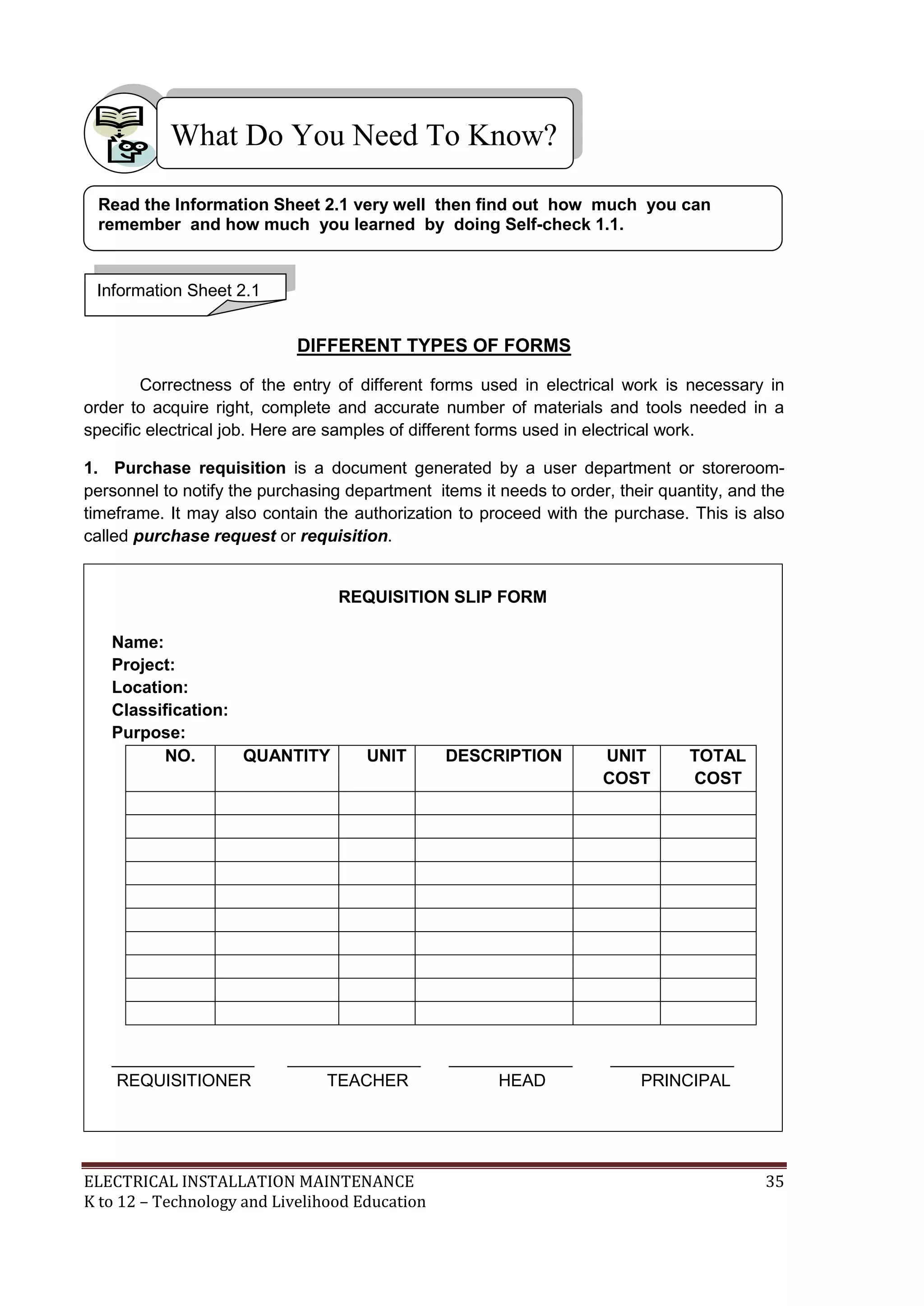
huge number of tools and equipment in the workshop, maintaining the inventory record is of
great value.

ELECTRICAL INSTALLATION MAINTENANCE
K to 12 – Technology and Livelihood Education

120
Maintaining and Storing Tools & Equipment
An important aspect of any business is the maintenance and storage of tools and
equipment. The investment in tools and equipment is a significant part of the overhead
expenses in any operation. Proper selection and maintenance of equipment are important
factors in managing business. Selecting the proper tool for the job and using the tool
properly will increase efficiency and reduce maintenance problems. Purchase tools, which
are well-made and suited to the intended use. Commercial usage may entail more heavy
duty demands on equipment.
Hand tools:
1. Clean dirt and debris from tools after each use.
2. Oil metal parts to prevent rust.
3. Lightly sand rough wooden handles and apply linseed oil.
4. Repair loose handles.
5. Sharpen blades of cutting tools.
6. Store tools in a clean dry storage area.
7. Protect surfaces of cutting tools in storage.
Power tools:
1. Read and follow the maintenance schedule in the owner’s manual for each piece
of power equipment.
2. Change the oil.
3. Clean the air filter.
4. Lubricate moving parts.
5. Sharpen dull blades or replace worn blades according to the owner’s manual.
6. Replace spark plugs.
7. Drain oil and gasoline before long-term storage.
8. Check electric cords and connections on electric-powered tools.
9. Store tools in a clean dry storage area.
Equipment:
1. Store equipment in a clean dry storage area.
2. Rinse and clean spray equipment after each use.
3. Clean spreaders and check wheel-driven gears.
ELECTRICAL INSTALLATION MAINTENANCE
K to 12 – Technology and Livelihood Education

121
4. Clean carts and wheelbarrows after use.

Sample Proper Arrangement and storage of tools and equipment

You can see in the pictures that all tools and equipment are arranged and
stored properly in their own racks. Like for example the screw drivers are arranged by
type and sizes, hammers, saws, c-clamps, etc. are in their racks.

ELECTRICAL INSTALLATION MAINTENANCE
K to 12 – Technology and Livelihood Education

122
How Much Have You Learned?
Self-Check 3.1
Direction: Enumerate the proper maintaining and storing of tool and equipment.
HANDTOOLS:
1.
2.
3.
4.
5.
6.
7.
EQUIPMENT:
1.
2.
3.
4.

Refer to the Answer Key. What is your score?

ELECTRICAL INSTALLATION MAINTENANCE
K to 12 – Technology and Livelihood Education

123
How Do You Apply What You Have Learned?
Show that you learned something by doing this activity.
Operation Sheet 3.1

INVENTORY OF TOOLS AND EQUIPMENT
Instruction: Given the record book/memorandum, receipts, inventory form,
ball pen and correction fluid, conduct inventory of tools and
equipment, identify, record and report damaged tools and
equipment and give repair recommendations if repairable.
Procedure:
1. Secure inventory forms/memorandum receipt of tools and equipment.
2. Study the parts of the Inventory Form.
3. Check whether the list of tools and equipment in the memorandum
receipt tallies with the existing tools and equipment found in the
workshop including their specifications and condition.
4. List down any losses and damages you find while conducting the
inventory
5. Fill out the remarks column of the inventory forms for any losses/
damages.
6. Recommend for replacement of lost tools and equipment and repair of
damaged tools and equipment if reparable.

ELECTRICAL INSTALLATION MAINTENANCE
K to 12 – Technology and Livelihood Education

124
SAN FRANCISCO HIGH SCHOOL
Misamis St. Bago Bantay Quezon City

INVENTORY FORM OF TOOLS AND EQUIPMENT
Item
No.

Quantity

Unit

Description

Condition

Remarks

1.
2.
3.
4.
5.
6.
7.
8.
9.
10.
11.
12.
13.
14.
15.
16.
17.
18.
19.
20.

Prepared by:

___________________

Date: _____________________

Name and Signature

ELECTRICAL INSTALLATION MAINTENANCE
K to 12 – Technology and Livelihood Education

125
Operation Sheet 3.2

PROCEDURE IN ARRANGING AND STORING TOOLS AND EQUIPMENT

Instruction: In a specific tool cabinet and a tool rack assigned to you,
arrange and store tools and equipment accordingly.
Procedure:
1. Classify the tools and equipment according to their types.
2. Arrange the tools by their types in the shelves/racks.
3. Place equipment in designated places or location.
Assessment: The teacher will assess you based on the performance criteria
listed below.

PERFORMANCE CRITERIA

PERFORMANCE
LEVEL
YES

NO

NA

1. Were the tools and equipment ready before performing
the task?

2. Were the tools arranged according to their types?
3. Were the equipment placed in their proper location
and arranged according to their types?

4. Were the tools/equipment placed in their respective
location and accessible for use when needed?

Satisfactory
Overall Performance
Unsatisfactory

Student’s name: __________________________

Teacher’s comment: ___________________________________________________
___________________________________________________
___________________________________________________

ELECTRICAL INSTALLATION MAINTENANCE
K to 12 – Technology and Livelihood Education

126
Congratulations! You did a great job! Rest and
relax a while then move on to the next lesson.
Good luck!

REFERENCES

LO1



Philippine Electrical Code. 2000 Edition.
Cardenas, Elpidio.1989, Fundamental and Elements of Electricity.
Philippines: national Bookstore.



Philippine Electrical Code. 1992 Edition, Institute of Integrated Electrical
Engineers of the Philippines Incorporated.




Max B. Fajardo Jr. & Leo R. Fajardo. , 2nd Edition.
Electrical Layout and Estimate.

LO 2



Philippine Electrical Code. 2000 Edition.
Cardenas, Elpidio.1989, Fundamental and Elements of Electricity.
Philippines: national Bookstore.



Philippine Electrical Code. 1992 Edition, Institute of Integrated Electrical
Engineers of the Philippines Incorporated.




Max B. Fajardo Jr. & Leo R. Fajardo. , 2nd Edition.
Electrical Layout and Estimate.

LO 3






Institute of Integrated Electrical Engineers of the Philippines
Incorporated. 1992, Philippine Electrical Code
Max B. Fajardo Jr. & Leo R. Fajardo. 2nd edition, Electrical Layout and
Estimate
Azares, Efren F. and Recana, Cirilo B. 1999, Practical electricity III;
Philippines: Adriana Publishing.
www.acmehowto.com/howto/maintenance/electrical/
www.thefabricator.com/safety/safety_article.cfm?id=1095

ELECTRICAL INSTALLATION MAINTENANCE
K to 12 – Technology and Livelihood Education

127
LESSON 5
Practice Occupational Health and Safety
Procedures

LEARNING OUTCOMES:
At the end of this Lesson, you are expected to
do the following:

LO 1. identify hazards and risks;
LO 2. evaluate risks and hazards; and
LO 3. control hazards and risks.

ELECTRICAL INSTALLATION MAINTENANCE
K to 12 – Technology and Livelihood Education

128
Definition of Terms
Ampere - unit of measurement for electric current
Circuit - the path of electric current
Conductor - a wire or a cord which provides path for current flow
Connectors and Adapters - accessories that are used to connect from boxes to
conduits or raceways to the other boxes in the electrical system
Corrugated plastic conduit (CPC) - commonly known as flexible non-metallic
conduit or the “moldflex”.
Hot wire - a wire through which current flows
Insulator - a plastic, rubber, or asbestos material used to cover electric wires
Kilowatt - a unit of power
Metallic Conduits - metal raceways that was classified into four; rigid steel conduit
(RSC); intermediate metallic conduit or tubing (IMC or IMT); electrical metallic
conduit or tubing (EMC or EMT); and the flexible metallic conduit (FMC)
Non-metallic conduits - plastic conduits or raceways designed to be a channel of
wire that are classified as; rigid non-metallic conduit or the PVC, the flexible nonmetallic or CPC, and the surface plastic molding
Philippine Electrical Code (PEC) - the governing rules and regulations that ensure
safety and fire-free environment
Resistance - the quality of electric current measured in ohms.
Threshold limit value (TLV) - a level to which it is believed a worker can be
exposed day after day for a working lifetime without adverse health effects.

Acronyms
OSHA - Occupational Safety and Health Administration
PPE - Personal Protective Equipment

ELECTRICAL INSTALLATION MAINTENANCE
K to 12 – Technology and Livelihood Education

129
LEARNING OUTCOME 1
Identify hazards and risks
PERFORMANCE STANDARDS




Workplace hazards and risks are identified and clearly explained.
Hazards/risks and its corresponding indicators are identified in with the
company procedures.
Contingency measures are recognized and established in accordance with
organizational procedures.



Materials/ Resources
Video clips on hazards and risks

ELECTRICAL INSTALLATION MAINTENANCE
K to 12 – Technology and Livelihood Education

130
What Do You Already Know?
Let us determine how much you already know about identifying hazards and
risks. Take this test.

Pretest LO 1

Direction: Match Column A with Column B. Write the letter only.
A
_____ 1. Adverse health effect
_____ 2. Hazards
_____ 3. Chemical hazards
_____ 4. Risks
_____ 5, Physical hazards
_____ 6. Wet floor
_____ 7. Ergonomic hazards
_____ 8. Psychological hazards
.
_____ 9.Unsafe work practices
_____10.Biological hazards

B
a. is the chance or the probability that a
person will be harmed.
b. caused by organism such as viruses,
bacteria fungi and parasites
c. Is a source of potential damage,
harm or adverse health effects
d. safety hazard
e. Vapor or gaseous substance
f. Slips, falls
g. hot or cold condition
h. decrease in life span
i. those that are basically causing
stress
j. awkward posture arising from
improper
work methods

Now check your answers using the Answer Key. If you got 90-100% of
the items correctly, proceed to the next Learning Outcome. If not, do the next
activity/ies again to gain knowledge and skills required for mastery.

ELECTRICAL INSTALLATION MAINTENANCE
K to 12 – Technology and Livelihood Education

131
What Do You Need To Know?
Read the Information Sheet 1.1 very well then find out how much you can
remember and how much you learned by doing Self-check 1.1.

Information Sheet 1.1

HAZARDS AND RISKS
What is the difference between 'hazard' and 'risk'?
A hazard is something that can cause harm, eg electricity, chemicals, working up a
ladder, noise, a keyboard, a bully at work, stress.
Risk is the chance or probability that a person will be harmed or experience an adverse
health effect once to a hazard. It may also apply to situations with property or equipment
loss.
A risk is the chance, high or low, that any hazard will actually cause somebody harm.

For example, working alone away from your office can be a hazard. The risk of
personal danger may be high. Electrical repair is a hazard. If someone accidentally turnedon the power the worker’s life will be in a 'high-risk' category.

ELECTRICAL INSTALLATION MAINTENANCE
K to 12 – Technology and Livelihood Education

132
Five Basic Workplace Hazards
There are ve major types of hazards which can put both your health and your safety at risk.
1.
2.
3.
4.
5.

Chemical hazards
Physical hazards
Biological hazards
Ergonomic hazards or job related hazards
Psychological hazards or stress
CHEMICAL HAZARDS

If you are working with cleaning products, bleaches, paints, and other
chemical agents, you need to understand what a chemical hazard is as well
as how to protect yourself.
Chemical hazards include:







liquids such a cleansers,
acids, and paints
vapours and fumes such as
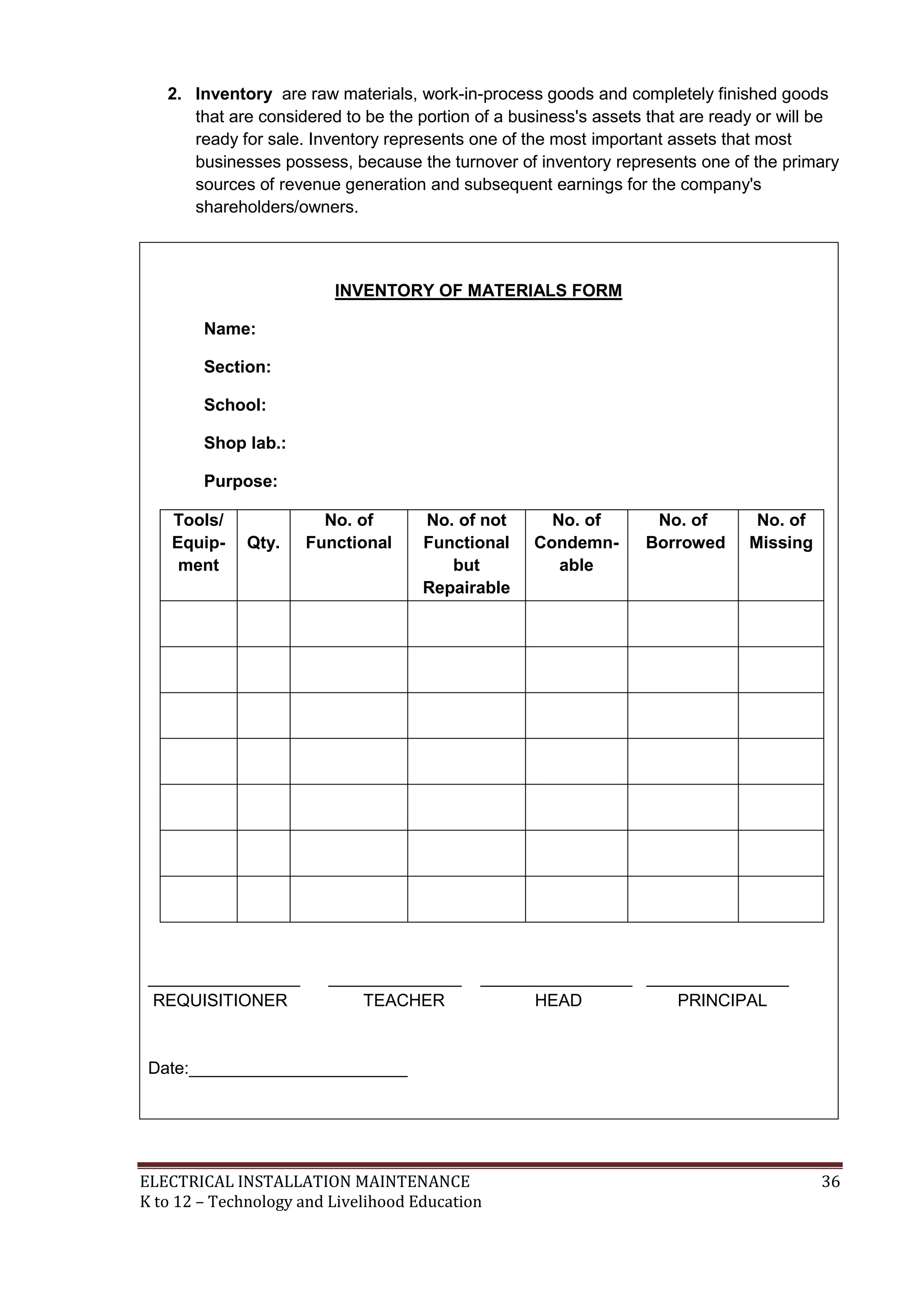
welding fumes
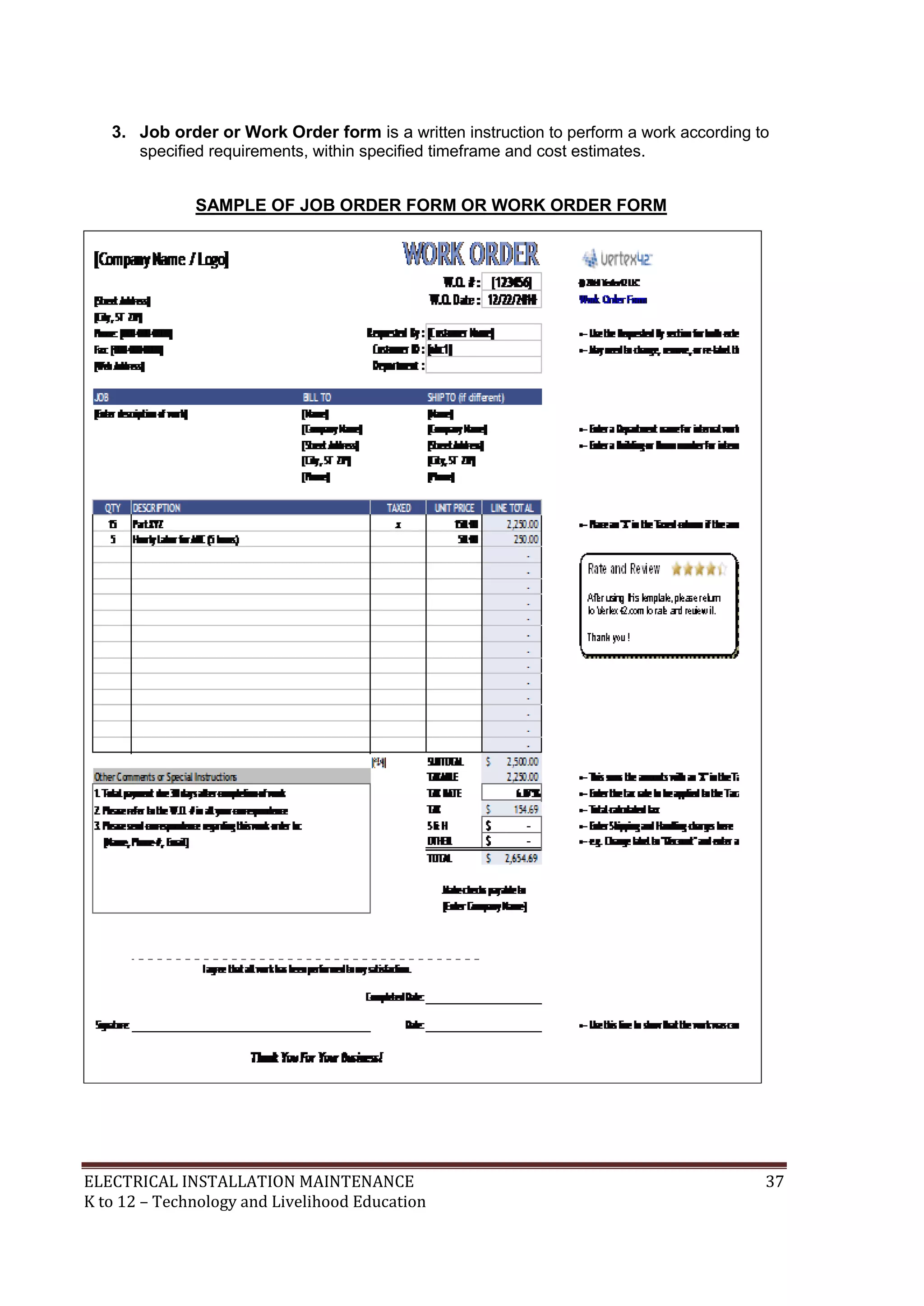
gases such as carbon monoxide
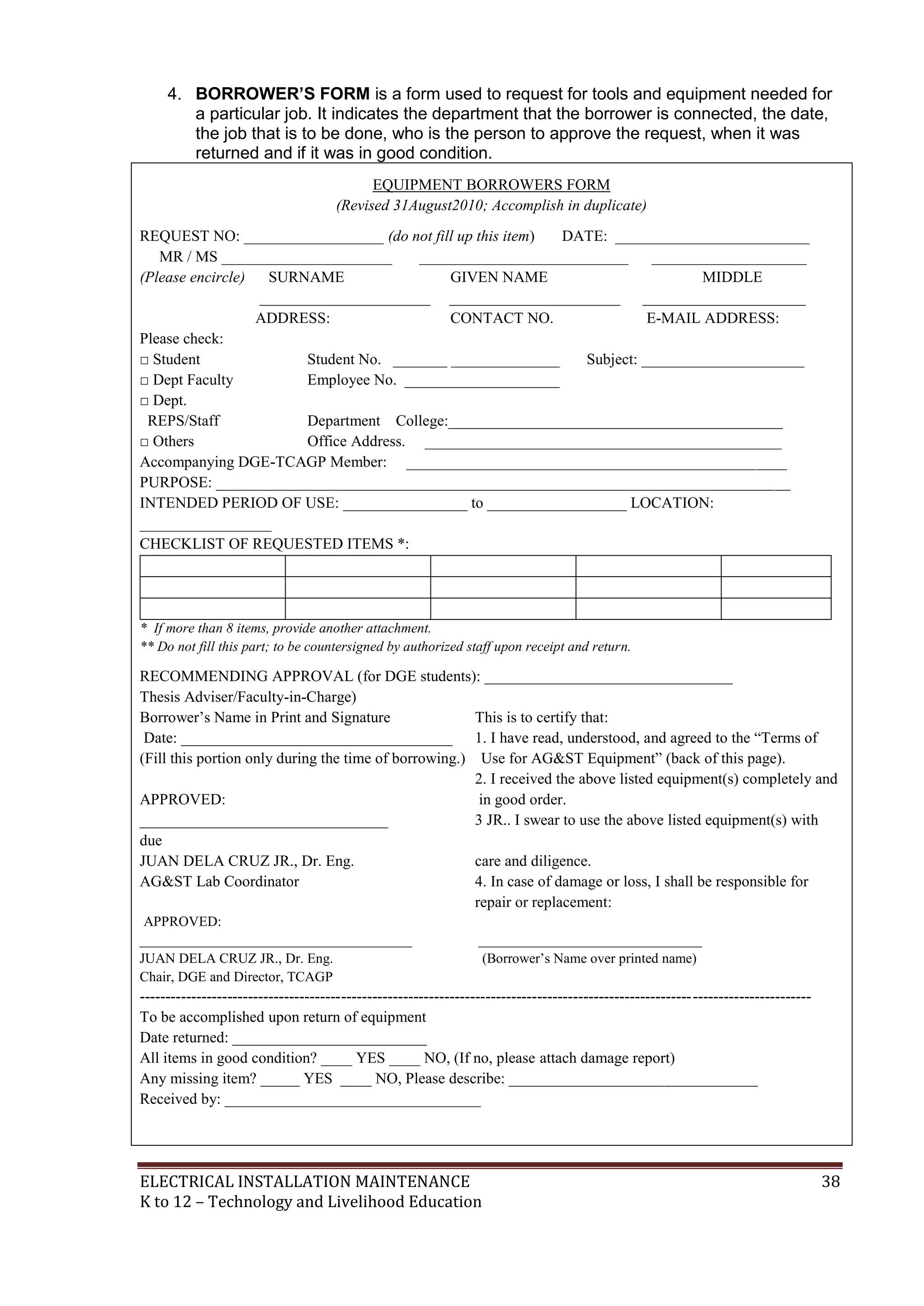
products that can catch re or explode

PHYSICAL HAZARDS

Physical hazards include:










Machinery
Electrical power
Noise
Power and hand tools
Working and walking surfaces
Trip and fall hazards
Ladders and scaffolds
Heat and cold
ventilation

BIOLOGICAL HAZARDS
Why be careful around ticks, mouse droppings, bird poop and wild animals?
Because you might get sick from working around certain animals, including

ELECTRICAL INSTALLATION MAINTENANCE
K to 12 – Technology and Livelihood Education

133
people. Biological hazards include bacteria, viruses, insects, plants, birds, animals, and
humans. The risks run from skin irritation and allergies to infections.
Dangers can come from:
•
•
•
•
•
•

unclean restrooms
mold and fungus
bacteria
insect stings
animal bites
poorly stored medical waste

ERGONOMIC HAZARDS
If your job is poorly designed, you can develop long term health problems.
These problems can arise from simple things, like working for long periods in an
awkward position or having to make the same motions over and over again.

Problems can come from:






lghting
chairs
lifting
repeated movements
computer screens

PSYCHOLOGICAL HAZARDS
Those that are basically causing stress to a worker. This kind of hazard
troubles an individual very much to an extent that his general well-being is
affected
Stress can lead to long-term health problems. Headaches, anxiety, and impatience are early
signs of stress.
Workplace causes of stress include:
•
•
•
•
•
•
•

heavy workloads
lack of control over the pace of work
shift work
noise
working by yourself
fear of job-loss
conflict with the employer

ELECTRICAL INSTALLATION MAINTENANCE
K to 12 – Technology and Livelihood Education

134
What are examples of a hazard?

Workplace Hazard

Example of
Hazard

Example of Harm Caused

thing

knife

cut

substance

benzene

leukemia

material

asbestos

mesothelioma

source of energy

electricity

shock, electrocution

condition

wet floor

slips, falls

process

welding

metal fume fever

practice

hard rock mining

silicosis

THRESHOLD LIMIT VALUE
One of the most critical among the hazards that one may encounter is the chemical
hazard. Chemical may produce reactions that may endanger ones health and life. This is the
reason why the American Conference of Governmental Hygienist (ACGIH) established a
threshold limit value (tlv).
TLV is the term used by the American Conference of Governmental Hygienists (ACGIH*) to
express the airborne concentration of a material to which nearly all persons can be exposed
day after day, without adverse health effects

ELECTRICAL INSTALLATION MAINTENANCE
K to 12 – Technology and Livelihood Education

135
How Much Have You Learned?
Self-Check 1.1
Given below is the list of common workplace hazards. Write at least three examples of each
type of hazard.

1.

Chemical hazard
________________________
________________________
________________________

2.

Physical hazard
________________________
________________________
________________________

3.

Biological hazard
________________________
________________________
________________________

4.

Ergonomic hazard or Job related
________________________
________________________
________________________

5.

Psychological hazards
________________________
________________________
________________________

Refer to the Answer Key. What is your score?

ELECTRICAL INSTALLATION MAINTENANCE
K to 12 – Technology and Livelihood Education

136
How Do You Apply What You Have Learned?
Show that you learned something by doing this activity.
Job Sheet 1.1

RESEARCH WORK
a. Make an internet research on different hazards and risks.
b. Be able to identify these different hazards.
c. Make a write-up on your research on workplace hazards and risks.

ELECTRICAL INSTALLATION MAINTENANCE
K to 12 – Technology and Livelihood Education

137
LEARNING OUTCOME 2
Evaluate hazards and risks
PERFORMANCE STANDARDS


Terms of maximum tolerable limits are identified based on threshold
limit values (TLV)
Effects of hazards are determined.
OHS issues and concerns are identified in accordance with
workplace requirements and relevant workplace OHS legislation.






Materials/ Resources
1. Threshold limit value table (tlv)
2. Video clips about hazards and risks

What Do You Already Know?
Let us determine how much you already know about evaluating hazards and risks.
Take this test.

Pretest LO 2
Direction: Multiple Choice: Select the letter of the correct answer.
__________1. The cross disciplinary area concerned with the safety, health and
welfare of people engaged in work or employment.
a.) Waste management

b) PEC

c) ACGIH

d) OHS

__________2. the collection, transport, processing or disposal, managing and
monitoring of waste materials.
a) Waste management

b) PEC

ELECTRICAL INSTALLATION MAINTENANCE
K to 12 – Technology and Livelihood Education

c) ACGIH

d) OHS

138
_________3. TLV means;
a) Threshold limited value

b) Threshold live value

c)) Threshold limit value

b) Time-weighted average

c) Total-weighted average

_________4. TWA means:
a) Time-wasted Average
_________5. TLV-C means;
a) Threshold limit value-ceiling b) Threshold limited value-ceiling c) Threshold live
value-ceiling
_________6. One type of hazard that needs careful evaluation before extinguishing
a) Chemical

b) Water

c) Fire

_________7. It is a fifteen minutes exposure to risk.
a) TLV-STEL

b) TLV-C

c) TLV-TWA

_________8. Chemicals with lower flash points present a greater ____________.
a) Personal hazard b) flammability hazard

c) explosion hazard

_________9. Process where a person identify, evaluate and determine the solution
to the risks.
a) Chemical assessment

b) Risk assessment

c) Physical assessment

________10. ) Any alteration of the physical, chemical and biological properties of
the atmospheric air, or any discharge thereto of any liquid, gaseous or solid
substances that will or is likely to create or to render the air resources of the country
harmful, detrimental, or injurious to public health, safety or welfare or which
will adversely affect their utilization for domestic, commercial, industrial, agricultural,
recreational, or other legitimate purposes.
a) Pollution

b) atmospheric pollution

c) air pollution

Now check your answers using the Answer Key. If you got 90-100% of
the items correctly, proceed to the next Learning Outcome. If not, do the next
activity/ies again to gain knowledge and skills required for mastery.

ELECTRICAL INSTALLATION MAINTENANCE
K to 12 – Technology and Livelihood Education

139
What Do You Need To Know?
Read the Information Sheet 2.1 very well then find out how much you can
remember and how much you learned by doing Self-check 2.1.

Information Sheet 2.1

What is a risk assessment?
Occupational Safety and Health (OHS) is a cross-disciplinary area concerned with
protecting the safety, health and welfare of people engaged in work or employment.
The goal of all occupational safety and health programs is to foster a safe work
environment. As a secondary effect, it may also protect co-workers, family members,
employers, customers, suppliers, nearby communities, and other members of the public who
are impacted by the workplace environment. It may involve interactions among many subject
areas, including occupational medicine, occupational (or industrial) hygiene, public
health, safety engineering / industrial engineering, chemistry, health physics.
Risks include acute and chronic health effects, for example, irritation or cancer, and
physical effects such as fires or explosions. The hazards are physical and health hazards.
II. Risk assessment
A. Risk assessment is the process where you:
1. identify hazards
2. analyze or evaluate the risk associated with that hazard
3. determine appropriate ways to eliminate or control the hazard
B. Factors that influence the degree of risk include:
 how much a person is exposed to a hazardous thing or condition
 how the person is exposed (e.g., breathing in a vapor, skin contact), and how severe
are the effects under the conditions of exposure

ELECTRICAL INSTALLATION MAINTENANCE
K to 12 – Technology and Livelihood Education

140
ACGIH has established TLV's for approximately 850 chemical.
TLVs may appear as:
TLV-TWA or time-weighted average, which is an average eight-hour exposure limit;
TLV-STEL or short-term exposure limit, which is a fifteen-minute exposure limit, or
TLV-C or ceiling, which is a limit which should never be exceeded without protection.

II. Fire and Explosion Hazard Assessment
Fire is one type of hazard that needs careful evaluation before extinguishing it. Not all fire
could be extinguished by water that is why it is necessary that we knew first the cause of fire
before dealing the fire.
1. Flash Point and Method Used: Lowest temperature at which a liquid will give off enough
flammable vapors to ignite. Since flash points vary according to how they are obtained, the
method used must be listed. Chemicals with lower flash points present a greater flammability
hazard.
2. Flammable Limits: Range of concentrations over which a flammable vapor mixed with air
will flash or explode if an ignition source is present. Range extends between lower explosive
limit (LEL) and upper explosive limit (UEL) and is expressed in percentage of volume of
vapor or gas in air (0 – 100%).
Chemicals with a broad flammable range (i.e., range between the LEL and the UEL)
and/or a flammable range in the lower percentages, present a greater flammability hazard.
3. Extinguishing Media: Fire-fighting material for use on substance that is burning, Firefighting material should be indicated by its generic name (e.g. water, foam, dry chemical,
etc.).
III. Waste management is the collection, transport, processing or disposal, managing and
monitoring of waste materials. The term usually relates to materials produced by human
activity, and the process is generally undertaken to reduce their effect on health,
the environment or aesthetics.
Waste management is a distinct practice from resource recovery which focuses on
delaying the rate of consumption of natural resources. The management of wastes treats all
materials as a single class, whether solid, liquid, gaseous or radioactive substances, and
tried to reduce the harmful environmental impacts of each through different methods.
Waste management practices differ for developed and developing nations,
for urban and rural areas, and for residential and industrial producers. Management for nonhazardous waste residential and institutional waste in metropolitan areas is usually the
responsibility of local government authorities, while management for non-hazardous
commercial and industrial waste is usually the responsibility of the generator.
ELECTRICAL INSTALLATION MAINTENANCE
K to 12 – Technology and Livelihood Education

141
PHILIPPINE CLEAN AIR ACT OF 1999
(Refer to Appendix 1 for elaboration)

The Philippine Clean Air Act of 1999 under its ―Declaration of Principles” stated
that the State shall protect and advance the right of the people to a balanced
and healthful ecology in accord with the rhythm and harmony of nature.
Declaration of Policies.
The State shall pursue a policy of balancing
development and environmental protection. To achieve this end, the framework for sustainable development shall be pursued.
Recognition of Rights. Pursuant to the above-declared principles, the following
rights of citizens are hereby sought to be recognized and the State shall seek to
guarantee their enjoyment.
Definitions.- As used in this Act:
a) “Air pollutant” means any matter found in the atmosphere other than
oxygen, nitrogen, water vapor, carbon dioxide, and the inert gases in
their natural or normal concentrations, that is detrimental to health or
the environment, which includes, but not limited to smoke, dust, soot,
cinders, fly ash, solid particles of any kind, gases, fumes, chemical
mists, steam and radioactive substances;
b) “Air pollution” means any alteration of the physical, chemical and
biological properties of the atmospheric air, or any discharge thereto of
any liquid, gaseous or solid substances that will or is likely to create or
to render the air resources of the country harmful, detrimental, or
injurious to public health, safety or welfare or which will adversely affect
their utilization for domestic, commercial, industrial, agricultural,
recreational, or other legitimate purposes;
c) “Ambient air quality guideline values” means the concentration of air over
specified periods classified as short-term and long-term which are
intended to serve as goals or objectives for the protection of health
and/or public welfare. These values shall be used for air quality
management purposes such as determining time trends, evaluating
stages of deterioration or enhancement of the air quality, and in general,
used as basis for taking positive action in preventing, controlling, or
abating air pollution;
d) “Ambient air quality” means the general amount of pollution present in a
broad area; and refers to the atmosphere’s average purity as

ELECTRICAL INSTALLATION MAINTENANCE
K to 12 – Technology and Livelihood Education

142
distinguished from discharge measurements taken at the source of
pollution;
e) “Certificate of Conformity” means a certificate issued by the Department of
Environment and Natural Resources to a vehicle manufacturer /
assembler or importer certifying that a particular new vehicle or
vehicle type meets the requirements provided under this Act and its
rules and regulations;
f) “Department” means the Department of Environment and Natural Resources;
g)“Eco-profile” means the geographic-based instrument for planners and
decision makers which present an evaluation of the environment quality
and carrying capacity of an area. It is the result of the integration of
primary data and information on natural resources and antropogenic
activities on the land which were evaluated by various environmental
risk assessment and forecasting methodologies that enable the
Department to anticipate the type of development control necessary in
the planning area.
h)“Emission” means any air contaminant, pollutant, gas stream or
unwanted sound from a known source which is passed into the
atmosphere;
i) “Greenhouse gases” means those gases that can potentially or can
reasonably be expected to induce global warming, which include
carbon dioxide, oxides of nitrogen, chloroflourocarbons, and the like;
j) “Hazardous substances” means those substances which present either: (1)
short-term acute hazards such as acute toxicity by ingestion,
inhalation, or skin absorption, corrosivity or other skin or eye contact
hazard or the risk of fire explosion; or (2) long-term toxicity upon
repeated exposure, carcinogecity (which in some cases result in acute
exposure but with a long latent period), resistance to detoxification
process such as biodegradation, the potential to pollute underground
or surface waters;
k) “Infectious waste” means that portion of medical waste that could transmit an
infectious disease;
l) “Medical waste” means the materials generated as a result of patient
diagnosis, treatment, or immunization of human beings or animals;
m) “Mobile source” means any vehicle propelled by or through
combustion of carbon-based or other fuel, constructed and operated
ELECTRICAL INSTALLATION MAINTENANCE
K to 12 – Technology and Livelihood Education

143
principally for the conveyance of persons or the transportation of
property goods;
n) “Motor vehicle” means any vehicle propelled by a gasoline or diesel engine
or by any means other than human or animal power, constructed and
operated principally for the conveyance of persons or the transportation
of property or goods in a public highway or street open to public use;
o) “Municipal waste” means the waste materials generated from
communities within a specific locality;
p) "New vehicle” means a vehicle constructed entirely from new parts that has
never been sold or registered with the DOTC or with the appropriate
agency or authority, and operated on the highways of the
Philippines, any foreign state or country;
q) “Octane Rating or the Anti-Knock Index(AKI)” means the rating of the antiknock characteristics of a grade or type of automotive gasoline as
determined by dividing by two (2) the sum of the Research Octane
Number (RON), plus the Motor Octane Number (MON); the octane
requirement, with respect to automotive gasoline for use in a motor
vehicle or a class thereof, whether imported, manufactured, or
assembled by a manufacturer, shall refer to the minimum octane rating
of such automotive gasoline which such manufacturer recommends for
the efficient operation of such motor vehicle, or a substantial portion of
such class, without knocking;
r) “Ozone Depleting Substances (ODS)” means those substances that
significantly deplete or otherwise modify the ozone layer in a manner
that is likely to result in adverse effects of human health and
the environment such as, but not limited to, chloroflourocarbons, halons
and the like;
s) “Persistent Organic Pollutants (POPs)” means the organic
compounds that persist in the environment, bioaccumulate through the
food web, and pose a risk of causing adverse effects to human health
and the environment. These compounds resist photolytic, chemical and
biological degradation, which shall include but not be limited to dioxin,
furan, Polychlorinated Biphenyls (PCBs), organochlorine pesticides,
such as aldrin, dieldrin, DDT, hexachlorobenzene, lindane, toxaphere
and chlordane;
t) “Poisonous and toxic fumes” means any emissions and fumes which are
beyond internationally - accepted standards, including but not limited to
the World Health Organization (WHO) guideline values;
u) “Pollution control device" means any device or apparatus used to prevent,
control or abate the pollution of air caused by emissions from identified
ELECTRICAL INSTALLATION MAINTENANCE
K to 12 – Technology and Livelihood Education

144
pollution sources at levels within the air pollution control
standards established by the Department;
v) “Pollution control technology” means the pollution control devices,
production process, fuel combustion processes or other means that
effectively prevent or reduce emissions or effluent;
w) “Standard of performance" means a standard for emissions of air pollutant
which reflects the degree of emission limitation achievable through the
application of the best system of emission reduction, taking
into account the cost of achieving such reduction and any non-air
quality health and environmental impact and energy requirement which
the Department determines, and adequately demonstrates; and
x) “Stationary source” means any building or immobile structure, facility or
installation which emits or may emit any air pollutant.

ELECTRICAL INSTALLATION MAINTENANCE
K to 12 – Technology and Livelihood Education

145
How Much Have You Learned?
Self-Check 2.1
DIRECTIONS: Multiple choice. Write the letter of the correct answer and write it in the
space provided.
_________1. Chemicals with lower flash points present a greater ____________.
a) Personal hazard b) flammability hazard c) explosion hazard d) skin hazard
_________2. Process where a person identify, evaluate and determine the solution
to the risks.
a) Chemical assessment b) Risk assessment c) Physical assessment d) NC
assessment
_________3. Any alteration of the physical, chemical and biological properties of the
atmospheric air, or any discharge thereto of any liquid, gaseous or solid substances
that will or is likely to create or to render the air resources of the country harmful,
detrimental, or injurious to public health, safety or welfare or which will adversely
affect their utilization for domestic, commercial, industrial, agricultural, recreational, or
other legitimate purposes.
a) Pollution

b) atmospheric pollution

c) air pollution

_________4. The cross disciplinary area concerned with the the safety, health and
welfare of people engaged in work or employment.
a.) Waste management b) PEC

c) ACGIH

d) OHS

__________5. the collection, transport, processing or disposal, managing and
monitoring of waste materials.
a) Waste management

b) PEC

c) ACGIH

d) OHS

Refer to the Answer Key. What is your score?

ELECTRICAL INSTALLATION MAINTENANCE
K to 12 – Technology and Livelihood Education

146
How Do You Apply What You Have Learned?
Show that you learned something by doing this activity.
Activity Sheet 2.1

A. Do the activity at home or during vacant time

1. Download and watch video presentation on different hazards and risk.
2. Make a short write-up on the video presentation you have watched.
B. Answer the following questions

1. What type of hazard was viewed in the video?
2. What risks were involved?
3. If you are going to evaluate the hazard and risk you had viewed, what
possible recommendations will you give? Why?

ELECTRICAL INSTALLATION MAINTENANCE
K to 12 – Technology and Livelihood Education

147
LEARNING OUTCOME 3
Controlling hazards and risks
PERFORMANCE STANDARDS





OHS procedures for controlling hazards and risk are strictly followed.
Procedures in dealing with workplace accidents, fire and emergencies
are followed in accordance with the organization’s OHS policies.
Personal protective equipment (PPE) is correctly used in accordance
with organization’s OHS procedures and practices.
Procedures in providing appropriate assistance in the event of
workplace emergencies are identified in line with the established
organizational protocol.



Materials
1. Personal protective equipment:







Safety goggles
Safety shoes
Safety helmet
Safety gloves
Safety shoes
Safety belt

2. First aid kit

ELECTRICAL INSTALLATION MAINTENANCE
K to 12 – Technology and Livelihood Education

148
What Do You Already Know?
Let us determine how much you already know controlling hazards and risks.
Take this test.
Pretest LO 3
A. DIRECTION:
Select the correct answer that corresponds to the statement in each
number. Write the correct answer at the space provided
_____________ 1. It includes ear and eye protection, respirators, and protective clothing.
______________2. Changing a piece of machinery (for example, using proper machine
guards) or a work process to reduce exposure to a hazard
______________3. Working a limited number of hours in a hazardous area
______________4. The process where you identify hazards, analyze or evaluate the risk
associated with that hazard, and determine appropriate ways to eliminate or control the
hazard.
______________5. Identify the source of the problem
IDENTIFY THE HAZARD

ASSESS THE RISK
PERSONAL PROTECTIVE EQUIPMENT
ENGINEERING CONTROL
ADMINISTRATIVE CONTROL
ELIMINATE HAZARDS

B.DIRECTION: TRUE OR FALSE. In the statements below write true if the statement is
correct and False if the statement is incorrect.
1. General cleanliness in the workplace is an important method of controlling
hazards.
2. Good housekeeping reduces the risk of fire and is cost-effective.
3. Safety signs are method of hazard control.
4. Hygiene (cleanliness) is not so important as a method of controlling hazards
5. Before you leave work, wash/shower and change your clothes when
necessary to prevent bringing workplace contaminants home to your family.

Now check your answers using the Answer Key. If you got 90-100% of
the items correctly, proceed to the next Learning Outcome. If not, do the next
activity/ies again to gain knowledge and skills required for mastery.

ELECTRICAL INSTALLATION MAINTENANCE
K to 12 – Technology and Livelihood Education

149
What Do You Need To Know?
Read the Information Sheet 3.1 very well then find out how much you can
remember and how much you learned by doing Self-check 3.1.

Information Sheet 3.1
3A. HAZARD CONTROL
All workplace hazards (chemical, physical, etc.) can be controlled by a variety of methods.
The goal of controlling hazards is to prevent workers from being exposed to
occupational hazards. Some methods of hazard control are more efficient than others, but
a combination of methods usually provides a safer workplace than relying on only one
method. Some methods of control are cheaper than others but may not provide the most
effective way to reduce exposures.
To control hazards in your workplace you need to identify and understand those
hazards. Your first priority should always be to eliminate the hazards. If the hazards can't be
eliminated, try finding safer ways to carry out those tasks by substituting less harmful
substances or changing the work environment through engineering controls. Also consider
changing how work activities are organized and performed. For example, reduce the time
workers are exposed to a hazard by rotating them to another task.
A. Controlling workplace hazards
Once a hazard has been identified and the risk assessed, control measures should be put
into place.A simple list of control measures can be utilized - the hierarchy of control.

1. Identify the Hazard
Identify the source of the problem

2. Assess the Risk
Risk assessment is the process where you:
o
o

Identify hazards,
Analyze or evaluate the risk associated
with that hazard.

ELECTRICAL INSTALLATION MAINTENANCE
K to 12 – Technology and Livelihood Education

150
o

Determine appropriate ways to eliminate or control
the hazard

3. Eliminate the Hazard Or Risk
Elimination of a specific hazard or hazardous work process, or
preventing it from entering the workplace, is the most effective
method of control. Eliminating a hazard means removing it
completely.

4. Engineering Control may mean changing a piece of
machinery (for example, using proper machine guards) or a
work process to reduce exposure to a hazard.

5. Administrative Controls
Working a limited number of hours in a hazardous area is an
example of an administrative control for example, job rotation.

6. Substitution is one measure of replacing one hazardous
agent or work process with a less dangerous one. It is
important to consider worker health and safety when work
processes are still in the planning stages.

Provide Personal Protective Equipment
Personal Protective Equipment (PPE) includes ear and eye
protection, respirators, and protective clothing.

Remember: it is always better to control the hazard as close to the source as possible.
Using personal protection is the least acceptable and least effective of all control
measures.

ELECTRICAL INSTALLATION MAINTENANCE
K to 12 – Technology and Livelihood Education

151
How Much Have You Learned?
Self-Check 3.1

DIRECTIONS: Select the correct answer that corresponds to the statement in each
number. Write the correct answer at the space provided
_____________ 1. It includes ear and eye protection, respirators, and protective
clothing.
______________2. It may mean changing a piece of machinery (for example,
using proper machine guards) or a work process to reduce
exposure to a hazard.
______________3. Working a limited number of hours in a hazardous area
______________4. The process where you identify hazards, analyze or evaluate
the risk associated with that hazard, and determine appropriate
ways to eliminate or control the hazard.
______________5. Identify the source of the problem.

IDENTIFY THE HAZARD

ASSESS THE RISK
PERSONAL PROTECTIVE EQUIPMENT

ENGINEERING CONTROL
ADMINISTRATIVE CONTROL
ELIMINATE HAZARDS

Refer to the Answer Key. What is your score?

ELECTRICAL INSTALLATION MAINTENANCE
K to 12 – Technology and Livelihood Education

152
What Do You Need To Know?
Read the Information Sheet 1.1 very well then find out how much you can
remember and how much you learned by doing Self-check 1.1.

Information Sheet 3.2
YOUR HEALTH AND SAFETY AT WORK
Personal hygiene
Finally, personal hygiene (cleanliness) is also very important as a method of controlling
hazards. Your employer should provide facilities so you can wash and/or take a shower
every day at the end of your shift, no matter what your job is. Wash your skin and hair with a
mild soap, rinse and dry your skin completely to protect it. Washing hands regularly, and
eating and smoking
away from your work
area help to prevent
ingesting
Do not take workplace
contaminants.
hazards home with you!
Lack of personal
cleanliness can affect
your family's health.
Your family can be
exposed to hazards
you work with if you
bring chemicals and
other workplace contaminants home with you on your clothes, hair or skin. Before you leave
work, wash/shower and change your clothes when necessary to prevent bringing workplace
contaminants home.
Leave your dirty clothes at work or, if you must wash them at home, wash
them separately — not with the family wash.

ELECTRICAL INSTALLATION MAINTENANCE
K to 12 – Technology and Livelihood Education

153
It may seem that the amount of contaminant you can bring home on your clothes or skin is
very small and cannot hurt your family. In reality a small exposure every day for months can
add up to a big exposure. A classic example of this ―spreading the hazard‖ involves
asbestos, where wives of asbestos workers have developed asbestosis from exposure to the
asbestos on their husbands' work clothes. Similarly, children have developed lead poisoning
from exposure to lead which comes home on their parents' work clothes.
If you wear protective clothing at work, such as aprons, laboratory coats, overalls,
etc., these should be cleaned regularly and you should inspect them for holes or areas that
are worn out. Workers who launder these clothes should be trained in the types of hazards
they may work with and how they can be controlled. Inspect your underclothes at home for
any signs of contamination with oils, solvents, etc. If you find any signs, then it means your
protective clothing at work is not effective.
Every workplace should have some kind of first-aid facility
Every workplace should have at least minimal first-aid facilities as well as adequate
personnel trained to provide first aid. First-aid facilities and trained personnel are important
components of a healthy and safe workplace.

ELECTRICAL INSTALLATION MAINTENANCE
K to 12 – Technology and Livelihood Education

154
A basic first-aid
facility

1. General cleanliness in the workplace is an important method of controlling
hazards.
2. Good housekeeping reduces the risk of fire and is cost-effective.
3. Good housekeeping measures should be planned when work processes are
in the design stage.
4. Safety signs are not a method of hazard control.
5. Personal cleanliness is an important method of controlling hazards.
6. Your employer should provide facilities so you can wash and/or take a
shower every day.
7. Before you leave work, wash/shower and change your clothes when
necessary to prevent bringing workplace contaminants home to your family.
8. Leave your dirty clothes at work. If you must wash them at home, wash them
separately — never wash your work clothes with your family's wash.
9. Your protective clothing should be cleaned regularly. Inspect your protective
clothing for holes and worn areas that could leave you open to exposures.
10. Inspect your undergarments for signs of contamination.
11. Your workplace should have at least minimal first-aid facilities.

EMERGENCY PREPAREDNESS
Process of ensuring that an organization has complied with the preventive measures,
is in a state of readiness to contain the effects of a forecasted disastrous event to minimize
loss of life, injury, and damage to property, can provide rescue, relief, rehabilitation, and
ELECTRICAL INSTALLATION MAINTENANCE
K to 12 – Technology and Livelihood Education

155
other services in the aftermath of the disaster, and has the capability and resources to
continue to sustain its essential functions without being overwhelmed by the demand placed
on them.
Preparedness for the first and immediate response is called emergency preparedness.

Always remember that disaster comes in the most unexpected time and place. Being ready
is always a necessity in all circumstances. The government is giving trainings that everybody
needs in all our localities. One should participate in this disaster training so that we will not
be caught unaware when calamity struck.

ELECTRICAL INSTALLATION MAINTENANCE
K to 12 – Technology and Livelihood Education

156
How Much Have You Learned?
Self-Check 3.2
DIRECTIONS: TRUE OR FALSE. In the statements below write true if the statement is
correct and false if the statement is not correct
a. General cleanliness in the workplace is an important method of controlling
hazards.
b. Good housekeeping reduces the risk of fire and is cost-effective.
c. Safety signs are method of hazard control.
d. Hygiene (cleanliness) is not so important as a method of controlling hazards.
e. Before you leave work, wash/shower and change your clothes when
necessary to prevent bringing workplace contaminants home to your family.
f. Your protective clothing should be cleaned regularly.
g. Inspect your undergarments for signs of contamination.
h. Your employer should provide facilities so you can wash and/or take a shower
at least once a week.

How Do You Apply What You Have Learned?
Show that you learned something by doing this activity.

Activity Sheet 3.1

POSTER MAKING
DIRECTION: Draw a poster in consonance with the theme ―Control Hazard, Before It
Starts”
MATERIALS:
1.
2.
3.
4.

Pencil
Poster paint or oil paint or crayon
Whole cartolina (yellow)
Ruler

TIME ALLOTMENT:
3 hours

ELECTRICAL INSTALLATION MAINTENANCE
K to 12 – Technology and Livelihood Education

157
How Well Did You Perform?
Find out by accomplishing the Scoring Rubric honestly and sincerely.
Remember it is your learning at stake!
Speed 20%
10 minutes before/ on allotted time ----------------------------- 20%
1minute up to 10 minutes after the allotted time - 10%
11 minutes and more than the allotted time ------- 05%
Originality 50 %
based on judges deliberation ----------------------------------------50%
Blending of colors 25%
based on judges deliberation ---------------------------------------25%
Good Housekeeping 5%
all the materials were kept clean and the work area
was properly cleaned -------------------------------------------------05%
Total

100%

Congratulations! You did a great job! Rest and
relax a while then move on to the next lesson.
Good luck!

REFERENCES





Philippine Electrical Code. 2000 Edition.
Cardenas, Elpidio. 1989, Fundamental and Elements of Electricity; Philippines:
National Bookstore.
http://sam.dgs.ca.gov/TOC/3800/3861.htm
http://old.iupac.org/goldbook/TT06915.pdf

ELECTRICAL INSTALLATION MAINTENANCE
K to 12 – Technology and Livelihood Education

158
Answer Keys

LESSON 1
HOW MUCH DO YOU ALREADY KNOW?
PRE-TEST
2. Combination Pliers
3. Long Nose Pliers
4. Philips Screw driver
5. Claw Hammer
6. Wire Stripper
7. Portable electric drill
8. Stubby screw driver
9. Electrician’s knife
10. Male plug
11. Fuse
12. Utility box
13. Conduits
14. Connectors
15. Circuit Breaker
16. Junction box
SELF CHECK
1. rat tail
2. plain tap
3. duplex cross
4. y splice
PRE-TEST
1.
2.
3.
4.

b
a
d
c

SELF CHECK

1.
2.
3.
4.

Requisition form
Inventory form
Job order or work order form
Borrower’s form

PRE-TEST
a.
1. For me
ELECTRICAL INSTALLATION MAINTENANCE
K to 12 – Technology and Livelihood Education

159
2. Damaged
3.
Correct
B.
1. The receiving person
2. Keep a copy
3. Write the findings and if posible, take a picture

LESSON 2
WHAT DO YOU ALREADY KNOW?
PRE-TEST
I

Matching Type:
1.
2.
3.
4.
5.

C
E
A
B
D

II . Multiple Choice:
1.
2.
3.
4.
5.

B
A
D
C
A

LO2- CARRY OUT MEASUREMENTS AND CALCULATIONS
A.
1. 10 mm
2. 36 inches
3. 10 cm
4. 1 cm
5. 12 inches
B.
6. cm
7. m
8. dm
9. yd
10. ft

ELECTRICAL INSTALLATION MAINTENANCE
K to 12 – Technology and Livelihood Education

160
C.
1. 304.8 cm
2. 700 mm
3. 1.25 ft
4. 5.468 yd

LESSON 3
PRETEST
LO1: A.
1.
2.
3.
4.
5.

b
d
a
e
c
B.

1. Warning
2. Read and understand instruction manual
3. Electrical hazard
4. Voltage danger
5. Power panel
6. Circuit breaker
7. Battery

PRE-TEST
LO2:
QUANTITY

ELECTRICAL FIXTURES

8 pieces

Lamp outlets

8 pieces

Duplex convenience outlets

4 pieces

Single gang switches

1 piece

Two gang switch

1 piece

Three gang switch

ELECTRICAL INSTALLATION MAINTENANCE
K to 12 – Technology and Livelihood Education

161
SELF CHECK
LO1.
1.
2.
3.
4.
5.

b
d
a
e
c

HOW MUCH DO YOU LEARNED?
SELF CHECK
Electrical Plan and Layout
LO2.
1.

Schematic Diagram of Series Circuit

2.

110V

Bulb
s

Source
110V
Switch

SCHEMATIC DIAGRAM OF PARALLEL CIRCUIT
ELECTRICAL INSTALLATION MAINTENANCE
K to 12 – Technology and Livelihood Education

162
HOW DO YOU APPLY WHAT YOU LEARNED?
ELECTRICAL SIGNS
LO1. Analyze electrical symbols and signs.
A.
R
P

R

O

C
A
U
T
I
O
N

T
L

O
V

H

I
S
A
F
E
T
Y
A
L
E
R
T

B

I

T

D
E
G

I

O

W
A
R
N
I
N
G

N
G

E

N

B.

a. Safety alert

b. Prohibition
c. Voltage
danger

d. Warning
e. Electrical
hazard

ELECTRICAL INSTALLATION MAINTENANCE
K to 12 – Technology and Livelihood Education

163
SELF CHECK
Electrical Plan
LO2
QUANTITY

ELECTRICAL FIXTURES

19 pieces

Lamp outlets

0

Duplex convenience outlet

4 pieces

Single gang switches

3 pieces

Two gang switches

3 piece

Three gang switches

HOW MUCH HAVE YOU LEARNED?
SELF CHECK
I.

II.

Text Twist:
1. Wire gauge
2. Voltmeter
3. Clamp meter
4. Push pull rule
Parts of Multi-tester
1. Scale
2. Adjustment screw
3. Range selector knob
4. Pointer
5. Zero-ohm adjustment knob
6. Test probe

LESSON 4
LO1: Check condition of tools and equipment
1. Pneumatic floor jack
2. Hand tools
3. Screw drivers
4. Wrench
5. Puller
6. Vacuum cleaner
7. Air drill
8. Personal Protective Equipment (PPE)
ELECTRICAL INSTALLATION MAINTENANCE
K to 12 – Technology and Livelihood Education

164
9. Pneumatic Torque Wrench
10. Machine/Power tools
SELF CHECK
LO1. Check condition of tools and equipment
Hand tools

Power tools

Pneumatic tools

1. Screw drivers

1.Grinding Wheels

1.Air Racket

2.Wrenches

2.Vacuum Cleaner

2.Air Drill

3.Pullers

3.Electric Drill

3.Air Chisel

4.Hammers

4.

4.

Pre-Test
LO2: Perform basic preventive maintenance
A.

1. D
2. C
3. E
4. A
5. B
B.
1. b. sweepingi
2. d. self-discipline
3. a. sorting
4. b. systematizing
5. c. sanitizing
HOW MUCH HAVE YOU LEARNED
Self-Check
LO2. Perform basic preventive maintenance
a.
1. Water (  )
2. Kerosene (X)
3. Detergent soap (  )
4. Gasoline (X)
5. Thinner (X)
ELECTRICAL INSTALLATION MAINTENANCE
K to 12 – Technology and Livelihood Education

165
b.
1.
2.
3.
4.
5.

SILICON LUBRICANT
WIRE PULLING LUBRICANT
LUBRICATING OIL/ ENGINE OIL
ANTI-RUST LUBRICANT SPRAY
ALL PURPOSE ANTI-RUST LUBCANT

WHAT DO YOU ALREADY KNOW?
LO 3: Store tools and equipments
Pre-test
For hand tools;
1.
2.
3.
4.
5.
6.
7.

TRUE
FALSE
TRUE
TRUE
TRUE
FALSE
TRUE

For equipment;
8. FALSE
9. TRUE
10. TRUE
SELF CHECK
HOW MUCH HAVE YOU LEARNED?
LO3: Store tool and equipment
Hand tools:
1. Clean dirt and debris from tools after each use.
2. Oil metal parts to prevent rust.
3. Lightly sand rough wooden handles and apply linseed oil.
4. Repair loose handles.
5. Sharpen blades of cutting tools.
6. Store tools in a clean dry storage area.
7. Protect surfaces of cutting tools in storage.

Power tools:

ELECTRICAL INSTALLATION MAINTENANCE
K to 12 – Technology and Livelihood Education

166
1 Read and follow the maintenance schedule in the owner’s manual for each piece
power equipment.
2. Change the oil.
3. Clean the air filter.
4. Lubricate moving parts.
5. Sharpen dull blades or replace worn blades according to the owner’s manual.
6. Replace spark plugs.
7. Drain oil and gasoline before long-term storage.
8. Check electric cords and connections on electric-powered tools.
9. Store tools in a clean dry storage area.

LESSON 5
HOW MUCH HAVE YOU ALREADY KNOW?
PRE-TEST

LO1. Identify hazards and risks.
8. H
9. C
10. E
11. A
12. G
13. F
14. J
15. I
16. D
17. B
SELF CHECK
LO 1: Identify Hazards And Risks
Given below is the list of common workplace hazards. Write at least three examples of each
type of hazard. (Choose only 3 from the given answers below).
1. Chemical hazard
 liquids such a cleansers,
 acids, and paints
 vapours and fumes such as welding fumes
 gases such as carbon monoxide
 products that can catch re or explode
2. Physical hazard
 Machinery
 ladders and scaffolds
ELECTRICAL INSTALLATION MAINTENANCE
K to 12 – Technology and Livelihood Education

trip and fall hazards
electrical power
167
 heat and cold
 noise
 noise
 power and hand tools
3. Biological hazard

heat and cold
ventilation
working and walking surface

 unclean restrooms
 mold and fungus
 bacteria
 insect stings
 animal bites
 poorly stored medical waste
4. Ergonomic Hazard or Job related hazard
 lighting
 chairs
 lifting
 repeated movements
 computer screens
5. Stress








heavy workloads
lack of control over the pace of work
shift work
noise
working by yourself
fear of job loss
conflict with the employer

HOW MUCH HAVE YOU ALREADY KNOW?
PRETEST
LO 2: EVALUATE HAZARDS AND RISKS
A.
1. Personal Protective Equipment
2. Eliminate hazards
3. Administrative control
4. Asses the risk
5. identify hazard
A. DIRECTION. TRUE OR FALSE. In the statements below write true if the
statement is true and false if the statement is not correct.

1. General cleanliness in the workplace is an important method of controlling
hazards.
ELECTRICAL INSTALLATION MAINTENANCE
K to 12 – Technology and Livelihood Education

168
2.
3.
4.
5.

Good housekeeping reduces the risk of fire and is cost-effective.
Safety signs are method of hazard control.
Hygiene (cleanliness) is not so important as a method of controlling hazards
Before you leave work, wash/shower and change your clothes when
necessary to prevent bringing workplace contaminants home to your family.

B.
1.TRUE
2.TRUE
3.FALSE
4.FALSE
5.TRUE
SELF CHECK
Lesson 2:

Evaluate hazards and risks

1. b
2. b
3. c
4. d
5. b
SELF CHECK
LO3: PERSONAL HYGENE
1.
2.
3.
4.
5.
6.
7.

TRUE
TRUE
FALSE
FALSE
TRUE
TRUE
TRUE

ELECTRICAL INSTALLATION MAINTENANCE
K to 12 – Technology and Livelihood Education

169
Acknowledgement
This Learning Module was developed for the Exploratory Courses in Technology and
Livelihood Education, Grades 7 and 8 of the K to 12 Curriculum with the assistance of the following
persons:
This Learning Module on ELECTRICAL INSTALLATION AND MAINTENANCE NC II was
developed by the following personnel:
MODULE WRITERS
HECTOR M. VALLARTA
Electrical Technology Coordinator
San Pedro Relocation Center National High School
San Pedro,Laguna

ROMAN A. CABUSORA JR.
Master Teacher I
San Francisco High School
Bago Bantay, Quezon City

REVIEWERS
GIL P. CASUGA
Chief TESD Specialist
REYNALDO S. DANTES
Senior TESD Specialist

MARIA A. ROQUE
Senior TESD Specialist

BERNADETTE S. AUDIJE
Senior TESD Specialist

VICTORIO N. MEDRANO
Principal IV, SPRCNHS

PARALUMAN R. GIRON, Ed.D.
Chair, Sub-TWG on K to 10

BRENDA B. CORPUZ, Ph.D.
TA for K to 12 Curriculum

OFELIA O. FLOJO
Retired Assistant Chief, EED, Region IV-A

BEATRIZ A. ADRIANO
Principal IV, ERVHS

AIDA T. GALURA
VSA II, ACNTS

DOMINGA CAROLINA F. CHAVEZ
Principal II, MBHS

DOCUMENTORS / SECRETARIAT
PRISCILLA E. ONG
K to 12 Secretariat

FREDERICK G. DEL ROSARIO
Head Teacher III, BNAHS

EMMANUEL V. DIONISIO
Head Teacher III, AFGBMTS

LYMWEL P. LOPEZ
Teacher I, AFGBMTS

DANTE D. VERMON JR.
Teacher I, AFGBMTS

CHERLYN F. DE LUNA
Teacher I, AFGBMTS

JOANNA LISA C. CARPIO
Teacher I, BNAHS

ROMANO T. LOPEZ
Teacher I, BNAHS

Dir. IMELDA B. TAGANAS
Executive Director, Qualifications Standards Office
K to 12 Learning Area Team Convenor, TLE/TVE

ELECTRICAL INSTALLATION MAINTENANCE
K to 12 – Technology and Livelihood Education

170
ELECTRICAL INSTALLATION MAINTENANCE
K to 12 – Technology and Livelihood Education

171

K to 12 electrical learning module

  • 1.
    Republic of thePhilippines DEPARTMENT OF EDUCATION K to 12 Basic Education Curriculum Technology and Livelihood Education Learning Module ELECTRICAL INSTALLATION AND MAINTENANCE EXPLORATORY COURSE Grades 7 and Grade 8
  • 2.
    TABLE OF CONTENTS WhatIs This Module About ? ................................................................................... 2 How Do You Use This Module ............................................................................... 4 LESSON 1 – Prepare Electrical Supplies, Materials and Tools……….5 - 45 LESSON 2 – Perform Mensuration and Calculation …………...……46 - 74 LESSON 3 – Interpret Technical Drawing and Plans…………....….75 - 93 LESSON 4 – Maintain Tools and Equipment …………………..….94 - 127 LESSON 5 – Practice Occupational Safety and Health……………. 128 - 158 ANSWER KEYS ................................................................................................ 159 - 169 Acknowledgment........................................................................................................... 170 ELECTRICAL INSTALLATION MAINTENANCE K to 12 – Technology and Livelihood Education 1
  • 3.
    What Is ThisModule About? Welcome to the world of Electrical Installation and Maintenance! This Module is an exploratory course which leads you to Electrical Installation and Maintenance National Certificate Level II ( NC II)1. It covers 5 common competencies that a Grade 7 / Grade 8 Technology and Livelihood Education (TLE) student like you ought to possess, namely: 1) 2) 3) 4) 5) Prepare electrical supplies, materials, and tools; Perform mensuration and calculations; Interpret technical drawings and plans; Maintain tools and equipment; and Practice occupational health and safety These 5 common competencies are covered separately in 5 Lessons. As shown below, each Lesson is directed to the attainment of one or two learning outcomes: Lesson 1 – Prepare electrical supplies, materials, and tools LO1. Identify electrical supplies, materials, and tools needed in electrical/wiring installation LO 2. Request appropriate supplies, materials, and tools for a specific job LO 3. Receive and inspect electrical supplies, materials and tools Lesson 2 – Perform Mensuration and Calculations LO 1. Select measuring tools and instruments LO 2. Carry out Measurements and Calculations Lesson 3 – Interpret Technical Drawing and Plans LO1. Analyze signs, symbols and data LO2. Interpret technical drawings and plans Lesson 4 – Maintain Tools and Equipment LO 1. Check condition of tools and equipment LO 2 Perform basic preventive maintenance LO 3 Store tools and equipment 1NATIONAL CERTIFICATE (NC) is a certification issued to individuals who achieved all the required units of competency for a national qualification as defined under the Training Regulations. NCs are aligned to specific levels within the PTQF. (TESDA Board Resolution No. 2004-13, Training Regulations Framework) NATIONAL CERTIFICATE LEVEL refers to the four (4) qualification levels defined in the Philippine TVET Qualifications Framework (PTQF) where the worker with: a. NC I performs a routine and predictable tasks; has little judgment; and, works under supervision; b. NC II performs prescribed range of functions involving known routines and procedures; has limited choice and complexity of functions, and has little accountability; ELECTRICAL INSTALLATION MAINTENANCE K to 12 – Technology and Livelihood Education 2
  • 4.
    Lesson 5 –Practice Occupational Health and Safety LO 1. Identify hazards and risks LO 2 Evaluate risks and hazards LO 3 Control hazards and risks Your success in this exploratory course on Electrical Installation and Maintenance is shown in your ability to perform the performance standards found in each learning outcome. ELECTRICAL INSTALLATION MAINTENANCE K to 12 – Technology and Livelihood Education 3
  • 5.
    How Do YouUse This Module? This Module has 5 Lessons. Each Lesson has the following parts.            Learning Outcomes Performance Standards Materials/Resources Definition of Terms What Do You Already Know? What Do You Need to Know? How Much Have You Learned? How Do You Apply What You Learned? How Well Did You Perform? How Do You Extend Your Learning? References To get the most from this Module, you need to do the following: 1. Begin by reading and understanding the Learning Outcome/s and Performance Standards. These tell you what you should know and be able to do at the end of this Module. 2. Find out what you already know by taking the Pretest then check your answer against the Answer Key. If you get 99 to 100% of the items correctly, you may proceed to the next Lesson. This means that you need not go through the Lesson because you already know what it is about. If you failed to get 99 to 100% correctly, go through the Lesson again and review especially those items which you failed to get. 3. Do the required Learning Activities. They begin with one or more Information Sheets. An Information Sheet contains important notes or basic information that you need to know. After reading the Information Sheet, test yourself on how much you learned by means of the Self-check. Refer to the Answer Key for correction. Do not hesitate to go back to the Information Sheet when you do not get all test items correctly. This will ensure your mastery of basic information. 4. Demonstrate what you learned by doing what the Activity / Operation /Job Sheet directs you to do. 5. You must be able to apply what you have learned in another activity or in real life situation. 6. Accomplish the Scoring Rubrics for you to know how well you performed. Each Lesson also provides you with references and definition of key terms for your guide. They can be of great help. Use them fully. If you have questions, ask your teacher for assistance. ELECTRICAL INSTALLATION MAINTENANCE K to 12 – Technology and Livelihood Education 4
  • 6.
    LESSON 1 Prepare ElectricalSupplies, Materials, and Tools LEARNING OUTCOMES: At the end of this Lesson, you are expected to do the following: LO 1. identify electrical supplies, materials, and tools; LO 2. request appropriate supplies, materials, and tools for a specific job; and LO 3. receive and inspect electrical supplies, materials and tools. ELECTRICAL INSTALLATION MAINTENANCE K to 12 – Technology and Livelihood Education 5
  • 7.
    Definition of Terms Ampere- a unit of measure of electric current Circuit - the path of electric current from the source to the components and goes back to the source Kilowatt - a unit of power which is equivalent to 1000w Conductor - a wire or a cord which provides path for current flow Resistance - the quality of electric current measured in ohms that resist the flow of current Hot wire - a wire through which current flows Insulator – material used to cover electric wires which may be made from plastic, rubber, or asbestos. Tools - are implements used to modify raw materials for human use Corrugated plastic conduit (CPC) - commonly known as flexible non-metallic conduit or the “moldflex” Metallic Conduits- metal raceways that was classified into four; rigid steel conduit (RSC), intermediate metallic conduit or tubing (IMC or IMT), electrical metallic conduit or tubing (EMC or EMT) and the flexible metallic conduit (FMC) Non-metallic conduits- plastic conduits or raceways designed to be a channel of wire that are classified as; rigid non-metallic conduit or the PVC, the flexible nonmetallic or CPC, and the surface plastic molding Connectors and Adapters - accessories that are used to connect from boxes to conduits or raceways to the other boxes in the electrical system ELECTRICAL INSTALLATION MAINTENANCE K to 12 – Technology and Livelihood Education 6
  • 8.
    LEARNING OUTCOME 1 Prepareelectrical supplies, materials, and tools PERFORMANCE STANDARDS     Tools and materials are identified as per job requirement. Tools are classified according to its function as per job requirement. Materials are classified according to its uses on a specific project. Tools and materials are selected. Materials/ Resources 1. Utility box 2. Connectors 8. Electrical Wires 9. Corrugated Plastic Conduit (CPC) 3. 4. 5. 6. 7. 10. Receptacles 11. Fuse Panel/ Safety switch 12. Square boxes 13. PVC conduit 14. Switches Male Plug Fuse Junction Box Conduits Circuit Breaker 15. Switch Plates 16. Cut-out boxes TOOLS: 1. 2. 3. 4. 5. 6. 7. 8. Long Nose Pliers Stubby Screw Driver Wire Stripper Portable Electric Drill Philips Screw Driver Combination Pliers Hammer Electrician’s Knife 9. Hacksaw 10. Diagonal cutting pliers 11. Half-round file 12. Round file 13. Spirit level ELECTRICAL INSTALLATION MAINTENANCE K to 12 – Technology and Livelihood Education 7
  • 9.
    What Do YouAlready Know? Let us determine how much you already know about preparing electrical supplies, materials and tools. Take this test. Pretest LO 1 Directions: Read the statement carefully and identify what is being described or defined. Choose your answer from the words inside the box. Long Nose Pliers Circuit Breaker Hammer Electrician’s Knife Utility box Portable Electric Drill Philips Screw Driver Connectors Wire Stripper Male Plug Fuse Combination Pliers Junction Box Stubby Screw Driver Conduits ______________1. This is used for griping, holding, cutting electrical wires and cables and even small nails. Usually used by linemen in doing heavy tasks. ______________2. Used for cutting and holding fine wires. This can reach tight space or small opening where other pliers cannot reach and also used in making terminal loops of copper wires. ______________3. This has a cross tip resembling a positive (+) sign. It is used to drive screws with cross slot heads. ______________4. This is tools used in driving or pounding and pulling out nails. ______________5. A tool used for removing insulation of medium sized wires ranging from gauge #10 to gauge #16. ______________6. A small drilling machine with a chuck capacity of ¼‖ to 3/8‖. It is used in making holes on metal sheets and concrete walls. ______________7. Comes in either Standard or Philips screw driver with short shank or blade and shorted handle used to turn screws in tight space where standard screw driver cannot be used. ELECTRICAL INSTALLATION MAINTENANCE K to 12 – Technology and Livelihood Education 8
  • 10.
    ______________8. Used bylinemen to remove insulation of wire and cables in low and high voltage transmission lines. ______________9. Is a device inserted to a convenience outlet to conduct electric current. A flat cord is attached to it on one end and the other end is connected to a current consuming instrument or appliance. ______________10. This is a circuit protective device that automatically blows and cut the current when an over load or short circuit happens. ______________11. This is a rectangular shaped metallic or plastic (PVC) material in which flush type convenience outlet and switch are attached. ______________12. Are electrical materials used as the passage of wires for protection and Insulation. ______________13. Are used to attach metallic or non-metallic conduit to the junction or utility boxes. ______________14. This is a protective device used to automatically cut off the current when trouble in the circuit such as short circuit or over load occurs. ______________15. Is an octagonal shaped electrical material where the connections or joints of wires are being done. It is also where the flush type lamp holder is attached. Now check your answers using the Answer Key. If you got 90100% of the items correctly, proceed to the next Learning Outcome. If not, do the next activity/ies again to gain knowledge and skills required for mastery. ELECTRICAL INSTALLATION MAINTENANCE K to 12 – Technology and Livelihood Education 9
  • 11.
    What Do YouNeed To Know? Read the Information Sheet 1.1 very well then find out how much you can remember and how much you learned by doing Self-check . Information Sheet 1.1 Electrical Tools and Equipment Electrical task can be accomplished systematically to save time, effort, and resources. Most of the work cannot be done using bare hands. To do the task, electrical tools or equipment are needed to perform the job. This lesson will discuss the function/use of each tool or equipment used in electrical wiring installations. The following are common electrical tools and equipment needed in the installation of electrical wiring. I. SCREW DRIVERS. These tools are made of steel hardened and tempered at the tip used to loosen or tighten screws with slotted heads. They come in various sizes and shapes. A. Standard/Flat Screw Driver. The blade tip is wedge-shaped and resembles a negative (-) sign. This is used to drive screws with a single slot head. ELECTRICAL INSTALLATION MAINTENANCE K to 12 – Technology and Livelihood Education 10
  • 12.
    B. Philips ScrewDriver. This has a cross tip resembling a positive (+) sign. This is used to drive screws with cross slot heads. C. Stubby Screw Driver. It comes in either Standard or Philips screw driver with short shank or blade and a shorted handle used to turn screws in tight space where standard screw driver cannot be used. D. Allen Screw Driver/Wrench. This could be in the shape of a screw driver or a wrench. Its function is to drive screw with hexagonal slot head. II. HAMMERS. These are tools used in driving or pounding and pulling out nails. They are made of hard steel, wood, plastic or rubber. The following are types of hammer: A. Claw hammer B. Mallet(rubber head) C. Ballpeen hammer A B ELECTRICAL INSTALLATION MAINTENANCE K to 12 – Technology and Livelihood Education C 11
  • 13.
    III. PLIERS. These madefrom metal with insulators in the handle and are used for cutting, twisting, bending, holding, and gripping wires and cables. A. Combination Pliers (Lineman’s Pliers). This is used for gripping, holding, and cutting electrical wires and cables and even small nails. They are usually used by linemen in doing heavy tasks. B. Side Cutting Pliers. This type of pliers is used for cutting fine, medium and big wires and cables. C. Long Nose Pliers. This is used for cutting and holding fine wires. This can reach tight space or small opening where other pliers cannot reach and also used in making terminal loops of copper wires. ELECTRICAL INSTALLATION MAINTENANCE K to 12 – Technology and Livelihood Education 12
  • 14.
    IV. Wire Stripper- Atool used for removing insulation of medium sized wires ranging from gauge #10 to gauge #16. V. Electrician’s Knife. This is used by linemen to remove insulation of wire and cables in low and high voltage transmission lines. VI. Portable Electric drill. A small drilling machine with a chuck capacity of ¼‖ to 3/8‖. It is used in making holes on metal sheets and concrete walls. Portable electric drill ELECTRICAL INSTALLATION MAINTENANCE K to 12 – Technology and Livelihood Education 13
  • 15.
    VII. Hacksaw. This toolis used to cut metal conduit and armored cable. Hacksaw Electrical Supplies and Materials Electrical materials are developed and constructed for a special purpose such as to: 1. 2. 3. 4. control the flow of current in an electrical circuit; carry electrical current from the source to the load or current consuming apparatus; hold and secure wires to its fixtures inside and outside houses and buildings; and protect the houses, buildings, appliances’ and instruments from any destruction and damage. The following are the most commonly used electrical materials. MATERIALS AND DESCRIPTION Convenience outlet- a device that acts as a convenient source of electrical energy for current consuming appliances. It is where the male plug of an appliance is inserted and usually fastened on the wall or connected in an extension cord. It maybe single, duplex, triplex or multiplex and could be surface type or flush type. PICTURES Surface type (duplex) Flush type (duplex) Male plug- a device inserted to a convenience outlet to conduct electric current. A flat cord is attached to it on one end and the other end is connected to a current consuming instrument or appliance. plugs ELECTRICAL INSTALLATION MAINTENANCE K to 12 – Technology and Livelihood Education Male 14
  • 16.
    Lamp holders- devicesthat hold and protect the lamp and are also called as ―Lamp Sockets/Receptacles‖. These come in many designs and sizes. They are classified as flush, hanging (weather proof/chain) and surface types. Flush type Surface type Switch - a device that connects and disconnects the flow of electric current in a circuit. There are many shapes, designs, and types and they are classified as hanging, flush, and surface types. Hanging (chain) Hanging (weather) Surface type Flush type Fuse - a circuit protective device that automatically blows and cut the current when and over load or short circuit happens. ELECTRICAL INSTALLATION MAINTENANCE K to 12 – Technology and Livelihood Education Knife blade Hanging type Cartridge Plug type 15
  • 17.
    Circuit Breaker -a protective device used to automatically blows and cuts the current when trouble in the circuit such as short circuit or overload occurs. Circuit breaker Junction Box - an octagonal shaped electrical material where the connections or joints of wires are being done. It is also where the flush type lamp holder is attached. This could be made of metal or plastic (PVC) Polyvinylchloride. Plastic Metal Utility Box - a rectangular shaped metallic or plastic (PVC) material in which flush type convenience outlet and switch are attached. METAL PLASTIC Flat Cord- Is a duplex stranded wire used for temporary wiring installation and commonly used in extension cord assembly. It comes in a roll of 150 meters and with sizes of gauge # 18 and gauge # 16 awg (American wire gauge). Flat cord ELECTRICAL INSTALLATION MAINTENANCE K to 12 – Technology and Livelihood Education 16
  • 18.
    Electrical Wire/Conductor- electrical materialthat could be: a. Stranded wire which is made of multiple strands joined together to make a single wire. a. Stranded wire b. Solid wire is made of a single strand of copper or aluminum wire. These are used in wiring installation inside and outside the buildings. b. Solid wire Metallic conduit Conduits/Pipes- electrical materials used as the passage of wires for protection and insulation. These could be rigid metallic, flexible metallic conduit (FMC), rigid nonmetallic (PVC), and flexible non-metallic or corrugated plastic conduit (CPC) Flexible Non-metallic conduit or corrugated plastic conduit (CPC) Rigid Non-metallic conduit (PVC) Clamps- electrical materials used to hold and anchor electrical conduits in its proper position. Metal clamp Connectors- used to attach metallic or non-metallic conduit to the junction or utility boxes. ELECTRICAL INSTALLATION MAINTENANCE K to 12 – Technology and Livelihood Education Metal connector Plastic clamp Flexible non metallic connector 17
  • 19.
    COMMON WIRE SPLICESAND JOINTS Introduction As a student in Electrical Installation and Maintenance you should acquire the important knowledge and skills in wire splices and joints and should be familiar with the actual application of every splice and joint. This will serve as your tool in performing actual wiring installation. Of course, another factor is the knowledge in interpreting and analyzing the wiring diagram especially if the circuit is complicated. The following are the Common Electrical Wire Splices and Joints. Rat Tail or Pig Tail. This kind of joint is commonly used to join two or more conductors inside the junction box. It is suitable for service where there is no mechanical stress when wires are to be connected in an outlet box, switch, or conduit fitting Y-splice. This method of wrapping is generally used on small cables because the strands are flexible and all can be wrapped in one operation. Knotted tap. This is used where the tap Plain tap joint. This is used where the tap wire is under considerable tensile wire is under heavy tensile stress. stress circuit. Aerial tap. This is used as a temporary tap ELECTRICAL INSTALLATION MAINTENANCE K to 12 – Technology and Livelihood Education Duplex cross joint. This is a two-tap wire turned simultaneously and is used 18
  • 20.
    usually done inconstructions sites. The where the two tap wire is under heavy easy twist will facilitate tap wire movement tensile stress. Western Union Short-tie Splice. This is the most widely used splice or joint in interior wiring installation to extend the Western Union Long Tie. This is used extensively for outside wiring to extend length of wire from one point to another. the length of wire from one end to another. Wrapped Tap or Tee Joint. This is Cross joint. The same application is done used on large solid conductors where it as in plain tap and the only difference is is difficult to wrap the heavy tap wire that this tap is a combination of two plain around the main wire. taps place side by side with each other. EXTENSION CORD An extension cord is a span of flexible electrical power cable with a plug on one end and multiple sockets on the other end. It comes in several varieties to suit the needs of the user. One of the most important considerations is the power handling capacity to make it safe and functional. Electrical gadgets are product of modern technology to make our life better. The number of electrical gadgets available at home and in offices may exceed the existing convenience outlet installed in every room. The best remedy to address the insufficiency of available outlet is to use an extension cord especially if the electrical gadgets need to operate at the same time. REMINDER Be careful in buying an extension cord. You have to look for the Department of Trade and Industry (DTI) markings. The Product Standard (PS) or Import Commodity Clearance (ICC) markings on it signify that the product passed the DTI standard for safety and quality. ELECTRICAL INSTALLATION MAINTENANCE K to 12 – Technology and Livelihood Education 19
  • 21.
    Sample pictures ofextension cords using different materials How Much Have You Learned? Self-Check 1.1 Direction. Identify each of the following tools/materials Refer to the Answer Key. What is your score? ELECTRICAL INSTALLATION MAINTENANCE K to 12 – Technology and Livelihood Education 20
  • 22.
    How Do YouApply What You Have Learned? Show that you learned something by doing this activity Operation Sheet 1.1 SKINNING OF WIRE USING DIFFERENT TOOLS AND EQUIPMENT DIRECTION. Given are sets of tasks and their corresponding pictures, practice those using appropriate tools and materials. Your performance will be judged using the following criteria: PERFORMANCE RUBRICS: CRITERIA Accuracy 1 2 3 4 Workmanship Proper handling of tools Speed Legend: 1- Poor 2- Fair 3- Good 4. Excellent SCALE Excellent 93-100 3 Good 86-92 2 Fair 79-85 1 o POINTS 4 o o o DESCRIPTION Poor 78 and below Accuracy- the ability to follow the procedures/directions with precision. Workmanship- the art, skill and finality of work. Proper handling of tools- the ability to apply proper handling of tools for a given task. Speed- efficiency of work. ELECTRICAL INSTALLATION MAINTENANCE K to 12 – Technology and Livelihood Education 21
  • 23.
    TOOLS: 1. 2. 3. 4. 5. Combination Plier Side cuttingplier Long nose plier Wire stripper Electrician’s knife MATERIALS: Solid and stranded copper wires of different sizes; #14, #12, #10 Tasks Pictures of the Tasks 1. Skin a wire using an electrician’s knife, about 1 to 1 ½ inches long. 2. Skin a wire using combination and side cutting pliers about 1 ½ inches long. Make sure that there will be no knick ( deep cut across the wire) on your skinned wires. 3. Remove insulators using wire stripper about 1 to 1 ½ inches long Operation Sheet 1.2A A CONNECTING SKINNED WIRES TO WIRING MATERIALS OBJECTIVE: To be able to properly connect skinned wires to bulb receptacles, convenience outlets, switches, or any other wiring materials. TOOLS 1. Combination pliers 2. Side cutting pliers ELECTRICAL INSTALLATION MAINTENANCE K to 12 – Technology and Livelihood Education 22
  • 24.
    3. 4. 5. 6. 7. Long nose pliers Wirestripper Electrician’s knife Phillips screw drivers Flat screw drivers MATERIALS:  Electrical wires used in Activity 1.1 PROCEDURE: Follow procedure on the table below 1. Make terminal loops using long nose pliers from your skinned wires of about 1 to 1 ½ inches long. 2. Connect the skinned wire to screw terminals of the bulb receptacle. *Be sure that the wire loop is to be connected or attached to the terminal screw in clockwise direction. 3. Insert the loop to the screw and tighten it to the convenience outlet. *Be sure that the wire loop is to be connected or attached to the terminal screw in clockwise direction. ELECTRICAL INSTALLATION MAINTENANCE K to 12 – Technology and Livelihood Education 23
  • 25.
    4. Insert theloop to the screw of the switch and tighten it. *Be sure that the wire loop is to be connected or attached to the terminal screw in clockwise direction. 5. Insert the loop to the screw of the fuse terminal and tighten it. *Be sure that the wire loop is to be connected or attached to the terminal screw in clockwise direction. Operation Sheet 1.2B SPLICING OF WIRES DIRECTIONS: Below are pictures of common wire splices and joints used in electrical wiring installations. Practice doing the task by following the steps given. Your performance will be judged using the rubric: Steps in splicing a rat tail joint Steps Figures 1. Strip the wire insulator at the ends of the conductor to be joined at about 50 mm. Clean both wires to be joined. ELECTRICAL INSTALLATION MAINTENANCE K to 12 – Technology and Livelihood Education 24
  • 26.
    2. Place thetwo ends of bare wire in crossed position. 3. Then, twist the bare conductors about five to seven times. Steps in splicing western union long- tie joint Steps Figures 1. Strip the wire ends for about 75 mm. 2. Place the wires in crossed position about mid halfway from the insulation. 3. Make four to six long twists of wires. ELECTRICAL INSTALLATION MAINTENANCE K to 12 – Technology and Livelihood Education 25
  • 27.
    4. Wrap eachside of the wire for about four to five turns as shown in figure 4. Steps in splicing aerial tap joint Steps  Strip the tap wire end about 75 mm. and the main wire end about 25 mm.  Place the wires in crossed position intersecting about 5 mm from the insulation of the tap wire and the main wire.  Bend the tap wire over the main wire making a long twist.  Figures Turn the tap wire around the main wire making four to five turns. ELECTRICAL INSTALLATION MAINTENANCE K to 12 – Technology and Livelihood Education 26
  • 28.
    How Much HaveYou Learned? Self-Check 1.2 A. Direction: Inside each piece of puzzle are jumbled letters. Arrange these letters to form the correct word on types of joints and splices/wire connections. 1. A T A A A P 2. I T T I N L D R L O C L L P C N R E I E U 3. P S X S Y S 4. P 1.__________________________________ 2.__________________________________ 3.__________________________________ 4.__________________________________ ELECTRICAL INSTALLATION MAINTENANCE K to 12 – Technology and Livelihood Education 27
  • 29.
    How Do YouApply What You Have Learned? Show that you learned something by doing this activity. Operation Sheet 1.3A INTRODUCTION Underwriter’s knot is one of the skills needed in making an extension cord. It is neither a joint nor a splice but a knot that is made in an extension cord. Its purpose is to relieve the strain on small wires of the cord and binding screws of convenience outlets and male plug. For you to make a quality and safe output you have to strictly follow the given procedure in making an underwriter’s knot. Below is the procedure. You will be rated by the use of this performance rubics. PERFORMANCE RUBRICS: CRITERIA Accuracy Workmanship Proper handling of tools Speed Legend: 1- poor 2- fair SCALE 4 3 2 1 1 2 3- good 4. Excellent DESCRIPTION Excellent Good Fair Poor 3 4 POINTS 93-100 86-92 79-85 78 and below Materials:  Flat cord no.18 AWG Tools:  Side cutting  long nose  combination pliers  Wire stripper/electrician’s knife ELECTRICAL INSTALLATION MAINTENANCE K to 12 – Technology and Livelihood Education 28
  • 30.
    Procedure and picture: 1.Split the end of the flat cord about 8 centimeters long. 1. Bend the left strand of the cord and place it at the back of the main cord following the arrow. 2. Bend the right strand of cord. Place it at the back of left strand and over the main cord. 3. Insert the right strand cord inside the loop made by left strand cord. 4. Pull both strands of the flat cord to tighten the knot. ELECTRICAL INSTALLATION MAINTENANCE K to 12 – Technology and Livelihood Education 29
  • 31.
    Operation Sheet 1.3B PROJECTPLAN IN MAKING AN EXTENSION CORD INTRODUCTION You might be wondering why there are several projects which are not completely done. Well, there are several reasons why this happens. It might be out of budget or not properly planned. So, this Lesson will help you achieve the desired quality project. A project plan is necessary before undertaking any project because it serves as your guide in accomplishing an activity. It will give you an idea what needs to be done, how much to spend and what procedures to undertake. A well prepared project plan saves time and cost of materials. Below is a sample project plan of an extension cord. This format can also be used in preparing a plan for other projects in the future. Project Plan - (Making an extension cord) Name of Student:_________________________ Year & Section:__________________ I. Name of Project: Extension Cord Assembly Date Started: ___________________ Date Finished: __________________ II. Objective: a. Demonstrate how to make an extension cord. b. Observe safety measures while doing the project. III. Sketch/Drawing: ELECTRICAL INSTALLATION MAINTENANCE K to 12 – Technology and Livelihood Education 30
  • 32.
    IV. Materials Needed: Qty. Unit Description UnitCost Total Cost 1 pc. Convenience Outlet (surface type Php 40.00 duplex) Php 40.00 3 meters Flat Cord # 18 AWG Php 12.00 Php 36.00 1 pc. Male Plug Php 15.00 Php 15.00 2 Pcs. Eyelet Wire Connectors Php Php 1.50 3.00 TOTAL COST OF MATERIALS Php 94.00 + cost of labor (approximately 20%-30% of cost of materials) Php 28.00 (30%) SELLING COST PHP 122.00 Sample Pictures of Materials Needed Flat Cord Male Plug Eyelet wire connectors Convenience Outlet V. Tools and Equipment Needed: 1. 2. 3. 4. 5. 6. Standard/Flat Screw Driver Philips Screw Driver Long Nose Pliers Side Cutting Pliers Electrician’s knife/ Pocket knife Continuity Tester or Multi-tester VI. Procedure: 1. 2. 3. 4. Prepare the plan. Gather all necessary materials, tools and equipment needed. Insert cord into the male plug, split the cord wires about 8 centimeters long. Remove insulation of both wires 1 centimeter long with a pocket knife as if sharpening a pencil. Be careful not to cut any strand. 5. Scrape bare wire with the back of the knife until shiny. Twist the wire stands. 6. Tie the underwriter’s knot. ELECTRICAL INSTALLATION MAINTENANCE K to 12 – Technology and Livelihood Education 31
  • 33.
    7. Make aloop on terminal wires and connect the wires to the screw of the male plug. The loop should go with the thread clockwise direction. 8. Split the cord wires at the other end about 4 centimeters long, then follow procedure no. 4. 9. Connect the wires to the connectors. 10. Open the convenience outlet then remove the screw. 11. Insert the wire connectors to the screws, tighten it and return the cover. 12. Check the continuity and test the extension cord. How Well Did You Perform? Find out by accomplishing the Scoring Rubric honestly and sincerely. Remember it is your learning at stake! Criteria for Assessment: PERFORMANCE RUBRICS: CRITERIA Accuracy Workmanship Proper handling of tools Speed 1 2 3 4 Legend: 1- Poor 2- Fair 3- Good 4. Excellent SCALE DESCRIPTION POINTS 4 Excellent 93-100 3 Good 86-92 2 Fair 79-85 1 Poor 78 and below o Accuracy- the ability to follow the procedures/directions with precision. o Workmanship- the art, skill and finality of work. o Proper handling of tools- the ability to apply proper handling of tools for a given task. o Speed- efficiency of work. ELECTRICAL INSTALLATION MAINTENANCE K to 12 – Technology and Livelihood Education 32
  • 34.
    LEARNING OUTCOME 2 Requestappropriate supplies, materials, and tools for a specific job PERFORMANCE STANDARDS     Needed materials and tools listed as per job requirement. Materials and tools are requested according to the list prepared. Requests are done as per company standard operating procedures (SOP) Unavailable materials and tools are substituted and provided without sacrificing cost and quality of work.  Materials/ Resources 1. 2. 3. 4. Inventory form Requisition form Job order form Borrower’s form ELECTRICAL INSTALLATION MAINTENANCE K to 12 – Technology and Livelihood Education 33
  • 35.
    What Do YouAlready Know? Let us determine how much you already know about requesting appropriate supplies, materials, and tools for a specific job. Take this test. Pretest LO 2 Direction: Match the forms in Column A with the corresponding descriptions in Column B. Write the letter of your answer. Column A 1. A document generated by a user department or storeroom-personnel to notify the purchasing department of items it needs to order, their quantity, and the time frame 2. The raw materials, work-in-process goods and completely finished goods that are considered to be the portion of a business's assets that are ready or will be ready for sale 3. A form use to request for tools and equipment to be used for a particular job. is a written instruction to perform a work 4. A written instruction to perform a work according to specified requirements, within specified timeframe and cost estimates. Column B _____ a. Inventory of Materials Form _____ b. Requisition Slip Form _____ c. Job Order/ Work Order Form _____d. Borrowers Form Now check your answers using the Answer Key. If you got 90100% of the items correctly, proceed to the next Learning Outcome. If not, do the next activity/ies again to gain knowledge and skills required for mastery. ELECTRICAL INSTALLATION MAINTENANCE K to 12 – Technology and Livelihood Education 34
  • 36.
    What Do YouNeed To Know? Read the Information Sheet 2.1 very well then find out how much you can remember and how much you learned by doing Self-check 1.1. Information Sheet 2.1 DIFFERENT TYPES OF FORMS Correctness of the entry of different forms used in electrical work is necessary in order to acquire right, complete and accurate number of materials and tools needed in a specific electrical job. Here are samples of different forms used in electrical work. 1. Purchase requisition is a document generated by a user department or storeroompersonnel to notify the purchasing department items it needs to order, their quantity, and the timeframe. It may also contain the authorization to proceed with the purchase. This is also called purchase request or requisition. REQUISITION SLIP FORM Name: Project: Location: Classification: Purpose: NO. QUANTITY _______________ REQUISITIONER UNIT ______________ TEACHER ELECTRICAL INSTALLATION MAINTENANCE K to 12 – Technology and Livelihood Education DESCRIPTION _____________ HEAD UNIT COST TOTAL COST _____________ PRINCIPAL 35
  • 37.
    2. Inventory areraw materials, work-in-process goods and completely finished goods that are considered to be the portion of a business's assets that are ready or will be ready for sale. Inventory represents one of the most important assets that most businesses possess, because the turnover of inventory represents one of the primary sources of revenue generation and subsequent earnings for the company's shareholders/owners. INVENTORY OF MATERIALS FORM Name: Section: School: Shop lab.: Purpose: Tools/ Equipment Qty. ________________ REQUISITIONER No. of Functional No. of not Functional but Repairable ______________ TEACHER No. of Condemnable No. of Borrowed No. of Missing ________________ _______________ HEAD PRINCIPAL Date:_______________________ ELECTRICAL INSTALLATION MAINTENANCE K to 12 – Technology and Livelihood Education 36
  • 38.
    3. Job orderor Work Order form is a written instruction to perform a work according to specified requirements, within specified timeframe and cost estimates. SAMPLE OF JOB ORDER FORM OR WORK ORDER FORM ELECTRICAL INSTALLATION MAINTENANCE K to 12 – Technology and Livelihood Education 37
  • 39.
    4. BORROWER’S FORMis a form used to request for tools and equipment needed for a particular job. It indicates the department that the borrower is connected, the date, the job that is to be done, who is the person to approve the request, when it was returned and if it was in good condition. EQUIPMENT BORROWERS FORM (Revised 31August2010; Accomplish in duplicate) REQUEST NO: __________________ (do not fill up this item) DATE: _________________________ MR / MS ______________________ ___________________________ ____________________ (Please encircle) SURNAME GIVEN NAME MIDDLE ______________________ ______________________ _____________________ ADDRESS: CONTACT NO. E-MAIL ADDRESS: Please check: □ Student Student No. _______ ______________ Subject: _____________________ □ Dept Faculty Employee No. ____________________ □ Dept. REPS/Staff Department College:___________________________________________ □ Others Office Address. ______________________________________________ Accompanying DGE-TCAGP Member: _________________________________________________ PURPOSE: __________________________________________________________________________ INTENDED PERIOD OF USE: ________________ to __________________ LOCATION: _________________ CHECKLIST OF REQUESTED ITEMS *: * If more than 8 items, provide another attachment. ** Do not fill this part; to be countersigned by authorized staff upon receipt and return. RECOMMENDING APPROVAL (for DGE students): ________________________________ Thesis Adviser/Faculty-in-Charge) Borrower’s Name in Print and Signature This is to certify that: Date: ___________________________________ 1. I have read, understood, and agreed to the “Terms of (Fill this portion only during the time of borrowing.) Use for AG&ST Equipment” (back of this page). 2. I received the above listed equipment(s) completely and APPROVED: in good order. ________________________________ 3 JR.. I swear to use the above listed equipment(s) with due JUAN DELA CRUZ JR., Dr. Eng. care and diligence. AG&ST Lab Coordinator 4. In case of damage or loss, I shall be responsible for repair or replacement: APPROVED: _______________________________________ JUAN DELA CRUZ JR., Dr. Eng. Chair, DGE and Director, TCAGP ________________________________ (Borrower’s Name over printed name) ---------------------------------------------------------------------------------------------------------------------------------To be accomplished upon return of equipment Date returned: _________________________ All items in good condition? ____ YES ____ NO, (If no, please attach damage report) Any missing item? _____ YES ____ NO, Please describe: ________________________________ Received by: _________________________________ ELECTRICAL INSTALLATION MAINTENANCE K to 12 – Technology and Livelihood Education 38
  • 40.
    How Much HaveYou Learned? Self-Check 2.1 Directions: Accomplish the table. COMMON TYPES OF FORMS 1. DESCRIPTION PURPOSE 2. 3. 4. Refer to the Answer Key. What is your score? ELECTRICAL INSTALLATION MAINTENANCE K to 12 – Technology and Livelihood Education 39
  • 41.
    How Do YouApply What You Have Learned? Show that you learned something by doing this activity. Activity Sheet 2.1 DRAMATIZATION/ROLE PLAY OBJECTIVE: To be able to understand and perform how to make requisition of supplies, materials, and tools for a specific job Materials:  Borrower’s Slip/ Form  Different electrical supplies and materials in the laboratory Tools: All available tools to be requested in the dramatization Persons Involved: Minimum of 3 students (1 will act as the tool keeper and the others are the borrowers) Time limit: 7 to 10 minutes ELECTRICAL INSTALLATION MAINTENANCE K to 12 – Technology and Livelihood Education 40
  • 42.
    LEARNING OUTCOME 3 Receiveand inspect electrical supplies, materials, and tools PERFORMANCE STANDARDS  Received and inspected materials and tools as per quantity and specification based on requisition. Tools and materials are checked for damages and manufacturing defects. Materials and tools received are handled with appropriate safety devices. Materials and tools are set aside to appropriate location nearest to the workplace.     Materials/ Resources 1. Sample of official receipt form 2. Delivery receipt form What Do You Already Know? Let us determine how much you already know about receiving and inspecting electrical supplies, materials, and tools. Take this test. Pretest LO 3 Direction: A. Complete the missing word to complete the three key words in receiving a shipment or supplies and materials: 1. Is it _____________________? 2. Is it _____________________? 3. Is the piece count _________? ELECTRICAL INSTALLATION MAINTENANCE K to 12 – Technology and Livelihood Education 41
  • 43.
    B. Answer thefollowing questions and write the correct answer on the space provided. 1. Who is responsible for requesting inspection for damaged goods and packaging? ________________________________ 2. What should you do with the copy of your request for inspection? _______________________________________________ 3. What should a person do with the findings of the inspection? ________________________________________________ Now check your answers using the Answer Key. If you got 90-100% of the items correctly, proceed to the next Learning Outcome. If not, do the next activity/ies again to gain knowledge and skills required for mastery. What Do You Need To Know? Read the Information Sheet 3.1 very well then find out how much you can remember and how much you learned by doing Self-check 3.1. Information Sheet 3.1 RECEIVING AND INSPECTING FREIGHT SHIPMENTS One of the tasks of a supply officer or logistics officer is the purchase of the company’s supplies, materials and anything that the company needs. But his duty does not end in just purchasing but also in receiving the deliveries of what he purchased. In receiving the deliveries, understand that you need to ensure that the right materials and supplies were delivered and all in good condition without defects. A. When you receive a shipment, ask the shipper the following questions: 1. Is it for me? Check the delivery receipt for the consignee's name and address. If your agency has more than one location, make sure the goods are for this exact address. Check the freight to see if it is the same as described on the delivery receipt. Look at the label on each item to make sure the shipment belongs to you. ELECTRICAL INSTALLATION MAINTENANCE K to 12 – Technology and Livelihood Education 42
  • 44.
    2. Is itdamaged? Do not sign the receipt before inspecting for damage. Check for holes, water, stains, and tears. Pick up cartons if you can. Check for rattling. Listen for something broken inside. Check to see if any package has been opened or if the sealing tape has been tampered with. 3. Is the piece count correct? Count the pieces and match the number on the delivery receipt to the number you have counted. If the shipment is on a pallet, check to make sure the pallet is solid with no voids inside the stack. If the shipment is shrink or stretch wrapped, make sure the wrap hasn't been cut and pieces removed. Sign only for the type of unit you receive. For example: two pallets. Don't sign for the number of packages that are supposed to be on the pallet. However, if time permits or the pallet is not banded or shrink wrapped, count the packages, and only then sign for the number of packages. B. If your delivery doesn't check out, do one of the following: 1. Refuse shipment if it isn't yours, if the shipment does not meet the terms specified by your agency, or is damaged to the point where it no longer has a value. 2. If yours, and only partially damaged or short, accept it and note exceptions on the delivery receipt. C. How to note exceptions: 1. Damage Notations: Be specific. Describe the damage accurately. Pinpoint the locations of all defects. If you can see the damage, have the driver wait while you open and inspect the packages. Write down the number and identity of the damaged pieces. This is called a "joint inventory." 2. Shortage Notations: If part of shipment is missing, write the number of pieces actually delivered on the delivery receipt and circle it. Then write down the number of pieces missing and note them as "short." 3. Signatures: Write down all exceptions on both copies of the delivery receipt. Have the driver sign both copies of the delivery receipt in his full name (not initials or nicknames). After the driver signs, you sign also. Write your agency's name, your full name, the date, and the time of day. D. Follow these steps when requesting an inspection: 1. The receiving person is responsible for requesting the carrier to inspect the damaged goods and packaging. The formal request should be made by phone right after discovering any loss or damage. 2. After the phone request, make a request for inspection by the carrier in writing. Note the date and time of your previous phone call and the person contacted. Keep a copy of your request letter on file. ELECTRICAL INSTALLATION MAINTENANCE K to 12 – Technology and Livelihood Education 43
  • 45.
    3. Once contactedabout damage or shortage, the carrier may waive inspection and tell you so. If so, write down the name of the person who waived the inspection, and the date and time of waiver. Then conduct your own detailed inspection. Write up your findings in a report and attach it to the file. If you can, take photographs to confirm your inspection report. How Much Have You Learned? Self-Check 3.1 a. Complete the missing word to complete the three key words in receiving a shipment or supplies and materials: 1. Is it _____________________? 2. Is it _____________________? 3. Is the piece count _________? b. Answer the following questions and write the correct answer on the space provided. 1. Who is responsible for requesting inspection for damaged goods and packaging? ________________________________ 2. What should you do with the copy of your request for inspection? _________________________________________________ 3. What should a person do with the findings of the inspection? _________________________________________________ Refer to the Answer Key. What is your score? ELECTRICAL INSTALLATION MAINTENANCE K to 12 – Technology and Livelihood Education 44
  • 46.
    How Do YouApply What You Have Learned? Show that you learned something by doing this activity. Activity Sheet 3.1 DRAMATIZATION ON RECEIVING SUPPLIES, MATERIALS, TOOLS AND EQUIPMENT I. OBJECTIVE To practice how to receive and inspect supplies and materials for a specific job II. PERSONS INVOLVED 1 student to act as supply officer/ tool and 1 student will act as delivery personnel III. SITUATION The delivery man arrived to deliver the electrical supplies and materials. The supply officer (the other student) will inspect before receiving the supplies and materials. Congratulations! You did a great job! Rest and relax a while then move on to the next lesson. Good luck! REFERENCES     Philippine Electrical Code. 2000 Edition. Cardenas, Elpidio.1989, Fundamental and Elements of Electricity. Philippines: national Bookstore. http://sam.dgs.ca.gov/TOC/3800/3861.htm http://electrical.about.com/od/electricaltools/tp/top16electricaltools.htm ELECTRICAL INSTALLATION MAINTENANCE K to 12 – Technology and Livelihood Education 45
  • 47.
    LESSON 2 Performing Mensurationand Calculation LEARNING OUTCOMES: At the end of this Lesson, you are expected to do the following: LO 1. select measuring tools and instruments; and LO 2. carry out measurements and calculations. ELECTRICAL INSTALLATION MAINTENANCE K to 12 – Technology and Livelihood Education 46
  • 48.
    Definition of Terms Amperage(Amps) - a unit of measurement of electrical current flow Ampere - a unit of measurement which describes the amount of electric current passing a certain point at a particular time Centimeter - hundredth of a meter Inch - a portion of a foot, which is an English unit of linear measurement Megger - an instrument used to measure the insulation resistance of conductors or wire. It gives measurement in ohms or meg-ohms Millimeter - one-thousandth of a meter Multi-tester - an electrical measuring instrument used to measure the voltage, the resistance or the current of a circuit. It is connected either through parallel or series with the circuit depending on what to measure Ohm - the unit of measurement used to express resistance Ohmmeter - an instrument used to measure resistance in ohms Volt - a unit of measurement of electrical pressure or voltage Voltmeter - an instrument specially designed for measuring voltage Wire Gauge - used to measure the diameter of magnetic wire ELECTRICAL INSTALLATION MAINTENANCE K to 12 – Technology and Livelihood Education 47
  • 49.
    LEARNING OUTCOME 1 SelectMeasuring Tools and Instruments PERFORMANCE STANDARDS  Measuring tools and instruments are selected/ classified as per object to be measured on job requirements.  Measurements are obtained according to job requirements.  Computation of resistance, current, and voltage using Ohms Law are obtained.  Materials/ Resources 1. 2. 3. 4. 5. 6. 7. Ruler Push-pull tape rule Multi-meter zigzag rule Wire gauge Micrometer caliper Vernier caliper 8. Activity Sheets ELECTRICAL INSTALLATION MAINTENANCE K to 12 – Technology and Livelihood Education 48
  • 50.
    What Do YouAlready Know? Let us determine how much you already know about selecting measuring tools and instruments. Take this test. Pretest LO 1 I. Direction: Match the electrical measuring tools and instruments in Column A to their descriptions in Column B. Write the letter of your answer in the space provided before each number. Column A _____1. Column B A. Voltmeter B. Volt-ohmmeter _____2. C. Micrometer _____3. D. Clamp Ammeter _____4. E. Wire gauge _____5. ELECTRICAL INSTALLATION MAINTENANCE K to 12 – Technology and Livelihood Education 49
  • 51.
    II. Multiple Choice: Direction: Choosethe correct answer and write only the letter on your answer sheet. 1. An instrument used to measure the amount of electrical current intensity in a circuit. a. Voltmeter b. Ammeter c. Micrometer d. Ohmmeter 2. A pocket sized tool used to test the line wire or circuit if there is current in it. a. Test light b. Wire gauge c. Ruler d. Pull-push rule 3. A measuring tool used to measure the length of an object in centimeter and inches. a. Test light b. Wire gauge c. Ruler d. Pull-push rule 4. It is used to measure the diameter of wires/conductors in circular mils. It can measure small and big sizes of wires and cables. a. Voltmeter b. Ammeter c. Micrometer d. Ohmmeter 5. It is used to measure the voltage, resistance and current of a circuit. It connected in parallel or series with the circuit depending on what to measure. a. Volt-Ohm-Milliammeter b. Micrometer c. Ohmmeter d. Ammeter Now check your answers using the Answer Key. If you got 90-100% of the items correctly, proceed to the next Learning Outcome. If not, do the next activity/ies again to gain knowledge and skills required for mastery. ELECTRICAL INSTALLATION MAINTENANCE K to 12 – Technology and Livelihood Education 50
  • 52.
    What Do YouNeed To Know? Read the Information Sheet 1.1 very well then find out how much you can remember and how much you learned by doing Self-check 1.1. Information Sheet 1.1 MEASURING TOOLS AND INSTRUMENTS Measurement is the process or the result of determining the ratio of a physical quantity, such as a length, time, temperature, etc., to a unit of measurement, such as the meter, second or degree Celsius. The science of measurement is called metrology. The English word measurement originates from the Latin mēnsūra and the verbmetiri through the Middle French mesure. Electrical measuring tools and instruments are sensitive and delicate so extra care is necessary in handling them. These are used to measure currents, voltages, resistances, wattages and other important elements in electrical works. This topic, will tackle the function/use of each measuring tool and instrument used in doing a electrical task. Different kinds of measuring tools and precision measuring instruments are as follows: Measuring tool/instrument Description Test Light is a pocket size tool used to test the line wire or circuit if there is current in it. Micrometer is used to measure the diameter of wires/conductors in circular mils. It can measure small and big sizes of wires and cables. ELECTRICAL INSTALLATION MAINTENANCE K to 12 – Technology and Livelihood Education 51
  • 53.
    Wire Gauge isused in determining the size of wires/conductors. The gauge ranges from 0 to 60 awg ( American wire gauge). Ruler/foot rule is a measuring tool used to measure length, width and thickness of short flat object and in sketching straight lines *A ruler/rule is a tool used in, for example, geometry, technical drawing, engineering, and carpentry, to measure lengths or distances or to draw straight lines. Strictly speaking, the ruler is the instrument used to rule straight lines and the calibrated instrument used for determining length called a measure. However, common usage calls both instruments rulers and the special name straight edge is used for an unmarked rule. Pull-Push Rule is a measuring tool used to measure the length of an object in centimeter and inches . ELECTRICAL INSTALLATION MAINTENANCE K to 12 – Technology and Livelihood Education 52
  • 54.
    Ammeter is aninstrument used to measure the amount of electrical current intensity in a circuit. The unit of measure is ampere (a). It is connected along or series to the circuit. Voltmeter is an instrument used to measure electrical pressure or voltage of a circuit. The unit of measure is volt (v). This is connected across or parallel to the circuit. Clamp Ammeter is also called tong-tester. It is used to measure current flowing in a conductor. It is clamped or hanged in a conductor. Volt-Ohmmeter (VOM) otherwise called as Multi-tester; is used to measure the voltage, resistance and current of a circuit. It is connected in parallel or series with the circuit depending on what to measure. ELECTRICAL INSTALLATION MAINTENANCE K to 12 – Technology and Livelihood Education 53
  • 55.
    How Much HaveYou Learned? Self-Check 1.1 Text Twist: A. Directions: Inside Box A are jumbled letters. Arrange the letters to form words pertaining to electrical measuring tools and instruments. Then write the words inside Box B. Box A 1. GEWIGREAU 2. MVLTETEOR Box B 1. 2. 3. AACMPLMMTREE 3. 4. RPPULLUSHULE4. B. Directions: Describe at least two of your answer in activity A. 1.__________________________________________________________ ___________________________________________________________ ___________________________________________________________ ___________________________________________________________ 2.__________________________________________________________ ______________________________________________________________ ______________________________________________________________ ______________________________________________________________ Refer to the Answer Key. What is your score? ELECTRICAL INSTALLATION MAINTENANCE K to 12 – Technology and Livelihood Education 54
  • 56.
    How Do YouApply What You Have Learned? Show that you learned something by doing this activity Activity Sheet 1.1 Directions: Using a pull-push rule measure the length, width, and thickness/height of teacher’s table and blackboard eraser. Write your answer inside the corresponding box. Measurement Object to be Measured Measurement of length of width Inches CentiMeter Inches Centimeter Measurement of thickness/height Inches Centimeter 1. Teacher’s table 2. Blackboard eraser 3. Teacher’s cabinet 4. Door of the classroom ELECTRICAL INSTALLATION MAINTENANCE K to 12 – Technology and Livelihood Education 55
  • 57.
    LEARNING OUTCOME 2 Carryout measurements and calculations PERFORMANCE STANDARDS     Numerical computations are self-checked and corrected for accuracy. Accurate measurements are obtained according to job requirements. Identified and converted systems of measurements to job requirements. Measured work pieces according to job requirements. Materials 1. 2. 3. 4. 5. 6. Paper Ball pen Ruler Push-pull tape Steel rule Activity Sheets What Do You Already Know? Let us determine how much you already know about carrying out measurement and calculations. Take this test. Pretest LO 2 A. Directions: Write the equivalent value of the given unit. _______ 1. 1cm is _____ mm _______ 2. 1 yard is _____ inches _______ 3. 1dm is _____ cm _______ 4. 10mm is _____ cm _______ 5. 1foot is _____ inches ELECTRICAL INSTALLATION MAINTENANCE K to 12 – Technology and Livelihood Education 56
  • 58.
    B. Directions: Writethe correct unit abbreviation of the following: _______ 6. Centimeter _______ 7. Meter _______ 8. Decimeter _______ 9. Yard _______10. Feet C. Directions: Convert the following: 1. 10 feet = ________cm 2. 70 cm = ________mm 3. 15 inches = ________ ft 4. 5 meters = ________ yard Now check your answers using the Answer Key. If you got 90-100% of the items correctly, proceed to the next Learning Outcome. If not, do the next activity/ies again to gain knowledge and skills required for mastery. ELECTRICAL INSTALLATION MAINTENANCE K to 12 – Technology and Livelihood Education 57
  • 59.
    What Do YouNeed To Know? Read the Information Sheet 2.1 very well then find out how much you can remember and how much you learned by doing Self-check 2.1. Information Sheet 2.1 SYSTEM OF MEASUREMENT A system of measurement is a set of units which can be used to specify anything can be measured. These are common units of measurement used in making layout and installation of electrical materials: A. Linear measures 1. English system provides the creative way on how people can measure by themselves. For example, people measure shorter distance on the ground with their feet. They measure long distances by their palms which is equal to a yard.  Inch  Yard  Miles 2. Metric system is a decimalized system of measurement. It exists in several variations with different choices of base units. Metric units are widely used around the world for personal, commercial and scientific purpose.     B. Millimeter Centimeter Decimeter Meter English units and each equivalent    12 inches 1 foot 1 yard = = = foot(ft) 3yard (yd) 36 inches ELECTRICAL INSTALLATION MAINTENANCE K to 12 – Technology and Livelihood Education 58
  • 60.
    C. Metric units andeach equivalent    10millimeter (mm) = 1centimeter (cm) 10centimeter = 1decimeter(dm) 10 decimeter = 1meter    English to metric equivalent 1 inch = 2.54 cm 1 foot = 30.48 cm 1 yard = 91.44 cm D. E. The centimeter graduation .5mm 1mm 10mm or 1cm 25 mm or 2.5 cm The graduation shows that every digit is .5mm How to read the cm graduation: 1. 2. 3. 4. First graduation is .5 mm Second graduation is 1mm Third graduation is 1.5mm Fourth graduation is 2mm Note: If the graduation reaches 10mm, it is equivalent to 1cm. ELECTRICAL INSTALLATION MAINTENANCE K to 12 – Technology and Livelihood Education 59
  • 61.
    F. The inch graduation 0 1/8 1/16 1/4 3/16 3/8 5/16 1/2 7/16 5/8 9/16 3/4 11/16 7/8 13/16 1inch 15/16 How to read the inch graduation: 1. 2. 3. 4. First graduation is 1/16 Second graduation is 18 Third graduation is 3/16 Fourth graduation is 1/4, then follow the given scale above. The inch graduation in a steel rule: Converting the unit of measurement from English to metric and vice versa Example: 1. 12 inches = ________ cm Since Cancel the common unit and apply cross multiplication. 12 inches = 2.54 cm 1 inch 12 x 2.54 cm Perform the indicated operation. ELECTRICAL INSTALLATION MAINTENANCE K to 12 – Technology and Livelihood Education 60
  • 62.
    1 Therefore: 12 inches= 30.48 cm 2. 6 feet = ________ inches Since 6 feet = 12 inches 1 feet 6 x 12 inches 1 Therefore: 6 feet = 72 inches ELECTRICAL INSTALLATION MAINTENANCE K to 12 – Technology and Livelihood Education 61
  • 63.
    THE MULTITESTER INTRODUCTION The Multitesteror multimeter is sometimes called the VOM (voltmeter, ohmmeter, milliammeter). It is the best instrument that can measure voltage, resistance and current. It is generally made of two types: the analog and the digital. A. PARTS OF A MULTI TESTER POINTER. The needle-shaped rod that moves over the scale of a meter. Pointer It is mechanically connected to the moving coil. it indicates the measured values on the multimeter scale. ELECTRICAL INSTALLATION MAINTENANCE K to 12 – Technology and Livelihood Education 62
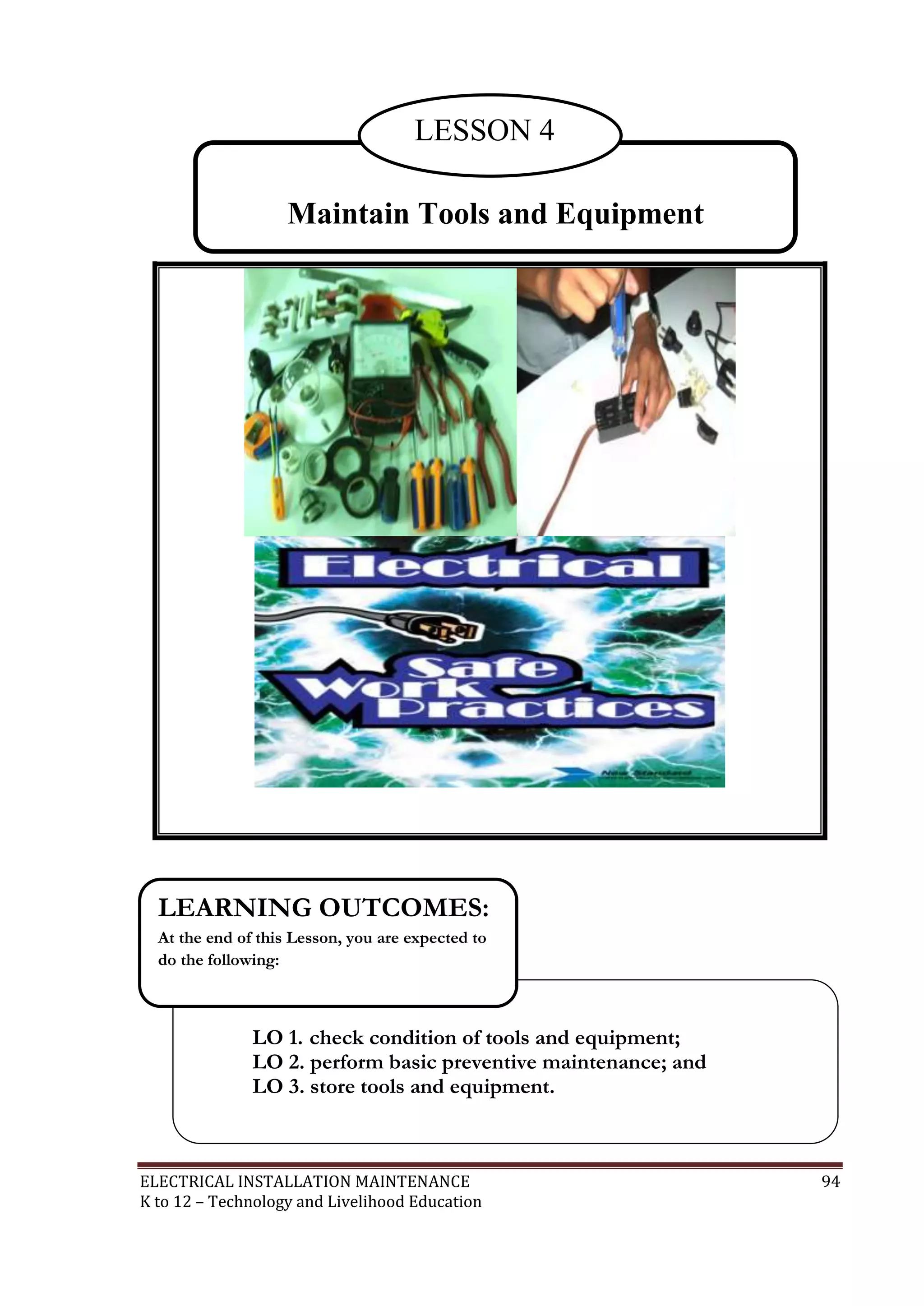
  • 64.
    RANGE SELECTOR KNOB (Selectorswitch) makes it possible to select different functions and range of the meter. Adjustment screw makes it possible to adjust the pointer to the zero position of the scale. ELECTRICAL INSTALLATION MAINTENANCE K to 12 – Technology and Livelihood Education 63
  • 65.
    SCALE is aseries of marking used for reading the value of a quantity setting. SCALE -can have different types of scale, for voltage and current readings the scales have mostly linear which means equal division. For resistance readings, the scale have logarithmic which means unequal divisions. Test probe positive (red), negative (black) is used to connect the circuit to the electrical components being tested Zero-ohm adjustingKnob is used to zero-in the pointer before measuring resistance. A. Proper care and maintenance of the multi tester 1. Read manual of instructions on how to operate the multi-tester. 2. In reading the amount of voltage, always start with the highest range to avoid reading voltage higher than the tester setting. 3. Be sure that the tester is set to the correct range setting: resistance range when measuring the ohm, voltage range when measuring voltage and ammeter range when measuring the value of electric current. 4. Always check the condition of its battery. Worn out batteries will damage the internal setting of the tester. 5. When the tester is not in used or will be stored, set the selector switch to 1000V or to OFF position. 6. Never drop the tester. ELECTRICAL INSTALLATION MAINTENANCE K to 12 – Technology and Livelihood Education 64
  • 66.
    B. How toread the meter scale of the multi tester To read the resistance range of the multi-tester, the given table below will be used. The unit of measurement to be used to determine its resistance is ohm. Range 0-2 2-10 10-20 20-50 50-100 100-200 Range x1 0.2 0.5 1 2 5 20 2 5 10 20 50 200 20 50 100 200 500 2K 200 500 1K 2K 5K 20K Range x10 Range x1k Range x 10k Pointer deflection Range setting is X1 Reading is 2.5ohms Pointer deflection Range setting is X10 Reading is 25 ohms ELECTRICAL INSTALLATION MAINTENANCE K to 12 – Technology and Livelihood Education 65
  • 67.
    Voltage scale Range Range 10V Range50V Range 250V Range 100V Value/div 0.2V 1V 5V 20V Voltage scale Range setting is 10 V (used 0-10 scale) Reading is 4.4V Range Range 10V Range 50V Range 250V Range 100V Value/div 0.2V 1V 5V 20V Voltage scale Range setting is 50V (used 0-10 scale) Reading is 24V Range Range 10V Range 50V Range 250V Range 1000V Value/div 0.2V 1V 5V 20V Voltage scale Range setting is 250V (used 0-10 scale) Reading is 110V ELECTRICAL INSTALLATION MAINTENANCE K to 12 – Technology and Livelihood Education 66
  • 68.
    How Much HaveYou Learned? Self-Check 2.1 PARTS OF MULTITESTER A. DIRECTION. Given a Multi-tester below, write the parts indicated by the arrow and give their functions. 1_______________ 2_______________ 3_______________ 4_________ 5____________ 6________ Refer to the Answer Key. What is your score? ELECTRICAL INSTALLATION MAINTENANCE K to 12 – Technology and Livelihood Education 67
  • 69.
    How Do YouApply What You Have Learned? Show that you learned something by doing this activity Job Sheet 2.1 I. USE MEASURING TOOLS Supplies and Materials  Sheet of paper  Pencil Tools and Equipment     Steel rule Bench rule Metric rule Foot rule Direction: Using any of the given measuring tools, read the actual measurement of the given samples. Write your answer on the space provided. Sample Actual measurement in centimeter Teacher’s Table Length of eraser Height of cabinet ELECTRICAL INSTALLATION MAINTENANCE K to 12 – Technology and Livelihood Education 68
  • 70.
    II. READING A VOLTMETER Indicatethe voltage reading of the voltmeter below Directions: Write your answer on the space provided. 1._______ VOLTS What is the reading? ELECTRICAL INSTALLATION MAINTENANCE K to 12 – Technology and Livelihood Education 69
  • 71.
    2.____VOLTS AC/DC Voltage Reading Vhens reading? PANIDA TECH. III. What is the 1000ACV READING AN OHMMETER A. Indicate the resistance reading of the ohmmeter below. Direction: WRITE YOUR READING AT THE SPACE PROVIDED. Resistanc e Reading Vhens What is the reading ? Rx1k PANIDA TECH. ELECTRICAL INSTALLATION MAINTENANCE K to 12 – Technology and Livelihood Education 70
  • 72.
    1. ____________OHMS Resistanc e Reading Vhens Whatis the reading? Rx1 PANIDA TECH. 2._______________ OHMS ELECTRICAL INSTALLATION MAINTENANCE K to 12 – Technology and Livelihood Education 71
  • 73.
    Resistan ce Reading Vhen s What is the reading? Rx1k PANIDA TECH. ____________OHMS Resistan ce Reading 3. Vhens Whatis the reading? Rx1 PANIDA TECH. ELECTRICAL INSTALLATION MAINTENANCE K to 12 – Technology and Livelihood Education 72
  • 74.
    4.__________OHMS IV. ACTUAL READING OFVOLTMETER AND OHMMETER Directions: Using a volt-ohmmeter measure the voltage of an existing convenience outlets inside your room, voltage of a dry cells/battery and resistance of resistors. Write your answer in the space provided. Device/Component to be Measured First Second Third 1. Voltage of the outlets volts volts volts 2. Voltage of a dry cells/battery volts volts volts 3. Resistance of a resistors ohms ohms ohms ELECTRICAL INSTALLATION MAINTENANCE K to 12 – Technology and Livelihood Education 73
  • 75.
    Congratulations! You dida great job! Rest and relax a while then move on to the next lesson. Good luck! REFERENCES       Philippine Electrical Code. Year 2000 Edition. Cardenas, Elpidio. 1989, Fundamental and Elements of Electricity. Philippines:National Bookstore. Enriquez, Michael Q., Gantalao, Fred T. and Lasala, Rommel M. 2004, Simple Electronics. Philippines: Andes Mountain Printers. Velasco, Benjamin S. 1994, Electronic Components Testing Simplified. Philippines: National Bookstore: 1994. http://sam.dgs.ca.gov/TOC/3800/3861.htm http://electrical.about.com/od/electricaltools/tp/top16electricaltools.htm ELECTRICAL INSTALLATION MAINTENANCE K to 12 – Technology and Livelihood Education 74
  • 76.
    LESSON 3 Interpret TechnicalDrawings and Plans LEARNING OUTCOMES: At the end of this Lesson, you are expected to do the following: LO 1. analyze signs, symbols and data; and LO 2. interpret technical drawings and plans. ELECTRICAL INSTALLATION MAINTENANCE K to 12 – Technology and Livelihood Education 75
  • 77.
    Definition of Terms Ampere(I) - the unit of electrical current (coulombs per second) Caution - indicates some precautionary measures against potential hazardous situation which, if not avoided, may result to a minor or moderate injury Danger - specifies hazardous situation which, if not avoided, will result to a serious injury or even death Isometric - a kind of drawing which shows the object in 3 dimensional views Joule (J) - a metric unit of energy: watt per second. 1 Kw hr = 2,655,000 ft-lb = 1.341 hp-hr = 3413 Btu = 3,600,000 joules Kilovolt-ampere (KVA) - a measurement of apparent electric power Kilowatt hour (Kwhr) - a unit of electrical energy or work performed Ohm - the unit of electrical resistance (volts/ampere) Orthographic - a drawing which shows the front top and side view of the object Volt (E) - the unit of electric pressure or electromotive force which will produce a current of 1 ampere through a resistance of 1 ohm Watts (W) and kilowatts (KW) - are units of electric power ELECTRICAL INSTALLATION MAINTENANCE K to 12 – Technology and Livelihood Education 76
  • 78.
    LEARNING OUTCOME 1 Analyzesigns, symbols and data PERFORMANCE STANDARDS   Electrical symbols and signs are identified according to job specifications. Electrical symbols and signs are determined according to classification or as appropriate in drawing. Materials/ Resources 1. 2. 3. 4. Oslo paper Drawing Pencil Ruler Black pen 5. Electrical symbols 6. Various Company/ industry warning signs 7. Cartolina 8. Illustration board What Do You Already Know? Let us determine how much you already know about analyzing signs, symbols and data. Take this test. Pretest LO 1 Analyze signs and symbols a. Direction: Match the electrical symbols in Column A with the corresponding description in column B. Write the letter of your answer in the space provided before each number. Column A Column B _______1. a. Push button _______2. b. Switch _______3. c. Wires connected ELECTRICAL INSTALLATION MAINTENANCE K to 12 – Technology and Livelihood Education 77
  • 79.
    _______4. d. Incandescent lamp _______5. e.Battery b. Identify what are the meaning of different signs enumerated below. Write your answer at the box provided for you. . _____________________ _____________________ _____________________ _____________________ _____________________ _____________________ _____________________ Now check your answers using the Answer Key. If you got 90-100% of the items correctly, proceed to the next Learning Outcome. If not, do the next activity/ies again to gain knowledge and skills required for mastery. ELECTRICAL INSTALLATION MAINTENANCE K to 12 – Technology and Livelihood Education 78
  • 80.
    What Do YouNeed To Know? Read the Information Sheet 1.1 very well then find out how much you can remember and how much you learned by doing Self-check 1.1. Information Sheet 1.1 COMMON ELECTRICAL SYMBOLS Electrical Symbols are small drawings or pictograms used to represent various electrical devices in a diagram or plan of an electrical circuit. These symbols are used in sketching schematic diagrams and electrical plans for numerous types of electrical works. Practically any electrical fixture found in a house has a symbol that coincides to said fixture on an electrical wiring diagram. These are very useful guide for an electrician or electrical contractor, thus, making the wiring easier to install as well. The following are common electrical symbols used in sketching wiring plan and diagram. Symbol Description Symbol Description Conductor/Wire Ammeter Terminal Voltmeter Switch Galvanometer Fuse Wattmeter Connected Wires Wires Not Connected Circuit Breaker Push Button Cell Bell ELECTRICAL INSTALLATION MAINTENANCE K to 12 – Technology and Livelihood Education 79
  • 81.
    Battery Buzzer Resistor Speaker Capacitor Antenna Diode Male plug Ground Service Entrance(3 wires) Lightning Arrester Duplex Convenience Outlet Kilowatt-Hour Meter Range Outlet Power Panel Board Special Purpose Outlet Lighting Panel Board Weatherproof Outlet Incandescent Lamp Floor Outlet Fluorescent Lamp S1 Single Pole Switch ELECTRICAL SIGNS Your power tool with its manual may contain "WARNING ICONS" (a picture symbol intended to alert you to, and/or to instruct you how to avoid a potentially hazardous condition). Knowing and understanding these symbols will help you operate your tool better and more safely. ELECTRICAL INSTALLATION MAINTENANCE K to 12 – Technology and Livelihood Education 80
  • 82.
    Electrical signs andstickers alert students, workers, and visitors to electrical hazards in the area. Alerting workers to high voltage areas, electrical hazards, power lines and other electrical equipment in the area, can help prevent fires and injuries. Proper electrical signs can inform workers of the dangers in the area. CAUTION indicates some precautionary measures against potential hazardous situation which, if not avoided, may result to a minor or moderate injury. SAFETY ALERT indicates that a person should observe extra awareness PROHIBITION means that any activity is not allowed as stated by the symbol. DANGER specifies hazardous situation which, if not avoided, will result to a serious injury or even death. WARNING specifies a potentially hazardous situation which, if not avoided, could result to serious injury or even death. READ AND UNDERSTAND INSTRUCTION MANUAL means that a person should make some reading before doing any activity. WEAR EYE PROTECTION indicates that a person should wear safety goggles or any related protection for the eyes. ELECTRICAL INSTALLATION MAINTENANCE K to 12 – Technology and Livelihood Education 81
  • 83.
    ELECTRICAL HAZARD indicatesthat electrical hazard is present in the area. VOLTAGE DANGER indicates high voltage in the area and surrounding equipment. How Much Have You Learned? Self-Check 1.1 Analyze electrical symbols and signs. A. Directions: Match the electrical symbols in Column A to their corresponding descriptions in Column B. Write the letter of your answer in the space provided before each number. Column A Column B _______1. a. Push button _______2. b. Switch _______3. c. Wires connected _______4. d. Incandescent lamp _______5. e. Battery ELECTRICAL INSTALLATION MAINTENANCE K to 12 – Technology and Livelihood Education 82
  • 84.
    B. Directions Fill outthe grid with at least five (5) electrical symbols and write their descriptions. Symbols Description 1. 2. 3. 4. 5. Refer to the Answer Key. What is your score? ELECTRICAL INSTALLATION MAINTENANCE K to 12 – Technology and Livelihood Education 83
  • 85.
    How Do YouApply What You Have Learned? Show that you learned something by doing this activity. Activity Sheet 1.1 a. Direction: Locate and box the different electrical signs below. X P X X X W O O O O O O V X R X C A U T I O N H O H X O X R X X X X S H L H H H H N X W S S S S T J P J H I S A F E T Y A L E R T H B B B B M M G M M M O M B I X X X X E X X X X H X B T S W L D J J J J R I S O I S W A R N I N G R B S O O S N L R J L L L R A S O N G J J J N L L L R R S O E J J J L L L L L R R S R S S S X X L X X X X X S b. Direction: Draw the electrical signs of the following: 1. Safety alert 2. Prohibition 3. Voltage danger 4. Warning 5. Electrical hazard ELECTRICAL INSTALLATION MAINTENANCE K to 12 – Technology and Livelihood Education 84
  • 86.
    LEARNING OUTCOME 2 Interprettechnical drawings and plans PERFORMANCE STANDARDS    Necessary tools, materials and equipment are identified according to the plan. Components, assemblies or object are recognized as per job requirement. Dimensions and specification are identified according to job requirements. Materials/Resources 1. 2. 3. 4. Bulb receptacles – 4 pcs. Toggle switch 2 pcs. Electrical lay-out Ruler ELECTRICAL INSTALLATION MAINTENANCE K to 12 – Technology and Livelihood Education 85
  • 87.
    What Do YouAlready Know? Let us determine how much you already know about interpreting technical drawings and plans. Take this test. Pretest LO 2 Directions: Below is a drawing of an electrical plan. Enumerate the number of outlets, bulbs, one-gang switch, two-gang switch and three-gang switch. Number of electrical fixtures found in the electrical plan QUANTITY ELECTRICAL FIXTURES Lamp outlets Duplex convenience outlets Single gang switches Two gang switch Three gang switch Now check your answers using the Answer Key. If you got 90-100% of the items correctly, proceed to the next Learning Outcome. If not, do the next activity/ies again to gain knowledge and skills required for mastery. ELECTRICAL INSTALLATION MAINTENANCE K to 12 – Technology and Livelihood Education 86
  • 88.
    What Do YouNeed To Know? Read the Information Sheet 1.1 very well then find out how much you can remember and how much you learned by doing Self-check 1.1. Information Sheet 2.1 ELECTRICAL WIRING DIAGRAM The flow of current in a conductor or wire can be represented by diagram. There are two types of diagram: pictorial diagram and schematic diagram. A. Pictorial diagram is a sketch of electrical circuit that shows the external appearance of each component. It is much like a photograph of the circuit and uses simple images of parts. Sample Pictorial diagram of one bulb controlled by single pole switch using 9 volt battery source. B. Schematic diagram is a sketch showing the components of the circuit using standard electrical symbols. It shows the actual number of components and how the wiring is routed but not the actual location. ELECTRICAL INSTALLATION MAINTENANCE K to 12 – Technology and Livelihood Education 87
  • 89.
    Diagram A Diagram B Sampleschematic diagrams of one bulb controlled by single pole switch using direct current (Diagram A) and alternating current (Diagram B) source. C. Types of Circuit 1. Series Circuit is a circuit in which lamps are arranged in a chain, so that the current has only one path to take. The current is the same through each load. Example of this is the Christmas lights. It consists of a number of bulbs that are connected side by side to meet the voltage requirement which is 220 volts for alternating current. Pictorial diagram of Christmas light in series circuit Schematic diagram of three bulbs connected in series controlled by a single pole switch. ELECTRICAL INSTALLATION MAINTENANCE K to 12 – Technology and Livelihood Education 88
  • 90.
    2. Parallel Circuitis a circuit in which lamps are connected across the wires. The voltage across each load on parallel circuit is the same. The advantage of using parallel circuit is that even if one of the lamps fails, still the remaining lamps will function. Pictorial diagram of two bulbs connected in parallel circuit controlled by a single pole switch. Schematic diagram of three bulbs connected in parallel circuit controlled by a single pole switch. ELECTRICAL PLAN Electrical plan is a graphical presentation of electrical wiring connections to install in a particular house or building. It indicates the position of electrical fixtures such as convenience outlets, switches, lightings, door bells, and others to be installed. Sample electrical plan of Single family dwelling ELECTRICAL INSTALLATION MAINTENANCE K to 12 – Technology and Livelihood Education 89
  • 91.
    Number of electricalfixtures found in the electrical plan: QUANTITY ELECTRICAL FIXTURES 8 pieces Lamp outlets 8 pieces Duplex convenience outlets 4 pieces Single gang switches 1 piece Two gang switch 1 piece Three gang switch ELECTRICAL INSTALLATION MAINTENANCE K to 12 – Technology and Livelihood Education 90
  • 92.
    How Much HaveYou Learned? Self-Check 2.1 Directions: Draw the schematic diagram of the following: 1. Two bulbs connected in series controlled by a single pole switch using direct current. 2. Four bulbs connected in parallel controlled by a single pole switch using alternating current. 1. 2. Refer to the Answer Key. What is your score? ELECTRICAL INSTALLATION MAINTENANCE K to 12 – Technology and Livelihood Education 91
  • 93.
    How Do YouApply What You Have Learned? Show that you learned something by doing this activity. Activity Sheet 2.1 Directions: Based on the electrical plan below count the number of electrical fixtures and then write it in table provided after the drawing. Number of electrical fixtures found in the electrical plan: QUANTITY ELECTRICAL FIXTURES Lamp outlets Duplex convenience outlet Single gang switches Two gang switches Three gang switches ELECTRICAL INSTALLATION MAINTENANCE K to 12 – Technology and Livelihood Education 92
  • 94.
    Congratulations! You dida great job! Rest and relax a while then move on to the next lesson. Good luck! REFERENCES LO1   LO 2    Azares, Efren F. and Recana, Cirilo B. 1999, Practical Electricity III; Philippines: Adriana Publishing:. Agpaoa, Feleciano. 1991, Interior and Exterior Wiring Troubleshooting; Philippines National Bookstore. Azares, Efren F. and Recana, Cirilo B. 1999, Practical Electricity III; Philippines: Adriana Publishing:. Agpaoa, Feleciano. 1991, Interior and Exterior Wiring Troubleshooting; Philippines National Bookstore. Acorda, Aidaida V. and Robles, Rosemarie D. Drafting I & II ELECTRICAL INSTALLATION MAINTENANCE K to 12 – Technology and Livelihood Education 93
  • 95.
    LESSON 4 Maintain Toolsand Equipment LEARNING OUTCOMES: At the end of this Lesson, you are expected to do the following: LO 1. check condition of tools and equipment; LO 2. perform basic preventive maintenance; and LO 3. store tools and equipment. ELECTRICAL INSTALLATION MAINTENANCE K to 12 – Technology and Livelihood Education 94
  • 96.
    Definition of Terms 5S- Sort, Systematize, Sweep, Sanitize, and Self-Discipline Functional tools and equipment - those that are in good condition and can perform its regular functions Lubricant - a substance introduced to lessen friction between moving surfaces; also functions to transport external particle Lubrication additives- many of the physical properties of various oils and greases Non-functional tools and equipment - those that are not able to perform its regular function because of impaired and damage part Nonpolar solvents - solvents which do not dissolve/are insoluble in water Pneumatic tool - instrument activated by air pressure Polar solvents - solvents which dissolve/are soluble in water Solvent - a component of a solution that dissolves solute and is usually present in large proportion or amount Sorting - to sort everything in a work area ELECTRICAL INSTALLATION MAINTENANCE K to 12 – Technology and Livelihood Education 95
  • 97.
    LEARNING OUTCOME 1 Checkconditions of tools and equipment PERFORMANCE STANDARDS     Tools and equipment are identified according to classification/ specification and job requirements. Non-functional tools and equipment are segregated and labeled according to classification Safety of tools and equipment are observed in accordance with manufacturer’s instructions Conditions of PPE are checked in accordance with manufacturer’s instructions.  Materials/ Resources 1. Checklist of tools and materials 2. Functional tools in the shop 3. Non-functional tools in the shop ELECTRICAL INSTALLATION MAINTENANCE K to 12 – Technology and Livelihood Education 96
  • 98.
    What Do YouAlready Know? Let us determine how much you already know about checking conditions of tools and equipment. Take this test. Pretest LO 1 Directions: Read each statement and identify what is being described. Choose your answer inside the circle and write them in the space provided before each number. Hand tools Pneumatic floor jack Screwdrivers Wrenches Personal Protective Equipment (PPE) Pullers Vacuum cleaner Air drill Pneumatic Torque Wrench Machine/Power tools ___________1. Uses compressed air to flow into the jack cylinder and causes the ram to extend and raise the vehicle. ___________2. These are tools manipulated by our hands without using electrical energy. __________3. Are used to drive, or turn screws. The common type has a single flat blade for driving screws with slotted heads. The other type has the cross slotted head. ___________4. A tool used to turn screws, nuts and bolts with hexagonal heads. ―Hexagonal‖ means six-sided. A variety of wrenches are used in the shop. ELECTRICAL INSTALLATION MAINTENANCE K to 12 – Technology and Livelihood Education 97
  • 99.
    ___________5. A toolused to remove gears and hubs from shafts, bushings from blind holes, and cylinders’ liners from the engine blocks. ____________6. This is used for cleaning the floor and car interiors after service. ____________7. This is lighter than a comparable electric drill. Repeatedly stalling or overloading does not damage or overheat the air drill. ____________8. A gadget that protects workers from injury or illness caused by having contact with the dangers/hazards in the workplace, Used by linemen to remove insulation of wire and cables in low and high voltage transmission lines. ____________9. This wrench uses compressed air to quickly and powerfully turn nuts, bolts, and other objects. ___________10. These are tools manipulated by our hands and with the use of electrical energy Now check your answers using the Answer Key. If you got 90-100% of the items correctly, proceed to the next Learning Outcome. If not, do the next activity/ies again to gain knowledge and skills required for mastery. What Do You Need To Know? Read the Information Sheet 1.1 very well then find out how much you can remember and how much you learned by doing Self-check 1.1. Information Sheet 1.1 Classification of Tools and Equipment A tool is a device that can be used to produce an item or accomplish a task, but that is not consumed in the process. It can be considered as extension of the human hand thus increasing speed, power, and accuracy and on the other hands equipment includes any machine powered by electricity. 1. Hand tools are tools manipulated by hands without using electrical energy such as: puller, hacksaw, pull-push rule, pliers, hammer, and others. ELECTRICAL INSTALLATION MAINTENANCE K to 12 – Technology and Livelihood Education 98
  • 100.
    2. Machine/Power toolsare tools manipulated by our hands and with the use of electrical energy such as: electric drill, grinding wheels, vacuum cleaner and others. 3. Pneumatic tools are tools or instruments activated by air pressure. Pneumatic tools are designed around three basic devices: the air cylinder, the vane motor, and the sprayer. A. Hand tools They include screwdrivers, hammers, pliers, wrenches and pullers. 1. Screwdrivers are used to drive, or turn screws. The common type has a single flat blade for driving screws with slotted heads. The other type has the cross slotted head. 1. Hammers are mostly used tools in the shop. They should be gripped at the end of the handle. 2. Pliers are specified types of adjustable wrenches. The two legs move on a pivot so that items of various sizes can be gripped. 3. Wrenches are used to turn screws, nuts and bolts with hexagonal heads. ―Hexagonal‖ means six-sided. A variety of wrenches are used in the shop. 4. Pullers are used to remove gears and hubs from shafts, bushings from blind holes, and cylinders’ liners from the engine blocks. B. Machine/Power Tools 1. Electric drill has an electric motor that drives a chuck. The chuck has jaws that can be opened and then closed to grip a drill kit. 2. Grinding tool can be either bench-mounted or installed on a pedestal. They may either have a grinding wheel, view wheel, or two grinding wheels. ELECTRICAL INSTALLATION MAINTENANCE K to 12 – Technology and Livelihood Education 99
  • 101.
    3. Vacuum cleaneris used for cleaning the floor and car interiors after service. C. Pneumatic tools 1. Pneumatic Torque Wrench. This wrench uses compressed air to quickly and powerfully turn nuts, bolts, and other objects. 2. Air chisel uses reciprocating motion to drive a cutting hammering tool. An air hammer drives a chisel to cut off a nut that has frozen to a stud. It can be used with a variety of tools-cutters and punches to do many jobs. 3. Air drill is lighter than a comparable electric drill. Repeatedly stalling or overloading does not damage or overheat the air drill. ELECTRICAL INSTALLATION MAINTENANCE K to 12 – Technology and Livelihood Education 100
  • 102.
    4. Air racketuses the sockets and attachments from a standard socket set. 5. Pneumatic floor jack uses compressed air to flow into the jack cylinder and causes the ram to extend and raise the vehicle. ELECTRICAL INSTALLATION MAINTENANCE K to 12 – Technology and Livelihood Education 101
  • 103.
    How Much HaveYou Learned? Self-Check 1.1 Directions: Inside the tools box are hand, pneumatic, and power tools. Identify and write them in their corresponding column provided below. Air Chisel Hammers Air Racket Air Drill Electric drill Vacuum Cleaner Grinding wheels Wrenches Screwdrivers Pullers Hand tools Power tools Pneumatic tools 1. 1. 1. 2. 2. 2. 3. 3. 3. 4. 4. 4. Refer to the Answer Key. What is your score? ELECTRICAL INSTALLATION MAINTENANCE K to 12 – Technology and Livelihood Education 102
  • 104.
    How Do YouApply What You Have Learned? Show that you learned something by doing this activity. Operation Sheet 1.1 A. Basic Maintenance of Electrical Tools and Equipment To ensure that your electric tools work when you need them, you must take proper care of them. A good routine of maintenance for your tools is one thing that you can do to make sure that the tool you need is working when you need it. 1. Clean out the Dust. To make sure that your electric tools are ready to go when you are, keep them clean and free of dust. Spend some time to clean out the dust every once in a while on your tools while they are inactive in storage. 2. Check the Cords. Look for tear/cut insulator on the power cords on your electric tools. This will ensure that your electric tool can get the power that it needs to function without an accident. 3. Use the right tool correctly. Use tools correctly and for their intended purposes. Follow the safety directions and operating procedures recommended by the manufacturer. When working on a circuit, use approved tools with insulated handles. ELECTRICAL INSTALLATION MAINTENANCE K to 12 – Technology and Livelihood Education 103
  • 105.
    4. Protect yourTools. Keep tools and cords away from heat, oil, and sharp objects. These hazards can damage insulation. If a tool or cord heats up, stop using it. Report the condition to a supervisor or instructor immediately. 5. Use double-insulated tools - Portable electrical tools are classified by the number of insulation barriers between the electrical conductors in the tool and the worker. 6. Storing Your Tools- Keep your electric tools stored in their original cases and containers. This will keep them free of dust and dirt while they are not being used. Note: proper care of your electric tools is the key to making sure that they last for many years ELECTRICAL INSTALLATION MAINTENANCE K to 12 – Technology and Livelihood Education 104
  • 106.
    B. Personal ProtectiveEquipment (PPE) Personal Protective Equipment (PPE) are gadgets to protect workers from injury or illness caused by having contact with the dangers/hazards in the workplace whether they are chemical, biological, radiation, physical, electrical, mechanical and others. These are the common Personal Protective Equipment gadgets: Hard Hats/ Helmets Goggle Mask Gloves Work boots Pants Pictures of electricians working using Personal Protective Equipment Pictures of Linemen’s working using Personal protective Equipment ELECTRICAL INSTALLATION MAINTENANCE K to 12 – Technology and Livelihood Education 105
  • 107.
    REMEMBER 1. Personal protective equipmentshould be taken cared as of the other tools and equipment. Wipe your helmets, gloves, safety shoes before keeping it. 2. It should also be cleaned, kept in proper tool rack/ cabinet. 3. It should be stored in dry places so that it will not have mold build-up. 4. Over-all suites should be washed regularly so that perspirations and other dirt will be washed clean. C. Classification of non-functional and functional tools Tools are very useful to us in our homes especially to our job. But tools that are no longer functional may cause harm. A. Make an inventory of functional and non-functional tools in your shop. B. Classify your tools according to is function.  Method of identifying non-functional tools and equipment 1. Visual inspection. It refers to the visual observation of an expert on the appearance of the tools and equipment. 2. Functionality. Vibration or extra noise from the operation means problems on parts and accessories started to develop. 3. Performance. When there is something wrong with the performance of either hand tools or equipment they need an immediate repair or maintenance. 4. Power supply (for electrically operated only). Failure to meet the required power supply, malfunction will occurs in the part of hand tools or equipment. 5. Person’s involved. It refers to the technical person who has the knowledge and skills about the technology.  Classifications of tools and equipment according to their uses: 1. 2. 3. 4. 5. 6. 7. Measuring tools Holding tools Cutting tools Driving tools Boring tools Electrical equipment Miscellaneous tools/instrument/equipment Non-functional tools and equipment are those that are not able to perform its regular function because of impaired and damage part. Examples of these are the following: ELECTRICAL INSTALLATION MAINTENANCE K to 12 – Technology and Livelihood Education 106
  • 108.
    Hammer with abroken handle Screw driver with a broken handle Long Nose damage jaw Pliers with A broken/cut foot rule Electrical equipment with damage cord ELECTRICAL INSTALLATION MAINTENANCE K to 12 – Technology and Livelihood Education 107
  • 109.
    Functional tools andequipment are those that are in good condition and can perform its regular functions. Examples of these are the following: Standard screw driver Philips Screw Driver Combination pliers Long Nose Pliers Wire Stripper ELECTRICAL INSTALLATION MAINTENANCE K to 12 – Technology and Livelihood Education Portable Electric Drill 108
  • 110.
    LEARNING OUTCOME 2 Performbasic preventive maintenance PERFORMANCE STANDARDS       Lubricants are identified according to types of equipment. Tools and equipment are lubricated according to preventive maintenance schedule or manufacturer’s specifications. Measuring instruments are checked and calibrated in accordance with manufacturer’s instructions. Tools are cleaned and lubricated according to standard procedures. Defective equipment and tools are inspected and replaced according to manufacturer’s specification. Work place is cleaned and kept in safe state in line with OSHC regulations.  Materials/Resources 1. 2. 3. 4. 5. 6. 7. Lubricating oils Lubricating spray Kerosene Detergent Gasoline Clean rugs Paint brushes ELECTRICAL INSTALLATION MAINTENANCE K to 12 – Technology and Livelihood Education 109
  • 111.
    What Do YouAlready Know? Let us determine how much you already know about performing basic preventive maintenance. Take this test. Pretest LO 2 A. Directions: Match the cleaning solvents in Column A with their corresponding uses in Column B. Write the letter of your answer in the space provided before each number. Column A ____1. Gasoline Column B a. It is used to wash dust in the floor, walls. ____2. Kerosene b. It is used to wash/clean benches, tables, cabinets, etc. ____3. Thinner c. It is used to remove dust, grease oil, paint, etc. d. It is used to wash greasy tools/ equipment. e. It is used to remove spilled paint on the floor, walls and tools. ____4. Water ____5. Detergent Soap and water B. Directions: Choose the best answer from the choices given and write letter of your answer on the space before each number. _________1. An action to clean your work place thoroughly so that there is no dust on floor, machines and equipment? a. sorting b. sweeping c. sanitizing d. self-discipline _________2. A condition of training people to follow cleaning disciplines independently. a. sorting b. sweeping c. sanitizing d. self-discipline _________3. An action to identify and eliminate all unnecessary items from your work place and dispose them. a. sorting b. sweeping c. sanitizing d. self-discipline _________4. An action to arrange or put every necessary item in good order so that s they can be easily picked for use. ‖ A place for everything, everything is in place‖ ELECTRICAL INSTALLATION MAINTENANCE K to 12 – Technology and Livelihood Education 110
  • 112.
    a. sweeping b. systematizing c.sanitizing d. sorting _________5. A condition of maintaining high standard of cleaning and workshop organization at all times. a. sweeping b. systematizing c. sanitizing d. sorting Now check your answers using the Answer Key. If you got 90-100% of the items correctly, proceed to the next Learning Outcome. If not, do the next activity/ies again to gain knowledge and skills required for mastery. ELECTRICAL INSTALLATION MAINTENANCE K to 12 – Technology and Livelihood Education 111
  • 113.
    What Do YouNeed To Know? Read the Information Sheet 2.1 very well then find out how much you can remember and how much you learned by doing Self-check 2.1. Information Sheet 2.1 A lubricant is a substance introduced to lessen friction between moving surfaces. It may also transport external particles. The property of reducing friction is known as lubricity. Types and Uses of lubricants Anti-rust lubricant spray: o o o o o loosen rusted part cleans and protect drives out moisture stops squeaks free sticky mechanisms Wire Pulling Lubricant: o o o does not damage insulation cling to wire and dries to a slippery film suitable for use with wire or cable covered with rubber (t, thw, thhn, etc) All Purpose Anti Rust Lubricant: o anti-rust o lubricating o rust removal o decontamination o conductance Lubricant Oil and Engine Oil: o o o lubricating the gear cleans and protect drives out moisture ELECTRICAL INSTALLATION MAINTENANCE K to 12 – Technology and Livelihood Education 112
  • 114.
    Silicon Lubricant: o o o o o heat stable lubricates protects reducesfriction water repellent Reminders A good lubricant possesses the following characteristics:       High boiling point. Low freezing point. High viscosity index. Thermal stability. Corrosion prevention. High resistance to oxidation. Types and Kinds of Cleaning Solvents Solvent is a component of a solution that dissolves solute and is usually present in large proportion or amount. It can be classified as polar and nonpolar. Polar solvents are solvents which dissolve/are soluble in water; while nonpolar solvents are solvents which do not dissolve/are insoluble in water. Solvents are usually used for cleaning in workshops. They are water, gasoline, kerosene, thinner and detergent soap. The table below shows the kinds of cleaning solvent based on their solubility in water. Cleaning Solvents a. water Solubility in Water Polar soluble Nonpolar x b. gasoline insoluble x c. kerosene insoluble x d. thinner insoluble x e. detergent soap soluble ELECTRICAL INSTALLATION MAINTENANCE K to 12 – Technology and Livelihood Education x 113
  • 115.
    Uses of CleaningSolvents Cleaning Solvents Uses Gasoline Wash greasy tools/ equipment. Kerosene Remove dust, grease oil, paint, etc. Thinner Remove spilled paint on the floor, walls and tools. Water Wash dust in the floor, walls, etc. Detergent Soap and water Wash/clean benches, tables, cabinets, etc. 5’s Approach in workshop keeping 5’S is a reference to a list of five Japanese words translated into English. This is an approached of organizing and managing the workplace and work flow with the intent to improve efficiency by eliminating wastes, improving flow of production, reducing process delays. These words are: Japanese words Seiri Seiton Seiso Seiketsu Shitsuke English translation Sort Set in order (systematize) Sweep Standardize (sanitize) Sustain (Self-discipline) 5’s APPROACH IN WORKSHOP KEEPING ELECTRICAL INSTALLATION MAINTENANCE K to 12 – Technology and Livelihood Education 114
  • 116.
    Sort Systematize Sweep Sanitize SelfDiscipline Sorting is an actionto identify and eliminate all unnecessary items from your work place and dispose them. Systematizing is an action to arrange or put every necessary item in good order so that they can be easily picked for use. Sweeping is an action to clean your work place thoroughly so that there is no dust on floor, machines and equipment. Sanitizing is a condition of maintaining high standard of cleaning and workshop organization at all times. Self-discipline is a condition of training people to follow cleaning disciplines independently. o o A place for everything Everything is in place ELECTRICAL INSTALLATION MAINTENANCE K to 12 – Technology and Livelihood Education 115
  • 117.
    How Much HaveYou Learned? Self-Check 2.1 A. Directions: Put a ( ) after each word if the solvent is polar and (X) if it is nonpolar. 1. 2. 3. 4. 5. water ( ) kerosene ( ) detergent soap ( ) gasoline ( ) thinner ( ) B. Directions: Identify the lubricants below by writing their names on the space provided. 1. _________________ 2. _________________ 3. _________________ 4. _________________ 5. __________________ Refer to the Answer Key. What is your score? ELECTRICAL INSTALLATION MAINTENANCE K to 12 – Technology and Livelihood Education 116
  • 118.
    How Do YouApply What You Have Learned? Show that you learned something by doing this activity. Operation Sheet 2.1 Title: Procedure in Cleaning Tools and Work Area Instructions: Bring cleaning solvents, rags and brooms, washing pan, electric fan and safety apparel. Clean tools and work area. Procedure: A. Tools 1. Wear protective clothing and goggles. 2. Gather the tools to be cleaned in the designated area for cleaning. 3. Classify the tools to be cleaned according to how dirty they are. 4. Measure and pour enough amount of cleaning solvent to the washing pan. 5. Submerge the tools in the washing pan. 6. Use paint brush to remove the dirt from the tools. 7. Get the tools from the washing pan and wipe them with rags until dry. 8. Clean and keep all materials used for cleaning. B. Work Area (Application of 5’s) 1. Wear protective clothing and goggles. 2. If there is dirt on the floor such as paint, used oil, grease, rust, etc., remove it first using the appropriate cleaning solvent. 3. Use the broom in cleaning the remaining dirt in the work area and an electric fan to facilitate the drying of the floor. 4. Assessment: The teacher will assess the students based on the performance criteria listed below. PERFORMANCE CRITERIA PERFORMANCE LEVEL YES NO NA 1. Were protective clothing and goggles worn at all times? 2. Were tools and equipment free of dust, grease, oil and other substances? 3. Was the work area dry, free of dust, grease and other substances? ELECTRICAL INSTALLATION MAINTENANCE K to 12 – Technology and Livelihood Education 117
  • 119.
    4. Were excesscleaning substances cleaned and kept in proper places? Satisfactory Overall Performance Unsatisfactory Student’s name: __________________________ Teacher’s comment: ___________________________________________________ ___________________________________________________ ___________________________________________________ ELECTRICAL INSTALLATION MAINTENANCE K to 12 – Technology and Livelihood Education 118
  • 120.
    LEARNING OUTCOME 3 Storetools and equipment PERFORMANCE STANDARDS    Inventory of tools, instruments, and equipment are conducted and recorded as per company practices. Tools are inspected, and replaced after use. Tools and equipment are stored safely in accordance with manufacturer’s specifications or company procedures.  Materials 1. Inventory forms 2. 3. 4. 5. Record book/memorandum Receipts Ball pen and Correction fluid What Do You Already Know? Let us determine how much you already know about storing tools and equipment. Take this test. Pretest LO 3 Directions: Write TRUE if the statement is correct and FALSE if the statement is not correct. For hand tools 1. 2. 3. 4. 5. Clean dirt and debris from tools after each use. Oil metal and wooden parts to prevent rust. Lightly sand rough wooden handles and apply linseed oil. Repair loose handles. Sharpen blades of cutting tools. ELECTRICAL INSTALLATION MAINTENANCE K to 12 – Technology and Livelihood Education 119
  • 121.
    6. Store toolsin a clean wet storage area. 7. Protect surfaces of cutting tools in storage. For equipment 8. Store equipment in a clean wet storage area. 9. Rinse and clean spray equipment after each use. 10. Clean spreaders and check wheel-driven gears. Now check your answers using the Answer Key. If you got 90-100% of the items correctly, proceed to the next Learning Outcome. If not, do the next activity/ies again to gain knowledge and skills required for mastery. What Do You Need To Know? Read the Information Sheet 3.1 very well then find out how much you can remember and how much you learned by doing Self-check 3.1. Information Sheet 3.1 Why Maintain Inventory of Tools and Equipment The most significant point to think at the start of your career is to acquire branded tools. They must be made out of high-quality steel and manufactured for precision. Special consideration is given to balance so that the tool/equipment will be properly maintained and prevent loses. Since the technician must work with his tools daily, regular inventory of tools/equipment is very significant. The initial cost of a minimum number of tools is high but there is accompanying warranty guarantees satisfaction and many years of service. It is better, in the long run, to start with a few cautiously selected tools that will take care of your most common needs and then slowly build-up to a complete set. It is sometimes hard to identify and memorize the huge number of tools and equipment in the workshop, maintaining the inventory record is of great value. ELECTRICAL INSTALLATION MAINTENANCE K to 12 – Technology and Livelihood Education 120
  • 122.
    Maintaining and StoringTools & Equipment An important aspect of any business is the maintenance and storage of tools and equipment. The investment in tools and equipment is a significant part of the overhead expenses in any operation. Proper selection and maintenance of equipment are important factors in managing business. Selecting the proper tool for the job and using the tool properly will increase efficiency and reduce maintenance problems. Purchase tools, which are well-made and suited to the intended use. Commercial usage may entail more heavy duty demands on equipment. Hand tools: 1. Clean dirt and debris from tools after each use. 2. Oil metal parts to prevent rust. 3. Lightly sand rough wooden handles and apply linseed oil. 4. Repair loose handles. 5. Sharpen blades of cutting tools. 6. Store tools in a clean dry storage area. 7. Protect surfaces of cutting tools in storage. Power tools: 1. Read and follow the maintenance schedule in the owner’s manual for each piece of power equipment. 2. Change the oil. 3. Clean the air filter. 4. Lubricate moving parts. 5. Sharpen dull blades or replace worn blades according to the owner’s manual. 6. Replace spark plugs. 7. Drain oil and gasoline before long-term storage. 8. Check electric cords and connections on electric-powered tools. 9. Store tools in a clean dry storage area. Equipment: 1. Store equipment in a clean dry storage area. 2. Rinse and clean spray equipment after each use. 3. Clean spreaders and check wheel-driven gears. ELECTRICAL INSTALLATION MAINTENANCE K to 12 – Technology and Livelihood Education 121
  • 123.
    4. Clean cartsand wheelbarrows after use. Sample Proper Arrangement and storage of tools and equipment You can see in the pictures that all tools and equipment are arranged and stored properly in their own racks. Like for example the screw drivers are arranged by type and sizes, hammers, saws, c-clamps, etc. are in their racks. ELECTRICAL INSTALLATION MAINTENANCE K to 12 – Technology and Livelihood Education 122
  • 124.
    How Much HaveYou Learned? Self-Check 3.1 Direction: Enumerate the proper maintaining and storing of tool and equipment. HANDTOOLS: 1. 2. 3. 4. 5. 6. 7. EQUIPMENT: 1. 2. 3. 4. Refer to the Answer Key. What is your score? ELECTRICAL INSTALLATION MAINTENANCE K to 12 – Technology and Livelihood Education 123
  • 125.
    How Do YouApply What You Have Learned? Show that you learned something by doing this activity. Operation Sheet 3.1 INVENTORY OF TOOLS AND EQUIPMENT Instruction: Given the record book/memorandum, receipts, inventory form, ball pen and correction fluid, conduct inventory of tools and equipment, identify, record and report damaged tools and equipment and give repair recommendations if repairable. Procedure: 1. Secure inventory forms/memorandum receipt of tools and equipment. 2. Study the parts of the Inventory Form. 3. Check whether the list of tools and equipment in the memorandum receipt tallies with the existing tools and equipment found in the workshop including their specifications and condition. 4. List down any losses and damages you find while conducting the inventory 5. Fill out the remarks column of the inventory forms for any losses/ damages. 6. Recommend for replacement of lost tools and equipment and repair of damaged tools and equipment if reparable. ELECTRICAL INSTALLATION MAINTENANCE K to 12 – Technology and Livelihood Education 124
  • 126.
    SAN FRANCISCO HIGHSCHOOL Misamis St. Bago Bantay Quezon City INVENTORY FORM OF TOOLS AND EQUIPMENT Item No. Quantity Unit Description Condition Remarks 1. 2. 3. 4. 5. 6. 7. 8. 9. 10. 11. 12. 13. 14. 15. 16. 17. 18. 19. 20. Prepared by: ___________________ Date: _____________________ Name and Signature ELECTRICAL INSTALLATION MAINTENANCE K to 12 – Technology and Livelihood Education 125
  • 127.
    Operation Sheet 3.2 PROCEDUREIN ARRANGING AND STORING TOOLS AND EQUIPMENT Instruction: In a specific tool cabinet and a tool rack assigned to you, arrange and store tools and equipment accordingly. Procedure: 1. Classify the tools and equipment according to their types. 2. Arrange the tools by their types in the shelves/racks. 3. Place equipment in designated places or location. Assessment: The teacher will assess you based on the performance criteria listed below. PERFORMANCE CRITERIA PERFORMANCE LEVEL YES NO NA 1. Were the tools and equipment ready before performing the task? 2. Were the tools arranged according to their types? 3. Were the equipment placed in their proper location and arranged according to their types? 4. Were the tools/equipment placed in their respective location and accessible for use when needed? Satisfactory Overall Performance Unsatisfactory Student’s name: __________________________ Teacher’s comment: ___________________________________________________ ___________________________________________________ ___________________________________________________ ELECTRICAL INSTALLATION MAINTENANCE K to 12 – Technology and Livelihood Education 126
  • 128.
    Congratulations! You dida great job! Rest and relax a while then move on to the next lesson. Good luck! REFERENCES LO1   Philippine Electrical Code. 2000 Edition. Cardenas, Elpidio.1989, Fundamental and Elements of Electricity. Philippines: national Bookstore.  Philippine Electrical Code. 1992 Edition, Institute of Integrated Electrical Engineers of the Philippines Incorporated.   Max B. Fajardo Jr. & Leo R. Fajardo. , 2nd Edition. Electrical Layout and Estimate. LO 2   Philippine Electrical Code. 2000 Edition. Cardenas, Elpidio.1989, Fundamental and Elements of Electricity. Philippines: national Bookstore.  Philippine Electrical Code. 1992 Edition, Institute of Integrated Electrical Engineers of the Philippines Incorporated.   Max B. Fajardo Jr. & Leo R. Fajardo. , 2nd Edition. Electrical Layout and Estimate. LO 3      Institute of Integrated Electrical Engineers of the Philippines Incorporated. 1992, Philippine Electrical Code Max B. Fajardo Jr. & Leo R. Fajardo. 2nd edition, Electrical Layout and Estimate Azares, Efren F. and Recana, Cirilo B. 1999, Practical electricity III; Philippines: Adriana Publishing. www.acmehowto.com/howto/maintenance/electrical/ www.thefabricator.com/safety/safety_article.cfm?id=1095 ELECTRICAL INSTALLATION MAINTENANCE K to 12 – Technology and Livelihood Education 127
  • 129.
    LESSON 5 Practice OccupationalHealth and Safety Procedures LEARNING OUTCOMES: At the end of this Lesson, you are expected to do the following: LO 1. identify hazards and risks; LO 2. evaluate risks and hazards; and LO 3. control hazards and risks. ELECTRICAL INSTALLATION MAINTENANCE K to 12 – Technology and Livelihood Education 128
  • 130.
    Definition of Terms Ampere- unit of measurement for electric current Circuit - the path of electric current Conductor - a wire or a cord which provides path for current flow Connectors and Adapters - accessories that are used to connect from boxes to conduits or raceways to the other boxes in the electrical system Corrugated plastic conduit (CPC) - commonly known as flexible non-metallic conduit or the “moldflex”. Hot wire - a wire through which current flows Insulator - a plastic, rubber, or asbestos material used to cover electric wires Kilowatt - a unit of power Metallic Conduits - metal raceways that was classified into four; rigid steel conduit (RSC); intermediate metallic conduit or tubing (IMC or IMT); electrical metallic conduit or tubing (EMC or EMT); and the flexible metallic conduit (FMC) Non-metallic conduits - plastic conduits or raceways designed to be a channel of wire that are classified as; rigid non-metallic conduit or the PVC, the flexible nonmetallic or CPC, and the surface plastic molding Philippine Electrical Code (PEC) - the governing rules and regulations that ensure safety and fire-free environment Resistance - the quality of electric current measured in ohms. Threshold limit value (TLV) - a level to which it is believed a worker can be exposed day after day for a working lifetime without adverse health effects. Acronyms OSHA - Occupational Safety and Health Administration PPE - Personal Protective Equipment ELECTRICAL INSTALLATION MAINTENANCE K to 12 – Technology and Livelihood Education 129
  • 131.
    LEARNING OUTCOME 1 Identifyhazards and risks PERFORMANCE STANDARDS    Workplace hazards and risks are identified and clearly explained. Hazards/risks and its corresponding indicators are identified in with the company procedures. Contingency measures are recognized and established in accordance with organizational procedures.  Materials/ Resources Video clips on hazards and risks ELECTRICAL INSTALLATION MAINTENANCE K to 12 – Technology and Livelihood Education 130
  • 132.
    What Do YouAlready Know? Let us determine how much you already know about identifying hazards and risks. Take this test. Pretest LO 1 Direction: Match Column A with Column B. Write the letter only. A _____ 1. Adverse health effect _____ 2. Hazards _____ 3. Chemical hazards _____ 4. Risks _____ 5, Physical hazards _____ 6. Wet floor _____ 7. Ergonomic hazards _____ 8. Psychological hazards . _____ 9.Unsafe work practices _____10.Biological hazards B a. is the chance or the probability that a person will be harmed. b. caused by organism such as viruses, bacteria fungi and parasites c. Is a source of potential damage, harm or adverse health effects d. safety hazard e. Vapor or gaseous substance f. Slips, falls g. hot or cold condition h. decrease in life span i. those that are basically causing stress j. awkward posture arising from improper work methods Now check your answers using the Answer Key. If you got 90-100% of the items correctly, proceed to the next Learning Outcome. If not, do the next activity/ies again to gain knowledge and skills required for mastery. ELECTRICAL INSTALLATION MAINTENANCE K to 12 – Technology and Livelihood Education 131
  • 133.
    What Do YouNeed To Know? Read the Information Sheet 1.1 very well then find out how much you can remember and how much you learned by doing Self-check 1.1. Information Sheet 1.1 HAZARDS AND RISKS What is the difference between 'hazard' and 'risk'? A hazard is something that can cause harm, eg electricity, chemicals, working up a ladder, noise, a keyboard, a bully at work, stress. Risk is the chance or probability that a person will be harmed or experience an adverse health effect once to a hazard. It may also apply to situations with property or equipment loss. A risk is the chance, high or low, that any hazard will actually cause somebody harm. For example, working alone away from your office can be a hazard. The risk of personal danger may be high. Electrical repair is a hazard. If someone accidentally turnedon the power the worker’s life will be in a 'high-risk' category. ELECTRICAL INSTALLATION MAINTENANCE K to 12 – Technology and Livelihood Education 132
  • 134.
    Five Basic WorkplaceHazards There are five major types of hazards which can put both your health and your safety at risk. 1. 2. 3. 4. 5. Chemical hazards Physical hazards Biological hazards Ergonomic hazards or job related hazards Psychological hazards or stress CHEMICAL HAZARDS If you are working with cleaning products, bleaches, paints, and other chemical agents, you need to understand what a chemical hazard is as well as how to protect yourself. Chemical hazards include:       liquids such a cleansers, acids, and paints vapours and fumes such as welding fumes gases such as carbon monoxide products that can catch fire or explode PHYSICAL HAZARDS Physical hazards include:          Machinery Electrical power Noise Power and hand tools Working and walking surfaces Trip and fall hazards Ladders and scaffolds Heat and cold ventilation BIOLOGICAL HAZARDS Why be careful around ticks, mouse droppings, bird poop and wild animals? Because you might get sick from working around certain animals, including ELECTRICAL INSTALLATION MAINTENANCE K to 12 – Technology and Livelihood Education 133
  • 135.
    people. Biological hazardsinclude bacteria, viruses, insects, plants, birds, animals, and humans. The risks run from skin irritation and allergies to infections. Dangers can come from: • • • • • • unclean restrooms mold and fungus bacteria insect stings animal bites poorly stored medical waste ERGONOMIC HAZARDS If your job is poorly designed, you can develop long term health problems. These problems can arise from simple things, like working for long periods in an awkward position or having to make the same motions over and over again. Problems can come from:      lghting chairs lifting repeated movements computer screens PSYCHOLOGICAL HAZARDS Those that are basically causing stress to a worker. This kind of hazard troubles an individual very much to an extent that his general well-being is affected Stress can lead to long-term health problems. Headaches, anxiety, and impatience are early signs of stress. Workplace causes of stress include: • • • • • • • heavy workloads lack of control over the pace of work shift work noise working by yourself fear of job-loss conflict with the employer ELECTRICAL INSTALLATION MAINTENANCE K to 12 – Technology and Livelihood Education 134
  • 136.
    What are examplesof a hazard? Workplace Hazard Example of Hazard Example of Harm Caused thing knife cut substance benzene leukemia material asbestos mesothelioma source of energy electricity shock, electrocution condition wet floor slips, falls process welding metal fume fever practice hard rock mining silicosis THRESHOLD LIMIT VALUE One of the most critical among the hazards that one may encounter is the chemical hazard. Chemical may produce reactions that may endanger ones health and life. This is the reason why the American Conference of Governmental Hygienist (ACGIH) established a threshold limit value (tlv). TLV is the term used by the American Conference of Governmental Hygienists (ACGIH*) to express the airborne concentration of a material to which nearly all persons can be exposed day after day, without adverse health effects ELECTRICAL INSTALLATION MAINTENANCE K to 12 – Technology and Livelihood Education 135
  • 137.
    How Much HaveYou Learned? Self-Check 1.1 Given below is the list of common workplace hazards. Write at least three examples of each type of hazard. 1. Chemical hazard ________________________ ________________________ ________________________ 2. Physical hazard ________________________ ________________________ ________________________ 3. Biological hazard ________________________ ________________________ ________________________ 4. Ergonomic hazard or Job related ________________________ ________________________ ________________________ 5. Psychological hazards ________________________ ________________________ ________________________ Refer to the Answer Key. What is your score? ELECTRICAL INSTALLATION MAINTENANCE K to 12 – Technology and Livelihood Education 136
  • 138.
    How Do YouApply What You Have Learned? Show that you learned something by doing this activity. Job Sheet 1.1 RESEARCH WORK a. Make an internet research on different hazards and risks. b. Be able to identify these different hazards. c. Make a write-up on your research on workplace hazards and risks. ELECTRICAL INSTALLATION MAINTENANCE K to 12 – Technology and Livelihood Education 137
  • 139.
    LEARNING OUTCOME 2 Evaluatehazards and risks PERFORMANCE STANDARDS  Terms of maximum tolerable limits are identified based on threshold limit values (TLV) Effects of hazards are determined. OHS issues and concerns are identified in accordance with workplace requirements and relevant workplace OHS legislation.    Materials/ Resources 1. Threshold limit value table (tlv) 2. Video clips about hazards and risks What Do You Already Know? Let us determine how much you already know about evaluating hazards and risks. Take this test. Pretest LO 2 Direction: Multiple Choice: Select the letter of the correct answer. __________1. The cross disciplinary area concerned with the safety, health and welfare of people engaged in work or employment. a.) Waste management b) PEC c) ACGIH d) OHS __________2. the collection, transport, processing or disposal, managing and monitoring of waste materials. a) Waste management b) PEC ELECTRICAL INSTALLATION MAINTENANCE K to 12 – Technology and Livelihood Education c) ACGIH d) OHS 138
  • 140.
    _________3. TLV means; a)Threshold limited value b) Threshold live value c)) Threshold limit value b) Time-weighted average c) Total-weighted average _________4. TWA means: a) Time-wasted Average _________5. TLV-C means; a) Threshold limit value-ceiling b) Threshold limited value-ceiling c) Threshold live value-ceiling _________6. One type of hazard that needs careful evaluation before extinguishing a) Chemical b) Water c) Fire _________7. It is a fifteen minutes exposure to risk. a) TLV-STEL b) TLV-C c) TLV-TWA _________8. Chemicals with lower flash points present a greater ____________. a) Personal hazard b) flammability hazard c) explosion hazard _________9. Process where a person identify, evaluate and determine the solution to the risks. a) Chemical assessment b) Risk assessment c) Physical assessment ________10. ) Any alteration of the physical, chemical and biological properties of the atmospheric air, or any discharge thereto of any liquid, gaseous or solid substances that will or is likely to create or to render the air resources of the country harmful, detrimental, or injurious to public health, safety or welfare or which will adversely affect their utilization for domestic, commercial, industrial, agricultural, recreational, or other legitimate purposes. a) Pollution b) atmospheric pollution c) air pollution Now check your answers using the Answer Key. If you got 90-100% of the items correctly, proceed to the next Learning Outcome. If not, do the next activity/ies again to gain knowledge and skills required for mastery. ELECTRICAL INSTALLATION MAINTENANCE K to 12 – Technology and Livelihood Education 139
  • 141.
    What Do YouNeed To Know? Read the Information Sheet 2.1 very well then find out how much you can remember and how much you learned by doing Self-check 2.1. Information Sheet 2.1 What is a risk assessment? Occupational Safety and Health (OHS) is a cross-disciplinary area concerned with protecting the safety, health and welfare of people engaged in work or employment. The goal of all occupational safety and health programs is to foster a safe work environment. As a secondary effect, it may also protect co-workers, family members, employers, customers, suppliers, nearby communities, and other members of the public who are impacted by the workplace environment. It may involve interactions among many subject areas, including occupational medicine, occupational (or industrial) hygiene, public health, safety engineering / industrial engineering, chemistry, health physics. Risks include acute and chronic health effects, for example, irritation or cancer, and physical effects such as fires or explosions. The hazards are physical and health hazards. II. Risk assessment A. Risk assessment is the process where you: 1. identify hazards 2. analyze or evaluate the risk associated with that hazard 3. determine appropriate ways to eliminate or control the hazard B. Factors that influence the degree of risk include:  how much a person is exposed to a hazardous thing or condition  how the person is exposed (e.g., breathing in a vapor, skin contact), and how severe are the effects under the conditions of exposure ELECTRICAL INSTALLATION MAINTENANCE K to 12 – Technology and Livelihood Education 140
  • 142.
    ACGIH has establishedTLV's for approximately 850 chemical. TLVs may appear as: TLV-TWA or time-weighted average, which is an average eight-hour exposure limit; TLV-STEL or short-term exposure limit, which is a fifteen-minute exposure limit, or TLV-C or ceiling, which is a limit which should never be exceeded without protection. II. Fire and Explosion Hazard Assessment Fire is one type of hazard that needs careful evaluation before extinguishing it. Not all fire could be extinguished by water that is why it is necessary that we knew first the cause of fire before dealing the fire. 1. Flash Point and Method Used: Lowest temperature at which a liquid will give off enough flammable vapors to ignite. Since flash points vary according to how they are obtained, the method used must be listed. Chemicals with lower flash points present a greater flammability hazard. 2. Flammable Limits: Range of concentrations over which a flammable vapor mixed with air will flash or explode if an ignition source is present. Range extends between lower explosive limit (LEL) and upper explosive limit (UEL) and is expressed in percentage of volume of vapor or gas in air (0 – 100%). Chemicals with a broad flammable range (i.e., range between the LEL and the UEL) and/or a flammable range in the lower percentages, present a greater flammability hazard. 3. Extinguishing Media: Fire-fighting material for use on substance that is burning, Firefighting material should be indicated by its generic name (e.g. water, foam, dry chemical, etc.). III. Waste management is the collection, transport, processing or disposal, managing and monitoring of waste materials. The term usually relates to materials produced by human activity, and the process is generally undertaken to reduce their effect on health, the environment or aesthetics. Waste management is a distinct practice from resource recovery which focuses on delaying the rate of consumption of natural resources. The management of wastes treats all materials as a single class, whether solid, liquid, gaseous or radioactive substances, and tried to reduce the harmful environmental impacts of each through different methods. Waste management practices differ for developed and developing nations, for urban and rural areas, and for residential and industrial producers. Management for nonhazardous waste residential and institutional waste in metropolitan areas is usually the responsibility of local government authorities, while management for non-hazardous commercial and industrial waste is usually the responsibility of the generator. ELECTRICAL INSTALLATION MAINTENANCE K to 12 – Technology and Livelihood Education 141
  • 143.
    PHILIPPINE CLEAN AIRACT OF 1999 (Refer to Appendix 1 for elaboration) The Philippine Clean Air Act of 1999 under its ―Declaration of Principles” stated that the State shall protect and advance the right of the people to a balanced and healthful ecology in accord with the rhythm and harmony of nature. Declaration of Policies. The State shall pursue a policy of balancing development and environmental protection. To achieve this end, the framework for sustainable development shall be pursued. Recognition of Rights. Pursuant to the above-declared principles, the following rights of citizens are hereby sought to be recognized and the State shall seek to guarantee their enjoyment. Definitions.- As used in this Act: a) “Air pollutant” means any matter found in the atmosphere other than oxygen, nitrogen, water vapor, carbon dioxide, and the inert gases in their natural or normal concentrations, that is detrimental to health or the environment, which includes, but not limited to smoke, dust, soot, cinders, fly ash, solid particles of any kind, gases, fumes, chemical mists, steam and radioactive substances; b) “Air pollution” means any alteration of the physical, chemical and biological properties of the atmospheric air, or any discharge thereto of any liquid, gaseous or solid substances that will or is likely to create or to render the air resources of the country harmful, detrimental, or injurious to public health, safety or welfare or which will adversely affect their utilization for domestic, commercial, industrial, agricultural, recreational, or other legitimate purposes; c) “Ambient air quality guideline values” means the concentration of air over specified periods classified as short-term and long-term which are intended to serve as goals or objectives for the protection of health and/or public welfare. These values shall be used for air quality management purposes such as determining time trends, evaluating stages of deterioration or enhancement of the air quality, and in general, used as basis for taking positive action in preventing, controlling, or abating air pollution; d) “Ambient air quality” means the general amount of pollution present in a broad area; and refers to the atmosphere’s average purity as ELECTRICAL INSTALLATION MAINTENANCE K to 12 – Technology and Livelihood Education 142
  • 144.
    distinguished from dischargemeasurements taken at the source of pollution; e) “Certificate of Conformity” means a certificate issued by the Department of Environment and Natural Resources to a vehicle manufacturer / assembler or importer certifying that a particular new vehicle or vehicle type meets the requirements provided under this Act and its rules and regulations; f) “Department” means the Department of Environment and Natural Resources; g)“Eco-profile” means the geographic-based instrument for planners and decision makers which present an evaluation of the environment quality and carrying capacity of an area. It is the result of the integration of primary data and information on natural resources and antropogenic activities on the land which were evaluated by various environmental risk assessment and forecasting methodologies that enable the Department to anticipate the type of development control necessary in the planning area. h)“Emission” means any air contaminant, pollutant, gas stream or unwanted sound from a known source which is passed into the atmosphere; i) “Greenhouse gases” means those gases that can potentially or can reasonably be expected to induce global warming, which include carbon dioxide, oxides of nitrogen, chloroflourocarbons, and the like; j) “Hazardous substances” means those substances which present either: (1) short-term acute hazards such as acute toxicity by ingestion, inhalation, or skin absorption, corrosivity or other skin or eye contact hazard or the risk of fire explosion; or (2) long-term toxicity upon repeated exposure, carcinogecity (which in some cases result in acute exposure but with a long latent period), resistance to detoxification process such as biodegradation, the potential to pollute underground or surface waters; k) “Infectious waste” means that portion of medical waste that could transmit an infectious disease; l) “Medical waste” means the materials generated as a result of patient diagnosis, treatment, or immunization of human beings or animals; m) “Mobile source” means any vehicle propelled by or through combustion of carbon-based or other fuel, constructed and operated ELECTRICAL INSTALLATION MAINTENANCE K to 12 – Technology and Livelihood Education 143
  • 145.
    principally for theconveyance of persons or the transportation of property goods; n) “Motor vehicle” means any vehicle propelled by a gasoline or diesel engine or by any means other than human or animal power, constructed and operated principally for the conveyance of persons or the transportation of property or goods in a public highway or street open to public use; o) “Municipal waste” means the waste materials generated from communities within a specific locality; p) "New vehicle” means a vehicle constructed entirely from new parts that has never been sold or registered with the DOTC or with the appropriate agency or authority, and operated on the highways of the Philippines, any foreign state or country; q) “Octane Rating or the Anti-Knock Index(AKI)” means the rating of the antiknock characteristics of a grade or type of automotive gasoline as determined by dividing by two (2) the sum of the Research Octane Number (RON), plus the Motor Octane Number (MON); the octane requirement, with respect to automotive gasoline for use in a motor vehicle or a class thereof, whether imported, manufactured, or assembled by a manufacturer, shall refer to the minimum octane rating of such automotive gasoline which such manufacturer recommends for the efficient operation of such motor vehicle, or a substantial portion of such class, without knocking; r) “Ozone Depleting Substances (ODS)” means those substances that significantly deplete or otherwise modify the ozone layer in a manner that is likely to result in adverse effects of human health and the environment such as, but not limited to, chloroflourocarbons, halons and the like; s) “Persistent Organic Pollutants (POPs)” means the organic compounds that persist in the environment, bioaccumulate through the food web, and pose a risk of causing adverse effects to human health and the environment. These compounds resist photolytic, chemical and biological degradation, which shall include but not be limited to dioxin, furan, Polychlorinated Biphenyls (PCBs), organochlorine pesticides, such as aldrin, dieldrin, DDT, hexachlorobenzene, lindane, toxaphere and chlordane; t) “Poisonous and toxic fumes” means any emissions and fumes which are beyond internationally - accepted standards, including but not limited to the World Health Organization (WHO) guideline values; u) “Pollution control device" means any device or apparatus used to prevent, control or abate the pollution of air caused by emissions from identified ELECTRICAL INSTALLATION MAINTENANCE K to 12 – Technology and Livelihood Education 144
  • 146.
    pollution sources atlevels within the air pollution control standards established by the Department; v) “Pollution control technology” means the pollution control devices, production process, fuel combustion processes or other means that effectively prevent or reduce emissions or effluent; w) “Standard of performance" means a standard for emissions of air pollutant which reflects the degree of emission limitation achievable through the application of the best system of emission reduction, taking into account the cost of achieving such reduction and any non-air quality health and environmental impact and energy requirement which the Department determines, and adequately demonstrates; and x) “Stationary source” means any building or immobile structure, facility or installation which emits or may emit any air pollutant. ELECTRICAL INSTALLATION MAINTENANCE K to 12 – Technology and Livelihood Education 145
  • 147.
    How Much HaveYou Learned? Self-Check 2.1 DIRECTIONS: Multiple choice. Write the letter of the correct answer and write it in the space provided. _________1. Chemicals with lower flash points present a greater ____________. a) Personal hazard b) flammability hazard c) explosion hazard d) skin hazard _________2. Process where a person identify, evaluate and determine the solution to the risks. a) Chemical assessment b) Risk assessment c) Physical assessment d) NC assessment _________3. Any alteration of the physical, chemical and biological properties of the atmospheric air, or any discharge thereto of any liquid, gaseous or solid substances that will or is likely to create or to render the air resources of the country harmful, detrimental, or injurious to public health, safety or welfare or which will adversely affect their utilization for domestic, commercial, industrial, agricultural, recreational, or other legitimate purposes. a) Pollution b) atmospheric pollution c) air pollution _________4. The cross disciplinary area concerned with the the safety, health and welfare of people engaged in work or employment. a.) Waste management b) PEC c) ACGIH d) OHS __________5. the collection, transport, processing or disposal, managing and monitoring of waste materials. a) Waste management b) PEC c) ACGIH d) OHS Refer to the Answer Key. What is your score? ELECTRICAL INSTALLATION MAINTENANCE K to 12 – Technology and Livelihood Education 146
  • 148.
    How Do YouApply What You Have Learned? Show that you learned something by doing this activity. Activity Sheet 2.1 A. Do the activity at home or during vacant time 1. Download and watch video presentation on different hazards and risk. 2. Make a short write-up on the video presentation you have watched. B. Answer the following questions 1. What type of hazard was viewed in the video? 2. What risks were involved? 3. If you are going to evaluate the hazard and risk you had viewed, what possible recommendations will you give? Why? ELECTRICAL INSTALLATION MAINTENANCE K to 12 – Technology and Livelihood Education 147
  • 149.
    LEARNING OUTCOME 3 Controllinghazards and risks PERFORMANCE STANDARDS     OHS procedures for controlling hazards and risk are strictly followed. Procedures in dealing with workplace accidents, fire and emergencies are followed in accordance with the organization’s OHS policies. Personal protective equipment (PPE) is correctly used in accordance with organization’s OHS procedures and practices. Procedures in providing appropriate assistance in the event of workplace emergencies are identified in line with the established organizational protocol.  Materials 1. Personal protective equipment:       Safety goggles Safety shoes Safety helmet Safety gloves Safety shoes Safety belt 2. First aid kit ELECTRICAL INSTALLATION MAINTENANCE K to 12 – Technology and Livelihood Education 148
  • 150.
    What Do YouAlready Know? Let us determine how much you already know controlling hazards and risks. Take this test. Pretest LO 3 A. DIRECTION: Select the correct answer that corresponds to the statement in each number. Write the correct answer at the space provided _____________ 1. It includes ear and eye protection, respirators, and protective clothing. ______________2. Changing a piece of machinery (for example, using proper machine guards) or a work process to reduce exposure to a hazard ______________3. Working a limited number of hours in a hazardous area ______________4. The process where you identify hazards, analyze or evaluate the risk associated with that hazard, and determine appropriate ways to eliminate or control the hazard. ______________5. Identify the source of the problem IDENTIFY THE HAZARD ASSESS THE RISK PERSONAL PROTECTIVE EQUIPMENT ENGINEERING CONTROL ADMINISTRATIVE CONTROL ELIMINATE HAZARDS B.DIRECTION: TRUE OR FALSE. In the statements below write true if the statement is correct and False if the statement is incorrect. 1. General cleanliness in the workplace is an important method of controlling hazards. 2. Good housekeeping reduces the risk of fire and is cost-effective. 3. Safety signs are method of hazard control. 4. Hygiene (cleanliness) is not so important as a method of controlling hazards 5. Before you leave work, wash/shower and change your clothes when necessary to prevent bringing workplace contaminants home to your family. Now check your answers using the Answer Key. If you got 90-100% of the items correctly, proceed to the next Learning Outcome. If not, do the next activity/ies again to gain knowledge and skills required for mastery. ELECTRICAL INSTALLATION MAINTENANCE K to 12 – Technology and Livelihood Education 149
  • 151.
    What Do YouNeed To Know? Read the Information Sheet 3.1 very well then find out how much you can remember and how much you learned by doing Self-check 3.1. Information Sheet 3.1 3A. HAZARD CONTROL All workplace hazards (chemical, physical, etc.) can be controlled by a variety of methods. The goal of controlling hazards is to prevent workers from being exposed to occupational hazards. Some methods of hazard control are more efficient than others, but a combination of methods usually provides a safer workplace than relying on only one method. Some methods of control are cheaper than others but may not provide the most effective way to reduce exposures. To control hazards in your workplace you need to identify and understand those hazards. Your first priority should always be to eliminate the hazards. If the hazards can't be eliminated, try finding safer ways to carry out those tasks by substituting less harmful substances or changing the work environment through engineering controls. Also consider changing how work activities are organized and performed. For example, reduce the time workers are exposed to a hazard by rotating them to another task. A. Controlling workplace hazards Once a hazard has been identified and the risk assessed, control measures should be put into place.A simple list of control measures can be utilized - the hierarchy of control. 1. Identify the Hazard Identify the source of the problem 2. Assess the Risk Risk assessment is the process where you: o o Identify hazards, Analyze or evaluate the risk associated with that hazard. ELECTRICAL INSTALLATION MAINTENANCE K to 12 – Technology and Livelihood Education 150
  • 152.
    o Determine appropriate waysto eliminate or control the hazard 3. Eliminate the Hazard Or Risk Elimination of a specific hazard or hazardous work process, or preventing it from entering the workplace, is the most effective method of control. Eliminating a hazard means removing it completely. 4. Engineering Control may mean changing a piece of machinery (for example, using proper machine guards) or a work process to reduce exposure to a hazard. 5. Administrative Controls Working a limited number of hours in a hazardous area is an example of an administrative control for example, job rotation. 6. Substitution is one measure of replacing one hazardous agent or work process with a less dangerous one. It is important to consider worker health and safety when work processes are still in the planning stages. Provide Personal Protective Equipment Personal Protective Equipment (PPE) includes ear and eye protection, respirators, and protective clothing. Remember: it is always better to control the hazard as close to the source as possible. Using personal protection is the least acceptable and least effective of all control measures. ELECTRICAL INSTALLATION MAINTENANCE K to 12 – Technology and Livelihood Education 151
  • 153.
    How Much HaveYou Learned? Self-Check 3.1 DIRECTIONS: Select the correct answer that corresponds to the statement in each number. Write the correct answer at the space provided _____________ 1. It includes ear and eye protection, respirators, and protective clothing. ______________2. It may mean changing a piece of machinery (for example, using proper machine guards) or a work process to reduce exposure to a hazard. ______________3. Working a limited number of hours in a hazardous area ______________4. The process where you identify hazards, analyze or evaluate the risk associated with that hazard, and determine appropriate ways to eliminate or control the hazard. ______________5. Identify the source of the problem. IDENTIFY THE HAZARD ASSESS THE RISK PERSONAL PROTECTIVE EQUIPMENT ENGINEERING CONTROL ADMINISTRATIVE CONTROL ELIMINATE HAZARDS Refer to the Answer Key. What is your score? ELECTRICAL INSTALLATION MAINTENANCE K to 12 – Technology and Livelihood Education 152
  • 154.
    What Do YouNeed To Know? Read the Information Sheet 1.1 very well then find out how much you can remember and how much you learned by doing Self-check 1.1. Information Sheet 3.2 YOUR HEALTH AND SAFETY AT WORK Personal hygiene Finally, personal hygiene (cleanliness) is also very important as a method of controlling hazards. Your employer should provide facilities so you can wash and/or take a shower every day at the end of your shift, no matter what your job is. Wash your skin and hair with a mild soap, rinse and dry your skin completely to protect it. Washing hands regularly, and eating and smoking away from your work area help to prevent ingesting Do not take workplace contaminants. hazards home with you! Lack of personal cleanliness can affect your family's health. Your family can be exposed to hazards you work with if you bring chemicals and other workplace contaminants home with you on your clothes, hair or skin. Before you leave work, wash/shower and change your clothes when necessary to prevent bringing workplace contaminants home. Leave your dirty clothes at work or, if you must wash them at home, wash them separately — not with the family wash. ELECTRICAL INSTALLATION MAINTENANCE K to 12 – Technology and Livelihood Education 153
  • 155.
    It may seemthat the amount of contaminant you can bring home on your clothes or skin is very small and cannot hurt your family. In reality a small exposure every day for months can add up to a big exposure. A classic example of this ―spreading the hazard‖ involves asbestos, where wives of asbestos workers have developed asbestosis from exposure to the asbestos on their husbands' work clothes. Similarly, children have developed lead poisoning from exposure to lead which comes home on their parents' work clothes. If you wear protective clothing at work, such as aprons, laboratory coats, overalls, etc., these should be cleaned regularly and you should inspect them for holes or areas that are worn out. Workers who launder these clothes should be trained in the types of hazards they may work with and how they can be controlled. Inspect your underclothes at home for any signs of contamination with oils, solvents, etc. If you find any signs, then it means your protective clothing at work is not effective. Every workplace should have some kind of first-aid facility Every workplace should have at least minimal first-aid facilities as well as adequate personnel trained to provide first aid. First-aid facilities and trained personnel are important components of a healthy and safe workplace. ELECTRICAL INSTALLATION MAINTENANCE K to 12 – Technology and Livelihood Education 154
  • 156.
    A basic first-aid facility 1.General cleanliness in the workplace is an important method of controlling hazards. 2. Good housekeeping reduces the risk of fire and is cost-effective. 3. Good housekeeping measures should be planned when work processes are in the design stage. 4. Safety signs are not a method of hazard control. 5. Personal cleanliness is an important method of controlling hazards. 6. Your employer should provide facilities so you can wash and/or take a shower every day. 7. Before you leave work, wash/shower and change your clothes when necessary to prevent bringing workplace contaminants home to your family. 8. Leave your dirty clothes at work. If you must wash them at home, wash them separately — never wash your work clothes with your family's wash. 9. Your protective clothing should be cleaned regularly. Inspect your protective clothing for holes and worn areas that could leave you open to exposures. 10. Inspect your undergarments for signs of contamination. 11. Your workplace should have at least minimal first-aid facilities. EMERGENCY PREPAREDNESS Process of ensuring that an organization has complied with the preventive measures, is in a state of readiness to contain the effects of a forecasted disastrous event to minimize loss of life, injury, and damage to property, can provide rescue, relief, rehabilitation, and ELECTRICAL INSTALLATION MAINTENANCE K to 12 – Technology and Livelihood Education 155
  • 157.
    other services inthe aftermath of the disaster, and has the capability and resources to continue to sustain its essential functions without being overwhelmed by the demand placed on them. Preparedness for the first and immediate response is called emergency preparedness. Always remember that disaster comes in the most unexpected time and place. Being ready is always a necessity in all circumstances. The government is giving trainings that everybody needs in all our localities. One should participate in this disaster training so that we will not be caught unaware when calamity struck. ELECTRICAL INSTALLATION MAINTENANCE K to 12 – Technology and Livelihood Education 156
  • 158.
    How Much HaveYou Learned? Self-Check 3.2 DIRECTIONS: TRUE OR FALSE. In the statements below write true if the statement is correct and false if the statement is not correct a. General cleanliness in the workplace is an important method of controlling hazards. b. Good housekeeping reduces the risk of fire and is cost-effective. c. Safety signs are method of hazard control. d. Hygiene (cleanliness) is not so important as a method of controlling hazards. e. Before you leave work, wash/shower and change your clothes when necessary to prevent bringing workplace contaminants home to your family. f. Your protective clothing should be cleaned regularly. g. Inspect your undergarments for signs of contamination. h. Your employer should provide facilities so you can wash and/or take a shower at least once a week. How Do You Apply What You Have Learned? Show that you learned something by doing this activity. Activity Sheet 3.1 POSTER MAKING DIRECTION: Draw a poster in consonance with the theme ―Control Hazard, Before It Starts” MATERIALS: 1. 2. 3. 4. Pencil Poster paint or oil paint or crayon Whole cartolina (yellow) Ruler TIME ALLOTMENT: 3 hours ELECTRICAL INSTALLATION MAINTENANCE K to 12 – Technology and Livelihood Education 157
  • 159.
    How Well DidYou Perform? Find out by accomplishing the Scoring Rubric honestly and sincerely. Remember it is your learning at stake! Speed 20% 10 minutes before/ on allotted time ----------------------------- 20% 1minute up to 10 minutes after the allotted time - 10% 11 minutes and more than the allotted time ------- 05% Originality 50 % based on judges deliberation ----------------------------------------50% Blending of colors 25% based on judges deliberation ---------------------------------------25% Good Housekeeping 5% all the materials were kept clean and the work area was properly cleaned -------------------------------------------------05% Total 100% Congratulations! You did a great job! Rest and relax a while then move on to the next lesson. Good luck! REFERENCES     Philippine Electrical Code. 2000 Edition. Cardenas, Elpidio. 1989, Fundamental and Elements of Electricity; Philippines: National Bookstore. http://sam.dgs.ca.gov/TOC/3800/3861.htm http://old.iupac.org/goldbook/TT06915.pdf ELECTRICAL INSTALLATION MAINTENANCE K to 12 – Technology and Livelihood Education 158
  • 160.
    Answer Keys LESSON 1 HOWMUCH DO YOU ALREADY KNOW? PRE-TEST 2. Combination Pliers 3. Long Nose Pliers 4. Philips Screw driver 5. Claw Hammer 6. Wire Stripper 7. Portable electric drill 8. Stubby screw driver 9. Electrician’s knife 10. Male plug 11. Fuse 12. Utility box 13. Conduits 14. Connectors 15. Circuit Breaker 16. Junction box SELF CHECK 1. rat tail 2. plain tap 3. duplex cross 4. y splice PRE-TEST 1. 2. 3. 4. b a d c SELF CHECK 1. 2. 3. 4. Requisition form Inventory form Job order or work order form Borrower’s form PRE-TEST a. 1. For me ELECTRICAL INSTALLATION MAINTENANCE K to 12 – Technology and Livelihood Education 159
  • 161.
    2. Damaged 3. Correct B. 1. Thereceiving person 2. Keep a copy 3. Write the findings and if posible, take a picture LESSON 2 WHAT DO YOU ALREADY KNOW? PRE-TEST I Matching Type: 1. 2. 3. 4. 5. C E A B D II . Multiple Choice: 1. 2. 3. 4. 5. B A D C A LO2- CARRY OUT MEASUREMENTS AND CALCULATIONS A. 1. 10 mm 2. 36 inches 3. 10 cm 4. 1 cm 5. 12 inches B. 6. cm 7. m 8. dm 9. yd 10. ft ELECTRICAL INSTALLATION MAINTENANCE K to 12 – Technology and Livelihood Education 160
  • 162.
    C. 1. 304.8 cm 2.700 mm 3. 1.25 ft 4. 5.468 yd LESSON 3 PRETEST LO1: A. 1. 2. 3. 4. 5. b d a e c B. 1. Warning 2. Read and understand instruction manual 3. Electrical hazard 4. Voltage danger 5. Power panel 6. Circuit breaker 7. Battery PRE-TEST LO2: QUANTITY ELECTRICAL FIXTURES 8 pieces Lamp outlets 8 pieces Duplex convenience outlets 4 pieces Single gang switches 1 piece Two gang switch 1 piece Three gang switch ELECTRICAL INSTALLATION MAINTENANCE K to 12 – Technology and Livelihood Education 161
  • 163.
    SELF CHECK LO1. 1. 2. 3. 4. 5. b d a e c HOW MUCHDO YOU LEARNED? SELF CHECK Electrical Plan and Layout LO2. 1. Schematic Diagram of Series Circuit 2. 110V Bulb s Source 110V Switch SCHEMATIC DIAGRAM OF PARALLEL CIRCUIT ELECTRICAL INSTALLATION MAINTENANCE K to 12 – Technology and Livelihood Education 162
  • 164.
    HOW DO YOUAPPLY WHAT YOU LEARNED? ELECTRICAL SIGNS LO1. Analyze electrical symbols and signs. A. R P R O C A U T I O N T L O V H I S A F E T Y A L E R T B I T D E G I O W A R N I N G N G E N B. a. Safety alert b. Prohibition c. Voltage danger d. Warning e. Electrical hazard ELECTRICAL INSTALLATION MAINTENANCE K to 12 – Technology and Livelihood Education 163
  • 165.
    SELF CHECK Electrical Plan LO2 QUANTITY ELECTRICALFIXTURES 19 pieces Lamp outlets 0 Duplex convenience outlet 4 pieces Single gang switches 3 pieces Two gang switches 3 piece Three gang switches HOW MUCH HAVE YOU LEARNED? SELF CHECK I. II. Text Twist: 1. Wire gauge 2. Voltmeter 3. Clamp meter 4. Push pull rule Parts of Multi-tester 1. Scale 2. Adjustment screw 3. Range selector knob 4. Pointer 5. Zero-ohm adjustment knob 6. Test probe LESSON 4 LO1: Check condition of tools and equipment 1. Pneumatic floor jack 2. Hand tools 3. Screw drivers 4. Wrench 5. Puller 6. Vacuum cleaner 7. Air drill 8. Personal Protective Equipment (PPE) ELECTRICAL INSTALLATION MAINTENANCE K to 12 – Technology and Livelihood Education 164
  • 166.
    9. Pneumatic TorqueWrench 10. Machine/Power tools SELF CHECK LO1. Check condition of tools and equipment Hand tools Power tools Pneumatic tools 1. Screw drivers 1.Grinding Wheels 1.Air Racket 2.Wrenches 2.Vacuum Cleaner 2.Air Drill 3.Pullers 3.Electric Drill 3.Air Chisel 4.Hammers 4. 4. Pre-Test LO2: Perform basic preventive maintenance A. 1. D 2. C 3. E 4. A 5. B B. 1. b. sweepingi 2. d. self-discipline 3. a. sorting 4. b. systematizing 5. c. sanitizing HOW MUCH HAVE YOU LEARNED Self-Check LO2. Perform basic preventive maintenance a. 1. Water (  ) 2. Kerosene (X) 3. Detergent soap (  ) 4. Gasoline (X) 5. Thinner (X) ELECTRICAL INSTALLATION MAINTENANCE K to 12 – Technology and Livelihood Education 165
  • 167.
    b. 1. 2. 3. 4. 5. SILICON LUBRICANT WIRE PULLINGLUBRICANT LUBRICATING OIL/ ENGINE OIL ANTI-RUST LUBRICANT SPRAY ALL PURPOSE ANTI-RUST LUBCANT WHAT DO YOU ALREADY KNOW? LO 3: Store tools and equipments Pre-test For hand tools; 1. 2. 3. 4. 5. 6. 7. TRUE FALSE TRUE TRUE TRUE FALSE TRUE For equipment; 8. FALSE 9. TRUE 10. TRUE SELF CHECK HOW MUCH HAVE YOU LEARNED? LO3: Store tool and equipment Hand tools: 1. Clean dirt and debris from tools after each use. 2. Oil metal parts to prevent rust. 3. Lightly sand rough wooden handles and apply linseed oil. 4. Repair loose handles. 5. Sharpen blades of cutting tools. 6. Store tools in a clean dry storage area. 7. Protect surfaces of cutting tools in storage. Power tools: ELECTRICAL INSTALLATION MAINTENANCE K to 12 – Technology and Livelihood Education 166
  • 168.
    1 Read andfollow the maintenance schedule in the owner’s manual for each piece power equipment. 2. Change the oil. 3. Clean the air filter. 4. Lubricate moving parts. 5. Sharpen dull blades or replace worn blades according to the owner’s manual. 6. Replace spark plugs. 7. Drain oil and gasoline before long-term storage. 8. Check electric cords and connections on electric-powered tools. 9. Store tools in a clean dry storage area. LESSON 5 HOW MUCH HAVE YOU ALREADY KNOW? PRE-TEST LO1. Identify hazards and risks. 8. H 9. C 10. E 11. A 12. G 13. F 14. J 15. I 16. D 17. B SELF CHECK LO 1: Identify Hazards And Risks Given below is the list of common workplace hazards. Write at least three examples of each type of hazard. (Choose only 3 from the given answers below). 1. Chemical hazard  liquids such a cleansers,  acids, and paints  vapours and fumes such as welding fumes  gases such as carbon monoxide  products that can catch fire or explode 2. Physical hazard  Machinery  ladders and scaffolds ELECTRICAL INSTALLATION MAINTENANCE K to 12 – Technology and Livelihood Education trip and fall hazards electrical power 167
  • 169.
     heat andcold  noise  noise  power and hand tools 3. Biological hazard heat and cold ventilation working and walking surface  unclean restrooms  mold and fungus  bacteria  insect stings  animal bites  poorly stored medical waste 4. Ergonomic Hazard or Job related hazard  lighting  chairs  lifting  repeated movements  computer screens 5. Stress        heavy workloads lack of control over the pace of work shift work noise working by yourself fear of job loss conflict with the employer HOW MUCH HAVE YOU ALREADY KNOW? PRETEST LO 2: EVALUATE HAZARDS AND RISKS A. 1. Personal Protective Equipment 2. Eliminate hazards 3. Administrative control 4. Asses the risk 5. identify hazard A. DIRECTION. TRUE OR FALSE. In the statements below write true if the statement is true and false if the statement is not correct. 1. General cleanliness in the workplace is an important method of controlling hazards. ELECTRICAL INSTALLATION MAINTENANCE K to 12 – Technology and Livelihood Education 168
  • 170.
    2. 3. 4. 5. Good housekeeping reducesthe risk of fire and is cost-effective. Safety signs are method of hazard control. Hygiene (cleanliness) is not so important as a method of controlling hazards Before you leave work, wash/shower and change your clothes when necessary to prevent bringing workplace contaminants home to your family. B. 1.TRUE 2.TRUE 3.FALSE 4.FALSE 5.TRUE SELF CHECK Lesson 2: Evaluate hazards and risks 1. b 2. b 3. c 4. d 5. b SELF CHECK LO3: PERSONAL HYGENE 1. 2. 3. 4. 5. 6. 7. TRUE TRUE FALSE FALSE TRUE TRUE TRUE ELECTRICAL INSTALLATION MAINTENANCE K to 12 – Technology and Livelihood Education 169
  • 171.
    Acknowledgement This Learning Modulewas developed for the Exploratory Courses in Technology and Livelihood Education, Grades 7 and 8 of the K to 12 Curriculum with the assistance of the following persons: This Learning Module on ELECTRICAL INSTALLATION AND MAINTENANCE NC II was developed by the following personnel: MODULE WRITERS HECTOR M. VALLARTA Electrical Technology Coordinator San Pedro Relocation Center National High School San Pedro,Laguna ROMAN A. CABUSORA JR. Master Teacher I San Francisco High School Bago Bantay, Quezon City REVIEWERS GIL P. CASUGA Chief TESD Specialist REYNALDO S. DANTES Senior TESD Specialist MARIA A. ROQUE Senior TESD Specialist BERNADETTE S. AUDIJE Senior TESD Specialist VICTORIO N. MEDRANO Principal IV, SPRCNHS PARALUMAN R. GIRON, Ed.D. Chair, Sub-TWG on K to 10 BRENDA B. CORPUZ, Ph.D. TA for K to 12 Curriculum OFELIA O. FLOJO Retired Assistant Chief, EED, Region IV-A BEATRIZ A. ADRIANO Principal IV, ERVHS AIDA T. GALURA VSA II, ACNTS DOMINGA CAROLINA F. CHAVEZ Principal II, MBHS DOCUMENTORS / SECRETARIAT PRISCILLA E. ONG K to 12 Secretariat FREDERICK G. DEL ROSARIO Head Teacher III, BNAHS EMMANUEL V. DIONISIO Head Teacher III, AFGBMTS LYMWEL P. LOPEZ Teacher I, AFGBMTS DANTE D. VERMON JR. Teacher I, AFGBMTS CHERLYN F. DE LUNA Teacher I, AFGBMTS JOANNA LISA C. CARPIO Teacher I, BNAHS ROMANO T. LOPEZ Teacher I, BNAHS Dir. IMELDA B. TAGANAS Executive Director, Qualifications Standards Office K to 12 Learning Area Team Convenor, TLE/TVE ELECTRICAL INSTALLATION MAINTENANCE K to 12 – Technology and Livelihood Education 170
  • 172.
    ELECTRICAL INSTALLATION MAINTENANCE Kto 12 – Technology and Livelihood Education 171