©2014 Azul Systems, Inc.	


Closing the [last?] inherent C
vs. Java speed gap

Gil Tene, CTO & co-Founder, Azul Systems
http://objectlayout.org
ObjectLayout

(and StructuredArray)

!
©2014 Azul Systems, Inc.	


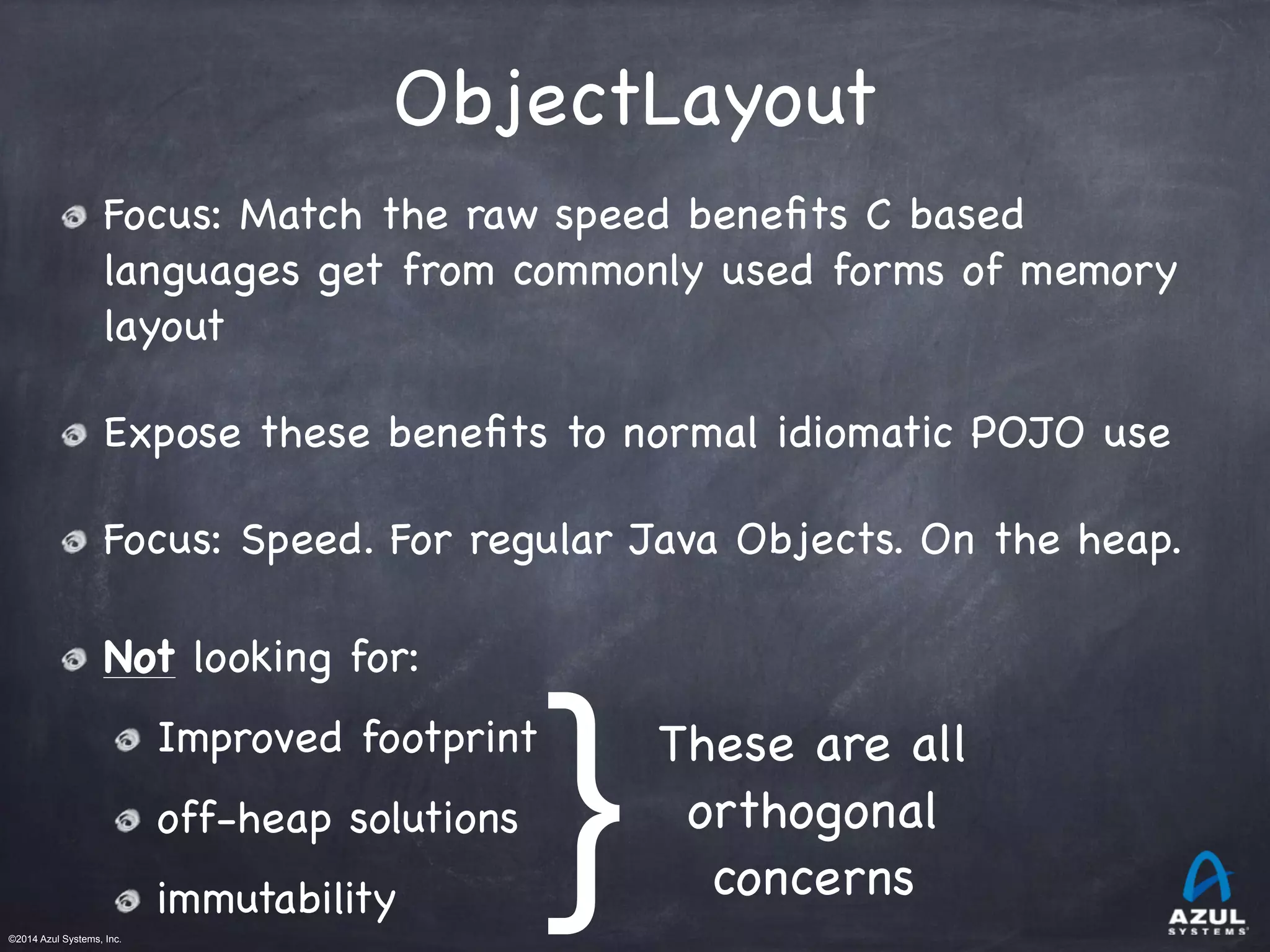
ObjectLayout
Focus: Match the raw speed benefits C based
languages get from commonly used forms of memory
layout 

Expose these benefits to normal idiomatic POJO use

Focus: Speed. For regular Java Objects. On the heap.

Not looking for:

Improved footprint 

off-heap solutions 

immutability
These are all

orthogonal
concerns}
©2014 Azul Systems, Inc.	


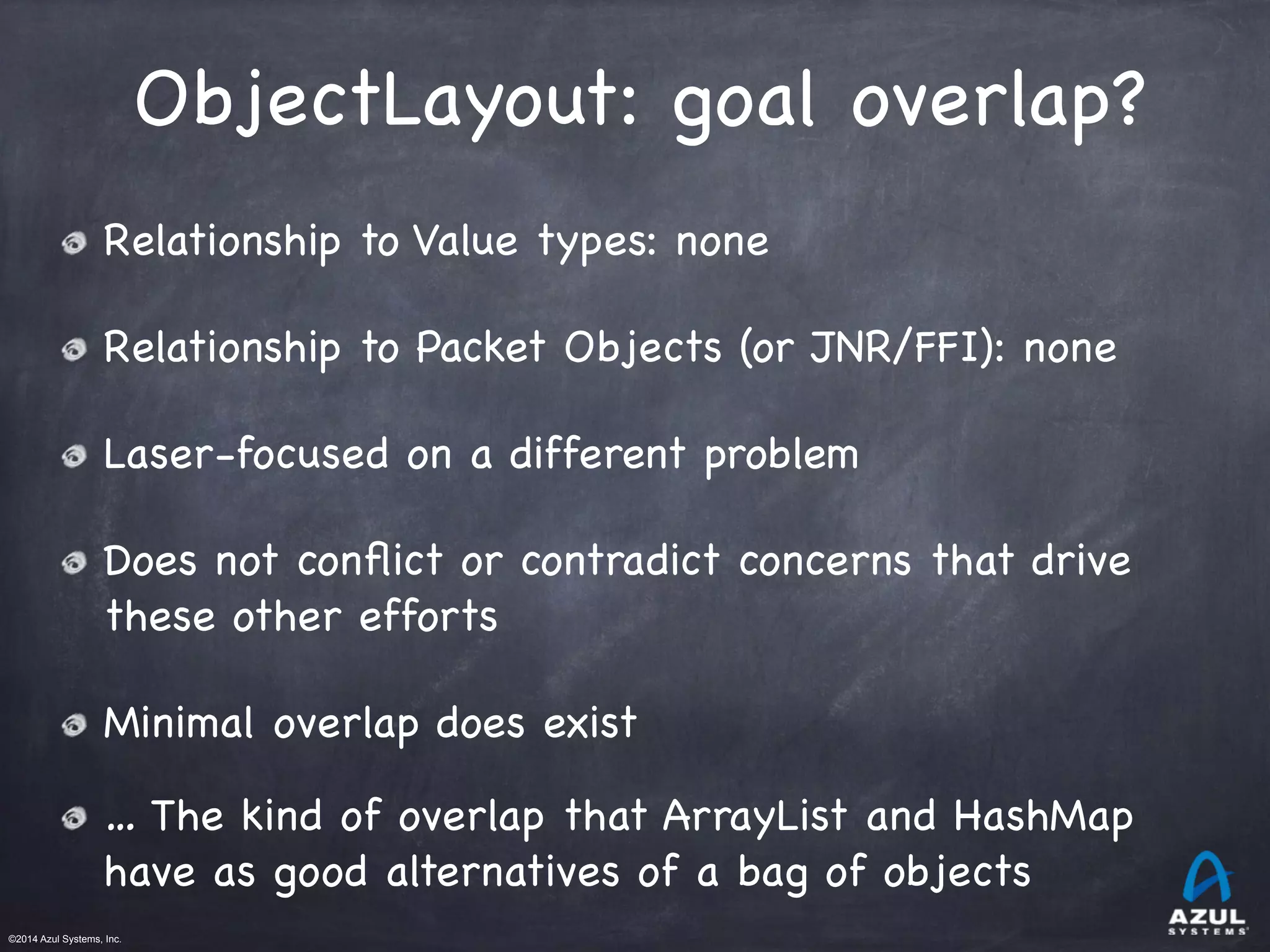
ObjectLayout: goal overlap?
Relationship to Value types: none

Relationship to Packet Objects (or JNR/FFI): none

Laser-focused on a different problem

Does not conflict or contradict concerns that drive
these other efforts

Minimal overlap does exist 

… The kind of overlap that ArrayList and HashMap
have as good alternatives of a bag of objects
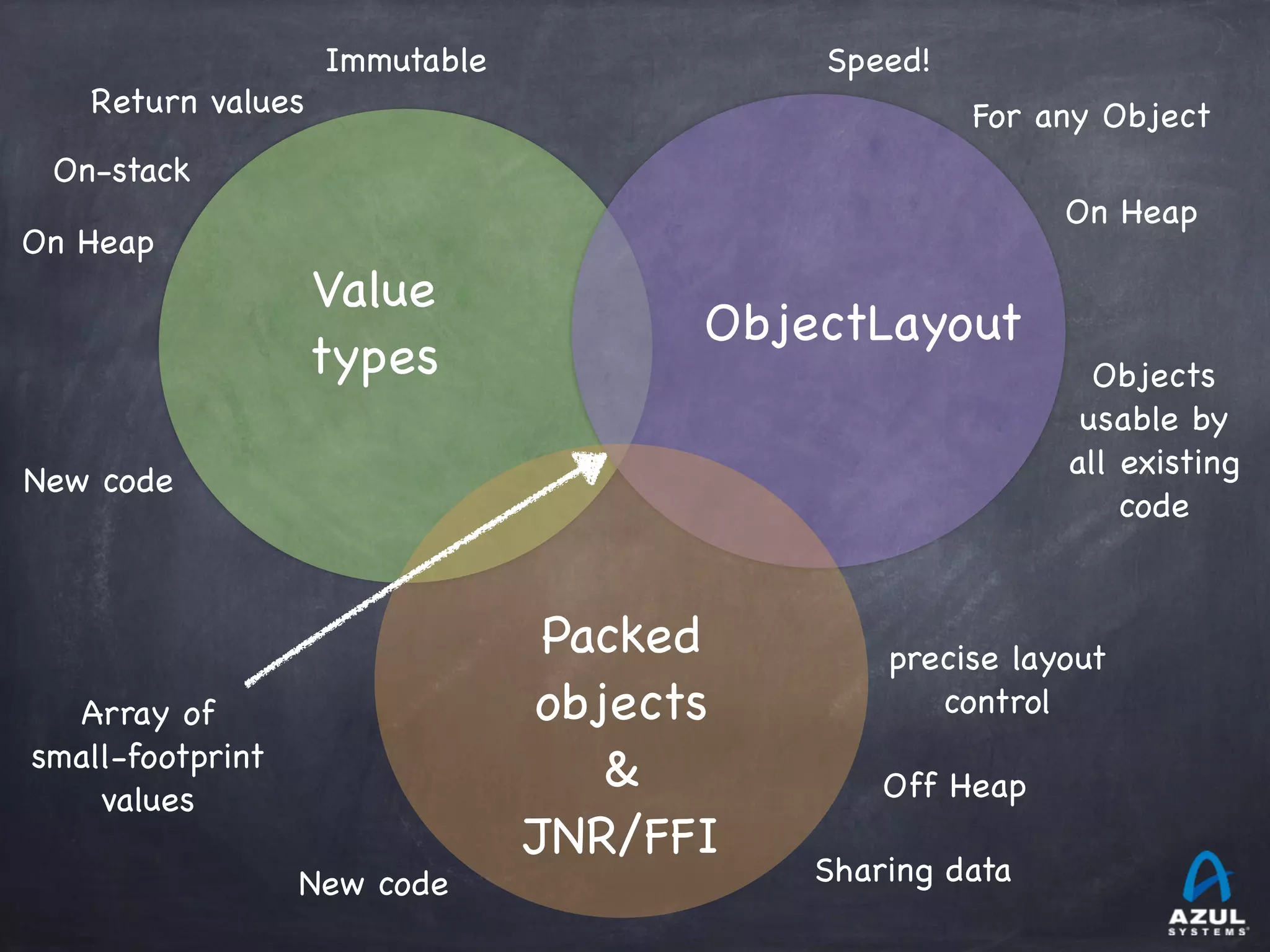
Value
types
Packed
objects

&

JNR/FFI
ObjectLayout
precise layout
control
Speed!
For any Object
On Heap
Off Heap
Sharing data
Immutable
On-stack
Return values
Objects
usable by
all existing
code
New code
On Heap
Array of
small-footprint
values
New code
©2014 Azul Systems, Inc.	


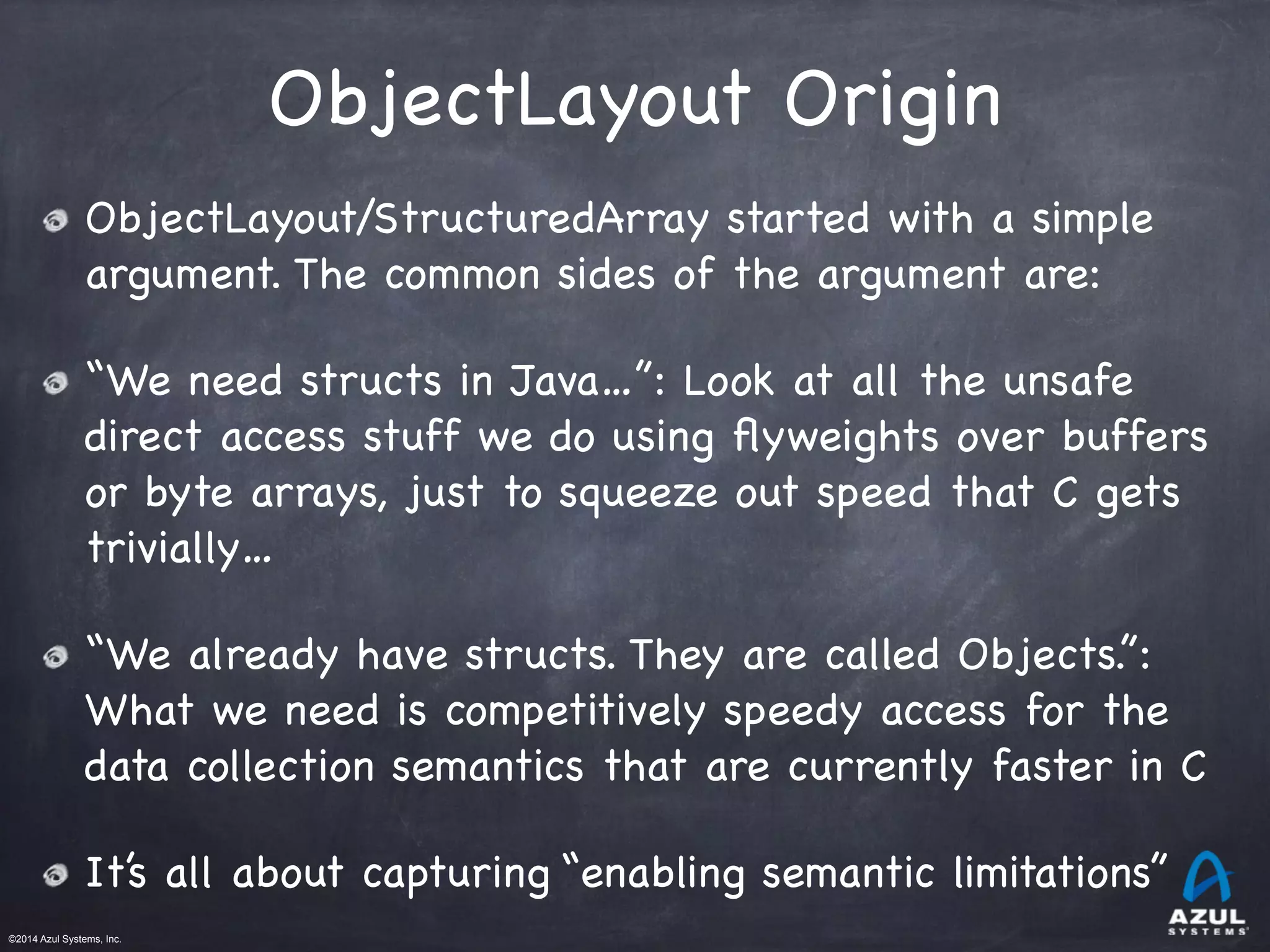
ObjectLayout Origin
ObjectLayout/StructuredArray started with a simple
argument. The common sides of the argument are:

“We need structs in Java…”: Look at all the unsafe
direct access stuff we do using flyweights over buffers
or byte arrays, just to squeeze out speed that C gets
trivially…

“We already have structs. They are called Objects.”:
What we need is competitively speedy access for the
data collection semantics that are currently faster in C

It’s all about capturing “enabling semantic limitations”
©2014 Azul Systems, Inc.	


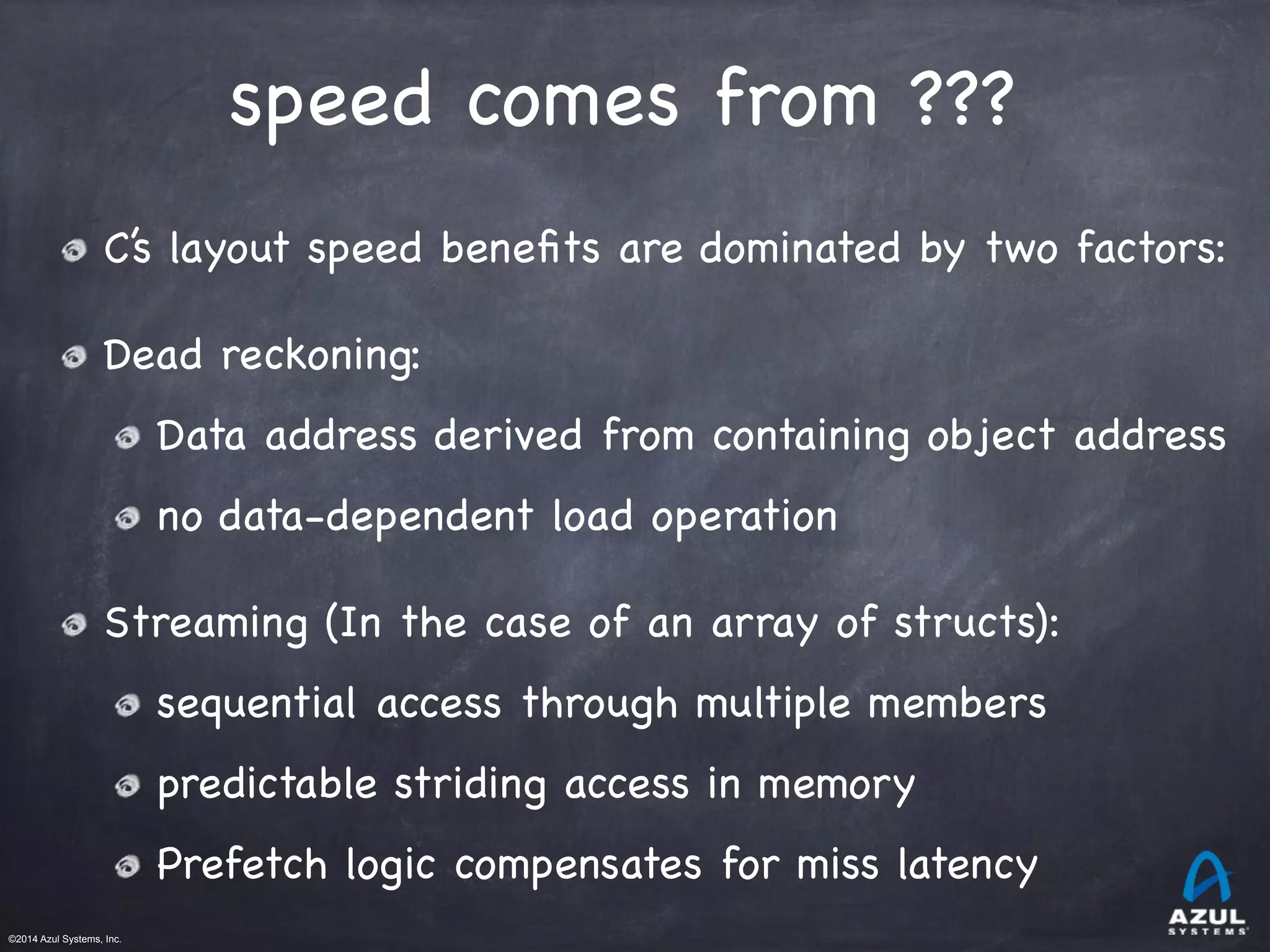
speed comes from ???
C’s layout speed benefits are dominated by two factors:

Dead reckoning: 

Data address derived from containing object address 

no data-dependent load operation

Streaming (In the case of an array of structs):

sequential access through multiple members

predictable striding access in memory

Prefetch logic compensates for miss latency
©2014 Azul Systems, Inc.	


example of speed-enabling limitations
Why is Object[] inherently slower than struct foo[]?

Java: a mutable array of same-base-type objects

C: An immutable array of exact-same-type structures

Mutability (of the array itself) & non-uniform member
size both force de-reference, and both break streaming

StructuredArray<T>: An immutable array of [potentially]
mutable exact-same-type (T) objects

Supports Instantiation, get(), but not put()…
©2014 Azul Systems, Inc.	


ObjectLayout target forms
Easily identified C-based layout forms:

array of structs

struct foo[];

struct with struct inside

struct foo { int a; struct bar b; int c; };

struct with array at the end

struct packet { int length; char[] body; }

None are currently (speed) matched in Java
©2014 Azul Systems, Inc.	


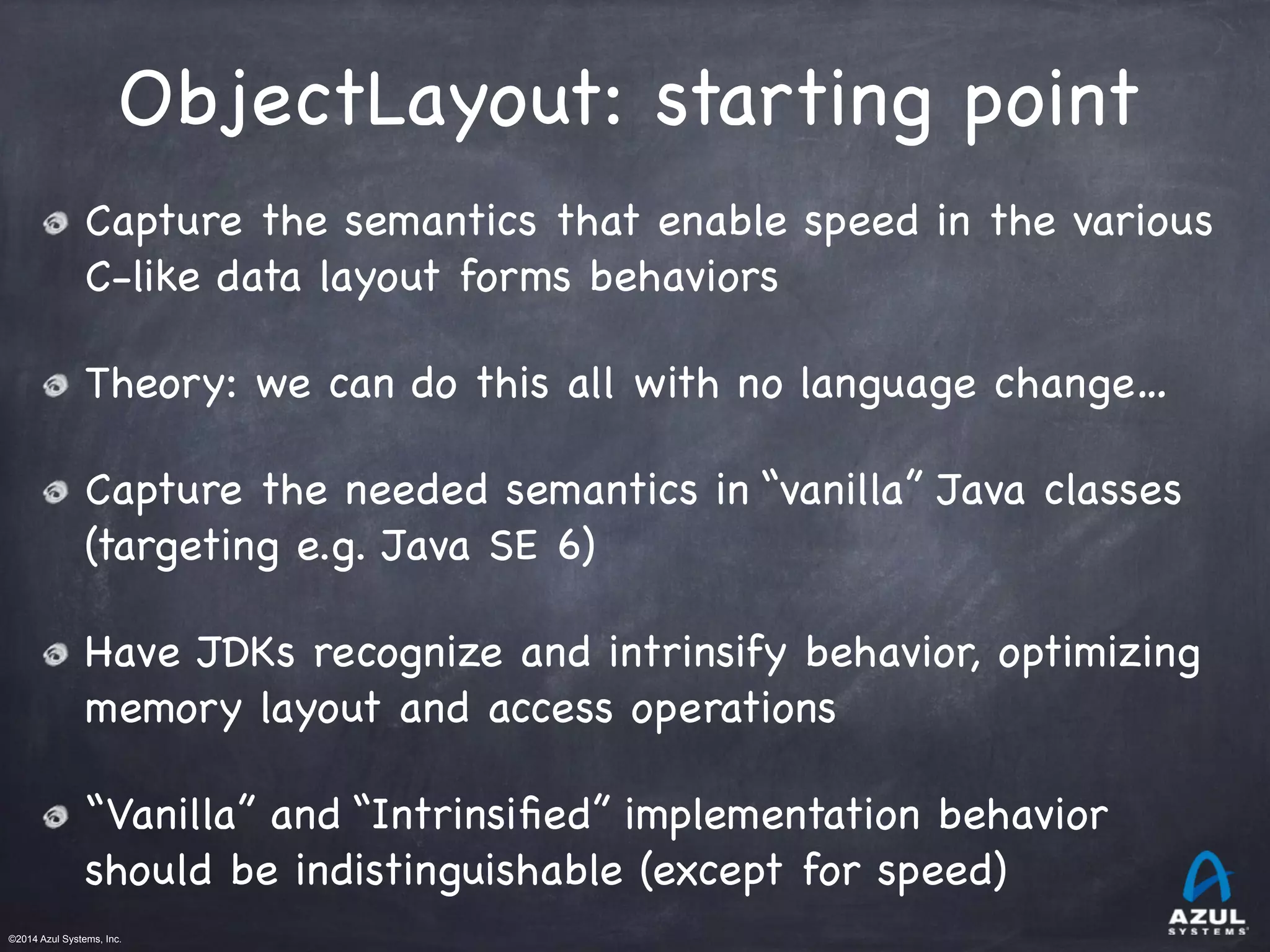
ObjectLayout: starting point
Capture the semantics that enable speed in the various
C-like data layout forms behaviors 

Theory: we can do this all with no language change… 

Capture the needed semantics in “vanilla” Java classes
(targeting e.g. Java SE 6)

Have JDKs recognize and intrinsify behavior, optimizing
memory layout and access operations

“Vanilla” and “Intrinsified” implementation behavior
should be indistinguishable (except for speed)
©2014 Azul Systems, Inc.	


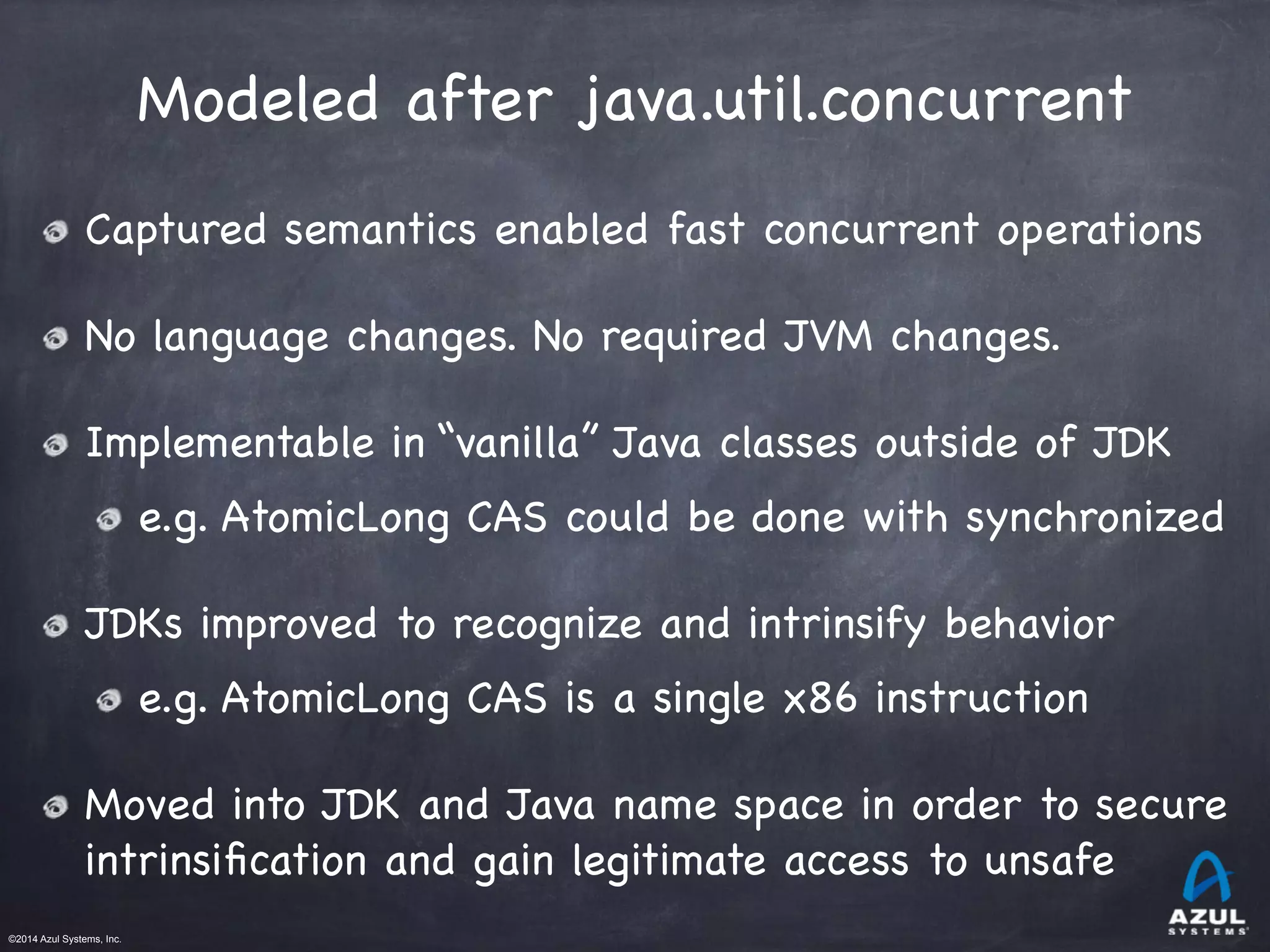
Modeled after java.util.concurrent
Captured semantics enabled fast concurrent operations

No language changes. No required JVM changes.

Implementable in “vanilla” Java classes outside of JDK

e.g. AtomicLong CAS could be done with synchronized

JDKs improved to recognize and intrinsify behavior

e.g. AtomicLong CAS is a single x86 instruction

Moved into JDK and Java name space in order to secure
intrinsification and gain legitimate access to unsafe
©2014 Azul Systems, Inc.	


ObjectLayout: StructuredArray
array of structs

struct foo[];

struct with struct inside

struct foo { int a; struct bar b; int c; };

struct with array at the end

struct packet { int len; char[] body; }
©2014 Azul Systems, Inc.	


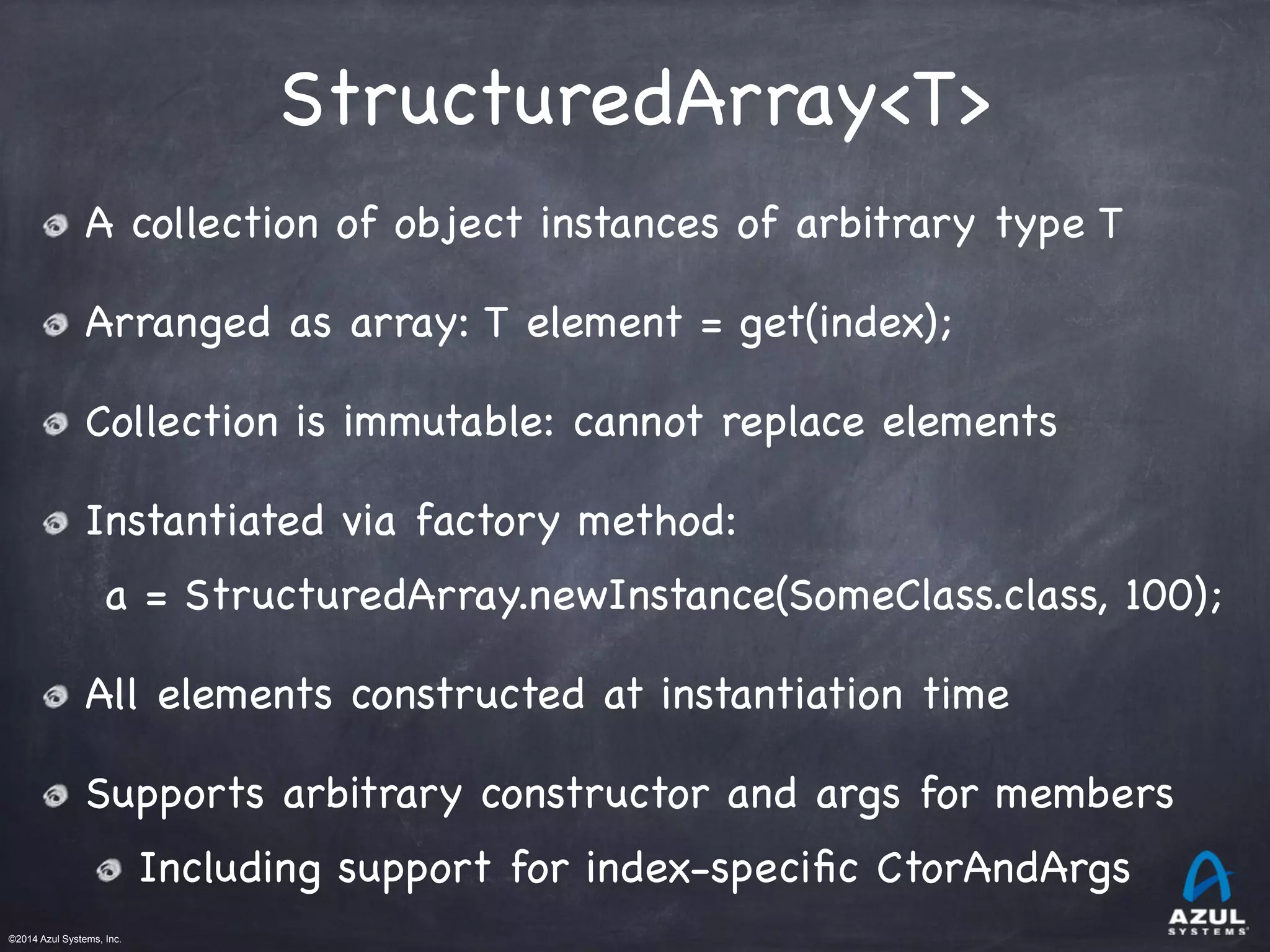
StructuredArray<T>
A collection of object instances of arbitrary type T

Arranged as array: T element = get(index);

Collection is immutable: cannot replace elements

Instantiated via factory method:

a = StructuredArray.newInstance(SomeClass.class, 100);

All elements constructed at instantiation time

Supports arbitrary constructor and args for members

Including support for index-specific CtorAndArgs
©2014 Azul Systems, Inc.	


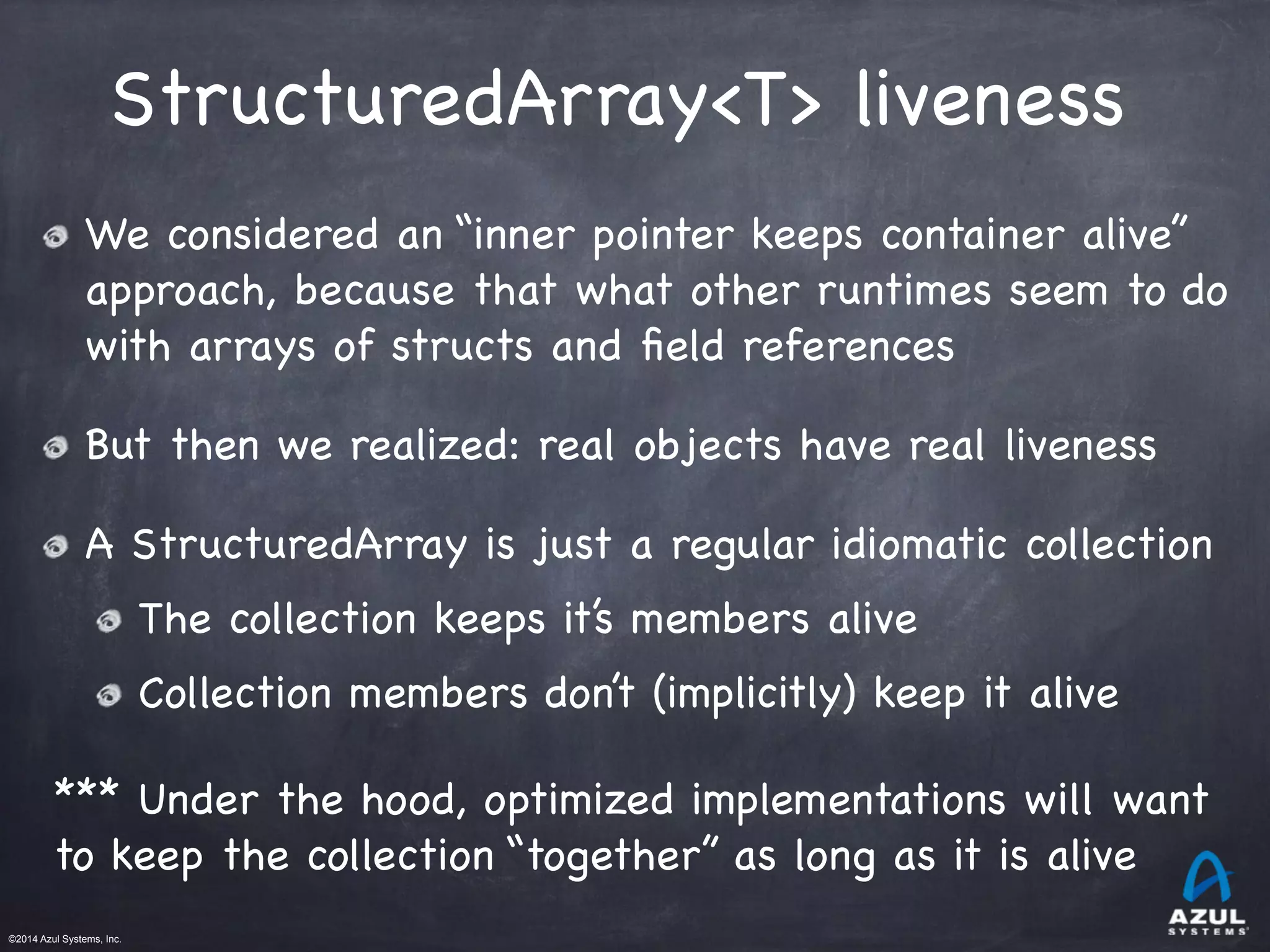
StructuredArray<T> liveness
We considered an “inner pointer keeps container alive”
approach, because that what other runtimes seem to do
with arrays of structs and field references

But then we realized: real objects have real liveness

A StructuredArray is just a regular idiomatic collection

The collection keeps it’s members alive

Collection members don’t (implicitly) keep it alive

*** Under the hood, optimized implementations will want
to keep the collection “together” as long as it is alive
©2014 Azul Systems, Inc.	


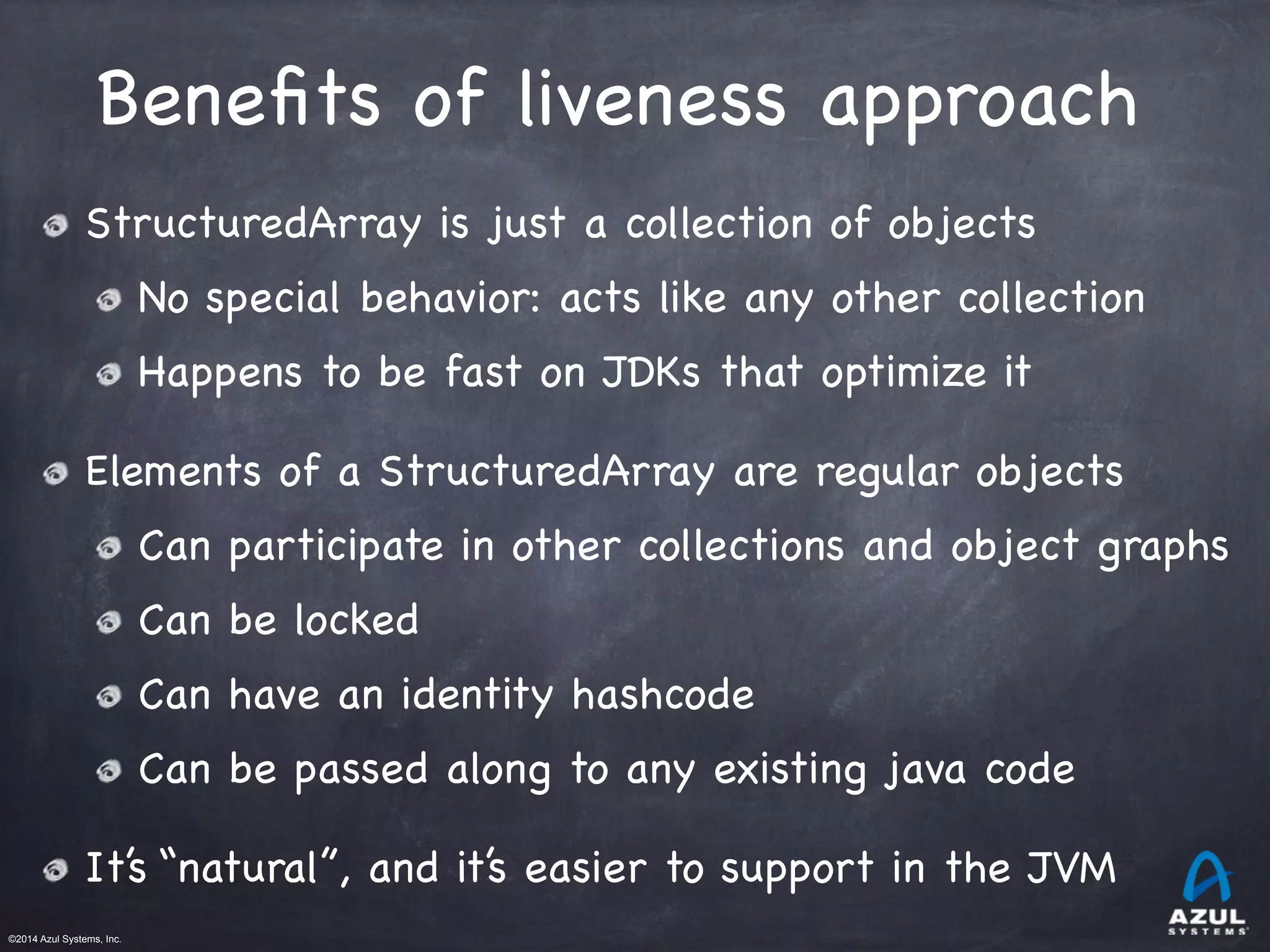
Benefits of liveness approach
StructuredArray is just a collection of objects

No special behavior: acts like any other collection

Happens to be fast on JDKs that optimize it

Elements of a StructuredArray are regular objects

Can participate in other collections and object graphs

Can be locked

Can have an identity hashcode

Can be passed along to any existing java code

It’s “natural”, and it’s easier to support in the JVM
©2014 Azul Systems, Inc.	


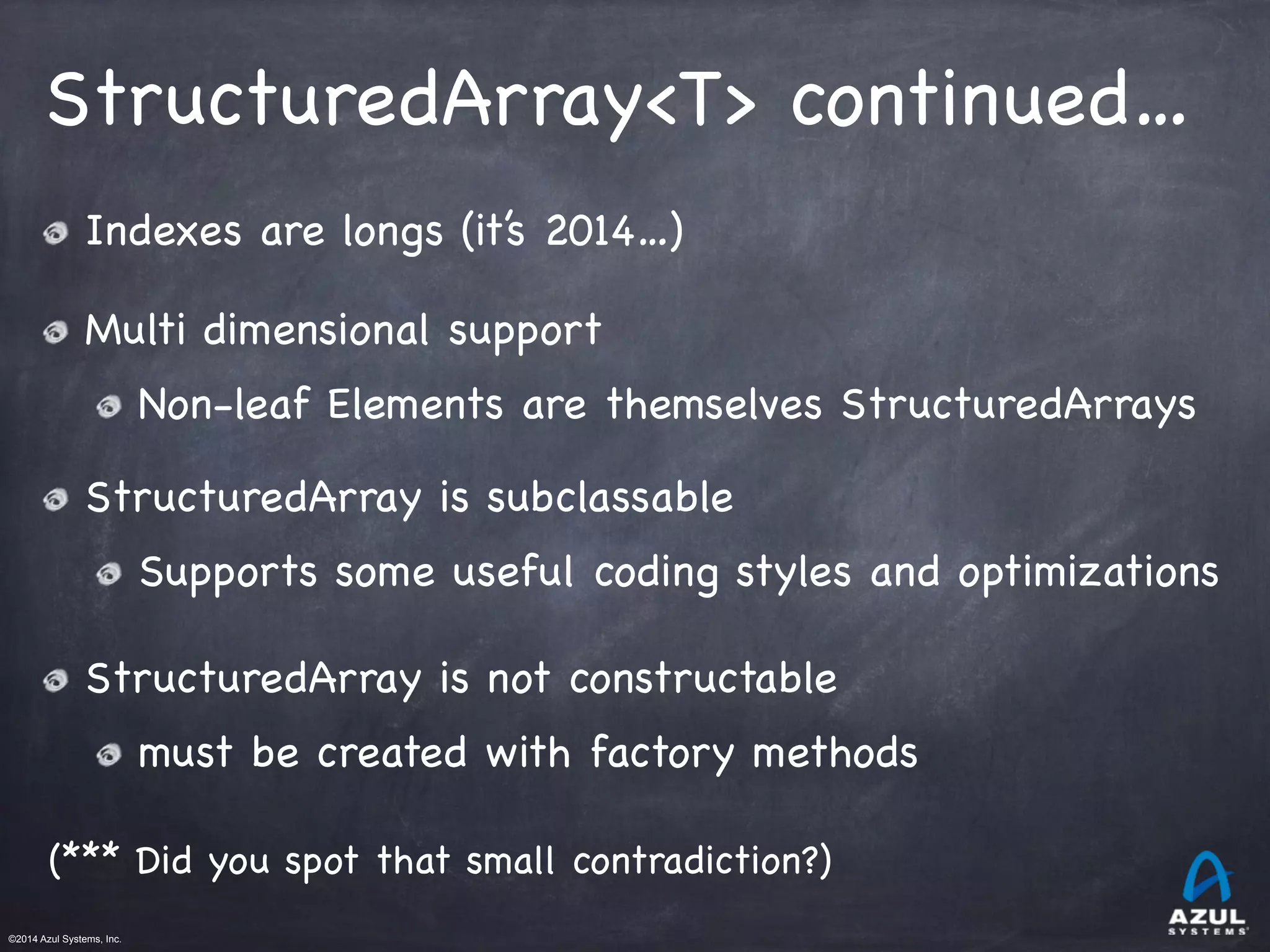
StructuredArray<T> continued…
Indexes are longs (it’s 2014…)

Multi dimensional support

Non-leaf Elements are themselves StructuredArrays

StructuredArray is subclassable

Supports some useful coding styles and optimizations

StructuredArray is not constructable

must be created with factory methods

(*** Did you spot that small contradiction?)
©2014 Azul Systems, Inc.	


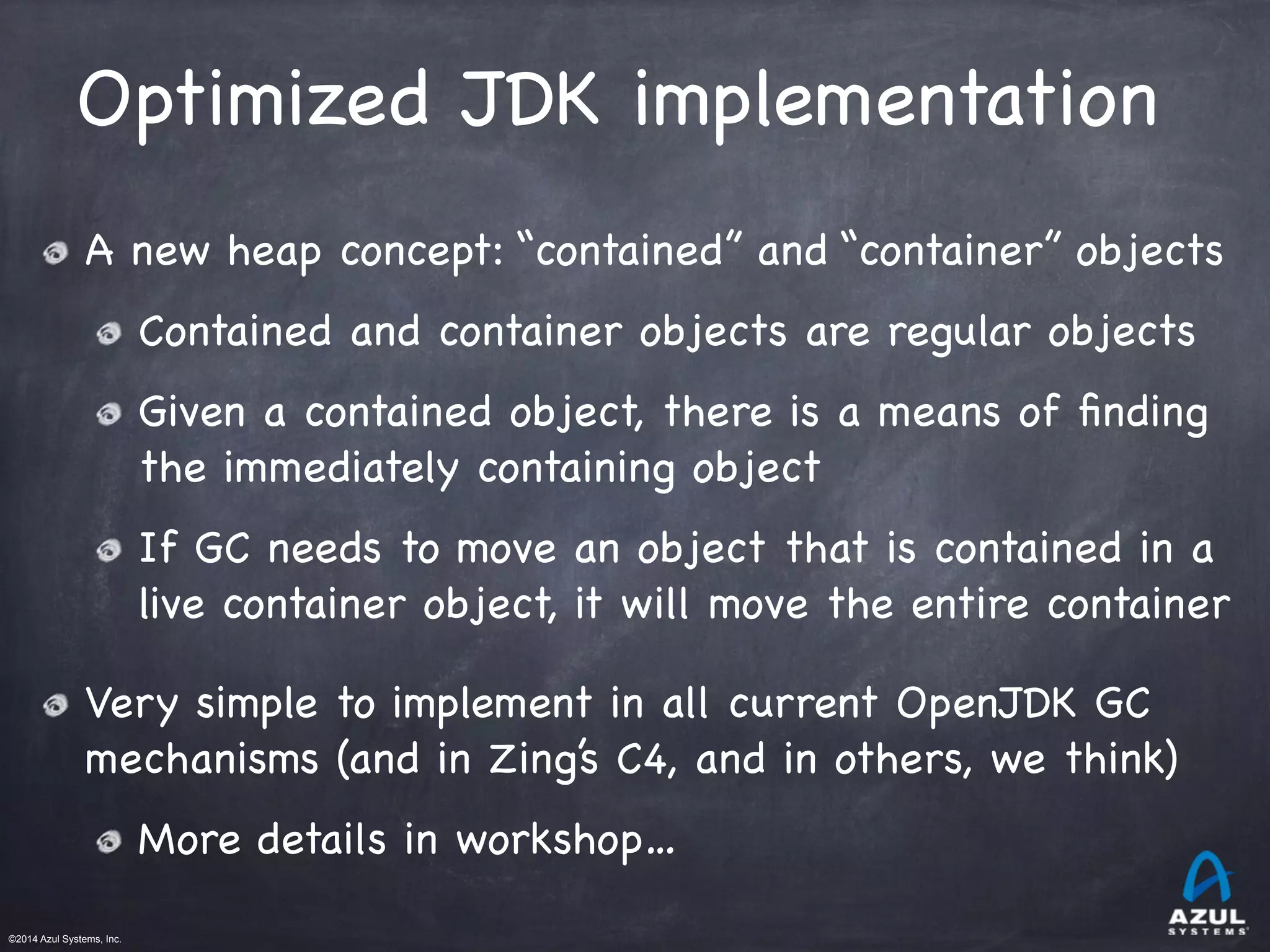
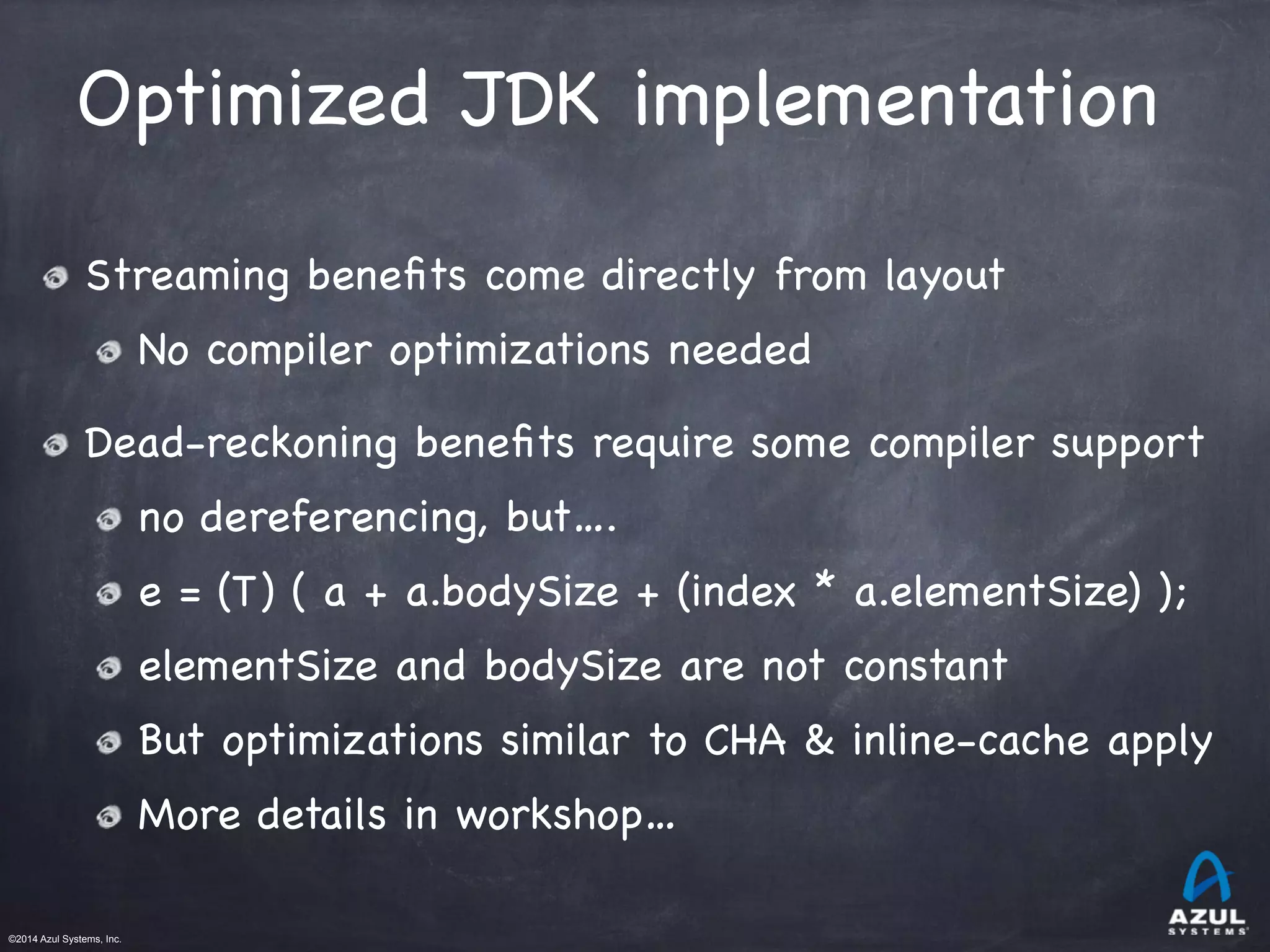
Optimized JDK implementation
A new heap concept: “contained” and “container” objects

Contained and container objects are regular objects

Given a contained object, there is a means of finding
the immediately containing object

If GC needs to move an object that is contained in a
live container object, it will move the entire container

Very simple to implement in all current OpenJDK GC
mechanisms (and in Zing’s C4, and in others, we think)

More details in workshop…
©2014 Azul Systems, Inc.	


Optimized JDK implementation
Streaming benefits come directly from layout

No compiler optimizations needed

Dead-reckoning benefits require some compiler support

no dereferencing, but….

e = (T) ( a + a.bodySize + (index * a.elementSize) );

elementSize and bodySize are not constant

But optimizations similar to CHA & inline-cache apply

More details in workshop…
©2014 Azul Systems, Inc.	


ObjectLayout forms 2 & 3
array of structs

struct foo[];

struct with struct inside

struct foo { int a; struct bar b; int c; };

struct with array at the end

struct packet { int len; char[] body; }
©2014 Azul Systems, Inc.	


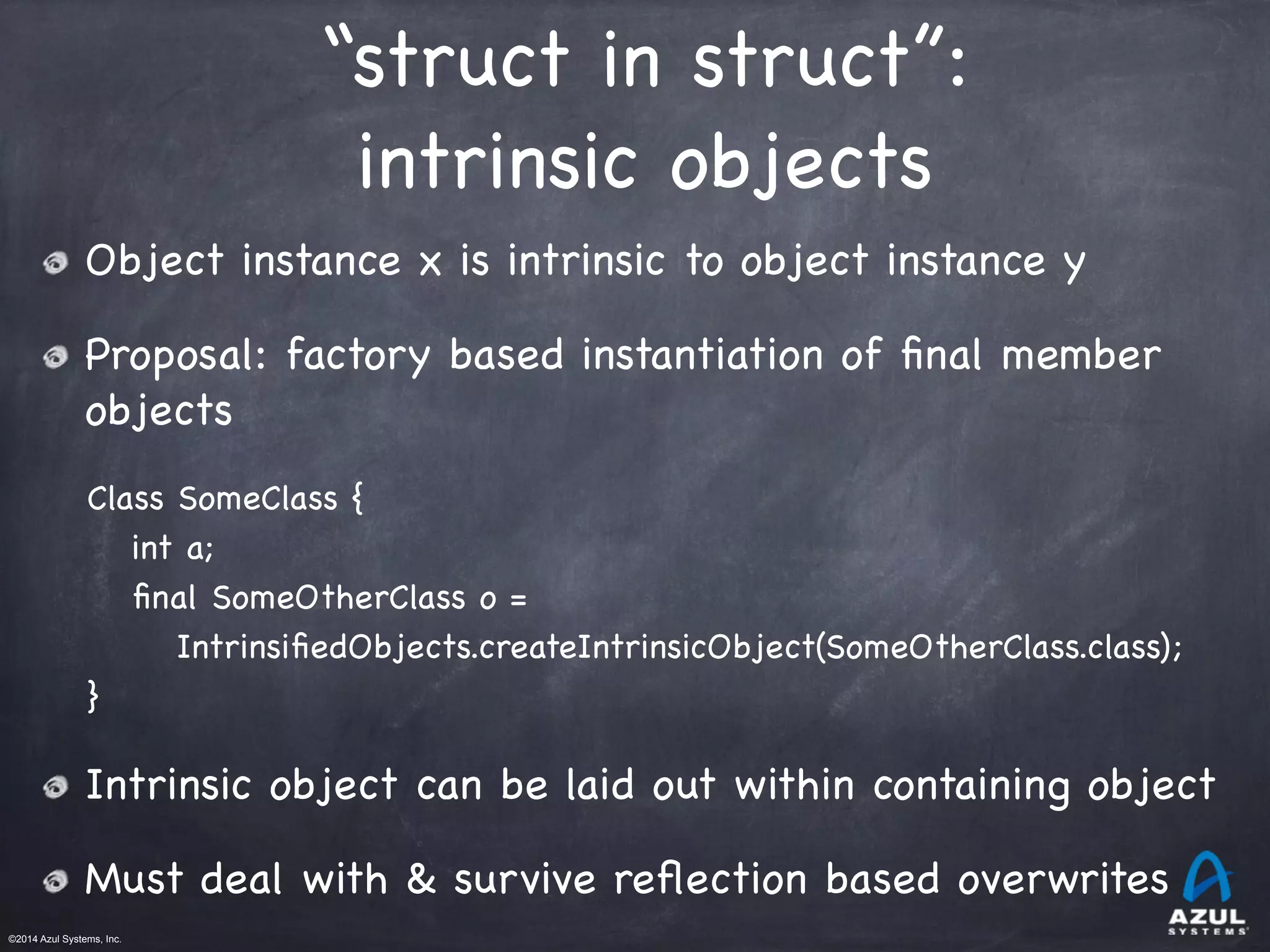
“struct in struct”: 

intrinsic objects
Object instance x is intrinsic to object instance y

Proposal: factory based instantiation of final member
objects

Class SomeClass {

int a;

final SomeOtherClass o =

IntrinsifiedObjects.createIntrinsicObject(SomeOtherClass.class);

} 

Intrinsic object can be laid out within containing object

Must deal with & survive reflection based overwrites
©2014 Azul Systems, Inc.	


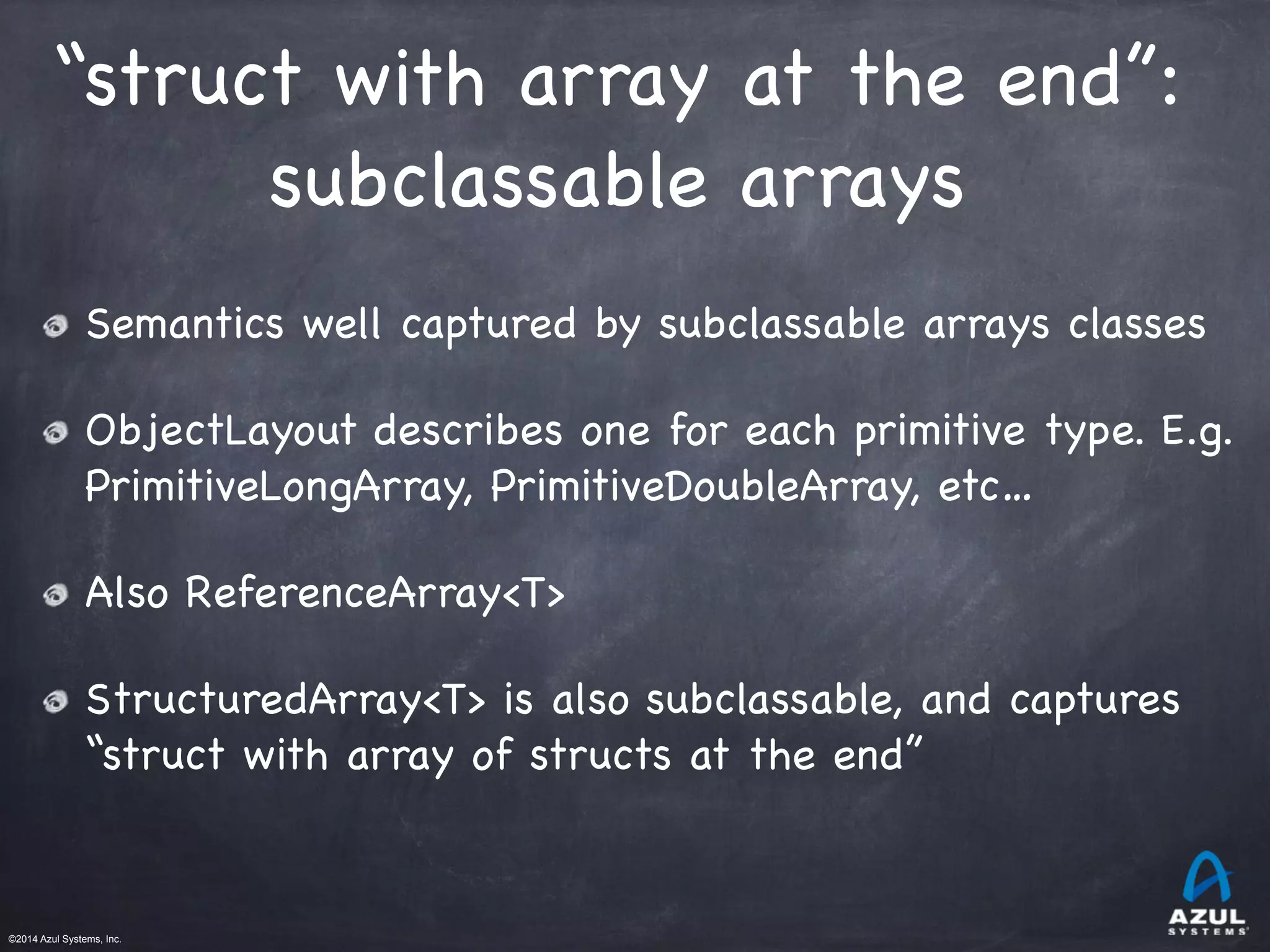
“struct with array at the end”:

subclassable arrays
Semantics well captured by subclassable arrays classes

ObjectLayout describes one for each primitive type. E.g.
PrimitiveLongArray, PrimitiveDoubleArray, etc…

Also ReferenceArray<T>

StructuredArray<T> is also subclassable, and captures
“struct with array of structs at the end”
©2014 Azul Systems, Inc.	


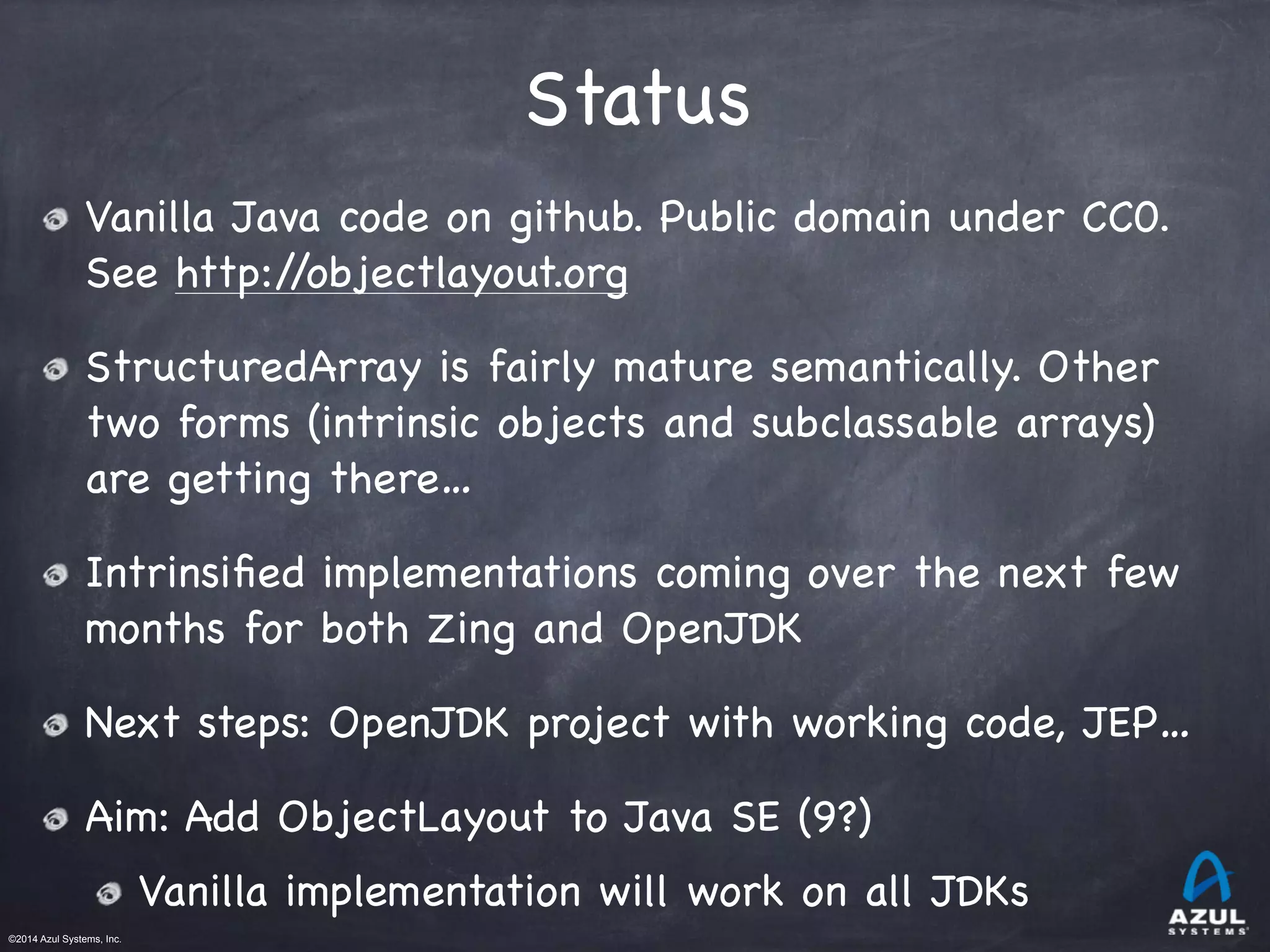
Status
Vanilla Java code on github. Public domain under CC0.
See http://objectlayout.org

StructuredArray is fairly mature semantically. Other
two forms (intrinsic objects and subclassable arrays)
are getting there…

Intrinsified implementations coming over the next few
months for both Zing and OpenJDK

Next steps: OpenJDK project with working code, JEP…

Aim: Add ObjectLayout to Java SE (9?)

Vanilla implementation will work on all JDKs
©2014 Azul Systems, Inc.	


ObjectLayout Summary
New Java classes: org.ObjectLayout.*

Propose to move into java namespace in Java SE (9?)

Work “out of the box” on Java 6, 7, 8, 9, …

No syntax changes, No new bytecodes 

No new required JVM behavior

Can “go fast” on JDKs that optimize for them

Relatively simple, isolated JVM changes needed

Proposing to include “go fast” in OpenJDK (9?)

Zing will support “go fast” for Java 6, 7, 8, 9, …
Q & A
@giltene
http://www.azulsystems.com
!
http://objectlayout.org

https://github.com/ObjectLayout/ObjectLayout

JVM Language Summit: Object layout presentation

  • 1.
    ©2014 Azul Systems,Inc. Closing the [last?] inherent C vs. Java speed gap Gil Tene, CTO & co-Founder, Azul Systems http://objectlayout.org ObjectLayout (and StructuredArray) !
  • 2.
    ©2014 Azul Systems,Inc. ObjectLayout Focus: Match the raw speed benefits C based languages get from commonly used forms of memory layout Expose these benefits to normal idiomatic POJO use Focus: Speed. For regular Java Objects. On the heap. Not looking for: Improved footprint off-heap solutions immutability These are all orthogonal concerns}
  • 3.
    ©2014 Azul Systems,Inc. ObjectLayout: goal overlap? Relationship to Value types: none Relationship to Packet Objects (or JNR/FFI): none Laser-focused on a different problem Does not conflict or contradict concerns that drive these other efforts Minimal overlap does exist … The kind of overlap that ArrayList and HashMap have as good alternatives of a bag of objects
  • 4.
    Value types Packed objects & JNR/FFI ObjectLayout precise layout control Speed! For anyObject On Heap Off Heap Sharing data Immutable On-stack Return values Objects usable by all existing code New code On Heap Array of small-footprint values New code
  • 5.
    ©2014 Azul Systems,Inc. ObjectLayout Origin ObjectLayout/StructuredArray started with a simple argument. The common sides of the argument are: “We need structs in Java…”: Look at all the unsafe direct access stuff we do using flyweights over buffers or byte arrays, just to squeeze out speed that C gets trivially… “We already have structs. They are called Objects.”: What we need is competitively speedy access for the data collection semantics that are currently faster in C It’s all about capturing “enabling semantic limitations”
  • 6.
    ©2014 Azul Systems,Inc. speed comes from ??? C’s layout speed benefits are dominated by two factors: Dead reckoning: Data address derived from containing object address no data-dependent load operation Streaming (In the case of an array of structs): sequential access through multiple members predictable striding access in memory Prefetch logic compensates for miss latency
  • 7.
    ©2014 Azul Systems,Inc. example of speed-enabling limitations Why is Object[] inherently slower than struct foo[]? Java: a mutable array of same-base-type objects C: An immutable array of exact-same-type structures Mutability (of the array itself) & non-uniform member size both force de-reference, and both break streaming StructuredArray<T>: An immutable array of [potentially] mutable exact-same-type (T) objects Supports Instantiation, get(), but not put()…
  • 8.
    ©2014 Azul Systems,Inc. ObjectLayout target forms Easily identified C-based layout forms: array of structs struct foo[]; struct with struct inside struct foo { int a; struct bar b; int c; }; struct with array at the end struct packet { int length; char[] body; } None are currently (speed) matched in Java
  • 9.
    ©2014 Azul Systems,Inc. ObjectLayout: starting point Capture the semantics that enable speed in the various C-like data layout forms behaviors Theory: we can do this all with no language change… Capture the needed semantics in “vanilla” Java classes (targeting e.g. Java SE 6) Have JDKs recognize and intrinsify behavior, optimizing memory layout and access operations “Vanilla” and “Intrinsified” implementation behavior should be indistinguishable (except for speed)
  • 10.
    ©2014 Azul Systems,Inc. Modeled after java.util.concurrent Captured semantics enabled fast concurrent operations No language changes. No required JVM changes. Implementable in “vanilla” Java classes outside of JDK e.g. AtomicLong CAS could be done with synchronized JDKs improved to recognize and intrinsify behavior e.g. AtomicLong CAS is a single x86 instruction Moved into JDK and Java name space in order to secure intrinsification and gain legitimate access to unsafe
  • 11.
    ©2014 Azul Systems,Inc. ObjectLayout: StructuredArray array of structs struct foo[]; struct with struct inside struct foo { int a; struct bar b; int c; }; struct with array at the end struct packet { int len; char[] body; }
  • 12.
    ©2014 Azul Systems,Inc. StructuredArray<T> A collection of object instances of arbitrary type T Arranged as array: T element = get(index); Collection is immutable: cannot replace elements Instantiated via factory method: a = StructuredArray.newInstance(SomeClass.class, 100); All elements constructed at instantiation time Supports arbitrary constructor and args for members Including support for index-specific CtorAndArgs
  • 13.
    ©2014 Azul Systems,Inc. StructuredArray<T> liveness We considered an “inner pointer keeps container alive” approach, because that what other runtimes seem to do with arrays of structs and field references But then we realized: real objects have real liveness A StructuredArray is just a regular idiomatic collection The collection keeps it’s members alive Collection members don’t (implicitly) keep it alive *** Under the hood, optimized implementations will want to keep the collection “together” as long as it is alive
  • 14.
    ©2014 Azul Systems,Inc. Benefits of liveness approach StructuredArray is just a collection of objects No special behavior: acts like any other collection Happens to be fast on JDKs that optimize it Elements of a StructuredArray are regular objects Can participate in other collections and object graphs Can be locked Can have an identity hashcode Can be passed along to any existing java code It’s “natural”, and it’s easier to support in the JVM
  • 15.
    ©2014 Azul Systems,Inc. StructuredArray<T> continued… Indexes are longs (it’s 2014…) Multi dimensional support Non-leaf Elements are themselves StructuredArrays StructuredArray is subclassable Supports some useful coding styles and optimizations StructuredArray is not constructable must be created with factory methods (*** Did you spot that small contradiction?)
  • 16.
    ©2014 Azul Systems,Inc. Optimized JDK implementation A new heap concept: “contained” and “container” objects Contained and container objects are regular objects Given a contained object, there is a means of finding the immediately containing object If GC needs to move an object that is contained in a live container object, it will move the entire container Very simple to implement in all current OpenJDK GC mechanisms (and in Zing’s C4, and in others, we think) More details in workshop…
  • 17.
    ©2014 Azul Systems,Inc. Optimized JDK implementation Streaming benefits come directly from layout No compiler optimizations needed Dead-reckoning benefits require some compiler support no dereferencing, but…. e = (T) ( a + a.bodySize + (index * a.elementSize) ); elementSize and bodySize are not constant But optimizations similar to CHA & inline-cache apply More details in workshop…
  • 18.
    ©2014 Azul Systems,Inc. ObjectLayout forms 2 & 3 array of structs struct foo[]; struct with struct inside struct foo { int a; struct bar b; int c; }; struct with array at the end struct packet { int len; char[] body; }
  • 19.
    ©2014 Azul Systems,Inc. “struct in struct”: intrinsic objects Object instance x is intrinsic to object instance y Proposal: factory based instantiation of final member objects Class SomeClass { int a; final SomeOtherClass o = IntrinsifiedObjects.createIntrinsicObject(SomeOtherClass.class); } Intrinsic object can be laid out within containing object Must deal with & survive reflection based overwrites
  • 20.
    ©2014 Azul Systems,Inc. “struct with array at the end”: subclassable arrays Semantics well captured by subclassable arrays classes ObjectLayout describes one for each primitive type. E.g. PrimitiveLongArray, PrimitiveDoubleArray, etc… Also ReferenceArray<T> StructuredArray<T> is also subclassable, and captures “struct with array of structs at the end”
  • 21.
    ©2014 Azul Systems,Inc. Status Vanilla Java code on github. Public domain under CC0. See http://objectlayout.org StructuredArray is fairly mature semantically. Other two forms (intrinsic objects and subclassable arrays) are getting there… Intrinsified implementations coming over the next few months for both Zing and OpenJDK Next steps: OpenJDK project with working code, JEP… Aim: Add ObjectLayout to Java SE (9?) Vanilla implementation will work on all JDKs
  • 22.
    ©2014 Azul Systems,Inc. ObjectLayout Summary New Java classes: org.ObjectLayout.* Propose to move into java namespace in Java SE (9?) Work “out of the box” on Java 6, 7, 8, 9, … No syntax changes, No new bytecodes No new required JVM behavior Can “go fast” on JDKs that optimize for them Relatively simple, isolated JVM changes needed Proposing to include “go fast” in OpenJDK (9?) Zing will support “go fast” for Java 6, 7, 8, 9, …
  • 23.