Core Java Training
Object Class
Page 1Classification: Restricted
Quick recap: Topics covered till now
• Data Types – Primitive (byte, short, int, long, double, float, char, boolean)
• Data Types – Wrapper (Byte, Short, Integer …)
• Data Types – Classes for String (String - immutable, StringBuilder – mutable,
StringBuffer – mutable+threadsafe); Concept of String pooling / interning
• Arrays
• Conditional statements, Loops
• OOP with Java –
• Polymorphism – Method overloading (Compile-time), Method Overriding
(Runtime)
• Inheritance – extending classes, implementing interfaces; multiple inheritance
• Abstraction – abstract classes vs interfaces
• Encapsulation – POJO classes / Beans
• Packaging, Class Modifiers (public, protected, default, private)
• Static members vs Instance members
• Exception handling
Page 2Classification: Restricted
Agenda
• Object Class
• toString()
• equals()
• Hashing
• hashCode()
Object Class
as
“The basic unit of any collection”
Page 4Classification: Restricted
Object class
• Superclass for all Java classes
• Any class without explicit extends clause is a direct subclass of Object
• Methods of Object include:
• String toString()
• boolean equals (Object other)
• int hashCode()
Page 5Classification: Restricted
5
Method toString()
• Returns String representation of object; describes state of object
• Automatically called when:
• Object is concatenated with a String
• Object is printed using print() or println()
• Object reference is passed to assert statement of the form:
assert condition : object
Page 6Classification: Restricted
6
Example
Rectangle r = new Rectangle (0,0,20,40);
System.out.println(r);
Prints out:
java.awt.Rectangle[x=0,y=0,width=20,height=40]
Page 7Classification: Restricted
7
More on toString()
• Default toString() method just prints (full) class name & hash code of object
• Not all API classes override toString()
• Good idea to implement for debugging purposes:
• Should return String containing values of important fields along with
their names
• Should also return result of getClass().getName() rather than hard-
coded class name
Page 8Classification: Restricted
Overriding toString(): example
public class Employee
{
public String toString()
{
return getClass().getName()
+ "[name=" + name
+ ",salary=" + salary
+ "]";
}
...
}
Typical String produced: Employee[name=John Doe,salary=40000]
Page 9Classification: Restricted
9
Overriding toString in a subclass
• Format superclass first
• Add unique subclass details
• Example:
public class Manager extends Employee
{
public String toString()
{
return super.toString()
+ "[department=" + department + "]";
}
...
}
Page 10Classification: Restricted
10
Example continued
• Typical String produced:
Manager[name=Mary Lamb,salary=75000][department=Admin]
• Note that superclass reports actual class name
Page 11Classification: Restricted
11
Equality testing
• Method equals() tests whether two objects have same contents
• By contrast, == operator test 2 references to see if they point to the same
object (or test primitive values for equality)
• Need to define for each class what “equality” means:
Compare all fields
Compare 1 or 2 key fields
Page 12Classification: Restricted
12
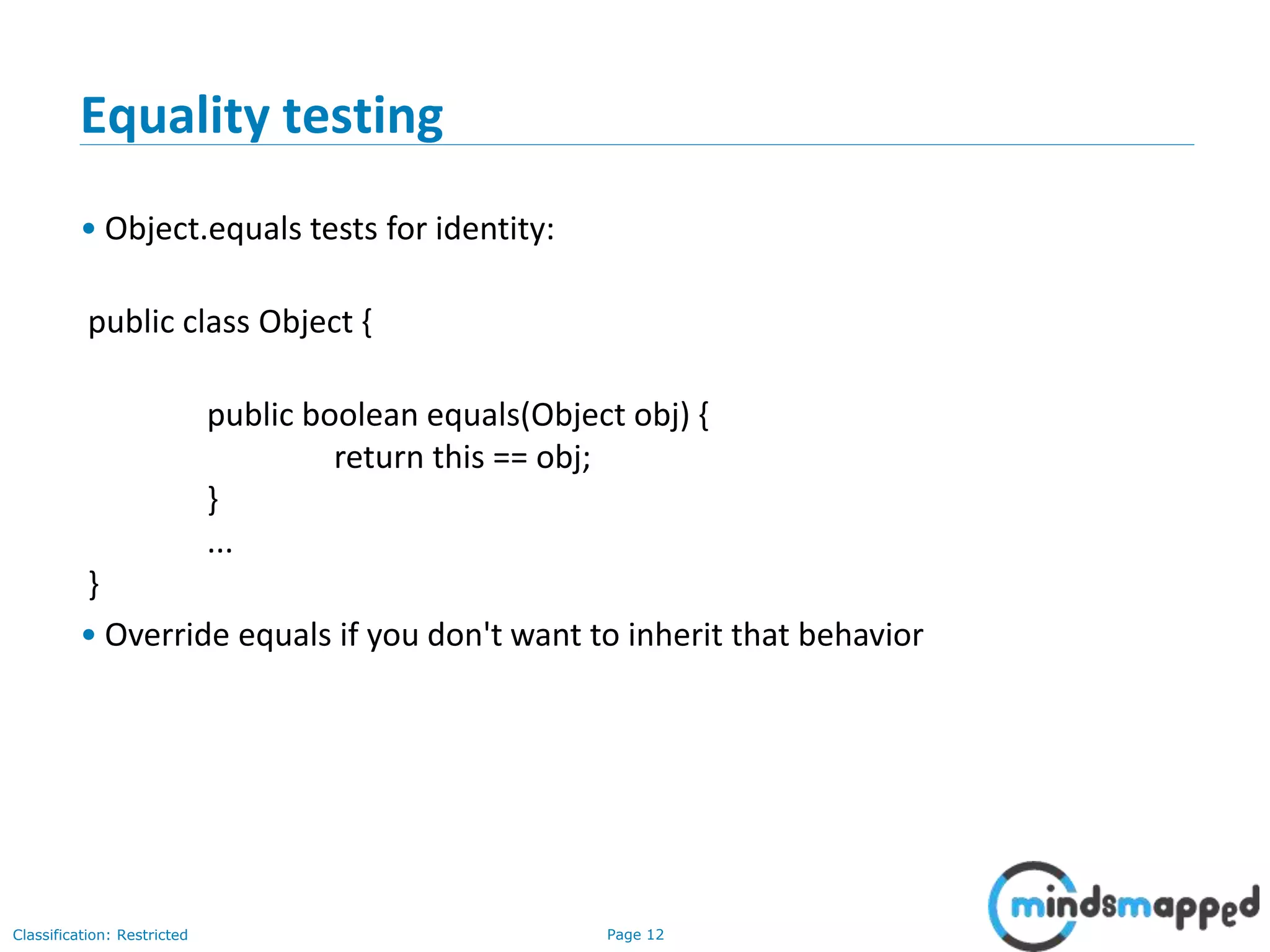
Equality testing
• Object.equals tests for identity:
public class Object {
public boolean equals(Object obj) {
return this == obj;
}
...
}
• Override equals if you don't want to inherit that behavior
Page 13Classification: Restricted
13
Overriding equals()
• Good practice to override, since many API methods assume objects have
well-defined notion of equality
• When overriding equals() in a subclass, can call superclass version by using
super.equals()
Page 14Classification: Restricted
14
Requirements for equals() method
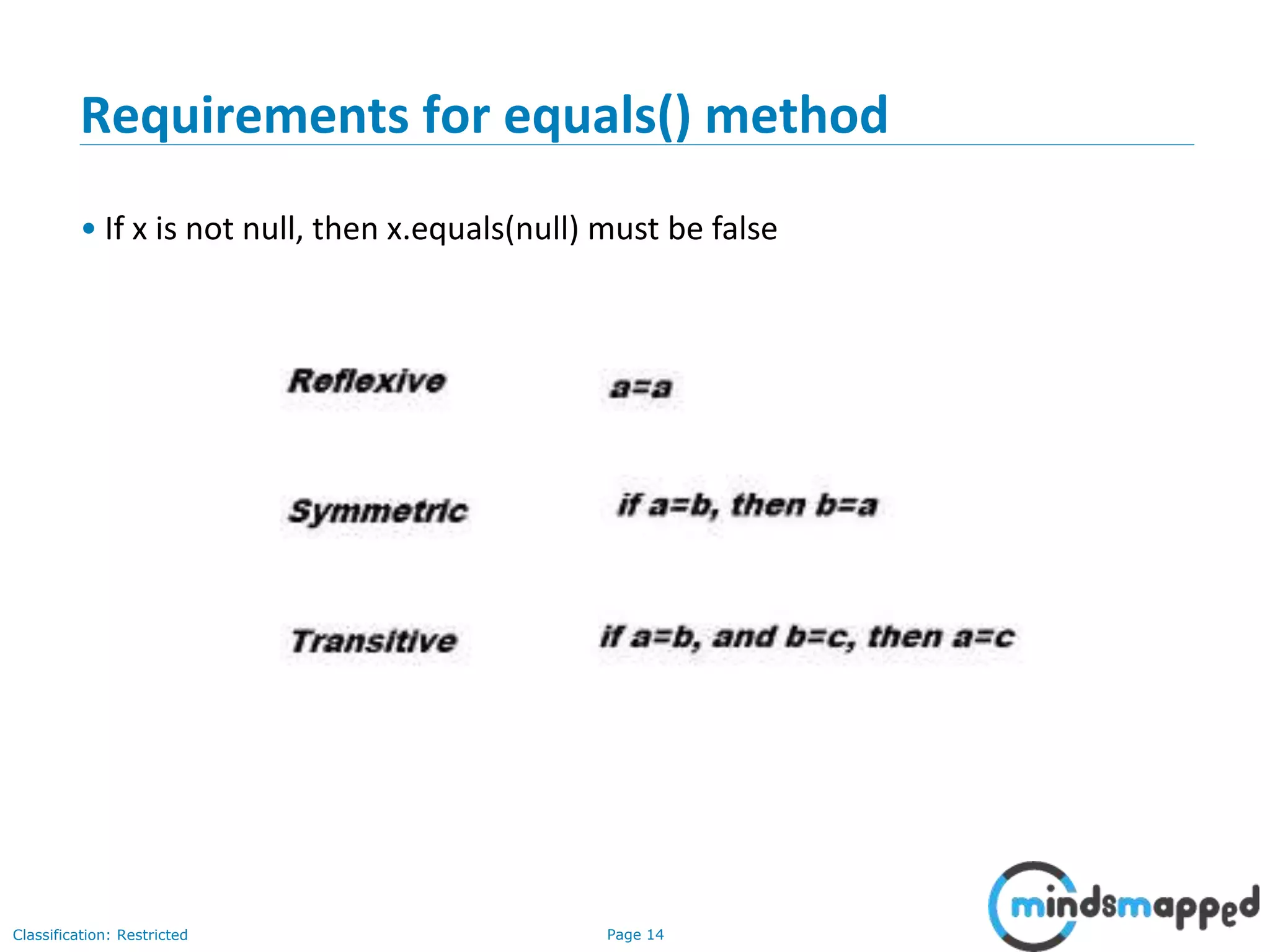
• If x is not null, then x.equals(null) must be false
Page 15Classification: Restricted
The perfect equals() method
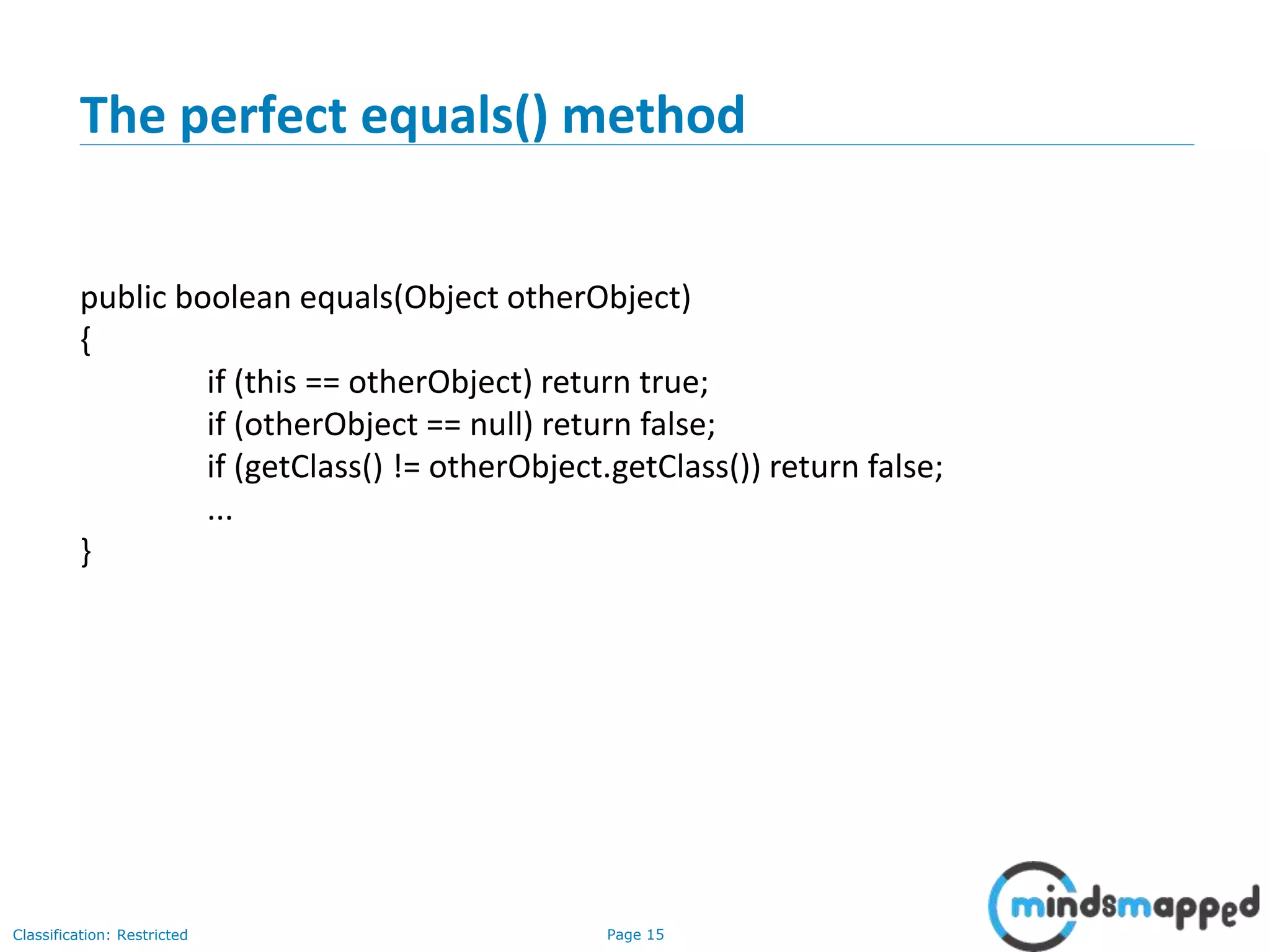
public boolean equals(Object otherObject)
{
if (this == otherObject) return true;
if (otherObject == null) return false;
if (getClass() != otherObject.getClass()) return false;
...
}
Page 16Classification: Restricted
16
Hashing
• Technique used to find elements in a data structure quickly, without doing
full linear search
• Important concepts:
• Hash code: integer value used to find array index for data
storage/retrieval
• Hash table: array of elements arranged according to hash code
• Hash function: computes hash code for element; uses algorithm likely to
produce different hash codes for different objects to minimize collisions
Page 17Classification: Restricted
17
Hashing in Java
• Java library contains HashSet and HashMap classes
• Use hash tables for data storage
• Since Object has a hashCode method (hash function), any type of object
can be stored in a hash table
Page 18Classification: Restricted
18
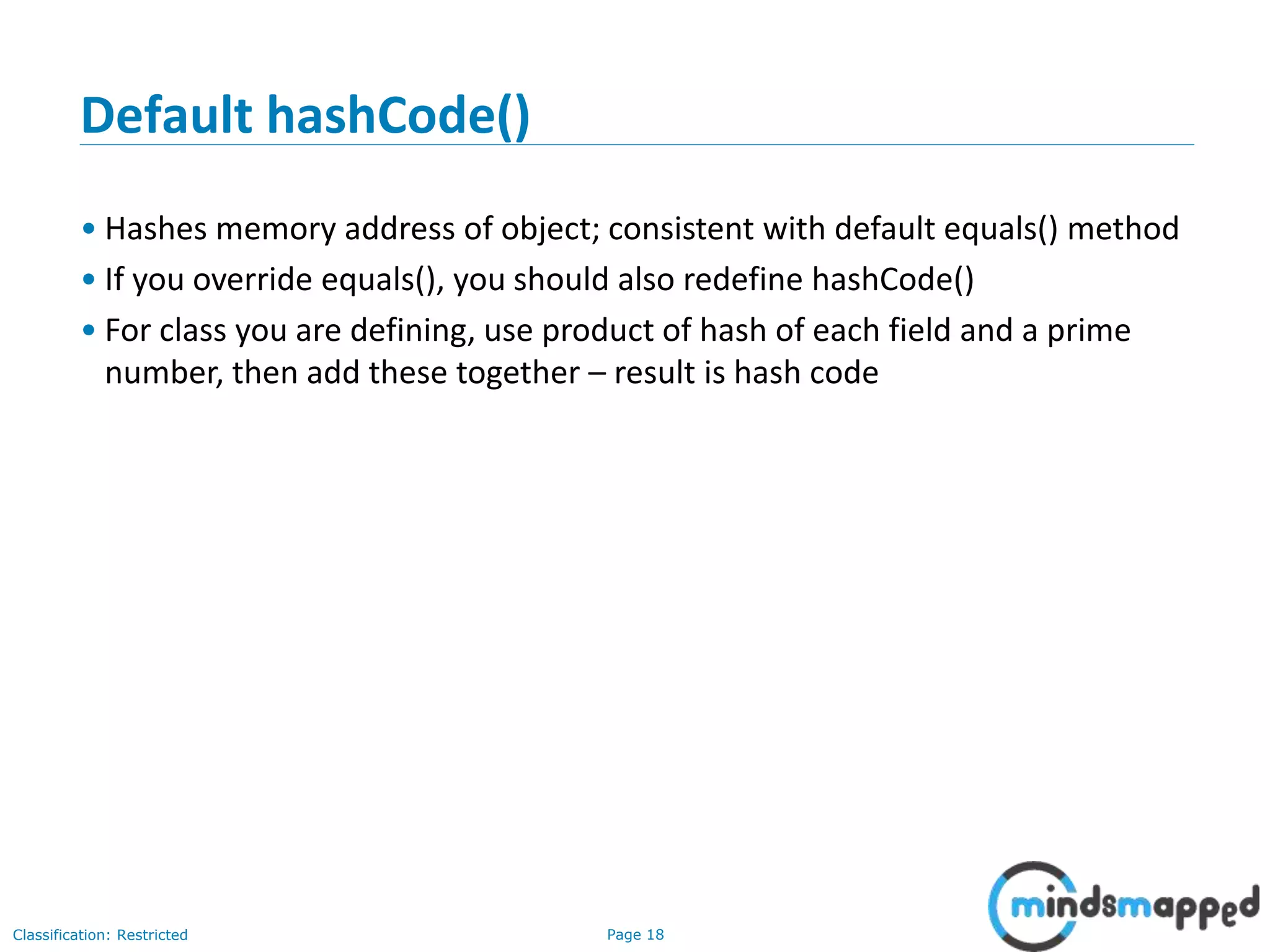
Default hashCode()
• Hashes memory address of object; consistent with default equals() method
• If you override equals(), you should also redefine hashCode()
• For class you are defining, use product of hash of each field and a prime
number, then add these together – result is hash code
Page 19Classification: Restricted
19
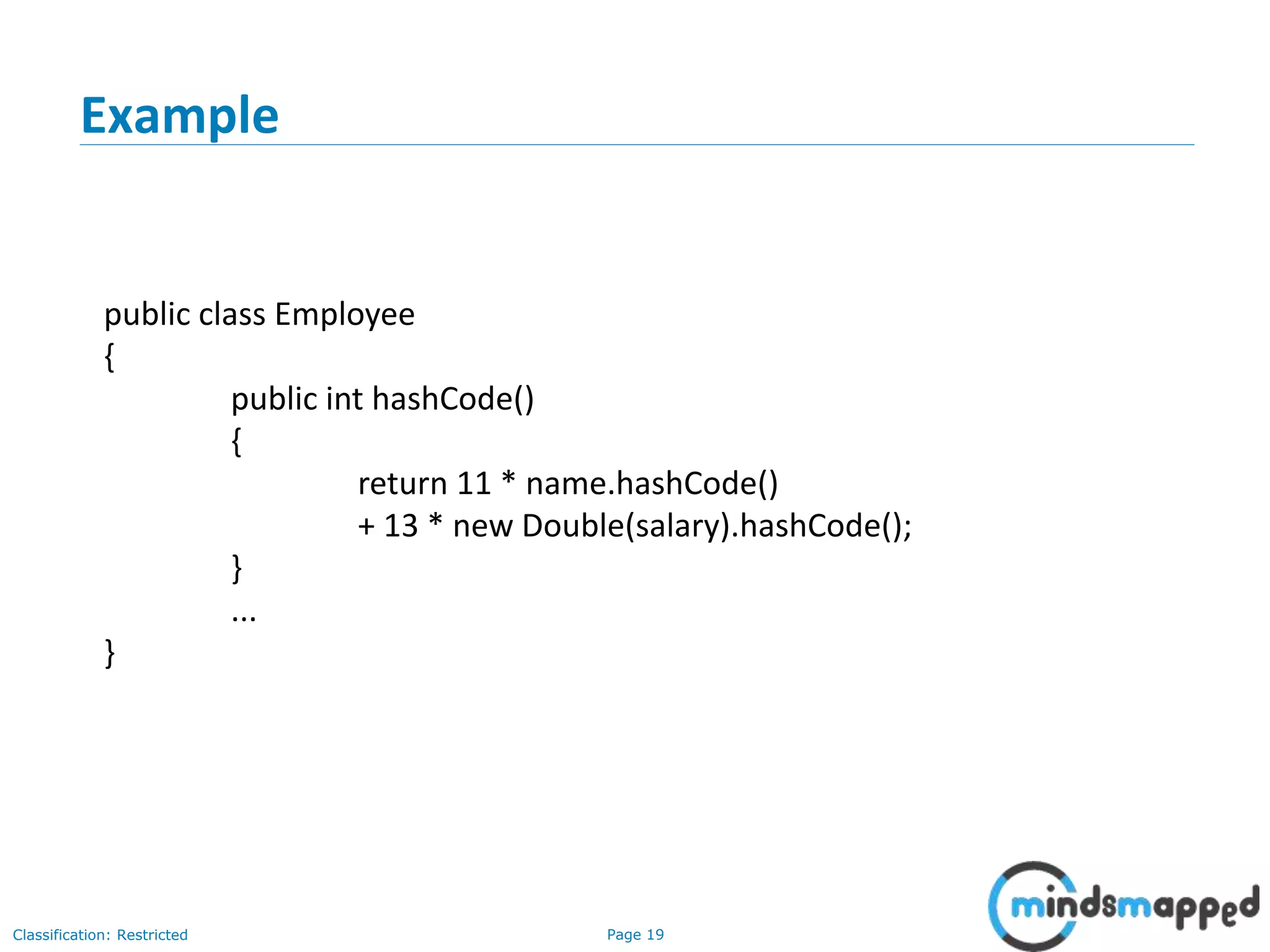
Example
public class Employee
{
public int hashCode()
{
return 11 * name.hashCode()
+ 13 * new Double(salary).hashCode();
}
...
}
Page 20Classification: Restricted
20
Topics to be covered in next session
• Recap of Arrays
• Introduction to Collections API
• Lists – ArrayList, Vector, LinkedList
Page 21Classification: Restricted
21
Thank you!

Object Class

  • 1.
  • 2.
    Page 1Classification: Restricted Quickrecap: Topics covered till now • Data Types – Primitive (byte, short, int, long, double, float, char, boolean) • Data Types – Wrapper (Byte, Short, Integer …) • Data Types – Classes for String (String - immutable, StringBuilder – mutable, StringBuffer – mutable+threadsafe); Concept of String pooling / interning • Arrays • Conditional statements, Loops • OOP with Java – • Polymorphism – Method overloading (Compile-time), Method Overriding (Runtime) • Inheritance – extending classes, implementing interfaces; multiple inheritance • Abstraction – abstract classes vs interfaces • Encapsulation – POJO classes / Beans • Packaging, Class Modifiers (public, protected, default, private) • Static members vs Instance members • Exception handling
  • 3.
    Page 2Classification: Restricted Agenda •Object Class • toString() • equals() • Hashing • hashCode()
  • 4.
    Object Class as “The basicunit of any collection”
  • 5.
    Page 4Classification: Restricted Objectclass • Superclass for all Java classes • Any class without explicit extends clause is a direct subclass of Object • Methods of Object include: • String toString() • boolean equals (Object other) • int hashCode()
  • 6.
    Page 5Classification: Restricted 5 MethodtoString() • Returns String representation of object; describes state of object • Automatically called when: • Object is concatenated with a String • Object is printed using print() or println() • Object reference is passed to assert statement of the form: assert condition : object
  • 7.
    Page 6Classification: Restricted 6 Example Rectangler = new Rectangle (0,0,20,40); System.out.println(r); Prints out: java.awt.Rectangle[x=0,y=0,width=20,height=40]
  • 8.
    Page 7Classification: Restricted 7 Moreon toString() • Default toString() method just prints (full) class name & hash code of object • Not all API classes override toString() • Good idea to implement for debugging purposes: • Should return String containing values of important fields along with their names • Should also return result of getClass().getName() rather than hard- coded class name
  • 9.
    Page 8Classification: Restricted OverridingtoString(): example public class Employee { public String toString() { return getClass().getName() + "[name=" + name + ",salary=" + salary + "]"; } ... } Typical String produced: Employee[name=John Doe,salary=40000]
  • 10.
    Page 9Classification: Restricted 9 OverridingtoString in a subclass • Format superclass first • Add unique subclass details • Example: public class Manager extends Employee { public String toString() { return super.toString() + "[department=" + department + "]"; } ... }
  • 11.
    Page 10Classification: Restricted 10 Examplecontinued • Typical String produced: Manager[name=Mary Lamb,salary=75000][department=Admin] • Note that superclass reports actual class name
  • 12.
    Page 11Classification: Restricted 11 Equalitytesting • Method equals() tests whether two objects have same contents • By contrast, == operator test 2 references to see if they point to the same object (or test primitive values for equality) • Need to define for each class what “equality” means: Compare all fields Compare 1 or 2 key fields
  • 13.
    Page 12Classification: Restricted 12 Equalitytesting • Object.equals tests for identity: public class Object { public boolean equals(Object obj) { return this == obj; } ... } • Override equals if you don't want to inherit that behavior
  • 14.
    Page 13Classification: Restricted 13 Overridingequals() • Good practice to override, since many API methods assume objects have well-defined notion of equality • When overriding equals() in a subclass, can call superclass version by using super.equals()
  • 15.
    Page 14Classification: Restricted 14 Requirementsfor equals() method • If x is not null, then x.equals(null) must be false
  • 16.
    Page 15Classification: Restricted Theperfect equals() method public boolean equals(Object otherObject) { if (this == otherObject) return true; if (otherObject == null) return false; if (getClass() != otherObject.getClass()) return false; ... }
  • 17.
    Page 16Classification: Restricted 16 Hashing •Technique used to find elements in a data structure quickly, without doing full linear search • Important concepts: • Hash code: integer value used to find array index for data storage/retrieval • Hash table: array of elements arranged according to hash code • Hash function: computes hash code for element; uses algorithm likely to produce different hash codes for different objects to minimize collisions
  • 18.
    Page 17Classification: Restricted 17 Hashingin Java • Java library contains HashSet and HashMap classes • Use hash tables for data storage • Since Object has a hashCode method (hash function), any type of object can be stored in a hash table
  • 19.
    Page 18Classification: Restricted 18 DefaulthashCode() • Hashes memory address of object; consistent with default equals() method • If you override equals(), you should also redefine hashCode() • For class you are defining, use product of hash of each field and a prime number, then add these together – result is hash code
  • 20.
    Page 19Classification: Restricted 19 Example publicclass Employee { public int hashCode() { return 11 * name.hashCode() + 13 * new Double(salary).hashCode(); } ... }
  • 21.
    Page 20Classification: Restricted 20 Topicsto be covered in next session • Recap of Arrays • Introduction to Collections API • Lists – ArrayList, Vector, LinkedList
  • 22.