Spring Data JPA
- By Jeevesh Pandey
• What is Spring Data
• Configurations
• Domain/Entities
• Persistent Identity
• Identifier Generation
• Customizing the Entity Object
• Entity Relationships
• Entity Inheritance
• EntityManager & the Persistent
Context
Agenda
• Repository and Repository Hierarchy
• User Defined Repository
• Defining Query methods
• Pageable
• Query creation : Custom Queries and
Named Queries
• Custom Interfaces
• Accessing Spring Data with rest
• Transactional
• Disadvantages
What and Why ?
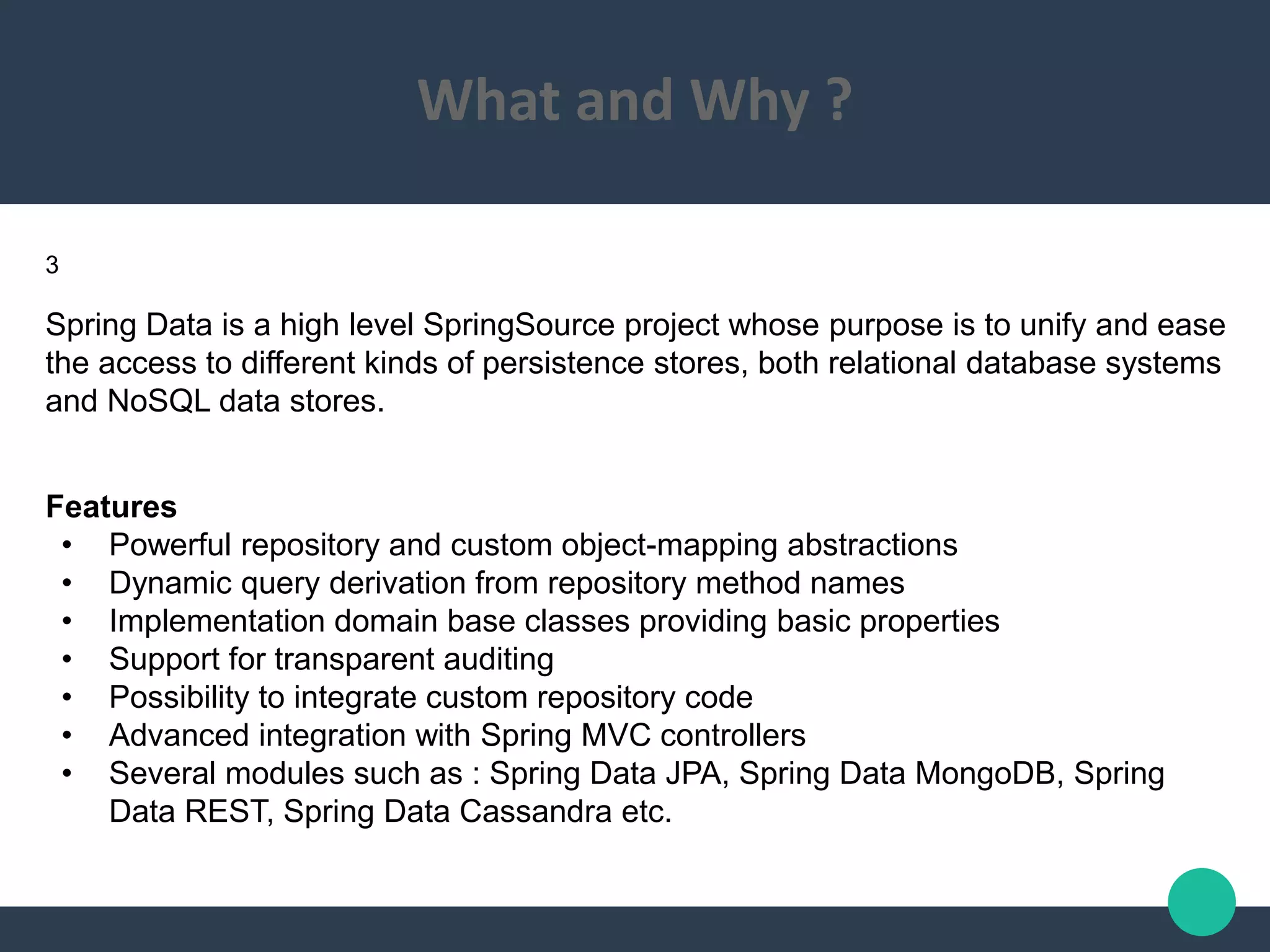
Spring Data is a high level SpringSource project whose purpose is to unify and ease
the access to different kinds of persistence stores, both relational database systems
and NoSQL data stores.
Features
• Powerful repository and custom object-mapping abstractions
• Dynamic query derivation from repository method names
• Implementation domain base classes providing basic properties
• Support for transparent auditing
• Possibility to integrate custom repository code
• Advanced integration with Spring MVC controllers
• Several modules such as : Spring Data JPA, Spring Data MongoDB, Spring
Data REST, Spring Data Cassandra etc.
3
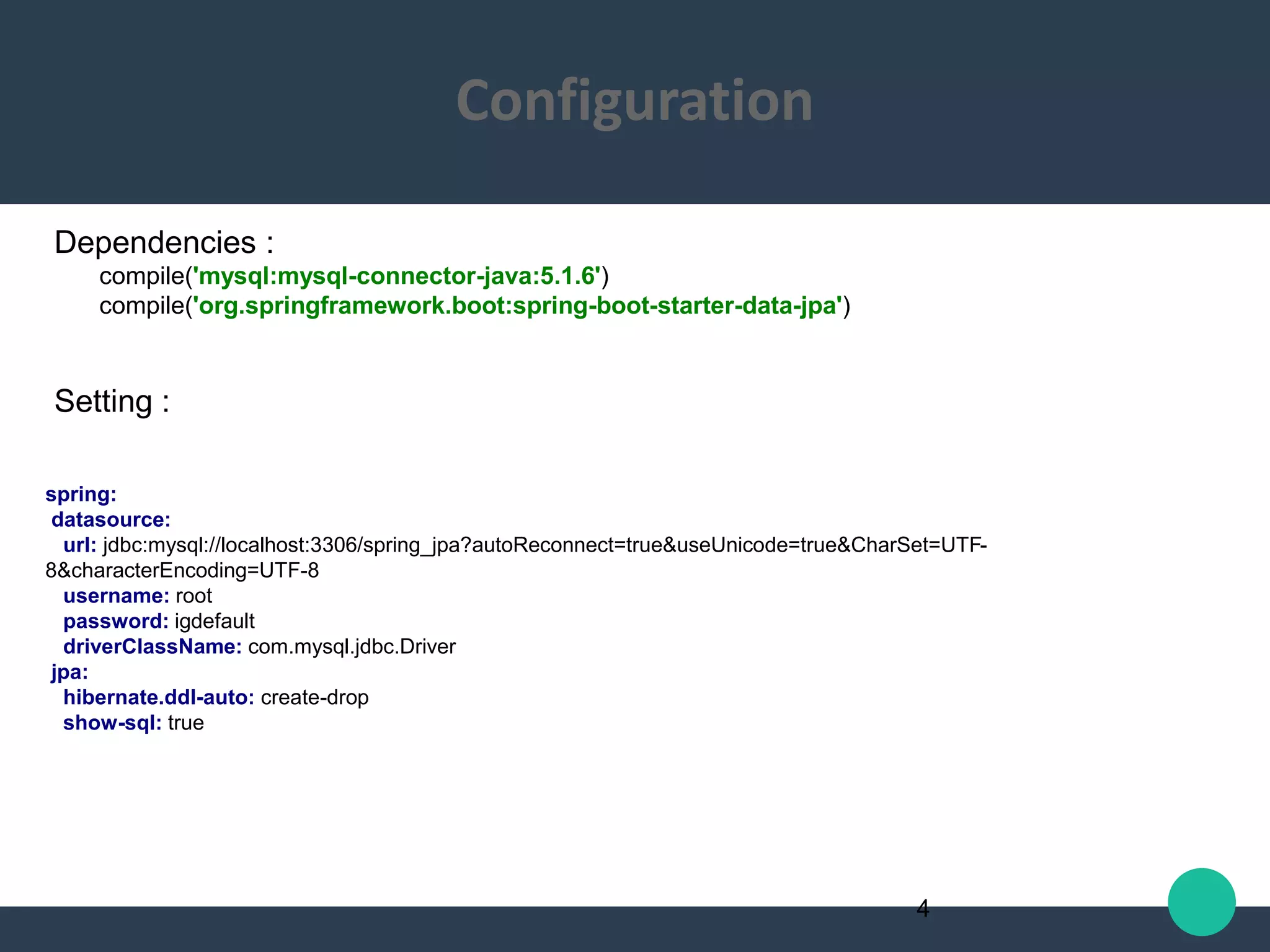
Dependencies :
compile('mysql:mysql-connector-java:5.1.6')
compile('org.springframework.boot:spring-boot-starter-data-jpa')
Setting :
spring:
datasource:
url: jdbc:mysql://localhost:3306/spring_jpa?autoReconnect=true&useUnicode=true&CharSet=UTF-
8&characterEncoding=UTF-8
username: root
password: igdefault
driverClassName: com.mysql.jdbc.Driver
jpa:
hibernate.ddl-auto: create-drop
show-sql: true
4
Configuration
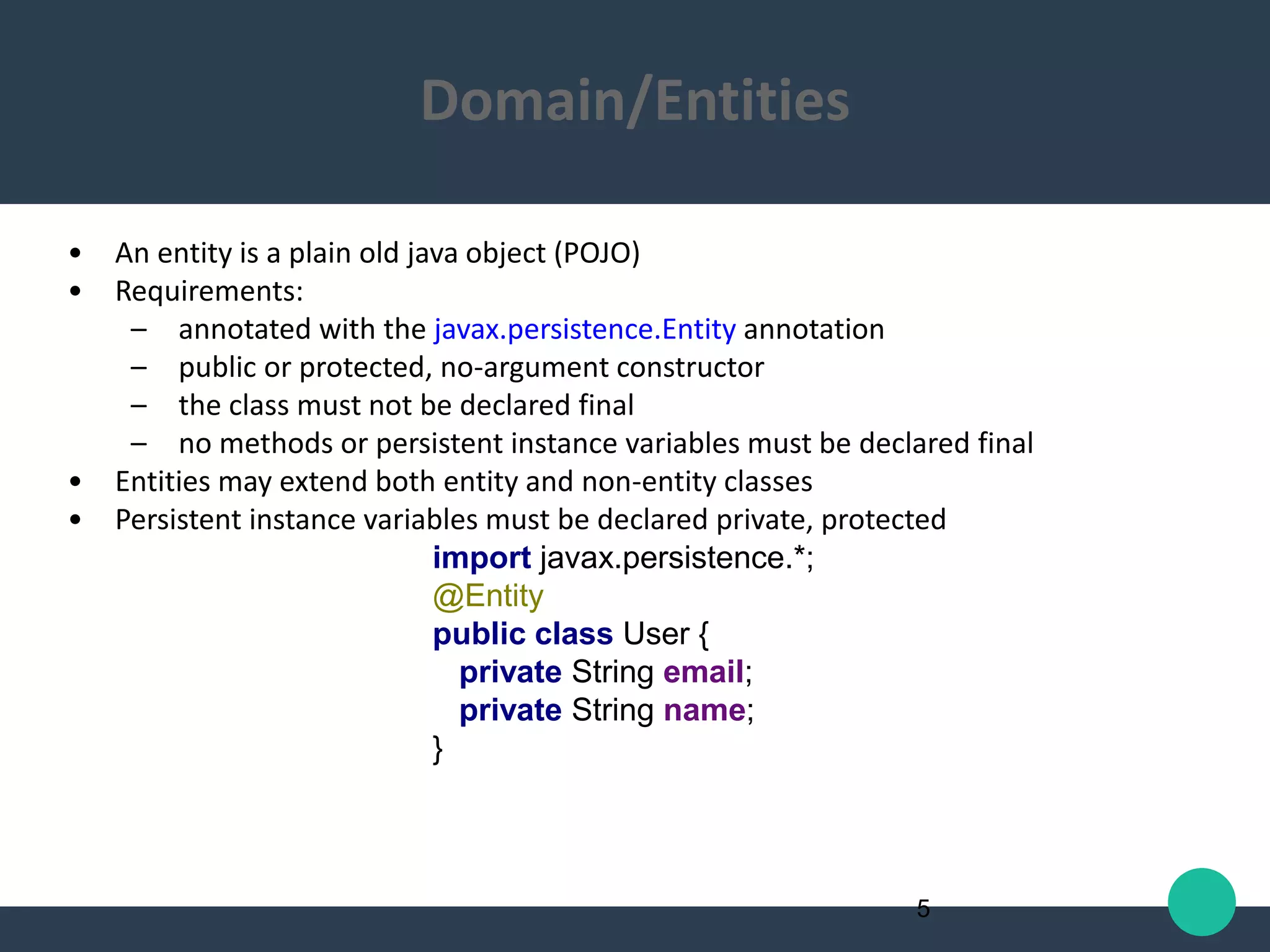
• An entity is a plain old java object (POJO)
• Requirements:
– annotated with the javax.persistence.Entity annotation
– public or protected, no-argument constructor
– the class must not be declared final
– no methods or persistent instance variables must be declared final
• Entities may extend both entity and non-entity classes
• Persistent instance variables must be declared private, protected
import javax.persistence.*;
@Entity
public class User {
private String email;
private String name;
}
5
Domain/Entities
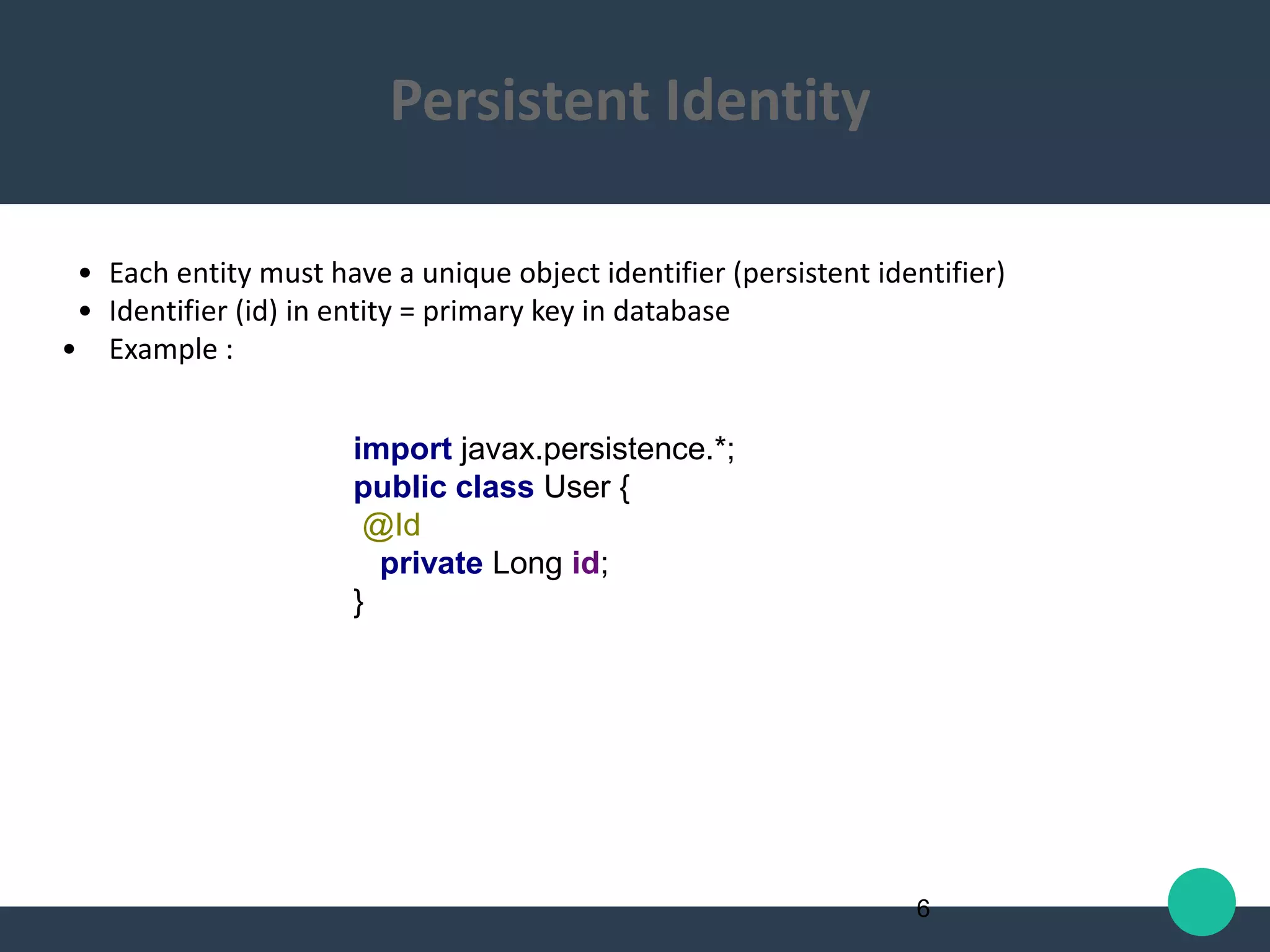
• Each entity must have a unique object identifier (persistent identifier)
• Identifier (id) in entity = primary key in database
• Example :
import javax.persistence.*;
public class User {
@Id
private Long id;
}
6
Persistent Identity
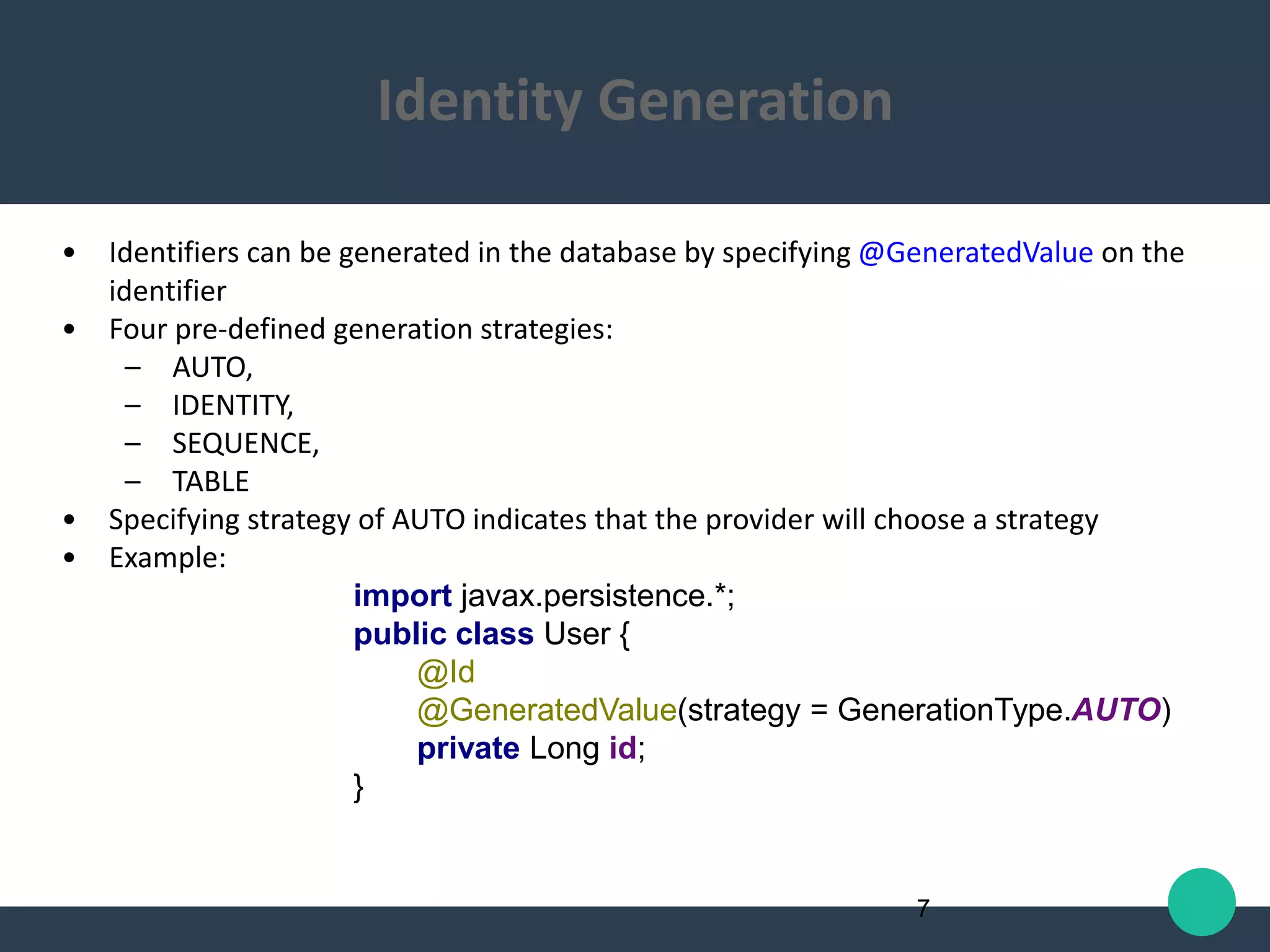
• Identifiers can be generated in the database by specifying @GeneratedValue on the
identifier
• Four pre-defined generation strategies:
– AUTO,
– IDENTITY,
– SEQUENCE,
– TABLE
• Specifying strategy of AUTO indicates that the provider will choose a strategy
• Example:
import javax.persistence.*;
public class User {
@Id
@GeneratedValue(strategy = GenerationType.AUTO)
private Long id;
}
7
Identity Generation
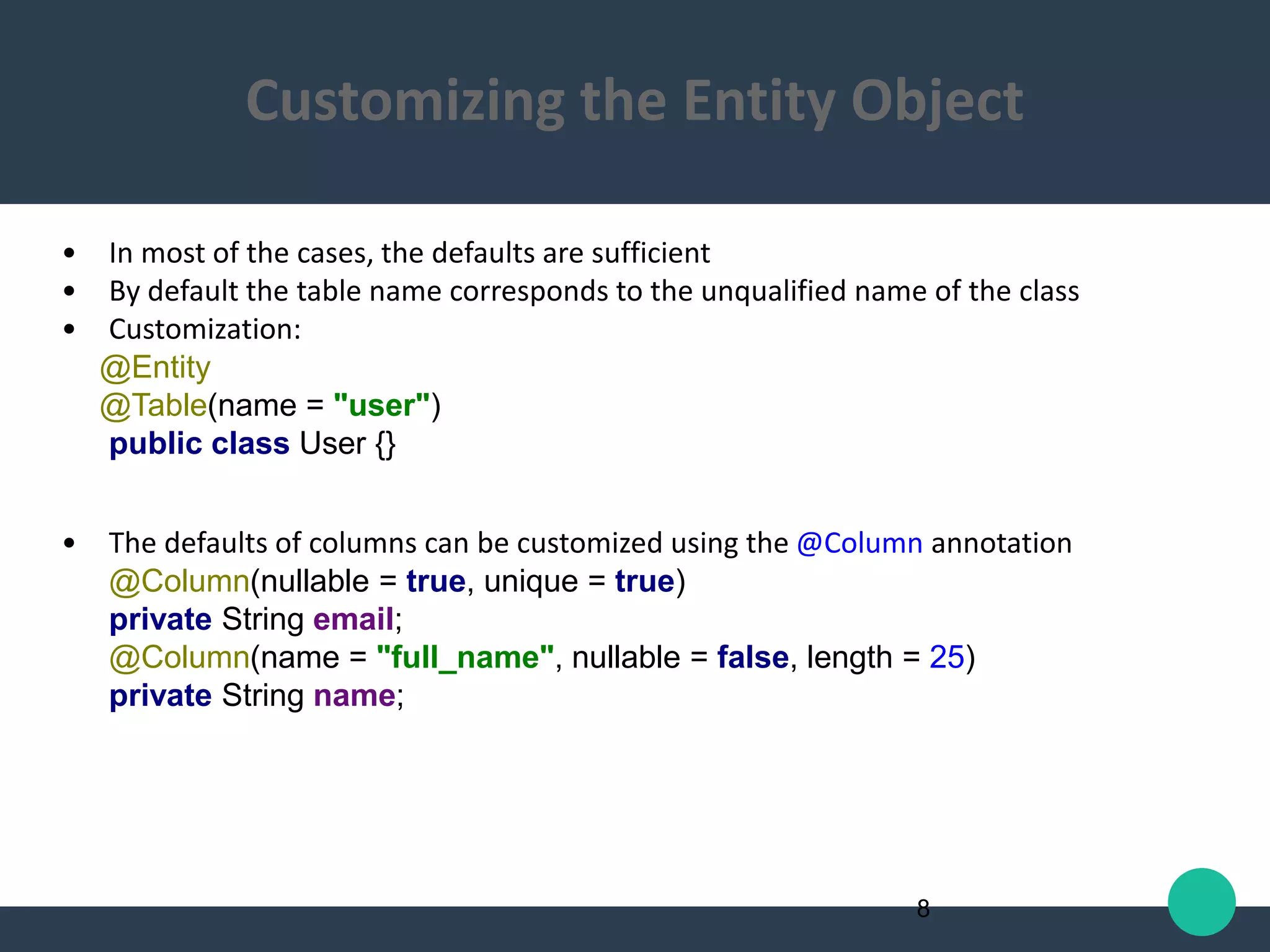
• In most of the cases, the defaults are sufficient
• By default the table name corresponds to the unqualified name of the class
• Customization:
@Entity
@Table(name = "user")
public class User {}
• The defaults of columns can be customized using the @Column annotation
@Column(nullable = true, unique = true)
private String email;
@Column(name = "full_name", nullable = false, length = 25)
private String name;
8
Customizing the Entity Object
• There are four types of relationship multiplicities:
– @OneToOne
– @OneToMany
– @ManyToOne
– @ManyToMany
• The direction of a relationship can be:
– bidirectional – owning side and inverse side
– unidirectional – owning side only
• Supports cascading updates/deletes
• You can declare performance strategy to use with fetching related rows
FetchType :
LAZY, EAGER
9
Entity Relationships
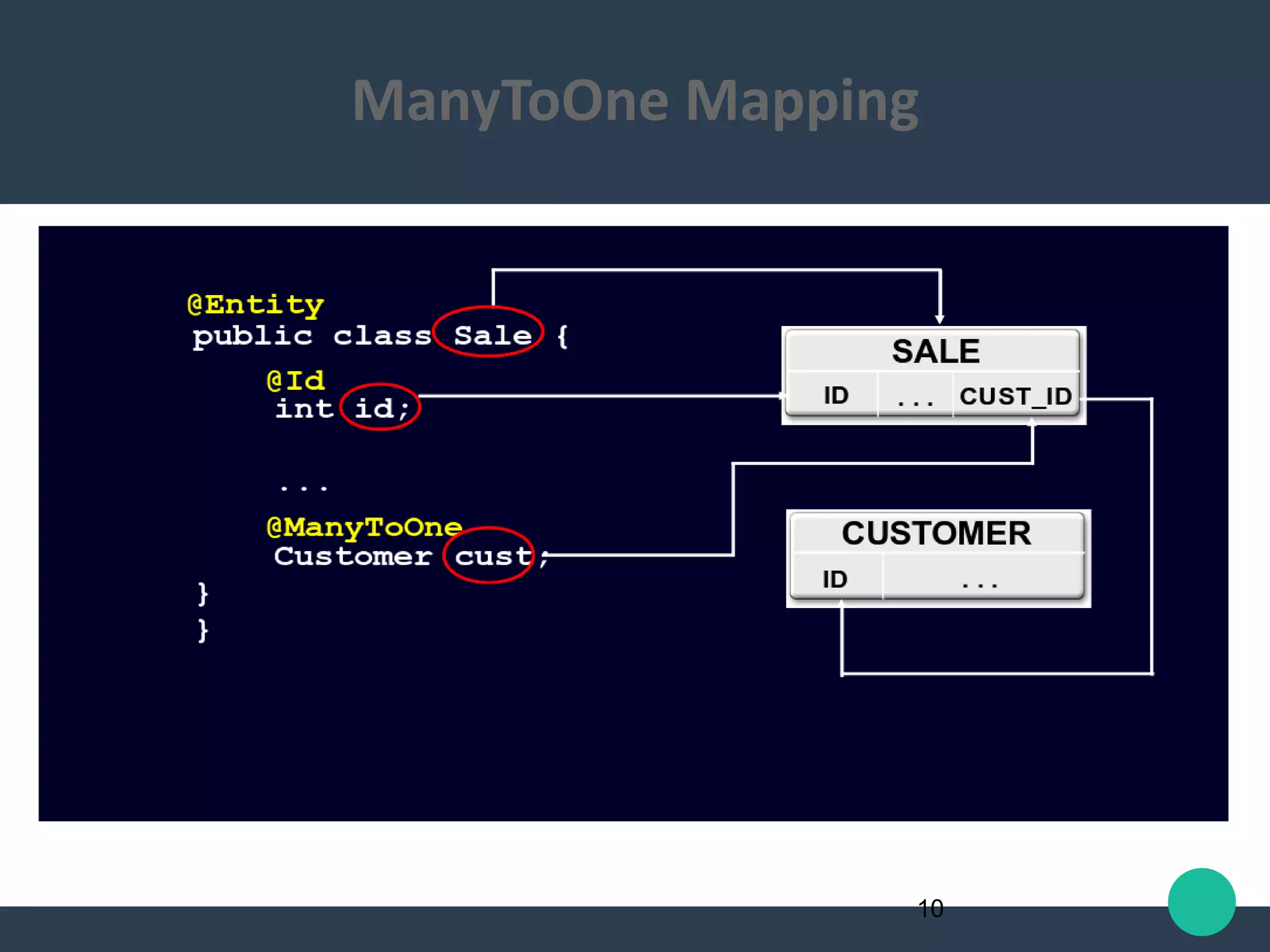
10
ManyToOne Mapping
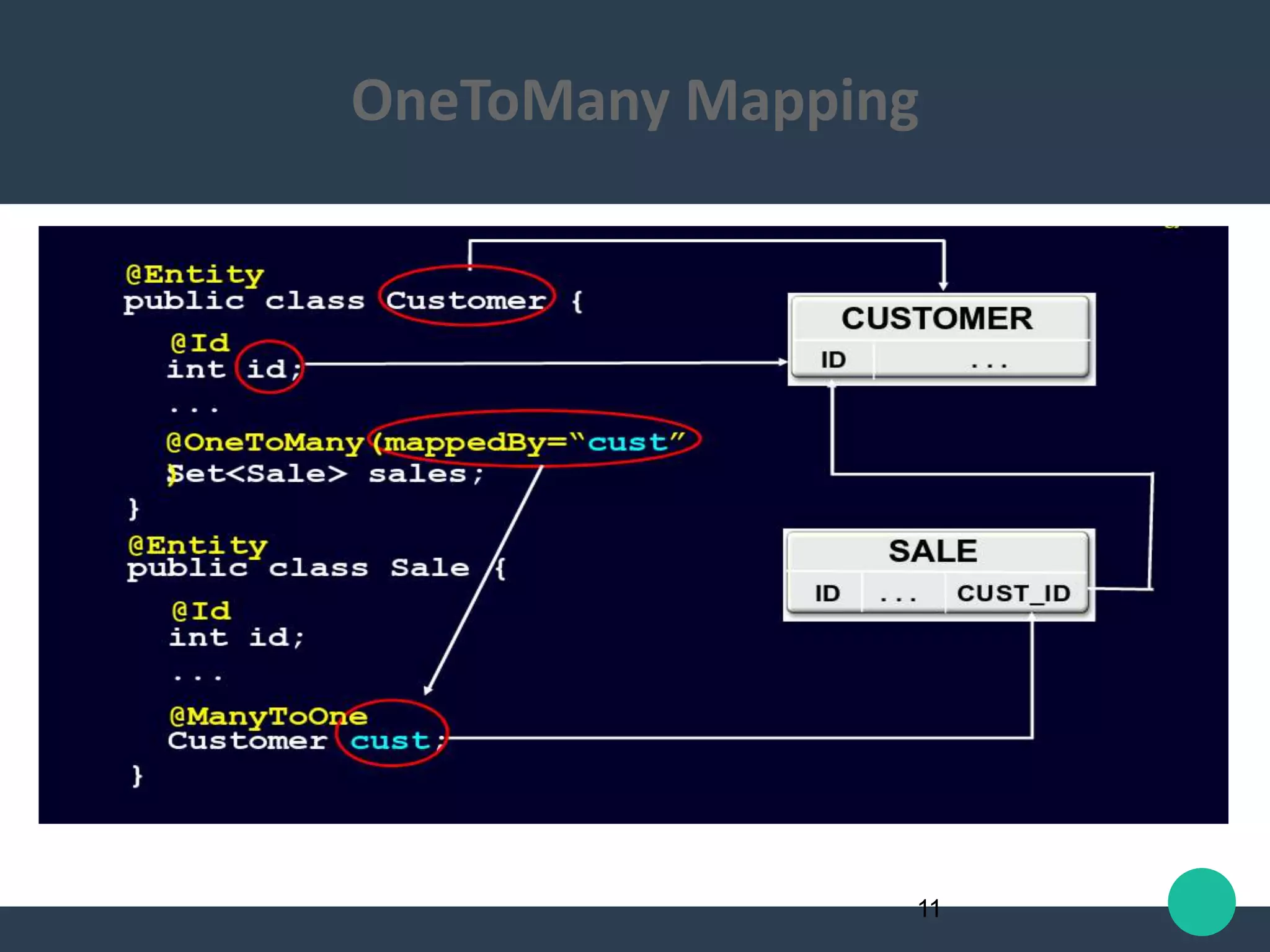
11
OneToMany Mapping
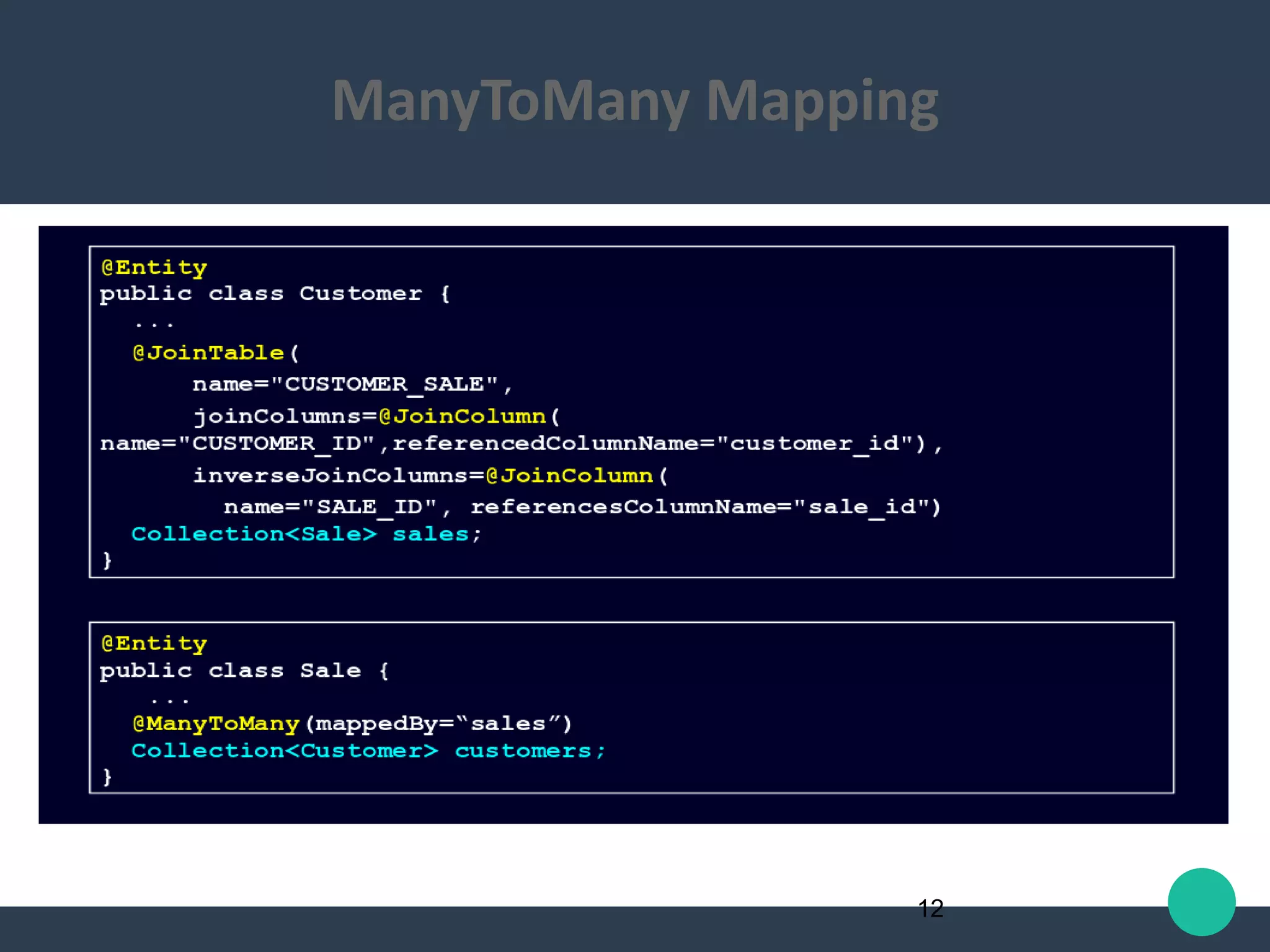
12
ManyToMany Mapping
• Entities can inherit from other entities and from non-entities
• The @Inheritance annotation identifies a mapping strategy:
– SINGLE_TABLE
– JOINED
– TABLE_PER_CLASS
• SINGLE_TABLE strategy - all classes in the hierarchy are mapped to a single table in the
database
• Discriminator column - contains a value that identifies the subclass
• Discriminator type - {STRING, CHAR, INTEGER}
• Discriminator value - value entered into the discriminator column for each entity in a
class hierarchy
13
Entity Inheritance
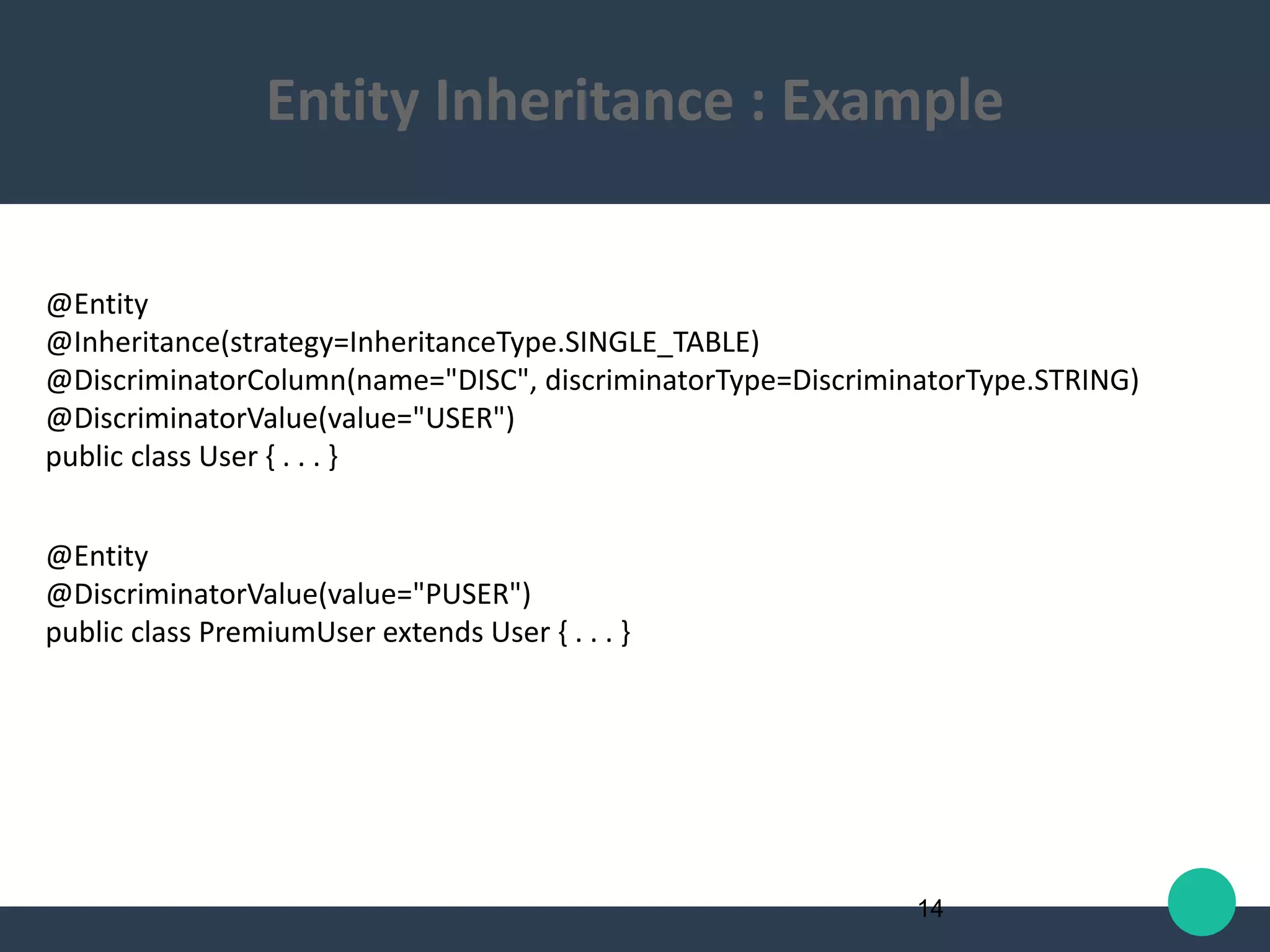
@Entity
@Inheritance(strategy=InheritanceType.SINGLE_TABLE)
@DiscriminatorColumn(name="DISC", discriminatorType=DiscriminatorType.STRING)
@DiscriminatorValue(value="USER")
public class User { . . . }
@Entity
@DiscriminatorValue(value="PUSER")
public class PremiumUser extends User { . . . }
14
Entity Inheritance : Example
• Entities are managed by the entity manager
• The entity manager is represented by javax.persistence.EntityManager instances
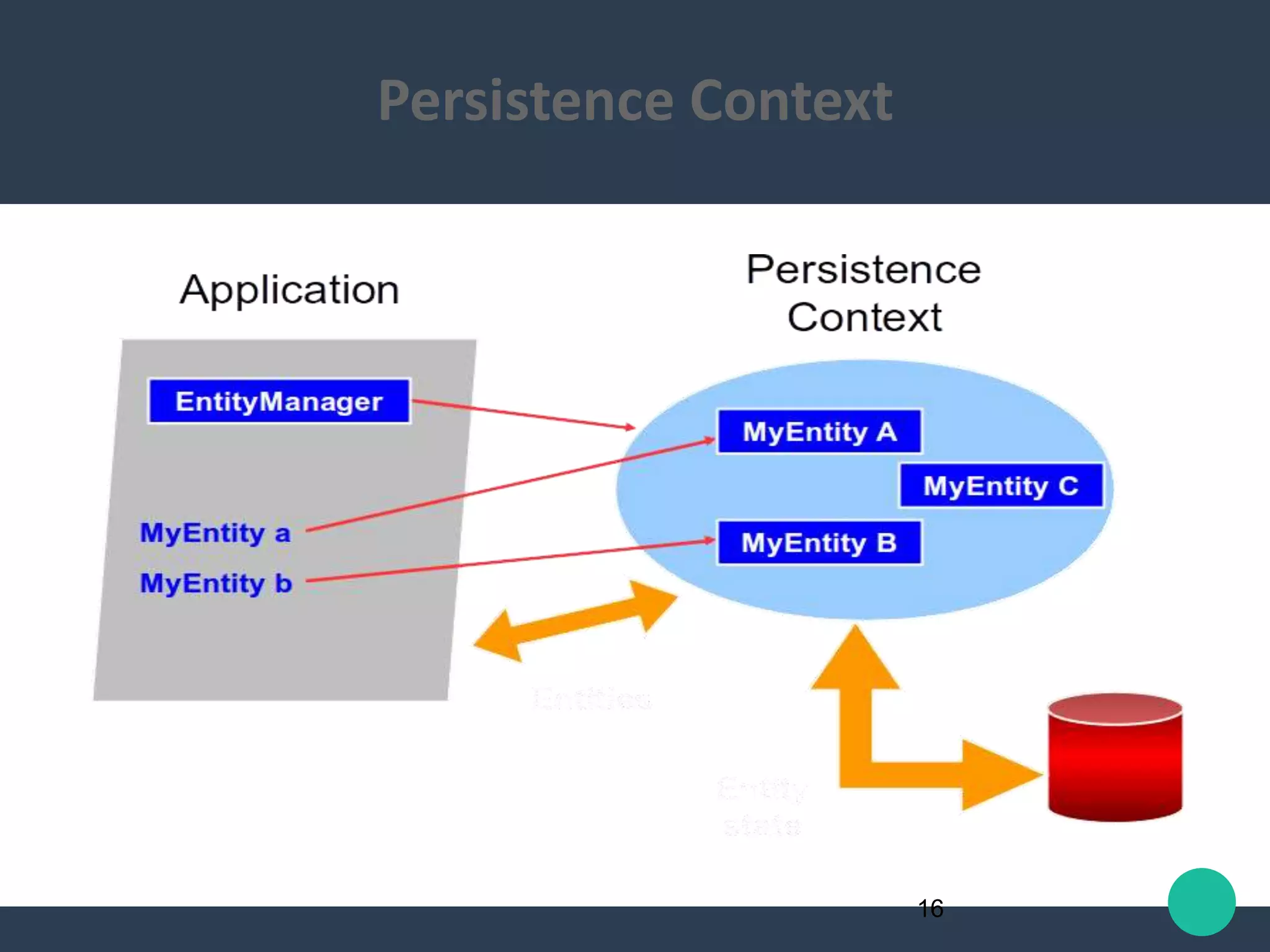
• Each EntityManager instance is associated with a persistence context
• A persistence context defines the scope under which particular entity instances are
created, persisted, and removed
• A persistence context is a set of managed entity instances that exist in a particular
data store
– Entities keyed by their persistent identity
– Only one entity with a given persistent identity may exist in the persistence
context
– Entities are added to the persistence context, but are not individually removable
(“detached”)
• Controlled and managed by EntityManager
– Contents of persistence context change as a result of operations on
EntityManager API
15
Managing Entities - JPA
16
Persistence Context
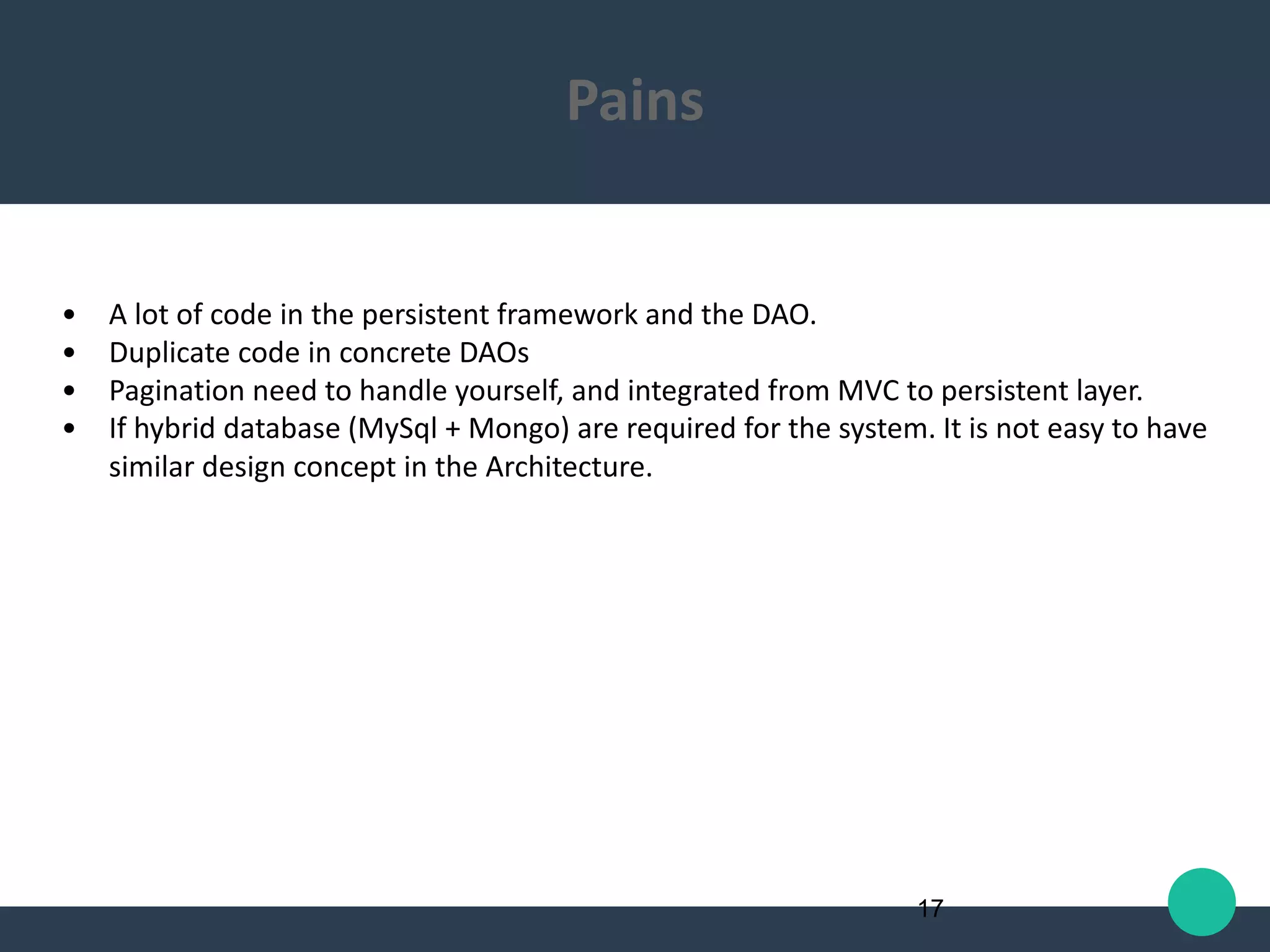
• A lot of code in the persistent framework and the DAO.
• Duplicate code in concrete DAOs
• Pagination need to handle yourself, and integrated from MVC to persistent layer.
• If hybrid database (MySql + Mongo) are required for the system. It is not easy to have
similar design concept in the Architecture.
17
Pains
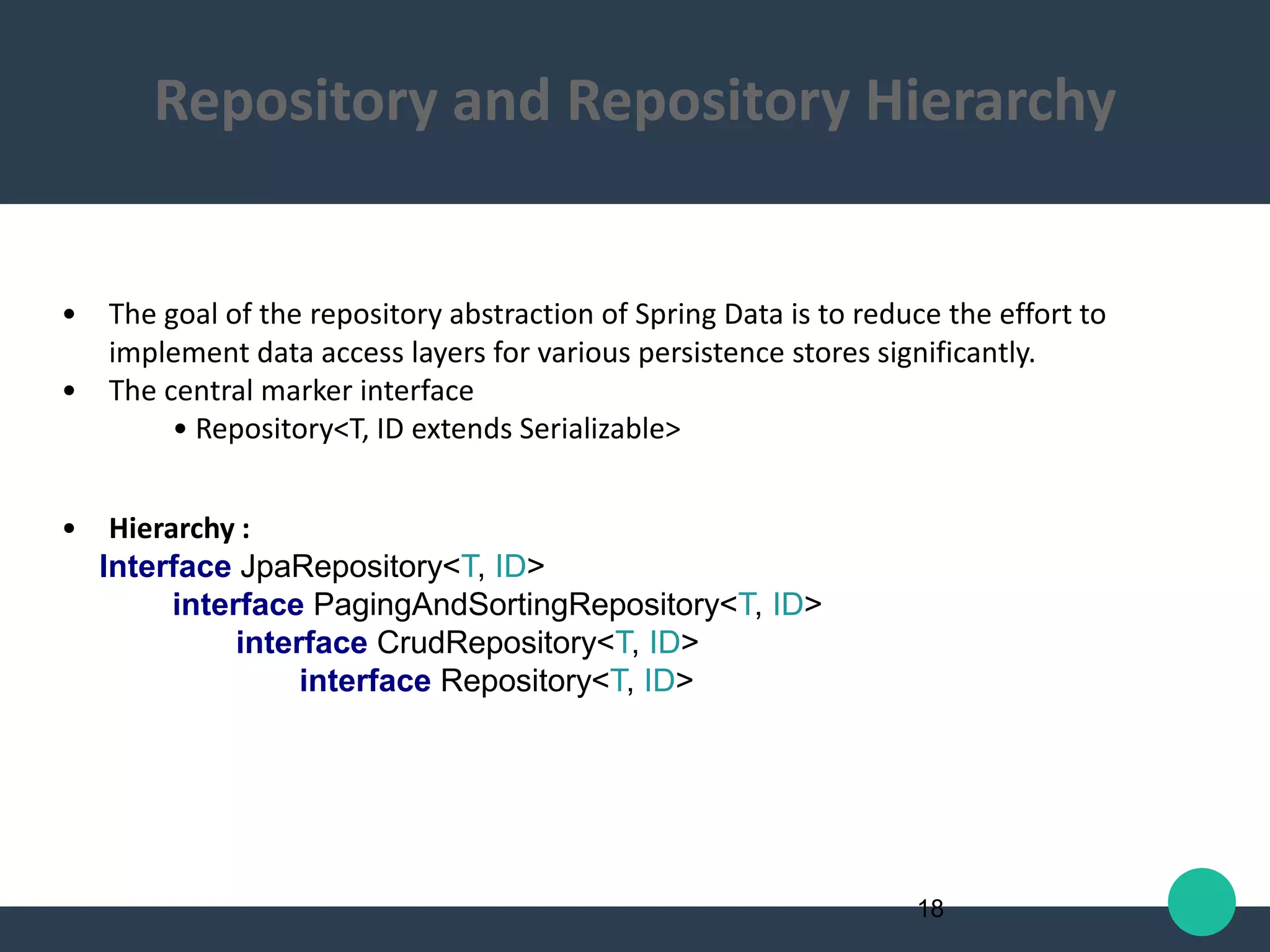
• The goal of the repository abstraction of Spring Data is to reduce the effort to
implement data access layers for various persistence stores significantly.
• The central marker interface
• Repository<T, ID extends Serializable>
• Hierarchy :
Interface JpaRepository<T, ID>
interface PagingAndSortingRepository<T, ID>
interface CrudRepository<T, ID>
interface Repository<T, ID>
18
Repository and Repository Hierarchy
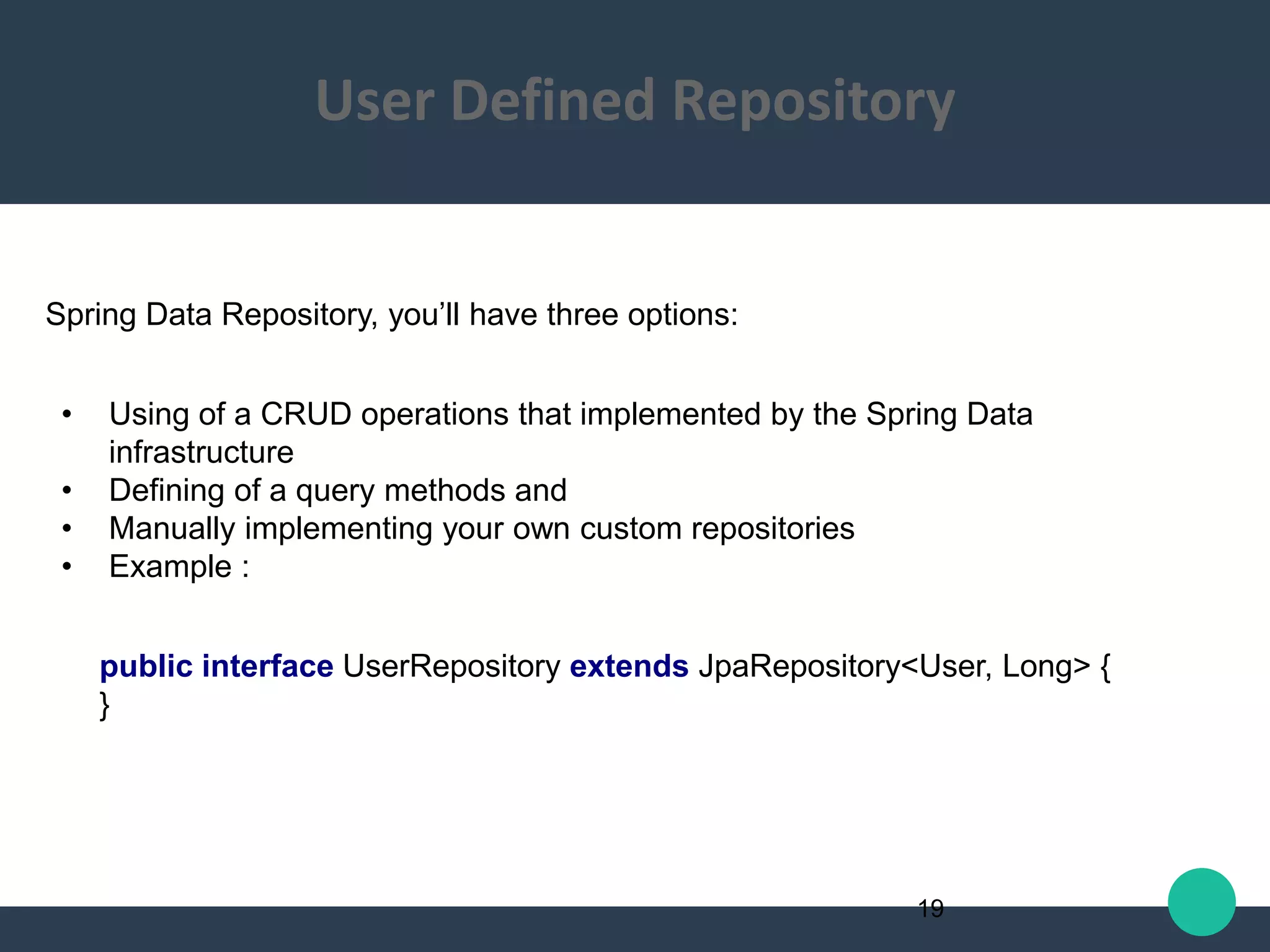
Spring Data Repository, you’ll have three options:
• Using of a CRUD operations that implemented by the Spring Data
infrastructure
• Defining of a query methods and
• Manually implementing your own custom repositories
• Example :
public interface UserRepository extends JpaRepository<User, Long> {
}
19
User Defined Repository
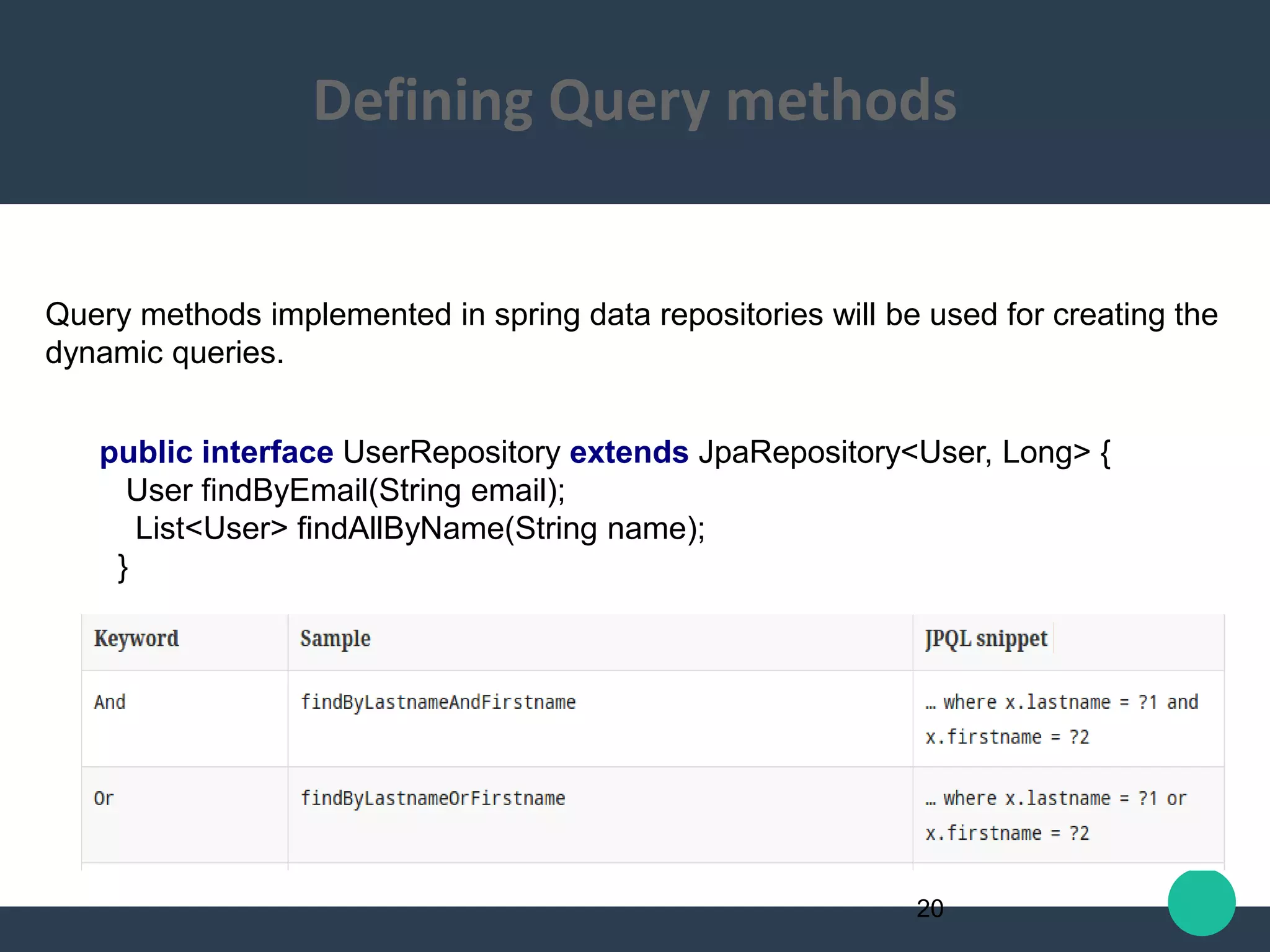
Query methods implemented in spring data repositories will be used for creating the
dynamic queries.
public interface UserRepository extends JpaRepository<User, Long> {
User findByEmail(String email);
List<User> findAllByName(String name);
}
20
Defining Query methods
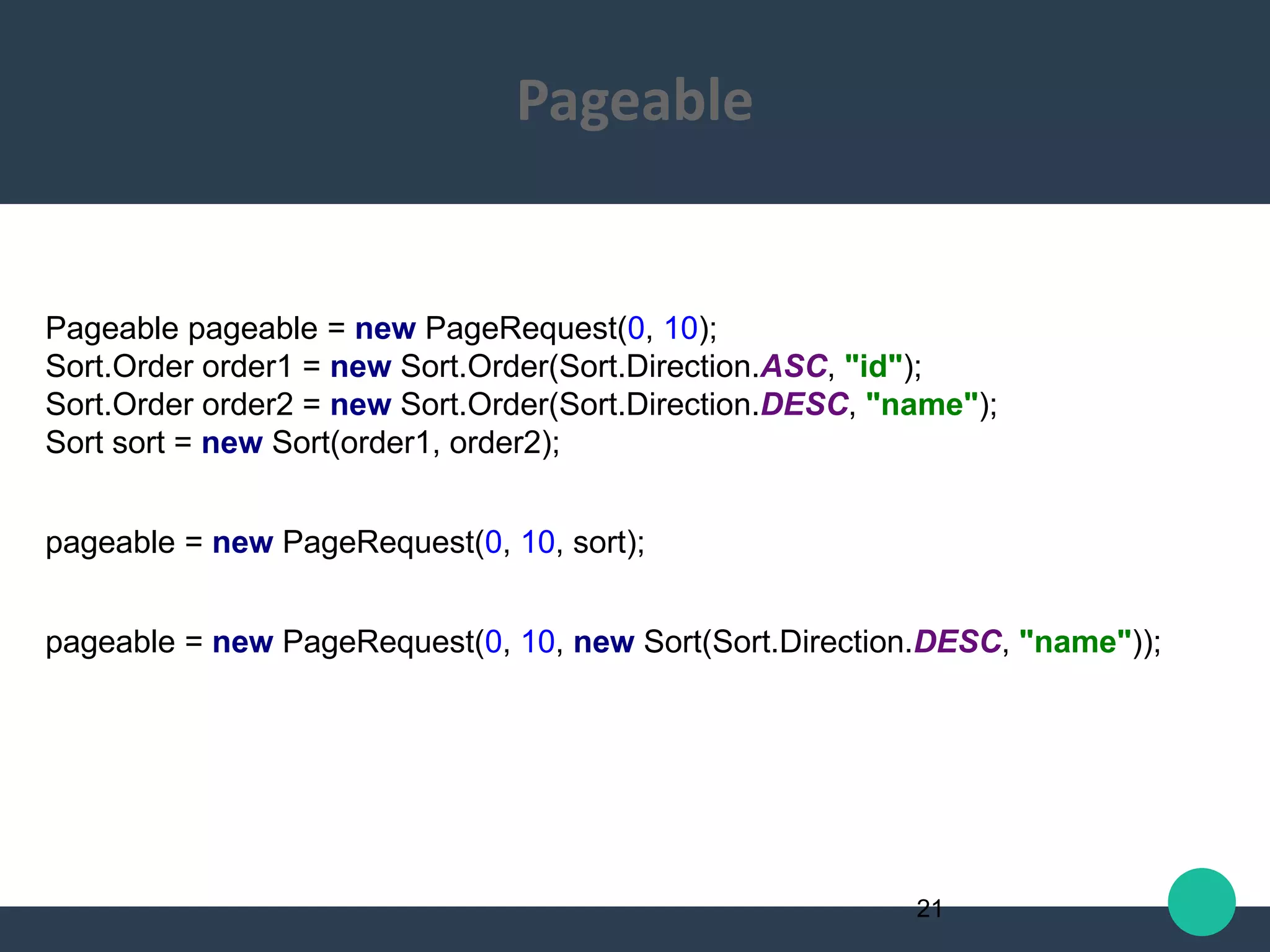
Pageable pageable = new PageRequest(0, 10);
Sort.Order order1 = new Sort.Order(Sort.Direction.ASC, "id");
Sort.Order order2 = new Sort.Order(Sort.Direction.DESC, "name");
Sort sort = new Sort(order1, order2);
pageable = new PageRequest(0, 10, sort);
pageable = new PageRequest(0, 10, new Sort(Sort.Direction.DESC, "name"));
21
Pageable
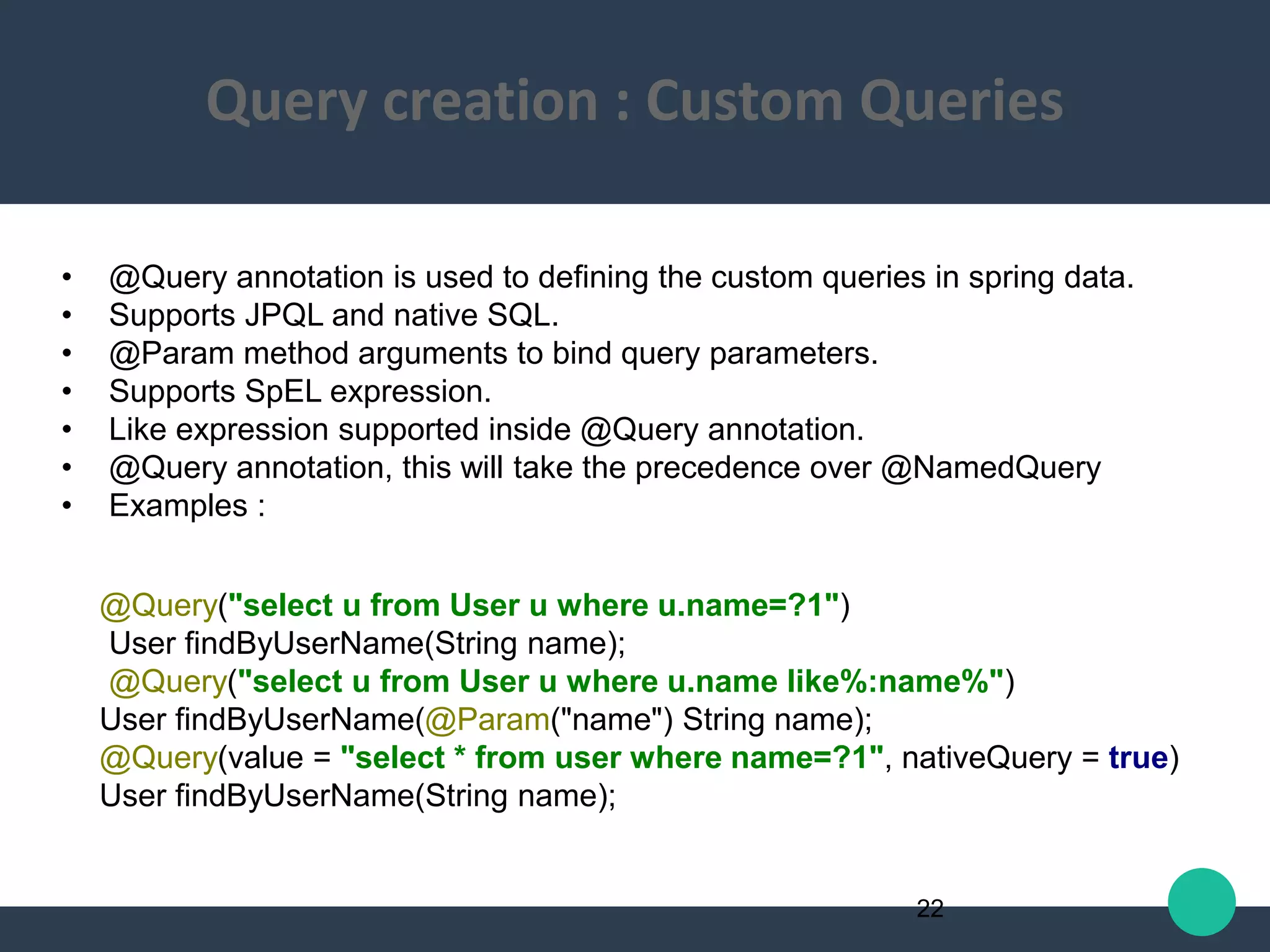
• @Query annotation is used to defining the custom queries in spring data.
• Supports JPQL and native SQL.
• @Param method arguments to bind query parameters.
• Supports SpEL expression.
• Like expression supported inside @Query annotation.
• @Query annotation, this will take the precedence over @NamedQuery
• Examples :
@Query("select u from User u where u.name=?1")
User findByUserName(String name);
@Query("select u from User u where u.name like%:name%")
User findByUserName(@Param("name") String name);
@Query(value = "select * from user where name=?1", nativeQuery = true)
User findByUserName(String name);
22
Query creation : Custom Queries
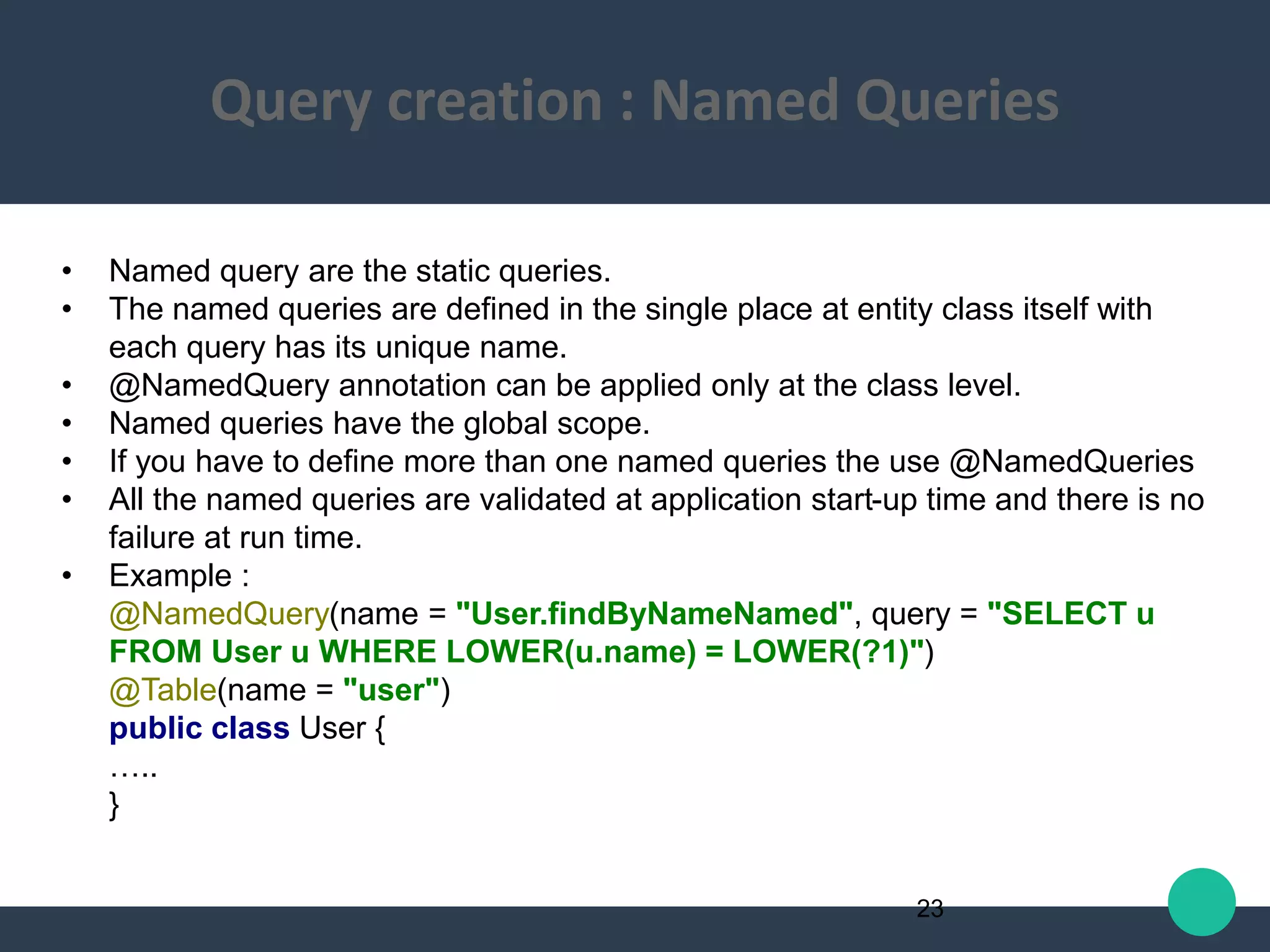
• Named query are the static queries.
• The named queries are defined in the single place at entity class itself with
each query has its unique name.
• @NamedQuery annotation can be applied only at the class level.
• Named queries have the global scope.
• If you have to define more than one named queries the use @NamedQueries
• All the named queries are validated at application start-up time and there is no
failure at run time.
• Example :
@NamedQuery(name = "User.findByNameNamed", query = "SELECT u
FROM User u WHERE LOWER(u.name) = LOWER(?1)")
@Table(name = "user")
public class User {
…..
}
23
Query creation : Named Queries
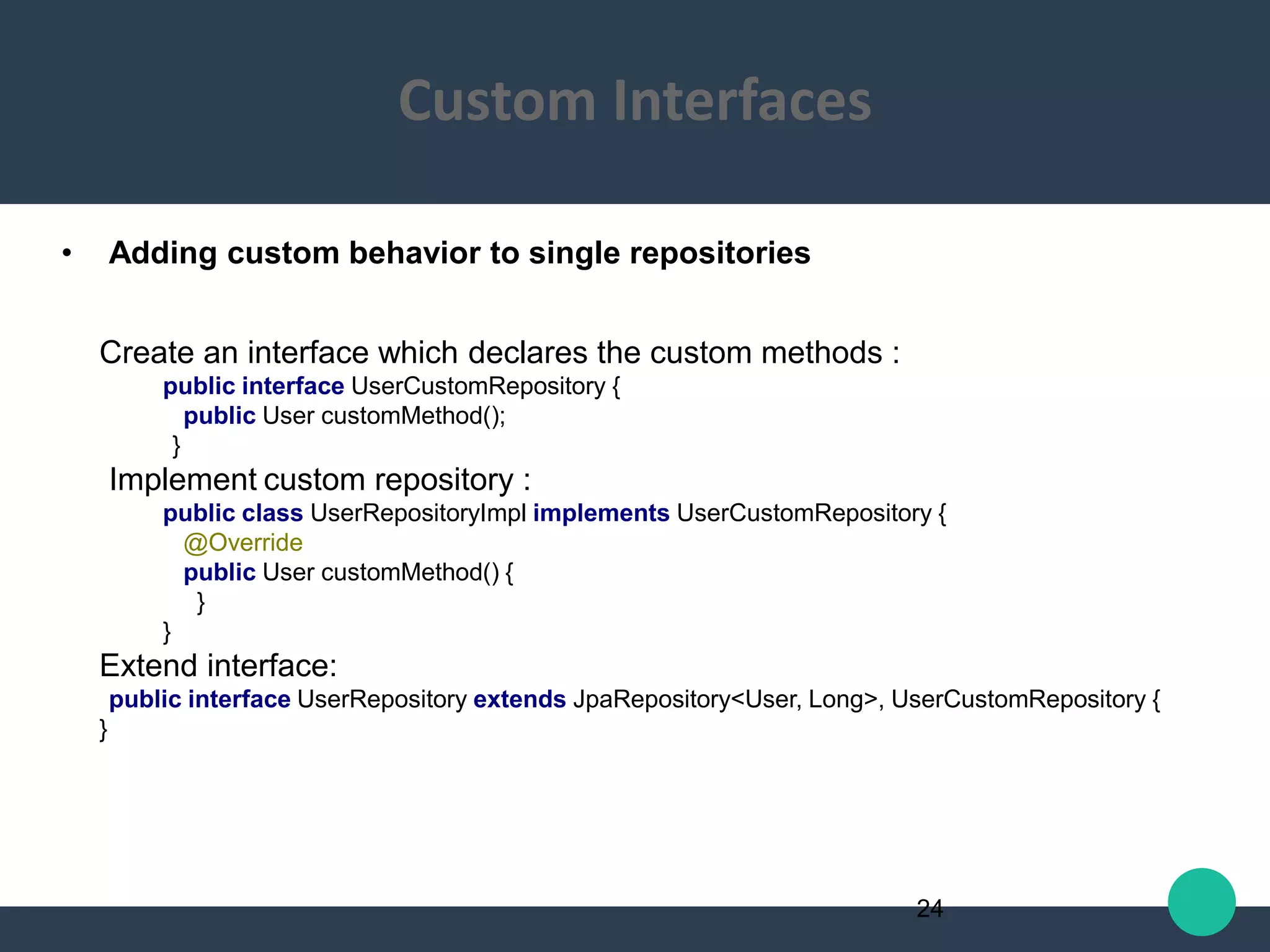
• Adding custom behavior to single repositories
Create an interface which declares the custom methods :
public interface UserCustomRepository {
public User customMethod();
}
Implement custom repository :
public class UserRepositoryImpl implements UserCustomRepository {
@Override
public User customMethod() {
}
}
Extend interface:
public interface UserRepository extends JpaRepository<User, Long>, UserCustomRepository {
}
24
Custom Interfaces
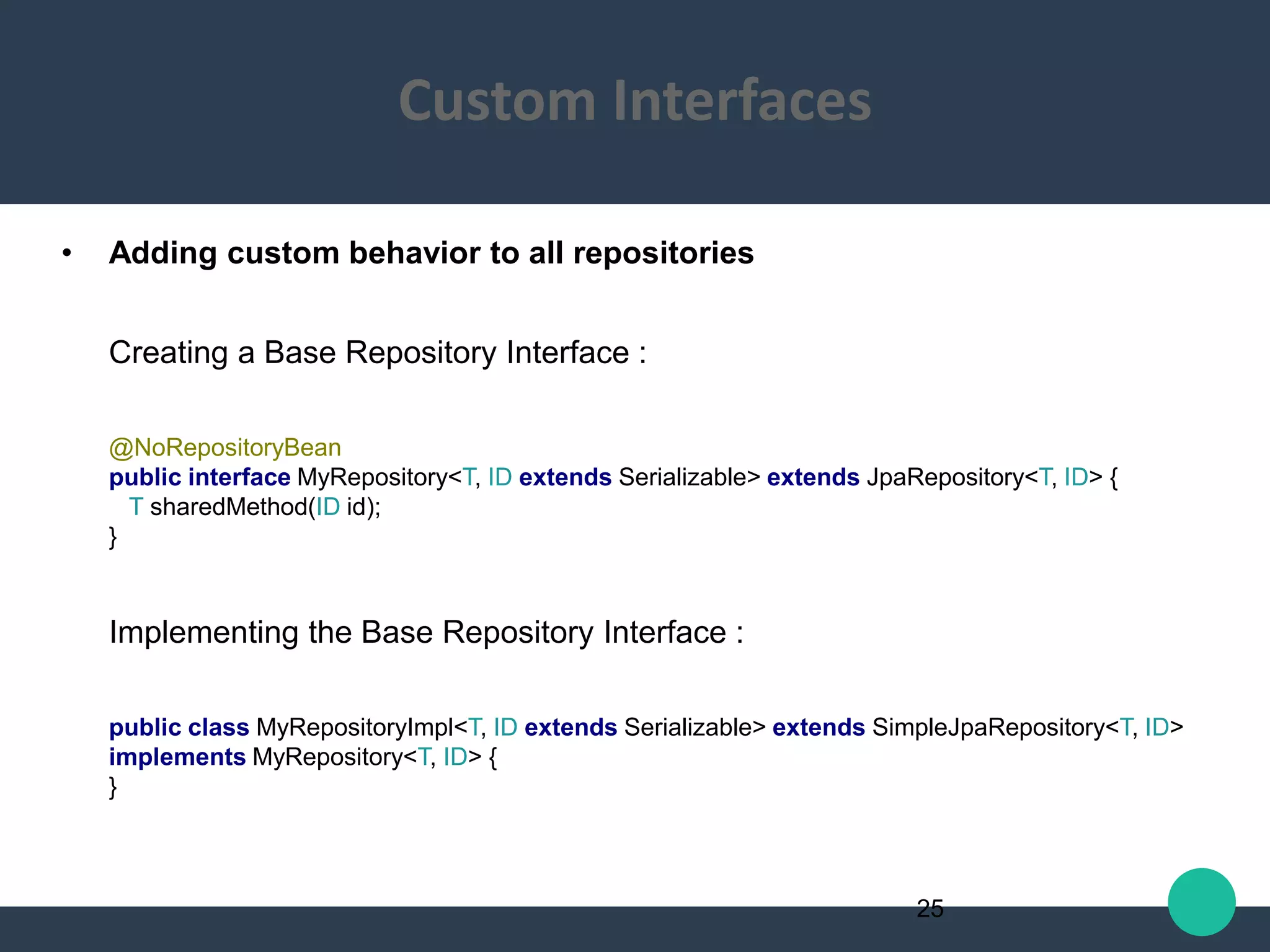
• Adding custom behavior to all repositories
Creating a Base Repository Interface :
@NoRepositoryBean
public interface MyRepository<T, ID extends Serializable> extends JpaRepository<T, ID> {
T sharedMethod(ID id);
}
Implementing the Base Repository Interface :
public class MyRepositoryImpl<T, ID extends Serializable> extends SimpleJpaRepository<T, ID>
implements MyRepository<T, ID> {
}
25
Custom Interfaces
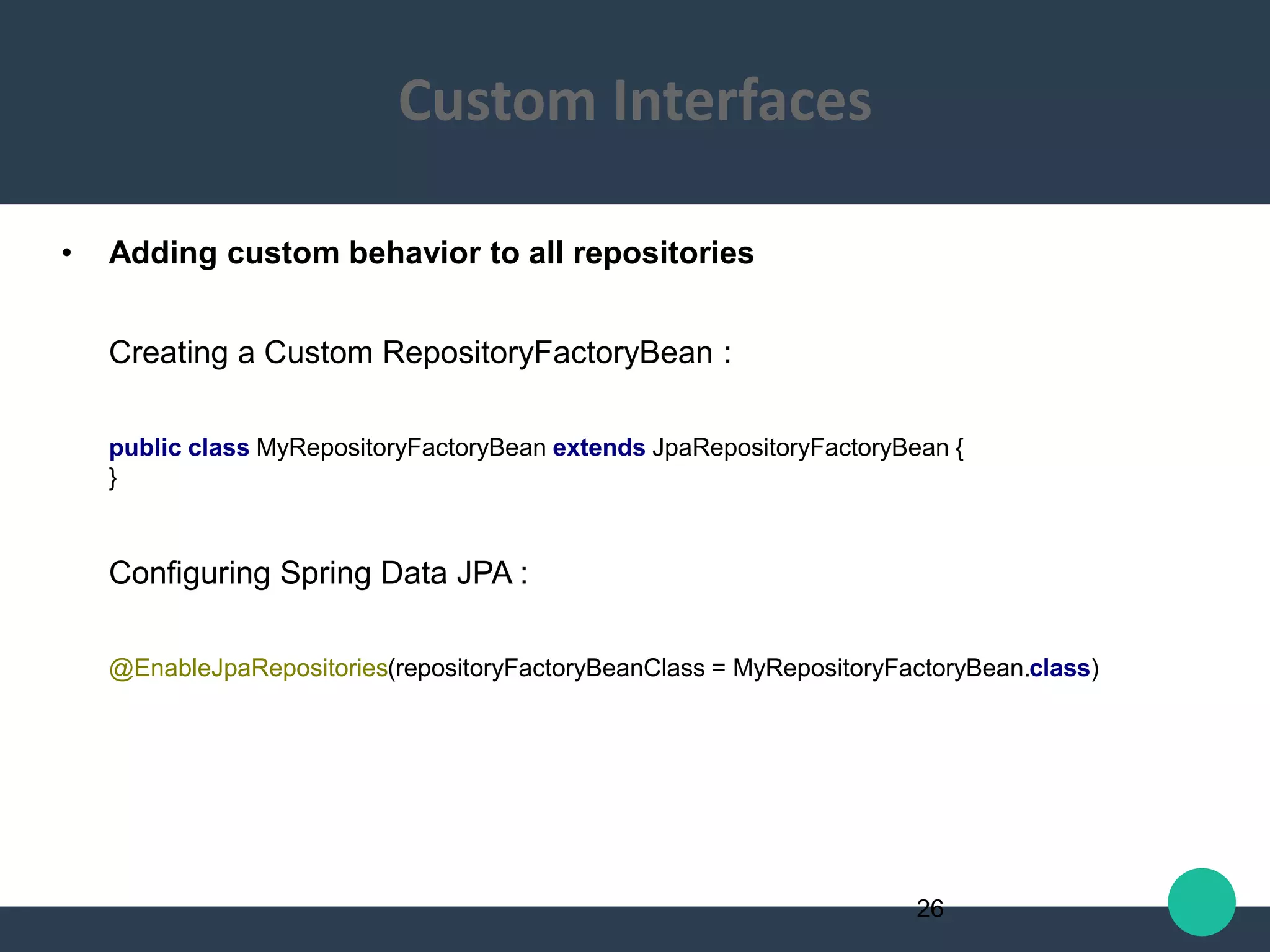
• Adding custom behavior to all repositories
Creating a Custom RepositoryFactoryBean :
public class MyRepositoryFactoryBean extends JpaRepositoryFactoryBean {
}
Configuring Spring Data JPA :
@EnableJpaRepositories(repositoryFactoryBeanClass = MyRepositoryFactoryBean.class)
26
Custom Interfaces
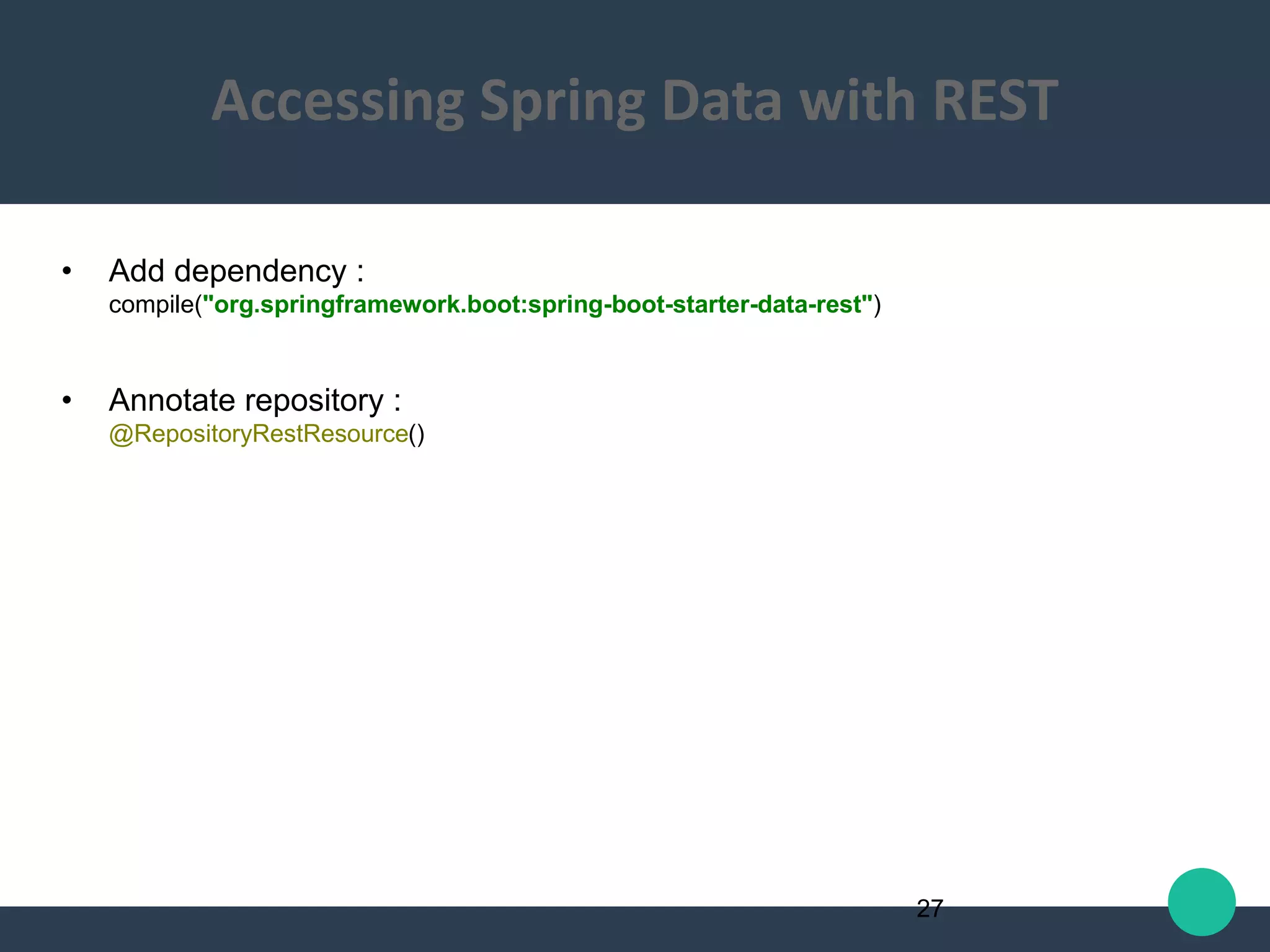
• Add dependency :
compile("org.springframework.boot:spring-boot-starter-data-rest")
• Annotate repository :
@RepositoryRestResource()
27
Accessing Spring Data with REST
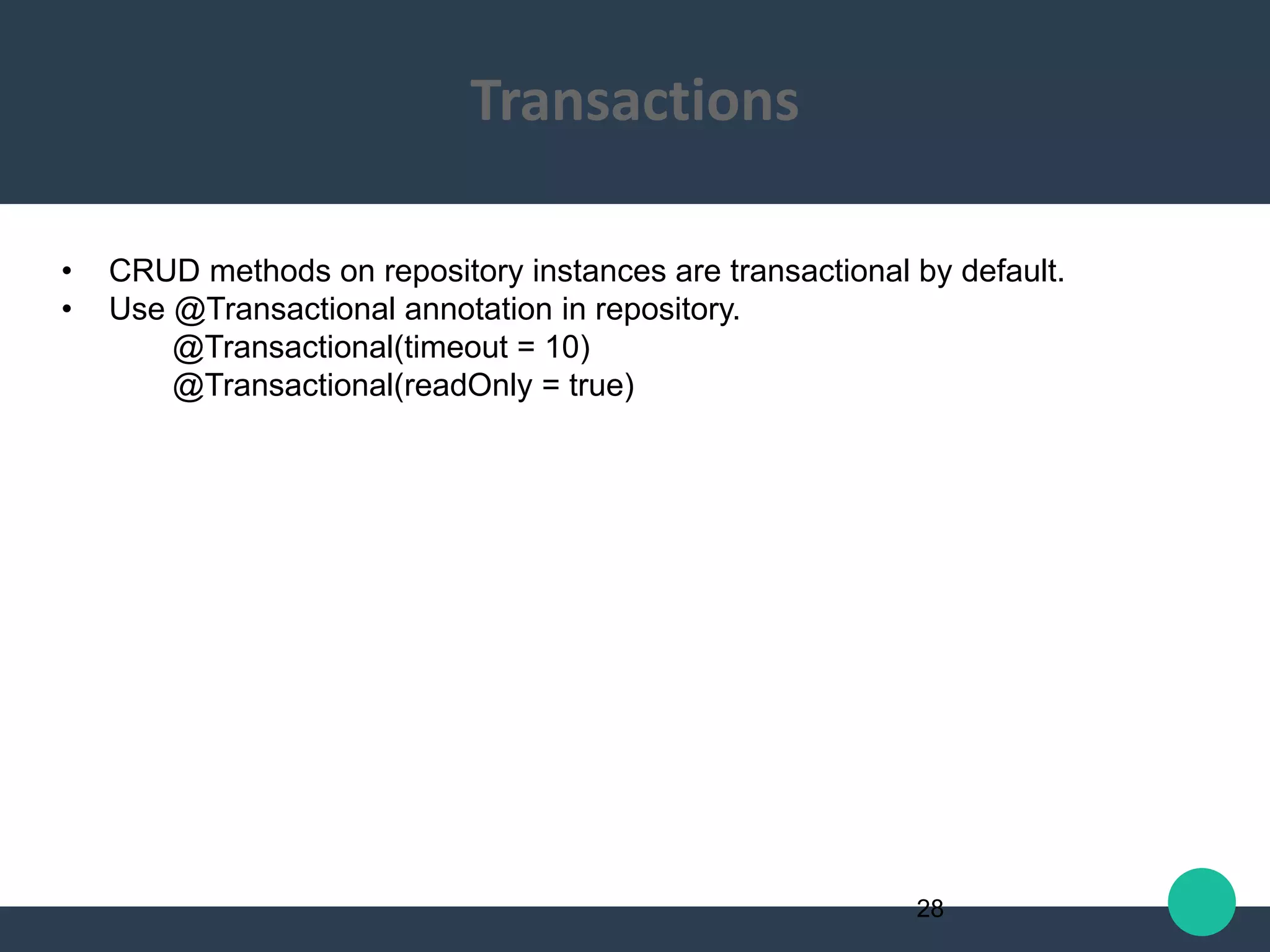
• CRUD methods on repository instances are transactional by default.
• Use @Transactional annotation in repository.
@Transactional(timeout = 10)
@Transactional(readOnly = true)
28
Transactions
Methods name are very long in the complicated structure.
No support for aggregation queries.
29
Disadvantages
References
31
Samples : https://github.com/jitinjeevesh/spring-jpa
 http://projects.spring.io/spring-data/
 https://dzone.com/articles/easier-jpa-spring-data-jpa
 http://docs.spring.io/spring-data/jpa/docs/current/reference/html/
Spring data jpa

Spring data jpa

  • 1.
    Spring Data JPA -By Jeevesh Pandey
  • 2.
    • What isSpring Data • Configurations • Domain/Entities • Persistent Identity • Identifier Generation • Customizing the Entity Object • Entity Relationships • Entity Inheritance • EntityManager & the Persistent Context Agenda • Repository and Repository Hierarchy • User Defined Repository • Defining Query methods • Pageable • Query creation : Custom Queries and Named Queries • Custom Interfaces • Accessing Spring Data with rest • Transactional • Disadvantages
  • 3.
    What and Why? Spring Data is a high level SpringSource project whose purpose is to unify and ease the access to different kinds of persistence stores, both relational database systems and NoSQL data stores. Features • Powerful repository and custom object-mapping abstractions • Dynamic query derivation from repository method names • Implementation domain base classes providing basic properties • Support for transparent auditing • Possibility to integrate custom repository code • Advanced integration with Spring MVC controllers • Several modules such as : Spring Data JPA, Spring Data MongoDB, Spring Data REST, Spring Data Cassandra etc. 3
  • 4.
    Dependencies : compile('mysql:mysql-connector-java:5.1.6') compile('org.springframework.boot:spring-boot-starter-data-jpa') Setting : spring: datasource: url:jdbc:mysql://localhost:3306/spring_jpa?autoReconnect=true&useUnicode=true&CharSet=UTF- 8&characterEncoding=UTF-8 username: root password: igdefault driverClassName: com.mysql.jdbc.Driver jpa: hibernate.ddl-auto: create-drop show-sql: true 4 Configuration
  • 5.
    • An entityis a plain old java object (POJO) • Requirements: – annotated with the javax.persistence.Entity annotation – public or protected, no-argument constructor – the class must not be declared final – no methods or persistent instance variables must be declared final • Entities may extend both entity and non-entity classes • Persistent instance variables must be declared private, protected import javax.persistence.*; @Entity public class User { private String email; private String name; } 5 Domain/Entities
  • 6.
    • Each entitymust have a unique object identifier (persistent identifier) • Identifier (id) in entity = primary key in database • Example : import javax.persistence.*; public class User { @Id private Long id; } 6 Persistent Identity
  • 7.
    • Identifiers canbe generated in the database by specifying @GeneratedValue on the identifier • Four pre-defined generation strategies: – AUTO, – IDENTITY, – SEQUENCE, – TABLE • Specifying strategy of AUTO indicates that the provider will choose a strategy • Example: import javax.persistence.*; public class User { @Id @GeneratedValue(strategy = GenerationType.AUTO) private Long id; } 7 Identity Generation
  • 8.
    • In mostof the cases, the defaults are sufficient • By default the table name corresponds to the unqualified name of the class • Customization: @Entity @Table(name = "user") public class User {} • The defaults of columns can be customized using the @Column annotation @Column(nullable = true, unique = true) private String email; @Column(name = "full_name", nullable = false, length = 25) private String name; 8 Customizing the Entity Object
  • 9.
    • There arefour types of relationship multiplicities: – @OneToOne – @OneToMany – @ManyToOne – @ManyToMany • The direction of a relationship can be: – bidirectional – owning side and inverse side – unidirectional – owning side only • Supports cascading updates/deletes • You can declare performance strategy to use with fetching related rows FetchType : LAZY, EAGER 9 Entity Relationships
  • 10.
  • 11.
  • 12.
  • 13.
    • Entities caninherit from other entities and from non-entities • The @Inheritance annotation identifies a mapping strategy: – SINGLE_TABLE – JOINED – TABLE_PER_CLASS • SINGLE_TABLE strategy - all classes in the hierarchy are mapped to a single table in the database • Discriminator column - contains a value that identifies the subclass • Discriminator type - {STRING, CHAR, INTEGER} • Discriminator value - value entered into the discriminator column for each entity in a class hierarchy 13 Entity Inheritance
  • 14.
    @Entity @Inheritance(strategy=InheritanceType.SINGLE_TABLE) @DiscriminatorColumn(name="DISC", discriminatorType=DiscriminatorType.STRING) @DiscriminatorValue(value="USER") public classUser { . . . } @Entity @DiscriminatorValue(value="PUSER") public class PremiumUser extends User { . . . } 14 Entity Inheritance : Example
  • 15.
    • Entities aremanaged by the entity manager • The entity manager is represented by javax.persistence.EntityManager instances • Each EntityManager instance is associated with a persistence context • A persistence context defines the scope under which particular entity instances are created, persisted, and removed • A persistence context is a set of managed entity instances that exist in a particular data store – Entities keyed by their persistent identity – Only one entity with a given persistent identity may exist in the persistence context – Entities are added to the persistence context, but are not individually removable (“detached”) • Controlled and managed by EntityManager – Contents of persistence context change as a result of operations on EntityManager API 15 Managing Entities - JPA
  • 16.
  • 17.
    • A lotof code in the persistent framework and the DAO. • Duplicate code in concrete DAOs • Pagination need to handle yourself, and integrated from MVC to persistent layer. • If hybrid database (MySql + Mongo) are required for the system. It is not easy to have similar design concept in the Architecture. 17 Pains
  • 18.
    • The goalof the repository abstraction of Spring Data is to reduce the effort to implement data access layers for various persistence stores significantly. • The central marker interface • Repository<T, ID extends Serializable> • Hierarchy : Interface JpaRepository<T, ID> interface PagingAndSortingRepository<T, ID> interface CrudRepository<T, ID> interface Repository<T, ID> 18 Repository and Repository Hierarchy
  • 19.
    Spring Data Repository,you’ll have three options: • Using of a CRUD operations that implemented by the Spring Data infrastructure • Defining of a query methods and • Manually implementing your own custom repositories • Example : public interface UserRepository extends JpaRepository<User, Long> { } 19 User Defined Repository
  • 20.
    Query methods implementedin spring data repositories will be used for creating the dynamic queries. public interface UserRepository extends JpaRepository<User, Long> { User findByEmail(String email); List<User> findAllByName(String name); } 20 Defining Query methods
  • 21.
    Pageable pageable =new PageRequest(0, 10); Sort.Order order1 = new Sort.Order(Sort.Direction.ASC, "id"); Sort.Order order2 = new Sort.Order(Sort.Direction.DESC, "name"); Sort sort = new Sort(order1, order2); pageable = new PageRequest(0, 10, sort); pageable = new PageRequest(0, 10, new Sort(Sort.Direction.DESC, "name")); 21 Pageable
  • 22.
    • @Query annotationis used to defining the custom queries in spring data. • Supports JPQL and native SQL. • @Param method arguments to bind query parameters. • Supports SpEL expression. • Like expression supported inside @Query annotation. • @Query annotation, this will take the precedence over @NamedQuery • Examples : @Query("select u from User u where u.name=?1") User findByUserName(String name); @Query("select u from User u where u.name like%:name%") User findByUserName(@Param("name") String name); @Query(value = "select * from user where name=?1", nativeQuery = true) User findByUserName(String name); 22 Query creation : Custom Queries
  • 23.
    • Named queryare the static queries. • The named queries are defined in the single place at entity class itself with each query has its unique name. • @NamedQuery annotation can be applied only at the class level. • Named queries have the global scope. • If you have to define more than one named queries the use @NamedQueries • All the named queries are validated at application start-up time and there is no failure at run time. • Example : @NamedQuery(name = "User.findByNameNamed", query = "SELECT u FROM User u WHERE LOWER(u.name) = LOWER(?1)") @Table(name = "user") public class User { ….. } 23 Query creation : Named Queries
  • 24.
    • Adding custombehavior to single repositories Create an interface which declares the custom methods : public interface UserCustomRepository { public User customMethod(); } Implement custom repository : public class UserRepositoryImpl implements UserCustomRepository { @Override public User customMethod() { } } Extend interface: public interface UserRepository extends JpaRepository<User, Long>, UserCustomRepository { } 24 Custom Interfaces
  • 25.
    • Adding custombehavior to all repositories Creating a Base Repository Interface : @NoRepositoryBean public interface MyRepository<T, ID extends Serializable> extends JpaRepository<T, ID> { T sharedMethod(ID id); } Implementing the Base Repository Interface : public class MyRepositoryImpl<T, ID extends Serializable> extends SimpleJpaRepository<T, ID> implements MyRepository<T, ID> { } 25 Custom Interfaces
  • 26.
    • Adding custombehavior to all repositories Creating a Custom RepositoryFactoryBean : public class MyRepositoryFactoryBean extends JpaRepositoryFactoryBean { } Configuring Spring Data JPA : @EnableJpaRepositories(repositoryFactoryBeanClass = MyRepositoryFactoryBean.class) 26 Custom Interfaces
  • 27.
    • Add dependency: compile("org.springframework.boot:spring-boot-starter-data-rest") • Annotate repository : @RepositoryRestResource() 27 Accessing Spring Data with REST
  • 28.
    • CRUD methodson repository instances are transactional by default. • Use @Transactional annotation in repository. @Transactional(timeout = 10) @Transactional(readOnly = true) 28 Transactions
  • 29.
    Methods name arevery long in the complicated structure. No support for aggregation queries. 29 Disadvantages
  • 31.
    References 31 Samples : https://github.com/jitinjeevesh/spring-jpa http://projects.spring.io/spring-data/  https://dzone.com/articles/easier-jpa-spring-data-jpa  http://docs.spring.io/spring-data/jpa/docs/current/reference/html/