Shock Index as a Predictor of
Morbidity and Mortality in Pediatric
Trauma Patients
Dr. Rahman setiawan
Background
 In pediatric patients with shock, early recognition and treatment save
 Incaring for the emergent trauma patient,vital signs, such as heart rate (HR) and
systolic blood pressure (SBP), are easily obtainable and are considered quick and
reliable clinical indicators of shock
 Tachycardia has been shown to predict increased mortality risk In pediatric shock
 Low SBP in the ED has been found to be one of the more powerful predictors of in-
hospital mortality in pediatric trauma patients
 In pediatric patients, the addition of delayed capillary refill to SBP measurement
improves early identification of mortality prone shock over hypotension and
tachycardia alone
Background
 Shock index (SI), defined as HR divided by SBP, has emerged as a useful tool for
monitoring acute circulatory failure in adults.
 When used for diagnosing early acute hypovolemia, SI can outperform
measurements of HR or SBP alone
 In pediatric septic shock, an increasing SI is associated with a higher risk of
mortality
 Early implementation of advanced life support in pediatric shock was associated
with improving SI
 In pediatric trauma patients SI would be a predictor of the primary outcome
mortality, in addition to other defined negative outcomes
Methods
 Cohort of patients to study SI using the National Trauma Data Bank (NTDB), version
7.2, admission year 2010
 Inclusion criteria were traumatically injured patients younger than 15 years
 Excluded patients transferred from another institution, patients dead on arrival,
patients with burn injuries, patients with missing data on presentation (HR, SBP,
GCS, and Injury Severity Score [ISS]), and patients with data that were considered
inconsistent with signs of life (HR <30beats /min and SBP<60mmHg)
 . Shock index was calculated by dividing HR by SBP
Methods
 SI was stratified by age (<12 months, 1 to <2 years, 2to<5years, 5to<12years
and12–14years)
 For each age group , a cut off SI was calculated rom the highest normal value of HR
and the lowest normal value of SBP taken from the vital sign ranges in the
Advanced Trauma Life Support manual
 a single variable (normal vs elevated) SI was created based on this age-specific cut
off value
 MannWhitney U test and Student t test to identify differences in the 2 groups for
continuous variables.
 Multivariate regression analysis was performed to assess factors predicting
mortality in pediatric trauma patients
Result
 A total of 88,045 pediatric trauma patients were identified in the 2010 NTDB. After
applying our exclusion criteria, 28,741 patients remained eligible foranalysis
 Median age for patients in our analytic data set was 9 years (IQR, 4–12 years), and
64.5% were male
 Median GCS score of 15 (IQR, 15–15), median ISS of 5 (IQR, 4–9), and median SI of
0.86 (IQR,0.72–1.03
 The overall mortality rate for all pediatric cases in the 2010 NTDB was 0.8%
(701/28,045
 After applying our selection criteria, the mortality rate was 0.7% (190/28,741), and
1.7% (n = 504) had an elevated SI on presentation
Result
Tabel 1
Result
Tabel 2
Result
Tabel 3
We present the association between normal SI and elevated SI and our study
outcomes. Patients with elevated SI were more likely to require blood transfusion (P <
0.001), require assisted ventilation (P < 0.001), require an OR/IR procedure (P < 0.001),
and require an ICU stay (P < 0.001).
Result
Tabel 3
Highlights the trend toward negative outcomes in patients with both elevated SI
who were discharged alive and those with a normal SI but ultimately died.
Compared with the population of patients discharged alive with an elevated SI, the
population of patients who died with a normal SI had an increase in all defined
negative outcomes except for blood transfusions (26.8% vs 41.4%, respectively).
Result
Tabel 4
 Table 4 demonstrates the
multivariate regression analysis for
factors associated with mortality in
pediatric trauma patients. Elevated
SI was the strongest predictor for
mortality (odds ratio [OR], 22.0;
95% confidence interval
[95%CI],15.1–31.9) in pediatric
trauma patients.When stratified by
minor trauma (ISS <16) and mild
brain injury (GCS score
>12),elevated SI remained
significantly associated with
mortality (ORs,72.0[95%CI,11.5–
449.6]and62.0[95%CI,14.6–269.1],
respectively). Hypotension (OR, 12.6
[95% CI, 7.8–20.4]) and tachycardia
(OR, 2.6 [95% CI, 1.9–3.5]) were also
predictive of mortality when
included simultaneously in a
separate regression analysis
Result
Tabel 5
Table 5 demonstrates the diagnostic test characteristics for elevated SI for each of the outcomes. Elevated SI had a specificity of
98.4% or greater for all outcomes tested. In predicting mortality inpediatrictrauma patients, the positive likelihoodratio for
elevated SI was 15.8. The sensitivity and negative likelihood ratio performance for elevated SI was best for mortality at 25.3% and
0.76, respectively. When compared with hypotension alone, the sensitivity for elevated SI was improved significantly for all defined
negative outcomes.
Discussion
This study demonstrates that elevated SI is a useful tool for the prediction of negative
outcomes in pediatric trauma patients
Compared with patients with a normal SI,patients with an elevated SI for their age
group have higher mortality rate, blood transfusion requirement, ventilation
requirement, OR/IR procedure requirement, and ICU stay requirement.
Elevated SI more strongly predicts mortality in pediatric trauma patients than
tachycardia or hypotension alone and improves upon the poor sensitivity of pediatric
hypotension in negative outcome prediction
Discussion
Shock index has been widely reported as a more sensitive marker of hemodynamic
instability compared with traditional vital signs such asHR and SBP
Shock index is a known predictor of mortality and adverse outcomes in pediatric septic
shock
The results of our study demonstrate that elevated SI is an accurate and specific tool
for predicting negative outcomes in pediatric trauma patients
Although tachycardia and hypotension were also associated with mortality, elevated SI
was the strongest predictor for mortality in pediatric trauma patients
Discussion
Elevated SI has high negative predictive value for identifying true negative outcomes;
however, the low prevalence of those outcomes limits its usefulness in that manner
Our results support the use of elevated SI in predicting high risk of mortality
irrespective of ISS or GCS.
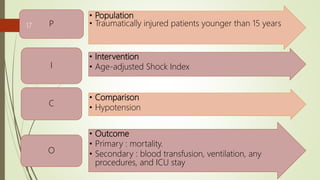
• Population
• Traumatically injured patients younger than 15 yearsP
• Intervention
• Age-adjusted Shock IndexI
• Comparison
• Hypotension
C
• Outcome
• Primary : mortality.
• Secondary : blood transfusion, ventilation, any
procedures, and ICU stay
O
17
TELAAH KRITIS
?
VALID
IMPORTANT
APPLICABLE
18
Apakah Penelitian ini Valid ?
? ?
19
Yes, they aimed to further evaluate the
utility of age-adjusted Shock Index to predict negative
outcomes in pediatric trauma.
20
1. Was the research question clear? Was the need for the
study adequately substansiated?
 Design : cohort
 Data collection: cross sectionally from National Trauma Data Bank
(NTDB), version 7.2, admission year 2010, the largest collection of trauma
index cases, which is maintained by the American College of Surgeons
(Chicago, Ill)
 Limitation: The NTDB is not a population-based data set and thus may
not be generalizable. They acknowledge the large amount of missing
data in their study may lead to selection bias, as noted by the
discrepancy between frequency of negative outcomes when comparing
the population with complete versus missing data.
21
2. What was the design of the study? How were the data collected (one
time (cross sectional) or repeated over time (longitudinal)? What were
the limitation data collection methods?
 Their inclusion criteria were traumatically injured patients younger than
15 years.
 They excluded patients transferred from another institution, patients
dead on arrival, patients with burn injuries, patients with missing data
on presentation (HR, SBP, GCS, and Injury Severity Score [ISS]), and
patients with data that were considered inconsistent with signs of life
(HR <30 beats/min and SBP <60 mm Hg).
 This sample is not representative because the NTDB is not a population-
based data set
22
3. Describe the sample. How was the sample selected (eligibility
criteria)? How is the sample representative of the population?
 Elevated SI had a specificity of 98.4% or greater for all outcomes tested.
In predicting mortality in pediatric trauma patients, the positive
likelihood ratio for elevated SI was 15.8. The sensitivity and negative
likelihood ratio performance for elevated SI was best for mortality at
25.3% and 0.76, respectively. When compared with hypotension alone,
the sensitivity for elevated SI was improved significantly for all defined
negative outcomes
23
4. Describe the variables of interest. If comparison study, on what
variables are group being compared? How were the groups similar?
How were the groups different?
 No, their sample size was not large enough to perform any
sub-analysis among the different age groups.
 Yes, they performed power analysis (Table 5)
24
5. Was the sample size large enough to detect a statistically
significant association or difference? Was a power analysis
performed?
 Confounder factor that have been accounted: age, gender, mechanism
of injury, race, payment type, and trauma center level designation
 Potential source of bias: there are no published normal SI values for
children and large amount of missing data
25 6. Were there any potential sources of bias? (Difference between
groups not accounted for in the analysis, drop-outs, discounting
outcomes, funding agency, etc)
 SI was stratified by age  a cutoff SI was calculated from the highest
normal value of HR and the lowest normal value of SBP  a single
variable (normal vs elevated) SI was created based on this age-specific
cutoff value (Table 1).
 There are no published normal SI values for children; thus, they
created the SI cutoff value used in their study to help identify patients
who have tachycardia but a normal low blood pressure.
26
7. Describe the reliability and validity of the measure. Were the
measures appropriate for the population or the variable being
studied?
 Yes, they described analysis plan in detail. They used appropriate type of
data analyzed.
 They performed Mann-Whitney U test and Student t test to identify
differences in the 2 groups for continuous variables. Multivariate
regression analysis was performed to assess factors predicting mortality
in pediatric trauma patients.
 Data distribution unkwown
27 8. Were the analysis plans (statisticalmethods) described in detail?
How were the data distributed? Were the correlative and
comparative tests appropriate for the type of data analyzed and the
questions asked?
PENELITIAN INI Kurang VALID
X28
Apakah Penelitian ini PENTING?
? ?
29
 Elevated SI is an accurate and specific predictor of morbidity
and mortality in pediatric trauma patients and is superior to tachycardia
or hypotension alone for predicting mortality.
30
1. What were the findings?
31
2.Was there clinical significance? Statistical significance?
Yes, the authors put their findings in the context of the
broader literature on this topic
In a prospective study evaluating the detection of early
hypovolemia, SI was a more accurate
Shock index is a known predictor of mortality and adverse outcomes
in pediatric septic shock
32
3. did author put their findings in the context of the
broader literature on this topic?
PENELITIAN INI PENTING

33
Apakah Penelitian ini DAPAT DITERAPKAN?
? ?
34
 This study showed that elevated SI is more strongly predictive of mortality than
tachycardia or hypotension alone in pediatric trauma patients and is especially
useful in children who present with apparent minor injury.
35
1. What relevance do the findings have to practice?
 Their results support the use of elevated SI as a readily available, simple
tool to improve early recognition of pediatric patients who are at risk of
shock and subsequent negative outcomes.
36
2. Discuss how the findings can be applied to practice
PENELITIAN INI APPLICABLE
37
KESIMPULAN TELAAH KRITIS
38
Kurang Valid X Penting 
Dapat diterapkan dengan beberapa
pertimbangan 

Jurnal 2 wawan

  • 1.
    Shock Index asa Predictor of Morbidity and Mortality in Pediatric Trauma Patients Dr. Rahman setiawan
  • 2.
    Background  In pediatricpatients with shock, early recognition and treatment save  Incaring for the emergent trauma patient,vital signs, such as heart rate (HR) and systolic blood pressure (SBP), are easily obtainable and are considered quick and reliable clinical indicators of shock  Tachycardia has been shown to predict increased mortality risk In pediatric shock  Low SBP in the ED has been found to be one of the more powerful predictors of in- hospital mortality in pediatric trauma patients  In pediatric patients, the addition of delayed capillary refill to SBP measurement improves early identification of mortality prone shock over hypotension and tachycardia alone
  • 3.
    Background  Shock index(SI), defined as HR divided by SBP, has emerged as a useful tool for monitoring acute circulatory failure in adults.  When used for diagnosing early acute hypovolemia, SI can outperform measurements of HR or SBP alone  In pediatric septic shock, an increasing SI is associated with a higher risk of mortality  Early implementation of advanced life support in pediatric shock was associated with improving SI  In pediatric trauma patients SI would be a predictor of the primary outcome mortality, in addition to other defined negative outcomes
  • 4.
    Methods  Cohort ofpatients to study SI using the National Trauma Data Bank (NTDB), version 7.2, admission year 2010  Inclusion criteria were traumatically injured patients younger than 15 years  Excluded patients transferred from another institution, patients dead on arrival, patients with burn injuries, patients with missing data on presentation (HR, SBP, GCS, and Injury Severity Score [ISS]), and patients with data that were considered inconsistent with signs of life (HR <30beats /min and SBP<60mmHg)  . Shock index was calculated by dividing HR by SBP
  • 5.
    Methods  SI wasstratified by age (<12 months, 1 to <2 years, 2to<5years, 5to<12years and12–14years)  For each age group , a cut off SI was calculated rom the highest normal value of HR and the lowest normal value of SBP taken from the vital sign ranges in the Advanced Trauma Life Support manual  a single variable (normal vs elevated) SI was created based on this age-specific cut off value  MannWhitney U test and Student t test to identify differences in the 2 groups for continuous variables.  Multivariate regression analysis was performed to assess factors predicting mortality in pediatric trauma patients
  • 6.
    Result  A totalof 88,045 pediatric trauma patients were identified in the 2010 NTDB. After applying our exclusion criteria, 28,741 patients remained eligible foranalysis  Median age for patients in our analytic data set was 9 years (IQR, 4–12 years), and 64.5% were male  Median GCS score of 15 (IQR, 15–15), median ISS of 5 (IQR, 4–9), and median SI of 0.86 (IQR,0.72–1.03  The overall mortality rate for all pediatric cases in the 2010 NTDB was 0.8% (701/28,045  After applying our selection criteria, the mortality rate was 0.7% (190/28,741), and 1.7% (n = 504) had an elevated SI on presentation
  • 7.
  • 8.
  • 9.
    Result Tabel 3 We presentthe association between normal SI and elevated SI and our study outcomes. Patients with elevated SI were more likely to require blood transfusion (P < 0.001), require assisted ventilation (P < 0.001), require an OR/IR procedure (P < 0.001), and require an ICU stay (P < 0.001).
  • 10.
    Result Tabel 3 Highlights thetrend toward negative outcomes in patients with both elevated SI who were discharged alive and those with a normal SI but ultimately died. Compared with the population of patients discharged alive with an elevated SI, the population of patients who died with a normal SI had an increase in all defined negative outcomes except for blood transfusions (26.8% vs 41.4%, respectively).
  • 11.
    Result Tabel 4  Table4 demonstrates the multivariate regression analysis for factors associated with mortality in pediatric trauma patients. Elevated SI was the strongest predictor for mortality (odds ratio [OR], 22.0; 95% confidence interval [95%CI],15.1–31.9) in pediatric trauma patients.When stratified by minor trauma (ISS <16) and mild brain injury (GCS score >12),elevated SI remained significantly associated with mortality (ORs,72.0[95%CI,11.5– 449.6]and62.0[95%CI,14.6–269.1], respectively). Hypotension (OR, 12.6 [95% CI, 7.8–20.4]) and tachycardia (OR, 2.6 [95% CI, 1.9–3.5]) were also predictive of mortality when included simultaneously in a separate regression analysis
  • 12.
    Result Tabel 5 Table 5demonstrates the diagnostic test characteristics for elevated SI for each of the outcomes. Elevated SI had a specificity of 98.4% or greater for all outcomes tested. In predicting mortality inpediatrictrauma patients, the positive likelihoodratio for elevated SI was 15.8. The sensitivity and negative likelihood ratio performance for elevated SI was best for mortality at 25.3% and 0.76, respectively. When compared with hypotension alone, the sensitivity for elevated SI was improved significantly for all defined negative outcomes.
  • 13.
    Discussion This study demonstratesthat elevated SI is a useful tool for the prediction of negative outcomes in pediatric trauma patients Compared with patients with a normal SI,patients with an elevated SI for their age group have higher mortality rate, blood transfusion requirement, ventilation requirement, OR/IR procedure requirement, and ICU stay requirement. Elevated SI more strongly predicts mortality in pediatric trauma patients than tachycardia or hypotension alone and improves upon the poor sensitivity of pediatric hypotension in negative outcome prediction
  • 14.
    Discussion Shock index hasbeen widely reported as a more sensitive marker of hemodynamic instability compared with traditional vital signs such asHR and SBP Shock index is a known predictor of mortality and adverse outcomes in pediatric septic shock The results of our study demonstrate that elevated SI is an accurate and specific tool for predicting negative outcomes in pediatric trauma patients Although tachycardia and hypotension were also associated with mortality, elevated SI was the strongest predictor for mortality in pediatric trauma patients
  • 15.
    Discussion Elevated SI hashigh negative predictive value for identifying true negative outcomes; however, the low prevalence of those outcomes limits its usefulness in that manner Our results support the use of elevated SI in predicting high risk of mortality irrespective of ISS or GCS.
  • 17.
    • Population • Traumaticallyinjured patients younger than 15 yearsP • Intervention • Age-adjusted Shock IndexI • Comparison • Hypotension C • Outcome • Primary : mortality. • Secondary : blood transfusion, ventilation, any procedures, and ICU stay O 17
  • 18.
  • 19.
    Apakah Penelitian iniValid ? ? ? 19
  • 20.
    Yes, they aimedto further evaluate the utility of age-adjusted Shock Index to predict negative outcomes in pediatric trauma. 20 1. Was the research question clear? Was the need for the study adequately substansiated?
  • 21.
     Design :cohort  Data collection: cross sectionally from National Trauma Data Bank (NTDB), version 7.2, admission year 2010, the largest collection of trauma index cases, which is maintained by the American College of Surgeons (Chicago, Ill)  Limitation: The NTDB is not a population-based data set and thus may not be generalizable. They acknowledge the large amount of missing data in their study may lead to selection bias, as noted by the discrepancy between frequency of negative outcomes when comparing the population with complete versus missing data. 21 2. What was the design of the study? How were the data collected (one time (cross sectional) or repeated over time (longitudinal)? What were the limitation data collection methods?
  • 22.
     Their inclusioncriteria were traumatically injured patients younger than 15 years.  They excluded patients transferred from another institution, patients dead on arrival, patients with burn injuries, patients with missing data on presentation (HR, SBP, GCS, and Injury Severity Score [ISS]), and patients with data that were considered inconsistent with signs of life (HR <30 beats/min and SBP <60 mm Hg).  This sample is not representative because the NTDB is not a population- based data set 22 3. Describe the sample. How was the sample selected (eligibility criteria)? How is the sample representative of the population?
  • 23.
     Elevated SIhad a specificity of 98.4% or greater for all outcomes tested. In predicting mortality in pediatric trauma patients, the positive likelihood ratio for elevated SI was 15.8. The sensitivity and negative likelihood ratio performance for elevated SI was best for mortality at 25.3% and 0.76, respectively. When compared with hypotension alone, the sensitivity for elevated SI was improved significantly for all defined negative outcomes 23 4. Describe the variables of interest. If comparison study, on what variables are group being compared? How were the groups similar? How were the groups different?
  • 24.
     No, theirsample size was not large enough to perform any sub-analysis among the different age groups.  Yes, they performed power analysis (Table 5) 24 5. Was the sample size large enough to detect a statistically significant association or difference? Was a power analysis performed?
  • 25.
     Confounder factorthat have been accounted: age, gender, mechanism of injury, race, payment type, and trauma center level designation  Potential source of bias: there are no published normal SI values for children and large amount of missing data 25 6. Were there any potential sources of bias? (Difference between groups not accounted for in the analysis, drop-outs, discounting outcomes, funding agency, etc)
  • 26.
     SI wasstratified by age  a cutoff SI was calculated from the highest normal value of HR and the lowest normal value of SBP  a single variable (normal vs elevated) SI was created based on this age-specific cutoff value (Table 1).  There are no published normal SI values for children; thus, they created the SI cutoff value used in their study to help identify patients who have tachycardia but a normal low blood pressure. 26 7. Describe the reliability and validity of the measure. Were the measures appropriate for the population or the variable being studied?
  • 27.
     Yes, theydescribed analysis plan in detail. They used appropriate type of data analyzed.  They performed Mann-Whitney U test and Student t test to identify differences in the 2 groups for continuous variables. Multivariate regression analysis was performed to assess factors predicting mortality in pediatric trauma patients.  Data distribution unkwown 27 8. Were the analysis plans (statisticalmethods) described in detail? How were the data distributed? Were the correlative and comparative tests appropriate for the type of data analyzed and the questions asked?
  • 28.
  • 29.
    Apakah Penelitian iniPENTING? ? ? 29
  • 30.
     Elevated SIis an accurate and specific predictor of morbidity and mortality in pediatric trauma patients and is superior to tachycardia or hypotension alone for predicting mortality. 30 1. What were the findings?
  • 31.
    31 2.Was there clinicalsignificance? Statistical significance?
  • 32.
    Yes, the authorsput their findings in the context of the broader literature on this topic In a prospective study evaluating the detection of early hypovolemia, SI was a more accurate Shock index is a known predictor of mortality and adverse outcomes in pediatric septic shock 32 3. did author put their findings in the context of the broader literature on this topic?
  • 33.
  • 34.
    Apakah Penelitian iniDAPAT DITERAPKAN? ? ? 34
  • 35.
     This studyshowed that elevated SI is more strongly predictive of mortality than tachycardia or hypotension alone in pediatric trauma patients and is especially useful in children who present with apparent minor injury. 35 1. What relevance do the findings have to practice?
  • 36.
     Their resultssupport the use of elevated SI as a readily available, simple tool to improve early recognition of pediatric patients who are at risk of shock and subsequent negative outcomes. 36 2. Discuss how the findings can be applied to practice
  • 37.
  • 38.
    KESIMPULAN TELAAH KRITIS 38 KurangValid X Penting  Dapat diterapkan dengan beberapa pertimbangan 