Code of Civil Procedure 1908
Prepared by:
Dr.T.Mohan
Assistant Professor,
Department of Corporate Secretaryship
SRCAS - CBE
Code of Civil Procedure 1908
• It extends to the whole of India except:
• the State of Nagaland and the tribal areas
• Provided that the State Government concerned
may, by notification in the Official Gazette, extend
the provisions of this Code or any of them to the
whole or part of the State of Nagaland or such
tribal areas, as the case may be, with such
supplemental, incidental or consequential
modifications as may be specified in the notification
Definitions
• “Code” includes rules;
• “decree” means the formal expression of an
adjudication which, so far as regards the Court
expressing it, conclusively determines the rights of the
parties with regard to all or any of the matters in
controversy in the suit and may be either preliminary
or final.
(a) any adjudication from which an appeal lies as an
appeal from an order, or
(b) (b) any order of dismissal for default
• “decree-holder” means any person in whose favour a decree has
been passed or an order capable of execution has been made
• “district” means the local limits of the jurisdiction of a principal
Civil Court of original jurisdiction (hereinafter called a “District
Court”), and includes the local limits of the ordinary original civil
jurisdiction of a High Court
• “foreign Court” means a Court situate outside India and not
established or continued by the authority of the Central
Government.
• “foreign judgment” means the judgment of a foreign Court;
• “Government Pleader” includes any officer appointed by the
State Government to perform all or any of the functions expressly
imposed by this Code on the Government Pleader and also any
pleader acting under the directions of the Government Pleader;
• “Judge” means the presiding officer of a Civil Court
• “judgment” means the statement given by the Judge of
the grounds of a decree or order
• “judgment-debtor” means any person against whom a
decree has been passed or an order capable of
execution has been made;
• “legal representative” means a person who in law
represents the estate of a deceased person, and includes
any person who intermeddles with the estate of the
deceased and where a party sues or is sued in a
representative character the person on whom the estate
devolves on the death of the party so suing or sued
SUITS IN GENERAL
• Courts to try all civil suits unless barred
• State Amendments
Stay of suit.—No Court shall proceed with the trial of
any suit in which the matter in issue is also directly
and substantially in issue in a previously instituted
suit between the same parties, or between parties
under whom they or any of them claim litigating
under the same title where such suit is pending in
the same or any other Court
• Res judicata.—No Court shall try any suit or issue in
which the matter directly and substantially in issue
has been directly and substantially in issue in a
former suit between the same parties, or between
parties under whom they or any of them claim,
litigating under the same title, in a Court competent
to try such subsequent suit or the suit in which such
issue has been subsequently raised, and has been
heard and finally decided by such Court.
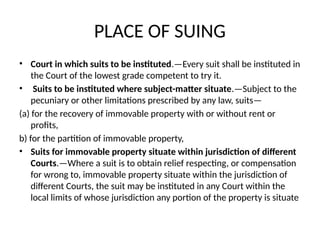
PLACE OF SUING
• Court in which suits to be instituted.—Every suit shall be instituted in
the Court of the lowest grade competent to try it.
• Suits to be instituted where subject-matter situate.—Subject to the
pecuniary or other limitations prescribed by any law, suits—
(a) for the recovery of immovable property with or without rent or
profits,
b) for the partition of immovable property,
• Suits for immovable property situate within jurisdiction of different
Courts.—Where a suit is to obtain relief respecting, or compensation
for wrong to, immovable property situate within the jurisdiction of
different Courts, the suit may be instituted in any Court within the
local limits of whose jurisdiction any portion of the property is situate
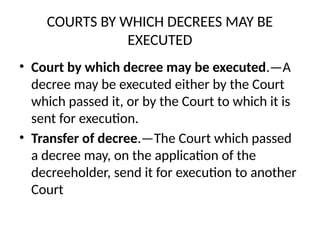
COURTS BY WHICH DECREES MAY BE
EXECUTED
• Court by which decree may be executed.—A
decree may be executed either by the Court
which passed it, or by the Court to which it is
sent for execution.
• Transfer of decree.—The Court which passed
a decree may, on the application of the
decreeholder, send it for execution to another
Court

Code of Civil Procedure 1908 Unit II.pptx

  • 1.
    Code of CivilProcedure 1908 Prepared by: Dr.T.Mohan Assistant Professor, Department of Corporate Secretaryship SRCAS - CBE
  • 2.
    Code of CivilProcedure 1908 • It extends to the whole of India except: • the State of Nagaland and the tribal areas • Provided that the State Government concerned may, by notification in the Official Gazette, extend the provisions of this Code or any of them to the whole or part of the State of Nagaland or such tribal areas, as the case may be, with such supplemental, incidental or consequential modifications as may be specified in the notification
  • 3.
    Definitions • “Code” includesrules; • “decree” means the formal expression of an adjudication which, so far as regards the Court expressing it, conclusively determines the rights of the parties with regard to all or any of the matters in controversy in the suit and may be either preliminary or final. (a) any adjudication from which an appeal lies as an appeal from an order, or (b) (b) any order of dismissal for default
  • 4.
    • “decree-holder” meansany person in whose favour a decree has been passed or an order capable of execution has been made • “district” means the local limits of the jurisdiction of a principal Civil Court of original jurisdiction (hereinafter called a “District Court”), and includes the local limits of the ordinary original civil jurisdiction of a High Court • “foreign Court” means a Court situate outside India and not established or continued by the authority of the Central Government. • “foreign judgment” means the judgment of a foreign Court; • “Government Pleader” includes any officer appointed by the State Government to perform all or any of the functions expressly imposed by this Code on the Government Pleader and also any pleader acting under the directions of the Government Pleader;
  • 5.
    • “Judge” meansthe presiding officer of a Civil Court • “judgment” means the statement given by the Judge of the grounds of a decree or order • “judgment-debtor” means any person against whom a decree has been passed or an order capable of execution has been made; • “legal representative” means a person who in law represents the estate of a deceased person, and includes any person who intermeddles with the estate of the deceased and where a party sues or is sued in a representative character the person on whom the estate devolves on the death of the party so suing or sued
  • 6.
    SUITS IN GENERAL •Courts to try all civil suits unless barred • State Amendments Stay of suit.—No Court shall proceed with the trial of any suit in which the matter in issue is also directly and substantially in issue in a previously instituted suit between the same parties, or between parties under whom they or any of them claim litigating under the same title where such suit is pending in the same or any other Court
  • 7.
    • Res judicata.—NoCourt shall try any suit or issue in which the matter directly and substantially in issue has been directly and substantially in issue in a former suit between the same parties, or between parties under whom they or any of them claim, litigating under the same title, in a Court competent to try such subsequent suit or the suit in which such issue has been subsequently raised, and has been heard and finally decided by such Court.
  • 8.
    PLACE OF SUING •Court in which suits to be instituted.—Every suit shall be instituted in the Court of the lowest grade competent to try it. • Suits to be instituted where subject-matter situate.—Subject to the pecuniary or other limitations prescribed by any law, suits— (a) for the recovery of immovable property with or without rent or profits, b) for the partition of immovable property, • Suits for immovable property situate within jurisdiction of different Courts.—Where a suit is to obtain relief respecting, or compensation for wrong to, immovable property situate within the jurisdiction of different Courts, the suit may be instituted in any Court within the local limits of whose jurisdiction any portion of the property is situate
  • 9.
    COURTS BY WHICHDECREES MAY BE EXECUTED • Court by which decree may be executed.—A decree may be executed either by the Court which passed it, or by the Court to which it is sent for execution. • Transfer of decree.—The Court which passed a decree may, on the application of the decreeholder, send it for execution to another Court