JSP
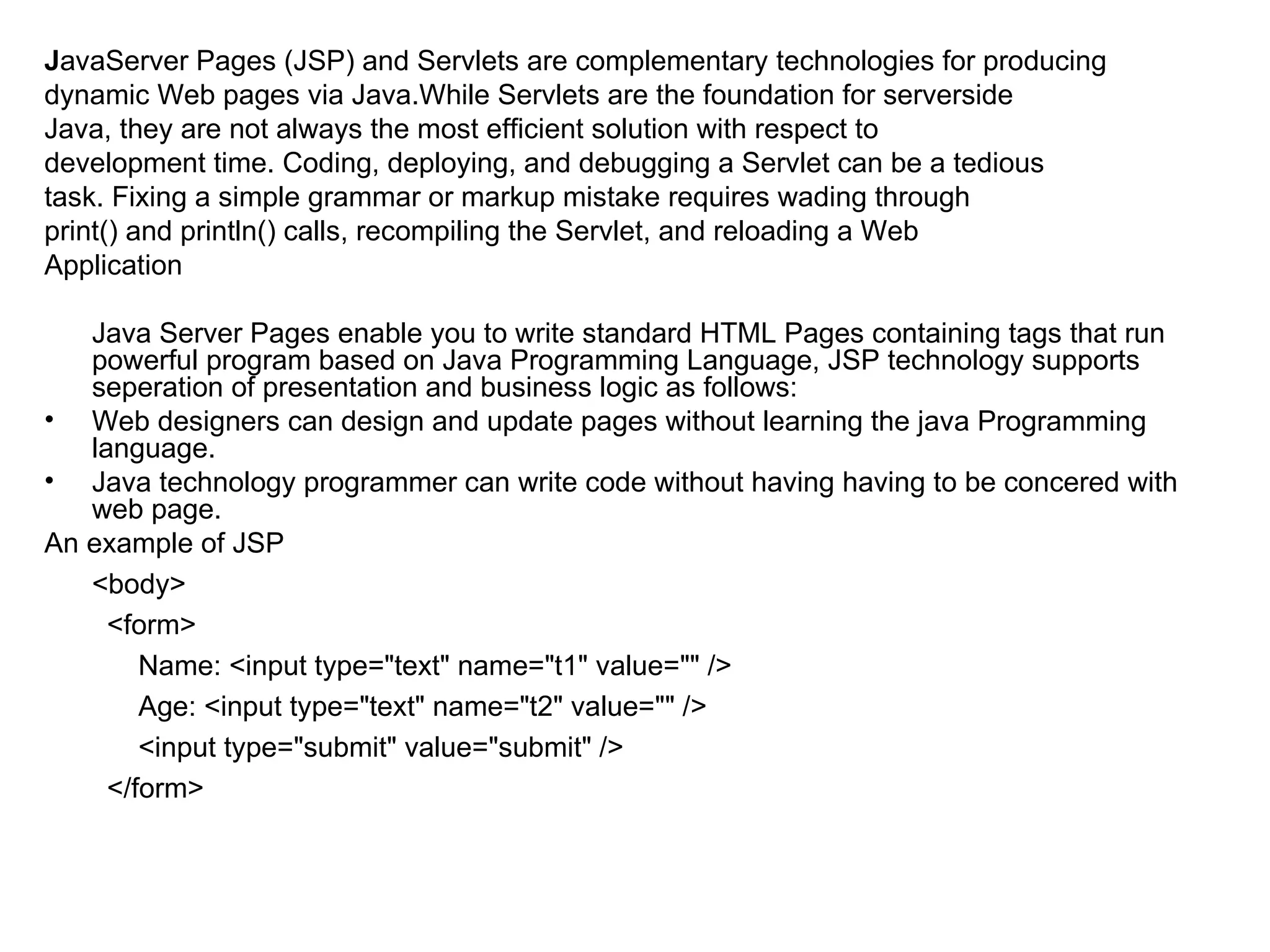
J avaServer Pages (JSP) and Servlets are complementary technologies for producing dynamic Web pages via Java.While Servlets are the foundation for serverside Java, they are not always the most efficient solution with respect to development time. Coding, deploying, and debugging a Servlet can be a tedious task. Fixing a simple grammar or markup mistake requires wading through print() and println() calls, recompiling the Servlet, and reloading a Web Application Java Server Pages enable you to write standard HTML Pages containing tags that run powerful program based on Java Programming Language, JSP technology supports seperation of presentation and business logic as follows: Web designers can design and update pages without learning the java Programming language. Java technology programmer can write code without having having to be concered with web page. An example of JSP <body> <form> Name: <input type=&quot;text&quot; name=&quot;t1&quot; value=&quot;&quot; /> Age: <input type=&quot;text&quot; name=&quot;t2&quot; value=&quot;&quot; /> <input type=&quot;submit&quot; value=&quot;submit&quot; /> </form>
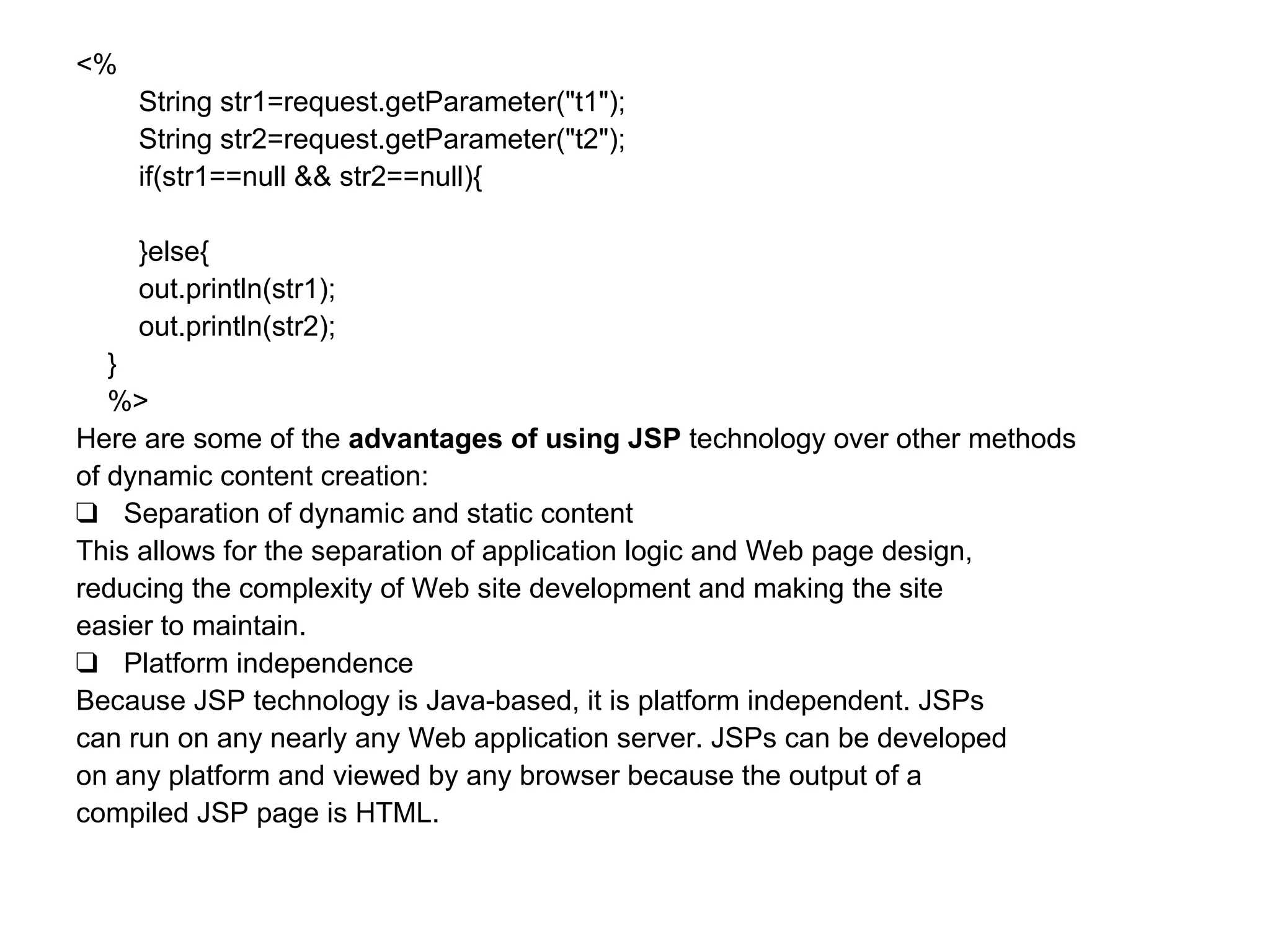
<% String str1=request.getParameter(&quot;t1&quot;); String str2=request.getParameter(&quot;t2&quot;); if(str1==null && str2==null){ }else{ out.println(str1); out.println(str2); } %> Here are some of the  advantages of using JSP  technology over other methods  of dynamic content creation:  ❑ Separation of dynamic and static content This allows for the separation of application logic and Web page design,  reducing the complexity of Web site development and making the site  easier to maintain. ❑ Platform independence Because JSP technology is Java-based, it is platform independent. JSPs  can run on any nearly any Web application server. JSPs can be developed  on any platform and viewed by any browser because the output of a  compiled JSP page is HTML.
 

Jsp

  • 1.
  • 2.
    J avaServer Pages(JSP) and Servlets are complementary technologies for producing dynamic Web pages via Java.While Servlets are the foundation for serverside Java, they are not always the most efficient solution with respect to development time. Coding, deploying, and debugging a Servlet can be a tedious task. Fixing a simple grammar or markup mistake requires wading through print() and println() calls, recompiling the Servlet, and reloading a Web Application Java Server Pages enable you to write standard HTML Pages containing tags that run powerful program based on Java Programming Language, JSP technology supports seperation of presentation and business logic as follows: Web designers can design and update pages without learning the java Programming language. Java technology programmer can write code without having having to be concered with web page. An example of JSP <body> <form> Name: <input type=&quot;text&quot; name=&quot;t1&quot; value=&quot;&quot; /> Age: <input type=&quot;text&quot; name=&quot;t2&quot; value=&quot;&quot; /> <input type=&quot;submit&quot; value=&quot;submit&quot; /> </form>
  • 3.
    <% String str1=request.getParameter(&quot;t1&quot;);String str2=request.getParameter(&quot;t2&quot;); if(str1==null && str2==null){ }else{ out.println(str1); out.println(str2); } %> Here are some of the advantages of using JSP technology over other methods of dynamic content creation: ❑ Separation of dynamic and static content This allows for the separation of application logic and Web page design, reducing the complexity of Web site development and making the site easier to maintain. ❑ Platform independence Because JSP technology is Java-based, it is platform independent. JSPs can run on any nearly any Web application server. JSPs can be developed on any platform and viewed by any browser because the output of a compiled JSP page is HTML.
  • 4.