Feature Writing
Feature Writing …
tells the reader a story. It has a
beginning (lead), middle and end.
It uses quotes liberally and allows
the reader to see the story through
detailed description and vivid
writing.
TYPES OF FEATURE STORIES
• Human Interest- issues that impact
people
• Profile- focuses on a specific individual’s
character or lifestyle
• Instructional- how-to feature
• News feature- focuses on a topic of
interest in the news
• Interpretative feature- deal with social,
economic, political, health, everyday
life problem
• Trend Stories- take the pulse of the
culture at the moment
• Seasonal Feature- story that has
relevance to the season or festival the
people celebrate
• Interview- obtains observations about
an issue that a person is
knowledgeable about.
• Informative feature- provides the
reader with knowledge that is
necessary to do a task or even to
avoid danger
• Live-in feature- an in-depth, often
magazine-length article that paints a
picture of a particular place and the
people who live or work there
• Personal Account/ Accomplishment-
deals with an unusual experience or
accomplishment of a person
REMINDERS:
• Do not forget citation and attribution
• Length is not a requirement
• Details should be based on facts
• It should have the emotional appeal
• Consider the social relevance
• Build a creative concept with unique
styles and techniques
Transition/Quote
Formula
Lead: Most interesting information.
Something that will grab the reader's attention
and drag them into the story.
Nut Graph: A summary of what the
story is going to be about. Why the story is
important.
Direct Quote: Connects to the nut
graph. Use more than one sentence. Direct
quotes should show the emotion of the story.
Transition: Next important fact. Use
transition words to help the story flow. They
can be facts, indirect quotes or partial quotes.
Direct Quote: Connects to the first
transition. Do not repeat the transition in the
quote. DQ should elaborate on the transition.
Transition: Next important fact. Use
transition words to help the story flow. They
can be facts, indirect quotes or partial quotes.
Direct Quote: Connects to the second
transition. Do not repeat the transition in the
quote. DQ should elaborate on the transition.
Linked
Linked
Linked
And so on… until the story is complete
Let's start at the
beginning with …
LEADS
The opening sentence must grab and
hold the reader's attention by using
specific, interest-arousing words.
Leads
The lead must catch the spirit of the
story and create the proper tone:
serious, sarcastic, ironic, flippant,
melancholy.
Leads
Leads
 Can be and often are longer than one sentence
 Your chance to grab the reader's attention
 Should be specific to your story
 Should not be filled with clichés
 Should be in third person
 Must fit the mood or tone of the story
A Few Types of Leads
 Narrative - tells a story
 Descriptive - describes a scene, person or subject
 Direct Quote – must be used with narrative
 Startling statement
 Contrast and Compare (then and now)
 Twist
Narrative - tells a story
Justin Greer's 2,800 friends have never seen him cry.
His father has seen him cry only once — the day last
October when doctors told the 16-year-old football player
that what he thought was a bad case of the flu was actually
leukemia.
“He cried a bit then,” Mr. Greer said. “But then he
squared off and said, ‘Well, I’m not dead yet.’ And I haven't
seen him cry since, although he's told me that sometimes he
cries at night when he's all alone.”
Narrative - tells a story
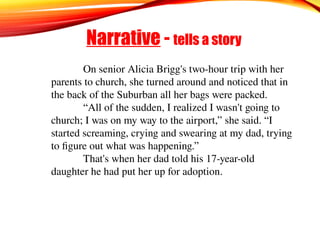
On senior Alicia Brigg's two-hour trip with her
parents to church, she turned around and noticed that in
the back of the Suburban all her bags were packed.
“All of the sudden, I realized I wasn't going to
church; I was on my way to the airport,” she said. “I
started screaming, crying and swearing at my dad, trying
to figure out what was happening.”
That's when her dad told his 17-year-old
daughter he had put her up for adoption.
Descriptive - describes a scene/person
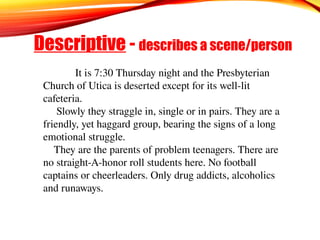
It is 7:30 Thursday night and the Presbyterian
Church of Utica is deserted except for its well-lit
cafeteria.
Slowly they straggle in, single or in pairs. They are a
friendly, yet haggard group, bearing the signs of a long
emotional struggle.
They are the parents of problem teenagers. There are
no straight-A-honor roll students here. No football
captains or cheerleaders. Only drug addicts, alcoholics
and runaways.
Descriptive - describes a scene or person
Standing in the lunch line, the boy turned to April Haler
and asked, “Will you be my girlfriend?”
Then he turned to his buddy and started laughing.
Just another cruel joke on the fat kid.
April, who once weighed almost 300 pounds, is used to
them. Since elementary school she has been teased and
taunted about her weight.
“I remember being called horrible names in elementary
school every time we went to the playground,” the
sophomore said.
But life is changing.
Descriptive - describes a scene or person
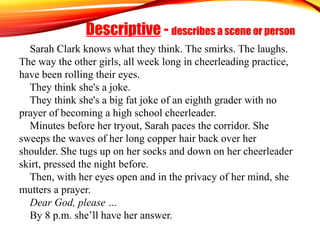
Sarah Clark knows what they think. The smirks. The laughs.
The way the other girls, all week long in cheerleading practice,
have been rolling their eyes.
They think she's a joke.
They think she's a big fat joke of an eighth grader with no
prayer of becoming a high school cheerleader.
Minutes before her tryout, Sarah paces the corridor. She
sweeps the waves of her long copper hair back over her
shoulder. She tugs up on her socks and down on her cheerleader
skirt, pressed the night before.
Then, with her eyes open and in the privacy of her mind, she
mutters a prayer.
Dear God, please …
By 8 p.m. she’ll have her answer.
Direct Quote - use sparingly. Must be very
powerful quote
“Don't be mad. I took some pills,” Karen Keaton
cried as she stooped over the toilet.
A few hours later, the 14-year-old freshman died
after a series of coronary arrests.
Direct Quote - use sparingly.
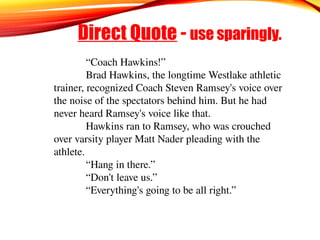
“Coach Hawkins!”
Brad Hawkins, the longtime Westlake athletic
trainer, recognized Coach Steven Ramsey's voice over
the noise of the spectators behind him. But he had
never heard Ramsey's voice like that.
Hawkins ran to Ramsey, who was crouched
over varsity player Matt Nader pleading with the
athlete.
“Hang in there.”
“Don't leave us.”
“Everything's going to be all right.”
Startling Statement - creates
drama
She never knew she had it.
______________________________________
Junior Josh Duckworth has a fetish.
Startling Statement/
Narrative/Descriptive
Zackary Jargowsky hates pronouns.
He hates the “she” that sometimes slips out
when he's playing Quidditch with his friends, and the
“it” he's been labeled by the ones who don't understand.
He hates the prolonged stares as people try to
figure out what is going on beneath his “Nightmare
Before Christmas” hoodie and plaid, vertical striped
shirts — the ones the stylist said would help.
Startling Statement –
creates drama
Melissa hates school.
It's not that she's dumb. It isn’t that she doesn’t
fit in socially. In fact, it isn’t that anything is
particularly wrong.
It's more of a matter of nothing being particularly
right.
A group of candystripers stand around the nursery, holding
incubator babies. It's “loving time.” Another young girl steps in with
her mother and picks up a baby, too. She is not in a uniform, but in a
hospital gown, for the baby she holds is her own — and it's her
“loving time.”
It's also time to say good-bye.
“I sat in that rocker and held him and rocked him and I cried
and cried and cried,” Amber, a senior, said. “I wanted that moment to
last forever so I could always hold him and always be there for him.”
“But I knew I couldn't. That's what hurt.”
Twist - sets reader up for one mood and then
twists it, surprises the reader
After tension-filled hours of last-minute primping,
the time had come for the contestants to walk into
the arena and strut their stuff in front of the three
judges and an appreciative crowd.
Some walked briskly with an air of confidence.
Others, distracted by the lights and cameras,
shuffled along slowly. A few, overcome by the
pressure, foamed at the mouth and mooed.
Twist
Even though Saturday's market steer competition at
the Austin-Travis County Livestock Show and Rodeo
was like many other beauty pageants, there were some
obvious differences.
The contestants — steers weighing more than half
a ton — were being judged on the type of T-bones
and rump roasts they would turn into instead of their
appearance in an evening gown or bathing suit.
A few more good ones …
By his own admission, Adan Peña was a lousy
student. Lazy. Apathetic. A typical junior high slacker. He
was heading in the direction of dropping out of school and
into a life of who knows what — at best, working on a
dairy farm. At worst, jail.
Writing devices for leads
 Repetition
Short, punchy sentences. Fragments.
 Using dialogue
Mixing sentence length to set a rhythm
 Breaking the rules … starting with “And”
The lead should open
with the specific,
then go to the general.
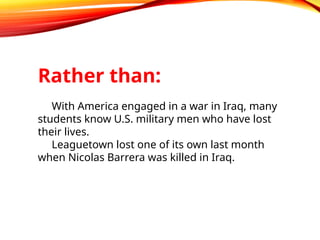
Rather than:
With America engaged in a war in Iraq, many
students know U.S. military men who have lost
their lives.
Leaguetown lost one of its own last month
when Nicolas Barrera was killed in Iraq.
Try this:
When Briana Barrera didn’t hear from her son,
Nicolas, for a week she knew something was
wrong. Maybe it was mother's intuition, but she
knew.
And when she saw two officers walking toward
her door, her worst fear was confirmed.
“The officers said they were sorry to deliver the
news, but Nicolas died with honor,” she said. “Dying
with honor? How does that help? My heart was
breaking. My boy was gone.”
• News or editorials leads.
•Avoid first and second person.
• Stating the obvious.
• Using cliches.
• “Imagine this…” leads
Lead writing pitfalls:
Freshman Sarah Diaz made the cheerleader squad
for the 2024-2025 school year.
Congratulations to Sarah Diaz for making the
cheerleading squad. We are proud of her.
No news or editorials leads.
Avoid first and second person
Every day, millions of people wake up, go to
work or go to school. But some days, they
don't.
Millions of teenagers have jobs. They work
for many reasons: college, cars, just to have
some spending money in their pocket.
Don't state the obvious
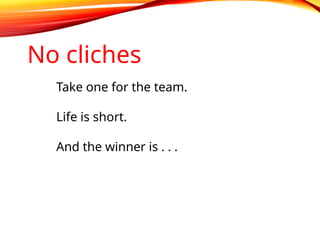
Take one for the team.
Life is short.
And the winner is . . .
No cliches
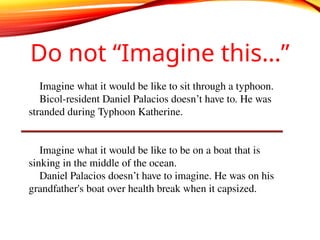
Do not “Imagine this…”
Imagine what it would be like to sit through a typhoon.
Bicol-resident Daniel Palacios doesn’t have to. He was
stranded during Typhoon Katherine.
Imagine what it would be like to be on a boat that is
sinking in the middle of the ocean.
Daniel Palacios doesn’t have to imagine. He was on his
grandfather's boat over health break when it capsized.
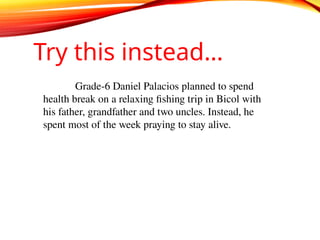
Grade-6 Daniel Palacios planned to spend
health break on a relaxing fishing trip in Bicol with
his father, grandfather and two uncles. Instead, he
spent most of the week praying to stay alive.
Try this instead…
What's next?
After a strong lead…
You need a strong nut
graph.
What is a nut graph?
Basically, it is a summary of what
the story is going to be about. It's the
5 Ws and H that you didn’t answer
in the lead.
It's the thesis sentence of your
story.
What are the 5 Ws and H?
• WHAT- What is the event
• WHEN- When it happened
• WHO-Who are the persons
involved
• WHERE-The place where it
happened
• Why- The reason why it
happened
• HOW- How the events unfold
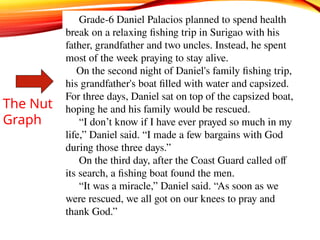
Grade-6 Daniel Palacios planned to spend health
break on a relaxing fishing trip in Surigao with his
father, grandfather and two uncles. Instead, he spent
most of the week praying to stay alive.
On the second night of Daniel's family fishing trip,
his grandfather's boat filled with water and capsized.
For three days, Daniel sat on top of the capsized boat,
hoping he and his family would be rescued.
“I don’t know if I have ever prayed so much in my
life,” Daniel said. “I made a few bargains with God
during those three days.”
On the third day, after the Coast Guard called off
its search, a fishing boat found the men.
“It was a miracle,” Daniel said. “As soon as we
were rescued, we all got on our knees to pray and
thank God.”
The Nut
Graph
What's next?
After a strong lead and an
informative nut graph…
Use the Transition/Quote
formula
Grade-6 Daniel Palacios planned to spend spring break on
a relaxing fishing trip in Surigao with his father, grandfather
and two uncles. Instead, he spent most of the week praying
to stay alive.
On the second night of Daniel's family fishing trip, his
grandfather's boat filled with water and capsized. For three
days, Daniel sat on top of the capsized boat, hoping he and
his family would be rescued.
“I don’t know if I have ever prayed so much in my life,”
Daniel said. “I made a few bargains with God during those
three days.”
On the third day, after the Coast Guard called off its
search, a fishing boat found the men.
“It was a miracle,” Daniel said. “As soon as we were
rescued, we all got on our knees to pray and thank God.”
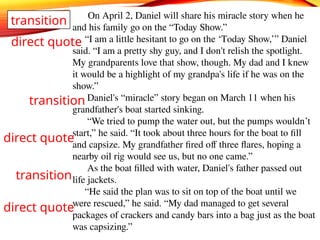
transition
direct quote
On April 2, Daniel will share his miracle story when he
and his family go on the “Today Show.”
“I am a little hesitant to go on the ‘Today Show,’” Daniel
said. “I am a pretty shy guy, and I don't relish the spotlight.
My grandparents love that show, though. My dad and I knew
it would be a highlight of my grandpa's life if he was on the
show.”
Daniel's “miracle” story began on March 11 when his
grandfather's boat started sinking.
“We tried to pump the water out, but the pumps wouldn’t
start,” he said. “It took about three hours for the boat to fill
and capsize. My grandfather fired off three flares, hoping a
nearby oil rig would see us, but no one came.”
As the boat filled with water, Daniel's father passed out
life jackets.
“He said the plan was to sit on top of the boat until we
were rescued,” he said. “My dad managed to get several
packages of crackers and candy bars into a bag just as the boat
was capsizing.”
transition
direct quote
transition
direct quote
direct quote
transition
So how do you
end a feature
story?
End your story with …
- A powerful quote
Or
- Tie the ending back to the lead
For example:
(Lead) “Don't be mad. I took some pills,” Karen Keaton
cried as she stooped over the toilet.
A few hours later, the 14-year-old freshman died
after a series of coronary arrests.
(Ending) Since the death of her oldest daughter, the
Keatons have found themselves becoming more
protective. “I find myself watching for things,” Mrs.
Keaton said. “I’m not sure for what. I’m just watching.”
For example:
(Lead) A group of candystripers stand around the
nursery, holding incubator babies. It's “loving time.”
Another young girl steps in with her mother and picks
up a baby, too. She is not in a uniform, but in a hospital
gown, for the baby she holds is her own — and it's her
“loving time.”
It's also time to say good-bye.
“I sat in that rocker and held him and rocked
him and I cried and cried and cried,” Amber, a senior,
said. “I wanted that moment to last forever so I could
always hold him and always be there for him.”
“But I knew I couldn’t. That's what hurt.”
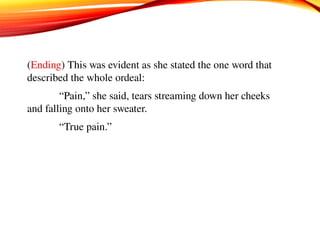
(Ending) This was evident as she stated the one word that
described the whole ordeal:
“Pain,” she said, tears streaming down her cheeks
and falling onto her sweater.
“True pain.”
For a Strong Feature Story
remember this …
GQ STUDD
G
Q
S
T
U
D
D
Great
Quotes
Strong Lead
Transition/Quote Formula
Unique Angle
Description - Show Don't Tell
Detail
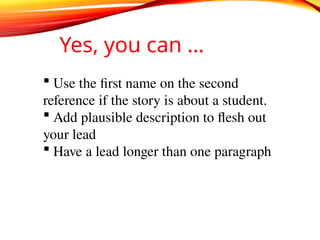
Yes, you can …
 Use the first name on the second
reference if the story is about a student.
 Add plausible description to flesh out
your lead
 Have a lead longer than one paragraph
Pitfalls to avoid in feature writing …
 Using a news lead
 Writing in the passive voice
 Using too many adverbs and adjectives
instead of specific nouns and powerful
verbs
 Messy handwriting
 Story doesn’t flow – doesn’t use T/Q
formula
 Lack of strong quotes
On contest day …
 Read the entire prompt
 Take a moment. Remember what
stands out to you. Try to use that for your
lead.
 Reread the prompt and highlight or
underline powerful quotes.
 Also, mark your nut graph (usually
the news peg) in the prompt.
 Cross out any unnecessary quotes or
people.
 Write.
Journalism: Feature Writing presentation.pptx

Journalism: Feature Writing presentation.pptx

  • 1.
  • 2.
    Feature Writing … tellsthe reader a story. It has a beginning (lead), middle and end. It uses quotes liberally and allows the reader to see the story through detailed description and vivid writing.
  • 3.
    TYPES OF FEATURESTORIES • Human Interest- issues that impact people • Profile- focuses on a specific individual’s character or lifestyle • Instructional- how-to feature • News feature- focuses on a topic of interest in the news
  • 4.
    • Interpretative feature-deal with social, economic, political, health, everyday life problem • Trend Stories- take the pulse of the culture at the moment • Seasonal Feature- story that has relevance to the season or festival the people celebrate • Interview- obtains observations about an issue that a person is knowledgeable about.
  • 5.
    • Informative feature-provides the reader with knowledge that is necessary to do a task or even to avoid danger • Live-in feature- an in-depth, often magazine-length article that paints a picture of a particular place and the people who live or work there • Personal Account/ Accomplishment- deals with an unusual experience or accomplishment of a person
  • 6.
    REMINDERS: • Do notforget citation and attribution • Length is not a requirement • Details should be based on facts • It should have the emotional appeal • Consider the social relevance • Build a creative concept with unique styles and techniques
  • 7.
    Transition/Quote Formula Lead: Most interestinginformation. Something that will grab the reader's attention and drag them into the story. Nut Graph: A summary of what the story is going to be about. Why the story is important. Direct Quote: Connects to the nut graph. Use more than one sentence. Direct quotes should show the emotion of the story. Transition: Next important fact. Use transition words to help the story flow. They can be facts, indirect quotes or partial quotes. Direct Quote: Connects to the first transition. Do not repeat the transition in the quote. DQ should elaborate on the transition. Transition: Next important fact. Use transition words to help the story flow. They can be facts, indirect quotes or partial quotes. Direct Quote: Connects to the second transition. Do not repeat the transition in the quote. DQ should elaborate on the transition. Linked Linked Linked And so on… until the story is complete
  • 8.
    Let's start atthe beginning with … LEADS
  • 9.
    The opening sentencemust grab and hold the reader's attention by using specific, interest-arousing words. Leads
  • 10.
    The lead mustcatch the spirit of the story and create the proper tone: serious, sarcastic, ironic, flippant, melancholy. Leads
  • 11.
    Leads  Can beand often are longer than one sentence  Your chance to grab the reader's attention  Should be specific to your story  Should not be filled with clichés  Should be in third person  Must fit the mood or tone of the story
  • 12.
    A Few Typesof Leads  Narrative - tells a story  Descriptive - describes a scene, person or subject  Direct Quote – must be used with narrative  Startling statement  Contrast and Compare (then and now)  Twist
  • 13.
    Narrative - tellsa story Justin Greer's 2,800 friends have never seen him cry. His father has seen him cry only once — the day last October when doctors told the 16-year-old football player that what he thought was a bad case of the flu was actually leukemia. “He cried a bit then,” Mr. Greer said. “But then he squared off and said, ‘Well, I’m not dead yet.’ And I haven't seen him cry since, although he's told me that sometimes he cries at night when he's all alone.”
  • 14.
    Narrative - tellsa story On senior Alicia Brigg's two-hour trip with her parents to church, she turned around and noticed that in the back of the Suburban all her bags were packed. “All of the sudden, I realized I wasn't going to church; I was on my way to the airport,” she said. “I started screaming, crying and swearing at my dad, trying to figure out what was happening.” That's when her dad told his 17-year-old daughter he had put her up for adoption.
  • 15.
    Descriptive - describesa scene/person It is 7:30 Thursday night and the Presbyterian Church of Utica is deserted except for its well-lit cafeteria. Slowly they straggle in, single or in pairs. They are a friendly, yet haggard group, bearing the signs of a long emotional struggle. They are the parents of problem teenagers. There are no straight-A-honor roll students here. No football captains or cheerleaders. Only drug addicts, alcoholics and runaways.
  • 16.
    Descriptive - describesa scene or person Standing in the lunch line, the boy turned to April Haler and asked, “Will you be my girlfriend?” Then he turned to his buddy and started laughing. Just another cruel joke on the fat kid. April, who once weighed almost 300 pounds, is used to them. Since elementary school she has been teased and taunted about her weight. “I remember being called horrible names in elementary school every time we went to the playground,” the sophomore said. But life is changing.
  • 17.
    Descriptive - describesa scene or person Sarah Clark knows what they think. The smirks. The laughs. The way the other girls, all week long in cheerleading practice, have been rolling their eyes. They think she's a joke. They think she's a big fat joke of an eighth grader with no prayer of becoming a high school cheerleader. Minutes before her tryout, Sarah paces the corridor. She sweeps the waves of her long copper hair back over her shoulder. She tugs up on her socks and down on her cheerleader skirt, pressed the night before. Then, with her eyes open and in the privacy of her mind, she mutters a prayer. Dear God, please … By 8 p.m. she’ll have her answer.
  • 18.
    Direct Quote -use sparingly. Must be very powerful quote “Don't be mad. I took some pills,” Karen Keaton cried as she stooped over the toilet. A few hours later, the 14-year-old freshman died after a series of coronary arrests.
  • 19.
    Direct Quote -use sparingly. “Coach Hawkins!” Brad Hawkins, the longtime Westlake athletic trainer, recognized Coach Steven Ramsey's voice over the noise of the spectators behind him. But he had never heard Ramsey's voice like that. Hawkins ran to Ramsey, who was crouched over varsity player Matt Nader pleading with the athlete. “Hang in there.” “Don't leave us.” “Everything's going to be all right.”
  • 20.
    Startling Statement -creates drama She never knew she had it. ______________________________________ Junior Josh Duckworth has a fetish.
  • 21.
    Startling Statement/ Narrative/Descriptive Zackary Jargowskyhates pronouns. He hates the “she” that sometimes slips out when he's playing Quidditch with his friends, and the “it” he's been labeled by the ones who don't understand. He hates the prolonged stares as people try to figure out what is going on beneath his “Nightmare Before Christmas” hoodie and plaid, vertical striped shirts — the ones the stylist said would help.
  • 22.
    Startling Statement – createsdrama Melissa hates school. It's not that she's dumb. It isn’t that she doesn’t fit in socially. In fact, it isn’t that anything is particularly wrong. It's more of a matter of nothing being particularly right.
  • 23.
    A group ofcandystripers stand around the nursery, holding incubator babies. It's “loving time.” Another young girl steps in with her mother and picks up a baby, too. She is not in a uniform, but in a hospital gown, for the baby she holds is her own — and it's her “loving time.” It's also time to say good-bye. “I sat in that rocker and held him and rocked him and I cried and cried and cried,” Amber, a senior, said. “I wanted that moment to last forever so I could always hold him and always be there for him.” “But I knew I couldn't. That's what hurt.” Twist - sets reader up for one mood and then twists it, surprises the reader
  • 24.
    After tension-filled hoursof last-minute primping, the time had come for the contestants to walk into the arena and strut their stuff in front of the three judges and an appreciative crowd. Some walked briskly with an air of confidence. Others, distracted by the lights and cameras, shuffled along slowly. A few, overcome by the pressure, foamed at the mouth and mooed. Twist
  • 25.
    Even though Saturday'smarket steer competition at the Austin-Travis County Livestock Show and Rodeo was like many other beauty pageants, there were some obvious differences. The contestants — steers weighing more than half a ton — were being judged on the type of T-bones and rump roasts they would turn into instead of their appearance in an evening gown or bathing suit.
  • 26.
    A few moregood ones … By his own admission, Adan Peña was a lousy student. Lazy. Apathetic. A typical junior high slacker. He was heading in the direction of dropping out of school and into a life of who knows what — at best, working on a dairy farm. At worst, jail.
  • 27.
    Writing devices forleads  Repetition Short, punchy sentences. Fragments.  Using dialogue Mixing sentence length to set a rhythm  Breaking the rules … starting with “And”
  • 28.
    The lead shouldopen with the specific, then go to the general.
  • 29.
    Rather than: With Americaengaged in a war in Iraq, many students know U.S. military men who have lost their lives. Leaguetown lost one of its own last month when Nicolas Barrera was killed in Iraq.
  • 30.
    Try this: When BrianaBarrera didn’t hear from her son, Nicolas, for a week she knew something was wrong. Maybe it was mother's intuition, but she knew. And when she saw two officers walking toward her door, her worst fear was confirmed. “The officers said they were sorry to deliver the news, but Nicolas died with honor,” she said. “Dying with honor? How does that help? My heart was breaking. My boy was gone.”
  • 31.
    • News oreditorials leads. •Avoid first and second person. • Stating the obvious. • Using cliches. • “Imagine this…” leads Lead writing pitfalls:

  • 32.
    Freshman Sarah Diazmade the cheerleader squad for the 2024-2025 school year. Congratulations to Sarah Diaz for making the cheerleading squad. We are proud of her. No news or editorials leads. Avoid first and second person
  • 33.
    Every day, millionsof people wake up, go to work or go to school. But some days, they don't. Millions of teenagers have jobs. They work for many reasons: college, cars, just to have some spending money in their pocket. Don't state the obvious
  • 34.
    Take one forthe team. Life is short. And the winner is . . . No cliches
  • 35.
    Do not “Imaginethis…” Imagine what it would be like to sit through a typhoon. Bicol-resident Daniel Palacios doesn’t have to. He was stranded during Typhoon Katherine. Imagine what it would be like to be on a boat that is sinking in the middle of the ocean. Daniel Palacios doesn’t have to imagine. He was on his grandfather's boat over health break when it capsized.
  • 36.
    Grade-6 Daniel Palaciosplanned to spend health break on a relaxing fishing trip in Bicol with his father, grandfather and two uncles. Instead, he spent most of the week praying to stay alive. Try this instead…
  • 37.
  • 38.
    After a stronglead… You need a strong nut graph.
  • 39.
    What is anut graph? Basically, it is a summary of what the story is going to be about. It's the 5 Ws and H that you didn’t answer in the lead. It's the thesis sentence of your story.
  • 40.
    What are the5 Ws and H? • WHAT- What is the event • WHEN- When it happened • WHO-Who are the persons involved • WHERE-The place where it happened • Why- The reason why it happened • HOW- How the events unfold
  • 41.
    Grade-6 Daniel Palaciosplanned to spend health break on a relaxing fishing trip in Surigao with his father, grandfather and two uncles. Instead, he spent most of the week praying to stay alive. On the second night of Daniel's family fishing trip, his grandfather's boat filled with water and capsized. For three days, Daniel sat on top of the capsized boat, hoping he and his family would be rescued. “I don’t know if I have ever prayed so much in my life,” Daniel said. “I made a few bargains with God during those three days.” On the third day, after the Coast Guard called off its search, a fishing boat found the men. “It was a miracle,” Daniel said. “As soon as we were rescued, we all got on our knees to pray and thank God.” The Nut Graph
  • 42.
  • 43.
    After a stronglead and an informative nut graph… Use the Transition/Quote formula
  • 44.
    Grade-6 Daniel Palaciosplanned to spend spring break on a relaxing fishing trip in Surigao with his father, grandfather and two uncles. Instead, he spent most of the week praying to stay alive. On the second night of Daniel's family fishing trip, his grandfather's boat filled with water and capsized. For three days, Daniel sat on top of the capsized boat, hoping he and his family would be rescued. “I don’t know if I have ever prayed so much in my life,” Daniel said. “I made a few bargains with God during those three days.” On the third day, after the Coast Guard called off its search, a fishing boat found the men. “It was a miracle,” Daniel said. “As soon as we were rescued, we all got on our knees to pray and thank God.” transition direct quote
  • 45.
    On April 2,Daniel will share his miracle story when he and his family go on the “Today Show.” “I am a little hesitant to go on the ‘Today Show,’” Daniel said. “I am a pretty shy guy, and I don't relish the spotlight. My grandparents love that show, though. My dad and I knew it would be a highlight of my grandpa's life if he was on the show.” Daniel's “miracle” story began on March 11 when his grandfather's boat started sinking. “We tried to pump the water out, but the pumps wouldn’t start,” he said. “It took about three hours for the boat to fill and capsize. My grandfather fired off three flares, hoping a nearby oil rig would see us, but no one came.” As the boat filled with water, Daniel's father passed out life jackets. “He said the plan was to sit on top of the boat until we were rescued,” he said. “My dad managed to get several packages of crackers and candy bars into a bag just as the boat was capsizing.” transition direct quote transition direct quote direct quote transition
  • 46.
    So how doyou end a feature story?
  • 47.
    End your storywith … - A powerful quote Or - Tie the ending back to the lead
  • 48.
    For example: (Lead) “Don'tbe mad. I took some pills,” Karen Keaton cried as she stooped over the toilet. A few hours later, the 14-year-old freshman died after a series of coronary arrests. (Ending) Since the death of her oldest daughter, the Keatons have found themselves becoming more protective. “I find myself watching for things,” Mrs. Keaton said. “I’m not sure for what. I’m just watching.”
  • 49.
    For example: (Lead) Agroup of candystripers stand around the nursery, holding incubator babies. It's “loving time.” Another young girl steps in with her mother and picks up a baby, too. She is not in a uniform, but in a hospital gown, for the baby she holds is her own — and it's her “loving time.” It's also time to say good-bye. “I sat in that rocker and held him and rocked him and I cried and cried and cried,” Amber, a senior, said. “I wanted that moment to last forever so I could always hold him and always be there for him.” “But I knew I couldn’t. That's what hurt.”
  • 50.
    (Ending) This wasevident as she stated the one word that described the whole ordeal: “Pain,” she said, tears streaming down her cheeks and falling onto her sweater. “True pain.”
  • 51.
    For a StrongFeature Story remember this … GQ STUDD
  • 52.
  • 53.
    Yes, you can…  Use the first name on the second reference if the story is about a student.  Add plausible description to flesh out your lead  Have a lead longer than one paragraph
  • 54.
    Pitfalls to avoidin feature writing …  Using a news lead  Writing in the passive voice  Using too many adverbs and adjectives instead of specific nouns and powerful verbs  Messy handwriting  Story doesn’t flow – doesn’t use T/Q formula  Lack of strong quotes
  • 55.
    On contest day…  Read the entire prompt  Take a moment. Remember what stands out to you. Try to use that for your lead.  Reread the prompt and highlight or underline powerful quotes.  Also, mark your nut graph (usually the news peg) in the prompt.  Cross out any unnecessary quotes or people.  Write.