01/26/26 Temple CTEReading Project
1
Journaling
The Reading to Writing Connection
Workshop #3
2.
01/26/26 Temple CTEReading Project
2
What is journaling?
Journaling is a reading comprehension
strategy integrating structured writing
activities that are used to monitor learner
understanding of reading passages.
Readers collect data, reread, and analyze
the findings in order to discover what they
mean or how they can be used. Journaling
can take many forms.
3.
01/26/26 Temple CTEReading Project
3
What are some forms of
journaling?
Journaling can take many forms, such as:
note taking
memos
learning logs
paragraph summary
prediction, discussion or reflection writings
4.
01/26/26 Temple CTEReading Project
4
Why Read and Write, what’s the
connection?
Writing can be used to facilitate learning
when students:
Have a clearly defined purpose to write.
Use writing as a means for building
knowledge.
Think critically: predict, question,
summarize.
5.
01/26/26 Temple CTEReading Project
5
Why Read and Write, what’s the
connection?
Writing can be used to facilitate learning
when students:
Make connections between text
knowledge and personal knowledge.
Apply their observations through writing.
Use career-related vocabulary to explain a
process.
6.
01/26/26 Temple CTEReading Project
6
Why journal in the content areas?
Writing is the most disciplined form of
thinking. ( Murray, 1984)
Journaling is not a separate activity, but
integral to the thinking process.
Journaling activities allow for the
processing and retaining of key ideas.
7.
01/26/26 Temple CTEReading Project
7
Why journal in the content areas?
By journaling, learners can:
1. Transform printed text into their own
language.
2. Construct meaning with new
information.
3. Explore, revise, and think on paper.
8.
01/26/26 Temple CTEReading Project
8
How will journaling increase
comprehension?
Journaling increases learner comprehension
by assisting in the:
Learning of new content
Interpretation of new content
Use of schemata to construct new
knowledge
Refinement of prior knowledge
9.
01/26/26 Temple CTEReading Project
9
What advantages do journaling
activities offer ?
Journaling gives students structured activities to:
Summarize ideas
Organize processes and sequences
Explore ideas from the text
Draw conclusions and reactions
Self – evaluate their learning
Revise and think on paper
Keep a record of their thinking
10.
01/26/26 Temple CTEReading Project
10
What advantages do journaling
activities offer ?
Journaling gives students structured activities to:
Discover vocabulary and develop meaning
Question, connect and apply their observations
through writing
Gather evidence to structure a process, procedure
or argument
Achieve a deeper understanding of text content
Share their ideas with others in peer and group
discussions
11.
01/26/26 Temple CTEReading Project
11
What framework can be used when
implementing journaling activities?
Before reading journaling
During reading journaling
After reading journaling
01/26/26 Temple CTEReading Project
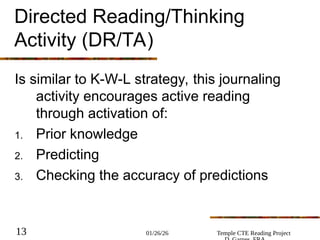
13
Directed Reading/Thinking
Activity (DR/TA)
Is similar to K-W-L strategy, this journaling
activity encourages active reading
through activation of:
1. Prior knowledge
2. Predicting
3. Checking the accuracy of predictions
14.
01/26/26 Temple CTEReading Project
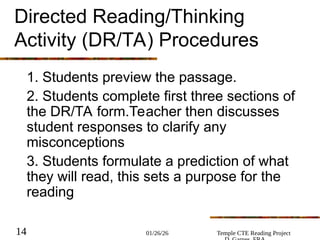
14
Directed Reading/Thinking
Activity (DR/TA) Procedures
1. Students preview the passage.
2. Students complete first three sections of
the DR/TA form.Teacher then discusses
student responses to clarify any
misconceptions
3. Students formulate a prediction of what
they will read, this sets a purpose for the
reading
15.
01/26/26 Temple CTEReading Project
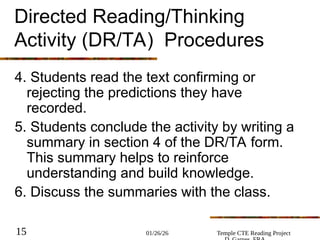
15
Directed Reading/Thinking
Activity (DR/TA) Procedures
4. Students read the text confirming or
rejecting the predictions they have
recorded.
5. Students conclude the activity by writing a
summary in section 4 of the DR/TA form.
This summary helps to reinforce
understanding and build knowledge.
6. Discuss the summaries with the class.
16.
01/26/26 Temple CTEReading Project
16
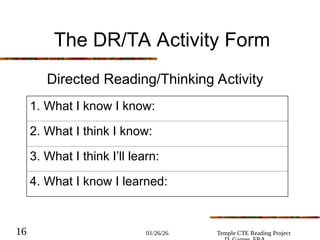
The DR/TA Activity Form
Directed Reading/Thinking Activity
1. What I know I know:
2. What I think I know:
3. What I think I’ll learn:
4. What I know I learned:
17.
01/26/26 Temple CTEReading Project
17
DR/TA Summary Discussions
A purposeful discussion of the summary
should:
1. Examine and review key ideas.
2. Focus on process and sequence, if a
procedure is explained.
3. Deepen student understanding of the
subject.
18.
01/26/26 Temple CTEReading Project
18
Prediction Journal
The prediction journal is used as a before
reading written response activity.
19.
01/26/26 Temple CTEReading Project
19
Prediction Journal
The prediction journal is designed to ask five
key questions whereby students:
1. engage prior knowledge,
2. make predictions,
3. identify major concepts to be learned,
4. clarify student purpose for reading
5. Identify reading strategies used during
the reading assignment
20.
01/26/26 Temple CTEReading Project
20
Sample Prediction Journal
1. What are some things you already know about the
passage?
2. What are some predictions about the passage?
3. What concepts are you trying to understand by reading
this passage?
4. What do you hope to learn by reading this passage?
5. What reading strategies might you use as you read the
passage to help you understand?
21.
01/26/26 Temple CTEReading Project
21
During Reading Journaling
Activities include
Writing to Learn
Process Logs
Discussion Journals
22.
01/26/26 Temple CTEReading Project
22
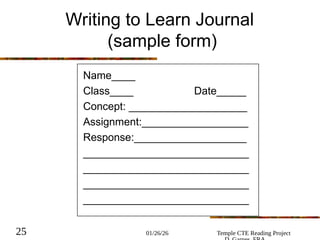
Writing To Learn Strategy
Can be incorporated across the curriculum
Helps students personalize learning
Encourages high-level thinking skills
Assists in helping students construct
meaning from the text
Writing activities are brief
23.
01/26/26 Temple CTEReading Project
23
Writing To Learn Strategy Steps
1.Select the concept you want students to
explore.
2. Assign the Writing to learn activity
any time during the class.
3. Give students three to five minutes think
time to consider a response
4. Have students write five minutes on the
topic.
24.
01/26/26 Temple CTEReading Project
24
Writing To Learn Strategy
Writing to learn discussion can be
centered on the written response
Writing to learn helps students reflect on
information under discussion.
Writing to learn helps students construct
summaries.
01/26/26 Temple CTEReading Project
26
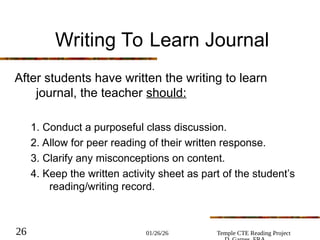
Writing To Learn Journal
After students have written the writing to learn
journal, the teacher should:
1. Conduct a purposeful class discussion.
2. Allow for peer reading of their written response.
3. Clarify any misconceptions on content.
4. Keep the written activity sheet as part of the student’s
reading/writing record.
27.
01/26/26 Temple CTEReading Project
27
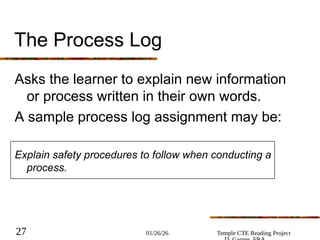
The Process Log
Asks the learner to explain new information
or process written in their own words.
A sample process log assignment may be:
Explain safety procedures to follow when conducting a
process.
28.
01/26/26 Temple CTEReading Project
28
The Process Log
Ten process logs prompts ( writing
assignment statements) are included in
the guide manual, refer to Handout 28-1.
29.
01/26/26 Temple CTEReading Project
29
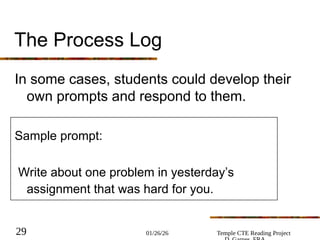
The Process Log
In some cases, students could develop their
own prompts and respond to them.
Sample prompt:
Write about one problem in yesterday’s
assignment that was hard for you.
30.
01/26/26 Temple CTEReading Project
30
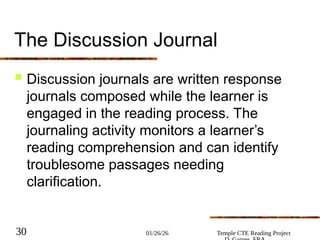
The Discussion Journal
Discussion journals are written response
journals composed while the learner is
engaged in the reading process. The
journaling activity monitors a learner’s
reading comprehension and can identify
troublesome passages needing
clarification.
31.
01/26/26 Temple CTEReading Project
31
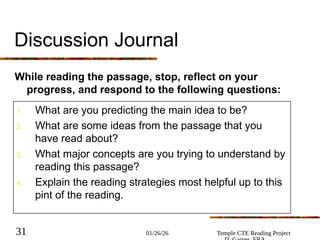
Discussion Journal
While reading the passage, stop, reflect on your
progress, and respond to the following questions:
1. What are you predicting the main idea to be?
2. What are some ideas from the passage that you
have read about?
3. What major concepts are you trying to understand by
reading this passage?
4. Explain the reading strategies most helpful up to this
pint of the reading.
32.
01/26/26 Temple CTEReading Project
32
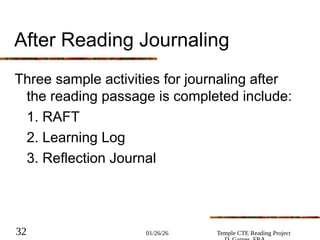
After Reading Journaling
Three sample activities for journaling after
the reading passage is completed include:
1. RAFT
2. Learning Log
3. Reflection Journal
33.
01/26/26 Temple CTEReading Project
33
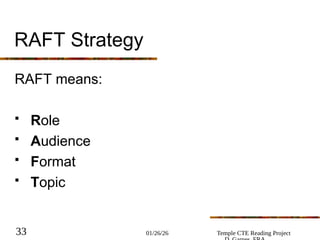
RAFT Strategy
RAFT means:
Role
Audience
Format
Topic
34.
01/26/26 Temple CTEReading Project
34
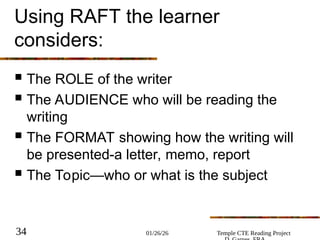
Using RAFT the learner
considers:
The ROLE of the writer
The AUDIENCE who will be reading the
writing
The FORMAT showing how the writing will
be presented-a letter, memo, report
The Topic—who or what is the subject
35.
01/26/26 Temple CTEReading Project
35
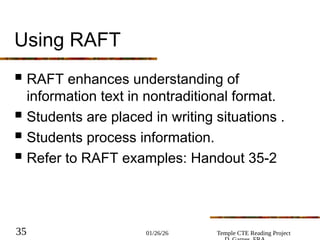
Using RAFT
RAFT enhances understanding of
information text in nontraditional format.
Students are placed in writing situations .
Students process information.
Refer to RAFT examples: Handout 35-2
36.
01/26/26 Temple CTEReading Project
36
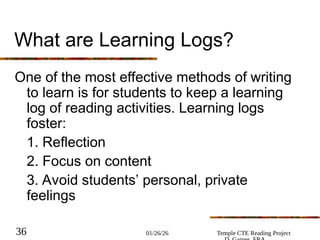
What are Learning Logs?
One of the most effective methods of writing
to learn is for students to keep a learning
log of reading activities. Learning logs
foster:
1. Reflection
2. Focus on content
3. Avoid students’ personal, private
feelings
37.
01/26/26 Temple CTEReading Project
37
Using Learning Logs: Procedures
1. Teacher selects process or content to
explore.
2. Assign the topic and give the students 3
to 5 minutes think time.
3. Have students write for five minutes on
the learning log topic
4. Discuss the learning log at a later date.
38.
01/26/26 Temple CTEReading Project
38
Using Learning Logs
1. An ongoing record of learning
2. Reread the learning log at a later date
and reflect on how ideas have changed.
3. Explain how fix-up reading strategies
have helped your comprehension
4. Refer to Handout 37-1 for ten learning
log prompts you may use.
39.
01/26/26 Temple CTEReading Project
39
Reflection Journals
After the reading passage is completed the
teacher may choose to use a reflection
journal writing activity.
40.
01/26/26 Temple CTEReading Project
40
Why use a reflection journal?
The reflection journal activity reflects upon
1. Main idea
2. Prediction/outcome comparison
3. Summarization
4. Real World connections
41.
01/26/26 Temple CTEReading Project
41
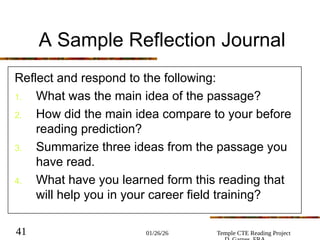
A Sample Reflection Journal
Reflect and respond to the following:
1. What was the main idea of the passage?
2. How did the main idea compare to your before
reading prediction?
3. Summarize three ideas from the passage you
have read.
4. What have you learned form this reading that
will help you in your career field training?
42.
01/26/26 Temple CTEReading Project
42
Troubleshooting Journaling
Activities
Refer to Handout 42-1 for ten writing tips for
students and teachers to use when
implementing journaling activities with
reading assignments.
43.
01/26/26 Temple CTEReading Project
43
Journaling
Improving reading comprehension with
the Reading to Writing Connection.
44.
01/26/26 Temple CTEReading Project
44
Credits:
Billmeyer, Rachel & Barton, Mary Lee. ( 1998) Teaching Reading in
the Content Areas: If Not Me, Then Who?, McREL, Aurora, CO.
Pennsylvania Literacy Framework ( 2002), Pennsylvania
Department of Education, Harrisburg, PA
Robb, Laura. (2003) Teaching Reading in Social Studies, Science,
and Math, Scholastic: NY,NY
Stephens, Elaine & Brown, Jean. (2000) A Handbook of Content
Literacy Strategies: 75 Practical Reading and Writing Ideas,
Christopher-Gordon Publishers: Norwood, MA.