Lubrication and Journal Bearing Design
 Lubrication systems distribute the lubricant to the moving machine parts in
contact.
 Lubricants reduce the friction between sliding or rolling machine elements,
such as gears, spindles, bearings, chains, dies, screws, cylinders, valves, and
cables, in order to prevent wear, heat generation, and premature failure.
 Lubricants may also function as a coolant that prevents thermal expansion.
Types of Lubrication
Five distinct forms of lubrication may be identified:
 Hydrodynamic Lubrication
 Hydrostatic Lubrication
 Elasto-hydrodynamic Lubrication
 Boundary Lubrication
 Solid film Lubrication
Lubrication and Journal Bearing Design
Hydrodynamic Lubrication:
 Hydrodynamic lubrication means that the load-carrying surfaces of the bearing are
separated by a relatively thick film of lubricant, so as to prevent metal-to-metal contact.
 Hydrodynamic lubrication does not depend upon the introduction of the lubricant under
pressure, though that may occur; but it does require the existence of an adequate supply at
all times.
 The film pressure is created by the moving surface itself pulling the lubricant into a
contact zone at a velocity sufficiently high to create the pressure necessary to separate the
surfaces against the load on the bearing.
 Hydrodynamic lubrication is also called full-film, or fluid, lubrication.
Lubrication and Journal Bearing Design
Hydrostatic lubrication:
 It is obtained by introducing the lubricant, which is sometimes air or water,
into the load-bearing area at a pressure high enough to separate the surfaces
with a relatively thick film of lubricant.
 So, unlike hydrodynamic lubrication, this kind of lubrication does not require
motion of one surface relative to another.
Lubrication and Journal Bearing Design
Elasto-hydrodynamic lubrication:
 It is the phenomenon that occurs when a lubricant is introduced between
surfaces that are in rolling contact, such as mating gears or rolling bearings.
Lubrication and Journal Bearing Design
Boundary lubrication:
In sufficient surface area, a drop in the velocity of the moving surface, a
lessening in the quantity of lubricant delivered to a bearing, an increase in the
bearing load, or an increase in lubricant temperature resulting in a decrease
in viscosity—any one of these—may prevent the buildup of a film thick
enough for full-film lubrication.
When this happens a metal to metal contact occurs in the contact region. This
is called boundary lubrication.
Lubrication and Journal Bearing Design
Solid Film Lubricant:
 When bearings must be operated at extreme temperatures, a solid-film
lubricant such as graphite or molybdenum disulfide must be used because
the ordinary mineral oils are not satisfactory.
The purposes of lubricant may be summarized as follows:
 To provide a film of lubricant between the sliding and rolling surfaces.
 To help distribute and dissipate heat.
 To prevent corrosion of the bearing surfaces.
 To protect the parts from the entrance of foreign matter.
Lubrication and Journal Bearing Design
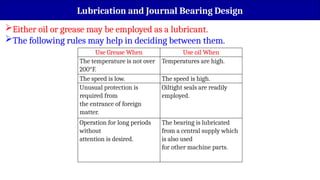
Either oil or grease may be employed as a lubricant.
The following rules may help in deciding between them.
Lubrication and Journal Bearing Design
Use Grease When Use oil When
The temperature is not over
200°F.
Temperatures are high.
The speed is low. The speed is high.
Unusual protection is
required from
the entrance of foreign
matter.
Oiltight seals are readily
employed.
Operation for long periods
without
attention is desired.
The bearing is lubricated
from a central supply which
is also used
for other machine parts.
 A bearing is a machine element which support another moving machine
element (known as journal). It permits a relative motion between the contact
surfaces of the members, while carrying the load.
Classification of Bearings
1. Depending upon the direction of load to be supported. The bearings under this group
are classified as:
(a) Radial bearings, and (b) Thrust bearings.
Bearing
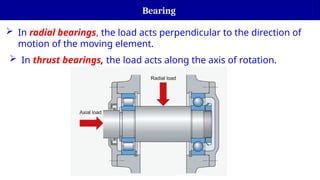
 In radial bearings, the load acts perpendicular to the direction of
motion of the moving element.
 In thrust bearings, the load acts along the axis of rotation.
Bearing
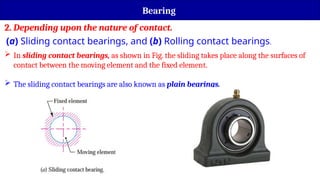
2. Depending upon the nature of contact.
(a) Sliding contact bearings, and (b) Rolling contact bearings.
 In sliding contact bearings, as shown in Fig. the sliding takes place along the surfaces of
contact between the moving element and the fixed element.
 The sliding contact bearings are also known as plain bearings.
Bearing
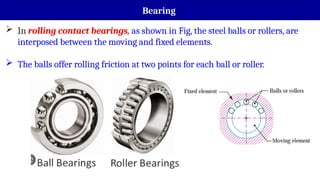
 In rolling contact bearings, as shown in Fig, the steel balls or rollers, are
interposed between the moving and fixed elements.
 The balls offer rolling friction at two points for each ball or roller.
Types of Sliding Contact Bearings
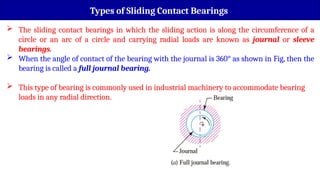
 The sliding contact bearings in which the sliding action is along the circumference of a
circle or an arc of a circle and carrying radial loads are known as journal or sleeve
bearings.
 When the angle of contact of the bearing with the journal is 360° as shown in Fig, then the
bearing is called a full journal bearing.
 This type of bearing is commonly used in industrial machinery to accommodate bearing
loads in any radial direction.
Types of Sliding Contact Bearings
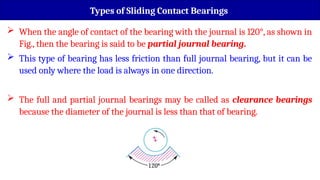
 When the angle of contact of the bearing with the journal is 120°, as shown in
Fig., then the bearing is said to be partial journal bearing.
 This type of bearing has less friction than full journal bearing, but it can be
used only where the load is always in one direction.
 The full and partial journal bearings may be called as clearance bearings
because the diameter of the journal is less than that of bearing.
Types of Sliding Contact Bearings
 When a partial journal bearing has no clearance i.e. the diameters of the
journal and bearing are equal, then the bearing is called a fitted bearing, as
shown in Fig.
Types of Sliding Contact Bearings
 The sliding contact bearings, according to the thickness of layer of the
lubricant between the bearing and the journal, may also be classified as
follows :
1. Thick film bearings.
 The thick film bearings are those in which the working surfaces are completely separated
from each other by the lubricant.
 Such type of bearings are also called as hydrodynamic lubricated bearings.
2. Thin film bearings.
 The thin film bearings are those in which, although lubricant is present, the working
surfaces partially contact each other atleast part of the time.
 Such type of bearings are also called boundary lubricated bearings.
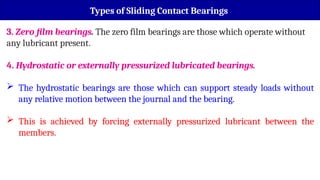
3. Zero film bearings. The zero film bearings are those which operate without
any lubricant present.
4. Hydrostatic or externally pressurized lubricated bearings.
 The hydrostatic bearings are those which can support steady loads without
any relative motion between the journal and the bearing.
 This is achieved by forcing externally pressurized lubricant between the
members.
Types of Sliding Contact Bearings
Sliding Contact Bearing
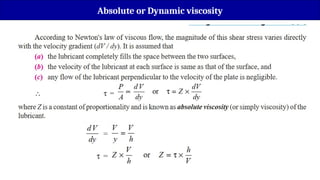
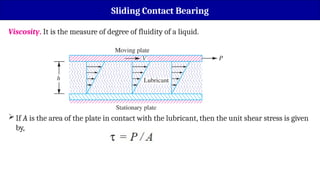
Viscosity. It is the measure of degree of fluidity of a liquid.
If A is the area of the plate in contact with the lubricant, then the unit shear stress is given
by,
Absolute or Dynamic viscosity
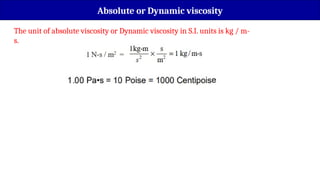
The unit of absolute viscosity or Dynamic viscosity in S.I. units is kg / m-
s.
Absolute or Dynamic viscosity
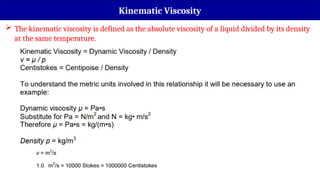
 The kinematic viscosity is defined as the absolute viscosity of a liquid divided by its density
at the same temperature.
Kinematic Viscosity
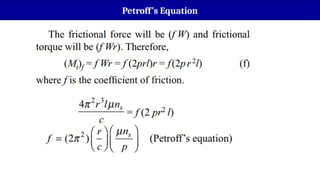
Petroff’s Equation
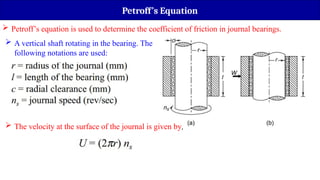
 Petroff’s equation is used to determine the coefficient of friction in journal bearings.
 A vertical shaft rotating in the bearing. The
following notations are used:
 The velocity at the surface of the journal is given by,
Petroff’s Equation
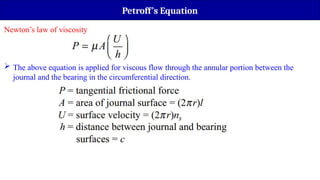
Newton’s law of viscosity
 The above equation is applied for viscous flow through the annular portion between the
journal and the bearing in the circumferential direction.
Petroff’s Equation
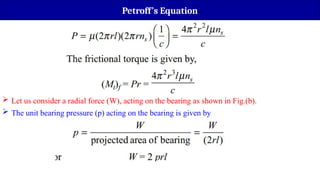
 Let us consider a radial force (W), acting on the bearing as shown in Fig.(b).
 The unit bearing pressure (p) acting on the bearing is given by
Petroff’s Equation
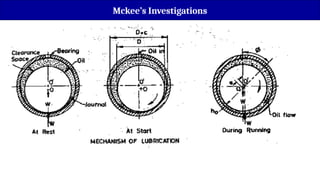
Mckee’s Investigations
 In hydrodynamic bearings, initially the journal is at rest. There is no relative motion and
no hydrodynamic film.
 Therefore, there is metal to metal contact between the surfaces of the journal and the
bearing.
 As the journal starts to rotate, it takes some time for the hydrodynamic film to build
sufficient pressure in the clearance space.
 During this period, there is partial metal to metal contact and a partial lubricant film. This
is thin film lubrication.
 As the speed is increased, more and more lubricant is forced into the wedge-shaped
clearance space and sufficient pressure is built up, separating the surfaces of the journal
and the bearing.
 This is thick film lubrication. Therefore, there is a transition from thin film lubrication to
thick film lubrication as the speed increases.
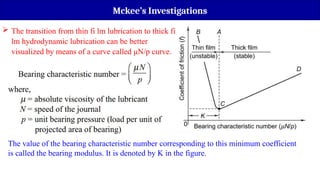
Mckee’s Investigations
 The transition from thin fi lm lubrication to thick fi
lm hydrodynamic lubrication can be better
visualized by means of a curve called μN/p curve.
The value of the bearing characteristic number corresponding to this minimum coefficient
is called the bearing modulus. It is denoted by K in the figure.
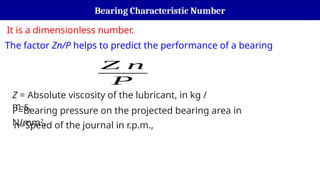
Bearing Characteristic Number
Z n
P
Z = Absolute viscosity of the lubricant, in kg /
m-s,
P=Bearing pressure on the projected bearing area in
N/mm2
,
n=Speed of the journal in r.p.m.,
It is a dimensionless number.
The factor Zn/P helps to predict the performance of a bearing
Sommerfeld Number
The Sommerfeld number is also a dimensionless parameter used
extensively in the design of journal bearings. Mathematically,
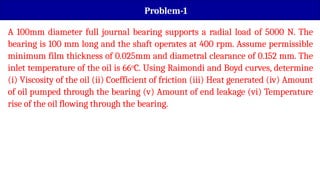
Problem-1
A 100mm diameter full journal bearing supports a radial load of 5000 N. The
bearing is 100 mm long and the shaft operates at 400 rpm. Assume permissible
minimum film thickness of 0.025mm and diametral clearance of 0.152 mm. The
inlet temperature of the oil is 66o
C. Using Raimondi and Boyd curves, determine
(i) Viscosity of the oil (ii) Coefficient of friction (iii) Heat generated (iv) Amount
of oil pumped through the bearing (v) Amount of end leakage (vi) Temperature
rise of the oil flowing through the bearing.
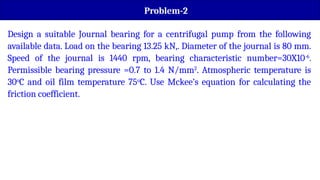
Problem-2
Design a suitable Journal bearing for a centrifugal pump from the following
available data. Load on the bearing 13.25 kN,. Diameter of the journal is 80 mm.
Speed of the journal is 1440 rpm, bearing characteristic number=30X10-6
.
Permissible bearing pressure =0.7 to 1.4 N/mm2
. Atmospheric temperature is
30o
C and oil film temperature 75o
C. Use Mckee’s equation for calculating the
friction coefficient.

Journal Bearings ppt for 4th year btech .pptx

  • 1.
    Lubrication and JournalBearing Design  Lubrication systems distribute the lubricant to the moving machine parts in contact.  Lubricants reduce the friction between sliding or rolling machine elements, such as gears, spindles, bearings, chains, dies, screws, cylinders, valves, and cables, in order to prevent wear, heat generation, and premature failure.  Lubricants may also function as a coolant that prevents thermal expansion.
  • 2.
    Types of Lubrication Fivedistinct forms of lubrication may be identified:  Hydrodynamic Lubrication  Hydrostatic Lubrication  Elasto-hydrodynamic Lubrication  Boundary Lubrication  Solid film Lubrication Lubrication and Journal Bearing Design
  • 3.
    Lubrication and JournalBearing Design Hydrodynamic Lubrication:  Hydrodynamic lubrication means that the load-carrying surfaces of the bearing are separated by a relatively thick film of lubricant, so as to prevent metal-to-metal contact.  Hydrodynamic lubrication does not depend upon the introduction of the lubricant under pressure, though that may occur; but it does require the existence of an adequate supply at all times.  The film pressure is created by the moving surface itself pulling the lubricant into a contact zone at a velocity sufficiently high to create the pressure necessary to separate the surfaces against the load on the bearing.  Hydrodynamic lubrication is also called full-film, or fluid, lubrication.
  • 4.
    Lubrication and JournalBearing Design Hydrostatic lubrication:  It is obtained by introducing the lubricant, which is sometimes air or water, into the load-bearing area at a pressure high enough to separate the surfaces with a relatively thick film of lubricant.  So, unlike hydrodynamic lubrication, this kind of lubrication does not require motion of one surface relative to another.
  • 5.
    Lubrication and JournalBearing Design Elasto-hydrodynamic lubrication:  It is the phenomenon that occurs when a lubricant is introduced between surfaces that are in rolling contact, such as mating gears or rolling bearings.
  • 6.
    Lubrication and JournalBearing Design Boundary lubrication: In sufficient surface area, a drop in the velocity of the moving surface, a lessening in the quantity of lubricant delivered to a bearing, an increase in the bearing load, or an increase in lubricant temperature resulting in a decrease in viscosity—any one of these—may prevent the buildup of a film thick enough for full-film lubrication. When this happens a metal to metal contact occurs in the contact region. This is called boundary lubrication.
  • 7.
    Lubrication and JournalBearing Design Solid Film Lubricant:  When bearings must be operated at extreme temperatures, a solid-film lubricant such as graphite or molybdenum disulfide must be used because the ordinary mineral oils are not satisfactory.
  • 8.
    The purposes oflubricant may be summarized as follows:  To provide a film of lubricant between the sliding and rolling surfaces.  To help distribute and dissipate heat.  To prevent corrosion of the bearing surfaces.  To protect the parts from the entrance of foreign matter. Lubrication and Journal Bearing Design
  • 9.
    Either oil orgrease may be employed as a lubricant. The following rules may help in deciding between them. Lubrication and Journal Bearing Design Use Grease When Use oil When The temperature is not over 200°F. Temperatures are high. The speed is low. The speed is high. Unusual protection is required from the entrance of foreign matter. Oiltight seals are readily employed. Operation for long periods without attention is desired. The bearing is lubricated from a central supply which is also used for other machine parts.
  • 10.
     A bearingis a machine element which support another moving machine element (known as journal). It permits a relative motion between the contact surfaces of the members, while carrying the load. Classification of Bearings 1. Depending upon the direction of load to be supported. The bearings under this group are classified as: (a) Radial bearings, and (b) Thrust bearings.
  • 11.
    Bearing  In radialbearings, the load acts perpendicular to the direction of motion of the moving element.  In thrust bearings, the load acts along the axis of rotation.
  • 12.
    Bearing 2. Depending uponthe nature of contact. (a) Sliding contact bearings, and (b) Rolling contact bearings.  In sliding contact bearings, as shown in Fig. the sliding takes place along the surfaces of contact between the moving element and the fixed element.  The sliding contact bearings are also known as plain bearings.
  • 13.
    Bearing  In rollingcontact bearings, as shown in Fig, the steel balls or rollers, are interposed between the moving and fixed elements.  The balls offer rolling friction at two points for each ball or roller.
  • 14.
    Types of SlidingContact Bearings  The sliding contact bearings in which the sliding action is along the circumference of a circle or an arc of a circle and carrying radial loads are known as journal or sleeve bearings.  When the angle of contact of the bearing with the journal is 360° as shown in Fig, then the bearing is called a full journal bearing.  This type of bearing is commonly used in industrial machinery to accommodate bearing loads in any radial direction.
  • 15.
    Types of SlidingContact Bearings  When the angle of contact of the bearing with the journal is 120°, as shown in Fig., then the bearing is said to be partial journal bearing.  This type of bearing has less friction than full journal bearing, but it can be used only where the load is always in one direction.  The full and partial journal bearings may be called as clearance bearings because the diameter of the journal is less than that of bearing.
  • 16.
    Types of SlidingContact Bearings  When a partial journal bearing has no clearance i.e. the diameters of the journal and bearing are equal, then the bearing is called a fitted bearing, as shown in Fig.
  • 17.
    Types of SlidingContact Bearings  The sliding contact bearings, according to the thickness of layer of the lubricant between the bearing and the journal, may also be classified as follows : 1. Thick film bearings.  The thick film bearings are those in which the working surfaces are completely separated from each other by the lubricant.  Such type of bearings are also called as hydrodynamic lubricated bearings. 2. Thin film bearings.  The thin film bearings are those in which, although lubricant is present, the working surfaces partially contact each other atleast part of the time.  Such type of bearings are also called boundary lubricated bearings.
  • 18.
    3. Zero filmbearings. The zero film bearings are those which operate without any lubricant present. 4. Hydrostatic or externally pressurized lubricated bearings.  The hydrostatic bearings are those which can support steady loads without any relative motion between the journal and the bearing.  This is achieved by forcing externally pressurized lubricant between the members. Types of Sliding Contact Bearings
  • 19.
    Sliding Contact Bearing Viscosity.It is the measure of degree of fluidity of a liquid. If A is the area of the plate in contact with the lubricant, then the unit shear stress is given by,
  • 20.
  • 21.
    The unit ofabsolute viscosity or Dynamic viscosity in S.I. units is kg / m- s. Absolute or Dynamic viscosity
  • 22.
     The kinematicviscosity is defined as the absolute viscosity of a liquid divided by its density at the same temperature. Kinematic Viscosity
  • 23.
    Petroff’s Equation  Petroff’sequation is used to determine the coefficient of friction in journal bearings.  A vertical shaft rotating in the bearing. The following notations are used:  The velocity at the surface of the journal is given by,
  • 24.
    Petroff’s Equation Newton’s lawof viscosity  The above equation is applied for viscous flow through the annular portion between the journal and the bearing in the circumferential direction.
  • 25.
    Petroff’s Equation  Letus consider a radial force (W), acting on the bearing as shown in Fig.(b).  The unit bearing pressure (p) acting on the bearing is given by
  • 26.
  • 27.
  • 28.
    Mckee’s Investigations  Inhydrodynamic bearings, initially the journal is at rest. There is no relative motion and no hydrodynamic film.  Therefore, there is metal to metal contact between the surfaces of the journal and the bearing.  As the journal starts to rotate, it takes some time for the hydrodynamic film to build sufficient pressure in the clearance space.  During this period, there is partial metal to metal contact and a partial lubricant film. This is thin film lubrication.  As the speed is increased, more and more lubricant is forced into the wedge-shaped clearance space and sufficient pressure is built up, separating the surfaces of the journal and the bearing.  This is thick film lubrication. Therefore, there is a transition from thin film lubrication to thick film lubrication as the speed increases.
  • 29.
    Mckee’s Investigations  Thetransition from thin fi lm lubrication to thick fi lm hydrodynamic lubrication can be better visualized by means of a curve called μN/p curve. The value of the bearing characteristic number corresponding to this minimum coefficient is called the bearing modulus. It is denoted by K in the figure.
  • 30.
    Bearing Characteristic Number Zn P Z = Absolute viscosity of the lubricant, in kg / m-s, P=Bearing pressure on the projected bearing area in N/mm2 , n=Speed of the journal in r.p.m., It is a dimensionless number. The factor Zn/P helps to predict the performance of a bearing
  • 31.
    Sommerfeld Number The Sommerfeldnumber is also a dimensionless parameter used extensively in the design of journal bearings. Mathematically,
  • 32.
    Problem-1 A 100mm diameterfull journal bearing supports a radial load of 5000 N. The bearing is 100 mm long and the shaft operates at 400 rpm. Assume permissible minimum film thickness of 0.025mm and diametral clearance of 0.152 mm. The inlet temperature of the oil is 66o C. Using Raimondi and Boyd curves, determine (i) Viscosity of the oil (ii) Coefficient of friction (iii) Heat generated (iv) Amount of oil pumped through the bearing (v) Amount of end leakage (vi) Temperature rise of the oil flowing through the bearing.
  • 33.
    Problem-2 Design a suitableJournal bearing for a centrifugal pump from the following available data. Load on the bearing 13.25 kN,. Diameter of the journal is 80 mm. Speed of the journal is 1440 rpm, bearing characteristic number=30X10-6 . Permissible bearing pressure =0.7 to 1.4 N/mm2 . Atmospheric temperature is 30o C and oil film temperature 75o C. Use Mckee’s equation for calculating the friction coefficient.