Creating Jobs in Our Neighborhoods!
Josh Silver, Vice President of Research and Policy, NCRC
April 20, 2012
Creating Jobs in Our Neighborhoods!


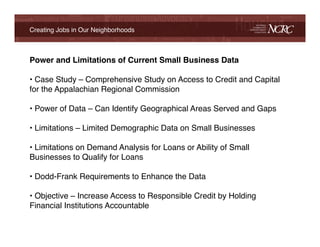
Power and Limitations of Current Small Business Data!

•  Case Study – Comprehensive Study on Access to Credit and Capital
for the Appalachian Regional Commission!
 !
•  Power of Data – Can Identify Geographical Areas Served and Gaps!
!
•  Limitations – Limited Demographic Data on Small Businesses!
!
•  Limitations on Demand Analysis for Loans or Ability of Small
Businesses to Qualify for Loans!
!
•  Dodd-Frank Requirements to Enhance the Data!
!
•  Objective – Increase Access to Responsible Credit by Holding
Financial Institutions Accountable!
!
Creating Jobs in Our Neighborhoods!


Objectives of Study of ARC Study
!
•  Measure access to credit and capital for small businesses. Compare US to
Appalachia and categories of counties and sub-regions within Appalachia

•  Supply of loans and investments by banks, CDFIs, equity funds, RLFs, and
other institutions

•  CRA small business lending, SBA 7a, SBA 504, microloan program, CDFI
lending

•  Distribution of banks, credit unions, CDFI and other institutions in Appalachia

•  Explore relationships between access to credit and distribution of lenders,
concentration levels, branches

•  Spatial autocorrelation, mapping, county index, demand analysis

!
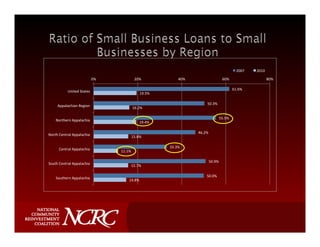
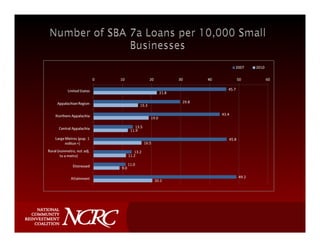
2007	
     2010	
  

                                      0%	
                  20%	
                 40%	
                          60%	
                              80%	
  

                                                                                                                           61.6%	
  
               United	
  States	
  
                                                                19.5%	
  

                                                                                                   50.3%	
  
       Appalachian	
  Region	
  
                                                           16.2%	
  

                                                                                                               55.5%	
  
     Northern	
  Appalachia	
  
                                                                19.4%	
  

                                                                                            46.2%	
  
North	
  Central	
  Appalachia	
  
                                                       15.8%	
  

                                                                            33.3%	
  
        Central	
  Appalachia	
  
                                               11.1%	
  

                                                                                                    50.9%	
  
South	
  Central	
  Appalachia	
  
                                                       15.7%	
  

                                                                                                  50.0%	
  
     Southern	
  Appalachia	
  
                                                     14.8%	
  
Creating Jobs in Our Neighborhoods!


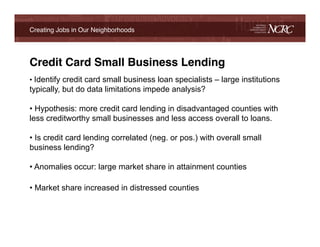
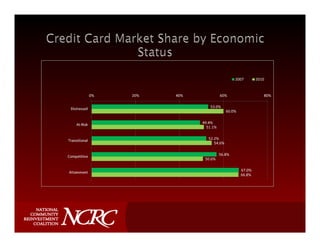
Credit Card Small Business Lending!
•  Identify credit card small business loan specialists – large institutions
typically, but do data limitations impede analysis?

•  Hypothesis: more credit card lending in disadvantaged counties with
less creditworthy small businesses and less access overall to loans.

•  Is credit card lending correlated (neg. or pos.) with overall small
business lending?

•  Anomalies occur: large market share in attainment counties

•  Market share increased in distressed counties !
!
Creating Jobs in Our Neighborhoods!


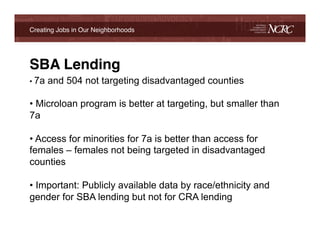
SBA Lending!
•  7a   and 504 not targeting disadvantaged counties

•  Microloan program is better at targeting, but smaller than
7a

•  Access for minorities for 7a is better than access for
females – females not being targeted in disadvantaged
counties

•  Important: Publicly available data by race/ethnicity and
gender for SBA lending but not for CRA lending
!
!
Creating Jobs in Our Neighborhoods!


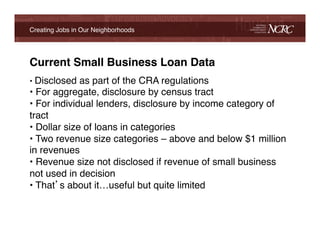
Current Small Business Loan Data!
•  Disclosed as part of the CRA regulations!
•  For aggregate, disclosure by census tract!
•  For individual lenders, disclosure by income category of
tract!
•  Dollar size of loans in categories!
•  Two revenue size categories – above and below $1 million
in revenues!
•  Revenue size not disclosed if revenue of small business
not used in decision!
•  That s about it…useful but quite limited!
!
Creating Jobs in Our Neighborhoods!


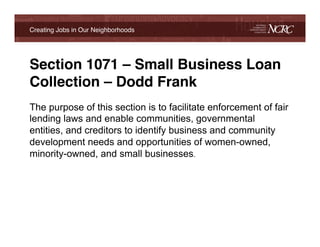
Section 1071 – Small Business Loan
Collection – Dodd Frank!
The purpose of this section is to facilitate enforcement of fair
lending laws and enable communities, governmental
entities, and creditors to identify business and community
development needs and opportunities of women-owned,
minority-owned, and small businesses.!
!
Creating Jobs in our Neighborhoods!


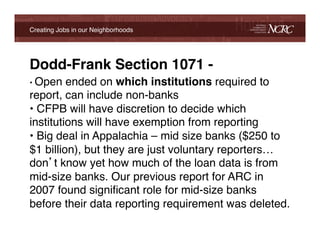
Dodd-Frank Section 1071 - !
•  Open  ended on which institutions required to
report, can include non-banks!
•  CFPB will have discretion to decide which
institutions will have exemption from reporting!
•  Big deal in Appalachia – mid size banks ($250 to
$1 billion), but they are just voluntary reporters…
don t know yet how much of the loan data is from
mid-size banks. Our previous report for ARC in
2007 found significant role for mid-size banks
before their data reporting requirement was deleted.!
!
Creating Jobs in Our Neighborhoods!


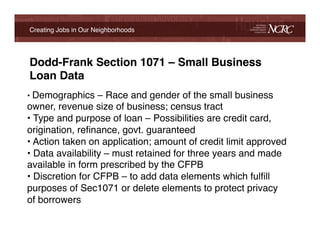
    Dodd-Frank Section 1071 – Small Business
    Loan Data!
•  Demographics – Race and gender of the small business
owner, revenue size of business; census tract!
•  Type and purpose of loan – Possibilities are credit card,
origination, refinance, govt. guaranteed!
•  Action taken on application; amount of credit limit approved!
•  Data availability – must retained for three years and made
available in form prescribed by the CFPB!
•  Discretion for CFPB – to add data elements which fulfill
purposes of Sec1071 or delete elements to protect privacy
of borrowers!

!
!
Creating Jobs in Our Neighborhoods!


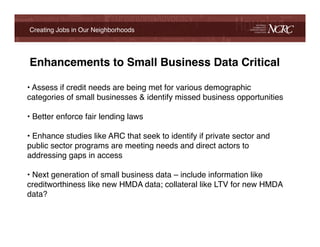
Enhancements to Small Business Data Critical!

•  Assess if credit needs are being met for various demographic
categories of small businesses & identify missed business opportunities!

•  Better enforce fair lending laws!

•  Enhance studies like ARC that seek to identify if private sector and
public sector programs are meeting needs and direct actors to
addressing gaps in access!
!
•  Next generation of small business data – include information like
creditworthiness like new HMDA data; collateral like LTV for new HMDA
data?!
!
THANK YOU!!


To follow up with the speaker:!
Josh Silver, Vice President of Research and Policy, NCRC!
202-464-2708 or jsilver@ncrc.org!


Presentations will be available at www.ncrc.org/conference by !
April 30, 2012!

Josh Silver | Creating Jobs Workshop 2

  • 1.
    Creating Jobs inOur Neighborhoods!
  • 2.
    Creating Jobs inOur Neighborhoods! Josh Silver, Vice President of Research and Policy, NCRC April 20, 2012
  • 3.
    Creating Jobs inOur Neighborhoods! Power and Limitations of Current Small Business Data! •  Case Study – Comprehensive Study on Access to Credit and Capital for the Appalachian Regional Commission! ! •  Power of Data – Can Identify Geographical Areas Served and Gaps! ! •  Limitations – Limited Demographic Data on Small Businesses! ! •  Limitations on Demand Analysis for Loans or Ability of Small Businesses to Qualify for Loans! ! •  Dodd-Frank Requirements to Enhance the Data! ! •  Objective – Increase Access to Responsible Credit by Holding Financial Institutions Accountable! !
  • 4.
    Creating Jobs inOur Neighborhoods! Objectives of Study of ARC Study ! •  Measure access to credit and capital for small businesses. Compare US to Appalachia and categories of counties and sub-regions within Appalachia •  Supply of loans and investments by banks, CDFIs, equity funds, RLFs, and other institutions •  CRA small business lending, SBA 7a, SBA 504, microloan program, CDFI lending •  Distribution of banks, credit unions, CDFI and other institutions in Appalachia •  Explore relationships between access to credit and distribution of lenders, concentration levels, branches •  Spatial autocorrelation, mapping, county index, demand analysis !
  • 5.
    2007   2010   0%   20%   40%   60%   80%   61.6%   United  States   19.5%   50.3%   Appalachian  Region   16.2%   55.5%   Northern  Appalachia   19.4%   46.2%   North  Central  Appalachia   15.8%   33.3%   Central  Appalachia   11.1%   50.9%   South  Central  Appalachia   15.7%   50.0%   Southern  Appalachia   14.8%  
  • 7.
    Creating Jobs inOur Neighborhoods! Credit Card Small Business Lending! •  Identify credit card small business loan specialists – large institutions typically, but do data limitations impede analysis? •  Hypothesis: more credit card lending in disadvantaged counties with less creditworthy small businesses and less access overall to loans. •  Is credit card lending correlated (neg. or pos.) with overall small business lending? •  Anomalies occur: large market share in attainment counties •  Market share increased in distressed counties ! !
  • 10.
    Creating Jobs inOur Neighborhoods! SBA Lending! •  7a and 504 not targeting disadvantaged counties •  Microloan program is better at targeting, but smaller than 7a •  Access for minorities for 7a is better than access for females – females not being targeted in disadvantaged counties •  Important: Publicly available data by race/ethnicity and gender for SBA lending but not for CRA lending ! !
  • 11.
    Creating Jobs inOur Neighborhoods! Current Small Business Loan Data! •  Disclosed as part of the CRA regulations! •  For aggregate, disclosure by census tract! •  For individual lenders, disclosure by income category of tract! •  Dollar size of loans in categories! •  Two revenue size categories – above and below $1 million in revenues! •  Revenue size not disclosed if revenue of small business not used in decision! •  That s about it…useful but quite limited! !
  • 12.
    Creating Jobs inOur Neighborhoods! Section 1071 – Small Business Loan Collection – Dodd Frank! The purpose of this section is to facilitate enforcement of fair lending laws and enable communities, governmental entities, and creditors to identify business and community development needs and opportunities of women-owned, minority-owned, and small businesses.! !
  • 13.
    Creating Jobs inour Neighborhoods! Dodd-Frank Section 1071 - ! •  Open ended on which institutions required to report, can include non-banks! •  CFPB will have discretion to decide which institutions will have exemption from reporting! •  Big deal in Appalachia – mid size banks ($250 to $1 billion), but they are just voluntary reporters… don t know yet how much of the loan data is from mid-size banks. Our previous report for ARC in 2007 found significant role for mid-size banks before their data reporting requirement was deleted.! !
  • 14.
    Creating Jobs inOur Neighborhoods! Dodd-Frank Section 1071 – Small Business Loan Data! •  Demographics – Race and gender of the small business owner, revenue size of business; census tract! •  Type and purpose of loan – Possibilities are credit card, origination, refinance, govt. guaranteed! •  Action taken on application; amount of credit limit approved! •  Data availability – must retained for three years and made available in form prescribed by the CFPB! •  Discretion for CFPB – to add data elements which fulfill purposes of Sec1071 or delete elements to protect privacy of borrowers! ! !
  • 15.
    Creating Jobs inOur Neighborhoods! Enhancements to Small Business Data Critical! •  Assess if credit needs are being met for various demographic categories of small businesses & identify missed business opportunities! •  Better enforce fair lending laws! •  Enhance studies like ARC that seek to identify if private sector and public sector programs are meeting needs and direct actors to addressing gaps in access! ! •  Next generation of small business data – include information like creditworthiness like new HMDA data; collateral like LTV for new HMDA data?! !
  • 16.
    THANK YOU!! To followup with the speaker:! Josh Silver, Vice President of Research and Policy, NCRC! 202-464-2708 or jsilver@ncrc.org! Presentations will be available at www.ncrc.org/conference by ! April 30, 2012!