Arts & StyleArts & Style
MAY 4, 2015 THETICKER ARTS & STYLE I PAGE 17
TV summer premieres bring back old and new fan favorites
Letterman says farewell to late night after more than two decades
BY BRIAN MCMAHON
STAFFWRITER
On May 20, David Letterman
will host his final episode of The
Late Show after a legendary 31-year
run.
“It’s been great, you’ve been
great, the network has been great,
but I’m retiring,” announced Let-
terman on an episode last year. Let-
terman, 68, said he is calling it quits
is to spend more time with family.
On air, Letterman often mentions
his 11-year-old son Harry, once
referring to him as “the only thing
that I’ve ever had in my life that is
perfect.” Letterman rarely shows
that type of sentimentality, prefer-
ring self-deprecation to revealing
his gentler side.
Nobody made hosting late
night TV look easier than Letter-
man. As he sat relaxed behind his
desk with his legs crossed and head
tilted slightly, Letterman coasted
through monologues and Inter-
views without ever showing a hint
of unease. Seeing what most late
night shows have become today—
little more than internet-type hu-
mor with the hosts partaking in
choreographed dance routines and
playing games—viewers may never
see Letterman’s Johnny Carson-
like style again.
Letterman did not sing and he
did not dance; he hosted. Unlike
Jimmy Fallon and Seth Meyers, Let-
terman’s intention was not to be-
come friends with every person he
interviewed. He stood toe-to-toe
with the likes of Bill O’Reilly and
Donald Trump, never holding back
an opinion. “In my mind, I think of
you as a goon,” said Letterman to
O’Reilly in 2008. And when Paris
Hilton came on the show in 2001
after a stint behind bars, Letterman
boldly asked her, “How’d you like
being in jail?”
The one-time weatherman got
his start as a comedy show host
in 1980, starring in The David Let-
terman Show on NBC, a morning
show that was canceled after less
than a year despite winning two
Emmys. From there Letterman be-
gan his late night career, hosting
Late Night with David Letterman
for 10 years before moving to CBS
in 1992 to host The Late Show.
The Late Show featured sketch
comedy that often took an acquired
taste to see the humor in. One
popular sketch was “Will it Float?,”
where a household object would be
droppedintoacontainerofwaterto
test its buoyancy. “Great Moments
in Presidential Speeches,” which
were excerpts from speeches that
made President George W. Bush
look foolish, also became a fan-fa-
vorite. Whether it was the time he
asked a smug James Franco what
his IQ was or when he checked an
invisible watch as Bill Maher mis-
fired with political jokes, Letter-
man had an uncanny ability to take
any overconfident celebrity down a
few notches.
Letterman is a comedian’s co-
median, and he received his fair
share of backlash for controver-
sial jokes. But he always took it in
stride, even laughing off a death
threat he received from al-Qaida
in 2011, which he speculated was
the work of his longtime adversary
Jay Leno.
Letterman was also the subject
of a blackmail scandal in 2009,
when he was threatened with the
publication of his dalliances with
Late Show employees. Letterman
owned up to his promiscuity, and
his blackmailer, Joe Halderman,
was sent to prison. Al Qaeda and
Halderman alike had failed to real-
ize what so many of us have: Letter-
man is untouchable.
Letterman interviewed Presi-
dent Barack Obama in September
of 2009, marking only the second
time a sitting president appeared
on a late night talk show. Other
prominent guests included Bill
Clinton, Tony Blair, George W.
Bush, Madonna and Oprah Win-
frey. In addition to being perhaps
America’s most successful come-
dian, Letterman is a prosperous
businessman. As the owner and
founder of Worldwide Pants Inc.,
a company that has produced TV
shows for five different networks,
Letterman has an estimated net
worth of $400 million.
Stephen Colbert, a comedian
who came to prominence as the
host of The Colbert Report on Com-
edy Central from 2005 to 2014 will
replace the Indiana-bred comic.
Fans of Colbert will have to adjust
to a new style from the political sat-
irist, as he will not portray an irate
Republican on the The Late Show
as he did on The Colbert Report.
Colbert, who signed a five-year
contract with CBS, expressed his
feelings on replacing Letterman in
an interview with Rolling Stone last
year, “I never dreamed that I would
follow in his footsteps, though
everyone in late night follows
Dave’s lead.”
Also saying farewell on May 20
will be Paul Shaffer, Letterman’s
sidekick and musical director since
1982. For decades, late night show
hosts will be judged by the standard
that Letterman set. And as viewers
try to get used to Fallon giggling
over every question and Jimmy
Kimmel’s stiff demeanor, they will
appreciate what they had in Letter-
man even more. Letterman will live
on in YouTube videos, but viewers
should all make a point to watch
him at least once in his remaining
few weeks on TV Letterman was as
good as it gets.
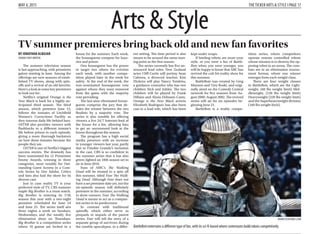
Letterman is seen as the force to be reckoned with on late nightTV with a career spanning back as far as 1980.
WWW.EONLINE.COM
BY JONATHAN ALBUJAR
SENIOR STAFFWRITER
The summer television season
is fast approaching, with premieres
galore starting in June. Among the
offerings are new seasons of estab-
lished TV shows, along with spin-
offs and a revival of an old favorite.
Here’s a look at some key premieres
to look out for:
Netflix’s original Orange is the
New Black is back for a highly an-
ticipated third season. The third
season, which premiers June 12,
follows the inmates of Litchfield
Women’s Corrections Facility as
they traverse daily life behind bars.
OITNB also provides viewers with
flashbacks to a different inmate’s
life before prison in each episode,
giving a more thorough backstory
on how these inmates became the
people they are.
OITNB is one of Netflix’s biggest
success stories. The dramedy has
been nominated for 12 Primetime
Emmy Awards, winning in three
categories, most notably for Out-
standing Guest Actress in a Com-
edy Series by Uzo Aduba. Critics
and fans also hail the show for its
diverse cast.
Just in case reality TV is your
preferred style of TV, CBS summer
staple Big Brother is a must-watch.
Big Brother is entering its 17th
season this year with a two-night
premiere scheduled for June 24
and June 25. The series itself airs
three nights a week on Sundays,
Wednesdays and the weekly live
elimination show on Thursdays.
Big Brother is a competition series
where 16 guests are locked in a
house for the summer. Each week,
the houseguests compete for luxu-
ries and power.
One houseguest has the power
to target two others for eviction
each week, with another compe-
tition played later in the week for
safety. At the end of the week, the
non-nominated houseguests vote
against whom they want removed
from the game with the majority
vote prevailing.
The last nine eliminated house-
guests comprise the jury that de-
cides the winner between the two
finalists by a majority vote. The
series is also notable for offering
viewers a live 24/7 Internet feed of
the house for a fee, allowing fans
to get an uncensored look at the
house throughout the season.
The program has a high social
media presence with an increase
in younger viewers last year, partly
due to Frankie Grande’s inclusion
in the cast. CBS is so confident in
the summer series that it has also
green-lighted an 18th season set to
air in June 2016.
Fans of AMC’s The Walking
Dead will be treated to a spin off
this summer, titled Fear The Walk-
ing Dead. Although Fear does not
have a set premiere date yet, not the
six-episode season will definitely
premiere in the summer, according
to show runners. Fear The Walking
Dead is meant to act as a compan-
ion series to its predecessor.
In contrast with traditional
spinoffs, which either serve as
prequels or sequels of the parent
series, Fear will tell the story of a
separate group of survivors during
the zombie apocalypse, in a differ-
ent setting. The time period is also
meant to be around the same start-
ing point as the first season.
The series currently has five an-
nounced lead roles. New Zealand
actor Cliff Curtis will portray Sean
Cabrera, a divorced teacher. Kim
Dickens will play Nancy Tomkins,
a guidance counselor who has two
children Nick and Ashley. The two
children will be played by Frank
Dillane and Alysia Debnam-Carey.
Orange is the New Black actress
Elizabeth Rodriguez has also been
cast in a lead role, which has been
kept under wraps.
If battling robots are more your
style, or you were a fan of Battle-
Bots when you were younger, you
will be happy to know that ABC has
revived the cult hit reality show for
this summer.
BattleBots was created by Greg
Munson and Trey Roski, and origi-
nally aired on the Comedy Central
network for five seasons from Au-
gust 2000–August 2002. The revived
series will air for six episodes be-
ginning June 21.
BattleBots is a reality compe-
tition series, where competitors
operate remote controlled robots
whose mission is to destroy the op-
posing robot in an arena. The com-
bats are in an elimination tourna-
ment format, where one winner
emerges from each weight class.
There are four weight classes
in BattleBots, which are the Light-
weight, (60 lbs weight limit) Mid-
dleweight, (120 lbs weight limit)
Heavyweight (220 lbs weight limit)
and the Superheavyweight division
(340 lbs weight limit).
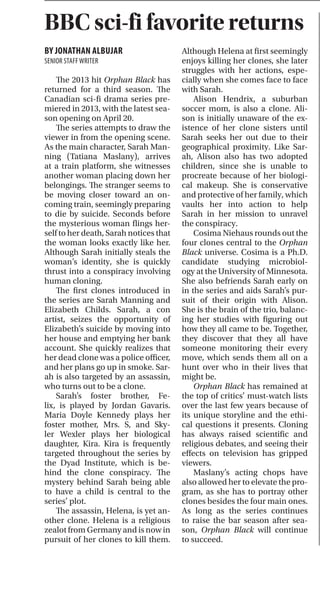
BattleBots entertains a different type of fan, with its sci-fi-based where contestants build robots competitively.
WWW.TECHTIMES.COM
THETICKER ARTS & STYLE I PAGE 11
Icelandic artist Bjork showcases her eccentricities at MoMa
APRIL 27, 2015
BY AMANI JAMES
STAFFWRITER
Bjork is not just singer or song-
writer but an innovator of these
times. She has been able to capti-
vate the world with her eccentrici-
ties. For the last 20 years, she has
pushed the boundaries through
art, music and design. The Mu-
seum of Modern Art presents a
complex perspective through the
presentation of her collaborative
art career.
On the first floor of MoMA, the
beautifully constructed wooden
instruments used on Bjork’s album
Biophilia (2011) are spread across
the floor. These large but intricate
instruments range from pipe or-
gans, gravity harp, a Tesla coil and
a gameleste.
These instruments only serve
a small piece of Bjork’s creative
process, though their massive
size makes it clear that her aes-
thetic is like no other. Each in-
strument serves an individual
purpose that cannot simply be
recreated by technology like most
music today. Instead, it brings
back the quality that a lot of music
is lacking in such a technology-
driven world.
As the sounds take over one’s
thoughts, the actions on the screen
create an image that the brain is
not used to seeing. In a room full of
quiet breathing and light from the
massive high-definition screens,
the experience can be overwhelm-
ing and alarming. But as the
sounds begin, one is quickly aware
that this is like nothing one has ever
experienced.
As Bjork appears on screen in
what seems like more of an artis-
tic expression than a dress, she is
on her knees moving in a pulsing
motion in a cave. As she moves, the
sound begins; produced by a high-
er quality than what many people
are used to, its uniquely engineered
design is very clear. There are over
20 speakers strategically placed to
provide the highest level of high-
definition sound possible. Many
assume that that the black tube-
like materials covering the walls are
simply to add to the visual aspect of
the installation. Instead, they allow
the sounds to bounce off the wall,
making the experience that more
impactful while soundproofing
the room.
With only 100 visitors allowed to
enter the exhibit at a time, visitors
are given the opportunity to fully
engulf themselves in the art before
them. “Black Lake” is a song from
Bjork’s recently released album,
Vulnicura. This song serves as the
lyrical guideline in which the vid-
eo is following. Serving as Bjork’s
ninth studio album, it provides an
alternative sound within a world of
heavily commercial pop music.
When exiting “Black Lake,” cin-
ema provides audiences with a
look into some of Bjork most iconic
music videos. As oversized red
cushions cover the floor inside the
room, visitors are given the oppor-
tunity to continue the manifesta-
tion of Bjork as the videos play on
a cinematic screen in front of them.
One video that catches attention is
“All Is Full Of Love” (1999).
The video begins with what
seems to be a female robot lay-
ing down on an all-white elevated
platform as machines tug and
pull at her to do what seems to be
maintenance.
Once the robot begins to sing, it
is clear that it is Bjork. As the video
continues, another robot begins to
sing background for Bjork. How-
ever, the video takes a controver-
sial turn when both female robots
kneel together on the platform and
touch and kiss each other in a hu-
man, intimate way. These same two
robots can be found on display in
“Songlines,” which serves as the
most intriguing and unique part of
the exhibition.
But for the most innovative part
of the exhibit, visitors are required
to wear headphones connected
to an iPod while a pre-recorded,
40-minute record plays as they
walk through the exhibit.
In “Songlines,” visitors walk
through an interactive maze that
progresses through the life of Bjork
through sound, images, biographi-
cal narrative as well as objects. This
part of the exhibition requires a
timed ticket since space as well as
technology is limited.
In this walk-through, some of
Bjork’s most memorable costumes,
portraits and props are presented.
The headphones provide the nar-
rative of a woman going through
life’s milestones by intertwining
some of Bjork’s most interesting
songs to tell the story. This musi-
cal ability to capitalize on the use of
many different types of sounds and
engineering leaves audiences im-
mersed in the exhibit.
With the use of music, Bjork has
been able to provide the world with
another perspective. Her uncom-
promised passion gives her work
an authenticity that cannot be du-
plicated. Her work withstands the
test of time as she continues to
evolve within her own boundaries,
with no sense of society’s expecta-
tion affecting it. This exhibition is a
reflection of that evolution.
Homogenic serves as Bjork’s third studio album, released in 1997 after a dangerous run-in with a mentally ill fan.
WWW.STEREOGUM.COM
Theseinstrumentsonly
serveasmallpieceofBjork’s
creativeprocess,thoughtheir
massivesizemakesitclear
thatheraestheticislikeno
other.Eachinstrumentserves
anindividualpurposethat
cannotsimplyberecreated
bytechnologylikemost
musictoday.Instead,itbrings
backthequalitythatalot
ofmusicislackinginsucha
technology-driven
world.
BBC sci-fi favorite returns
BY JONATHAN ALBUJAR
SENIOR STAFFWRITER
The 2013 hit Orphan Black has
returned for a third season. The
Canadian sci-fi drama series pre-
miered in 2013, with the latest sea-
son opening on April 20.
The series attempts to draw the
viewer in from the opening scene.
As the main character, Sarah Man-
ning (Tatiana Maslany), arrives
at a train platform, she witnesses
another woman placing down her
belongings. The stranger seems to
be moving closer toward an on-
coming train, seemingly preparing
to die by suicide. Seconds before
the mysterious woman flings her-
self to her death, Sarah notices that
the woman looks exactly like her.
Although Sarah initially steals the
woman’s identity, she is quickly
thrust into a conspiracy involving
human cloning.
The first clones introduced in
the series are Sarah Manning and
Elizabeth Childs. Sarah, a con
artist, seizes the opportunity of
Elizabeth’s suicide by moving into
her house and emptying her bank
account. She quickly realizes that
her dead clone was a police officer,
and her plans go up in smoke. Sar-
ah is also targeted by an assassin,
who turns out to be a clone.
Sarah’s foster brother, Fe-
lix, is played by Jordan Gavaris.
Maria Doyle Kennedy plays her
foster mother, Mrs. S, and Sky-
ler Wexler plays her biological
daughter, Kira. Kira is frequently
targeted throughout the series by
the Dyad Institute, which is be-
hind the clone conspiracy. The
mystery behind Sarah being able
to have a child is central to the
series’ plot.
The assassin, Helena, is yet an-
other clone. Helena is a religious
zealot from Germany and is now in
pursuit of her clones to kill them.
Although Helena at first seemingly
enjoys killing her clones, she later
struggles with her actions, espe-
cially when she comes face to face
with Sarah.
Alison Hendrix, a suburban
soccer mom, is also a clone. Ali-
son is initially unaware of the ex-
istence of her clone sisters until
Sarah seeks her out due to their
geographical proximity. Like Sar-
ah, Alison also has two adopted
children, since she is unable to
procreate because of her biologi-
cal makeup. She is conservative
and protective of her family, which
vaults her into action to help
Sarah in her mission to unravel
the conspiracy.
Cosima Niehaus rounds out the
four clones central to the Orphan
Black universe. Cosima is a Ph.D.
candidate studying microbiol-
ogy at the University of Minnesota.
She also befriends Sarah early on
in the series and aids Sarah’s pur-
suit of their origin with Alison.
She is the brain of the trio, balanc-
ing her studies with figuring out
how they all came to be. Together,
they discover that they all have
someone monitoring their every
move, which sends them all on a
hunt over who in their lives that
might be.
Orphan Black has remained at
the top of critics’ must-watch lists
over the last few years because of
its unique storyline and the ethi-
cal questions it presents. Cloning
has always raised scientific and
religious debates, and seeing their
effects on television has gripped
viewers.
Maslany’s acting chops have
also allowed her to elevate the pro-
gram, as she has to portray other
clones besides the four main ones.
As long as the series continues
to raise the bar season after sea-
son, Orphan Black will continue
to succeed.
PAGE 12 ITHETICKER ARTS & STYLE
HBO’s fan-favorite Game of Thrones draws in new wave of fans
APRIL 20, 2015
BY JONATHAN ALBUJAR
SENIOR STAFFWRITER
HBO’s most-watched original
drama of all time, Game of Thrones,
has returned for a fifth season. The
season’s first episode, titled “The
Wars to Come,” picks up where the
fourth season left off. The Nielsen
ratings indicate that the season
premiere recorded a series-high
viewership of 8 million viewers,
and that is before factoring in the
DVR and Video-On-Demand audi-
ence viewers in the days following.
The title of the season opener
is meant to set up the multiple
plots of the season. The most im-
portant of the many ongoing wars
being the fight for the iron throne,
which is the struggle the show is
named after.
At the beginning of this sea-
son, the seven kingdoms are led by
Tommen Baratheon, who assumed
power after his brother, formerly
King Joffrey, died in the previ-
ous season. There are several who
threaten his fragile grip on power,
especially with his grandfather, the
ferocious Tywin Lannister meet-
ing his demise in the season four
finale. Those seeking to claim the
throne include Stannis Boratheon,
who believes he is the rightful heir
to fallen King Robert Baratheon
and Daenerys Targaryen, who be-
lieves Robert snatched the throne
unjustly from her father.
Daenerys enters this season
fighting her own internal war in
how best to govern the cities of Es-
sos, which she conquered in the
past few seasons. Although she
is building toward sailing across
the Narrow Sea with her massive
army, she must first prove to her-
self she can successfully govern a
smaller country.
However, her dragons are be-
coming unruly, her trusted advi-
sor Jorah Mormont was exiled for
previously spying on her, and the
former masters she overthrew are
rebelling against her rule. So the
question remains: Will Daenerys
ever make it to Westeros?
Meanwhile, north of the Wall,
Stannis’ storyline has merged with
Jon Snow’s as we last saw Stan-
nis saving Jon from the Free Folk,
led by the King-Beyond-the-Wall
Mance Rayder. Since being nar-
rowly defeated in season two in his
war against the Lannisters for the
throne, Stannis has regained mo-
mentum in his quest. Although his
intentions in the throne are unclear
going into the new season, view-
ers can be sure that his reasons are
linked with strengthening his po-
sitioning before striking the ruling
army a second time.
Another proxy war central to
the future of Westeros is the battle
between Queen Regent Cersei Lan-
nister and lady-in-waiting Mar-
gaery Tyrell. Cersei has been wary
of Margaery since she first arrived
in King’s Landing, and their rivalry
has only escalated since then. With
Joffrey out of the picture and Mar-
gaery promised to the new King
Tommen, Cersei is sure to under-
cut Margaery’s influence at any op-
portunity in the new season, and
Margaery has shown she will not go
down without a fight.
Cersei’s troubles are com-
pounded by the death of her father,
who was killed by her brother Tyri-
on in the season four finale. Tyrion
immediately flees King’s Landing
with the help of Varys, who decides
to leave with Tyrion. They are head-
ing across the Narrow Sea, with
previews leading up to the season
premiere pointing to crossing paths
with Daenerys.
Arya Stark has also decided to
leave the Seven Kingdoms and
seems to be headed somewhere
new. With nowhere else to go, she
decided to head to Braavos, where
an old friend Jaqen H’ghar had told
her to go if she ever needed a place
to stay a few seasons back.
Characters from seasons past
that will not appear in season five
are Bran Stark and Hodor. These
characters’ storylines have caught
up to their storylines in George R.R.
Martin’s A Song of Ice and Fire nov-
els and showrunners David Benioff
and D.B. Weiss made the decision
to give these characters the season
off, but they will return.
The progress of plot of the TV
versionofGameofThronescatching
up to the novels has been subject
of much debate this season, with
many other storylines also near-
ing where they left off in Martin’s
fifth novel, A Dance With Dragons.
Creators Benioff and Weiss have
finally commented on the matter,
confirming that the show will likely
end before Martin’s seventh novel
is released, spoiling the ending for
book readers.
In an interview with Vanity Fair,
they stated, “Luckily, we’ve been
talking about this with Martin for
a long time ... and we know where
things are heading. We’ll eventually
meet up at pretty much the same
place where George is going. There
might be a few deviations along the
route, but we’re heading toward the
same destination.”
HBO’s season five launch also
hit a snag just one day before the
premiere. The cable channel sends
out DVD screeners to critics to view
episodes early, under the condi-
tion that they are not released to
the public. One of these copies was
leaked on the eve of the premiere,
resulting in the first four episodes
being leaked prematurely. Al-
though this did not seem to hurt
HBO when the viewer figures were
released, this is sure to cause head-
aches for viewers who abhor hav-
ing the show spoiled for the next
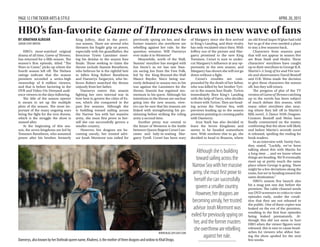
few weeks.Daenerys, also known by her Dothraki queen name, Khaleesi, is the mother of three dragons and widow to Khal Drogo.
WWW.BLOG.SKYLIGHT.COM
Althoughsheisbuilding
towardsailingacrossthe
NarrowSeawithhermassive
army,shemustfirstproveto
herselfshecansuccessfully
governasmallercountry.
However,herdragonsare
becomingunruly,hertrusted
advisorJorahMormontwas
exiledforpreviouslyspyingon
her,andtheformermasters
sheoverthrewarerebelling
againstherrule.
Arts & StyleArts & Style
MARCH 30, 2015PAGE 16 ITHETICKER ARTS & STYLE
BY REYNALDO CARRASCO
SPORTS EDITOR
Catch him riding around town
naked in a Lamborghini or teach-
ing a dolphin how to handle a Bar-
etta. Better yet, find him at the lo-
cal basketball court giving Godzilla
the work. He is a man of many
names, one of which is universally
recognized: Action Bronson.
The gourmet chef-turned-rap-
per is at the forefront of New York’s
hip-hop renaissance, and his lat-
est release, Mr. Wonderful, is as ri-
diculous and over-the-top as any
album in recent memory. Though
his absurd rhymes are enough to
bring anyone to tears of laughter,
Bronson is no joke-rapper.
An astute student of Ghostface
Killah’s Wu-Tang school of rap,
Bronson is capable of weaving
metaphors, similes and double en-
tendres as well as anyone in the rap
game. What separates him from the
pack is his dedication to old-school
beats and humor.
After a cheeky introduction,
Bronson gets right to work with his
cousin, Big Body Bes, on “The Ris-
ing,” the album’s second track. The
duo boasts about its new celeb-
rity status and all the luxuries that
come with it. Bronson has always
been a pretty boy, but a little extra
cash helps the cause: “Since I was
young I had the husky gut/ But I’m
gorgeous/ got money in the pouch
just like a tourist.”
The album slows down on the
following song “Terry.” Bronson
takes listeners on a dreamy tour
through the corridors of his mind
over a soulful, psychedelic Alche-
mist beat. When Bronson said he
let the drugs take over, he meant
it. Who else could discover the
universe’s deepest, darkest secrets
while watching Iron Chef high on
jenkem?
The album hits a high point af-
ter the “THUG LOVE STORY 2017
THE MUSICAL” interlude as Bron-
son links up with Mark Ronson
and Party Supplies on a series of
genre-bending songs. It starts with
the eighth song, “A Light In The Ad-
dict,” a pensive, somber cut. Bron-
son contemplates life’s fragility as
he stares out a plane’s window.
He wonders if a fall from a plane
would be felt at all. Twisted as he
is, he compares the experience to
being strangled with a belt during
sex, in an interview with Complex.
He said, “It’s kind of like, would you
cry if I died with a belt around my
neck? Or would you be like, hell
yeah? If you knew that I died from
strangulation while f---ing would
you be happy or would you be sad?”
The following song, “Baby Blue,”
is arguably the album’s best track.
With help from Chance the Rapper,
Bronson curses his past love over a
catchy piano and horn instrumen-
tal. Despite two heavy verses from
Bronson, Chance’s verse is the big-
gest takeaway of the song.
Chance delivers a spiteful wave
of lyrics as he hopes for the very
worst in life for his ex. Though at
the end, he reveals his true feelings.
“I hope your tears don’t hurt, and I
can smile in your face/ Cut my loss-
es, how Delilah changed my locks
to a fade/ I hope you happy/ I hope
you happy /I hope you ruined this
s--- for a reason.”
With a jazzy bass line and soft
drum line, Bronson delivers every
rhyme with a calm, calculated de-
livery. The last verse presents Bron-
son at his best as he uses the song’s
final seconds showcase his rapping
chops. “I’m classically trained in
drug dealing/ but I wasn’t good
at drug dealing/ so I flipped shit,
rug, ceiling.”
To call him a cult hero would be
cutting him short. Though he has
been on the scene for a relatively
short time, Bronson’s reputation
precedes him.
That being said, the fame does
not seem to faze him. He presents
himself as an everyman; he pushes
that notion through his music and
antics. Bronson routinely gives
away food, shoes and goodies at
his shows.
He brings fans on to the stage,
only to suplex them back down to
the floor, like an older sibling prac-
ticing his favorite wrestling moves
on a kid brother. And he never
stops. Bronson keeps rapping, even
in a portable toilet. Even while
working in a food truck. Just wait
for him to rap while waiting for his
child in the delivery room.
Bronson was born and raised
in Flushing, Queens, and he never
forgets that; the borough’s most
famous avenues always make an
appearance in his lyrics. And he is
always eager to pay respects to his
forefathers: the Kool G Raps and
Cam’rons of the world.
Catch him schooling Dolph
Lundgren in the ring. Or pirouet-
ting on the moon. Or riding a uni-
corn into the sunset. Bronson is the
most interesting man in hip-hop.
Queens-bred rapper Action Bronson slays with Mr. Wonderful
Earl comes into his own Bloodline toys with family dynamics
Chance the Rapper and Bronson recreate scenes from the 1988 film ComingtoAmericain the music video for“Baby Blue.”
WWW.PITCHFORK.COM
BY STEPHEN ELLIOTT
COPY EDITOR
I Don’t Like Shit, I Don’t Go
Outside is Earl Sweatshirt’s sec-
ond studio album. The lead and
only single, “Grief,” was released
only a week before the album was
digitally released on iTunes. With
little to no marketing, the album
has so far flown under the radar,
especially in light of recent high-
profile releases by industry heavy-
hitters like Kendrick Lamar and
Action Bronson.
One would be inclined to think
this was deliberate on the part of
Earl, who, in his maturation as
a rapper has only become more
introspective. His latest release is
practically diametrically opposed
to his earlier material under the
Odd Future banner.
Clocking in at a mere 29 min-
utes and 56 seconds with 10
tracks, I Don’t Like Shit is as sparse
and pared down as Earl’s new
flow. Muted harmonies overlaid
on choppy, ambient beats stand
in the background to Earl’s muf-
fled, prosaic rhymes. A couple of
hooks and no true choruses em-
bolden the incisive, albeit laconic,
wit with which Earl spits. Save for
one song made by Left Brain, Earl
produced all of the beats. Mini-
mal features and no guest pro-
ducers speak to the heart of the
album: clarity.
Since releasing his first mix-
tape, Earl, and subsequently being
sent to a school for at-risk youth
in Samoa, Earl has undergone an
identity deconstruction and re-
vival. Earl has looked inside and
elected to stay there despite his
popularity. The prodigal son of
underground rap, Earl has never
seemed comfortable with the
hype surrounding his name.
I Don’t Like Shit is Earl react-
ing against expectation. Aban-
doning the braggadocio, verbally
deft raps characteristic of his
early days, and likewise the apa-
thy of Doris, Earl’s evolution has
reached the point of despondency
like a teenager rebelling against
his parents.
“I just want my time and my
mind intact/ when they both gone
you can’t buy ‘em back,” the last
bar of “Grief” emblemizes Earl’s
introspection in light of his noto-
riety. Rapping with a target on his
back, forever at the mercy of ex-
pectation, Earl’s understated, even
underwhelming, album’s genius is
in its ennui.
Individually, each song is rug-
ged yet reflective, heavy-handed
yet understated. But as an album,
they make for a bored composi-
tion. Earl’s flow is considerably
slower, packing the punch into the
diction and not the delivery, and
his beats complement this.
Nevertheless, the album is a
strong showing for Earl, one that
serves as a transition between two
different versions of himself. Some
speculate that the album is writ-
ten this way in response to feuds
about direction, money and fame
with Odd Future’s frontman, Tyler
the Creator.
Some went so far as to suggest
that Odd Future was a defunct
project, as the group to which Earl
owes his name has struggled to
maintain any semblance of rel-
evance in pop culture, let alone
salience in the rap world. Earl may
very well be distancing himself
from his established image of ex-
cessively vulgar skate punks with a
penchant for shock value.
I Don’t Like Shit is the growing
pains album for Earl, though the
pain is dull and hardly noticeable.
Bored but not uninspired, tired
but not lazy, Earl’s sophomore re-
lease is a strong step forward for
Earl into his own brand of rap.
BY JONATHAN ALBUJAR
SENIOR STAFFWRITER
Netflix has continued its recent
streak of releasing original pro-
gramming in consecutive months
with its latest addition, Bloodline.
The family drama, which pre-
miered on March 20, is already be-
ing considered a hit by critics and
fans alike.
Bloodline tells the story of the
Rayburn family, four adult siblings
and their parents. The series be-
gins with the family holding a fam-
ily reunion in their Florida Keys
community where the siblings
grew up and where the parents still
reside. The eldest son, considered
the black sheep, is absent from the
family reunion. This is where view-
ers start to see the first cracks in
this seemingly close family, which
is treated as an important com-
ponent of the community, having
contributed to its growth.
Danny (Ben Mendelsohn),
the aforementioned black sheep,
eventually shows up to the fam-
ily reunion, much to the delight of
his mother. However, his presence
causes waves with his siblings. It
becomes clear that some mem-
bers of the family hold resentment
towards Danny for reasons other
than just his wild behavior.
His drug addiction, for exam-
ple, is revealed during the pilot ep-
isode. Adding to the mystery of the
Rayburn family is the line recited
by his brother John in the closing
minute of the premiere episode.
“We’re not bad people, but we did
a bad thing,” John states, reveal-
ing that the Rayburns have a big
secret, which is meant to keep the
audience hooked.
Although he clearly loves his
family, Danny’s intentions for
returning home are not entirely
pure, as he goes against family
wishes and brings an outsider to
the reunion, upsetting his siblings.
His friendship with Eric O’Bannon
(Jamie McShane) also adds to his
bad reputation, for Eric is a parolee
who is not a great influence on his
behavior. Danny eventually makes
the decision to try to return to the
family fold permanently.
Kyle Chandler plays second
son, Jack Rayburn. Jack is consid-
ered the family’s protector, always
trying to mend the rifts caused
mainly by Danny. Jack also works
as a detective in the county sher-
iff’s office and, in the pilot, finds a
dead body while on duty. Danny
pleads to Jack to make his case
to their father for his permanent
return, and it becomes clear that
Jack is one of the main reasons
Danny is still welcome, as he has
been his defender in spite of the
bad behavior.
Linda Cardellini plays the
third sibling and only daughter,
Meg Rayburn. Meg is an attorney
and the only Rayburn sibling to
have made a living outside of the
Florida Keys. She also plays the
role of family peacekeeper, try-
ing to keep everyone together
whenever possible.
Norbert Leo Butz is the young-
est Rayburn, Kevin. Danny’s arrival
affects Kevin the most as he is sus-
picious of his motives, and so the
two immediately clash. Kevin is
protective of his mother’s feelings,
seemingly aware that Danny will
only break her heart once again
by disappointing her. Kevin would
prefer Danny’s stay in the Keys to
not become permanent.
Sissy Spacek and Sam Shep-
herd play the family matriarch and
patriarch, Sally and Robert. Sally
welcomes Danny home with open
arms and is just happy to have her
family back together.
Robert, however, is cold and
shares his youngest son’s suspi-
cions on Danny’s motives to make
his stay permanent. After consid-
ering John’s plea for his brother
Danny, Robert decides to leave the
decision up to his three other chil-
dren, which is sure to further drive
a wedge in a family their neigh-
bors, and viewers alike, would con-
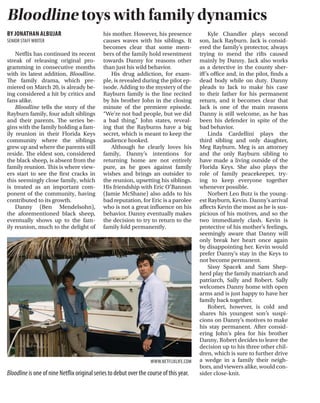
sider close-knit.Bloodline is one of nine Netflix original series to debut over the course of this year.
WWW.NETFLIXLIFE.COM
THETICKER ARTS & STYLE I PAGE 13MARCH 23, 2015
BY REYNALDO CARRASCO
SPORTS EDITOR
Kendrick Lamar is a force of na-
ture. Every rhyme he spits a gale,
every bar he throws a tidal wave.
His best verses change the very
landscape of hip-hop, and his latest
release, To Pimp A Butterfly, may
change the genre itself. With heavy
funk, soul and jazz influences, La-
mar attempts to confront his latest
demons as he struggles with his
newfound success.
Though not a socially-conscious
album, To Pimp a Butterfly does
find Lamar setting crosshairs on
many of society’s injustices against
African-Americans and the hypoc-
risies that have become a mainstay
in today’s culture. This is not an al-
bum for the club, car or patio. This
is an album for meditation, not
congregation.
Lamar opens the project with
“Wesley’s Theory,” a funky, fast-
paced piece focused on the pitfalls
ofthepursuitofmaterialhappiness,
especially among the lives of black
entertainers. Clocking in at around
five minutes, Lamar sets the tone
for the rest of the album with help
from Thundercat and George Clin-
ton. He approaches the struggle of
black stardom through two lenses:
that of the artist in question and the
system abusing him.
The title itself was warning
enough, using Wesley Snipes’ tu-
multuous journey through Holly-
wood to describe the exceedingly
depressing short shelf life of black
musicians and actors. Legend-
ary 1960s reggae artist Boris Gar-
diner lends Lamar use of perhaps
the greatest hook ever sung by a
black singer, elevating “Wesley’s
Theory” that much higher; ques-
tion the heart of any friend who
is not moved by “who will re-
mind/you and I/that every n---- is
a star?” Clinton’s booming voice
then takes over to offer a parable
using the album’s title before the
song truly begins.
From then on, Lamar takes over.
In his role as the artist, Lamar de-
scribes the illusions of grandeur
that have destroyed many black
artists before him. His voice whines
and pops with every guitar stroke
as allows the clueless, arrogant
artist run wild.
Despite its upbeat tempo, the
chorus is strikingly cynical and
somber. Thundercat combines
two of black America’s most iconic
phrases,aDaveChappelle-inspired
verse, “we shoulda never gave” and
“n----- wanna go back home,” to
create a chorus catchy enough to
remember.
After a short, cliched interrup-
tion from Dr. Dre, the system takes
over Lamar’s second verse. Lamar
blacks out and allows his sinister
second psyche to assume control
as he runs through the complete
pimping process.
Under the guise of Uncle Sam,
he pushes the artist down the path
of destruction. Go on, buy any-
thing and everything. “Don’t have
receipts?/Oh man that’s fine.” Pay
them later, and “f*ck those hat-
ers,” they never understood the
struggle. In fact, go ahead and buy
everything twice. “Your horoscope
is a Gemini/two sides/so you bet-
ter cop everything two times. Two
coupes, two chains, two C notes.”
Lamar plots the artist’s rise to
the top, all the way up to the White
House, before it all comes crash-
ing down: “But remember you ain’t
pass economics in school/and ev-
erything you buy taxes will deny/
I’ll Wesley snipe your ass before
35.” Uncle Sam, the taxman and the
reaper are one and the same in the
artist’s eyes.
Lamar created “Wesley’s Theo-
ry” to break the cycle of abuse, and
before its closing, Clinton reminds
those still on the hunt to confront
success to “look both ways” before
it “crosses their minds.”
With 16 songs in total, Lamar
spends nearly an hour and 19 min-
utes illuminating the darkest cor-
ners of his soul to the world. After
good kid, m.A.A.d city, it was clear
that Compton left him with major
psychological damage.
The album’s sixth track, “u,” il-
lustrates this perfectly. Lamar
spends four-and-a-half minutes
drunk and alone in a hotel room
confronting his survivor’s guilt. He
stares at a mirror, cursing his short-
comings and inconsistencies, con-
stantly repeating the phrase “loving
you is complicated.” He calls him-
self a “f-cking failure” while drink-
ing his sorrows away.
He fades in and out of con-
sciousness, reminiscing on all the
times he let his friends and fam-
ily down. “You ain’t no brother/
you ain’t no disciple/you ain’t no
friend./A friend never leave Comp-
ton for profit.” Anger is not this
album’s sole focus. Lamar runs
through the entire emotional spec-
trum as illustrated on songs such as
“Hood Politics,” “How Much A Dol-
lar Cost” and “Mortal Man.”
Raising an album to instant-
classic status a few days after its re-
lease is always a risky proposition.
Lamar has yet to offer anything less
than great though. Time and time
again, he has delivered. His flow,
delivery, lyricism and storytelling
ability are unparalleled; Lamar is
at the height of his powers. It is rare
in the world of music to find a song
that can clearly conjure a color or
image in one’s mind, yet Lamar’s
work is constantly on that edge.
At its core, music is about vibra-
tions, about metaphysical forces
that are never seen but obviously
felt. Lamar’s synesthesia is no ac-
cident. He is a sorcerer. He takes
his life energy to create music that
transcends the mind’s barriers.
Is there a difference between a
song and a sermon? Both have the
power to move nations and cul-
tures, minds and souls.
Kendrick Lamar breaks Spotify’s record for first-day listens
Lamar won two Grammy Awards this year in the categories of Best Rap Song for“i”and Best Rap Performance.
WWW.WIKIPEDIA.ORG
BY JONATHAN ALBUJAR
SENIOR STAFFWRITER
The CW network is venturing
into the zombie craze with the lat-
est edition to its lineup, iZombie.
The show is a horror-comedy hy-
brid that puts a new spin on the
zombie stories viewers have grown
accustomed to. Veronica Mars
producers Rob Thomas and Diane
Ruggiero-Wright developed the se-
ries for television while tying in the
crime-fighting wit of their former
program.
The show tells the story of Olivia
“Liv” Moore, a promising medi-
cal resident. Liv leads a seemingly
perfect life at the beginning of
the show, though this all quickly
changes after she attends a boat
party with a colleague.
The boat party turns into a
zombie outbreak, and Liv turns
into a zombie after being infect-
ed by a drug dealer who created
the drug that directly caused the
outbreak. This flips Liv’s perfect
life upside-down, as the zombie
side effects force her to change
around all aspects of her life. She
becomes depressed, cannot sleep
and loses her purpose in life in ad-
dition to breaking things off with
her fiance.
Rose McIver leads the cast as
Liv. Her acting credits include re-
curring roles on Masters of Sex and
Once Upon a Time. Although she
begins the series feeling lost, she
eventually realizes that she has vi-
sions about the person whose brain
she eats. She uses this newfound
ability to her own advantage.
Liv also finds it difficult to deal
with friends and family; she does
not want to get too close for fear of
infecting one of them. She instead
chooses to shut everyone out, not
only breaking off her engagement
but also turning cold to her room-
mate. She also fails to listen to ca-
reer advice from her mother, who
believes her condition is just post-
traumatic stress disorder from the
zombie boat party.
Liv switches career paths and
lands a job assisting the coroner
Dr. Ravi Chakrabarti (Rahul Kohli).
Chakrabarti quickly realizes Liv is a
zombie. Interestingly, he has dab-
bled in conspiracy theories before,
an endeavor that cost him his last
job. Rather than being frightened
by a zombie, Chakrabarti takes
to studying Liv and expresses an
interest in finding a cure for her.
Liv’s reaction to eating brains
leads her to work with detective
Clive Babineaux (Malcolm Good-
win). Babineaux is a newly promot-
ed detective from the vice division,
though he has fallen short since
receiving his promotion. Desperate
to make his first arrest, he decides
to use Liv’s visions to his advantage
although he is wary of just how she
is able to procure them. Chakrabar-
ti allows Liv to take time away from
the morgue to assist Babineaux.
Robert Buckley portrays Liv’s
ex-fiance, Major Lilywhite. Lily-
white begins the series deeply in
love with Liv. Due to their impend-
ing nuptials, he insists she have
one last hurrah at the boat party
without him despite her initial re-
fusal to attend. However, Lilywhite
is deeply affected by the inevitable
break up. Although he clearly still
loves her, he begins to move on in
the pilot.
Rounding out the cast are Da-
vid Anders, Aly Michalka, Molly
Hagan and Nick Purcha, as Blaine
DeBeers, Peyton Charles, Eva
Moore and Evan Moore, respec-
tively. DeBeers plays the drug
dealer at the boat party. He pops
back into Liv’s life in a vision at the
close of the pilot with unanswered
questions looming.
Charles is Liv’s best friend and
roommate and is very worried
about her new attitude in life. She
attempts to bring back her room-
mate’s bubbly attitude, but her at-
tempts prove futile, thereby creat-
ing a rift between them. Eva and
Evan are Liv’s mother and brother.
While Evan seems less disturbed
than Eva at their Liv’s condition,
they both notice her declining in-
terest in life, and Eva, in particu-
lar, tries to nudge her back into
the fold.
The pilot convinces the audi-
ence that this show has staying
power. It not only appropriates el-
ements of past zombie shows and
movies but also mixes humor to
create a powerful combination. At
first, Liv is depressed by her condi-
tion, though by the end of the hour
she is able to find the positives.
iZombie shows the power of friend-
ship and family, as each person in
Liv’s life has not lost hope in resus-
citating the old Liv.
The show premiered on March
17. It airs on the CW’s Tuesday
night line up.
The CW’s iZombie channels neo-noir with an insatiable bloodlust
The show is loosely based on the comic book series of the same name created by Chris Roberson and Michael Allred, and Allred even illustrated the opening credits.
WWW.HYPABLE.COM
THETICKERARTS&STYLE I PAGE19MARCH 16, 2015
CONTINUED FROM FRONT PAGE
Statistically, rape occurs in In-
dia every 20 minutes. Despite the
commonality of these instances,
this particular case led to a pub-
lic uproar. Protests, led primar-
ily by university students, were
held across India. In India, where
names of rape victims are not of-
ficially released, she was named
India’s daughter.
The film featured interviews
with friends and family of Singh’s
as well as one of the convicted
perpetrators and the attorneys.
The victim’s identity was disclosed
artfully in the film, reflective of the
series of events that took place
after the rape. For days, the pub-
lic knew of the woman who was
attacked but did not know her
name. In a symbolic shedding
of fear and shame that has been
largely associated with rape, her
father stepped forward to reveal it:
Jyoti Singh.
Satendra, a tutor and friend of
Singh’s, explained the events of the
day as he had heard them. Singh
was raped and grievously injured
while returning home with a male
friend. Her companion’s attempts
at defending her were futile; he
was assaulted and discarded to the
side, incapable of helping.
Singh herself disclosed the gro-
tesque details of the rape once she
was taken to hospital. After raping
her, Singh’s attackers had also evis-
cerated her with an iron rod. Her
injuries were so substantial that
the doctors did not know what to
“put together” or take apart.
One of the convicted rapists,
Mukesh Singh, blamed the victim
herself for the crime, stating, “[A]
girl is far more responsible for a
rape than a boy.” Along with Muke-
sh, defense attorneys on the case,
A.P. Singh and M.L. Sharma, used
arguments based on deep-rooted
beliefs in the country.
According to these individuals,
a woman is created for taking care
of the household, her husband and
children. Sharma equated a wom-
an with a flower that needs protec-
tion from a man, symbolized by
the thorns on a rose stem. If the
woman is not protected, “certainly
the dog will take her out.” Mukesh
and his attorney stated that since
Jyoti was with a male friend who
was not her husband, the actions
of the men were justified.
The ingrained distinctions be-
tween males and females in Indian
society is also represented by the
large-scale female feticide. Of the
feticides that took place in India
in recent years, 99.87 percent were
female fetuses.
Teary-eyed reactions pervad-
ed the audience as Jyoti’s father
shared his pain of cremating his
own daughter. Her mother spoke
of her inability to move past her
daughter’s death. One particular
comment by Asha, Jyoti’s mother,
hit home for a lot of people in the
audience: “If the law thinks it is
right to marry a girl at the age of
12 or 13, then a 15/16-year-old
boy who rapes or harms a girl, why
can’t he be punished?” She was
referring to the 17-year-old rapist
who was charged as a juvenile and
sentenced to a lesser punishment.
As Udwin spoke to the audi-
ence, she mentioned why Baruch
was chosen as a venue for the
documentary’s global premiere.
This location was chosen mainly
because “[violence or rape] could
happen anywhere” and in recog-
nition that the young, educated
generation is key in moving this
cause forward.
She actively referred to students
as the “torches” of the future and to
education, as one of the speakers
conveyed in the film, as the only
way to change the current way
of thinking.
India’s Daughter was scheduled
to broadcast in India on March
8, International Women’s Day.
However, the film was banned by
the Indian government and never
aired, but Udwin proudly noted
that rather than showing any other
content, the screen went dark for
an hour in support of her cause.
The end of the documentary
and the follow-up panel discussed
the issues that India’s Daughter has
brought into public spotlight. The
panel stressed that India is not the
only region with these problems.
These issues, which are rooted
in gender inequality, are prevalent
in developed, developing and un-
der-developed countries. Accord-
ing to Rt. Hon. Valerie Amos at the
premiere, “There is a continuum
in both individual and targeted
violence [against women]. Cultural
change is very difficult. This is not
just about developing societies. It
is systematic.”
During her speech, Pinto ad-
dressed the immediate categoriza-
tion of children upon birth, which
leads to and is characteristic of
gender inequality throughout so-
cieties. “Global misogyny is the
greatest pressing issue in our soci-
ety ... Our pride is misplaced when
one gender on our planet is yet to
be emancipated.”
Pervasive throughout the pre-
miere of this enlightening docu-
mentary was Jyoti, meaning “light”
in Hindi. Jyoti lit the hall at the
beginning with the vigil. It was felt
when Udwin asked the audience
to close their eyes to feel Jyoti and
when Pinto ended her speech ask-
ing the audience to imagine the
greatest source of light they could
think of empowering them to take
a stance.
India’s Daughter pushes women’s rights Netflix breaks in Kimmy
BY JONATHAN ALBUJAR
SENIOR STAFFWRITER
Netflix has become famous
for streaming its original dramas,
such as House of Cards and Orange
is the New Black. This month, how-
ever, it premiered the comedy se-
ries Unbreakable Kimmy Schmidt,
which creators hope will join the
ranks of its heavyweight prede-
cessors as a critically acclaimed
juggernaut.
NBC originally won the rights
to air the comedy, but the deal
fell through last year, and cre-
ators Tina Fey and Robert Carlock
went shopping for a new home for
the program.
Kimmy tells the story of a group
of women who, after living under a
cult leader for 15 years, are thrown
back into the real world, which has
been modernized since they were
last free. The series is told through
the eyes of Kimmy Schmidt as
she attempts to start her life over
again, letting nothing stop her in
her quest for a fresh start.
Ellie Kemper, most famous for
playing receptionist Erin Hannon
in The Office, portrays the titular
character. She is a carefree woman
who, after being saved by the au-
thorities from the cult leader, de-
cides to leave her hometown and
move to New York City. The big
city puts up a lot of hurdles, most
notably who to move in with in the
premiere episode since she has no
friends or relatives in the area and
no source of income.
Playing the role of her even-
tual roommate is Tituss Burgess,
who plays Titus Andromedon. An-
dromedon is an aspiring Broad-
way performer, currently down
on his luck and making ends meet
by working as Iron Man in Times
Square. He is originally cold to
Schmidt’s plight, as he wants to
live alone and does not care much
for others. However, through
various hilarious adventures, he
grows to bond with her, albeit
begrudgingly.
Carol Kane, who lives above
Schmidt and Andromedon, plays
their landlord Lillian Kaush-
tupper. Kaushtupper cares a lot
for Andromedon but that does not
stop her from attempting to evict
him for not having paid rent in
months. Schmidt offers to pay the
back rent if she is allowed to stay
with Andromedon, who reluctant-
ly agrees but not before ensuring
he gets the bigger room.
Schmidt’s search for a job final-
ly comes to an end after she agrees
to become a nanny for the family
of Jacqueline Voorhees, played by
Jane Krakowski. Schmidt begins
different relationships with Voor-
hees and her two stepchildren,
Xanthippe and Buckley, played by
Dylan Gelula and Tanner Flood.
Jacqueline, though hesitant at first,
eventually becomes friends with
Schmidt, who helps her through
problems of her own. Schmidt be-
friends Buckley, who is a spoiled
child, by letting him get what he
wants. Xanthippe, however, abso-
lutely despises her and will stop at
nothing to get her fired.
Schmidt is a kind, lovable pro-
tagonist who goes through rough
patches throughout the 13-epi-
sode season. Although she loses
hope on the future in some in-
stances, flashbacks from her time
trapped in her cult’s bunker re-
mind her of life’s obstacles and
ways she can overcome them.
The character’s interactions
not only provide comic relief but
also serve to provide hope to any
viewer who might have lost it at
one point or another. This mes-
sage of hope will serve Kimmy well
in its future.
Arts & StyleArts & Style
MARCH 9, 2015 THETICKER ARTS & STYLE I PAGE 13
BY JONATHAN ALBUJAR
STAFFWRITER
The Underwoods are back and
this time they are fighting to stay
in power.
The Netflix original series House
of Cards returned for its third sea-
son, consisting of 13 episodes, on
Feb. 27, much to the anticipation
of viewers. Reprising their roles
as series leads are Kevin Spacey
and Robin Wright as president
and first lady of the United States.
House of Cards was created as part
of Netflix’s foray into producing
original programming, and the
flagship series shows no sign of
going away.
House of Cards tells the story of
now former House Majority Whip
Francis J. Underwood and his wife,
Claire, and their various machina-
tions in the world of politics. The
first two seasons focus on the Un-
derwoods’ ascension up the po-
litical ladder after then-President
Garrett Walker promised Francis
the office of the secretary of state
before winning the election but
later reneged.
Through various underhanded
schemes, Francis gets selected to
be vice president after removing
the incumbent by offering him a
more desirable position. He re-
moves any evidence of these plots
along the way, including shoving
first season’s Zoe Barnes, played
by Kate Mara, into the path of
a moving train, but one loose
end remains.
His Chief of Staff, Doug Stamp-
er, played by Michael Kelly, is his
enforcer, carrying out most of the
dirty deeds that Francis’ power
struggle requires. Stamper, a re-
covering alcoholic, usually follows
through on his orders but falls in
love with a prostitute, Rachel, who
becomes a part of Francis’ political
chess game.
Though he is tasked with kill-
ing her, Stamper hesitates on fol-
lowing through, which results in
Rachel beating him to near death
at the end of the second season. In
the season finale Francis succeeds
in getting Walker to step aside.
Thus, he is is elevated to U.S. Presi-
dent, despite having never had a
vote cast in his favor. Rachel on
the run and Stamper’s uncertain
fate provide obstacles on Francis’
road to power heading into the
new season.
The third season sees the return
of some characters from previous
seasons. It also introduces new
characters central to the new plot.
Returning characters include Molly
Parker as House Minority Whip
Jackie Sharp, Maherasha Ali as new
Chief of Staff Remy Danton, Eliza-
beth Marvel as Solicitor General
Heather Dunbar, Derek Cecil as
Press Secretary Seth Grayson and
Jayne Atkinson as Secretary of State
Catherine Durant.
Each of these characters in
some way led to Francis’ ascen-
sion and have all been rewarded
with prominent positions in his
inner circle. The president faces
pushback, however, when he at-
tains his ultimate goal but cannot
keep all his promises to his many
loyalists.
New to the House of Cards uni-
verse this season are Kim Dickens,
Lars Mikkelsen and Paul Sparks, as
White House correspondent Kate
Baldwin, award-winning author
Thomas Yates and Russian Presi-
dent Viktor Petrov, respectively.
Baldwin is a tough-as-nails jour-
nalist who is aware of how corrupt
Francis is. Yates is an author whom
the president seeks personally af-
ter his initial attempt at a jobs plan
falls flat in Congress.
Petrov is the main antagonist
to Francis’ plans in the third sea-
son, trying to undermine U.S. for-
eign policy in order to advance
his own country. Although the
presidents try to reach a peace
agreement early in the season,
talks quickly fall through escalat-
ing into a political war. Petrov is
obviously a fictionalized version of
Vladimir Putin.
Besides Francis’ actual gover-
nance of the country and the con-
tinued Rachel storyline, a notable
side plot of the season is the effect
the White House has on the Under-
wood marriage. Though they have
worked as a team to reach their mu-
tual goal, the Underwoods begin to
develop cracks in their relationship
throughout the season. Their new
goals to govern the country do not
always align, which leads them
to be continuously at odds with
each other.
House of Cards, now an Emmy-
winning drama, has quickly risen
to the top of the television ranks,
much like its characters. It is a de-
licious story of a ruthless couple
stopping at nothing to get what they
want, even committing murder.
Although these actions are usu-
ally deplorable, characters also
have human moments and become
anti-heroes in their own right.
While some root for their eventual
comeuppance, other viewers, in
the end, hope that the Underwoods
continue to deliver more seasons of
great drama.
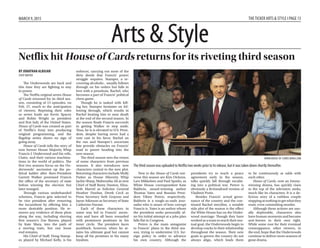
Netflix hit House of Cards returns for its riveting third season
The third season was uploaded to Netflix two weeks prior to its release, but it was taken down shortly thereafter.
WWW.HOUSEOFCARDS.WIKIA.COM
BY LUIS LUCERO
STAFFWRITER
Larry David, the creator of the
critically acclaimed and Emmy
Award-winning sitcoms Seinfeld
and Curb Your Enthusiasm, has
teamed up with Tony Award-win-
ning stage director Anna Shapiro,
who has most recently directed the
surprise Broadway hits Of Mice and
Men and This Is Our Youth, to bring
his quirky and irreverent style of
comedy to Broadway.
While Fish in the Dark, David’s
playwright debut, will run for 18
weeks beginning March 5 at the
Cort Theatre, it has already been
performed for several weeks to
sold-out crowds during its preview
run. It has gotten to the point where
several of his Seinfeld and Curb col-
leagues have had a hard time get-
ting seats for previews. Consider-
ing the successful previews, it is
evident that David has a big hit on
his hands.
The play stars David and Ben
Shenkman as Norman and Arthur
Drexel, respectively, two brothers
who are dealing with the death of
their father and figuring out who
he intended to have carry out his
dying wish.
What starts out as feud be-
tween two brothers soon escalates
to include their cantankerous
mother (Jayne Houdyshell), Nor-
man’s frustrated wife (Rita Wilson)
and even his cunning housemaid
(Rosie Perez). The rest of the play
sees David trying to wind his way
around the endless problems that
this family feud spawned. While
the play uses the typical death-in-
the-family storyline, what David
and Shapiro do with it that makes
the play as great as it is.
David has incorporated many
tropes and gags that audiences
have enjoyed from both of his
shows. From the black comedy
to the hilariously awkward situ-
ations the characters find them-
selves in, if it has been previously
used with successful results by
David, it has been incorporated
into the play.
The surprising part is that many
of the jokes that are recycled for the
play are just as funny now as they
were in their respective shows, a
testament to David’s comedic ge-
nius both on and off camera.
Even with the occasional sense
of familiarity, David shows that
he still has a few new tricks up his
sleeve. One such example of this is
the segues between the three main
sets: the hospital waiting room,
Norman’s house and the man-
sion of the Drexel patriarch. These
segues are primarily done with an
animated death certificate that is
projected on the curtain.
While it slowly fills itself in
normally, by the halfway point,
it then takes on a life of its own
by cleverly illustrating events in
the story that have already hap-
pened as well as future incidents in
the storyline.
The music used in the play is
brief and incidental. But com-
pared to the simple bass guitar
beats of Seinfeld and the stock
cartoon music of Curb, Fish in the
Dark’s score is more fleshed-out
and engaging.
Bringing it all together is the
tremendous cast that David as-
sembled for the play. Despite the
character having a different name,
David’s portrayal of Norman is
more or less exactly the same as
his performance of himself in
Curb. He is just as neurotic and
obnoxious, and his ability to start
fights over meaningless things is as
prominent as ever.
Even his wardrobe on the stage
is no less casual and laid-back
than on the screen. With all that
said, Norman was written in a way
that could only truly be played by
David, since no other actor could
come close to giving off the same
crazy vibe he delivered. Also, he
has a surprising amount of stage
presence for an actor who has
only had two lead roles prior to his
theatrical debut.
Shenkman’s performance as Ar-
thur rings some bells of Jeff Garlin’s
performance of David’s manager
and best friend on Curb. His orga-
nized and considerate personality
is the polar opposite of Norman’s
selfish and delusional persona. As
a comedic foil, Shenkman brings
a layer of sibling annoyance and
passive aggressiveness to counter-
balance David’s character.
As the mother of the Drexel
brothers, Houdyshell brings some
flashbacks from both Seinfeld and
Curb. Her performance shares sim-
ilarities with both Estelle Harris’
sarcastic and overbearing perfor-
mance of Estelle Costanza on Sein-
feld and Susie Essman’s bombastic
performance from Curb. There are
times during the play when she
steals the entire scene from David
and Shenkman.
Rounding out the cast is Perez.
Aside from David, she is the only
other recognizable face in the cast.
Perez brings the exaggerated for-
eign character that David seems
to love to include in both of his TV
shows. Her performance in this
play is a fun combination of her
usual sassy persona and David’s
trademark dry humor.
While its run will be short, Fish
in the Dark will no doubt continue
to create quite the buzz on Broad-
way with its comedy. For fans of
David’s work, it will definitely
make up for the long delayed ninth
season of Curb.
Seinfeld creator brings laughter to Broadway in Fish in the Dark
Davidhasincorporated
manytropesandgagsthat
audienceshaveenjoyed
frombothofhisshows.
Fromtheblackcomedy
tothehilariouslyawkward
situationsthecharactersfind
themselvesin,ifithasbeen
previouslyusedwithsuccessful
resultsbyDavid,ithasbeen
incorporatedintotheplay.
David, Sheepshead Bay native, shares the stage with his co-starWilson, executive producer of Mamma Mia!, the film.
WWW.BROADWAY.COM
PAGE 16 ITHETICKER ARTS & STYLE MARCH 2, 2015
BY JONATHAN ALBUJAR
STAFFWRITER
Back for an unprecedented
30th season, the hit CBS reality
television show Survivor contin-
ues its historic run with the pre-
miere of Survivor: Worlds Apart on
Wednesday, Feb. 25. Considered
the grandfather of modern reality
television competition shows, Sur-
vivor regularly throws in themes
for each season, and this season is
no exception.
Worlds Apart gathers contes-
tants from different walks of life
and splits them into three tribes.
Tribes are divided among a white-
collar tribe, which has contestants
with affluent backgrounds, a blue-
collar tribe, which features people
who work lower-class, more labor-
oriented jobs, and a no-collar tribe,
which consists of contestants who
are free spirits. This season’s theme
is just the latest in a long list of
social experiments Survivor has
pitched to audiences, and this sea-
son promises to showcase to view-
ers how different backgrounds deal
with similar situations.
Survivor premiered on May 30,
2000, and had resounding success.
Over 50 million viewers watched
the finale of season one, Survivor:
Borneo, with double that number
having watched at least part of
the finale, according to its Nielsen
ratings. Survivor was developed
for American television by Mark
Burnett and is based on Swedish
program Expedition Robinson.
The idea for the show was based
upon a social experiment that
placed ordinary Americans into a
remote environment, isolated from
the rest of the world. The element
of competition for a million dol-
lars creates drama, which always
makes for compelling reality tele-
vision. Survivor is played with an
even mix of two to four tribes in
every season.
Tribes are given only a bag of
rice, which they are expected to
ration. Competitions are played
among tribes for rewards, which
include food and comfort items.
Tribes also compete in immunity
challenges in every episode, which
result in the losing tribe head-
ing to tribal council. There, one
of the losing tribe’s members is
voted off by a secret majority vote.
Once the number of contestants
is whittled down to anywhere be-
tween nine and 12 contestants,
depending on the seasons, the
tribes merge and all immunity
challenges become challenges for
individual immunity.
The game is played until there
are two to three contestants, which
again, varies by season. The seven
to nine eliminated contestants
comprise the jury, which decides
by a majority vote who should win
the million-dollar grand prize.
While the format might have got-
ten stale and boring after a while,
Survivor producers and host Jeff
Probst have come up with new
ideas for every season to keep
both contestants and viewers
on their toes.
The first season was not filled
with much of the drama that is
considered the norm in modern
seasons. Contestants, for the most
part, were content in letting the
chips fall where they may, even if
that meant their elimination. This,
however, was not the case for inau-
gural winner Richard Hatch, who
still remains one of reality televi-
sion’s most infamous villains.
Hatch was honest about his in-
tentions to do whatever necessary
to win, which the jury rewarded
him for over the sneakier Kelly
Wigglesworth. Hatch is also re-
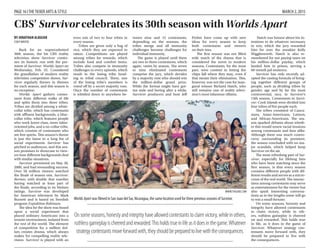
membered for not paying taxes on
his million-dollar payday, which
landed him in prison, serving a
60-month jail sentence.
Survivor has only recently ad-
opted the casting formula of bring-
ing together different groups of
people, such as dividing tribes by
gender, age and by far the most
controversial, race, in Survivor’s
13th season. Contestants in Survi-
vor: Cook Islands were divided into
four tribes of five people each.
The tribes consisted of Cauca-
sians, Asian-Americans, Latinos,
and African-Americans. The sea-
son sparked debates about wheth-
er this would renew racial tensions
among contestants and fans alike.
Although there was much contro-
versy surrounding its premiere,
the season concluded with no ma-
jor scandals, which helped keep
Survivor on the air.
The most refreshing part of Sur-
vivor, especially for lifelong fans
who have been watching since the
first season, is that every season
contains different people with dif-
ferent results and serves as a micro-
cosm of the real world. The interac-
tions among contestants may serve
as entertainment for the viewer but
also spark interesting conversa-
tions as to the lengths some will go
to win a small fortune.
On some seasons, honesty and
integrity have allowed contestants
to claim victory, while in oth-
ers, ruthless gameplay is cheered
on and rewarded. This holds true
in life, as it does in the game of
Survivor. Whatever strategy con-
testants move forward with, they
should be prepared to live with
the consequences.
BY REYNALDO CARRASCO
SPORTS EDITOR
If all it took were a couple of
singles to go big-time, Big Sean
would be a legend by now. Big
Sean’s commercial appeal is well
documented; his catchy ad-libs
and simple punch lines are easy for
anyone to follow. But mainstream
success only earned him respect
as a pop artist. He had to prove to
his peers and to the underground
that rap was more to him than just
a meal ticket.
This is not to say that Big Sean
is not talented. His earlier projects
like Finally Famous Vol. 3: Big and
Detroit were promising when they
were first released, enough so to
warrant features from the likes of
J. Cole, Common and Kendrick La-
mar. His first official album was a
different story though.
Finally Famous was mediocre
and shallow. Released at the height
of “hashtag-rap,” Big Sean’s first al-
bum was obviously geared toward
being a radio-wave pleaser. Need-
less to say, no one took him seri-
ously. Most people thought he was
a joke rapper. This reputation car-
ried over in G.O.O.D. Music’s Cruel
Summer album, and because of
that, he was more of a footnote than
an actual contributor to the project.
However, his second album, Hall
of Fame, was Big Sean’s first step
toward maturing as an artist.
Taking cues from his sensei,
Kanye West, this project is a bom-
bastic effort for Big Sean. The only
problem is that at this point in his
career, the lyrics resemble brag-
gadocio more than anything else.
Despite that, listeners took notice
of his honesty more than before.
Tracks like “Nothing Is Stopping
With You” are more emotionally
charged than others. This is due to
a willingness on Big Sean’s part to
describe the inner machinations of
his daily life and past, as well as an
improvement on his beat selection.
Big Sean’s newest album, Dark
Sky Paradise, picks up right where
he left off. At a compact 12-track
listing (15 on the deluxe edition),
he finds a healthy balance be-
tween modesty and arrogance.
The first two tracks, “Dark Sky
(Skyscrapers)” and “Blessings”
demonstrate this perfectly.
The first shows Big Sean to be
as self-aware as he has ever been,
from the number of breasts he sees
on tour to the number of zeroes on
his latest check, he boasts about all
the usual luxuries rappers enjoy. At
the same time though, he refers to
his beginnings as a child, teen, and
burgeoning rapper and superstar. It
is clear that Big Sean has mastered
the art of the humble brag.
“Blessings,”whichhasacutfrom
Drake, is an understated banger.
The beat itself is moody and low-
key with droning basses and synths
that fit perfectly with the lyrics. Big
Sean and Drake take turns talking
about the roads their careers have
taken up to this point. The song
feels longer than its four minutes
and 12 seconds, and though it is a
single, it feels more like a long sip of
whiskey than a shot of tequila.
The third song, “All Your Fault”
continues the opening song’s
strong start. With a feature from
West included, Big Sean takes shots
at his ex-girlfriend while hyping
up his current situation. West sup-
plies him with the dose of insanity
every G.O.O.D. Music song needs
while also providing a soulful and
operatic sampling.
The album slows down a bit
around the seventh track, “Win
Some, Lose Some.” Jhene Aiko pro-
vides the hook and Big Sean goes
to work, this time diving into the
more vulnerable side of his per-
sona. Big Sean is not invincible,
and he knows that. Like Drake, he
is not afraid to show that he too is
capable of being hurt, especially
by women.
In the tenth track, “Deep,” Big
Sean gets lost in his own mind. It
seems like he tried to get existen-
tial, but it falls flat. Though he has
matured a great deal, there are mo-
ments where he tries too hard. This
is one of them. Talking about how
deep his own lyrics are is not going
to help his cause, especially when
he has a washed-up Lil Wayne
helping him. It sounds like some-
thing he made when he was stoned
and forgot to delete.
Luckily, he ends the album on a
high note. The second-to-last song,
“One Man Can Change The World,”
is Big Sean’s crack at a power
ballad. It is beautiful.
With John Legend and West’s
best 808s and Heartbreak voice on
the hook, Big Sean takes listeners
on a journey through his child-
hood. He spills his heart talking
about his loved ones, specifically
his parents. It is an emotionally
stimulating experience that will
penetrate anyone’s heart.
Big Sean has a come a long way
from his days as an over-confident
Kidz Bop rapper. Though he has
blips here and there, he is more
confident in his own identity and
not the one created for him by com-
mercial singles. This time around,
Big Sean is forging his legacy on his
own terms.
Big Sean establishes himself on serious terms with latest release
Though Big Sean began the recording process back in 2013, he did not finish DarkSkyParadiseuntil January this year.
WorldsApartwas filmed in San Juan del Sur, Nicaragua, the same location used for three previous seasons of Survivor.
WWW.TVGUIDE.COM
Onsomeseasons,honestyandintegrityhaveallowedcontestantstoclaimvictory,whileinothers,
ruthlessgameplayischeeredandrewarded.Thisholdstrueinlifeasitdoesinthegame.Whatever
strategycontestantsmoveforwardwith,theyshouldbepreparedtolivewiththeconsequences.
WWW.HOTNEWHIPHOP.COM
CBS’ Survivor celebrates its 30th season with Worlds Apart
Arts & StyleArts & Style
FEBRUARY 23, 2015 THETICKER ARTS & STYLE I PAGE 11
BY LUIS LUCERO
STAFFWRITER
Shortly before television view-
ers across the country witnessed
the end of Walter White’s gripping
story arc of personal destruction on
Breaking Bad, series creator Vince
Gilligan announced that he was de-
veloping a spinoff series featuring
the show’s corrupt, hysterical law-
yer, Saul Goodman. After two years
of format changes, filming and
multiple delayed premiere dates,
Better Call Saul finally premiered
on Feb. 8 with two episodes across
two nights.
While the announcement of
the show was cause for excitement
and speculation among Breaking
Bad fans, there were also those
who were skeptical as to whether
or not the show could work. Typi-
cally, spinoffs to popular TV shows
have a very hard time escaping the
shadow of the original.
It may disappoint audiences by
not coming close to the quality of
the original show, or it may gain
positive reactions as a serviceable
series that manages to act as an en-
tertaining distraction to the source
show, or, in very rare cases, actually
stand on its own two feet as a show
that eclipses the original at times.
Better Call Saul has shown that
it undoubtedly fits into that rare
third category.
The pilot episode, aptly titled
“Uno,” opens up with the tra-
ditional long cold opening that
viewers have long come to associ-
ate with Breaking Bad. This time
around, it serves as a way of pro-
viding an expanded epilogue for
the original show, or in this case,
Goodman’s story. While the be-
ginning setup is satisfying way of
hooking viewers, the creative deci-
sion to film it in black and white is
absolute genius.
Not only does it bring back a
few flashbacks from similar scenes
in Breaking Bad, it also gives view-
ers an idea of how difficult it is for
Goodman to adjust to his post-
criminal lawyer life. As expected,
Goodman’s pre-Breaking Bad life
is told with regular color cinema-
tography. Without giving much
away, all that can be said is that
the transition from the black and
white opening to the color show
is a testament to Gilligan’s genius
storytelling methods.
After the opening, the audience
is finally introduced to the young
Goodman, or James McGill, as he
was known then. McGill is a strug-
gling lawyer that is trying to stay
afloat. Even as a young lawyer, he
shows many of the same quick wit-
ted and sneaky traits that he carries
over into the future.
Halfway through the pilot, Mc-
Gill gets involved into an extortion
scheme that will serve as the main
story arc for the season. The overall
story and dialogue are just as sharp
as in the Breaking Bad days. Gilli-
gan provides the perfect balance of
both intense drama and hysterical
black comedy that results in some
of the best television in ages.
Several characters from Break-
ing Bad make appearances over the
course of the series, either as recur-
ring characters or just for the sake
of a fan service cameo.
Reprising his role of Saul
Goodman/James McGill is Bob
Odenkirk. As a supporting actor
on Breaking Bad, Odenkirk pro-
vided the comic relief for a show
that already had its fair amount of
black humor. One of the biggest
questions leading to the premiere
was whether he could be a good
leading actor.
In first two episodes of Better
Call Saul, Odenkirk has shown
himself to be more than capable of
carrying an entire series. It could
even be argued that his perfor-
mance in this show even rivals
Bryan Cranston’s performance of
White. Aside from still being as
quick-witted and passive aggres-
sive as ever, he adds a layer of un-
certainty and nervousness.
So far, the only other Breaking
Bad character to appear on the
show is Mike, played by Jonathan
Banks. While his role on the show
will be greatly expanded as the se-
ries continues, his role in the first
two episodes was mainly to serve
as a comic foil for McGill.
One of the new characters of
the show is James’ brother, Chuck
McGill, played by Michael McK-
ean. He is basically the complete
opposite of James. Chuck is also a
lawyer but he is far more success-
ful and financially stable than his
brother. But at the start of the se-
ries, he is shown to suffer a mas-
sive mental breakdown, and now
James has to take care of his broth-
er’s issues while juggling his own
problems. McKean’s performance
makes viewers both feel annoyed
by Chuck yet also feel sympathetic
for his plight.
As far as new shows of 2015 go,
Better Call Saul is among the best
so far, and it is one of the very few
spinoffs to both live up to all the
massive hype building up to the
premiere and completely escape
the shadow of the original show in
the process. Hopefully, this show
continues to gets better with each
consecutive episode and season.
Gilligan invokes Breaking Bad’s dark humor in Better Call Saul
BY JONATHAN ALBUJAR
STAFFWRITER
Valentine’s Day weekend usu-
ally offers a slew of romantic mov-
ies, but one movie shattered all
records for movies debuting dur-
ing the holiday. 50 Shades of Grey
managed to defy the box office
odds that are typically not kind to
movie premieres, and made a stag-
gering $90 million over the week-
end, including President’s Day.
50 Shades of Grey was released
on Feb. 13. It is based on E.L.
James’ bestselling novel of the
same name. The film stars Dakota
Johnson as Anastasia Steele, a vir-
gin college graduate, and Jamie
Dornan as Christian Grey, a young
billionaire businessman.
The film tells the story of the re-
lationship between the two main
characters, evolving from a chance
meeting. When her roommate falls
ill, Ana replaces her as Christian’s
interviewer. This encounter soon
evolves into a romantic relation-
ship, which takes a surprising turn
once Christian reveals his true in-
tentions for pursuing Ana.
Christian reveals to her that he
enjoys being the dominant partner
in a sadomasochistic relationship
and seeks her approval to accept
his terms and be his submissive
partner. This surprises Ana as
she never had a sexual encounter
prior to meeting Christian. She
has to decide if she wants to al-
low Christian to inflict pain on
her in order to continue spending
time with him.
The movie did not stray far from
the book, besides minor changes
necessary to contain the film to a
reasonable time limit. One big dif-
ference readers of the novel will
likely have noticed is the film’s
abrupt ending, ending one scene
earlier if it had followed the novel’s
ending. Besides its success in the
United States, 50 Shades of Grey
has also managed to succeed glob-
ally, banking over $160 million at
the box office through Sunday.
Although 50 Shades of Grey
achieved monetary success in its
opening weekend, the movie did
not premiere without its share of
controversy. Before its U.S. release,
the National Center for Sexual Ex-
ploitation sought to halt the film’s
premiere, citing concerns of its
depiction of Christian and Ana’s
sexual relationship. The center
stated that the movie “is really
about sexual abuse and violence
against women.” The center’s mis-
sion was obviously in vain as the
film premiered in the United States
without delay.
However, the sadomasochistic
nature of the relationship in the
film has affected its release global-
ly. Although scheduled for a Feb.12
release in Malaysia, the film was
denied a certificate by the Malay-
sian Film Censorship Board for its
content. Other countries, includ-
ing Kenya and Indonesia, followed
suit. The Philippines took a more
lenient approach, opting to cen-
sor the film’s sex scenes while still
allowing the film a limited release.
Moviegoers who enjoyed the
film and did not read the novel will
be happy to know that 50 Shades of
Grey is actually the first in a trilogy,
which continues to tell the story of
the main character’s relationship.
After the film’s success, a sequel
has been given the green light, slat-
ed for an early 2016 premiere. Un-
doubtedly, a third or even fourth
film will also be in the works, wrap-
ping up the novels.
Despite the controversy sur-
rounding the novels, the film was
entertaining in delving into an as-
pect of relationships, which is usu-
ally taboo to display, let alone talk
about. The novel’s success had al-
ready attracted controversy, so the
same was expected when the film
was due to be produced. The main
actors did a great job playing their
roles of dominant and submis-
sive partners in the relationship,
and their chemistry is undeniable
throughout the movie.
50 Shades of Grey is never go-
ing to please all moviegoers. The
dialogue is at times cheesy and
the content is racy, but it has elic-
ited strong reactions from fans
and detractors alike, thus helping
it to achieve its strong box office
numbers. Certainly, when sequels
50 Shades Darker and 50 Shades
Freed are released, the debates
over the film’s content will renew.
BY DAMLA BEK
ARTS & STYLE EDITOR
The main problem with If
You’re Reading This, It’s Too Late is
that it fails to strike a balance be-
tween soft Drake and hard Drake.
Drake is chided all across the In-
ternet for being too soft, but in
this latest release, he is simply not
soft enough. He has either devel-
oped a protective outer shell in re-
sponse to all the criticism or he is
over-compensating.
To exemplify this point, both
Take Care and Nothing Was the
Same maintained some sem-
blance of equilibrium; “HYFR”
balances out “Make Me Proud,”
and “Started From The Bottom”
counters “From Time.”
Drake’s whole brand is found-
ed upon the notion that he is in
touch with his emotions. If You’re
Reading This strays so far from his
otherwise fixed formula it is dis-
arming. This mixtape is pure rap-
ping, so fans who appreciate the
vulnerability of Drake’s singing
will be sorely disappointed.
Even if the ratio is off, Drake
attempted to pull a Beyonce; If
You’re Reading This was released
on Feb. 15 to ecstatic fans with no
prior announcements or adver-
tising. To his credit, this mixtape
debuted at the No. 1 spot on the
Billboard 100.
Drake starts out strong with
“Legend,” in which he establish-
es himself as something of a big
deal. In the chorus he comes to
a breakthrough realization that,
“If I die, I’m a legend.” Drake is
the 6 God, the founder of OVO
Sound, so at the very least, he
has the evidence to back up his
weighty claims.
Drake moves on to “Energy,”
which is less aurally pleasing
than its predecessor. However,
it fits the bill perfectly in that he
uses the opportunity to address
his enemies.
In “10 Bands,” Drake shows off
the wealth he has accumulated
over the course of his career. The
backing beats provide an airy con-
trast to the density of his rapping,
but lyrically speaking, this song is
lacking. “Know Yourself” is an un-
deniable banger. Again, the beats
here are light to the point of be-
ing whimsical. Though Drake is
“running the 6 with his woes,” his
producers Boi-1da, Vinylz and Sik
Sense deserve more credit.
Likewise, “6 God” is on the
same level. Drake is, of course,
alluding to the area code for To-
ronto. Though his dedication
to his hometown is admirable,
the constant references are a
little tiresome.
Of the 17 total tracks, there
are four distinctly soft-ish songs
on this mixtape. Each of these
songs is unapologetically vulner-
able, and for this reason, they are
some of the better songs on the
album. The first is “Preach,” fea-
turing PARTYNEXTDOOR, which
sounds vaguely like Drake is hav-
ing a religious experience in the
recording booth.
“Wednesday Night Interlude”
is even more out there. It is a dec-
laration of loneliness, of aching
desire for the company of an ex-
girlfriend. Conversely, “Now and
Forever” embodies a sentiment of
dissatisfaction. Lastly, “Jungle” is
the best song on If You’re Reading
This. It is somewhat low-key but
still catchy enough to echo in a lis-
tener’s mind. It is the ideal song for
a bedroom.
If You’re Reading This is ul-
timately a hit or miss mixtape.
Drake is probably satisfied with his
efforts to assert himself, and some
fans may appreciate where he is
coming from, but there was never
a need to alienate soft Drake.
50 Shades achieves box office success
Prior to BetterCallSaul, which scored the highest debut ratings in the history of cableTV, Gilligan worked on anX-Filesspinoff.
WWW.IMDB.COM
Drake does himself in
Although50ShadesofGreyachievedmonetarysuccessin
itsopeningweekend,themoviedidnotpremierewithout
itsshareofcontroversy.BeforetheU.S.release,theNational
CenterforSexualExploitationsoughttohaltthefilm’spremiere,
citingconcernsofitsdepictionofChristianandAna’ssexual
relationship.Thecenterstatedthatthemovie“isreallyabout
sexualabuseandviolenceagainstwomen.”
FEBRUARY 9, 2015 THETICKER SPECIAL I PAGE 13
CONTINUED FROM PAGE 11
Many studies have been con-
ducted to try to determine exactly
how influential Saturday Night
Live’s political sketches are to the
voting public. According to Joe
Saltzman, a professor in the Uni-
versity of Southern California’s An-
nenberg School for Communica-
tion, “The perception is that there’s
an audience that cites its primary
news source as predominantly en-
tertainment shows and, if valid,
this certainly would have an impact
on the presidential election.”
There is a portion of the popu-
lation that receives their political
information strictly from comedy
shows such as Saturday Night Live,
illustrating that viewers are im-
pacted by political humor that may
translate into how viewers perceive
certain candidates.
Even though Saturday Night
Live creates content that serves as
social commentary, simply put,
its primary purpose is to make
the audience laugh. This has
proven to be an increasingly im-
portant job in a world that can be
chaotic and unpredictable. At a
time when the country was over-
whelmed with confusion and pain,
Saturday Night Live’s brand of
comedy helped to relieve tension
after 9/11.
The moment when Michaels
turned to then-Mayor Rudy Gi-
uliani and asked, “Can we be fun-
ny?” to which the mayor respond-
ed, “Why start now?” illustrated
to the nation that it was OK to
laugh again.
Though many regard Saturday
Night Live as one of the country’s
biggest institutions, it has been
known to lack hiring diverse em-
ployees. The majority of the cast
has consistently been Caucasian
and male. It has been revealed that
in the early days of the show, get-
ting material on the program as a
female writer was more difficult.
Casting has evolved through the
years, allowing for the top women
in comedy to anchor the show, but
more work needs to be done in or-
der to properly capture the voice of
the country.
Comedian W. Kamau Bell
brings up the program’s diver-
sity issue, saying Saturday Night
Live is “rooted in the tradition of
schools like UCB and Second City,
and does not necessarily appeal
to or include people with other
perspectives.”
Since most of the cast members
are found through improv schools,
which also have diversity issues,
many writers and performers are
overlooked in the hiring process.
Multiple perspectives are impera-
tive in comedy in order to relate
to a broad audience. Recently, ac-
tive steps have been taken by Mi-
chaels to seek out a more diverse
cast and writing staff. Sasheer
Zamata was hired as a cast mem-
ber, and writers Michael Che and
Leslie Jones were promoted to
cast positions.
The nature of Saturday Night
Live’s casting system will always
lead to backlash from audiences.
Since the show’s inception, cast
changes have received great skep-
ticism. Comedy icons such as Will
Ferrell, Adam Sandler and Jimmy
Fallon were all initially criticized
by the media and fans as being the
downfall of the show. Repertory
players and new players alike have
to prove that they are worthy of be-
ing a part of the institution that is
Saturday Night Live.
Recent years have proven to be
remodeling years as beloved veter-
an cast members Fred Armisen, Bill
Hader, Kristen Wigg and Jason Su-
deikis have all parted ways. But the
show has found stars in the likes of
Kate McKinnon, Taran Killam, Jay
Pharoah, Aidy Bryant and Cecily
Strong who all bring their unique
comedic sensibilities as well as un-
canny celebrity impressions. Van-
essa Bayer, Bobby Moynihan and
Kenan Thompson continue their
reign as dependable senior mem-
bers of the show. Michaels has
found unique stars in Beck Bennett
and Kyle Mooney, whose style of
comedy was discovered through a
Web series.
This season, Saturday Night
Live has also expanded the cast
to include stand-up comedian
Pete Davidson, who was hired at
20 years old, making him one of
the youngest cast members in the
show’s history. After 12-and-a-half-
years at the show and eight years as
“Weekend Update” anchor, head
writer Seth Meyers left the program
to host his own late night talk show
in early 2014.
This shift has caused several
changes to the “Weekend Update”
desk, ultimately leading to the cur-
rent lineup of Che and Colin Jost.
This is the first time in Saturday
Night Live history that two men
have co-anchored the segment.
Saturday Night Live has stood
the test of time regardless of the
criticisms it has faced. It will con-
tinue its reign as one of the longest-
running telecasted series. Remod-
eling years will bring skepticism,
and campaign seasons will bring
new viewers. With technology ad-
vancing, emphasis will continue to
be placed on digital content, and
the material will be shortened to
hold our fleeting attention.
The mammoth presence that is
Saturday Night Live will continue to
lure and inspire comedians, actors,
improvisers and writers, hopefully
leading to a voice that represents a
broad range of viewers.
Saturday Night Live remains relevant
Haderispicturedincharacteron“WeekendUpdate”asStefon,anover-the-topguide
to NewYork’s hottest clubs and a counter to Meyers’relative solemnity.
BY JONATHAN ALBUJAR
STAFFWRITER
The 2015 TV season has just be-
gun, but there is already a host of
upcoming shows that have viewers
highly anticipating their premieres.
These programs include a variety
of different genres, from comedies
to science fiction, dramas to horror
and even a few spinoffs. Although
these shows differ in their con-
tent, they all share the same goal:
to capture the viewer’s attention
and stay on our screens for as long
as possible.
Perhaps the most highly antici-
pated premiere of 2015 is the spi-
noff of the critically acclaimed tele-
vision classic Breaking Bad, titled
Better Call Saul, on AMC. Breaking
Bad tells the story of Walter White,
a chemistry professor who resorts
to manufacturing and selling crys-
tal methamphetamine after being
diagnosed with terminal cancer.
He comes to this radical decision in
order to leave behind money for his
family after his death.
Better Call Saul will focus on
the life of Saul Goodman, a lawyer
who was a regular character on
Breaking Bad, always offering legal
advice to the main characters.
Another highly anticipated spi-
noff, tentatively titled Cobalt, also
comes from AMC. Set in the same
universe as The Walking Dead, Co-
balt will tell the story of a group of
survivors of the same zombie apoc-
alypse set in Los Angeles, a differ-
ent location from the original.
Cliff Curtis and Kim Dickens
will play the male and female lead
roles of Sean Cabrera and Nancy
Tomkins, with Nancy’s two chil-
dren filling out the other two an-
nounced main character roles.
More casting announcements are
forthcoming, and Cobalt looks to
emulate The Walking Dead’s rat-
ings and juggernaut status for the
cable network.
Heroes: Reborn also has a pop-
ular predecessor, although it will
be a 13-episode miniseries instead
of a full-fledged spinoff. The sci-
fi drama will share a similar plot
to Heroes, in that regular people
come to discover they possess spe-
cial abilities. The show will also be
preceded by a digital series, which
fans can follow on NBC’s website.
Although flailing ratings doomed
Heroes in its last few years on the
air, Heroes: Reborn hopes to recap-
ture the loyal audience of its first
few seasons, when viewership was
at its highest.
The streaming service Netflix
also has a pair of new offerings for
the 2015 television season. Mar-
vel’s Daredevil, which is part of
the growing number of superhero
television series, will tell the story
of Matt Mourdock and his trans-
formation from a normal blind
man to the crime-fighting super-
hero on the streets of Hell’s Kitchen
in New York.
This marks Netflix’s first foray
into the superhero genre, but with
Marvel dominating with yearly
movies, including the upcom-
ing Avengers sequel, the move to
streaming television seems like a
smart move. All episodes of Dare-
devil will be available on Netflix on
April 10.
Also on the horizon for Netflix is
the comedy Unbreakable Kimmy
Schmidt. Created by Tina Fey and
Robert Carlock, this show will tell
the story of Kimmy Schmidt, who
recently escaped from a doomsday
cult and is starting life over in New
York. Although the show is not set
to stream until March 6, it has al-
ready been given the green light
for two seasons of 13 episodes, dis-
playing Netflix’s confidence in the
success of the program.
Another comedy set for a 2015
premiere is Fresh Off The Boat,
which debuted its first episode on
Feb. 4. The comedy is loosely based
on the life of chef Eddie Huang
and his memoir of the same name.
The comedy will follow an Asian-
American family who moves from
Chinatown in Washington D.C. to
the suburbs of Orlando, Florida,
where the patriarch of the fam-
ily decides to open a Wild West-
themed restaurant.
The family at first has trouble
assimilating to the move, as they
were comfortable with their sur-
roundings in their previous neigh-
borhood, but make the best of their
new place. Fresh Off The Boat aims
to make television history as the
first successful American television
program with an all Asian-Ameri-
can lead cast.
Mixing comedy and drama, Fox
hopes to capture the same suc-
cess fellow horror-anthology series
American Horror Story has en-
joyed over the past four years with
Scream Queens. Expected to pre-
miere in the fall, Scream Queens’s
first season will revolve around
a college campus that has been
rocked by a series of murders.
Leading the cast is legendary
scream queen Jamie Lee Curtis,
who is no stranger to leading hor-
ror films with her appearances in
the Halloween franchise.
Also rounding out the cast
are Lea Michele, Joe Mangani-
ello, Emma Roberts, Abigail Bre-
slin, and Keke Palmer as well as
singer Ariana Grande, who will
appear in a recurring role. Cre-
ated by Ryan Murphy, Scream
Queens is guaranteed to make au-
diences give the premiere a scream
in the fall.
New, highly anticipated television shows to debut on the small screen
WWW.WOWTHATSCOOL.COM
WWW.QUOTEIMG.COM
WWW.NBCNEWS.COM
BetterCallSaulwas planned by creatorVince Gilligan to be developed as a comedic short.
WWW.BLOG.KOLLABORATION.ORG
Huang was wary of selling the rights to his memoir, though he was consulted throughout the production.
DavidSpade,SandlerandChrisFarleyarepicturedincharacterastheGapGirls,three
teenage girls who perfectly embody the drollness of suburban mall culture.
Arts & StyleArts & Style
FEBRUARY 2, 2015PAGE 12 ITHETICKER ARTS & STYLE
BY DAMLA BEK
ARTS & STYLE EDITOR
Broadway’s own scrappy up-
and-comer Lin-Manuel Miranda
has made quite a name for himself
since In The Heights propelled him
into the spotlight around 2008. In
The Heights won four Tony Awards
and one Grammy Award, and Mi-
randa received further critical ac-
claim for his work on Bring It On:
The Musical in 2011.
If he is not making guest ap-
pearances on the contemporary
remake of The Electric Company, he
is pushing his improvisational hip-
hop group from small-time stages
to big-time networks. Miranda has
proved himself to be a promis-
ing young player, and if his latest
project is any indication, fans and
critics alike can expect great things
from him going forward.
Hamilton has been in the works
for years, and Miranda even per-
formed the opening number at the
White House Poetry Jam in 2012.
However, it is now a full-blown mu-
sical spanning about three hours.
The story details the life of Alex-
ander Hamilton, played by Miran-
da himself—and it is clear that he
identifies with this black sheep of a
Founding Father. The cast is made
up almost entirely of people of
color, and thus Hamilton is a fresh,
personal take on early American
history; to see the white male elite
subverted like that is a really em-
powering experience.
In typical fashion, Miranda em-
ploys hip-hop instead of orches-
tral fare. And while it may seem
anachronistic, again this plays into
that restructured power dynamic.
The end result is engaging and
beautifully executed.
Hamilton was born out of wed-
lock in the British West Indies. His
father, a Scotsman, bailed on their
family under the threat of bigamy
charges, given that his mother
had never actually divorced her
first husband prior to leaving him.
She later died after contracting a
severe fever, though Hamilton mi-
raculously survived. His brush with
death made him that much more
determined to establish himself,
and so, Hamilton set forth into the
New World armed with wit and will
to incite revolution.
The audience is introduced to
Hamilton’s rather tumultuous life
in a dazzling, though still informa-
tive, number. Here, the audience
gets a feel for Hamilton’s personal-
ity and the hardships he faced over
the course of his life.
The scene then transitions into
Hamilton’s first encounter with one
Aaron Burr (Leslie Odom Jr.) the
politician who eventually shoots
and kills him in a duel. Their meet-
ing is friendly, if tense, because
each man senses the weight of the
other’s political intentions.
Odom is a little robotic in the
role, but it serves Miranda’s pur-
pose. Though the audience may
come to sympathize with Burr’s
own struggles, ultimately, Hamil-
ton is about the man himself. He is
a penniless, status-less immigrant
climbing his way to the top. He is
relentless; that perpetual glint in
Miranda’s eye works well here.
Burr introduces Hamilton to
a group of equally rambunctious
men: John Laurens (Anthony Ra-
mos), Marquis du Lafayette (Dav-
eed Diggs) and Henry Lee (Okier-
iete Onaodowan), all revolutionar-
ies. These actors all complement
Miranda’s vigor beautifully. Where
Ramos exudes boyish charm, Diggs
offers accented, well-timed quips,
and Onaodowan commands the
audience’s attention.
Hamilton and his band of merry
compatriots stir up polemical dis-
course in the public sphere in be-
tween drinking and chasing tail.
They eventually become four of the
main figures in the forthcoming
revolutionary war. In fact, Hamilton
is recruited by George Washington
(Christopher Jackson, also of In
The Heights fame) to work behind
the scenes and plan attack strate-
gies, though he is itching to be out
in the trenches.
Hamilton falls in love with, mar-
ries and has children with Eliza
Schuyler (Phillipa Soo), one of
three sisters who belong to a high-
class family.
But there is more to it than
that—the oldest, Angelica (Renée
Elise Goldsberry), is smitten with
Hamilton upon sight. He declares
that they are one and the same, two
people who “will be never satis-
fied.” But Eliza falls in love just as
easily and Angelica draws back for
the sake of her sister’s happiness. In
that way, the relationship between
these two sisters is complex and
compelling.
At some point, Hamilton also
falls to temptation by a seductive
girl-next-door type. He engages
in an affair that nearly ruins his
career. However, he makes the
best of it and comes clean of his
own volition before his enemies
(Thomas Jefferson and James Mad-
ison, interestingly enough) can out
him. This reminds the audience
that Hamilton was not without
his flaws.
Miranda’s intention is neither to
excuse his infidelity nor to skew the
truth. Ultimately, Hamilton serves
to immortalize him as he was, as
he actually lived his life. In the final
number, the cast sings, “Who lives,
who dies, who tells your story?”
Hamilton will be playing at the
Newman Theater at the Public
Theater through April 5, though it
is still in previews. It is completely
sold out until the end of its run,
but cheaper tickets are available
through two lottery programs.
The Public’s mission as a non-
profit organization is essentially to
ensure that culture is not an unob-
tainable entity. Thus, it falls in line
with Miranda’s own efforts to make
the show more accessible to peo-
ple in the lower economic bracket.
The performing arts world will
be waiting patiently for Miranda’s
next big hit.
Miranda brings lives of Founding Fathers to fore with Hamilton
The Americans makes its
return to small screenBY MIA CARABALLO
CONTRIBUTINGWRITER
With the release of their sixth
studio album, titled American
Beauty/American Psycho, pop-
rock quartet Fall Out Boy contin-
ues their legacy of reinvention,
blending hints of punk, soul and
hip-hop into their unique sound.
At first glance, the album is a com-
pilation of catchy anthems, a con-
temporary spin on arena rock with
enough mainstream appeal to
succeed on Top 40 radio and take
the number one spot on the Bill-
board 200 charts. But as the album
progresses, so too does its sound
and substance.
The two lead singles, “Cen-
turies” and “American Beauty/
American Psycho” are modern
rock anthems, catchy enough to be
enjoyable but lacking in the lyrical
prowess long-time fans have come
to expect, even from Fall Out Boy’s
biggest hits. The last single to be re-
leased is “Uma Thurman,” which is
arguably the catchiest single from
the album. The track incorporates
samples from the theme song of
the 1950s sitcom The Munsters and
references the ’90s cult classic film
Pulp Fiction. All three singles ap-
ply sound samples, with “Centu-
ries” sampling from “Tom’s Diner”
by Suzanne Vega and “American
Beauty/American Psycho” sam-
pling from Motley Crue’s “Too
Fast for Love.” Together the singles
summarize the new direction Fall
Out Boy hopes to take, breathing
new life into classic rock ‘n’ roll,
even if it means sacrificing a bit
of content.
Deviating from its predecessor,
Save Rock and Roll, which relied
heavily on collaborations with oth-
er artists, American Beauty/Ameri-
can Psycho utilizes iconic song
snippets to vary the sound, giving
the album a more cohesive feel.
Standouts from the album in-
clude “The Kids Aren’t Alright,”
“Jet Pack Blues,” “Fourth of July”
and “Favorite Record,” which
explore themes of love and loss
with a seasoned version of the
wit and lyrical style that fans have
come to know and love. “The Kids
Aren’t Alright” is the slowest song
of the record,but by far the most
thoughtfully written, with clever
lines reminiscent of Folie a Deux.
The song feels like a youth-
ful heart trying to reconcile itself
with the disenchantment of grow-
ing up, a feeling all too familiar to
many enduring and former angst-
ridden teenagers.
“Jet Pack Blues” is a melanchol-
ic ballad that perfectly pairs the
soulfulness explored by lead singer
Patrick Stump in his solo project,
Soul Punk, with lyrics that tell the
tale of loneliness and maintaining
a relationship while living life on
the road.
The lyrics to “Fourth of July”
are the most layered and com-
plex, reminiscing on young love
to a rhythmic track with a slight
hip-hop undertone. Unlike the
tormented love ballads of From
Under the Cork Tree, Fall Out Boy’s
first major label release, “Fourth
of July” tells of a romance viewed
in hindsight with the clarity and
shared blame.
The next track on the album,
“Favorite Record,” is another nos-
talgic ballad with a synthesized
echo that mirrors the substance.
What would be a perfect end to the
album instead transitions into yet
another anthem.
The last two songs of the al-
bum, “Immortals,” a promotional
release for the Disney film Big
Hero 6, and “Twin Skeleton’s” are
rougher rock anthems, that like
the singles, lack depth and feel out
of place at the close of the album.
They successfully transition from
brash anthems to more thought-
ful songs that evoke elusive emo-
tions,; however, the progression
back to generic rock anthems ends
the record on a flat note.
American Beauty/American
Psycho can feel like two different
albums haphazardly shuffled into
one record, but considering the ti-
tle, the juxtaposition is fitting. The
album is almost a clash between
the band as artists and the band as
rock stars, leaving them struggling
to appease themselves, the media,
the die-hards and their own egos.
BY JONATHAN ALBUJAR
STAFFWRITER
The critically acclaimed drama
The Americans has returned for a
third season on the FX network.
The espionage thriller, set during
the Cold War, has been nominated
for various awards, with its three
coveted Emmy nominations. The
Americans premiered two years
ago on Jan. 30, 2013, and has main-
tained steady, positive ratings since
its opening episode.
The show centers on the Jen-
nings family and their lifelong mis-
sion in the United States. Elizabeth
and Phillip Jennings live in the Vir-
ginia suburbs with their children,
but their secret is that they were
actually born in Russia.
The pair are KGB operatives and
are frequently sent on missions by
leaders of the Soviet Union to gain
intelligence on the enemy, the
United States. The series also de-
picts the U.S. point-of-view through
the eyes of their neighbor, whom
they are aware is an FBI counter-
intelligence agent. Throughout the
series, both countries’ operatives
attempt to gain the upper hand by
any means necessary.
Established actors Keri Russell
and Matthew Rhys portray Eliza-
beth and Phillip, respectively. The
Jennings spy duo, although mar-
ried, were put together by Soviet
leadership at first and were not in
love upon having marriage thrust
upon them. In terms of keeping
up appearances with friends and
neighbors, they have also con-
ceived two children and have pro-
gressively grown to love each other.
They also go on missions in
various disguises in order to gain
intelligence when such orders are
relayed through their handlers. A
running storyline involves Rhys
playing boyfriend to FBI secretary
Martha Hanson, played by Allison
Wright. Their relationship, which
Elizabeth is fully aware of, takes
Phillip away from his family oc-
casionally. These are the types of
sacrifices both main characters
make on a daily basis for the sake of
their homeland.
The Jennings’ neighbor Stan
Beeman, played by Noah Em-
merich, represents the foil to the
main character’s plans. Beeman
is unaware he is living next door
to his sworn enemies, which is by
no accident. Beeman is a very pa-
triotic agent, who stops at nothing
to end any possible threat to the
United States.
Beeman also gathers Soviet in-
telligence from his assistant, Nina
Krilova, who he acquires early on
and threatens to prosecute should
she not cooperate with the FBI.
Played by Annet Mahendru, Nina
works in a high-ranking Soviet of-
fice that gives her direct knowledge
of any upcoming missions against
the United States.
What makes The Americans
compelling television is, despite
knowing the eventual end result of
the Cold War in history, as the se-
ries unfolds, viewers tend to root
for the Jennings, even though they
are at war with the United States.
Although the storytelling justly of-
fers the American point of view as
well, the causes the Soviets fight for
are similar to the ones Americans
fought for, and as a viewer, one can-
not help but sympathize with their
story and mission.
After two successful seasons,
here is to hoping The Americans are
not taken out anytime soon.
Fall Out Boy makes it big all over again
Hamilton’s marriage to Eliza was a calculated move given her family’s political clout.
WWW.BROADWAYWORLD.COM
FallOutBoywillbetouringwithWizKhalifaandHoodieAllenthiscomingsummer.
WWW.FUSE.TV
Arts & StyleArts & Style
JANUARY 26, 2015PAGE 16 ITHETICKER ARTS & STYLE
BY JONATHAN ALBUJAR
STAFFWRITER
Academy Award-winning direc-
tor and producer Lee Daniels has
taken a break from the big screen
and moved to television in 2015.
Looking to replicate the success he
achieved from his movie Precious,
he has launched his first foray into
television with Empire.
Empire premiered on Jan. 7, and
it has already proven it will be yet
another success for Daniels. The
second episode increased its view-
ership over its premiere with over
10 million viewers, and so the Fox
network decided to give it an early
renewal for a second season, a rar-
ity for a new show.
The show centers on the Lyon
family and their lives at the top of
the music industry. Empire also
provides flashbacks to the rise of
the patriarch of the family, Lucious,
at the expense of his wife Cookie.
The couple bankrolled their start in
the industry through illegal means.
Their three sons, now adult
men, each have a role in the com-
pany, and each has different rea-
sons for wanting to be its leader
one day. Throughout each episode,
there are also several musical per-
formances, showcasing the talents
of not only members of the Lyon
family but other artists signed to
Empire Entertainment.
Terrence Howard and Taraji P.
Henson portray the two lead char-
acters, Lucious and Cookie, respec-
tively. The two have so much on-
screen chemistry that Henson her-
self objected to Wesley Snipes as
Daniels’ first choice to play Lucious
and pitched Howard, a gamble that
paid off, as she had not been offi-
cially cast when doing so.
The Lyons are reunited in the
premiere after 17 years apart, as
Cookie had been in prison for that
period of time. Having taken the fall
for a drug deal gone wrong, she re-
turns to claim her piece of the com-
pany she feels Lucious owes her for
sacrificing so many years of her life.
Although Lucious agrees to help
his ex-wife, as he has moved on
with a younger woman, Cookie de-
mands more, which starts a power
struggle between the two. Further
complicating matters is the fact that
Lucious was diagnosed with Lou
Gehrig’s disease, and is given only
a few years to live, in which time he
must choose one of his three sons
to replace him as CEO of Empire.
Their eldest son Andre, played
by Trai Byers, is the current chief
financial officer of the company.
Although he is their Wharton-edu-
cated, eldest son, he has a couple of
drawbacks to his bid for control of
the company.
Andre is the only son who does
not record or produce music, which
Lucious believes is a non-starter in
a very competitive industry whose
leaders are all artists in their own
right. He also suffers from bipolar
disorder, which might also derail
his plans to become the heir.
Jamal, the middle son played
by Jussie Smollet, would seem to
be next in line to the throne. He is
a disciplined artist who writes his
own songs and is also of sound
mind, unlike his brothers. How-
ever, there is one part of Jamal’s life
THAT Lucious believes would hin-
der the company’s success should
he take over one day: Jamal is gay
and out to his family, and although
he has spent his whole life try-
ing to earn his father’s approval,
it has never been enough to break
through to him, although his moth-
er is completely supportive.
That leaves Hakeem, the young-
est son, played by Brysheere Grey.
Although he would seemingly ben-
efit from the drawbacks of selecting
his older brothers as heirs, he too
has his own. Hakeem is a talented
rapper, but he is also arrogant and
too immature to run a company on
his own. Given that Lucious only
has a few years to train a successor,
that seems too tall a task if he were
to select Hakeem, as he does not
have the discipline it would take to
run Empire.
What has and will continue to
make Empire a successful televi-
sion show is that, at its heart, it is a
show about the struggles of a fam-
ily. The Lyons once had nothing
and now they have it all, which has
created huge rifts among them.
Although they all make ques-
tionable decisions, you cannot
help but root for them as a unit and
hope one day they can all sit down
and enjoy a simple dinner together,
something they have already tried
and failed to do.
The King Lear-style plot of
which Lyon son will succeed Lu-
cious also proves to make a family
reunion an almost impossible task,
but it does make for highly enter-
taining television.
BY LUIS LUCERO
STAFFWRITER
One of the most enduring parts
of 1990s pop culture was the vid-
eo game console wars between
the Sega Genesis and the Super
Nintendo Entertainment System
(SNES). In many ways, the mod-
ern video game industry and fan
community was molded from the
battles waged between both com-
panies.
However, as Blake J. Harris ex-
plains in his debut book Console
Wars: Sega, Nintendo, and the
Battle that Defined a Generation,
the Sega vs. Nintendo generation
was quite possibly the tech world’s
quintessential David and Goliath
story, if there ever was one.
For most of the book, Harris fo-
cuses on the American branch of
Sega and an executive named Tom
Kalinske. Kalinske, something of
a maverick officer of toys, became
CEO of the company’s struggling
American division shortly after the
launch of the Genesis in 1990.
While he knew practically noth-
ing about video games upon join-
ing the company, Kalinske soon as-
sembled a team in the offices that
aimed to achieve the impossible
goal of releasing Nintendo’s stran-
glehold on the U.S. game market.
While Sega of America is giv-
en center stage, several chapters
are dedicated to the Nintendo of
America’s side of the story. Follow-
ing a brief recap of how the com-
pany took the video game world by
storm, Harris shows how Nintendo
of America dealt with the impend-
ing threat of the Genesis and their
aggressive mudslinging campaign
against them.
Console Wars also references
Sony and its early attempts at
partnering with both Nintendo
and Sega to produce a CD-based
game console, the PlayStation. In-
deed, the PlayStation was the very
console that eventually took down
both companies.
Although many of the stories
and facts have already been told in
various gaming publications and
websites, Harris manages to take a
lot of this existing information and
adapt it in a way that makes it ap-
pealing both to gamers and any cu-
rious passers-by.
Rather than presenting it as yet
another historical analysis of video
games that can easily be found on-
line, Harris decides to angle Con-
sole Wars as a business-oriented,
technological thriller novel that
does to Sega what The Acciden-
tal Billionaires did to Facebook or
Moneyball did for the 2002 Oak-
land Athletics. This approach al-
most makes the book read like the
script for a movie or a television
mini-series.
While this is a very fascinating
look into a memorable part of ’90s
culture, the book does feel like it
both stops short and drags on at
times. Several chapters in Con-
sole Wars could have either been
trimmed down or dropped entirely
since they do not seem to add all
that much to the overall narrative
of competition. One such example
is the chapter that deals with Sega
of America trying to get third-party
companies to break their exclusiv-
ity with Nintendo and also make
games for the Genesis. Although
this makes for some interesting
conflict, ultimately it drags on to
the point of tedium.
As previously mentioned, Nin-
tendo’s role in the console wars
were relegated to just a few chap-
ters. While this is good execution
in terms of tone, there were several
other stories from pre-SNES days
at the company that would have
added a more balanced look at the
console wars, such as how the com-
pany first reacted to the Sega Mas-
ter System in the face of the original
Nintendo Entertainment System.
Though Harris clearly intended
for the timeline of the book to be
roughly 1990-1996, one cannot
help but feel that Harris should
have focused more on the eventual
downfall of Sega.
While he did zero in on the in-
ternal struggles between Sega of
America and Sega of Japan, which
played a key role in the company’s
fall from grace, it would have been
nice if the company’s two post-
Genesis consoles—the Saturn and
Dreamcast—were also highlighted.
Then again, there is always the pos-
sibility of some sort of follow-up
book from Harris that covers this
subject.
One of the biggest surprises
to hit bookshelves so far, Harris
has seemingly paved the way for
more books on the history of video
games to hopefully be published.
And for those who still want more
after checking this book out, there
is both a companion documentary
being produced by Harris and a
script for a feature film adaptation
is being written by Seth Rogen and
Evan Goldberg for Sony Pictures.
Console Wars details merciless rivalry between Sega and Nintendo
WWW.HITFIX.COM
Howard and Henson also previously starred opposite each other in the 2005 independent drama Hustle&Flow.
Fox’s Empire lays bare familial struggles in the music industry
MIA CARABALLO |THETICKER
Though ConsoleWars is a whopping 576 pages, Harris spends most of it of talking about Sega’s struggles rather than Nintendo’s.
BlakeJ.Harrisexplainsinhis
debutbookConsoleWars:
Sega,Nintendo,andtheBattle
thatDefinedaGeneration,the
Segavs.Nintendogeneration
wasquitepossiblythetech
world’squintessentialDavid
andGoliathstory,ifthereever
wasone.
THETICKER ARTS & STYLE I PAGE 19DECEMBER 8, 2014
BY JONATHAN ALBUJAR
CONTRIBUTINGWRITER
After seven seasons, Sons of An-
archy will air its highly anticipated
series finale. Sons of Anarchy pre-
miered on Sept. 3, 2008, on the FX
network. Kurt Sutter, who was pre-
viously a writer, director and pro-
ducer for another hit FX television
show, The Shield, created the show.
Over the course of its seven-year
run, Sons of Anarchy became the
FX network’s highest-rated show
ever, surpassing previous record-
holder The Shield in its third sea-
son and averaging almost 5 million
viewers per week.
The show centers on the fic-
tional Redwood chapter of the Sons
of Anarchy Motorcycle club, head-
quartered in the fictional town of
Charming, California. The club, re-
ferred to frequently by its anagram,
SAMCRO, has chapters in many cit-
ies across the United States as well
as overseas. The club protects the
town of Charming through what-
ever means necessary and also as-
sists fellow members of the club
whenever necessary.
The club is originally led by
President Clay Morrow, played
by Ron Perlman, and Vice Presi-
dent Jax Teller, played by Charlie
Hunnam. Teller’s father John first
founded the motorcycle club in
the 1960s along with eight other
men, known as “The First 9,” which
Morrow is also a member of. Af-
ter John’s death under mysterious
circumstances, revealed later in
the show, Morrow takes over as its
leader and picks John’s son to be
his righthand man.
Clay’s wife, who is also Jax’s
mother and John’s widow Gem-
ma is portrayed by Katey Sagal.
Gemma, although not a member
of the club, plays a central role in
the plot throughout the series. As
mother and wife to the two lead-
ers of the club, she wields a lot of
influence over the decisions made
by the club and looks out for the
best interest of her family. Gemma
also wields influence over Wayne
Unser, played by Dayton Callie.
Unser is the sheriff of Charming
and has been friends with Gemma
for decades.
Maggie Siff and Drea de Matteo
as Tara Knowles and Wendy Case
play the other two women in Jax’s
life. Wendy is Jax’s first wife and the
mother of his first child, Abel.
They have since divorced amid
Wendy’s continued drug abuse
and lack of care for her child.
Tara, meanwhile, is Jax’s high
school sweetheart, who reap-
pears in his life in the first season,
and who he slowly rekindles a
relationship with.
Rounding out the rest of the
main cast are the members of the
motorcycle club. Mark Boone Ju-
nior plays Bobby Munson, one of
the only even-tempered mem-
bers of the cub who is also its
treasury secretary, keeping its re-
cords and finances in order. Alex
Trager, portrayed by Kim Coates,
is originally the sergeant-at-arms
of the club and extremely loyal to
Clay Morrow.
The only two non-white Ameri-
cans in the SAMCRO chapter are
Chibs Telford and Juice Ortiz,
played by Tommy Flanagan and
Theo Rossi. Chibs is from Ireland,
where the Sons of Anarchy have
chapters. Ortiz is of mixed Latino
and African American descent.
Sons of Anarchy’s staying pow-
er is attributed to its strong focus
on family and, by extension, the
brotherhood displayed among the
members of the club. The char-
acters on this show often choose
less than ethical means to solve
problems for one another, but their
hearts are often in the right place,
and the audience can relate to
them. The action scenes and strug-
gle between outlaws and author-
ity figures also appeal to lovers of
the genre.
Sons of Anarchy fans might not
be saying farewell to SAMCRO after
the final episode airs. Kurt Sutter
has stated he is in talks with FX to
create a Sons of Anarchy prequel
set in the 1960s featuring the birth
of the motorcycle club.
FX’s long-running Sons of Anarchy takes a final, historic ride home
Hunnam, a British actor born in Newcastle, England, prefers to travel only by means of motorcycle in his own life.
WWW.SCREENRANT.COM
Coffee @ 6 plays host to
talents of Baruch
BY CALVIN RONG
PHOTOGRAPHY EDITOR
Theearthyaromaofcoffeefloats
throughout the room, mingling
and mixing with the sweet scent
of waffles and syrup. The two con-
trasting bouquets combine with
the display of fresh fruit to create
a medley of gourmet proportions.
The only thing warmer than the
coffee is the crowd; the crowd of-
fers their ear and heart to the artist
utters. They give a salvo of applause
to both congratulate and thank the
artist for their performance. This is
Coffee @ 6, a room full of people
gathered to join in and share the
human experience of art.
What at first might seem like
some bohemian cafe is Coffee @
6, an open mic event hosted by Ba-
ruch College’s own literary maga-
zine, Encounters. Encounters pub-
lishes the artistic and literary works
of Baruch students each semester.
This biannual event is fan favorite,
drawing large crowds year after
year. The event attracts so many
people, in fact, that the small TV
room is quickly filled to standing
room only.
However, students come for far
more than just the delicious waf-
fles and coffee. Indeed, the event
boasts a wide range of perfor-
mances. Every year students may
sign up and perform in any way
they please.
With such a warm and wel-
coming audience, this event is
perfect for veteran wordsmiths
and fledgling artists alike. Ev-
ery performer stepped up to
the stage with a confidence that
can only be gained through
rigorous rehearsal.
Some musicians preferred to
sing their covers of popular songs
while others performed original
material. From the smoothing
voice of Taylor Higgs to the ener-
gizing performance by Jeremiah
Mallari, to the provocative display
by Eileen Makak and the enchant-
ing aria by Sophia Kapitan, the
lineup had something to appeal
to everyone.
These performers went beyond
simply engaging in a reenactment
of set steps; they bled their hearts
and invited the room to share in
the medium they loved. Whether it
was song or prose, the energy they
produced was captivating. Mentor
of the Baruch Toastmasters Bobby
McFerrin told a moving story about
holding a child. It was hard for even
the least-maternal members of the
crowd to not be touched.
After the scheduled lineup was
finished, the floor was opened to
anyone who wanted to perform.
This was the perfect opportu-
nity for shy artists to put them-
selves out there or for someone
to test their new material to a
welcoming crowd.
When asked about how this
event started, Crystal Zheng, busi-
ness manager of Encounters, said,
“Coffee @ Six started between En-
counters and a USG representative,
Jordan Bonet, [though] he’s long
graduated by now. We wanted to
collaborate together to show that
Baruch has a more creative side.
Because when you think of Ba-
ruch, you think business … but this
event, which always has a major
turnout, shows you how creative
Baruch can be. “
Be sure to not miss this event
next semester.
AC/DC’s Rock or Bust tops the charts
BY LUIS LUCERO
STAFFWRITER
Earlier this year, AC/DC an-
nounced that one of their original
members, rhythm guitarist and
backing vocalist Malcolm Young,
would be forced to take permanent
medical leave from the band short-
ly before recording started on their
first studio album in six years, Rock
or Bust.
The band members found
themselves faced with a similar sit-
uation when the legendary Back in
Black album was recorded after the
death of original vocalist Bon Scott
in 1980. With this new album, how-
ever, AC/DC is out to show once
again that they can still rock out in
the face of tragedy.
The album clocks in at 35 min-
utes. At first glance, this makesRock
or Bust look more like a glorified EP
than a full-length studio album, but
the run time actually feels perfect
since there are no filler songs.
As far as lyrics go, AC/DC will
probably never deviate from their
tradition of writing songs about
sex, violence and rock ‘n’ roll. Some
may expect the band pay some kind
of subtle tribute to Young the same
way that Back in Black’s title track
and “Have a Drink on Me” saluted
Scott. However, the title track “Rock
or Bust” is the band’s way of saying
that the internal problems will not
stop them from rocking on. The
song is simply about the band get-
ting hyped up for a rock concert:
“We turn the amps up high/the
crowd’s gonna hit the sky.”
The closest that AC/DC gets to
tackling this tricky subject is in the
song “Hard Times,” and even then it
ends on a high note with a promise
to overcome the blues. Every other
track treads familiar ground such as
girls, having a good time and rock-
ing it out.
But the band’s real draw is their
aggressive, hard-rock sound, which
comes from the sum of its parts.
Without a doubt, the lead and
rhythm guitars are the most recog-
nizable parts of the music. Even to-
day, lead guitarist Angus Young can
still deliver new, catchy riffs and
blistering solos to rock along to.
From the first track to the last, An-
gus’ guitar lunges at listener’s ears
like an attack dog and never relents
throughout the entire album. This
time around, Angus paid homage
to the band’s past guitarists.
The opening riff of “Rock or
Bust” sounds very similar to the
classic riff of AC/DC’s “Highway to
Hell” and “Sweet Candy.” It opens
with a very Jimi Hendrix-esque
feedback that sounds like it was
taken straight from “Foxy Lady.”
Newcomer Stevie Young has a
fairly sizable role to fill in with the
rhythm guitar, and while Malcolm
will be missed by fans, Stevie’s play-
ing is serviceable and gets the job
done well.
If the guitars are not the most
important part of AC/DC’s music,
the vocals are definitely a close
contender. Brian Johnson, in his
10th AC/DC album, still provides
all the howling vocals that augment
perfectly with the Youngs’ guitar
parts. Rounding out the band is the
rhythm section, featuring Cliff Wil-
liams on bass guitar and Phil Rudd
on drums.
Though one would not think
much about the band’s bass sec-
tion, Cliff Williams and Rudd pro-
vide a simple yet effective groove
that drives all the songs. All five
musicians come together to put
forth a solid album.
Four tracks in particular, “Rock
or Bust,” “Rock the Blues Away,”
“Baptism By Fire,” and “Sweet Can-
dy,” have the potential to be dev-
astating live songs during the in-
evitable world tour. If Rock or Bust
aimed to prove that AC/DC can still
survive without its key members, it
succeeded and then some.
Long-time fans will enjoy this
album and newcomers will find
reason to become fans of the band.
Whether or not this is going to
end up being AC/DC’s last album
and tour, fans can at least know
that the band went off with an
electrifying bang.
WWW.LOUDWIRE.COM
Rudd was not featured in the latest band photo, though he remains in the ranks.
WWW.IMDB.COM
AfterthefinaleairsonTuesday,Dec.9,SutterissettoreleaseaSonsofAnarchybook.
Arts & StyleArts & Style
NOVEMBER 17, 2014PAGE 14 ITHETICKER ARTS & STYLE
BY JONATHAN ALBUJAR
CONTRIBUTINGWRITER
Shonda Rhimes, the creator
and executive producer of current
ABC’s hit series Grey’s Anatomy
and Scandal, has hit the jackpot
again with How to Get Away with
Murder. The new show, which at-
tracted an astounding viewership
of over 20 million for its series pre-
miere—including those who use
DVR—rounds out a trio of dramas
on Thursday nights, dubbed Shon-
daland Thursdays.
How To Get Away With Murder
premiered on Sept. 25. The legal
drama focuses on a group of law
students who are eventually hired
to work for their professor and de-
fense attorney Annalise Keating,
played by Viola Davis. The series
is set at fictitious Middleton Law
School in Philadelphia and fea-
tures an ensemble cast. Keating
and her legal team, which includes
two associates, soon become en-
tangled in the murder of a student,
Lila Stangard, and that becomes
the central plot of the season.
The series also uses flash-
forwards in every episode, which
reveal to the audience that some-
one in the main cast has been
murdered. Each episode shows
the team defending a differ-
ent client from charges ranging
from fraud to, as the series name
suggests, murder.
Keating’s team of students in-
cludes two actors who already
have star power of their own in
their young careers. The most rec-
ognizable actor on her team of
students is arguably Alfred Enoch,
who portrays Wes Gibbons. Enoch
will be familiar to anyone who
followed the Harry Potter movie
franchise, in which he played
Dean Thomas.
The character he plays this time
around is a law student who was ac-
cepted to Middleton off the waitlist,
which makes him an easy target
for ridicule by the rest of the team.
He also moves into an apartment
building where he becomes neigh-
bor to a mysterious young woman,
whom he quickly takes an interest
in. Rebecca Sutter, played by Katie
Findlay, quickly becomes a suspect
in the Stangard murder.
Matt McGorry, who plays Asher
Millstone, also has had success be-
fore How To Get Away With Murder.
He previously played prison guard
John Bennett in the highly success-
ful Netflix series Orange Is The New
Black. Here, however, Millstone is
an aspiring lawyer who comes from
an affluent family whose father is
also a highly respected judge. Mill-
stone comes off as a misogynist at
first, but we soon learn there is dif-
ferent side to him.
The rest of the actors in Davis’
group of students are Jack Falahee
who plays Connor Walsh, Aja Nao-
mi King who plays Michaela Pratt
and Karla Souza who plays Laurel
Castillo. Walsh is a ruthless, and
at first promiscuous, law student
who happens to be gay. Pratt is a
very ambitious young woman who
looks up to her professor and wants
to follow in her footsteps. Castillo
is a talented idealist who later pur-
sues a relationship with someone
in the firm.
Keating’s team also includes
two associates, played by Liza Weil
and Charlie Weber. Weil portrays
Bonnie Winterbottom, a dedicated
attorney who is a helpful ally to Ke-
ating. Weber’s Frank Delfino is the
only one on the team who is not a
lawyer or studying to become one.
Instead, Delfino is a fiercely loyal
confidante of Keating who does not
shy away from doing her dirty work
and also has a knack for sleeping
with her students.
Rounding out the main cast
are Tom Verica and Billy Brown
who portray Sam Keating and
Nate Lahey, respectively. Sam is
the husband to Annalise and is
also a psychology professor at the
university. Although married, An-
nalise also engages in an affair
with Lahey, a respected detec-
tive who Keating feels she can be
herself around.
The recipe to this show’s suc-
cess, besides being created by
Rhimes of course, is that it stays
true to its name. Keating defends
people who are charged with hei-
nous crimes, some of who are
guilty, and yet, by the end of the
hour, viewers find themselves root-
ing for her and her team to succeed
in winning the case for their clients.
Any show that can pull that off on
a weekly basis has a long future on
the air.
BY LUIS LUCERO
STAFFWRITER
2014 has been a groundbreak-
ing year thus far for Marvel Com-
ics. Movies like Captain America:
The Winter Soldier, X-Men: Days
of Future Past and Guardians of
the Galaxy all came out to rave
reviews and equally high box of-
fice returns throughout the spring
and summer.
Friday, Nov. 7 saw the release of
the last Marvel movie of the year,
Big Hero 6, as the first theatrical
animated Marvel movie to be pro-
duced. Unlike Captain America
and Guardians of the Galaxy, this
movie was not produced by Dis-
ney’s Marvel Studios division but
rather by the company’s resurging
Walt Disney Animation Studios. In
the past couple of years, the studio
has been in the middle of a dramat-
ic comeback.
Movies like Wreck-It Ralph and
Frozen have drawn interest in Dis-
ney animation from their Pixar
division back to their main studio.
After the latter scored rave reviews,
$1.2 billion in the box office and an
Oscar Award for the studio’s first-
ever Best Animated Film, Big Hero
6 has the difficult task of following
up Frozen’s monster success.
This time around, Disney decid-
ed to take a similar approach that
was also utilized successfully with
Guardians of the Galaxy.
To clarify, animators took a rela-
tively unknown Marvel comic book
series and adapted it into a poten-
tial franchise. The main difference
is that Big Hero 6 was planned
as a standalone project and not
as part of the larger Marvel Cin-
ematic Universe, which includes
both Guardians of the Galaxy and
The Avengers.
While the Marvel name is not
anywhere on either the promotion-
al materials or in the film credits,
the company’s influence can still
be seen in the final movie. The set
up for this movie hits many of the
same beats found in any comic
book origin movie.
Big Hero 6 centers on Hiro, a
boy genius with a knack for robot-
ics. But after a tragic turn of events
rocks his world, Hiro creates a rag-
tag team of crimefighters, which
includes an inflatable medical ro-
bot named Baymax. Together, the
team heads off to find out the cause
of this mayhem.
Even in animation, the endear-
ing characters, witty humor and
adrenaline-pumping action typi-
cally associated with Marvel have
all been included in Big Hero 6. In-
deed, it is one of the very best that
Disney has produced; this movie
is a massive breath of fresh air in
terms of style and story.
Big Hero 6 is vastly superior to
the already excellent Disney film
that preceded it, Frozen. Just the
idea of an animated movie about
a superhero team is enough to re-
mind viewers of another similar
movie released by Disney: Pixar’s
The Incredibles.
Both movies have a similar tone
and a similar sense of humor. The
main difference, however, is that
Big Hero 6 is a full-blown superhe-
ro movie, while The Incredibles was
more a fleshed-out homage and
parody of not only superhero mov-
ies but also James Bond-esque spy
movies and action and adventure
film serials.
It is also satisfying to finally see
Disney Animation Studios create
a legitimate action movie. Mov-
ies like Atlantis: The Lost Empire
and Treasure Planet were previ-
ous attempts by the studio to dive
into this genre, but both seemed
to hold back from achieving their
fullest potential in this genre by
falling back into the traditional
Disney gimmicks. Big Hero 6 gives
viewers a taste of how an animat-
ed action movie from the studio
would look like.
Another fantastic element of
the movie is Baymax. Watching the
trailers, he comes off as a robotic
version of Frozen’s wise cracking
snowman, Olaf. But after watching
Big Hero 6, Baymax is not so much a
comic-relief character but a docile
and caring guide for Hiro.
The audience really gets invest-
ed in the bond that both characters
form over the course of the movie.
And without spoiling anything, the
more touching scenes involve Hiro
and Baymax. Big Hero 6 is a superb-
ly produced addition to an amazing
winning streak that hopefully con-
tinues for years.
Big Hero 6 makes a lasting impression on audiences far and wide
Baymax‘s plump and lovable design was inspired by soft robotics research conducted at Carnegie Mellon University.
WWW.IMDB.COM
WWW.IMDB.COM
High ratings mean that the first season has been given a full order of 15 episodes.
WWW.HOLLYWOODREPORTER.COM
The original Big Hero 6 was a team of
Marvel superheroes from 1998.
Thenewshow,which
attractedanastounding
viewershipofover20million
foritsseriespremiere—
includingthosewhouse
DVR—roundsoutatrio
ofdramasonThursday
nights,dubbedShondaland
Thursdays.
How to Get Away with Murder uses shock value to engage fans
THETICKER ARTS & STYLE I PAGE 19NOVEMBER 10, 2014
We live in an insane world
of consumerism, where back-
to-school supplies are in stores
a week after summer vacation
starts, and Halloween candy and
costumes are put on the shelves
when the weather is still swelter-
ingly hot. And if you are looking
for a last minute Halloween cos-
tume on its eve, all you will be
able to find are Santa hats and
peppermint sticks.
How confusing is this when
you are trying to find an outfit for
Thanksgiving? Very confusing.
Thanksgiving attire should bring
out the amazing colors of the fall
season: forest green, burnt orange,
deep navy and taupe. How are we
supposed to find this when all that
becomes available are the bright
greens and fire-engine reds of
Christmas, and the bright navies
and silvers of Hanukah? No, I do
not want to wear a gold sequin
dress on Thanksgiving, so why is it
being sold in early November?
Most women are too con-
sumed with buying turkeys, yams
and patterned tights for their
Thanksgiving dinner parties to
spend time, money and energy
searching for a Christmas outfit
a month ahead of time. Women
would come in the store from early
December through Christmas Eve
in search of the perfect holiday
outfit, at which point we had none.
In fact, the clothing stores next to
us had none. What we had was
spring resort wear lining our walls
while there was a blizzard outside
and snow plows in the parking lot.
If this has never happened to
you, either you are an overachiev-
er or you just do not like to shop.
Let me help you out here.
Hit the sales racks! By now, all
the good fall clothing is on sale!
It is amazing and sad at the same
time. You may have trouble find-
ing your size, but remember that
oversized sweaters are always an
amazing buy, so if there is only an
x-large left, get it! It will go great
with leggings and knee-high boots
or you can dress it up with a knee-
length skirt and booties.
Try some online shopping!
Stores tend to have more options
online than they do in store. If you
did not buy that amazing dress,
sweater or slacks that you saw two
months ago in Zara, you may be
able to find it online. Sometimes,
the workers keep “out of season”
clothing on the website to accom-
modate different regions, or to
represent a larger brand than what
is in stores.
If you have reached the point of
desperation, swap! You may have
already worn that perfect dress last
Thanksgiving, but your best friend
has not! If you are lucky enough to
have a cousin, sister or best friend,
who is around the same size as
you, do some temporary lending
and switches to freshen up your
wardrobe for the holiday. This will
save you money that you will have
to spend on gifts next month and
all you have to buy is maybe a fresh
pair of tights and some fun acces-
sories for the season.
Shopping for holidays
RISA HARTSOUGH
BY JONATHAN ALBUJAR
CONTRIBUTINGWRITER
The CW has scored a sleeper
hit with their dramedy Jane the
Virgin, which premiered on Oct.
13, the show is loosely based on
Venezuelan hit telenovela Juana
la Virgen. Although it has been on
the air for less than a month, the
show has had strong enough rat-
ings and enough hype to be picked
up by the network for a full season,
a strong indicator of confidence in
a freshman show.
Jane the Virgin stars Gina Ro-
driguez as the titular character,
Jane Villanueva. She is a 23-year-
old Latina woman who has taken a
vow of abstinence until marriage.
After a mix-up with her gynecolo-
gist, she is artificially inseminated,
which results in her pregnancy,
and that sets up the various plots
of the show.
Andrea Navedo plays Jane’s
mother, Xomara Villanueva. Xo-
mara had Jane out of wedlock at
a very young age, which played a
big part in Jane’s decision to take
a vow of abstinence. Although she
and Jane have a very close rela-
tionship, she is keeping a big se-
cret from Jane: the identity of her
birth father.
Rounding out the Villanueva fe-
male trio is Alba, played by Ivonne
Coll. Alba is Jane’s very religious
grandmother and is also the per-
son who made Jane take her vow as
a young girl. The eldest Villanueva
speaks only in Spanish throughout
the series, although her lines are
subtitled in English.
Jane’s pregnancy complicates
her relationship with long-term
boyfriend Michael Cordero Jr.,
played by Brett Dier. Cordero, a
detective, has been with Jane for a
couple of years and is madly in love
with her. He completely respects
Jane’s choice to abstain. Despite
both initially swearing to each oth-
er that this would not affect their
seemingly perfect relationship,
things quickly get rocky between
the once unbreakable pair.
The actual father of the child
is Rafael Solano, played by Justin
Baldoni, who is married to Yael
Grobglas’ character Petra Solano.
Rafael, once a rich playboy who
cared only about himself, recently
survived a battle with cancer and
has since changed his ways. He re-
alizes he is no longer in love with
his wife Petra, who picks up on
this fact.
Desperate to keep Rafael since
they have a five-year prenuptial
agreement with one year to go,
Petra decides to artificially in-
seminate herself with a sample of
Rafael’s sperm. Although Rafael
is infertile because of the chemo-
therapy as a result of the cancer,
Petra has an unaffected sample
she has been saving for a rainy day.
Further adding to the drama in this
marriage is her affair with Roman
Zazo, played by Alano Miller, who
is Rafael’s best friend.
The catalyst to all of this drama
is Dr. Luisa Alver, played by Yara
Martinez. Alver, a gynecologist and
Rafael’s sister, is stricken with grief
as she walks in on her wife cheat-
ing on her with another woman.
This trauma affects her the next
day at work, when she commits
the unthinkable and mistakenly
inseminates Jane instead of Petra.
Dealing with her marriage fall-
ing apart and her career now in
shambles, Alver seeks solace in a
former lover.
Finishing off the main cast is
Jamie Camil, who plays Rogelio de
la Vega. This character is first intro-
duced as the main character in the
telenovela within the show titled
Pasion de los Santos. This tele-
novela is featured heavily in the
pilot as a favorite of the Villanueva
women. It is not until the end of
the first episode that Rogelio’s role
in the show becomes apparent, as
he is actually very familiar with a
main character in real life.
Jane the Virgin has found suc-
cess early in the fall season be-
cause it does not take itself too
seriously. Although it is based
on a telenovela, and is filled with
seemingly unbelievable dramatic
twists in every episode, it owns this
with pride and allows the viewer to
suspend disbelief for each hour-
long episode.
It also depicts a cast filled with
a strong case of ethnic minor-
ity actors without making it the
selling point of the show. The
hot-button topics of religion and
abstinence are also depicted in a
respectful way and are not forced
down the audience’s throat. As
long as Jane the Virgin contin-
ues this formula, it should have
no trouble staying on the air for a
long time.
Jane the Virgin is the CW’s latest hit
Watsky wins over the
crowd in Williamsburg
BY MIA CARABALLO
CONTRIBUTINGWRITER
Kicking off his third headlining
tour to promote his latest album,
titled All You Can Do, poet-turned-
rapper George Watsky remained
true to his roots of playing and
thriving in intimate venues. His
performance this past Tuesday,
Nov. 4 at the Music Hall of Wil-
liamsburg featured up-and-com-
ing opening acts whose skills and
style are on par with his own.
Self-described as “Mos Def
meets Woody Allen,” Watsky has
an affinity for flawlessly interlac-
ing playful yet profound lyrics that
manage to never take themselves
too seriously, even when tackling
serious issues.
The night began with open-
ers Anderson .Paak aka Breezy
Lovejoy, who produced Watsky’s
latest album followed by Kyle ac-
companied by DJ Brick. Both per-
formed a mix of soulful and upbeat
tracks combined with just the right
amount of 1990s nostalgia to leave
the largely millennial audience
buzzing and eager for more.
The performance began and
ended strong with new tracks off
All You Can Do, sprinkled with fan
favorites from Cardboard Castles, A
New Kind of Sexy and Nothing Like
the First Time. Songs like “The One”
and “Ugly Faces” were particularly
memorable given their quirky, up-
tempo electronic beats and light-
heartedly honest lyrics.
Watsky seamlessly transitioned
between the silly and the seri-
ous with tracks like “Tiny Glow-
ing Screens,” a two-part song and
spoken word poem which offers a
quick-witted commentary on his
generation’s fixation with technol-
ogy and materialism. Other high
points of the performance includ-
ed “Ninjas in Paris” and “Rich Girl,”
both fan favorites, which showcase
Watsky’s playful nature.
The highlight of the night was
easily “Whoa Whoa Whoa,” the first
single off of All You Can Do and ar-
guably the most lexically intricate
song in Watsky’s discography; it
was flawlessly executed. The tone
of the song shows just how Watsky
has matured as a lyricist.
Though both of Watsky’s most
recent albums focus on his rela-
tionship with success, Cardboard
Castles feels like more of a humble
thank you. In contrast, All You Can
Do shows a newfound confidence
as well as a darker examination of
the toll success takes on him and
reflecting on some somber mo-
ments in his life, not seen in his lyr-
ics since “Wounded Healer.”
The nature of Watsky’s lyrical
prowess and technical proficiency
leaves the audience wanting more,
almost overwhelmed by the fact
that so much has been elegantly
condensed into short, quick and
deeply insightful bursts. The night
ended with an audience demand-
ed encore, and the venue was slow
to clear out, as though all that had
been said was still being taken in.
All You Can Do, like each of its
predecessors, explores a new and
distinct sound while still being un-
deniably himself. No stranger to
musical experimentation, Watsky
has been turning traditional no-
tions of hip-hop on its head with
his own brand of lisp-y rhymes
coupled with samples from various
musical genres. Three full-length
albums and two mixtapes later, it
is clear from his latest performance
that he is here to stay.
BY AARON MEYER
CONTRIBUTINGWRITER
These days, it is rare to find col-
lege students who listen to classi-
cal music, and if they do, it is usu-
ally on a Pandora station in the
background as an accompaniment
to homework. For most young
people, classical music seems ste-
reotypically boring, but that ste-
reotype was broken at 8 p.m. on
Wednesday, Oct. 29, in the Engel-
man Recital Hall.
The performance was no ordi-
nary classical music concert. The
Harlem Quartet has taken string
quartets to a new level. The mem-
bers of the group have pioneered
an agreement between two seem-
ingly incompatible genres of mu-
sic: jazz and classical.
“For too long,” the lead violinist
Ilmar Gavilan said, “people have
thought of classical music as rigid
and restrictive. We’re changing
that.” The music they created was
otherworldly, and they completely
seized the audience’s attention.
The show was an absolute delight
from start to finish.
The group debuted in 2006 at
Carnegie Hall and has since per-
formed with legends such as Chick
Corea and Itzhak Perlman. Their
talent has propelled them around
the world and earned them a
Grammy award. They are pleas-
ing to the ear as well as the eye
with their happy faces and bouncy
on-stage personalities, and their
fluency with their instruments
is striking.
The program itself began with
a strenuous and technically de-
manding piece as a way of show-
casing the group’s classical mas-
tery and aplomb. Mendelssohn’s
Quartet No. 6, Op. 80 is a rigorous
maelstrom of twists and surprises
with starts and stops that necessi-
tate a cohesive group of musicians
who feel in sync with one another.
It is also the final piece that Men-
delssohn composed before his
death two months later.
Even as they played the fast-
paced first movement, all four
wore faces of ease and relaxation;
their frequent eye contact—a sig-
nature trademark of jazz musi-
cians and typically absent in clas-
sical performers—proved to the
audience their comfort and pro-
ficiency with such intensely chal-
lenging classical pieces.
After that, they loosened up,
playing Corea’s “The Adventures
of Hippocrates.” Though it is not
strictly jazz, the song contains
jazzy elements as it progresses
through its five movements: a tan-
go, a waltz, a ballad, a funk groove,
and a fugue. The musicians were
smiling the whole time.
They closed with Wynton Mar-
salis’ Quartet No. 1, “At the Octo-
roon Ball.” As they played, some-
thing strange happened: the au-
dience laughed. The viola player
was stamping his feet, the cellist
was banging his bow on his music
stand, and the two violinists were
making funny faces at each other.
The piece is meant to sound like
a swamp in Louisiana with croaks
and hisses of gadflies and gators
and the spectacle was both hilari-
ous and enchanting.
At the end, the applause was so
thunderous that the quartet en-
cored with a tumultuous rendition
of “Almendra,” a sexy, Latin groove
that is usually reserved for inti-
mate dance halls. Moments after
the performance was over, there
was a line to buy the group’s CD.
So many aspects of their per-
formance were unique and excit-
ing. It was the farthest thing from
a stuffy, snobby classical concert.
Instead, it was a cocktail of count-
less sensory styles and funky fu-
sions of music. To college students
whose exposure to classical music
is limited, this is the group that
will spur a lasting love. Though the
group will not be performing in
New York for a few more months,
their album can be streamed on-
line for free on their website.
Harlem Quartet makes classical lively
The Harlem Quartet has toured France, Belgium, Panama, Canada and more.
WWW1.CUNY.EDU
WWW.TVMEGASITE.NET
Arts & StyleArts & Style
OCTOBER 27, 2014 THETICKER ARTS & STYLE I PAGE 13
BY JONATHAN ALBUJAR
CONTRIBUTINGWRITER
American Horror Story has re-
turned for a fourth season with
Freak Show on FX. The horror
anthology series, which returned
on Oct. 8, is back and better than
ever. The show has seen its view-
ership rise with every succeed-
ing season premiere since its
first season.
The show premiered strongly
again with over 10 million tuning
in to watch the first episode titled
“Monsters Among Us.” The season
opener was such a ratings success
that the series has already been re-
newed for a fifth season.
American Horror Story pre-
miered on Oct. 5, 2011. It is the
brainchild of Brad Falchuk and
Ryan Murphy, the latter of whom
also created another FX hit Nip/
Tuck, as well as the polar opposite
FOX show Glee. The series creators
always intended for the show to be
an anthology series with new sto-
ries each season. Although many
actors from one season appear on
a following season, they play dif-
ferent characters altogether.
The most celebrated of all the
actors who have appeared on
American Horror Story over all four
seasons is Jessica Lange. Lange has
appeared in the most episodes
over the course of the show and
has played a central character in
each one.
In recognition of her work she
has earned an Emmy nomina-
tion, specifically for her portrayals
of Constance Langdon in Murder
House, Sister Jude in Asylum and
Fiona Goode in Coven. She won for
her performances in the first and
third seasons.
In Freak Show Lange plays Elsa
Mars, a German expatriate who
manages one of the last remain-
ing freak shows in Jupiter, Florida
in 1952. Mars has always wanted to
be a world-famous star but has yet
to achieve her goal. With the help
of her troupe of freaks, she hopes
to renew interest in her failing
freak show and elevate herself to
star status.
Other returning actors from
previous seasons include Sar-
ah Paulson and Evan Peters, as
well legendary actresses Frances
Conroy, Kathy Bates and Angela
Bassett.
Paulson returns as Bette and
Dot Tattler, a pair of conjoined
twins who possess opposing per-
sonalities and are recruited by
Mars to join her troupe. They be-
come the stars of the freak show
but soon threaten to overshadow
Mars, threatening her dreams.
Conroy plays Gloria Mott, a
wealthy woman who is the mother
of a very immature son who is end-
lessly fascinated by the freak show.
Bates, also coming off her own
Emmy win for her performance
in Coven, plays Ethel Darling, a
bearded lady and Mars’ right-hand
woman. She is also mother to Evan
Peters’ character Jimmy Darling,
who lives with a rare condition
known as syndactyly, which gives
him lobster-like hands.
Bassett plays Desiree Dupree, a
three-breasted woman who seeks
to join the freak show along with
her husband, given that most oth-
er freak shows across the country
have closed down.
New additions to the Ameri-
can Horror Story family include
Michael Chiklis, Finn Wittrock
and John Michael Lynch. Chiklis
plays Dell Toledo, the husband
of Dupree and the freak show’s
strongman while Wittrock por-
trays Dandy Mott, the spoiled,
mentally unbalanced adult
son of Mott.
The addition with the greatest
impact might end up being a char-
acter that has yet to utter a single
word in the first two episodes.
Lynch portrays Twisty the Clown,
a serial murderer who kills his
victims ruthlessly but with a little
clown flair. Needless to say, his
character should send chills down
the spines of viewers.
FX welcomes fans to the freak show
De la Renta leaves
behind legacy of style BY REYNALDO CARRASCO
SPORTS EDITOR
STN MTN/Kauai is the latest
project from the rapper Donald
Glover, better known as Childish
Gambino. The mixtape is split into
two parts with the first, STN MTN,
focused on showcasing Glover’s
technical mastery of rap. Kauai
instead puts the spotlight on his
skills as a singer.
“Sober” is the first track on Kau-
ai. It is a light-hearted ballad about
going through the motions of a
break-up. Glover draws parallels
between his past relationship and
drug addiction by the chorus, “And
now that it’s over, I’ll never be so-
ber/Now I’m so high.” For users, is
anything more frustrating than go-
ing cold turkey? Is anything more
liberating than getting stoned?
Glover has never shied away from
exposing the emotional makeup of
his mind through music.
The difference this time around
is the way he presents himself. It
is packaged in a way to gain more
commercial appeal, and that act
alone further endears Glover to
fans new and old.
The production on “Sober” in-
cludes a catchy keyboard rhythm
over spacey synths. Glover seems
bored using that lone beat, so near
the end he strips everything away
and installs an experimental, bass-
heavy melody while slowing down
his voice. If Martians landed in Ja-
maica and started their own band,
their first single would sound
like a cross between this and the
following track.
“Pop Thieves (Make It Feel
Good)” is one of the best songs
to come from the project. Glover
weaves another love song but this
time in the form of a disco tune.
He uses synths and xylophones to
craft a beat that will make listeners
want to get up and move. He also
gives it a soothing tone by adding
ambient tropical sounds, such as
birds chirping and waves crash-
ing, to immerse his audience in the
Kauai experience.
In typical fashion, Glover
changes the direction of the song
completely by having Will Smith’s
teenage son, Jaden Smith, re-
cite a poem, and unfortunately,
it does not add anything mean-
ingful. Smith attempts to sound
insightful as he recites his story
by the campfire, but instead,
it reads like a collection of his
stalest tweets.
Indeed, Smith returns with his
philosophy lecture at the begin-
ning of the seventh track of the
mixtape, “Late Night in Kauai.”
Glover quickly comes to rescue
with some powerful rhymes and a
calm, cool delivery.
His bars fall in line with the
production value of the song as he
uses subtle bass lines over tropi-
cal noises once again; this time
he employs crickets and bongos.
Sadly, he sours the song with his
own pseudo-intellectual soliloquy
at the end.
The final song of the project is a
“beach picnic” remix to his hit-sin-
gle “3005,” the first single off of Be-
cause the Internet. Glover height-
ens the pitch of his own voice while
stripping away most of the beat ex-
cept for the trumpet and bass.
He then adds more ambient
noise and a sparkling synth tone
to give the piece a dreamy feel,
though near the end, he changes it
up by adding loud, poppy sounds.
He whispers “hol’ up” all through-
out, begging not to leave the beau-
tiful, mystical island of Kauai.
STN MTN/Kauai is a journey
of self-discovery for Glover. In the
first half of his journey, he retells
tales of the past and present by de-
scribing the Atlanta he once knew
and the Atlanta he knows now.
The second half, however, is de-
voted to the future. Glover seeks to
transcend the barriers of hip-hop
and R&B by taking listeners on
an adventure through a fantasti-
cal island. Glover may be ready
to enter the mainstream chan-
nels, but he wants his loyal fans
to understand that his brand will
never change.
BY AMANI JAMES
CONTRIBUTINGWRITER
Classic, unique, fine: these
are the words used to define not
a fashion designer but an Ameri-
can icon. Fashion is only a small
fraction of what Oscar de la
Renta meant to the world of de-
sign. Above all, he believed that
beauty is ultimately rooted in the
woman herself.
De la Renta was born in Santo
Domingo, Dominican Repub-
lic. He later spent time in Eu-
rope and Spain, and he had an
uncanny sense of what women
need and desire in not only in
the United States but also around
the world.
His foray into fashion began
while he was studying painting
at the Academy of San Fernan-
do in Madrid. In order to make
moneyontheside,hewouldsketch
dresses for newspapers and fash-
ion houses. Eventually, he passed
on a design that was ultimately
produced and presented on the
cover of Life.
Though fashion trends
have transitioned from clas-
sic Hollywood to androgyny to
minimalism and now to what
some would call boho chic,
de la Renta has stayed rel-
evant throughout half a cen-
tury without straying from his
foundation in classic and over-
embellished glamour.
De la Renta has dressed ev-
eryone from the former first lady
Jacqueline Kennedy Onassis to
Rihanna. He captured their in-
dividualistic beauty with his
glamourous gowns and pieces.
His gowns have produced iconic
moments in fashion, such as Be-
yonce’s spread for Vogue in Janu-
ary 2013. Rose-red ruffles cascade
to the floor as she lays covered
in a masterpiece.
His ability to captivate observ-
ers with the simple-yet-complex
designs is impressive, even to those
who have kept track of him through
the years. This very unique quality
is a reflection of not only women
of today but also times past. In the
words of Vogue contributing writer
and fashion powerhouse Andre
Leon Talley, “You see the women
first, and the dress only compli-
ments her beauty.”
De la Renta’s work is an exten-
sion of his colorful and humorous
personality. He loved to sing and
would often tell highly entertain-
ing stories of his time in Paris.
He could intrigue a crowd and
captivate their hearts in only a
matter of minutes.
Over the years, as Talley
watched as not only a peer but also
a close friend, he came to under-
stand “His impeccable personal
style about people, parties, and
fashion, fueled his work. Known for
hisappropriateelegance,healways
designed with the ultimate motiva-
tion that women must look and feel
beautiful,” wrote Talley.
Anna Wintour, Vogue’s editor-
in-chief, spoke of de la Renta and
his legacy, asserting “He was the
most democratic man I knew, and
he would have lived happily and
defined any era.”
With this spirit, he was able
captivate generations. With his
passing, the world celebrates the
life of an icon, a life that is best re-
membered through iconic designs,
timeless craftsmanship and an il-
luminating smile. His influence
will live on.
Kauai shows off Gambino’s sensitivity
BY DAMLA BEK
ARTS & STYLE EDITOR
The New Media Artspace at Ba-
ruch College is hosting two proj-
ects this semester. NeoGeo, pre-
sented by new media artist Marina
Zurkow in collaboration with Dan-
iel Shiffman, and Landfill Club,
developed by multidisciplinary
artist Ben Kauffman. The two-part
exhibition is located in the now-
vacated payphone alcoves on all
four floors of the William and Ani-
ta Newman Library, and curated
by assistant professor of fine arts
Katherine Behar.
“Petrochemicals and their re-
lationship to Deep Time are the
common theme in NeoGeo/Land-
fill Club and have been central to
Zurkow’s practice for many years,”
said Behar. “Zurkow, Kauffman
and I worked together to develop
a project that would further their
artistic visions and be appropriate
for the Baruch community.”
The exhibition coincided with
the September People’s Climate
March, which Behar insisted was
an “unplanned, happy accident.”
NeoGeo is a series of anima-
tions on loop, each one playing
on a flat-screen television hoisted
above the objects exhibited in
Landfill Club. According to the
prepared curatorial statement,
NeoGeo “simulates drilling for oil,
as though drilling through the four
floors of the vertically stacked New
Media Artspace galleries.” Thus,
the infinite loop is a metaphor: the
drilling never ends.
In each QuickTime video, the
three-pronged drill plows through
different layers of otherwise un-
exposed material represented by
various “mathematical visualiza-
tion tools.” Some layers are more
easily eroded than others.
Interestingly, the drill never
stops, not even when it hits a
pocket of oil. Every time the drill
reaches an oil repository, the vid-
eo seems to shake around the edg-
es, thus emphasizing the unstable
nature of the drilling process.
Landfill Club, instead, “‘drills
up’ into future Deep Time, looking
at long-lasting relations between
petrochemicals and humans.”
The project compiles plastic
objects from the waste streams of
everyday people. Kauffman called
upon the dedicated team of stu-
dent docents at the New Media
Artspace as well as 60 students
across various classes to contrib-
ute. Before submitting, partici-
pants fill out detailed forms about
the object. Thus, participation
necessitates that students spend
time thinking about their plastic
waste; the club forces people to
hold themselves accountable.
Found objects include plastic
bottles, food packing and pens.
“Not only does their artwork
use new media in creative, ex-
perimental ways, but their proj-
ects bring attention to important
ecological issues that are relevant
to many disciplines across the col-
lege,” asserted Behar.
NeoGeo/Landfill Club runs
through Dec. 10. It is free and open
to all CUNY students, faculty and
staff during regular library hours.
Artspace keeps it green
WWW.IMDB.COM
EN.WIKIPEDIA.ORG
STNMTN was released via DatPiff on Oct. 2, andKauai was available the next day.

Jonathan Albujar's Ticker Articles

  • 1.
    Arts & StyleArts& Style MAY 4, 2015 THETICKER ARTS & STYLE I PAGE 17 TV summer premieres bring back old and new fan favorites Letterman says farewell to late night after more than two decades BY BRIAN MCMAHON STAFFWRITER On May 20, David Letterman will host his final episode of The Late Show after a legendary 31-year run. “It’s been great, you’ve been great, the network has been great, but I’m retiring,” announced Let- terman on an episode last year. Let- terman, 68, said he is calling it quits is to spend more time with family. On air, Letterman often mentions his 11-year-old son Harry, once referring to him as “the only thing that I’ve ever had in my life that is perfect.” Letterman rarely shows that type of sentimentality, prefer- ring self-deprecation to revealing his gentler side. Nobody made hosting late night TV look easier than Letter- man. As he sat relaxed behind his desk with his legs crossed and head tilted slightly, Letterman coasted through monologues and Inter- views without ever showing a hint of unease. Seeing what most late night shows have become today— little more than internet-type hu- mor with the hosts partaking in choreographed dance routines and playing games—viewers may never see Letterman’s Johnny Carson- like style again. Letterman did not sing and he did not dance; he hosted. Unlike Jimmy Fallon and Seth Meyers, Let- terman’s intention was not to be- come friends with every person he interviewed. He stood toe-to-toe with the likes of Bill O’Reilly and Donald Trump, never holding back an opinion. “In my mind, I think of you as a goon,” said Letterman to O’Reilly in 2008. And when Paris Hilton came on the show in 2001 after a stint behind bars, Letterman boldly asked her, “How’d you like being in jail?” The one-time weatherman got his start as a comedy show host in 1980, starring in The David Let- terman Show on NBC, a morning show that was canceled after less than a year despite winning two Emmys. From there Letterman be- gan his late night career, hosting Late Night with David Letterman for 10 years before moving to CBS in 1992 to host The Late Show. The Late Show featured sketch comedy that often took an acquired taste to see the humor in. One popular sketch was “Will it Float?,” where a household object would be droppedintoacontainerofwaterto test its buoyancy. “Great Moments in Presidential Speeches,” which were excerpts from speeches that made President George W. Bush look foolish, also became a fan-fa- vorite. Whether it was the time he asked a smug James Franco what his IQ was or when he checked an invisible watch as Bill Maher mis- fired with political jokes, Letter- man had an uncanny ability to take any overconfident celebrity down a few notches. Letterman is a comedian’s co- median, and he received his fair share of backlash for controver- sial jokes. But he always took it in stride, even laughing off a death threat he received from al-Qaida in 2011, which he speculated was the work of his longtime adversary Jay Leno. Letterman was also the subject of a blackmail scandal in 2009, when he was threatened with the publication of his dalliances with Late Show employees. Letterman owned up to his promiscuity, and his blackmailer, Joe Halderman, was sent to prison. Al Qaeda and Halderman alike had failed to real- ize what so many of us have: Letter- man is untouchable. Letterman interviewed Presi- dent Barack Obama in September of 2009, marking only the second time a sitting president appeared on a late night talk show. Other prominent guests included Bill Clinton, Tony Blair, George W. Bush, Madonna and Oprah Win- frey. In addition to being perhaps America’s most successful come- dian, Letterman is a prosperous businessman. As the owner and founder of Worldwide Pants Inc., a company that has produced TV shows for five different networks, Letterman has an estimated net worth of $400 million. Stephen Colbert, a comedian who came to prominence as the host of The Colbert Report on Com- edy Central from 2005 to 2014 will replace the Indiana-bred comic. Fans of Colbert will have to adjust to a new style from the political sat- irist, as he will not portray an irate Republican on the The Late Show as he did on The Colbert Report. Colbert, who signed a five-year contract with CBS, expressed his feelings on replacing Letterman in an interview with Rolling Stone last year, “I never dreamed that I would follow in his footsteps, though everyone in late night follows Dave’s lead.” Also saying farewell on May 20 will be Paul Shaffer, Letterman’s sidekick and musical director since 1982. For decades, late night show hosts will be judged by the standard that Letterman set. And as viewers try to get used to Fallon giggling over every question and Jimmy Kimmel’s stiff demeanor, they will appreciate what they had in Letter- man even more. Letterman will live on in YouTube videos, but viewers should all make a point to watch him at least once in his remaining few weeks on TV Letterman was as good as it gets. Letterman is seen as the force to be reckoned with on late nightTV with a career spanning back as far as 1980. WWW.EONLINE.COM BY JONATHAN ALBUJAR SENIOR STAFFWRITER The summer television season is fast approaching, with premieres galore starting in June. Among the offerings are new seasons of estab- lished TV shows, along with spin- offs and a revival of an old favorite. Here’s a look at some key premieres to look out for: Netflix’s original Orange is the New Black is back for a highly an- ticipated third season. The third season, which premiers June 12, follows the inmates of Litchfield Women’s Corrections Facility as they traverse daily life behind bars. OITNB also provides viewers with flashbacks to a different inmate’s life before prison in each episode, giving a more thorough backstory on how these inmates became the people they are. OITNB is one of Netflix’s biggest success stories. The dramedy has been nominated for 12 Primetime Emmy Awards, winning in three categories, most notably for Out- standing Guest Actress in a Com- edy Series by Uzo Aduba. Critics and fans also hail the show for its diverse cast. Just in case reality TV is your preferred style of TV, CBS summer staple Big Brother is a must-watch. Big Brother is entering its 17th season this year with a two-night premiere scheduled for June 24 and June 25. The series itself airs three nights a week on Sundays, Wednesdays and the weekly live elimination show on Thursdays. Big Brother is a competition series where 16 guests are locked in a house for the summer. Each week, the houseguests compete for luxu- ries and power. One houseguest has the power to target two others for eviction each week, with another compe- tition played later in the week for safety. At the end of the week, the non-nominated houseguests vote against whom they want removed from the game with the majority vote prevailing. The last nine eliminated house- guests comprise the jury that de- cides the winner between the two finalists by a majority vote. The series is also notable for offering viewers a live 24/7 Internet feed of the house for a fee, allowing fans to get an uncensored look at the house throughout the season. The program has a high social media presence with an increase in younger viewers last year, partly due to Frankie Grande’s inclusion in the cast. CBS is so confident in the summer series that it has also green-lighted an 18th season set to air in June 2016. Fans of AMC’s The Walking Dead will be treated to a spin off this summer, titled Fear The Walk- ing Dead. Although Fear does not have a set premiere date yet, not the six-episode season will definitely premiere in the summer, according to show runners. Fear The Walking Dead is meant to act as a compan- ion series to its predecessor. In contrast with traditional spinoffs, which either serve as prequels or sequels of the parent series, Fear will tell the story of a separate group of survivors during the zombie apocalypse, in a differ- ent setting. The time period is also meant to be around the same start- ing point as the first season. The series currently has five an- nounced lead roles. New Zealand actor Cliff Curtis will portray Sean Cabrera, a divorced teacher. Kim Dickens will play Nancy Tomkins, a guidance counselor who has two children Nick and Ashley. The two children will be played by Frank Dillane and Alysia Debnam-Carey. Orange is the New Black actress Elizabeth Rodriguez has also been cast in a lead role, which has been kept under wraps. If battling robots are more your style, or you were a fan of Battle- Bots when you were younger, you will be happy to know that ABC has revived the cult hit reality show for this summer. BattleBots was created by Greg Munson and Trey Roski, and origi- nally aired on the Comedy Central network for five seasons from Au- gust 2000–August 2002. The revived series will air for six episodes be- ginning June 21. BattleBots is a reality compe- tition series, where competitors operate remote controlled robots whose mission is to destroy the op- posing robot in an arena. The com- bats are in an elimination tourna- ment format, where one winner emerges from each weight class. There are four weight classes in BattleBots, which are the Light- weight, (60 lbs weight limit) Mid- dleweight, (120 lbs weight limit) Heavyweight (220 lbs weight limit) and the Superheavyweight division (340 lbs weight limit). BattleBots entertains a different type of fan, with its sci-fi-based where contestants build robots competitively. WWW.TECHTIMES.COM
  • 2.
    THETICKER ARTS &STYLE I PAGE 11 Icelandic artist Bjork showcases her eccentricities at MoMa APRIL 27, 2015 BY AMANI JAMES STAFFWRITER Bjork is not just singer or song- writer but an innovator of these times. She has been able to capti- vate the world with her eccentrici- ties. For the last 20 years, she has pushed the boundaries through art, music and design. The Mu- seum of Modern Art presents a complex perspective through the presentation of her collaborative art career. On the first floor of MoMA, the beautifully constructed wooden instruments used on Bjork’s album Biophilia (2011) are spread across the floor. These large but intricate instruments range from pipe or- gans, gravity harp, a Tesla coil and a gameleste. These instruments only serve a small piece of Bjork’s creative process, though their massive size makes it clear that her aes- thetic is like no other. Each in- strument serves an individual purpose that cannot simply be recreated by technology like most music today. Instead, it brings back the quality that a lot of music is lacking in such a technology- driven world. As the sounds take over one’s thoughts, the actions on the screen create an image that the brain is not used to seeing. In a room full of quiet breathing and light from the massive high-definition screens, the experience can be overwhelm- ing and alarming. But as the sounds begin, one is quickly aware that this is like nothing one has ever experienced. As Bjork appears on screen in what seems like more of an artis- tic expression than a dress, she is on her knees moving in a pulsing motion in a cave. As she moves, the sound begins; produced by a high- er quality than what many people are used to, its uniquely engineered design is very clear. There are over 20 speakers strategically placed to provide the highest level of high- definition sound possible. Many assume that that the black tube- like materials covering the walls are simply to add to the visual aspect of the installation. Instead, they allow the sounds to bounce off the wall, making the experience that more impactful while soundproofing the room. With only 100 visitors allowed to enter the exhibit at a time, visitors are given the opportunity to fully engulf themselves in the art before them. “Black Lake” is a song from Bjork’s recently released album, Vulnicura. This song serves as the lyrical guideline in which the vid- eo is following. Serving as Bjork’s ninth studio album, it provides an alternative sound within a world of heavily commercial pop music. When exiting “Black Lake,” cin- ema provides audiences with a look into some of Bjork most iconic music videos. As oversized red cushions cover the floor inside the room, visitors are given the oppor- tunity to continue the manifesta- tion of Bjork as the videos play on a cinematic screen in front of them. One video that catches attention is “All Is Full Of Love” (1999). The video begins with what seems to be a female robot lay- ing down on an all-white elevated platform as machines tug and pull at her to do what seems to be maintenance. Once the robot begins to sing, it is clear that it is Bjork. As the video continues, another robot begins to sing background for Bjork. How- ever, the video takes a controver- sial turn when both female robots kneel together on the platform and touch and kiss each other in a hu- man, intimate way. These same two robots can be found on display in “Songlines,” which serves as the most intriguing and unique part of the exhibition. But for the most innovative part of the exhibit, visitors are required to wear headphones connected to an iPod while a pre-recorded, 40-minute record plays as they walk through the exhibit. In “Songlines,” visitors walk through an interactive maze that progresses through the life of Bjork through sound, images, biographi- cal narrative as well as objects. This part of the exhibition requires a timed ticket since space as well as technology is limited. In this walk-through, some of Bjork’s most memorable costumes, portraits and props are presented. The headphones provide the nar- rative of a woman going through life’s milestones by intertwining some of Bjork’s most interesting songs to tell the story. This musi- cal ability to capitalize on the use of many different types of sounds and engineering leaves audiences im- mersed in the exhibit. With the use of music, Bjork has been able to provide the world with another perspective. Her uncom- promised passion gives her work an authenticity that cannot be du- plicated. Her work withstands the test of time as she continues to evolve within her own boundaries, with no sense of society’s expecta- tion affecting it. This exhibition is a reflection of that evolution. Homogenic serves as Bjork’s third studio album, released in 1997 after a dangerous run-in with a mentally ill fan. WWW.STEREOGUM.COM Theseinstrumentsonly serveasmallpieceofBjork’s creativeprocess,thoughtheir massivesizemakesitclear thatheraestheticislikeno other.Eachinstrumentserves anindividualpurposethat cannotsimplyberecreated bytechnologylikemost musictoday.Instead,itbrings backthequalitythatalot ofmusicislackinginsucha technology-driven world. BBC sci-fi favorite returns BY JONATHAN ALBUJAR SENIOR STAFFWRITER The 2013 hit Orphan Black has returned for a third season. The Canadian sci-fi drama series pre- miered in 2013, with the latest sea- son opening on April 20. The series attempts to draw the viewer in from the opening scene. As the main character, Sarah Man- ning (Tatiana Maslany), arrives at a train platform, she witnesses another woman placing down her belongings. The stranger seems to be moving closer toward an on- coming train, seemingly preparing to die by suicide. Seconds before the mysterious woman flings her- self to her death, Sarah notices that the woman looks exactly like her. Although Sarah initially steals the woman’s identity, she is quickly thrust into a conspiracy involving human cloning. The first clones introduced in the series are Sarah Manning and Elizabeth Childs. Sarah, a con artist, seizes the opportunity of Elizabeth’s suicide by moving into her house and emptying her bank account. She quickly realizes that her dead clone was a police officer, and her plans go up in smoke. Sar- ah is also targeted by an assassin, who turns out to be a clone. Sarah’s foster brother, Fe- lix, is played by Jordan Gavaris. Maria Doyle Kennedy plays her foster mother, Mrs. S, and Sky- ler Wexler plays her biological daughter, Kira. Kira is frequently targeted throughout the series by the Dyad Institute, which is be- hind the clone conspiracy. The mystery behind Sarah being able to have a child is central to the series’ plot. The assassin, Helena, is yet an- other clone. Helena is a religious zealot from Germany and is now in pursuit of her clones to kill them. Although Helena at first seemingly enjoys killing her clones, she later struggles with her actions, espe- cially when she comes face to face with Sarah. Alison Hendrix, a suburban soccer mom, is also a clone. Ali- son is initially unaware of the ex- istence of her clone sisters until Sarah seeks her out due to their geographical proximity. Like Sar- ah, Alison also has two adopted children, since she is unable to procreate because of her biologi- cal makeup. She is conservative and protective of her family, which vaults her into action to help Sarah in her mission to unravel the conspiracy. Cosima Niehaus rounds out the four clones central to the Orphan Black universe. Cosima is a Ph.D. candidate studying microbiol- ogy at the University of Minnesota. She also befriends Sarah early on in the series and aids Sarah’s pur- suit of their origin with Alison. She is the brain of the trio, balanc- ing her studies with figuring out how they all came to be. Together, they discover that they all have someone monitoring their every move, which sends them all on a hunt over who in their lives that might be. Orphan Black has remained at the top of critics’ must-watch lists over the last few years because of its unique storyline and the ethi- cal questions it presents. Cloning has always raised scientific and religious debates, and seeing their effects on television has gripped viewers. Maslany’s acting chops have also allowed her to elevate the pro- gram, as she has to portray other clones besides the four main ones. As long as the series continues to raise the bar season after sea- son, Orphan Black will continue to succeed.
  • 3.
    PAGE 12 ITHETICKERARTS & STYLE HBO’s fan-favorite Game of Thrones draws in new wave of fans APRIL 20, 2015 BY JONATHAN ALBUJAR SENIOR STAFFWRITER HBO’s most-watched original drama of all time, Game of Thrones, has returned for a fifth season. The season’s first episode, titled “The Wars to Come,” picks up where the fourth season left off. The Nielsen ratings indicate that the season premiere recorded a series-high viewership of 8 million viewers, and that is before factoring in the DVR and Video-On-Demand audi- ence viewers in the days following. The title of the season opener is meant to set up the multiple plots of the season. The most im- portant of the many ongoing wars being the fight for the iron throne, which is the struggle the show is named after. At the beginning of this sea- son, the seven kingdoms are led by Tommen Baratheon, who assumed power after his brother, formerly King Joffrey, died in the previ- ous season. There are several who threaten his fragile grip on power, especially with his grandfather, the ferocious Tywin Lannister meet- ing his demise in the season four finale. Those seeking to claim the throne include Stannis Boratheon, who believes he is the rightful heir to fallen King Robert Baratheon and Daenerys Targaryen, who be- lieves Robert snatched the throne unjustly from her father. Daenerys enters this season fighting her own internal war in how best to govern the cities of Es- sos, which she conquered in the past few seasons. Although she is building toward sailing across the Narrow Sea with her massive army, she must first prove to her- self she can successfully govern a smaller country. However, her dragons are be- coming unruly, her trusted advi- sor Jorah Mormont was exiled for previously spying on her, and the former masters she overthrew are rebelling against her rule. So the question remains: Will Daenerys ever make it to Westeros? Meanwhile, north of the Wall, Stannis’ storyline has merged with Jon Snow’s as we last saw Stan- nis saving Jon from the Free Folk, led by the King-Beyond-the-Wall Mance Rayder. Since being nar- rowly defeated in season two in his war against the Lannisters for the throne, Stannis has regained mo- mentum in his quest. Although his intentions in the throne are unclear going into the new season, view- ers can be sure that his reasons are linked with strengthening his po- sitioning before striking the ruling army a second time. Another proxy war central to the future of Westeros is the battle between Queen Regent Cersei Lan- nister and lady-in-waiting Mar- gaery Tyrell. Cersei has been wary of Margaery since she first arrived in King’s Landing, and their rivalry has only escalated since then. With Joffrey out of the picture and Mar- gaery promised to the new King Tommen, Cersei is sure to under- cut Margaery’s influence at any op- portunity in the new season, and Margaery has shown she will not go down without a fight. Cersei’s troubles are com- pounded by the death of her father, who was killed by her brother Tyri- on in the season four finale. Tyrion immediately flees King’s Landing with the help of Varys, who decides to leave with Tyrion. They are head- ing across the Narrow Sea, with previews leading up to the season premiere pointing to crossing paths with Daenerys. Arya Stark has also decided to leave the Seven Kingdoms and seems to be headed somewhere new. With nowhere else to go, she decided to head to Braavos, where an old friend Jaqen H’ghar had told her to go if she ever needed a place to stay a few seasons back. Characters from seasons past that will not appear in season five are Bran Stark and Hodor. These characters’ storylines have caught up to their storylines in George R.R. Martin’s A Song of Ice and Fire nov- els and showrunners David Benioff and D.B. Weiss made the decision to give these characters the season off, but they will return. The progress of plot of the TV versionofGameofThronescatching up to the novels has been subject of much debate this season, with many other storylines also near- ing where they left off in Martin’s fifth novel, A Dance With Dragons. Creators Benioff and Weiss have finally commented on the matter, confirming that the show will likely end before Martin’s seventh novel is released, spoiling the ending for book readers. In an interview with Vanity Fair, they stated, “Luckily, we’ve been talking about this with Martin for a long time ... and we know where things are heading. We’ll eventually meet up at pretty much the same place where George is going. There might be a few deviations along the route, but we’re heading toward the same destination.” HBO’s season five launch also hit a snag just one day before the premiere. The cable channel sends out DVD screeners to critics to view episodes early, under the condi- tion that they are not released to the public. One of these copies was leaked on the eve of the premiere, resulting in the first four episodes being leaked prematurely. Al- though this did not seem to hurt HBO when the viewer figures were released, this is sure to cause head- aches for viewers who abhor hav- ing the show spoiled for the next few weeks.Daenerys, also known by her Dothraki queen name, Khaleesi, is the mother of three dragons and widow to Khal Drogo. WWW.BLOG.SKYLIGHT.COM Althoughsheisbuilding towardsailingacrossthe NarrowSeawithhermassive army,shemustfirstproveto herselfshecansuccessfully governasmallercountry. However,herdragonsare becomingunruly,hertrusted advisorJorahMormontwas exiledforpreviouslyspyingon her,andtheformermasters sheoverthrewarerebelling againstherrule.
  • 4.
    Arts & StyleArts& Style MARCH 30, 2015PAGE 16 ITHETICKER ARTS & STYLE BY REYNALDO CARRASCO SPORTS EDITOR Catch him riding around town naked in a Lamborghini or teach- ing a dolphin how to handle a Bar- etta. Better yet, find him at the lo- cal basketball court giving Godzilla the work. He is a man of many names, one of which is universally recognized: Action Bronson. The gourmet chef-turned-rap- per is at the forefront of New York’s hip-hop renaissance, and his lat- est release, Mr. Wonderful, is as ri- diculous and over-the-top as any album in recent memory. Though his absurd rhymes are enough to bring anyone to tears of laughter, Bronson is no joke-rapper. An astute student of Ghostface Killah’s Wu-Tang school of rap, Bronson is capable of weaving metaphors, similes and double en- tendres as well as anyone in the rap game. What separates him from the pack is his dedication to old-school beats and humor. After a cheeky introduction, Bronson gets right to work with his cousin, Big Body Bes, on “The Ris- ing,” the album’s second track. The duo boasts about its new celeb- rity status and all the luxuries that come with it. Bronson has always been a pretty boy, but a little extra cash helps the cause: “Since I was young I had the husky gut/ But I’m gorgeous/ got money in the pouch just like a tourist.” The album slows down on the following song “Terry.” Bronson takes listeners on a dreamy tour through the corridors of his mind over a soulful, psychedelic Alche- mist beat. When Bronson said he let the drugs take over, he meant it. Who else could discover the universe’s deepest, darkest secrets while watching Iron Chef high on jenkem? The album hits a high point af- ter the “THUG LOVE STORY 2017 THE MUSICAL” interlude as Bron- son links up with Mark Ronson and Party Supplies on a series of genre-bending songs. It starts with the eighth song, “A Light In The Ad- dict,” a pensive, somber cut. Bron- son contemplates life’s fragility as he stares out a plane’s window. He wonders if a fall from a plane would be felt at all. Twisted as he is, he compares the experience to being strangled with a belt during sex, in an interview with Complex. He said, “It’s kind of like, would you cry if I died with a belt around my neck? Or would you be like, hell yeah? If you knew that I died from strangulation while f---ing would you be happy or would you be sad?” The following song, “Baby Blue,” is arguably the album’s best track. With help from Chance the Rapper, Bronson curses his past love over a catchy piano and horn instrumen- tal. Despite two heavy verses from Bronson, Chance’s verse is the big- gest takeaway of the song. Chance delivers a spiteful wave of lyrics as he hopes for the very worst in life for his ex. Though at the end, he reveals his true feelings. “I hope your tears don’t hurt, and I can smile in your face/ Cut my loss- es, how Delilah changed my locks to a fade/ I hope you happy/ I hope you happy /I hope you ruined this s--- for a reason.” With a jazzy bass line and soft drum line, Bronson delivers every rhyme with a calm, calculated de- livery. The last verse presents Bron- son at his best as he uses the song’s final seconds showcase his rapping chops. “I’m classically trained in drug dealing/ but I wasn’t good at drug dealing/ so I flipped shit, rug, ceiling.” To call him a cult hero would be cutting him short. Though he has been on the scene for a relatively short time, Bronson’s reputation precedes him. That being said, the fame does not seem to faze him. He presents himself as an everyman; he pushes that notion through his music and antics. Bronson routinely gives away food, shoes and goodies at his shows. He brings fans on to the stage, only to suplex them back down to the floor, like an older sibling prac- ticing his favorite wrestling moves on a kid brother. And he never stops. Bronson keeps rapping, even in a portable toilet. Even while working in a food truck. Just wait for him to rap while waiting for his child in the delivery room. Bronson was born and raised in Flushing, Queens, and he never forgets that; the borough’s most famous avenues always make an appearance in his lyrics. And he is always eager to pay respects to his forefathers: the Kool G Raps and Cam’rons of the world. Catch him schooling Dolph Lundgren in the ring. Or pirouet- ting on the moon. Or riding a uni- corn into the sunset. Bronson is the most interesting man in hip-hop. Queens-bred rapper Action Bronson slays with Mr. Wonderful Earl comes into his own Bloodline toys with family dynamics Chance the Rapper and Bronson recreate scenes from the 1988 film ComingtoAmericain the music video for“Baby Blue.” WWW.PITCHFORK.COM BY STEPHEN ELLIOTT COPY EDITOR I Don’t Like Shit, I Don’t Go Outside is Earl Sweatshirt’s sec- ond studio album. The lead and only single, “Grief,” was released only a week before the album was digitally released on iTunes. With little to no marketing, the album has so far flown under the radar, especially in light of recent high- profile releases by industry heavy- hitters like Kendrick Lamar and Action Bronson. One would be inclined to think this was deliberate on the part of Earl, who, in his maturation as a rapper has only become more introspective. His latest release is practically diametrically opposed to his earlier material under the Odd Future banner. Clocking in at a mere 29 min- utes and 56 seconds with 10 tracks, I Don’t Like Shit is as sparse and pared down as Earl’s new flow. Muted harmonies overlaid on choppy, ambient beats stand in the background to Earl’s muf- fled, prosaic rhymes. A couple of hooks and no true choruses em- bolden the incisive, albeit laconic, wit with which Earl spits. Save for one song made by Left Brain, Earl produced all of the beats. Mini- mal features and no guest pro- ducers speak to the heart of the album: clarity. Since releasing his first mix- tape, Earl, and subsequently being sent to a school for at-risk youth in Samoa, Earl has undergone an identity deconstruction and re- vival. Earl has looked inside and elected to stay there despite his popularity. The prodigal son of underground rap, Earl has never seemed comfortable with the hype surrounding his name. I Don’t Like Shit is Earl react- ing against expectation. Aban- doning the braggadocio, verbally deft raps characteristic of his early days, and likewise the apa- thy of Doris, Earl’s evolution has reached the point of despondency like a teenager rebelling against his parents. “I just want my time and my mind intact/ when they both gone you can’t buy ‘em back,” the last bar of “Grief” emblemizes Earl’s introspection in light of his noto- riety. Rapping with a target on his back, forever at the mercy of ex- pectation, Earl’s understated, even underwhelming, album’s genius is in its ennui. Individually, each song is rug- ged yet reflective, heavy-handed yet understated. But as an album, they make for a bored composi- tion. Earl’s flow is considerably slower, packing the punch into the diction and not the delivery, and his beats complement this. Nevertheless, the album is a strong showing for Earl, one that serves as a transition between two different versions of himself. Some speculate that the album is writ- ten this way in response to feuds about direction, money and fame with Odd Future’s frontman, Tyler the Creator. Some went so far as to suggest that Odd Future was a defunct project, as the group to which Earl owes his name has struggled to maintain any semblance of rel- evance in pop culture, let alone salience in the rap world. Earl may very well be distancing himself from his established image of ex- cessively vulgar skate punks with a penchant for shock value. I Don’t Like Shit is the growing pains album for Earl, though the pain is dull and hardly noticeable. Bored but not uninspired, tired but not lazy, Earl’s sophomore re- lease is a strong step forward for Earl into his own brand of rap. BY JONATHAN ALBUJAR SENIOR STAFFWRITER Netflix has continued its recent streak of releasing original pro- gramming in consecutive months with its latest addition, Bloodline. The family drama, which pre- miered on March 20, is already be- ing considered a hit by critics and fans alike. Bloodline tells the story of the Rayburn family, four adult siblings and their parents. The series be- gins with the family holding a fam- ily reunion in their Florida Keys community where the siblings grew up and where the parents still reside. The eldest son, considered the black sheep, is absent from the family reunion. This is where view- ers start to see the first cracks in this seemingly close family, which is treated as an important com- ponent of the community, having contributed to its growth. Danny (Ben Mendelsohn), the aforementioned black sheep, eventually shows up to the fam- ily reunion, much to the delight of his mother. However, his presence causes waves with his siblings. It becomes clear that some mem- bers of the family hold resentment towards Danny for reasons other than just his wild behavior. His drug addiction, for exam- ple, is revealed during the pilot ep- isode. Adding to the mystery of the Rayburn family is the line recited by his brother John in the closing minute of the premiere episode. “We’re not bad people, but we did a bad thing,” John states, reveal- ing that the Rayburns have a big secret, which is meant to keep the audience hooked. Although he clearly loves his family, Danny’s intentions for returning home are not entirely pure, as he goes against family wishes and brings an outsider to the reunion, upsetting his siblings. His friendship with Eric O’Bannon (Jamie McShane) also adds to his bad reputation, for Eric is a parolee who is not a great influence on his behavior. Danny eventually makes the decision to try to return to the family fold permanently. Kyle Chandler plays second son, Jack Rayburn. Jack is consid- ered the family’s protector, always trying to mend the rifts caused mainly by Danny. Jack also works as a detective in the county sher- iff’s office and, in the pilot, finds a dead body while on duty. Danny pleads to Jack to make his case to their father for his permanent return, and it becomes clear that Jack is one of the main reasons Danny is still welcome, as he has been his defender in spite of the bad behavior. Linda Cardellini plays the third sibling and only daughter, Meg Rayburn. Meg is an attorney and the only Rayburn sibling to have made a living outside of the Florida Keys. She also plays the role of family peacekeeper, try- ing to keep everyone together whenever possible. Norbert Leo Butz is the young- est Rayburn, Kevin. Danny’s arrival affects Kevin the most as he is sus- picious of his motives, and so the two immediately clash. Kevin is protective of his mother’s feelings, seemingly aware that Danny will only break her heart once again by disappointing her. Kevin would prefer Danny’s stay in the Keys to not become permanent. Sissy Spacek and Sam Shep- herd play the family matriarch and patriarch, Sally and Robert. Sally welcomes Danny home with open arms and is just happy to have her family back together. Robert, however, is cold and shares his youngest son’s suspi- cions on Danny’s motives to make his stay permanent. After consid- ering John’s plea for his brother Danny, Robert decides to leave the decision up to his three other chil- dren, which is sure to further drive a wedge in a family their neigh- bors, and viewers alike, would con- sider close-knit.Bloodline is one of nine Netflix original series to debut over the course of this year. WWW.NETFLIXLIFE.COM
  • 5.
    THETICKER ARTS &STYLE I PAGE 13MARCH 23, 2015 BY REYNALDO CARRASCO SPORTS EDITOR Kendrick Lamar is a force of na- ture. Every rhyme he spits a gale, every bar he throws a tidal wave. His best verses change the very landscape of hip-hop, and his latest release, To Pimp A Butterfly, may change the genre itself. With heavy funk, soul and jazz influences, La- mar attempts to confront his latest demons as he struggles with his newfound success. Though not a socially-conscious album, To Pimp a Butterfly does find Lamar setting crosshairs on many of society’s injustices against African-Americans and the hypoc- risies that have become a mainstay in today’s culture. This is not an al- bum for the club, car or patio. This is an album for meditation, not congregation. Lamar opens the project with “Wesley’s Theory,” a funky, fast- paced piece focused on the pitfalls ofthepursuitofmaterialhappiness, especially among the lives of black entertainers. Clocking in at around five minutes, Lamar sets the tone for the rest of the album with help from Thundercat and George Clin- ton. He approaches the struggle of black stardom through two lenses: that of the artist in question and the system abusing him. The title itself was warning enough, using Wesley Snipes’ tu- multuous journey through Holly- wood to describe the exceedingly depressing short shelf life of black musicians and actors. Legend- ary 1960s reggae artist Boris Gar- diner lends Lamar use of perhaps the greatest hook ever sung by a black singer, elevating “Wesley’s Theory” that much higher; ques- tion the heart of any friend who is not moved by “who will re- mind/you and I/that every n---- is a star?” Clinton’s booming voice then takes over to offer a parable using the album’s title before the song truly begins. From then on, Lamar takes over. In his role as the artist, Lamar de- scribes the illusions of grandeur that have destroyed many black artists before him. His voice whines and pops with every guitar stroke as allows the clueless, arrogant artist run wild. Despite its upbeat tempo, the chorus is strikingly cynical and somber. Thundercat combines two of black America’s most iconic phrases,aDaveChappelle-inspired verse, “we shoulda never gave” and “n----- wanna go back home,” to create a chorus catchy enough to remember. After a short, cliched interrup- tion from Dr. Dre, the system takes over Lamar’s second verse. Lamar blacks out and allows his sinister second psyche to assume control as he runs through the complete pimping process. Under the guise of Uncle Sam, he pushes the artist down the path of destruction. Go on, buy any- thing and everything. “Don’t have receipts?/Oh man that’s fine.” Pay them later, and “f*ck those hat- ers,” they never understood the struggle. In fact, go ahead and buy everything twice. “Your horoscope is a Gemini/two sides/so you bet- ter cop everything two times. Two coupes, two chains, two C notes.” Lamar plots the artist’s rise to the top, all the way up to the White House, before it all comes crash- ing down: “But remember you ain’t pass economics in school/and ev- erything you buy taxes will deny/ I’ll Wesley snipe your ass before 35.” Uncle Sam, the taxman and the reaper are one and the same in the artist’s eyes. Lamar created “Wesley’s Theo- ry” to break the cycle of abuse, and before its closing, Clinton reminds those still on the hunt to confront success to “look both ways” before it “crosses their minds.” With 16 songs in total, Lamar spends nearly an hour and 19 min- utes illuminating the darkest cor- ners of his soul to the world. After good kid, m.A.A.d city, it was clear that Compton left him with major psychological damage. The album’s sixth track, “u,” il- lustrates this perfectly. Lamar spends four-and-a-half minutes drunk and alone in a hotel room confronting his survivor’s guilt. He stares at a mirror, cursing his short- comings and inconsistencies, con- stantly repeating the phrase “loving you is complicated.” He calls him- self a “f-cking failure” while drink- ing his sorrows away. He fades in and out of con- sciousness, reminiscing on all the times he let his friends and fam- ily down. “You ain’t no brother/ you ain’t no disciple/you ain’t no friend./A friend never leave Comp- ton for profit.” Anger is not this album’s sole focus. Lamar runs through the entire emotional spec- trum as illustrated on songs such as “Hood Politics,” “How Much A Dol- lar Cost” and “Mortal Man.” Raising an album to instant- classic status a few days after its re- lease is always a risky proposition. Lamar has yet to offer anything less than great though. Time and time again, he has delivered. His flow, delivery, lyricism and storytelling ability are unparalleled; Lamar is at the height of his powers. It is rare in the world of music to find a song that can clearly conjure a color or image in one’s mind, yet Lamar’s work is constantly on that edge. At its core, music is about vibra- tions, about metaphysical forces that are never seen but obviously felt. Lamar’s synesthesia is no ac- cident. He is a sorcerer. He takes his life energy to create music that transcends the mind’s barriers. Is there a difference between a song and a sermon? Both have the power to move nations and cul- tures, minds and souls. Kendrick Lamar breaks Spotify’s record for first-day listens Lamar won two Grammy Awards this year in the categories of Best Rap Song for“i”and Best Rap Performance. WWW.WIKIPEDIA.ORG BY JONATHAN ALBUJAR SENIOR STAFFWRITER The CW network is venturing into the zombie craze with the lat- est edition to its lineup, iZombie. The show is a horror-comedy hy- brid that puts a new spin on the zombie stories viewers have grown accustomed to. Veronica Mars producers Rob Thomas and Diane Ruggiero-Wright developed the se- ries for television while tying in the crime-fighting wit of their former program. The show tells the story of Olivia “Liv” Moore, a promising medi- cal resident. Liv leads a seemingly perfect life at the beginning of the show, though this all quickly changes after she attends a boat party with a colleague. The boat party turns into a zombie outbreak, and Liv turns into a zombie after being infect- ed by a drug dealer who created the drug that directly caused the outbreak. This flips Liv’s perfect life upside-down, as the zombie side effects force her to change around all aspects of her life. She becomes depressed, cannot sleep and loses her purpose in life in ad- dition to breaking things off with her fiance. Rose McIver leads the cast as Liv. Her acting credits include re- curring roles on Masters of Sex and Once Upon a Time. Although she begins the series feeling lost, she eventually realizes that she has vi- sions about the person whose brain she eats. She uses this newfound ability to her own advantage. Liv also finds it difficult to deal with friends and family; she does not want to get too close for fear of infecting one of them. She instead chooses to shut everyone out, not only breaking off her engagement but also turning cold to her room- mate. She also fails to listen to ca- reer advice from her mother, who believes her condition is just post- traumatic stress disorder from the zombie boat party. Liv switches career paths and lands a job assisting the coroner Dr. Ravi Chakrabarti (Rahul Kohli). Chakrabarti quickly realizes Liv is a zombie. Interestingly, he has dab- bled in conspiracy theories before, an endeavor that cost him his last job. Rather than being frightened by a zombie, Chakrabarti takes to studying Liv and expresses an interest in finding a cure for her. Liv’s reaction to eating brains leads her to work with detective Clive Babineaux (Malcolm Good- win). Babineaux is a newly promot- ed detective from the vice division, though he has fallen short since receiving his promotion. Desperate to make his first arrest, he decides to use Liv’s visions to his advantage although he is wary of just how she is able to procure them. Chakrabar- ti allows Liv to take time away from the morgue to assist Babineaux. Robert Buckley portrays Liv’s ex-fiance, Major Lilywhite. Lily- white begins the series deeply in love with Liv. Due to their impend- ing nuptials, he insists she have one last hurrah at the boat party without him despite her initial re- fusal to attend. However, Lilywhite is deeply affected by the inevitable break up. Although he clearly still loves her, he begins to move on in the pilot. Rounding out the cast are Da- vid Anders, Aly Michalka, Molly Hagan and Nick Purcha, as Blaine DeBeers, Peyton Charles, Eva Moore and Evan Moore, respec- tively. DeBeers plays the drug dealer at the boat party. He pops back into Liv’s life in a vision at the close of the pilot with unanswered questions looming. Charles is Liv’s best friend and roommate and is very worried about her new attitude in life. She attempts to bring back her room- mate’s bubbly attitude, but her at- tempts prove futile, thereby creat- ing a rift between them. Eva and Evan are Liv’s mother and brother. While Evan seems less disturbed than Eva at their Liv’s condition, they both notice her declining in- terest in life, and Eva, in particu- lar, tries to nudge her back into the fold. The pilot convinces the audi- ence that this show has staying power. It not only appropriates el- ements of past zombie shows and movies but also mixes humor to create a powerful combination. At first, Liv is depressed by her condi- tion, though by the end of the hour she is able to find the positives. iZombie shows the power of friend- ship and family, as each person in Liv’s life has not lost hope in resus- citating the old Liv. The show premiered on March 17. It airs on the CW’s Tuesday night line up. The CW’s iZombie channels neo-noir with an insatiable bloodlust The show is loosely based on the comic book series of the same name created by Chris Roberson and Michael Allred, and Allred even illustrated the opening credits. WWW.HYPABLE.COM
  • 6.
    THETICKERARTS&STYLE I PAGE19MARCH16, 2015 CONTINUED FROM FRONT PAGE Statistically, rape occurs in In- dia every 20 minutes. Despite the commonality of these instances, this particular case led to a pub- lic uproar. Protests, led primar- ily by university students, were held across India. In India, where names of rape victims are not of- ficially released, she was named India’s daughter. The film featured interviews with friends and family of Singh’s as well as one of the convicted perpetrators and the attorneys. The victim’s identity was disclosed artfully in the film, reflective of the series of events that took place after the rape. For days, the pub- lic knew of the woman who was attacked but did not know her name. In a symbolic shedding of fear and shame that has been largely associated with rape, her father stepped forward to reveal it: Jyoti Singh. Satendra, a tutor and friend of Singh’s, explained the events of the day as he had heard them. Singh was raped and grievously injured while returning home with a male friend. Her companion’s attempts at defending her were futile; he was assaulted and discarded to the side, incapable of helping. Singh herself disclosed the gro- tesque details of the rape once she was taken to hospital. After raping her, Singh’s attackers had also evis- cerated her with an iron rod. Her injuries were so substantial that the doctors did not know what to “put together” or take apart. One of the convicted rapists, Mukesh Singh, blamed the victim herself for the crime, stating, “[A] girl is far more responsible for a rape than a boy.” Along with Muke- sh, defense attorneys on the case, A.P. Singh and M.L. Sharma, used arguments based on deep-rooted beliefs in the country. According to these individuals, a woman is created for taking care of the household, her husband and children. Sharma equated a wom- an with a flower that needs protec- tion from a man, symbolized by the thorns on a rose stem. If the woman is not protected, “certainly the dog will take her out.” Mukesh and his attorney stated that since Jyoti was with a male friend who was not her husband, the actions of the men were justified. The ingrained distinctions be- tween males and females in Indian society is also represented by the large-scale female feticide. Of the feticides that took place in India in recent years, 99.87 percent were female fetuses. Teary-eyed reactions pervad- ed the audience as Jyoti’s father shared his pain of cremating his own daughter. Her mother spoke of her inability to move past her daughter’s death. One particular comment by Asha, Jyoti’s mother, hit home for a lot of people in the audience: “If the law thinks it is right to marry a girl at the age of 12 or 13, then a 15/16-year-old boy who rapes or harms a girl, why can’t he be punished?” She was referring to the 17-year-old rapist who was charged as a juvenile and sentenced to a lesser punishment. As Udwin spoke to the audi- ence, she mentioned why Baruch was chosen as a venue for the documentary’s global premiere. This location was chosen mainly because “[violence or rape] could happen anywhere” and in recog- nition that the young, educated generation is key in moving this cause forward. She actively referred to students as the “torches” of the future and to education, as one of the speakers conveyed in the film, as the only way to change the current way of thinking. India’s Daughter was scheduled to broadcast in India on March 8, International Women’s Day. However, the film was banned by the Indian government and never aired, but Udwin proudly noted that rather than showing any other content, the screen went dark for an hour in support of her cause. The end of the documentary and the follow-up panel discussed the issues that India’s Daughter has brought into public spotlight. The panel stressed that India is not the only region with these problems. These issues, which are rooted in gender inequality, are prevalent in developed, developing and un- der-developed countries. Accord- ing to Rt. Hon. Valerie Amos at the premiere, “There is a continuum in both individual and targeted violence [against women]. Cultural change is very difficult. This is not just about developing societies. It is systematic.” During her speech, Pinto ad- dressed the immediate categoriza- tion of children upon birth, which leads to and is characteristic of gender inequality throughout so- cieties. “Global misogyny is the greatest pressing issue in our soci- ety ... Our pride is misplaced when one gender on our planet is yet to be emancipated.” Pervasive throughout the pre- miere of this enlightening docu- mentary was Jyoti, meaning “light” in Hindi. Jyoti lit the hall at the beginning with the vigil. It was felt when Udwin asked the audience to close their eyes to feel Jyoti and when Pinto ended her speech ask- ing the audience to imagine the greatest source of light they could think of empowering them to take a stance. India’s Daughter pushes women’s rights Netflix breaks in Kimmy BY JONATHAN ALBUJAR SENIOR STAFFWRITER Netflix has become famous for streaming its original dramas, such as House of Cards and Orange is the New Black. This month, how- ever, it premiered the comedy se- ries Unbreakable Kimmy Schmidt, which creators hope will join the ranks of its heavyweight prede- cessors as a critically acclaimed juggernaut. NBC originally won the rights to air the comedy, but the deal fell through last year, and cre- ators Tina Fey and Robert Carlock went shopping for a new home for the program. Kimmy tells the story of a group of women who, after living under a cult leader for 15 years, are thrown back into the real world, which has been modernized since they were last free. The series is told through the eyes of Kimmy Schmidt as she attempts to start her life over again, letting nothing stop her in her quest for a fresh start. Ellie Kemper, most famous for playing receptionist Erin Hannon in The Office, portrays the titular character. She is a carefree woman who, after being saved by the au- thorities from the cult leader, de- cides to leave her hometown and move to New York City. The big city puts up a lot of hurdles, most notably who to move in with in the premiere episode since she has no friends or relatives in the area and no source of income. Playing the role of her even- tual roommate is Tituss Burgess, who plays Titus Andromedon. An- dromedon is an aspiring Broad- way performer, currently down on his luck and making ends meet by working as Iron Man in Times Square. He is originally cold to Schmidt’s plight, as he wants to live alone and does not care much for others. However, through various hilarious adventures, he grows to bond with her, albeit begrudgingly. Carol Kane, who lives above Schmidt and Andromedon, plays their landlord Lillian Kaush- tupper. Kaushtupper cares a lot for Andromedon but that does not stop her from attempting to evict him for not having paid rent in months. Schmidt offers to pay the back rent if she is allowed to stay with Andromedon, who reluctant- ly agrees but not before ensuring he gets the bigger room. Schmidt’s search for a job final- ly comes to an end after she agrees to become a nanny for the family of Jacqueline Voorhees, played by Jane Krakowski. Schmidt begins different relationships with Voor- hees and her two stepchildren, Xanthippe and Buckley, played by Dylan Gelula and Tanner Flood. Jacqueline, though hesitant at first, eventually becomes friends with Schmidt, who helps her through problems of her own. Schmidt be- friends Buckley, who is a spoiled child, by letting him get what he wants. Xanthippe, however, abso- lutely despises her and will stop at nothing to get her fired. Schmidt is a kind, lovable pro- tagonist who goes through rough patches throughout the 13-epi- sode season. Although she loses hope on the future in some in- stances, flashbacks from her time trapped in her cult’s bunker re- mind her of life’s obstacles and ways she can overcome them. The character’s interactions not only provide comic relief but also serve to provide hope to any viewer who might have lost it at one point or another. This mes- sage of hope will serve Kimmy well in its future.
  • 7.
    Arts & StyleArts& Style MARCH 9, 2015 THETICKER ARTS & STYLE I PAGE 13 BY JONATHAN ALBUJAR STAFFWRITER The Underwoods are back and this time they are fighting to stay in power. The Netflix original series House of Cards returned for its third sea- son, consisting of 13 episodes, on Feb. 27, much to the anticipation of viewers. Reprising their roles as series leads are Kevin Spacey and Robin Wright as president and first lady of the United States. House of Cards was created as part of Netflix’s foray into producing original programming, and the flagship series shows no sign of going away. House of Cards tells the story of now former House Majority Whip Francis J. Underwood and his wife, Claire, and their various machina- tions in the world of politics. The first two seasons focus on the Un- derwoods’ ascension up the po- litical ladder after then-President Garrett Walker promised Francis the office of the secretary of state before winning the election but later reneged. Through various underhanded schemes, Francis gets selected to be vice president after removing the incumbent by offering him a more desirable position. He re- moves any evidence of these plots along the way, including shoving first season’s Zoe Barnes, played by Kate Mara, into the path of a moving train, but one loose end remains. His Chief of Staff, Doug Stamp- er, played by Michael Kelly, is his enforcer, carrying out most of the dirty deeds that Francis’ power struggle requires. Stamper, a re- covering alcoholic, usually follows through on his orders but falls in love with a prostitute, Rachel, who becomes a part of Francis’ political chess game. Though he is tasked with kill- ing her, Stamper hesitates on fol- lowing through, which results in Rachel beating him to near death at the end of the second season. In the season finale Francis succeeds in getting Walker to step aside. Thus, he is is elevated to U.S. Presi- dent, despite having never had a vote cast in his favor. Rachel on the run and Stamper’s uncertain fate provide obstacles on Francis’ road to power heading into the new season. The third season sees the return of some characters from previous seasons. It also introduces new characters central to the new plot. Returning characters include Molly Parker as House Minority Whip Jackie Sharp, Maherasha Ali as new Chief of Staff Remy Danton, Eliza- beth Marvel as Solicitor General Heather Dunbar, Derek Cecil as Press Secretary Seth Grayson and Jayne Atkinson as Secretary of State Catherine Durant. Each of these characters in some way led to Francis’ ascen- sion and have all been rewarded with prominent positions in his inner circle. The president faces pushback, however, when he at- tains his ultimate goal but cannot keep all his promises to his many loyalists. New to the House of Cards uni- verse this season are Kim Dickens, Lars Mikkelsen and Paul Sparks, as White House correspondent Kate Baldwin, award-winning author Thomas Yates and Russian Presi- dent Viktor Petrov, respectively. Baldwin is a tough-as-nails jour- nalist who is aware of how corrupt Francis is. Yates is an author whom the president seeks personally af- ter his initial attempt at a jobs plan falls flat in Congress. Petrov is the main antagonist to Francis’ plans in the third sea- son, trying to undermine U.S. for- eign policy in order to advance his own country. Although the presidents try to reach a peace agreement early in the season, talks quickly fall through escalat- ing into a political war. Petrov is obviously a fictionalized version of Vladimir Putin. Besides Francis’ actual gover- nance of the country and the con- tinued Rachel storyline, a notable side plot of the season is the effect the White House has on the Under- wood marriage. Though they have worked as a team to reach their mu- tual goal, the Underwoods begin to develop cracks in their relationship throughout the season. Their new goals to govern the country do not always align, which leads them to be continuously at odds with each other. House of Cards, now an Emmy- winning drama, has quickly risen to the top of the television ranks, much like its characters. It is a de- licious story of a ruthless couple stopping at nothing to get what they want, even committing murder. Although these actions are usu- ally deplorable, characters also have human moments and become anti-heroes in their own right. While some root for their eventual comeuppance, other viewers, in the end, hope that the Underwoods continue to deliver more seasons of great drama. Netflix hit House of Cards returns for its riveting third season The third season was uploaded to Netflix two weeks prior to its release, but it was taken down shortly thereafter. WWW.HOUSEOFCARDS.WIKIA.COM BY LUIS LUCERO STAFFWRITER Larry David, the creator of the critically acclaimed and Emmy Award-winning sitcoms Seinfeld and Curb Your Enthusiasm, has teamed up with Tony Award-win- ning stage director Anna Shapiro, who has most recently directed the surprise Broadway hits Of Mice and Men and This Is Our Youth, to bring his quirky and irreverent style of comedy to Broadway. While Fish in the Dark, David’s playwright debut, will run for 18 weeks beginning March 5 at the Cort Theatre, it has already been performed for several weeks to sold-out crowds during its preview run. It has gotten to the point where several of his Seinfeld and Curb col- leagues have had a hard time get- ting seats for previews. Consider- ing the successful previews, it is evident that David has a big hit on his hands. The play stars David and Ben Shenkman as Norman and Arthur Drexel, respectively, two brothers who are dealing with the death of their father and figuring out who he intended to have carry out his dying wish. What starts out as feud be- tween two brothers soon escalates to include their cantankerous mother (Jayne Houdyshell), Nor- man’s frustrated wife (Rita Wilson) and even his cunning housemaid (Rosie Perez). The rest of the play sees David trying to wind his way around the endless problems that this family feud spawned. While the play uses the typical death-in- the-family storyline, what David and Shapiro do with it that makes the play as great as it is. David has incorporated many tropes and gags that audiences have enjoyed from both of his shows. From the black comedy to the hilariously awkward situ- ations the characters find them- selves in, if it has been previously used with successful results by David, it has been incorporated into the play. The surprising part is that many of the jokes that are recycled for the play are just as funny now as they were in their respective shows, a testament to David’s comedic ge- nius both on and off camera. Even with the occasional sense of familiarity, David shows that he still has a few new tricks up his sleeve. One such example of this is the segues between the three main sets: the hospital waiting room, Norman’s house and the man- sion of the Drexel patriarch. These segues are primarily done with an animated death certificate that is projected on the curtain. While it slowly fills itself in normally, by the halfway point, it then takes on a life of its own by cleverly illustrating events in the story that have already hap- pened as well as future incidents in the storyline. The music used in the play is brief and incidental. But com- pared to the simple bass guitar beats of Seinfeld and the stock cartoon music of Curb, Fish in the Dark’s score is more fleshed-out and engaging. Bringing it all together is the tremendous cast that David as- sembled for the play. Despite the character having a different name, David’s portrayal of Norman is more or less exactly the same as his performance of himself in Curb. He is just as neurotic and obnoxious, and his ability to start fights over meaningless things is as prominent as ever. Even his wardrobe on the stage is no less casual and laid-back than on the screen. With all that said, Norman was written in a way that could only truly be played by David, since no other actor could come close to giving off the same crazy vibe he delivered. Also, he has a surprising amount of stage presence for an actor who has only had two lead roles prior to his theatrical debut. Shenkman’s performance as Ar- thur rings some bells of Jeff Garlin’s performance of David’s manager and best friend on Curb. His orga- nized and considerate personality is the polar opposite of Norman’s selfish and delusional persona. As a comedic foil, Shenkman brings a layer of sibling annoyance and passive aggressiveness to counter- balance David’s character. As the mother of the Drexel brothers, Houdyshell brings some flashbacks from both Seinfeld and Curb. Her performance shares sim- ilarities with both Estelle Harris’ sarcastic and overbearing perfor- mance of Estelle Costanza on Sein- feld and Susie Essman’s bombastic performance from Curb. There are times during the play when she steals the entire scene from David and Shenkman. Rounding out the cast is Perez. Aside from David, she is the only other recognizable face in the cast. Perez brings the exaggerated for- eign character that David seems to love to include in both of his TV shows. Her performance in this play is a fun combination of her usual sassy persona and David’s trademark dry humor. While its run will be short, Fish in the Dark will no doubt continue to create quite the buzz on Broad- way with its comedy. For fans of David’s work, it will definitely make up for the long delayed ninth season of Curb. Seinfeld creator brings laughter to Broadway in Fish in the Dark Davidhasincorporated manytropesandgagsthat audienceshaveenjoyed frombothofhisshows. Fromtheblackcomedy tothehilariouslyawkward situationsthecharactersfind themselvesin,ifithasbeen previouslyusedwithsuccessful resultsbyDavid,ithasbeen incorporatedintotheplay. David, Sheepshead Bay native, shares the stage with his co-starWilson, executive producer of Mamma Mia!, the film. WWW.BROADWAY.COM
  • 8.
    PAGE 16 ITHETICKERARTS & STYLE MARCH 2, 2015 BY JONATHAN ALBUJAR STAFFWRITER Back for an unprecedented 30th season, the hit CBS reality television show Survivor contin- ues its historic run with the pre- miere of Survivor: Worlds Apart on Wednesday, Feb. 25. Considered the grandfather of modern reality television competition shows, Sur- vivor regularly throws in themes for each season, and this season is no exception. Worlds Apart gathers contes- tants from different walks of life and splits them into three tribes. Tribes are divided among a white- collar tribe, which has contestants with affluent backgrounds, a blue- collar tribe, which features people who work lower-class, more labor- oriented jobs, and a no-collar tribe, which consists of contestants who are free spirits. This season’s theme is just the latest in a long list of social experiments Survivor has pitched to audiences, and this sea- son promises to showcase to view- ers how different backgrounds deal with similar situations. Survivor premiered on May 30, 2000, and had resounding success. Over 50 million viewers watched the finale of season one, Survivor: Borneo, with double that number having watched at least part of the finale, according to its Nielsen ratings. Survivor was developed for American television by Mark Burnett and is based on Swedish program Expedition Robinson. The idea for the show was based upon a social experiment that placed ordinary Americans into a remote environment, isolated from the rest of the world. The element of competition for a million dol- lars creates drama, which always makes for compelling reality tele- vision. Survivor is played with an even mix of two to four tribes in every season. Tribes are given only a bag of rice, which they are expected to ration. Competitions are played among tribes for rewards, which include food and comfort items. Tribes also compete in immunity challenges in every episode, which result in the losing tribe head- ing to tribal council. There, one of the losing tribe’s members is voted off by a secret majority vote. Once the number of contestants is whittled down to anywhere be- tween nine and 12 contestants, depending on the seasons, the tribes merge and all immunity challenges become challenges for individual immunity. The game is played until there are two to three contestants, which again, varies by season. The seven to nine eliminated contestants comprise the jury, which decides by a majority vote who should win the million-dollar grand prize. While the format might have got- ten stale and boring after a while, Survivor producers and host Jeff Probst have come up with new ideas for every season to keep both contestants and viewers on their toes. The first season was not filled with much of the drama that is considered the norm in modern seasons. Contestants, for the most part, were content in letting the chips fall where they may, even if that meant their elimination. This, however, was not the case for inau- gural winner Richard Hatch, who still remains one of reality televi- sion’s most infamous villains. Hatch was honest about his in- tentions to do whatever necessary to win, which the jury rewarded him for over the sneakier Kelly Wigglesworth. Hatch is also re- membered for not paying taxes on his million-dollar payday, which landed him in prison, serving a 60-month jail sentence. Survivor has only recently ad- opted the casting formula of bring- ing together different groups of people, such as dividing tribes by gender, age and by far the most controversial, race, in Survivor’s 13th season. Contestants in Survi- vor: Cook Islands were divided into four tribes of five people each. The tribes consisted of Cauca- sians, Asian-Americans, Latinos, and African-Americans. The sea- son sparked debates about wheth- er this would renew racial tensions among contestants and fans alike. Although there was much contro- versy surrounding its premiere, the season concluded with no ma- jor scandals, which helped keep Survivor on the air. The most refreshing part of Sur- vivor, especially for lifelong fans who have been watching since the first season, is that every season contains different people with dif- ferent results and serves as a micro- cosm of the real world. The interac- tions among contestants may serve as entertainment for the viewer but also spark interesting conversa- tions as to the lengths some will go to win a small fortune. On some seasons, honesty and integrity have allowed contestants to claim victory, while in oth- ers, ruthless gameplay is cheered on and rewarded. This holds true in life, as it does in the game of Survivor. Whatever strategy con- testants move forward with, they should be prepared to live with the consequences. BY REYNALDO CARRASCO SPORTS EDITOR If all it took were a couple of singles to go big-time, Big Sean would be a legend by now. Big Sean’s commercial appeal is well documented; his catchy ad-libs and simple punch lines are easy for anyone to follow. But mainstream success only earned him respect as a pop artist. He had to prove to his peers and to the underground that rap was more to him than just a meal ticket. This is not to say that Big Sean is not talented. His earlier projects like Finally Famous Vol. 3: Big and Detroit were promising when they were first released, enough so to warrant features from the likes of J. Cole, Common and Kendrick La- mar. His first official album was a different story though. Finally Famous was mediocre and shallow. Released at the height of “hashtag-rap,” Big Sean’s first al- bum was obviously geared toward being a radio-wave pleaser. Need- less to say, no one took him seri- ously. Most people thought he was a joke rapper. This reputation car- ried over in G.O.O.D. Music’s Cruel Summer album, and because of that, he was more of a footnote than an actual contributor to the project. However, his second album, Hall of Fame, was Big Sean’s first step toward maturing as an artist. Taking cues from his sensei, Kanye West, this project is a bom- bastic effort for Big Sean. The only problem is that at this point in his career, the lyrics resemble brag- gadocio more than anything else. Despite that, listeners took notice of his honesty more than before. Tracks like “Nothing Is Stopping With You” are more emotionally charged than others. This is due to a willingness on Big Sean’s part to describe the inner machinations of his daily life and past, as well as an improvement on his beat selection. Big Sean’s newest album, Dark Sky Paradise, picks up right where he left off. At a compact 12-track listing (15 on the deluxe edition), he finds a healthy balance be- tween modesty and arrogance. The first two tracks, “Dark Sky (Skyscrapers)” and “Blessings” demonstrate this perfectly. The first shows Big Sean to be as self-aware as he has ever been, from the number of breasts he sees on tour to the number of zeroes on his latest check, he boasts about all the usual luxuries rappers enjoy. At the same time though, he refers to his beginnings as a child, teen, and burgeoning rapper and superstar. It is clear that Big Sean has mastered the art of the humble brag. “Blessings,”whichhasacutfrom Drake, is an understated banger. The beat itself is moody and low- key with droning basses and synths that fit perfectly with the lyrics. Big Sean and Drake take turns talking about the roads their careers have taken up to this point. The song feels longer than its four minutes and 12 seconds, and though it is a single, it feels more like a long sip of whiskey than a shot of tequila. The third song, “All Your Fault” continues the opening song’s strong start. With a feature from West included, Big Sean takes shots at his ex-girlfriend while hyping up his current situation. West sup- plies him with the dose of insanity every G.O.O.D. Music song needs while also providing a soulful and operatic sampling. The album slows down a bit around the seventh track, “Win Some, Lose Some.” Jhene Aiko pro- vides the hook and Big Sean goes to work, this time diving into the more vulnerable side of his per- sona. Big Sean is not invincible, and he knows that. Like Drake, he is not afraid to show that he too is capable of being hurt, especially by women. In the tenth track, “Deep,” Big Sean gets lost in his own mind. It seems like he tried to get existen- tial, but it falls flat. Though he has matured a great deal, there are mo- ments where he tries too hard. This is one of them. Talking about how deep his own lyrics are is not going to help his cause, especially when he has a washed-up Lil Wayne helping him. It sounds like some- thing he made when he was stoned and forgot to delete. Luckily, he ends the album on a high note. The second-to-last song, “One Man Can Change The World,” is Big Sean’s crack at a power ballad. It is beautiful. With John Legend and West’s best 808s and Heartbreak voice on the hook, Big Sean takes listeners on a journey through his child- hood. He spills his heart talking about his loved ones, specifically his parents. It is an emotionally stimulating experience that will penetrate anyone’s heart. Big Sean has a come a long way from his days as an over-confident Kidz Bop rapper. Though he has blips here and there, he is more confident in his own identity and not the one created for him by com- mercial singles. This time around, Big Sean is forging his legacy on his own terms. Big Sean establishes himself on serious terms with latest release Though Big Sean began the recording process back in 2013, he did not finish DarkSkyParadiseuntil January this year. WorldsApartwas filmed in San Juan del Sur, Nicaragua, the same location used for three previous seasons of Survivor. WWW.TVGUIDE.COM Onsomeseasons,honestyandintegrityhaveallowedcontestantstoclaimvictory,whileinothers, ruthlessgameplayischeeredandrewarded.Thisholdstrueinlifeasitdoesinthegame.Whatever strategycontestantsmoveforwardwith,theyshouldbepreparedtolivewiththeconsequences. WWW.HOTNEWHIPHOP.COM CBS’ Survivor celebrates its 30th season with Worlds Apart
  • 9.
    Arts & StyleArts& Style FEBRUARY 23, 2015 THETICKER ARTS & STYLE I PAGE 11 BY LUIS LUCERO STAFFWRITER Shortly before television view- ers across the country witnessed the end of Walter White’s gripping story arc of personal destruction on Breaking Bad, series creator Vince Gilligan announced that he was de- veloping a spinoff series featuring the show’s corrupt, hysterical law- yer, Saul Goodman. After two years of format changes, filming and multiple delayed premiere dates, Better Call Saul finally premiered on Feb. 8 with two episodes across two nights. While the announcement of the show was cause for excitement and speculation among Breaking Bad fans, there were also those who were skeptical as to whether or not the show could work. Typi- cally, spinoffs to popular TV shows have a very hard time escaping the shadow of the original. It may disappoint audiences by not coming close to the quality of the original show, or it may gain positive reactions as a serviceable series that manages to act as an en- tertaining distraction to the source show, or, in very rare cases, actually stand on its own two feet as a show that eclipses the original at times. Better Call Saul has shown that it undoubtedly fits into that rare third category. The pilot episode, aptly titled “Uno,” opens up with the tra- ditional long cold opening that viewers have long come to associ- ate with Breaking Bad. This time around, it serves as a way of pro- viding an expanded epilogue for the original show, or in this case, Goodman’s story. While the be- ginning setup is satisfying way of hooking viewers, the creative deci- sion to film it in black and white is absolute genius. Not only does it bring back a few flashbacks from similar scenes in Breaking Bad, it also gives view- ers an idea of how difficult it is for Goodman to adjust to his post- criminal lawyer life. As expected, Goodman’s pre-Breaking Bad life is told with regular color cinema- tography. Without giving much away, all that can be said is that the transition from the black and white opening to the color show is a testament to Gilligan’s genius storytelling methods. After the opening, the audience is finally introduced to the young Goodman, or James McGill, as he was known then. McGill is a strug- gling lawyer that is trying to stay afloat. Even as a young lawyer, he shows many of the same quick wit- ted and sneaky traits that he carries over into the future. Halfway through the pilot, Mc- Gill gets involved into an extortion scheme that will serve as the main story arc for the season. The overall story and dialogue are just as sharp as in the Breaking Bad days. Gilli- gan provides the perfect balance of both intense drama and hysterical black comedy that results in some of the best television in ages. Several characters from Break- ing Bad make appearances over the course of the series, either as recur- ring characters or just for the sake of a fan service cameo. Reprising his role of Saul Goodman/James McGill is Bob Odenkirk. As a supporting actor on Breaking Bad, Odenkirk pro- vided the comic relief for a show that already had its fair amount of black humor. One of the biggest questions leading to the premiere was whether he could be a good leading actor. In first two episodes of Better Call Saul, Odenkirk has shown himself to be more than capable of carrying an entire series. It could even be argued that his perfor- mance in this show even rivals Bryan Cranston’s performance of White. Aside from still being as quick-witted and passive aggres- sive as ever, he adds a layer of un- certainty and nervousness. So far, the only other Breaking Bad character to appear on the show is Mike, played by Jonathan Banks. While his role on the show will be greatly expanded as the se- ries continues, his role in the first two episodes was mainly to serve as a comic foil for McGill. One of the new characters of the show is James’ brother, Chuck McGill, played by Michael McK- ean. He is basically the complete opposite of James. Chuck is also a lawyer but he is far more success- ful and financially stable than his brother. But at the start of the se- ries, he is shown to suffer a mas- sive mental breakdown, and now James has to take care of his broth- er’s issues while juggling his own problems. McKean’s performance makes viewers both feel annoyed by Chuck yet also feel sympathetic for his plight. As far as new shows of 2015 go, Better Call Saul is among the best so far, and it is one of the very few spinoffs to both live up to all the massive hype building up to the premiere and completely escape the shadow of the original show in the process. Hopefully, this show continues to gets better with each consecutive episode and season. Gilligan invokes Breaking Bad’s dark humor in Better Call Saul BY JONATHAN ALBUJAR STAFFWRITER Valentine’s Day weekend usu- ally offers a slew of romantic mov- ies, but one movie shattered all records for movies debuting dur- ing the holiday. 50 Shades of Grey managed to defy the box office odds that are typically not kind to movie premieres, and made a stag- gering $90 million over the week- end, including President’s Day. 50 Shades of Grey was released on Feb. 13. It is based on E.L. James’ bestselling novel of the same name. The film stars Dakota Johnson as Anastasia Steele, a vir- gin college graduate, and Jamie Dornan as Christian Grey, a young billionaire businessman. The film tells the story of the re- lationship between the two main characters, evolving from a chance meeting. When her roommate falls ill, Ana replaces her as Christian’s interviewer. This encounter soon evolves into a romantic relation- ship, which takes a surprising turn once Christian reveals his true in- tentions for pursuing Ana. Christian reveals to her that he enjoys being the dominant partner in a sadomasochistic relationship and seeks her approval to accept his terms and be his submissive partner. This surprises Ana as she never had a sexual encounter prior to meeting Christian. She has to decide if she wants to al- low Christian to inflict pain on her in order to continue spending time with him. The movie did not stray far from the book, besides minor changes necessary to contain the film to a reasonable time limit. One big dif- ference readers of the novel will likely have noticed is the film’s abrupt ending, ending one scene earlier if it had followed the novel’s ending. Besides its success in the United States, 50 Shades of Grey has also managed to succeed glob- ally, banking over $160 million at the box office through Sunday. Although 50 Shades of Grey achieved monetary success in its opening weekend, the movie did not premiere without its share of controversy. Before its U.S. release, the National Center for Sexual Ex- ploitation sought to halt the film’s premiere, citing concerns of its depiction of Christian and Ana’s sexual relationship. The center stated that the movie “is really about sexual abuse and violence against women.” The center’s mis- sion was obviously in vain as the film premiered in the United States without delay. However, the sadomasochistic nature of the relationship in the film has affected its release global- ly. Although scheduled for a Feb.12 release in Malaysia, the film was denied a certificate by the Malay- sian Film Censorship Board for its content. Other countries, includ- ing Kenya and Indonesia, followed suit. The Philippines took a more lenient approach, opting to cen- sor the film’s sex scenes while still allowing the film a limited release. Moviegoers who enjoyed the film and did not read the novel will be happy to know that 50 Shades of Grey is actually the first in a trilogy, which continues to tell the story of the main character’s relationship. After the film’s success, a sequel has been given the green light, slat- ed for an early 2016 premiere. Un- doubtedly, a third or even fourth film will also be in the works, wrap- ping up the novels. Despite the controversy sur- rounding the novels, the film was entertaining in delving into an as- pect of relationships, which is usu- ally taboo to display, let alone talk about. The novel’s success had al- ready attracted controversy, so the same was expected when the film was due to be produced. The main actors did a great job playing their roles of dominant and submis- sive partners in the relationship, and their chemistry is undeniable throughout the movie. 50 Shades of Grey is never go- ing to please all moviegoers. The dialogue is at times cheesy and the content is racy, but it has elic- ited strong reactions from fans and detractors alike, thus helping it to achieve its strong box office numbers. Certainly, when sequels 50 Shades Darker and 50 Shades Freed are released, the debates over the film’s content will renew. BY DAMLA BEK ARTS & STYLE EDITOR The main problem with If You’re Reading This, It’s Too Late is that it fails to strike a balance be- tween soft Drake and hard Drake. Drake is chided all across the In- ternet for being too soft, but in this latest release, he is simply not soft enough. He has either devel- oped a protective outer shell in re- sponse to all the criticism or he is over-compensating. To exemplify this point, both Take Care and Nothing Was the Same maintained some sem- blance of equilibrium; “HYFR” balances out “Make Me Proud,” and “Started From The Bottom” counters “From Time.” Drake’s whole brand is found- ed upon the notion that he is in touch with his emotions. If You’re Reading This strays so far from his otherwise fixed formula it is dis- arming. This mixtape is pure rap- ping, so fans who appreciate the vulnerability of Drake’s singing will be sorely disappointed. Even if the ratio is off, Drake attempted to pull a Beyonce; If You’re Reading This was released on Feb. 15 to ecstatic fans with no prior announcements or adver- tising. To his credit, this mixtape debuted at the No. 1 spot on the Billboard 100. Drake starts out strong with “Legend,” in which he establish- es himself as something of a big deal. In the chorus he comes to a breakthrough realization that, “If I die, I’m a legend.” Drake is the 6 God, the founder of OVO Sound, so at the very least, he has the evidence to back up his weighty claims. Drake moves on to “Energy,” which is less aurally pleasing than its predecessor. However, it fits the bill perfectly in that he uses the opportunity to address his enemies. In “10 Bands,” Drake shows off the wealth he has accumulated over the course of his career. The backing beats provide an airy con- trast to the density of his rapping, but lyrically speaking, this song is lacking. “Know Yourself” is an un- deniable banger. Again, the beats here are light to the point of be- ing whimsical. Though Drake is “running the 6 with his woes,” his producers Boi-1da, Vinylz and Sik Sense deserve more credit. Likewise, “6 God” is on the same level. Drake is, of course, alluding to the area code for To- ronto. Though his dedication to his hometown is admirable, the constant references are a little tiresome. Of the 17 total tracks, there are four distinctly soft-ish songs on this mixtape. Each of these songs is unapologetically vulner- able, and for this reason, they are some of the better songs on the album. The first is “Preach,” fea- turing PARTYNEXTDOOR, which sounds vaguely like Drake is hav- ing a religious experience in the recording booth. “Wednesday Night Interlude” is even more out there. It is a dec- laration of loneliness, of aching desire for the company of an ex- girlfriend. Conversely, “Now and Forever” embodies a sentiment of dissatisfaction. Lastly, “Jungle” is the best song on If You’re Reading This. It is somewhat low-key but still catchy enough to echo in a lis- tener’s mind. It is the ideal song for a bedroom. If You’re Reading This is ul- timately a hit or miss mixtape. Drake is probably satisfied with his efforts to assert himself, and some fans may appreciate where he is coming from, but there was never a need to alienate soft Drake. 50 Shades achieves box office success Prior to BetterCallSaul, which scored the highest debut ratings in the history of cableTV, Gilligan worked on anX-Filesspinoff. WWW.IMDB.COM Drake does himself in Although50ShadesofGreyachievedmonetarysuccessin itsopeningweekend,themoviedidnotpremierewithout itsshareofcontroversy.BeforetheU.S.release,theNational CenterforSexualExploitationsoughttohaltthefilm’spremiere, citingconcernsofitsdepictionofChristianandAna’ssexual relationship.Thecenterstatedthatthemovie“isreallyabout sexualabuseandviolenceagainstwomen.”
  • 10.
    FEBRUARY 9, 2015THETICKER SPECIAL I PAGE 13 CONTINUED FROM PAGE 11 Many studies have been con- ducted to try to determine exactly how influential Saturday Night Live’s political sketches are to the voting public. According to Joe Saltzman, a professor in the Uni- versity of Southern California’s An- nenberg School for Communica- tion, “The perception is that there’s an audience that cites its primary news source as predominantly en- tertainment shows and, if valid, this certainly would have an impact on the presidential election.” There is a portion of the popu- lation that receives their political information strictly from comedy shows such as Saturday Night Live, illustrating that viewers are im- pacted by political humor that may translate into how viewers perceive certain candidates. Even though Saturday Night Live creates content that serves as social commentary, simply put, its primary purpose is to make the audience laugh. This has proven to be an increasingly im- portant job in a world that can be chaotic and unpredictable. At a time when the country was over- whelmed with confusion and pain, Saturday Night Live’s brand of comedy helped to relieve tension after 9/11. The moment when Michaels turned to then-Mayor Rudy Gi- uliani and asked, “Can we be fun- ny?” to which the mayor respond- ed, “Why start now?” illustrated to the nation that it was OK to laugh again. Though many regard Saturday Night Live as one of the country’s biggest institutions, it has been known to lack hiring diverse em- ployees. The majority of the cast has consistently been Caucasian and male. It has been revealed that in the early days of the show, get- ting material on the program as a female writer was more difficult. Casting has evolved through the years, allowing for the top women in comedy to anchor the show, but more work needs to be done in or- der to properly capture the voice of the country. Comedian W. Kamau Bell brings up the program’s diver- sity issue, saying Saturday Night Live is “rooted in the tradition of schools like UCB and Second City, and does not necessarily appeal to or include people with other perspectives.” Since most of the cast members are found through improv schools, which also have diversity issues, many writers and performers are overlooked in the hiring process. Multiple perspectives are impera- tive in comedy in order to relate to a broad audience. Recently, ac- tive steps have been taken by Mi- chaels to seek out a more diverse cast and writing staff. Sasheer Zamata was hired as a cast mem- ber, and writers Michael Che and Leslie Jones were promoted to cast positions. The nature of Saturday Night Live’s casting system will always lead to backlash from audiences. Since the show’s inception, cast changes have received great skep- ticism. Comedy icons such as Will Ferrell, Adam Sandler and Jimmy Fallon were all initially criticized by the media and fans as being the downfall of the show. Repertory players and new players alike have to prove that they are worthy of be- ing a part of the institution that is Saturday Night Live. Recent years have proven to be remodeling years as beloved veter- an cast members Fred Armisen, Bill Hader, Kristen Wigg and Jason Su- deikis have all parted ways. But the show has found stars in the likes of Kate McKinnon, Taran Killam, Jay Pharoah, Aidy Bryant and Cecily Strong who all bring their unique comedic sensibilities as well as un- canny celebrity impressions. Van- essa Bayer, Bobby Moynihan and Kenan Thompson continue their reign as dependable senior mem- bers of the show. Michaels has found unique stars in Beck Bennett and Kyle Mooney, whose style of comedy was discovered through a Web series. This season, Saturday Night Live has also expanded the cast to include stand-up comedian Pete Davidson, who was hired at 20 years old, making him one of the youngest cast members in the show’s history. After 12-and-a-half- years at the show and eight years as “Weekend Update” anchor, head writer Seth Meyers left the program to host his own late night talk show in early 2014. This shift has caused several changes to the “Weekend Update” desk, ultimately leading to the cur- rent lineup of Che and Colin Jost. This is the first time in Saturday Night Live history that two men have co-anchored the segment. Saturday Night Live has stood the test of time regardless of the criticisms it has faced. It will con- tinue its reign as one of the longest- running telecasted series. Remod- eling years will bring skepticism, and campaign seasons will bring new viewers. With technology ad- vancing, emphasis will continue to be placed on digital content, and the material will be shortened to hold our fleeting attention. The mammoth presence that is Saturday Night Live will continue to lure and inspire comedians, actors, improvisers and writers, hopefully leading to a voice that represents a broad range of viewers. Saturday Night Live remains relevant Haderispicturedincharacteron“WeekendUpdate”asStefon,anover-the-topguide to NewYork’s hottest clubs and a counter to Meyers’relative solemnity. BY JONATHAN ALBUJAR STAFFWRITER The 2015 TV season has just be- gun, but there is already a host of upcoming shows that have viewers highly anticipating their premieres. These programs include a variety of different genres, from comedies to science fiction, dramas to horror and even a few spinoffs. Although these shows differ in their con- tent, they all share the same goal: to capture the viewer’s attention and stay on our screens for as long as possible. Perhaps the most highly antici- pated premiere of 2015 is the spi- noff of the critically acclaimed tele- vision classic Breaking Bad, titled Better Call Saul, on AMC. Breaking Bad tells the story of Walter White, a chemistry professor who resorts to manufacturing and selling crys- tal methamphetamine after being diagnosed with terminal cancer. He comes to this radical decision in order to leave behind money for his family after his death. Better Call Saul will focus on the life of Saul Goodman, a lawyer who was a regular character on Breaking Bad, always offering legal advice to the main characters. Another highly anticipated spi- noff, tentatively titled Cobalt, also comes from AMC. Set in the same universe as The Walking Dead, Co- balt will tell the story of a group of survivors of the same zombie apoc- alypse set in Los Angeles, a differ- ent location from the original. Cliff Curtis and Kim Dickens will play the male and female lead roles of Sean Cabrera and Nancy Tomkins, with Nancy’s two chil- dren filling out the other two an- nounced main character roles. More casting announcements are forthcoming, and Cobalt looks to emulate The Walking Dead’s rat- ings and juggernaut status for the cable network. Heroes: Reborn also has a pop- ular predecessor, although it will be a 13-episode miniseries instead of a full-fledged spinoff. The sci- fi drama will share a similar plot to Heroes, in that regular people come to discover they possess spe- cial abilities. The show will also be preceded by a digital series, which fans can follow on NBC’s website. Although flailing ratings doomed Heroes in its last few years on the air, Heroes: Reborn hopes to recap- ture the loyal audience of its first few seasons, when viewership was at its highest. The streaming service Netflix also has a pair of new offerings for the 2015 television season. Mar- vel’s Daredevil, which is part of the growing number of superhero television series, will tell the story of Matt Mourdock and his trans- formation from a normal blind man to the crime-fighting super- hero on the streets of Hell’s Kitchen in New York. This marks Netflix’s first foray into the superhero genre, but with Marvel dominating with yearly movies, including the upcom- ing Avengers sequel, the move to streaming television seems like a smart move. All episodes of Dare- devil will be available on Netflix on April 10. Also on the horizon for Netflix is the comedy Unbreakable Kimmy Schmidt. Created by Tina Fey and Robert Carlock, this show will tell the story of Kimmy Schmidt, who recently escaped from a doomsday cult and is starting life over in New York. Although the show is not set to stream until March 6, it has al- ready been given the green light for two seasons of 13 episodes, dis- playing Netflix’s confidence in the success of the program. Another comedy set for a 2015 premiere is Fresh Off The Boat, which debuted its first episode on Feb. 4. The comedy is loosely based on the life of chef Eddie Huang and his memoir of the same name. The comedy will follow an Asian- American family who moves from Chinatown in Washington D.C. to the suburbs of Orlando, Florida, where the patriarch of the fam- ily decides to open a Wild West- themed restaurant. The family at first has trouble assimilating to the move, as they were comfortable with their sur- roundings in their previous neigh- borhood, but make the best of their new place. Fresh Off The Boat aims to make television history as the first successful American television program with an all Asian-Ameri- can lead cast. Mixing comedy and drama, Fox hopes to capture the same suc- cess fellow horror-anthology series American Horror Story has en- joyed over the past four years with Scream Queens. Expected to pre- miere in the fall, Scream Queens’s first season will revolve around a college campus that has been rocked by a series of murders. Leading the cast is legendary scream queen Jamie Lee Curtis, who is no stranger to leading hor- ror films with her appearances in the Halloween franchise. Also rounding out the cast are Lea Michele, Joe Mangani- ello, Emma Roberts, Abigail Bre- slin, and Keke Palmer as well as singer Ariana Grande, who will appear in a recurring role. Cre- ated by Ryan Murphy, Scream Queens is guaranteed to make au- diences give the premiere a scream in the fall. New, highly anticipated television shows to debut on the small screen WWW.WOWTHATSCOOL.COM WWW.QUOTEIMG.COM WWW.NBCNEWS.COM BetterCallSaulwas planned by creatorVince Gilligan to be developed as a comedic short. WWW.BLOG.KOLLABORATION.ORG Huang was wary of selling the rights to his memoir, though he was consulted throughout the production. DavidSpade,SandlerandChrisFarleyarepicturedincharacterastheGapGirls,three teenage girls who perfectly embody the drollness of suburban mall culture.
  • 11.
    Arts & StyleArts& Style FEBRUARY 2, 2015PAGE 12 ITHETICKER ARTS & STYLE BY DAMLA BEK ARTS & STYLE EDITOR Broadway’s own scrappy up- and-comer Lin-Manuel Miranda has made quite a name for himself since In The Heights propelled him into the spotlight around 2008. In The Heights won four Tony Awards and one Grammy Award, and Mi- randa received further critical ac- claim for his work on Bring It On: The Musical in 2011. If he is not making guest ap- pearances on the contemporary remake of The Electric Company, he is pushing his improvisational hip- hop group from small-time stages to big-time networks. Miranda has proved himself to be a promis- ing young player, and if his latest project is any indication, fans and critics alike can expect great things from him going forward. Hamilton has been in the works for years, and Miranda even per- formed the opening number at the White House Poetry Jam in 2012. However, it is now a full-blown mu- sical spanning about three hours. The story details the life of Alex- ander Hamilton, played by Miran- da himself—and it is clear that he identifies with this black sheep of a Founding Father. The cast is made up almost entirely of people of color, and thus Hamilton is a fresh, personal take on early American history; to see the white male elite subverted like that is a really em- powering experience. In typical fashion, Miranda em- ploys hip-hop instead of orches- tral fare. And while it may seem anachronistic, again this plays into that restructured power dynamic. The end result is engaging and beautifully executed. Hamilton was born out of wed- lock in the British West Indies. His father, a Scotsman, bailed on their family under the threat of bigamy charges, given that his mother had never actually divorced her first husband prior to leaving him. She later died after contracting a severe fever, though Hamilton mi- raculously survived. His brush with death made him that much more determined to establish himself, and so, Hamilton set forth into the New World armed with wit and will to incite revolution. The audience is introduced to Hamilton’s rather tumultuous life in a dazzling, though still informa- tive, number. Here, the audience gets a feel for Hamilton’s personal- ity and the hardships he faced over the course of his life. The scene then transitions into Hamilton’s first encounter with one Aaron Burr (Leslie Odom Jr.) the politician who eventually shoots and kills him in a duel. Their meet- ing is friendly, if tense, because each man senses the weight of the other’s political intentions. Odom is a little robotic in the role, but it serves Miranda’s pur- pose. Though the audience may come to sympathize with Burr’s own struggles, ultimately, Hamil- ton is about the man himself. He is a penniless, status-less immigrant climbing his way to the top. He is relentless; that perpetual glint in Miranda’s eye works well here. Burr introduces Hamilton to a group of equally rambunctious men: John Laurens (Anthony Ra- mos), Marquis du Lafayette (Dav- eed Diggs) and Henry Lee (Okier- iete Onaodowan), all revolutionar- ies. These actors all complement Miranda’s vigor beautifully. Where Ramos exudes boyish charm, Diggs offers accented, well-timed quips, and Onaodowan commands the audience’s attention. Hamilton and his band of merry compatriots stir up polemical dis- course in the public sphere in be- tween drinking and chasing tail. They eventually become four of the main figures in the forthcoming revolutionary war. In fact, Hamilton is recruited by George Washington (Christopher Jackson, also of In The Heights fame) to work behind the scenes and plan attack strate- gies, though he is itching to be out in the trenches. Hamilton falls in love with, mar- ries and has children with Eliza Schuyler (Phillipa Soo), one of three sisters who belong to a high- class family. But there is more to it than that—the oldest, Angelica (Renée Elise Goldsberry), is smitten with Hamilton upon sight. He declares that they are one and the same, two people who “will be never satis- fied.” But Eliza falls in love just as easily and Angelica draws back for the sake of her sister’s happiness. In that way, the relationship between these two sisters is complex and compelling. At some point, Hamilton also falls to temptation by a seductive girl-next-door type. He engages in an affair that nearly ruins his career. However, he makes the best of it and comes clean of his own volition before his enemies (Thomas Jefferson and James Mad- ison, interestingly enough) can out him. This reminds the audience that Hamilton was not without his flaws. Miranda’s intention is neither to excuse his infidelity nor to skew the truth. Ultimately, Hamilton serves to immortalize him as he was, as he actually lived his life. In the final number, the cast sings, “Who lives, who dies, who tells your story?” Hamilton will be playing at the Newman Theater at the Public Theater through April 5, though it is still in previews. It is completely sold out until the end of its run, but cheaper tickets are available through two lottery programs. The Public’s mission as a non- profit organization is essentially to ensure that culture is not an unob- tainable entity. Thus, it falls in line with Miranda’s own efforts to make the show more accessible to peo- ple in the lower economic bracket. The performing arts world will be waiting patiently for Miranda’s next big hit. Miranda brings lives of Founding Fathers to fore with Hamilton The Americans makes its return to small screenBY MIA CARABALLO CONTRIBUTINGWRITER With the release of their sixth studio album, titled American Beauty/American Psycho, pop- rock quartet Fall Out Boy contin- ues their legacy of reinvention, blending hints of punk, soul and hip-hop into their unique sound. At first glance, the album is a com- pilation of catchy anthems, a con- temporary spin on arena rock with enough mainstream appeal to succeed on Top 40 radio and take the number one spot on the Bill- board 200 charts. But as the album progresses, so too does its sound and substance. The two lead singles, “Cen- turies” and “American Beauty/ American Psycho” are modern rock anthems, catchy enough to be enjoyable but lacking in the lyrical prowess long-time fans have come to expect, even from Fall Out Boy’s biggest hits. The last single to be re- leased is “Uma Thurman,” which is arguably the catchiest single from the album. The track incorporates samples from the theme song of the 1950s sitcom The Munsters and references the ’90s cult classic film Pulp Fiction. All three singles ap- ply sound samples, with “Centu- ries” sampling from “Tom’s Diner” by Suzanne Vega and “American Beauty/American Psycho” sam- pling from Motley Crue’s “Too Fast for Love.” Together the singles summarize the new direction Fall Out Boy hopes to take, breathing new life into classic rock ‘n’ roll, even if it means sacrificing a bit of content. Deviating from its predecessor, Save Rock and Roll, which relied heavily on collaborations with oth- er artists, American Beauty/Ameri- can Psycho utilizes iconic song snippets to vary the sound, giving the album a more cohesive feel. Standouts from the album in- clude “The Kids Aren’t Alright,” “Jet Pack Blues,” “Fourth of July” and “Favorite Record,” which explore themes of love and loss with a seasoned version of the wit and lyrical style that fans have come to know and love. “The Kids Aren’t Alright” is the slowest song of the record,but by far the most thoughtfully written, with clever lines reminiscent of Folie a Deux. The song feels like a youth- ful heart trying to reconcile itself with the disenchantment of grow- ing up, a feeling all too familiar to many enduring and former angst- ridden teenagers. “Jet Pack Blues” is a melanchol- ic ballad that perfectly pairs the soulfulness explored by lead singer Patrick Stump in his solo project, Soul Punk, with lyrics that tell the tale of loneliness and maintaining a relationship while living life on the road. The lyrics to “Fourth of July” are the most layered and com- plex, reminiscing on young love to a rhythmic track with a slight hip-hop undertone. Unlike the tormented love ballads of From Under the Cork Tree, Fall Out Boy’s first major label release, “Fourth of July” tells of a romance viewed in hindsight with the clarity and shared blame. The next track on the album, “Favorite Record,” is another nos- talgic ballad with a synthesized echo that mirrors the substance. What would be a perfect end to the album instead transitions into yet another anthem. The last two songs of the al- bum, “Immortals,” a promotional release for the Disney film Big Hero 6, and “Twin Skeleton’s” are rougher rock anthems, that like the singles, lack depth and feel out of place at the close of the album. They successfully transition from brash anthems to more thought- ful songs that evoke elusive emo- tions,; however, the progression back to generic rock anthems ends the record on a flat note. American Beauty/American Psycho can feel like two different albums haphazardly shuffled into one record, but considering the ti- tle, the juxtaposition is fitting. The album is almost a clash between the band as artists and the band as rock stars, leaving them struggling to appease themselves, the media, the die-hards and their own egos. BY JONATHAN ALBUJAR STAFFWRITER The critically acclaimed drama The Americans has returned for a third season on the FX network. The espionage thriller, set during the Cold War, has been nominated for various awards, with its three coveted Emmy nominations. The Americans premiered two years ago on Jan. 30, 2013, and has main- tained steady, positive ratings since its opening episode. The show centers on the Jen- nings family and their lifelong mis- sion in the United States. Elizabeth and Phillip Jennings live in the Vir- ginia suburbs with their children, but their secret is that they were actually born in Russia. The pair are KGB operatives and are frequently sent on missions by leaders of the Soviet Union to gain intelligence on the enemy, the United States. The series also de- picts the U.S. point-of-view through the eyes of their neighbor, whom they are aware is an FBI counter- intelligence agent. Throughout the series, both countries’ operatives attempt to gain the upper hand by any means necessary. Established actors Keri Russell and Matthew Rhys portray Eliza- beth and Phillip, respectively. The Jennings spy duo, although mar- ried, were put together by Soviet leadership at first and were not in love upon having marriage thrust upon them. In terms of keeping up appearances with friends and neighbors, they have also con- ceived two children and have pro- gressively grown to love each other. They also go on missions in various disguises in order to gain intelligence when such orders are relayed through their handlers. A running storyline involves Rhys playing boyfriend to FBI secretary Martha Hanson, played by Allison Wright. Their relationship, which Elizabeth is fully aware of, takes Phillip away from his family oc- casionally. These are the types of sacrifices both main characters make on a daily basis for the sake of their homeland. The Jennings’ neighbor Stan Beeman, played by Noah Em- merich, represents the foil to the main character’s plans. Beeman is unaware he is living next door to his sworn enemies, which is by no accident. Beeman is a very pa- triotic agent, who stops at nothing to end any possible threat to the United States. Beeman also gathers Soviet in- telligence from his assistant, Nina Krilova, who he acquires early on and threatens to prosecute should she not cooperate with the FBI. Played by Annet Mahendru, Nina works in a high-ranking Soviet of- fice that gives her direct knowledge of any upcoming missions against the United States. What makes The Americans compelling television is, despite knowing the eventual end result of the Cold War in history, as the se- ries unfolds, viewers tend to root for the Jennings, even though they are at war with the United States. Although the storytelling justly of- fers the American point of view as well, the causes the Soviets fight for are similar to the ones Americans fought for, and as a viewer, one can- not help but sympathize with their story and mission. After two successful seasons, here is to hoping The Americans are not taken out anytime soon. Fall Out Boy makes it big all over again Hamilton’s marriage to Eliza was a calculated move given her family’s political clout. WWW.BROADWAYWORLD.COM FallOutBoywillbetouringwithWizKhalifaandHoodieAllenthiscomingsummer. WWW.FUSE.TV
  • 12.
    Arts & StyleArts& Style JANUARY 26, 2015PAGE 16 ITHETICKER ARTS & STYLE BY JONATHAN ALBUJAR STAFFWRITER Academy Award-winning direc- tor and producer Lee Daniels has taken a break from the big screen and moved to television in 2015. Looking to replicate the success he achieved from his movie Precious, he has launched his first foray into television with Empire. Empire premiered on Jan. 7, and it has already proven it will be yet another success for Daniels. The second episode increased its view- ership over its premiere with over 10 million viewers, and so the Fox network decided to give it an early renewal for a second season, a rar- ity for a new show. The show centers on the Lyon family and their lives at the top of the music industry. Empire also provides flashbacks to the rise of the patriarch of the family, Lucious, at the expense of his wife Cookie. The couple bankrolled their start in the industry through illegal means. Their three sons, now adult men, each have a role in the com- pany, and each has different rea- sons for wanting to be its leader one day. Throughout each episode, there are also several musical per- formances, showcasing the talents of not only members of the Lyon family but other artists signed to Empire Entertainment. Terrence Howard and Taraji P. Henson portray the two lead char- acters, Lucious and Cookie, respec- tively. The two have so much on- screen chemistry that Henson her- self objected to Wesley Snipes as Daniels’ first choice to play Lucious and pitched Howard, a gamble that paid off, as she had not been offi- cially cast when doing so. The Lyons are reunited in the premiere after 17 years apart, as Cookie had been in prison for that period of time. Having taken the fall for a drug deal gone wrong, she re- turns to claim her piece of the com- pany she feels Lucious owes her for sacrificing so many years of her life. Although Lucious agrees to help his ex-wife, as he has moved on with a younger woman, Cookie de- mands more, which starts a power struggle between the two. Further complicating matters is the fact that Lucious was diagnosed with Lou Gehrig’s disease, and is given only a few years to live, in which time he must choose one of his three sons to replace him as CEO of Empire. Their eldest son Andre, played by Trai Byers, is the current chief financial officer of the company. Although he is their Wharton-edu- cated, eldest son, he has a couple of drawbacks to his bid for control of the company. Andre is the only son who does not record or produce music, which Lucious believes is a non-starter in a very competitive industry whose leaders are all artists in their own right. He also suffers from bipolar disorder, which might also derail his plans to become the heir. Jamal, the middle son played by Jussie Smollet, would seem to be next in line to the throne. He is a disciplined artist who writes his own songs and is also of sound mind, unlike his brothers. How- ever, there is one part of Jamal’s life THAT Lucious believes would hin- der the company’s success should he take over one day: Jamal is gay and out to his family, and although he has spent his whole life try- ing to earn his father’s approval, it has never been enough to break through to him, although his moth- er is completely supportive. That leaves Hakeem, the young- est son, played by Brysheere Grey. Although he would seemingly ben- efit from the drawbacks of selecting his older brothers as heirs, he too has his own. Hakeem is a talented rapper, but he is also arrogant and too immature to run a company on his own. Given that Lucious only has a few years to train a successor, that seems too tall a task if he were to select Hakeem, as he does not have the discipline it would take to run Empire. What has and will continue to make Empire a successful televi- sion show is that, at its heart, it is a show about the struggles of a fam- ily. The Lyons once had nothing and now they have it all, which has created huge rifts among them. Although they all make ques- tionable decisions, you cannot help but root for them as a unit and hope one day they can all sit down and enjoy a simple dinner together, something they have already tried and failed to do. The King Lear-style plot of which Lyon son will succeed Lu- cious also proves to make a family reunion an almost impossible task, but it does make for highly enter- taining television. BY LUIS LUCERO STAFFWRITER One of the most enduring parts of 1990s pop culture was the vid- eo game console wars between the Sega Genesis and the Super Nintendo Entertainment System (SNES). In many ways, the mod- ern video game industry and fan community was molded from the battles waged between both com- panies. However, as Blake J. Harris ex- plains in his debut book Console Wars: Sega, Nintendo, and the Battle that Defined a Generation, the Sega vs. Nintendo generation was quite possibly the tech world’s quintessential David and Goliath story, if there ever was one. For most of the book, Harris fo- cuses on the American branch of Sega and an executive named Tom Kalinske. Kalinske, something of a maverick officer of toys, became CEO of the company’s struggling American division shortly after the launch of the Genesis in 1990. While he knew practically noth- ing about video games upon join- ing the company, Kalinske soon as- sembled a team in the offices that aimed to achieve the impossible goal of releasing Nintendo’s stran- glehold on the U.S. game market. While Sega of America is giv- en center stage, several chapters are dedicated to the Nintendo of America’s side of the story. Follow- ing a brief recap of how the com- pany took the video game world by storm, Harris shows how Nintendo of America dealt with the impend- ing threat of the Genesis and their aggressive mudslinging campaign against them. Console Wars also references Sony and its early attempts at partnering with both Nintendo and Sega to produce a CD-based game console, the PlayStation. In- deed, the PlayStation was the very console that eventually took down both companies. Although many of the stories and facts have already been told in various gaming publications and websites, Harris manages to take a lot of this existing information and adapt it in a way that makes it ap- pealing both to gamers and any cu- rious passers-by. Rather than presenting it as yet another historical analysis of video games that can easily be found on- line, Harris decides to angle Con- sole Wars as a business-oriented, technological thriller novel that does to Sega what The Acciden- tal Billionaires did to Facebook or Moneyball did for the 2002 Oak- land Athletics. This approach al- most makes the book read like the script for a movie or a television mini-series. While this is a very fascinating look into a memorable part of ’90s culture, the book does feel like it both stops short and drags on at times. Several chapters in Con- sole Wars could have either been trimmed down or dropped entirely since they do not seem to add all that much to the overall narrative of competition. One such example is the chapter that deals with Sega of America trying to get third-party companies to break their exclusiv- ity with Nintendo and also make games for the Genesis. Although this makes for some interesting conflict, ultimately it drags on to the point of tedium. As previously mentioned, Nin- tendo’s role in the console wars were relegated to just a few chap- ters. While this is good execution in terms of tone, there were several other stories from pre-SNES days at the company that would have added a more balanced look at the console wars, such as how the com- pany first reacted to the Sega Mas- ter System in the face of the original Nintendo Entertainment System. Though Harris clearly intended for the timeline of the book to be roughly 1990-1996, one cannot help but feel that Harris should have focused more on the eventual downfall of Sega. While he did zero in on the in- ternal struggles between Sega of America and Sega of Japan, which played a key role in the company’s fall from grace, it would have been nice if the company’s two post- Genesis consoles—the Saturn and Dreamcast—were also highlighted. Then again, there is always the pos- sibility of some sort of follow-up book from Harris that covers this subject. One of the biggest surprises to hit bookshelves so far, Harris has seemingly paved the way for more books on the history of video games to hopefully be published. And for those who still want more after checking this book out, there is both a companion documentary being produced by Harris and a script for a feature film adaptation is being written by Seth Rogen and Evan Goldberg for Sony Pictures. Console Wars details merciless rivalry between Sega and Nintendo WWW.HITFIX.COM Howard and Henson also previously starred opposite each other in the 2005 independent drama Hustle&Flow. Fox’s Empire lays bare familial struggles in the music industry MIA CARABALLO |THETICKER Though ConsoleWars is a whopping 576 pages, Harris spends most of it of talking about Sega’s struggles rather than Nintendo’s. BlakeJ.Harrisexplainsinhis debutbookConsoleWars: Sega,Nintendo,andtheBattle thatDefinedaGeneration,the Segavs.Nintendogeneration wasquitepossiblythetech world’squintessentialDavid andGoliathstory,ifthereever wasone.
  • 13.
    THETICKER ARTS &STYLE I PAGE 19DECEMBER 8, 2014 BY JONATHAN ALBUJAR CONTRIBUTINGWRITER After seven seasons, Sons of An- archy will air its highly anticipated series finale. Sons of Anarchy pre- miered on Sept. 3, 2008, on the FX network. Kurt Sutter, who was pre- viously a writer, director and pro- ducer for another hit FX television show, The Shield, created the show. Over the course of its seven-year run, Sons of Anarchy became the FX network’s highest-rated show ever, surpassing previous record- holder The Shield in its third sea- son and averaging almost 5 million viewers per week. The show centers on the fic- tional Redwood chapter of the Sons of Anarchy Motorcycle club, head- quartered in the fictional town of Charming, California. The club, re- ferred to frequently by its anagram, SAMCRO, has chapters in many cit- ies across the United States as well as overseas. The club protects the town of Charming through what- ever means necessary and also as- sists fellow members of the club whenever necessary. The club is originally led by President Clay Morrow, played by Ron Perlman, and Vice Presi- dent Jax Teller, played by Charlie Hunnam. Teller’s father John first founded the motorcycle club in the 1960s along with eight other men, known as “The First 9,” which Morrow is also a member of. Af- ter John’s death under mysterious circumstances, revealed later in the show, Morrow takes over as its leader and picks John’s son to be his righthand man. Clay’s wife, who is also Jax’s mother and John’s widow Gem- ma is portrayed by Katey Sagal. Gemma, although not a member of the club, plays a central role in the plot throughout the series. As mother and wife to the two lead- ers of the club, she wields a lot of influence over the decisions made by the club and looks out for the best interest of her family. Gemma also wields influence over Wayne Unser, played by Dayton Callie. Unser is the sheriff of Charming and has been friends with Gemma for decades. Maggie Siff and Drea de Matteo as Tara Knowles and Wendy Case play the other two women in Jax’s life. Wendy is Jax’s first wife and the mother of his first child, Abel. They have since divorced amid Wendy’s continued drug abuse and lack of care for her child. Tara, meanwhile, is Jax’s high school sweetheart, who reap- pears in his life in the first season, and who he slowly rekindles a relationship with. Rounding out the rest of the main cast are the members of the motorcycle club. Mark Boone Ju- nior plays Bobby Munson, one of the only even-tempered mem- bers of the cub who is also its treasury secretary, keeping its re- cords and finances in order. Alex Trager, portrayed by Kim Coates, is originally the sergeant-at-arms of the club and extremely loyal to Clay Morrow. The only two non-white Ameri- cans in the SAMCRO chapter are Chibs Telford and Juice Ortiz, played by Tommy Flanagan and Theo Rossi. Chibs is from Ireland, where the Sons of Anarchy have chapters. Ortiz is of mixed Latino and African American descent. Sons of Anarchy’s staying pow- er is attributed to its strong focus on family and, by extension, the brotherhood displayed among the members of the club. The char- acters on this show often choose less than ethical means to solve problems for one another, but their hearts are often in the right place, and the audience can relate to them. The action scenes and strug- gle between outlaws and author- ity figures also appeal to lovers of the genre. Sons of Anarchy fans might not be saying farewell to SAMCRO after the final episode airs. Kurt Sutter has stated he is in talks with FX to create a Sons of Anarchy prequel set in the 1960s featuring the birth of the motorcycle club. FX’s long-running Sons of Anarchy takes a final, historic ride home Hunnam, a British actor born in Newcastle, England, prefers to travel only by means of motorcycle in his own life. WWW.SCREENRANT.COM Coffee @ 6 plays host to talents of Baruch BY CALVIN RONG PHOTOGRAPHY EDITOR Theearthyaromaofcoffeefloats throughout the room, mingling and mixing with the sweet scent of waffles and syrup. The two con- trasting bouquets combine with the display of fresh fruit to create a medley of gourmet proportions. The only thing warmer than the coffee is the crowd; the crowd of- fers their ear and heart to the artist utters. They give a salvo of applause to both congratulate and thank the artist for their performance. This is Coffee @ 6, a room full of people gathered to join in and share the human experience of art. What at first might seem like some bohemian cafe is Coffee @ 6, an open mic event hosted by Ba- ruch College’s own literary maga- zine, Encounters. Encounters pub- lishes the artistic and literary works of Baruch students each semester. This biannual event is fan favorite, drawing large crowds year after year. The event attracts so many people, in fact, that the small TV room is quickly filled to standing room only. However, students come for far more than just the delicious waf- fles and coffee. Indeed, the event boasts a wide range of perfor- mances. Every year students may sign up and perform in any way they please. With such a warm and wel- coming audience, this event is perfect for veteran wordsmiths and fledgling artists alike. Ev- ery performer stepped up to the stage with a confidence that can only be gained through rigorous rehearsal. Some musicians preferred to sing their covers of popular songs while others performed original material. From the smoothing voice of Taylor Higgs to the ener- gizing performance by Jeremiah Mallari, to the provocative display by Eileen Makak and the enchant- ing aria by Sophia Kapitan, the lineup had something to appeal to everyone. These performers went beyond simply engaging in a reenactment of set steps; they bled their hearts and invited the room to share in the medium they loved. Whether it was song or prose, the energy they produced was captivating. Mentor of the Baruch Toastmasters Bobby McFerrin told a moving story about holding a child. It was hard for even the least-maternal members of the crowd to not be touched. After the scheduled lineup was finished, the floor was opened to anyone who wanted to perform. This was the perfect opportu- nity for shy artists to put them- selves out there or for someone to test their new material to a welcoming crowd. When asked about how this event started, Crystal Zheng, busi- ness manager of Encounters, said, “Coffee @ Six started between En- counters and a USG representative, Jordan Bonet, [though] he’s long graduated by now. We wanted to collaborate together to show that Baruch has a more creative side. Because when you think of Ba- ruch, you think business … but this event, which always has a major turnout, shows you how creative Baruch can be. “ Be sure to not miss this event next semester. AC/DC’s Rock or Bust tops the charts BY LUIS LUCERO STAFFWRITER Earlier this year, AC/DC an- nounced that one of their original members, rhythm guitarist and backing vocalist Malcolm Young, would be forced to take permanent medical leave from the band short- ly before recording started on their first studio album in six years, Rock or Bust. The band members found themselves faced with a similar sit- uation when the legendary Back in Black album was recorded after the death of original vocalist Bon Scott in 1980. With this new album, how- ever, AC/DC is out to show once again that they can still rock out in the face of tragedy. The album clocks in at 35 min- utes. At first glance, this makesRock or Bust look more like a glorified EP than a full-length studio album, but the run time actually feels perfect since there are no filler songs. As far as lyrics go, AC/DC will probably never deviate from their tradition of writing songs about sex, violence and rock ‘n’ roll. Some may expect the band pay some kind of subtle tribute to Young the same way that Back in Black’s title track and “Have a Drink on Me” saluted Scott. However, the title track “Rock or Bust” is the band’s way of saying that the internal problems will not stop them from rocking on. The song is simply about the band get- ting hyped up for a rock concert: “We turn the amps up high/the crowd’s gonna hit the sky.” The closest that AC/DC gets to tackling this tricky subject is in the song “Hard Times,” and even then it ends on a high note with a promise to overcome the blues. Every other track treads familiar ground such as girls, having a good time and rock- ing it out. But the band’s real draw is their aggressive, hard-rock sound, which comes from the sum of its parts. Without a doubt, the lead and rhythm guitars are the most recog- nizable parts of the music. Even to- day, lead guitarist Angus Young can still deliver new, catchy riffs and blistering solos to rock along to. From the first track to the last, An- gus’ guitar lunges at listener’s ears like an attack dog and never relents throughout the entire album. This time around, Angus paid homage to the band’s past guitarists. The opening riff of “Rock or Bust” sounds very similar to the classic riff of AC/DC’s “Highway to Hell” and “Sweet Candy.” It opens with a very Jimi Hendrix-esque feedback that sounds like it was taken straight from “Foxy Lady.” Newcomer Stevie Young has a fairly sizable role to fill in with the rhythm guitar, and while Malcolm will be missed by fans, Stevie’s play- ing is serviceable and gets the job done well. If the guitars are not the most important part of AC/DC’s music, the vocals are definitely a close contender. Brian Johnson, in his 10th AC/DC album, still provides all the howling vocals that augment perfectly with the Youngs’ guitar parts. Rounding out the band is the rhythm section, featuring Cliff Wil- liams on bass guitar and Phil Rudd on drums. Though one would not think much about the band’s bass sec- tion, Cliff Williams and Rudd pro- vide a simple yet effective groove that drives all the songs. All five musicians come together to put forth a solid album. Four tracks in particular, “Rock or Bust,” “Rock the Blues Away,” “Baptism By Fire,” and “Sweet Can- dy,” have the potential to be dev- astating live songs during the in- evitable world tour. If Rock or Bust aimed to prove that AC/DC can still survive without its key members, it succeeded and then some. Long-time fans will enjoy this album and newcomers will find reason to become fans of the band. Whether or not this is going to end up being AC/DC’s last album and tour, fans can at least know that the band went off with an electrifying bang. WWW.LOUDWIRE.COM Rudd was not featured in the latest band photo, though he remains in the ranks. WWW.IMDB.COM AfterthefinaleairsonTuesday,Dec.9,SutterissettoreleaseaSonsofAnarchybook.
  • 14.
    Arts & StyleArts& Style NOVEMBER 17, 2014PAGE 14 ITHETICKER ARTS & STYLE BY JONATHAN ALBUJAR CONTRIBUTINGWRITER Shonda Rhimes, the creator and executive producer of current ABC’s hit series Grey’s Anatomy and Scandal, has hit the jackpot again with How to Get Away with Murder. The new show, which at- tracted an astounding viewership of over 20 million for its series pre- miere—including those who use DVR—rounds out a trio of dramas on Thursday nights, dubbed Shon- daland Thursdays. How To Get Away With Murder premiered on Sept. 25. The legal drama focuses on a group of law students who are eventually hired to work for their professor and de- fense attorney Annalise Keating, played by Viola Davis. The series is set at fictitious Middleton Law School in Philadelphia and fea- tures an ensemble cast. Keating and her legal team, which includes two associates, soon become en- tangled in the murder of a student, Lila Stangard, and that becomes the central plot of the season. The series also uses flash- forwards in every episode, which reveal to the audience that some- one in the main cast has been murdered. Each episode shows the team defending a differ- ent client from charges ranging from fraud to, as the series name suggests, murder. Keating’s team of students in- cludes two actors who already have star power of their own in their young careers. The most rec- ognizable actor on her team of students is arguably Alfred Enoch, who portrays Wes Gibbons. Enoch will be familiar to anyone who followed the Harry Potter movie franchise, in which he played Dean Thomas. The character he plays this time around is a law student who was ac- cepted to Middleton off the waitlist, which makes him an easy target for ridicule by the rest of the team. He also moves into an apartment building where he becomes neigh- bor to a mysterious young woman, whom he quickly takes an interest in. Rebecca Sutter, played by Katie Findlay, quickly becomes a suspect in the Stangard murder. Matt McGorry, who plays Asher Millstone, also has had success be- fore How To Get Away With Murder. He previously played prison guard John Bennett in the highly success- ful Netflix series Orange Is The New Black. Here, however, Millstone is an aspiring lawyer who comes from an affluent family whose father is also a highly respected judge. Mill- stone comes off as a misogynist at first, but we soon learn there is dif- ferent side to him. The rest of the actors in Davis’ group of students are Jack Falahee who plays Connor Walsh, Aja Nao- mi King who plays Michaela Pratt and Karla Souza who plays Laurel Castillo. Walsh is a ruthless, and at first promiscuous, law student who happens to be gay. Pratt is a very ambitious young woman who looks up to her professor and wants to follow in her footsteps. Castillo is a talented idealist who later pur- sues a relationship with someone in the firm. Keating’s team also includes two associates, played by Liza Weil and Charlie Weber. Weil portrays Bonnie Winterbottom, a dedicated attorney who is a helpful ally to Ke- ating. Weber’s Frank Delfino is the only one on the team who is not a lawyer or studying to become one. Instead, Delfino is a fiercely loyal confidante of Keating who does not shy away from doing her dirty work and also has a knack for sleeping with her students. Rounding out the main cast are Tom Verica and Billy Brown who portray Sam Keating and Nate Lahey, respectively. Sam is the husband to Annalise and is also a psychology professor at the university. Although married, An- nalise also engages in an affair with Lahey, a respected detec- tive who Keating feels she can be herself around. The recipe to this show’s suc- cess, besides being created by Rhimes of course, is that it stays true to its name. Keating defends people who are charged with hei- nous crimes, some of who are guilty, and yet, by the end of the hour, viewers find themselves root- ing for her and her team to succeed in winning the case for their clients. Any show that can pull that off on a weekly basis has a long future on the air. BY LUIS LUCERO STAFFWRITER 2014 has been a groundbreak- ing year thus far for Marvel Com- ics. Movies like Captain America: The Winter Soldier, X-Men: Days of Future Past and Guardians of the Galaxy all came out to rave reviews and equally high box of- fice returns throughout the spring and summer. Friday, Nov. 7 saw the release of the last Marvel movie of the year, Big Hero 6, as the first theatrical animated Marvel movie to be pro- duced. Unlike Captain America and Guardians of the Galaxy, this movie was not produced by Dis- ney’s Marvel Studios division but rather by the company’s resurging Walt Disney Animation Studios. In the past couple of years, the studio has been in the middle of a dramat- ic comeback. Movies like Wreck-It Ralph and Frozen have drawn interest in Dis- ney animation from their Pixar division back to their main studio. After the latter scored rave reviews, $1.2 billion in the box office and an Oscar Award for the studio’s first- ever Best Animated Film, Big Hero 6 has the difficult task of following up Frozen’s monster success. This time around, Disney decid- ed to take a similar approach that was also utilized successfully with Guardians of the Galaxy. To clarify, animators took a rela- tively unknown Marvel comic book series and adapted it into a poten- tial franchise. The main difference is that Big Hero 6 was planned as a standalone project and not as part of the larger Marvel Cin- ematic Universe, which includes both Guardians of the Galaxy and The Avengers. While the Marvel name is not anywhere on either the promotion- al materials or in the film credits, the company’s influence can still be seen in the final movie. The set up for this movie hits many of the same beats found in any comic book origin movie. Big Hero 6 centers on Hiro, a boy genius with a knack for robot- ics. But after a tragic turn of events rocks his world, Hiro creates a rag- tag team of crimefighters, which includes an inflatable medical ro- bot named Baymax. Together, the team heads off to find out the cause of this mayhem. Even in animation, the endear- ing characters, witty humor and adrenaline-pumping action typi- cally associated with Marvel have all been included in Big Hero 6. In- deed, it is one of the very best that Disney has produced; this movie is a massive breath of fresh air in terms of style and story. Big Hero 6 is vastly superior to the already excellent Disney film that preceded it, Frozen. Just the idea of an animated movie about a superhero team is enough to re- mind viewers of another similar movie released by Disney: Pixar’s The Incredibles. Both movies have a similar tone and a similar sense of humor. The main difference, however, is that Big Hero 6 is a full-blown superhe- ro movie, while The Incredibles was more a fleshed-out homage and parody of not only superhero mov- ies but also James Bond-esque spy movies and action and adventure film serials. It is also satisfying to finally see Disney Animation Studios create a legitimate action movie. Mov- ies like Atlantis: The Lost Empire and Treasure Planet were previ- ous attempts by the studio to dive into this genre, but both seemed to hold back from achieving their fullest potential in this genre by falling back into the traditional Disney gimmicks. Big Hero 6 gives viewers a taste of how an animat- ed action movie from the studio would look like. Another fantastic element of the movie is Baymax. Watching the trailers, he comes off as a robotic version of Frozen’s wise cracking snowman, Olaf. But after watching Big Hero 6, Baymax is not so much a comic-relief character but a docile and caring guide for Hiro. The audience really gets invest- ed in the bond that both characters form over the course of the movie. And without spoiling anything, the more touching scenes involve Hiro and Baymax. Big Hero 6 is a superb- ly produced addition to an amazing winning streak that hopefully con- tinues for years. Big Hero 6 makes a lasting impression on audiences far and wide Baymax‘s plump and lovable design was inspired by soft robotics research conducted at Carnegie Mellon University. WWW.IMDB.COM WWW.IMDB.COM High ratings mean that the first season has been given a full order of 15 episodes. WWW.HOLLYWOODREPORTER.COM The original Big Hero 6 was a team of Marvel superheroes from 1998. Thenewshow,which attractedanastounding viewershipofover20million foritsseriespremiere— includingthosewhouse DVR—roundsoutatrio ofdramasonThursday nights,dubbedShondaland Thursdays. How to Get Away with Murder uses shock value to engage fans
  • 15.
    THETICKER ARTS &STYLE I PAGE 19NOVEMBER 10, 2014 We live in an insane world of consumerism, where back- to-school supplies are in stores a week after summer vacation starts, and Halloween candy and costumes are put on the shelves when the weather is still swelter- ingly hot. And if you are looking for a last minute Halloween cos- tume on its eve, all you will be able to find are Santa hats and peppermint sticks. How confusing is this when you are trying to find an outfit for Thanksgiving? Very confusing. Thanksgiving attire should bring out the amazing colors of the fall season: forest green, burnt orange, deep navy and taupe. How are we supposed to find this when all that becomes available are the bright greens and fire-engine reds of Christmas, and the bright navies and silvers of Hanukah? No, I do not want to wear a gold sequin dress on Thanksgiving, so why is it being sold in early November? Most women are too con- sumed with buying turkeys, yams and patterned tights for their Thanksgiving dinner parties to spend time, money and energy searching for a Christmas outfit a month ahead of time. Women would come in the store from early December through Christmas Eve in search of the perfect holiday outfit, at which point we had none. In fact, the clothing stores next to us had none. What we had was spring resort wear lining our walls while there was a blizzard outside and snow plows in the parking lot. If this has never happened to you, either you are an overachiev- er or you just do not like to shop. Let me help you out here. Hit the sales racks! By now, all the good fall clothing is on sale! It is amazing and sad at the same time. You may have trouble find- ing your size, but remember that oversized sweaters are always an amazing buy, so if there is only an x-large left, get it! It will go great with leggings and knee-high boots or you can dress it up with a knee- length skirt and booties. Try some online shopping! Stores tend to have more options online than they do in store. If you did not buy that amazing dress, sweater or slacks that you saw two months ago in Zara, you may be able to find it online. Sometimes, the workers keep “out of season” clothing on the website to accom- modate different regions, or to represent a larger brand than what is in stores. If you have reached the point of desperation, swap! You may have already worn that perfect dress last Thanksgiving, but your best friend has not! If you are lucky enough to have a cousin, sister or best friend, who is around the same size as you, do some temporary lending and switches to freshen up your wardrobe for the holiday. This will save you money that you will have to spend on gifts next month and all you have to buy is maybe a fresh pair of tights and some fun acces- sories for the season. Shopping for holidays RISA HARTSOUGH BY JONATHAN ALBUJAR CONTRIBUTINGWRITER The CW has scored a sleeper hit with their dramedy Jane the Virgin, which premiered on Oct. 13, the show is loosely based on Venezuelan hit telenovela Juana la Virgen. Although it has been on the air for less than a month, the show has had strong enough rat- ings and enough hype to be picked up by the network for a full season, a strong indicator of confidence in a freshman show. Jane the Virgin stars Gina Ro- driguez as the titular character, Jane Villanueva. She is a 23-year- old Latina woman who has taken a vow of abstinence until marriage. After a mix-up with her gynecolo- gist, she is artificially inseminated, which results in her pregnancy, and that sets up the various plots of the show. Andrea Navedo plays Jane’s mother, Xomara Villanueva. Xo- mara had Jane out of wedlock at a very young age, which played a big part in Jane’s decision to take a vow of abstinence. Although she and Jane have a very close rela- tionship, she is keeping a big se- cret from Jane: the identity of her birth father. Rounding out the Villanueva fe- male trio is Alba, played by Ivonne Coll. Alba is Jane’s very religious grandmother and is also the per- son who made Jane take her vow as a young girl. The eldest Villanueva speaks only in Spanish throughout the series, although her lines are subtitled in English. Jane’s pregnancy complicates her relationship with long-term boyfriend Michael Cordero Jr., played by Brett Dier. Cordero, a detective, has been with Jane for a couple of years and is madly in love with her. He completely respects Jane’s choice to abstain. Despite both initially swearing to each oth- er that this would not affect their seemingly perfect relationship, things quickly get rocky between the once unbreakable pair. The actual father of the child is Rafael Solano, played by Justin Baldoni, who is married to Yael Grobglas’ character Petra Solano. Rafael, once a rich playboy who cared only about himself, recently survived a battle with cancer and has since changed his ways. He re- alizes he is no longer in love with his wife Petra, who picks up on this fact. Desperate to keep Rafael since they have a five-year prenuptial agreement with one year to go, Petra decides to artificially in- seminate herself with a sample of Rafael’s sperm. Although Rafael is infertile because of the chemo- therapy as a result of the cancer, Petra has an unaffected sample she has been saving for a rainy day. Further adding to the drama in this marriage is her affair with Roman Zazo, played by Alano Miller, who is Rafael’s best friend. The catalyst to all of this drama is Dr. Luisa Alver, played by Yara Martinez. Alver, a gynecologist and Rafael’s sister, is stricken with grief as she walks in on her wife cheat- ing on her with another woman. This trauma affects her the next day at work, when she commits the unthinkable and mistakenly inseminates Jane instead of Petra. Dealing with her marriage fall- ing apart and her career now in shambles, Alver seeks solace in a former lover. Finishing off the main cast is Jamie Camil, who plays Rogelio de la Vega. This character is first intro- duced as the main character in the telenovela within the show titled Pasion de los Santos. This tele- novela is featured heavily in the pilot as a favorite of the Villanueva women. It is not until the end of the first episode that Rogelio’s role in the show becomes apparent, as he is actually very familiar with a main character in real life. Jane the Virgin has found suc- cess early in the fall season be- cause it does not take itself too seriously. Although it is based on a telenovela, and is filled with seemingly unbelievable dramatic twists in every episode, it owns this with pride and allows the viewer to suspend disbelief for each hour- long episode. It also depicts a cast filled with a strong case of ethnic minor- ity actors without making it the selling point of the show. The hot-button topics of religion and abstinence are also depicted in a respectful way and are not forced down the audience’s throat. As long as Jane the Virgin contin- ues this formula, it should have no trouble staying on the air for a long time. Jane the Virgin is the CW’s latest hit Watsky wins over the crowd in Williamsburg BY MIA CARABALLO CONTRIBUTINGWRITER Kicking off his third headlining tour to promote his latest album, titled All You Can Do, poet-turned- rapper George Watsky remained true to his roots of playing and thriving in intimate venues. His performance this past Tuesday, Nov. 4 at the Music Hall of Wil- liamsburg featured up-and-com- ing opening acts whose skills and style are on par with his own. Self-described as “Mos Def meets Woody Allen,” Watsky has an affinity for flawlessly interlac- ing playful yet profound lyrics that manage to never take themselves too seriously, even when tackling serious issues. The night began with open- ers Anderson .Paak aka Breezy Lovejoy, who produced Watsky’s latest album followed by Kyle ac- companied by DJ Brick. Both per- formed a mix of soulful and upbeat tracks combined with just the right amount of 1990s nostalgia to leave the largely millennial audience buzzing and eager for more. The performance began and ended strong with new tracks off All You Can Do, sprinkled with fan favorites from Cardboard Castles, A New Kind of Sexy and Nothing Like the First Time. Songs like “The One” and “Ugly Faces” were particularly memorable given their quirky, up- tempo electronic beats and light- heartedly honest lyrics. Watsky seamlessly transitioned between the silly and the seri- ous with tracks like “Tiny Glow- ing Screens,” a two-part song and spoken word poem which offers a quick-witted commentary on his generation’s fixation with technol- ogy and materialism. Other high points of the performance includ- ed “Ninjas in Paris” and “Rich Girl,” both fan favorites, which showcase Watsky’s playful nature. The highlight of the night was easily “Whoa Whoa Whoa,” the first single off of All You Can Do and ar- guably the most lexically intricate song in Watsky’s discography; it was flawlessly executed. The tone of the song shows just how Watsky has matured as a lyricist. Though both of Watsky’s most recent albums focus on his rela- tionship with success, Cardboard Castles feels like more of a humble thank you. In contrast, All You Can Do shows a newfound confidence as well as a darker examination of the toll success takes on him and reflecting on some somber mo- ments in his life, not seen in his lyr- ics since “Wounded Healer.” The nature of Watsky’s lyrical prowess and technical proficiency leaves the audience wanting more, almost overwhelmed by the fact that so much has been elegantly condensed into short, quick and deeply insightful bursts. The night ended with an audience demand- ed encore, and the venue was slow to clear out, as though all that had been said was still being taken in. All You Can Do, like each of its predecessors, explores a new and distinct sound while still being un- deniably himself. No stranger to musical experimentation, Watsky has been turning traditional no- tions of hip-hop on its head with his own brand of lisp-y rhymes coupled with samples from various musical genres. Three full-length albums and two mixtapes later, it is clear from his latest performance that he is here to stay. BY AARON MEYER CONTRIBUTINGWRITER These days, it is rare to find col- lege students who listen to classi- cal music, and if they do, it is usu- ally on a Pandora station in the background as an accompaniment to homework. For most young people, classical music seems ste- reotypically boring, but that ste- reotype was broken at 8 p.m. on Wednesday, Oct. 29, in the Engel- man Recital Hall. The performance was no ordi- nary classical music concert. The Harlem Quartet has taken string quartets to a new level. The mem- bers of the group have pioneered an agreement between two seem- ingly incompatible genres of mu- sic: jazz and classical. “For too long,” the lead violinist Ilmar Gavilan said, “people have thought of classical music as rigid and restrictive. We’re changing that.” The music they created was otherworldly, and they completely seized the audience’s attention. The show was an absolute delight from start to finish. The group debuted in 2006 at Carnegie Hall and has since per- formed with legends such as Chick Corea and Itzhak Perlman. Their talent has propelled them around the world and earned them a Grammy award. They are pleas- ing to the ear as well as the eye with their happy faces and bouncy on-stage personalities, and their fluency with their instruments is striking. The program itself began with a strenuous and technically de- manding piece as a way of show- casing the group’s classical mas- tery and aplomb. Mendelssohn’s Quartet No. 6, Op. 80 is a rigorous maelstrom of twists and surprises with starts and stops that necessi- tate a cohesive group of musicians who feel in sync with one another. It is also the final piece that Men- delssohn composed before his death two months later. Even as they played the fast- paced first movement, all four wore faces of ease and relaxation; their frequent eye contact—a sig- nature trademark of jazz musi- cians and typically absent in clas- sical performers—proved to the audience their comfort and pro- ficiency with such intensely chal- lenging classical pieces. After that, they loosened up, playing Corea’s “The Adventures of Hippocrates.” Though it is not strictly jazz, the song contains jazzy elements as it progresses through its five movements: a tan- go, a waltz, a ballad, a funk groove, and a fugue. The musicians were smiling the whole time. They closed with Wynton Mar- salis’ Quartet No. 1, “At the Octo- roon Ball.” As they played, some- thing strange happened: the au- dience laughed. The viola player was stamping his feet, the cellist was banging his bow on his music stand, and the two violinists were making funny faces at each other. The piece is meant to sound like a swamp in Louisiana with croaks and hisses of gadflies and gators and the spectacle was both hilari- ous and enchanting. At the end, the applause was so thunderous that the quartet en- cored with a tumultuous rendition of “Almendra,” a sexy, Latin groove that is usually reserved for inti- mate dance halls. Moments after the performance was over, there was a line to buy the group’s CD. So many aspects of their per- formance were unique and excit- ing. It was the farthest thing from a stuffy, snobby classical concert. Instead, it was a cocktail of count- less sensory styles and funky fu- sions of music. To college students whose exposure to classical music is limited, this is the group that will spur a lasting love. Though the group will not be performing in New York for a few more months, their album can be streamed on- line for free on their website. Harlem Quartet makes classical lively The Harlem Quartet has toured France, Belgium, Panama, Canada and more. WWW1.CUNY.EDU WWW.TVMEGASITE.NET
  • 16.
    Arts & StyleArts& Style OCTOBER 27, 2014 THETICKER ARTS & STYLE I PAGE 13 BY JONATHAN ALBUJAR CONTRIBUTINGWRITER American Horror Story has re- turned for a fourth season with Freak Show on FX. The horror anthology series, which returned on Oct. 8, is back and better than ever. The show has seen its view- ership rise with every succeed- ing season premiere since its first season. The show premiered strongly again with over 10 million tuning in to watch the first episode titled “Monsters Among Us.” The season opener was such a ratings success that the series has already been re- newed for a fifth season. American Horror Story pre- miered on Oct. 5, 2011. It is the brainchild of Brad Falchuk and Ryan Murphy, the latter of whom also created another FX hit Nip/ Tuck, as well as the polar opposite FOX show Glee. The series creators always intended for the show to be an anthology series with new sto- ries each season. Although many actors from one season appear on a following season, they play dif- ferent characters altogether. The most celebrated of all the actors who have appeared on American Horror Story over all four seasons is Jessica Lange. Lange has appeared in the most episodes over the course of the show and has played a central character in each one. In recognition of her work she has earned an Emmy nomina- tion, specifically for her portrayals of Constance Langdon in Murder House, Sister Jude in Asylum and Fiona Goode in Coven. She won for her performances in the first and third seasons. In Freak Show Lange plays Elsa Mars, a German expatriate who manages one of the last remain- ing freak shows in Jupiter, Florida in 1952. Mars has always wanted to be a world-famous star but has yet to achieve her goal. With the help of her troupe of freaks, she hopes to renew interest in her failing freak show and elevate herself to star status. Other returning actors from previous seasons include Sar- ah Paulson and Evan Peters, as well legendary actresses Frances Conroy, Kathy Bates and Angela Bassett. Paulson returns as Bette and Dot Tattler, a pair of conjoined twins who possess opposing per- sonalities and are recruited by Mars to join her troupe. They be- come the stars of the freak show but soon threaten to overshadow Mars, threatening her dreams. Conroy plays Gloria Mott, a wealthy woman who is the mother of a very immature son who is end- lessly fascinated by the freak show. Bates, also coming off her own Emmy win for her performance in Coven, plays Ethel Darling, a bearded lady and Mars’ right-hand woman. She is also mother to Evan Peters’ character Jimmy Darling, who lives with a rare condition known as syndactyly, which gives him lobster-like hands. Bassett plays Desiree Dupree, a three-breasted woman who seeks to join the freak show along with her husband, given that most oth- er freak shows across the country have closed down. New additions to the Ameri- can Horror Story family include Michael Chiklis, Finn Wittrock and John Michael Lynch. Chiklis plays Dell Toledo, the husband of Dupree and the freak show’s strongman while Wittrock por- trays Dandy Mott, the spoiled, mentally unbalanced adult son of Mott. The addition with the greatest impact might end up being a char- acter that has yet to utter a single word in the first two episodes. Lynch portrays Twisty the Clown, a serial murderer who kills his victims ruthlessly but with a little clown flair. Needless to say, his character should send chills down the spines of viewers. FX welcomes fans to the freak show De la Renta leaves behind legacy of style BY REYNALDO CARRASCO SPORTS EDITOR STN MTN/Kauai is the latest project from the rapper Donald Glover, better known as Childish Gambino. The mixtape is split into two parts with the first, STN MTN, focused on showcasing Glover’s technical mastery of rap. Kauai instead puts the spotlight on his skills as a singer. “Sober” is the first track on Kau- ai. It is a light-hearted ballad about going through the motions of a break-up. Glover draws parallels between his past relationship and drug addiction by the chorus, “And now that it’s over, I’ll never be so- ber/Now I’m so high.” For users, is anything more frustrating than go- ing cold turkey? Is anything more liberating than getting stoned? Glover has never shied away from exposing the emotional makeup of his mind through music. The difference this time around is the way he presents himself. It is packaged in a way to gain more commercial appeal, and that act alone further endears Glover to fans new and old. The production on “Sober” in- cludes a catchy keyboard rhythm over spacey synths. Glover seems bored using that lone beat, so near the end he strips everything away and installs an experimental, bass- heavy melody while slowing down his voice. If Martians landed in Ja- maica and started their own band, their first single would sound like a cross between this and the following track. “Pop Thieves (Make It Feel Good)” is one of the best songs to come from the project. Glover weaves another love song but this time in the form of a disco tune. He uses synths and xylophones to craft a beat that will make listeners want to get up and move. He also gives it a soothing tone by adding ambient tropical sounds, such as birds chirping and waves crash- ing, to immerse his audience in the Kauai experience. In typical fashion, Glover changes the direction of the song completely by having Will Smith’s teenage son, Jaden Smith, re- cite a poem, and unfortunately, it does not add anything mean- ingful. Smith attempts to sound insightful as he recites his story by the campfire, but instead, it reads like a collection of his stalest tweets. Indeed, Smith returns with his philosophy lecture at the begin- ning of the seventh track of the mixtape, “Late Night in Kauai.” Glover quickly comes to rescue with some powerful rhymes and a calm, cool delivery. His bars fall in line with the production value of the song as he uses subtle bass lines over tropi- cal noises once again; this time he employs crickets and bongos. Sadly, he sours the song with his own pseudo-intellectual soliloquy at the end. The final song of the project is a “beach picnic” remix to his hit-sin- gle “3005,” the first single off of Be- cause the Internet. Glover height- ens the pitch of his own voice while stripping away most of the beat ex- cept for the trumpet and bass. He then adds more ambient noise and a sparkling synth tone to give the piece a dreamy feel, though near the end, he changes it up by adding loud, poppy sounds. He whispers “hol’ up” all through- out, begging not to leave the beau- tiful, mystical island of Kauai. STN MTN/Kauai is a journey of self-discovery for Glover. In the first half of his journey, he retells tales of the past and present by de- scribing the Atlanta he once knew and the Atlanta he knows now. The second half, however, is de- voted to the future. Glover seeks to transcend the barriers of hip-hop and R&B by taking listeners on an adventure through a fantasti- cal island. Glover may be ready to enter the mainstream chan- nels, but he wants his loyal fans to understand that his brand will never change. BY AMANI JAMES CONTRIBUTINGWRITER Classic, unique, fine: these are the words used to define not a fashion designer but an Ameri- can icon. Fashion is only a small fraction of what Oscar de la Renta meant to the world of de- sign. Above all, he believed that beauty is ultimately rooted in the woman herself. De la Renta was born in Santo Domingo, Dominican Repub- lic. He later spent time in Eu- rope and Spain, and he had an uncanny sense of what women need and desire in not only in the United States but also around the world. His foray into fashion began while he was studying painting at the Academy of San Fernan- do in Madrid. In order to make moneyontheside,hewouldsketch dresses for newspapers and fash- ion houses. Eventually, he passed on a design that was ultimately produced and presented on the cover of Life. Though fashion trends have transitioned from clas- sic Hollywood to androgyny to minimalism and now to what some would call boho chic, de la Renta has stayed rel- evant throughout half a cen- tury without straying from his foundation in classic and over- embellished glamour. De la Renta has dressed ev- eryone from the former first lady Jacqueline Kennedy Onassis to Rihanna. He captured their in- dividualistic beauty with his glamourous gowns and pieces. His gowns have produced iconic moments in fashion, such as Be- yonce’s spread for Vogue in Janu- ary 2013. Rose-red ruffles cascade to the floor as she lays covered in a masterpiece. His ability to captivate observ- ers with the simple-yet-complex designs is impressive, even to those who have kept track of him through the years. This very unique quality is a reflection of not only women of today but also times past. In the words of Vogue contributing writer and fashion powerhouse Andre Leon Talley, “You see the women first, and the dress only compli- ments her beauty.” De la Renta’s work is an exten- sion of his colorful and humorous personality. He loved to sing and would often tell highly entertain- ing stories of his time in Paris. He could intrigue a crowd and captivate their hearts in only a matter of minutes. Over the years, as Talley watched as not only a peer but also a close friend, he came to under- stand “His impeccable personal style about people, parties, and fashion, fueled his work. Known for hisappropriateelegance,healways designed with the ultimate motiva- tion that women must look and feel beautiful,” wrote Talley. Anna Wintour, Vogue’s editor- in-chief, spoke of de la Renta and his legacy, asserting “He was the most democratic man I knew, and he would have lived happily and defined any era.” With this spirit, he was able captivate generations. With his passing, the world celebrates the life of an icon, a life that is best re- membered through iconic designs, timeless craftsmanship and an il- luminating smile. His influence will live on. Kauai shows off Gambino’s sensitivity BY DAMLA BEK ARTS & STYLE EDITOR The New Media Artspace at Ba- ruch College is hosting two proj- ects this semester. NeoGeo, pre- sented by new media artist Marina Zurkow in collaboration with Dan- iel Shiffman, and Landfill Club, developed by multidisciplinary artist Ben Kauffman. The two-part exhibition is located in the now- vacated payphone alcoves on all four floors of the William and Ani- ta Newman Library, and curated by assistant professor of fine arts Katherine Behar. “Petrochemicals and their re- lationship to Deep Time are the common theme in NeoGeo/Land- fill Club and have been central to Zurkow’s practice for many years,” said Behar. “Zurkow, Kauffman and I worked together to develop a project that would further their artistic visions and be appropriate for the Baruch community.” The exhibition coincided with the September People’s Climate March, which Behar insisted was an “unplanned, happy accident.” NeoGeo is a series of anima- tions on loop, each one playing on a flat-screen television hoisted above the objects exhibited in Landfill Club. According to the prepared curatorial statement, NeoGeo “simulates drilling for oil, as though drilling through the four floors of the vertically stacked New Media Artspace galleries.” Thus, the infinite loop is a metaphor: the drilling never ends. In each QuickTime video, the three-pronged drill plows through different layers of otherwise un- exposed material represented by various “mathematical visualiza- tion tools.” Some layers are more easily eroded than others. Interestingly, the drill never stops, not even when it hits a pocket of oil. Every time the drill reaches an oil repository, the vid- eo seems to shake around the edg- es, thus emphasizing the unstable nature of the drilling process. Landfill Club, instead, “‘drills up’ into future Deep Time, looking at long-lasting relations between petrochemicals and humans.” The project compiles plastic objects from the waste streams of everyday people. Kauffman called upon the dedicated team of stu- dent docents at the New Media Artspace as well as 60 students across various classes to contrib- ute. Before submitting, partici- pants fill out detailed forms about the object. Thus, participation necessitates that students spend time thinking about their plastic waste; the club forces people to hold themselves accountable. Found objects include plastic bottles, food packing and pens. “Not only does their artwork use new media in creative, ex- perimental ways, but their proj- ects bring attention to important ecological issues that are relevant to many disciplines across the col- lege,” asserted Behar. NeoGeo/Landfill Club runs through Dec. 10. It is free and open to all CUNY students, faculty and staff during regular library hours. Artspace keeps it green WWW.IMDB.COM EN.WIKIPEDIA.ORG STNMTN was released via DatPiff on Oct. 2, andKauai was available the next day.