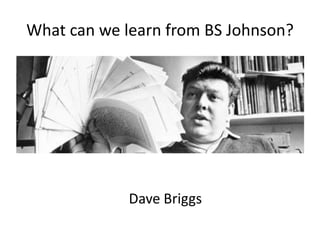
What can we learn from BS Johnson?
Dave Briggs
Aims
• To gain knowledge about
BS Johnson, his life and his
work.
• To practice skills of
assessing different ways of
telling stories and
innovating in the way work
is done.
• To reflect on the attitudes
we have towards our
work, whether we have
fixed ideas about how it is
done and the ways we
could innovate ourselves.
Objectives
• Understand the
concept of a story, and
a novel
• Gain an understanding
of the life and work of
BS Johnson
• To take away ideas on
how Johnson’s
approach to his writing
can help us in our work
What is a novel?
• BS Johnson was a novelist.
• However, he said that “telling stories was
telling lies”.
• He believed that films and TV did made-up
stories much better than novels.
• Therefore, all novels should be based directly
on the author’s real experience.
Discussion exercise
• Think about the books you like to read.
• Which would you call novels?
• Why would you describe them as novels?
• Can you think of a story in a book, that isn’t a
novel?
About BS Johnson
• Born in 1933 in London
• Started work at 16 as a
clerk
• Learned Latin at night
school and went to
university
• Became a teacher, and
then a full time writer
BS Johnson’s work
• His novels were
increasingly
experimental in
terms of form and
typography
• He also wrote
plays, films and
television
programmes
Form
• Form is the way the story is
written. For example:
– Traditional ‘realist’ novel
– Film scripts
– Diaries
– Letters
– Stream of consciousness
– Different perspectives
Typography
• Typography is the way the
story is printed. For
instance:
– Use of fonts
– Size of writing
– Use of white space
– Use of colour
– The shape of the paper
– The way the book is bound
Johnson’s novels
• Travelling People (1963)
• Albert Angelo (1964)
• Trawl (1966)
• The Unfortunates (1969)
• House Mother
Normal (1971)
• Christie Malry's Own
Double-Entry (1973)
• See the Old Lady
Decently (1975)
Discussion exercise
• Look at the worksheet with different stories
listed.
• What form could they be written in?
– Remember, form is the style of writing, such as
letters, diaries or film scripts etc
• What typographical innovations might be
used?
– Remember, typography is things like
fonts, paper, binding and so on
About BS Johnson
• At the age of 40, in
1973, he committed
suicide.
• He didn’t feel he was
achieving the critical
or commercial
success he should
have been.
Summary
• Ultimately, Johnson
failed on his own
terms.
• But we are still
talking about him!
• Also, he tried to do
something
new, didn’t settle for
the accepted
methods.
Final exercise
• Check your
knowledge with the
quiz
• Think about the final
question – what can
we learn from BS
Johnson in our own
lives and practice?
Any final questions?
Dave Briggs
dave@kindofdigitial.com

What can we learn from BS Johnson?

  • 1.
    What can welearn from BS Johnson? Dave Briggs
  • 2.
    Aims • To gainknowledge about BS Johnson, his life and his work. • To practice skills of assessing different ways of telling stories and innovating in the way work is done. • To reflect on the attitudes we have towards our work, whether we have fixed ideas about how it is done and the ways we could innovate ourselves.
  • 3.
    Objectives • Understand the conceptof a story, and a novel • Gain an understanding of the life and work of BS Johnson • To take away ideas on how Johnson’s approach to his writing can help us in our work
  • 4.
    What is anovel? • BS Johnson was a novelist. • However, he said that “telling stories was telling lies”. • He believed that films and TV did made-up stories much better than novels. • Therefore, all novels should be based directly on the author’s real experience.
  • 5.
    Discussion exercise • Thinkabout the books you like to read. • Which would you call novels? • Why would you describe them as novels? • Can you think of a story in a book, that isn’t a novel?
  • 6.
    About BS Johnson •Born in 1933 in London • Started work at 16 as a clerk • Learned Latin at night school and went to university • Became a teacher, and then a full time writer
  • 7.
    BS Johnson’s work •His novels were increasingly experimental in terms of form and typography • He also wrote plays, films and television programmes
  • 8.
    Form • Form isthe way the story is written. For example: – Traditional ‘realist’ novel – Film scripts – Diaries – Letters – Stream of consciousness – Different perspectives Typography • Typography is the way the story is printed. For instance: – Use of fonts – Size of writing – Use of white space – Use of colour – The shape of the paper – The way the book is bound
  • 9.
    Johnson’s novels • TravellingPeople (1963) • Albert Angelo (1964) • Trawl (1966) • The Unfortunates (1969) • House Mother Normal (1971) • Christie Malry's Own Double-Entry (1973) • See the Old Lady Decently (1975)
  • 10.
    Discussion exercise • Lookat the worksheet with different stories listed. • What form could they be written in? – Remember, form is the style of writing, such as letters, diaries or film scripts etc • What typographical innovations might be used? – Remember, typography is things like fonts, paper, binding and so on
  • 11.
    About BS Johnson •At the age of 40, in 1973, he committed suicide. • He didn’t feel he was achieving the critical or commercial success he should have been.
  • 12.
    Summary • Ultimately, Johnson failedon his own terms. • But we are still talking about him! • Also, he tried to do something new, didn’t settle for the accepted methods.
  • 13.
    Final exercise • Checkyour knowledge with the quiz • Think about the final question – what can we learn from BS Johnson in our own lives and practice?
  • 14.
    Any final questions? DaveBriggs dave@kindofdigitial.com