Information literacy in Scotland:
an opportunity for all
Dr John Crawford
Friday 13th February 2015
Atlantic Quay: Glasgow
Information literacy defined
"Information literacy is knowing when
and why you need information, where to
find it, and how to evaluate, use and
communicate it in an ethical manner."
Chartered Institute of Library and
Information Professionals (2004)
What information literacy involves
• A need for information
• The resources available
• How to find information
• The need to evaluate results
• How to work with or exploit results
• Ethics and responsibility of use
• How to communicate or share your findings
• How to manage your findings
A brief history
• Term coined in 1974 by Paul Zurkowski
• Originally made progress in higher and other
areas of education
• Closely linked with independent and lifelong
learning
• Other areas increasingly recognised –
workplace, health, informed political decision
making, digital participation, skills
development and much more
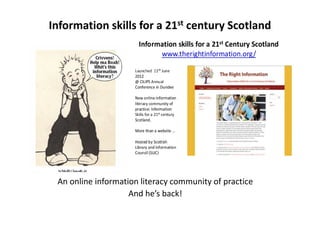
Information skills for a 21st century Scotland
An online information literacy community of practice
And he’s back!
Royal Society of Edinburgh report
Spreading the benefits: vision
• The report ‘vision’ states:
• ‘That everyone in Scotland has the information and
digital skills required to participate in the digital arena
and prosper from digital opportunities.
• That sustainable online and peer support for
continuing learning and development of information
and digital skills throughout all stages of life is in place.
• That information and digital skills are embedded across
the curriculum and from pre-school to tertiary.’
Spreading the benefits: public libraries
The role of public libraries in the digital
inclusion agenda is recognised:
‘As a valuable resource in the drive to full
digital inclusion, libraries must be
supported to maintain and increase their
capacity to provide public access to the
online world’
Spreading the benefits: training
teachers in information literacy
• All Education Faculties within Scottish
universities should include components of
information literacy, digital skills and
computing science in their programmes of
study for all primary and secondary teachers.’
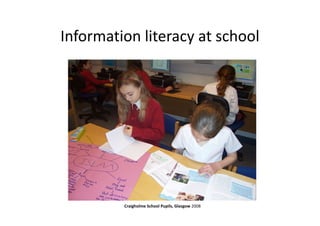
Information literacy at school
Craigholme School Pupils, Glasgow 2008
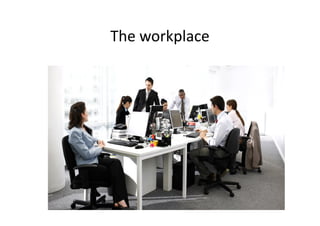
The workplace
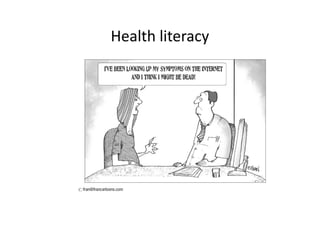
Health literacy
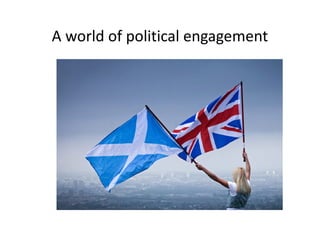
A world of political engagement
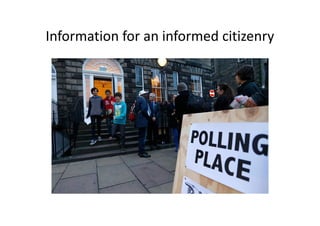
Information for an informed citizenry
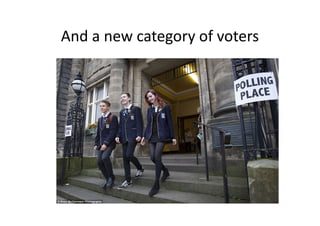
And a new category of voters
The lessons of the Referendum
• A festival of information use – but old
problems resurfaced
• Information literacy no longer a specialist
topic
• The importance of 14-17 year olds. 89% of
those surveyed had consulted key sources of
information on the Referendum :
https://www.aqmen.ac.uk/youngscotsurveyre
sults
The challenge of digital participation
• 22% of the Scottish population are not Internet
users (about 1.3 million)
• UK‘Digital by default’ programme – key services
to be delivered online including social security
benefits
• Scottish Government ‘digital first’ and a devolved
training strategy
• A crisis requiring a response from the information
sector and a devolved training agenda
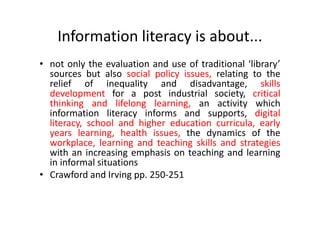
Information literacy is about...
• not only the evaluation and use of traditional ‘library’
sources but also social policy issues, relating to the
relief of inequality and disadvantage, skills
development for a post industrial society, critical
thinking and lifelong learning, an activity which
information literacy informs and supports, digital
literacy, school and higher education curricula, early
years learning, health issues, the dynamics of the
workplace, learning and teaching skills and strategies
with an increasing emphasis on teaching and learning
in informal situations
• Crawford and Irving pp. 250-251
Things we could do
• Understand better what we are all doing
• Identify areas of common interest
• Develop activities in co-operation with each
other, rather than separately
• Be aware of each others R&D activities and try
to work together
• Make information literacy a national activity
Questions? Contact details
John Crawford
johncrawford705@yahoo.co.uk
Chair, Information Skills for a 21st
Century Scotland,
Information skills for a 21st century
Scotland
http://scotinfolit.squarespace.co
m/

John crawford il in scotland

  • 1.
    Information literacy inScotland: an opportunity for all Dr John Crawford Friday 13th February 2015 Atlantic Quay: Glasgow
  • 2.
    Information literacy defined "Informationliteracy is knowing when and why you need information, where to find it, and how to evaluate, use and communicate it in an ethical manner." Chartered Institute of Library and Information Professionals (2004)
  • 3.
    What information literacyinvolves • A need for information • The resources available • How to find information • The need to evaluate results • How to work with or exploit results • Ethics and responsibility of use • How to communicate or share your findings • How to manage your findings
  • 4.
    A brief history •Term coined in 1974 by Paul Zurkowski • Originally made progress in higher and other areas of education • Closely linked with independent and lifelong learning • Other areas increasingly recognised – workplace, health, informed political decision making, digital participation, skills development and much more
  • 5.
    Information skills fora 21st century Scotland An online information literacy community of practice And he’s back!
  • 6.
    Royal Society ofEdinburgh report
  • 7.
    Spreading the benefits:vision • The report ‘vision’ states: • ‘That everyone in Scotland has the information and digital skills required to participate in the digital arena and prosper from digital opportunities. • That sustainable online and peer support for continuing learning and development of information and digital skills throughout all stages of life is in place. • That information and digital skills are embedded across the curriculum and from pre-school to tertiary.’
  • 8.
    Spreading the benefits:public libraries The role of public libraries in the digital inclusion agenda is recognised: ‘As a valuable resource in the drive to full digital inclusion, libraries must be supported to maintain and increase their capacity to provide public access to the online world’
  • 9.
    Spreading the benefits:training teachers in information literacy • All Education Faculties within Scottish universities should include components of information literacy, digital skills and computing science in their programmes of study for all primary and secondary teachers.’
  • 10.
    Information literacy atschool Craigholme School Pupils, Glasgow 2008
  • 11.
  • 12.
  • 13.
    A world ofpolitical engagement
  • 14.
    Information for aninformed citizenry
  • 15.
    And a newcategory of voters
  • 16.
    The lessons ofthe Referendum • A festival of information use – but old problems resurfaced • Information literacy no longer a specialist topic • The importance of 14-17 year olds. 89% of those surveyed had consulted key sources of information on the Referendum : https://www.aqmen.ac.uk/youngscotsurveyre sults
  • 17.
    The challenge ofdigital participation • 22% of the Scottish population are not Internet users (about 1.3 million) • UK‘Digital by default’ programme – key services to be delivered online including social security benefits • Scottish Government ‘digital first’ and a devolved training strategy • A crisis requiring a response from the information sector and a devolved training agenda
  • 18.
    Information literacy isabout... • not only the evaluation and use of traditional ‘library’ sources but also social policy issues, relating to the relief of inequality and disadvantage, skills development for a post industrial society, critical thinking and lifelong learning, an activity which information literacy informs and supports, digital literacy, school and higher education curricula, early years learning, health issues, the dynamics of the workplace, learning and teaching skills and strategies with an increasing emphasis on teaching and learning in informal situations • Crawford and Irving pp. 250-251
  • 19.
    Things we coulddo • Understand better what we are all doing • Identify areas of common interest • Develop activities in co-operation with each other, rather than separately • Be aware of each others R&D activities and try to work together • Make information literacy a national activity
  • 20.
    Questions? Contact details JohnCrawford johncrawford705@yahoo.co.uk Chair, Information Skills for a 21st Century Scotland, Information skills for a 21st century Scotland http://scotinfolit.squarespace.co m/