Information Literacy in
Scotland: Challenges and
Opportunities
HILARY.WEIR@SQA.ORG.UKHILARY.WEIR@SQA.ORG.UKHILARY.WEIR@SQA.ORG.UKHILARY.WEIR@SQA.ORG.UK @@@@hilarydigitalhilarydigitalhilarydigitalhilarydigital
DIGITAL LITERACY & ENGAGEMENT MANAGER, SQADIGITAL LITERACY & ENGAGEMENT MANAGER, SQADIGITAL LITERACY & ENGAGEMENT MANAGER, SQADIGITAL LITERACY & ENGAGEMENT MANAGER, SQA
FEBRUARY 2015FEBRUARY 2015FEBRUARY 2015FEBRUARY 2015
SQA & Digital Participation
Digital Participation Charter
Learn the right skills
Opportunity to become digitally fluent
Encourage mentoring and volunteering programmes
Contribute and share resources
Develop qualifications and training
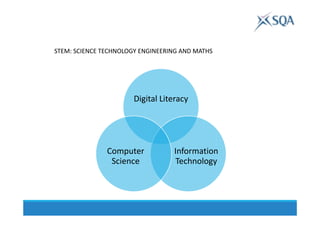
Digital Literacy
Information
Technology
Computer
Science
STEM: SCIENCE TECHNOLOGY ENGINEERING AND MATHS
NPA in Digital Passport
Qualification
Design Team
Consultation
Validation
Digital Participation: A National Framework for
Local Action
Spreading the Benefits of Digital Participation
Digital Participation Charter
Cross Party Group in the Scottish Parliament on
Digital Participation
Education Working for All (Wood report)
Digital Scotland Inquiry – CILIPS response
Development process
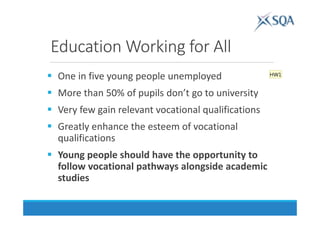
Education Working for All
One in five young people unemployed
More than 50% of pupils don’t go to university
Very few gain relevant vocational qualifications
Greatly enhance the esteem of vocational
qualifications
Young people should have the opportunity to
follow vocational pathways alongside academic
studies
HW1
Slide 5
HW1 Make more relevant to Info Lit agenda - use quote from CILIPs or SG Literacy Action plan/RSE Spreading the benefits of Dig Participation Critival
review of Impact of School libraries
Hilary Weir, 06/02/2015
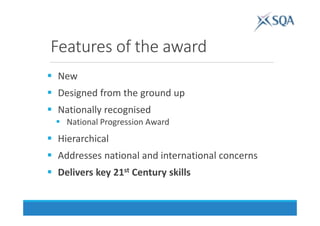
Features of the award
New
Designed from the ground up
Nationally recognised
National Progression Award
Hierarchical
Addresses national and international concerns
Delivers key 21st Century skills
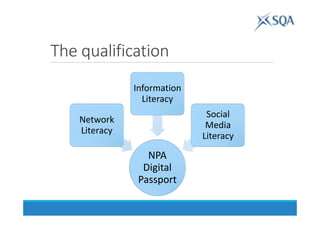
The qualification
NPA
Digital
Passport
Network
Literacy
Information
Literacy
Social
Media
Literacy
Digital Passport
SCQF 4
• Information
Literacy (4)
• Network
Literacy (4)
• Social Media
Literacy (4)
Digital Passport
SCQF 5
• Information
Literacy (5)
• Network
Literacy (5)
• Social Media
Literacy (5)
Digital Passport
SCQF 6
• Information
Literacy (6)
• Network
Literacy (6)
• Social Media
Literacy (6)
SCQF Level 4 SCQF Level 5 SCQF Level 6
1. Describe network
systems.
2. Connect to a
network.
3. Use network
resources.
1. Explain the function
of network systems
and network devices.
2. Set-up a network
connection.
3. Communicate and
contribute using
network systems.
1. Select network
devices.
2. Secure a network.
3. Collaborate using a
network system.
Network Literacy
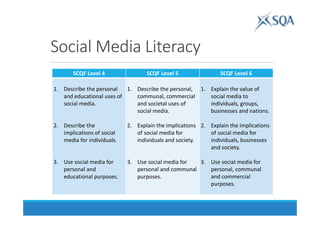
Social Media Literacy
SCQF Level 4 SCQF Level 5 SCQF Level 6
1. Describe the personal
and educational uses of
social media.
2. Describe the
implications of social
media for individuals.
3. Use social media for
personal and
educational purposes.
1. Describe the personal,
communal, commercial
and societal uses of
social media.
2. Explain the implications
of social media for
individuals and society.
3. Use social media for
personal and communal
purposes.
1. Explain the value of
social media to
individuals, groups,
businesses and nations.
2. Explain the implications
of social media for
individuals, businesses
and society.
3. Use social media for
personal, communal
and commercial
purposes.
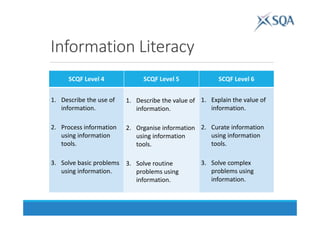
Information Literacy
SCQF Level 4 SCQF Level 5 SCQF Level 6
1. Describe the use of
information.
2. Process information
using information
tools.
3. Solve basic problems
using information.
1. Describe the value of
information.
2. Organise information
using information
tools.
3. Solve routine
problems using
information.
1. Explain the value of
information.
2. Curate information
using information
tools.
3. Solve complex
problems using
information.
Outcomes
• Describe network
systems
• Connect to a network
• Use network resources
Contents
• Growth of networks
• Common uses
• Operating principles
• Hardware and software
components
• Online safety
• Security
• Using networks
• Netiquette
Evidence
• Test and checklist
OR
• Portfolio
Outcomes
• Explain function of network
systems
• Set-up a network
connection
• Communicate using
network systems
Contents
• Growth of networks
• Value of networks
• Hardware and software
components
• Setting up a network
• Configuring a network
connection
• Online safety
• Security
• Personal Learning Networks
Evidence
• Test and checklist
OR
• Portfolio
Outcomes
• Select network devices
• Secure a network
• Collaborate using a network
Contents
• Selecting network devices
• Network performance
• Network threats
• Securing networks
• Current and future growth
of networks
• Collaborating using
networks
• Learning using networks
• Network ethics
Evidence
• Test and checklist
OR
• Portfolio
Outcomes
• Describe the use of
information
• Process information
• Solve basic problems
using information
Contents
• Data and information
• Growth of information
• Use of information
• Rights and
responsibilities
• Sources of information
• Authority
• Selecting sources
• Using information tools
Evidence
• Test and checklist
OR
• Portfolio
Outcomes
• Describe the value of
information
• Organise information
• Solve routine problems
using information
Contents
• Growth of information
• Value of information
• Rights and
responsibilities
• Common sources
• Authority
• Selecting information
• Evaluating information
Evidence
• Test and checklist
OR
• Portfolio
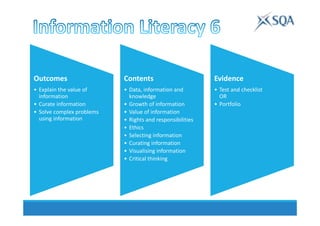
Outcomes
• Explain the value of
information
• Curate information
• Solve complex problems
using information
Contents
• Data, information and
knowledge
• Growth of information
• Value of information
• Rights and responsibilities
• Ethics
• Selecting information
• Curating information
• Visualising information
• Critical thinking
Evidence
• Test and checklist
OR
• Portfolio
Outcomes
• Describe the uses of social
media
• Describe the implications
of social media
• Use social media
Contents
• Milestones in social media
• Types of social media
• Use of social media
• Rights and responsibilities
• Social presence
• Potential dangers
• Attention literacy
• Using social media
Evidence
• Test and checklist
OR
• Activity log
Outcomes
•Describe the uses of social
media
•Describe the implications of
social media
•Use social media
Contents
•Historical development of
social media
•Types of social media
•Social intelligence
•Use of social media
•Rights and responsibilities
•Social presence
•Potential dangers
•Societal issues
•Attention literacy
•Social production
Evidence
•Investigation of contemporary
issue surrounding social media
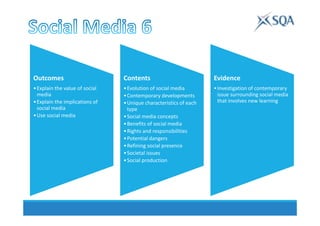
Outcomes
•Explain the value of social
media
•Explain the implications of
social media
•Use social media
Contents
•Evolution of social media
•Contemporary developments
•Unique characteristics of each
type
•Social media concepts
•Benefits of social media
•Rights and responsibilities
•Potential dangers
•Refining social presence
•Societal issues
•Social production
Evidence
•Investigation of contemporary
issue surrounding social media
that involves new learning
Support Materials
Assessment Support Pack for every Unit
SOLAR assessments (www.sqasolar.org.uk)
Online and offline resources mapped to
individual Outcomes and Performance Criteria
Practical activities/guides
SQA Unit search facility
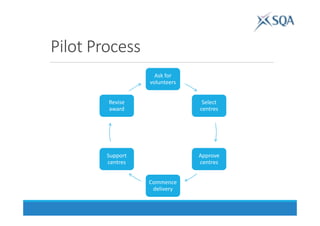
Pilot Process
Ask for
volunteers
Select
centres
Approve
centres
Commence
delivery
Support
centres
Revise
award
Working with SQA
Review of NPA in Digital Literacy
Join Qualification Design Team
Write Units and support materials
Be part of consultation process
Provide feedback
Validate award
Hilary weir sqa

Hilary weir sqa

  • 1.
    Information Literacy in Scotland:Challenges and Opportunities HILARY.WEIR@SQA.ORG.UKHILARY.WEIR@SQA.ORG.UKHILARY.WEIR@SQA.ORG.UKHILARY.WEIR@SQA.ORG.UK @@@@hilarydigitalhilarydigitalhilarydigitalhilarydigital DIGITAL LITERACY & ENGAGEMENT MANAGER, SQADIGITAL LITERACY & ENGAGEMENT MANAGER, SQADIGITAL LITERACY & ENGAGEMENT MANAGER, SQADIGITAL LITERACY & ENGAGEMENT MANAGER, SQA FEBRUARY 2015FEBRUARY 2015FEBRUARY 2015FEBRUARY 2015
  • 2.
    SQA & DigitalParticipation Digital Participation Charter Learn the right skills Opportunity to become digitally fluent Encourage mentoring and volunteering programmes Contribute and share resources Develop qualifications and training
  • 3.
  • 4.
    NPA in DigitalPassport Qualification Design Team Consultation Validation Digital Participation: A National Framework for Local Action Spreading the Benefits of Digital Participation Digital Participation Charter Cross Party Group in the Scottish Parliament on Digital Participation Education Working for All (Wood report) Digital Scotland Inquiry – CILIPS response Development process
  • 5.
    Education Working forAll One in five young people unemployed More than 50% of pupils don’t go to university Very few gain relevant vocational qualifications Greatly enhance the esteem of vocational qualifications Young people should have the opportunity to follow vocational pathways alongside academic studies HW1
  • 6.
    Slide 5 HW1 Makemore relevant to Info Lit agenda - use quote from CILIPs or SG Literacy Action plan/RSE Spreading the benefits of Dig Participation Critival review of Impact of School libraries Hilary Weir, 06/02/2015
  • 7.
    Features of theaward New Designed from the ground up Nationally recognised National Progression Award Hierarchical Addresses national and international concerns Delivers key 21st Century skills
  • 8.
  • 9.
    Digital Passport SCQF 4 •Information Literacy (4) • Network Literacy (4) • Social Media Literacy (4) Digital Passport SCQF 5 • Information Literacy (5) • Network Literacy (5) • Social Media Literacy (5) Digital Passport SCQF 6 • Information Literacy (6) • Network Literacy (6) • Social Media Literacy (6)
  • 10.
    SCQF Level 4SCQF Level 5 SCQF Level 6 1. Describe network systems. 2. Connect to a network. 3. Use network resources. 1. Explain the function of network systems and network devices. 2. Set-up a network connection. 3. Communicate and contribute using network systems. 1. Select network devices. 2. Secure a network. 3. Collaborate using a network system. Network Literacy
  • 11.
    Social Media Literacy SCQFLevel 4 SCQF Level 5 SCQF Level 6 1. Describe the personal and educational uses of social media. 2. Describe the implications of social media for individuals. 3. Use social media for personal and educational purposes. 1. Describe the personal, communal, commercial and societal uses of social media. 2. Explain the implications of social media for individuals and society. 3. Use social media for personal and communal purposes. 1. Explain the value of social media to individuals, groups, businesses and nations. 2. Explain the implications of social media for individuals, businesses and society. 3. Use social media for personal, communal and commercial purposes.
  • 12.
    Information Literacy SCQF Level4 SCQF Level 5 SCQF Level 6 1. Describe the use of information. 2. Process information using information tools. 3. Solve basic problems using information. 1. Describe the value of information. 2. Organise information using information tools. 3. Solve routine problems using information. 1. Explain the value of information. 2. Curate information using information tools. 3. Solve complex problems using information.
  • 14.
    Outcomes • Describe network systems •Connect to a network • Use network resources Contents • Growth of networks • Common uses • Operating principles • Hardware and software components • Online safety • Security • Using networks • Netiquette Evidence • Test and checklist OR • Portfolio
  • 15.
    Outcomes • Explain functionof network systems • Set-up a network connection • Communicate using network systems Contents • Growth of networks • Value of networks • Hardware and software components • Setting up a network • Configuring a network connection • Online safety • Security • Personal Learning Networks Evidence • Test and checklist OR • Portfolio
  • 16.
    Outcomes • Select networkdevices • Secure a network • Collaborate using a network Contents • Selecting network devices • Network performance • Network threats • Securing networks • Current and future growth of networks • Collaborating using networks • Learning using networks • Network ethics Evidence • Test and checklist OR • Portfolio
  • 17.
    Outcomes • Describe theuse of information • Process information • Solve basic problems using information Contents • Data and information • Growth of information • Use of information • Rights and responsibilities • Sources of information • Authority • Selecting sources • Using information tools Evidence • Test and checklist OR • Portfolio
  • 18.
    Outcomes • Describe thevalue of information • Organise information • Solve routine problems using information Contents • Growth of information • Value of information • Rights and responsibilities • Common sources • Authority • Selecting information • Evaluating information Evidence • Test and checklist OR • Portfolio
  • 19.
    Outcomes • Explain thevalue of information • Curate information • Solve complex problems using information Contents • Data, information and knowledge • Growth of information • Value of information • Rights and responsibilities • Ethics • Selecting information • Curating information • Visualising information • Critical thinking Evidence • Test and checklist OR • Portfolio
  • 20.
    Outcomes • Describe theuses of social media • Describe the implications of social media • Use social media Contents • Milestones in social media • Types of social media • Use of social media • Rights and responsibilities • Social presence • Potential dangers • Attention literacy • Using social media Evidence • Test and checklist OR • Activity log
  • 21.
    Outcomes •Describe the usesof social media •Describe the implications of social media •Use social media Contents •Historical development of social media •Types of social media •Social intelligence •Use of social media •Rights and responsibilities •Social presence •Potential dangers •Societal issues •Attention literacy •Social production Evidence •Investigation of contemporary issue surrounding social media
  • 22.
    Outcomes •Explain the valueof social media •Explain the implications of social media •Use social media Contents •Evolution of social media •Contemporary developments •Unique characteristics of each type •Social media concepts •Benefits of social media •Rights and responsibilities •Potential dangers •Refining social presence •Societal issues •Social production Evidence •Investigation of contemporary issue surrounding social media that involves new learning
  • 23.
    Support Materials Assessment SupportPack for every Unit SOLAR assessments (www.sqasolar.org.uk) Online and offline resources mapped to individual Outcomes and Performance Criteria Practical activities/guides SQA Unit search facility
  • 24.
  • 25.
    Working with SQA Reviewof NPA in Digital Literacy Join Qualification Design Team Write Units and support materials Be part of consultation process Provide feedback Validate award