In what ways does your media
 product use, develop or challenge
forms and conventions of real media
            products?
• Camera shots, angles and edits: Having
  learned and researched different shots, angles
  and edits, I was made aware of when different
  shots, angles and edits were going to be
  appropriate.
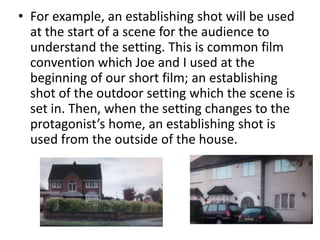
• For example, an establishing shot will be used
  at the start of a scene for the audience to
  understand the setting. This is common film
  convention which Joe and I used at the
  beginning of our short film; an establishing
  shot of the outdoor setting which the scene is
  set in. Then, when the setting changes to the
  protagonist’s home, an establishing shot is
  used from the outside of the house.
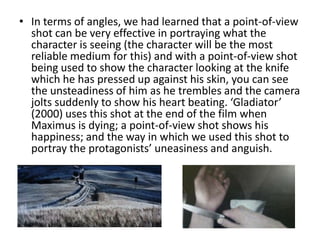
• In terms of angles, we had learned that a point-of-view
  shot can be very effective in portraying what the
  character is seeing (the character will be the most
  reliable medium for this) and with a point-of-view shot
  being used to show the character looking at the knife
  which he has pressed up against his skin, you can see
  the unsteadiness of him as he trembles and the camera
  jolts suddenly to show his heart beating. ‘Gladiator’
  (2000) uses this shot at the end of the film when
  Maximus is dying; a point-of-view shot shows his
  happiness; and the way in which we used this shot to
  portray the protagonists’ uneasiness and anguish.
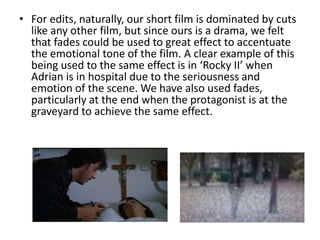
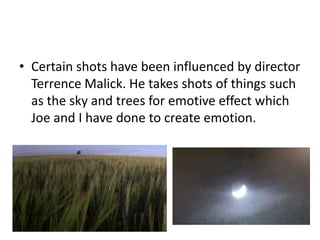
• For edits, naturally, our short film is dominated by cuts
  like any other film, but since ours is a drama, we felt
  that fades could be used to great effect to accentuate
  the emotional tone of the film. A clear example of this
  being used to the same effect is in ‘Rocky II’ when
  Adrian is in hospital due to the seriousness and
  emotion of the scene. We have also used fades,
  particularly at the end when the protagonist is at the
  graveyard to achieve the same effect.
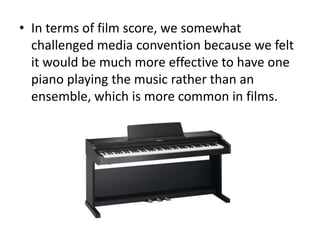
• Certain shots have been influenced by director
  Terrence Malick. He takes shots of things such
  as the sky and trees for emotive effect which
  Joe and I have done to create emotion.
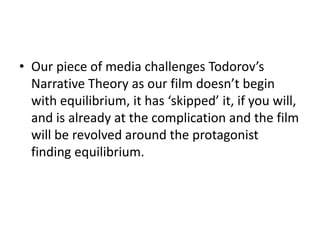
• In terms of film score, we somewhat
  challenged media convention because we felt
  it would be much more effective to have one
  piano playing the music rather than an
  ensemble, which is more common in films.
• Our piece of media challenges Todorov’s
  Narrative Theory as our film doesn’t begin
  with equilibrium, it has ‘skipped’ it, if you will,
  and is already at the complication and the film
  will be revolved around the protagonist
  finding equilibrium.
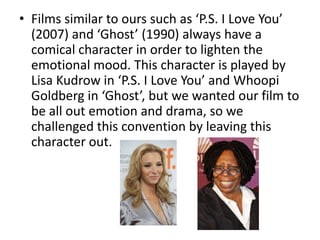
• Films similar to ours such as ‘P.S. I Love You’
  (2007) and ‘Ghost’ (1990) always have a
  comical character in order to lighten the
  emotional mood. This character is played by
  Lisa Kudrow in ‘P.S. I Love You’ and Whoopi
  Goldberg in ‘Ghost’, but we wanted our film to
  be all out emotion and drama, so we
  challenged this convention by leaving this
  character out.
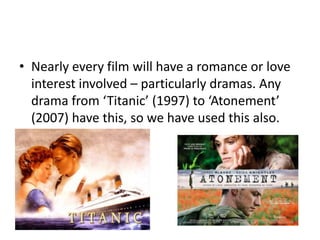
• Nearly every film will have a romance or love
  interest involved – particularly dramas. Any
  drama from ‘Titanic’ (1997) to ‘Atonement’
  (2007) have this, so we have used this also.
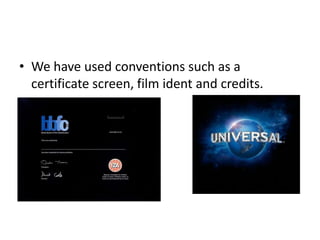
• We have used conventions such as a
  certificate screen, film ident and credits.
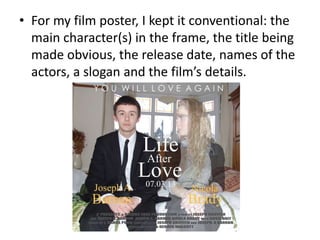
• For my film poster, I kept it conventional: the
  main character(s) in the frame, the title being
  made obvious, the release date, names of the
  actors, a slogan and the film’s details.
• Moreover, the review was also kept conventional.
  These conventions are that they always come
  across as somewhat informal and lighthearted
  with a touch of humor; so when writing it I tried
  to achieve this as best as I could with the ending
  summing everything up in a witty way.

  Furthermore, it is set out conventionally with
  common review elements such as a ‘did you
  know’ and a picture from the film.
• It is a conventional short film as it simply
  revolves around one key event like ‘Paper
  Hearts’ which is a short film I studied at the
  beginning of the year.

Joe b eval 1

  • 1.
    In what waysdoes your media product use, develop or challenge forms and conventions of real media products?
  • 2.
    • Camera shots,angles and edits: Having learned and researched different shots, angles and edits, I was made aware of when different shots, angles and edits were going to be appropriate.
  • 3.
    • For example,an establishing shot will be used at the start of a scene for the audience to understand the setting. This is common film convention which Joe and I used at the beginning of our short film; an establishing shot of the outdoor setting which the scene is set in. Then, when the setting changes to the protagonist’s home, an establishing shot is used from the outside of the house.
  • 4.
    • In termsof angles, we had learned that a point-of-view shot can be very effective in portraying what the character is seeing (the character will be the most reliable medium for this) and with a point-of-view shot being used to show the character looking at the knife which he has pressed up against his skin, you can see the unsteadiness of him as he trembles and the camera jolts suddenly to show his heart beating. ‘Gladiator’ (2000) uses this shot at the end of the film when Maximus is dying; a point-of-view shot shows his happiness; and the way in which we used this shot to portray the protagonists’ uneasiness and anguish.
  • 5.
    • For edits,naturally, our short film is dominated by cuts like any other film, but since ours is a drama, we felt that fades could be used to great effect to accentuate the emotional tone of the film. A clear example of this being used to the same effect is in ‘Rocky II’ when Adrian is in hospital due to the seriousness and emotion of the scene. We have also used fades, particularly at the end when the protagonist is at the graveyard to achieve the same effect.
  • 6.
    • Certain shotshave been influenced by director Terrence Malick. He takes shots of things such as the sky and trees for emotive effect which Joe and I have done to create emotion.
  • 7.
    • In termsof film score, we somewhat challenged media convention because we felt it would be much more effective to have one piano playing the music rather than an ensemble, which is more common in films.
  • 8.
    • Our pieceof media challenges Todorov’s Narrative Theory as our film doesn’t begin with equilibrium, it has ‘skipped’ it, if you will, and is already at the complication and the film will be revolved around the protagonist finding equilibrium.
  • 9.
    • Films similarto ours such as ‘P.S. I Love You’ (2007) and ‘Ghost’ (1990) always have a comical character in order to lighten the emotional mood. This character is played by Lisa Kudrow in ‘P.S. I Love You’ and Whoopi Goldberg in ‘Ghost’, but we wanted our film to be all out emotion and drama, so we challenged this convention by leaving this character out.
  • 10.
    • Nearly everyfilm will have a romance or love interest involved – particularly dramas. Any drama from ‘Titanic’ (1997) to ‘Atonement’ (2007) have this, so we have used this also.
  • 11.
    • We haveused conventions such as a certificate screen, film ident and credits.
  • 12.
    • For myfilm poster, I kept it conventional: the main character(s) in the frame, the title being made obvious, the release date, names of the actors, a slogan and the film’s details.
  • 13.
    • Moreover, thereview was also kept conventional. These conventions are that they always come across as somewhat informal and lighthearted with a touch of humor; so when writing it I tried to achieve this as best as I could with the ending summing everything up in a witty way. Furthermore, it is set out conventionally with common review elements such as a ‘did you know’ and a picture from the film.
  • 14.
    • It isa conventional short film as it simply revolves around one key event like ‘Paper Hearts’ which is a short film I studied at the beginning of the year.