Job Trends Using
Data Analytics
PRESENTED BY:
GOURAV ANVEKAR
RANJAN MELANTA
KUNAL SAVLANI
Agenda
 Introduction
 BI Tools/Techniques Used
 Data Normalization
 Analysis
 Comparison
 Business Value
 Conclusion
Introduction
Introduction
 The dataset is based on job market metrics like
salaries, job industries, occupation, countries etc.
 Contains historical data from year 1983 to 1999
 Contains wage data of 132 countries
 Data source EconomicsWebInstitute.org
Dataset Snapshot
BI Tools/Techniques Used
 Tableau
 Microsoft Excel Pivot table
 Google Data Visualization API
Data Normalization
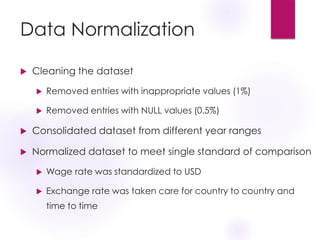
 Cleaning the dataset
 Removed entries with inappropriate values (1%)
 Removed entries with NULL values (0.5%)
 Consolidated dataset from different year ranges
 Normalized dataset to meet single standard of comparison
 Wage rate was standardized to USD
 Exchange rate was taken care for country to country and
time to time
Analysis
Average Wages Vs Country
Average Wages Vs Year
Average Wages Vs Occupation
0.00
500.00
1000.00
1500.00
2000.00
2500.00
3000.00
Airtransportpilot
Governmentexecutive…
Accountant
Dentist(general)
Governmentexecutive…
Journalist
Electronicsdraughtsman
Technicaleducation…
Supervisororgeneral…
Miner
Metalmelter
Roadtransportservices…
Ship'ssteward(passenger)
Constructionalsteelerector
Buildingelectrician
Benchmoulder(metal)
Electricpowerlineman
Butcher
Postofficecounterclerk
Forestsupervisor
Deep-seafisherman
Quarryman
Grainmiller
Telephoneswitchboard…
Aircraftaccidentfire-fighter
Urbanmotortruckdriver
Ambulancedriver
Cook
Sawmillsawyer
Labourer
Logger
Furnitureupholsterer
Fieldcropfarmworker
Sewing-machineoperator
Plantationsupervisor
Average Wage Vs Occupation
Comparison
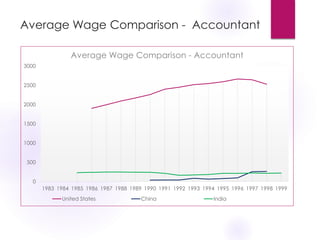
Average Wage Comparison
Average Wage Comparison - Accountant
0
500
1000
1500
2000
2500
3000
1983 1984 1985 1986 1987 1988 1989 1990 1991 1992 1993 1994 1995 1996 1997 1998 1999
Average Wage Comparison - Accountant
United States China India
Data Visualization
Conclusion
Business Value
 The analysis can be used by
 Job boards like glassdoor, LinkedIn etc. to recommend
potential employers to candidates based on their profile and
the job industries
 University career services department to help students target
specific occupation by considering average salary metrics by
locations, growing trends etc.
 This analysis can further be extended to make future
predictions in job trends
Conclusion
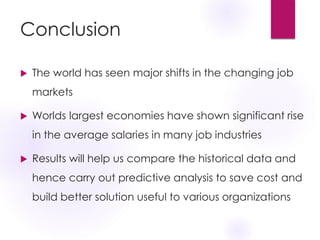
 The world has seen major shifts in the changing job
markets
 Worlds largest economies have shown significant rise
in the average salaries in many job industries
 Results will help us compare the historical data and
hence carry out predictive analysis to save cost and
build better solution useful to various organizations
Questions
Thank you

Job Trends Presentation

  • 1.
    Job Trends Using DataAnalytics PRESENTED BY: GOURAV ANVEKAR RANJAN MELANTA KUNAL SAVLANI
  • 2.
    Agenda  Introduction  BITools/Techniques Used  Data Normalization  Analysis  Comparison  Business Value  Conclusion
  • 3.
  • 4.
    Introduction  The datasetis based on job market metrics like salaries, job industries, occupation, countries etc.  Contains historical data from year 1983 to 1999  Contains wage data of 132 countries  Data source EconomicsWebInstitute.org
  • 5.
  • 6.
    BI Tools/Techniques Used Tableau  Microsoft Excel Pivot table  Google Data Visualization API
  • 7.
    Data Normalization  Cleaningthe dataset  Removed entries with inappropriate values (1%)  Removed entries with NULL values (0.5%)  Consolidated dataset from different year ranges  Normalized dataset to meet single standard of comparison  Wage rate was standardized to USD  Exchange rate was taken care for country to country and time to time
  • 8.
  • 9.
  • 10.
  • 11.
  • 12.
    Average Wages VsOccupation 0.00 500.00 1000.00 1500.00 2000.00 2500.00 3000.00 Airtransportpilot Governmentexecutive… Accountant Dentist(general) Governmentexecutive… Journalist Electronicsdraughtsman Technicaleducation… Supervisororgeneral… Miner Metalmelter Roadtransportservices… Ship'ssteward(passenger) Constructionalsteelerector Buildingelectrician Benchmoulder(metal) Electricpowerlineman Butcher Postofficecounterclerk Forestsupervisor Deep-seafisherman Quarryman Grainmiller Telephoneswitchboard… Aircraftaccidentfire-fighter Urbanmotortruckdriver Ambulancedriver Cook Sawmillsawyer Labourer Logger Furnitureupholsterer Fieldcropfarmworker Sewing-machineoperator Plantationsupervisor Average Wage Vs Occupation
  • 13.
  • 14.
  • 15.
    Average Wage Comparison- Accountant 0 500 1000 1500 2000 2500 3000 1983 1984 1985 1986 1987 1988 1989 1990 1991 1992 1993 1994 1995 1996 1997 1998 1999 Average Wage Comparison - Accountant United States China India
  • 16.
  • 17.
  • 18.
    Business Value  Theanalysis can be used by  Job boards like glassdoor, LinkedIn etc. to recommend potential employers to candidates based on their profile and the job industries  University career services department to help students target specific occupation by considering average salary metrics by locations, growing trends etc.  This analysis can further be extended to make future predictions in job trends
  • 19.
    Conclusion  The worldhas seen major shifts in the changing job markets  Worlds largest economies have shown significant rise in the average salaries in many job industries  Results will help us compare the historical data and hence carry out predictive analysis to save cost and build better solution useful to various organizations
  • 20.
  • 21.