JOB SEARCH STRATEGIES
A practical guide to identifying and getting job
opportunities
Presented by Patrick Kabajjo
Developed by:
Marketplace for Information and Services Ltd.
Course objectives
In this course you will learn:
• How to market yourself before potential
employers and within your network
• How to set parameters for your search
• How to effectively use a range of strategies
for job searching
• How to track your job search efforts
Target audience
Are your job search efforts futile?
Or are you;
• Fresh out of school?
• Unemployed?
• Looking to change jobs?
Course summary
By the end of this course, you will be able to:
1.Identify preferred jobs
2.Look for the right support in your search
3.Confidently pursue job opportunities with
potential employers
Overview of the course
• Section 1
– Lecture 1: Introduction, common challenges
in job search process
– Lecture 2: Important tools for your search
• Section 2
– Lecture 3: Factors which will guide your
search
• Section 3
– Lecture 4: Job search strategies
– Lecture 5: Tracking your efforts
Course requirements
• A computer that:
connects to the internet and
has Microsoft PowerPoint
• Prerequisite knowledge on how to write a
Curriculum Vitae (CV)
Course delivery methods
• Audio over PowerPoint presentation
• Screen casts of sample resources
• Tools & links under supplementary
materials
• Activities/assignments after each lecture
LECTURE 1: Course Introduction
Lecture Outline;
1.Realities and challenges faced by job
seekers
2. Assessment of your current strategies
Learning outcomes
After this lecture you will be:
1.More aware of the challenges ahead of you.
2.Able to identify and assess the effectiveness
of strategies you already know or have used.
Realities in the job market
The power relations between you (the job
seeker) and potential employer may seem
skewed
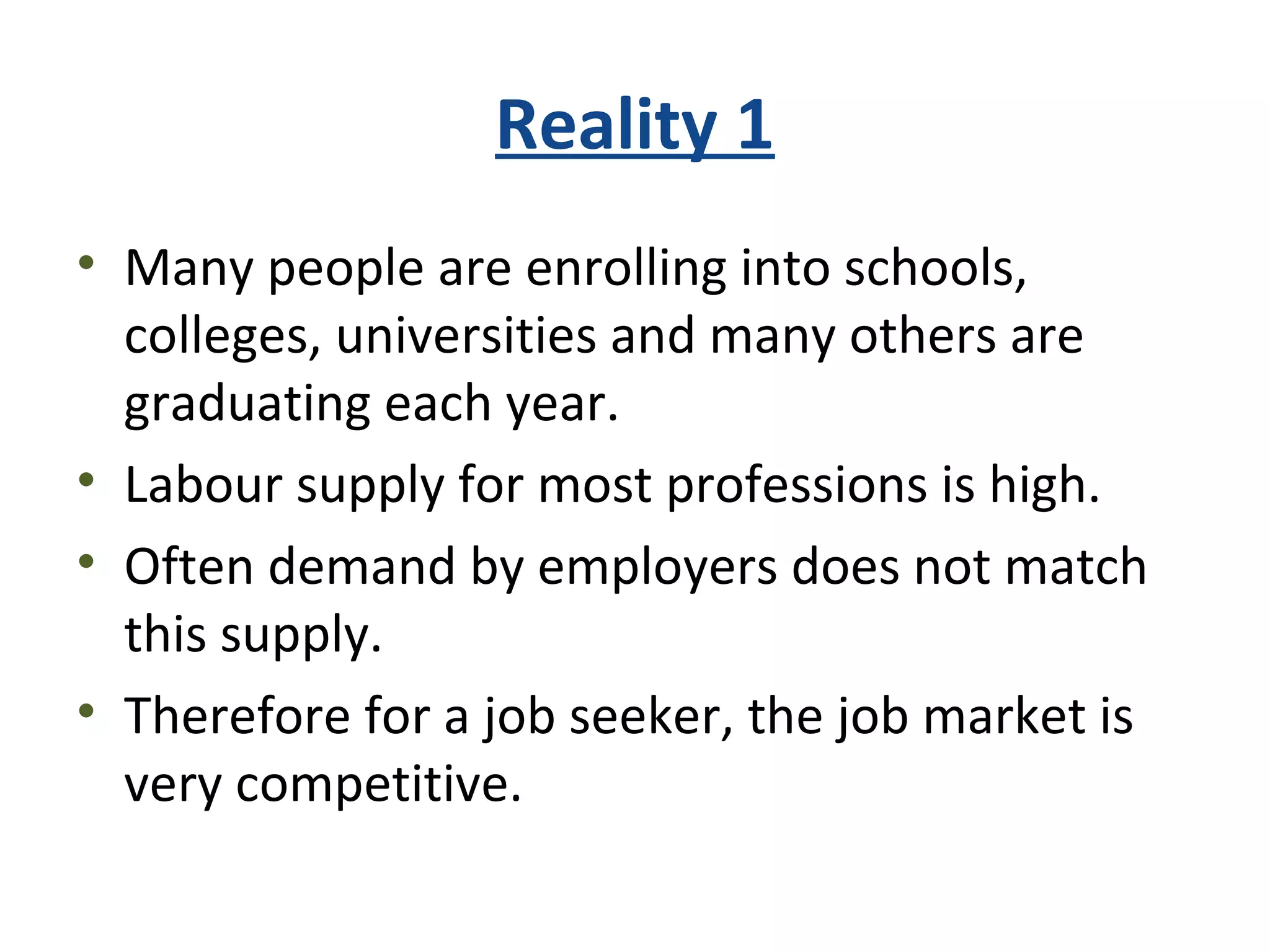
Reality 1
• Many people are enrolling into schools,
colleges, universities and many others are
graduating each year.
• Labour supply for most professions is high.
• Often demand by employers does not match
this supply.
• Therefore for a job seeker, the job market is
very competitive.
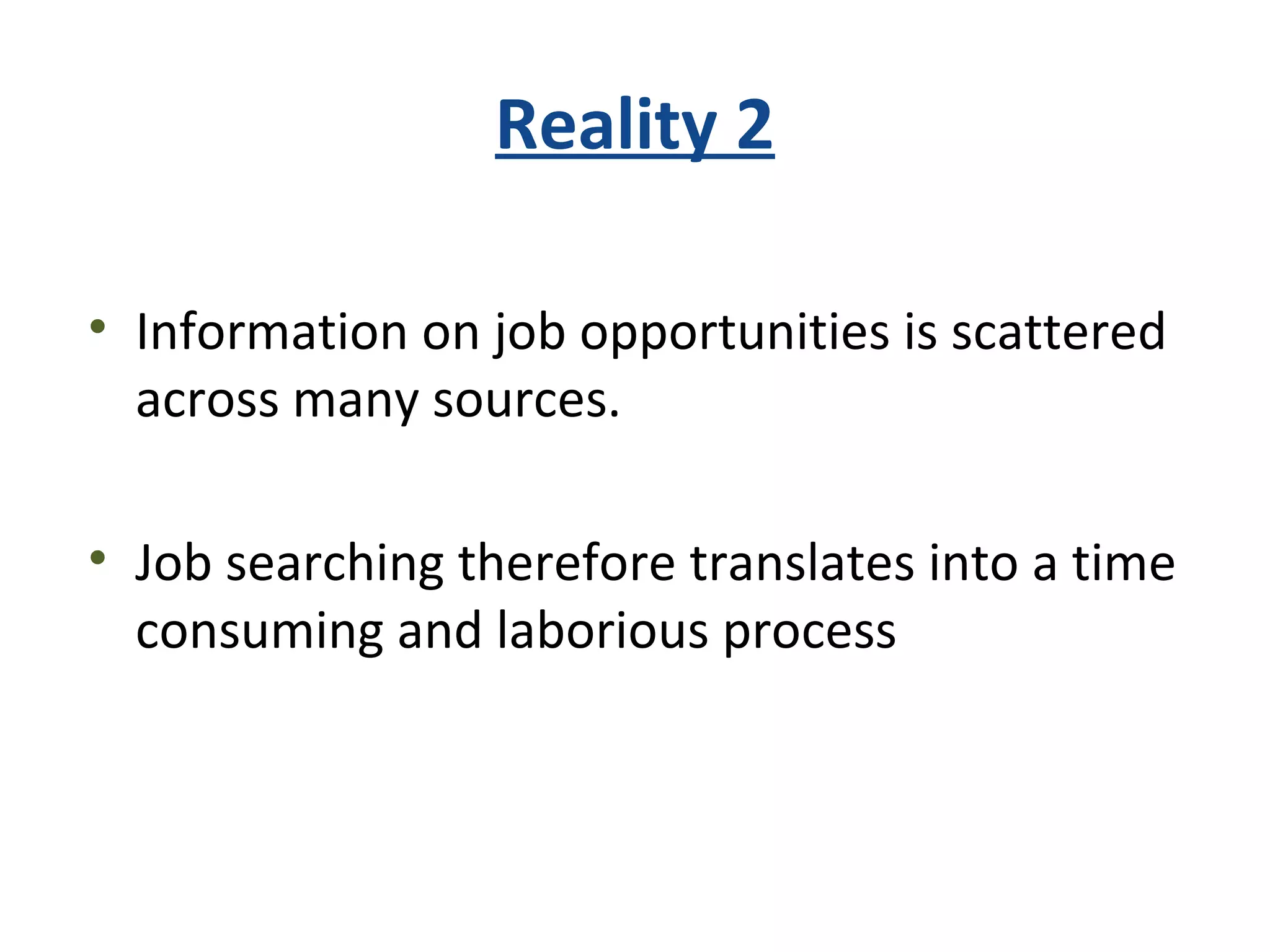
Reality 2
• Information on job opportunities is scattered
across many sources.
• Job searching therefore translates into a time
consuming and laborious process
Reality 3
• Whenever they can, employers will look for
the most suitable job candidates using search
and hiring processes that are:
Most affordable
Least time consuming
• Job seekers often rely on publicly available
job related information
Reality 3 continued:
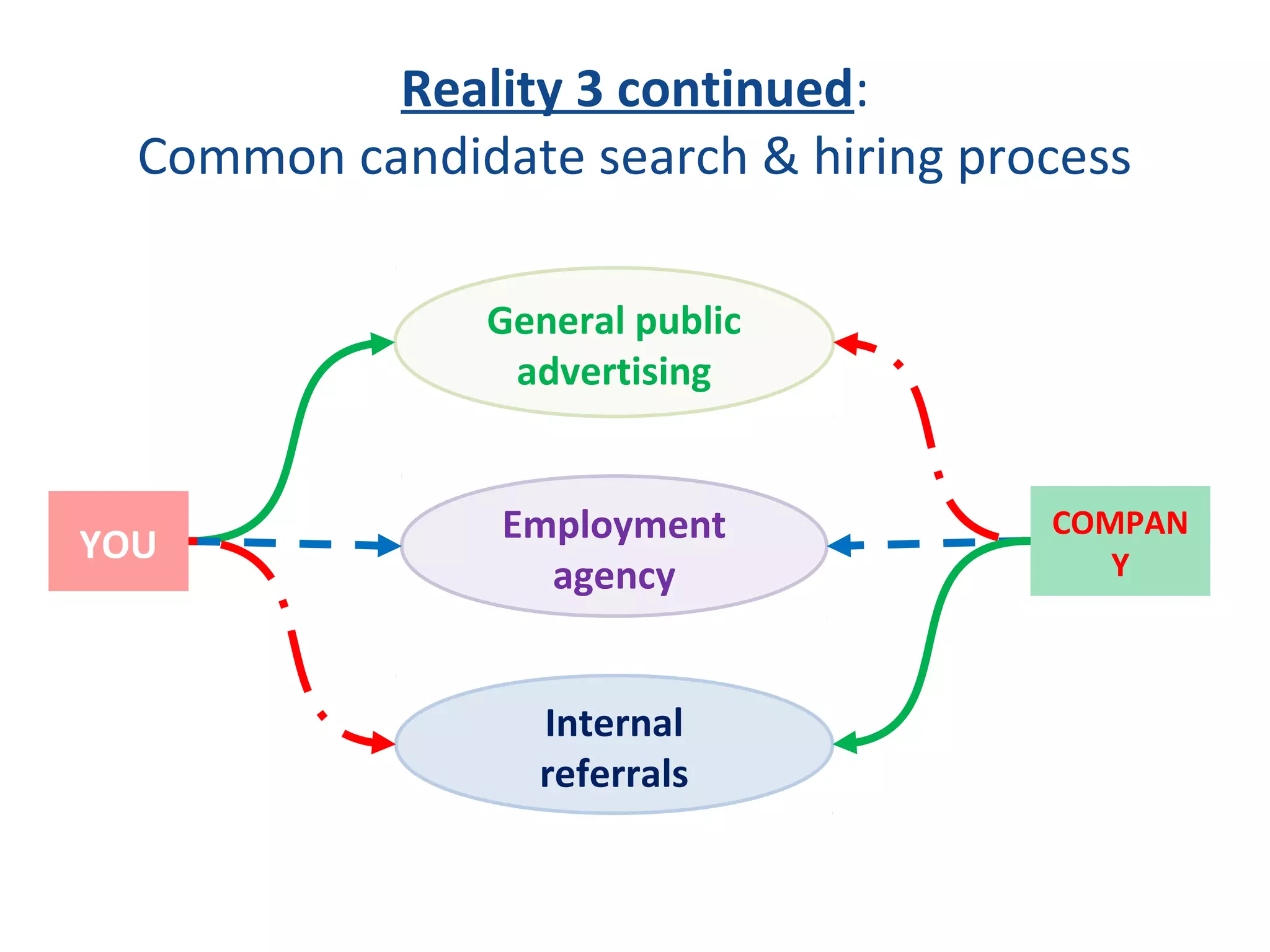
Common candidate search & hiring process
YOU
COMPAN
Y
General public
advertising
Employment
agency
Internal
referrals
CONCLUSION
The power and information relations between
employers and job seekers may be uneven BUT
they can be levelled with:
– A strategic job search process
– Appropriate resources and tools
– Persistent and enthusiastic attitude
ACTIVITY 1:
• Think about your friends’/colleagues’ job
search experiences.
• For those that got jobs, list 5 techniques that
they used to get their foot in the door.
• Examine whether you have used any of them?
ACTIVITY 2:
A. In your own job search experience so far (if you
have started the process), which strategies have
yielded some results e.g. a positive response or
acknowledgement from a potential employer or
an invitation to an interview, etc.?
B. List 3 things that might be holding you back
from getting results you want from your search.
Thank you!

Job search strategies lecture 1

  • 1.
    JOB SEARCH STRATEGIES Apractical guide to identifying and getting job opportunities Presented by Patrick Kabajjo Developed by: Marketplace for Information and Services Ltd.
  • 2.
    Course objectives In thiscourse you will learn: • How to market yourself before potential employers and within your network • How to set parameters for your search • How to effectively use a range of strategies for job searching • How to track your job search efforts
  • 3.
    Target audience Are yourjob search efforts futile? Or are you; • Fresh out of school? • Unemployed? • Looking to change jobs?
  • 4.
    Course summary By theend of this course, you will be able to: 1.Identify preferred jobs 2.Look for the right support in your search 3.Confidently pursue job opportunities with potential employers
  • 5.
    Overview of thecourse • Section 1 – Lecture 1: Introduction, common challenges in job search process – Lecture 2: Important tools for your search • Section 2 – Lecture 3: Factors which will guide your search • Section 3 – Lecture 4: Job search strategies – Lecture 5: Tracking your efforts
  • 6.
    Course requirements • Acomputer that: connects to the internet and has Microsoft PowerPoint • Prerequisite knowledge on how to write a Curriculum Vitae (CV)
  • 7.
    Course delivery methods •Audio over PowerPoint presentation • Screen casts of sample resources • Tools & links under supplementary materials • Activities/assignments after each lecture
  • 8.
    LECTURE 1: CourseIntroduction Lecture Outline; 1.Realities and challenges faced by job seekers 2. Assessment of your current strategies
  • 9.
    Learning outcomes After thislecture you will be: 1.More aware of the challenges ahead of you. 2.Able to identify and assess the effectiveness of strategies you already know or have used.
  • 10.
    Realities in thejob market The power relations between you (the job seeker) and potential employer may seem skewed
  • 11.
    Reality 1 • Manypeople are enrolling into schools, colleges, universities and many others are graduating each year. • Labour supply for most professions is high. • Often demand by employers does not match this supply. • Therefore for a job seeker, the job market is very competitive.
  • 12.
    Reality 2 • Informationon job opportunities is scattered across many sources. • Job searching therefore translates into a time consuming and laborious process
  • 13.
    Reality 3 • Wheneverthey can, employers will look for the most suitable job candidates using search and hiring processes that are: Most affordable Least time consuming • Job seekers often rely on publicly available job related information
  • 14.
    Reality 3 continued: Commoncandidate search & hiring process YOU COMPAN Y General public advertising Employment agency Internal referrals
  • 15.
    CONCLUSION The power andinformation relations between employers and job seekers may be uneven BUT they can be levelled with: – A strategic job search process – Appropriate resources and tools – Persistent and enthusiastic attitude
  • 16.
    ACTIVITY 1: • Thinkabout your friends’/colleagues’ job search experiences. • For those that got jobs, list 5 techniques that they used to get their foot in the door. • Examine whether you have used any of them?
  • 17.
    ACTIVITY 2: A. Inyour own job search experience so far (if you have started the process), which strategies have yielded some results e.g. a positive response or acknowledgement from a potential employer or an invitation to an interview, etc.? B. List 3 things that might be holding you back from getting results you want from your search.
  • 18.

Editor's Notes

  • #2 Hi, my name is Patrick Kabajjo. I am a social entrepreneur based in Uganda with a passion for personal development. I will present this course which has been developed by a team from Marketplace for Information and Services Limited with whom I work. This course is based on our experiences and those of others we know and have worked with over time.
  • #3 In this course you will learn: How to market yourself before potential employers and within your network How to set parameters for your search. You will be able to determine how wide to cast your net. How to effectively use a range of strategies for job searching How to track your job search efforts
  • #4 If your answer to any of these questions is YES, then this course is designed for you! It targets anyone who is looking for a job for whatever reason. The course is designed to offer you practical tips on how to improve on your job search with the aims of enabling you to market yourself better in your search and raising your chances of getting a job.
  • #5 By the end of this 30 minute course, you will be able to identify preferred jobs, seek for the right support in your search and confidently pursue job opportunities with potential employers
  • #6 This course is divided into 3 sections and each lecture is approximately 6 minutes long: Section 1 includes two lectures. Lecture 1 covers an introduction and common challenges in the job search process. Lecture 2 covers important tools you should have for your search which include a Curriculum Vitae, elevator speech and business card. Section 2 covers the factors which you should bear in mind as you embark on the job search. These are presented in Lecture 3. Section 3 covers two lectures. Lecture 4 outlines seven strategies you can apply in order to engage with potential employers. In lecture 5, I will present you with a tool which will enable you to track your job search efforts systematically as you go along.
  • #7 In order to access this course, you must have access to a computer with an internet connection, Microsoft PowerPoint and option to play audio or sound recordings. This course is based on the assumption that you are ready to hit the job market, armed a well written CV that you can share with potential employers in order to be considered for employment
  • #8 I will talk you through the PowerPoint slides and share screen casts of sample resources like websites. As I present, I will refer you to some website links which you can use to get additional information. Each lecture will include at least one assignment for you to complete in order to assess your understanding of the material.
  • #9 In this lecture,  I will present some of the realities and challenges that many job seekers in Africa face. These points will assure you of the need to use more proactive and effective job search strategies. I will also get you to think about techniques you already know to have worked from your experience and that of others in your network.
  • #11 When searching for a job, the power and control relations between you and potential employers may seem uneven. The opportunity to advance in your career may seem to be at the mercy of an employer who may or may not select you for a position in their company.   I will discuss three common realities that make this relationship and experience even more challenging
  • #12 Schools, colleges, universities and other educational institutions churn out graduates each year. However, the supply of such talented and qualified individuals in the job market is often not matched by demand from employers. This makes the job searches very competitive and therefore you have to be more proactive, more passionate and persistent than the rest in selling yourself in order to attract the attention of potential employers. Therefore my question to you is this: What sets you apart?
  • #13 Information on job vacancies is scattered across many sources. These may include, internet sources, word of mouth, newspapers, radio, and the like. In what is now a common African context job banks and labour market information systems are rare and underdeveloped. It falls upon the job seeker to search for opportunities by whatever means possible. Searching for a job eventually turns out to be a time consuming and labourious process. Therefore, job seekers must be strategic and systematic in their job searches.
  • #14 Another challenge is that companies approach their hiring process by advertising internally as a first step. This means that when a job vacancy is brought to the attention of a departmental line manager, he/she shares the opportunity with employees and the human resources team before the job opportunity is shared externally with an employment agency or advertised outside the company. This means that many job opportunities do not get publicized and when they do, they are taken up before you can even consider responding to a job posting.
  • #15 There are there common ways in which employers can source job candidates and through which job seekers can access jobs. Employers can circulate general public job advertisements which job seekers can read and respond to. Both parties can get the services of employment agencies. These agencies can look for job candidates on behalf of the employers and also look for potential employers on behalf of the job seeker. Current staff in the company can refer job seekers to their employers and job seekers can also get current staff in the company they would like to join to refer/recommend them to employers.   Here lies the challenge. For you as a job seeker, the most accessible information can be got from job advertisements. The second most available option is through an employment agency and the least available option is through referrals by staff in that company since you may not have any contacts in the company of your choice.   However, Companies usually advertise internally as a first step. The second preferred option is to get an employment agency to do the candidate search for them and lastly they may post a general job advertisement.   The result of this process is a disconnect and a challenge for you as a job seeker.
  • #16 Much as I might have painted a gloomy picture for you, be encouraged that you can level the power and information relations to some extent by being more strategic in your search and using to the right resources that are most likely at your disposal.
  • #18 In your own job search experience so far (if you have started the process), what strategies have yielded some results? List 3 things that might be holding you back from getting the results you want.
  • #19 Thank you! Join me again for Lecture 2 during which I will share information on three important tools that you must have before you embark on your job search.