Job Duties and Tasks for: "Psychiatric Technician"
1) Monitor patients' physical and emotional well-being and report unusual behavior or
physical ailments to medical staff.
2) Provide nursing, psychiatric and personal care to mentally ill, emotionally disturbed or
mentally retarded patients.
3) Observe and influence patients' behavior, communicating and interacting with them
and teaching, counseling and befriending them.
4) Take and record measures of patients' physical condition, using devices such as
thermometers and blood pressure gauges.
5) Encourage patients to develop work skills and to participate in social, recreational, and
other therapeutic activities that enhance interpersonal skills and develop social
relationships.
6) Collaborate with and assist doctors, psychologists, and rehabilitation therapists
working with mentally ill, emotionally disturbed, or developmentally disabled patients in
order to treat, rehabilitate, and return patients to the community.
7) Develop and teach strategies to promote client wellness and independence.
8) Restrain violent, potentially violent, or suicidal patients by verbal or physical means as
required.
9) Aid patients in performing tasks such as bathing and keeping beds, clothing and living
areas clean.
10) Administer oral medications and hypodermic injections, following physician's
prescriptions and hospital procedures.
11) Issue medications from dispensary and maintain records in accordance with
specified procedures.
12) Interview new patients to complete admission forms, to assess their mental health
status and to obtain their mental health and treatment history.
13) Lead prescribed individual or group therapy sessions as part of specific therapeutic
procedures.
14) Contact patients' relatives to arrange family conferences.
Job Activities for: "Psychiatric Technician"
1) Documenting/Recording Information-- Entering, transcribing, recording, storing, or
maintaining information in written or electronic/magnetic form.
2) Communicating with Supervisors, Peers, or Subordinates -- Providing information
to supervisors, co-workers, and subordinates by telephone, in written form, e-mail, or in
person.
3) Resolving Conflicts and Negotiating with Others -- Handling complaints, settling
disputes, and resolving grievances and conflicts, or otherwise negotiating with others.
4) Assisting and Caring for Others -- Providing personal assistance, medical attention,
emotional support, or other personal care to others such as coworkers, customers, or
patients.
5) Getting Information -- Observing, receiving, and otherwise obtaining information
from all relevant sources.
6) Making Decisions and Solving Problems -- Analyzing information and evaluating
results to choose the best solution and solve problems.
7) Identifying Objects, Actions, and Events -- Identifying information by categorizing,
estimating, recognizing differences or similarities, and detecting changes in
circumstances or events.
8) Establishing and Maintaining Interpersonal Relationships -- Developing
constructive and cooperative working relationships with others, and maintaining them
over time.
9) Coaching and Developing Others -- Identifying the developmental needs of others
and coaching, mentoring, or otherwise helping others to improve their knowledge or
skills.
10) Performing General Physical Activities -- Performing physical activities that
require considerable use of your arms and legs and moving your whole body, such as
climbing, lifting, balancing, walking, stooping, and handling of materials.
11) Monitor Processes, Materials, or Surroundings -- Monitoring and reviewing
information from materials, events, or the environment, to detect or assess problems.
12) Evaluating Information to Determine Compliance with Standards -- Using
relevant information and individual judgment to determine whether events or processes
comply with laws, regulations, or standards.
13) Organizing, Planning, and Prioritizing Work -- Developing specific goals and
plans to prioritize, organize, and accomplish your work.
14) Developing Objectives and Strategies -- Establishing long-range objectives and
specifying the strategies and actions to achieve them.
15) Coordinating the Work and Activities of Others -- Getting members of a group to
work together to accomplish tasks.
16) Guiding, Directing, and Motivating Subordinates -- Providing guidance and
direction to subordinates, including setting performance standards and monitoring
performance.
17) Processing Information -- Compiling, coding, categorizing, calculating, tabulating,
auditing, or verifying information or data.
18) Scheduling Work and Activities -- Scheduling events, programs, and activities, as
well as the work of others.
19) Developing and Building Teams -- Encouraging and building mutual trust, respect,
and cooperation among team members.
20) Training and Teaching Others -- Identifying the educational needs of others,
developing formal educational or training programs or classes, and teaching or
instructing others.
21) Performing Administrative Activities -- Performing day-to-day administrative tasks
such as maintaining information files and processing paperwork.
22) Updating and Using Relevant Knowledge -- Keeping up-to-date technically and
applying new knowledge to your job.
23) Analyzing Data or Information -- Identifying the underlying principles, reasons, or
facts of information by breaking down information or data into separate parts.
24) Judging the Qualities of Things, Services, or People -- Assessing the value,
importance, or quality of things or people.
25) Thinking Creatively -- Developing, designing, or creating new applications, ideas,
relationships, systems, or products, including artistic contributions.
26) Interpreting the Meaning of Information for Others -- Translating or explaining
what information means and how it can be used.
Skills Needed for: "Psychiatric Technician"
1) Active Listening -- Giving full attention to what other people are saying, taking time to
understand the points being made, asking questions as appropriate, and not interrupting
at inappropriate times.
2) Writing -- Communicating effectively in writing as appropriate for the needs of the
audience.
3) Reading Comprehension -- Understanding written sentences and paragraphs in
work related documents.
4) Social Perceptiveness -- Being aware of others' reactions and understanding why
they react as they do.
5) Speaking -- Talking to others to convey information effectively.
6) Instructing -- Teaching others how to do something.
7) Critical Thinking -- Using logic and reasoning to identify the strengths and
weaknesses of alternative solutions, conclusions or approaches to problems.
8) Service Orientation -- Actively looking for ways to help people.
9) Monitoring -- Monitoring/Assessing performance of yourself, other individuals, or
organizations to make improvements or take corrective action.
10) Learning Strategies -- Selecting and using training/instructional methods and
procedures appropriate for the situation when learning or teaching new things.
11) Active Learning -- Understanding the implications of new information for both
current and future problem-solving and decision-making.
12) Negotiation -- Bringing others together and trying to reconcile differences.
13) Coordination -- Adjusting actions in relation to others' actions.
14) Persuasion -- Persuading others to change their minds or behavior.
15) Judgment and Decision Making -- Considering the relative costs and benefits of
potential actions to choose the most appropriate one.
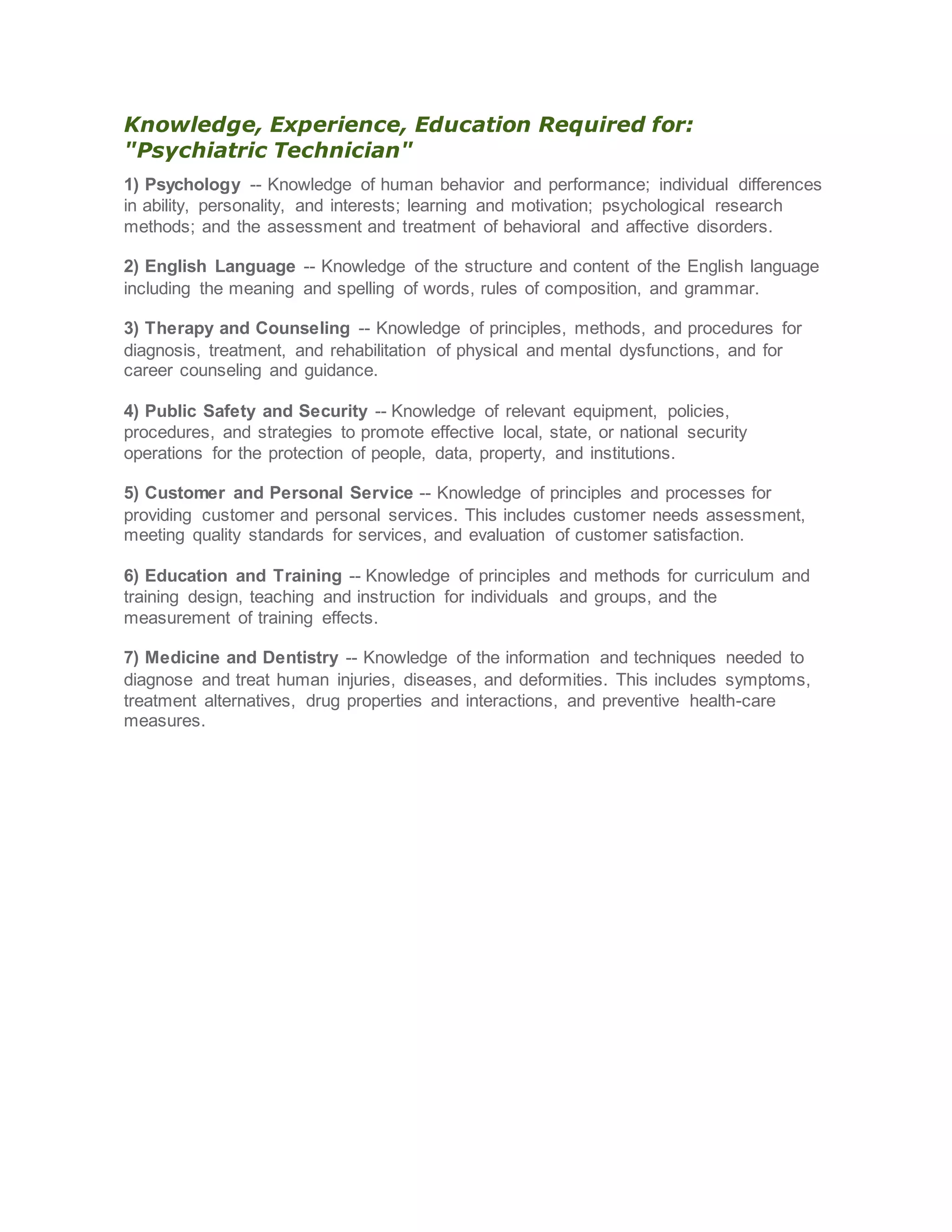
Knowledge, Experience, Education Required for:
"Psychiatric Technician"
1) Psychology -- Knowledge of human behavior and performance; individual differences
in ability, personality, and interests; learning and motivation; psychological research
methods; and the assessment and treatment of behavioral and affective disorders.
2) English Language -- Knowledge of the structure and content of the English language
including the meaning and spelling of words, rules of composition, and grammar.
3) Therapy and Counseling -- Knowledge of principles, methods, and procedures for
diagnosis, treatment, and rehabilitation of physical and mental dysfunctions, and for
career counseling and guidance.
4) Public Safety and Security -- Knowledge of relevant equipment, policies,
procedures, and strategies to promote effective local, state, or national security
operations for the protection of people, data, property, and institutions.
5) Customer and Personal Service -- Knowledge of principles and processes for
providing customer and personal services. This includes customer needs assessment,
meeting quality standards for services, and evaluation of customer satisfaction.
6) Education and Training -- Knowledge of principles and methods for curriculum and
training design, teaching and instruction for individuals and groups, and the
measurement of training effects.
7) Medicine and Dentistry -- Knowledge of the information and techniques needed to
diagnose and treat human injuries, diseases, and deformities. This includes symptoms,
treatment alternatives, drug properties and interactions, and preventive health-care
measures.

Job Duties and Tasks

  • 1.
    Job Duties andTasks for: "Psychiatric Technician" 1) Monitor patients' physical and emotional well-being and report unusual behavior or physical ailments to medical staff. 2) Provide nursing, psychiatric and personal care to mentally ill, emotionally disturbed or mentally retarded patients. 3) Observe and influence patients' behavior, communicating and interacting with them and teaching, counseling and befriending them. 4) Take and record measures of patients' physical condition, using devices such as thermometers and blood pressure gauges. 5) Encourage patients to develop work skills and to participate in social, recreational, and other therapeutic activities that enhance interpersonal skills and develop social relationships. 6) Collaborate with and assist doctors, psychologists, and rehabilitation therapists working with mentally ill, emotionally disturbed, or developmentally disabled patients in order to treat, rehabilitate, and return patients to the community. 7) Develop and teach strategies to promote client wellness and independence. 8) Restrain violent, potentially violent, or suicidal patients by verbal or physical means as required. 9) Aid patients in performing tasks such as bathing and keeping beds, clothing and living areas clean. 10) Administer oral medications and hypodermic injections, following physician's prescriptions and hospital procedures. 11) Issue medications from dispensary and maintain records in accordance with specified procedures. 12) Interview new patients to complete admission forms, to assess their mental health status and to obtain their mental health and treatment history. 13) Lead prescribed individual or group therapy sessions as part of specific therapeutic procedures. 14) Contact patients' relatives to arrange family conferences.
  • 2.
    Job Activities for:"Psychiatric Technician" 1) Documenting/Recording Information-- Entering, transcribing, recording, storing, or maintaining information in written or electronic/magnetic form. 2) Communicating with Supervisors, Peers, or Subordinates -- Providing information to supervisors, co-workers, and subordinates by telephone, in written form, e-mail, or in person. 3) Resolving Conflicts and Negotiating with Others -- Handling complaints, settling disputes, and resolving grievances and conflicts, or otherwise negotiating with others. 4) Assisting and Caring for Others -- Providing personal assistance, medical attention, emotional support, or other personal care to others such as coworkers, customers, or patients. 5) Getting Information -- Observing, receiving, and otherwise obtaining information from all relevant sources. 6) Making Decisions and Solving Problems -- Analyzing information and evaluating results to choose the best solution and solve problems. 7) Identifying Objects, Actions, and Events -- Identifying information by categorizing, estimating, recognizing differences or similarities, and detecting changes in circumstances or events. 8) Establishing and Maintaining Interpersonal Relationships -- Developing constructive and cooperative working relationships with others, and maintaining them over time. 9) Coaching and Developing Others -- Identifying the developmental needs of others and coaching, mentoring, or otherwise helping others to improve their knowledge or skills. 10) Performing General Physical Activities -- Performing physical activities that require considerable use of your arms and legs and moving your whole body, such as climbing, lifting, balancing, walking, stooping, and handling of materials. 11) Monitor Processes, Materials, or Surroundings -- Monitoring and reviewing information from materials, events, or the environment, to detect or assess problems. 12) Evaluating Information to Determine Compliance with Standards -- Using relevant information and individual judgment to determine whether events or processes comply with laws, regulations, or standards. 13) Organizing, Planning, and Prioritizing Work -- Developing specific goals and plans to prioritize, organize, and accomplish your work. 14) Developing Objectives and Strategies -- Establishing long-range objectives and
  • 3.
    specifying the strategiesand actions to achieve them. 15) Coordinating the Work and Activities of Others -- Getting members of a group to work together to accomplish tasks. 16) Guiding, Directing, and Motivating Subordinates -- Providing guidance and direction to subordinates, including setting performance standards and monitoring performance. 17) Processing Information -- Compiling, coding, categorizing, calculating, tabulating, auditing, or verifying information or data. 18) Scheduling Work and Activities -- Scheduling events, programs, and activities, as well as the work of others. 19) Developing and Building Teams -- Encouraging and building mutual trust, respect, and cooperation among team members. 20) Training and Teaching Others -- Identifying the educational needs of others, developing formal educational or training programs or classes, and teaching or instructing others. 21) Performing Administrative Activities -- Performing day-to-day administrative tasks such as maintaining information files and processing paperwork. 22) Updating and Using Relevant Knowledge -- Keeping up-to-date technically and applying new knowledge to your job. 23) Analyzing Data or Information -- Identifying the underlying principles, reasons, or facts of information by breaking down information or data into separate parts. 24) Judging the Qualities of Things, Services, or People -- Assessing the value, importance, or quality of things or people. 25) Thinking Creatively -- Developing, designing, or creating new applications, ideas, relationships, systems, or products, including artistic contributions. 26) Interpreting the Meaning of Information for Others -- Translating or explaining what information means and how it can be used.
  • 4.
    Skills Needed for:"Psychiatric Technician" 1) Active Listening -- Giving full attention to what other people are saying, taking time to understand the points being made, asking questions as appropriate, and not interrupting at inappropriate times. 2) Writing -- Communicating effectively in writing as appropriate for the needs of the audience. 3) Reading Comprehension -- Understanding written sentences and paragraphs in work related documents. 4) Social Perceptiveness -- Being aware of others' reactions and understanding why they react as they do. 5) Speaking -- Talking to others to convey information effectively. 6) Instructing -- Teaching others how to do something. 7) Critical Thinking -- Using logic and reasoning to identify the strengths and weaknesses of alternative solutions, conclusions or approaches to problems. 8) Service Orientation -- Actively looking for ways to help people. 9) Monitoring -- Monitoring/Assessing performance of yourself, other individuals, or organizations to make improvements or take corrective action. 10) Learning Strategies -- Selecting and using training/instructional methods and procedures appropriate for the situation when learning or teaching new things. 11) Active Learning -- Understanding the implications of new information for both current and future problem-solving and decision-making. 12) Negotiation -- Bringing others together and trying to reconcile differences. 13) Coordination -- Adjusting actions in relation to others' actions. 14) Persuasion -- Persuading others to change their minds or behavior. 15) Judgment and Decision Making -- Considering the relative costs and benefits of potential actions to choose the most appropriate one.
  • 5.
    Knowledge, Experience, EducationRequired for: "Psychiatric Technician" 1) Psychology -- Knowledge of human behavior and performance; individual differences in ability, personality, and interests; learning and motivation; psychological research methods; and the assessment and treatment of behavioral and affective disorders. 2) English Language -- Knowledge of the structure and content of the English language including the meaning and spelling of words, rules of composition, and grammar. 3) Therapy and Counseling -- Knowledge of principles, methods, and procedures for diagnosis, treatment, and rehabilitation of physical and mental dysfunctions, and for career counseling and guidance. 4) Public Safety and Security -- Knowledge of relevant equipment, policies, procedures, and strategies to promote effective local, state, or national security operations for the protection of people, data, property, and institutions. 5) Customer and Personal Service -- Knowledge of principles and processes for providing customer and personal services. This includes customer needs assessment, meeting quality standards for services, and evaluation of customer satisfaction. 6) Education and Training -- Knowledge of principles and methods for curriculum and training design, teaching and instruction for individuals and groups, and the measurement of training effects. 7) Medicine and Dentistry -- Knowledge of the information and techniques needed to diagnose and treat human injuries, diseases, and deformities. This includes symptoms, treatment alternatives, drug properties and interactions, and preventive health-care measures.