Projecting symptoms 4
Joanna Lowry
In The VisibleandtheInvisibleMauriceMerleau-Pontystruggledwiththedevel­
opment of a theory of vision that would take into account our embodiment,
describing the 'chiasmatic' relationship between the viewer and the world,
an intertwining through which the world is brought into a kind of visibility.
What he felt needed to be put into question and seen as problematic was how
the viewer carne to be seen as separate from the world - how the visual ever
became positioned as something other, something differentiated and separate
from the spectator. Stephen Melville sums up the central issue thus:
Vision is the place where our continuity with the world conceals itself, the
place where we mistake our contact for distance, imagining that seeing is a
substitute for, rather than a mode of, touching - and it is this anaesthesia, this
senselessness, at the heart oftransparency that demands our acknowledgement
and pushes our dealings with the visual beyond recognition.1
Recent studies theorising the history of the visual have made us more aware of
its provisionality, and of the extent to which our relationship to the presumed
transparency of vision is in fact the product of complex historical conditions
and cultural formations. Melville's comments draw our attention particularly
to the way in which the very definition of 'the visual' is predicated upon the
construction of a distance between the spectator and the world - a distance
that is maintained through the work of culture and through the work of
technology. Photographic technologies have provided one key cultural mecha­
nism for defining the place ofthe visual and positioning it in relationship to
us. In representingthesubject they also define thesiteof the subject's visibility,
the place at which he or she can be seen. They cut through the world; interrupt
it, producing difference and distance, and projecting these onto the surface
of the paper or the screen. They produce a differentiated space of the visible
within which the subject and the spectator are made aware of their otherness
and their distance from each other.
In this essay I explore sorne of the ways in which contemporary video
1- ---- __,_J...,_�.l .i-1-.. .....+ ..,.,..., ........� ............ l"l-,,;"1"' 'ho+'l:ATPPn tl, p �11hlPrt ::1ncl the
t4 lni11111.i I owry
spcctator, and the implications that these developments have for the way
in which we understand subjectivity as a cultural construction. I argue that
through these practices the self that is projected onto these screens is invari­
ably seen as a potentially hysterical self, peculiarly fragile and troubled. We
tend, when confronted with these works, to read the signs of the subject's
behaviour clinically - as though they were symptoms of a hidden trauma.
One way of understanding this phenomenon is to plot its origins in the:
early relationship established between photography and mental illness in the
nineteenth century. My argument is that the peculiar ambivalence between
the clinical and the theatrical that was established in sorne of these images,
linked as it was to ideas about the evidential power ofthe photographic image
itself, established a powerful discursive space that is still being actively articu­
lated in the gallery today. Toe works that I describe each deploy this discur­
sive space in slightly different ways, but all involve a specific negotiation of
the relationship between the spectator and the subject through the way in
which they are physically installed, and all of them in sorne sense construct
that relationshipas diagnostic, with the subject exhibiting their symptoms to,
a clinical gaze.
The studio and the clinic
Toe development of the concept of mental illness in the nineteenth century
involvedaconstellationofideasaround the body as the physicalsite ofobserv­
able symptoms, the performance ofwhich could be captured by both photog­
raphy and film. This construction of a diagnostic apparatus was connected
to a production of the hysterical subject through encouraging the patient to
perform their symptoms.2 It is possible to trace the historicalcongruence that
emerged between the clinic or consulting room and the photographic studio
from that period into the present <lay. Toe relationship between the develop­
ment of photographic technologies and the representation of mental illness
has been well documented by a number of writers, notably Sander Gilman,
Allan Sekula, David Green, Jessica Evans, Suren Lalvani, and Georges Didi­
Huberman.3 Central to all these studies was a recognition that photographic
technology provided an unprecedented opportunity for the cultural construc­
tion of the body as a set of visible signs that appeared to satisfy a positivist
desire for visual evidence ofhidden mental or emotional states. Drawing on a
dominantly Foucauldian perspective, these writers emphasised the role played
by these technologies in classifying, monitoring, and essentially producing
mental illness as an object ofknowledge.
What also emerged in these studies, however, was the observation that
in the nineteenth century there was a recurrent concern with the potentially
Projecting syrnptorns
mine whether the symptomatic behaviour being expressed by the subject was
involmitary or performed, and ifit was performed, then could it be seen as an
authentic expression ofan inner state or not? These debates, which circulated
in the medical and scientific journals of the time, intimated evidence of a
mismatch between the positivist ontology embedded in the scientific recep­
tion of these technologies and the popular, performative appropriation of
portrait photography as a site for playing with identity and social roles.
Toree examples of the photographic documentation of hysterical illness
in particular spring to mind, each of which offers sorne insight into the
phenomenon with which we are concerned: the photographs of the insane
taken by Dr Hugh Diamond at the Surrey County Lunatic Asylum in the
1850s, the set of photographs taken by Osear Rejlander in 1877 to illustrate
Darwin's study_ of the expressions of the emotions in man, and the photo­
graphs of female hysterics taken by Albert Londe for the French psychiatrist
Jean-Martin Charcot at the Salpetriere Hospital for the Insane in Paris at the
end of the nineteenth century.
Hugh Diamond, the resident superintendent of the Female Department
of the Surrey County Lunatic Asylum in the 1850s, was responsible for the
collection of á large archive of photographs of the patients. Sander Gilman
has pointed out that these images were being produced at a time when there
was a real shift happening in our understanding of the relationship between
mind and body.4
Early mechanistic relationships between a notion ofmental
pathology and its physical expression were being supplanted by more complex
ones and the photography ofthe insane appeared to offer a neutral diagnostic
space for the analysis of this. In a paper that Diamond read before the Royal
Society in 1856, 'On the application of photography in the physiognomic and
mental phenomena ofinsanity', a series ofinteresting observations about the
photographic image may be discerned.
Firstly Diamond claimed that the photograph spokefor itself- it was objec­
tively accurate. It seemed, therefore, in the terms ofthe positivistic framework
within which scientific forms ofphotography were understood at that time, to
offer a neutral, dispassionate representation of the symptoms of the patient.
Secondly, he suggested, its archival capacity meant that it offered the potential
for the cataloguing ofa psychopathology. Thirdly, perhaps most interestingly,
he observed thatit offeredthe potential to reveal to patients themselves a repre­
sentation of their own pathological state. Photography, then, might not only
play a part in thediagnosis ofa pathology, but might also produce that reflexive
moment of self-recognition that could be part of the cure. Gilman describes
how Diamond's contemporary, the psychiatrist John Connolly, also noted in
response to Diamond's photographs that there was something peculiar to the
photographic representation of the expression which could not be replicated
thr011oh tr<1rlition<1l form� of rPnrP�Pnbtion• nhr.tr.o-r<>nh" hP nr.tPrl rr.nlrl
$15
,lo.1111r1 Lowry
capture the after-effect of the impression of a recent muscular agitation, th
'singular expression arising from morbid movements of the mind:5
AnticipatingWalterBenjamin'snotionof theopticalunconscious, Diamon
intimated that the camera, disinterestedly mechanical, could'usurp our expe
tations by revealing things we <lid not know about ourselves - aspects of ou
behaviour that we would not, otherwise, have been able to see. It is easy t
see in such an approach the convergence of a set of ideas about the mind, as �
hidden space to be revealed through the interpretation of symptoms playedout
on the surface of the body and the idea of photography as a privileged screen
upon which those symptoms might be projected. It becomes evident that the
concept of facial and bodily expression as a special kind of primarily sympto-1
matic sign is supported and sustained by elements of the photographic sign
- the indexical, the archival, the mechanistic, the contingent, and the reflexive.i
Charles Darwin, writing his book on the Expression of the Emotions in1
Man and Animals in 1871, made extensive use of photographs of the insanej
to illustrate his examples;6
It was, he claimed, the insane who suffered ther,
strongest emotions, and who gave uncontrolled vent to them. Darwin encoun-:,¡
tered a number, of interesting problems, however, in his analysis of these,,
photographic images. Sander Gilman has plotted the ambiguity in Darwin's
approach to the photographic image, at one point insisting on the veracity
of the clinical image - and utilising it precisely because it seemed to indicaté
verifiable evidence of the emotional states with which he was concerned - and
at another point employing the well-known photographer Osear Rejlander to
make photographs of actors posing to represent the emotions. Gilman argues
that towards the end of his study Darwin became increasingly sceptical about
the veracity of the photographic image and the difficulty of distinguishing
within it between the authentic and the performed.7
Toe very same issues concerning the relationship between authenticity and
performance were central to the discussions around photography that were
taking place at the Salpetriere Hospital for the Insane in Paris between 1876
and 1888.8
Toe principal psychiatrist, Charcot, was celebrated for his investi­
gation of hysteria. Every Tuesday he would hold public audiences at which
he would lecture about his patients to the assorted congregation of doctors,
students, and general public, bringing them along to act out their hysterical
symptoms in public. Through hypnosis he was able both to suppress their
symptoms and encourage them to replay their maniacal behaviour to order.
He also collected a huge archive of photographs of the patients, which he
used to illustrate his emerging classification of hysterical symptoms. One of
the most interesting aspects of this practice is the shift that is registered in
Charcot's work from a use of photography that was essentially classificatory
into one that was diagnostic and which indeed ultimately involved the use of
11 _ ..l _ __ _ ---'- _.CL----4-........! ........l ......�.....+.,..........,.."' 9
Projecting symptoms
It is clear, furthermore, that there were a number of interesting paral­
lels between the theatre of the asylum and the popular theatre. Many of the
gestures and expressions ofthe women bore close resemblance to the stylised
melodramatic gestures of contemporary actors. Indeed, one of the great
concerns at the heart of Charcot's work was the issue of performance. How
could he be sure that the women's symptoms were authentic and that they
weren't simulating them? Toe concern was intensified by the popular belief
that one of the key qualities of the hysteric was her tendency towards theat­
rical performance and dramatic effect. On the one hand, Charcot believed that
thephotograph was a disinterested scientific tool, allowing for the cataloguing
andclassification of a number of psychiatric diseases, and indeed allowing for
a level of scrutiny of the subject that might expose any artífice or deception.
On the other hand, he was complicit in the construction of a photographic
theatre that actively incited the reproduction of a symptomatology.
These examples drawn from the nineteenth century are significant because
theyreveal theemergence of an uncertainty in our relationship to photograph­
ically based images that has remained with us ever since. Whilst photography
offered an unprecedented objective recording of the physical presence of a
person, its invention coincided with the development of complex models of
the self and the psyche that rendered such recordings unreliable. This paradox
wasplayed out through the convergence of a clinical and a photographic gaze,
linked to the diagnostic interrogation of the performance of the self.
Whilst, therefore, the rules for constructing a neutralised scientific space of
observation might be elaborate and considered, they also had a tendency to be
imperfect and difficult to maintain and control. One of the cultural legacies of
this history is, I would argue, a continuing uncertainty in our understanding
of the relationship of the performing subject to the image, and also a pervasive
ambiguity in our understanding of the kind of performance space represented
by the camera. This space is one that often shifts uncertainly between being a
theatreanda clinic, a workshop, anda laboratory. If thereisa backdrop curtain
in a photographic image, then its function can be twofold, both to set a scene
and to screen it off. In either case, however, we are considering, as a result of
the gradual embedding of these pictorial conventions, a peculiar convergence
within photographic technologies themselves of visual discourses concerned
withunderstanding the psychological stateof the subject. Itispossibleto think,
therefore, about photography as constituting a particular type of cultural site
for the production of the self. It is a site that can be thought of as bounded
by a distinctive relationship between the surface of the print as a place on
which the identity of the subject is inscribed, and the confined, hybrid space
within which that identity is performed for us. It has become established as a
concentrated source ofknowledge about the psychological state of the subject
- :::1 i;;:n�rp -in ,.,.rh1;.1, Pi.TPl'"l.T <TPct11rP ,...,,.... PVTI"l"OC'C-ÍA-ri -ici +n. ha ?a..-,,...:1 ........ n .........................+........,_
97
Jurn111,1 1 owry
'lhe discursive convergence between theatre and clinic has had a powerf1
influence on the development of contemporary variations on the theme ofth
portrait, particularly in the realm of video art, where, since the early exper
ments of performance artists in the 1960s and 1970s the self is often portraye
on screen asa hystericalsubject on the verge of breakdown: weeping, shoutin
laughing, confessing, and always in extremis. Toe figure of the performanc
artist that dominates·this particular moment in history is an agonistic subjec
performing to the camera in his or her studio, subjecting the body to humilil
ating feats of endurance or narcissistically interrogating his or her own image
and confessing his or her own abjection. Artists such as Vito Acconci, Marina
Abramovic, and Bruce Nauman all played a role in establishing the site of
video performance as one in which the very basis of the psychic integrity of
the person could be routinely subjected to stress, interrogation, and degrada­
tion. Toe video recording of a performance, with its rough, real-time presence
became a vehicle of the construction of a discursive space that sought to link
concepts of authenticity (registered by the recording itself) and performa­
tivity, the space of performance being established as one in which the self
might be effectively dismantled.
In these scenarios the psychological subject that emerged was often
presented as deeply unstable. Artists engaged in the monotonous repetition :
of acts or words for hours on end, talking to themselves through the camera,
masturbating or hitting themselves, or reproducíng sorne banal activity: •
Marina Abramovic brushingher hair with increasingviolence, or Vito Acconci
thrusting his fist in and out of his mouth, so repeatedly and intensely that it
eventually became an act of violent self-abuse. Toe performance to camera
rapidly became established, almost by default, as the site of a kind of psychic
working through of a trauma, a privileged site for acting out the limits of what
it means to be a person. Recorded by the camera, the bare studio spaces in"
which these activities· took place were at once a theatre and a laboratory. In
this space all of the wider connotations of identity were stripped away and the
subject was exposed to a more acute scrutiny. From the spectator's position,
beyond the fourth wall, the performers were examined with a kind of dispas­
sionate dissociation. Toe assumption that lies behind these practices is that
this space, marked out by the narrow margin between the blank studio wall
and the screen, is a space within which the fragility of the psyche can be fully
tested and revealed.
It is clear here that there are similarities between the development of
photography as a space for the performance of unstable psychologies in
the nineteenth century and the emergence of the video screen as a site for
the performance of hysterical behaviour in the latter half of the twentieth
century. Notwithstanding the differences between the two technologies and
•.1.... r, �J�.r.r.
........,......... ,L-,1-.......-t--or- ..-,,h,,.n+ mDrl-i11m_cn�r1"hrlhr Pn<TPnrl PrPrl 'hv P�rh of thPm� T
Projecting symploms
would argue that they both share a commonformation, each of them founded,
in the early years of their production, as technologies for the performance
of the self. These two means of visual reproduction, video and photography,
have thus become established in contemporary practice as apparatuses for the
production of subjectivity and are. thereby linked to a psychic economy that is
intrinsically fragile. This is an economy in which the subject, whether posing
for a photographic portrait, or performing on the screen, is invariably on the
brink of dissolution, is always potentially hysterical.
Toe experiments of the early performance artists of the 1960s were replayed
in a new form in the 1990s in work by artists such as Gillian Wearing and Sam
Taylor-Wood who also deployed the use of real-time recording in a quasi­
clinical setting to explore notions of psychic instability. Wearing's. classic
Confess All On Video. Don't Worry You Will Be In Disguise. Intrigued? Call
· Gillian (1994), which features long monologues by masked individuals telling
their terrible secrets, was perhaps the most well-known work among many of
that period which deployed the confessional discourse of the clinical/thera­
peutic context as a space of revelation. Wearing's work was always reflexive
in its use. of medium: the comical masks worn by her subjects, whilst offering
them the security of anonymity, also cocked a snook at the cameras ability to
show the truth, and posed the fundamental question of how we read any face.
In her other work, too, Wearing constantly drew attention to the complicity of
the medium in the performance of self, using strategi�s such as playing tapes
backwards or re-dubbing voices over actors' bodies.
Taylor-Wood exploited the ambivalence of performance and hysteria and
paid actors to act out the extremes of emotion. In Method in Madness (1994)
she employed a method actor to act out a gradual emotional breakdown to
the camera; in a series called Crying Men (2002) she photographed a number
of celebrity figures in tears. Toe ambivalence of the performed emotion was
also explored in extremis by Bill Viola, whose portraits of actors performing
a variety of exaggerated emotions, from joy to despair, were replayed in slow
motion whilst framed as traditional portraits on the wall in the ensemble
installation of The Passions (2003). Toe state-of-the-art, mesmerising clarity of
these recordings provided a foil to the deconstructive power of the technology,
which was, in effect, looking for the chinks in the performance, yet revealing
it as a seamless whole. Through their use of both actors and ordinary people,
these artists interrogated the ontology of performance. But what is also clear is
that video art became the site of a peculiar visibility of the body under stress.
If video was established in the 1970s as perhaps the most significant site
for the performance of the instability of the self, in more recent years this
phenomenon has been intensified by the emergence of the large screen as a
site for its projection� ·Toe large-scale projected image of the subject under
stress has helved to consolidate the gallerv as a vlace where we engage in
99
o Jornma Lowry
a kind of diagnosis of the contemporary subject. Toe technology of videoi
'projection' intensifies focus on 'projection' as á psychological mechanism{
which implicates the viewer. Thus, the new apparatus of video (large-screen,5
digital projectiort) has increasingly emerged as a privileged cultural site for
the definition ofmodern subjectivity. Stripped of ali external contextual refer­
ences, and subjected to the rigidity of the video artist's stipulations, clinically
interrogated by the lens, our frailty and perversity is exposed at that very
moment at which the video camera starts recording.
Projections, symptoms, and therapy
Perhaps perversely, it is in the new form of large-screen video projection that
the technologies of photography arid video have become. most closely inter­
related, for it is in this space of installation that the kinds of spectatorship each
demands are most closely allied. Toe use of extreme, slowed-down tempo­
rality which accompanies many artists' use of video projection .-e including
Sam Taylor-Wood, Bill Viola, and, famously, Douglas Gordon - confirms
this convergence between the still and moving image. Works by these artists
produce a video time that tends either towards stasis, repetition, and the loop,
or alternatively towards an extended sense of presentness that is experienced
as actually resistant to time. Toe diagnostic gaze that we have inherited from
photography's historical complicity in the nineteenth-century preoccupation
with physipgnomy as an indicator of social or mental pathology is implicit in
the way we address images in this space.
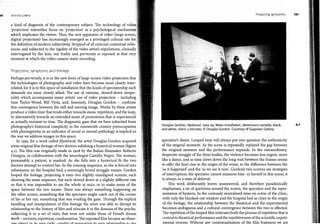
In 1995, for a work called Hysterical, the artist Douglas Gordon acquired
sorne original film footage of two doctors subduing a hysterical woman (figure
4.1). Toe film was originally made in 1908 by the Italian filmmaker Roberto
Omegna, in collaboration with the neurologist Camillo Negro. Toe woman,
presumably a patient, is masked. As she falls into a hysterical fit the two
doctors attempt to control her. In the ensuing sequence, as she is forced into
submission on the hospital bed, a seemingly brutal struggle ensues. Gordoil
looped the footage, projecting it onto two slightly misaligned screens, each
showing the same sequence, but each slowed down at a slightly different rate
so that it was impossible to see the whole at once, or to make sense of the
space between the two scenes. There was always something happening on
the other screen, something that the spectator might catch out of the corner
of his or her eye, something that was evading the gaze. Through the explicit
handling and manipulation of film footage the artist was able to disrupt its
relationship to the history of film and relocate it in the domain of the psyche,
subjecting it to a set of rules that were not unlike those of Freud's dream
work - revision, repetition, condensation. Toe repeated film became an obses­
Projecting sympi:omi,
Douglas Gordon, Hysterical, 1994-95.Video installation, dimensions variable, black­
and-white, silent, 3 minutes.© Douglas Gordon. Courtesy of Gagosian Gallery.
spectator's desire. Looped time will always put into question the authenticity
of the original moment. As the scene is repeatedly replayed the gap between
the original moment and the performance expands. In the extraordinary,
desperáte struggle of the three bodies, the violence becomes less urgent, more
like a dance, and as time slows down the long wait between the frames seems
to offer the final clue to the origin of the event, to the difference between the
'as it happened' and the 'as we see it now: Gordon's two screens are strategies
of interruption; the spectator cannot immerse him- or herself in this scene; it
is always in a state of deferral.
This work deliberately leaves unanswered, and therefore paradoxically
emphasises, a set of questions around the screen, the spectator and the repre­
sentation of hysteria. In the curiously neutralised mise-en-scene of the clinic,
with only the blanked-out window and the hospital bed as clues to the origin
of the footage, the relationship between the theatrical and the experimental
becomes ambiguous and a cultural convergence between the two is effected.
Toe repetition of the looped film reiterates both the process of repetition that is
centralto theatrical performanceand the repetitivenessof the scientific experi­
mental nrocess. Without anv contextualisation of the film friwment we are
101
4.1
l<i.11111.i l owry
unable to understand why the patientishysterkal, nor the seeming brutalityof
the medical team, but what is established is the potential complicity offilm as
a medium in the representation ofhysteria. The film documents the hysterical
fit, but it a:lso reproduces the repetitive conditions ofthe symptom through its
own processes ofrepetition. Furthermore the interior space within which the
scene takes place is confirmed as a space bounded by the performance ofthe
symptom, its diagnosis, and its management; as a space which we might think
ofas a clinic, with the spectator taking on a detached and diagnostic gaze.
Furthermore, through the objectification ofthe film itselfon the two screens,
placed in the centre ofthe gallery as sculptural objects, the installation draws
our attention to the close relationship between the material surface ofthe film
as a medium and the clinical theatre ofrepresentations played out upon it.
This convergence between film as a medium, the diagnostic gaze, and a
theatre ofhysteria was also the subject.ofanother work ofthe same period,
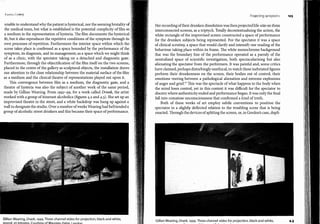
made by Gillian Wearing. From 1997-99, for a work called Drunk, the artist
worked with a group ofitinerant alcoholics (figures 4.2 and 4.3). She set up an
improvised theatre in the street, and a white backdrop was hung up against a
wall to designate the studio. Over a number ofweeksWearing had befriendeda
group ofalcoholic street drinkers and this became their space ofperformance.
Gllllan Wearing, Drunk, 1999. Three-channel video for projection, black-and-white,
sciund, 23 minutes. Courtesv of Maureen Palev. Lonrlon.
Projecting symptonh
Her recording oftheir drunken dissolutionwas then projectedlife-sizeon thrcc
interconnected screens, as a triptych. Totally decontextualising the action, thc
white rectangle ofthe improvised screen constructed a space ofperformance
for the drunken subjects being represented. Por the spectator it was a space
ofclinical scrutiny, a space that would clarify and intensify our reading ofthe
behaviour taking place within its frame. Toe white monochrome background
that was the boundary line of the performance operated as a parody ofthe
neutralised space of scientific investigation, both spectacularising but also
alienating the spectator from the performers. lt was painful and, sorne critics
have claimed, perhaps disturbingly unethical, to watch these inebriated figures
perform their drunkenness on the screen, their bodies out of control, their
emotions veering between a pathological alienation and extreme explosions
ofanger and grief.1
º This was the spectacle ofwhat happens to the body when
the mind loses control, yet in this context it was difficult for the spectator to
discern where authenticity ended and performance began. It was only the final
fall into comatose unconsciousness that confirmed a kind oftruth.
Both of these works of art employ subtle conventions to position the
spectator in a slightly deflected relation to the troubling scene that is being
enacted. Through thedevicesofsplitting the screen, or, in Gordon's case, dupli-
Gillian Wearing, Drunk, 1999. Three-channel video for projection, black-and-white,
n 1 1 - _, _
103
4,3
104 111,11111,1 lowry
i.:aling it, the position of the observer is displaced from any direct engagemen
wilh the participants in the scene. Toe spectator is, through this deflectim
positioned so that he or she cannot identify with the subject, but must instea
observe them. In each case he or she is confronted with the spectacle of
clinical theatre and is thereby situated in a place from which the subject
behaviour demands not to be engaged with or responded to, but instead to b
V •. 1ead as a set of sympt�signs of sorne invisible and unarticulated traumt,
Both these works use the quasi-clinical heritage of photographic technologie
to define the individual subject as inherently unstable and hysterical, and tof,
establish the screen of video projection as a site for the display and perforJ
manee of their symptoms. Toe medium of video projection has thus become,
in a very material way, associated with a particular way of understanding what
it is to be a person in contemporary society.
However, developments in the way in which video portraits have been
installed in recent years have given their relationship with the spectator an
'::/::.. added complexity. Toe size and scale of these projectionsand their architectural
.¡.__ presence situate them in a very different domain from that of work displayed
on a monitor. And the emphasis on a confrontation with the face itself means
that the spectator's relationship to the subject is of a very different kind from
that represented by the two works described above. In both cases the spectator
could be a detached observer of hysterical behaviour, whereas in these works
the subject is larger than life andin a sense confronts thespectator, requiring of
them, in sorne obscure and indefinable way, that they read their signs. Between
,()'
' �
C:_ -
)
r-. l
•;,J)
·"-
�'
..e
'·
1996 and 2003 Thomas Struth recorded a series of large-scale video portraits
<½,_ __Q!at were to be ro·ected onto hanging screens. These wefe displayed li¡;­
/J' spectral_p
resences around t e uge museum space, the apparatus of projec-
tfon subtl�was an archival structure underpinning the work,
arguably borrowed from the example of still photographer August Sander's
early twentieth-century portraits of subjects classified by profession: Struth's
subjects included a number of distinct bourgeois social types, including an
architect, a student, an art dealer, Struth's godson, a little girl ... Toe subjects
were not selected for their individuality but because, at sorne level, they were
fairly unremarkable, resolutely middle-class, benignly typical - their personal
histories were unimportant for the work. It was their anonymity and conse­
quently their emptiness as potential spaces for the inscription of meaning and
the projection of fantasy that made them compelling. This anonymity initially
impelled the spectator to consider these portraits at the level of surface, as
occupying the flat dimensions of the screen. Without a sense of a particular
person to whom one might begin to ascribe sorne meaning and identity, the
faces that were presented to the spectator could only return his or her reading
back onto themselves. Their blankness refused any narrative coding of the
time of the oose. Toe emohasis on snectacularlv 1::mrp_ fnrm;il. ;incl �imnlP
Projecting syrnpl.0111',
screens also encouraged the spectator to see the screens as modernist objects,
drawing attention to the elusive materiality of the surface of the screen itselC
reiriforcing the fact that, though it offered a representational depth, the screen
was also an object that was absolutely without depth, absolutely thin: one
could walk behind it.
These screens, though, also operated as sites for exposing the self under
a certain duress. Toe subjects sat or stood for a whole hour in front of the
camera, as still as possible, their concentration occasionally interrupted by the
blinkof an eye, a slight wriggle of the body or shifting of their pose.Under the
imposition of the rigid terms of engagement they entered into a trance-like
state, alternating almost imperceptibly between a subtle self-consciousness in
front of the camera and a withdrawn meditative state, flickering in between
the place of being and the requirement to become a sign. At times it seemed
that these people were on the brink of becoming so self-absorbed that they
might slip out of visibility itself, withdraw into sorne other imaginary space
and leave one with only the surface of the screen to gaze at. Toe relation­
ship between the surface materiality of the image and the performance was
absolutely fragile and thin. But in that context the subject seems fragile too,
holding him- or herself together for the sake of the recording. In this sense,
despite the calmer tone of these works, which contrasts with those earlier
video pieces I have discussed, Struth's works could, perhaps surprisingly, be
seen to reinforce the sense of the screen as a site for the inscription of our
psychic fragility.
-One way offñterpreting these portraits is as being about the way in which
��ituted as subjects in a technological culture; they dramatise the
tension between technologies of surveillance and the sélf-determination of
-performance that is at the heart of my discussion here. But the works also
rarse rmportant questions about the gaze and the significance it takes on in the
gallery context. Struth's screens were suspended from the ceiling and hung,
angled away from each other so that they could only be looked at one at a
time.Holding their pose as still as possible for such a long period of time and
staring straight into the camera lens was certainly an exercise in endurance for
the subjects, one which had its own power dynamic in relation to the mobile,
shiftingaudience that passed through the museumhalls where it was installed.
Toe spectator felt compelled to return the gaze, to watch back, but inevitably
could not meet the challenge - was out-faced, and turned to move on to the
next encounter uncomfortably aware of his or her irrelevance to the subject
they had left behind. Part of the discomfiture was of course related to the fact
that the gaze that seemed to be directed at the spectator was not directed at
him or her at all, but at the camera. Toe very directness of the apparent form
of address was in fact an illusion, masking the presence of the filmic apparatus.
'Tl, ,o r"l'l'Y,::H"'., ; ,..., ¾-l-.� r- T�-rr,....,],- ...,,,..,....-,..,,,....,..,._+,...,. ;l ,..., 1-l!- ...l �-�J..!_ .&.L - __! --- _ 1 .C. - 1 _] y_. - •,
105
�
'"º /1 1,11111,1 l 1 1fVIV
1iil' s¡wcialor's gaze, but it was now absent and became a kind of vanishing
¡1oi111 for a returning gaze that could never be met.
Whcn faced with works like this, we also feel as though there is a sense
in which, in front of the image, it is we who are positioned in the place of
!he visible. We are reminded of Lacan's discomfiture in his anecdote about
thc sardine can bobbing in the sea, glinting in the sun, not seeing him as he
sits in the boat with the laughing fishermen, but nevertheless placing him
in the field of the visible.1
1
Now we become aware that the very fact that the
subjects of these works don't see us exposes the space of the visible as far
from being a continuous plane. It is in fact uneven, fissured, and folded, and
we are reminded that this space of visibility is peculiarly complicated by the
intervention of the apparatus. It is this fault-line in the visible, at thej>9Jnt of
the illusory_C()l1Vergence ()f th;s_e t;;.�Jia�-es=-thejuqfrc:fi:afld_tl-i�_ §pi_�tator's
- that defines the difference and the distánce between us.
Struth's work can be seen as typical of a genre of contemporary video
portraiturecentred on thelargeprojectedface.I havesuggestedthatthere is an
ambivalence within this work about how it addresses the spectator, not oE!Y,
as the diseng3:ged spe_ct_atQr ofªIU-º.d�rn_i�t_tr_a_cfü_i9I12.p _
t1J aJ_s9_i!_s__�_I1..Qtject of
_the gáze produced by the image, and finally and perhaps most fundamentally
as a spectator who is 'diagnostic' and who can see and interpret the vulner­
ability of the subject portrayed. This is a hypothesised spectator who can
clearly be traced back to the traditions of photographic representation that
were discussed earlier in this essay. However, in many contemporary video
installations we are no longer positioned asobjective observers by our specta­
torial position; we are positioned instead as embodied spectators in the space;
the theatre includes us; it is fundamentally dialogic. In such works there is a
convergence between a diagnostic gaze and a space of performance of the self
within a dialogical framework.This establishes the space of projection as one
that is bounded by the psychical parameters of the therapeutic relationship.
In 2006 Phil Collins installed a major piece of work, gerr;egin geri donü�ü
(the return ofthe real) (2005), in the Tate Gallery Turner Prize show (figure
4-4). In a long darkened room, empty apart from benches for the spectators
clown each side, two projections faced each other. On one wall, at a large
scale, there was a series of faces of Turkish individuals who had been partici­
pants in reality TV shows, each recounting in a series of lengthy interviews
the impact that this experience had had upon their life.On the opposite wall
a separate projection displayed their interviewer. He was himself a director
of rcality shows, but in this situation took the role of a kindly counsellor or
lhcrapist, eliciting their story, encouraging them to tell more, nodding his
asscnl lo their attempts to construct the narrative of their lives, sympatheti­
c,dly c11gaging with their confusion and despair, and, by his very neutral and
11011 j11d¡_,_c111<:11tal nrcsen,f'_ pnrn11r"aina thPm t� �� ,,._+1-,~- ---l ·-11 -
Projl'l lÍIIIJ •,y11r¡>l<>III',
Phil Collins, ger�egin geri donü�ü (the return ofthe real), 2005. Multi-channel video
installation, colour, sound, 60 minutes. lnstallation view, Ausstellungshalle zeitgeni::is­
sische Kunst Münster, 2007. Photo: Thomas Wrede. Courtesy Shady Lane Productions.
Whilst the former participants were represented against a blank backdrop
- representing the neutrality of the 'studio' as a site of representation - the
director was clearly seen in the studio that is the site of production, with all his
equipment behind him, theinterviewees' facesbeingsimultaneouslyscreened,
as they spoke, on a monitor behind him. This screen, the one displaying the
director, therefore represented not only the scene of production but also that
of projection, and in this sense it also implicitly complied with the construc­
tion of the kind of narcissistic structuring of video space that was endemic to
the forms of early video art referred to above. In such works artists performed
to the camera whilst simultaneously being seen performing on the monitor, a
form of practice which Rosalind Krauss has famously declared to be charac­
teristic of the medium itself: 'The body ... [is] centred between two machines
that are the opening and closing of a parenthesis. The first of these is the
camera; the second is the monitor, which re-projects the performer's image
with the immediacy of a mirror:12
The interviews, then, in the way in which they were displayed, theatri-
107
4.4
'
ij'
,,
1¡
1
1
:,1
lji
'1
'1
'l.
[!
j]il
,1,
¡Ji
:''¡:
1
!
108 Joanna Lowry
A space that seemed initially to be divided equally - two people in dialogtw
with each other - was actually the scene of a more complex allegorical repre­
sentation of the very unequal power relations involved in any form of revela­
tory or confessional discourse, and of the role of technology in constructing
the parameters of that discourse. Moreover, seated in the dark space between
these two screens, it was clear that the audience were very clearly part of thc
space defined by that technological apparatus. The interviews, which were
monologic in form, were extremely long - between forty minutes and an hour.
In an important sense they were banal, undramatic, and apparently unedited.
Non-Turkish speakers had to read the subtitles. Video art is no stranger to the
epic representation of monotony, repetition, and the everyday; a generation of
spectators have been armoured to endure hours of real time recording on the
basis that this is an appropriate form for art to take in a consumerist society
wedded to melodrama and spectacle. Nevertheless there was something inter­
esting in the fact that so many visitors to the gallery were happy to relapse into
a semi-somnolent state listening to the long, detailed biographies of a series of
strangers - whilst reading the translations in subtitles.
The role of the spectator in such a space is fairly undemanding; indeed, it
has passivity thrust upon it. There is no requirement here that he or she <loes
anything but watch and listen. There is sorne comparison to be made with the
immersive passivity of the cinema experience, but in this context the conse­
quences of the conventions of unedited straight recording limit any sense of
imaginative engagement; there is no dramatic structure to engage with, no
tension to be felt, and even the requirement to seek sorne documentary truth
has been stripped away. Yet there is still a sense that the spectator's passive
presence is part of the apparatus, positioned physically at this empty inter­
face between two projections. The spectator is a witness, one who scrutinises
the face on the screen, looking for signs of self-possession or disintegration,
seeking a glimpse of the truth, trying to match the fleeting expressions to the
tone of the voice or the translated subtitles that flicker across the screen. He
or shebegins to take up a diagnostic gaze, a disinterested form of observation,
matching words to gestures, fleeting expressions, seeing the screen as a surface
made up of symptomatic signs rather than as producing a representation of
a person.
Rosalind Krauss, in her discussion of the narcissism of video practice,
saw the reflexive real-time loops that it created as being a mechanism that
severed or disconnected the subject from 'text'.13 In the collapsed present that
is created by the mirror reflection of video, the subject, she argued, is severed
from text, from language, from the public, and from their own psychic history.
Shc saw this as a potenÜally regressive form of practice. Collins's installation,
1 would argue, suggests a different inflection of video's narcissism. His instal­
lnl ion rcconstr11c:ts thP .�n�rp nf virlPn nrriiPrtirm "º " thPr'lnPni-;...- Th p�f-va AV
O
·- - . - . ,
Vl ">v7...t_.¿,:
,- f .. '
)-''?) �,(
, '
·_.,, ;; -·/ 
e) .__/-.)':." .·
/LL-l,-q-1.t?__Ct.}
{.(::-�""")- "..(,,, "- -;t: <:el
.�,, +('
(,_/:,/
(,-
_ / �
(' .. > • ' 
,r. ,,··"'': � � ,• { / { f ' ,-1
_ (
Projecting syrn¡ 110111•,
consulting room. The gallery space in this context has all the qualitics of
the communicational space of analysis. The temporal conflation that Krauss
described is spatialised in thisinstallation and, far from being about the evacu-
ation of text, in this dramatised encounter we can see the subject becoming
text, enacting the story through which they have become who they are. Their
words are made visible through so many forms of recording and translation,
their huge faces presented not as signs of identity but primarily as symptoms
of sorne hidden unstable state. The projected image on screen in the gallery
has become positioned as a peculiarly privileged site for the representation of
the individual and for the definition of a modern form of unstable subjectivity.
Stripped of all externa! contextual references, and subjected to the rigidity
of the photographer's or filmmaker's stipulations, clinically interrogated by
the lens, the individual's frailty is exposed at that very moment at which the
video camera starts recording. Like the silent therapist in the chair at the end
of the couch, the spectator's presence enables the symptomatic structure of
the subject to be articulated, spoken, and made visible. The darkened gallery
takes on the characteristics of a kind of consulting room, the screen becomes
a site for the production of symptoms and the subject on the screenjre-gm:xe.s-­
tliat familiar 'chmcal subJect that wenave encountered befor�. In this instal­
lation the entire viewing space has been physically commandeered by a thera­
peutic discourse in which we appear to be literally placed inside the dialogical
relationship created by the confessional structure of the piece.
Stephen Melville's observations about the instability of the relationship
between viewer and viewed, and the problematic that he opens up when he
asks how it is that we can be enabled to separate those positions, are important.
They suggest a way of looking at the technologies that we use in the creation
of artworks as mechanisms for the production of a problematised definition
of the visible; it is an approach that implies indeed that visibility is hard-won
and that spectatorship is something that has to be continually constructed
and defined. In this essay I have tried to suggest that video projection as a
technology for the production of art about the self has developed in the partic­
ular way it has partly as a result of a historically constituted set of discourses
around mental illness and photography that stretch back into the nineteenth
century. As a result of this the positions offered to the spectator by these works
are always situated in a web of historically constituted discourses, discourses
which suggest a clinical or diagnostic relationship between the spectator and
the subject and which frame the modern self that is represented there as a
set of symptoms. The argument is, perhaps, that the history of video instal­
lation is above all a cultural one, carrying the traces of discourses that have
complex and entangled histories, the influence of which continue to permeate
the spaces of projection.
109
110 Joanna Lowry
Notes
1 Stephen Melville, 'Division of the gaze or remarks on the color and tenor
contemporary theory', in Melville, Seams: Art as a Philosophical Context, cd,..
Jeremy Gilbert-Rolfe (Amsterdam: G + B Arts, 1996), p. 121. Melville discusses tht
relationship between a Lacanian model of vision and Merleau-Ponty's concept
the embodied viewer in a way which has been helpful for my discussion here.
2 GeorgesDidi-Huberman's Invention of Hysteria, trans. Alisa Hartz (Cambridg,�1
Mass.: MIT, 2003) is one of the key works to have drawn attention to this relation•
ship.
3 Sander L. Gilman, Difference and Pathology: Stereotypes of Sexuality, Race and
Madness (New York: Cornell University, 1985); Didi-Huberman, Invention cf .·
Hysteria;David Green, 'Veins of resemblance: Francis Galton, photography and
eugenics'. Oxford Art Journal, T2 (1984), pp. 3-16; Jessica Evans, 'Toe iron cagc
of visibility'. Ten.8 International Photography Journal, 29 (1988), pp. 38-51; Suren
Lalvani, Photography, Vision and the Productíon of Modern Bodíes (Albany, N.Y.:
State University of New York Press, 1996); Allan Sekula, 'Toe body in the archive:
October, 39 (Winter 1986), pp. 3-64.
4 Sander Gilman, Seeingthe Insane (New York: John Wiley and Sons/Brunner/Mazel
Publishers, 1982). Gilman's discussion of this body of images can also be found in
his 'Toe image of the hysteric', in Sander L. Gilman, Helen King, Roy Porter, G.
S. Rousseau, and Elaine Showalter (eds), Hysteria Beyond Freud (Berkeley, Calif.:
University of California Press, 1993), pp. 345-452.
5 Connolly, quoted in Gilman, Seeíng the Insane, p. 168.
6 CharlesDarwin, TheExpression oftheEmotions in Man andAnimals (1871; London:
John Murray, 1904). See Gilman's discussion ofDarwin's use of photographs in his
Seeíng the Insane, pp. 179-90.
7 See Gilman, Seeing the Insane, p. 185.
8 There have been many studies of Charcot's treatment of hysteria, notablyDidi­
Huberman's Invention of Hysteria; A. R. G. Owen, Hysteria, Hypnosis and
Healing: The Work of J.-M. Charcot (London: Dobson, 1971); Felicia McCarren,
'Toe "symptomatic act'' circa 1900: hysteria, hypnosis, electricity, dance'. Critica!
Inquiry, 21:4 (Summer 1995), pp. 748-73-
9 Ulrich Baer has made this aspect of Charcot's work the subject of a fascinating
study in his Spectral Evidence: The Photography of Trauma (Cambridge, Mass.:
MIT Press, 2002).
10 An extended discussion of the ethical implications of this work can be found in
David Hopkins, "'Out of it": drunkenness and ethics in Martha Rosler and Gillian
Wearing', Art History, 26:3 (June 2003), pp. 340-63.
11 Jacques Lacan, 'Toe line and light'. in 'Toegaze as Objet petít a'. in The Four Funda­
mental Concepts of Psychoanalysís, trans. Alan Sheridan (London: Hogarth Press/
Institute of Psychoanalysis, 1977), pp. 91-104.
12 Rosalind Krauss, 'Video: the aesthetics of narcissism', October, 1 (Spring 1976), pp.
50-64.
1.1 lüauss, 'Video: the aesthetics of narcissisrn', p. 53.
'You've got me under your spell': 5
the entranced spectator
Maria Walsh
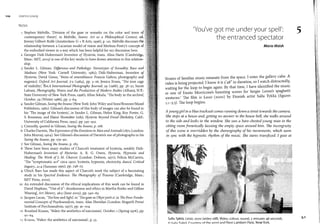
Strains of familiar music emanate from the space. I enter the gallery cube. A
video is being projected. I know it is 3'48" in duration, so I watch distractedly,
waiting for the loop to begin again. By that time, I have identified the music
as one of Ennio Morricone's haunting seores for Sergio Leone's spaghetti
westerns.' Toe film is Lasso (2000) by Finnish artist Salla Tykka (figures
5.1-5.3). Toe loop begins.
A young girl in a blue tracksuit comes running down a street towards the camera.
She stops at a house and, getting no answer to the house-bell, she walks around
to the side and looks in the window. She sees a bare-chested young man in the
sitting room frenetically lassoing the empty space around him. The incongruity
of this scene is overridden by the choreography of his movements, which seem
in sync with the hypnotic rhythm of the music. She stares transfixed. I gaze at
Salla Tykka, Lasso, 2000 (video still). Video, colour, sound, 3 minutes 48 seconds.
!n C::.11:. T"kk,i íni irtP,v nfthP r1rti<;t r1nd Yvon Lambert Paris. New York.
5.1

Joanna Lowry - Proyectando Síntomas - Inglés.pdf

  • 1.
    Projecting symptoms 4 JoannaLowry In The VisibleandtheInvisibleMauriceMerleau-Pontystruggledwiththedevel­ opment of a theory of vision that would take into account our embodiment, describing the 'chiasmatic' relationship between the viewer and the world, an intertwining through which the world is brought into a kind of visibility. What he felt needed to be put into question and seen as problematic was how the viewer carne to be seen as separate from the world - how the visual ever became positioned as something other, something differentiated and separate from the spectator. Stephen Melville sums up the central issue thus: Vision is the place where our continuity with the world conceals itself, the place where we mistake our contact for distance, imagining that seeing is a substitute for, rather than a mode of, touching - and it is this anaesthesia, this senselessness, at the heart oftransparency that demands our acknowledgement and pushes our dealings with the visual beyond recognition.1 Recent studies theorising the history of the visual have made us more aware of its provisionality, and of the extent to which our relationship to the presumed transparency of vision is in fact the product of complex historical conditions and cultural formations. Melville's comments draw our attention particularly to the way in which the very definition of 'the visual' is predicated upon the construction of a distance between the spectator and the world - a distance that is maintained through the work of culture and through the work of technology. Photographic technologies have provided one key cultural mecha­ nism for defining the place ofthe visual and positioning it in relationship to us. In representingthesubject they also define thesiteof the subject's visibility, the place at which he or she can be seen. They cut through the world; interrupt it, producing difference and distance, and projecting these onto the surface of the paper or the screen. They produce a differentiated space of the visible within which the subject and the spectator are made aware of their otherness and their distance from each other. In this essay I explore sorne of the ways in which contemporary video 1- ---- __,_J...,_�.l .i-1-.. .....+ ..,.,..., ........� ............ l"l-,,;"1"' 'ho+'l:ATPPn tl, p �11hlPrt ::1ncl the
  • 2.
    t4 lni11111.i Iowry spcctator, and the implications that these developments have for the way in which we understand subjectivity as a cultural construction. I argue that through these practices the self that is projected onto these screens is invari­ ably seen as a potentially hysterical self, peculiarly fragile and troubled. We tend, when confronted with these works, to read the signs of the subject's behaviour clinically - as though they were symptoms of a hidden trauma. One way of understanding this phenomenon is to plot its origins in the: early relationship established between photography and mental illness in the nineteenth century. My argument is that the peculiar ambivalence between the clinical and the theatrical that was established in sorne of these images, linked as it was to ideas about the evidential power ofthe photographic image itself, established a powerful discursive space that is still being actively articu­ lated in the gallery today. Toe works that I describe each deploy this discur­ sive space in slightly different ways, but all involve a specific negotiation of the relationship between the spectator and the subject through the way in which they are physically installed, and all of them in sorne sense construct that relationshipas diagnostic, with the subject exhibiting their symptoms to, a clinical gaze. The studio and the clinic Toe development of the concept of mental illness in the nineteenth century involvedaconstellationofideasaround the body as the physicalsite ofobserv­ able symptoms, the performance ofwhich could be captured by both photog­ raphy and film. This construction of a diagnostic apparatus was connected to a production of the hysterical subject through encouraging the patient to perform their symptoms.2 It is possible to trace the historicalcongruence that emerged between the clinic or consulting room and the photographic studio from that period into the present <lay. Toe relationship between the develop­ ment of photographic technologies and the representation of mental illness has been well documented by a number of writers, notably Sander Gilman, Allan Sekula, David Green, Jessica Evans, Suren Lalvani, and Georges Didi­ Huberman.3 Central to all these studies was a recognition that photographic technology provided an unprecedented opportunity for the cultural construc­ tion of the body as a set of visible signs that appeared to satisfy a positivist desire for visual evidence ofhidden mental or emotional states. Drawing on a dominantly Foucauldian perspective, these writers emphasised the role played by these technologies in classifying, monitoring, and essentially producing mental illness as an object ofknowledge. What also emerged in these studies, however, was the observation that in the nineteenth century there was a recurrent concern with the potentially Projecting syrnptorns mine whether the symptomatic behaviour being expressed by the subject was involmitary or performed, and ifit was performed, then could it be seen as an authentic expression ofan inner state or not? These debates, which circulated in the medical and scientific journals of the time, intimated evidence of a mismatch between the positivist ontology embedded in the scientific recep­ tion of these technologies and the popular, performative appropriation of portrait photography as a site for playing with identity and social roles. Toree examples of the photographic documentation of hysterical illness in particular spring to mind, each of which offers sorne insight into the phenomenon with which we are concerned: the photographs of the insane taken by Dr Hugh Diamond at the Surrey County Lunatic Asylum in the 1850s, the set of photographs taken by Osear Rejlander in 1877 to illustrate Darwin's study_ of the expressions of the emotions in man, and the photo­ graphs of female hysterics taken by Albert Londe for the French psychiatrist Jean-Martin Charcot at the Salpetriere Hospital for the Insane in Paris at the end of the nineteenth century. Hugh Diamond, the resident superintendent of the Female Department of the Surrey County Lunatic Asylum in the 1850s, was responsible for the collection of á large archive of photographs of the patients. Sander Gilman has pointed out that these images were being produced at a time when there was a real shift happening in our understanding of the relationship between mind and body.4 Early mechanistic relationships between a notion ofmental pathology and its physical expression were being supplanted by more complex ones and the photography ofthe insane appeared to offer a neutral diagnostic space for the analysis of this. In a paper that Diamond read before the Royal Society in 1856, 'On the application of photography in the physiognomic and mental phenomena ofinsanity', a series ofinteresting observations about the photographic image may be discerned. Firstly Diamond claimed that the photograph spokefor itself- it was objec­ tively accurate. It seemed, therefore, in the terms ofthe positivistic framework within which scientific forms ofphotography were understood at that time, to offer a neutral, dispassionate representation of the symptoms of the patient. Secondly, he suggested, its archival capacity meant that it offered the potential for the cataloguing ofa psychopathology. Thirdly, perhaps most interestingly, he observed thatit offeredthe potential to reveal to patients themselves a repre­ sentation of their own pathological state. Photography, then, might not only play a part in thediagnosis ofa pathology, but might also produce that reflexive moment of self-recognition that could be part of the cure. Gilman describes how Diamond's contemporary, the psychiatrist John Connolly, also noted in response to Diamond's photographs that there was something peculiar to the photographic representation of the expression which could not be replicated thr011oh tr<1rlition<1l form� of rPnrP�Pnbtion• nhr.tr.o-r<>nh" hP nr.tPrl rr.nlrl $15
  • 3.
    ,lo.1111r1 Lowry capture theafter-effect of the impression of a recent muscular agitation, th 'singular expression arising from morbid movements of the mind:5 AnticipatingWalterBenjamin'snotionof theopticalunconscious, Diamon intimated that the camera, disinterestedly mechanical, could'usurp our expe tations by revealing things we <lid not know about ourselves - aspects of ou behaviour that we would not, otherwise, have been able to see. It is easy t see in such an approach the convergence of a set of ideas about the mind, as � hidden space to be revealed through the interpretation of symptoms playedout on the surface of the body and the idea of photography as a privileged screen upon which those symptoms might be projected. It becomes evident that the concept of facial and bodily expression as a special kind of primarily sympto-1 matic sign is supported and sustained by elements of the photographic sign - the indexical, the archival, the mechanistic, the contingent, and the reflexive.i Charles Darwin, writing his book on the Expression of the Emotions in1 Man and Animals in 1871, made extensive use of photographs of the insanej to illustrate his examples;6 It was, he claimed, the insane who suffered ther, strongest emotions, and who gave uncontrolled vent to them. Darwin encoun-:,¡ tered a number, of interesting problems, however, in his analysis of these,, photographic images. Sander Gilman has plotted the ambiguity in Darwin's approach to the photographic image, at one point insisting on the veracity of the clinical image - and utilising it precisely because it seemed to indicaté verifiable evidence of the emotional states with which he was concerned - and at another point employing the well-known photographer Osear Rejlander to make photographs of actors posing to represent the emotions. Gilman argues that towards the end of his study Darwin became increasingly sceptical about the veracity of the photographic image and the difficulty of distinguishing within it between the authentic and the performed.7 Toe very same issues concerning the relationship between authenticity and performance were central to the discussions around photography that were taking place at the Salpetriere Hospital for the Insane in Paris between 1876 and 1888.8 Toe principal psychiatrist, Charcot, was celebrated for his investi­ gation of hysteria. Every Tuesday he would hold public audiences at which he would lecture about his patients to the assorted congregation of doctors, students, and general public, bringing them along to act out their hysterical symptoms in public. Through hypnosis he was able both to suppress their symptoms and encourage them to replay their maniacal behaviour to order. He also collected a huge archive of photographs of the patients, which he used to illustrate his emerging classification of hysterical symptoms. One of the most interesting aspects of this practice is the shift that is registered in Charcot's work from a use of photography that was essentially classificatory into one that was diagnostic and which indeed ultimately involved the use of 11 _ ..l _ __ _ ---'- _.CL----4-........! ........l ......�.....+.,..........,.."' 9 Projecting symptoms It is clear, furthermore, that there were a number of interesting paral­ lels between the theatre of the asylum and the popular theatre. Many of the gestures and expressions ofthe women bore close resemblance to the stylised melodramatic gestures of contemporary actors. Indeed, one of the great concerns at the heart of Charcot's work was the issue of performance. How could he be sure that the women's symptoms were authentic and that they weren't simulating them? Toe concern was intensified by the popular belief that one of the key qualities of the hysteric was her tendency towards theat­ rical performance and dramatic effect. On the one hand, Charcot believed that thephotograph was a disinterested scientific tool, allowing for the cataloguing andclassification of a number of psychiatric diseases, and indeed allowing for a level of scrutiny of the subject that might expose any artífice or deception. On the other hand, he was complicit in the construction of a photographic theatre that actively incited the reproduction of a symptomatology. These examples drawn from the nineteenth century are significant because theyreveal theemergence of an uncertainty in our relationship to photograph­ ically based images that has remained with us ever since. Whilst photography offered an unprecedented objective recording of the physical presence of a person, its invention coincided with the development of complex models of the self and the psyche that rendered such recordings unreliable. This paradox wasplayed out through the convergence of a clinical and a photographic gaze, linked to the diagnostic interrogation of the performance of the self. Whilst, therefore, the rules for constructing a neutralised scientific space of observation might be elaborate and considered, they also had a tendency to be imperfect and difficult to maintain and control. One of the cultural legacies of this history is, I would argue, a continuing uncertainty in our understanding of the relationship of the performing subject to the image, and also a pervasive ambiguity in our understanding of the kind of performance space represented by the camera. This space is one that often shifts uncertainly between being a theatreanda clinic, a workshop, anda laboratory. If thereisa backdrop curtain in a photographic image, then its function can be twofold, both to set a scene and to screen it off. In either case, however, we are considering, as a result of the gradual embedding of these pictorial conventions, a peculiar convergence within photographic technologies themselves of visual discourses concerned withunderstanding the psychological stateof the subject. Itispossibleto think, therefore, about photography as constituting a particular type of cultural site for the production of the self. It is a site that can be thought of as bounded by a distinctive relationship between the surface of the print as a place on which the identity of the subject is inscribed, and the confined, hybrid space within which that identity is performed for us. It has become established as a concentrated source ofknowledge about the psychological state of the subject - :::1 i;;:n�rp -in ,.,.rh1;.1, Pi.TPl'"l.T <TPct11rP ,...,,.... PVTI"l"OC'C-ÍA-ri -ici +n. ha ?a..-,,...:1 ........ n .........................+........,_ 97
  • 4.
    Jurn111,1 1 owry 'lhediscursive convergence between theatre and clinic has had a powerf1 influence on the development of contemporary variations on the theme ofth portrait, particularly in the realm of video art, where, since the early exper ments of performance artists in the 1960s and 1970s the self is often portraye on screen asa hystericalsubject on the verge of breakdown: weeping, shoutin laughing, confessing, and always in extremis. Toe figure of the performanc artist that dominates·this particular moment in history is an agonistic subjec performing to the camera in his or her studio, subjecting the body to humilil ating feats of endurance or narcissistically interrogating his or her own image and confessing his or her own abjection. Artists such as Vito Acconci, Marina Abramovic, and Bruce Nauman all played a role in establishing the site of video performance as one in which the very basis of the psychic integrity of the person could be routinely subjected to stress, interrogation, and degrada­ tion. Toe video recording of a performance, with its rough, real-time presence became a vehicle of the construction of a discursive space that sought to link concepts of authenticity (registered by the recording itself) and performa­ tivity, the space of performance being established as one in which the self might be effectively dismantled. In these scenarios the psychological subject that emerged was often presented as deeply unstable. Artists engaged in the monotonous repetition : of acts or words for hours on end, talking to themselves through the camera, masturbating or hitting themselves, or reproducíng sorne banal activity: • Marina Abramovic brushingher hair with increasingviolence, or Vito Acconci thrusting his fist in and out of his mouth, so repeatedly and intensely that it eventually became an act of violent self-abuse. Toe performance to camera rapidly became established, almost by default, as the site of a kind of psychic working through of a trauma, a privileged site for acting out the limits of what it means to be a person. Recorded by the camera, the bare studio spaces in" which these activities· took place were at once a theatre and a laboratory. In this space all of the wider connotations of identity were stripped away and the subject was exposed to a more acute scrutiny. From the spectator's position, beyond the fourth wall, the performers were examined with a kind of dispas­ sionate dissociation. Toe assumption that lies behind these practices is that this space, marked out by the narrow margin between the blank studio wall and the screen, is a space within which the fragility of the psyche can be fully tested and revealed. It is clear here that there are similarities between the development of photography as a space for the performance of unstable psychologies in the nineteenth century and the emergence of the video screen as a site for the performance of hysterical behaviour in the latter half of the twentieth century. Notwithstanding the differences between the two technologies and •.1.... r, �J�.r.r. ........,......... ,L-,1-.......-t--or- ..-,,h,,.n+ mDrl-i11m_cn�r1"hrlhr Pn<TPnrl PrPrl 'hv P�rh of thPm� T Projecting symploms would argue that they both share a commonformation, each of them founded, in the early years of their production, as technologies for the performance of the self. These two means of visual reproduction, video and photography, have thus become established in contemporary practice as apparatuses for the production of subjectivity and are. thereby linked to a psychic economy that is intrinsically fragile. This is an economy in which the subject, whether posing for a photographic portrait, or performing on the screen, is invariably on the brink of dissolution, is always potentially hysterical. Toe experiments of the early performance artists of the 1960s were replayed in a new form in the 1990s in work by artists such as Gillian Wearing and Sam Taylor-Wood who also deployed the use of real-time recording in a quasi­ clinical setting to explore notions of psychic instability. Wearing's. classic Confess All On Video. Don't Worry You Will Be In Disguise. Intrigued? Call · Gillian (1994), which features long monologues by masked individuals telling their terrible secrets, was perhaps the most well-known work among many of that period which deployed the confessional discourse of the clinical/thera­ peutic context as a space of revelation. Wearing's work was always reflexive in its use. of medium: the comical masks worn by her subjects, whilst offering them the security of anonymity, also cocked a snook at the cameras ability to show the truth, and posed the fundamental question of how we read any face. In her other work, too, Wearing constantly drew attention to the complicity of the medium in the performance of self, using strategi�s such as playing tapes backwards or re-dubbing voices over actors' bodies. Taylor-Wood exploited the ambivalence of performance and hysteria and paid actors to act out the extremes of emotion. In Method in Madness (1994) she employed a method actor to act out a gradual emotional breakdown to the camera; in a series called Crying Men (2002) she photographed a number of celebrity figures in tears. Toe ambivalence of the performed emotion was also explored in extremis by Bill Viola, whose portraits of actors performing a variety of exaggerated emotions, from joy to despair, were replayed in slow motion whilst framed as traditional portraits on the wall in the ensemble installation of The Passions (2003). Toe state-of-the-art, mesmerising clarity of these recordings provided a foil to the deconstructive power of the technology, which was, in effect, looking for the chinks in the performance, yet revealing it as a seamless whole. Through their use of both actors and ordinary people, these artists interrogated the ontology of performance. But what is also clear is that video art became the site of a peculiar visibility of the body under stress. If video was established in the 1970s as perhaps the most significant site for the performance of the instability of the self, in more recent years this phenomenon has been intensified by the emergence of the large screen as a site for its projection� ·Toe large-scale projected image of the subject under stress has helved to consolidate the gallerv as a vlace where we engage in 99
  • 5.
    o Jornma Lowry akind of diagnosis of the contemporary subject. Toe technology of videoi 'projection' intensifies focus on 'projection' as á psychological mechanism{ which implicates the viewer. Thus, the new apparatus of video (large-screen,5 digital projectiort) has increasingly emerged as a privileged cultural site for the definition ofmodern subjectivity. Stripped of ali external contextual refer­ ences, and subjected to the rigidity of the video artist's stipulations, clinically interrogated by the lens, our frailty and perversity is exposed at that very moment at which the video camera starts recording. Projections, symptoms, and therapy Perhaps perversely, it is in the new form of large-screen video projection that the technologies of photography arid video have become. most closely inter­ related, for it is in this space of installation that the kinds of spectatorship each demands are most closely allied. Toe use of extreme, slowed-down tempo­ rality which accompanies many artists' use of video projection .-e including Sam Taylor-Wood, Bill Viola, and, famously, Douglas Gordon - confirms this convergence between the still and moving image. Works by these artists produce a video time that tends either towards stasis, repetition, and the loop, or alternatively towards an extended sense of presentness that is experienced as actually resistant to time. Toe diagnostic gaze that we have inherited from photography's historical complicity in the nineteenth-century preoccupation with physipgnomy as an indicator of social or mental pathology is implicit in the way we address images in this space. In 1995, for a work called Hysterical, the artist Douglas Gordon acquired sorne original film footage of two doctors subduing a hysterical woman (figure 4.1). Toe film was originally made in 1908 by the Italian filmmaker Roberto Omegna, in collaboration with the neurologist Camillo Negro. Toe woman, presumably a patient, is masked. As she falls into a hysterical fit the two doctors attempt to control her. In the ensuing sequence, as she is forced into submission on the hospital bed, a seemingly brutal struggle ensues. Gordoil looped the footage, projecting it onto two slightly misaligned screens, each showing the same sequence, but each slowed down at a slightly different rate so that it was impossible to see the whole at once, or to make sense of the space between the two scenes. There was always something happening on the other screen, something that the spectator might catch out of the corner of his or her eye, something that was evading the gaze. Through the explicit handling and manipulation of film footage the artist was able to disrupt its relationship to the history of film and relocate it in the domain of the psyche, subjecting it to a set of rules that were not unlike those of Freud's dream work - revision, repetition, condensation. Toe repeated film became an obses­ Projecting sympi:omi, Douglas Gordon, Hysterical, 1994-95.Video installation, dimensions variable, black­ and-white, silent, 3 minutes.© Douglas Gordon. Courtesy of Gagosian Gallery. spectator's desire. Looped time will always put into question the authenticity of the original moment. As the scene is repeatedly replayed the gap between the original moment and the performance expands. In the extraordinary, desperáte struggle of the three bodies, the violence becomes less urgent, more like a dance, and as time slows down the long wait between the frames seems to offer the final clue to the origin of the event, to the difference between the 'as it happened' and the 'as we see it now: Gordon's two screens are strategies of interruption; the spectator cannot immerse him- or herself in this scene; it is always in a state of deferral. This work deliberately leaves unanswered, and therefore paradoxically emphasises, a set of questions around the screen, the spectator and the repre­ sentation of hysteria. In the curiously neutralised mise-en-scene of the clinic, with only the blanked-out window and the hospital bed as clues to the origin of the footage, the relationship between the theatrical and the experimental becomes ambiguous and a cultural convergence between the two is effected. Toe repetition of the looped film reiterates both the process of repetition that is centralto theatrical performanceand the repetitivenessof the scientific experi­ mental nrocess. Without anv contextualisation of the film friwment we are 101 4.1
  • 6.
    l<i.11111.i l owry unableto understand why the patientishysterkal, nor the seeming brutalityof the medical team, but what is established is the potential complicity offilm as a medium in the representation ofhysteria. The film documents the hysterical fit, but it a:lso reproduces the repetitive conditions ofthe symptom through its own processes ofrepetition. Furthermore the interior space within which the scene takes place is confirmed as a space bounded by the performance ofthe symptom, its diagnosis, and its management; as a space which we might think ofas a clinic, with the spectator taking on a detached and diagnostic gaze. Furthermore, through the objectification ofthe film itselfon the two screens, placed in the centre ofthe gallery as sculptural objects, the installation draws our attention to the close relationship between the material surface ofthe film as a medium and the clinical theatre ofrepresentations played out upon it. This convergence between film as a medium, the diagnostic gaze, and a theatre ofhysteria was also the subject.ofanother work ofthe same period, made by Gillian Wearing. From 1997-99, for a work called Drunk, the artist worked with a group ofitinerant alcoholics (figures 4.2 and 4.3). She set up an improvised theatre in the street, and a white backdrop was hung up against a wall to designate the studio. Over a number ofweeksWearing had befriendeda group ofalcoholic street drinkers and this became their space ofperformance. Gllllan Wearing, Drunk, 1999. Three-channel video for projection, black-and-white, sciund, 23 minutes. Courtesv of Maureen Palev. Lonrlon. Projecting symptonh Her recording oftheir drunken dissolutionwas then projectedlife-sizeon thrcc interconnected screens, as a triptych. Totally decontextualising the action, thc white rectangle ofthe improvised screen constructed a space ofperformance for the drunken subjects being represented. Por the spectator it was a space ofclinical scrutiny, a space that would clarify and intensify our reading ofthe behaviour taking place within its frame. Toe white monochrome background that was the boundary line of the performance operated as a parody ofthe neutralised space of scientific investigation, both spectacularising but also alienating the spectator from the performers. lt was painful and, sorne critics have claimed, perhaps disturbingly unethical, to watch these inebriated figures perform their drunkenness on the screen, their bodies out of control, their emotions veering between a pathological alienation and extreme explosions ofanger and grief.1 º This was the spectacle ofwhat happens to the body when the mind loses control, yet in this context it was difficult for the spectator to discern where authenticity ended and performance began. It was only the final fall into comatose unconsciousness that confirmed a kind oftruth. Both of these works of art employ subtle conventions to position the spectator in a slightly deflected relation to the troubling scene that is being enacted. Through thedevicesofsplitting the screen, or, in Gordon's case, dupli- Gillian Wearing, Drunk, 1999. Three-channel video for projection, black-and-white, n 1 1 - _, _ 103 4,3
  • 7.
    104 111,11111,1 lowry i.:alingit, the position of the observer is displaced from any direct engagemen wilh the participants in the scene. Toe spectator is, through this deflectim positioned so that he or she cannot identify with the subject, but must instea observe them. In each case he or she is confronted with the spectacle of clinical theatre and is thereby situated in a place from which the subject behaviour demands not to be engaged with or responded to, but instead to b V •. 1ead as a set of sympt�signs of sorne invisible and unarticulated traumt, Both these works use the quasi-clinical heritage of photographic technologie to define the individual subject as inherently unstable and hysterical, and tof, establish the screen of video projection as a site for the display and perforJ manee of their symptoms. Toe medium of video projection has thus become, in a very material way, associated with a particular way of understanding what it is to be a person in contemporary society. However, developments in the way in which video portraits have been installed in recent years have given their relationship with the spectator an '::/::.. added complexity. Toe size and scale of these projectionsand their architectural .¡.__ presence situate them in a very different domain from that of work displayed on a monitor. And the emphasis on a confrontation with the face itself means that the spectator's relationship to the subject is of a very different kind from that represented by the two works described above. In both cases the spectator could be a detached observer of hysterical behaviour, whereas in these works the subject is larger than life andin a sense confronts thespectator, requiring of them, in sorne obscure and indefinable way, that they read their signs. Between ,()' ' � C:_ - ) r-. l •;,J) ·"- �' ..e '· 1996 and 2003 Thomas Struth recorded a series of large-scale video portraits <½,_ __Q!at were to be ro·ected onto hanging screens. These wefe displayed li¡;­ /J' spectral_p resences around t e uge museum space, the apparatus of projec- tfon subtl�was an archival structure underpinning the work, arguably borrowed from the example of still photographer August Sander's early twentieth-century portraits of subjects classified by profession: Struth's subjects included a number of distinct bourgeois social types, including an architect, a student, an art dealer, Struth's godson, a little girl ... Toe subjects were not selected for their individuality but because, at sorne level, they were fairly unremarkable, resolutely middle-class, benignly typical - their personal histories were unimportant for the work. It was their anonymity and conse­ quently their emptiness as potential spaces for the inscription of meaning and the projection of fantasy that made them compelling. This anonymity initially impelled the spectator to consider these portraits at the level of surface, as occupying the flat dimensions of the screen. Without a sense of a particular person to whom one might begin to ascribe sorne meaning and identity, the faces that were presented to the spectator could only return his or her reading back onto themselves. Their blankness refused any narrative coding of the time of the oose. Toe emohasis on snectacularlv 1::mrp_ fnrm;il. ;incl �imnlP Projecting syrnpl.0111', screens also encouraged the spectator to see the screens as modernist objects, drawing attention to the elusive materiality of the surface of the screen itselC reiriforcing the fact that, though it offered a representational depth, the screen was also an object that was absolutely without depth, absolutely thin: one could walk behind it. These screens, though, also operated as sites for exposing the self under a certain duress. Toe subjects sat or stood for a whole hour in front of the camera, as still as possible, their concentration occasionally interrupted by the blinkof an eye, a slight wriggle of the body or shifting of their pose.Under the imposition of the rigid terms of engagement they entered into a trance-like state, alternating almost imperceptibly between a subtle self-consciousness in front of the camera and a withdrawn meditative state, flickering in between the place of being and the requirement to become a sign. At times it seemed that these people were on the brink of becoming so self-absorbed that they might slip out of visibility itself, withdraw into sorne other imaginary space and leave one with only the surface of the screen to gaze at. Toe relation­ ship between the surface materiality of the image and the performance was absolutely fragile and thin. But in that context the subject seems fragile too, holding him- or herself together for the sake of the recording. In this sense, despite the calmer tone of these works, which contrasts with those earlier video pieces I have discussed, Struth's works could, perhaps surprisingly, be seen to reinforce the sense of the screen as a site for the inscription of our psychic fragility. -One way offñterpreting these portraits is as being about the way in which ��ituted as subjects in a technological culture; they dramatise the tension between technologies of surveillance and the sélf-determination of -performance that is at the heart of my discussion here. But the works also rarse rmportant questions about the gaze and the significance it takes on in the gallery context. Struth's screens were suspended from the ceiling and hung, angled away from each other so that they could only be looked at one at a time.Holding their pose as still as possible for such a long period of time and staring straight into the camera lens was certainly an exercise in endurance for the subjects, one which had its own power dynamic in relation to the mobile, shiftingaudience that passed through the museumhalls where it was installed. Toe spectator felt compelled to return the gaze, to watch back, but inevitably could not meet the challenge - was out-faced, and turned to move on to the next encounter uncomfortably aware of his or her irrelevance to the subject they had left behind. Part of the discomfiture was of course related to the fact that the gaze that seemed to be directed at the spectator was not directed at him or her at all, but at the camera. Toe very directness of the apparent form of address was in fact an illusion, masking the presence of the filmic apparatus. 'Tl, ,o r"l'l'Y,::H"'., ; ,..., ¾-l-.� r- T�-rr,....,],- ...,,,..,....-,..,,,....,..,._+,...,. ;l ,..., 1-l!- ...l �-�J..!_ .&.L - __! --- _ 1 .C. - 1 _] y_. - •, 105 �
  • 8.
    '"º /1 1,11111,1l 1 1fVIV 1iil' s¡wcialor's gaze, but it was now absent and became a kind of vanishing ¡1oi111 for a returning gaze that could never be met. Whcn faced with works like this, we also feel as though there is a sense in which, in front of the image, it is we who are positioned in the place of !he visible. We are reminded of Lacan's discomfiture in his anecdote about thc sardine can bobbing in the sea, glinting in the sun, not seeing him as he sits in the boat with the laughing fishermen, but nevertheless placing him in the field of the visible.1 1 Now we become aware that the very fact that the subjects of these works don't see us exposes the space of the visible as far from being a continuous plane. It is in fact uneven, fissured, and folded, and we are reminded that this space of visibility is peculiarly complicated by the intervention of the apparatus. It is this fault-line in the visible, at thej>9Jnt of the illusory_C()l1Vergence ()f th;s_e t;;.�Jia�-es=-thejuqfrc:fi:afld_tl-i�_ §pi_�tator's - that defines the difference and the distánce between us. Struth's work can be seen as typical of a genre of contemporary video portraiturecentred on thelargeprojectedface.I havesuggestedthatthere is an ambivalence within this work about how it addresses the spectator, not oE!Y, as the diseng3:ged spe_ct_atQr ofªIU-º.d�rn_i�t_tr_a_cfü_i9I12.p _ t1J aJ_s9_i!_s__�_I1..Qtject of _the gáze produced by the image, and finally and perhaps most fundamentally as a spectator who is 'diagnostic' and who can see and interpret the vulner­ ability of the subject portrayed. This is a hypothesised spectator who can clearly be traced back to the traditions of photographic representation that were discussed earlier in this essay. However, in many contemporary video installations we are no longer positioned asobjective observers by our specta­ torial position; we are positioned instead as embodied spectators in the space; the theatre includes us; it is fundamentally dialogic. In such works there is a convergence between a diagnostic gaze and a space of performance of the self within a dialogical framework.This establishes the space of projection as one that is bounded by the psychical parameters of the therapeutic relationship. In 2006 Phil Collins installed a major piece of work, gerr;egin geri donü�ü (the return ofthe real) (2005), in the Tate Gallery Turner Prize show (figure 4-4). In a long darkened room, empty apart from benches for the spectators clown each side, two projections faced each other. On one wall, at a large scale, there was a series of faces of Turkish individuals who had been partici­ pants in reality TV shows, each recounting in a series of lengthy interviews the impact that this experience had had upon their life.On the opposite wall a separate projection displayed their interviewer. He was himself a director of rcality shows, but in this situation took the role of a kindly counsellor or lhcrapist, eliciting their story, encouraging them to tell more, nodding his asscnl lo their attempts to construct the narrative of their lives, sympatheti­ c,dly c11gaging with their confusion and despair, and, by his very neutral and 11011 j11d¡_,_c111<:11tal nrcsen,f'_ pnrn11r"aina thPm t� �� ,,._+1-,~- ---l ·-11 - Projl'l lÍIIIJ •,y11r¡>l<>III', Phil Collins, ger�egin geri donü�ü (the return ofthe real), 2005. Multi-channel video installation, colour, sound, 60 minutes. lnstallation view, Ausstellungshalle zeitgeni::is­ sische Kunst Münster, 2007. Photo: Thomas Wrede. Courtesy Shady Lane Productions. Whilst the former participants were represented against a blank backdrop - representing the neutrality of the 'studio' as a site of representation - the director was clearly seen in the studio that is the site of production, with all his equipment behind him, theinterviewees' facesbeingsimultaneouslyscreened, as they spoke, on a monitor behind him. This screen, the one displaying the director, therefore represented not only the scene of production but also that of projection, and in this sense it also implicitly complied with the construc­ tion of the kind of narcissistic structuring of video space that was endemic to the forms of early video art referred to above. In such works artists performed to the camera whilst simultaneously being seen performing on the monitor, a form of practice which Rosalind Krauss has famously declared to be charac­ teristic of the medium itself: 'The body ... [is] centred between two machines that are the opening and closing of a parenthesis. The first of these is the camera; the second is the monitor, which re-projects the performer's image with the immediacy of a mirror:12 The interviews, then, in the way in which they were displayed, theatri- 107 4.4 ' ij' ,, 1¡ 1 1 :,1 lji '1 '1 'l. [! j]il ,1, ¡Ji :''¡: 1 !
  • 9.
    108 Joanna Lowry Aspace that seemed initially to be divided equally - two people in dialogtw with each other - was actually the scene of a more complex allegorical repre­ sentation of the very unequal power relations involved in any form of revela­ tory or confessional discourse, and of the role of technology in constructing the parameters of that discourse. Moreover, seated in the dark space between these two screens, it was clear that the audience were very clearly part of thc space defined by that technological apparatus. The interviews, which were monologic in form, were extremely long - between forty minutes and an hour. In an important sense they were banal, undramatic, and apparently unedited. Non-Turkish speakers had to read the subtitles. Video art is no stranger to the epic representation of monotony, repetition, and the everyday; a generation of spectators have been armoured to endure hours of real time recording on the basis that this is an appropriate form for art to take in a consumerist society wedded to melodrama and spectacle. Nevertheless there was something inter­ esting in the fact that so many visitors to the gallery were happy to relapse into a semi-somnolent state listening to the long, detailed biographies of a series of strangers - whilst reading the translations in subtitles. The role of the spectator in such a space is fairly undemanding; indeed, it has passivity thrust upon it. There is no requirement here that he or she <loes anything but watch and listen. There is sorne comparison to be made with the immersive passivity of the cinema experience, but in this context the conse­ quences of the conventions of unedited straight recording limit any sense of imaginative engagement; there is no dramatic structure to engage with, no tension to be felt, and even the requirement to seek sorne documentary truth has been stripped away. Yet there is still a sense that the spectator's passive presence is part of the apparatus, positioned physically at this empty inter­ face between two projections. The spectator is a witness, one who scrutinises the face on the screen, looking for signs of self-possession or disintegration, seeking a glimpse of the truth, trying to match the fleeting expressions to the tone of the voice or the translated subtitles that flicker across the screen. He or shebegins to take up a diagnostic gaze, a disinterested form of observation, matching words to gestures, fleeting expressions, seeing the screen as a surface made up of symptomatic signs rather than as producing a representation of a person. Rosalind Krauss, in her discussion of the narcissism of video practice, saw the reflexive real-time loops that it created as being a mechanism that severed or disconnected the subject from 'text'.13 In the collapsed present that is created by the mirror reflection of video, the subject, she argued, is severed from text, from language, from the public, and from their own psychic history. Shc saw this as a potenÜally regressive form of practice. Collins's installation, 1 would argue, suggests a different inflection of video's narcissism. His instal­ lnl ion rcconstr11c:ts thP .�n�rp nf virlPn nrriiPrtirm "º " thPr'lnPni-;...- Th p�f-va AV O ·- - . - . , Vl ">v7...t_.¿,: ,- f .. ' )-''?) �,( , ' ·_.,, ;; -·/ e) .__/-.)':." .· /LL-l,-q-1.t?__Ct.} {.(::-�""")- "..(,,, "- -;t: <:el .�,, +(' (,_/:,/ (,- _ / � (' .. > • ' ,r. ,,··"'': � � ,• { / { f ' ,-1 _ ( Projecting syrn¡ 110111•, consulting room. The gallery space in this context has all the qualitics of the communicational space of analysis. The temporal conflation that Krauss described is spatialised in thisinstallation and, far from being about the evacu- ation of text, in this dramatised encounter we can see the subject becoming text, enacting the story through which they have become who they are. Their words are made visible through so many forms of recording and translation, their huge faces presented not as signs of identity but primarily as symptoms of sorne hidden unstable state. The projected image on screen in the gallery has become positioned as a peculiarly privileged site for the representation of the individual and for the definition of a modern form of unstable subjectivity. Stripped of all externa! contextual references, and subjected to the rigidity of the photographer's or filmmaker's stipulations, clinically interrogated by the lens, the individual's frailty is exposed at that very moment at which the video camera starts recording. Like the silent therapist in the chair at the end of the couch, the spectator's presence enables the symptomatic structure of the subject to be articulated, spoken, and made visible. The darkened gallery takes on the characteristics of a kind of consulting room, the screen becomes a site for the production of symptoms and the subject on the screenjre-gm:xe.s-­ tliat familiar 'chmcal subJect that wenave encountered befor�. In this instal­ lation the entire viewing space has been physically commandeered by a thera­ peutic discourse in which we appear to be literally placed inside the dialogical relationship created by the confessional structure of the piece. Stephen Melville's observations about the instability of the relationship between viewer and viewed, and the problematic that he opens up when he asks how it is that we can be enabled to separate those positions, are important. They suggest a way of looking at the technologies that we use in the creation of artworks as mechanisms for the production of a problematised definition of the visible; it is an approach that implies indeed that visibility is hard-won and that spectatorship is something that has to be continually constructed and defined. In this essay I have tried to suggest that video projection as a technology for the production of art about the self has developed in the partic­ ular way it has partly as a result of a historically constituted set of discourses around mental illness and photography that stretch back into the nineteenth century. As a result of this the positions offered to the spectator by these works are always situated in a web of historically constituted discourses, discourses which suggest a clinical or diagnostic relationship between the spectator and the subject and which frame the modern self that is represented there as a set of symptoms. The argument is, perhaps, that the history of video instal­ lation is above all a cultural one, carrying the traces of discourses that have complex and entangled histories, the influence of which continue to permeate the spaces of projection. 109
  • 10.
    110 Joanna Lowry Notes 1Stephen Melville, 'Division of the gaze or remarks on the color and tenor contemporary theory', in Melville, Seams: Art as a Philosophical Context, cd,.. Jeremy Gilbert-Rolfe (Amsterdam: G + B Arts, 1996), p. 121. Melville discusses tht relationship between a Lacanian model of vision and Merleau-Ponty's concept the embodied viewer in a way which has been helpful for my discussion here. 2 GeorgesDidi-Huberman's Invention of Hysteria, trans. Alisa Hartz (Cambridg,�1 Mass.: MIT, 2003) is one of the key works to have drawn attention to this relation• ship. 3 Sander L. Gilman, Difference and Pathology: Stereotypes of Sexuality, Race and Madness (New York: Cornell University, 1985); Didi-Huberman, Invention cf .· Hysteria;David Green, 'Veins of resemblance: Francis Galton, photography and eugenics'. Oxford Art Journal, T2 (1984), pp. 3-16; Jessica Evans, 'Toe iron cagc of visibility'. Ten.8 International Photography Journal, 29 (1988), pp. 38-51; Suren Lalvani, Photography, Vision and the Productíon of Modern Bodíes (Albany, N.Y.: State University of New York Press, 1996); Allan Sekula, 'Toe body in the archive: October, 39 (Winter 1986), pp. 3-64. 4 Sander Gilman, Seeingthe Insane (New York: John Wiley and Sons/Brunner/Mazel Publishers, 1982). Gilman's discussion of this body of images can also be found in his 'Toe image of the hysteric', in Sander L. Gilman, Helen King, Roy Porter, G. S. Rousseau, and Elaine Showalter (eds), Hysteria Beyond Freud (Berkeley, Calif.: University of California Press, 1993), pp. 345-452. 5 Connolly, quoted in Gilman, Seeíng the Insane, p. 168. 6 CharlesDarwin, TheExpression oftheEmotions in Man andAnimals (1871; London: John Murray, 1904). See Gilman's discussion ofDarwin's use of photographs in his Seeíng the Insane, pp. 179-90. 7 See Gilman, Seeing the Insane, p. 185. 8 There have been many studies of Charcot's treatment of hysteria, notablyDidi­ Huberman's Invention of Hysteria; A. R. G. Owen, Hysteria, Hypnosis and Healing: The Work of J.-M. Charcot (London: Dobson, 1971); Felicia McCarren, 'Toe "symptomatic act'' circa 1900: hysteria, hypnosis, electricity, dance'. Critica! Inquiry, 21:4 (Summer 1995), pp. 748-73- 9 Ulrich Baer has made this aspect of Charcot's work the subject of a fascinating study in his Spectral Evidence: The Photography of Trauma (Cambridge, Mass.: MIT Press, 2002). 10 An extended discussion of the ethical implications of this work can be found in David Hopkins, "'Out of it": drunkenness and ethics in Martha Rosler and Gillian Wearing', Art History, 26:3 (June 2003), pp. 340-63. 11 Jacques Lacan, 'Toe line and light'. in 'Toegaze as Objet petít a'. in The Four Funda­ mental Concepts of Psychoanalysís, trans. Alan Sheridan (London: Hogarth Press/ Institute of Psychoanalysis, 1977), pp. 91-104. 12 Rosalind Krauss, 'Video: the aesthetics of narcissism', October, 1 (Spring 1976), pp. 50-64. 1.1 lüauss, 'Video: the aesthetics of narcissisrn', p. 53. 'You've got me under your spell': 5 the entranced spectator Maria Walsh Strains of familiar music emanate from the space. I enter the gallery cube. A video is being projected. I know it is 3'48" in duration, so I watch distractedly, waiting for the loop to begin again. By that time, I have identified the music as one of Ennio Morricone's haunting seores for Sergio Leone's spaghetti westerns.' Toe film is Lasso (2000) by Finnish artist Salla Tykka (figures 5.1-5.3). Toe loop begins. A young girl in a blue tracksuit comes running down a street towards the camera. She stops at a house and, getting no answer to the house-bell, she walks around to the side and looks in the window. She sees a bare-chested young man in the sitting room frenetically lassoing the empty space around him. The incongruity of this scene is overridden by the choreography of his movements, which seem in sync with the hypnotic rhythm of the music. She stares transfixed. I gaze at Salla Tykka, Lasso, 2000 (video still). Video, colour, sound, 3 minutes 48 seconds. !n C::.11:. T"kk,i íni irtP,v nfthP r1rti<;t r1nd Yvon Lambert Paris. New York. 5.1