Ankit Choudhary Anupam Saxena
Rituparna Datta Rohit Pareek
Sagar Jogani Sunil Kheria
 12/06/2007- Announcement from Ford that it plans to sell Land Rover and Jaguar
 08 2007 - Major bidders were identified Tata Motors , M&M, Ceribrus capital
Management, TPG Capital, Apollo Management India’s
 Tata Motors and M&M arrived as top bidders ($ 2.05b & $ 1.9b)
 03/01/2008– Ford announces Tata as the preferred bidders
 26/03/2008 - Ford agreed to sell their Jaguar Land Rover operations to Tata
Motors.(2.3b)
 02/06/2008– The acquisition was complete
 MOTIVES OF TAKEOVER
 Provide significant potential for revenue synergy
including giving TATA greater international distribution
broader product range and better customer service
skills
 Tata gains access to world class engineering capability
 Strengthens relationship b/w Tata steel and motoring
business
Following Cost Rationalisation initiatives were taken to improve cash flows:
 Single shifts and down time at all three UK assembly plants.
 Supplier payment terms extended from 45 to 60 days in line with industry
standard.
 Receivables reduced by £133 million from 38 to 27 days.
 Inventory reduced by £217m between June 2008 and March 2009 from 70 to 50
days .
 Labor actions
 Voluntary retirement to 600 employees.
 Agency staff reduced by 800.
 Offered leaves to 300 workers of Bromwhich and solihull plant.
 Additional 450 job cuts including 300 managers.
 Agreement with Unions to implement pay freeze and longer working hours
(equivalent to approximately 20% reduction in labor costs.)
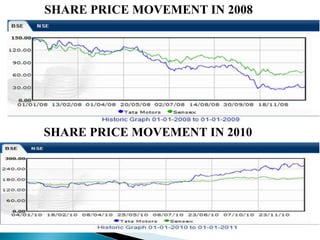
SHARE PRICE MOVEMENT IN 2008
SHARE PRICE MOVEMENT IN 2010
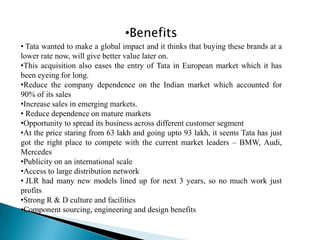
•Benefits
• Tata wanted to make a global impact and it thinks that buying these brands at a
lower rate now, will give better value later on.
•This acquisition also eases the entry of Tata in European market which it has
been eyeing for long.
•Reduce the company dependence on the Indian market which accounted for
90% of its sales
•Increase sales in emerging markets.
• Reduce dependence on mature markets
•Opportunity to spread its business across different customer segment
•At the price staring from 63 lakh and going upto 93 lakh, it seems Tata has just
got the right place to compete with the current market leaders – BMW, Audi,
Mercedes
•Publicity on an international scale
•Access to large distribution network
• JLR had many new models lined up for next 3 years, so no much work just
profits
•Strong R & D culture and facilities
•Component sourcing, engineering and design benefits
 The merger seemed poorly timed
 Demand for luxury cars collapsed as a result of
financial crisis
 Started making profits in 2010 upto 41 %
 Now an example of a successful merger
 Entered CHINA in march 2012 with a joint venture
with Chery automobiles

Jlr

  • 1.
    Ankit Choudhary AnupamSaxena Rituparna Datta Rohit Pareek Sagar Jogani Sunil Kheria
  • 2.
     12/06/2007- Announcementfrom Ford that it plans to sell Land Rover and Jaguar  08 2007 - Major bidders were identified Tata Motors , M&M, Ceribrus capital Management, TPG Capital, Apollo Management India’s  Tata Motors and M&M arrived as top bidders ($ 2.05b & $ 1.9b)  03/01/2008– Ford announces Tata as the preferred bidders  26/03/2008 - Ford agreed to sell their Jaguar Land Rover operations to Tata Motors.(2.3b)  02/06/2008– The acquisition was complete  MOTIVES OF TAKEOVER  Provide significant potential for revenue synergy including giving TATA greater international distribution broader product range and better customer service skills  Tata gains access to world class engineering capability  Strengthens relationship b/w Tata steel and motoring business
  • 3.
    Following Cost Rationalisationinitiatives were taken to improve cash flows:  Single shifts and down time at all three UK assembly plants.  Supplier payment terms extended from 45 to 60 days in line with industry standard.  Receivables reduced by £133 million from 38 to 27 days.  Inventory reduced by £217m between June 2008 and March 2009 from 70 to 50 days .  Labor actions  Voluntary retirement to 600 employees.  Agency staff reduced by 800.  Offered leaves to 300 workers of Bromwhich and solihull plant.  Additional 450 job cuts including 300 managers.  Agreement with Unions to implement pay freeze and longer working hours (equivalent to approximately 20% reduction in labor costs.)
  • 5.
    SHARE PRICE MOVEMENTIN 2008 SHARE PRICE MOVEMENT IN 2010
  • 6.
    •Benefits • Tata wantedto make a global impact and it thinks that buying these brands at a lower rate now, will give better value later on. •This acquisition also eases the entry of Tata in European market which it has been eyeing for long. •Reduce the company dependence on the Indian market which accounted for 90% of its sales •Increase sales in emerging markets. • Reduce dependence on mature markets •Opportunity to spread its business across different customer segment •At the price staring from 63 lakh and going upto 93 lakh, it seems Tata has just got the right place to compete with the current market leaders – BMW, Audi, Mercedes •Publicity on an international scale •Access to large distribution network • JLR had many new models lined up for next 3 years, so no much work just profits •Strong R & D culture and facilities •Component sourcing, engineering and design benefits
  • 8.
     The mergerseemed poorly timed  Demand for luxury cars collapsed as a result of financial crisis  Started making profits in 2010 upto 41 %  Now an example of a successful merger  Entered CHINA in march 2012 with a joint venture with Chery automobiles