Testing & Software
SPECIALISED TOOLS AND CUTTING EDGE TECHNOLOGY
TO GAIN COMPETITIVE ADVANTAGE
Testing & Software
The JK Drop Weight Tester is the authorised specialist
equipment required to conduct the JK Drop Weight
(JKDW) and SMC Test®
. Both tests are proven global
industry standards for ore breakage characterisation.
JKDW and SMC Tests®
are licenced to 37 metallurgical
laboratories across 82 countries. To date over 42,000
tests have been completed across more than 32
different commodities.
Global industry standard based on
Scientific Methodologies
for measuring impact breakage
JK Drop Weight Tester
JK Drop Weight Test
SMC Test®
The JKDW test is now an industry standard for ore
characterisation. It measures resistance of a sample to
impact breakage using JK breakage parameters, A and
b. These parameters are used in JKSimMet for design
and optimisation of AG/SAG mill, HPGR and crusher
circuits. Additional parameters such as t10, ta and Ecs
can also be determined using the JKDW test.
The JKDW test requires 100 kg of crushed rock in the
size range -63+4.75 mm (120 kg of full drill core greater
than 65 mm diameter is also suitable).
The SMC Test®
developed by Dr Steve Morrell of SMC
Testing is a cost-effective means of profiling an ore
body.
The SMC Test®
was originally designed for the
breakage characterisation of drill core. The results
of the SMC Test®
can be used to determine various
parameters such as the Drop-Weight index (DWi),
JK rock breakage parameters A and b, JK abrasion
parameter ta, the t10-Ecs size-energy matrix for
crusher modelling and comminution parameters
Mia, Mih and Mic used for power-based calculations.
Geometallurgical Tests
JKTech also offers a suite of Geometallurgical
Tests for the small mass, high volume
characterisation of processing attributes
and performance.
SMC Testing requires 30 kg of drill core samples or
lump rock remnants from previous testing or from
the parent sample.
When a number of SMC Tests® are to be carried out
on an ore body, it is recommended to perform an
SMC Test®
and a JKDW Test from each ore domain to
provide the best correlation for the ore body profile.
JKTech offers a combined SMC/DWT which is a cost
effective option to calibrate the SMC Test®
results to
that of the full JKDWT.
The Integrated JKDW and SMC Test®
A new form of test has been developed
which enables both JKDW and SMC Test®
parameters to be determined using a
simplified procedure.
The major advantage of the new ‘Integrated
Test’ for clients is being able to obtain both
JKDW and SMC Test®
parameters using a
reduced amount of sample when compared
to performing both tests separately.
Worldwide JKDW, SMC and JKBBM
Quality Control testing ensures
globally reliable results
JK Bond Ball Mill Test
JK Quality Assurance
SAG Circuit Specific Energy
JKTech carries out regular quality control testing
of the laboratories licenced to perform JKDW, SMC
and JKBBM Tests to ensure that results are all within
acceptable statistical limits. This means that clients
can be confident that results are accurate whichever
laboratory performs the testwork.
Due to the non-linear aspect of A*b as a hardness
measure, the SAG Circuit Specific Energy (SCSE)
concept has been introduced as an additional
parameter to enable a more intuitive measure of
ore hardness. The SCSE was developed by extensive
modelling over a range of A*b, ta and SG values,
using the concept of a ‘standard’ SAG mill with
pebble crusher circuit.
The JK Bond Ball Mill (JKBBM) test, is a locked cycle
grindability test conducted using a standard laboratory
Bond Ball Mill with the same steel ball charge and
material feed size (100% passing 3.35 mm) as the Bond
Ball Mill Work Index (BBMWi) test.
The JKBBM test is an improved method which requires
approximately 50% less material than the BBMWi test.
This test can be reliably applied to samples that have
previously been excluded from testing due to mass
limitations. Added benefits of this test is a lower cost
and faster turnaround compared with the BBMWi test
and it is underpinned by the JK Quality Assurance
program.
The JKBBM test requires 5 kg of material, with the
material being crushed to -3.35 mm for the test.
The SCSE parameter is the expected power draw
for the sample when modelled using the ‘standard’
circuit. The SCSE parameter allows a more intuitive
comparison between samples than the A*b
parameters, and is now reported for all JKDW and
SMC Tests®.
Powerful simulation software
applications for Optimisation and
Design
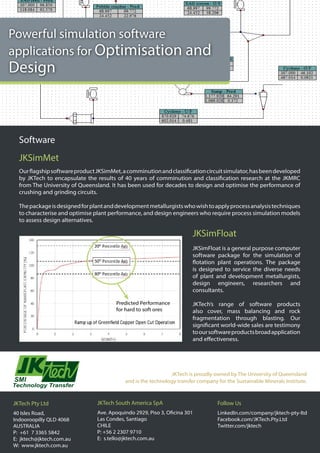
OurflagshipsoftwareproductJKSimMet,acomminutionandclassificationcircuitsimulator,hasbeendeveloped
by JKTech to encapsulate the results of 40 years of comminution and classification research at the JKMRC
from The University of Queensland. It has been used for decades to design and optimise the performance of
crushing and grinding circuits.
Thepackageisdesignedforplantanddevelopmentmetallurgistswhowishtoapplyprocessanalysistechniques
to characterise and optimise plant performance, and design engineers who require process simulation models
to assess design alternatives.
Software
JKSimFloat is a general purpose computer
software package for the simulation of
flotation plant operations. The package
is designed to service the diverse needs
of plant and development metallurgists,
design engineers, researchers and
consultants.
JKTech’s range of software products
also cover, mass balancing and rock
fragmentation through blasting. Our
significant world-wide sales are testimony
tooursoftwareproductsbroadapplication
and effectiveness.
Predicted Performance
for hard to soft ores
JKSimMet
JKSimFloat
JKTech Pty Ltd
40 Isles Road,
Indooroopilly QLD 4068
AUSTRALIA
P: +61 7 3365 5842
E: jktech@jktech.com.au
W: www.jktech.com.au
JKTech South America SpA
Ave. Apoquindo 2929, Piso 3, Oficina 301
Las Condes, Santiago
CHILE
P: +56 2 2307 9710
E: s.tello@jktech.com.au
Follow Us
LinkedIn.com/company/jktech-pty-ltd
Facebook.com/JKTech.Pty.Ltd
Twitter.com/jktech
JKTech is proudly owned by The University of Queensland
and is the technology transfer company for the Sustainable Minerals Institute.

Jk tech testing & software 2017 final 091117 (web)

  • 1.
    Testing & Software SPECIALISEDTOOLS AND CUTTING EDGE TECHNOLOGY TO GAIN COMPETITIVE ADVANTAGE Testing & Software
  • 2.
    The JK DropWeight Tester is the authorised specialist equipment required to conduct the JK Drop Weight (JKDW) and SMC Test® . Both tests are proven global industry standards for ore breakage characterisation. JKDW and SMC Tests® are licenced to 37 metallurgical laboratories across 82 countries. To date over 42,000 tests have been completed across more than 32 different commodities. Global industry standard based on Scientific Methodologies for measuring impact breakage JK Drop Weight Tester JK Drop Weight Test SMC Test® The JKDW test is now an industry standard for ore characterisation. It measures resistance of a sample to impact breakage using JK breakage parameters, A and b. These parameters are used in JKSimMet for design and optimisation of AG/SAG mill, HPGR and crusher circuits. Additional parameters such as t10, ta and Ecs can also be determined using the JKDW test. The JKDW test requires 100 kg of crushed rock in the size range -63+4.75 mm (120 kg of full drill core greater than 65 mm diameter is also suitable). The SMC Test® developed by Dr Steve Morrell of SMC Testing is a cost-effective means of profiling an ore body. The SMC Test® was originally designed for the breakage characterisation of drill core. The results of the SMC Test® can be used to determine various parameters such as the Drop-Weight index (DWi), JK rock breakage parameters A and b, JK abrasion parameter ta, the t10-Ecs size-energy matrix for crusher modelling and comminution parameters Mia, Mih and Mic used for power-based calculations. Geometallurgical Tests JKTech also offers a suite of Geometallurgical Tests for the small mass, high volume characterisation of processing attributes and performance. SMC Testing requires 30 kg of drill core samples or lump rock remnants from previous testing or from the parent sample. When a number of SMC Tests® are to be carried out on an ore body, it is recommended to perform an SMC Test® and a JKDW Test from each ore domain to provide the best correlation for the ore body profile. JKTech offers a combined SMC/DWT which is a cost effective option to calibrate the SMC Test® results to that of the full JKDWT. The Integrated JKDW and SMC Test® A new form of test has been developed which enables both JKDW and SMC Test® parameters to be determined using a simplified procedure. The major advantage of the new ‘Integrated Test’ for clients is being able to obtain both JKDW and SMC Test® parameters using a reduced amount of sample when compared to performing both tests separately. Worldwide JKDW, SMC and JKBBM Quality Control testing ensures globally reliable results JK Bond Ball Mill Test JK Quality Assurance SAG Circuit Specific Energy JKTech carries out regular quality control testing of the laboratories licenced to perform JKDW, SMC and JKBBM Tests to ensure that results are all within acceptable statistical limits. This means that clients can be confident that results are accurate whichever laboratory performs the testwork. Due to the non-linear aspect of A*b as a hardness measure, the SAG Circuit Specific Energy (SCSE) concept has been introduced as an additional parameter to enable a more intuitive measure of ore hardness. The SCSE was developed by extensive modelling over a range of A*b, ta and SG values, using the concept of a ‘standard’ SAG mill with pebble crusher circuit. The JK Bond Ball Mill (JKBBM) test, is a locked cycle grindability test conducted using a standard laboratory Bond Ball Mill with the same steel ball charge and material feed size (100% passing 3.35 mm) as the Bond Ball Mill Work Index (BBMWi) test. The JKBBM test is an improved method which requires approximately 50% less material than the BBMWi test. This test can be reliably applied to samples that have previously been excluded from testing due to mass limitations. Added benefits of this test is a lower cost and faster turnaround compared with the BBMWi test and it is underpinned by the JK Quality Assurance program. The JKBBM test requires 5 kg of material, with the material being crushed to -3.35 mm for the test. The SCSE parameter is the expected power draw for the sample when modelled using the ‘standard’ circuit. The SCSE parameter allows a more intuitive comparison between samples than the A*b parameters, and is now reported for all JKDW and SMC Tests®.
  • 3.
    Powerful simulation software applicationsfor Optimisation and Design OurflagshipsoftwareproductJKSimMet,acomminutionandclassificationcircuitsimulator,hasbeendeveloped by JKTech to encapsulate the results of 40 years of comminution and classification research at the JKMRC from The University of Queensland. It has been used for decades to design and optimise the performance of crushing and grinding circuits. Thepackageisdesignedforplantanddevelopmentmetallurgistswhowishtoapplyprocessanalysistechniques to characterise and optimise plant performance, and design engineers who require process simulation models to assess design alternatives. Software JKSimFloat is a general purpose computer software package for the simulation of flotation plant operations. The package is designed to service the diverse needs of plant and development metallurgists, design engineers, researchers and consultants. JKTech’s range of software products also cover, mass balancing and rock fragmentation through blasting. Our significant world-wide sales are testimony tooursoftwareproductsbroadapplication and effectiveness. Predicted Performance for hard to soft ores JKSimMet JKSimFloat JKTech Pty Ltd 40 Isles Road, Indooroopilly QLD 4068 AUSTRALIA P: +61 7 3365 5842 E: jktech@jktech.com.au W: www.jktech.com.au JKTech South America SpA Ave. Apoquindo 2929, Piso 3, Oficina 301 Las Condes, Santiago CHILE P: +56 2 2307 9710 E: s.tello@jktech.com.au Follow Us LinkedIn.com/company/jktech-pty-ltd Facebook.com/JKTech.Pty.Ltd Twitter.com/jktech JKTech is proudly owned by The University of Queensland and is the technology transfer company for the Sustainable Minerals Institute.