■
176 177TELE-audiovision International — The World‘s Largest Digital TV Trade Magazine — 03-04/2013 — www.TELE-audiovision.com www.TELE-audiovision.com — 03-04/2013 — TELE-audiovision International — 全球发行量最大的数字电视杂志
•	Develops receivers with
complex features
•	Installation of Apps on a
limited basis
•	Android system
requires higher quality
components that results
in higher costs
•	Android is well-suited
for private users but only
limited for cable network
operators
Jiuzhou´s
Android
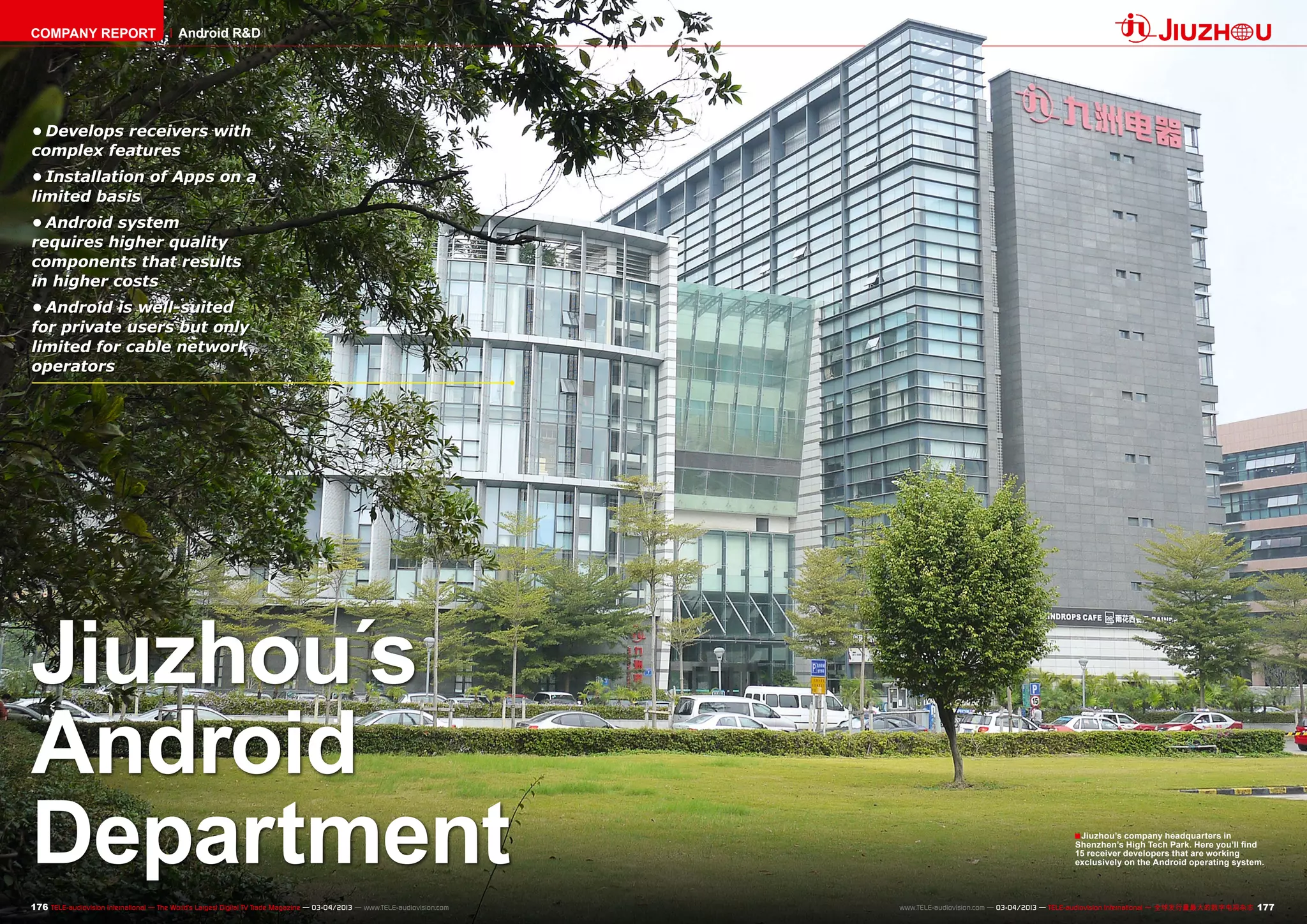
Department Jiuzhou’s company headquarters in
Shenzhen’s High Tech Park. Here you’ll find
15 receiver developers that are working
exclusively on the Android operating system.
COMPANY REPORT Android R&D
■
ë
Shenzhen
■
178 TELE-audiovision International — The World‘s Largest Digital TV Trade Magazine — 03-04/2013 — www.TELE-audiovision.com
Yongjun Zhang is the Android
Product Manager. He’s familiar
with all the advantages and
disadvantages of this operating
system.
Will Android become the
operating system of the future?
With an enormous R&D department,
Jiuzhou has become one of the trailblaz-
ers of large receiver manufacturers for
satellite, terrestrial TV and cable recep-
tion. Quite a few different operating
systems can be found in these receivers
but there’s one operating system that
everyone has been talking about for the
past several years: the Android system.
Here at TELE-audiovision we also have
been expecting that more and more
receivers would appear on the market
with this operating system, yet that
hasn’t really happened. We introduced
one of the first boxes, a DVB-T receiver
- the DTP2100 from Jiuzhou, back in our
11-12/2012 issue. So, is the expected
Android receiver boom now going to get
off the ground?
Who better to answer this question
than the Android receiver Product Man-
ager at Jiuzhou, Yongjun Zhang, who
currently is developing Android prod-
In the 11-12/2012 issue we introduced the new Jiuzhou receiver
DTP2100, one of the first receivers based on the Android operating
system.
www.TELE-audiovision.com/12/11/jiuzhou
COMPANY REPORT Android R&D
1
2
3
4
180 181TELE-audiovision International — The World‘s Largest Digital TV Trade Magazine — 03-04/2013 — www.TELE-audiovision.com www.TELE-audiovision.com — 03-04/2013 — TELE-audiovision International — 全球发行量最大的数字电视杂志
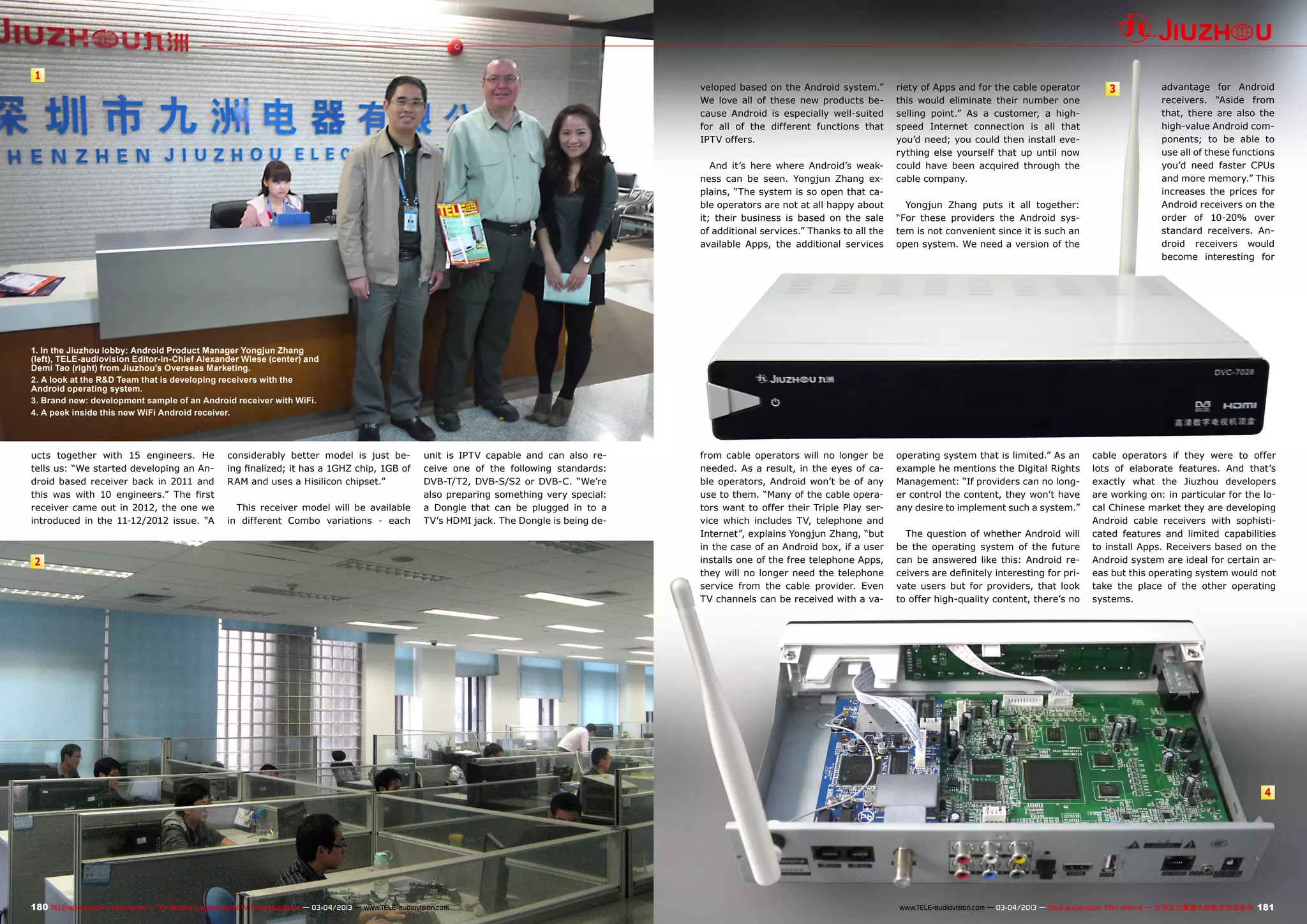
1. In the Jiuzhou lobby: Android Product Manager Yongjun Zhang
(left), TELE-audiovision Editor-in-Chief Alexander Wiese (center) and
Demi Tao (right) from Jiuzhou's Overseas Marketing.
2. A look at the R&D Team that is developing receivers with the
Android operating system.
3. Brand new: development sample of an Android receiver with WiFi.
4. A peek inside this new WiFi Android receiver.
ucts together with 15 engineers. He
tells us: “We started developing an An-
droid based receiver back in 2011 and
this was with 10 engineers.” The first
receiver came out in 2012, the one we
introduced in the 11-12/2012 issue. “A
considerably better model is just be-
ing finalized; it has a 1GHZ chip, 1GB of
RAM and uses a Hisilicon chipset.”
This receiver model will be available
in different Combo variations - each
unit is IPTV capable and can also re-
ceive one of the following standards:
DVB-T/T2, DVB-S/S2 or DVB-C. “We’re
also preparing something very special:
a Dongle that can be plugged in to a
TV’s HDMI jack. The Dongle is being de-
veloped based on the Android system.”
We love all of these new products be-
cause Android is especially well-suited
for all of the different functions that
IPTV offers.
And it’s here where Android’s weak-
ness can be seen. Yongjun Zhang ex-
plains, “The system is so open that ca-
ble operators are not at all happy about
it; their business is based on the sale
of additional services.” Thanks to all the
available Apps, the additional services
from cable operators will no longer be
needed. As a result, in the eyes of ca-
ble operators, Android won’t be of any
use to them. “Many of the cable opera-
tors want to offer their Triple Play ser-
vice which includes TV, telephone and
Internet”, explains Yongjun Zhang, “but
in the case of an Android box, if a user
installs one of the free telephone Apps,
they will no longer need the telephone
service from the cable provider. Even
TV channels can be received with a va-
riety of Apps and for the cable operator
this would eliminate their number one
selling point.” As a customer, a high-
speed Internet connection is all that
you’d need; you could then install eve-
rything else yourself that up until now
could have been acquired through the
cable company.
Yongjun Zhang puts it all together:
“For these providers the Android sys-
tem is not convenient since it is such an
open system. We need a version of the
operating system that is limited.” As an
example he mentions the Digital Rights
Management: “If providers can no long-
er control the content, they won’t have
any desire to implement such a system.”
The question of whether Android will
be the operating system of the future
can be answered like this: Android re-
ceivers are definitely interesting for pri-
vate users but for providers, that look
to offer high-quality content, there’s no
cable operators if they were to offer
lots of elaborate features. And that’s
exactly what the Jiuzhou developers
are working on: in particular for the lo-
cal Chinese market they are developing
Android cable receivers with sophisti-
cated features and limited capabilities
to install Apps. Receivers based on the
Android system are ideal for certain ar-
eas but this operating system would not
take the place of the other operating
systems.
advantage for Android
receivers. “Aside from
that, there are also the
high-value Android com-
ponents; to be able to
use all of these functions
you’d need faster CPUs
and more memory.” This
increases the prices for
Android receivers on the
order of 10-20% over
standard receivers. An-
droid receivers would
become interesting for

Jiuzhou

  • 1.
    ■ 176 177TELE-audiovision International— The World‘s Largest Digital TV Trade Magazine — 03-04/2013 — www.TELE-audiovision.com www.TELE-audiovision.com — 03-04/2013 — TELE-audiovision International — 全球发行量最大的数字电视杂志 • Develops receivers with complex features • Installation of Apps on a limited basis • Android system requires higher quality components that results in higher costs • Android is well-suited for private users but only limited for cable network operators Jiuzhou´s Android Department Jiuzhou’s company headquarters in Shenzhen’s High Tech Park. Here you’ll find 15 receiver developers that are working exclusively on the Android operating system. COMPANY REPORT Android R&D
  • 2.
    ■ ë Shenzhen ■ 178 TELE-audiovision International— The World‘s Largest Digital TV Trade Magazine — 03-04/2013 — www.TELE-audiovision.com Yongjun Zhang is the Android Product Manager. He’s familiar with all the advantages and disadvantages of this operating system. Will Android become the operating system of the future? With an enormous R&D department, Jiuzhou has become one of the trailblaz- ers of large receiver manufacturers for satellite, terrestrial TV and cable recep- tion. Quite a few different operating systems can be found in these receivers but there’s one operating system that everyone has been talking about for the past several years: the Android system. Here at TELE-audiovision we also have been expecting that more and more receivers would appear on the market with this operating system, yet that hasn’t really happened. We introduced one of the first boxes, a DVB-T receiver - the DTP2100 from Jiuzhou, back in our 11-12/2012 issue. So, is the expected Android receiver boom now going to get off the ground? Who better to answer this question than the Android receiver Product Man- ager at Jiuzhou, Yongjun Zhang, who currently is developing Android prod- In the 11-12/2012 issue we introduced the new Jiuzhou receiver DTP2100, one of the first receivers based on the Android operating system. www.TELE-audiovision.com/12/11/jiuzhou COMPANY REPORT Android R&D
  • 3.
    1 2 3 4 180 181TELE-audiovision International— The World‘s Largest Digital TV Trade Magazine — 03-04/2013 — www.TELE-audiovision.com www.TELE-audiovision.com — 03-04/2013 — TELE-audiovision International — 全球发行量最大的数字电视杂志 1. In the Jiuzhou lobby: Android Product Manager Yongjun Zhang (left), TELE-audiovision Editor-in-Chief Alexander Wiese (center) and Demi Tao (right) from Jiuzhou's Overseas Marketing. 2. A look at the R&D Team that is developing receivers with the Android operating system. 3. Brand new: development sample of an Android receiver with WiFi. 4. A peek inside this new WiFi Android receiver. ucts together with 15 engineers. He tells us: “We started developing an An- droid based receiver back in 2011 and this was with 10 engineers.” The first receiver came out in 2012, the one we introduced in the 11-12/2012 issue. “A considerably better model is just be- ing finalized; it has a 1GHZ chip, 1GB of RAM and uses a Hisilicon chipset.” This receiver model will be available in different Combo variations - each unit is IPTV capable and can also re- ceive one of the following standards: DVB-T/T2, DVB-S/S2 or DVB-C. “We’re also preparing something very special: a Dongle that can be plugged in to a TV’s HDMI jack. The Dongle is being de- veloped based on the Android system.” We love all of these new products be- cause Android is especially well-suited for all of the different functions that IPTV offers. And it’s here where Android’s weak- ness can be seen. Yongjun Zhang ex- plains, “The system is so open that ca- ble operators are not at all happy about it; their business is based on the sale of additional services.” Thanks to all the available Apps, the additional services from cable operators will no longer be needed. As a result, in the eyes of ca- ble operators, Android won’t be of any use to them. “Many of the cable opera- tors want to offer their Triple Play ser- vice which includes TV, telephone and Internet”, explains Yongjun Zhang, “but in the case of an Android box, if a user installs one of the free telephone Apps, they will no longer need the telephone service from the cable provider. Even TV channels can be received with a va- riety of Apps and for the cable operator this would eliminate their number one selling point.” As a customer, a high- speed Internet connection is all that you’d need; you could then install eve- rything else yourself that up until now could have been acquired through the cable company. Yongjun Zhang puts it all together: “For these providers the Android sys- tem is not convenient since it is such an open system. We need a version of the operating system that is limited.” As an example he mentions the Digital Rights Management: “If providers can no long- er control the content, they won’t have any desire to implement such a system.” The question of whether Android will be the operating system of the future can be answered like this: Android re- ceivers are definitely interesting for pri- vate users but for providers, that look to offer high-quality content, there’s no cable operators if they were to offer lots of elaborate features. And that’s exactly what the Jiuzhou developers are working on: in particular for the lo- cal Chinese market they are developing Android cable receivers with sophisti- cated features and limited capabilities to install Apps. Receivers based on the Android system are ideal for certain ar- eas but this operating system would not take the place of the other operating systems. advantage for Android receivers. “Aside from that, there are also the high-value Android com- ponents; to be able to use all of these functions you’d need faster CPUs and more memory.” This increases the prices for Android receivers on the order of 10-20% over standard receivers. An- droid receivers would become interesting for