You are cordially invited
to celebration of eternal life in
heaven byJESUS.
Yourpresence ishighly
appreciated
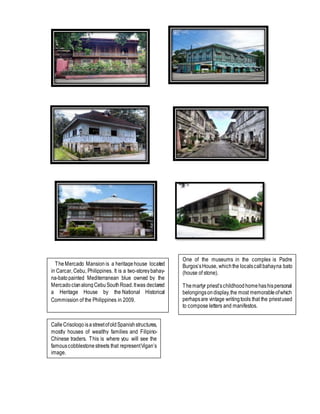
One of the museums in the complex is Padre
Burgos’sHouse, whichthe localscallbahayna bato
(house of stone).
Themartyr priest’schildhoodhomehashispersonal
belongingsondisplay,the most memorableofwhich
perhapsare vintage writingtools that the priestused
to compose letters and manifestos.
TheMercado Mansion is a heritagehouse located
in Carcar, Cebu, Philippines. It is a two-storeybahay-
na-batopainted Mediterranean blue owned by the
MercadoclanalongCebuSouthRoad.Itwas declared
a Heritage House by the National Historical
Commission of the Philippines in 2009.
CalleCrisologo isastreetofoldSpanishstructures,
mostly houses of wealthy families and Filipino-
Chinese traders. This is where you will see the
famouscobblestonestreets that representVigan’s
image.
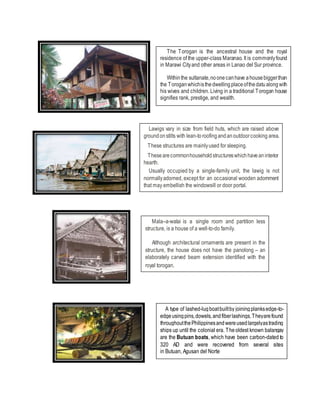
The Torogan is the ancestral house and the royal
residence of the upper-class Maranao. It is commonlyfound
in Marawi Cityand other areas in Lanao del Sur province.
Withinthe sultanate,noonecanhave ahousebiggerthan
the Toroganwhichisthedwellingplaceofthedatualongwith
his wives and children. Living in a traditional Torogan house
signifies rank, prestige, and wealth.
Lawigs vary in size from field huts, which are raised above
groundonstilts with lean-toroofingandanoutdoorcooking area.
These structures are mainlyused for sleeping.
Thesearecommonhouseholdstructureswhichhaveaninterior
hearth.
Usually occupied by a single-family unit, the lawig is not
normallyadorned, except for an occasional wooden adornment
that may embellish the windowsill or door portal.
Mala–a-walai is a single room and partition less
structure, is a house of a well-to-do family.
Although architectural ornaments are present in the
structure, the house does not have the panolong – an
elaborately carved beam extension identified with the
royal torogan.
A type of lashed-lugboatbuiltby joiningplanksedge-to-
edgeusingpins,dowels,andfiberlashings.Theyarefound
throughoutthePhilippinesandwereusedlargelyastrading
ships up until the colonial era. Theoldest known balangay
are the Butuan boats, which have been carbon-dated to
320 AD and were recovered from several sites
in Butuan, Agusan del Norte
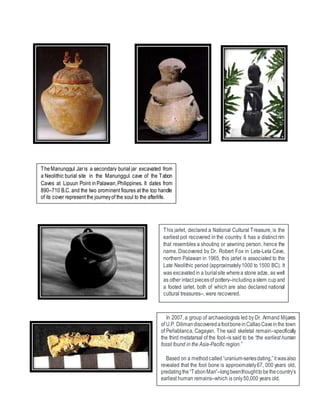
TheManunggul Jaris a secondary burial jar excavated from
a Neolithic burial site in the Manunggul cave of the Tabon
Caves at Lipuun Point inPalawan,Philippines. It dates from
890–710 B.C. and the two prominent figures at the top handle
of its cover represent the journeyof the soul to the afterlife.
This jarlet, declared a National Cultural Treasure, is the
earliest pot recovered in the country. It has a distinct rim
that resembles a shouting or yawning person, hence the
name. Discovered by Dr. Robert Fox in Leta-Leta Cave,
northern Palawan in 1965, this jarlet is associated to the
Late Neolithic period (approximately1000 to 1500 BC). It
was excavatedin a burialsite wherea stone adze, as well
as other intact piecesof pottery–includingastem cupand
a footed jarlet, both of which are also declared national
cultural treasures–, were recovered.
In 2007, a group of archaeologists led by Dr. Armand Mijares
of U.P. DilimandiscoveredafootboneinCallaoCaveinthe town
of Peñablanca, Cagayan. The said skeletal remain–specifically
the third metatarsal of the foot–is said to be “the earliest human
fossil found in the Asia-Pacific region.”
Based on a methodcalled “uranium-seriesdating,”it wasalso
revealed that the foot bone is approximately67, 000 years old,
predatingthe“TabonMan”–longbeenthoughttobethecountry’s
earliest human remains–which is only50,000 years old.
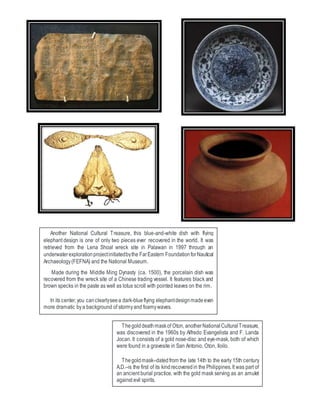
Thegolddeathmaskof Oton, anotherNationalCulturalTreasure,
was discovered in the 1960s by Alfredo Evangelista and F. Landa
Jocan. It consists of a gold nose-disc and eye-mask, both of which
were found in a gravesite in San Antonio, Oton, Iloilo.
Thegoldmask–datedfrom the late 14th to the early 15th century
A.D.–is the first of its kindrecoveredin the Philippines.It was part of
an ancient burial practice, with the gold mask serving as an amulet
against evil spirits.
Another National Cultural Treasure, this blue-and-white dish with flying
elephant design is one of only two pieces ever recovered in the world. It was
retrieved from the Lena Shoal wreck site in Palawan in 1997 through an
underwaterexplorationprojectinitiatedbythe FarEastern FoundationforNautical
Archaeology(FEFNA) and the National Museum.
Made during the Middle Ming Dynasty (ca. 1500), the porcelain dish was
recovered from the wreck site of a Chinese trading vessel. It features black and
brown specks in the paste as well as lotus scroll with pointed leaves on the rim.
In its center,you canclearlyseea dark-blueflying elephantdesignmadeeven
more dramatic bya background of stormyand foamywaves.
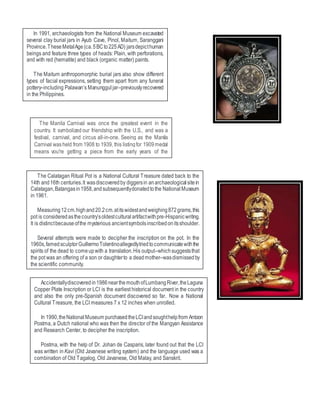
In 1991, archaeologists from the National Museum excavated
several clay burial jars in Ayub Cave, Pinol, Maitum, Saranggani
Province.TheseMetalAge(ca.5BCto225AD) jarsdepicthuman
beings and feature three types of heads: Plain, with perforations,
and with red (hematite) and black (organic matter) paints.
The Maitum anthropomorphic burial jars also show different
types of facial expressions, setting them apart from any funeral
pottery–including Palawan’s Manunggul jar–previouslyrecovered
in the Philippines.
The Calatagan Ritual Pot is a National Cultural Treasure dated back to the
14th and16th centuries.It wasdiscoveredby diggersin anarchaeologicalsitein
Calatagan,Batangasin1958,andsubsequentlydonatedtothe NationalMuseum
in 1961.
Measuring12cm.highand20.2cm.atitswidestandweighing872grams,this
pot is consideredasthecountry’soldestculturalartifactwithpre-Hispanicwriting.
It is distinctbecauseofthe mysterious ancientsymbolsinscribedonitsshoulder.
Several attempts were made to decipher the inscription on the pot. In the
1960s,famedsculptorGuillermoTolentinoallegedlytriedtocommunicatewiththe
spirits of the dead to comeupwith a translation.His output–whichsuggeststhat
the pot was an offering of a son or daughterto a deadmother–wasdismissedby
the scientific community.
Accidentallydiscoveredin1986nearthemouthofLumbangRiver,theLaguna
Copper Plate Inscription or LCI is the earliest historical document in the country
and also the only pre-Spanish document discovered so far. Now a National
Cultural Treasure, the LCI measures 7 x 12 inches when unrolled.
In 1990,theNationalMuseum purchasedtheLCIandsoughthelpfrom Antoon
Postma, a Dutch national who was then the director of the Mangyan Assistance
and Research Center, to decipher the inscription.
Postma, with the help of Dr. Johan de Casparis, later found out that the LCI
was written in Kavi (Old Javanese writing system) and the language used was a
combination of Old Tagalog, Old Javanese, Old Malay, and Sanskrit.
The Manila Carnival was once the greatest event in the
country. It symbolized our friendship with the U.S., and was a
festival, carnival, and circus all-in-one. Seeing as the Manila
Carnival washeld from 1908 to 1939, this listingfor 1909medal
means you're getting a piece from the early years of the
exposition.
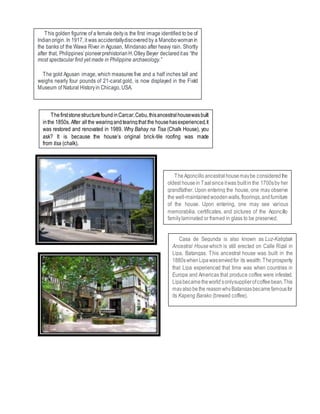
This golden figurine of a female deityis the first image identified to be of
Indianorigin. In 1917, it was accidentallydiscoveredby a Manobowomanin
the banks of the Wawa River in Agusan, Mindanao after heavy rain. Shortly
after that, Philippines’pioneerprehistorianH.Otley Beyer declareditas “the
most spectacular find yet made in Philippine archaeology.”
The gold Agusan image, which measures five and a half inches tall and
weighs nearly four pounds of 21-carat gold, is now displayed in the Field
Museum of Natural Historyin Chicago, USA.
ThefirststonestructurefoundinCarcar,Cebu,thisancestralhousewasbuilt
inthe 1850s. After allthe wearingandtearingthat the househasexperienced,it
was restored and renovated in 1989. Why Bahay na Tisa (Chalk House), you
ask? It is because the house’s original brick-tile roofing was made
from tisa (chalk).
TheAgoncillo ancestralhousemaybe consideredthe
oldest housein Taalsinceitwas builtin the 1700sby her
grandfather. Upon entering the house, one may observe
the well-maintainedwoodenwalls,floorings,andfurniture
of the house. Upon entering, one may see various
memorabilia, certificates, and pictures of the Agoncillo
familylaminated or framed in glass to be preserved.
Casa de Segunda is also known as Luz-Katigbak
Ancestral House which is still erected on Calle Rizal in
Lipa, Batangas. This ancestral house was built in the
1880swhenLipawasenviedfor its wealth.Theprosperity
that Lipa experienced that time was when countries in
Europe and Americas that produce coffee were infested.
Lipabecametheworld’sonlysupplierofcoffeebean.This
mayalsobethe reasonwhyBatangasbecamefamousfor
its Kapeng Barako (brewed coffee).
PHILIPPINE ARTIFACTS and
HOUSES
Project in Arts 5
Philippine Artifacts
Philippine houses

jesus.docx

  • 1.
    You are cordiallyinvited to celebration of eternal life in heaven byJESUS. Yourpresence ishighly appreciated
  • 2.
    One of themuseums in the complex is Padre Burgos’sHouse, whichthe localscallbahayna bato (house of stone). Themartyr priest’schildhoodhomehashispersonal belongingsondisplay,the most memorableofwhich perhapsare vintage writingtools that the priestused to compose letters and manifestos. TheMercado Mansion is a heritagehouse located in Carcar, Cebu, Philippines. It is a two-storeybahay- na-batopainted Mediterranean blue owned by the MercadoclanalongCebuSouthRoad.Itwas declared a Heritage House by the National Historical Commission of the Philippines in 2009. CalleCrisologo isastreetofoldSpanishstructures, mostly houses of wealthy families and Filipino- Chinese traders. This is where you will see the famouscobblestonestreets that representVigan’s image.
  • 3.
    The Torogan isthe ancestral house and the royal residence of the upper-class Maranao. It is commonlyfound in Marawi Cityand other areas in Lanao del Sur province. Withinthe sultanate,noonecanhave ahousebiggerthan the Toroganwhichisthedwellingplaceofthedatualongwith his wives and children. Living in a traditional Torogan house signifies rank, prestige, and wealth. Lawigs vary in size from field huts, which are raised above groundonstilts with lean-toroofingandanoutdoorcooking area. These structures are mainlyused for sleeping. Thesearecommonhouseholdstructureswhichhaveaninterior hearth. Usually occupied by a single-family unit, the lawig is not normallyadorned, except for an occasional wooden adornment that may embellish the windowsill or door portal. Mala–a-walai is a single room and partition less structure, is a house of a well-to-do family. Although architectural ornaments are present in the structure, the house does not have the panolong – an elaborately carved beam extension identified with the royal torogan. A type of lashed-lugboatbuiltby joiningplanksedge-to- edgeusingpins,dowels,andfiberlashings.Theyarefound throughoutthePhilippinesandwereusedlargelyastrading ships up until the colonial era. Theoldest known balangay are the Butuan boats, which have been carbon-dated to 320 AD and were recovered from several sites in Butuan, Agusan del Norte
  • 4.
    TheManunggul Jaris asecondary burial jar excavated from a Neolithic burial site in the Manunggul cave of the Tabon Caves at Lipuun Point inPalawan,Philippines. It dates from 890–710 B.C. and the two prominent figures at the top handle of its cover represent the journeyof the soul to the afterlife. This jarlet, declared a National Cultural Treasure, is the earliest pot recovered in the country. It has a distinct rim that resembles a shouting or yawning person, hence the name. Discovered by Dr. Robert Fox in Leta-Leta Cave, northern Palawan in 1965, this jarlet is associated to the Late Neolithic period (approximately1000 to 1500 BC). It was excavatedin a burialsite wherea stone adze, as well as other intact piecesof pottery–includingastem cupand a footed jarlet, both of which are also declared national cultural treasures–, were recovered. In 2007, a group of archaeologists led by Dr. Armand Mijares of U.P. DilimandiscoveredafootboneinCallaoCaveinthe town of Peñablanca, Cagayan. The said skeletal remain–specifically the third metatarsal of the foot–is said to be “the earliest human fossil found in the Asia-Pacific region.” Based on a methodcalled “uranium-seriesdating,”it wasalso revealed that the foot bone is approximately67, 000 years old, predatingthe“TabonMan”–longbeenthoughttobethecountry’s earliest human remains–which is only50,000 years old.
  • 5.
    Thegolddeathmaskof Oton, anotherNationalCulturalTreasure, wasdiscovered in the 1960s by Alfredo Evangelista and F. Landa Jocan. It consists of a gold nose-disc and eye-mask, both of which were found in a gravesite in San Antonio, Oton, Iloilo. Thegoldmask–datedfrom the late 14th to the early 15th century A.D.–is the first of its kindrecoveredin the Philippines.It was part of an ancient burial practice, with the gold mask serving as an amulet against evil spirits. Another National Cultural Treasure, this blue-and-white dish with flying elephant design is one of only two pieces ever recovered in the world. It was retrieved from the Lena Shoal wreck site in Palawan in 1997 through an underwaterexplorationprojectinitiatedbythe FarEastern FoundationforNautical Archaeology(FEFNA) and the National Museum. Made during the Middle Ming Dynasty (ca. 1500), the porcelain dish was recovered from the wreck site of a Chinese trading vessel. It features black and brown specks in the paste as well as lotus scroll with pointed leaves on the rim. In its center,you canclearlyseea dark-blueflying elephantdesignmadeeven more dramatic bya background of stormyand foamywaves.
  • 6.
    In 1991, archaeologistsfrom the National Museum excavated several clay burial jars in Ayub Cave, Pinol, Maitum, Saranggani Province.TheseMetalAge(ca.5BCto225AD) jarsdepicthuman beings and feature three types of heads: Plain, with perforations, and with red (hematite) and black (organic matter) paints. The Maitum anthropomorphic burial jars also show different types of facial expressions, setting them apart from any funeral pottery–including Palawan’s Manunggul jar–previouslyrecovered in the Philippines. The Calatagan Ritual Pot is a National Cultural Treasure dated back to the 14th and16th centuries.It wasdiscoveredby diggersin anarchaeologicalsitein Calatagan,Batangasin1958,andsubsequentlydonatedtothe NationalMuseum in 1961. Measuring12cm.highand20.2cm.atitswidestandweighing872grams,this pot is consideredasthecountry’soldestculturalartifactwithpre-Hispanicwriting. It is distinctbecauseofthe mysterious ancientsymbolsinscribedonitsshoulder. Several attempts were made to decipher the inscription on the pot. In the 1960s,famedsculptorGuillermoTolentinoallegedlytriedtocommunicatewiththe spirits of the dead to comeupwith a translation.His output–whichsuggeststhat the pot was an offering of a son or daughterto a deadmother–wasdismissedby the scientific community. Accidentallydiscoveredin1986nearthemouthofLumbangRiver,theLaguna Copper Plate Inscription or LCI is the earliest historical document in the country and also the only pre-Spanish document discovered so far. Now a National Cultural Treasure, the LCI measures 7 x 12 inches when unrolled. In 1990,theNationalMuseum purchasedtheLCIandsoughthelpfrom Antoon Postma, a Dutch national who was then the director of the Mangyan Assistance and Research Center, to decipher the inscription. Postma, with the help of Dr. Johan de Casparis, later found out that the LCI was written in Kavi (Old Javanese writing system) and the language used was a combination of Old Tagalog, Old Javanese, Old Malay, and Sanskrit. The Manila Carnival was once the greatest event in the country. It symbolized our friendship with the U.S., and was a festival, carnival, and circus all-in-one. Seeing as the Manila Carnival washeld from 1908 to 1939, this listingfor 1909medal means you're getting a piece from the early years of the exposition.
  • 7.
    This golden figurineof a female deityis the first image identified to be of Indianorigin. In 1917, it was accidentallydiscoveredby a Manobowomanin the banks of the Wawa River in Agusan, Mindanao after heavy rain. Shortly after that, Philippines’pioneerprehistorianH.Otley Beyer declareditas “the most spectacular find yet made in Philippine archaeology.” The gold Agusan image, which measures five and a half inches tall and weighs nearly four pounds of 21-carat gold, is now displayed in the Field Museum of Natural Historyin Chicago, USA. ThefirststonestructurefoundinCarcar,Cebu,thisancestralhousewasbuilt inthe 1850s. After allthe wearingandtearingthat the househasexperienced,it was restored and renovated in 1989. Why Bahay na Tisa (Chalk House), you ask? It is because the house’s original brick-tile roofing was made from tisa (chalk). TheAgoncillo ancestralhousemaybe consideredthe oldest housein Taalsinceitwas builtin the 1700sby her grandfather. Upon entering the house, one may observe the well-maintainedwoodenwalls,floorings,andfurniture of the house. Upon entering, one may see various memorabilia, certificates, and pictures of the Agoncillo familylaminated or framed in glass to be preserved. Casa de Segunda is also known as Luz-Katigbak Ancestral House which is still erected on Calle Rizal in Lipa, Batangas. This ancestral house was built in the 1880swhenLipawasenviedfor its wealth.Theprosperity that Lipa experienced that time was when countries in Europe and Americas that produce coffee were infested. Lipabecametheworld’sonlysupplierofcoffeebean.This mayalsobethe reasonwhyBatangasbecamefamousfor its Kapeng Barako (brewed coffee).
  • 8.
    PHILIPPINE ARTIFACTS and HOUSES Projectin Arts 5 Philippine Artifacts Philippine houses