JESUS WAS THE CORNERSTONE
EDITED BY GLENN PEASE
Psalm118:22 22Thestone the builders rejected has
become the cornerstone;
Question:"What does it mean that Jesus Christ is the cornerstone?"
Answer: In ancient building practices, the cornerstone was the principal stone
placed at the corner of the edifice. The cornerstone was usuallyone of the
largest, the most solid, and the most carefully constructedof any in the edifice.
Jesus describes Himselfas the Cornerstone that His church would be built
upon, a unified body of believers, both Jew and Gentile.
The Book ofIsaiah has many references to the Messiahto come. In several
places He is referred to as “the Cornerstone,” suchas in Isaiah 28:16-17:“So
this is what the sovereignLord says:‘See, I lay a stone in Zion, a tested stone,
a precious cornerstone for a sure foundation; the one who trusts will never be
dismayed. I will make justice the measuring line and righteousness the plumb
line.’” God is speaking to scoffers and boasters whenHe refers to the
Cornerstone—His precious Son—who provides the firm foundation for their
lives, if they would but trust in Him. Isaiahuses constructionterminology
(measuring line and plumb line) to make his point; these are things the people
in his time would understand.
In the New Testamentthe cornerstone metaphor is continued. This time,
however, the apostle Paul is preaching to the Ephesian Christians for the
purpose of helping them know Christ better. In chapter 2, verses 19-21, the
comparisonbetweenJesus and Cornerstone becomes veryclear:
“Consequently, you are no longer foreigners and aliens, but fellow citizens
with God’s people and members of God’s household, built on the foundation
of the apostles and prophets, with Christ Jesus himself as the chief
cornerstone. In him the whole building is joined together and rises to become
a holy temple in the Lord.” Furthermore, in the 1 Peter 2:6, what Isaiahsaid
centuries before is affirmed in exactly the same words.
What a marvelous book is the God-inspired Bible! Peteruses construction
terms for his hearers, just as Isaiahdid, both knowing their audiences would
be familiar with them. Also, they both use “Cornerstone”to represent the
Messiah, One whom Peterknew personally, and whom Isaiahonly knew
through the heavenly Father’s promise. Their words bore out what Jesus was
to say as recordedin the Gospelof John, “I am the way and the truth and the
life. No one comes to the Fatherexcept through me” (John 14:6).
https://www.gotquestions.org/Jesus-Christ-cornerstone.html
SPURGEON IN TREASURYOF DAVID, "EXPOSITION
This passage( Psalms 118:22-27) will appearto be a mixture of the
expressions ofthe people and of the hero himself.
Verse 22. The stone which the builders refused is become the head stone of the
corner. Here the people magnify God for bringing his chosenservantinto the
honourable office, which had been allotted to him by divine decree. A wise
king and valiant leader is a stone by which the national fabric is built up.
David had been rejectedby those in authority, but God had placed him in a
position of the highest honour and the greatestusefulness,making him the
chief cornerstone ofthe state. In the case of many others whose early life has
been spent in conflict, the Lord has been pleasedto accomplishhis divine
purposes in like manner; but to none is this text so applicable as to the Lord
Jesus himself: he is the living stone, the tried stone, elect, precious, which God
himself appointed from of old. The Jewishbuilders, scribe, priest, Pharisee,
and Herodian, rejectedhim with disdain. They could see no excellence in him
that they should build upon him; he could not be made to fit in with their
ideal of a national church, he was a stone of another quarry from themselves,
and not after their mind nor according to their taste;therefore they casthim
awayand poured contempt upon him, even as Petersaid, "This is the stone
which was set at nought of you builders"; they reckonedhim to be as nothing,
though he is Lord of all. In raising him from the dead the Lord God exalted
him to be the head of his church, the very pinnacle of her glory and beauty.
Since then he has become the confidence of the Gentiles, even of them that are
afar off upon the sea, and thus he has joined the two walls of Jew and Gentile
into one stately temple, and is seento be the binding cornerstone, making both
one. This is a delightful subject for contemplation.
Jesus in all things hath the preeminence, he is the principal stone of the whole
house of God. We are accustomedto lay some one stone of a public building
with solemn ceremony, and to deposit in it any precious things which may
have been selectedas a memorial of the occasion:henceforth that cornerstone
is lookedupon as peculiarly honourable, and joyful memories are associated
with it. All this is in a very emphatic sense true of our blessedLord, "The
Shepherd, the Stone of Israel." Godhimself laid him where he is, and hid
within him all the precious things of the eternalcovenant; and there he shall
for everremain, the foundation of all our hopes, the glory of all our joys, the
united bond of all our fellowship. He is "the head over all things to the
church," and by him the church is fitly framed together, and growethunto a
holy temple in the Lord. Still do the builders refuse him: even to this day the
professionalteachers ofthe gospelare far too apt to fly to any and every new
philosophy soonerthan maintain the simple gospel, whichis the essenceof
Christ: nevertheless, he holds his true positionamongst his people, and the
foolish builders shall see to their utter confusionthat his truth shall be exalted
over all. Those who reject the chosenstone will stumble againsthim to their
own hurt, and ere long will come his secondadvent, when he will fall upon
them from the heights of heaven, and grind them to powder.
EXPLANATORY NOTES AND QUAINT SAYINGS
Verse 22. The stone. The head stone of the corner. Christ Jesus is a stone:no
firmness, but in him. A fundamental stone:no building, but on him. A corner
stone:no piecing nor reconciliation, but in him. James Ford, 1856.
Verse 22. The stone which the builders rejected, etc. To apply it to Christ,
"The Stone" is the ground of all. Two things befall it; two things as contrary
as may be, --
Refused, castaway;then, called for again, and made head of the building. So,
two parts there are to the eye.
The refusing;
The raising; which are his two estates,his humiliation, and his exaltation. In
either of these you may observe two degrees, a quibus, and quosque, by whom
and how far. By whom refused? We weighthe word, aeificantes:not by men
unskilful, but by workmen, professedbuilders; it is so much the worse. How
far? We weigh the word, -- reprobaverunt; usque ad reprobari, even to a
reprobation. It is not improbaverunt, disliked, as not fit for some eminent
place;but reprobaverunt, utterly reprobate, for any place at all.
Again, exalted, by whom? The next words are a Domino, by God, as gooda
builder, nay, better than the best of them; which makes amends for the
former. And How far? Placedby him, not in any part of the building; but in
the part most in the eye (the corner), and in the highestplace of it, the very
head.
So, rejected, and that by the builders, and to the lowestestate:and from the
lowestestate exaltedin caput anguli, to the chiefestplace of all; and that by
God himself. Lancelot Andrewes.
Verse 22. The stone which the builders refused, etc. We need not wonder, that
not only the powers of the world are usually enemies to Christ, and that the
contrivers of policies, those builders, leave out Christ in their building, but
that the pretended builders of the church of God, though they use the name of
Christ, and serve their turn with that, yet rejecthimself, and oppose the
powerof his spiritual kingdom. There may be wit and learning, and much
knowledge ofthe Scriptures, amongstthose that are haters of the Lord Jesus
Christ, and of the powerof godliness, and corrupters of the worship of God. It
is the spirit of humility and obedience, and saving faith, that teachmen to
esteemChrist, and build upon him. The vanity and folly of these builders'
opinion appears in this, that they are overpoweredby the greatArchitect of
the church: his purpose stands. Notwithstanding their rejectionof Christ, he
is still made the head cornerstone. They casthim awayby their reproaches,
and by giving him up to be crucified and then castinto the grave, causing a
stone to be rolled upon this stone which they had so rejected, that it might
appear no more, and so thought themselves sure. But even from thence did he
arise, and became the head of the corner. Robert Leighton.
Verse 22. The stone which the builders refused, etc. That is to say, God senta
living, precious, chosenstone on earth; but the Jews, who then had the
building of the church, rejectedthat stone, and said of it, "This man, who
observethnot the Sabbath, is not of God and, "We have no king but Caesar,"
and, That seducersaid, I will rise after three days"; and many similar things
beside. But this stone, so rejectedby the builders as unfit for raising the
spiritual edifice, is become the head of the corner;has been made by God, the
principal architect, the bond to connectthe two walls and keepthem together;
that is to say, has been made the head of the whole church, composedofJews
and Gentiles;and such a head, that whoeveris not under him cannot be
saved; and whoeveris built under him, the living stone, will certainly be
saved. Now all this is the Lord's doing, done by his electionand design,
without any intervention on the part of man, and therefore, it is wonderful in
our eyes. Forwho is there that must not look upon it as a wonderful thing, to
find a man crucified, dead and buried, rising, after three days, from the dead,
immortal, with unbounded power, and declaredPrince of men and angels,
and a way openedthrough him for mortal man, to the kingdom of heaven, to
the societyofthe angels, to a happy immortality? Robert Bellarmine.
Verse 22. The stone which the builders refused. Here we behold with how
strong and impregnable a shield the Holy Ghostfurnishes us againstthe
empty vaunting of the Papal clergy. Be it so, that they possessthe name, "chief
builders"; but if they disown Christ, does it necessarilyfollow that we must
disown him also? Letus rather contemn and trample under our feet all their
decrees, andlet us reverence this precious stone upon which our salvation
rests. By the expression, is become the head of the corner, we are to
understand the realfoundation of the church, which sustains the whole weight
of the edifice; it being requisite that the corners should form the main
strength of buildings. John Calvin.
Verse 22. The stone, etc. That is, I, whom the greatmen and rulers of the
people rejected( 1 Samuel 26:19 ), as the builders of a house reject a stone
unfit to be employed in it, am now become king over Israel and Judah; and a
type of that glorious King who shall hereafter be in like manner refused (
Luke 19:14 Luke 20:17 ), and then be by God exalted to be Lord of all the
world, and the foundation of all men's happiness. Thomas Fellton.
Verse 22 The stone. The author of Historia Scholasticamentions it as a
tradition that at the building of the secondtemple there was a particular stone
of which that was literally true, which is here parabolically rehearsed, viz.,
that it had the hap to be often takenup by the builders, and as oft rejected,
and at last was found to be perfectly fit for the most honourable place, that of
the chief cornerstone, whichcoupled the sides of the walls together, the
extraordinariness whereofoccasionedthe speechhere following:This is the
Lord's doing; it is marvellous in our eyes. Henry Hammond.
Verse 22. The head stone of the corner. How of the "corner"? The corneris
the place where two walls meet: and there be many twos in this building: the
two walls of nations. Jews andGentiles; the two of conditions, bond and free;
the two of sex, male and female:the greattwo (which this Easterday we
celebrate)of the quick and the dead; above all, the greatesttwo of all, heaven
and earth. LancelotAndrewes.
Verse 22. Is become the head stone of the corner.
Higher yet and ever higher, passethhe those ranks above,
Where the seraphs are enkindled with the flame of endless
love;
Passeththem, for not even seraphs ever loved so well as he
Who hath borne for his beloved, stripes, and thorns, and
shameful tree;
Ever further, ever onward, where no angel's footmay tread,
Where the twenty-four elders prostrate fall in mystic
dread:
Where the four strange living creatures sing their hymn
before the throne,
The DespisedOne and rejectedpasseth, in his might alone;
Passeththrough the dazzling rainbow, till upon the
father's right
He is seated, his Co-Equal, God of God, anti Light of
Light. R. F. Littledale.
Verse 22. Head stone of the corner. It is now clearto all by divine grace whom
Holy Scripture calls the cornerstone. Him in truth who, taking unto himself
from one side the Jewish, and from the other the Gentile people, unites, as it
were, two walls in the one fabric of the Church; them of whom it is written,
"He hath made both one";who exhibited himself as the Cornerstone, not only
in things below, but in things above, because he united on earth the nations of
the Gentiles to the people of Israel, and both togetherto angels. Forat his
birth the angels exclaimed, "Onearth peace, goodwill toward men." Gregory,
quoted by Henry Newland, 1860.
Verse 22. The corner. By Bede it is rendered as a reasonwhy the Jewish
builders refused our SaviourChrist for the head place, Quia in uno pariete,
stare amabant. They could endure no corner; they must stand alone upon
their own single wall; be of themselves, not join with Gentiles or Samaritans.
And Christ they endured not, because they thought if he had been heard he
would have inclined that way. Alias oves oportet me adducere ( John 10:16 ).
Alias they could not abide. But sure, a purpose there must be, alias oves
adducendi, of bringing in others, of joining a corner, or else we do not facere
secundum exemplar, build not according to Christ's pattern; our fashion of
fabric is not like his. LancelotAndrewes.
Verse 22-27. By the consentof all expositors, in this Psalmis typed the coming
of Christ, and his kingdom of the gospel. This is manifested by an exaltation,
by an exultation, by a petition, by a benediction. The exaltation: Psalms
118:22 , The stone which the builders refused is become the head stone of the
corner. The Jews refusedthis stone, but God hath built his church upon it.
The exultation: Psalms 118:24 , This is the day which the Lord hath made; we
will rejoice and be glad in it. A more blessedday than that day was whereinhe
made man, when he had done making the world; "Rejoice we, andbe glad in
it."
The petition: Psalms 118:25 , Save now, I beseechthee, O LORD:O LORD, I
beseechthee, sendnow prosperity. Thy justice would not suffer thee to save
without the Messiah;he is come, "Save now, O LORD, I beseechthee." Our
Saviour is come, let mercy and salvation come along with him.
The benediction makes all clear:Psalms 118:26 , Blessedbe he that cometh in
the name of the LORD. For what David here prophesied, the people after
accomplished:Matthew 21:9 , "Blessedis he that cometh in the name of the
Lord." The corollaryor sum is in my text: Psalms 118:27 , God is the LORD,
which hath shewedus light: bind the sacrifice with cords, even unto the horns
of the altar. Thomas Adams.
HINTS FOR PASTORS AND LAYPERSONS
Verse 22. In these words we may notice the following particulars.
The metaphoricalview in which the church is here represented, namely, that
of a house or building.
The characterthat our Immanuel bears with respectto this building; he is the
stone in a way of eminence, without whom there can be no building, no house
for Godto dwell in among the children of men.
The characterofthe workmenemployed in this spiritual structure; they are
calledbuilders.
A fatal error they are chargedwith in building the house of God; they refuse
the stone of God's choosing;they do not allow him a place in his ownhouse.
Notice the place that Christ should and shall have in this building, let the
builders do their worst: he is made the head stone of the corner. The words
immediately following declare how this is effected, and how the saints are
affectedwith the news of his exaltation, notwithstanding the malice of hell and
earth: "This is the Lord's doing, and it is wonderful in our eyes." Ebenezer
Erskine.
Verse 22-23.
The mystery stated.
That which is leastesteemedby men as a means of salvationis most esteemed
by God.
That which is most esteemedby God when made knownis leastesteemedby
man.
The mystery explained. The way of salvationis the Lord's doing, therefore
marvellous in our eyes. --G.R.
Verse 22-25. --
Christ rejected.
Christ exalted.
His exaltationis due to God alone.
His exaltationcommences a new era.
His exaltationsuggests a new prayer. See Spurgeon's Sermon, no. 1,420.
BIBLEHUB RESOURCES
Pulpit Commentary Homiletics
The Stone In The Corner
Psalm118:22
R. Tuck
The stone which the builders rejectedis become the head of the corner. This
may be the rejoicing of the leaderof the procession, whenit is admitted within
the gates ofthe new temple, and advances towards the greataltar. We must
remember that we have here poeticalfigure, and we must not endeavorto
force the language, as if it were descriptive fact. The figure is a very familiar
one. God constantly makes the "weak things of this world confound the things
that are mighty" Israel, as a nation, was like a despised stone in Babylon; now
that it had againits sacredtemple, it might easilybe thought of as having
become the corner-stone of the temple of religion for humanity. "This saying
was true of David, the despised one among the sons of Jesse, but raised to be
the ruler of Israeland the progenitorof Christ. It was true of his descendant
Zerubbabel, the head of the returning Israelites afterthe Captivity, whose
person and work were despised(Zechariah 4:10), but who beganand finished
the building, and who ' brought forth the head-stone with shoutings, crying,
Grace, grace unto it!' (Zechariah 4:7). But it was to be fulfilled in the largest
sense by Messiah, as the Jews themselves acknowledge." "Israelis this stone,
rejectedas of no accountin the political plans of those who were trying to
shape the destinies of the Easternnations at their own pleasure, but in the
purpose of God destined to a chief place in the building up of history." "The
emblem applies with the fullest meaning to our Lord Jesus Christ, who,
though rejectedby the Jewishauthorities, was nevertheless destinedto unite
both Jews and Gentiles in one vast and glorious spiritual building."
I. THE ELEVATIONS AND BENEDICTIONSOF GOD ARE ALWAYS A
SURPRISE TO THE MODEST AND HUMBLE SOUL. Their natural feeling
leads them to wonder why God has dealt so graciouslywith them. They
contrasttheir insignificancy in themselves with the dignities to which God lifts
them; and feel the surprise of Divine grace.
II. MODEST AND HUMBLE SOULS ARE THE ONES BEST FITTED TO
RECEIVE DIVINE ELEVATIONS AND BENEDICTIONS. The man who
glories in what he attains, as if he had obtained it himself, is proved unworthy
of the elevation, and is not likely to make the best of it. The David-mood is
always more hopeful than the Solomonic. In what mood do we regard the
triumphs of Divine grace in our lives? - R.T.
Biblical Illustrator
The stone which the builders refused is become the head stone of the corner.
Psalm118:22
Christ, the head stone of the corner
John Eadie, D.D.
The ode seems to have been sung in a solemn processionto the temple; and by
the Levitical band in responsive chorus. The stone, styled the "headof the
corner," was not placed on the top of the wall, but in some important and
conspicuous position. Now, when the temple was built, a stone, intended by
the originaldesigners for this purpose, seems to have been rejectedby the
builders, and castawayas useless among the rubbish: but as no other stone
could be found to supply its place, either from necessity, or from Divine
warning, the despisedstone was soughtfor, and built into that honourable
station to which by the heavenly Architect it had been destined. And when the
gates ofthe temple were opened, and the processionwas arrangedin its
courts, its massive buildings and goldenornaments are left out of view, —
though the most prominent beauties of the wonderful fabric , — and by the
Spirit of Godthis truly wonderful event is commemorated, as being the most
notable in the history of the erectionof the sanctuary, as proving the minute
and surprising care which God exercisedoverHis house, and as being typical
of future erections no less strange and worthy of celebration. The verse may
now be illustrated by a reference to Christ as Prophet, as Priest, as King.
I. AS PROPHET. The important office of teacheror interpreter of the will of
God has been exercisedby the Son of God ever since revelations have been
made to the world. As Logos, or Oracle, the Sonbears such a relation to the
Father as speechdoes to thought. This mysterious personage was the Jehovah
of the Hebrew nation, who gave the law from Sinai, and was worshipped on
Sion, and came at length to "His temple," which He had consecratedand
inhabited. But when Messiahappearedin human form, and beganhis
prophetical career, proclaiming the spirituality and extent of the law of God,
— affording evidence of His divine mission by miracles so decisive, so public,
so frequent, so peculiar, — then was the indignation of the builders excited.
And as the stone despisedby the builders might be castawayamong the
rubbish, and be at length buried and out of sight, so was Jesus slain, and
committed to the sepulchre, and hid from view in its depth and darkness;yet,
though rejected, has He become the head of the corner. To prove Himself the
faithful and true Witness He rose from the dead; if by His own power, then
He was God, and as God could neither deceive nor betray His creatures;if by
His Father's power, then Jehovahwould not accreditan impostor. Now Jesus
is exalted as the greatProphet of the Church, though He was once despised;
and now, what with the descentof His Spirit to guide into all truth; what with
the commission, "Go ye into all the world," and the varied qualifications for
that lofty enterprise; and what with the living ministry which He has founded,
and perpetuated, and blessedto preach the Word; may we not perceive the
truth of the psalmist's declaration, and may we not add in adoring wonder
and gratitude, "This is the doing of the Lord!"
II. AS PRIEST. The priesthood of Jesus is of eternalordination. In virtue of
His priesthooddid He actwith men as a prophet. It was necessarythat He
should assume our nature, that He might have somewhatto offer; yet, alas!
how few recognizedHis sacerdotaldignity. Nor were they without warning
from the typical language of their priesthood and sacrifices;yet, through
prejudice, they would not recognize a priest in Jesus, forHe wore not the
sacredvestments, and was not sprung from Aaron, — nor an atonement in the
death of Him who died on Calvary amidst the scornand execrations ofthe
multitude. This His noblest office was unseen, unvalued; and, in His decease,
men saw nothing but the merited end of treasonand blasphemy. Hoping to
effectthe extinction of His pretensions by His death, they assistedonly in
unfolding His designs. Immortal life to a dying world has flown from His
blood, — yet, though the manner of His death combined the stigma of slavery
with the degradationof crime, that death was a true and proper sacrifice,
vicarious, perfect, accepted, successful. And now in heaven the greatHigh
Priestin the heavenly temple has become the head of the corner. Now does He
pursue the greatwork of intercessionin the realms of repose and glory; by
His "ownblood He entered in once into the holy place, having obtained
eternal redemption for us."
III. AS KING. The incarnate Jesus had been often depicted by the prophets as
a monarch, "on the throne of His father David," — yet "when He came to His
own, His own receivedHim not." Was not He who died on Calvary
condemned for His treasonable aspirations to the throne of Judea? And who
could fancy Him a king who wore no diadem and waved no banner, lived in
obscurity and privation, and died in desertionand ignominy? But the stone,
though disallowedof men, is chosenof God and precious. God hath raised
Him from the dead, and placed Him at His own right hand, and endowedHim
with universal government. The sceptre of all worlds is swayedby a human
arm. So that if you considerwhat contempt was poured upon Jesus as a King,
— how they crownedHim with thorns, and put a reed in His hand, and
arrayed Him in garments of mock royalty, and bowed the knee before Him in
contemptuous obeisance,and placeda tablet over His cross, and inscribed on
it as His accusation, "This is Jesus, the King of the Jews";and then again
considerHis present exaltationto the throne of the universe, angels obeying
His word, and the countless armies of heaven rejoicing to execute His
mandates, and the work of the last judgment committed to His hand; you
cannot fail to perceive how truly the symbol has been verified: "The stone
which the builders despisedis become the head of the corner."
(John Eadie, D.D.)
The stone rejectedby the builders exalted as the head atone of the corner
E. Erskine.
I. VIEW THE CHURCH AS A HOUSE OR BUILDING (Isaiah 2:2, 3; 1
Corinthians 3:9).
II. THE CHARACTER GIVEN TO CHRIST WITH RELATION TO THIS
BUILDING. He is "the Stone" in a way of eminence and excellency. He is the
matchless and incomparable Stone, for He is the chief Stone of the corner;the
brightness of His Father's glory is in Him, and the express image of His
Person.
III. THE WORKMEN EMPLOYED IN REARING THIS SPIRITUAL
BUILDING OR FABRIC OF THE CHURCH HERE CALLED BUILDERS.
IV. THE FATAL ERRORS OF THESE BUILDERS SPOKEN OF IN MY
TEXT. They reject the Stone, without which their whole building was nothing
but a medley of confusion, howeverglorious it might appear in their own eyes.
1. This fatal error of theirs proceededfrom their ignorance of Christ, in the
excellencyof His person, and of the glorious mystery of redemption and
salvationthrough Him (Acts 3:17; 1 Corinthians 2:7, 8).
2. Mistakennotions of the nature of the Messiah's kingdomwas anothercause
of their rejecting this precious stone. What a dangerous thing it is not to have
right conceptions ofthe spiritual nature of Christ's kingdom.
V. INQUIRE WHAT MAY BE IMPLIED IN CHRIST'S BEING MADE THE
HEAD STONE OF THE CORNER, NOTWITHSTANDING THE
ATTEMPTS OF THE BUILDERS TO JOSTLE HIM OUT OF HIS PLACE.
1. It implies Christ's exaltationand victory over all His enemies and opposers.
2. It implies that God has a greatregard for the glory of His Son, as the Head
and King of His Church.
3. It implies that the whole spiritual fabric or building of the Church hangs
upon Him, as the superstructure leans upon the foundation and chief corner
stone.
4. It implies that He alone is the centre of unity in the Church.
5. It implies that Christ is the beauty and ornament of His Church, for much
of the beauty and ornament of the building lies in the corner stone.
6. It implies that they who would build the Church of Christ must still have
Him in their eye, and that the whole of their conduct and administration in
the house of God must be regulated with a view to His glory and honour.
7. It implies that God and corrupt builders are driving quite different
measures and designs.
VI. APPLICATION.
1. Let us beware of the fatal errors before mentioned, whereby the Jewish
builders ruined their once glorious fabric, and buried themselves in the ruins
thereof.
2. Let us seek the builders' word from the greatMaster-builder; for there is a
word which Christ gives to His faithful ministers, whereby the art of building
is much conveyed (John 17:14).
3. Let us take care that every stone of the building corresponds with the
foundation and cornerstone. In order to which, let us examine our own and
others' doctrines and conversationby the plumb-line and infallible rule of the
word (Isaiah 8:20).
(E. Erskine.)
The crone refused by the builders
J. Beaumont.
I. NOTICE THE VIEWS HERE GIVEN TO THE REJECTIONOF THE
MESSIAH.
1. The ignominy with which they treated His Person.
2. The opposition with which they met His doctrine.
II. NOTICE THE SUBSEQUENT EXALTATION OF THE LORD JESUS
CHRIST.
1. His Personhas become highly exalted.
2. The victory gained by His doctrine, in rapidly subduing the hearts of men,
and nations of men, to the faith.
III. CONSIDER THIS CHANGE IN THE FORTUNES OF THE STONE AS
THE DOING OF THE LORD, AND NOT THE DOING OF MAN; NOT THE
WORK OF ANGELS, NOT THE ACHIEVEMENT OF ANGELS, BUT THE
DOING OF THE LORD.
1. It is the doing of all the persons in the Trinity.
2. It is the doing of all the attributes of the Godhead.
3. It is the doing of all the dispensations of Providence.
IV. THE CLAIM WHICH THIS MAGNIFICENT EVENT — THE
EXALTATION OF CHRIST — HAS UPON THE ATTENTION AND
ADMIRATION OF MEN.
1. The exaltation of the Saviour's mediatorial person is marvellous in our eyes.
2. The victory gained by the doctrines of Christ. "It is marvellous in our
eyes." There is a sevenfold marvel; whether you consider the doctrine which
won the victory, the instruments employed, the weapons that were wielded by
those instruments while they were propagating the doctrine, the opposition
over which it triumphed, the number of those on whom it took hold, and over
whom it prevailed, or the supernatural effects on all those of whom it took
hold — whether you considerthe one or the other, "it is marvellous in our
eyes."
(J. Beaumont.)
The rejectedstone
Homilist.
I. THE FACT. We have Christ's authority for applying this spiritually to
Him. The rejection of Christ foreknown. Rejectionby man no proof of
worthlessness:the rejectedmay be of God. Men reject the greaterfor the
lesser;the moral for the sensual, allself-indulgent men risk their moral in
gratifying their sensual;the spiritual for the natural, God has ordained us to
life by faith, because thatlife is higher and nobler than the life of sense or
appearance;the enduring for the sake ofthe temporal: all this in rejecting
Christ. Hostility to Him worse than useless — ruinous.
II. THE CAUSE. "This is the Lord's doing." God works by man: through
man as an agent:over man as the sovereignfjord. God works by the wrath of
mum the child's rebellion and anger will not frustrate the father's purpose.
That may be the Lord's doing which looks very unlike it. Evil a mystery, but
God's doing through it, clear in the Gospel, though nowhere else.
III. THE RESULT. "It is marvellous in our eyes." The scheme ofsalvation,
marvellous in conception, unlike and beyond all human thought. All that God
does should be marvellous to us, would be if we were His little children.
Wonder plays an important part m our history and religion.
(Homilist.)
The head stone of the corner
I. CHRIST REJECTED.
1. He was clearly placedbefore the Jewishpeople as the stone which God
would lay in Zion as the foundation of their hopes, but they persistently
refused Him. Alas, for the blindness of men's hearts.
2. His rejection was rendered the more remarkable and the more sorrowful
because He was rejectedby the builders or leaders of the nation.
3. It was a violent and indignant rejection. They were not content to say, "He
is not the Messiah," but they turned their hottestmalice againstfilm; they
were furious at the sight of Him.
4. This rejectionwas most unreasonable;they did. violence to truth and
justice by their evil deed.
II. CHRIST EXALTED.
1. At this moment Christ has the chief place of honour in the building of God.
2. Noris He alone eminent for His position of honour, but for His surpassing
usefulness. He is the head stone of the corner, that stone which joins two walls
together, and is the bond of the building. Jew and Gentile are now one in
Christ Jesus. Wondrous cornerstone Thou dost bind all of us togetherwho
are in Thee, so that by love of Thee we are builded togetherfor a temple of the
Holy Ghost. Thou art the perfect bond, the eternalholdfast, the Divine cement
which holds the universe in one. Is it not written, "By Him all things consist"?
3. Our Lord Jesus Christthen is brought up from all rejection and shame go
which His enemies put Him to be by usefulness and by honour the grandest
personage upon the face of the earth; and all this none the less, but all the
more, because He was rejected. He lost nothing by His enemies. They
scourgedHis back, but they did not rob Him of that imperial purple which
now adorns Him; they crownedHim with thorns, but those thorns have
increasedthe brilliance of His diadem of light; they pierced His hands, and
thereby prepared them to swayan irresistible sceptic of love over men's
hearts; they crucified Him, but His crucifixion led Him to His greaterhonour.
III. THE EXALTATION OF CHRIST IS DUE TO GOD ALONE (ver. 23).
Jesus Christ's name and work were at length had in honour in the world, but
this was due to no man's wisdom, eloquence, orpower, but entirely to the
Lord, who is wonderful in counseland greatin might. When I considerhow
hostile is human nature to the Gospel, the very existence ofa true Church in
the world is to me a miracle. Just think of it. Why, at this very day, we have
all the wisdom, and power, and eloquence, and skill of the superstition of the
world arrayed againstthe simple Gospelof Jesus. Thoughthey are agreedin
nothing else, they all unite againstChrist.
IV. THE EXALTATION OF THE REJECTED CHRIST COMMENCESA
NEW ERA (ver. 24). We date from our Lord's resurrectioneven as the Jews
of old counted from the night wherein they went out of Egypt. What is this
day which the Lord hath made? I reply first, it is the day of the Gospel.
Through our Lord's exaltationpardon for the guilty is freely preachedamong
all nations, and whosoeverbelieveth in Him hath everlasting life. What day is
this which the Lord hath made? Why, in the next place, it is a Sabbath day,
the beginning of a long line of Sabbaths. The day in which our Lord Jesus rose
from the dead is now sacredto rest and holy joy. Let us keepit with reverent
love, and bless God for making it. Again, "This is the day which the Lord hath
made." The resurrectionof Christ commences anera of triumph. We have
spokenof the Gospelday, and the Sabbatic day, but it is also a day of
victories. As Jesus Christ rose from the dead, so will His truth continually rise
from the sepulchre into which men may eastit. As he triumphed over the
powers of death and darkness, so will His Gospeltriumph over all opposition.
V. THE EXALTATION OF CHRIST SUGGESTS APRAYER (ver. 25).
1. A prayer for salvation. Put it in the present tense. Ask for a display of the
present saving power of our exaltedHead.
2. The other half of the prayer is for prosperity. "O Lord, send now
prosperity."
( C. H. Spurgeon.)
Christ the head stone of the corner
H. Melvill, B.D.
The corneris the place where two walls meet, and the cornerstone is that by
which they are connectedor combined. Hence the idea suggestedby a corner
stone is mainly that of union; and it is as uniting what was separatedor
detachedthat Christ is speciallypresentedto us under such an emblem. And
verily He was the Corner Stone. In His Personwere combined the Divine
nature and the human; and it was this combination, His being the Corner
Stone betweenGod and man, which alone fitted Him for the vast office He
had undertaken to discharge. Did He not, moreover, unite Jew and Gentile,
making both one, by removing all ceremonialdistinctions, and founding a
Church which threw open its gates to every nation under heaven? Nay, did He
not unite God and man in another sense by becoming, in His own person, a
Corner Stone? He reconciledthe world to its Maker — He restoredharmony
where sin had wrought a fearful separation. Yes, He was, and He is, the
Corner Stone betweenearth and heaven. But it is evident from the manner in
which St. Peter has quoted the prophecy in our text, that it had especial
reference to the resurrectionof Christ. It was by and through the
Resurrectionthat the rejectedStone was exaltedto the head of the corner;
and forasmuch as the allegedmarvel lies evidently in the transition from the
rejectionto the exaltation, we are bound to conclude that the process through
which the transition took place had much to do with the wonder expressedby
the psalmist. And never ought the Resurrectionof the Redeemerto appear to
us other than a factas amazing as it is consolatory;for there is a respectin
which the resurrectionof Christ differs immeasurably from every other
recordedcase ofthe quickening of the dead. Others were raisedby Christ, or
by men acting in the name and with the authority of Christ; but Christ raised
Himself. He rose from the grave — rose by His own act. "Destroythis
temple," saidHe, "and in three days I will raise it up;" the evangelistadding,
as a comment, "He spake of the temple of His body." Marvel of marvels! that
which we believe will not ceaseto be marvellous when eternity has been given
to its contemplation— is that "the Word was made flesh and dwelt amongst
us"; but the marvel seems immeasurably heightened when the dead Christ, as
well as the living, may be defined as actually a person of the Godhead.
Divinity in the gravel — this is a stupendous thing. But Divinity was in the
grave — Divinity was proved to have been in the grave, when the rejected
Stone, by the exercise ofits own power, came forth from the grave. Verily, we
must exclaim with the psalmist — "This is the Lord's doing." The
resurrectionof Christ, effectedthrough His own power, supersedes all
necessityfor any other miracle in evidence of the Divine origin of Christianity.
How could that being be less than Deity itself, who, even when dead in human
nature, was mighty enoughto quicken that nature — who, by the strangestof
all combinations, must have been dead and alive at once, and who was able, in
that respectin which He was alive, to reanimate Himself in that respectin
which He was dead? Needwe ask whetherthis excites your amazement? Oh!
which of you, when he thinks how, in rising from the dead, the Redeemer
destroyedthe curse and provided that "the creature itself also should be
delivered from the bondage of corruption" — which of you can refuse to join
in the exclamation— "This is the Lord's doing, and it is marvellous in our
eyes"? Butamazement or admiration is not only the feeling which the fact
before us should excite. The battle, the narrative of which is so surprising, was
fought in our behalf, and the landscape, which awakens suchlofty emotions,
includes within its sweepwhateveris most precious to ourselves. A Redeemer
detained in the grave, would have necessarilybeen a Redeemerunable to
redeem; a stone not exaltedto "the head of the corner," would have been one
which failed to combine earth and heaven. We, then, who can rejoice, because
there has arisena Mediator betweenus and God, must therefore rejoice in the
exaltation of the rejectedStone. It was in the rising to "the head of the
corner" that this Stone sweptdown the obstacles to the forgiveness ofman,
and opened to him the pathway to heavenand immortality. And there is more
to be saidthan this. The resurrectionof our own bodies is intimately
connectedwith the resurrectionof Christ — connected, as an effectwith a
cause;"for since by man came death, by man came also the resurrectionfrom
the dead: for as in Adam all die, even so in Christ shall all be made alive."
Therefore, if it be any cause for joy that our bodies are to rise, it is cause for
joy that the Stone rejectedby the builders was exalted of God to "the head of
the corner." And the resurrectionof the body is a cause for joy. The body,
indeed, is to be a spiritual body, and therefore will renovatedmaterialism
assume a more spiritual character, congenial to that of the celestial
inhabitants; but a material system there surely shall be — a material world,
with material loveliness, and an over-arching sky, in which, when the present
constellations shallbe quenched, their places shall be filled with others, more
beautifully, more eloquently bright. If such, then, be the resurrection, and
such our personalinterest in the rising of the rejectedStone to be "the head of
the corner," it is not amazement only with which you will hear the record or
look upon the landscape. The recordis that of a stupendous victory, but a
victory which securedyou the means of grace and the hope of glory. Oh! then,
delight must be added to amazement. If you have already exclaimed with a
tongue of wonder, "This is the Lord's doing; it is marvellous in our eyes," will
you not now add with a tongue of exultation, "This is the day which the Lord
hath made; we will rejoice and be glad in it"?
(H. Melvill, B.D.)
COMMENTARIES
Ellicott's Commentary for English Readers
(22) The stone.—Better, a stone. There is no article. Israel is, of course, this
stone, rejectedas of no accountin the political plans of those who were trying
to shape the destinies of the Easternnations at their own pleasure, but in the
purpose of God destined to a chief place in the building up of history. The
image is developedby Isaiah 28:16-17, andprepared, by the Messianic hope
poured into it, for the use of Christ Himself and the repeatedapplications of it
to Him by the apostles (Matthew 21:42-44;Acts 4:11; 1Peter2:7; Ephesians
2:20; see New TestamentCommentary).
Matthew Henry's Concise Commentary
118:22,23, mayrefer to David's preferment; but principally to Christ. 1. His
humiliation; he is the Stone which the builders refused: they would go on in
their building without him. This proved the ruin of those who thus made light
of him. RejectersofChrist are rejectedof God. 2. His exaltation; he is the
chief Cornerstone in the foundation. He is the chief Top-stone, in whom the
building is completed, who must, in all things, have the pre-eminence. Christ's
name is Wonderful; and the redemption he wrought out is the most amazing
of all God's wondrous works. We will rejoice and be glad in the Lord's day;
not only that such a day is appointed, but in the occasion ofit, Christ's
becoming the Head. Sabbath days ought to be rejoicing days, then they are to
us as the days of heaven. Let this Saviour be my Saviour, my Ruler. Let my
soul prosper and be in health, in that peace and righteousness whichhis
government brings. Let me have victory over the lusts that war againstmy
soul; and let Divine grace subdue my heart. The duty which the Lord has
made, brings light with it, true light. The duty this privilege calls for, is here
setforth; the sacrifices we are to offer to God in gratitude for redeeming love,
are ourselves;not to be slain upon the altar, but living sacrifices, to be bound
to the altar; spiritual sacrifices ofprayer and praise, in which our hearts must
be engaged. The psalmist praises God, and calls upon all about him to give
thanks to God for the glad tidings of greatjoy to all people, that there is a
Redeemer, evenChrist the Lord. In him the covenantof grace is made sure
and everlasting.
Barnes'Notes on the Bible
The stone which the builders refused - See the notes at Matthew 21:42-43.
Compare Mark 12:10-11;Acts 4:11; 1 Peter2:7. This is an allusion to a
building, as if a stone should be castawayby workmenas unfit to be worked
into the edifice. The figure would then be applicable to anyone who, for any
purpose, was rejected. Thus it might have been applied many a time to David;
so, doubtless, to others who urged claims to authority and power;and so,
eminently, to the Lord Jesus Christ. We are not to suppose that this had
original reference to the Messiah, but the language was applicable to him; and
it is used in the passages above referredto, in addressesto the Jews, merelyto
show them how the principle was found in their own writings, that one who
was rejected, like a stone regarded as unfit to be workedinto any part of a
building, might be in reality so important that it would be laid yet at the very
corner, and become the most valuable stone in the edifice - that on which the
whole superstructure would rest.
Is become the head stone of the corner- The principal stone placed at the
corner of the edifice. This is usually one of the largest, the most solid, and the
most carefully constructedof any in the edifice. Of course one would be
needed at eachcornerof the building to constitute a firm support, but usually
there is one placedat one corner of an edifice largerand more carefully made
than the others, often laid with imposing ceremonies, andprepared to contain
whateverit may be thought necessaryto deposit in the foundation of the
building to be transmitted to future times as preserving the names of the
builders, or expressing the design of the edifice. Such a position he who had
been rejectedwas to occupy in the civil polity of his country; such a position
eminently the Lord Jesus occupies in relation to the church. Ephesians 2:20.
Jamieson-Fausset-BrownBible Commentary
22, 23. These words are applied by Christ (Mt 21:42)to Himself, as the
foundation of the Church (compare Ac 4:11; Eph 2:20; 1Pe 2:4, 7). It may
here denote God's wondrous exaltation to power and influence of him whom
the rulers of the nation despised. Whether (see on [633]Ps 118:1)David or
Zerubbabel (compare Hag 2:2; Zec 4:7-10)be primarily meant, there is here
typically representedGod's more wonderful doings in exalting Christ,
crucified as an impostor, to be the Prince and Saviour and Head of His
Church.
The Treasuryof David
22 The stone which the builders refused is become the head stone of the
corner.
23 This is the Lord's doing; it is marvellous in our eyes.
24 This is the day which the Lord hath made; we will rejoice and be glad in it.
25 Save now, I beseechthee, O Lord: O Lord, I beseechthee, sendnow
prosperity.
26 Blessedbe he that comethin the name of the Lord: we have blessedyou out
of the house of the Lord.
27 God is the Lord, which hath showedus light: bind the sacrifice with cords,
even unto the horns of the altar.
This passagewill appearto be a mixture of the expressions ofthe people and
of the hero himself.
Psalm118:22
"The stone which the builders refused is become the head stone of the
corner." Here the people magnify God for bringing his chosenservantinto the
honourable office, which had been allotted to him by divine decree. A wise
king and valiant leader is a stone by which the national fabric is built up.
David had been rejectedby those in authority, but God had placed him in a
position of the highest honour and the greatestusefulness,making him the
chief corner-stone of the state. In the case ofmany others whose early life has
been spent in conflict, the Lord has been pleasedto accomplishhis divine
purposes in like manner; but to none is this text so applicable as to the Lord
Jesus himself- he is the living stone, the tried stone, elect, precious, which God
himself appointed from of old. The Jewishbuilders, scribe, priest, Pharisee,
and Herodian, rejectedhim with disdain. They could see no excellence in him
that they should build upon him; he could not be made to fit in with their
ideal of a national church, he was a stone of another quarry from themselves,
and not after their mind nor according to their taste;therefore they casthim
awayand poured contempt upon him, even as Petersaid, "This is the stone
which was set at nought of you builders": they reckonedhim to be as nothing,
though he is Lord of all. In raising him from the dead the Lord God exalted
him to be the head of his church, the very pinnacle of her glory and beauty.
Since then he has become the confidence of the Gentiles, even of them that are
afar off upon the sea, and thus he has joined the two walls of Jew and Gentile
into one stately temple, and is seento be the binding corner-stone, making
both one. This is a delightful subject for contemplation.
Jesus in all things hath the pre-eminence, he is the principal stone of the whole
house of God. We are accustomedto lay some one stone of a public building
with solemn ceremony, and to deposit in it any precious things which may
have been selectedas a memorial of the occasion:henceforth that corner-stone
is lookedupon as peculiarly honourable, and joyful memories are associated
with it. All this is in a very emphatic sense true of our blessedLord, "The
Shepherd, the Stone of Israel." Godhimself laid him where he is, and hid
within him all the precious things of the eternalcovenant; and there he shall
for everremain, the foundation of all our hopes, the glory of all our joys, the
uniting bond of all our fellowship. He is "the head over all things to the
church," and by him the church is fitly framed together, and growethunto a
holy temple in the Lord. Still do the builders refuse him: even to this day the
professionalteachers ofthe gospelare far too apt to fly to any and every new
philosophy soonerthan maintain the simple gospel, whichis the essenceof
Christ: nevertheless, he holds his true positionamongst his people, and the
foolish builders shall see to their utter confusionthat his truth shall be exalted
over all. Those who reject the chosenstone will stumble againsthim to their
own hurt, and ere long will come his secondadvent, when he will fall upon
them from the heights of heaven, and grind them to powder.
Psalm118:23
"This is the Lord's doing." The exaltedposition of Christ in his church is not
the work of man, and does not depend for its continuation upon any builders
or ministers; God himself has wrought the exaltationof our Lord Jesus.
Considering the oppositionwhich comes from the wisdom, the power, and the
authority of this world, it is manifest that if the kingdom of Christ be indeed
setup and maintained in the world it must be by supernatural power. Indeed,
it is so even in the smallestdetail. Every grain of true faith in this world is a
divine creation, and every hour in which the true church subsists is a
prolonged miracle. It is not the goodnessofhuman nature, nor the force of
reasoning, which exalts Christ, and builds up the church, but a power from
above. This staggersthe adversary, for he cannotunderstand what it is which
baffles him: of the Holy Ghost he knows nothing. "It is marvellous in our
eyes." We actuallysee it; it is not in our thoughts and hopes and prayers
alone, but the astonishing work is actually before our eyes. Jesus reigns, his
poweris felt, and we perceive that it is so. Faith sees our greatMaster, far
above all principality, and power, and might, and dominion, and every name
that is named, not only in this world, but also in that which is to come;she
sees and marvels. It never ceasesto astonishus, as we see, evenhere below,
God by means of weakness defeating power, by the simplicity of his word
baffling the craft of men, and by the invisible influence of his Spirit exalting
his Sonin human hearts in the teeth of open and determined opposition. It is
indeed "marvellous in our eyes," as allGod's works must be if men care to
study them. In the Hebrew the passage reads, "Itis wonderfully done" : not
only is the exaltationof Jesus of Nazarethitself wonderful, but the way in
which it is brought about is marvellous' it is wonderfully done. The more we
study the history of Christ and his church the more fully shall we agree with
this declaration.
Psalm118:24
"This is the day which the Lord hath made." A new era has commenced. The
day of David's enthronement was the beginning of better times for Israel;and
in a far higher sense the day of our Lord's resurrectionis a new day of God's
own making, for it is the dawn of a blesseddispensation. No doubt the
Israelitish nation celebratedthe victory of its champion with a day of feasting,
music and song;and surely it is but meet that we should reverently keepthe
feastof the triumph of the Sonof David. We observe the Lord's-day as
henceforth our true Sabbath, a day made and ordained of God, for the
perpetual remembrance of the achievements of our Redeemer. Wheneverthe
soft Sabbath light of the first day of the week breaks upon the earth, let us
sing,
continued...
Matthew Poole's Commentary
The commonwealthof Israeland the church of God are here and elsewhere in
Scripture compared to a building, wherein as the people are the stones and
the matter, so the princes and rulers are the builders, whose office it was to
erect, and support, and improve the building, and to use their wisdom and
powerin choosing fit materials for the severalparts and purposes of the
building, and in the rejection of what was unprofitable and inconvenient. And
these master-builders rejectedDavid as an obscure, and treacherous, and
rebellious person, fit to be not only laid aside and thrown away, but also to be
crushed to pieces. And so their successorsrejectedChrist as an enemy to
Moses,a friend to sinners, and a blasphemer againstGod, and therefore
deserving death and damnation.
The head stone of the corner; the chief stone in the whole building, by which
the severalparts of the building are upheld and firmly united and kept
together. Thus David united all the tribes and families of Israel, who had been
miserably distractedand divided by the civil wars betweenthe houses of Saul
and David. And thus Christ united Jews and Gentiles together, as is observed,
Ephesians 2:14, &c. And although David alludeth to himself and his own
condition, yet it is not to be doubted but that having the prophetical Spirit, by
which he foresaw the coming of Christ, and his ill usage from the Jews, of
which he speaks veryparticularly Psalm 22, and elsewhere;and having his
thoughts much taken up with Christ and the event of his kingdom, of which he
speaks in divers of his Psalms, he had his eye principally fixed upon him in
these and the following expressions. And therefore this place is justly
expounded of Christ in the New Testament, as Mark 12:10 Acts 4:11 Romans
9:32 Ephesians 2:20 1 Peter 2:6, comparedwith Isaiah 28:16. And to him
indeed the words agree much more properly and fully than to David.
Gill's Exposition of the Entire Bible
The stone which the builders refused,.... This is not Zerubabel, according to
the sense ofsome Jews, as Theodoretsuggests;nor the people of Israel, as
Jarchiand Kimchi; nor David, as the Targum, which paraphrases the words,
"the child the builders despisedwas among the sons of Jesse, anddeserved to
be appointed a king and a governor.''
He doubtless was a type of Christ, and there was some shadow of what is here
said in him: he was refused by all the tribes but Judah; Ishbosheth, the son of
Saul, was setupon the throne, though afterwards all Israeland Judah united
in making David king, 2 Samuel 2:8. But the Messiahis intended, as some
ancient Jewishwriters (e) own, and Jarchihimself elsewhere (f) confesses;and
which is certainfrom the quotation and application of this passageto Christ,
in Matthew 21:42, Acts 4:11; who is compared to a stone for his strength and
duration; and because ofhis usefulness in the spiritual building of the church,
as a foundation and cornerstone; See Gill on Matthew 21:42. Him the Jewish
builders refused; their political ones, their rulers, that believed not on him;
the princes of this world, that rose up againsthim and crucified him; even
those who were the support of their civil state, and the maintainers of it: but
more especiallytheir ecclesiasticalbuilders, the chief priests, Scribes, and
Pharisees,who built the people, or directed them to build on their carnal
privileges, the traditions of the elders, and their own legalrighteousness.
These refusedto receive Jesus as the Messiah, and to believe in him; they
refused to own and honour him as King of Zion; they refused his doctrines
and ordinances;they refused to hear him preach, or suffer others to hear him;
they refused to make use of him in the spiritual building, either to preach him
themselves, or allow others to do it; they rejectedhim with contempt; they set
him at nought, and preferred a thief and a robber to him;
is become the head stone of the corner;Christ is the cornerstone, that unites
electangels and electmen together, Jews and Gentiles, Old and New
Testamentsaints, saints above and below, saints in all ages and places;and he
is the head stone, or chief cornerstone, for strength and beauty, and the head
of the corner; or of persons most eminent, who are sometimes calledthe
corner, Judges 20:2. Christ is exalted above all; he is the head of principalities
and powers, the angels;he is made higher than the kings of the earth; and is
the head of the body, the church, an head both of eminence and influence.
(e) Zohar in Exod. fol. 93. 3. Vid. Tikkune Zohar, Correct. 5. fol. 15. 2.((f)
Comment. in Mic. v. 2.
Geneva Study Bible
The stone which the builders {k} refused is become the head stone of the
corner.
(k) Though Saul and the chief powers refusedme to be king, yet Godhas
preferred me above them all.
EXEGETICAL(ORIGINAL LANGUAGES)
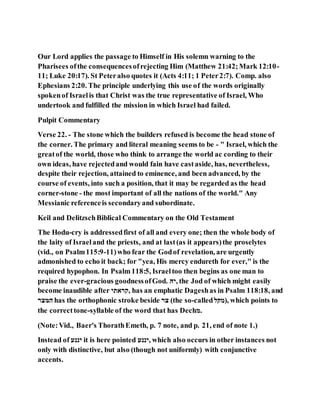
Cambridge Bible for Schools andColleges
22. The stone which the builders rejected
Is become the head of the corner.
A metaphor from building. The ‘corner-stone’bonding the walls togetherwas
a most important part of the structure. A large and strong stone was needed
for the purpose. It is mentioned along with the foundation (Jeremiah 51:26;
Job 38:6) of which it formed part (Isaiah 28:16); and so possibly the meaning
here is ‘the chief cornerstone’ofthe foundation. But ‘the head of the corner’
is more naturally explained to be the top-stone (Zechariah4:7), not only
bonding the walls together, but completing the building. Israel is the ‘head
corner-stone.’The powers of the world flung it aside as useless, but God
destined it for the most honourable and important place in the building of His
kingdom in the world. The words express Israel’s consciousnessofits mission
and destiny in the purpose of God. The perfect “is become” is a perfect of
certainty. With the eye of faith the Psalmistsees the Divine purpose already
realised.
Our Lord applies the passage to Himself in His solemn warning to the
Pharisees ofthe consequencesofrejecting Him (Matthew 21:42;Mark 12:10-
11; Luke 20:17). St Peteralso quotes it (Acts 4:11; 1 Peter2:7). Comp. also
Ephesians 2:20. The principle underlying this use of the words originally
spokenof Israelis that Christ was the true representative of Israel, Who
undertook and fulfilled the mission in which Israel had failed.
Pulpit Commentary
Verse 22. - The stone which the builders refused is become the head stone of
the corner. The primary and literal meaning seems to be - " Israel, which the
greatof the world, those who think to arrange the world ac cording to their
own ideas, have rejectedand would fain have castaside, has, nevertheless,
despite their rejection, attained to eminence, and been advanced, by the
course of events, into such a position, that it may be regarded as the head
corner-stone - the most important of all the nations of the world." Any
Messianic referenceis secondaryand subordinate.
Keil and DelitzschBiblical Commentary on the Old Testament
The Hodu-cry is addressedfirst of all and every one; then the whole body of
the laity of Israeland the priests, and at last(as it appears)the proselytes
(vid., on Psalm115:9-11)who fear the Godof revelation, are urgently
admonished to echo it back; for "yea, His mercy endureth for ever," is the
required hypophon. In Psalm118:5, Israeltoo then begins as one man to
praise the ever-gracious goodnessofGod. ‫,ּהי‬ the Jod of which might easily
become inaudible after ‫,יתארּה‬ has an emphatic Dageshas in Psalm 118:18, and
‫רצּמת‬ has the orthophonic stroke beside ‫ּמת‬ (the so-called‫,)לּקמ‬ which points to
the correcttone-syllable of the word that has Dech‫.ל‬
(Note:Vid., Baer's ThorathEmeth, p. 7 note, and p. 21, end of note 1.)
Instead of ‫ּהננע‬ it is here pointed ‫,ּהננע‬ which also occurs in other instances not
only with distinctive, but also (though not uniformly) with conjunctive
accents.
(Note:Hitzig on Proverbs 8:22 considers the pointing ‫ּהנני‬ to be occasionedby
Dech, and in fact ‫ּהננע‬ in the passagebefore us has Tarcha, and in 1 Samuel
28:15 Munach; but in the passagebefore us, if we read ‫רּהבחתלב‬ as one word
according to the Masora, ‫ּהננע‬ is rather to be accentedwith Mugrash;and in 1
Samuel 28:15 the reading ‫ּהננע‬ is found side by side with ‫ּהננע‬ (e.g., in Bibl.
Bomberg. 1521). Nevertheless ‫ּהנרפתּמ‬Psalm17:3, and ‫ּהנתר‬ Job 30:19
(according to Kimchi's Michlol, 30a), beside Mercha, show that the pointing
beside conjunctive as beside disjunctive accents wavers betweena& and a4,
although a4 is properly only justified beside disjunctive accents, and ‫ּמננּה‬ also
really only occurs in pause.)
The constructions is a pregnant one (as in Psalm 22:22;Psalm 28:1; Psalm
74:7; 2 Samuel 18:19;Ezra 2:62; 2 Chronicles 32:1): He answeredme by
removing me to a free space (Psalm18:20). Both lines end with ‫;ּהי‬
nevertheless the reading ‫בצתחבּהר‬ is attestedby the Masora (vid., Baer's
Psalterium, pp. 132f.), insteadof ‫ּהי‬ ‫.ּהצתחב‬ It has its advocates evenin the
Talmud (B. Pesachim117a), andsignifies a boundless extent, ‫ּהר‬ expressing the
highest degree of comparison, like ‫לאלמּהר‬ in Jeremiah2:31, the deepest
darkness. Eventhe lxx appears to have read ‫לתחבּהר‬ thus as one word (εἰς
πλατυσμόν, Symmachus εἰς εὐρυχωρίαν). The Targum and Jerome, however,
render it as we do; it is highly improbable that in one and the same verse the
divine name should not be intended to be used in the same force of meaning.
Psalm56:1-13 (Psalm 56:10;Psalm 56:5, Psalm 56:12)echoes in Psalm 118:6;
and in Psalm118:7 Psalm54:1-7 (Psalm54:6) is in the mind of the later poet.
In that passageit is still more clearthan in the passagebefore us that by the
Beth of ‫ּהעזתּה‬ Jahve is not meant to be designatedas unus e multis, but as a
helper who outweighs the greatestmultitude of helpers. The Jewishpeople
had experiencedthis helpful succourof Jahve in opposition to the
persecutions ofthe Samaritans and the satraps during the building of the
Temple; and had at the same time learned what is expressedin Psalm 118:7-8
(cf. Psalm146:3), that trust in Jahve (for which ‫רסח‬ ‫ב‬ is the proper word)
proves true, and trust in men, on the contrary, and especiallyin princes, is
deceptive; for under Pseudo-Smerdis the work, begun under Cyrus, and
representedas open to suspicioneven in the reign of Cambyses, was
interdicted. But in the reign of Darius it againbecame free: Jahve showedthat
He disposes events and the hearts of men in favour of His people, so that out
of this has grownup in the minds of His people the confident expectationof a
world-subduing supremacy expressedin Psalm118:10.
The clauses Psalm118:10, Psalm118:11, and Psalm118:12, expressedin the
perfect form, are intended more hypothetically than as describing facts. The
perfect is here setout in relief as a hypothetical tense by the following future.
‫םמוּג־ּהּכ‬ signifies, as in Psalm117:1, the heathen of every kind. ‫םבתּהּכ‬ (in the
Aramaic and Arabic with )‫ז‬ are both bees and wasps, whichmake themselves
especiallytroublesome in harvest time. The suffix of ‫אלּהמּכ‬ (from ‫לנמ‬ equals
,71:2 sudoxE ;03:92 sudoxE nisa emas eht si(seceip ni tuc ,nwod weh ot ,‫לממ‬
and also beside a conjunctive accentin Psalm74:8. Yet the reading ‫,ּכמּהלא‬ like
detroppus retteb eht ereh si ,71:2 kukkabaH‫ּהחּהרן‬(vid., Gesenius,
Lehrgebude, S. 177), and it has been adopted by Norzi, Heidenheim, and
Baer. The ‫םּה‬ is that which states the ground or reason, and then becomes
directly confirmatory and assuring (Psalm 128:2, Psalm128:4), which here,
after the "in the name of Jahve" that precedes it, is applied and placed just as
in the oath in 1 Samuel 14:44. And in general, as Redslobhas demonstrated, ‫םּה‬
has not originally a relative, but a positive (determining) signification, ‫כ‬ being
just as much a demonstrative sound as ‫ד‬ ,‫ז‬ ,‫,ׁש‬ and ‫ר‬ (cf. ἐκεῖ, ἐκεῖνος, κει'νος,
ecce, hic, illic, with the Doric τηνεί, τῆνος). The notion of compassing round
about is heightened in Psalm118:11 by the juxtaposition of two forms of the
same verb (Ges. 67, rem. 10), as in Hosea 4:18; Habakkuk 1:5; Zephaniah 2:1,
and frequently. The figure of the bees is takenfrom Deuteronomy 1:44. The
perfect ‫םעכנ‬ (cf. Isaiah 43:17)describes their destruction, which takes place
instantly and unexpectedly. The Pual points to the punishing powerthat
comes upon them: they are extinguished (exstinguuntur) like a fire of thorns,
the crackling flame of which expires as quickly as it has blazed up (Psalm
58:10). In Psalm 118:13 the language of Israelis addressedto the hostile
worldly power, as the antithesis shows. It thrust, yea thrust (inf. intens.)
Israel, that it might fall (‫;מנלמ‬ with reference to the pointing, vid., on Psalm
40:15); but Jahve's help would not suffer it to come to that pass. Therefore the
song at the Red Sea is revived in the heart and mouth of Israel. Psalm118:14
(like Isaiah12:2) is takenfrom Exodus 15:2. ‫עּזּה‬ (in MSS also written ‫)עּזּה‬ is a
collateralform of ‫עּזּה‬ (Ew. 255, a), and here signifies the lofty self-
consciousnesswhichis united with the possessionofpower: pride and its
expressionan exclamationof joy. Concerning ‫רתלז‬ vid., on Psalm16:6. As at
that time, the cry of exultation and of salvation (i.e., of deliverance and of
victory) is in the tabernacles ofthe righteous:the right hand of Jahve - they
sing - ‫חּהמ‬ ‫עיר‬ (Numbers 24:18), practises valour, proves itself energetic, gains
(maintains) the victory. ‫ת־ללר‬ is Milra, and therefore an adjective:victoriosa
(Ew. 120 d), from ‫תלּכ‬ equals ‫תנּכ‬ like ‫ד־לּכ‬ from ‫.דלּכ‬ It is not the part. Pil. (cf.
Hosea 11:7), since the rejectionof the participial Mem occurs in connection
with Poaland Pual, but not elsewherewith Pilel (‫ת־לּכ‬ equals ‫לת־לּכ‬ from ‫.)תנּכ‬
The word yields a simpler sense, too, as adject. participle Kal; romēmā́ h is
only the fuller form for ramā́ h, Exodus 14:8 (cf. rā́ mah, Isaiah26:11). It is not
its own strength that avails for Israel's exultation of victory, but the energy of
the right hand of Jahve. Being come to the brink of the abyss, Israel is become
anew sure of its immortality through Him. God has, it is true, most severely
chastenedit (‫ּהּנתּסּה‬ with the suffix anni as in Genesis 30:6, and ‫ּהי‬ with the
emphatic Dagesh, whichneither reduplicates nor connects, cf. Psalm118:5,
Psalm94:12), but still with moderation (Isaiah 27:7.). He has not suffered
Israelto fall a prey to death, but reservedit for its high vocation, that it may
see the mighty deeds of God and proclaim them to all the world. Amidst such
celebrationof Jahve the festive processionofthe dedication of the Temple has
arrived at the enclosure wallof the Temple.
PRECEPTAUSTIN RESOURCES
Psalm118:22 The Stone which the builders rejectedHas become the chief
Corner stone.
The stone (KJV): Mt 21:42 Mk 12:10,11 Lu 20:17 Ac 4:11 Eph 2:20-22 1Pe
2:4-8
the head (KJV): Zec 4:7
Septuagint (Lxx) - lithon on apedokimasan(apodokimazo:aoristtense - throw
out as result of a test; reject, declare useless Mt21.42 orthink of as unworthy
Heb 12.17)oioikodomountes (oikodomeo:present tense:the builders Mt
21.42)houtos egenethe (3SAPI)eis kephalengonias (gonia: lit. streetcorner
Mt6.5;of a building =cornerstone, keystone, capstone Mt21.42)
Peterclearly links this OT prophecy with the Messiah(Note that in the NAS
words that are quoted directly from the OT are easyto identify for they are in
ALL CAPITAL LETTERS as you see in all 3 of the passagesbelow).
6 Forthis is contained in Scripture: "BEHOLD, I LAY IN ZION A CHOICE
STONE, A PRECIOUS CORNER stone, AND HE WHO BELIEVES IN HIM
WILL NOT BE DISAPPOINTED."
7 This precious value, then, is for you who believe; but for those who
disbelieve, "THE STONE WHICH THE BUILDERS REJECTED,THIS
BECAME THE VERY CORNER stone,"
8 and, "A STONE OF STUMBLING AND A ROCK OF OFFENSE";for
they stumble because they are disobedient to the word, and to this doom they
were also appointed. (1 Peter2:6-8)
Henry Morris on 1 Peter2:6 (chief cornerstone) - Note that Peterhere
recognizes thatChrist, not himself, is the foundation stone of the church (as
some have misinterpreted the teaching of Matthew 16:18). He is quoting from
Isaiah28:16, showing that this Messianic prophecywas fulfilled in Christ. The
Lord Jesus also calledHis words the true foundation (Matthew 7:24-27), and
Paul confirmed that there is no other foundation (1 Corinthians 3:11). Isaiah
had also stressedthat "in the LORD JEHOVAH is everlasting strength," or
"the Rock ofages" (Isaiah26:4).
Henry Morris on 1 Peter2:7 - The reference here (1 Peter 2:7) is to Psalm
118:22, which, in turn, was referring to the tradition that, when Solomon's
temple was being built, the odd-shaped stone which seemednot to fit
anywhere turned out to be the chief cornerstone, designedforthe very apex of
the temple. The stones had all been preciselycut deep in the quarry, so that no
noise of construction could be heard while the temple was growing (1 Kings
5:17; 6:7). In analogous fashion, eachbelieveris being laid quietly as a living
stone in the greatspiritual temple. But the unique stone of the pinnacle corner
is Christ Himself, who is also the temple's foundation. He is both underneath
all, upholding us, and above all, crowning us as our glorious Head.
Henry Morris on 1 Peter2:8 (rock of offence) - In the meantime, until He is
made the head stone (Zechariah 4:7), Christ is just a stumbling stone on the
ground, as it were, getting in the way of everyone who would pass by. Peter
here quotes Isaiah 8:14, to which Jesus also referredin the same vein
(Matthew 21:42-44). But note also Daniel2:34 and Jeremiah13:16.
THE STONE WHICH THE BUILDERS REJECTED:the Jewishleaders said
they would not have Him rule over them. They thought Him unworthy! Notice
that the Psalmistmentions "salvation" (Ps 118:21)which is the Hebrew Word
"Yeshu'ah" (Jesus is calledYeshua today by many MessanicJews).
HAS BECOME THE CHIEF CORNER:This phrase is quoted in Mt 21:42,
Acts 4:11, Ep 2:20 & 1 Pe 2:7
In Mt 21:42-43 the experts in BUILDING GOD'S TEMPLE, hadrejectedthe
CORNER-STONEthat God Himself had selectedfor His Own house!!! Their
very rejectionwas the FULFILLMENT of this prophecy in Ps 118:22-23!But
God is sovereign...andso He sets aside the JEWS for a time and makes Christ
the CORNERSTONE andgives the gospelto a ''NATION'' that will be
fruitful.
Today a CORNERSTONE is placedat the foundation of a building, in ancient
Israelthe CAPSTONE wasplacedat the very top---a true ''HEAD'' STONE.
Jesus is the STONE that serves as the alignment and completion of our lives.
See Christ (as Stone or Rock), Ge 49:24;Ex 17:6, 1 Pe 2:8, Ps 118 Looks
beyond the rejection of the Stone (Christ) to His final exaltation in the
kingdom (v22). <Christ> (Stone): v22; Isa 8:14. (Ge 49:24; 1 Pet 2:8)
See relatedartices:
The Rock ofAges
Christ the Smitten Rock
Christ the Stone
According to Mark 12:10–11 (cf. Mark 8:31; Matt 23:29;Luke 13:35), Jesus
applied Ps 118:22–23to his coming passionand resurrection, and they ring
out againon Peter’s lips in Acts 4:11. V 22 of the psalm became an important
element in the theologicalstone imageryof Eph 2:20–21;1 Pet2:4–8.
Underlying the citationof verse 6 in Heb 3:6 is doubtless a sense ofthe
Christian community’s oneness with the glorified Christ.
Spurgeon- “The stone which the builders refusedis become the head stone of
the corner.” Here the people magnify God for bringing his chosenservant into
the honourable office, which had been allottedto him by divine decree. A wise
king and valiant leader is a stone by which the national fabric is built up.
David had been rejectedby those in authority, but God had placed him in a
position of the highest honour and the greatestusefulness,making him the
chief corner-stone of the state. In the case ofmany others whose early life has
been spent in conflict, the Lord has been pleasedto accomplishhis divine
purposes in like manner; but to none is this text so applicable as to the Lord
Jesus himself: he is the living stone, the tried stone, elect, precious, which God
himself appointed from of old. The Jewishbuilders, scribe, priest, Pharisee,
and Herodian, rejectedhim with disdain. They could see no excellence in him
that they should build upon him; he could not be made to fit in with their
ideal of a national church, he was a stone of another quarry from themselves,
and not after their mind nor according to their taste;therefore they casthim
awayand poured contempt upon him, even as Petersaid, “This is the stone
which was set at nought of you builders”: they reckonedhim to be as nothing,
though he is Lord of all. In raising him from the dead the Lord God exalted
him to be the head of his church, the very pinnacle of her glory and beauty.
Since then he has become the confidence of the Gentiles, even of them that are
afar off upon the sea, and thus he has joined the two walls of Jew and Gentile
into one stately temple, and is seento be the binding corner-stone, making
both one. This is a delightful subject for contemplation. Jesus in all things
hath the pre-eminence, he is the principal stone of the whole house of God. We
are accustomedto lay some one stone of a public building with solemn
ceremony, and to deposit in it any precious things which may have been
selectedas a memorial of the occasion:henceforththat corner-stone is looked
upon as peculiarly honourable, and joyful memories are associatedwith it. All
this is in a very emphatic sense true of our blessedLord, “The Shepherd, the
Stone of Israel.” Godhimself laid him where he is, and hid within him all the
precious things of the eternal covenant;and there he shall for ever remain, the
foundation of all our hopes, the glory of all our joys, the uniting bond of all
our fellowship. He is “the head overall things to the church,” and by him the
church is fitly framed together, and growethunto a holy temple in the Lord.
Still do the builders refuse him: even to this day the professionalteachers of
the gospelare far too apt to fly to any and every new philosophy soonerthan
maintain the simple gospel, which is the essence ofChrist: nevertheless, he
holds his true position amongsthis people, and the foolishbuilders shall see to
their utter confusion that his truth shall be exalted over all. Those who reject
the chosenstone will stumble againsthim to their own hurt, and ere long will
come his secondadvent, when he will fall upon them from the heights of
heaven, and grind them to powder.
Scofield's summary - Christ is the Rock (or Stone):(1) strickenthat the Spirit
of life may flow from Him to all who will drink (Exo 17:6; 1 Cor 10:4; cp.
John 4:13 - 14;7:37 - 39); (2) to the Church, the foundation and chief
Cornerstone (Eph 2:20); (3) to the Jews atHis first coming, a "stumbling
stone" (Rom 9:32 - 33;1 Cor 1:23); (4) to Israelat His secondcoming, the
"capstone"ofthe corner(Zech 4:7); (5) to the Gentile world power, the
smiting "rock cut out, but not by human hands" (Dan 2:34); (6) in the divine
purpose, the Stone which, after the destruction of Gentile world power, is to
grow and fill the earth (Dan 2:35); and (7) to unbelievers, the crushing Stone
of judgment that will grind those, upon whom it falls, to powder (Mat 21:44).
THE HEADSTONE OF THE CORNER NO. 1420
A SERMON DELIVERED ON LORD’S-DAYMORNING, JUNE 23, 1878,
BY C. H. SPURGEON, AT THE METROPOLITAN TABERNACLE,
NEWINGTON.
“The stone which the builders refused is become the headstone ofthe corner.
This is the Lord’s doing; it is marvelous in our eyes. This is the day which the
Lord has made; we will rejoice and be glad in it. Save now, I beseechYou, O
Lord: O Lord, I beseechYou, send now prosperity.” Psalm118:22-25.
IT would be difficult, if not impossible, to fix with certainty the occasion
which first suggestedthis Psalm. It has even been thought to be purely
prophetic and rather foretelling history than narrating it. I rather incline to
the opinion that some Israelite hero, chosenof God to high office in the midst
of his people, had been rejectedby the rulers, had passedthrough many
struggles, some ofthem of the most violent kind, and at last, notwithstanding
the rejectionof his people and their leaders, had attained to a prominent
position, no, to a chief place in the midst of the nation. The Psalmis applicable
to Christ and to Him it is referred in the New Testamentseveraltimes. But
probably from the human point of view, it was at first intended to celebrate
the victory of some chosenman of God who, despite his divine election, had
been rejectedby his countrymen. Providence conductedhim to a crowning
successand he magnified the Lord for it. In some way or other, a stone has
come to be connectedwith severalpersons whose history was of this
character. RememberJacob. He flees from his father’s house because Esau
threatens to kill him. He appears to be the rejectedmember of Isaac’s family,
by whom the house would never be built up. At the end of a day’s journey he
lies down with a stone for his pillow, and as he sweetlyslumbers he sees
heaven open, beholds the mystic ladder and rises assuredof the love of the
Almighty God. By faith thus infused into his soul, he becomes strong for his
future life and so lives that now the house of Abraham and Isaac stands
representedin the seedof Jacobalone, and Esauwith all his dukes, has utterly
passedaway. The next occurrence ofthe stone happens in reference to
Joseph, of whom the dying Jacobsaid, “Fromthence is the Shepherd the stone
of Israel.” He was separatedfrom his brothers by their envy and grievously
wounded by their malice. They said, “Behold, this dreamer comes,” andthey
sold him for a slave into the stranger’s land. From the dungeons of Egypt he
climbed to the throne and became the cornerstone of Israel’s house. On his
bosom his agedfather could lay his head and dream as he did at Bethel. And
by his powerand wisdom, the shepherd family was happily built up. Then
came David, whom his elder brothers despised and even his father passedhim
over, until the prophet of God askedfor him, that he might be anointed with
oil. Out of his hand went that stone of Israelwhich laid low the pride of
Philistia. Goliath must bite the ground when the stone of Israelflies from the
hand of Israel’s shepherd, who was destined to be her king. He was rejected
and hated by Saul so that he wanderedabout in the wilderness, hiding in
caves and rocks until the hour came when he was calledto the throne. Then
the stone which the builders refused became the headstone of the corner, and
he and his people confessedthatit was the Lord’s doing and it was marvelous
in their eyes. Be not afraid, O you persecutedones, for you shall fulfill your
destiny. It has happened againand againin history, that those who have been
destined to do greatthings for the Lord have first of all been compelled to
pass through a trying ordeal of misunderstanding and rejection. Such history
repeats itself and it may do so in your instance. The speckledbird of the
family, the one leastbeloved, often rises to take the most prominent place.
Jephthah was driven out from his father’s family and yet in their distress his
brethren were glad enough to make him their champion and accepthim as
their head. Bow your head in patience, young man, and bear whateverGod or
His enemies may lay upon you, for assuredly as the Lord is in you and with
you, He will bring you forth and of you, too, it shall be true in your own little
way, “The stone which the builders refused, the same is become the headstone
of the corner.”
The Headstone of the Corner Sermon #1420
Tellsomeone today how much you love Jesus Christ. Volume 24
2
2
At this time however, we shall confine our application of these verses to our
blessedLord Himself, to whom they most evidently refer. Their meaning is
focusedupon Him and in reference to Him eachword is emphatic. He applied
them to Himself, for Matthew tells us in the 21stchapterof his gospelthat our
Lord said to the chief priests and Pharisees, “Didyou never read in the
Scriptures, The stone which the builders rejected, the same is become the
head of the corner?” You remember also, how Petersaid in the face of the
crucifiers of Christ, “Be it knownunto you all and to all the people of Israel,
that by the name of Jesus Christ of Nazareth, whom you crucified, whom God
raisedfrom the dead, even by Him does this man stand here before you whole.
This is the stone which was setat nothing of you builders, which is become the
head of the corner. Neither is there salvationin any other, for there is none
other name under heaven given among men whereby we must be saved.” In
his first epistle, Peterrefers againto this psalm in the well-remembered
words, “Why also it is containedin the Scripture, Behold, I lay in Zion a chief
cornerstone, elect, precious:and he that believes on Him shall not be
confounded. Unto you therefore which believe He is precious:but unto them
which are disobedient, the stone which the builders disallowed, the same is
made the head of the corner.” Of our own exalted Lord we are going to speak
at this time and may the Spirit bear witness in our hearts to His honor. I.
First, I invite your thoughts to CHRIST REJECTED—“Thestone which the
builders refused.” The Lord Jesus came into this world at the fullness of time
when the Messiahwas expectedby those devout men who waitedfor salvation
in Israel. He came born of parents descendedfrom that royal house from
which Messiahwas prophesiedas coming and He was born in the very city
which had been pointed out by seers ofold. All details of His life in His early
days correspondedwith prophetic intimations and answeredto the signs
which the Lord had appointed. There was nothing in which He did that did
not exactlyfit the symbols of the sanctuaryand the personaltypes of history.
Everything which could speak criedwith one voice, “Beholdthe Lamb of
God.” He was clearly placedbefore the Jewishpeople as the stone which God
would lay in Zion as the foundation of their hopes, but they persistently
refused Him. It was not from lack of evidence, for John came prophesying
concerning Him and as I have already said, John was but the last of a long list
of prophets who had all pointed to Him as the Anointed of the Lord, and yet
IsraelrejectedHim. His ownmiracles and teaching were more than sufficient
evidence of His mission, but Israel would have none of Him. He was a stone
evidently of God’s quarrying and preparing. His extraordinary birth marked
Him out as differing from all the rest of mankind. His surpassing excellence
and moral beauty declaredHim to be destined to the highest position. His
person displayed the marvelous love and wisdom of God and with half an eye,
if they had willed to see it, the Jews might have perceivedthat He was
anointed to be the cornerstone of the spiritual temple, but yet they refused
Him. “He came unto His own and His ownreceivedHim not.” He came to
those who had the oracles, but in this thing they set at nothing the oracles.He
came to those who had the law and the prophets, but they were deaf to all holy
testimonies and disownedHim. Alas, for the blindness of men’s hearts. His
rejectionwas rendered the more remarkable and the more sorrowful because
He was rejectedby the builders or leaders of the nation. “The stone which the
builders refused.” If the common people, who were ignorant of the law, had
not perceivedHim to be the chosenstone, we might not have wondered. But
there were men of learning and researchamong the people and these rejected
Him. They had builders who understood spiritual architecture, or professed
to do so—the scribes who studied the law and the priests who taught the
people—these were the master builders, whose business it was to make the
selectionofthe cornerstone. Butthese rejectedour Lord. It was not only the
mob of Jerusalemthat rejectedChrist, but the rulers led the way. True, the
many cried, “Crucify Him!” but not till they were bribed by the priests, the
clergyof the day, the Sadducees, the skepticalmen of science, the Pharisees
and ritualistic professors. Thesewere they who satin Moses’seat, in whom
the people had confidence, and by their scheming, the people were led to
rejectthe cornerstone whichthe Lord Himself had laid. Concerning this
rejectionwe must also remark that it was no common one. It was a violent
and indignant rejection. They were not content to say, “He is not the
Messiah,”but they turned their hottest malice againstHim. They were furious
at the sight of Him. This precious stone was kickedagainstand rolled about
with violence and all manner of ridicule was poured upon it. Nothing would
content them but the blood of the man who had disturbed their consciences
and questioned their pretensions. “The stone which the builders refused” is to
be read with a heavy stress upon the word REFUSED. Petersays,“He was set
at nothing of you builders.” They slandered Him in life and mockedHim in
death. They
Sermon #1420 The Headstone ofthe Corner
Volume 24 Tell someone todayhow much you love Jesus Christ.
3
3
spat their accusationsagainstHim when He was free and gave Him overto be
defiled with the spit of the soldiers’mouths when He was bound. They made
Him live an outcast’s life and then they hung Him up to die a felon’s death.
This rejectionwas most unreasonable. Theydid violence to truth and justice
by their evil deed. For which of His works did they stone Him? There was
nothing in His characterwhich should have incensedthem. There was nothing
about Him which ought to have excited their doubts, much less their wrath.
But yet they willfully and resolutelyrejectedHim. They said, “We will not
have this man to reign over us.” The cause, in part, was blind prejudice. They
expecteda king surrounded with earthly pomp and girt with physical force to
break the Roman yoke and create an Israelite empire more famous than that
of Solomon. And because He came as the son of a lowly virgin, robed in a
peasant’s dress and humbly dwelt among the sons of men in meekestfashion,
therefore they refused Him. There was no real reasonwhy He should have
been refused because ofHis humiliation, for was not their Messiahso to
come? Did not Isaiahsay, “He shall grow up before Him as a tender plant,
and as a root out of a dry ground: He has no form nor comeliness;and when
we shall see Him, there is no beauty that we should desire Him.” He agreed
with the prophecies, but not with their prejudices and therefore they cried,
“Away with Him. Away with Him.” Those prejudices were the result of sheer
ignorance, for if they had studied the word they would have seenthat the
Christ of God was not the Christ of their dreams. And had they searchedthe
Scriptures they might have known that Jesus of Nazarethwas the Lord of
glory. They had eyes, but would not see. The light was around them, but they
comprehended it not. The pride of their hearts kept them in ignorance. They
did not want to know. The proud philosophic Sadducee felt sure of his ground,
for he was a thinker and despisedthe vulgar populace. He did not wish for
evidence as to the existence of angelor spirit, or of the resurrectionof the
dead, and therefore he scornfully rejectedthe man who brought life and
immortality to light. The Pharisee, supremelyrighteous in himself, did not
want to know a man who taught him that he was lostand came to be the
Savior of sinners. He felt too safe alreadyto need saving. Thus the Ever-
blessedwas chasedout of the world by the pride which scorns all excellence
exceptits own. Men flung awayGod’s dearestjewelbecause it outshone their
own counterfeit jewelry. Nor was it pride alone, for that mother sin was
surrounded with all other evils. They wanted to devour widows’houses in
secretand He exposedthem. They wanted to go on saying their long prayers
and yet to persecute the righteous and He unmasked them. Certainof them
wanted to be free-thinkers and yet to be thought orthodox and He denounced
them as hypocrites. They denied the essentialprinciples of revelation, but He
came forth from the Fatherto bear witness of God, and therefore they utterly
abhorred Him. Their sin, as it could not associatewith His holiness, raised a
clamor againstHim and with cunning and malice they denounced, condemned
and utterly rejectedthe stone which God had appointed to be the foundation
and cornerstone ofHis New Jerusalem. Ah, my brethren, you know what
came of it. They threw that chosenstone awayand when they had removed it
awayfrom their Babel-building they thought their troubles at an end, when
indeed, they had just begun. That stone was removed out of the way and yet
they stumbled upon it. They stumbled to their own confusion. Yes, they
stumbled to their owndestruction. How broken were they by that stone at the
awful siege of Jerusalem, whenthey and their city perished. Now, also, that
stone has been lifted up into heaven by the mighty powerof God and in the
fullness of time it will descendupon these foolish builders with terrible effect,
for upon whomeverit shall fall it will grind him to powder. Even while that
stone was here, they fell upon it and were broken. But when He comes a
secondtime, He will fall upon them and woe unto them in that day. Let us not
be among the company of the rejecters. Letus not consortwith those who cast
doubts upon the gospelof Jesus. Ratherlet our hearts joyfully bless God for
appointing Him to be the headstone of the corner. Let us acceptHim in that
characterand at once build upon Him— “Chosenof God, to sinners dear,
And saints adore the name! We trust our whole salvationhere, Norshall we
suffer shame.” Godforbid that we should rejectthe testimony of God
concerning His Sonand so make Goda liar and bring down eternal wrath
upon our own heads. Our safetylies in reception, not in rejection, for to “as
many as receivedHim, to them gave He powerto become the sons of God,
even to them that believe on His name.” As for those who rejectHim, we hear
with trembling these words from the lips of the loving
The Headstone of the Corner Sermon #1420
Tellsomeone today how much you love Jesus Christ. Volume 24
4
4
Jesus—“Butthose, My enemies, which would not that I should reign over
them, bring here and slay them before Me.” II. With great delight I now pass
to the secondtopic which is CHRIST EXALTED—“The stone which the
builders refused is become the headstone of the corner”—thatis to say, at this
moment Christ has the chief place of honor in the building of God. He is the
headstone, for He is higher than the kings of the earth. He is higher than all
the opposing powers of wisdom or of superstition and He is the head over all
things to His church. Glory be to His name, in the midst of His people He is
above all and overall—we worship Him with rapture. He is King of kings and
Lord of lords, “for by Him were all things createdthat are in heavenand that
are in earth, visible and invisible, whether they are thrones, or dominions, or
principalities, or powers:all things were createdby Him and for Him,” There
is none like Him among the sons of men. In all things He has the preeminence.
He that was crucified is now enthroned. He that lay in the grave now reigns in
glory. Noris He only eminent for His position of honor, but for His
surpassing usefulness. He is the headstone of the corner, that stone which
joins two walls togetherand is the bond of the building. Jew and Gentile are
now one in Christ Jesus. It is true He is a stone in Israel’s wall, but He is also a
stone in the Gentile’s wall. In Him is neither Jew nor Gentile distinctively, for
they are both there inclusively. He has made both one. The Phariseeswould
have it that the wall should finish within the line of Judah’s race, but not so
thought our Master. His heart went forth to the other sheepwhich He had
that were not yet of the fold. This made them wrathful, but their wrath did
not prevent His accomplishing His designand now He is the bond of the
building, holding Jew and Gentile in firm unity. This precious cornerstone
binds God and man togetherin wondrous amity, for He is both in one. He
joins earth and heaven together, for He participates in each. He joins time and
eternity together, for He was a man of few years and yet He is the Ancient of
Days. Wondrous cornerstone!You bind all of us togetherwho are in You, so
that by love of You we are built togetherfor a temple of the Holy Spirit. You
are the perfect bond, the eternal holdfast, the divine cementwhich holds the
universe in one. Is it not written, “By Him all things consist”? OurLord Jesus
Christ then, is brought up from all rejectionand shame to which His enemies
put Him, to be by usefulness and by honor, the grandestpersonupon the face
of the earth, and all this none the less, but all the more, because He was
rejected. He lost nothing by His enemies. TheyscourgedHis back, but they
did not rob Him of that imperial purple which now adorns Him. They
crownedHim with thorns, but those thorns have increasedthe brilliance of
His diadem of light. They pierced His hands and thereby prepared them to
swayan irresistible scepterof love over men’s hearts. They nailed His feet, but
those feet stand firm forever upon the throne of sovereignty. They crucified
Him, but His crucifixion led Him to His greaterhonor, since He therein
finished the work which was given Him to do, and now also God has highly
exalted Him and given Him a name which is above every name. As it has been,
so is it, and so shall it be. Man’s opposition to the gospelwill not interfere with
it one single whit, but the eternal purposes of Jehovahshall be fulfilled. Our
adversaries may mine and undermine. They may openly oppose and secretly
assail. But upon this rock, evenupon Christ, shall the truth and the church
forever restand no harm shall come to it. The Lord will lift the stone which
the builders refusedand make it to become the headstone of the corner,
therefore let us not fail nor be discouraged. Already our text has been
fulfilled. Our Lord Christ was dead and buried, but His foes were desperately
afraid that He would rise againand so they rolled a stone to the tomb’s mouth
and sealedit. But He rose for all that, and became the first fruits of them that
slept, the headstone of the resurrection. His resurrectionutterly defeated
those who reckonedupon destroying His power. What could they do against
one whom death itself could not silence? When His resurrectionattestedHis
mission, what could they sayagainstHim? Nor was this all, for to add to His
honor, He was receivedup into heaven. Beyond the eternal hills He rose, the
gates ofheaven opening at His coming. And amidst the acclamationof angels
and redeemedspirits, He ascendedto the highest place that heavenaffords.
What a change from Gabbatha and all the maltreatment of the Pavementto
the sea ofglass mingled with fire and to the seatof infinite majesty! Jesus has
gone from the bar to the throne, and there He sits in majesty. His adversaries
may grind their teeth at Him, but the King is setupon the holy hill of Zion
beyond their wrath. “Why do the heathen rage and the people imagine a vain
thing?” JehovahJesus is King and none can challenge His sovereignty.
Sermon #1420 The Headstone ofthe Corner
Volume 24 Tell someone todayhow much you love Jesus Christ.
5
5
At Pentecost, too, this was fulfilled, for when His few and humble disciples
were inspired by the Holy Spirit and began to speak with tongues of fire, all
Jerusalemrang with the wonder—and then again, the despisedand rejected
stone was made the headstone of the corner. Very speedily throughout the
known world the testimony of His name was made to sound forth till His
Word had gone forth as far as the sun’s utmost track and all nations beheld
the light thereof. Then the gods of the heathen tottered and colossalsystems of
idolatry were ground to powder. Glory be unto You, O Christ! You did
triumph gloriously in those first ages ofYour church! That triumph is still
proceeding. It will be consummatedbyand-by. What confusionwill take hold
upon the hearts of His adversaries whenHe shall be revealed!He is hidden
now and His people with Him, but the day draws near when He shall come a
secondtime to be admired in all them that believe. What astonishment will
then take hold upon those who refused His righteous claims. Then will they
know that this is the Lord’s doing, though it will be terrible in their eyes. All
intelligent beings, even down to the blackestdevil of hell, shall at the second
advent of our Lord be obliged to confess that the stone which the builders
refused has become the headstone of the corner. The Man of Nazareth shall be
Lord of all before the eyes of all mankind. For that, we diligently look. I call
upon you, dear brothers and sisters, this morning, to greatly rejoice in the fact
which we have thus brought before you. It is a grand truth that Christ Jesus is
now enthroned beyond the reachof those who rejectedand despisedHim—
“Honor immortal must be paid, Instead of scandaland of scorn While glory
shines around His head, And a bright crownwithout a thorn.” III. Thirdly, I
ask your attention to the next point, which is introduced to us by the 23rd
verse. THE EXALTATION OF CHRIST IS DUE TO GOD ALONE—“This is
the Lord’s doing and it is marvelous in our eyes.” Now, this was so as a matter
of history. Jesus Christ’s name and work were at length, had in honor in the
world, but this was due to no man’s wisdom, eloquence, orpower, but entirely
to the Lord, who is wonderful in counseland greatin might. Look, my
brethren, if the Scribes and Pharisees hadendorsed the claims of our Lord, it
might have been said that Christianity was grafted upon the old stock of
Judaism, and therefore grew with vigor. And if Pilate, or Herod, or any of the
greatones, especiallyif the Caesarofthe day had acceptedit, then the
following ages would have said, “Oh yes, He derived His power and was lifted
to His place through the prestige of empire and the prowess ofarms.” But it
was not so. All the establishments on earth were againstHim, rank and station
despisedthe carpenter’s Son, superstition abhorred His simplicity and
spirituality, ceremonialismwould have nothing to do with Him who said that
the temple was to be destroyed, skepticismcould not endure Him, for He gave
not a jot of ground for its doubts, or food for its speculations. And the kings of
the earth and the statesmenutterly derided Him, for He spoke ofa kingdom
which was not of this world. And yet He triumphed, and now His name is the
most famous among the sons of men. This was not because poets satwaiting
upon Parnassus to pour forth their loftiest lays, or because minstrels with
their fingers on their harp strings, stood prepared to draw forth matchless
music to celebrate His advent. No, the hymns which were composedin His
honor had a lowly virgin and an equally humble matron as their authors. And
the music which saluted Him was the noise of children in the streets, shouting,
“Hosanna to the Son of David.” The Sonof man owes nothing of His glory to
man. His elevation to the throne is the Lord’s doing and marvelous in our
eyes! And while this is true as to the past, it remains true at this day, for the
gospelof Christ, wheneverit spreads in the earth, owes its triumphs entirely
to divine interposition. When I considerhow hostile human nature is to the
gospel, the very existence ofa true Church in the world is to me, a miracle.
Nor to me alone does it appearso, for it really is a superhuman work and is
workedby the Lord alone. Just think of it. Why, at this very day, we have all
the wisdomand power and eloquence and skill of the superstition of the world
arrayed againstthe simple gospelofJesus Christ. Though they are agreedin
nothing else, they all unite againstChrist. He of the SevenHills has nothing
but maledictions for the pure gospelof Jesus and with him stand a hierarchy
clothed with terrible powerand a troop of Jesuits who stop at nothing.
Completely organized, numerous, subtle, all-pervading, the warriors of Rome
are a greathost and not to be lightly thought upon. See how superstition
multiplies in this land. See how the builders, appointed by the state to build up
a Protestantchurch, are pulling it down with both hands. These are priests,
clergy—God’s heritage!And what are they doing? They are lifting up an
idolatrous crucifix in
The Headstone of the Corner Sermon #1420
Tellsomeone today how much you love Jesus Christ. Volume 24
6
6
the place of the doctrine of the cross, setting sacraments in the place of the
precious blood and preaching salvationby their own priestcraft instead of
salvationby the grace of God through Jesus Christ. The builders are rejecting
Him and yet His cause lives on. The wise men on the other side of the house,
the builders who claim to be scientific scholars and persons of advanced
thought and thorough culture, these also, have their fling againstthe gospel.
For anything I can see oftheir pretended depth of learning, I would
recommend them to attend to their science and obtain a little more culture
before they set up for teachers orthey may expose their ownshallowness.
These boastfully wise men, these self-styled thinking men, are all againstthe
gospelof Jesus. WhenI see the powerwhich at the presenttime is enlistedon
the side of doubt and skepticism, I, for my part, am astonishedthat anybody
believes the gospelat all, and I feel that it is the Lord’s doing and marvelous
in my eyes. True faith is supernatural. It stands not in the wisdom of man, but
in divine power. WhereverChrist is exalted, as, blessedbe His name, He is in
many churches, it is not because ofany wit or skill or poweron the part of the
minister, but because the Holy Spirit is at work among the people bringing
them to Christ. Do not, then, dear brethren, despond on behalf of Christ’s
cause. The realprogress of Christianity must be supernatural! Whenever we
fight with the woodenswordof reason, we may expectto be defeated, not
because the gospelis againstreasonor contrary to it, but because it is so much
above reasonthat we cannot comprehend it and therefore, lose powerby
hearing gospeltruth as if it were a human discovery. If there is not working
with Christianity a divine agencyaltogetherabove its reasonableness,if there
is not, in fact, the Spirit of God working with it to convert men, then it will
come to nothing and vanish like other systems. Our reliance must be
therefore, not upon evidences which we can bring to prove the truth of the
gospel, nor upon eloquence by which we may advance its claims, but upon the
Eternal Spirit of God, for it is He, and He alone, who can lift the rejected
stone and make it to become the headstone of the corner. It is impossible for
blinded human nature to believe the truth of God. And therefore we must be
born again. Gospelteachings are so humbling, so radical, so pure, so spiritual,
so much above our thoughts, that nobody will acceptthem unless taught of
God. His chosenpeople shall be taught of the Spirit and the rest will choose to
remain in blindness. So it has been, and so it ever shall be. But, beloved, let us
not tremble because ofthis, for despite human blindness, and the opposition
of the wise, Christ must reign even to the world’s end. Did I hear a whisper
that ministers are nowadays very broad and have given up the old gospel? I
know it and I am not surprised. The builders are the first to reject the chosen
stone. Christ owes little to preachers and some of His worstenemies are found
in their ranks. Unconverted men are in too many pulpits and are seeking out
many inventions to set aside the pure gospelwhich exalts Christ Jesus. Let
them alone. The ditch is gaping for these blind guides. Our Lord cando
without them. He owes His victories to Himself and to Himself alone. And
therefore, let the faith of His people rest in peace, for if they will have
patience, they shall see greaterthings than they have yet beheld. Our text says
that it is not only the Lord’s doing and marvelous, but it is marvelous, “in our
eyes,” whichit could not be if we did not see it. We shall see and we shall
marvel. Some of us may have passedaway, but you who are younger may live
to see modern thought obtain supremacy over human minds. German
rationalism which has ripened into Socialismmay yet pollute the mass of
mankind and lead them to overturn the foundations of society. Then
“advancedprinciples” will hold carnival and free thought will riot with the
vice and blood which were years ago the insignia of “the age of reason.” Isay
not that it will be so, but I should not wonder if it came to pass, for deadly
principles are abroad and certainministers are spreading them. If it ever
should be so, do not, O believers, for a single moment despair, but restcertain
that the Lord is about to do a marvelous thing in the earth and that He will lift
up once again the stone which the builders have again refused and cause it to
become more than ever the headstone of the corner. Neverdream of defeat.
Be calm amid all the din of controversy, for the hand which holds the gospel
must win the victory. This is the Lord’s doing and we shall see it. IV. Let us
now notice that THE EXALTATION OF THE REJECTED CHRIST
COMMENCES ANEW ERA. For what says the 24th verse? “This is the day
which the Lord has made; we will rejoice and be glad in it.” We date from our
Lord’s resurrection, evenas the Jews of old counted from the night wherein
they went out of Egypt. What is this day which the Lord has made? I reply
first, it is the day of the gospel. Throughour Lord’s exaltationpardon for the
guilty is freely preachedamong all nations and whoeverbelieves in Him has
everlasting life. Now is Christ exaltedon high to give repentance unto Israel
and remissionof sins. Now is He on the throne of power that He may be able
to save to the utter
Sermon #1420 The Headstone ofthe Corner
Volume 24 Tell someone todayhow much you love Jesus Christ.
7
7
most them that come to God by Him. Let us rejoice and be glad in Him. How
can we rejoice and be glad in Him exceptby believing in Him? Come, let us
believe the gospel, the gospelof the once rejected, but now exalted Savior. Let
us put our trust in Him and then let us sing for joy of heart because we have a
royal Savior, an exaltedSavior, an almighty Savior in whose hands our souls
are safe. The era of the gospelought to be a time of gladness, forits favors, are
rich, its light is clear, its promises are abundant and its truth is certain. To be
unhappy now that Jesus reigns is to be ungrateful. It is a royal feast. Let us
eat to the full and so honor the King and bless ourselves. Whatday is this
which the Lord has made? Why, in the next place, it is a Sabbath day, the
beginning of a long line of Sabbaths. The day in which our Lord Jesus rose
from the dead is now sacredto rest and holy joy. Let us keepit with reverent
love and bless God for making it— “This is the day the Lord has made, He
calls the hours His own. Let heaven rejoice, let the earth be glad, And praise
surround the throne! TodayHe rose and left the dead And Satan’s empire
fell! Today the saints His triumphs spread, And all His wonders tell.” The
world calls the Sabbath Sunday, do not let us turn it into Cloud-day. Certain
goodChristian people look upon the Lord’s Day as a seasonso solemnthat it
can only be properly kept by being as dreary as possible. Draw down the
blinds, darken the room, chide the children, cherish every smile, now we are
getting Sabbatic. Let us go up to the house of prayer like convicts exercising in
the prison yard and there let us be as decorouslymiserable as possible. Let the
preacherbe as dull and as monotonous as though he had no subject to preach
about but death and destruction and must preserve an air of melancholy, or
none would think him gracious. Suchis not the teaching of our Master, nor is
it according to His mind and spirit. Herbert well says of the Sabbath— “You
are a day of mirth, And where the weekdays trailon ground, Your flight is
higher, as your birth.” It should be “a day most calm, most bright,” fit to be
called, “the endorsementof supreme delight.” It is a time of the singing of
birds, for the winter of our Lord’s humiliation is over and He has risen from
the dead. Today we celebrate the glory of Christ in the highest heavens, as the
electof God and the cornerstone of His church. Surely it ill becomes us to go
about with our hands upon our loins as if we mourned His victory and
begrudged His honor. No, let us clap our hands with exultation. “The Lord
reigns. Let the earth rejoice. Let the multitude of the isles be glad thereof.”
Again, “This is the day which the Lord has made.” The resurrectionof Christ
commences anera of triumph. We have spokenofthe gospelday and the
Sabbatic day, but it is also a day of victories. As Jesus Christ rose from the
dead, so will His truth continually rise from the sepulcherinto which men
may castit. As He triumphed over the powers of death and darkness, so will
His gospeltriumph over all opposition. Whenever at any time your hearts are
heavy, I would bid you stand at the open tomb of Christ and remember that
He rose. And if He could not be held by the bands of death, certainly neither
He nor His gospelcanbe held by any other bands. His adversaries thrust His
gospelinto the tomb again. They proclaim that the old doctrines are
ineffectual, but as surely as Jesus our Lord lives they shall see the truth revive
again. Walk in patience, for the vision will not tarry. The day comes when in
yet greaterpowerthe gospelshall renew its youth and the world shall
assuredlyknow that the Lord has done it. Let us rejoice and be glad that we
live in an era bright with victories of the right and the true. We may have to
fight for them and wait for them, but they will surely come and Christ shall
reign forever and ever. I would to God that the thought of the exalted Christ
would be the beginning of days to some of you. This day beganwith sunlight
but at this hour it deepens into gloom. The skies are overcastand a tempest is
hurrying up. I trust that with my dear hearers it may be the absolute reverse,
that if you beganthis morning amid clouds of doubt and showers oftears, you
may see Christ exalted in the highest heaven, because He has offeredfor you
His greatatoning sacrifice, andmay you look to Him and find clear shining
after the rain, a greatcalm after a greatstorm.
The Headstone of the Corner Sermon #1420
Tellsomeone today how much you love Jesus Christ. Volume 24
8
8
V. I close by saying that THE EXALTATION OF CHRIST SUGGESTSA
PRAYER. The 25th verse supplies us with it. “Save now, I beseechYou, O
Lord: O Lord, I beseechYou, send now prosperity.” First, it is a prayer for
salvation. It may mean, “Godsave the King: may Jesus live forever,” and in
that sense we would make the heavens ring with it. But we will take it this
morning, to be a prayer for the salvationof men. Since Christ is the exalted
and victorious Savior, let us beseechHim to save all those who are around us.
Save them, Lord! Save them all! Save them now! Put it in the present tense.
Ask for a display of the present saving power of our exaltedHead. O Christ
Jesus, Prince and Lord, save the sinners in Zion! We beseechYou save those
who occupy these pews Sabbath after Sabbath and hear about You, but do not
know You. Save, too, the strangers that are within Your gates and are
strangers to You as well as to us. Save the careless, goodLord! Save the
anxious! Save the seekers!By Your glory at the Father’s side, we beseechYou,
save men! Do you believe that Christ Jesus is at the right hand of God? If you
do, all things are possible with Him and He has promised to hear prayer. Hear
me then, you thousands of Israel, as I entreat you now to breathe one hearty
unanimous prayer to this effect—“Savenow, O Lord, we beseechYou.” Put
the name of your child to the prayer if you please, or that of your wife, or
father, or sister, or brother, but do put up the prayer to Him who is enthroned
on purpose to save. Save now, O Lord. You are no more despisedand
rejected. Unveil Your glory by saving men. You could save even in Your
agony. On the cross you saveda dying thief. But now in glory, You have
mightier power. Therefore, O Savior, save now. Will you not persistently urge
that petition, O you who know His readiness to hear? Sinners, will you not
pray thus for yourselves? Here now, as we sit togetherin this dense gloom, so
unusual in the month of June, let us feel that the shadow of the Eternal is
brooding over us, that the Almighty is now covering us with His wings. Do you
not feelnear to Him? Be sure of this, He is very near to you. Call upon Him
while He is near. In all probability we shall in a few moments, hear His
majestic voice rolling in thunder through the sky, and before long we shall see
the flash of His glittering spear. Let all this deepen our reverence and prompt
us to entreatHim now to save us. The God that thunders at His pleasure is
near. Bow before Him and trust in His Son, Christ Jesus, andlet the prayer go
up, “Save now.” Do not wait for tomorrow, nor even until the storm has
passedover, but now, even now, seek His salvation. The other half of the
prayer is for prosperity. “O Lord, send now prosperity.” This is what we
continually need in this church. The prayer is in harmony with the whole
passage. Since, Lord, You have lifted the chief stone into its place, be pleased
to raise up other stones of Your temple into their places. Fit them, one upon
another, and send a prosperous building up. Lord, You have conquered all the
foes of Christ, come and conquer the foes of your church today. Lord, You did
gather out a people to His praise and build up a church in the first centuries
of Christianity and then Your Son Jesus was gloriouslythe corner and
headstone. Come againand build up Your own church throughout all the
lands, a church in which the Lord Jesus shallbe exaltedeven to the highest.
“Sendnow prosperity.” I pray you, beloved, join in this prayer. Pray that
Jerusalemmay have peace and prosperity, for they that love her and her
peace still have greathappiness. Join in the supplication to the once rejected
but now exaltedcovenant Head of the church and the Lord will bless you for
Jesus Christ’s sake. Amen.
PORTION OF SCRIPTUREREAD BEFORESERMON—PSALM 118
HYMN FROM “OUR OWN HYMN BOOK”—353, 118 (VERSION 2, 3).
Adapted from The C. H. SpurgeonCollection, Version1.0, Ages Software.
PLEASE PRAY THE HOLY SPIRIT WILL USE THIS SERMON TO
BRING MANY TO A SAVING KNOWLEDGE OF JESUS CHRIST.
By the grace ofGod, for all 63 volumes of C. H. Spurgeon sermons in Modern
English, and 574 Spanish translations, visit: www.spurgeongems.org
Verse 22
Psalms 118:22
The stone which the builders refused is become the head stone of the corner.
Christ, the head stone of the corner
The ode seems to have been sung in a solemn processionto the temple; and by
the Levitical band in responsive chorus. The stone, styled the “headof the
corner,” was not placedon the top of the wall, but in some important and
conspicuous position. Now, when the temple was built, a stone, intended by
the originaldesigners for this purpose, seems to have been rejectedby the
builders, and castawayas useless among the rubbish: but as no other stone
could be found to supply its place, either from necessity, or from Divine
warning, the despisedstone was soughtfor, and built into that honourable
station to which by the heavenly Architect it had been destined. And when the
gates ofthe temple were opened, and the processionwas arrangedin its
courts, its massive buildings and goldenornaments are left out of view,--
though the most prominent beauties of the wonderful fabric ,--and by the
Spirit of Godthis truly wonderful event is commemorated, as being the most
notable in the history of the erectionof the sanctuary, as proving the minute
and surprising care which God exercisedoverHis house, and as being typical
of future erections no less strange and worthy of celebration. The verse may
now be illustrated by a reference to Christ as Prophet, as Priest, as King.
I. As prophet. The important office of teacheror interpreter of the will of God
has been exercisedby the Son of God ever since revelations have been made to
the world. As Logos, orOracle, the Son bears such a relation to the Father as
speechdoes to thought. This mysterious personage was the Jehovahof the
Hebrew nation, who gave the law from Sinai, and was worshipped on Sion,
and came at length to “His temple,” which He had consecratedand inhabited.
But when Messiahappearedin human form, and beganhis prophetical
career, proclaiming the spirituality and extent of the law of God,--affording
evidence of His divine mission by miracles so decisive, so public, so frequent,
so peculiar,--then was the indignation of the builders excited. And as the stone
despisedby the builders might be castawayamong the rubbish, and be at
length buried and out of sight, so was Jesus slain, and committed to the
sepulchre, and hid from view in its depth and darkness;yet, though rejected,
has He become the head of the corner. To prove Himself the faithful and true
Witness He rose from the dead; if by His own power, then He was God, and as
God could neither deceive nor betray His creatures;if by His Father’s power,
then Jehovahwould not accreditan impostor. Now Jesus is exaltedas the
greatProphet of the Church, though He was once despised;and now, what
with the descentof His Spirit to guide into all truth; what with the
commission, “Go ye into all the world,” and the varied qualifications for that
lofty enterprise; and what with the living ministry which He has founded, and
perpetuated, and blessedto preachthe Word; may we not perceive the truth
of the psalmist’s declaration, and may we not add in adoring wonderand
gratitude, “This is the doing of the Lord!”
II. As priest. The priesthood of Jesus is of eternalordination. In virtue of His
priesthood did He actwith men as a prophet. It was necessarythat He should
assume our nature, that He might have somewhatto offer; yet, alas!how few
recognizedHis sacerdotaldignity. Nor were they without warning from the
typical language oftheir priesthood and sacrifices;yet, through prejudice,
they would not recognize a priest in Jesus, forHe wore not the sacred
vestments, and was not sprung from Aaron,--nor an atonement in the death of
Him who died on Calvary amidst the scorn and execrations ofthe multitude.
This His noblestoffice was unseen, unvalued; and, in His decease,men saw
nothing but the merited end of treasonand blasphemy. Hoping to effectthe
extinction of His pretensions by His death, they assistedonly in unfolding His
designs. Immortal life to a dying world has flown from His blood,--yet, though
the manner of His death combined the stigma of slaverywith the degradation
of crime, that death was a true and proper sacrifice, vicarious, perfect,
accepted, successful. And now in heaven the greatHigh Priestin the heavenly
temple has become the head of the corner. Now does He pursue the great
work of intercessionin the realms of repose and glory; by His “ownblood He
entered in once into the holy place, having obtained eternal redemption for
us.”
III. As king. The incarnate Jesus had been often depicted by the prophets as a
monarch, “on the throne of His father David,”--yet “whenHe came to His
own, His own receivedHim not.” Was not He who died on Calvary
condemned for His treasonable aspirations to the throne of Judea? And who
could fancy Him a king who wore no diadem and waved no banner, lived in
obscurity and privation, and died in desertionand ignominy? But the stone,
though disallowedof men, is chosenof God and precious. God hath raised
Him from the dead, and placed Him at His own right hand, and endowedHim
with universal government. The sceptre of all worlds is swayedby a human
arm. So that if you considerwhat contempt was poured upon Jesus as a King,-
-how they crownedHim with thorns, and put a reed in His hand, and arrayed
Him in garments of mock royalty, and bowed the knee before Him in
contemptuous obeisance,and placeda tablet over His cross, and inscribed on
it as His accusation, “This is Jesus, the King of the Jews”;and then again
considerHis present exaltationto the throne of the universe, angels obeying
His word, and the countless armies of heaven rejoicing to execute His
mandates, and the work of the last judgment committed to His hand; you
cannot fail to perceive how truly the symbol has been verified: “The stone
which the builders despisedis become the head of the corner.” (JohnEadie,
D.D.)
The stone rejectedby the builders exalted as the head atone of the corner
I. View the Church as a house or building (Isaiah 2:2-3; 1 Corinthians 3:9).
II. The charactergivento Christ with relation to this building. He is “the
Stone” in a way of eminence and excellency. He is the matchless and
incomparable Stone, for He is the chief Stone of the corner; the brightness of
His Father’s glory is in Him, and the express image of His Person.
III. The workmenemployed in rearing this spiritual building or fabric of the
Church here calledbuilders.
IV. The fatal errors of these builders spokenof in my text. They rejectthe
Stone, without which their whole building was nothing but a medley of
confusion, howeverglorious it might appearin their own eyes.
1. This fatal error of theirs proceededfrom their ignorance of Christ, in the
excellencyof His person, and of the glorious mystery of redemption and
salvationthrough Him (Acts 3:17; 1 Corinthians 2:7-8).
2. Mistakennotions of the nature of the Messiah’s kingdomwas anothercause
of their rejecting this precious stone. What a dangerous thing it is not to have
right conceptions ofthe spiritual nature of Christ’s kingdom.
V. Inquire what may be implied in Christ’s being made the Head Stone of the
corner, notwithstanding the attempts of the builders to jostle Him out of His
place.
1. It implies Christ’s exaltationand victory overall His enemies and opposers.
2. It implies that God has a greatregard for the glory of His Son, as the Head
and King of His Church.
3. It implies that the whole spiritual fabric or building of the Church hangs
upon Him, as the superstructure leans upon the foundation and chief corner
stone.
4. It implies that He alone is the centre of unity in the Church.
5. It implies that Christ is the beauty and ornament of His Church, for much
of the beauty and ornament of the building lies in the corner stone.
6. It implies that they who would build the Church of Christ must still have
Him in their eye, and that the whole of their conduct and administration in
the house of God must be regulated with a view to His glory and honour.
7. It implies that God and corrupt builders are driving quite different
measures and designs.
VI. Application.
1. Let us beware of the fatal errors before mentioned, whereby the Jewish
builders ruined their once glorious fabric, and buried themselves in the ruins
thereof.
2. Let us seek the builders’ word from the greatMaster-builder; for there is a
word which Christ gives to His faithful ministers, whereby the art of building
is much conveyed (John 17:14).
3. Let us take care that every stone of the building corresponds with the
foundation and cornerstone. In order to which, let us examine our own and
others’ doctrines and conversationby the plumb-line and infallible rule of the
word (Isaiah 8:20). (E. Erskine.)
The crone refused by the builders
I. Notice the views here given to the rejectionof the messiah.
1. The ignominy with which they treated His Person.
2. The opposition with which they met His doctrine.
II. notice the subsequent exaltationof the Lord Jesus Christ.
1. His Personhas become highly exalted.
2. The victory gained by His doctrine, in rapidly subduing the hearts of men,
and nations of men, to the faith.
III. Considerthis change in the fortunes of the stone as the doing of the Lord,
and not the doing of man; not the work of angels, not the achievementof
angels, but the doing of the Lord.
1. It is the doing of all the persons in the Trinity.
2. It is the doing of all the attributes of the Godhead.
3. It is the doing of all the dispensations of Providence.
IV. The claim which this magnificent event--the exaltationof Christ--has upon
the attention and admiration of men.
1. The exaltation of the Saviour’s mediatorial person is marvellous in our
eyes.
2. The victory gained by the doctrines of Christ. “It is marvellous in our eyes.”
There is a sevenfoldmarvel; whether you considerthe doctrine which won the
victory, the instruments employed, the weapons that were wielded by those
instruments while they were propagating the doctrine, the opposition over
which it triumphed, the number of those on whom it took hold, and over
whom it prevailed, or the supernatural effects on all those of whom it took
hold--whether you consider the one or the other, “it is marvellous in our
eyes.” (J. Beaumont.)
The rejectedstone
I. The fact. We have Christ’s authority for applying this spiritually to Him.
The rejectionof Christ foreknown. Rejectionby man no proof of
worthlessness:the rejectedmay be of God. Men reject the greaterfor the
lesser;the moral for the sensual, allself-indulgent men risk their moral in
gratifying their sensual;the spiritual for the natural, God has ordained us to
life by faith, because thatlife is higher and nobler than the life of sense or
appearance;the enduring for the sake ofthe temporal: all this in rejecting
Christ. Hostility to Him worse than useless--ruinous.
II. The cause. “This is the Lord’s doing.” Godworks by man: through man as
an agent: over man as the sovereignfjord. God works by the wrath of mum
the child’s rebellion and angerwill not frustrate the father’s purpose. That
may be the Lord’s doing which looks very unlike it. Evil a mystery, but God’s
doing through it, clearin the Gospel, though nowhere else.
III. The result. “It is marvellous in our eyes.” The scheme of salvation,
marvellous in conception, unlike and beyond all human thought. All that God
does should be marvellous to us, would be if we were His little children.
Wonder plays an important part m our history and religion. (Homilist.)
The head stone of the corner
I. Christ rejected.
1. He was clearly placedbefore the Jewishpeople as the stone which God
would lay in Zion as the foundation of their hopes, but they persistently
refused Him. Alas, for the blindness of men’s hearts.
2. His rejection was rendered the more remarkable and the more sorrowful
because He was rejectedby the builders or leaders of the nation.
3. It was a violent and indignant rejection. They were not content to say, “He
is not the Messiah,” but they turned their hottestmalice againstfilm; they
were furious at the sight of Him.
4. This rejectionwas most unreasonable;they did violence to truth and justice
by their evil deed.
II. Christ exalted.
1. At this moment Christ has the chief place of honour in the building of God.
2. Noris He alone eminent for His position of honour, but for His surpassing
usefulness. He is the head stone of the corner, that stone which joins two walls
together, and is the bond of the building. Jew and Gentile are now one in
Christ Jesus. Wondrous cornerstone Thou dost bind all of us togetherwho
are in Thee, so that by love of Thee we are builded togetherfor a temple of the
Holy Ghost. Thou art the perfect bond, the eternalholdfast, the Divine cement
which holds the universe in one. Is it not written, “By Him all things consist”?
3. Our Lord Jesus Christthen is brought up from all rejection and shame go
which His enemies put Him to be by usefulness and by honour the grandest
personage upon the face of the earth; and all this none the less, but all the
more, because He was rejected. He lost nothing by His enemies. They
scourgedHis back, but they did not rob Him of that imperial purple which
now adorns Him; they crownedHim with thorns, but those thorns have
increasedthe brilliance of His diadem of light; they pierced His hands, and
thereby prepared them to swayan irresistible sceptic of love over men’s
hearts; they crucified Him, but His crucifixion led Him to His greaterhonour.
III. The exaltationof Christ is due to God alone (verse 23). Jesus Christ’s
name and work were at length had in honour in the world, but this was due to
no man’s wisdom, eloquence, or power, but entirely to the Lord, who is
wonderful in counseland great in might. When I considerhow hostile is
human nature to the Gospel, the very existence ofa true Church in the world
is to me a miracle. Just think of it. Why, at this very day, we have all the
wisdom, and power, and eloquence, and skill of the superstition of the world
arrayed againstthe simple Gospelof Jesus. Though they are agreedin nothing
else, they all unite againstChrist.
IV. The exaltationof the rejectedChrist commences a new era (verse 24). We
date from our Lord’s resurrectioneven as the Jews of old counted from the
night wherein they went out of Egypt. What is this day which the Lord hath
made? I reply first, it is the day of the Gospel. Through our Lord’s exaltation
pardon for the guilty is freely preachedamong all nations, and whosoever
believeth in Him hath everlasting life. What day is this which the Lord hath
made? Why, in the next place, it is a Sabbath day, the beginning of a long line
of Sabbaths. The day in which our Lord Jesus rose from the dead is now
sacredto restand holy joy. Let us keepit with reverent love, and bless God
for making it. Again, “This is the day which the Lord hath made.” The
resurrectionof Christ commences anera of triumph. We have spokenof the
Gospelday, and the Sabbatic day, but it is also a day of victories. As Jesus
Christ rose from the dead, so will His truth continually rise from the
sepulchre into which men may eastit. As he triumphed overthe powers of
death and darkness, so will His Gospeltriumph over all opposition.
V. The exaltationof Christ suggestsa prayer (verse 25).
1. A prayer for salvation. Put it in the present tense. Ask for a display of the
present saving power of our exaltedHead.
2. The other half of the prayer is for prosperity. “O Lord, send now
prosperity.” (C. H. Spurgeon.)
Christ the head stone of the corner
The corneris the place where two walls meet, and the cornerstone is that by
which they are connectedor combined. Hence the idea suggestedby a corner
stone is mainly that of union; and it is as uniting what was separatedor
detachedthat Christ is speciallypresentedto us under such an emblem. And
verily He was the Corner Stone. In His Personwere combined the Divine
nature and the human; and it was this combination, His being the Corner
Stone betweenGod and man, which alone fitted Him for the vast office He
had undertaken to discharge. Did He not, moreover, unite Jew and Gentile,
making both one, by removing all ceremonialdistinctions, and founding a
Church which threw open its gates to every nation under heaven? Nay, did He
not unite God and man in another sense by becoming, in His own person, a
Corner Stone? He reconciledthe world to its Maker--He restoredharmony
where sin had wrought a fearful separation. Yes, He was, and He is, the
Corner Stone betweenearth and heaven. But it is evident from the manner in
which St. Peter has quoted the prophecy in our text, that it had especial
reference to the resurrectionof Christ. It was by and through the
Resurrectionthat the rejectedStone was exaltedto the head of the corner;
and forasmuch as the allegedmarvel lies evidently in the transition from the
rejectionto the exaltation, we are bound to conclude that the process through
which the transition took place had much to do with the wonder expressedby
the psalmist. And never ought the Resurrectionof the Redeemerto appear to
us other than a factas amazing as it is consolatory;for there is a respectin
which the resurrectionof Christ differs immeasurably from every other
recordedcase ofthe quickening of the dead. Others were raisedby Christ, or
by men acting in the name and with the authority of Christ; but Christ raised
Himself. He rose from the grave--rose by His own act. “Destroythis temple,”
said He, “and in three days I will raise it up;” the evangelistadding, as a
comment, “He spake ofthe temple of His body.” Marvelof marvels! that
which we believe will not ceaseto be marvellous when eternity has been given
to its contemplation--is that “the Word was made flesh and dwelt amongst
us”; but the marvel seems immeasurably heightened when the dead Christ, as
well as the living, may be defined as actually a person of the Godhead.
Divinity in the gravel--this is a stupendous thing. But Divinity was in the
grave--Divinity was proved to have been in the grave, when the rejected
Stone, by the exercise ofits own power, came forth from the grave. Verily, we
must exclaim with the psalmist--“This is the Lord’s doing.” The resurrection
of Christ, effectedthrough His own power, supersedes allnecessityfor any
other miracle in evidence of the Divine origin of Christianity. How could that
being be less than Deity itself, who, even when dead in human nature, was
mighty enoughto quicken that nature--who, by the strangestof all
combinations, must have been dead and alive at once, and who was able, in
that respectin which He was alive, to reanimate Himself in that respectin
which He was dead? Needwe ask whetherthis excites your amazement? Oh!
which of you, when he thinks how, in rising from the dead, the Redeemer
destroyedthe curse and provided that “the creature itself also should be
delivered from the bondage of corruption”--which of you canrefuse to join in
the exclamation--“This is the Lord’s doing, and it is marvellous in our eyes”?
But amazement or admiration is not only the feeling which the factbefore us
should excite. The battle, the narrative of which is so surprising, was fought in
our behalf, and the landscape, which awakenssuchlofty emotions, includes
within its sweepwhateveris most precious to ourselves. A Redeemerdetained
in the grave, would have necessarilybeen a Redeemerunable to redeem; a
stone not exaltedto “the head of the corner,” would have been one which
failed to combine earth and heaven. We, then, who canrejoice, because there
has arisena Mediatorbetweenus and God, must therefore rejoice in the
exaltation of the rejectedStone. It was in the rising to “the head of the corner”
that this Stone sweptdown the obstacles to the forgiveness ofman, and
opened to him the pathway to heavenand immortality. And there is more to
be said than this. The resurrection of our own bodies is intimately connected
with the resurrectionof Christ--connected, as an effectwith a cause;“for
since by man came death, by man came also the resurrection from the dead:
for as in Adam all die, even so in Christ shall all be made alive.” Therefore, if
it be any cause for joy that our bodies are to rise, it is cause for joy that the
Stone rejectedby the builders was exalted of God to “the head of the corner.”
And the resurrection of the body is a cause forjoy. The body, indeed, is to be
a spiritual body, and therefore will renovatedmaterialism assume a more
spiritual character, congenialto that of the celestialinhabitants; but a
material system there surely shall be--a material world, with material
loveliness, and an over-arching sky, in which, when the present constellations
shall be quenched, their places shallbe filled with others, more beautifully,
more eloquently bright. If such, then, be the resurrection, and such our
personalinterest in the rising of the rejectedStone to be “the head of the
corner,” it is not amazement only with which you will hear the recordor look
upon the landscape. The recordis that of a stupendous victory, but a victory
which securedyou the means of grace and the hope of glory. Oh! then, delight
must be added to amazement. If you have alreadyexclaimed with a tongue of
wonder, “This is the Lord’s doing; it is marvellous in our eyes,” willyou not
now add with a tongue of exultation, “This is the day which the Lord hath
made; we will rejoice and be glad in it”? (H. Melvill, B.D.)The Biblical
Illustrator
END OF PRECEPT AUSTIN RESOURCES
Hillsong Live Lyrics
Play "Cornerstone"
on Amazon Music
"Cornerstone"
My hope is built on nothing less
Than Jesus'blood and righteousness
I dare not trust the sweetestframe
But wholly trust in Jesus'name
My hope is built on nothing less
Than Jesus'blood and righteousness
I dare not trust the sweetestframe
But wholly trust in Jesus'name
Christ alone;cornerstone
Weak made strong in the Savior's love
Through the storm, He is Lord
Lord of all
When Darkness seemsto hide His face
I rest on His unchanging grace
In every high and stormy gale
My anchorholds within the veil
Christ alone;cornerstone
Weak made strong in the Savior's love
Through the storm, He is Lord
Lord of all
He is Lord
Lord of all
Christ alone;cornerstone
Weak made strong in the Savior's love
Through the storm, He is Lord
Lord of all
Christ alone;cornerstone
Weak made strong in the Savior's love
Through the storm, He is Lord
Lord of all
When He shall come with trumpet sound
Oh, may I then in Him be found
Dressedin His righteousness alone
Faultless standbefore the throne
Jesus Is the Cornerstone
Report this post
Quote
Post
by savedbygrace » Wed Sep05, 2007 4:23 pm
Guest, I'm glad you found the song you were looking for.
Here are the lyrics to "In Christ Alone" for anyone else who might be
searching for the same song.
In Christ Alone.
In Christ alone my hope is found
He is my light, my strength, my song
This Cornerstone, this solid ground
Firm through the fiercestdrought and storm
What heights of love, what depths of peace
When fears are stilled, when strivings cease
My Comforter, my All in All
Here in the love of Christ I stand
In Christ alone, who took on flesh
Fullness of God in helpless babe
This gift of love and righteousness
Scornedby the ones He came to save
'Til on that cross as Jesus died
The wrath of God was satisfied
For every sin on Him was laid
Here in the death of Christ live
https://namethathymn.com/hymn-lyrics/viewtopic.php?t=1611
1 Christ is our corner-stone,
on him alone we build;
with his true saints alone
the courts of heaven are filled:
on his greatlove
our hopes we place
of present grace
and joys above.2 O then with hymns of praise
these hallowedcourts shall ring;
our voices we will raise
the Three in One to sing;
and thus proclaim
in joyful song,
both loud and long,
that glorious name.3 Here, gracious God, do thou
for evermore draw nigh;
accepteachfaithful vow,
and mark eachsuppliant sigh;
in copious shower
on all who pray
eachholy day
thy blessings pour.4 Here may we gain from heaven
the grace whichwe implore;
and may that grace, once given,
be with us evermore,
until that day
when all the blest
to endless rest
are calledaway.
Source:Ancient and Modern: hymns and songs for refreshing worship #608
All representative texts • Compare texts
Translator:John Chandler
John Chandler, one of the most successfultranslators ofhymns, was born at
Witley in Surrey, June 16, 1806. He was educatedat Corpus Christi College,
Oxford, B.A. 1827, M.A. 1830. Ordaineddeaconin 1831 and priest in 1832, he
succeededhis father as the patron and vicar of Whitley, in 1837. His first
volume, entitled The Hymns of the Primitive Church, now first Collected,
Translatedand Arranged, 1837, contained100 hymns, for the most part
ancient, with a few additions from the Paris Breviary of 1736. Fouryears
later, he republished this volume under the title of hymns of the Church,
mostly primitive, collected, translatedand arrangedfor public use, 1841.
Other publications include a Life of William of Wykeham, 1842, andHorae
s… Go to person page >
Jesus:The Cornerstone
1 Peter2:4-10 / January 8, 2017 / David VanAcker
1 Peter2:4-10 As you come to him, a living stone rejectedby men but in the
sight of God chosenand precious, 5 you yourselves like living stones are being
built up as a spiritual house, to be a holy priesthood, to offer spiritual
sacrifices acceptable to God through Jesus Christ. 6 Forit stands in Scripture:
“Behold, I am laying in Zion a stone, a cornerstone chosenand precious, and
whoeverbelieves in him will not be put to shame.”
7 So the honor is for you who believe, but for those who do not believe,
“The stone that the builders rejectedhas become the cornerstone,”
8 and
“A stone of stumbling, and a rock of offense.”
They stumble because they disobey the word, as they were destined to do.
9 But you are a chosenrace, a royal priesthood, a holy nation, a people for his
own possession, that you may proclaim the excellencies ofhim who called you
out of darkness into his marvelous light. 10 Once you were not a people, but
now you are God’s people;once you had not receivedmercy, but now you
have receivedmercy.
INTRODUCTION
Peter’s aim in this letter is to help the persecuted, electexiles endure their
persecutionin a manner pleasing to God. His main point, however, is that our
ability to do so is entirely dependent on the grace ofGod through Jesus
Christ. Grace, may we never forgetthis: our ability to please Godin any
circumstance (especiallydifficult circumstances)is completely contingent on
the gospel.
What’s more, the grace of the gospelis entirely dependent on the reality of the
person of Jesus and the historical work of God on our behalf. If Jesus is not
the Sonof God, if he did not die on the cross for our sins, if his resurrection
from the dead is not evidence of the Father’s acceptance ofhis payment, if we
do not gain access to Jesus’cross-accomplishments through faith, and if the
Holy Spirit was not sent to us to renew and strengthenand sustain us, then we
have no reasonfor any hope at all, much less hope of suffering well.
The keyhere, once again, is that our hope and help are not basedon the idea
of Jesus or his cross, but on the actual, historicalGod-man and the actual-
historicalcross upon which he hung. Our help and hope are not basedon our
feelings toward God, but upon the factthat his one and only Son suffered the
wrath of God, died, and rose againon behalf of all who would trust in him. It
is not the sentiment of these things that saves us. It is not the spiritual lessonof
these things that saves us. And it is not our self-made version of these things
that saves us. It is the grace ofGod in the form of the actualperson and death
of Jesus that saves us.
Fully aware of this (for he personally, actually walkedwith the actual person
of Jesus and witnessedthe actual crucified and resurrectedJesus), Peter,
himself amazed by the true nature of Jesus, invites his readers to join him in
amazement. That’s the main point of our passageforthis morning: the
amazing reality of the person of Jesus and what he accomplishedfor the
people of God, according to the will of God. Grace, if when I’m finished
preaching through this passage overthe next three weeks, you are not
increasinglyamazed by who Jesus is, what he has done and is doing for us,
and the loving kindness of the Fatherto orchestrate allof this, something went
tragicallywrong. Let’s pray now that no tragedies would happen this
morning, and that instead we’d all be thoroughly and appropriately amazed.
JESUS:THE CORNERSTONEOF THE CHURCH
Again, in our passagethis morning there are three principles that we must see
and understand if we are to honor Godin our suffering. First, we must not
miss the factthat Jesus is the cornerstone upon which God is building his
Church. Second, Petermakes it clearthat the Church, built upon Jesus,
possesses andwill possessblessingsbeyond comprehension. And third, all of
this was predestined by the Father and predicted by the prophets.
This morning we’ll consideronly the first amazing reality: Jesus is the
cornerstone ofthe Church. Of the great Cornerstone, Peterhighlights five
glorious truths; truths that are able to strengthenus and help us and amaze us
regardless ofthe circumstances in which we find ourselves.
A living corner stone (2:4)
A cornerstone, especiallyaccording to the architecture of biblical times, is a
crucial element of construction. Often times an entire structure is dependent
upon its cornerstone to hold it up. That is, buildings were engineeredsuch
that should the corner stone be removed the entire building might collapse.
Additionally, the cornerstone ofa building is often ornate and holds markings
indicating the significant aspects ofthe structure (such as the date of its
creation, builder, or purpose).
Simply, a cornerstone is often—in structure and symbolism—the most
important and essentialaspectofa building’s architecture.
Through his prophets God had promised to send such a cornerstone to his
people. God determined—and revealedhis determination—to send an
unshakable foundation for his people to gatherand grow upon. This
cornerstone, however, wouldnot be a rock, but a person. Jesus declared
himself to be the cornerstone Godpromised to send. And Peterpersonally
heard his claim. This is recordedin Matthew’s gospelat the end of a parable
of the wickedtenants.
Matthew 21:42 [As an explanation of the parable] Jesus said to [his disciples],
“Have you never read in the Scriptures: “‘ The stone that the builders
rejectedhas become the cornerstone;this was the Lord’s doing, and it is
marvelous in our eyes’?
This, evidently, was etchedinto Peter’s mind and heart. It amazed him and
stirred him to worship Jesus in such a way that he referred to it much later in
his plea to the Jewishleaders in Acts 4.
Acts 4:8-11 Peter, filled with the Holy Spirit, said…”Rulers ofthe people and
elders, 9 if we are being examined today concerning a gooddeed done to a
crippled man, by what means this man has been healed, 10 let it be known to
all of you and to all the people of Israelthat by the name of Jesus Christof
Nazareth, whom you crucified, whom God raised from the dead- by him this
man is standing before you well. 11 This Jesus is the stone that was rejected
by you, the builders, which has become the cornerstone.
And, evidently, Jesus’cornerstoneclaimamazed Peterand stirred him to
worship such that in our passageforthis morning, which he wrote much later
still, he againhighlights this greatreality. We see it in his ownwords in v.4
where he refers to Jesus as the living stone. And we see it in his quotation of
the cornerstone promising prophesies of Isaiah 28, Psalm118, and Isaiah 8 (in
vs. 6, 7, and 8).
When it comes to the Church (all of the people of God of all time), Jesus is
most certainly the cornerstone in all of the ways I mentioned above. He is the
foundation on which the entire Church is built. Without him the Church
cannot stand. He is the head of the Church and the cause ofthe Church’s
beauty. And he is the source of the Church and the assignerofits purpose.
As amazing as it is that we could saythis about any man, the nature of Jesus’
cornerstoneness is more amazing still. Ordinary cornerstones are, ofcourse,
inanimate objects. Theyserve a significant purpose, but they do so on the
basis of the life and will and strength and purpose of another.
Jesus, however, is different. He is a living cornerstone. He allowedhimself to
be fashioned by the Father. He is alive and willingly lays himself down to be
built upon. More amazing still, he not only has life, but he gives life. He not
only offers himself as a solid foundation to be built upon, he gives life—eternal
life—to all who do.
Grace, the clearand unmistakable application of this amazing reality is that
just as the Church is built on Christ alone, so must our church and our lives.
He is the only sure foundation. He is the only foundation that is truly living
and life-giving. We must not build our church or our lives on anything else.
We canget people to come here easierif we build this place on comfort or fun
or an attempt to meet the felt needs of our community or on socially
acceptable goodworks.Ofcourse there is a place for all these things in the
church, but they are an altogetherinadequate substitute foundation for the
church to be built upon.
Likewise, we will have an easiertime in this world if we build our lives upon
our any number of things other than Christ. But again, he is the only sure
foundation. He is the only living, life-giving foundation. We must build upon
him alone—his nature and work on our behalf.
Jesus is the living cornerstone Godpromised to send. And understanding this
and being properly amazed by this is greathelp in times of trouble. For when
we understand this, we understand that a church or life built upon the great
rock of Jesus cannotbe shaken. It cannot be knockeddown. It cannot be
destroyed. It will endure whateverattacks the enemy hurls at it.
Rejectedby men (2:4)
However, though it is true that Jesus is the foundation upon which God is
building the church, and the only safe and satisfying place to build our lives,
the secondamazing reality that Peterwould have us understand (if we are to
honor God in our suffering) is that nevertheless the world around us rejects
Jesus as its cornerstone.
Wishing it awayor ignoring it or being ignorant of it does not change the
reality that Jesus is the living cornerstone, but it will change how people
respond to him. Peter’s readers neededthis understanding of the nature of
Jesus in order to suffer well because it explains why they were being
persecutedin the first place. It is preciselybecause the Jews in particular, and
the world in general, rejectedJesus as God’s one foundation that the electhad
been exiled, and still are.
At best the world still doesn’t know what to do with people who take the
person and teachings of Jesus seriously. At worst, which we seemto be moving
toward, the world despises those who do. This is what sin does. This is what it
has done from the beginning. Sin blinds us to the glory of God in all forms,
including the glory of his Son as the cornerstone of his kingdom.
Jesus was rejectedby men as the living cornerstone, and so will be those who
build upon him. Indeed, as v.8 says, he is the rock of offense, the great
stumbling block for those who do not believe.
Grace, this is help to suffer well. It lets us know what to expectand why.
When we understand this well, we are not surprised by our persecutionand
we are not afraid that our foundation might crumble. Again, Jesus, oursure
foundation, our living cornerstone, canwithstandall that this world and the
demons of hell can throw at him. And as long as we’ve built our lives and
church upon him so can we!
Chosenby God (2:4)
Before the foundation of the world was laid, God determined to save his
people from their sins. That’s an amazing reality that boggles the mind.
People regularly and rightly reference Ephesians 1 to demonstrate this
glorious reality.
Ephesians 1:3-4 Blessedbe the God and Father of our Lord Jesus Christ, who
has blessedus in Christ with every spiritual blessing in the heavenly places, 4
even as he chose us in him before the foundation of the world, that we should
be holy and blameless before him…
But what many often miss is the fact that this passagenot only teaches that
God chose for himself a people to be his own before the foundation of the
world, he also chose the one through whom he would bless and save and adopt
and sanctify his people. He chose us and the One who would bring us to
himself. Though we may miss this, Peterdid not. He says in v.4 that Jesus is a
living cornerstone, “rejectedby men but in the sight of God chosen…”.
What an amazing reality! What a powerful help in times of trouble. Our fight
for faithful perseverance through trouble finds greathelp in the amazing
reality that our salvationand savior were chosenand sealedevenbefore our
trouble began;indeed, before the world began. It is the idea of this Jesus, this
cornerstone, that saves us, it is the great reality that he was chosenby God to
come into this world and die in our place—andso he did. Amazing grace!
Amazing help.
Precious in the sight of God (2:4)
Greaterstill, though mankind naturally rejects Jesus because mankind
naturally despises the idea of Jesus as the foundation of the world,
nevertheless, he is precious beyond measure to the Father. Mankind, by
natural disposition, is ignorant at best and outright hostile at worst to the idea
of Jesus being God’s cornerstone. We either don’t taste it or hate the taste of
Jesus being the source and purpose of our lives. But the Father delights in his
Son. He delights in him with a divine ferocity that we can scarcelyimagine.
Peterdeclares this too in 2:4.
1 Peter2:4-10 As you come to him, a living stone rejectedby men but in the
sight of God chosenand precious…
Before the world was createdthe Fatherloved His Son.
John 17:24 Father, I desire that they also, whom you have given me, may be
with me where I am, to see my glory that you have given me because youloved
me before the foundation of the world.
From the beginning of his earthly ministry it is written,
Matthew 3:16-17 And when Jesus was baptized, immediately he went up from
the water, and behold, the heavens were opened to him, and he saw the Spirit
of God descending like a dove and coming to reston him; 17 and behold, a
voice from heaven said, “This is my beloved Son, with whom I am well
pleased.”
And again, later on in his ministry, at his transfiguration, the Fatherrepeated
these precious words,
Matthew 17:5 [Peter] was still speaking when, behold, a bright cloud
overshadowedthem, and a voice from the cloud said, “This is my beloved Son,
with whom I am well pleased;listen to him.”
Peterhimself was there for the transfiguration blessing of the Father. He
wrote about it in his secondletter,
2 Peter1:16-18 we did not follow cleverly devised myths when we made
known to you the power and coming of our Lord Jesus Christ, but we were
eyewitnesses ofhis majesty. 17 For when he receivedhonor and glory from
God the Father, and the voice was borne to him by the Majestic Glory, “This
is my beloved Son, with whom I am well pleased,” 18 we ourselves heardthis
very voice borne from heaven, for we were with him on the holy mountain.
Grace, may we learn from this and be amazedby this and find help in our
times of trouble in this. Should the entire world despise Jesus, it would not
diminish the Father’s love for him one iota. In the same way, should the entire
world despise us for building our church and lives upon Jesus, should
persecutioncome upon us in measures never before seen, it would not
decreasethe Father’s love for us by one degree. The Father’s pleasure and
love + nothing else is everything. The experience of the Father’s pleasure and
love easilyoverwhelms even the most unimaginable suffering in this life.
Jesus is the living cornerstone. And even though he is rejectedby men he is
chosenby and precious to the Father. When, by grace through faith he
becomes these things to us, we have perfect and sufficient help in times of
comfort and unimaginable suffering.
That which makes us acceptable to God (2:5)
As amazing as these things are, as always, no matter how amazed by God we
are, we ought always to be more amazed still. And so Petergives us another—
a fifth (and final)—reasonto grow in our amazement and bit of help to honor
God in times of trouble.
Not only does Petertell his readers (and us) that Jesus is chosenand precious,
but also why he is chosenand precious. That is, Petergives us one of the
countless reasons that Jesus is chosenand precious to the Father;namely, that
he makes us acceptable to the Father!
We’ll get to this more next week, but here I want to simply mention that it is
only a ministry and life built upon Jesus that the Father will accept. The
simple factis, even our best attempts at goodworks, atrighteousness, fall
short. Even now, evenwith the indwelling Spirit, we still fall short of the glory
of God, every time. We lack wisdom to know exactlywhat to do. Even when
we do know what to do, we lack the perfect motivation to carry it out.
And yet, through Jesus Christ, the Father accepts ourimperfect acts offered
in faith as righteous. He finds even our inadequate attempts to please him
pleasing in Jesus. That’s an awesomelyamazing reality. That’s wonderfully
sufficient help in times of trouble. And that’s Peter’s point in 2:5.
1 Peter2:5 … you yourselves like living stones are being built up as a spiritual
house, to be a holy priesthood, to offer spiritual sacrifices acceptable to God
through Jesus Christ.
Jesus was chosenby the Fatherto be our righteousness. And he is precious to
the Fatherbecause he succeededperfectly. Amazing!
CONCLUSION
Jesus is the living cornerstone, rejectedby sinful man, but chosenand
precious to the Fatherfor dying to rescue the people of God. Amazing, Grace
Church.
So what are we to do with all of this? Petertells us in v.4: come to Jesus. Be
amazed by him…who he is and what he’s done for you. Let this reality wash
over you and come to Jesus. Cryout to the Spirit to stir your soul as it ought
to be stirred by this and come to Jesus.
Christian, come to Jesus and castoff the remaining sin that entangles you.
Come to Jesus and reengagethe mission the Christ gave to his church. Come
to Jesus and give yourself to the care of the vulnerable. Come to Jesus and
know that your attempts at righteousness, althoughimperfect, will be
acceptable andpleasing to God “through Jesus Christ”. Come to Jesus, build
your life entirely upon him and find persevering amazement and help for all
that comes your way.
Non-Christian, forsake the things of the flesh and the world and come to
Jesus. Stoplooking for satisfactionin places that don’t contain it and come to
Jesus. Stopimagining that you are the ruler of your life and come to Jesus. He
will receive you. He will acceptyou. He will washyou cleanand make you new
and whole and full and safe in him! He will grant you all the blessings ofthe
children of God, of all those who build upon the living cornerstone…and
that’s where we go next week. Amen. http://gracewyoming.com/jesus-the-
cornerstone/
The Chief Cornerstone
Back in the days when the Old West was being settled, there were a lot of
pioneers who made their way over the Oregontrail. When they got to the
easternslope of the RockyMountains, they found a stream a little too wide to
cross in one step. So they "two-stepped" across by using an ugly lump sticking
up out of the waterin the middle of the stream.
As the years passed, other pioneers settledin that area, built their cabins,
strung fences and plowedthe fields. One man built his cabin near that same
stream. But he had a problem -- his door flapped in the wind. To solve his
problem, he found a heavy lump in the middle of the stream. So he carried it
to his front step and it became a door stop.
More years passed. Railroads were built across the nation, more people
pushed westand modern cities sprang up. A nephew of the old pioneer went
eastto study geologyata large university. He returned home during vacation.
Lo and behold, on the front porch of his uncle's cabin by the stream, he found
not just an ugly lump, and not just a heavy lump, but a lump of pure gold, the
largestgold nuggetever discoveredon the easternslopes ofthe Rockies!
It had been there for three generations, but everybody saw it in a different
light, some as an ugly lump, some as a heavy lump, but only the nephew saw it
for what it really was -- a lump of gold. The same thing is true of Jesus. The
same Jesus whom others have seenas a stumbling rock was actually a very
precious stone -- the chief cornerstone.
The cornerstone was the major structural part of ancient buildings. It had to
be strong enough to support what was built upon it, and it had to be precisely
laid, because every other part of the structure was oriented to it. The
cornerstone was the support, the orienter, and the unifier of the entire
building. That is what Jesus Christ is to God's building, the church. The
whole building ties togetherbecause ofthe cornerstone.
"You are....members ofGod's household, built on the foundation of the
apostles and prophets, with Christ Jesus himself as the chief cornerstone. In
him the whole building is joined togetherand rises to become a holy temple in
the Lord." (Ephesians 2:19-21)
Alan Smith alansmith.servant@gmail.com
Fayetteville, North Carolina
What Exactly does the Bible Meanby the Word 'Cornerstone'?
No matter how many searchengines one uses, no matter how many libraries
one visits, no matter how many Forums one asks, the question always seems to
remain the same: What is the Bible trying to say when it uses the word
'Cornerstone'. It's just another Rock forHeaven's sake, andJesus was a wood
carpenteranyway. Those goofyFreemasons with their absurd and ridiculous
rites and rituals aren't going to be any help either. Half of them still think that
Cornerstone and a Capstone MEAN THE SAME THING!
As the somewhatdisgusting American saying goes, Bible scholars and other
related experts need to gettheir heads out of their b-tts, or more precisely-
they need to get their Capstones outtheir Cornerstones andfigure out this
Biblical mystery once and for all. Until then, it's time for yet another 'as the
Bible states...'
Complete List of Cornerstone Biblical Passages
On what were its footings set, or who laid its Cornerstone?
- Job 38:6
The stone the builders rejectedhas become the Cornerstone.
- Psalm118:22
Our sons shall be as plants grownup in their youth, and our daughters as
Cornerstones built after the fashion of a palace.
- Psalm144:12
The leaders of Memphis are deceived, the Cornerstones ofher peoples have
led Egypt astray.
- Isaiah19:13
See, I lay a stone in Zion, a testedstone, a precious Cornerstone for a sure
foundation; the one who relies on it will never be strickenwith panic.
- Isaiah28:16
No rock will be takenfrom you for a Cornerstone, nor any stone for a
foundation, for you will be desolate forever.
- Jeremiah51:26
From Judah will come the Cornerstone, from him the tent peg, from him the
battle bow, from him every ruler.
- Zechariah 10:4
Jesus saidto them, “Have you never read in the scriptures: ‘The stone the
builders rejectedhas become the Cornerstone;the Lord has done this, and it
is marvelous in our eyes?’"
- Matthew 21:42
Haven’t you read this passage ofscripture: 'The stone the builders rejected
has become the Cornerstone?'
- Mark 12:10
Jesus lookeddirectly at them and asked, “Thenwhatis the meaning of that
which is written: ‘The stone the builders rejectedhas become the
Cornerstone’"?
- Luke 20:17
Jesus is ‘the stone you builders rejected, which has become the Cornerstone.’
- Acts 4:11
Having been built on the foundation of the apostles and prophets, Christ Jesus
Himself being the Cornerstone.
- Ephesians 2:20
In scripture it says:'See, I lay a stone in Zion, a chosenand precious
Cornerstone, and the one who trusts in him will never be put to shame.' Now
to you who believe, this stone is precious. But to those who do not believe, 'The
stone the builders rejectedhas become the Cornerstone.'
- 1 Peter2:6-7
What does it mean that Jesus is the cornerstone?
In biblical times, a cornerstone was usedas the foundation and standard upon
which a building was constructed. Once in place, the rest of the building
would conform to the angles and size of the cornerstone. In addition, if
removed, the entire structure could collapse.
In the Bible, messianic prophecies spoke ofthe Messiahas the Cornerstone.
Isaiah28:16 says, "Behold, I am the one who has laid as a foundation in Zion,
a stone, a testedstone, a precious cornerstone, ofa sure foundation." Psalm
118:22 speaks ofthe Messiah, stating, "The stone that the builders rejected
has become the cornerstone."Matthew, Mark, and Luke record Jesus
referring to this passageas finding its fulfillment in Him (Matthew 21:42;
Mark 12:10; Luke 20:17). EachGospelindicates this teaching of Jesus
occurredbetweenMonday and Wednesdayof the Passoverweek,while Jesus
was in Jerusalemduring the time betweenHis triumphal entry (called Palm
Sunday) and His crucifixion. Matthew's accountreveals that this specific
teaching likely took place on the Monday before Christ's crucifixion (Matthew
21:17-18). Peterlaterused this passageto condemn the Jewishreligious
leaders, stating, "This Jesus is the stone that was rejectedby you, the builders,
which has become the cornerstone" (Acts 4:11).
The apostle Peteralso spoke ofJesus as Cornerstone ontwo other occasions.
In 1 Peter2:6, he notes, "Forit stands in Scripture: 'Behold, I am laying in
Zion a stone, a cornerstone chosenandprecious, and whoeverbelieves in him
will not be put to shame.'" The following verse, 1 Peter2:7, adds, "So the
honor is for you who believe, but for those who do not believe, 'The stone that
the builders rejectedhas become the cornerstone.'"
In one additional place, the apostle Paul references the idea of Jesus as
Cornerstone, teaching, "Youare fellow citizens with the saints and members
of the householdof God, built on the foundation of the apostles and prophets,
Christ Jesus himselfbeing the cornerstone" (Ephesians 2:19-20). This was
likely both a reference to the Old Testamentprediction by Psalm118:22 as
well as an illustration of Jesus as the Cornerstone upon which the "household
of God" was being built.
For those living in societies where people often built their ownhomes, using
constructionterminology to explain the priority of Jesus the Messiahas the
Cornerstone ofthe household of God provided a clearconnecting point that
would have been well understood by the original audience. Today, we read
these words and clearly see the Bible's indication that Jesus serves as the
foundation of the Church as well as for eachChristian's individual life.
https://www.compellingtruth.org/Jesus-Christ-cornerstone.html
Children's sermon on Jesus the Cornerstone
Jesus the Cornerstone:The stone the builders rejected
Lectionary: Matt 21:33-46 - For Jr. Youth, Sunday Schoolor Children's
church
Children’s Bible message – idea: Make a small towerout of building blocks or
books. Explain the importance of the foundational “cornerstones”atthe base
of your structure. Discuss whatmight happen if blocks are removed. Ask
them what would happen if one of your most important “cornerstones”were
removed. Pull out one of these blocks making the structure fall. Explain how
the bible says Jesus is like a “cornerstone.”Some people felt he was not
needed but we know that he is the most important of all.
(Comment: Scholars are unsure whether this stone is a capstone at the top of
an arch, a traditional cornerstone orthe locking capstone atthe top of
intersecting walls. Whateveris the right interpretation the basic messageis
the same.)
Object lessonitems:Building blocks, boxes orHymns books. Place 3 or 4 key
“stones”atthe bottom of the structure so that your building will fall if one is
removed.
Complete Children’s Sermon: Good morning children! Look what I have in
this box this morning. Do you know what these are? Right! They are building
blocks. When I was young, I used to love building things with blocks like
these. Let’s make a building this morning. (Start by making the appropriate
foundation and then ask the children to help you build the structure.) Please
give me a hand. Thank you for helping. It’s looking like a nice building. Let’s
make it nice and tall. Now, what would happen if I took one of these blocks of
the very top? That’s right. I don’t think it would matter that much. Do you
see these “stones”atthe bottom? These are “cornerstones.” Theyare very
important. What do you think will happen if I removed one of these
cornerstones?Hmmm. Let’s find out. I’m going to take out this one and throw
it away. (Let the building crash to the ground.) Wow! That was not a very
goodidea. It really came crashing to the ground. The cornerstone(s)is the
most important stone of the whole building. Our bible reading today says that
Jesus is like a cornerstone that the builders decidedto throw away. However,
that wasn’tvery smart because Jesus was the most important “stone” ofall. If
we try, build our lives or a church without Jesus it will probably end up like
this building here. So always remember to make Jesus the most important
part of your life.
Children’s Prayer: DearGod. Thank you for sending Jesus to be like a strong
cornerstone onwhich we can build our lives. In Jesus’name – Amen!
Copyright 2011 SundayChildrensFocus.comAndrew Hewlett - Feelfree to use
this lessonatyour Sunday service but please give credit to
Sundaychildrensfocus.comand considerlinking your webpage to this site.
Thank you. A.H.
Acts 4:11-12 Chief Cornerstone
Acts 4:13 Peterand John
Acts 4:14-22 Lame Man
Acts 4:23-31 You are God
ACTS 4:11 11 This is the ‘stone which was rejectedby you builders, which
has become the chief cornerstone.’
What is "the chief cornerstone" (Acts 4:11)?
A building typically has four corners, and buildings back then were built with
stones. The chief cornerstone was the first stone laid down on the ground at
one cornerof the building, which was then built by adding stones next to and
on top of the chief cornerstone.
How important was the chief cornerstone?
If the chief cornerstone was laideven slightly angled, the whole building
ended up at least slightly rotated on its own axis. If the chief cornerstone was
laid even slightly slanted, the whole building ended up tilted and risked
collapse.
Who is the "stone ... which has become the chief cornerstone"?
Jesus, who is the chief cornerstone of our faith, "for there is no other name
under heaven given among men by which we must be saved” (Acts 4:11).
Is this analogyappropriate?
If what you believe about Jesus is set correctly, the rest of the building blocks
of your faith will work themselves out and your faith will endure. If you what
you believe about Jesus is incorrect, nothing you add to it will correctthe
error and your 'faith' will risk collapse.
How so?
For example, the Bible says that you will go to heaven insteadof hell when you
die if you sincerely believe that Jesus died on the cross to pay the death
penalty due for your sins (see John 3:16 meaning). If your faith is built on this
chief cornerstone, it will endure through hardship, even death, because the
rest of your eternity in heaven or hell hang in the balance. But many pulpits
today tell people to believe in Jesus because He will make them more healthy
and wealthy while on the earth, and to express their "faith" by giving money
to their ministry. If your faith is built on this lie, it will collapse as soonas the
promised health and wealthfail to materialize and the lie is exposed.
Who are the "builders" (Acts 4:11), and why did they rejectthe chief
cornerstone?
The religious leaders and teachers, who wanted themselves to be the chief
cornerstone ofwhat their hearers believe.
Does this still happen today?
ACTS 4:12 12 Nor is there salvation in any other, for there is no other name
under heaven given among men by which we must be saved.”
Why isn't "there salvation in any other" (Acts 4:12) personthan Jesus?
Nobody else died for your sins, and nobody else could die for your sins.
Why not?
If a death row inmate were to tell the judge that he would like to die for the
crimes committed by another death row inmate, the judge will tell him, "No,
you will die for your owncrimes." Only a sinless persons candie to pay the
death penalty due for someone else's sins, and the only sinless person in
history was Jesus.
Why doesn't Satanpoint to a dog or a catand tell people, "You can be saved
by believing in that"?
People would laugh at him.
So whom does Satanpoint to and tell people to believe to be saved?
The people who were close to Jesus during His time on earth, including his
mother and leaddisciple.
https://www.bibleversestudy.com/acts/acts4-chief-cornerstone.htm
This Week's Sermon:"The Cornerstone"
Acts 4:1 to 12
While Peter and John were speaking to the people, the priests, the captain of
the temple guard, and the Sadducees confrontedthem. 2 They were incensed
that the apostles were teaching the people and announcing that the
resurrectionof the dead was happening because ofJesus. 3 They seizedPeter
and John and put them in prison until the next day. (It was alreadyevening.)
4 Many who heard the word became believers, and their number grew to
about five thousand.
5 The next day the leaders, elders, and legalexperts gatheredin Jerusalem, 6
along with Annas the high priest, Caiaphas, John, Alexander, and others from
the high priest’s family. 7 They had Peter and John brought before them and
asked, “Bywhat poweror in what name did you do this?”
8 Then Peter, inspired by the Holy Spirit, answered, “Leaders ofthe people
and elders, 9 are we being examined today because something goodwas done
for a sick person, a gooddeed that healedhim? 10 If so, then you and all the
people of Israelneed to know that this man stands healthy before you because
of the name of Jesus Christ the Nazarene—whomyou crucified but whom
God raisedfrom the dead. 11 This Jesus is the stone you builders rejected;he
has become the cornerstone!12 Salvationcan be found in no one else.
Throughout the whole world, no other name has been given among humans
through which we must be saved.” (Common English Bible)
“The Way: The PostJesus, Pre Paul Church,” Week Four
The nine year old boy, dressedsimply in a plain t shirt and camo shorts, was
so small that he required a milk crate to stand on in order to be seenover the
podium in the city council chambers. But seenhe was, and in an
extraordinarily powerful way, as the council voted unanimously to
temporarily stay a citywide ordinance banning freestanding structures in the
front yards of houses.
And why would a nine year old kid care about such an obscure city law?
Well, because he had become enamoredwith the Little Free Library
movement, which strives to place small, mailbox type “libraries,” basically,
book depositories, onstreet corners of residentialareas acrossthe country as
a means of fostering literacy in children and community in adults. The entire
scheme is dependent on the “take a book, return a book in its place” honor
code, and this boy, Spencer, decided, with his parents’ blessing, to build a
Little Free Library for himself and his friends and neighbors to enjoy.
Until he and his parents receiveda ceaseand desistorder from the city of
Leawood, Kansas (which, by the by, is right next door to my hometown of
Overland Park), saying the Little Free Library violated this obscure
ordinance, and must be taken down. Which led to the boy’s testimony upon a
milk crate at a city council meeting lastMonday. Which in turn led to the
council remedying what was, originally, a rather heartless rejectionofa young
boy’s attempts to simply better his community. And in reading about
Spencer’s initial rejectionby his hometown, I reachedimmediately for the
verse that Peterrecites here, which was citedby Jesus before him, and was in
turn written into the Psalms before Jesus everarrived: The stone that the
builders rejectedhas become the cornerstone.
The library that was once rejectedhas become a little boy’s cornerstone. How
amazing that truly is.
This is a new sermon series for us, and it is a sermon series that we begin
today for two reasons. One is that the day of Pentecost(the day when the
Holy Spirit comes down upon the remaining Apostles) fell on Sunday, June 8,
this year, and oftentimes, when we preachers preachon Pentecost, we just do
that one story about the Holy Spirit, but then we go on to something else,
neglecting the many amazing stories that follow. The other is that it’s now
officially summer, and summer is the seasonforaction movies at the cinema,
and (increasinglyfrequently) their sequels, which may or may not be as good
as the original/worth attending at all/a blatant money grab by movie studios
(depending on just how bad the sequel is!). The Gospels have their own sequel
in the New Testament:Acts of the Apostles, commonly referred to simply as
Acts. Acts is written by Luke (the writer of the Gospelwhich bears his name)
preciselyas a sequel in his two volume set of historicalaccountings of Christ’s
ministry and the early church, and it is, to my way of thinking, far better than
many of the sequels we are used to today! So this is a sermonseries meant to
take us through a Biblical sequel to the Gospels in addition to picking up
where the Pentecoststoryleaves off, and we began with the massive response
to Peter’s first sermon: a conversionof 3,000 people. Since then, we have also
seenPeter’s first healing miracle followedby Peter’s secondsermon, and
today, we see the first explicit pushback to those deeds by the religious
authorities in Jerusalem:Peterand John are arrested, imprisoned, and
interrogated, leading up to Peter’s inspired reply in verses 8 to 12.
Now, the basic plot of Acts 4 should be pretty familiar to us: a religious
teacheris in Jerusalem, the religious teacherdoes and says amazing things,
and the religious teachersoongets arrestedfor it.
That’s exactlywhat happens to Jesus in the Passion. It is what happens to
Peterand John as well, albeit with different short term ending (but ultimately,
a similar long term ending for Peter, as he is eventually martyred via
crucifixion some 30 years after the timeline that Acts of the Apostles covers).
But how Peterresponds to his arrest, imprisonment, and interrogationis
profoundly different from how Jesus respondedto His.
If you recall, Jesus was almostcompletelysilent throughout the interrogations
of both Caiaphas, the high priest, and Pontius Pilate, the Roman prefect,
breaking that silence only to confirm His status as the Sonof God. Peter, on
the other hand, is inspired by the Holy Spirit to make a rather profound
declarationabout this Jesus who had remained silent. What makes this
contrasteven more striking is that when Jesus did in fact engage the temple
authorities who persecutedHim, He often did so in riddles, parables, and
Socratic dialogue in order to trap His opponents (like when He asks fora
denarius coin when askedwhether to pay taxes to Caesarornot in order to
discredit the temple authorities who are asking Him this).
And that contrastis an appropriate one: Jesus uses wit, cleverness,and a
divine amount of foresightto discredit his questioners. Peter, onthe other
hand, is not divine…he is a humble fisherman whose name means “Rock,”or
even “Rockhead” (like “blockhead” in Peanuts!), and so his defense, rather
than relying on wit, simply barrels right over his questioners with its
directness, laying blame directly on them for abusing their authority to have
Jesus crucified. Jesus was the type to slip awayfrom crowds completely
unnoticed. Peter, had the technologybeen available to him, would probably
have preferred to drive a Mack truck through the gates to escape the crowds.
In other words, Peteris a very different man comparedto his teacher. Which
perhaps ought not to surprise us: Plato differed from Socrates, Alexander
differed from Aristotle, and so too does Peter differ from Jesus. Butbeing his
own person does not exclude Peterfrom keeping Jesus as the, as he puts it,
cornerstone ofhis faith in God.
That term, cornerstone, in verse 11 did not, as I said at the beginning,
originate with Peter, or even with Jesus. It originated with Psalm118, which
tradition says that David, the secondking of Israel and progenitor of the
Davidic familial line which Jesus Himself belongs to, wrote. And even if,
realistically, Psalm118 might have been anonymously written, you can
understand how tradition would ascribe the psalm to David preciselybecause
of verse 27, which is the verse that Jesus cites in Luke 20 and the verse that
Petercites here.
David was once the cornerstone that a builder had at one point rejected. The
prophet Samuel had come to the estate of David’s father, Jesse, onGod’s
command that there, he would discoverthe next king of Israel. One by one
Jesse’s oldersons came before Samuel, and eachtime, Samuel was convinced
that this was the man God had chosento lead Israel. And eachtime, God said
no.
Until he got to the youngest, littlest son. Until he gotto the proverbial runt of
the litter. Until he got to David. And then God said a resounding, YES! And
Samuel swallowedwhateverdisbelief he may have harbored and anointed
David the future king of Israel, and in so doing, turning that young boy into
the cornerstone upon which an entire dynasty, kingdom, and unified nation
would be built.
And then, a full millennium after David, comes Jesus Himself. Born to dirt
poor parents in a freaking barn after they were turned awayfrom an inn, the
baby who was rejectedwould grow into the man who was once more rejected,
who would resurrect into the Christ who was, is, and will forever be the
cornerstone ofour faith and the faith of literally millions upon millions of
people. Bible professorPaulWalaskaycouldnot put it better: “Peter
identified Jesus as a stone that might have been rejectedas ordinary and
useless, but instead was chosenas the cornerstone ofGod’s work toward a
redeemeduniverse.”
And one of those millions upon millions, Peter, would in turn be the
cornerstone himself, for, in Jesus’ownwords in Matthew 16 after Peter
declares Jesus to be the Messiah, the Sonof the Living God: you are the rock
upon which I shall build my church.
The cornerstone, in effect, on which the church was built. A stone that once
more builders are rejecting by arresting him and imprisoning him and
questioning him with what was surely the utmost hostility is in the process of
becoming the cornerstone ofChrist’s brainchild: the Christian Church.
Despite how different he was from Jesus. Despite how he had once denied
Jesus. Despite the fact that really, his name of Peter, of Rock, was probably
kinda given as a commentary on his intelligence, or lack thereof. Despite all
of these things, the stone, the rock, has become the cornerstone.
You may feellike Peteror Jesus in this way…perhaps possessedofno one
outstanding, savantlike gift, feeling ordinary and useless, rejectedby others
and by the world because they did not hold you in any esteem. It’s sadly far
too easyto end up feeling worthless in a world where we spend way too much
crucifying eachother and not enough time resurrecting eachother, where we
spend too much energy burying one anotherand not enough energylifting
eachother up out of the muck and the mud and the mess that our lives can,
and do, become. And when that happens, it becomes fartoo easyto see
ourselves as worthless atjust about anything! For whenever that has
happened to you by someone else, especiallyby someone in the church or
claiming to act on behalf of Jesus Christ, I am so, so sorry. That is not what
we are meant to be about. That is not what we are calledto.
Becauseeveryonce in a while, we reverse course. We stop, realize what we
have done, and we turn ourselves around. The Leawoodcity council realized
it, and decidedto elevate a nine year old boy whose inarguably noble intention
was simply to better his neighborhood. Where in your life will you realize it?
Where have you been presented with a cornerstone upon which to help build
your life and rejectedit out of hand? More the point, where have you actually
offered yourself as a cornerstone for someone else,as opposedto offering
yourself as a demolition ball or a stick of TNT?
BecausePeterdoesn’trefer to Jesus in terms of destruction…the holy
dynamite our Lord and Savior is emphatically not. The cornerstone, though,
he emphatically is, and will forever be. My cornerstone. Your cornerstone.
Our cornerstone.
And as Peterbravely proclaims here to the temple authorities, in that divine
cornerstone’s name you will find salvation.
By God’s grace, may it be so. Amen.
Rev. Eric Atcheson
Longview, Washington
Jesus – Living Cornerstone
J. MichaelShannon
According
to the people at “Ripley’s Believe it or Not,” the cornerstone of
the WashingtonMonument, which was laid on July 4, 1884, disappeared
and has never been found. How could someone have carried off the
stone which weighed24,500pounds?
Jesus is
the cornerstone ofour faith and the church. Some might argue that our
cornerstone is missing. This is not true. He is a living stone and he
lives and reigns in his church from the glories of heaven. He is not
lost, we know where he is.
_______________
J. MichaelShannon is professorof preaching at Cincinnati Bible College in
Cincinnati, OH.
Jesus – Living Cornerstone
J. MichaelShannon
According
to the people at “Ripley’s Believe it or Not,” the cornerstone of
the WashingtonMonument, which was laid on July 4, 1884, disappeared
and has never been found. How could someone have carried off the
stone which weighed24,500pounds?
Jesus is
the cornerstone ofour faith and the church. Some might argue that our
cornerstone is missing. This is not true. He is a living stone and he
lives and reigns in his church from the glories of heaven. He is not
lost, we know where he is.
_______________
J. MichaelShannon is professorof preaching at Cincinnati Bible College in
Cincinnati, OH.
Jesus Our Cornerstone
“He lookeddirectly at them and said, ‘What then is this that is written: “The
stone that the builders rejectedhas become the cornerstone”?’”(Luke 20:17).
- Luke 20:9-18
For centuries, God calledthe citizens of old covenantIsrael to stop relying on
the gods around them and instead lean on Him, the Rock who is faithful in all
His ways and a shelterfor those in need (Deut. 32:4; Ps. 71:3). This
commandment to shun idolatry in favor of worship of Yahweh, the one true
God, was the most basic requirement for the ancient Israelites (Ex. 20:1–3),
but the people as a whole failed to keepit. Though the Lord sent prophets
againand againto callthe people back to covenantfidelity (Isa. 6; Jer. 1;
Ezek. 2:1–7), most of them did not abandon their flagrant idolatry. The
disobedience gotso bad that our Creatorwas left with no choice but to cast
the people into exile if He was to be true to the warnings and stipulations He
had given to Israel (Lev. 26; 2 Kings 17:7–23).
Upon the return of the people to the land, there was a new and laudable
dedication to obey the Mosaic law in order to prevent an exile from happening
again(Neh. 8–10). Regrettably, however, overtime the religious leaders began
to treat Torah as an end in itself, adding commands and rules that obscured
the true intent of that law. When the Rock to whom the law of Moses points
finally came, these leaders, by and large, could not receive Him as the One in
whom they were to find shelter. This entire story is encapsulatedin the
parable that Jesus tells in today’s passage, whichreveals that He embodies the
Rock upon whom His people must stand.
Jesus probably echoesIsaiah5:1–7 here, a passage in which the prophet
compares the faithless citizens of Jerusalemto the Lord’s vineyard. Christ
changes this image a bit, portraying the religious leaders as the tenants of the
vineyard. These tenants continually rejectthose who are sent by the ownerof
the vineyard — God — and kill the owner’s son (Luke 20:9–18). The leaders
to whom Jesus is speaking recognize thatthe parable is about them, but
instead of doing the wise thing and receiving the Son, they conspire to kill
Him, thereby proving Christ’s words to be true (v. 19).
Our Savioris the Rock, and if we do not stand upon Him as our cornerstone,
then we will stumble upon Him and be destroyed like the leaders who opposed
Him (vv. 17–18). Maywe always seek to stand on Him and not the sinking
sand of idolatry and works righteousnessthat is ever before us.
Coram Deo
Even believers are not immune to the temptation that calls us to treat the
commands of God as ends in themselves. But God’s law is not in itself the end;
rather, it always points us to Christ and is something that we follow in
gratitude for having been redeemedthrough the blood of Jesus, who is
Himself the end of the law. How are you tempted to rest on the
commandments of the law and not the rock that is Christ Jesus.
Passages forFurther Study
Isaiah28:14–22
Zechariah 10:3–5
Luke 4:16–29
Romans 3:21
by R.C. Sproul
Is Jesus Your Cornerstone?
February 20, 2018 By Dale Fletcher
Leave a Comment
Last Fall, Janice and I took a two-weektrip to New England to enjoy the
beautiful fall foliage. We saw some wonderful sites and had some great
experiences as we traveled though 13 states and covered3000 miles from
South Carolina to Maine, and back. Along the way we had the goodfortune of
visiting with a graduate of Janice’s professionalcoachtraining program and
one of this ministries Faith and Health Ambassadors.
Bennington, VT Battle Monument
One site that we especiallyenjoyedvisiting was the Bennington Battle
Monument in Bennington, VT. It’s the tallest structure in Vermont and
commemorates the Battle of Bennington, a battle that lead to the turning
point in the Revolutionary War. We were able to ride an elevatorto the top of
the monument for a panoramic view of the valleys and rolling hills of
Vermont, Massachusetts and New York.
I was particularly struck by the stone that the monument was made with and
how the tower was constructed. As I stoodinside the base of the monument,
and read about its construction and the significance ofthe placementof its
cornerstone, I made some parallels to our Christian faith.
The Bennington Battle Monument is 306 feet 4 and 1/2 inches tall. (It’s about
half the height of the WashingtonMonument in DC which is 555 feet.)The
cornerstone was laid in 1887, andthe monument was completedand dedicated
in 1891.
The walls of the foundation were built to a thickness ofnine feet. The
cornerstone itselfis sevenfeet long, more than two feetthick, and it estimated
to weigh five tons. A copper box set under the stone contains documents and
memorabilia. The stone used for the exterior is Sandy Hill dolomite, a blue-
gray magnesianlimestone that was queried from near Hudson Falls, NY. This
stone was chosenbecause it’s known to be resistantto the effects of withering,
abrasion, and crackling. It’s the same type of stone that was used to build a
portion of the BrooklynBridge.
So how might all this tie in to our spiritual lives?
The size, weight, placement and type of the cornerstone ofthis monument –
and it’s significance as to how it sturdies this tall structure has it’s parallels to
our faith.
The cornerstone ofthis massive structure serves to ‘anchor’ the monument.
All the stones that were added after the cornerstone hinged upon the
placement of the first stone that was laid. This cornerstone was the first of
many other stones that serve as the foundation upon which the entire
monument rests.
https://www.faithandhealthconnection.org/is-jesus-your-cornerstone/
"THE FIRST EPISTLE OF PETER"
Jesus: Cornerstone, Or Stumblingstone? (2:4-10)
INTRODUCTION
1. When the infant Jesus was being presented to the Lord at the temple,
an interesting statement was made concerning Him by Simeon:
"Behold, this Child in destined for the fall and rising of many
in Israel..." (Lk 2:34)
2. In other words, Jesus was destinedto have different effects on
different people...
a. To some, He would be the cause oftheir rising
b. Forothers, He would be their down fall
3. In 1 Peter2:4-10, the apostle Peterexpands upon this same theme...
a. To some people, Jesus serves as a "cornerstone"
b. To others, He is a "stumblingstone".
[What's the difference? Well...]
I. TO THOSE WHO BELIEVE, JESUS IS A "CORNERSTONE"
A. HE IS A "LIVING STONE" (4)
1. Which was rejectedby men
a. As stated by John in Jn 1:10-11
b. Instead, they crucified Him
2. And yet, He was chosenby God, consideredto be precious
a. As foretold in Ps 118:22, Godhas taken that which was
rejectedby men and made it the "cornerstone"
b. The cornerstone ofwhat?
B. THE "CORNERSTONE"OF A GREAT SPIRITUAL HOUSE OR
TEMPLE (5-6)
1. Upon which we are being built
2. The same thought or illustration is used by the apostle Paul
- 1Co 3:9-11, 16-17;Ep 2:19-22
3. As this spiritual house built upon Christ, we fulfill certain
responsibilities...
a. We serve as a holy priesthood, offering spiritual
sacrifices to God, e.g.:
1) Our bodies - Ro 12:1-2
2) Our praise - He 13:15
3) Our doing good and sharing - He 13:16
4) Even our deaths - 2Ti4:6-8
b. We therefore serve as God's specialpeople (9-10)
1) With a specialtask of proclaiming the praises of God
2) For by His grace...
a) We have been calledout of darkness into His
marvelous light
b) We who were not a people, are now the people of God
c) We have obtained mercy!
C. JESUS IS ALSO THE ROCKUPON WHICH WE AS INDIVIDUALS
BUILD OUR
LIVES - MT 7:24-27
1. By following His teachings, we are able to establish our lives
on solid ground
2. And this enables us to withstand the "storms" oflife
[So in more ways than one, Jesus is truly a "cornerstone"to those who
believe in Him and follow Him.
But what about those who do not believe in Jesus, who do not make Him
the "cornerstone" oftheir lives?]
II. TO THOSE WHO DISBELIEVE, JESUS IS A "STUMBLINGSTONE"
A. THERE IS NO OTHER ALTERNATIVE (7-8)
1. Either Jesus is the cornerstone...
a. Upon which we are being built as stones in His temple (the
church)
b. Upon which we are building our lives by following His
teaching
2. Or He will be the "stumblingstone" over which we will meet our
doom!
B. THAT JESUS WOULD BE A STUMBLINGSTONE TO SOME...
1. Was foretold by Isaiah, who Peterquotes - cf. Isa 8:13-15
2. We saw that Simeon also foresaw the same thing when Jesus was
presentedin the temple as a newborn - Lk 2:34
3. Even Jesus saw Himself as this stumblingstone - Mt 21:42-44
C. SADLY, JESUS HAS BECOME A STUMBLINGSTONE TO ISRAEL...
1. Cf. Ro 9:30-33;1Co 1:23
2. Jesus was a stumbling block to many of the Jews because...
a. They thought that they could attain righteousness by
keeping the Law
b. They could not acceptthe need for a suffering Messiahto
atone for their sins!
D. IN A SIMILAR WAY, JESUS IS A STUMBLINGSTONE FOR MANY
PEOPLE
TODAY...
1. Pride prevents them from accepting Jesus onHis terms!
2. They think that they canplease God and go to heaven on the
basis of their gooddeeds
3. Therefore, they are unwilling...
a. To confess their sinfulness, and their need for Jesus
Christ
b. To turn their lives over to Jesus, and to do His Will
E. THE SAD PART IS THIS: TO THOSE WHO STUMBLE BY BEING
DISOBEDIENT,
DOOM AWAITS!
1. Forsuch doom has been appointed by God - 1Pe 2:8
2. Such is logicallynecessary, for without Christ...
a. We will die in our ownsins - cf. Jn 8:24
b. Righteous punishment can only follow - cf. Re 20:11-15
CONCLUSION
1. We often sing "Jesus, RockofAges," for truly Jesus is like a rock.
But what kind of rock is He to us?
2. If we are willing to believe and obey Jesus, He canbe the
CORNERSTONE...
a. Upon which we canbe added as part of His church, the spiritual
temple
b. Upon which can build our lives so as to have a full and
meaningful life
3. But if we disbelieve and are disobedient. then by necessityJesus
will be our STUMBLINGSTONE...
a. Over which we will fall
b. Under which we will be broken and be ground to powder
There is no middle ground. What will Jesus be for you? Are you
obedient to His Word?
<< Previous | Index | Next >>
Home Page
Have A Bible Question? | Want A Free Bible Study Course? | Looking ForA
Church NearYou?
Want To Talk With Someone By Phone? | Want To Discuss The Bible By
Email?
SearchThe Outlines
Executable Outlines, Copyright © Mark A. Copeland, 2016
Jesus is my Cornerstone
let it be knownto you all, and to all the people of Israel, that by the name of
Jesus Christ of Nazareth, whom you crucified, whom God raised from the
dead, by Him this man stands here before you whole. This is the Stone which
was rejectedby you builders, which has become the Chief Cornerstone.' –
Acts 4.10-11
Mostof the Jews ofthis time had a basic understanding of the scriptures.
Mostof them knew the prophecies about Messiah. Theyall knew about the
‘rejectedstone’ that would become the ‘Cornerstone.’In Matthew 21.42 Jesus
quoted Psalm118.20-23whenHe said of Himself – ‘This is the gate of the
Lord, through which the righteous shall enter. I will praise You, for You have
answeredme, and have become my salvation. The stone which the builders
rejectedhas become the chief cornerstone. This was the Lord's doing; It is
marvellous in our eyes.’
Petermakes a direct application in his letter to the church later on – ‘To you
who believe Jesus is a precious Stone, but to those who don’t believe He is the
rejectedstone Who became the Cornerstone ofthe Church.
We still live in a world that rejects the Stone. They really don't want Him.
As we enter a new year we need to decide what our foundation for the year is
going to be. The world has rejectedJesus. We need to be sure that we don’t
emulate the world by building our year without Him. We need to lay our
foundation in Jesus as our precious cornerstone for 2013, andthen build
throughout the yearon that foundation.
I remember a song called‘Jesus is the Cornerstone’from severalyears ago. I
think maybe its words are a greatreminder for this new year:
(Words & Music by Lari Goss)
Jesus is the Cornerstone,
He came for sinners to atone;
Tho' rejectedby His own,
He became the Cornerstone.
O Jesus is the Cornerstone.
When I am by trial oppressed,
On the Stone I am at rest;
When the seeds oftruth are sown,
He remains the Cornerstone.
Jesus is the Cornerstone.
O Rock of Ages oh cleft for me,
Oh let me hide myself in Thee;
O Rock of Ages so secure,
And for all time it shall endure;
Til the children reachtheir home,
He remains the Cornerstone.
Till the breaking of the dawn,
Oh til all footsteps have ceasedto roam;
Ever let the truth be known,
That Jesus is the Cornerstone.
Jesus is the Cornerstone.
Till the breaking of the dawn,
Oh til all footsteps have ceasedto roam;
Ever let His truth be known,
That Jesus is the Cornerstone.
My Jesus is the Cornerstone!
Postedby Naas Preacherat 06:11
Email This
BlogThis!
Share to Twitter
Share to Facebook
Share to Pinterest
1 comment:
Carol-Ann Allen said...
I think this song is from more than "several" years ago!:)
A google searchfor these lyrics brought your blog forward. Although the
newer"Cornerstone" by Hillsong is an interesting attempt to give the old
Solid Rock lyrics a fresh presentation, I found myself describing the old hymn
and the power of the lyrics for the old Cornerstone to my daughter last night.
It must go back to the 60's or 70's at least, I would guess!The passageoftime
is an awesome thing!
https://rogersreflections.blogspot.com/2013/01/jesus-is-my-cornerstone.html
Luke 20:9-20
The Slain Son Is Our Cornerstone
Check out these helpful resources
Biblical Commentary
Children’s Sermons
Hymn Lists
Luke 20:9-20
The Slain Son Is Our Cornerstone
The Rev. James T. Batchelor
Today’s Gospelis an accountof another parable. This parable is tragic on
many levels. The parable itself tells of the tragedyof a son’s death at the
hands of evil people. The meaning of the parable illustrates a horrible tragedy
in Israel. Worst of all, the people who had the most to gainfrom this parable
rejectedit and as they rejectedit, they were doomed to commit the very crime
illustrated in the parable.
Jesus told this parable during holy week. It was probably the Tuesdayafter
the first Palm Sunday. Jesus is no longerteaching in the Galileancountryside.
Now He is teaching in the temple. The temple should be a sacredplace, but it
has become the headquarters of the religious corruption that plagues Israel.
Jesus rode into Jerusalemon a donkey amidst the praise of the Passover
Pilgrims. Then He cleansedthe Court of the Gentiles of the money changers
and those who sold. His teaching was bringing people back to God’s Word. In
short, He was a problem for the corrupt authorities in Jerusalem.
Those authorities wanted to get rid of Jesus, but they couldn’t figure out how
to do it. They had to come up with a plan that gotrid of Jesus, but did not
expose their corruption. For the time being, all they could do was debate with
Jesus and hope that He would make a mistake. They tried every trick that
they knew, but Jesus always had an answerthat was solidly based on the
Word of God.
Jesus told the parable in today’s Gospelto illustrate the corruption that
always attacks those who remain faithful to the Word of God.
The economic arrangements in the parable are still very common today. It is
not at all unusual for a farmer to rent land from a landownerin exchange for
a share of the harvest. It is also not unusual for the landowner to send an
agentto collecthis share at harvest time. These are just about the only normal
elements in this story.
Renters in the realworld knew that there would be swift punishment for those
who withheld a fair share and beat up the owner’s agents. There is no way
that real world renters would considerthemselves heirs if the sondied. The
thought processes ofthe renters in the parable illustrate incredible foolishness
and utter evil.
The landowner does unusual things as well. He sent multiple servants into a
dangerous situation. Then, when the tenants have thoroughly demonstrated
their evil and cruelty, he sent his son? That is definitely not normal.
Jesus basedthis parable on a poem from the prophet Isaiah: Let me sing for
my wellbeloved a song of my beloved about his vineyard. My beloved had a
vineyard on a very fruitful hill. He dug it up, gatheredout its stones, planted it
with the choicestvine, built a towerin the middle of it, and also cut out a wine
press therein. He lookedfor it to yield grapes, but it yielded wild grapes.
“Now, inhabitants of Jerusalemand men of Judah, please judge betweenme
and my vineyard … For the vineyard of Yahweh of Armies is the house of
Israel, and the men of Judah his pleasant plant: and he lookedfor justice, but,
behold, oppression;for righteousness,but, behold, a cry of distress.” (Isaiah
5:1–3, 7)
Since this was a well-knownportion of Scripture, the hearers immediately
knew that the vineyard representedthe land of Israel. The LORD of hosts is
the landowner. The renters represented the people of Israel. The servants who
came to collectwere the prophets who were looking for the fruit of
repentance. The Son would therefore be the Son of God Himself.
The hearers also knew the horrible history of God’s prophets in Israel.
Instead of listening to the prophets, they put the prophets in prison, tortured
them, and killed them. Only a hand full of prophets died of natural causes in
Israel. The rest were all murdered simply because they proclaimed the
messagethat God gave them to proclaim. The hearers knew that the history
Jesus illustrated with His parable was absolutely true and they were rightly
ashamedof this history. In addition to all this, the parable told the people that
they would even kill the Sonof God, the promised MessiahHimself.
The judgment they earned with their treacheryis severe. They will lose their
land, their heritage, and worstof all, their relationship with God.
A SUBSCRIBER SAYS:“DearDick, I’ve tried many sources ofsermon
preparation helps, and yours is the first one that I consistentlyfeel
comfortable with. Your material is arrangedin a manner that is easyto
follow, easyto understand, and easyto present. Thank you for being there for
us.”
TRY SERMONWRITER!
A user-friendly resource forbusy pastors!
GET YOUR FOUR FREE SAMPLES!
Click here for more information
This is one of those rare times when the meaning of a parable is immediately
crystal clearto its hearers. It is crystal clearand it is terrifying. The people
respond in horror, “Mayit never be!” (Luke 20:16)
The scribes and the chief priests couldn’t help but overhearas Jesus taught
the people. They were also horrified. They were horrified that they were going
to lose their positions of authority. The Gospelaccording to John makes this
very clear. The chief priests therefore and the Phariseesgathereda council,
and said, “What are we doing? Forthis man does many signs. If we leave him
alone like this, everyone will believe in him, and the Romans will come and
take awayboth our place and our nation.” (John 11:47-48)
The renters in the parable sound like idiots when they say, “This is the heir.
Come, let’s kill him, that the inheritance may be ours.” (Luke 20:14)There is
no way that an inheritance would ever go to the murderers of the legitimate
heir. Never the less, that is exactlywhat the scribes and the chief priests
decide to do with Jesus. In a few days, they will back Pontius Pilate into a
corner and coerce him into crucifying Jesus. In this way they hope to preserve
their positions of authority in Jerusalem. How foolish!
Things haven’t changedmuch down through the centuries. There are many
true, solid, faithful pastors who are not preaching, but are making deliveries
for UPS, working at Wal-Mart, BestBuy, and so forth. Why? When they
taught the true Word of Godto their congregations,the congregations didn’t
like it. The congregationswantedpastors who would tickle their ears instead
of preach the truth. These congregations liedabout these pastors and
destroyedtheir reputations. Now these fine and faithful preachers spendtheir
days collecting shopping carts in parking lots. How sad it is that some people
would rather have their church close its doors than listen to the Word of God
taught in its truth and purity.
C.F.W. Walther, the first president of the MissouriSynod said, “… As soonas
my word is proclaimed, people will split into two camps. Some will receive it
with joy; others will be offended by it and will begin to hate and persecute
those who receive it. …the church is not a kingdom that can be built up in
peace. It is locatedwithin the domain of the devil, the prince of this world.
Accordingly, the church has no choice but to be at war. It is the Church
Militant and will remain such until the blessedend. Whenever a church
appears to be not a militant church but a church at ease, that is a false church.
You can rely on it.” (Law & Gospel:Thesis XIII)
Jesus ended this story of the vineyard with the father returning in anger,
destroying the evil tenants, and giving the vineyard to others. There will come
a day when those who abused God’s servants will have to face a very angry
judge.
Fortunately, Jesus did not stop teaching at the end of the parable of the
wickedtenants. He continued with a quote from the Psalms. The stone which
the builders rejectedhas become the cornerstone. (Psalm118:22)With these
words, Jesus taught the people that He is the cornerstone … the one upon
whom the church will stand. He also taught that before He can become that
cornerstone, the authorities must rejectHim.
Jesus will live out the meaning of these words a few days later. Just as the
builders rejectedthe stone in the Psalm, so the Jewishleaders rejectedJesus
as the Christ. They rejectedHim with extreme prejudice. They tried Him,
sentencedHim, and handed Him over to Pilate to carry out the execution.
Neverthe less, Godraised Jesus from the dead and Jesus became the
cornerstone ofthe church. Unlike the son in the parable who stayeddead,
Jesus Christ, the stone, who was rejected, didn’t staydead. Although his
friends put Jesus in the grave on Friday, Jesus left the grave under His own
poweron Sunday. He became the cornerstone – the cornerstone upon which
God builds His church.
Jesus, who was the rejectedstone, conquered sin, death, and the power of the
devil with His holy life, His suffering, His death on a cross, andHis
resurrectionfrom the dead. He is now the living cornerstone forme, for you
and for all who believe.
The parable of the wickedtenants shows us as sinners who rejectthe Word of
God at every opportunity. It also shows us that God is a God of greatpatience,
a God who wants all people to be saved. It shows us a Godwho is willing to
send His own Sonto a certaindeath in order to save us from our own sin.
The rejectedstone that becomes the cornerstone shows us that all is not lost.
We have a saviorwho suffered extreme rejectionfor us and is now alive and
the true object of saving faith. His is the only truth that saves. Jesus, the slain
son, is the cornerstone that establishes the church forever. Amen.
Scripture quotations from the World English Bible.
Copyright 2013, JamesT. Batchelor. Usedby permission.
https://www.sermonwriter.com/sermons/luke-209-20-the-slain-son-is-our-
cornerstone-batchelor/
Rejectedofmen for being too good
we crucified You on a cross ofwood
But Your Fatherhad other plans for You
for the temple was to be built anew
A building not made of rock or of stone
but one made up of Christians alone
Built of people savedby the grace of God
the Cornerstone is Jesus Christ the Lord
A greattemple not built by human skill
but made up of those who follow God's will
The living temple of Your body Lord
and its' builder and its' maker is God
To build it the old temple had to go
through death so that You could raise it up so.
This is marvellous in our sight O Lord
One in Christ we are the temple of God.
Roy Allen
Jesus was the cornerstone

Jesus was the cornerstone

  • 1.
    JESUS WAS THECORNERSTONE EDITED BY GLENN PEASE Psalm118:22 22Thestone the builders rejected has become the cornerstone; Question:"What does it mean that Jesus Christ is the cornerstone?" Answer: In ancient building practices, the cornerstone was the principal stone placed at the corner of the edifice. The cornerstone was usuallyone of the largest, the most solid, and the most carefully constructedof any in the edifice. Jesus describes Himselfas the Cornerstone that His church would be built upon, a unified body of believers, both Jew and Gentile. The Book ofIsaiah has many references to the Messiahto come. In several places He is referred to as “the Cornerstone,” suchas in Isaiah 28:16-17:“So this is what the sovereignLord says:‘See, I lay a stone in Zion, a tested stone, a precious cornerstone for a sure foundation; the one who trusts will never be dismayed. I will make justice the measuring line and righteousness the plumb line.’” God is speaking to scoffers and boasters whenHe refers to the Cornerstone—His precious Son—who provides the firm foundation for their lives, if they would but trust in Him. Isaiahuses constructionterminology (measuring line and plumb line) to make his point; these are things the people in his time would understand. In the New Testamentthe cornerstone metaphor is continued. This time, however, the apostle Paul is preaching to the Ephesian Christians for the
  • 2.
    purpose of helpingthem know Christ better. In chapter 2, verses 19-21, the comparisonbetweenJesus and Cornerstone becomes veryclear: “Consequently, you are no longer foreigners and aliens, but fellow citizens with God’s people and members of God’s household, built on the foundation of the apostles and prophets, with Christ Jesus himself as the chief cornerstone. In him the whole building is joined together and rises to become a holy temple in the Lord.” Furthermore, in the 1 Peter 2:6, what Isaiahsaid centuries before is affirmed in exactly the same words. What a marvelous book is the God-inspired Bible! Peteruses construction terms for his hearers, just as Isaiahdid, both knowing their audiences would be familiar with them. Also, they both use “Cornerstone”to represent the Messiah, One whom Peterknew personally, and whom Isaiahonly knew through the heavenly Father’s promise. Their words bore out what Jesus was to say as recordedin the Gospelof John, “I am the way and the truth and the life. No one comes to the Fatherexcept through me” (John 14:6). https://www.gotquestions.org/Jesus-Christ-cornerstone.html SPURGEON IN TREASURYOF DAVID, "EXPOSITION This passage( Psalms 118:22-27) will appearto be a mixture of the expressions ofthe people and of the hero himself. Verse 22. The stone which the builders refused is become the head stone of the corner. Here the people magnify God for bringing his chosenservantinto the honourable office, which had been allotted to him by divine decree. A wise king and valiant leader is a stone by which the national fabric is built up. David had been rejectedby those in authority, but God had placed him in a position of the highest honour and the greatestusefulness,making him the chief cornerstone ofthe state. In the case of many others whose early life has been spent in conflict, the Lord has been pleasedto accomplishhis divine purposes in like manner; but to none is this text so applicable as to the Lord
  • 3.
    Jesus himself: heis the living stone, the tried stone, elect, precious, which God himself appointed from of old. The Jewishbuilders, scribe, priest, Pharisee, and Herodian, rejectedhim with disdain. They could see no excellence in him that they should build upon him; he could not be made to fit in with their ideal of a national church, he was a stone of another quarry from themselves, and not after their mind nor according to their taste;therefore they casthim awayand poured contempt upon him, even as Petersaid, "This is the stone which was set at nought of you builders"; they reckonedhim to be as nothing, though he is Lord of all. In raising him from the dead the Lord God exalted him to be the head of his church, the very pinnacle of her glory and beauty. Since then he has become the confidence of the Gentiles, even of them that are afar off upon the sea, and thus he has joined the two walls of Jew and Gentile into one stately temple, and is seento be the binding cornerstone, making both one. This is a delightful subject for contemplation. Jesus in all things hath the preeminence, he is the principal stone of the whole house of God. We are accustomedto lay some one stone of a public building with solemn ceremony, and to deposit in it any precious things which may have been selectedas a memorial of the occasion:henceforth that cornerstone is lookedupon as peculiarly honourable, and joyful memories are associated with it. All this is in a very emphatic sense true of our blessedLord, "The Shepherd, the Stone of Israel." Godhimself laid him where he is, and hid within him all the precious things of the eternalcovenant; and there he shall for everremain, the foundation of all our hopes, the glory of all our joys, the united bond of all our fellowship. He is "the head over all things to the church," and by him the church is fitly framed together, and growethunto a holy temple in the Lord. Still do the builders refuse him: even to this day the professionalteachers ofthe gospelare far too apt to fly to any and every new philosophy soonerthan maintain the simple gospel, whichis the essenceof Christ: nevertheless, he holds his true positionamongst his people, and the foolish builders shall see to their utter confusionthat his truth shall be exalted over all. Those who reject the chosenstone will stumble againsthim to their own hurt, and ere long will come his secondadvent, when he will fall upon them from the heights of heaven, and grind them to powder.
  • 4.
    EXPLANATORY NOTES ANDQUAINT SAYINGS Verse 22. The stone. The head stone of the corner. Christ Jesus is a stone:no firmness, but in him. A fundamental stone:no building, but on him. A corner stone:no piecing nor reconciliation, but in him. James Ford, 1856. Verse 22. The stone which the builders rejected, etc. To apply it to Christ, "The Stone" is the ground of all. Two things befall it; two things as contrary as may be, -- Refused, castaway;then, called for again, and made head of the building. So, two parts there are to the eye. The refusing; The raising; which are his two estates,his humiliation, and his exaltation. In either of these you may observe two degrees, a quibus, and quosque, by whom and how far. By whom refused? We weighthe word, aeificantes:not by men unskilful, but by workmen, professedbuilders; it is so much the worse. How far? We weigh the word, -- reprobaverunt; usque ad reprobari, even to a reprobation. It is not improbaverunt, disliked, as not fit for some eminent place;but reprobaverunt, utterly reprobate, for any place at all. Again, exalted, by whom? The next words are a Domino, by God, as gooda builder, nay, better than the best of them; which makes amends for the former. And How far? Placedby him, not in any part of the building; but in the part most in the eye (the corner), and in the highestplace of it, the very head. So, rejected, and that by the builders, and to the lowestestate:and from the lowestestate exaltedin caput anguli, to the chiefestplace of all; and that by God himself. Lancelot Andrewes. Verse 22. The stone which the builders refused, etc. We need not wonder, that not only the powers of the world are usually enemies to Christ, and that the contrivers of policies, those builders, leave out Christ in their building, but that the pretended builders of the church of God, though they use the name of Christ, and serve their turn with that, yet rejecthimself, and oppose the
  • 5.
    powerof his spiritualkingdom. There may be wit and learning, and much knowledge ofthe Scriptures, amongstthose that are haters of the Lord Jesus Christ, and of the powerof godliness, and corrupters of the worship of God. It is the spirit of humility and obedience, and saving faith, that teachmen to esteemChrist, and build upon him. The vanity and folly of these builders' opinion appears in this, that they are overpoweredby the greatArchitect of the church: his purpose stands. Notwithstanding their rejectionof Christ, he is still made the head cornerstone. They casthim awayby their reproaches, and by giving him up to be crucified and then castinto the grave, causing a stone to be rolled upon this stone which they had so rejected, that it might appear no more, and so thought themselves sure. But even from thence did he arise, and became the head of the corner. Robert Leighton. Verse 22. The stone which the builders refused, etc. That is to say, God senta living, precious, chosenstone on earth; but the Jews, who then had the building of the church, rejectedthat stone, and said of it, "This man, who observethnot the Sabbath, is not of God and, "We have no king but Caesar," and, That seducersaid, I will rise after three days"; and many similar things beside. But this stone, so rejectedby the builders as unfit for raising the spiritual edifice, is become the head of the corner;has been made by God, the principal architect, the bond to connectthe two walls and keepthem together; that is to say, has been made the head of the whole church, composedofJews and Gentiles;and such a head, that whoeveris not under him cannot be saved; and whoeveris built under him, the living stone, will certainly be saved. Now all this is the Lord's doing, done by his electionand design, without any intervention on the part of man, and therefore, it is wonderful in our eyes. Forwho is there that must not look upon it as a wonderful thing, to find a man crucified, dead and buried, rising, after three days, from the dead, immortal, with unbounded power, and declaredPrince of men and angels, and a way openedthrough him for mortal man, to the kingdom of heaven, to the societyofthe angels, to a happy immortality? Robert Bellarmine. Verse 22. The stone which the builders refused. Here we behold with how strong and impregnable a shield the Holy Ghostfurnishes us againstthe empty vaunting of the Papal clergy. Be it so, that they possessthe name, "chief builders"; but if they disown Christ, does it necessarilyfollow that we must
  • 6.
    disown him also?Letus rather contemn and trample under our feet all their decrees, andlet us reverence this precious stone upon which our salvation rests. By the expression, is become the head of the corner, we are to understand the realfoundation of the church, which sustains the whole weight of the edifice; it being requisite that the corners should form the main strength of buildings. John Calvin. Verse 22. The stone, etc. That is, I, whom the greatmen and rulers of the people rejected( 1 Samuel 26:19 ), as the builders of a house reject a stone unfit to be employed in it, am now become king over Israel and Judah; and a type of that glorious King who shall hereafter be in like manner refused ( Luke 19:14 Luke 20:17 ), and then be by God exalted to be Lord of all the world, and the foundation of all men's happiness. Thomas Fellton. Verse 22 The stone. The author of Historia Scholasticamentions it as a tradition that at the building of the secondtemple there was a particular stone of which that was literally true, which is here parabolically rehearsed, viz., that it had the hap to be often takenup by the builders, and as oft rejected, and at last was found to be perfectly fit for the most honourable place, that of the chief cornerstone, whichcoupled the sides of the walls together, the extraordinariness whereofoccasionedthe speechhere following:This is the Lord's doing; it is marvellous in our eyes. Henry Hammond. Verse 22. The head stone of the corner. How of the "corner"? The corneris the place where two walls meet: and there be many twos in this building: the two walls of nations. Jews andGentiles; the two of conditions, bond and free; the two of sex, male and female:the greattwo (which this Easterday we celebrate)of the quick and the dead; above all, the greatesttwo of all, heaven and earth. LancelotAndrewes. Verse 22. Is become the head stone of the corner. Higher yet and ever higher, passethhe those ranks above, Where the seraphs are enkindled with the flame of endless love;
  • 7.
    Passeththem, for noteven seraphs ever loved so well as he Who hath borne for his beloved, stripes, and thorns, and shameful tree; Ever further, ever onward, where no angel's footmay tread, Where the twenty-four elders prostrate fall in mystic dread: Where the four strange living creatures sing their hymn before the throne, The DespisedOne and rejectedpasseth, in his might alone; Passeththrough the dazzling rainbow, till upon the father's right He is seated, his Co-Equal, God of God, anti Light of Light. R. F. Littledale. Verse 22. Head stone of the corner. It is now clearto all by divine grace whom Holy Scripture calls the cornerstone. Him in truth who, taking unto himself from one side the Jewish, and from the other the Gentile people, unites, as it were, two walls in the one fabric of the Church; them of whom it is written, "He hath made both one";who exhibited himself as the Cornerstone, not only in things below, but in things above, because he united on earth the nations of the Gentiles to the people of Israel, and both togetherto angels. Forat his birth the angels exclaimed, "Onearth peace, goodwill toward men." Gregory, quoted by Henry Newland, 1860. Verse 22. The corner. By Bede it is rendered as a reasonwhy the Jewish builders refused our SaviourChrist for the head place, Quia in uno pariete, stare amabant. They could endure no corner; they must stand alone upon their own single wall; be of themselves, not join with Gentiles or Samaritans. And Christ they endured not, because they thought if he had been heard he
  • 8.
    would have inclinedthat way. Alias oves oportet me adducere ( John 10:16 ). Alias they could not abide. But sure, a purpose there must be, alias oves adducendi, of bringing in others, of joining a corner, or else we do not facere secundum exemplar, build not according to Christ's pattern; our fashion of fabric is not like his. LancelotAndrewes. Verse 22-27. By the consentof all expositors, in this Psalmis typed the coming of Christ, and his kingdom of the gospel. This is manifested by an exaltation, by an exultation, by a petition, by a benediction. The exaltation: Psalms 118:22 , The stone which the builders refused is become the head stone of the corner. The Jews refusedthis stone, but God hath built his church upon it. The exultation: Psalms 118:24 , This is the day which the Lord hath made; we will rejoice and be glad in it. A more blessedday than that day was whereinhe made man, when he had done making the world; "Rejoice we, andbe glad in it." The petition: Psalms 118:25 , Save now, I beseechthee, O LORD:O LORD, I beseechthee, sendnow prosperity. Thy justice would not suffer thee to save without the Messiah;he is come, "Save now, O LORD, I beseechthee." Our Saviour is come, let mercy and salvation come along with him. The benediction makes all clear:Psalms 118:26 , Blessedbe he that cometh in the name of the LORD. For what David here prophesied, the people after accomplished:Matthew 21:9 , "Blessedis he that cometh in the name of the Lord." The corollaryor sum is in my text: Psalms 118:27 , God is the LORD, which hath shewedus light: bind the sacrifice with cords, even unto the horns of the altar. Thomas Adams. HINTS FOR PASTORS AND LAYPERSONS Verse 22. In these words we may notice the following particulars. The metaphoricalview in which the church is here represented, namely, that of a house or building.
  • 9.
    The characterthat ourImmanuel bears with respectto this building; he is the stone in a way of eminence, without whom there can be no building, no house for Godto dwell in among the children of men. The characterofthe workmenemployed in this spiritual structure; they are calledbuilders. A fatal error they are chargedwith in building the house of God; they refuse the stone of God's choosing;they do not allow him a place in his ownhouse. Notice the place that Christ should and shall have in this building, let the builders do their worst: he is made the head stone of the corner. The words immediately following declare how this is effected, and how the saints are affectedwith the news of his exaltation, notwithstanding the malice of hell and earth: "This is the Lord's doing, and it is wonderful in our eyes." Ebenezer Erskine. Verse 22-23. The mystery stated. That which is leastesteemedby men as a means of salvationis most esteemed by God. That which is most esteemedby God when made knownis leastesteemedby man. The mystery explained. The way of salvationis the Lord's doing, therefore marvellous in our eyes. --G.R. Verse 22-25. -- Christ rejected. Christ exalted. His exaltationis due to God alone.
  • 10.
    His exaltationcommences anew era. His exaltationsuggests a new prayer. See Spurgeon's Sermon, no. 1,420. BIBLEHUB RESOURCES Pulpit Commentary Homiletics The Stone In The Corner Psalm118:22 R. Tuck The stone which the builders rejectedis become the head of the corner. This may be the rejoicing of the leaderof the procession, whenit is admitted within the gates ofthe new temple, and advances towards the greataltar. We must remember that we have here poeticalfigure, and we must not endeavorto force the language, as if it were descriptive fact. The figure is a very familiar one. God constantly makes the "weak things of this world confound the things that are mighty" Israel, as a nation, was like a despised stone in Babylon; now that it had againits sacredtemple, it might easilybe thought of as having become the corner-stone of the temple of religion for humanity. "This saying was true of David, the despised one among the sons of Jesse, but raised to be the ruler of Israeland the progenitorof Christ. It was true of his descendant Zerubbabel, the head of the returning Israelites afterthe Captivity, whose person and work were despised(Zechariah 4:10), but who beganand finished the building, and who ' brought forth the head-stone with shoutings, crying, Grace, grace unto it!' (Zechariah 4:7). But it was to be fulfilled in the largest sense by Messiah, as the Jews themselves acknowledge." "Israelis this stone, rejectedas of no accountin the political plans of those who were trying to shape the destinies of the Easternnations at their own pleasure, but in the purpose of God destined to a chief place in the building up of history." "The emblem applies with the fullest meaning to our Lord Jesus Christ, who,
  • 11.
    though rejectedby theJewishauthorities, was nevertheless destinedto unite both Jews and Gentiles in one vast and glorious spiritual building." I. THE ELEVATIONS AND BENEDICTIONSOF GOD ARE ALWAYS A SURPRISE TO THE MODEST AND HUMBLE SOUL. Their natural feeling leads them to wonder why God has dealt so graciouslywith them. They contrasttheir insignificancy in themselves with the dignities to which God lifts them; and feel the surprise of Divine grace. II. MODEST AND HUMBLE SOULS ARE THE ONES BEST FITTED TO RECEIVE DIVINE ELEVATIONS AND BENEDICTIONS. The man who glories in what he attains, as if he had obtained it himself, is proved unworthy of the elevation, and is not likely to make the best of it. The David-mood is always more hopeful than the Solomonic. In what mood do we regard the triumphs of Divine grace in our lives? - R.T. Biblical Illustrator The stone which the builders refused is become the head stone of the corner.
  • 12.
    Psalm118:22 Christ, the headstone of the corner John Eadie, D.D. The ode seems to have been sung in a solemn processionto the temple; and by the Levitical band in responsive chorus. The stone, styled the "headof the corner," was not placed on the top of the wall, but in some important and conspicuous position. Now, when the temple was built, a stone, intended by the originaldesigners for this purpose, seems to have been rejectedby the builders, and castawayas useless among the rubbish: but as no other stone could be found to supply its place, either from necessity, or from Divine warning, the despisedstone was soughtfor, and built into that honourable station to which by the heavenly Architect it had been destined. And when the gates ofthe temple were opened, and the processionwas arrangedin its courts, its massive buildings and goldenornaments are left out of view, — though the most prominent beauties of the wonderful fabric , — and by the Spirit of Godthis truly wonderful event is commemorated, as being the most notable in the history of the erectionof the sanctuary, as proving the minute and surprising care which God exercisedoverHis house, and as being typical of future erections no less strange and worthy of celebration. The verse may now be illustrated by a reference to Christ as Prophet, as Priest, as King. I. AS PROPHET. The important office of teacheror interpreter of the will of God has been exercisedby the Son of God ever since revelations have been made to the world. As Logos, or Oracle, the Sonbears such a relation to the Father as speechdoes to thought. This mysterious personage was the Jehovah of the Hebrew nation, who gave the law from Sinai, and was worshipped on Sion, and came at length to "His temple," which He had consecratedand inhabited. But when Messiahappearedin human form, and beganhis prophetical career, proclaiming the spirituality and extent of the law of God, — affording evidence of His divine mission by miracles so decisive, so public, so frequent, so peculiar, — then was the indignation of the builders excited. And as the stone despisedby the builders might be castawayamong the rubbish, and be at length buried and out of sight, so was Jesus slain, and
  • 13.
    committed to thesepulchre, and hid from view in its depth and darkness;yet, though rejected, has He become the head of the corner. To prove Himself the faithful and true Witness He rose from the dead; if by His own power, then He was God, and as God could neither deceive nor betray His creatures;if by His Father's power, then Jehovahwould not accreditan impostor. Now Jesus is exalted as the greatProphet of the Church, though He was once despised; and now, what with the descentof His Spirit to guide into all truth; what with the commission, "Go ye into all the world," and the varied qualifications for that lofty enterprise; and what with the living ministry which He has founded, and perpetuated, and blessedto preach the Word; may we not perceive the truth of the psalmist's declaration, and may we not add in adoring wonder and gratitude, "This is the doing of the Lord!" II. AS PRIEST. The priesthood of Jesus is of eternalordination. In virtue of His priesthooddid He actwith men as a prophet. It was necessarythat He should assume our nature, that He might have somewhatto offer; yet, alas! how few recognizedHis sacerdotaldignity. Nor were they without warning from the typical language of their priesthood and sacrifices;yet, through prejudice, they would not recognize a priest in Jesus, forHe wore not the sacredvestments, and was not sprung from Aaron, — nor an atonement in the death of Him who died on Calvary amidst the scornand execrations ofthe multitude. This His noblest office was unseen, unvalued; and, in His decease, men saw nothing but the merited end of treasonand blasphemy. Hoping to effectthe extinction of His pretensions by His death, they assistedonly in unfolding His designs. Immortal life to a dying world has flown from His blood, — yet, though the manner of His death combined the stigma of slavery with the degradationof crime, that death was a true and proper sacrifice, vicarious, perfect, accepted, successful. And now in heaven the greatHigh Priestin the heavenly temple has become the head of the corner. Now does He pursue the greatwork of intercessionin the realms of repose and glory; by His "ownblood He entered in once into the holy place, having obtained eternal redemption for us." III. AS KING. The incarnate Jesus had been often depicted by the prophets as a monarch, "on the throne of His father David," — yet "when He came to His own, His own receivedHim not." Was not He who died on Calvary
  • 14.
    condemned for Histreasonable aspirations to the throne of Judea? And who could fancy Him a king who wore no diadem and waved no banner, lived in obscurity and privation, and died in desertionand ignominy? But the stone, though disallowedof men, is chosenof God and precious. God hath raised Him from the dead, and placed Him at His own right hand, and endowedHim with universal government. The sceptre of all worlds is swayedby a human arm. So that if you considerwhat contempt was poured upon Jesus as a King, — how they crownedHim with thorns, and put a reed in His hand, and arrayed Him in garments of mock royalty, and bowed the knee before Him in contemptuous obeisance,and placeda tablet over His cross, and inscribed on it as His accusation, "This is Jesus, the King of the Jews";and then again considerHis present exaltationto the throne of the universe, angels obeying His word, and the countless armies of heaven rejoicing to execute His mandates, and the work of the last judgment committed to His hand; you cannot fail to perceive how truly the symbol has been verified: "The stone which the builders despisedis become the head of the corner." (John Eadie, D.D.) The stone rejectedby the builders exalted as the head atone of the corner E. Erskine. I. VIEW THE CHURCH AS A HOUSE OR BUILDING (Isaiah 2:2, 3; 1 Corinthians 3:9). II. THE CHARACTER GIVEN TO CHRIST WITH RELATION TO THIS BUILDING. He is "the Stone" in a way of eminence and excellency. He is the matchless and incomparable Stone, for He is the chief Stone of the corner;the brightness of His Father's glory is in Him, and the express image of His Person. III. THE WORKMEN EMPLOYED IN REARING THIS SPIRITUAL BUILDING OR FABRIC OF THE CHURCH HERE CALLED BUILDERS.
  • 15.
    IV. THE FATALERRORS OF THESE BUILDERS SPOKEN OF IN MY TEXT. They reject the Stone, without which their whole building was nothing but a medley of confusion, howeverglorious it might appear in their own eyes. 1. This fatal error of theirs proceededfrom their ignorance of Christ, in the excellencyof His person, and of the glorious mystery of redemption and salvationthrough Him (Acts 3:17; 1 Corinthians 2:7, 8). 2. Mistakennotions of the nature of the Messiah's kingdomwas anothercause of their rejecting this precious stone. What a dangerous thing it is not to have right conceptions ofthe spiritual nature of Christ's kingdom. V. INQUIRE WHAT MAY BE IMPLIED IN CHRIST'S BEING MADE THE HEAD STONE OF THE CORNER, NOTWITHSTANDING THE ATTEMPTS OF THE BUILDERS TO JOSTLE HIM OUT OF HIS PLACE. 1. It implies Christ's exaltationand victory over all His enemies and opposers. 2. It implies that God has a greatregard for the glory of His Son, as the Head and King of His Church. 3. It implies that the whole spiritual fabric or building of the Church hangs upon Him, as the superstructure leans upon the foundation and chief corner stone. 4. It implies that He alone is the centre of unity in the Church. 5. It implies that Christ is the beauty and ornament of His Church, for much of the beauty and ornament of the building lies in the corner stone. 6. It implies that they who would build the Church of Christ must still have Him in their eye, and that the whole of their conduct and administration in the house of God must be regulated with a view to His glory and honour. 7. It implies that God and corrupt builders are driving quite different measures and designs. VI. APPLICATION.
  • 16.
    1. Let usbeware of the fatal errors before mentioned, whereby the Jewish builders ruined their once glorious fabric, and buried themselves in the ruins thereof. 2. Let us seek the builders' word from the greatMaster-builder; for there is a word which Christ gives to His faithful ministers, whereby the art of building is much conveyed (John 17:14). 3. Let us take care that every stone of the building corresponds with the foundation and cornerstone. In order to which, let us examine our own and others' doctrines and conversationby the plumb-line and infallible rule of the word (Isaiah 8:20). (E. Erskine.) The crone refused by the builders J. Beaumont. I. NOTICE THE VIEWS HERE GIVEN TO THE REJECTIONOF THE MESSIAH. 1. The ignominy with which they treated His Person. 2. The opposition with which they met His doctrine. II. NOTICE THE SUBSEQUENT EXALTATION OF THE LORD JESUS CHRIST. 1. His Personhas become highly exalted. 2. The victory gained by His doctrine, in rapidly subduing the hearts of men, and nations of men, to the faith. III. CONSIDER THIS CHANGE IN THE FORTUNES OF THE STONE AS THE DOING OF THE LORD, AND NOT THE DOING OF MAN; NOT THE WORK OF ANGELS, NOT THE ACHIEVEMENT OF ANGELS, BUT THE DOING OF THE LORD.
  • 17.
    1. It isthe doing of all the persons in the Trinity. 2. It is the doing of all the attributes of the Godhead. 3. It is the doing of all the dispensations of Providence. IV. THE CLAIM WHICH THIS MAGNIFICENT EVENT — THE EXALTATION OF CHRIST — HAS UPON THE ATTENTION AND ADMIRATION OF MEN. 1. The exaltation of the Saviour's mediatorial person is marvellous in our eyes. 2. The victory gained by the doctrines of Christ. "It is marvellous in our eyes." There is a sevenfold marvel; whether you consider the doctrine which won the victory, the instruments employed, the weapons that were wielded by those instruments while they were propagating the doctrine, the opposition over which it triumphed, the number of those on whom it took hold, and over whom it prevailed, or the supernatural effects on all those of whom it took hold — whether you considerthe one or the other, "it is marvellous in our eyes." (J. Beaumont.) The rejectedstone Homilist. I. THE FACT. We have Christ's authority for applying this spiritually to Him. The rejection of Christ foreknown. Rejectionby man no proof of worthlessness:the rejectedmay be of God. Men reject the greaterfor the lesser;the moral for the sensual, allself-indulgent men risk their moral in gratifying their sensual;the spiritual for the natural, God has ordained us to life by faith, because thatlife is higher and nobler than the life of sense or appearance;the enduring for the sake ofthe temporal: all this in rejecting Christ. Hostility to Him worse than useless — ruinous. II. THE CAUSE. "This is the Lord's doing." God works by man: through man as an agent:over man as the sovereignfjord. God works by the wrath of
  • 18.
    mum the child'srebellion and anger will not frustrate the father's purpose. That may be the Lord's doing which looks very unlike it. Evil a mystery, but God's doing through it, clear in the Gospel, though nowhere else. III. THE RESULT. "It is marvellous in our eyes." The scheme ofsalvation, marvellous in conception, unlike and beyond all human thought. All that God does should be marvellous to us, would be if we were His little children. Wonder plays an important part m our history and religion. (Homilist.) The head stone of the corner I. CHRIST REJECTED. 1. He was clearly placedbefore the Jewishpeople as the stone which God would lay in Zion as the foundation of their hopes, but they persistently refused Him. Alas, for the blindness of men's hearts. 2. His rejection was rendered the more remarkable and the more sorrowful because He was rejectedby the builders or leaders of the nation. 3. It was a violent and indignant rejection. They were not content to say, "He is not the Messiah," but they turned their hottestmalice againstfilm; they were furious at the sight of Him. 4. This rejectionwas most unreasonable;they did. violence to truth and justice by their evil deed. II. CHRIST EXALTED. 1. At this moment Christ has the chief place of honour in the building of God. 2. Noris He alone eminent for His position of honour, but for His surpassing usefulness. He is the head stone of the corner, that stone which joins two walls together, and is the bond of the building. Jew and Gentile are now one in Christ Jesus. Wondrous cornerstone Thou dost bind all of us togetherwho are in Thee, so that by love of Thee we are builded togetherfor a temple of the
  • 19.
    Holy Ghost. Thouart the perfect bond, the eternalholdfast, the Divine cement which holds the universe in one. Is it not written, "By Him all things consist"? 3. Our Lord Jesus Christthen is brought up from all rejection and shame go which His enemies put Him to be by usefulness and by honour the grandest personage upon the face of the earth; and all this none the less, but all the more, because He was rejected. He lost nothing by His enemies. They scourgedHis back, but they did not rob Him of that imperial purple which now adorns Him; they crownedHim with thorns, but those thorns have increasedthe brilliance of His diadem of light; they pierced His hands, and thereby prepared them to swayan irresistible sceptic of love over men's hearts; they crucified Him, but His crucifixion led Him to His greaterhonour. III. THE EXALTATION OF CHRIST IS DUE TO GOD ALONE (ver. 23). Jesus Christ's name and work were at length had in honour in the world, but this was due to no man's wisdom, eloquence, orpower, but entirely to the Lord, who is wonderful in counseland greatin might. When I considerhow hostile is human nature to the Gospel, the very existence ofa true Church in the world is to me a miracle. Just think of it. Why, at this very day, we have all the wisdom, and power, and eloquence, and skill of the superstition of the world arrayed againstthe simple Gospelof Jesus. Thoughthey are agreedin nothing else, they all unite againstChrist. IV. THE EXALTATION OF THE REJECTED CHRIST COMMENCESA NEW ERA (ver. 24). We date from our Lord's resurrectioneven as the Jews of old counted from the night wherein they went out of Egypt. What is this day which the Lord hath made? I reply first, it is the day of the Gospel. Through our Lord's exaltationpardon for the guilty is freely preachedamong all nations, and whosoeverbelieveth in Him hath everlasting life. What day is this which the Lord hath made? Why, in the next place, it is a Sabbath day, the beginning of a long line of Sabbaths. The day in which our Lord Jesus rose from the dead is now sacredto rest and holy joy. Let us keepit with reverent love, and bless God for making it. Again, "This is the day which the Lord hath made." The resurrectionof Christ commences anera of triumph. We have spokenof the Gospelday, and the Sabbatic day, but it is also a day of victories. As Jesus Christ rose from the dead, so will His truth continually rise
  • 20.
    from the sepulchreinto which men may eastit. As he triumphed over the powers of death and darkness, so will His Gospeltriumph over all opposition. V. THE EXALTATION OF CHRIST SUGGESTS APRAYER (ver. 25). 1. A prayer for salvation. Put it in the present tense. Ask for a display of the present saving power of our exaltedHead. 2. The other half of the prayer is for prosperity. "O Lord, send now prosperity." ( C. H. Spurgeon.) Christ the head stone of the corner H. Melvill, B.D. The corneris the place where two walls meet, and the cornerstone is that by which they are connectedor combined. Hence the idea suggestedby a corner stone is mainly that of union; and it is as uniting what was separatedor detachedthat Christ is speciallypresentedto us under such an emblem. And verily He was the Corner Stone. In His Personwere combined the Divine nature and the human; and it was this combination, His being the Corner Stone betweenGod and man, which alone fitted Him for the vast office He had undertaken to discharge. Did He not, moreover, unite Jew and Gentile, making both one, by removing all ceremonialdistinctions, and founding a Church which threw open its gates to every nation under heaven? Nay, did He not unite God and man in another sense by becoming, in His own person, a Corner Stone? He reconciledthe world to its Maker — He restoredharmony where sin had wrought a fearful separation. Yes, He was, and He is, the Corner Stone betweenearth and heaven. But it is evident from the manner in which St. Peter has quoted the prophecy in our text, that it had especial reference to the resurrectionof Christ. It was by and through the Resurrectionthat the rejectedStone was exaltedto the head of the corner; and forasmuch as the allegedmarvel lies evidently in the transition from the rejectionto the exaltation, we are bound to conclude that the process through
  • 21.
    which the transitiontook place had much to do with the wonder expressedby the psalmist. And never ought the Resurrectionof the Redeemerto appear to us other than a factas amazing as it is consolatory;for there is a respectin which the resurrectionof Christ differs immeasurably from every other recordedcase ofthe quickening of the dead. Others were raisedby Christ, or by men acting in the name and with the authority of Christ; but Christ raised Himself. He rose from the grave — rose by His own act. "Destroythis temple," saidHe, "and in three days I will raise it up;" the evangelistadding, as a comment, "He spake of the temple of His body." Marvel of marvels! that which we believe will not ceaseto be marvellous when eternity has been given to its contemplation— is that "the Word was made flesh and dwelt amongst us"; but the marvel seems immeasurably heightened when the dead Christ, as well as the living, may be defined as actually a person of the Godhead. Divinity in the gravel — this is a stupendous thing. But Divinity was in the grave — Divinity was proved to have been in the grave, when the rejected Stone, by the exercise ofits own power, came forth from the grave. Verily, we must exclaim with the psalmist — "This is the Lord's doing." The resurrectionof Christ, effectedthrough His own power, supersedes all necessityfor any other miracle in evidence of the Divine origin of Christianity. How could that being be less than Deity itself, who, even when dead in human nature, was mighty enoughto quicken that nature — who, by the strangestof all combinations, must have been dead and alive at once, and who was able, in that respectin which He was alive, to reanimate Himself in that respectin which He was dead? Needwe ask whetherthis excites your amazement? Oh! which of you, when he thinks how, in rising from the dead, the Redeemer destroyedthe curse and provided that "the creature itself also should be delivered from the bondage of corruption" — which of you can refuse to join in the exclamation— "This is the Lord's doing, and it is marvellous in our eyes"? Butamazement or admiration is not only the feeling which the fact before us should excite. The battle, the narrative of which is so surprising, was fought in our behalf, and the landscape, which awakens suchlofty emotions, includes within its sweepwhateveris most precious to ourselves. A Redeemer detained in the grave, would have necessarilybeen a Redeemerunable to redeem; a stone not exaltedto "the head of the corner," would have been one which failed to combine earth and heaven. We, then, who can rejoice, because
  • 22.
    there has arisenaMediator betweenus and God, must therefore rejoice in the exaltation of the rejectedStone. It was in the rising to "the head of the corner" that this Stone sweptdown the obstacles to the forgiveness ofman, and opened to him the pathway to heavenand immortality. And there is more to be saidthan this. The resurrectionof our own bodies is intimately connectedwith the resurrectionof Christ — connected, as an effectwith a cause;"for since by man came death, by man came also the resurrectionfrom the dead: for as in Adam all die, even so in Christ shall all be made alive." Therefore, if it be any cause for joy that our bodies are to rise, it is cause for joy that the Stone rejectedby the builders was exalted of God to "the head of the corner." And the resurrectionof the body is a cause for joy. The body, indeed, is to be a spiritual body, and therefore will renovatedmaterialism assume a more spiritual character, congenial to that of the celestial inhabitants; but a material system there surely shall be — a material world, with material loveliness, and an over-arching sky, in which, when the present constellations shallbe quenched, their places shall be filled with others, more beautifully, more eloquently bright. If such, then, be the resurrection, and such our personalinterest in the rising of the rejectedStone to be "the head of the corner," it is not amazement only with which you will hear the record or look upon the landscape. The recordis that of a stupendous victory, but a victory which securedyou the means of grace and the hope of glory. Oh! then, delight must be added to amazement. If you have already exclaimed with a tongue of wonder, "This is the Lord's doing; it is marvellous in our eyes," will you not now add with a tongue of exultation, "This is the day which the Lord hath made; we will rejoice and be glad in it"? (H. Melvill, B.D.) COMMENTARIES Ellicott's Commentary for English Readers
  • 23.
    (22) The stone.—Better,a stone. There is no article. Israel is, of course, this stone, rejectedas of no accountin the political plans of those who were trying to shape the destinies of the Easternnations at their own pleasure, but in the purpose of God destined to a chief place in the building up of history. The image is developedby Isaiah 28:16-17, andprepared, by the Messianic hope poured into it, for the use of Christ Himself and the repeatedapplications of it to Him by the apostles (Matthew 21:42-44;Acts 4:11; 1Peter2:7; Ephesians 2:20; see New TestamentCommentary). Matthew Henry's Concise Commentary 118:22,23, mayrefer to David's preferment; but principally to Christ. 1. His humiliation; he is the Stone which the builders refused: they would go on in their building without him. This proved the ruin of those who thus made light of him. RejectersofChrist are rejectedof God. 2. His exaltation; he is the chief Cornerstone in the foundation. He is the chief Top-stone, in whom the building is completed, who must, in all things, have the pre-eminence. Christ's name is Wonderful; and the redemption he wrought out is the most amazing of all God's wondrous works. We will rejoice and be glad in the Lord's day; not only that such a day is appointed, but in the occasion ofit, Christ's becoming the Head. Sabbath days ought to be rejoicing days, then they are to us as the days of heaven. Let this Saviour be my Saviour, my Ruler. Let my soul prosper and be in health, in that peace and righteousness whichhis government brings. Let me have victory over the lusts that war againstmy soul; and let Divine grace subdue my heart. The duty which the Lord has made, brings light with it, true light. The duty this privilege calls for, is here setforth; the sacrifices we are to offer to God in gratitude for redeeming love, are ourselves;not to be slain upon the altar, but living sacrifices, to be bound to the altar; spiritual sacrifices ofprayer and praise, in which our hearts must be engaged. The psalmist praises God, and calls upon all about him to give thanks to God for the glad tidings of greatjoy to all people, that there is a Redeemer, evenChrist the Lord. In him the covenantof grace is made sure and everlasting.
  • 24.
    Barnes'Notes on theBible The stone which the builders refused - See the notes at Matthew 21:42-43. Compare Mark 12:10-11;Acts 4:11; 1 Peter2:7. This is an allusion to a building, as if a stone should be castawayby workmenas unfit to be worked into the edifice. The figure would then be applicable to anyone who, for any purpose, was rejected. Thus it might have been applied many a time to David; so, doubtless, to others who urged claims to authority and power;and so, eminently, to the Lord Jesus Christ. We are not to suppose that this had original reference to the Messiah, but the language was applicable to him; and it is used in the passages above referredto, in addressesto the Jews, merelyto show them how the principle was found in their own writings, that one who was rejected, like a stone regarded as unfit to be workedinto any part of a building, might be in reality so important that it would be laid yet at the very corner, and become the most valuable stone in the edifice - that on which the whole superstructure would rest. Is become the head stone of the corner- The principal stone placed at the corner of the edifice. This is usually one of the largest, the most solid, and the most carefully constructedof any in the edifice. Of course one would be needed at eachcornerof the building to constitute a firm support, but usually there is one placedat one corner of an edifice largerand more carefully made than the others, often laid with imposing ceremonies, andprepared to contain whateverit may be thought necessaryto deposit in the foundation of the building to be transmitted to future times as preserving the names of the builders, or expressing the design of the edifice. Such a position he who had been rejectedwas to occupy in the civil polity of his country; such a position eminently the Lord Jesus occupies in relation to the church. Ephesians 2:20. Jamieson-Fausset-BrownBible Commentary 22, 23. These words are applied by Christ (Mt 21:42)to Himself, as the foundation of the Church (compare Ac 4:11; Eph 2:20; 1Pe 2:4, 7). It may here denote God's wondrous exaltation to power and influence of him whom the rulers of the nation despised. Whether (see on [633]Ps 118:1)David or Zerubbabel (compare Hag 2:2; Zec 4:7-10)be primarily meant, there is here
  • 25.
    typically representedGod's morewonderful doings in exalting Christ, crucified as an impostor, to be the Prince and Saviour and Head of His Church. The Treasuryof David 22 The stone which the builders refused is become the head stone of the corner. 23 This is the Lord's doing; it is marvellous in our eyes. 24 This is the day which the Lord hath made; we will rejoice and be glad in it. 25 Save now, I beseechthee, O Lord: O Lord, I beseechthee, sendnow prosperity. 26 Blessedbe he that comethin the name of the Lord: we have blessedyou out of the house of the Lord. 27 God is the Lord, which hath showedus light: bind the sacrifice with cords, even unto the horns of the altar. This passagewill appearto be a mixture of the expressions ofthe people and of the hero himself. Psalm118:22 "The stone which the builders refused is become the head stone of the corner." Here the people magnify God for bringing his chosenservantinto the honourable office, which had been allotted to him by divine decree. A wise king and valiant leader is a stone by which the national fabric is built up. David had been rejectedby those in authority, but God had placed him in a position of the highest honour and the greatestusefulness,making him the chief corner-stone of the state. In the case ofmany others whose early life has been spent in conflict, the Lord has been pleasedto accomplishhis divine purposes in like manner; but to none is this text so applicable as to the Lord Jesus himself- he is the living stone, the tried stone, elect, precious, which God himself appointed from of old. The Jewishbuilders, scribe, priest, Pharisee, and Herodian, rejectedhim with disdain. They could see no excellence in him
  • 26.
    that they shouldbuild upon him; he could not be made to fit in with their ideal of a national church, he was a stone of another quarry from themselves, and not after their mind nor according to their taste;therefore they casthim awayand poured contempt upon him, even as Petersaid, "This is the stone which was set at nought of you builders": they reckonedhim to be as nothing, though he is Lord of all. In raising him from the dead the Lord God exalted him to be the head of his church, the very pinnacle of her glory and beauty. Since then he has become the confidence of the Gentiles, even of them that are afar off upon the sea, and thus he has joined the two walls of Jew and Gentile into one stately temple, and is seento be the binding corner-stone, making both one. This is a delightful subject for contemplation. Jesus in all things hath the pre-eminence, he is the principal stone of the whole house of God. We are accustomedto lay some one stone of a public building with solemn ceremony, and to deposit in it any precious things which may have been selectedas a memorial of the occasion:henceforth that corner-stone is lookedupon as peculiarly honourable, and joyful memories are associated with it. All this is in a very emphatic sense true of our blessedLord, "The Shepherd, the Stone of Israel." Godhimself laid him where he is, and hid within him all the precious things of the eternalcovenant; and there he shall for everremain, the foundation of all our hopes, the glory of all our joys, the uniting bond of all our fellowship. He is "the head over all things to the church," and by him the church is fitly framed together, and growethunto a holy temple in the Lord. Still do the builders refuse him: even to this day the professionalteachers ofthe gospelare far too apt to fly to any and every new philosophy soonerthan maintain the simple gospel, whichis the essenceof Christ: nevertheless, he holds his true positionamongst his people, and the foolish builders shall see to their utter confusionthat his truth shall be exalted over all. Those who reject the chosenstone will stumble againsthim to their own hurt, and ere long will come his secondadvent, when he will fall upon them from the heights of heaven, and grind them to powder. Psalm118:23 "This is the Lord's doing." The exaltedposition of Christ in his church is not the work of man, and does not depend for its continuation upon any builders
  • 27.
    or ministers; Godhimself has wrought the exaltationof our Lord Jesus. Considering the oppositionwhich comes from the wisdom, the power, and the authority of this world, it is manifest that if the kingdom of Christ be indeed setup and maintained in the world it must be by supernatural power. Indeed, it is so even in the smallestdetail. Every grain of true faith in this world is a divine creation, and every hour in which the true church subsists is a prolonged miracle. It is not the goodnessofhuman nature, nor the force of reasoning, which exalts Christ, and builds up the church, but a power from above. This staggersthe adversary, for he cannotunderstand what it is which baffles him: of the Holy Ghost he knows nothing. "It is marvellous in our eyes." We actuallysee it; it is not in our thoughts and hopes and prayers alone, but the astonishing work is actually before our eyes. Jesus reigns, his poweris felt, and we perceive that it is so. Faith sees our greatMaster, far above all principality, and power, and might, and dominion, and every name that is named, not only in this world, but also in that which is to come;she sees and marvels. It never ceasesto astonishus, as we see, evenhere below, God by means of weakness defeating power, by the simplicity of his word baffling the craft of men, and by the invisible influence of his Spirit exalting his Sonin human hearts in the teeth of open and determined opposition. It is indeed "marvellous in our eyes," as allGod's works must be if men care to study them. In the Hebrew the passage reads, "Itis wonderfully done" : not only is the exaltationof Jesus of Nazarethitself wonderful, but the way in which it is brought about is marvellous' it is wonderfully done. The more we study the history of Christ and his church the more fully shall we agree with this declaration. Psalm118:24 "This is the day which the Lord hath made." A new era has commenced. The day of David's enthronement was the beginning of better times for Israel;and in a far higher sense the day of our Lord's resurrectionis a new day of God's own making, for it is the dawn of a blesseddispensation. No doubt the Israelitish nation celebratedthe victory of its champion with a day of feasting, music and song;and surely it is but meet that we should reverently keepthe feastof the triumph of the Sonof David. We observe the Lord's-day as henceforth our true Sabbath, a day made and ordained of God, for the
  • 28.
    perpetual remembrance ofthe achievements of our Redeemer. Wheneverthe soft Sabbath light of the first day of the week breaks upon the earth, let us sing, continued... Matthew Poole's Commentary The commonwealthof Israeland the church of God are here and elsewhere in Scripture compared to a building, wherein as the people are the stones and the matter, so the princes and rulers are the builders, whose office it was to erect, and support, and improve the building, and to use their wisdom and powerin choosing fit materials for the severalparts and purposes of the building, and in the rejection of what was unprofitable and inconvenient. And these master-builders rejectedDavid as an obscure, and treacherous, and rebellious person, fit to be not only laid aside and thrown away, but also to be crushed to pieces. And so their successorsrejectedChrist as an enemy to Moses,a friend to sinners, and a blasphemer againstGod, and therefore deserving death and damnation. The head stone of the corner; the chief stone in the whole building, by which the severalparts of the building are upheld and firmly united and kept together. Thus David united all the tribes and families of Israel, who had been miserably distractedand divided by the civil wars betweenthe houses of Saul and David. And thus Christ united Jews and Gentiles together, as is observed, Ephesians 2:14, &c. And although David alludeth to himself and his own condition, yet it is not to be doubted but that having the prophetical Spirit, by which he foresaw the coming of Christ, and his ill usage from the Jews, of which he speaks veryparticularly Psalm 22, and elsewhere;and having his thoughts much taken up with Christ and the event of his kingdom, of which he speaks in divers of his Psalms, he had his eye principally fixed upon him in these and the following expressions. And therefore this place is justly expounded of Christ in the New Testament, as Mark 12:10 Acts 4:11 Romans 9:32 Ephesians 2:20 1 Peter 2:6, comparedwith Isaiah 28:16. And to him indeed the words agree much more properly and fully than to David.
  • 29.
    Gill's Exposition ofthe Entire Bible The stone which the builders refused,.... This is not Zerubabel, according to the sense ofsome Jews, as Theodoretsuggests;nor the people of Israel, as Jarchiand Kimchi; nor David, as the Targum, which paraphrases the words, "the child the builders despisedwas among the sons of Jesse, anddeserved to be appointed a king and a governor.'' He doubtless was a type of Christ, and there was some shadow of what is here said in him: he was refused by all the tribes but Judah; Ishbosheth, the son of Saul, was setupon the throne, though afterwards all Israeland Judah united in making David king, 2 Samuel 2:8. But the Messiahis intended, as some ancient Jewishwriters (e) own, and Jarchihimself elsewhere (f) confesses;and which is certainfrom the quotation and application of this passageto Christ, in Matthew 21:42, Acts 4:11; who is compared to a stone for his strength and duration; and because ofhis usefulness in the spiritual building of the church, as a foundation and cornerstone; See Gill on Matthew 21:42. Him the Jewish builders refused; their political ones, their rulers, that believed not on him; the princes of this world, that rose up againsthim and crucified him; even those who were the support of their civil state, and the maintainers of it: but more especiallytheir ecclesiasticalbuilders, the chief priests, Scribes, and Pharisees,who built the people, or directed them to build on their carnal privileges, the traditions of the elders, and their own legalrighteousness. These refusedto receive Jesus as the Messiah, and to believe in him; they refused to own and honour him as King of Zion; they refused his doctrines and ordinances;they refused to hear him preach, or suffer others to hear him; they refused to make use of him in the spiritual building, either to preach him themselves, or allow others to do it; they rejectedhim with contempt; they set him at nought, and preferred a thief and a robber to him; is become the head stone of the corner;Christ is the cornerstone, that unites electangels and electmen together, Jews and Gentiles, Old and New Testamentsaints, saints above and below, saints in all ages and places;and he is the head stone, or chief cornerstone, for strength and beauty, and the head of the corner; or of persons most eminent, who are sometimes calledthe
  • 30.
    corner, Judges 20:2.Christ is exalted above all; he is the head of principalities and powers, the angels;he is made higher than the kings of the earth; and is the head of the body, the church, an head both of eminence and influence. (e) Zohar in Exod. fol. 93. 3. Vid. Tikkune Zohar, Correct. 5. fol. 15. 2.((f) Comment. in Mic. v. 2. Geneva Study Bible The stone which the builders {k} refused is become the head stone of the corner. (k) Though Saul and the chief powers refusedme to be king, yet Godhas preferred me above them all. EXEGETICAL(ORIGINAL LANGUAGES) Cambridge Bible for Schools andColleges 22. The stone which the builders rejected Is become the head of the corner. A metaphor from building. The ‘corner-stone’bonding the walls togetherwas a most important part of the structure. A large and strong stone was needed for the purpose. It is mentioned along with the foundation (Jeremiah 51:26; Job 38:6) of which it formed part (Isaiah 28:16); and so possibly the meaning here is ‘the chief cornerstone’ofthe foundation. But ‘the head of the corner’ is more naturally explained to be the top-stone (Zechariah4:7), not only bonding the walls together, but completing the building. Israel is the ‘head corner-stone.’The powers of the world flung it aside as useless, but God destined it for the most honourable and important place in the building of His kingdom in the world. The words express Israel’s consciousnessofits mission and destiny in the purpose of God. The perfect “is become” is a perfect of certainty. With the eye of faith the Psalmistsees the Divine purpose already realised.
  • 31.
    Our Lord appliesthe passage to Himself in His solemn warning to the Pharisees ofthe consequencesofrejecting Him (Matthew 21:42;Mark 12:10- 11; Luke 20:17). St Peteralso quotes it (Acts 4:11; 1 Peter2:7). Comp. also Ephesians 2:20. The principle underlying this use of the words originally spokenof Israelis that Christ was the true representative of Israel, Who undertook and fulfilled the mission in which Israel had failed. Pulpit Commentary Verse 22. - The stone which the builders refused is become the head stone of the corner. The primary and literal meaning seems to be - " Israel, which the greatof the world, those who think to arrange the world ac cording to their own ideas, have rejectedand would fain have castaside, has, nevertheless, despite their rejection, attained to eminence, and been advanced, by the course of events, into such a position, that it may be regarded as the head corner-stone - the most important of all the nations of the world." Any Messianic referenceis secondaryand subordinate. Keil and DelitzschBiblical Commentary on the Old Testament The Hodu-cry is addressedfirst of all and every one; then the whole body of the laity of Israeland the priests, and at last(as it appears)the proselytes (vid., on Psalm115:9-11)who fear the Godof revelation, are urgently admonished to echo it back; for "yea, His mercy endureth for ever," is the required hypophon. In Psalm118:5, Israeltoo then begins as one man to praise the ever-gracious goodnessofGod. ‫,ּהי‬ the Jod of which might easily become inaudible after ‫,יתארּה‬ has an emphatic Dageshas in Psalm 118:18, and ‫רצּמת‬ has the orthophonic stroke beside ‫ּמת‬ (the so-called‫,)לּקמ‬ which points to the correcttone-syllable of the word that has Dech‫.ל‬ (Note:Vid., Baer's ThorathEmeth, p. 7 note, and p. 21, end of note 1.) Instead of ‫ּהננע‬ it is here pointed ‫,ּהננע‬ which also occurs in other instances not only with distinctive, but also (though not uniformly) with conjunctive accents.
  • 32.
    (Note:Hitzig on Proverbs8:22 considers the pointing ‫ּהנני‬ to be occasionedby Dech, and in fact ‫ּהננע‬ in the passagebefore us has Tarcha, and in 1 Samuel 28:15 Munach; but in the passagebefore us, if we read ‫רּהבחתלב‬ as one word according to the Masora, ‫ּהננע‬ is rather to be accentedwith Mugrash;and in 1 Samuel 28:15 the reading ‫ּהננע‬ is found side by side with ‫ּהננע‬ (e.g., in Bibl. Bomberg. 1521). Nevertheless ‫ּהנרפתּמ‬Psalm17:3, and ‫ּהנתר‬ Job 30:19 (according to Kimchi's Michlol, 30a), beside Mercha, show that the pointing beside conjunctive as beside disjunctive accents wavers betweena& and a4, although a4 is properly only justified beside disjunctive accents, and ‫ּמננּה‬ also really only occurs in pause.) The constructions is a pregnant one (as in Psalm 22:22;Psalm 28:1; Psalm 74:7; 2 Samuel 18:19;Ezra 2:62; 2 Chronicles 32:1): He answeredme by removing me to a free space (Psalm18:20). Both lines end with ‫;ּהי‬ nevertheless the reading ‫בצתחבּהר‬ is attestedby the Masora (vid., Baer's Psalterium, pp. 132f.), insteadof ‫ּהי‬ ‫.ּהצתחב‬ It has its advocates evenin the Talmud (B. Pesachim117a), andsignifies a boundless extent, ‫ּהר‬ expressing the highest degree of comparison, like ‫לאלמּהר‬ in Jeremiah2:31, the deepest darkness. Eventhe lxx appears to have read ‫לתחבּהר‬ thus as one word (εἰς πλατυσμόν, Symmachus εἰς εὐρυχωρίαν). The Targum and Jerome, however, render it as we do; it is highly improbable that in one and the same verse the divine name should not be intended to be used in the same force of meaning. Psalm56:1-13 (Psalm 56:10;Psalm 56:5, Psalm 56:12)echoes in Psalm 118:6; and in Psalm118:7 Psalm54:1-7 (Psalm54:6) is in the mind of the later poet. In that passageit is still more clearthan in the passagebefore us that by the Beth of ‫ּהעזתּה‬ Jahve is not meant to be designatedas unus e multis, but as a helper who outweighs the greatestmultitude of helpers. The Jewishpeople had experiencedthis helpful succourof Jahve in opposition to the persecutions ofthe Samaritans and the satraps during the building of the Temple; and had at the same time learned what is expressedin Psalm 118:7-8 (cf. Psalm146:3), that trust in Jahve (for which ‫רסח‬ ‫ב‬ is the proper word) proves true, and trust in men, on the contrary, and especiallyin princes, is deceptive; for under Pseudo-Smerdis the work, begun under Cyrus, and representedas open to suspicioneven in the reign of Cambyses, was interdicted. But in the reign of Darius it againbecame free: Jahve showedthat
  • 33.
    He disposes eventsand the hearts of men in favour of His people, so that out of this has grownup in the minds of His people the confident expectationof a world-subduing supremacy expressedin Psalm118:10. The clauses Psalm118:10, Psalm118:11, and Psalm118:12, expressedin the perfect form, are intended more hypothetically than as describing facts. The perfect is here setout in relief as a hypothetical tense by the following future. ‫םמוּג־ּהּכ‬ signifies, as in Psalm117:1, the heathen of every kind. ‫םבתּהּכ‬ (in the Aramaic and Arabic with )‫ז‬ are both bees and wasps, whichmake themselves especiallytroublesome in harvest time. The suffix of ‫אלּהמּכ‬ (from ‫לנמ‬ equals ,71:2 sudoxE ;03:92 sudoxE nisa emas eht si(seceip ni tuc ,nwod weh ot ,‫לממ‬ and also beside a conjunctive accentin Psalm74:8. Yet the reading ‫,ּכמּהלא‬ like detroppus retteb eht ereh si ,71:2 kukkabaH‫ּהחּהרן‬(vid., Gesenius, Lehrgebude, S. 177), and it has been adopted by Norzi, Heidenheim, and Baer. The ‫םּה‬ is that which states the ground or reason, and then becomes directly confirmatory and assuring (Psalm 128:2, Psalm128:4), which here, after the "in the name of Jahve" that precedes it, is applied and placed just as in the oath in 1 Samuel 14:44. And in general, as Redslobhas demonstrated, ‫םּה‬ has not originally a relative, but a positive (determining) signification, ‫כ‬ being just as much a demonstrative sound as ‫ד‬ ,‫ז‬ ,‫,ׁש‬ and ‫ר‬ (cf. ἐκεῖ, ἐκεῖνος, κει'νος, ecce, hic, illic, with the Doric τηνεί, τῆνος). The notion of compassing round about is heightened in Psalm118:11 by the juxtaposition of two forms of the same verb (Ges. 67, rem. 10), as in Hosea 4:18; Habakkuk 1:5; Zephaniah 2:1, and frequently. The figure of the bees is takenfrom Deuteronomy 1:44. The perfect ‫םעכנ‬ (cf. Isaiah 43:17)describes their destruction, which takes place instantly and unexpectedly. The Pual points to the punishing powerthat comes upon them: they are extinguished (exstinguuntur) like a fire of thorns, the crackling flame of which expires as quickly as it has blazed up (Psalm 58:10). In Psalm 118:13 the language of Israelis addressedto the hostile worldly power, as the antithesis shows. It thrust, yea thrust (inf. intens.) Israel, that it might fall (‫;מנלמ‬ with reference to the pointing, vid., on Psalm 40:15); but Jahve's help would not suffer it to come to that pass. Therefore the song at the Red Sea is revived in the heart and mouth of Israel. Psalm118:14 (like Isaiah12:2) is takenfrom Exodus 15:2. ‫עּזּה‬ (in MSS also written ‫)עּזּה‬ is a collateralform of ‫עּזּה‬ (Ew. 255, a), and here signifies the lofty self-
  • 34.
    consciousnesswhichis united withthe possessionofpower: pride and its expressionan exclamationof joy. Concerning ‫רתלז‬ vid., on Psalm16:6. As at that time, the cry of exultation and of salvation (i.e., of deliverance and of victory) is in the tabernacles ofthe righteous:the right hand of Jahve - they sing - ‫חּהמ‬ ‫עיר‬ (Numbers 24:18), practises valour, proves itself energetic, gains (maintains) the victory. ‫ת־ללר‬ is Milra, and therefore an adjective:victoriosa (Ew. 120 d), from ‫תלּכ‬ equals ‫תנּכ‬ like ‫ד־לּכ‬ from ‫.דלּכ‬ It is not the part. Pil. (cf. Hosea 11:7), since the rejectionof the participial Mem occurs in connection with Poaland Pual, but not elsewherewith Pilel (‫ת־לּכ‬ equals ‫לת־לּכ‬ from ‫.)תנּכ‬ The word yields a simpler sense, too, as adject. participle Kal; romēmā́ h is only the fuller form for ramā́ h, Exodus 14:8 (cf. rā́ mah, Isaiah26:11). It is not its own strength that avails for Israel's exultation of victory, but the energy of the right hand of Jahve. Being come to the brink of the abyss, Israel is become anew sure of its immortality through Him. God has, it is true, most severely chastenedit (‫ּהּנתּסּה‬ with the suffix anni as in Genesis 30:6, and ‫ּהי‬ with the emphatic Dagesh, whichneither reduplicates nor connects, cf. Psalm118:5, Psalm94:12), but still with moderation (Isaiah 27:7.). He has not suffered Israelto fall a prey to death, but reservedit for its high vocation, that it may see the mighty deeds of God and proclaim them to all the world. Amidst such celebrationof Jahve the festive processionofthe dedication of the Temple has arrived at the enclosure wallof the Temple. PRECEPTAUSTIN RESOURCES Psalm118:22 The Stone which the builders rejectedHas become the chief Corner stone. The stone (KJV): Mt 21:42 Mk 12:10,11 Lu 20:17 Ac 4:11 Eph 2:20-22 1Pe 2:4-8 the head (KJV): Zec 4:7
  • 35.
    Septuagint (Lxx) -lithon on apedokimasan(apodokimazo:aoristtense - throw out as result of a test; reject, declare useless Mt21.42 orthink of as unworthy Heb 12.17)oioikodomountes (oikodomeo:present tense:the builders Mt 21.42)houtos egenethe (3SAPI)eis kephalengonias (gonia: lit. streetcorner Mt6.5;of a building =cornerstone, keystone, capstone Mt21.42) Peterclearly links this OT prophecy with the Messiah(Note that in the NAS words that are quoted directly from the OT are easyto identify for they are in ALL CAPITAL LETTERS as you see in all 3 of the passagesbelow). 6 Forthis is contained in Scripture: "BEHOLD, I LAY IN ZION A CHOICE STONE, A PRECIOUS CORNER stone, AND HE WHO BELIEVES IN HIM WILL NOT BE DISAPPOINTED." 7 This precious value, then, is for you who believe; but for those who disbelieve, "THE STONE WHICH THE BUILDERS REJECTED,THIS BECAME THE VERY CORNER stone," 8 and, "A STONE OF STUMBLING AND A ROCK OF OFFENSE";for they stumble because they are disobedient to the word, and to this doom they were also appointed. (1 Peter2:6-8) Henry Morris on 1 Peter2:6 (chief cornerstone) - Note that Peterhere recognizes thatChrist, not himself, is the foundation stone of the church (as some have misinterpreted the teaching of Matthew 16:18). He is quoting from Isaiah28:16, showing that this Messianic prophecywas fulfilled in Christ. The Lord Jesus also calledHis words the true foundation (Matthew 7:24-27), and Paul confirmed that there is no other foundation (1 Corinthians 3:11). Isaiah had also stressedthat "in the LORD JEHOVAH is everlasting strength," or "the Rock ofages" (Isaiah26:4). Henry Morris on 1 Peter2:7 - The reference here (1 Peter 2:7) is to Psalm 118:22, which, in turn, was referring to the tradition that, when Solomon's temple was being built, the odd-shaped stone which seemednot to fit anywhere turned out to be the chief cornerstone, designedforthe very apex of the temple. The stones had all been preciselycut deep in the quarry, so that no noise of construction could be heard while the temple was growing (1 Kings
  • 36.
    5:17; 6:7). Inanalogous fashion, eachbelieveris being laid quietly as a living stone in the greatspiritual temple. But the unique stone of the pinnacle corner is Christ Himself, who is also the temple's foundation. He is both underneath all, upholding us, and above all, crowning us as our glorious Head. Henry Morris on 1 Peter2:8 (rock of offence) - In the meantime, until He is made the head stone (Zechariah 4:7), Christ is just a stumbling stone on the ground, as it were, getting in the way of everyone who would pass by. Peter here quotes Isaiah 8:14, to which Jesus also referredin the same vein (Matthew 21:42-44). But note also Daniel2:34 and Jeremiah13:16. THE STONE WHICH THE BUILDERS REJECTED:the Jewishleaders said they would not have Him rule over them. They thought Him unworthy! Notice that the Psalmistmentions "salvation" (Ps 118:21)which is the Hebrew Word "Yeshu'ah" (Jesus is calledYeshua today by many MessanicJews). HAS BECOME THE CHIEF CORNER:This phrase is quoted in Mt 21:42, Acts 4:11, Ep 2:20 & 1 Pe 2:7 In Mt 21:42-43 the experts in BUILDING GOD'S TEMPLE, hadrejectedthe CORNER-STONEthat God Himself had selectedfor His Own house!!! Their very rejectionwas the FULFILLMENT of this prophecy in Ps 118:22-23!But God is sovereign...andso He sets aside the JEWS for a time and makes Christ the CORNERSTONE andgives the gospelto a ''NATION'' that will be fruitful. Today a CORNERSTONE is placedat the foundation of a building, in ancient Israelthe CAPSTONE wasplacedat the very top---a true ''HEAD'' STONE. Jesus is the STONE that serves as the alignment and completion of our lives. See Christ (as Stone or Rock), Ge 49:24;Ex 17:6, 1 Pe 2:8, Ps 118 Looks beyond the rejection of the Stone (Christ) to His final exaltation in the kingdom (v22). <Christ> (Stone): v22; Isa 8:14. (Ge 49:24; 1 Pet 2:8) See relatedartices: The Rock ofAges Christ the Smitten Rock
  • 37.
    Christ the Stone Accordingto Mark 12:10–11 (cf. Mark 8:31; Matt 23:29;Luke 13:35), Jesus applied Ps 118:22–23to his coming passionand resurrection, and they ring out againon Peter’s lips in Acts 4:11. V 22 of the psalm became an important element in the theologicalstone imageryof Eph 2:20–21;1 Pet2:4–8. Underlying the citationof verse 6 in Heb 3:6 is doubtless a sense ofthe Christian community’s oneness with the glorified Christ. Spurgeon- “The stone which the builders refusedis become the head stone of the corner.” Here the people magnify God for bringing his chosenservant into the honourable office, which had been allottedto him by divine decree. A wise king and valiant leader is a stone by which the national fabric is built up. David had been rejectedby those in authority, but God had placed him in a position of the highest honour and the greatestusefulness,making him the chief corner-stone of the state. In the case ofmany others whose early life has been spent in conflict, the Lord has been pleasedto accomplishhis divine purposes in like manner; but to none is this text so applicable as to the Lord Jesus himself: he is the living stone, the tried stone, elect, precious, which God himself appointed from of old. The Jewishbuilders, scribe, priest, Pharisee, and Herodian, rejectedhim with disdain. They could see no excellence in him that they should build upon him; he could not be made to fit in with their ideal of a national church, he was a stone of another quarry from themselves, and not after their mind nor according to their taste;therefore they casthim awayand poured contempt upon him, even as Petersaid, “This is the stone which was set at nought of you builders”: they reckonedhim to be as nothing, though he is Lord of all. In raising him from the dead the Lord God exalted him to be the head of his church, the very pinnacle of her glory and beauty. Since then he has become the confidence of the Gentiles, even of them that are afar off upon the sea, and thus he has joined the two walls of Jew and Gentile into one stately temple, and is seento be the binding corner-stone, making both one. This is a delightful subject for contemplation. Jesus in all things hath the pre-eminence, he is the principal stone of the whole house of God. We are accustomedto lay some one stone of a public building with solemn ceremony, and to deposit in it any precious things which may have been selectedas a memorial of the occasion:henceforththat corner-stone is looked
  • 38.
    upon as peculiarlyhonourable, and joyful memories are associatedwith it. All this is in a very emphatic sense true of our blessedLord, “The Shepherd, the Stone of Israel.” Godhimself laid him where he is, and hid within him all the precious things of the eternal covenant;and there he shall for ever remain, the foundation of all our hopes, the glory of all our joys, the uniting bond of all our fellowship. He is “the head overall things to the church,” and by him the church is fitly framed together, and growethunto a holy temple in the Lord. Still do the builders refuse him: even to this day the professionalteachers of the gospelare far too apt to fly to any and every new philosophy soonerthan maintain the simple gospel, which is the essence ofChrist: nevertheless, he holds his true position amongsthis people, and the foolishbuilders shall see to their utter confusion that his truth shall be exalted over all. Those who reject the chosenstone will stumble againsthim to their own hurt, and ere long will come his secondadvent, when he will fall upon them from the heights of heaven, and grind them to powder. Scofield's summary - Christ is the Rock (or Stone):(1) strickenthat the Spirit of life may flow from Him to all who will drink (Exo 17:6; 1 Cor 10:4; cp. John 4:13 - 14;7:37 - 39); (2) to the Church, the foundation and chief Cornerstone (Eph 2:20); (3) to the Jews atHis first coming, a "stumbling stone" (Rom 9:32 - 33;1 Cor 1:23); (4) to Israelat His secondcoming, the "capstone"ofthe corner(Zech 4:7); (5) to the Gentile world power, the smiting "rock cut out, but not by human hands" (Dan 2:34); (6) in the divine purpose, the Stone which, after the destruction of Gentile world power, is to grow and fill the earth (Dan 2:35); and (7) to unbelievers, the crushing Stone of judgment that will grind those, upon whom it falls, to powder (Mat 21:44). THE HEADSTONE OF THE CORNER NO. 1420
  • 39.
    A SERMON DELIVEREDON LORD’S-DAYMORNING, JUNE 23, 1878, BY C. H. SPURGEON, AT THE METROPOLITAN TABERNACLE, NEWINGTON. “The stone which the builders refused is become the headstone ofthe corner. This is the Lord’s doing; it is marvelous in our eyes. This is the day which the Lord has made; we will rejoice and be glad in it. Save now, I beseechYou, O Lord: O Lord, I beseechYou, send now prosperity.” Psalm118:22-25. IT would be difficult, if not impossible, to fix with certainty the occasion which first suggestedthis Psalm. It has even been thought to be purely prophetic and rather foretelling history than narrating it. I rather incline to the opinion that some Israelite hero, chosenof God to high office in the midst of his people, had been rejectedby the rulers, had passedthrough many struggles, some ofthem of the most violent kind, and at last, notwithstanding the rejectionof his people and their leaders, had attained to a prominent position, no, to a chief place in the midst of the nation. The Psalmis applicable to Christ and to Him it is referred in the New Testamentseveraltimes. But probably from the human point of view, it was at first intended to celebrate the victory of some chosenman of God who, despite his divine election, had been rejectedby his countrymen. Providence conductedhim to a crowning successand he magnified the Lord for it. In some way or other, a stone has come to be connectedwith severalpersons whose history was of this character. RememberJacob. He flees from his father’s house because Esau threatens to kill him. He appears to be the rejectedmember of Isaac’s family, by whom the house would never be built up. At the end of a day’s journey he lies down with a stone for his pillow, and as he sweetlyslumbers he sees heaven open, beholds the mystic ladder and rises assuredof the love of the Almighty God. By faith thus infused into his soul, he becomes strong for his future life and so lives that now the house of Abraham and Isaac stands representedin the seedof Jacobalone, and Esauwith all his dukes, has utterly passedaway. The next occurrence ofthe stone happens in reference to
  • 40.
    Joseph, of whomthe dying Jacobsaid, “Fromthence is the Shepherd the stone of Israel.” He was separatedfrom his brothers by their envy and grievously wounded by their malice. They said, “Behold, this dreamer comes,” andthey sold him for a slave into the stranger’s land. From the dungeons of Egypt he climbed to the throne and became the cornerstone of Israel’s house. On his bosom his agedfather could lay his head and dream as he did at Bethel. And by his powerand wisdom, the shepherd family was happily built up. Then came David, whom his elder brothers despised and even his father passedhim over, until the prophet of God askedfor him, that he might be anointed with oil. Out of his hand went that stone of Israelwhich laid low the pride of Philistia. Goliath must bite the ground when the stone of Israelflies from the hand of Israel’s shepherd, who was destined to be her king. He was rejected and hated by Saul so that he wanderedabout in the wilderness, hiding in caves and rocks until the hour came when he was calledto the throne. Then the stone which the builders refused became the headstone of the corner, and he and his people confessedthatit was the Lord’s doing and it was marvelous in their eyes. Be not afraid, O you persecutedones, for you shall fulfill your destiny. It has happened againand againin history, that those who have been destined to do greatthings for the Lord have first of all been compelled to pass through a trying ordeal of misunderstanding and rejection. Such history repeats itself and it may do so in your instance. The speckledbird of the family, the one leastbeloved, often rises to take the most prominent place. Jephthah was driven out from his father’s family and yet in their distress his brethren were glad enough to make him their champion and accepthim as their head. Bow your head in patience, young man, and bear whateverGod or His enemies may lay upon you, for assuredly as the Lord is in you and with you, He will bring you forth and of you, too, it shall be true in your own little way, “The stone which the builders refused, the same is become the headstone of the corner.” The Headstone of the Corner Sermon #1420 Tellsomeone today how much you love Jesus Christ. Volume 24 2
  • 41.
    2 At this timehowever, we shall confine our application of these verses to our blessedLord Himself, to whom they most evidently refer. Their meaning is focusedupon Him and in reference to Him eachword is emphatic. He applied them to Himself, for Matthew tells us in the 21stchapterof his gospelthat our Lord said to the chief priests and Pharisees, “Didyou never read in the Scriptures, The stone which the builders rejected, the same is become the head of the corner?” You remember also, how Petersaid in the face of the crucifiers of Christ, “Be it knownunto you all and to all the people of Israel, that by the name of Jesus Christ of Nazareth, whom you crucified, whom God raisedfrom the dead, even by Him does this man stand here before you whole. This is the stone which was setat nothing of you builders, which is become the head of the corner. Neither is there salvationin any other, for there is none other name under heaven given among men whereby we must be saved.” In his first epistle, Peterrefers againto this psalm in the well-remembered words, “Why also it is containedin the Scripture, Behold, I lay in Zion a chief cornerstone, elect, precious:and he that believes on Him shall not be confounded. Unto you therefore which believe He is precious:but unto them which are disobedient, the stone which the builders disallowed, the same is made the head of the corner.” Of our own exalted Lord we are going to speak at this time and may the Spirit bear witness in our hearts to His honor. I. First, I invite your thoughts to CHRIST REJECTED—“Thestone which the builders refused.” The Lord Jesus came into this world at the fullness of time when the Messiahwas expectedby those devout men who waitedfor salvation in Israel. He came born of parents descendedfrom that royal house from which Messiahwas prophesiedas coming and He was born in the very city which had been pointed out by seers ofold. All details of His life in His early days correspondedwith prophetic intimations and answeredto the signs which the Lord had appointed. There was nothing in which He did that did not exactlyfit the symbols of the sanctuaryand the personaltypes of history. Everything which could speak criedwith one voice, “Beholdthe Lamb of God.” He was clearly placedbefore the Jewishpeople as the stone which God would lay in Zion as the foundation of their hopes, but they persistently refused Him. It was not from lack of evidence, for John came prophesying
  • 42.
    concerning Him andas I have already said, John was but the last of a long list of prophets who had all pointed to Him as the Anointed of the Lord, and yet IsraelrejectedHim. His ownmiracles and teaching were more than sufficient evidence of His mission, but Israel would have none of Him. He was a stone evidently of God’s quarrying and preparing. His extraordinary birth marked Him out as differing from all the rest of mankind. His surpassing excellence and moral beauty declaredHim to be destined to the highest position. His person displayed the marvelous love and wisdom of God and with half an eye, if they had willed to see it, the Jews might have perceivedthat He was anointed to be the cornerstone of the spiritual temple, but yet they refused Him. “He came unto His own and His ownreceivedHim not.” He came to those who had the oracles, but in this thing they set at nothing the oracles.He came to those who had the law and the prophets, but they were deaf to all holy testimonies and disownedHim. Alas, for the blindness of men’s hearts. His rejectionwas rendered the more remarkable and the more sorrowful because He was rejectedby the builders or leaders of the nation. “The stone which the builders refused.” If the common people, who were ignorant of the law, had not perceivedHim to be the chosenstone, we might not have wondered. But there were men of learning and researchamong the people and these rejected Him. They had builders who understood spiritual architecture, or professed to do so—the scribes who studied the law and the priests who taught the people—these were the master builders, whose business it was to make the selectionofthe cornerstone. Butthese rejectedour Lord. It was not only the mob of Jerusalemthat rejectedChrist, but the rulers led the way. True, the many cried, “Crucify Him!” but not till they were bribed by the priests, the clergyof the day, the Sadducees, the skepticalmen of science, the Pharisees and ritualistic professors. Thesewere they who satin Moses’seat, in whom the people had confidence, and by their scheming, the people were led to rejectthe cornerstone whichthe Lord Himself had laid. Concerning this rejectionwe must also remark that it was no common one. It was a violent and indignant rejection. They were not content to say, “He is not the Messiah,”but they turned their hottest malice againstHim. They were furious at the sight of Him. This precious stone was kickedagainstand rolled about with violence and all manner of ridicule was poured upon it. Nothing would content them but the blood of the man who had disturbed their consciences
  • 43.
    and questioned theirpretensions. “The stone which the builders refused” is to be read with a heavy stress upon the word REFUSED. Petersays,“He was set at nothing of you builders.” They slandered Him in life and mockedHim in death. They Sermon #1420 The Headstone ofthe Corner Volume 24 Tell someone todayhow much you love Jesus Christ. 3 3 spat their accusationsagainstHim when He was free and gave Him overto be defiled with the spit of the soldiers’mouths when He was bound. They made Him live an outcast’s life and then they hung Him up to die a felon’s death. This rejectionwas most unreasonable. Theydid violence to truth and justice by their evil deed. For which of His works did they stone Him? There was nothing in His characterwhich should have incensedthem. There was nothing about Him which ought to have excited their doubts, much less their wrath. But yet they willfully and resolutelyrejectedHim. They said, “We will not have this man to reign over us.” The cause, in part, was blind prejudice. They expecteda king surrounded with earthly pomp and girt with physical force to break the Roman yoke and create an Israelite empire more famous than that of Solomon. And because He came as the son of a lowly virgin, robed in a peasant’s dress and humbly dwelt among the sons of men in meekestfashion, therefore they refused Him. There was no real reasonwhy He should have been refused because ofHis humiliation, for was not their Messiahso to come? Did not Isaiahsay, “He shall grow up before Him as a tender plant, and as a root out of a dry ground: He has no form nor comeliness;and when we shall see Him, there is no beauty that we should desire Him.” He agreed with the prophecies, but not with their prejudices and therefore they cried, “Away with Him. Away with Him.” Those prejudices were the result of sheer ignorance, for if they had studied the word they would have seenthat the Christ of God was not the Christ of their dreams. And had they searchedthe Scriptures they might have known that Jesus of Nazarethwas the Lord of glory. They had eyes, but would not see. The light was around them, but they
  • 44.
    comprehended it not.The pride of their hearts kept them in ignorance. They did not want to know. The proud philosophic Sadducee felt sure of his ground, for he was a thinker and despisedthe vulgar populace. He did not wish for evidence as to the existence of angelor spirit, or of the resurrectionof the dead, and therefore he scornfully rejectedthe man who brought life and immortality to light. The Pharisee, supremelyrighteous in himself, did not want to know a man who taught him that he was lostand came to be the Savior of sinners. He felt too safe alreadyto need saving. Thus the Ever- blessedwas chasedout of the world by the pride which scorns all excellence exceptits own. Men flung awayGod’s dearestjewelbecause it outshone their own counterfeit jewelry. Nor was it pride alone, for that mother sin was surrounded with all other evils. They wanted to devour widows’houses in secretand He exposedthem. They wanted to go on saying their long prayers and yet to persecute the righteous and He unmasked them. Certainof them wanted to be free-thinkers and yet to be thought orthodox and He denounced them as hypocrites. They denied the essentialprinciples of revelation, but He came forth from the Fatherto bear witness of God, and therefore they utterly abhorred Him. Their sin, as it could not associatewith His holiness, raised a clamor againstHim and with cunning and malice they denounced, condemned and utterly rejectedthe stone which God had appointed to be the foundation and cornerstone ofHis New Jerusalem. Ah, my brethren, you know what came of it. They threw that chosenstone awayand when they had removed it awayfrom their Babel-building they thought their troubles at an end, when indeed, they had just begun. That stone was removed out of the way and yet they stumbled upon it. They stumbled to their own confusion. Yes, they stumbled to their owndestruction. How broken were they by that stone at the awful siege of Jerusalem, whenthey and their city perished. Now, also, that stone has been lifted up into heaven by the mighty powerof God and in the fullness of time it will descendupon these foolish builders with terrible effect, for upon whomeverit shall fall it will grind him to powder. Even while that stone was here, they fell upon it and were broken. But when He comes a secondtime, He will fall upon them and woe unto them in that day. Let us not be among the company of the rejecters. Letus not consortwith those who cast doubts upon the gospelof Jesus. Ratherlet our hearts joyfully bless God for appointing Him to be the headstone of the corner. Let us acceptHim in that
  • 45.
    characterand at oncebuild upon Him— “Chosenof God, to sinners dear, And saints adore the name! We trust our whole salvationhere, Norshall we suffer shame.” Godforbid that we should rejectthe testimony of God concerning His Sonand so make Goda liar and bring down eternal wrath upon our own heads. Our safetylies in reception, not in rejection, for to “as many as receivedHim, to them gave He powerto become the sons of God, even to them that believe on His name.” As for those who rejectHim, we hear with trembling these words from the lips of the loving The Headstone of the Corner Sermon #1420 Tellsomeone today how much you love Jesus Christ. Volume 24 4 4 Jesus—“Butthose, My enemies, which would not that I should reign over them, bring here and slay them before Me.” II. With great delight I now pass to the secondtopic which is CHRIST EXALTED—“The stone which the builders refused is become the headstone of the corner”—thatis to say, at this moment Christ has the chief place of honor in the building of God. He is the headstone, for He is higher than the kings of the earth. He is higher than all the opposing powers of wisdom or of superstition and He is the head over all things to His church. Glory be to His name, in the midst of His people He is above all and overall—we worship Him with rapture. He is King of kings and Lord of lords, “for by Him were all things createdthat are in heavenand that are in earth, visible and invisible, whether they are thrones, or dominions, or principalities, or powers:all things were createdby Him and for Him,” There is none like Him among the sons of men. In all things He has the preeminence. He that was crucified is now enthroned. He that lay in the grave now reigns in glory. Noris He only eminent for His position of honor, but for His surpassing usefulness. He is the headstone of the corner, that stone which joins two walls togetherand is the bond of the building. Jew and Gentile are now one in Christ Jesus. It is true He is a stone in Israel’s wall, but He is also a stone in the Gentile’s wall. In Him is neither Jew nor Gentile distinctively, for they are both there inclusively. He has made both one. The Phariseeswould
  • 46.
    have it thatthe wall should finish within the line of Judah’s race, but not so thought our Master. His heart went forth to the other sheepwhich He had that were not yet of the fold. This made them wrathful, but their wrath did not prevent His accomplishing His designand now He is the bond of the building, holding Jew and Gentile in firm unity. This precious cornerstone binds God and man togetherin wondrous amity, for He is both in one. He joins earth and heaven together, for He participates in each. He joins time and eternity together, for He was a man of few years and yet He is the Ancient of Days. Wondrous cornerstone!You bind all of us togetherwho are in You, so that by love of You we are built togetherfor a temple of the Holy Spirit. You are the perfect bond, the eternal holdfast, the divine cementwhich holds the universe in one. Is it not written, “By Him all things consist”? OurLord Jesus Christ then, is brought up from all rejectionand shame to which His enemies put Him, to be by usefulness and by honor, the grandestpersonupon the face of the earth, and all this none the less, but all the more, because He was rejected. He lost nothing by His enemies. TheyscourgedHis back, but they did not rob Him of that imperial purple which now adorns Him. They crownedHim with thorns, but those thorns have increasedthe brilliance of His diadem of light. They pierced His hands and thereby prepared them to swayan irresistible scepterof love over men’s hearts. They nailed His feet, but those feet stand firm forever upon the throne of sovereignty. They crucified Him, but His crucifixion led Him to His greaterhonor, since He therein finished the work which was given Him to do, and now also God has highly exalted Him and given Him a name which is above every name. As it has been, so is it, and so shall it be. Man’s opposition to the gospelwill not interfere with it one single whit, but the eternal purposes of Jehovahshall be fulfilled. Our adversaries may mine and undermine. They may openly oppose and secretly assail. But upon this rock, evenupon Christ, shall the truth and the church forever restand no harm shall come to it. The Lord will lift the stone which the builders refusedand make it to become the headstone of the corner, therefore let us not fail nor be discouraged. Already our text has been fulfilled. Our Lord Christ was dead and buried, but His foes were desperately afraid that He would rise againand so they rolled a stone to the tomb’s mouth and sealedit. But He rose for all that, and became the first fruits of them that slept, the headstone of the resurrection. His resurrectionutterly defeated
  • 47.
    those who reckonedupondestroying His power. What could they do against one whom death itself could not silence? When His resurrectionattestedHis mission, what could they sayagainstHim? Nor was this all, for to add to His honor, He was receivedup into heaven. Beyond the eternal hills He rose, the gates ofheaven opening at His coming. And amidst the acclamationof angels and redeemedspirits, He ascendedto the highest place that heavenaffords. What a change from Gabbatha and all the maltreatment of the Pavementto the sea ofglass mingled with fire and to the seatof infinite majesty! Jesus has gone from the bar to the throne, and there He sits in majesty. His adversaries may grind their teeth at Him, but the King is setupon the holy hill of Zion beyond their wrath. “Why do the heathen rage and the people imagine a vain thing?” JehovahJesus is King and none can challenge His sovereignty. Sermon #1420 The Headstone ofthe Corner Volume 24 Tell someone todayhow much you love Jesus Christ. 5 5 At Pentecost, too, this was fulfilled, for when His few and humble disciples were inspired by the Holy Spirit and began to speak with tongues of fire, all Jerusalemrang with the wonder—and then again, the despisedand rejected stone was made the headstone of the corner. Very speedily throughout the known world the testimony of His name was made to sound forth till His Word had gone forth as far as the sun’s utmost track and all nations beheld the light thereof. Then the gods of the heathen tottered and colossalsystems of idolatry were ground to powder. Glory be unto You, O Christ! You did triumph gloriously in those first ages ofYour church! That triumph is still proceeding. It will be consummatedbyand-by. What confusionwill take hold upon the hearts of His adversaries whenHe shall be revealed!He is hidden now and His people with Him, but the day draws near when He shall come a secondtime to be admired in all them that believe. What astonishment will then take hold upon those who refused His righteous claims. Then will they know that this is the Lord’s doing, though it will be terrible in their eyes. All intelligent beings, even down to the blackestdevil of hell, shall at the second
  • 48.
    advent of ourLord be obliged to confess that the stone which the builders refused has become the headstone of the corner. The Man of Nazareth shall be Lord of all before the eyes of all mankind. For that, we diligently look. I call upon you, dear brothers and sisters, this morning, to greatly rejoice in the fact which we have thus brought before you. It is a grand truth that Christ Jesus is now enthroned beyond the reachof those who rejectedand despisedHim— “Honor immortal must be paid, Instead of scandaland of scorn While glory shines around His head, And a bright crownwithout a thorn.” III. Thirdly, I ask your attention to the next point, which is introduced to us by the 23rd verse. THE EXALTATION OF CHRIST IS DUE TO GOD ALONE—“This is the Lord’s doing and it is marvelous in our eyes.” Now, this was so as a matter of history. Jesus Christ’s name and work were at length, had in honor in the world, but this was due to no man’s wisdom, eloquence, orpower, but entirely to the Lord, who is wonderful in counseland greatin might. Look, my brethren, if the Scribes and Pharisees hadendorsed the claims of our Lord, it might have been said that Christianity was grafted upon the old stock of Judaism, and therefore grew with vigor. And if Pilate, or Herod, or any of the greatones, especiallyif the Caesarofthe day had acceptedit, then the following ages would have said, “Oh yes, He derived His power and was lifted to His place through the prestige of empire and the prowess ofarms.” But it was not so. All the establishments on earth were againstHim, rank and station despisedthe carpenter’s Son, superstition abhorred His simplicity and spirituality, ceremonialismwould have nothing to do with Him who said that the temple was to be destroyed, skepticismcould not endure Him, for He gave not a jot of ground for its doubts, or food for its speculations. And the kings of the earth and the statesmenutterly derided Him, for He spoke ofa kingdom which was not of this world. And yet He triumphed, and now His name is the most famous among the sons of men. This was not because poets satwaiting upon Parnassus to pour forth their loftiest lays, or because minstrels with their fingers on their harp strings, stood prepared to draw forth matchless music to celebrate His advent. No, the hymns which were composedin His honor had a lowly virgin and an equally humble matron as their authors. And the music which saluted Him was the noise of children in the streets, shouting, “Hosanna to the Son of David.” The Sonof man owes nothing of His glory to man. His elevation to the throne is the Lord’s doing and marvelous in our
  • 49.
    eyes! And whilethis is true as to the past, it remains true at this day, for the gospelof Christ, wheneverit spreads in the earth, owes its triumphs entirely to divine interposition. When I considerhow hostile human nature is to the gospel, the very existence ofa true Church in the world is to me, a miracle. Nor to me alone does it appearso, for it really is a superhuman work and is workedby the Lord alone. Just think of it. Why, at this very day, we have all the wisdomand power and eloquence and skill of the superstition of the world arrayed againstthe simple gospelofJesus Christ. Though they are agreedin nothing else, they all unite againstChrist. He of the SevenHills has nothing but maledictions for the pure gospelof Jesus and with him stand a hierarchy clothed with terrible powerand a troop of Jesuits who stop at nothing. Completely organized, numerous, subtle, all-pervading, the warriors of Rome are a greathost and not to be lightly thought upon. See how superstition multiplies in this land. See how the builders, appointed by the state to build up a Protestantchurch, are pulling it down with both hands. These are priests, clergy—God’s heritage!And what are they doing? They are lifting up an idolatrous crucifix in The Headstone of the Corner Sermon #1420 Tellsomeone today how much you love Jesus Christ. Volume 24 6 6 the place of the doctrine of the cross, setting sacraments in the place of the precious blood and preaching salvationby their own priestcraft instead of salvationby the grace of God through Jesus Christ. The builders are rejecting Him and yet His cause lives on. The wise men on the other side of the house, the builders who claim to be scientific scholars and persons of advanced thought and thorough culture, these also, have their fling againstthe gospel. For anything I can see oftheir pretended depth of learning, I would recommend them to attend to their science and obtain a little more culture before they set up for teachers orthey may expose their ownshallowness. These boastfully wise men, these self-styled thinking men, are all againstthe gospelof Jesus. WhenI see the powerwhich at the presenttime is enlistedon
  • 50.
    the side ofdoubt and skepticism, I, for my part, am astonishedthat anybody believes the gospelat all, and I feel that it is the Lord’s doing and marvelous in my eyes. True faith is supernatural. It stands not in the wisdom of man, but in divine power. WhereverChrist is exalted, as, blessedbe His name, He is in many churches, it is not because ofany wit or skill or poweron the part of the minister, but because the Holy Spirit is at work among the people bringing them to Christ. Do not, then, dear brethren, despond on behalf of Christ’s cause. The realprogress of Christianity must be supernatural! Whenever we fight with the woodenswordof reason, we may expectto be defeated, not because the gospelis againstreasonor contrary to it, but because it is so much above reasonthat we cannot comprehend it and therefore, lose powerby hearing gospeltruth as if it were a human discovery. If there is not working with Christianity a divine agencyaltogetherabove its reasonableness,if there is not, in fact, the Spirit of God working with it to convert men, then it will come to nothing and vanish like other systems. Our reliance must be therefore, not upon evidences which we can bring to prove the truth of the gospel, nor upon eloquence by which we may advance its claims, but upon the Eternal Spirit of God, for it is He, and He alone, who can lift the rejected stone and make it to become the headstone of the corner. It is impossible for blinded human nature to believe the truth of God. And therefore we must be born again. Gospelteachings are so humbling, so radical, so pure, so spiritual, so much above our thoughts, that nobody will acceptthem unless taught of God. His chosenpeople shall be taught of the Spirit and the rest will choose to remain in blindness. So it has been, and so it ever shall be. But, beloved, let us not tremble because ofthis, for despite human blindness, and the opposition of the wise, Christ must reign even to the world’s end. Did I hear a whisper that ministers are nowadays very broad and have given up the old gospel? I know it and I am not surprised. The builders are the first to reject the chosen stone. Christ owes little to preachers and some of His worstenemies are found in their ranks. Unconverted men are in too many pulpits and are seeking out many inventions to set aside the pure gospelwhich exalts Christ Jesus. Let them alone. The ditch is gaping for these blind guides. Our Lord cando without them. He owes His victories to Himself and to Himself alone. And therefore, let the faith of His people rest in peace, for if they will have patience, they shall see greaterthings than they have yet beheld. Our text says
  • 51.
    that it isnot only the Lord’s doing and marvelous, but it is marvelous, “in our eyes,” whichit could not be if we did not see it. We shall see and we shall marvel. Some of us may have passedaway, but you who are younger may live to see modern thought obtain supremacy over human minds. German rationalism which has ripened into Socialismmay yet pollute the mass of mankind and lead them to overturn the foundations of society. Then “advancedprinciples” will hold carnival and free thought will riot with the vice and blood which were years ago the insignia of “the age of reason.” Isay not that it will be so, but I should not wonder if it came to pass, for deadly principles are abroad and certainministers are spreading them. If it ever should be so, do not, O believers, for a single moment despair, but restcertain that the Lord is about to do a marvelous thing in the earth and that He will lift up once again the stone which the builders have again refused and cause it to become more than ever the headstone of the corner. Neverdream of defeat. Be calm amid all the din of controversy, for the hand which holds the gospel must win the victory. This is the Lord’s doing and we shall see it. IV. Let us now notice that THE EXALTATION OF THE REJECTED CHRIST COMMENCES ANEW ERA. For what says the 24th verse? “This is the day which the Lord has made; we will rejoice and be glad in it.” We date from our Lord’s resurrection, evenas the Jews of old counted from the night wherein they went out of Egypt. What is this day which the Lord has made? I reply first, it is the day of the gospel. Throughour Lord’s exaltationpardon for the guilty is freely preachedamong all nations and whoeverbelieves in Him has everlasting life. Now is Christ exaltedon high to give repentance unto Israel and remissionof sins. Now is He on the throne of power that He may be able to save to the utter Sermon #1420 The Headstone ofthe Corner Volume 24 Tell someone todayhow much you love Jesus Christ. 7 7 most them that come to God by Him. Let us rejoice and be glad in Him. How can we rejoice and be glad in Him exceptby believing in Him? Come, let us
  • 52.
    believe the gospel,the gospelof the once rejected, but now exalted Savior. Let us put our trust in Him and then let us sing for joy of heart because we have a royal Savior, an exaltedSavior, an almighty Savior in whose hands our souls are safe. The era of the gospelought to be a time of gladness, forits favors, are rich, its light is clear, its promises are abundant and its truth is certain. To be unhappy now that Jesus reigns is to be ungrateful. It is a royal feast. Let us eat to the full and so honor the King and bless ourselves. Whatday is this which the Lord has made? Why, in the next place, it is a Sabbath day, the beginning of a long line of Sabbaths. The day in which our Lord Jesus rose from the dead is now sacredto rest and holy joy. Let us keepit with reverent love and bless God for making it— “This is the day the Lord has made, He calls the hours His own. Let heaven rejoice, let the earth be glad, And praise surround the throne! TodayHe rose and left the dead And Satan’s empire fell! Today the saints His triumphs spread, And all His wonders tell.” The world calls the Sabbath Sunday, do not let us turn it into Cloud-day. Certain goodChristian people look upon the Lord’s Day as a seasonso solemnthat it can only be properly kept by being as dreary as possible. Draw down the blinds, darken the room, chide the children, cherish every smile, now we are getting Sabbatic. Let us go up to the house of prayer like convicts exercising in the prison yard and there let us be as decorouslymiserable as possible. Let the preacherbe as dull and as monotonous as though he had no subject to preach about but death and destruction and must preserve an air of melancholy, or none would think him gracious. Suchis not the teaching of our Master, nor is it according to His mind and spirit. Herbert well says of the Sabbath— “You are a day of mirth, And where the weekdays trailon ground, Your flight is higher, as your birth.” It should be “a day most calm, most bright,” fit to be called, “the endorsementof supreme delight.” It is a time of the singing of birds, for the winter of our Lord’s humiliation is over and He has risen from the dead. Today we celebrate the glory of Christ in the highest heavens, as the electof God and the cornerstone of His church. Surely it ill becomes us to go about with our hands upon our loins as if we mourned His victory and begrudged His honor. No, let us clap our hands with exultation. “The Lord reigns. Let the earth rejoice. Let the multitude of the isles be glad thereof.” Again, “This is the day which the Lord has made.” The resurrectionof Christ commences anera of triumph. We have spokenofthe gospelday and the
  • 53.
    Sabbatic day, butit is also a day of victories. As Jesus Christ rose from the dead, so will His truth continually rise from the sepulcherinto which men may castit. As He triumphed over the powers of death and darkness, so will His gospeltriumph over all opposition. Whenever at any time your hearts are heavy, I would bid you stand at the open tomb of Christ and remember that He rose. And if He could not be held by the bands of death, certainly neither He nor His gospelcanbe held by any other bands. His adversaries thrust His gospelinto the tomb again. They proclaim that the old doctrines are ineffectual, but as surely as Jesus our Lord lives they shall see the truth revive again. Walk in patience, for the vision will not tarry. The day comes when in yet greaterpowerthe gospelshall renew its youth and the world shall assuredlyknow that the Lord has done it. Let us rejoice and be glad that we live in an era bright with victories of the right and the true. We may have to fight for them and wait for them, but they will surely come and Christ shall reign forever and ever. I would to God that the thought of the exalted Christ would be the beginning of days to some of you. This day beganwith sunlight but at this hour it deepens into gloom. The skies are overcastand a tempest is hurrying up. I trust that with my dear hearers it may be the absolute reverse, that if you beganthis morning amid clouds of doubt and showers oftears, you may see Christ exalted in the highest heaven, because He has offeredfor you His greatatoning sacrifice, andmay you look to Him and find clear shining after the rain, a greatcalm after a greatstorm. The Headstone of the Corner Sermon #1420 Tellsomeone today how much you love Jesus Christ. Volume 24 8 8 V. I close by saying that THE EXALTATION OF CHRIST SUGGESTSA PRAYER. The 25th verse supplies us with it. “Save now, I beseechYou, O Lord: O Lord, I beseechYou, send now prosperity.” First, it is a prayer for salvation. It may mean, “Godsave the King: may Jesus live forever,” and in that sense we would make the heavens ring with it. But we will take it this morning, to be a prayer for the salvationof men. Since Christ is the exalted
  • 54.
    and victorious Savior,let us beseechHim to save all those who are around us. Save them, Lord! Save them all! Save them now! Put it in the present tense. Ask for a display of the present saving power of our exaltedHead. O Christ Jesus, Prince and Lord, save the sinners in Zion! We beseechYou save those who occupy these pews Sabbath after Sabbath and hear about You, but do not know You. Save, too, the strangers that are within Your gates and are strangers to You as well as to us. Save the careless, goodLord! Save the anxious! Save the seekers!By Your glory at the Father’s side, we beseechYou, save men! Do you believe that Christ Jesus is at the right hand of God? If you do, all things are possible with Him and He has promised to hear prayer. Hear me then, you thousands of Israel, as I entreat you now to breathe one hearty unanimous prayer to this effect—“Savenow, O Lord, we beseechYou.” Put the name of your child to the prayer if you please, or that of your wife, or father, or sister, or brother, but do put up the prayer to Him who is enthroned on purpose to save. Save now, O Lord. You are no more despisedand rejected. Unveil Your glory by saving men. You could save even in Your agony. On the cross you saveda dying thief. But now in glory, You have mightier power. Therefore, O Savior, save now. Will you not persistently urge that petition, O you who know His readiness to hear? Sinners, will you not pray thus for yourselves? Here now, as we sit togetherin this dense gloom, so unusual in the month of June, let us feel that the shadow of the Eternal is brooding over us, that the Almighty is now covering us with His wings. Do you not feelnear to Him? Be sure of this, He is very near to you. Call upon Him while He is near. In all probability we shall in a few moments, hear His majestic voice rolling in thunder through the sky, and before long we shall see the flash of His glittering spear. Let all this deepen our reverence and prompt us to entreatHim now to save us. The God that thunders at His pleasure is near. Bow before Him and trust in His Son, Christ Jesus, andlet the prayer go up, “Save now.” Do not wait for tomorrow, nor even until the storm has passedover, but now, even now, seek His salvation. The other half of the prayer is for prosperity. “O Lord, send now prosperity.” This is what we continually need in this church. The prayer is in harmony with the whole passage. Since, Lord, You have lifted the chief stone into its place, be pleased to raise up other stones of Your temple into their places. Fit them, one upon another, and send a prosperous building up. Lord, You have conquered all the
  • 55.
    foes of Christ,come and conquer the foes of your church today. Lord, You did gather out a people to His praise and build up a church in the first centuries of Christianity and then Your Son Jesus was gloriouslythe corner and headstone. Come againand build up Your own church throughout all the lands, a church in which the Lord Jesus shallbe exaltedeven to the highest. “Sendnow prosperity.” I pray you, beloved, join in this prayer. Pray that Jerusalemmay have peace and prosperity, for they that love her and her peace still have greathappiness. Join in the supplication to the once rejected but now exaltedcovenant Head of the church and the Lord will bless you for Jesus Christ’s sake. Amen. PORTION OF SCRIPTUREREAD BEFORESERMON—PSALM 118 HYMN FROM “OUR OWN HYMN BOOK”—353, 118 (VERSION 2, 3). Adapted from The C. H. SpurgeonCollection, Version1.0, Ages Software. PLEASE PRAY THE HOLY SPIRIT WILL USE THIS SERMON TO BRING MANY TO A SAVING KNOWLEDGE OF JESUS CHRIST. By the grace ofGod, for all 63 volumes of C. H. Spurgeon sermons in Modern English, and 574 Spanish translations, visit: www.spurgeongems.org Verse 22 Psalms 118:22 The stone which the builders refused is become the head stone of the corner.
  • 56.
    Christ, the headstone of the corner The ode seems to have been sung in a solemn processionto the temple; and by the Levitical band in responsive chorus. The stone, styled the “headof the corner,” was not placedon the top of the wall, but in some important and conspicuous position. Now, when the temple was built, a stone, intended by the originaldesigners for this purpose, seems to have been rejectedby the builders, and castawayas useless among the rubbish: but as no other stone could be found to supply its place, either from necessity, or from Divine warning, the despisedstone was soughtfor, and built into that honourable station to which by the heavenly Architect it had been destined. And when the gates ofthe temple were opened, and the processionwas arrangedin its courts, its massive buildings and goldenornaments are left out of view,-- though the most prominent beauties of the wonderful fabric ,--and by the Spirit of Godthis truly wonderful event is commemorated, as being the most notable in the history of the erectionof the sanctuary, as proving the minute and surprising care which God exercisedoverHis house, and as being typical of future erections no less strange and worthy of celebration. The verse may now be illustrated by a reference to Christ as Prophet, as Priest, as King. I. As prophet. The important office of teacheror interpreter of the will of God has been exercisedby the Son of God ever since revelations have been made to the world. As Logos, orOracle, the Son bears such a relation to the Father as speechdoes to thought. This mysterious personage was the Jehovahof the Hebrew nation, who gave the law from Sinai, and was worshipped on Sion, and came at length to “His temple,” which He had consecratedand inhabited. But when Messiahappearedin human form, and beganhis prophetical career, proclaiming the spirituality and extent of the law of God,--affording evidence of His divine mission by miracles so decisive, so public, so frequent, so peculiar,--then was the indignation of the builders excited. And as the stone despisedby the builders might be castawayamong the rubbish, and be at length buried and out of sight, so was Jesus slain, and committed to the sepulchre, and hid from view in its depth and darkness;yet, though rejected, has He become the head of the corner. To prove Himself the faithful and true
  • 57.
    Witness He rosefrom the dead; if by His own power, then He was God, and as God could neither deceive nor betray His creatures;if by His Father’s power, then Jehovahwould not accreditan impostor. Now Jesus is exaltedas the greatProphet of the Church, though He was once despised;and now, what with the descentof His Spirit to guide into all truth; what with the commission, “Go ye into all the world,” and the varied qualifications for that lofty enterprise; and what with the living ministry which He has founded, and perpetuated, and blessedto preachthe Word; may we not perceive the truth of the psalmist’s declaration, and may we not add in adoring wonderand gratitude, “This is the doing of the Lord!” II. As priest. The priesthood of Jesus is of eternalordination. In virtue of His priesthood did He actwith men as a prophet. It was necessarythat He should assume our nature, that He might have somewhatto offer; yet, alas!how few recognizedHis sacerdotaldignity. Nor were they without warning from the typical language oftheir priesthood and sacrifices;yet, through prejudice, they would not recognize a priest in Jesus, forHe wore not the sacred vestments, and was not sprung from Aaron,--nor an atonement in the death of Him who died on Calvary amidst the scorn and execrations ofthe multitude. This His noblestoffice was unseen, unvalued; and, in His decease,men saw nothing but the merited end of treasonand blasphemy. Hoping to effectthe extinction of His pretensions by His death, they assistedonly in unfolding His designs. Immortal life to a dying world has flown from His blood,--yet, though the manner of His death combined the stigma of slaverywith the degradation of crime, that death was a true and proper sacrifice, vicarious, perfect, accepted, successful. And now in heaven the greatHigh Priestin the heavenly temple has become the head of the corner. Now does He pursue the great work of intercessionin the realms of repose and glory; by His “ownblood He entered in once into the holy place, having obtained eternal redemption for us.”
  • 58.
    III. As king.The incarnate Jesus had been often depicted by the prophets as a monarch, “on the throne of His father David,”--yet “whenHe came to His own, His own receivedHim not.” Was not He who died on Calvary condemned for His treasonable aspirations to the throne of Judea? And who could fancy Him a king who wore no diadem and waved no banner, lived in obscurity and privation, and died in desertionand ignominy? But the stone, though disallowedof men, is chosenof God and precious. God hath raised Him from the dead, and placed Him at His own right hand, and endowedHim with universal government. The sceptre of all worlds is swayedby a human arm. So that if you considerwhat contempt was poured upon Jesus as a King,- -how they crownedHim with thorns, and put a reed in His hand, and arrayed Him in garments of mock royalty, and bowed the knee before Him in contemptuous obeisance,and placeda tablet over His cross, and inscribed on it as His accusation, “This is Jesus, the King of the Jews”;and then again considerHis present exaltationto the throne of the universe, angels obeying His word, and the countless armies of heaven rejoicing to execute His mandates, and the work of the last judgment committed to His hand; you cannot fail to perceive how truly the symbol has been verified: “The stone which the builders despisedis become the head of the corner.” (JohnEadie, D.D.) The stone rejectedby the builders exalted as the head atone of the corner I. View the Church as a house or building (Isaiah 2:2-3; 1 Corinthians 3:9). II. The charactergivento Christ with relation to this building. He is “the Stone” in a way of eminence and excellency. He is the matchless and incomparable Stone, for He is the chief Stone of the corner; the brightness of His Father’s glory is in Him, and the express image of His Person. III. The workmenemployed in rearing this spiritual building or fabric of the Church here calledbuilders.
  • 59.
    IV. The fatalerrors of these builders spokenof in my text. They rejectthe Stone, without which their whole building was nothing but a medley of confusion, howeverglorious it might appearin their own eyes. 1. This fatal error of theirs proceededfrom their ignorance of Christ, in the excellencyof His person, and of the glorious mystery of redemption and salvationthrough Him (Acts 3:17; 1 Corinthians 2:7-8). 2. Mistakennotions of the nature of the Messiah’s kingdomwas anothercause of their rejecting this precious stone. What a dangerous thing it is not to have right conceptions ofthe spiritual nature of Christ’s kingdom. V. Inquire what may be implied in Christ’s being made the Head Stone of the corner, notwithstanding the attempts of the builders to jostle Him out of His place. 1. It implies Christ’s exaltationand victory overall His enemies and opposers. 2. It implies that God has a greatregard for the glory of His Son, as the Head and King of His Church. 3. It implies that the whole spiritual fabric or building of the Church hangs upon Him, as the superstructure leans upon the foundation and chief corner stone. 4. It implies that He alone is the centre of unity in the Church. 5. It implies that Christ is the beauty and ornament of His Church, for much of the beauty and ornament of the building lies in the corner stone. 6. It implies that they who would build the Church of Christ must still have Him in their eye, and that the whole of their conduct and administration in the house of God must be regulated with a view to His glory and honour. 7. It implies that God and corrupt builders are driving quite different measures and designs.
  • 60.
    VI. Application. 1. Letus beware of the fatal errors before mentioned, whereby the Jewish builders ruined their once glorious fabric, and buried themselves in the ruins thereof. 2. Let us seek the builders’ word from the greatMaster-builder; for there is a word which Christ gives to His faithful ministers, whereby the art of building is much conveyed (John 17:14). 3. Let us take care that every stone of the building corresponds with the foundation and cornerstone. In order to which, let us examine our own and others’ doctrines and conversationby the plumb-line and infallible rule of the word (Isaiah 8:20). (E. Erskine.) The crone refused by the builders I. Notice the views here given to the rejectionof the messiah. 1. The ignominy with which they treated His Person. 2. The opposition with which they met His doctrine. II. notice the subsequent exaltationof the Lord Jesus Christ. 1. His Personhas become highly exalted. 2. The victory gained by His doctrine, in rapidly subduing the hearts of men, and nations of men, to the faith. III. Considerthis change in the fortunes of the stone as the doing of the Lord, and not the doing of man; not the work of angels, not the achievementof angels, but the doing of the Lord.
  • 61.
    1. It isthe doing of all the persons in the Trinity. 2. It is the doing of all the attributes of the Godhead. 3. It is the doing of all the dispensations of Providence. IV. The claim which this magnificent event--the exaltationof Christ--has upon the attention and admiration of men. 1. The exaltation of the Saviour’s mediatorial person is marvellous in our eyes. 2. The victory gained by the doctrines of Christ. “It is marvellous in our eyes.” There is a sevenfoldmarvel; whether you considerthe doctrine which won the victory, the instruments employed, the weapons that were wielded by those instruments while they were propagating the doctrine, the opposition over which it triumphed, the number of those on whom it took hold, and over whom it prevailed, or the supernatural effects on all those of whom it took hold--whether you consider the one or the other, “it is marvellous in our eyes.” (J. Beaumont.) The rejectedstone I. The fact. We have Christ’s authority for applying this spiritually to Him. The rejectionof Christ foreknown. Rejectionby man no proof of worthlessness:the rejectedmay be of God. Men reject the greaterfor the lesser;the moral for the sensual, allself-indulgent men risk their moral in gratifying their sensual;the spiritual for the natural, God has ordained us to life by faith, because thatlife is higher and nobler than the life of sense or appearance;the enduring for the sake ofthe temporal: all this in rejecting Christ. Hostility to Him worse than useless--ruinous. II. The cause. “This is the Lord’s doing.” Godworks by man: through man as an agent: over man as the sovereignfjord. God works by the wrath of mum
  • 62.
    the child’s rebellionand angerwill not frustrate the father’s purpose. That may be the Lord’s doing which looks very unlike it. Evil a mystery, but God’s doing through it, clearin the Gospel, though nowhere else. III. The result. “It is marvellous in our eyes.” The scheme of salvation, marvellous in conception, unlike and beyond all human thought. All that God does should be marvellous to us, would be if we were His little children. Wonder plays an important part m our history and religion. (Homilist.) The head stone of the corner I. Christ rejected. 1. He was clearly placedbefore the Jewishpeople as the stone which God would lay in Zion as the foundation of their hopes, but they persistently refused Him. Alas, for the blindness of men’s hearts. 2. His rejection was rendered the more remarkable and the more sorrowful because He was rejectedby the builders or leaders of the nation. 3. It was a violent and indignant rejection. They were not content to say, “He is not the Messiah,” but they turned their hottestmalice againstfilm; they were furious at the sight of Him. 4. This rejectionwas most unreasonable;they did violence to truth and justice by their evil deed. II. Christ exalted. 1. At this moment Christ has the chief place of honour in the building of God. 2. Noris He alone eminent for His position of honour, but for His surpassing usefulness. He is the head stone of the corner, that stone which joins two walls together, and is the bond of the building. Jew and Gentile are now one in Christ Jesus. Wondrous cornerstone Thou dost bind all of us togetherwho
  • 63.
    are in Thee,so that by love of Thee we are builded togetherfor a temple of the Holy Ghost. Thou art the perfect bond, the eternalholdfast, the Divine cement which holds the universe in one. Is it not written, “By Him all things consist”? 3. Our Lord Jesus Christthen is brought up from all rejection and shame go which His enemies put Him to be by usefulness and by honour the grandest personage upon the face of the earth; and all this none the less, but all the more, because He was rejected. He lost nothing by His enemies. They scourgedHis back, but they did not rob Him of that imperial purple which now adorns Him; they crownedHim with thorns, but those thorns have increasedthe brilliance of His diadem of light; they pierced His hands, and thereby prepared them to swayan irresistible sceptic of love over men’s hearts; they crucified Him, but His crucifixion led Him to His greaterhonour. III. The exaltationof Christ is due to God alone (verse 23). Jesus Christ’s name and work were at length had in honour in the world, but this was due to no man’s wisdom, eloquence, or power, but entirely to the Lord, who is wonderful in counseland great in might. When I considerhow hostile is human nature to the Gospel, the very existence ofa true Church in the world is to me a miracle. Just think of it. Why, at this very day, we have all the wisdom, and power, and eloquence, and skill of the superstition of the world arrayed againstthe simple Gospelof Jesus. Though they are agreedin nothing else, they all unite againstChrist. IV. The exaltationof the rejectedChrist commences a new era (verse 24). We date from our Lord’s resurrectioneven as the Jews of old counted from the night wherein they went out of Egypt. What is this day which the Lord hath made? I reply first, it is the day of the Gospel. Through our Lord’s exaltation pardon for the guilty is freely preachedamong all nations, and whosoever believeth in Him hath everlasting life. What day is this which the Lord hath made? Why, in the next place, it is a Sabbath day, the beginning of a long line of Sabbaths. The day in which our Lord Jesus rose from the dead is now sacredto restand holy joy. Let us keepit with reverent love, and bless God
  • 64.
    for making it.Again, “This is the day which the Lord hath made.” The resurrectionof Christ commences anera of triumph. We have spokenof the Gospelday, and the Sabbatic day, but it is also a day of victories. As Jesus Christ rose from the dead, so will His truth continually rise from the sepulchre into which men may eastit. As he triumphed overthe powers of death and darkness, so will His Gospeltriumph over all opposition. V. The exaltationof Christ suggestsa prayer (verse 25). 1. A prayer for salvation. Put it in the present tense. Ask for a display of the present saving power of our exaltedHead. 2. The other half of the prayer is for prosperity. “O Lord, send now prosperity.” (C. H. Spurgeon.) Christ the head stone of the corner The corneris the place where two walls meet, and the cornerstone is that by which they are connectedor combined. Hence the idea suggestedby a corner stone is mainly that of union; and it is as uniting what was separatedor detachedthat Christ is speciallypresentedto us under such an emblem. And verily He was the Corner Stone. In His Personwere combined the Divine nature and the human; and it was this combination, His being the Corner Stone betweenGod and man, which alone fitted Him for the vast office He had undertaken to discharge. Did He not, moreover, unite Jew and Gentile, making both one, by removing all ceremonialdistinctions, and founding a Church which threw open its gates to every nation under heaven? Nay, did He not unite God and man in another sense by becoming, in His own person, a Corner Stone? He reconciledthe world to its Maker--He restoredharmony where sin had wrought a fearful separation. Yes, He was, and He is, the Corner Stone betweenearth and heaven. But it is evident from the manner in which St. Peter has quoted the prophecy in our text, that it had especial reference to the resurrectionof Christ. It was by and through the Resurrectionthat the rejectedStone was exaltedto the head of the corner; and forasmuch as the allegedmarvel lies evidently in the transition from the
  • 65.
    rejectionto the exaltation,we are bound to conclude that the process through which the transition took place had much to do with the wonder expressedby the psalmist. And never ought the Resurrectionof the Redeemerto appear to us other than a factas amazing as it is consolatory;for there is a respectin which the resurrectionof Christ differs immeasurably from every other recordedcase ofthe quickening of the dead. Others were raisedby Christ, or by men acting in the name and with the authority of Christ; but Christ raised Himself. He rose from the grave--rose by His own act. “Destroythis temple,” said He, “and in three days I will raise it up;” the evangelistadding, as a comment, “He spake ofthe temple of His body.” Marvelof marvels! that which we believe will not ceaseto be marvellous when eternity has been given to its contemplation--is that “the Word was made flesh and dwelt amongst us”; but the marvel seems immeasurably heightened when the dead Christ, as well as the living, may be defined as actually a person of the Godhead. Divinity in the gravel--this is a stupendous thing. But Divinity was in the grave--Divinity was proved to have been in the grave, when the rejected Stone, by the exercise ofits own power, came forth from the grave. Verily, we must exclaim with the psalmist--“This is the Lord’s doing.” The resurrection of Christ, effectedthrough His own power, supersedes allnecessityfor any other miracle in evidence of the Divine origin of Christianity. How could that being be less than Deity itself, who, even when dead in human nature, was mighty enoughto quicken that nature--who, by the strangestof all combinations, must have been dead and alive at once, and who was able, in that respectin which He was alive, to reanimate Himself in that respectin which He was dead? Needwe ask whetherthis excites your amazement? Oh! which of you, when he thinks how, in rising from the dead, the Redeemer destroyedthe curse and provided that “the creature itself also should be delivered from the bondage of corruption”--which of you canrefuse to join in the exclamation--“This is the Lord’s doing, and it is marvellous in our eyes”? But amazement or admiration is not only the feeling which the factbefore us should excite. The battle, the narrative of which is so surprising, was fought in our behalf, and the landscape, which awakenssuchlofty emotions, includes within its sweepwhateveris most precious to ourselves. A Redeemerdetained in the grave, would have necessarilybeen a Redeemerunable to redeem; a stone not exaltedto “the head of the corner,” would have been one which
  • 66.
    failed to combineearth and heaven. We, then, who canrejoice, because there has arisena Mediatorbetweenus and God, must therefore rejoice in the exaltation of the rejectedStone. It was in the rising to “the head of the corner” that this Stone sweptdown the obstacles to the forgiveness ofman, and opened to him the pathway to heavenand immortality. And there is more to be said than this. The resurrection of our own bodies is intimately connected with the resurrectionof Christ--connected, as an effectwith a cause;“for since by man came death, by man came also the resurrection from the dead: for as in Adam all die, even so in Christ shall all be made alive.” Therefore, if it be any cause for joy that our bodies are to rise, it is cause for joy that the Stone rejectedby the builders was exalted of God to “the head of the corner.” And the resurrection of the body is a cause forjoy. The body, indeed, is to be a spiritual body, and therefore will renovatedmaterialism assume a more spiritual character, congenialto that of the celestialinhabitants; but a material system there surely shall be--a material world, with material loveliness, and an over-arching sky, in which, when the present constellations shall be quenched, their places shallbe filled with others, more beautifully, more eloquently bright. If such, then, be the resurrection, and such our personalinterest in the rising of the rejectedStone to be “the head of the corner,” it is not amazement only with which you will hear the recordor look upon the landscape. The recordis that of a stupendous victory, but a victory which securedyou the means of grace and the hope of glory. Oh! then, delight must be added to amazement. If you have alreadyexclaimed with a tongue of wonder, “This is the Lord’s doing; it is marvellous in our eyes,” willyou not now add with a tongue of exultation, “This is the day which the Lord hath made; we will rejoice and be glad in it”? (H. Melvill, B.D.)The Biblical Illustrator END OF PRECEPT AUSTIN RESOURCES Hillsong Live Lyrics
  • 67.
    Play "Cornerstone" on AmazonMusic "Cornerstone" My hope is built on nothing less Than Jesus'blood and righteousness I dare not trust the sweetestframe But wholly trust in Jesus'name My hope is built on nothing less Than Jesus'blood and righteousness I dare not trust the sweetestframe But wholly trust in Jesus'name Christ alone;cornerstone Weak made strong in the Savior's love Through the storm, He is Lord Lord of all When Darkness seemsto hide His face I rest on His unchanging grace In every high and stormy gale
  • 68.
    My anchorholds withinthe veil My anchorholds within the veil Christ alone;cornerstone Weak made strong in the Savior's love Through the storm, He is Lord Lord of all He is Lord Lord of all Christ alone;cornerstone Weak made strong in the Savior's love Through the storm, He is Lord Lord of all Christ alone;cornerstone Weak made strong in the Savior's love Through the storm, He is Lord Lord of all When He shall come with trumpet sound Oh, may I then in Him be found Dressedin His righteousness alone
  • 69.
    Faultless standbefore thethrone Jesus Is the Cornerstone Report this post Quote Post by savedbygrace » Wed Sep05, 2007 4:23 pm Guest, I'm glad you found the song you were looking for. Here are the lyrics to "In Christ Alone" for anyone else who might be searching for the same song. In Christ Alone. In Christ alone my hope is found He is my light, my strength, my song This Cornerstone, this solid ground Firm through the fiercestdrought and storm What heights of love, what depths of peace When fears are stilled, when strivings cease
  • 70.
    My Comforter, myAll in All Here in the love of Christ I stand In Christ alone, who took on flesh Fullness of God in helpless babe This gift of love and righteousness Scornedby the ones He came to save 'Til on that cross as Jesus died The wrath of God was satisfied For every sin on Him was laid Here in the death of Christ live https://namethathymn.com/hymn-lyrics/viewtopic.php?t=1611 1 Christ is our corner-stone, on him alone we build; with his true saints alone the courts of heaven are filled: on his greatlove our hopes we place of present grace and joys above.2 O then with hymns of praise
  • 71.
    these hallowedcourts shallring; our voices we will raise the Three in One to sing; and thus proclaim in joyful song, both loud and long, that glorious name.3 Here, gracious God, do thou for evermore draw nigh; accepteachfaithful vow, and mark eachsuppliant sigh; in copious shower on all who pray eachholy day thy blessings pour.4 Here may we gain from heaven the grace whichwe implore; and may that grace, once given, be with us evermore, until that day when all the blest to endless rest are calledaway. Source:Ancient and Modern: hymns and songs for refreshing worship #608
  • 72.
    All representative texts• Compare texts Translator:John Chandler John Chandler, one of the most successfultranslators ofhymns, was born at Witley in Surrey, June 16, 1806. He was educatedat Corpus Christi College, Oxford, B.A. 1827, M.A. 1830. Ordaineddeaconin 1831 and priest in 1832, he succeededhis father as the patron and vicar of Whitley, in 1837. His first volume, entitled The Hymns of the Primitive Church, now first Collected, Translatedand Arranged, 1837, contained100 hymns, for the most part ancient, with a few additions from the Paris Breviary of 1736. Fouryears later, he republished this volume under the title of hymns of the Church, mostly primitive, collected, translatedand arrangedfor public use, 1841. Other publications include a Life of William of Wykeham, 1842, andHorae s… Go to person page > Jesus:The Cornerstone 1 Peter2:4-10 / January 8, 2017 / David VanAcker 1 Peter2:4-10 As you come to him, a living stone rejectedby men but in the sight of God chosenand precious, 5 you yourselves like living stones are being built up as a spiritual house, to be a holy priesthood, to offer spiritual sacrifices acceptable to God through Jesus Christ. 6 Forit stands in Scripture: “Behold, I am laying in Zion a stone, a cornerstone chosenand precious, and whoeverbelieves in him will not be put to shame.” 7 So the honor is for you who believe, but for those who do not believe, “The stone that the builders rejectedhas become the cornerstone,”
  • 73.
    8 and “A stoneof stumbling, and a rock of offense.” They stumble because they disobey the word, as they were destined to do. 9 But you are a chosenrace, a royal priesthood, a holy nation, a people for his own possession, that you may proclaim the excellencies ofhim who called you out of darkness into his marvelous light. 10 Once you were not a people, but now you are God’s people;once you had not receivedmercy, but now you have receivedmercy. INTRODUCTION Peter’s aim in this letter is to help the persecuted, electexiles endure their persecutionin a manner pleasing to God. His main point, however, is that our ability to do so is entirely dependent on the grace ofGod through Jesus Christ. Grace, may we never forgetthis: our ability to please Godin any circumstance (especiallydifficult circumstances)is completely contingent on the gospel. What’s more, the grace of the gospelis entirely dependent on the reality of the person of Jesus and the historical work of God on our behalf. If Jesus is not the Sonof God, if he did not die on the cross for our sins, if his resurrection from the dead is not evidence of the Father’s acceptance ofhis payment, if we do not gain access to Jesus’cross-accomplishments through faith, and if the Holy Spirit was not sent to us to renew and strengthenand sustain us, then we have no reasonfor any hope at all, much less hope of suffering well. The keyhere, once again, is that our hope and help are not basedon the idea of Jesus or his cross, but on the actual, historicalGod-man and the actual- historicalcross upon which he hung. Our help and hope are not basedon our feelings toward God, but upon the factthat his one and only Son suffered the wrath of God, died, and rose againon behalf of all who would trust in him. It is not the sentiment of these things that saves us. It is not the spiritual lessonof these things that saves us. And it is not our self-made version of these things that saves us. It is the grace ofGod in the form of the actualperson and death of Jesus that saves us.
  • 74.
    Fully aware ofthis (for he personally, actually walkedwith the actual person of Jesus and witnessedthe actual crucified and resurrectedJesus), Peter, himself amazed by the true nature of Jesus, invites his readers to join him in amazement. That’s the main point of our passageforthis morning: the amazing reality of the person of Jesus and what he accomplishedfor the people of God, according to the will of God. Grace, if when I’m finished preaching through this passage overthe next three weeks, you are not increasinglyamazed by who Jesus is, what he has done and is doing for us, and the loving kindness of the Fatherto orchestrate allof this, something went tragicallywrong. Let’s pray now that no tragedies would happen this morning, and that instead we’d all be thoroughly and appropriately amazed. JESUS:THE CORNERSTONEOF THE CHURCH Again, in our passagethis morning there are three principles that we must see and understand if we are to honor Godin our suffering. First, we must not miss the factthat Jesus is the cornerstone upon which God is building his Church. Second, Petermakes it clearthat the Church, built upon Jesus, possesses andwill possessblessingsbeyond comprehension. And third, all of this was predestined by the Father and predicted by the prophets. This morning we’ll consideronly the first amazing reality: Jesus is the cornerstone ofthe Church. Of the great Cornerstone, Peterhighlights five glorious truths; truths that are able to strengthenus and help us and amaze us regardless ofthe circumstances in which we find ourselves. A living corner stone (2:4) A cornerstone, especiallyaccording to the architecture of biblical times, is a crucial element of construction. Often times an entire structure is dependent upon its cornerstone to hold it up. That is, buildings were engineeredsuch that should the corner stone be removed the entire building might collapse. Additionally, the cornerstone ofa building is often ornate and holds markings indicating the significant aspects ofthe structure (such as the date of its creation, builder, or purpose).
  • 75.
    Simply, a cornerstoneis often—in structure and symbolism—the most important and essentialaspectofa building’s architecture. Through his prophets God had promised to send such a cornerstone to his people. God determined—and revealedhis determination—to send an unshakable foundation for his people to gatherand grow upon. This cornerstone, however, wouldnot be a rock, but a person. Jesus declared himself to be the cornerstone Godpromised to send. And Peterpersonally heard his claim. This is recordedin Matthew’s gospelat the end of a parable of the wickedtenants. Matthew 21:42 [As an explanation of the parable] Jesus said to [his disciples], “Have you never read in the Scriptures: “‘ The stone that the builders rejectedhas become the cornerstone;this was the Lord’s doing, and it is marvelous in our eyes’? This, evidently, was etchedinto Peter’s mind and heart. It amazed him and stirred him to worship Jesus in such a way that he referred to it much later in his plea to the Jewishleaders in Acts 4. Acts 4:8-11 Peter, filled with the Holy Spirit, said…”Rulers ofthe people and elders, 9 if we are being examined today concerning a gooddeed done to a crippled man, by what means this man has been healed, 10 let it be known to all of you and to all the people of Israelthat by the name of Jesus Christof Nazareth, whom you crucified, whom God raised from the dead- by him this man is standing before you well. 11 This Jesus is the stone that was rejected by you, the builders, which has become the cornerstone. And, evidently, Jesus’cornerstoneclaimamazed Peterand stirred him to worship such that in our passageforthis morning, which he wrote much later still, he againhighlights this greatreality. We see it in his ownwords in v.4 where he refers to Jesus as the living stone. And we see it in his quotation of the cornerstone promising prophesies of Isaiah 28, Psalm118, and Isaiah 8 (in vs. 6, 7, and 8). When it comes to the Church (all of the people of God of all time), Jesus is most certainly the cornerstone in all of the ways I mentioned above. He is the
  • 76.
    foundation on whichthe entire Church is built. Without him the Church cannot stand. He is the head of the Church and the cause ofthe Church’s beauty. And he is the source of the Church and the assignerofits purpose. As amazing as it is that we could saythis about any man, the nature of Jesus’ cornerstoneness is more amazing still. Ordinary cornerstones are, ofcourse, inanimate objects. Theyserve a significant purpose, but they do so on the basis of the life and will and strength and purpose of another. Jesus, however, is different. He is a living cornerstone. He allowedhimself to be fashioned by the Father. He is alive and willingly lays himself down to be built upon. More amazing still, he not only has life, but he gives life. He not only offers himself as a solid foundation to be built upon, he gives life—eternal life—to all who do. Grace, the clearand unmistakable application of this amazing reality is that just as the Church is built on Christ alone, so must our church and our lives. He is the only sure foundation. He is the only foundation that is truly living and life-giving. We must not build our church or our lives on anything else. We canget people to come here easierif we build this place on comfort or fun or an attempt to meet the felt needs of our community or on socially acceptable goodworks.Ofcourse there is a place for all these things in the church, but they are an altogetherinadequate substitute foundation for the church to be built upon. Likewise, we will have an easiertime in this world if we build our lives upon our any number of things other than Christ. But again, he is the only sure foundation. He is the only living, life-giving foundation. We must build upon him alone—his nature and work on our behalf. Jesus is the living cornerstone Godpromised to send. And understanding this and being properly amazed by this is greathelp in times of trouble. For when we understand this, we understand that a church or life built upon the great rock of Jesus cannotbe shaken. It cannot be knockeddown. It cannot be destroyed. It will endure whateverattacks the enemy hurls at it. Rejectedby men (2:4)
  • 77.
    However, though itis true that Jesus is the foundation upon which God is building the church, and the only safe and satisfying place to build our lives, the secondamazing reality that Peterwould have us understand (if we are to honor God in our suffering) is that nevertheless the world around us rejects Jesus as its cornerstone. Wishing it awayor ignoring it or being ignorant of it does not change the reality that Jesus is the living cornerstone, but it will change how people respond to him. Peter’s readers neededthis understanding of the nature of Jesus in order to suffer well because it explains why they were being persecutedin the first place. It is preciselybecause the Jews in particular, and the world in general, rejectedJesus as God’s one foundation that the electhad been exiled, and still are. At best the world still doesn’t know what to do with people who take the person and teachings of Jesus seriously. At worst, which we seemto be moving toward, the world despises those who do. This is what sin does. This is what it has done from the beginning. Sin blinds us to the glory of God in all forms, including the glory of his Son as the cornerstone of his kingdom. Jesus was rejectedby men as the living cornerstone, and so will be those who build upon him. Indeed, as v.8 says, he is the rock of offense, the great stumbling block for those who do not believe. Grace, this is help to suffer well. It lets us know what to expectand why. When we understand this well, we are not surprised by our persecutionand we are not afraid that our foundation might crumble. Again, Jesus, oursure foundation, our living cornerstone, canwithstandall that this world and the demons of hell can throw at him. And as long as we’ve built our lives and church upon him so can we! Chosenby God (2:4) Before the foundation of the world was laid, God determined to save his people from their sins. That’s an amazing reality that boggles the mind. People regularly and rightly reference Ephesians 1 to demonstrate this glorious reality.
  • 78.
    Ephesians 1:3-4 Blessedbethe God and Father of our Lord Jesus Christ, who has blessedus in Christ with every spiritual blessing in the heavenly places, 4 even as he chose us in him before the foundation of the world, that we should be holy and blameless before him… But what many often miss is the fact that this passagenot only teaches that God chose for himself a people to be his own before the foundation of the world, he also chose the one through whom he would bless and save and adopt and sanctify his people. He chose us and the One who would bring us to himself. Though we may miss this, Peterdid not. He says in v.4 that Jesus is a living cornerstone, “rejectedby men but in the sight of God chosen…”. What an amazing reality! What a powerful help in times of trouble. Our fight for faithful perseverance through trouble finds greathelp in the amazing reality that our salvationand savior were chosenand sealedevenbefore our trouble began;indeed, before the world began. It is the idea of this Jesus, this cornerstone, that saves us, it is the great reality that he was chosenby God to come into this world and die in our place—andso he did. Amazing grace! Amazing help. Precious in the sight of God (2:4) Greaterstill, though mankind naturally rejects Jesus because mankind naturally despises the idea of Jesus as the foundation of the world, nevertheless, he is precious beyond measure to the Father. Mankind, by natural disposition, is ignorant at best and outright hostile at worst to the idea of Jesus being God’s cornerstone. We either don’t taste it or hate the taste of Jesus being the source and purpose of our lives. But the Father delights in his Son. He delights in him with a divine ferocity that we can scarcelyimagine. Peterdeclares this too in 2:4. 1 Peter2:4-10 As you come to him, a living stone rejectedby men but in the sight of God chosenand precious… Before the world was createdthe Fatherloved His Son.
  • 79.
    John 17:24 Father,I desire that they also, whom you have given me, may be with me where I am, to see my glory that you have given me because youloved me before the foundation of the world. From the beginning of his earthly ministry it is written, Matthew 3:16-17 And when Jesus was baptized, immediately he went up from the water, and behold, the heavens were opened to him, and he saw the Spirit of God descending like a dove and coming to reston him; 17 and behold, a voice from heaven said, “This is my beloved Son, with whom I am well pleased.” And again, later on in his ministry, at his transfiguration, the Fatherrepeated these precious words, Matthew 17:5 [Peter] was still speaking when, behold, a bright cloud overshadowedthem, and a voice from the cloud said, “This is my beloved Son, with whom I am well pleased;listen to him.” Peterhimself was there for the transfiguration blessing of the Father. He wrote about it in his secondletter, 2 Peter1:16-18 we did not follow cleverly devised myths when we made known to you the power and coming of our Lord Jesus Christ, but we were eyewitnesses ofhis majesty. 17 For when he receivedhonor and glory from God the Father, and the voice was borne to him by the Majestic Glory, “This is my beloved Son, with whom I am well pleased,” 18 we ourselves heardthis very voice borne from heaven, for we were with him on the holy mountain. Grace, may we learn from this and be amazedby this and find help in our times of trouble in this. Should the entire world despise Jesus, it would not diminish the Father’s love for him one iota. In the same way, should the entire world despise us for building our church and lives upon Jesus, should persecutioncome upon us in measures never before seen, it would not decreasethe Father’s love for us by one degree. The Father’s pleasure and love + nothing else is everything. The experience of the Father’s pleasure and love easilyoverwhelms even the most unimaginable suffering in this life.
  • 80.
    Jesus is theliving cornerstone. And even though he is rejectedby men he is chosenby and precious to the Father. When, by grace through faith he becomes these things to us, we have perfect and sufficient help in times of comfort and unimaginable suffering. That which makes us acceptable to God (2:5) As amazing as these things are, as always, no matter how amazed by God we are, we ought always to be more amazed still. And so Petergives us another— a fifth (and final)—reasonto grow in our amazement and bit of help to honor God in times of trouble. Not only does Petertell his readers (and us) that Jesus is chosenand precious, but also why he is chosenand precious. That is, Petergives us one of the countless reasons that Jesus is chosenand precious to the Father;namely, that he makes us acceptable to the Father! We’ll get to this more next week, but here I want to simply mention that it is only a ministry and life built upon Jesus that the Father will accept. The simple factis, even our best attempts at goodworks, atrighteousness, fall short. Even now, evenwith the indwelling Spirit, we still fall short of the glory of God, every time. We lack wisdom to know exactlywhat to do. Even when we do know what to do, we lack the perfect motivation to carry it out. And yet, through Jesus Christ, the Father accepts ourimperfect acts offered in faith as righteous. He finds even our inadequate attempts to please him pleasing in Jesus. That’s an awesomelyamazing reality. That’s wonderfully sufficient help in times of trouble. And that’s Peter’s point in 2:5. 1 Peter2:5 … you yourselves like living stones are being built up as a spiritual house, to be a holy priesthood, to offer spiritual sacrifices acceptable to God through Jesus Christ. Jesus was chosenby the Fatherto be our righteousness. And he is precious to the Fatherbecause he succeededperfectly. Amazing! CONCLUSION
  • 81.
    Jesus is theliving cornerstone, rejectedby sinful man, but chosenand precious to the Fatherfor dying to rescue the people of God. Amazing, Grace Church. So what are we to do with all of this? Petertells us in v.4: come to Jesus. Be amazed by him…who he is and what he’s done for you. Let this reality wash over you and come to Jesus. Cryout to the Spirit to stir your soul as it ought to be stirred by this and come to Jesus. Christian, come to Jesus and castoff the remaining sin that entangles you. Come to Jesus and reengagethe mission the Christ gave to his church. Come to Jesus and give yourself to the care of the vulnerable. Come to Jesus and know that your attempts at righteousness, althoughimperfect, will be acceptable andpleasing to God “through Jesus Christ”. Come to Jesus, build your life entirely upon him and find persevering amazement and help for all that comes your way. Non-Christian, forsake the things of the flesh and the world and come to Jesus. Stoplooking for satisfactionin places that don’t contain it and come to Jesus. Stopimagining that you are the ruler of your life and come to Jesus. He will receive you. He will acceptyou. He will washyou cleanand make you new and whole and full and safe in him! He will grant you all the blessings ofthe children of God, of all those who build upon the living cornerstone…and that’s where we go next week. Amen. http://gracewyoming.com/jesus-the- cornerstone/ The Chief Cornerstone Back in the days when the Old West was being settled, there were a lot of pioneers who made their way over the Oregontrail. When they got to the easternslope of the RockyMountains, they found a stream a little too wide to
  • 82.
    cross in onestep. So they "two-stepped" across by using an ugly lump sticking up out of the waterin the middle of the stream. As the years passed, other pioneers settledin that area, built their cabins, strung fences and plowedthe fields. One man built his cabin near that same stream. But he had a problem -- his door flapped in the wind. To solve his problem, he found a heavy lump in the middle of the stream. So he carried it to his front step and it became a door stop. More years passed. Railroads were built across the nation, more people pushed westand modern cities sprang up. A nephew of the old pioneer went eastto study geologyata large university. He returned home during vacation. Lo and behold, on the front porch of his uncle's cabin by the stream, he found not just an ugly lump, and not just a heavy lump, but a lump of pure gold, the largestgold nuggetever discoveredon the easternslopes ofthe Rockies! It had been there for three generations, but everybody saw it in a different light, some as an ugly lump, some as a heavy lump, but only the nephew saw it for what it really was -- a lump of gold. The same thing is true of Jesus. The same Jesus whom others have seenas a stumbling rock was actually a very precious stone -- the chief cornerstone. The cornerstone was the major structural part of ancient buildings. It had to be strong enough to support what was built upon it, and it had to be precisely laid, because every other part of the structure was oriented to it. The cornerstone was the support, the orienter, and the unifier of the entire building. That is what Jesus Christ is to God's building, the church. The whole building ties togetherbecause ofthe cornerstone.
  • 83.
    "You are....members ofGod'shousehold, built on the foundation of the apostles and prophets, with Christ Jesus himself as the chief cornerstone. In him the whole building is joined togetherand rises to become a holy temple in the Lord." (Ephesians 2:19-21) Alan Smith alansmith.servant@gmail.com Fayetteville, North Carolina What Exactly does the Bible Meanby the Word 'Cornerstone'? No matter how many searchengines one uses, no matter how many libraries one visits, no matter how many Forums one asks, the question always seems to remain the same: What is the Bible trying to say when it uses the word 'Cornerstone'. It's just another Rock forHeaven's sake, andJesus was a wood carpenteranyway. Those goofyFreemasons with their absurd and ridiculous rites and rituals aren't going to be any help either. Half of them still think that Cornerstone and a Capstone MEAN THE SAME THING!
  • 84.
    As the somewhatdisgustingAmerican saying goes, Bible scholars and other related experts need to gettheir heads out of their b-tts, or more precisely- they need to get their Capstones outtheir Cornerstones andfigure out this Biblical mystery once and for all. Until then, it's time for yet another 'as the Bible states...' Complete List of Cornerstone Biblical Passages On what were its footings set, or who laid its Cornerstone? - Job 38:6 The stone the builders rejectedhas become the Cornerstone. - Psalm118:22 Our sons shall be as plants grownup in their youth, and our daughters as Cornerstones built after the fashion of a palace. - Psalm144:12
  • 85.
    The leaders ofMemphis are deceived, the Cornerstones ofher peoples have led Egypt astray. - Isaiah19:13 See, I lay a stone in Zion, a testedstone, a precious Cornerstone for a sure foundation; the one who relies on it will never be strickenwith panic. - Isaiah28:16 No rock will be takenfrom you for a Cornerstone, nor any stone for a foundation, for you will be desolate forever. - Jeremiah51:26 From Judah will come the Cornerstone, from him the tent peg, from him the battle bow, from him every ruler. - Zechariah 10:4
  • 86.
    Jesus saidto them,“Have you never read in the scriptures: ‘The stone the builders rejectedhas become the Cornerstone;the Lord has done this, and it is marvelous in our eyes?’" - Matthew 21:42 Haven’t you read this passage ofscripture: 'The stone the builders rejected has become the Cornerstone?' - Mark 12:10 Jesus lookeddirectly at them and asked, “Thenwhatis the meaning of that which is written: ‘The stone the builders rejectedhas become the Cornerstone’"? - Luke 20:17 Jesus is ‘the stone you builders rejected, which has become the Cornerstone.’ - Acts 4:11
  • 87.
    Having been builton the foundation of the apostles and prophets, Christ Jesus Himself being the Cornerstone. - Ephesians 2:20 In scripture it says:'See, I lay a stone in Zion, a chosenand precious Cornerstone, and the one who trusts in him will never be put to shame.' Now to you who believe, this stone is precious. But to those who do not believe, 'The stone the builders rejectedhas become the Cornerstone.' - 1 Peter2:6-7 What does it mean that Jesus is the cornerstone? In biblical times, a cornerstone was usedas the foundation and standard upon which a building was constructed. Once in place, the rest of the building would conform to the angles and size of the cornerstone. In addition, if removed, the entire structure could collapse. In the Bible, messianic prophecies spoke ofthe Messiahas the Cornerstone. Isaiah28:16 says, "Behold, I am the one who has laid as a foundation in Zion, a stone, a testedstone, a precious cornerstone, ofa sure foundation." Psalm 118:22 speaks ofthe Messiah, stating, "The stone that the builders rejected has become the cornerstone."Matthew, Mark, and Luke record Jesus referring to this passageas finding its fulfillment in Him (Matthew 21:42; Mark 12:10; Luke 20:17). EachGospelindicates this teaching of Jesus occurredbetweenMonday and Wednesdayof the Passoverweek,while Jesus was in Jerusalemduring the time betweenHis triumphal entry (called Palm
  • 88.
    Sunday) and Hiscrucifixion. Matthew's accountreveals that this specific teaching likely took place on the Monday before Christ's crucifixion (Matthew 21:17-18). Peterlaterused this passageto condemn the Jewishreligious leaders, stating, "This Jesus is the stone that was rejectedby you, the builders, which has become the cornerstone" (Acts 4:11). The apostle Peteralso spoke ofJesus as Cornerstone ontwo other occasions. In 1 Peter2:6, he notes, "Forit stands in Scripture: 'Behold, I am laying in Zion a stone, a cornerstone chosenandprecious, and whoeverbelieves in him will not be put to shame.'" The following verse, 1 Peter2:7, adds, "So the honor is for you who believe, but for those who do not believe, 'The stone that the builders rejectedhas become the cornerstone.'" In one additional place, the apostle Paul references the idea of Jesus as Cornerstone, teaching, "Youare fellow citizens with the saints and members of the householdof God, built on the foundation of the apostles and prophets, Christ Jesus himselfbeing the cornerstone" (Ephesians 2:19-20). This was likely both a reference to the Old Testamentprediction by Psalm118:22 as well as an illustration of Jesus as the Cornerstone upon which the "household of God" was being built. For those living in societies where people often built their ownhomes, using constructionterminology to explain the priority of Jesus the Messiahas the Cornerstone ofthe household of God provided a clearconnecting point that would have been well understood by the original audience. Today, we read these words and clearly see the Bible's indication that Jesus serves as the foundation of the Church as well as for eachChristian's individual life. https://www.compellingtruth.org/Jesus-Christ-cornerstone.html
  • 89.
    Children's sermon onJesus the Cornerstone Jesus the Cornerstone:The stone the builders rejected Lectionary: Matt 21:33-46 - For Jr. Youth, Sunday Schoolor Children's church Children’s Bible message – idea: Make a small towerout of building blocks or books. Explain the importance of the foundational “cornerstones”atthe base of your structure. Discuss whatmight happen if blocks are removed. Ask them what would happen if one of your most important “cornerstones”were removed. Pull out one of these blocks making the structure fall. Explain how the bible says Jesus is like a “cornerstone.”Some people felt he was not needed but we know that he is the most important of all. (Comment: Scholars are unsure whether this stone is a capstone at the top of an arch, a traditional cornerstone orthe locking capstone atthe top of intersecting walls. Whateveris the right interpretation the basic messageis the same.) Object lessonitems:Building blocks, boxes orHymns books. Place 3 or 4 key “stones”atthe bottom of the structure so that your building will fall if one is removed. Complete Children’s Sermon: Good morning children! Look what I have in this box this morning. Do you know what these are? Right! They are building blocks. When I was young, I used to love building things with blocks like these. Let’s make a building this morning. (Start by making the appropriate
  • 90.
    foundation and thenask the children to help you build the structure.) Please give me a hand. Thank you for helping. It’s looking like a nice building. Let’s make it nice and tall. Now, what would happen if I took one of these blocks of the very top? That’s right. I don’t think it would matter that much. Do you see these “stones”atthe bottom? These are “cornerstones.” Theyare very important. What do you think will happen if I removed one of these cornerstones?Hmmm. Let’s find out. I’m going to take out this one and throw it away. (Let the building crash to the ground.) Wow! That was not a very goodidea. It really came crashing to the ground. The cornerstone(s)is the most important stone of the whole building. Our bible reading today says that Jesus is like a cornerstone that the builders decidedto throw away. However, that wasn’tvery smart because Jesus was the most important “stone” ofall. If we try, build our lives or a church without Jesus it will probably end up like this building here. So always remember to make Jesus the most important part of your life. Children’s Prayer: DearGod. Thank you for sending Jesus to be like a strong cornerstone onwhich we can build our lives. In Jesus’name – Amen! Copyright 2011 SundayChildrensFocus.comAndrew Hewlett - Feelfree to use this lessonatyour Sunday service but please give credit to Sundaychildrensfocus.comand considerlinking your webpage to this site. Thank you. A.H. Acts 4:11-12 Chief Cornerstone Acts 4:13 Peterand John Acts 4:14-22 Lame Man Acts 4:23-31 You are God
  • 91.
    ACTS 4:11 11This is the ‘stone which was rejectedby you builders, which has become the chief cornerstone.’ What is "the chief cornerstone" (Acts 4:11)? A building typically has four corners, and buildings back then were built with stones. The chief cornerstone was the first stone laid down on the ground at one cornerof the building, which was then built by adding stones next to and on top of the chief cornerstone. How important was the chief cornerstone? If the chief cornerstone was laideven slightly angled, the whole building ended up at least slightly rotated on its own axis. If the chief cornerstone was laid even slightly slanted, the whole building ended up tilted and risked collapse. Who is the "stone ... which has become the chief cornerstone"? Jesus, who is the chief cornerstone of our faith, "for there is no other name under heaven given among men by which we must be saved” (Acts 4:11). Is this analogyappropriate? If what you believe about Jesus is set correctly, the rest of the building blocks of your faith will work themselves out and your faith will endure. If you what you believe about Jesus is incorrect, nothing you add to it will correctthe error and your 'faith' will risk collapse. How so? For example, the Bible says that you will go to heaven insteadof hell when you die if you sincerely believe that Jesus died on the cross to pay the death penalty due for your sins (see John 3:16 meaning). If your faith is built on this chief cornerstone, it will endure through hardship, even death, because the rest of your eternity in heaven or hell hang in the balance. But many pulpits today tell people to believe in Jesus because He will make them more healthy and wealthy while on the earth, and to express their "faith" by giving money
  • 92.
    to their ministry.If your faith is built on this lie, it will collapse as soonas the promised health and wealthfail to materialize and the lie is exposed. Who are the "builders" (Acts 4:11), and why did they rejectthe chief cornerstone? The religious leaders and teachers, who wanted themselves to be the chief cornerstone ofwhat their hearers believe. Does this still happen today? ACTS 4:12 12 Nor is there salvation in any other, for there is no other name under heaven given among men by which we must be saved.” Why isn't "there salvation in any other" (Acts 4:12) personthan Jesus? Nobody else died for your sins, and nobody else could die for your sins. Why not? If a death row inmate were to tell the judge that he would like to die for the crimes committed by another death row inmate, the judge will tell him, "No, you will die for your owncrimes." Only a sinless persons candie to pay the death penalty due for someone else's sins, and the only sinless person in history was Jesus. Why doesn't Satanpoint to a dog or a catand tell people, "You can be saved by believing in that"? People would laugh at him. So whom does Satanpoint to and tell people to believe to be saved? The people who were close to Jesus during His time on earth, including his mother and leaddisciple. https://www.bibleversestudy.com/acts/acts4-chief-cornerstone.htm
  • 93.
    This Week's Sermon:"TheCornerstone" Acts 4:1 to 12 While Peter and John were speaking to the people, the priests, the captain of the temple guard, and the Sadducees confrontedthem. 2 They were incensed that the apostles were teaching the people and announcing that the resurrectionof the dead was happening because ofJesus. 3 They seizedPeter and John and put them in prison until the next day. (It was alreadyevening.) 4 Many who heard the word became believers, and their number grew to about five thousand. 5 The next day the leaders, elders, and legalexperts gatheredin Jerusalem, 6 along with Annas the high priest, Caiaphas, John, Alexander, and others from the high priest’s family. 7 They had Peter and John brought before them and asked, “Bywhat poweror in what name did you do this?” 8 Then Peter, inspired by the Holy Spirit, answered, “Leaders ofthe people and elders, 9 are we being examined today because something goodwas done for a sick person, a gooddeed that healedhim? 10 If so, then you and all the people of Israelneed to know that this man stands healthy before you because of the name of Jesus Christ the Nazarene—whomyou crucified but whom God raisedfrom the dead. 11 This Jesus is the stone you builders rejected;he has become the cornerstone!12 Salvationcan be found in no one else. Throughout the whole world, no other name has been given among humans through which we must be saved.” (Common English Bible)
  • 94.
    “The Way: ThePostJesus, Pre Paul Church,” Week Four The nine year old boy, dressedsimply in a plain t shirt and camo shorts, was so small that he required a milk crate to stand on in order to be seenover the podium in the city council chambers. But seenhe was, and in an extraordinarily powerful way, as the council voted unanimously to temporarily stay a citywide ordinance banning freestanding structures in the front yards of houses. And why would a nine year old kid care about such an obscure city law? Well, because he had become enamoredwith the Little Free Library movement, which strives to place small, mailbox type “libraries,” basically, book depositories, onstreet corners of residentialareas acrossthe country as a means of fostering literacy in children and community in adults. The entire scheme is dependent on the “take a book, return a book in its place” honor code, and this boy, Spencer, decided, with his parents’ blessing, to build a Little Free Library for himself and his friends and neighbors to enjoy. Until he and his parents receiveda ceaseand desistorder from the city of Leawood, Kansas (which, by the by, is right next door to my hometown of Overland Park), saying the Little Free Library violated this obscure ordinance, and must be taken down. Which led to the boy’s testimony upon a milk crate at a city council meeting lastMonday. Which in turn led to the council remedying what was, originally, a rather heartless rejectionofa young boy’s attempts to simply better his community. And in reading about Spencer’s initial rejectionby his hometown, I reachedimmediately for the verse that Peterrecites here, which was citedby Jesus before him, and was in turn written into the Psalms before Jesus everarrived: The stone that the builders rejectedhas become the cornerstone.
  • 95.
    The library thatwas once rejectedhas become a little boy’s cornerstone. How amazing that truly is. This is a new sermon series for us, and it is a sermon series that we begin today for two reasons. One is that the day of Pentecost(the day when the Holy Spirit comes down upon the remaining Apostles) fell on Sunday, June 8, this year, and oftentimes, when we preachers preachon Pentecost, we just do that one story about the Holy Spirit, but then we go on to something else, neglecting the many amazing stories that follow. The other is that it’s now officially summer, and summer is the seasonforaction movies at the cinema, and (increasinglyfrequently) their sequels, which may or may not be as good as the original/worth attending at all/a blatant money grab by movie studios (depending on just how bad the sequel is!). The Gospels have their own sequel in the New Testament:Acts of the Apostles, commonly referred to simply as Acts. Acts is written by Luke (the writer of the Gospelwhich bears his name) preciselyas a sequel in his two volume set of historicalaccountings of Christ’s ministry and the early church, and it is, to my way of thinking, far better than many of the sequels we are used to today! So this is a sermonseries meant to take us through a Biblical sequel to the Gospels in addition to picking up where the Pentecoststoryleaves off, and we began with the massive response to Peter’s first sermon: a conversionof 3,000 people. Since then, we have also seenPeter’s first healing miracle followedby Peter’s secondsermon, and today, we see the first explicit pushback to those deeds by the religious authorities in Jerusalem:Peterand John are arrested, imprisoned, and interrogated, leading up to Peter’s inspired reply in verses 8 to 12. Now, the basic plot of Acts 4 should be pretty familiar to us: a religious teacheris in Jerusalem, the religious teacherdoes and says amazing things, and the religious teachersoongets arrestedfor it.
  • 96.
    That’s exactlywhat happensto Jesus in the Passion. It is what happens to Peterand John as well, albeit with different short term ending (but ultimately, a similar long term ending for Peter, as he is eventually martyred via crucifixion some 30 years after the timeline that Acts of the Apostles covers). But how Peterresponds to his arrest, imprisonment, and interrogationis profoundly different from how Jesus respondedto His. If you recall, Jesus was almostcompletelysilent throughout the interrogations of both Caiaphas, the high priest, and Pontius Pilate, the Roman prefect, breaking that silence only to confirm His status as the Sonof God. Peter, on the other hand, is inspired by the Holy Spirit to make a rather profound declarationabout this Jesus who had remained silent. What makes this contrasteven more striking is that when Jesus did in fact engage the temple authorities who persecutedHim, He often did so in riddles, parables, and Socratic dialogue in order to trap His opponents (like when He asks fora denarius coin when askedwhether to pay taxes to Caesarornot in order to discredit the temple authorities who are asking Him this). And that contrastis an appropriate one: Jesus uses wit, cleverness,and a divine amount of foresightto discredit his questioners. Peter, onthe other hand, is not divine…he is a humble fisherman whose name means “Rock,”or even “Rockhead” (like “blockhead” in Peanuts!), and so his defense, rather than relying on wit, simply barrels right over his questioners with its directness, laying blame directly on them for abusing their authority to have Jesus crucified. Jesus was the type to slip awayfrom crowds completely unnoticed. Peter, had the technologybeen available to him, would probably have preferred to drive a Mack truck through the gates to escape the crowds. In other words, Peteris a very different man comparedto his teacher. Which perhaps ought not to surprise us: Plato differed from Socrates, Alexander differed from Aristotle, and so too does Peter differ from Jesus. Butbeing his
  • 97.
    own person doesnot exclude Peterfrom keeping Jesus as the, as he puts it, cornerstone ofhis faith in God. That term, cornerstone, in verse 11 did not, as I said at the beginning, originate with Peter, or even with Jesus. It originated with Psalm118, which tradition says that David, the secondking of Israel and progenitor of the Davidic familial line which Jesus Himself belongs to, wrote. And even if, realistically, Psalm118 might have been anonymously written, you can understand how tradition would ascribe the psalm to David preciselybecause of verse 27, which is the verse that Jesus cites in Luke 20 and the verse that Petercites here. David was once the cornerstone that a builder had at one point rejected. The prophet Samuel had come to the estate of David’s father, Jesse, onGod’s command that there, he would discoverthe next king of Israel. One by one Jesse’s oldersons came before Samuel, and eachtime, Samuel was convinced that this was the man God had chosento lead Israel. And eachtime, God said no. Until he got to the youngest, littlest son. Until he gotto the proverbial runt of the litter. Until he got to David. And then God said a resounding, YES! And Samuel swallowedwhateverdisbelief he may have harbored and anointed David the future king of Israel, and in so doing, turning that young boy into the cornerstone upon which an entire dynasty, kingdom, and unified nation would be built. And then, a full millennium after David, comes Jesus Himself. Born to dirt poor parents in a freaking barn after they were turned awayfrom an inn, the baby who was rejectedwould grow into the man who was once more rejected, who would resurrect into the Christ who was, is, and will forever be the
  • 98.
    cornerstone ofour faithand the faith of literally millions upon millions of people. Bible professorPaulWalaskaycouldnot put it better: “Peter identified Jesus as a stone that might have been rejectedas ordinary and useless, but instead was chosenas the cornerstone ofGod’s work toward a redeemeduniverse.” And one of those millions upon millions, Peter, would in turn be the cornerstone himself, for, in Jesus’ownwords in Matthew 16 after Peter declares Jesus to be the Messiah, the Sonof the Living God: you are the rock upon which I shall build my church. The cornerstone, in effect, on which the church was built. A stone that once more builders are rejecting by arresting him and imprisoning him and questioning him with what was surely the utmost hostility is in the process of becoming the cornerstone ofChrist’s brainchild: the Christian Church. Despite how different he was from Jesus. Despite how he had once denied Jesus. Despite the fact that really, his name of Peter, of Rock, was probably kinda given as a commentary on his intelligence, or lack thereof. Despite all of these things, the stone, the rock, has become the cornerstone. You may feellike Peteror Jesus in this way…perhaps possessedofno one outstanding, savantlike gift, feeling ordinary and useless, rejectedby others and by the world because they did not hold you in any esteem. It’s sadly far too easyto end up feeling worthless in a world where we spend way too much crucifying eachother and not enough time resurrecting eachother, where we spend too much energy burying one anotherand not enough energylifting eachother up out of the muck and the mud and the mess that our lives can, and do, become. And when that happens, it becomes fartoo easyto see ourselves as worthless atjust about anything! For whenever that has
  • 99.
    happened to youby someone else, especiallyby someone in the church or claiming to act on behalf of Jesus Christ, I am so, so sorry. That is not what we are meant to be about. That is not what we are calledto. Becauseeveryonce in a while, we reverse course. We stop, realize what we have done, and we turn ourselves around. The Leawoodcity council realized it, and decidedto elevate a nine year old boy whose inarguably noble intention was simply to better his neighborhood. Where in your life will you realize it? Where have you been presented with a cornerstone upon which to help build your life and rejectedit out of hand? More the point, where have you actually offered yourself as a cornerstone for someone else,as opposedto offering yourself as a demolition ball or a stick of TNT? BecausePeterdoesn’trefer to Jesus in terms of destruction…the holy dynamite our Lord and Savior is emphatically not. The cornerstone, though, he emphatically is, and will forever be. My cornerstone. Your cornerstone. Our cornerstone. And as Peterbravely proclaims here to the temple authorities, in that divine cornerstone’s name you will find salvation. By God’s grace, may it be so. Amen. Rev. Eric Atcheson Longview, Washington
  • 100.
    Jesus – LivingCornerstone J. MichaelShannon According to the people at “Ripley’s Believe it or Not,” the cornerstone of the WashingtonMonument, which was laid on July 4, 1884, disappeared and has never been found. How could someone have carried off the stone which weighed24,500pounds? Jesus is the cornerstone ofour faith and the church. Some might argue that our cornerstone is missing. This is not true. He is a living stone and he lives and reigns in his church from the glories of heaven. He is not lost, we know where he is. _______________ J. MichaelShannon is professorof preaching at Cincinnati Bible College in Cincinnati, OH. Jesus – Living Cornerstone J. MichaelShannon According to the people at “Ripley’s Believe it or Not,” the cornerstone of the WashingtonMonument, which was laid on July 4, 1884, disappeared
  • 101.
    and has neverbeen found. How could someone have carried off the stone which weighed24,500pounds? Jesus is the cornerstone ofour faith and the church. Some might argue that our cornerstone is missing. This is not true. He is a living stone and he lives and reigns in his church from the glories of heaven. He is not lost, we know where he is. _______________ J. MichaelShannon is professorof preaching at Cincinnati Bible College in Cincinnati, OH. Jesus Our Cornerstone “He lookeddirectly at them and said, ‘What then is this that is written: “The stone that the builders rejectedhas become the cornerstone”?’”(Luke 20:17). - Luke 20:9-18 For centuries, God calledthe citizens of old covenantIsrael to stop relying on the gods around them and instead lean on Him, the Rock who is faithful in all His ways and a shelterfor those in need (Deut. 32:4; Ps. 71:3). This commandment to shun idolatry in favor of worship of Yahweh, the one true God, was the most basic requirement for the ancient Israelites (Ex. 20:1–3), but the people as a whole failed to keepit. Though the Lord sent prophets againand againto callthe people back to covenantfidelity (Isa. 6; Jer. 1; Ezek. 2:1–7), most of them did not abandon their flagrant idolatry. The disobedience gotso bad that our Creatorwas left with no choice but to cast the people into exile if He was to be true to the warnings and stipulations He had given to Israel (Lev. 26; 2 Kings 17:7–23).
  • 102.
    Upon the returnof the people to the land, there was a new and laudable dedication to obey the Mosaic law in order to prevent an exile from happening again(Neh. 8–10). Regrettably, however, overtime the religious leaders began to treat Torah as an end in itself, adding commands and rules that obscured the true intent of that law. When the Rock to whom the law of Moses points finally came, these leaders, by and large, could not receive Him as the One in whom they were to find shelter. This entire story is encapsulatedin the parable that Jesus tells in today’s passage, whichreveals that He embodies the Rock upon whom His people must stand. Jesus probably echoesIsaiah5:1–7 here, a passage in which the prophet compares the faithless citizens of Jerusalemto the Lord’s vineyard. Christ changes this image a bit, portraying the religious leaders as the tenants of the vineyard. These tenants continually rejectthose who are sent by the ownerof the vineyard — God — and kill the owner’s son (Luke 20:9–18). The leaders to whom Jesus is speaking recognize thatthe parable is about them, but instead of doing the wise thing and receiving the Son, they conspire to kill Him, thereby proving Christ’s words to be true (v. 19). Our Savioris the Rock, and if we do not stand upon Him as our cornerstone, then we will stumble upon Him and be destroyed like the leaders who opposed Him (vv. 17–18). Maywe always seek to stand on Him and not the sinking sand of idolatry and works righteousnessthat is ever before us. Coram Deo Even believers are not immune to the temptation that calls us to treat the commands of God as ends in themselves. But God’s law is not in itself the end; rather, it always points us to Christ and is something that we follow in gratitude for having been redeemedthrough the blood of Jesus, who is Himself the end of the law. How are you tempted to rest on the commandments of the law and not the rock that is Christ Jesus. Passages forFurther Study Isaiah28:14–22
  • 103.
    Zechariah 10:3–5 Luke 4:16–29 Romans3:21 by R.C. Sproul Is Jesus Your Cornerstone? February 20, 2018 By Dale Fletcher Leave a Comment Last Fall, Janice and I took a two-weektrip to New England to enjoy the beautiful fall foliage. We saw some wonderful sites and had some great experiences as we traveled though 13 states and covered3000 miles from South Carolina to Maine, and back. Along the way we had the goodfortune of visiting with a graduate of Janice’s professionalcoachtraining program and one of this ministries Faith and Health Ambassadors. Bennington, VT Battle Monument One site that we especiallyenjoyedvisiting was the Bennington Battle Monument in Bennington, VT. It’s the tallest structure in Vermont and commemorates the Battle of Bennington, a battle that lead to the turning point in the Revolutionary War. We were able to ride an elevatorto the top of the monument for a panoramic view of the valleys and rolling hills of Vermont, Massachusetts and New York. I was particularly struck by the stone that the monument was made with and how the tower was constructed. As I stoodinside the base of the monument,
  • 104.
    and read aboutits construction and the significance ofthe placementof its cornerstone, I made some parallels to our Christian faith. The Bennington Battle Monument is 306 feet 4 and 1/2 inches tall. (It’s about half the height of the WashingtonMonument in DC which is 555 feet.)The cornerstone was laid in 1887, andthe monument was completedand dedicated in 1891. The walls of the foundation were built to a thickness ofnine feet. The cornerstone itselfis sevenfeet long, more than two feetthick, and it estimated to weigh five tons. A copper box set under the stone contains documents and memorabilia. The stone used for the exterior is Sandy Hill dolomite, a blue- gray magnesianlimestone that was queried from near Hudson Falls, NY. This stone was chosenbecause it’s known to be resistantto the effects of withering, abrasion, and crackling. It’s the same type of stone that was used to build a portion of the BrooklynBridge. So how might all this tie in to our spiritual lives? The size, weight, placement and type of the cornerstone ofthis monument – and it’s significance as to how it sturdies this tall structure has it’s parallels to our faith. The cornerstone ofthis massive structure serves to ‘anchor’ the monument. All the stones that were added after the cornerstone hinged upon the placement of the first stone that was laid. This cornerstone was the first of many other stones that serve as the foundation upon which the entire monument rests. https://www.faithandhealthconnection.org/is-jesus-your-cornerstone/ "THE FIRST EPISTLE OF PETER" Jesus: Cornerstone, Or Stumblingstone? (2:4-10)
  • 105.
    INTRODUCTION 1. When theinfant Jesus was being presented to the Lord at the temple, an interesting statement was made concerning Him by Simeon: "Behold, this Child in destined for the fall and rising of many in Israel..." (Lk 2:34) 2. In other words, Jesus was destinedto have different effects on different people... a. To some, He would be the cause oftheir rising b. Forothers, He would be their down fall 3. In 1 Peter2:4-10, the apostle Peterexpands upon this same theme... a. To some people, Jesus serves as a "cornerstone" b. To others, He is a "stumblingstone". [What's the difference? Well...] I. TO THOSE WHO BELIEVE, JESUS IS A "CORNERSTONE" A. HE IS A "LIVING STONE" (4)
  • 106.
    1. Which wasrejectedby men a. As stated by John in Jn 1:10-11 b. Instead, they crucified Him 2. And yet, He was chosenby God, consideredto be precious a. As foretold in Ps 118:22, Godhas taken that which was rejectedby men and made it the "cornerstone" b. The cornerstone ofwhat? B. THE "CORNERSTONE"OF A GREAT SPIRITUAL HOUSE OR TEMPLE (5-6) 1. Upon which we are being built 2. The same thought or illustration is used by the apostle Paul - 1Co 3:9-11, 16-17;Ep 2:19-22 3. As this spiritual house built upon Christ, we fulfill certain responsibilities... a. We serve as a holy priesthood, offering spiritual sacrifices to God, e.g.: 1) Our bodies - Ro 12:1-2 2) Our praise - He 13:15 3) Our doing good and sharing - He 13:16 4) Even our deaths - 2Ti4:6-8 b. We therefore serve as God's specialpeople (9-10) 1) With a specialtask of proclaiming the praises of God
  • 107.
    2) For byHis grace... a) We have been calledout of darkness into His marvelous light b) We who were not a people, are now the people of God c) We have obtained mercy! C. JESUS IS ALSO THE ROCKUPON WHICH WE AS INDIVIDUALS BUILD OUR LIVES - MT 7:24-27 1. By following His teachings, we are able to establish our lives on solid ground 2. And this enables us to withstand the "storms" oflife [So in more ways than one, Jesus is truly a "cornerstone"to those who believe in Him and follow Him. But what about those who do not believe in Jesus, who do not make Him the "cornerstone" oftheir lives?] II. TO THOSE WHO DISBELIEVE, JESUS IS A "STUMBLINGSTONE" A. THERE IS NO OTHER ALTERNATIVE (7-8) 1. Either Jesus is the cornerstone...
  • 108.
    a. Upon whichwe are being built as stones in His temple (the church) b. Upon which we are building our lives by following His teaching 2. Or He will be the "stumblingstone" over which we will meet our doom! B. THAT JESUS WOULD BE A STUMBLINGSTONE TO SOME... 1. Was foretold by Isaiah, who Peterquotes - cf. Isa 8:13-15 2. We saw that Simeon also foresaw the same thing when Jesus was presentedin the temple as a newborn - Lk 2:34 3. Even Jesus saw Himself as this stumblingstone - Mt 21:42-44 C. SADLY, JESUS HAS BECOME A STUMBLINGSTONE TO ISRAEL... 1. Cf. Ro 9:30-33;1Co 1:23 2. Jesus was a stumbling block to many of the Jews because... a. They thought that they could attain righteousness by keeping the Law b. They could not acceptthe need for a suffering Messiahto atone for their sins! D. IN A SIMILAR WAY, JESUS IS A STUMBLINGSTONE FOR MANY PEOPLE
  • 109.
    TODAY... 1. Pride preventsthem from accepting Jesus onHis terms! 2. They think that they canplease God and go to heaven on the basis of their gooddeeds 3. Therefore, they are unwilling... a. To confess their sinfulness, and their need for Jesus Christ b. To turn their lives over to Jesus, and to do His Will E. THE SAD PART IS THIS: TO THOSE WHO STUMBLE BY BEING DISOBEDIENT, DOOM AWAITS! 1. Forsuch doom has been appointed by God - 1Pe 2:8 2. Such is logicallynecessary, for without Christ... a. We will die in our ownsins - cf. Jn 8:24 b. Righteous punishment can only follow - cf. Re 20:11-15 CONCLUSION 1. We often sing "Jesus, RockofAges," for truly Jesus is like a rock. But what kind of rock is He to us? 2. If we are willing to believe and obey Jesus, He canbe the
  • 110.
    CORNERSTONE... a. Upon whichwe canbe added as part of His church, the spiritual temple b. Upon which can build our lives so as to have a full and meaningful life 3. But if we disbelieve and are disobedient. then by necessityJesus will be our STUMBLINGSTONE... a. Over which we will fall b. Under which we will be broken and be ground to powder There is no middle ground. What will Jesus be for you? Are you obedient to His Word? << Previous | Index | Next >> Home Page Have A Bible Question? | Want A Free Bible Study Course? | Looking ForA Church NearYou? Want To Talk With Someone By Phone? | Want To Discuss The Bible By Email? SearchThe Outlines
  • 111.
    Executable Outlines, Copyright© Mark A. Copeland, 2016 Jesus is my Cornerstone let it be knownto you all, and to all the people of Israel, that by the name of Jesus Christ of Nazareth, whom you crucified, whom God raised from the dead, by Him this man stands here before you whole. This is the Stone which was rejectedby you builders, which has become the Chief Cornerstone.' – Acts 4.10-11 Mostof the Jews ofthis time had a basic understanding of the scriptures. Mostof them knew the prophecies about Messiah. Theyall knew about the ‘rejectedstone’ that would become the ‘Cornerstone.’In Matthew 21.42 Jesus quoted Psalm118.20-23whenHe said of Himself – ‘This is the gate of the Lord, through which the righteous shall enter. I will praise You, for You have answeredme, and have become my salvation. The stone which the builders rejectedhas become the chief cornerstone. This was the Lord's doing; It is marvellous in our eyes.’ Petermakes a direct application in his letter to the church later on – ‘To you who believe Jesus is a precious Stone, but to those who don’t believe He is the rejectedstone Who became the Cornerstone ofthe Church. We still live in a world that rejects the Stone. They really don't want Him.
  • 112.
    As we entera new year we need to decide what our foundation for the year is going to be. The world has rejectedJesus. We need to be sure that we don’t emulate the world by building our year without Him. We need to lay our foundation in Jesus as our precious cornerstone for 2013, andthen build throughout the yearon that foundation. I remember a song called‘Jesus is the Cornerstone’from severalyears ago. I think maybe its words are a greatreminder for this new year: (Words & Music by Lari Goss) Jesus is the Cornerstone, He came for sinners to atone; Tho' rejectedby His own, He became the Cornerstone. O Jesus is the Cornerstone. When I am by trial oppressed, On the Stone I am at rest; When the seeds oftruth are sown, He remains the Cornerstone. Jesus is the Cornerstone.
  • 113.
    O Rock ofAges oh cleft for me, Oh let me hide myself in Thee; O Rock of Ages so secure, And for all time it shall endure; Til the children reachtheir home, He remains the Cornerstone. Till the breaking of the dawn, Oh til all footsteps have ceasedto roam; Ever let the truth be known, That Jesus is the Cornerstone. Jesus is the Cornerstone. Till the breaking of the dawn, Oh til all footsteps have ceasedto roam; Ever let His truth be known, That Jesus is the Cornerstone. My Jesus is the Cornerstone! Postedby Naas Preacherat 06:11
  • 114.
    Email This BlogThis! Share toTwitter Share to Facebook Share to Pinterest 1 comment: Carol-Ann Allen said... I think this song is from more than "several" years ago!:) A google searchfor these lyrics brought your blog forward. Although the newer"Cornerstone" by Hillsong is an interesting attempt to give the old Solid Rock lyrics a fresh presentation, I found myself describing the old hymn and the power of the lyrics for the old Cornerstone to my daughter last night. It must go back to the 60's or 70's at least, I would guess!The passageoftime is an awesome thing! https://rogersreflections.blogspot.com/2013/01/jesus-is-my-cornerstone.html Luke 20:9-20 The Slain Son Is Our Cornerstone Check out these helpful resources Biblical Commentary Children’s Sermons
  • 115.
    Hymn Lists Luke 20:9-20 TheSlain Son Is Our Cornerstone The Rev. James T. Batchelor Today’s Gospelis an accountof another parable. This parable is tragic on many levels. The parable itself tells of the tragedyof a son’s death at the hands of evil people. The meaning of the parable illustrates a horrible tragedy in Israel. Worst of all, the people who had the most to gainfrom this parable rejectedit and as they rejectedit, they were doomed to commit the very crime illustrated in the parable. Jesus told this parable during holy week. It was probably the Tuesdayafter the first Palm Sunday. Jesus is no longerteaching in the Galileancountryside. Now He is teaching in the temple. The temple should be a sacredplace, but it has become the headquarters of the religious corruption that plagues Israel. Jesus rode into Jerusalemon a donkey amidst the praise of the Passover Pilgrims. Then He cleansedthe Court of the Gentiles of the money changers and those who sold. His teaching was bringing people back to God’s Word. In short, He was a problem for the corrupt authorities in Jerusalem. Those authorities wanted to get rid of Jesus, but they couldn’t figure out how to do it. They had to come up with a plan that gotrid of Jesus, but did not expose their corruption. For the time being, all they could do was debate with Jesus and hope that He would make a mistake. They tried every trick that they knew, but Jesus always had an answerthat was solidly based on the Word of God. Jesus told the parable in today’s Gospelto illustrate the corruption that always attacks those who remain faithful to the Word of God. The economic arrangements in the parable are still very common today. It is not at all unusual for a farmer to rent land from a landownerin exchange for
  • 116.
    a share ofthe harvest. It is also not unusual for the landowner to send an agentto collecthis share at harvest time. These are just about the only normal elements in this story. Renters in the realworld knew that there would be swift punishment for those who withheld a fair share and beat up the owner’s agents. There is no way that real world renters would considerthemselves heirs if the sondied. The thought processes ofthe renters in the parable illustrate incredible foolishness and utter evil. The landowner does unusual things as well. He sent multiple servants into a dangerous situation. Then, when the tenants have thoroughly demonstrated their evil and cruelty, he sent his son? That is definitely not normal. Jesus basedthis parable on a poem from the prophet Isaiah: Let me sing for my wellbeloved a song of my beloved about his vineyard. My beloved had a vineyard on a very fruitful hill. He dug it up, gatheredout its stones, planted it with the choicestvine, built a towerin the middle of it, and also cut out a wine press therein. He lookedfor it to yield grapes, but it yielded wild grapes. “Now, inhabitants of Jerusalemand men of Judah, please judge betweenme and my vineyard … For the vineyard of Yahweh of Armies is the house of Israel, and the men of Judah his pleasant plant: and he lookedfor justice, but, behold, oppression;for righteousness,but, behold, a cry of distress.” (Isaiah 5:1–3, 7) Since this was a well-knownportion of Scripture, the hearers immediately knew that the vineyard representedthe land of Israel. The LORD of hosts is the landowner. The renters represented the people of Israel. The servants who came to collectwere the prophets who were looking for the fruit of repentance. The Son would therefore be the Son of God Himself. The hearers also knew the horrible history of God’s prophets in Israel. Instead of listening to the prophets, they put the prophets in prison, tortured them, and killed them. Only a hand full of prophets died of natural causes in Israel. The rest were all murdered simply because they proclaimed the messagethat God gave them to proclaim. The hearers knew that the history Jesus illustrated with His parable was absolutely true and they were rightly
  • 117.
    ashamedof this history.In addition to all this, the parable told the people that they would even kill the Sonof God, the promised MessiahHimself. The judgment they earned with their treacheryis severe. They will lose their land, their heritage, and worstof all, their relationship with God. A SUBSCRIBER SAYS:“DearDick, I’ve tried many sources ofsermon preparation helps, and yours is the first one that I consistentlyfeel comfortable with. Your material is arrangedin a manner that is easyto follow, easyto understand, and easyto present. Thank you for being there for us.” TRY SERMONWRITER! A user-friendly resource forbusy pastors! GET YOUR FOUR FREE SAMPLES! Click here for more information This is one of those rare times when the meaning of a parable is immediately crystal clearto its hearers. It is crystal clearand it is terrifying. The people respond in horror, “Mayit never be!” (Luke 20:16) The scribes and the chief priests couldn’t help but overhearas Jesus taught the people. They were also horrified. They were horrified that they were going to lose their positions of authority. The Gospelaccording to John makes this very clear. The chief priests therefore and the Phariseesgathereda council, and said, “What are we doing? Forthis man does many signs. If we leave him alone like this, everyone will believe in him, and the Romans will come and take awayboth our place and our nation.” (John 11:47-48) The renters in the parable sound like idiots when they say, “This is the heir. Come, let’s kill him, that the inheritance may be ours.” (Luke 20:14)There is
  • 118.
    no way thatan inheritance would ever go to the murderers of the legitimate heir. Never the less, that is exactlywhat the scribes and the chief priests decide to do with Jesus. In a few days, they will back Pontius Pilate into a corner and coerce him into crucifying Jesus. In this way they hope to preserve their positions of authority in Jerusalem. How foolish! Things haven’t changedmuch down through the centuries. There are many true, solid, faithful pastors who are not preaching, but are making deliveries for UPS, working at Wal-Mart, BestBuy, and so forth. Why? When they taught the true Word of Godto their congregations,the congregations didn’t like it. The congregationswantedpastors who would tickle their ears instead of preach the truth. These congregations liedabout these pastors and destroyedtheir reputations. Now these fine and faithful preachers spendtheir days collecting shopping carts in parking lots. How sad it is that some people would rather have their church close its doors than listen to the Word of God taught in its truth and purity. C.F.W. Walther, the first president of the MissouriSynod said, “… As soonas my word is proclaimed, people will split into two camps. Some will receive it with joy; others will be offended by it and will begin to hate and persecute those who receive it. …the church is not a kingdom that can be built up in peace. It is locatedwithin the domain of the devil, the prince of this world. Accordingly, the church has no choice but to be at war. It is the Church Militant and will remain such until the blessedend. Whenever a church appears to be not a militant church but a church at ease, that is a false church. You can rely on it.” (Law & Gospel:Thesis XIII) Jesus ended this story of the vineyard with the father returning in anger, destroying the evil tenants, and giving the vineyard to others. There will come a day when those who abused God’s servants will have to face a very angry judge. Fortunately, Jesus did not stop teaching at the end of the parable of the wickedtenants. He continued with a quote from the Psalms. The stone which the builders rejectedhas become the cornerstone. (Psalm118:22)With these words, Jesus taught the people that He is the cornerstone … the one upon
  • 119.
    whom the churchwill stand. He also taught that before He can become that cornerstone, the authorities must rejectHim. Jesus will live out the meaning of these words a few days later. Just as the builders rejectedthe stone in the Psalm, so the Jewishleaders rejectedJesus as the Christ. They rejectedHim with extreme prejudice. They tried Him, sentencedHim, and handed Him over to Pilate to carry out the execution. Neverthe less, Godraised Jesus from the dead and Jesus became the cornerstone ofthe church. Unlike the son in the parable who stayeddead, Jesus Christ, the stone, who was rejected, didn’t staydead. Although his friends put Jesus in the grave on Friday, Jesus left the grave under His own poweron Sunday. He became the cornerstone – the cornerstone upon which God builds His church. Jesus, who was the rejectedstone, conquered sin, death, and the power of the devil with His holy life, His suffering, His death on a cross, andHis resurrectionfrom the dead. He is now the living cornerstone forme, for you and for all who believe. The parable of the wickedtenants shows us as sinners who rejectthe Word of God at every opportunity. It also shows us that God is a God of greatpatience, a God who wants all people to be saved. It shows us a Godwho is willing to send His own Sonto a certaindeath in order to save us from our own sin. The rejectedstone that becomes the cornerstone shows us that all is not lost. We have a saviorwho suffered extreme rejectionfor us and is now alive and the true object of saving faith. His is the only truth that saves. Jesus, the slain son, is the cornerstone that establishes the church forever. Amen. Scripture quotations from the World English Bible. Copyright 2013, JamesT. Batchelor. Usedby permission. https://www.sermonwriter.com/sermons/luke-209-20-the-slain-son-is-our- cornerstone-batchelor/
  • 120.
    Rejectedofmen for beingtoo good we crucified You on a cross ofwood But Your Fatherhad other plans for You for the temple was to be built anew A building not made of rock or of stone but one made up of Christians alone Built of people savedby the grace of God the Cornerstone is Jesus Christ the Lord A greattemple not built by human skill but made up of those who follow God's will The living temple of Your body Lord and its' builder and its' maker is God To build it the old temple had to go through death so that You could raise it up so. This is marvellous in our sight O Lord One in Christ we are the temple of God. Roy Allen