Jesus on Leadership
An Analysis by Jeremy Bugh
Jesus on Leadership: Timeless Wisdom on Servant
Leadership
The Details:
 Author – C. Gene Wilkes
 Purpose – To demonstrate that Jesus “taught and
embodied leadership as service.”
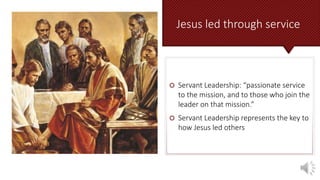
Jesus led through service
 Servant Leadership: “passionate service
to the mission, and to those who join the
leader on that mission.”
 Servant Leadership represents the key to
how Jesus led others
The 7 Principles of Christ-Like Leadership
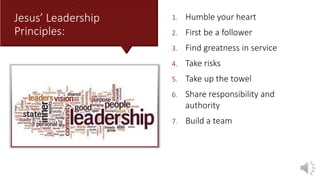
Jesus’ Leadership
Principles:
1. Humble your heart
2. First be a follower
3. Find greatness in service
4. Take risks
5. Take up the towel
6. Share responsibility and
authority
7. Build a team
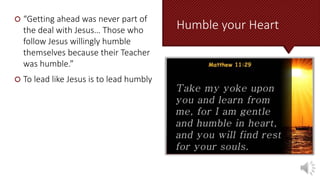
Humble your Heart
 “Getting ahead was never part of
the deal with Jesus… Those who
follow Jesus willingly humble
themselves because their Teacher
was humble.”
 To lead like Jesus is to lead humbly
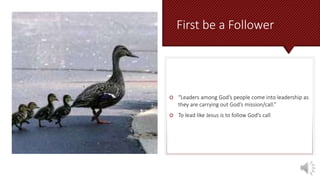
First be a Follower
 “Leaders among God’s people come into leadership as
they are carrying out God’s mission/call.”
 To lead like Jesus is to follow God’s call
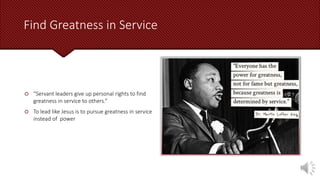
Find Greatness in Service
 “Servant leaders give up personal rights to find
greatness in service to others.”
 To lead like Jesus is to pursue greatness in service
instead of power
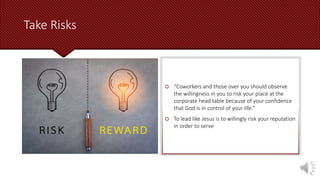
Take Risks
 “Coworkers and those over you should observe
the willingness in you to risk your place at the
corporate head table because of your confidence
that God is in control of your life.”
 To lead like Jesus is to willingly risk your reputation
in order to serve
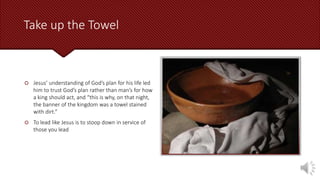
Take up the Towel
 Jesus’ understanding of God’s plan for his life led
him to trust God’s plan rather than man’s for how
a king should act, and “this is why, on that night,
the banner of the kingdom was a towel stained
with dirt.”
 To lead like Jesus is to stoop down in service of
those you lead
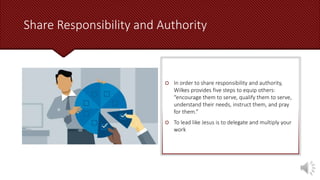
Share Responsibility and Authority
 In order to share responsibility and authority,
Wilkes provides five steps to equip others:
“encourage them to serve, qualify them to serve,
understand their needs, instruct them, and pray
for them.”
 To lead like Jesus is to delegate and multiply your
work
Build a Team
 “Leadership of a team is the highest expression of
servant leadership.”
 To lead like Jesus is to develop a team who carries
on the mission
Works Cited
 Wilkes, C. Gene. Jesus on Leadership: Timeless Wisdom on Servant
Leadership. Carol Stream, IL: Tyndale House Publishers, Inc, 1998.

Jesus on leadership

  • 1.
    Jesus on Leadership AnAnalysis by Jeremy Bugh
  • 2.
    Jesus on Leadership:Timeless Wisdom on Servant Leadership The Details:  Author – C. Gene Wilkes  Purpose – To demonstrate that Jesus “taught and embodied leadership as service.”
  • 3.
    Jesus led throughservice  Servant Leadership: “passionate service to the mission, and to those who join the leader on that mission.”  Servant Leadership represents the key to how Jesus led others
  • 4.
    The 7 Principlesof Christ-Like Leadership
  • 5.
    Jesus’ Leadership Principles: 1. Humbleyour heart 2. First be a follower 3. Find greatness in service 4. Take risks 5. Take up the towel 6. Share responsibility and authority 7. Build a team
  • 6.
    Humble your Heart “Getting ahead was never part of the deal with Jesus… Those who follow Jesus willingly humble themselves because their Teacher was humble.”  To lead like Jesus is to lead humbly
  • 7.
    First be aFollower  “Leaders among God’s people come into leadership as they are carrying out God’s mission/call.”  To lead like Jesus is to follow God’s call
  • 8.
    Find Greatness inService  “Servant leaders give up personal rights to find greatness in service to others.”  To lead like Jesus is to pursue greatness in service instead of power
  • 9.
    Take Risks  “Coworkersand those over you should observe the willingness in you to risk your place at the corporate head table because of your confidence that God is in control of your life.”  To lead like Jesus is to willingly risk your reputation in order to serve
  • 10.
    Take up theTowel  Jesus’ understanding of God’s plan for his life led him to trust God’s plan rather than man’s for how a king should act, and “this is why, on that night, the banner of the kingdom was a towel stained with dirt.”  To lead like Jesus is to stoop down in service of those you lead
  • 11.
    Share Responsibility andAuthority  In order to share responsibility and authority, Wilkes provides five steps to equip others: “encourage them to serve, qualify them to serve, understand their needs, instruct them, and pray for them.”  To lead like Jesus is to delegate and multiply your work
  • 12.
    Build a Team “Leadership of a team is the highest expression of servant leadership.”  To lead like Jesus is to develop a team who carries on the mission
  • 13.
    Works Cited  Wilkes,C. Gene. Jesus on Leadership: Timeless Wisdom on Servant Leadership. Carol Stream, IL: Tyndale House Publishers, Inc, 1998.

Editor's Notes

  • #2 Be specific and direct in the title. Use the subtitle to give the specific context of the speech. -The goal should be to capture the audience’s attention which can be done with a quote, a startling statistic, or fact. It is not necessary to include this attention getter on the slide.
  • #3 Use the background points to post details that are not common knowledge, or that the audience will need to understand the context of the speech. -Do not read these main points from the PowerPoint, instead elaborate on these points during the speech.
  • #4 The title of main point #1 should be clear and concise. Each piece of evidence should be summarized for clarity and cited correctly. Do not simply read the pieces of evidence, but elaborate where needed. [type notes for elaboration here] Be sure to transition to main point #2 and the next slide.
  • #5 Dedicate this entire slide to the thesis statement. It is the reason the speech is being given. Use this time to reveal the three main points of the speech (slides 4,5,6) as an overview for the direction of the speech: -[type main point #1 here] -[type main point #2 here] -[type main point #3 here] Be sure to transition to the first main point and the next slide.
  • #6 The title of main point #2 should be clear and concise. Each piece of evidence should be summarized for clarity and cited correctly. Do not simply read the pieces of evidence, but elaborate where needed. [type notes for elaboration here] Be sure to transition to main point #3 and the next slide.
  • #7 The counterargument should be the most common argument against the topic. The goal for this slide is to address the counterargument in such a way as to actually strengthen the original topic. Be sure to address each piece of evidence against the topic. As you address each piece of evidence elaborate on the text found on the slide. Remember to transition to the final slide, the action step.
  • #8 The counterargument should be the most common argument against the topic. The goal for this slide is to address the counterargument in such a way as to actually strengthen the original topic. Be sure to address each piece of evidence against the topic. As you address each piece of evidence elaborate on the text found on the slide. Remember to transition to the final slide, the action step.
  • #9 The counterargument should be the most common argument against the topic. The goal for this slide is to address the counterargument in such a way as to actually strengthen the original topic. Be sure to address each piece of evidence against the topic. As you address each piece of evidence elaborate on the text found on the slide. Remember to transition to the final slide, the action step.
  • #10 The counterargument should be the most common argument against the topic. The goal for this slide is to address the counterargument in such a way as to actually strengthen the original topic. Be sure to address each piece of evidence against the topic. As you address each piece of evidence elaborate on the text found on the slide. Remember to transition to the final slide, the action step.
  • #11 The counterargument should be the most common argument against the topic. The goal for this slide is to address the counterargument in such a way as to actually strengthen the original topic. Be sure to address each piece of evidence against the topic. As you address each piece of evidence elaborate on the text found on the slide. Remember to transition to the final slide, the action step.
  • #12 The counterargument should be the most common argument against the topic. The goal for this slide is to address the counterargument in such a way as to actually strengthen the original topic. Be sure to address each piece of evidence against the topic. As you address each piece of evidence elaborate on the text found on the slide. Remember to transition to the final slide, the action step.
  • #13 The counterargument should be the most common argument against the topic. The goal for this slide is to address the counterargument in such a way as to actually strengthen the original topic. Be sure to address each piece of evidence against the topic. As you address each piece of evidence elaborate on the text found on the slide. Remember to transition to the final slide, the action step.
  • #14 The counterargument should be the most common argument against the topic. The goal for this slide is to address the counterargument in such a way as to actually strengthen the original topic. Be sure to address each piece of evidence against the topic. As you address each piece of evidence elaborate on the text found on the slide. Remember to transition to the final slide, the action step.