Seven Principles
for Coaching with
Emotional Intelligence
Note for readers:
This document is an incomplete extract, provided exclusively to individuals who
registered for JCA’s webinar, ‘Value and Belief: attitudes for Coaching with
Emotional Intelligence’ held on 14 November 2016.
It is provided solely for the purposes of personal development for those
individuals, to assist them in applying Emotional Intelligence principles in their
coaching practice.
The full version of this document is provided within the participant materials for
JCA’s coach development programme, ‘Coaching with Emotional Intelligence’.
To register as a programme participant or for more information, please call
+44 (0)1242 239238 or visit www.jcaglobal.com
All rights reserved. No part of this publication may be reproduced or transmitted
in any form or by any means, electronic or mechanical, including photocopy,
recording, or any information storage and retrieval system, without permission
in writing from the author.
Copyright © 2016 JCA Global
Introduction
“I cannot teach anyone anything, I can only make them think “ (Socrates)
What is coaching? There are many models and definitions of coaching as well as many distinct
approaches to coaching, such as life coaching, sports coaching, executive coaching,
performance coaching and business coaching. This diversity of applications mean there is not a
single, universally agreed explanation of what coaching is. However, some of the most useful
descriptions include:
“Unlocking a person’s potential to maximise their performance” (Whitmore, 1996)
“The art of facilitating the performance, learning and development of another” (Downey, 2003)
“…a powerful alliance designed to forward and enhance a life-long process of human learning,
effectiveness and fulfilment” (Whitworth et al, 2007)
These definitions help set the context for coaching, but exploring and applying the following
underlying principles will give greater insight into what Coaching with Emotional Intelligence is
really about, illustrating the attitudes, awareness and behaviours that make up its essential
core.
The seven principles can be thought of as the strong foundations which support the work of
coaching and keep it rooted in good practices. As with the foundations of a building, the
principles are interlocking and mutually reinforcing and as such, help each moment in coaching
to assist the growth of the coachee and movement towards achieving their desired outcomes.
Here, each of the seven principles is briefly explained, with a description of how it supports
effective coaching practices and the success of the coaching endeavour. There are also
reflective questions to develop personal insights and help you apply the principles in the
coaching you do.
We suggest you choose just one or two questions for each principle that appeal to you to
reflect on as you read, and come back to the others periodically throughout the Coaching with
Emotional Intelligence programme. You can use the self-evaluation document to make notes of
your reflections. If you are not yet actively coaching, you can consider how you apply the
principles in other working relationships.
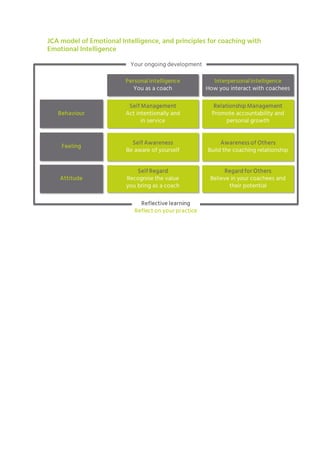
As shown below, the seven principles align to JCA’s model of Emotional Intelligence (Maddocks,
2014). This model is based on neurological evidence and provides an organising framework for
understanding effective human behaviour – specifically in this case, effective coaching:
JCA model of Emotional Intelligence, and principles for coaching with
Emotional Intelligence
Principle 1.
Recognise the value you bring
as a coach
Your own ongoing journey of personal development will always inform your development as a
coach, and over time the evolution of your signature coaching style. This will be true whether
you coach as a leader in an organisation, within a specialist field such as Learning &
Development, or as an independent practitioner offering executive coaching services.
Recognising the unique value you bring as a coach gives you greater belief in yourself, your
capabilities and your coaching skills – from the very start of your coaching journey and as you
progress through the years. Enabled by reflecting on your practice (principle 7), your
development journey will require curiosity, courage and compassion. Therefore it is important
for you as a coach to build your Self Regard. Self-Regard is a cornerstone of Emotional
Intelligence, defined as:
“… the degree to which an individual accepts and values themselves”
Developing your own sense of value comes from having a sense of meaning and purpose
around who you are as a coach, living out your personal values in the coaching you do, utilising
your gifts and talents. Accepting yourself includes your awareness of development gaps,
mistakes and setbacks, as well as successes and progression. However building your Self
Regard does not mean holding yourself to an imagined standard of perfection as a coach, or
thinking you have ‘finished’ your development – remember, the journey is ongoing!
Recognising the value you bring as a coach supports effective coaching by helping you be
authentic and non-defensive in your presence, hold a curious and open attitude, invite trust
and act in service of your coachees (principle 3). It also helps you believe in your coachees and
their potential, for example seeing the value they bring to their role, and how they can grow
(principle 2). In turn all of this will enable your coachees to be open with you, to be vulnerable,
and to be brave in pursuing their desired outcomes.
To recognise more of the value you bring as a coach, discuss the following questions with other
coaches or in supervision, or reflect and write down responses in your learning journal:
— Why did you choose to learn to be a coach?
— Why would you like people to hire you as a coach?
— What is the value you want to bring?
— What are your personal values?
— What do others admire in you and give you praise for?
— What do you bring to coaching?
— What are your gifts and talents, your capabilities and skills?
— When does your ‘inner critic’ berate you for mistakes, or not being ‘good enough’?
— Using your answers to all the other questions above, what statements can challenge the
negativity of your inner critic, or re-frame the criticisms into positive suggestions for
development?
Principle 4.
Believe in your coachees and
their potential
Much as recognising the value you bring as a coach gives you greater belief in yourself
(principle 1), demonstrating you believe in your coachees enables them to be vulnerable, open,
and brave in pursuing their desired outcomes. It is a key capacity for coaches to be able to see
potential in others when they can’t see it themselves, which flows from holding an attitude of
unconditional positive regard towards them. Psychologist Carl Rogers (1956) first developed
this concept as part of his human-centred approach to helping clients achieve all their human
potential. It is later described as:
“… an attitude of grace, an attitude that values us even knowing our failings. It is a profound
relief to drop our pretences, confess our worst feelings, and discover that we are still accepted.
In a good marriage, a close family, or an intimate friendship, we are free to be spontaneous
without fearing the loss of others' esteem.” (Myers, 2007).
Beyond even the relationships Myers refers to, the safety, freedom to speak openly and
acceptance experienced in a coaching relationship are highly valued by coachees. Having
someone to work with on their development and goals whom they can be confident has no
agenda outside that agreed in the coaching contract, is a powerful catalytic element in
coaching. Nonetheless, in parallel with acting in service (principle 3) believing in your coachees
does not preclude providing feedback and challenge when appropriate – even more so, as a
coach you demonstrate your genuine belief in someone’s potential for growth when you work
with them on attitudes, thinking or behaviours that are currently limiting their success. This is
brought out in JCA’s model of Emotional Intelligence, where Regard for Others is defined as:
“The degree to which a person accepts and values others (as distinct from liking or approving
of what they do)”
You show unconditional Regard for Others through maintaining belief in each coachee as a
unique individual, accepting their views, opinions and beliefs as their views, opinions and
beliefs. It is about nurturing a caring for another person, being aware of their needs and seeing
their humanity. It helps you experience compassion and transmit empathy for a person’s
struggle with issues and problems, or excitement at new opportunities and successes.
It is often helpful to use your imagination to see your coachee achieving what they would like,
to hold a personal vision for them first, when they cannot, and then develop the coaching
conversation whilst holding that belief in them.
To develop your Regard for Others, and demonstrate belief in your coachees and their
potential, consider the following in your reflective practice, in supervision or in discussion with
other coaches:
— Notice your judgements – when you challenge or disagree with others, it is for what they
do or say, and not for their being or who they are?
— Seek to understand others, develop compassion and respond appropriately. How readily
can you see things from their point of view? What are their personal values? Their concerns?
How might they be feeling? What do they really want?
— Find opportunities to express positive regard for your coachees. What do you like about
them? What do you admire in their effort and achievements? How is their behaviour
helping the progress of the coaching? What have you said and done to express those
things?
References
References Here we’ve detailed the references that accompany ‘Seven Principles for Coaching
with Emotional Intelligence’.
These have been separated into research papers and books. All references are shown in
alphabetical order.
Research Papers
Rogers, C. R. (1956), “Client Centered Theory”, Journal of Counselling Psychology Vol 3(2), P115-
120
Books
Downey, M. (2003), “Effective Coaching”, Orion Business Books, London
Maddocks, J (2014), “Emotional Intelligence @ Work: How to make change stick”, Spa House
Publishing, Cheltenham
Myers, David G. (2007). Psychology (8th ed.). Worth, New York
Whitmore, J. (1996). “Coaching for Performance”, Nicholas Brealey Publishing, London
Whitworth L., Kimsey-House H, Sandahl, P. (2007) “Co-Active Coaching: new skills for coaching
people toward success in work and life.” Davis black publishing, California
JCA-webinar-seven principles

JCA-webinar-seven principles

  • 1.
    Seven Principles for Coachingwith Emotional Intelligence Note for readers: This document is an incomplete extract, provided exclusively to individuals who registered for JCA’s webinar, ‘Value and Belief: attitudes for Coaching with Emotional Intelligence’ held on 14 November 2016. It is provided solely for the purposes of personal development for those individuals, to assist them in applying Emotional Intelligence principles in their coaching practice. The full version of this document is provided within the participant materials for JCA’s coach development programme, ‘Coaching with Emotional Intelligence’. To register as a programme participant or for more information, please call +44 (0)1242 239238 or visit www.jcaglobal.com All rights reserved. No part of this publication may be reproduced or transmitted in any form or by any means, electronic or mechanical, including photocopy, recording, or any information storage and retrieval system, without permission in writing from the author. Copyright © 2016 JCA Global
  • 2.
    Introduction “I cannot teachanyone anything, I can only make them think “ (Socrates) What is coaching? There are many models and definitions of coaching as well as many distinct approaches to coaching, such as life coaching, sports coaching, executive coaching, performance coaching and business coaching. This diversity of applications mean there is not a single, universally agreed explanation of what coaching is. However, some of the most useful descriptions include: “Unlocking a person’s potential to maximise their performance” (Whitmore, 1996) “The art of facilitating the performance, learning and development of another” (Downey, 2003) “…a powerful alliance designed to forward and enhance a life-long process of human learning, effectiveness and fulfilment” (Whitworth et al, 2007) These definitions help set the context for coaching, but exploring and applying the following underlying principles will give greater insight into what Coaching with Emotional Intelligence is really about, illustrating the attitudes, awareness and behaviours that make up its essential core. The seven principles can be thought of as the strong foundations which support the work of coaching and keep it rooted in good practices. As with the foundations of a building, the principles are interlocking and mutually reinforcing and as such, help each moment in coaching to assist the growth of the coachee and movement towards achieving their desired outcomes. Here, each of the seven principles is briefly explained, with a description of how it supports effective coaching practices and the success of the coaching endeavour. There are also reflective questions to develop personal insights and help you apply the principles in the coaching you do. We suggest you choose just one or two questions for each principle that appeal to you to reflect on as you read, and come back to the others periodically throughout the Coaching with Emotional Intelligence programme. You can use the self-evaluation document to make notes of your reflections. If you are not yet actively coaching, you can consider how you apply the principles in other working relationships. As shown below, the seven principles align to JCA’s model of Emotional Intelligence (Maddocks, 2014). This model is based on neurological evidence and provides an organising framework for understanding effective human behaviour – specifically in this case, effective coaching:
  • 3.
    JCA model ofEmotional Intelligence, and principles for coaching with Emotional Intelligence
  • 4.
    Principle 1. Recognise thevalue you bring as a coach Your own ongoing journey of personal development will always inform your development as a coach, and over time the evolution of your signature coaching style. This will be true whether you coach as a leader in an organisation, within a specialist field such as Learning & Development, or as an independent practitioner offering executive coaching services. Recognising the unique value you bring as a coach gives you greater belief in yourself, your capabilities and your coaching skills – from the very start of your coaching journey and as you progress through the years. Enabled by reflecting on your practice (principle 7), your development journey will require curiosity, courage and compassion. Therefore it is important for you as a coach to build your Self Regard. Self-Regard is a cornerstone of Emotional Intelligence, defined as: “… the degree to which an individual accepts and values themselves” Developing your own sense of value comes from having a sense of meaning and purpose around who you are as a coach, living out your personal values in the coaching you do, utilising your gifts and talents. Accepting yourself includes your awareness of development gaps, mistakes and setbacks, as well as successes and progression. However building your Self Regard does not mean holding yourself to an imagined standard of perfection as a coach, or thinking you have ‘finished’ your development – remember, the journey is ongoing! Recognising the value you bring as a coach supports effective coaching by helping you be authentic and non-defensive in your presence, hold a curious and open attitude, invite trust and act in service of your coachees (principle 3). It also helps you believe in your coachees and their potential, for example seeing the value they bring to their role, and how they can grow (principle 2). In turn all of this will enable your coachees to be open with you, to be vulnerable, and to be brave in pursuing their desired outcomes. To recognise more of the value you bring as a coach, discuss the following questions with other coaches or in supervision, or reflect and write down responses in your learning journal: — Why did you choose to learn to be a coach? — Why would you like people to hire you as a coach? — What is the value you want to bring? — What are your personal values? — What do others admire in you and give you praise for?
  • 5.
    — What doyou bring to coaching? — What are your gifts and talents, your capabilities and skills? — When does your ‘inner critic’ berate you for mistakes, or not being ‘good enough’? — Using your answers to all the other questions above, what statements can challenge the negativity of your inner critic, or re-frame the criticisms into positive suggestions for development? Principle 4. Believe in your coachees and their potential Much as recognising the value you bring as a coach gives you greater belief in yourself (principle 1), demonstrating you believe in your coachees enables them to be vulnerable, open, and brave in pursuing their desired outcomes. It is a key capacity for coaches to be able to see potential in others when they can’t see it themselves, which flows from holding an attitude of unconditional positive regard towards them. Psychologist Carl Rogers (1956) first developed this concept as part of his human-centred approach to helping clients achieve all their human potential. It is later described as: “… an attitude of grace, an attitude that values us even knowing our failings. It is a profound relief to drop our pretences, confess our worst feelings, and discover that we are still accepted. In a good marriage, a close family, or an intimate friendship, we are free to be spontaneous without fearing the loss of others' esteem.” (Myers, 2007). Beyond even the relationships Myers refers to, the safety, freedom to speak openly and acceptance experienced in a coaching relationship are highly valued by coachees. Having someone to work with on their development and goals whom they can be confident has no agenda outside that agreed in the coaching contract, is a powerful catalytic element in coaching. Nonetheless, in parallel with acting in service (principle 3) believing in your coachees does not preclude providing feedback and challenge when appropriate – even more so, as a coach you demonstrate your genuine belief in someone’s potential for growth when you work with them on attitudes, thinking or behaviours that are currently limiting their success. This is brought out in JCA’s model of Emotional Intelligence, where Regard for Others is defined as: “The degree to which a person accepts and values others (as distinct from liking or approving of what they do)” You show unconditional Regard for Others through maintaining belief in each coachee as a unique individual, accepting their views, opinions and beliefs as their views, opinions and beliefs. It is about nurturing a caring for another person, being aware of their needs and seeing
  • 6.
    their humanity. Ithelps you experience compassion and transmit empathy for a person’s struggle with issues and problems, or excitement at new opportunities and successes. It is often helpful to use your imagination to see your coachee achieving what they would like, to hold a personal vision for them first, when they cannot, and then develop the coaching conversation whilst holding that belief in them. To develop your Regard for Others, and demonstrate belief in your coachees and their potential, consider the following in your reflective practice, in supervision or in discussion with other coaches: — Notice your judgements – when you challenge or disagree with others, it is for what they do or say, and not for their being or who they are? — Seek to understand others, develop compassion and respond appropriately. How readily can you see things from their point of view? What are their personal values? Their concerns? How might they be feeling? What do they really want? — Find opportunities to express positive regard for your coachees. What do you like about them? What do you admire in their effort and achievements? How is their behaviour helping the progress of the coaching? What have you said and done to express those things?
  • 7.
    References References Here we’vedetailed the references that accompany ‘Seven Principles for Coaching with Emotional Intelligence’. These have been separated into research papers and books. All references are shown in alphabetical order. Research Papers Rogers, C. R. (1956), “Client Centered Theory”, Journal of Counselling Psychology Vol 3(2), P115- 120 Books Downey, M. (2003), “Effective Coaching”, Orion Business Books, London Maddocks, J (2014), “Emotional Intelligence @ Work: How to make change stick”, Spa House Publishing, Cheltenham Myers, David G. (2007). Psychology (8th ed.). Worth, New York Whitmore, J. (1996). “Coaching for Performance”, Nicholas Brealey Publishing, London Whitworth L., Kimsey-House H, Sandahl, P. (2007) “Co-Active Coaching: new skills for coaching people toward success in work and life.” Davis black publishing, California