Servlets Strength &Servlet applets
Presented By
M.Anushuya
I MSC (CS)
Servelets Strength:-
Servlets are the Java programs that run on the
Java-enabled web server or application server.
They are used to handle the request obtained from
the webserver, process the request, produce the
response, then send a response back to the
webserver.
Advantages of a Java Servlet :-
• Servlet is faster than CGI as it doesn’t involve the
creation of a new process for every new request
received.
• Servlets, as written in Java, are platform-independent.
• Removes the overhead of creating a new process for
each request as Servlet doesn’t run in a separate
process. There is only a single instance that handles all
requests concurrently.
• This also saves the memory and allows a Servlet to
easily manage the client state.
• It is a server-side component, so Servlet inherits
the security provided by the Web server.
What is Applet?
• An applet is a Java program that can be
embedded into a web page.
• It runs inside the web browser and works
at client side.
• An applet is embedded in an HTML page
using the APPLET or OBJECT tag and
hosted on a web server.
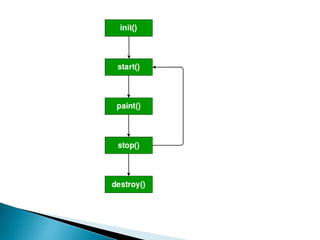
It is important to understand the order in which the
various methods shown in the above image are called.
When an applet begins, the following methods are
called, in this sequence:-
• init( )
• start( )
• paint( )
When an applet is terminated, the following sequence
of method calls takes place:-
• stop( )
• destroy( )
1. init( ) : The init( ) method is the first method
to be called. This is where you should initialize
variables. This method is called only
once during the run time of your applet.
2. start( ) : The start( ) method is called
after init( ). It is also called to restart an applet
after it has been stopped. Note that init( ) is
called once i.e. when the first time an applet is
loaded whereas start( ) is called each time an
applet’s HTML document is displayed onscreen.
So, if a user leaves a web page and comes back,
the applet resumes execution at start( ).
3. paint( ) : The paint( ) method is called each time an AWT-based
applet’s output must be redrawn. This situation can occur for
several reasons. For example, the window in which the applet is
running may be overwritten by another window and then
uncovered. Or the applet window may be minimized and then
restored.
paint( ) is also called when the applet begins execution. Whatever
the cause, whenever the applet must redraw its output, paint( ) is
called.
The paint( ) method has one parameter of type Graphics. This
parameter will contain the graphics context, which describes the
graphics environment in which the applet is running. This context
is used whenever output to the applet is required.
java.pptx

java.pptx

  • 1.
    Servlets Strength &Servletapplets Presented By M.Anushuya I MSC (CS)
  • 2.
    Servelets Strength:- Servlets arethe Java programs that run on the Java-enabled web server or application server. They are used to handle the request obtained from the webserver, process the request, produce the response, then send a response back to the webserver.
  • 4.
    Advantages of aJava Servlet :- • Servlet is faster than CGI as it doesn’t involve the creation of a new process for every new request received. • Servlets, as written in Java, are platform-independent. • Removes the overhead of creating a new process for each request as Servlet doesn’t run in a separate process. There is only a single instance that handles all requests concurrently. • This also saves the memory and allows a Servlet to easily manage the client state. • It is a server-side component, so Servlet inherits the security provided by the Web server.
  • 5.
    What is Applet? •An applet is a Java program that can be embedded into a web page. • It runs inside the web browser and works at client side. • An applet is embedded in an HTML page using the APPLET or OBJECT tag and hosted on a web server.
  • 7.
    It is importantto understand the order in which the various methods shown in the above image are called. When an applet begins, the following methods are called, in this sequence:- • init( ) • start( ) • paint( ) When an applet is terminated, the following sequence of method calls takes place:- • stop( ) • destroy( )
  • 8.
    1. init( ): The init( ) method is the first method to be called. This is where you should initialize variables. This method is called only once during the run time of your applet. 2. start( ) : The start( ) method is called after init( ). It is also called to restart an applet after it has been stopped. Note that init( ) is called once i.e. when the first time an applet is loaded whereas start( ) is called each time an applet’s HTML document is displayed onscreen. So, if a user leaves a web page and comes back, the applet resumes execution at start( ).
  • 9.
    3. paint( ): The paint( ) method is called each time an AWT-based applet’s output must be redrawn. This situation can occur for several reasons. For example, the window in which the applet is running may be overwritten by another window and then uncovered. Or the applet window may be minimized and then restored. paint( ) is also called when the applet begins execution. Whatever the cause, whenever the applet must redraw its output, paint( ) is called. The paint( ) method has one parameter of type Graphics. This parameter will contain the graphics context, which describes the graphics environment in which the applet is running. This context is used whenever output to the applet is required.