JavaFX Dependency
Injection with
FxContainer

                    Presented by
                 Srikanth Shenoy
                    ObjectSource
  Learn FxContainer in 10 minutes
Introduction
   Who am I?
       A hands-on architect
       Experienced and very knowledgeable in Java and
        Java EE
       Authored a book on Struts
       Several articles on Java EE for leading journals
       Director of Enterprise Java Practice at
        ObjectSource
       Creator of FxObjects and FxContainer framework
Introduction
   What is FxContainer? (Currently 1.0)
       Open source IoC container written in JavaFX.
       Meant specifically for Dependency Injection in
        JavaFX applications
       Very much Spring-like
       Small footprint (< 75K)
       Sequence, Collection Support
       Mix Java and JavaFX wiring
   Learn FxContainer in 20 slides! (10 minutes)
IoC Container Landscape
   Spring
       Supports XML and Annotations based DI
       Supports Constructor & Setter Injection
   Guice
       Supports Annotations and API based DI
       Supports Constructor & Setter Injection
   PicoContainer and many more..
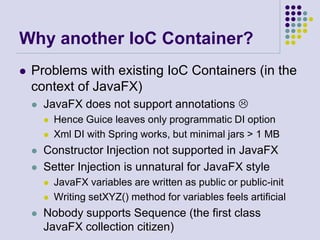
Why another IoC Container?
   Problems with existing IoC Containers (in the
    context of JavaFX)
       JavaFX does not support annotations 
           Hence Guice leaves only programmatic DI option
           Xml DI with Spring works, but minimal jars > 1 MB
       Constructor Injection not supported in JavaFX
       Setter Injection is unnatural for JavaFX style
           JavaFX variables are written as public or public-init
           Writing setXYZ() method for variables feels artificial
       Nobody supports Sequence (the first class
        JavaFX collection citizen)
Setter Injection
var finder = MovieFinder {
  movieDao: MovieDao { }
}

   Dependency Injection with any other IoC
    container needs a setter like this (Not Good)
public class MovieFinder {
  public-init movieDao:MovieDao;
  public function setMovieDao(dao:MovieDao) {
    this.movieDao = dao;
  }
}
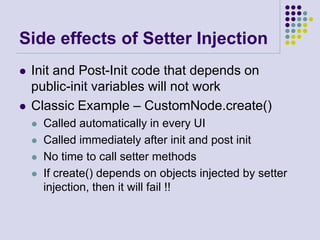
Side effects of Setter Injection
   Init and Post-Init code that depends on
    public-init variables will not work
   Classic Example – CustomNode.create()
       Called automatically in every UI
       Called immediately after init and post init
       No time to call setter methods
       If create() depends on objects injected by setter
        injection, then it will fail !!
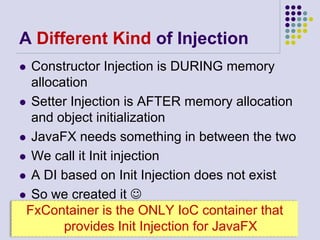
A Different Kind of Injection
 Constructor Injection is DURING memory
  allocation
 Setter Injection is AFTER memory allocation
  and object initialization
 JavaFX needs something in between the two

 We call it Init injection

 A DI based on Init Injection does not exist

 So we created it 
 FxContainer is the ONLY IoC container that
        provides Init Injection for JavaFX
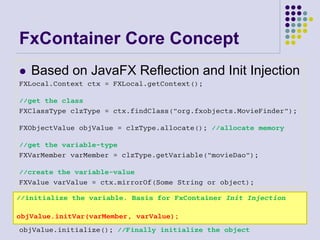
FxContainer Core Concept
   Based on JavaFX Reflection and Init Injection
FXLocal.Context ctx = FXLocal.getContext();

//get the class
FXClassType clzType = ctx.findClass("org.fxobjects.MovieFinder");

FXObjectValue objValue = clzType.allocate(); //allocate memory

//get the variable-type
FXVarMember varMember = clzType.getVariable("movieDao");

//create the variable-value
FXValue varValue = ctx.mirrorOf(Some String or object);

//initialize the variable. Basis for FxContainer Init Injection

objValue.initVar(varMember, varValue);
objValue.initialize(); //Finally initialize the object
FxContainer Overview
   Uses Setter Injection for Java objects
   Uses Init Injection for JavaFX objects
   Can mix both Java and JavaFX objects
   Java objects can hold references to JavaFX
    objects via interfaces
   Very Spring Like in configuration
   Powerful, Lightweight and Easy to use
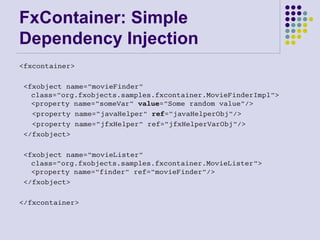
FxContainer: Simple
Dependency Injection
<fxcontainer>

<fxobject name="movieFinder"
  class="org.fxobjects.samples.fxcontainer.MovieFinderImpl">
  <property name="someVar" value="Some random value"/>
  <property name="javaHelper" ref="javaHelperObj"/>
  <property name="jfxHelper" ref="jfxHelperVarObj"/>
</fxobject>

<fxobject name="movieLister"
  class="org.fxobjects.samples.fxcontainer.MovieLister">
  <property name="finder" ref="movieFinder"/>
</fxobject>

</fxcontainer>
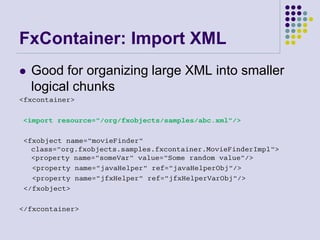
FxContainer: Import XML
   Good for organizing large XML into smaller
    logical chunks
<fxcontainer>

<import resource="/org/fxobjects/samples/abc.xml"/>

<fxobject name="movieFinder"
  class="org.fxobjects.samples.fxcontainer.MovieFinderImpl">
  <property name="someVar" value="Some random value"/>
  <property name="javaHelper" ref="javaHelperObj"/>
  <property name="jfxHelper" ref="jfxHelperVarObj"/>
</fxobject>

</fxcontainer>
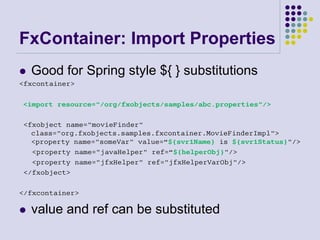
FxContainer: Import Properties
   Good for Spring style ${ } substitutions
<fxcontainer>

<import resource="/org/fxobjects/samples/abc.properties"/>

<fxobject name="movieFinder"
  class="org.fxobjects.samples.fxcontainer.MovieFinderImpl">
  <property name="someVar" value=“${svr1Name} is ${svr1Status}"/>
  <property name="javaHelper" ref=“${helperObj}"/>
  <property name="jfxHelper" ref="jfxHelperVarObj"/>
</fxobject>

</fxcontainer>

   value and ref can be substituted
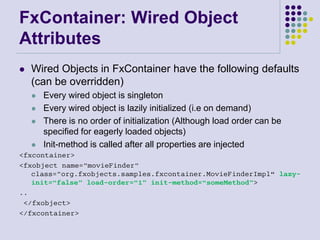
FxContainer: Wired Object
Attributes
   Wired Objects in FxContainer have the following defaults
    (can be overridden)
       Every wired object is singleton
       Every wired object is lazily initialized (i.e on demand)
       There is no order of initialization (Although load order can be
        specified for eagerly loaded objects)
       Init-method is called after all properties are injected
<fxcontainer>
<fxobject name="movieFinder"
   class="org.fxobjects.samples.fxcontainer.MovieFinderImpl“ lazy-
   init=“false” load-order=“1” init-method=“someMethod”>
..
 </fxobject>
</fxcontainer>
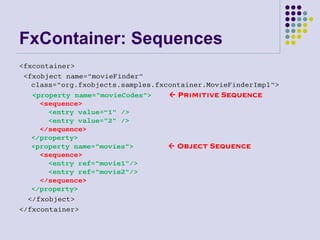
FxContainer: Sequences
<fxcontainer>
 <fxobject name="movieFinder"
   class="org.fxobjects.samples.fxcontainer.MovieFinderImpl">
   <property name="movieCodes">     Primitive Sequence
     <sequence>
       <entry value=“1" />
       <entry value="2" />
     </sequence>
   </property>
   <property name="movies">         Object Sequence
     <sequence>
       <entry ref="movie1"/>
       <entry ref="movie2"/>
     </sequence>
   </property>
  </fxobject>
</fxcontainer>
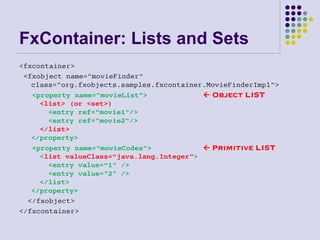
FxContainer: Lists and Sets
<fxcontainer>
 <fxobject name="movieFinder"
   class="org.fxobjects.samples.fxcontainer.MovieFinderImpl">
   <property name="movieList">              Object LIST
     <list> (or <set>)
       <entry ref="movie1"/>
       <entry ref="movie2"/>
     </list>
   </property>
   <property name="movieCodes">             Primitive LIST
     <list valueClass=“java.lang.Integer”>
       <entry value=“1" />
       <entry value="2" />
     </list>
   </property>
  </fxobject>
</fxcontainer>
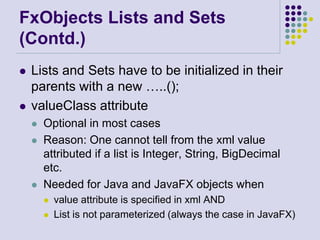
FxObjects Lists and Sets
(Contd.)
   Lists and Sets have to be initialized in their
    parents with a new …..();
   valueClass attribute
       Optional in most cases
       Reason: One cannot tell from the xml value
        attributed if a list is Integer, String, BigDecimal
        etc.
       Needed for Java and JavaFX objects when
           value attribute is specified in xml AND
           List is not parameterized (always the case in JavaFX)
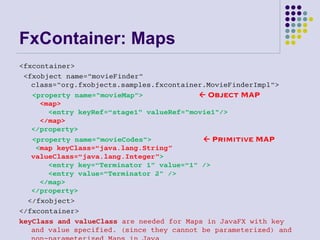
FxContainer: Maps
<fxcontainer>
 <fxobject name="movieFinder"
   class="org.fxobjects.samples.fxcontainer.MovieFinderImpl">
   <property name="movieMap">              Object MAP
     <map>
       <entry keyRef=“stage1” valueRef="movie1"/>
     </map>
   </property>
   <property name="movieCodes">             Primitive MAP
    <map keyClass=“java.lang.String”
   valueClass=“java.lang.Integer”>
       <entry key=“Terminator 1” value=“1" />
       <entry value=“Terminator 2" />
     </map>
   </property>
  </fxobject>
</fxcontainer>
keyClass and valueClass are needed for Maps in JavaFX with key
   and value specified. (since they cannot be parameterized) and
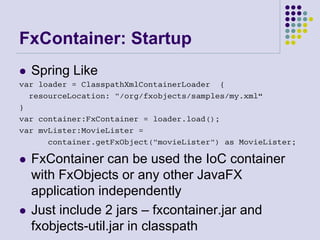
FxContainer: Startup
   Spring Like
var loader = ClasspathXmlContainerLoader {
  resourceLocation: "/org/fxobjects/samples/my.xml“
}
var container:FxContainer = loader.load();
var mvLister:MovieLister =
      container.getFxObject("movieLister") as MovieLister;

   FxContainer can be used the IoC container
    with FxObjects or any other JavaFX
    application independently
   Just include 2 jars – fxcontainer.jar and
    fxobjects-util.jar in classpath
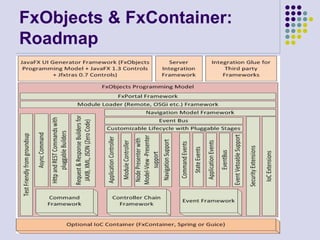
FxObjects & FxContainer:
Roadmap
Links
   Project site – https://fxobjects/dev.java.net
   FxContainer is a subproject of FxObjects
   Not a single person open source project
       FxObjects and FxContainer developed and supported
        by ObjectSource (http://www.objectsource.com)
   Download, use, extend, redistribute, OEM
   Discussion Forums on project site
   Participation welcome
       Post ideas, questions, concerns, comments
       Contribute code

JavaFX Dependency Injection with FxContainer

  • 1.
    JavaFX Dependency Injection with FxContainer Presented by Srikanth Shenoy ObjectSource Learn FxContainer in 10 minutes
  • 2.
    Introduction  Who am I?  A hands-on architect  Experienced and very knowledgeable in Java and Java EE  Authored a book on Struts  Several articles on Java EE for leading journals  Director of Enterprise Java Practice at ObjectSource  Creator of FxObjects and FxContainer framework
  • 3.
    Introduction  What is FxContainer? (Currently 1.0)  Open source IoC container written in JavaFX.  Meant specifically for Dependency Injection in JavaFX applications  Very much Spring-like  Small footprint (< 75K)  Sequence, Collection Support  Mix Java and JavaFX wiring  Learn FxContainer in 20 slides! (10 minutes)
  • 4.
    IoC Container Landscape  Spring  Supports XML and Annotations based DI  Supports Constructor & Setter Injection  Guice  Supports Annotations and API based DI  Supports Constructor & Setter Injection  PicoContainer and many more..
  • 5.
    Why another IoCContainer?  Problems with existing IoC Containers (in the context of JavaFX)  JavaFX does not support annotations   Hence Guice leaves only programmatic DI option  Xml DI with Spring works, but minimal jars > 1 MB  Constructor Injection not supported in JavaFX  Setter Injection is unnatural for JavaFX style  JavaFX variables are written as public or public-init  Writing setXYZ() method for variables feels artificial  Nobody supports Sequence (the first class JavaFX collection citizen)
  • 6.
    Setter Injection var finder= MovieFinder { movieDao: MovieDao { } }  Dependency Injection with any other IoC container needs a setter like this (Not Good) public class MovieFinder { public-init movieDao:MovieDao; public function setMovieDao(dao:MovieDao) { this.movieDao = dao; } }
  • 7.
    Side effects ofSetter Injection  Init and Post-Init code that depends on public-init variables will not work  Classic Example – CustomNode.create()  Called automatically in every UI  Called immediately after init and post init  No time to call setter methods  If create() depends on objects injected by setter injection, then it will fail !!
  • 8.
    A Different Kindof Injection  Constructor Injection is DURING memory allocation  Setter Injection is AFTER memory allocation and object initialization  JavaFX needs something in between the two  We call it Init injection  A DI based on Init Injection does not exist  So we created it  FxContainer is the ONLY IoC container that provides Init Injection for JavaFX
  • 9.
    FxContainer Core Concept  Based on JavaFX Reflection and Init Injection FXLocal.Context ctx = FXLocal.getContext(); //get the class FXClassType clzType = ctx.findClass("org.fxobjects.MovieFinder"); FXObjectValue objValue = clzType.allocate(); //allocate memory //get the variable-type FXVarMember varMember = clzType.getVariable("movieDao"); //create the variable-value FXValue varValue = ctx.mirrorOf(Some String or object); //initialize the variable. Basis for FxContainer Init Injection objValue.initVar(varMember, varValue); objValue.initialize(); //Finally initialize the object
  • 10.
    FxContainer Overview  Uses Setter Injection for Java objects  Uses Init Injection for JavaFX objects  Can mix both Java and JavaFX objects  Java objects can hold references to JavaFX objects via interfaces  Very Spring Like in configuration  Powerful, Lightweight and Easy to use
  • 11.
    FxContainer: Simple Dependency Injection <fxcontainer> <fxobjectname="movieFinder" class="org.fxobjects.samples.fxcontainer.MovieFinderImpl"> <property name="someVar" value="Some random value"/> <property name="javaHelper" ref="javaHelperObj"/> <property name="jfxHelper" ref="jfxHelperVarObj"/> </fxobject> <fxobject name="movieLister" class="org.fxobjects.samples.fxcontainer.MovieLister"> <property name="finder" ref="movieFinder"/> </fxobject> </fxcontainer>
  • 12.
    FxContainer: Import XML  Good for organizing large XML into smaller logical chunks <fxcontainer> <import resource="/org/fxobjects/samples/abc.xml"/> <fxobject name="movieFinder" class="org.fxobjects.samples.fxcontainer.MovieFinderImpl"> <property name="someVar" value="Some random value"/> <property name="javaHelper" ref="javaHelperObj"/> <property name="jfxHelper" ref="jfxHelperVarObj"/> </fxobject> </fxcontainer>
  • 13.
    FxContainer: Import Properties  Good for Spring style ${ } substitutions <fxcontainer> <import resource="/org/fxobjects/samples/abc.properties"/> <fxobject name="movieFinder" class="org.fxobjects.samples.fxcontainer.MovieFinderImpl"> <property name="someVar" value=“${svr1Name} is ${svr1Status}"/> <property name="javaHelper" ref=“${helperObj}"/> <property name="jfxHelper" ref="jfxHelperVarObj"/> </fxobject> </fxcontainer>  value and ref can be substituted
  • 14.
    FxContainer: Wired Object Attributes  Wired Objects in FxContainer have the following defaults (can be overridden)  Every wired object is singleton  Every wired object is lazily initialized (i.e on demand)  There is no order of initialization (Although load order can be specified for eagerly loaded objects)  Init-method is called after all properties are injected <fxcontainer> <fxobject name="movieFinder" class="org.fxobjects.samples.fxcontainer.MovieFinderImpl“ lazy- init=“false” load-order=“1” init-method=“someMethod”> .. </fxobject> </fxcontainer>
  • 15.
    FxContainer: Sequences <fxcontainer> <fxobjectname="movieFinder" class="org.fxobjects.samples.fxcontainer.MovieFinderImpl"> <property name="movieCodes">  Primitive Sequence <sequence> <entry value=“1" /> <entry value="2" /> </sequence> </property> <property name="movies">  Object Sequence <sequence> <entry ref="movie1"/> <entry ref="movie2"/> </sequence> </property> </fxobject> </fxcontainer>
  • 16.
    FxContainer: Lists andSets <fxcontainer> <fxobject name="movieFinder" class="org.fxobjects.samples.fxcontainer.MovieFinderImpl"> <property name="movieList">  Object LIST <list> (or <set>) <entry ref="movie1"/> <entry ref="movie2"/> </list> </property> <property name="movieCodes">  Primitive LIST <list valueClass=“java.lang.Integer”> <entry value=“1" /> <entry value="2" /> </list> </property> </fxobject> </fxcontainer>
  • 17.
    FxObjects Lists andSets (Contd.)  Lists and Sets have to be initialized in their parents with a new …..();  valueClass attribute  Optional in most cases  Reason: One cannot tell from the xml value attributed if a list is Integer, String, BigDecimal etc.  Needed for Java and JavaFX objects when  value attribute is specified in xml AND  List is not parameterized (always the case in JavaFX)
  • 18.
    FxContainer: Maps <fxcontainer> <fxobjectname="movieFinder" class="org.fxobjects.samples.fxcontainer.MovieFinderImpl"> <property name="movieMap">  Object MAP <map> <entry keyRef=“stage1” valueRef="movie1"/> </map> </property> <property name="movieCodes">  Primitive MAP <map keyClass=“java.lang.String” valueClass=“java.lang.Integer”> <entry key=“Terminator 1” value=“1" /> <entry value=“Terminator 2" /> </map> </property> </fxobject> </fxcontainer> keyClass and valueClass are needed for Maps in JavaFX with key and value specified. (since they cannot be parameterized) and
  • 19.
    FxContainer: Startup  Spring Like var loader = ClasspathXmlContainerLoader { resourceLocation: "/org/fxobjects/samples/my.xml“ } var container:FxContainer = loader.load(); var mvLister:MovieLister = container.getFxObject("movieLister") as MovieLister;  FxContainer can be used the IoC container with FxObjects or any other JavaFX application independently  Just include 2 jars – fxcontainer.jar and fxobjects-util.jar in classpath
  • 20.
  • 21.
    Links  Project site – https://fxobjects/dev.java.net  FxContainer is a subproject of FxObjects  Not a single person open source project  FxObjects and FxContainer developed and supported by ObjectSource (http://www.objectsource.com)  Download, use, extend, redistribute, OEM  Discussion Forums on project site  Participation welcome  Post ideas, questions, concerns, comments  Contribute code