Java Software Solutions Foundations of Program Design 7th Edition Lewis Test Bank
Java Software Solutions Foundations of Program Design 7th Edition Lewis Test Bank
Java Software Solutions Foundations of Program Design 7th Edition Lewis Test Bank
Java Software Solutions Foundations of Program Design 7th Edition Lewis Test Bank
Java Software Solutions Foundations of Program Design 7th Edition Lewis Test Bank
1.
Download the fullversion and explore a variety of test banks
or solution manuals at https://testbankfan.com
Java Software Solutions Foundations of Program
Design 7th Edition Lewis Test Bank
_____ Tap the link below to start your download _____
https://testbankfan.com/product/java-software-solutions-
foundations-of-program-design-7th-edition-lewis-test-bank/
Find test banks or solution manuals at testbankfan.com today!
2.
We have selectedsome products that you may be interested in
Click the link to download now or visit testbankfan.com
for more options!.
Java Software Solutions Foundations of Program Design 7th
Edition Lewis Solutions Manual
https://testbankfan.com/product/java-software-solutions-foundations-
of-program-design-7th-edition-lewis-solutions-manual/
Java Foundations Introduction to Program Design and Data
Structures 4th Edition Lewis Test Bank
https://testbankfan.com/product/java-foundations-introduction-to-
program-design-and-data-structures-4th-edition-lewis-test-bank/
Java Software Solutions 9th Edition Lewis Test Bank
https://testbankfan.com/product/java-software-solutions-9th-edition-
lewis-test-bank/
U S Banking System 3rd Edition Center-for-Financial-
Training Test Bank
https://testbankfan.com/product/u-s-banking-system-3rd-edition-center-
for-financial-training-test-bank/
3.
Canadian Business andthe Law 4th Edition Duplessis
Solutions Manual
https://testbankfan.com/product/canadian-business-and-the-law-4th-
edition-duplessis-solutions-manual/
Management Asia-Pacific 6th Edition Samson Solutions
Manual
https://testbankfan.com/product/management-asia-pacific-6th-edition-
samson-solutions-manual/
Canadian Personal Care Provider Canadian 1st Edition
Wolgin Test Bank
https://testbankfan.com/product/canadian-personal-care-provider-
canadian-1st-edition-wolgin-test-bank/
Beginnings and Beyond Foundations in Early Childhood
Education 9th Edition Gordon Solutions Manual
https://testbankfan.com/product/beginnings-and-beyond-foundations-in-
early-childhood-education-9th-edition-gordon-solutions-manual/
Basic Real Estate Appraisal 8th Edition Betts Test Bank
https://testbankfan.com/product/basic-real-estate-appraisal-8th-
edition-betts-test-bank/
4.
Oral Pathology ClinicalPathologic Correlations 6th
Edition Regezi Test Bank
https://testbankfan.com/product/oral-pathology-clinical-pathologic-
correlations-6th-edition-regezi-test-bank/
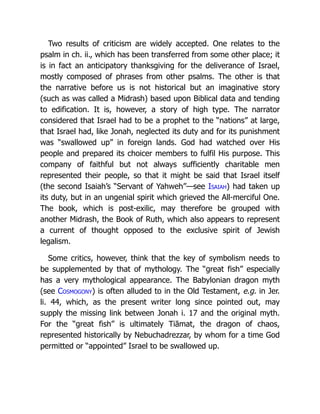
Two results ofcriticism are widely accepted. One relates to the
psalm in ch. ii., which has been transferred from some other place; it
is in fact an anticipatory thanksgiving for the deliverance of Israel,
mostly composed of phrases from other psalms. The other is that
the narrative before us is not historical but an imaginative story
(such as was called a Midrash) based upon Biblical data and tending
to edification. It is, however, a story of high type. The narrator
considered that Israel had to be a prophet to the “nations” at large,
that Israel had, like Jonah, neglected its duty and for its punishment
was “swallowed up” in foreign lands. God had watched over His
people and prepared its choicer members to fulfil His purpose. This
company of faithful but not always sufficiently charitable men
represented their people, so that it might be said that Israel itself
(the second Isaiah’s “Servant of Yahweh”—see Isaiah) had taken up
its duty, but in an ungenial spirit which grieved the All-merciful One.
The book, which is post-exilic, may therefore be grouped with
another Midrash, the Book of Ruth, which also appears to represent
a current of thought opposed to the exclusive spirit of Jewish
legalism.
Some critics, however, think that the key of symbolism needs to
be supplemented by that of mythology. The “great fish” especially
has a very mythological appearance. The Babylonian dragon myth
(see Cosmogony) is often alluded to in the Old Testament, e.g. in Jer.
li. 44, which, as the present writer long since pointed out, may
supply the missing link between Jonah i. 17 and the original myth.
For the “great fish” is ultimately Tiāmat, the dragon of chaos,
represented historically by Nebuchadrezzar, by whom for a time God
permitted or “appointed” Israel to be swallowed up.
27.
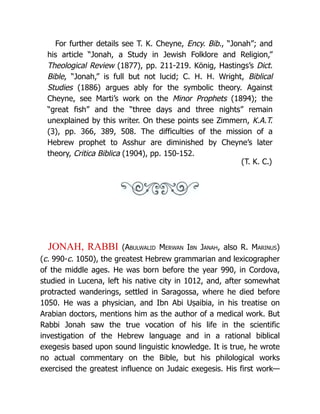
For further detailssee T. K. Cheyne, Ency. Bib., “Jonah”; and
his article “Jonah, a Study in Jewish Folklore and Religion,”
Theological Review (1877), pp. 211-219. König, Hastings’s Dict.
Bible, “Jonah,” is full but not lucid; C. H. H. Wright, Biblical
Studies (1886) argues ably for the symbolic theory. Against
Cheyne, see Marti’s work on the Minor Prophets (1894); the
“great fish” and the “three days and three nights” remain
unexplained by this writer. On these points see Zimmern, K.A.T.
(3), pp. 366, 389, 508. The difficulties of the mission of a
Hebrew prophet to Asshur are diminished by Cheyne’s later
theory, Critica Biblica (1904), pp. 150-152.
(T. K. C.)
JONAH, RABBI (Abulwalid Merwan Ibn Janah, also R. Marinus)
(c. 990-c. 1050), the greatest Hebrew grammarian and lexicographer
of the middle ages. He was born before the year 990, in Cordova,
studied in Lucena, left his native city in 1012, and, after somewhat
protracted wanderings, settled in Saragossa, where he died before
1050. He was a physician, and Ibn Abi Uṣaibia, in his treatise on
Arabian doctors, mentions him as the author of a medical work. But
Rabbi Jonah saw the true vocation of his life in the scientific
investigation of the Hebrew language and in a rational biblical
exegesis based upon sound linguistic knowledge. It is true, he wrote
no actual commentary on the Bible, but his philological works
exercised the greatest influence on Judaic exegesis. His first work—
28.
composed, like allthe rest, in Arabic—bears the title Almustalḥa, and
forms, as is indicated by the word, a criticism and at the same time
a supplement to the two works of Yehuda ‘Ḥayyuj on the verbs with
weak-sounding and double-sounding roots. These two tractates, with
which ‘Ḥayyuj had laid the foundations of scientific Hebrew grammar,
were recognized by Abulwalid as the basis of his own grammatical
investigations, and Abraham Ibn Daud, when enumerating the great
Spanish Jews in his history, sums up the significance of R. Jonah in
the words: “He completed what ‘Ḥayyuj had begun.” The principal
work of R. Jonah is the Kitab al Tanḳiḥ (“Book of Exact
Investigation”), which consists of two parts, regarded as two distinct
books—the Kitab al-Luma (“Book of Many-coloured Flower-beds”)
and the Kitab al-uṣul (“Book of Roots”). The former (ed. J.
Derenbourg, Paris, 1886) contains the grammar, the latter (ed. Ad.
Neubauer, Oxford, 1875) the lexicon of the Hebrew language. Both
works are also published in the Hebrew translation of Yehuda Ibn
Tibbon (Sefer Ha-Riḳmah, ed. B. Goldberg, Frankfurt am Main, 1855;
Sefer Ha-Schoraschim, ed. W. Bacher, Berlin, 1897). The other
writings of Rabbi Jonah, so far as extant, have appeared in an
edition of the Arabic original accompanied by a French translation
(Opuscules et traités d’Abou’l Walid, ed. Joseph and Hartwig
Derenbourg, Paris 1880). A few fragments and numerous quotations
in his principal book form our only knowledge of the Kitab al-Tashwir
(“Book of Refutation”) a controversial work in four parts, in which
Rabbi Jonah successfully repelled the attacks of the opponents of his
first treatise. At the head of this opposition stood the famous Samuel
Ibn Nagdela (S. Ha-Nagid) a disciple of ‘Ḥayyuj. The grammatical
work of Rabbi Jonah extended, moreover, to the domain of rhetoric
and biblical hermeneutics, and his lexicon contains many exegetical
excursuses. This lexicon is of especial importance by reason of its
29.
ample contribution tothe comparative philology of the Semitic
languages—Hebrew and Arabic, in particular. Abulwalid’s works mark
the culminating point of Hebrew scholarship during the middle ages,
and he attained a level which was not surpassed till the modern
development of philological science in the 19th century.
See S. Munk, Notice sur Abou’l Walid (Paris, 1851); W. Bacher,
Leben und Werke des Abulwalid und die Quellen seiner
Schrifterklärung (Leipzig, 1885); id., Aus der Schrifterklärung des
Abulwalid (Leipzig, 1889); id., Die hebr.-arabische
Sprachvergleichung des Abulwalid (Vienna, 1884); id., Die
hebräisch-neuhebräische und hebr.-aramäische
Sprachvergleichung des Abulwalid (Vienna, 1885).
(W. Ba.)
JONAS, JUSTUS (1493-1555), German Protestant reformer,
was born at Nordhausen in Thuringia, on the 5th of June 1493. His
real name was Jodokus (Jobst) Koch, which he changed according to
the common custom of German scholars in the 16th century, when
at the university of Erfurt. He entered that university in 1506,
studied law and the humanities, and became Master of Arts in 1510.
In 1511 he went to Wittenberg, where he took his bachelor’s degree
in law. He returned to Erfurt in 1514 or 1515, was ordained priest,
and in 1518 was promoted doctor in both faculties and appointed to
a well-endowed canonry in the church of St Severus, to which a
30.
professorship of lawwas attached. His great admiration for Erasmus
first led him to Greek and biblical studies, and his election in May
1519 as rector of the university was regarded as a triumph for the
partisans of the New Learning. It was not, however, until after the
Leipzig disputation with Eck that Luther won his allegiance. He
accompanied Luther to Worms in 1521, and there was appointed by
the elector of Saxony professor of canon law at Wittenberg. During
Luther’s stay in the Wartburg Jonas was one of the most active of
the Wittenberg reformers. Giving himself up to preaching and
polemics, he aided the Reformation by his gift as a translator,
turning Luther’s and Melanchthon’s works into German or Latin as
the case might be, thus becoming a sort of double of both. He was
busied in conferences and visitations during the next twenty years,
and in diplomatic work with the princes. In 1541 he began a
successful preaching crusade in Halle; he became superintendent of
its churches in 1542. In 1546 he was present at Luther’s deathbed at
Eisleben, and preached the funeral sermon; but in the same year
was banished from the duchy by Maurice, duke (later elector) of
Saxony. From that time until his death, Jonas was unable to secure a
satisfactory living. He wandered from place to place preaching, and
finally went to Eisfeld (1553), where he died. He had been married
three times.
See Briefswechsel des Justus Jonas, gesammelt und
bearbeitet von G. Kawerau (2 vols., Halle, 1884-1885);
Kawerau’s article in Herzog-Hauck, Realencyklopädie, ed. 3, with
bibliography.
31.
JONATHAN (Heb. “Yah[weh] gives”). Of the many Jewish
bearers of this name, three are well known: (1) the grandson of
Moses, who was priest at Dan (Judg. xviii. 30). The reading
Manasseh (see R.V. mg.; obtained by inserting n above the
consonantal text in the Hebrew) is apparently intended to suggest
that he was the son of that idolatrous king. (2) The eldest son of
Saul, who, together with his father, freed Israel from the crushing
oppression of the Philistines (1 Sam. xiii. seq.). Both are lauded in an
elegy quoted from the Book of Jashar (2 Sam. i.) for their warm
mutual love, their heroism, and their labours on behalf of the
people. Jonathan’s name is most familiar for the firm friendship
which subsisted between him and David (1 Sam. xviii. 1-4; xix. 1-7;
xx., xxii. 8; xxiii. 16-18), and when he fell at the battle of Gilboa and
left behind him a young child (1 Sam. xxxi.; 2 Sam. iv. 4), David took
charge of the youth and gave him a place at his court (2 Sam. ix.).
See further David, Saul. (3) The Maccabee (see Jews; Maccabees).
32.
JONCIÈRES, VICTORIN (1839-1903),French composer,
was born in Paris on the 12th of April 1839. He first devoted his
attention to painting, but afterwards took up the serious study of
music. He entered the Paris Conservatoire, but did not remain there
long, because he had espoused too warmly the cause of Wagner
against his professor. He composed the following operas:
Sardanapale (1867), Le Dernier jour de Pompéi (1869), Dimitri
(1876), La Reine Berthe (1878), Le Chevalier Jean (1885), Lancelot
(1900). He also wrote incidental music to Hamlet, a symphony, and
other works. Joncières’ admiration for Wagner asserted itself rather
in a musical than a dramatic sense. The influence of the German
master’s earlier style can be traced in his operas. Joncières, however,
adhered to the recognized forms of the French opera and did not
model his works according to the later developments of the
Wagnerian “music drama.” He may indeed be said to have been at
least as much influenced by Gounod as by Wagner. From 1871 he
was musical critic for La Liberté. He died on the 26th of October
1903.
JONES, ALFRED GILPIN (1824-1906), Canadian politician,
was born at Weymouth, Nova Scotia, in September 1824, the son of
Guy C. Jones of Yarmouth, and grandson of a United Empire
Loyalist. In 1865 he opposed the federation of the British American
provinces, and, in his anger at the refusal of the British government
33.
to repeal suchportions of the British North America Act as referred
to Nova Scotia, made a speech which won for him the name of Haul-
down-the-flag Jones. He was for many years a member of the
Federal Parliament, and for a few months in 1878 was minister of
militia under the Liberal government. Largely owing to his influence
the Liberal party refused in 1878 to abandon its Free Trade policy, an
obstinacy which led to its defeat in that year. In 1900 he was
appointed lieutenant-governor of his native province, and held this
position till his death on the 15th of March 1906.
JONES, SIR ALFRED LEWIS (1845-1909), British
shipowner, was born in Carmarthenshire, in 1845. At the age of
twelve he was apprenticed to the managers of the African Steamship
Company at Liverpool, making several voyages to the west coast of
Africa. By the time he was twenty-six he had risen to be manager of
the business. Not finding sufficient scope in this post, he borrowed
money to purchase two or three small sailing vessels, and started in
the shipping business on his own account. The venture succeeded,
and he made additions to his fleet, but after a few years’ successful
trading, realizing that sailing ships were about to be superseded by
steamers, he sold his vessels. About this time (1891) Messrs. Elder,
Dempster & Co., who purchased the business of the old African
Steamship Company, offered him a managerial post. This offer he
accepted, subject to Messrs. Elder, Dempster selling him a number
34.
of their shares,and he thus acquired an interest in the business, and
subsequently, by further share purchases, its control. See further
Steamship Lines. In 1901 he was knighted. Sir Alfred Jones took a
keen interest in imperial affairs, and was instrumental in founding
the Liverpool school of tropical medicine. He acquired considerable
territorial interests in West Africa, and financial interests in many of
the companies engaged in opening up and developing that part of
the world. He also took the leading part in opening up a new line of
communication with the West Indies, and stimulating the Jamaica
fruit trade and tourist traffic. He died on the 13th of December 1909,
leaving large charitable bequests.
JONES, EBENEZER (1820-1860), British poet, was born in
Islington, London, on the 20th of January 1820. His father, who was
of Welsh extraction, was a strict Calvinist, and Ebenezer was
educated at a dull, middle-class school. The death of his father
obliged him to become a clerk in the office of a tea merchant.
Shelley and Carlyle were his spiritual masters, and he spent all his
spare time in reading and writing; but he developed an exaggerated
style of thought and expression, due partly to a defective education.
The unkind reception of his Studies of Sensation and Event (1843)
seemed to be the last drop in his bitter cup of life. Baffled and
disheartened, he destroyed his manuscripts. He earned his living as
an accountant and by literary hack work, and it was not until he was
35.
rapidly dying ofconsumption that he wrote his three remarkable
poems, “Winter Hymn to the Snow,” “When the World is Burning”
and “To Death.” The fame that these and some of the pieces in the
early volume brought to their author came too late. He died on the
14th of September 1860.
It was not till 1870 that Dante Gabriel Rossetti praised his
work in Notes and Queries. Rossetti’s example was followed by
W. B. Scott, Theodore Watts-Dunton, who contributed some
papers on the subject to the Athenaeum (September and
October 1878), and R. H. Sheppard, who edited Studies of
Sensation and Event in 1879.
JONES, ERNEST CHARLES (1819-1869), English Chartist,
was born at Berlin on the 25th of January 1819, and educated in
Germany. His father, an officer in the British army, was then equerry
to the duke of Cumberland—afterwards king of Hanover. In 1838
Jones came to England, and in 1841 published anonymously The
Wood Spirit, a romantic novel. This was followed by some songs and
poems. In 1844 he was called to the bar at the Middle Temple. In
1845 he joined the Chartist agitation, quickly becoming its most
prominent figure, and vigorously carrying on the party’s campaign
on the platform and in the press. His speeches, in which he openly
advocated physical force, led to his prosecution, and he was
36.
sentenced in 1848to two years’ imprisonment for sedition. While in
prison he wrote, it is said in his own blood on leaves torn from a
prayer-book, The Revolt of Hindostan, an epic poem. On his release
he again became the leader of what remained of the Chartist party
and editor of its organ. But he was almost its only public speaker; he
was out of sympathy with the other leading Chartists, and soon
joined the advanced Radical party. Thenceforward he devoted
himself to law and literature, writing novels, tales and political songs.
He made several unsuccessful attempts to enter parliament, and was
about to contest Manchester, with the certainty of being returned,
when he died there on the 26th of January 1869. He is believed to
have sacrificed a considerable fortune rather than abandon his
Chartist principles. His wife was Jane Atherley; and his son,
Llewellyn Atherley-Jones, K.C. (b. 1851), became a well-known
barrister and Liberal member of parliament.
JONES, HENRY (1831-1899), English author, well known as a
writer on whist under his nom de guerre “Cavendish,” was born in
London on the 2nd of November 1831, being the eldest son of Henry
D. Jones, a medical practitioner. He adopted his father’s profession,
established himself in 1852 and continued for sixteen years in
practice in London. The father was a keen devotee of whist, and
under his eye the son became early in life a good player. He was a
member of several whist clubs, among them the “Cavendish,” and in
37.
1862 appeared hisPrinciples of Whist, stated and explained by
“Cavendish,” which was destined to become the leading authority as
to the practice of the game. This work was followed by treatises on
the laws of piquet and écarté. “Cavendish” also wrote on billiards,
lawn tennis and croquet, and contributed articles on whist and other
games to the ninth edition of the Encyclopaedia Britannica.
“’Cavendish’ was not a law-maker, but he codified and commented
upon the laws which had been made during many generations of
card-playing.” One of the most noteworthy points in his character
was the manner in which he kept himself abreast of improvements
in his favourite game. He died on the 10th of February 1899.
JONES, HENRY ARTHUR (1851- ), English dramatist,
was born at Grandborough, Buckinghamshire, on the 28th of
September 1851 the son of Silvanus Jones, a farmer. He began to
earn his living early, his spare time being given to literary pursuits.
He was twenty-seven before his first piece, Only Round the Corner,
was produced at the Exeter Theatre, but within four years of his
début as a dramatist he scored a great success by The Silver King
(November 1882), written with Henry Herman, a melodrama
produced by Wilson Barrett at the Princess’s Theatre. Its financial
success enabled the author to write a play “to please himself.” Saints
and Sinners (1884), which ran for two hundred nights, placed on the
stage a picture of middle-class life and religion in a country town,
38.
and the introductionof the religious element raised considerable
outcry. The author defended himself in an article published in the
Nineteenth Century (January 1885), taking for his starting-point a
quotation from the preface to Molière’s Tartuffe. His next serious
piece was The Middleman (1889), followed by Judah (1890), both
powerful plays, which established his reputation. Later plays were
The Dancing Girl (1891), The Crusaders (1891), The Bauble Shop
(1893), The Tempter (1893), The Masqueraders (1894), The Case of
Rebellious Susan (1894), The Triumph of the Philistines (1895),
Michael and his Lost Angel (1896), The Rogue’s Comedy (1896), The
Physician (1897), The Liars (1897), Carnac Sahib (1899), The
Manœuvres of Jane (1899), The Lackeys’ Carnival (1900), Mrs
Dane’s Defence (1900), The Princess’s Nose (1902), Chance the Idol
(1902), Whitewashing Julia (1903), Joseph Entangled (1904), The
Chevalier (1904), &c. A uniform edition of his plays began to be
issued in 1891; and his own views of dramatic art have been
expressed from time to time in lectures and essays, collected in 1895
as The Renascence of the English Drama.
JONES, INIGO (1573-1651), English architect, sometimes
called the “English Palladio,” the son of a cloth-worker, was born in
London on the 15th of July 1573. It is stated that he was
apprenticed to a joiner, but at any rate his talent for drawing
attracted the attention of Thomas Howard, earl of Arundel (some
39.
say William, 3rdearl of Pembroke), through whose help he went to
study landscape-painting in Italy. His preference soon transferred
itself to architecture, and, following chiefly the style of Palladio, he
acquired at Venice such a reputation that in 1604 he was invited by
Christian IV. to Denmark, where he is said to have designed the two
great royal palaces of Rosenborg and Frederiksborg. In the following
year he accompanied Anne of Denmark to the court of James I. of
England, where, besides being appointed architect to the queen and
Prince Henry, he was employed in supplying the designs and
decorations of the court masques. After a second visit to Italy in
1612, Jones was appointed surveyor-general of royal buildings by
James I., and was engaged to prepare designs for a new palace at
Whitehall. In 1620 he was employed by the king to investigate the
origin of Stonehenge, when he came to the absurd conclusion that it
had been a Roman temple. Shortly afterwards he was appointed one
of the commissioners for the repair of St Paul’s, but the work was
not begun till 1633. Under Charles I. he enjoyed the same offices as
under his predecessor, and in the capacity of designer of the
masques he came into collision with Ben Jonson, who frequently
made him the butt of his satire. After the Civil War Jones was forced
to pay heavy fines as a courtier and malignant. He died in poverty
on the 5th of July 1651.
A list of the principal buildings designed by Jones is given in
Dallaway’s edition of Walpole’s Anecdotes of Painting, and for an
estimate of him as an architect see Fergusson’s History of
Modern Architecture. The Architecture of Palladio, in 4 books, by
Inigo Jones, appeared in 1715; The Most Notable Antiquity of
Great Britain, called Stonehenge, restored by Inigo Jones, in
1655 (ed. with memoir, 1725); the Designs of Inigo Jones, by W.
Kent, in 1727; and The Designs of Inigo Jones, by J. Ware, in
40.
1757. See alsoG. H. Birch, London Churches of the XVIIth and
XVIIIth Centuries (1896); W. J. Loftie, Inigo Jones and Wren, or
the Rise and Decline of Modern Architecture in England (1893).
JONES, JOHN (c. 1800-1882), English art collector, was born
about 1800 in or near London. He was apprenticed to a tailor, and
about 1825 opened a shop of his own in the west-end of London. In
1850 he was able to retire from active management with a large
fortune. When quite a young man he had begun to collect articles of
vertu. The rooms over his shop in which he at first lived were soon
crowded, and even the bedrooms of his new house in Piccadilly were
filled with art treasures. His collection was valued at approximately
£250,000. Jones died in London on the 7th of January 1882, leaving
his pictures, furniture and objects of art to the South Kensington
Museum.
A Catalogue of the Jones Bequest was published by the
Museum in 1882, and a Handbook, with memoir, in 1883.
41.
JONES, JOHN PAUL(1747-1792), American naval officer,
was born on the 6th of July 1747, on the estate of Arbigland, in the
parish of Kirkbean and the stewartry of Kirkcudbright, Scotland. His
father, John Paul, was gardener to Robert Craik, a member of
parliament; and his mother, Jean Macduff, was the daughter of a
Highlander. Young John Paul, at the age of twelve, became
shipmaster’s apprentice to a merchant of Whitehaven, named
Younger. At seventeen he shipped as second mate and in the next
year as first mate in one of his master’s vessels; on being released
from his indentures, he acquired an interest in a ship, and as first
mate made two voyages between Jamaica and the Guinea coast,
trading in slaves. Becoming dissatisfied with this kind of
employment, he sold his share in the ship and embarked for
England. During the voyage both the captain and the mate died of
fever, and John Paul took command and brought the ship safely to
port. The owners gave him and the crew 10% of the cargo; after
1768, as captain of one of their merchantmen, John Paul made
several voyages to America; but for unknown reasons he suddenly
gave up his command to live in America in poverty and obscurity
until 1775. During this period he assumed the name of Jones,
apparently out of regard for Willie Jones, a wealthy planter and
prominent political leader of North Carolina, who had befriended
John Paul in his days of poverty.
When war broke out between England and her American colonies,
John Paul Jones was commissioned as a first lieutenant by the
Continental Congress, on the 22nd of December 1775. In 1776 he
participated in the unsuccessful attack on the island of New
Providence, and as commander first of the “Providence” and then of
the “Alfred” he cruised between Bermuda and Nova Scotia, inflicting
much damage on British shipping and fisheries. On the 10th of
42.
October 1776 hewas promoted captain. On the 1st of November
1777 he sailed in the sloop-of-war “Ranger” for France with
despatches for the American commissioners, announcing the
surrender of Burgoyne and asking that Jones should be supplied
with a swift frigate for harassing the coasts of England. Failing to
secure a frigate, Jones sailed from Brest in the “Ranger” on the 10th
of April 1778. A few days later he surprised the garrisons of the two
forts commanding the harbour of Whitehaven, a port with which he
was familiar from boyhood, spiked the guns and made an
unsuccessful attempt to fire the shipping. Four days thereafter he
encountered the British sloop-of-war “Drake,” a vessel slightly
superior to his in fighting capacity, and after an hour’s engagement
the British ship struck her colours and was taken to Brest. By this
exploit Jones became a great hero in the eyes of the French, just
beginning a war with Great Britain. With the rank of commodore he
was now put at the head of a squadron of five ships. His flagship,
the “Duras,” a re-fitted East Indiaman, was re-named by him the
“Bonhomme Richard,” as a compliment to Benjamin Franklin, whose
Poor Richard’s Almanac was then popular in France. On the 14th of
August the five ships sailed from L’Orient, accompanied by two
French privateers. Several of the French commanders under Jones
proved insubordinate, and the privateers and three of the men-of-
war soon deserted him. With the others, however, he continued to
take prizes, and even planned to attack the port of Leith, but was
prevented by unfavourable winds. On the evening of the 23rd of
September the three men-of-war sighted two British men-of-war, the
“Serapis” and the “Countess of Scarbrough,” off Flamborough Head.
The “Alliance,” commanded by Captain Landais, made off, leaving
the “Bonhomme Richard” and the “Pallas” to engage the
Englishmen. Jones engaged the greatly superior “Serapis,” and after
43.
a desperate battleof three and a half hours compelled the English
ship to surrender. The “Countess of Scarbrough” had meanwhile
struck to the more formidable “Pallas.” Jones transferred his men
and supplies to the “Serapis,” and the next day the “Bonhomme
Richard” sank.
During the following year Jones spent much of his time in Paris.
Louis XVI. gave him a gold-hilted sword and the royal order of
military merit, and made him chevalier of France. Early in 1781
Jones returned to America to secure a new command. Congress
offered him the command of the “America,” a frigate then building,
but the vessel was shortly afterwards given to France. In November
1783 he was sent to Paris as agent for the prizes captured in
European waters under his own command, and although he gave
much attention to social affairs and engaged in several private
business enterprises, he was very successful in collecting the prize
money. Early in 1787 he returned to America and received a gold
medal from Congress in recognition of his services.
In 1788 Jones entered the service of the empress Catherine of
Russia, avowing his intention, however, “to preserve the condition of
an American citizen and officer.” As a rear-admiral he took part in the
naval campaign in the Liman (an arm of the Black Sea, into which
flow the Bug and Dnieper rivers) against the Turks, but the jealous
intrigues of Russian officers caused him to be recalled to St
Petersburg for the pretended purpose of being transferred to a
command in the North Sea. Here he was compelled to remain in
idleness, while rival officers plotted against him and even maliciously
assailed his private character. In August 1789 he left St Petersburg a
bitterly disappointed man. In May 1790 he arrived in Paris, where he
44.
remained in retirementduring the rest of his life, although he made
several efforts to re-enter the Russian service.
Undue exertion and exposure had wasted his strength before he
reached the prime of life, and after an illness, in which he was
attended by the queen’s physician, he died on the 18th of July 1792.
His body was interred in the St Louis cemetery for foreign
Protestants, the funeral expenses being paid from the private purse
of Pierrot François Simmoneau, the king’s commissary. In the
confusion during the following years the burial place of Paul Jones
was forgotten; but in June 1899 General Horace Porter, American
ambassador to France, began a systematic search for the body, and
after excavations on the site of the old Protestant cemetery, now
covered with houses, a leaden coffin was discovered, which
contained the body in a remarkable state of preservation. In July
1905 a fleet of American war-ships carried the body to Annapolis,
where it now rests in one of the buildings of the naval academy.
Jones was a seaman of great bravery and technical ability, but
over-jealous of his reputation and inclined to be querulous and
boastful. The charges by the English that he was a pirate were
particularly galling to him. Although of unprepossessing appearance,
5 ft. 7 in. in height and slightly round-shouldered, he was noted for
his pleasant manners and was welcomed into the most brilliant
courts of Europe.
Romance has played with the memory of Paul Jones to such
an extent that few accounts of his life are correct. Of the early
biographies the best are Sherburne’s (London, 1825), chiefly a
collection of Jones’s correspondence; the Janette-Taylor
Collection (New York, 1830), containing numerous extracts from
his letters and journals; and the life by A. S. MacKenzie (2 vols.,
45.
New York, 1846).In recent years a number of new biographies
have appeared, including A. C. Buell’s (2 vols., 1900), the
trustworthiness of which has been discredited, and Hutchins
Hapgood’s in the Riverside Biographical Series (1901). The life
by Cyrus Townsend Brady in the “Great Commanders Series”
(1900) is perhaps the best.
JONES, MICHAEL (d. 1649), British soldier. His father was
bishop of Killaloe in Ireland. At the outbreak of the English Civil War
he was studying law, but he soon took service in the army of the
king in Ireland. He was present with Ormonde’s army in many of the
expeditions and combats of the devastating Irish War, but upon the
conclusion of the “Irish Cessation” (see Ormonde, James Butler, Duke
of) he resolved to leave the king’s service for that of the parliament,
in which he soon distinguished himself by his activity and skill. In the
Welsh War, and especially at the last great victory at Rowton Heath,
Jones’s cavalry was always far superior to that of the Royalists, and
in reward for his services he was made governor of Chester when
that city fell into the hands of the parliament. Soon afterwards Jones
was sent again to the Irish War, in the capacity of commander-in-
chief. He began his work by reorganizing the army in the
neighbourhood of Dublin, and for some time he carried on a
desultory war of posts, necessarily more concerned for his supplies
than for a victory. But at Dungan Hill he obtained a complete success
46.
over the armyof General Preston, and though the war was by no
means ended, Jones was able to hold a large tract of country for the
parliament. But on the execution of Charles I., the war entered upon
a new phase, and garrison after garrison fell to Ormonde’s Royalists.
Soon Jones was shut up in Dublin, and then followed a siege which
was regarded both in England and Ireland with the most intense
interest. On the 2nd of August 1649 the Dublin garrison relieved
itself by the brilliant action of Rathmines, in which the royal army
was practically destroyed. A fortnight later Cromwell landed with
heavy reinforcements from England. Jones, his lieutenant-general,
took the field; but on the 19th of December 1649 he died, worn out
by the fatigues of the campaign.
JONES, OWEN (1741-1814), Welsh antiquary, was born on
the 3rd of September 1741 at Llanvihangel Glyn y Myvyr in
Denbighshire. In 1760 he entered the service of a London firm of
furriers, to whose business he ultimately succeeded. He had from
boyhood studied Welsh literature, and later devoted time and money
to its collection. Assisted by Edward William of Glamorgan (Iolo
Morganwg) and Dr. Owen Pughe, he published, at a cost of more
than £1000, the well-known Myvyrian Archaiology of Wales (1801-
1807), a collection of pieces dating from the 6th to the 14th century.
The manuscripts which he had brought together are deposited in the
British Museum; the material not utilized in the Myvyrian Archaiology
47.
amounts to 100volumes, containing 16,000 pages of verse and
15,300 pages of prose. Jones was the founder of the Gwyneddigion
Society (1772) in London for the encouragement of Welsh studies
and literature; and he began in 1805 a miscellany—the Greal—of
which only one volume appeared. An edition of the poems of Davydd
ab Gwilym was also issued at his expense. He died on the 26th of
December 1814 at his business premises in Upper Thames Street,
London.
JONES, OWEN (1809-1874), British architect and art
decorator, son of Owen Jones, a Welsh antiquary, was born in
London. After an apprenticeship of six years in an architect’s office,
he travelled for four years in Italy, Greece, Turkey, Egypt and Spain,
making a special study of the Alhambra. On his return to England in
1836 he busied himself in his professional work. His forte was
interior decoration, for which his formula was: “Form without colour
is like a body without a soul.” He was one of the superintendents of
works for the Exhibition of 1851 and was responsible for the general
decoration of the Crystal Palace at Sydenham. Along with Digby
Wyatt, Jones collected the casts of works of art with which the
palace was filled. He died in London on the 19th of April 1874.
Owen Jones was described in the Builder for 1874 as “the
most potent apostle of colour that architectural England has had
48.
in these days.”His range of activity is to be traced in his works:
Plans, Elevations and Details of the Alhambra (1835-1845), in
which he was assisted by MM. Goury and Gayangos; Designs for
Mosaic and Tesselated Pavements (1842); Polychromatic
Ornament of Italy (1845); An Attempt to Define the Principles
which regulate the Employment of Colour in Decorative Arts
(1852); Handbook to the Alhambra Court (1854); Grammar of
Ornament (1856), a very important work; One Thousand and
One Initial Letters (1864); Seven Hundred and Two Monograms
(1864); and Examples of Chinese Ornament (1867).
JONES, RICHARD (1790-1855), English economist, was born
at Tunbridge Wells. The son of a solicitor, he was intended for the
legal profession, and was educated at Caius College, Cambridge.
Owing to ill-health, he abandoned the idea of the law and took
orders soon after leaving Cambridge. For several years he held
curacies in Sussex and Kent. In 1833 he was appointed professor of
political economy at King’s College, London, resigning this post in
1835 to succeed T. R. Malthus in the chair of political economy and
history at the East India College at Haileybury. He took an active
part in the commutation of tithes in 1836 and showed great ability
as a tithe commissioner, an office which he filled till 1851. He was
for some time, also, a charity commissioner. He died at Haileybury,
shortly after he had resigned his professorship, on the 26th of
49.
January 1855. In1831 Jones published his Essay on the Distribution
of Wealth and on the Sources of Taxation, his most important work.
In it he showed himself a thorough-going critic of the Ricardian
system.
Jones’s method is inductive; his conclusions are founded on a
wide observation of contemporary facts, aided by the study of
history. The world he professed to study was not an imaginary
world, inhabited by abstract “economic men,” but the real world
with the different forms which the ownership and cultivation of
land, and, in general, the conditions of production and
distribution, assume at different times and places. His
recognition of such different systems of life in communities
occupying different stages in the progress of civilization led to
his proposal of what he called a “political economy of nations.”
This was a protest against the practice of taking the exceptional
state of facts which exists, and is indeed only partially realized,
in a small corner of our planet as representing the uniform type
of human societies, and ignoring the effects of the early history
and special development of each community as influencing its
economic phenomena. Jones is remarkable for his freedom from
exaggeration and one-sided statement; thus, whilst holding
Malthus in, perhaps, undue esteem, he declines to accept the
proposition that an increase of the means of subsistence is
necessarily followed by an increase of population; and he
maintains what is undoubtedly true, that with the growth of
population, in all well-governed and prosperous states, the
command over food, instead of diminishing, increases.
A collected edition of Jones’s works, with a preface by W.
Whewell, was published in 1859.
50.
JONES, THOMAS RUPERT(1819- ), English geologist
and palaeontologist, was born in London on the 1st of October 1819.
While at a private school at Ilminster, his attention was attracted to
geology by the fossils that are so abundant in the Lias quarries. In
1835 he was apprenticed to a surgeon at Taunton, and he completed
his apprenticeship in 1842 at Newbury in Berkshire. He was then
engaged in practice mainly in London, till in 1849 he was appointed
assistant secretary to the Geological Society of London. In 1862 he
was made professor of geology at the Royal Military College,
Sandhurst. Having devoted his especial attention to fossil microzoa,
he now became the highest authority in England on the Foraminifera
and Entomostraca. He edited the 2nd edition of Mantell’s Medals of
Creation (1854), the 3rd edition of Mantell’s Geological Excursions
round the Isle of Wight (1854), and the 7th edition of Mantell’s
Wonders of Geology (1857); he also edited the 2nd edition of
Dixon’s Geology of Sussex (1878). He was elected F.R.S. in 1872 and
was awarded the Lyell medal by the Geological Society in 1890. For
many years he was specially interested in the geology of South
Africa.
His publications include A Monograph of the Entomostraca of
the Cretaceous Formation of England (Palaeontograph. Soc.,
1849); A Monograph of the Tertiary Entomostraca of England
(ibid. 1857); A Monograph of the Fossil Estheriae (ibid. 1862); A
51.
Monograph of theForaminifera of the Crag (ibid. 1866, &c., with
H. B. Brady); and numerous articles in the Annals and Magazine
of Natural History, the Geological Magazine, the Proceedings of
the Geologists’ Association, and other journals.
JONES, WILLIAM (1726-1800), English divine, was born at
Lowick, in Northamptonshire on the 30th of July 1726. He was
descended from an old Welsh family and one of his progenitors was
Colonel John Jones, brother-in-law of Cromwell. He was educated at
Charterhouse School, and at University College, Oxford. There a
kindred taste for music, as well as a similarity in regard to other
points of character, led to his close intimacy with George Horne
(q.v.), afterwards bishop of Norwich, whom he induced to study
Hutchinsonian doctrines. After obtaining his bachelor’s degree in
1749, Jones held various preferments. In 1777 he obtained the
perpetual curacy of Nayland, Suffolk, and on Horne’s appointment to
Norwich became his chaplain, afterwards writing his life. His vicarage
became the centre of a High Church coterie, and Jones himself was
a link between the non-jurors and the Oxford movement. He could
write intelligibly on abstruse topics. He died on the 6th of January
1800.
In 1756 Jones published his tractate On the Catholic Doctrine
of the Trinity, a statement of the doctrine from the
Hutchinsonian point of view, with a succinct and able summary
52.
of biblical proofs.This was followed in 1762 by an Essay on the
First Principles of Natural Philosophy, in which he maintained the
theories of Hutchinson in opposition to those of Sir Isaac
Newton, and in 1781 he dealt with the same subject in
Physiological Disquisitions. Jones was also the originator of the
British Critic (May 1793). His collected works, with a life by
William Stevens, appeared in 1801, in 12 vols., and were
condensed into 6 vols. in 1810. A life of Jones, forming pt. 5 of
the Biography of English Divines, was published in 1849.
JONES, SIR WILLIAM (1746-1794), British Orientalist and
jurist, was born in London on the 28th of September 1746. He
distinguished himself at Harrow, and during his last three years there
applied himself to the study of Oriental languages, teaching himself
the rudiments of Arabic, and reading Hebrew with tolerable ease. In
his vacations he improved his acquaintance with French and Italian.
In 1764 Jones entered University College, Oxford, where he
continued to study Oriental literature, and perfected himself in
Persian and Arabic by the aid of a Syrian Mirza, whom he had
discovered and brought from London. He added to his knowledge of
Hebrew and made considerable progress in Italian, Spanish and
Portuguese. He began the study of Chinese, and made himself
master of the radical characters of that language. During five years
he partly supported himself by acting as tutor to Lord Althorpe,
53.
afterwards the secondEarl Spencer, and in 1766 he obtained a
fellowship. Though but twenty-two years of age, he was already
becoming famous as an Orientalist, and when Christian VII. of
Denmark visited England in 1768, bringing with him a life of Nadir
Shah in Persian, Jones was requested to translate the MS. into
French. The translation appeared in 1770, with an introduction
containing a description of Asia and a short history of Persia. This
was followed in the same year by a Traité sur la poésie orientale,
and by a French metrical translation of the odes of Hafiz. In 1771 he
published a Dissertation sur la littérature orientale, defending Oxford
scholars against the criticisms made by Anquetil Du Perron in the
introduction to his translation of the Zend-Avesta. In the same year
appeared his Grammar of the Persian Language. In 1772 Jones
published a volume of Poems, Chiefly Translations from Asiatick
Languages, together with Two Essays on the Poetry of Eastern
Nations and on the Arts commonly called Imitative, and in 1774 a
treatise entitled Poeseos Asiaticæ commentatorium libri sex, which
definitely confirmed his authority as an Oriental scholar.
Finding that some more financially profitable occupation was
necessary, Jones devoted himself with his customary energy to the
study of the law, and was called to the bar at the Middle Temple in
1774. He studied not merely the technicalities, but the philosophy, of
law, and within two years had acquired so considerable a reputation
that he was in 1776 appointed commissioner in bankruptcy. Besides
writing an Essay on the Law of Bailments, which enjoyed a high
reputation both in England and America, Jones translated, in 1778,
the speeches of Isaeus on the Athenian right of inheritance. In 1780
he was a parliamentary candidate for the university of Oxford, but
withdrew from the contest before the day of election, as he found he
54.
had no chanceof success owing to his Liberal opinions, especially on
the questions of the American War and of the slave trade.
In 1783 was published his translation of the seven ancient Arabic
poems called Moallakât. In the same year he was appointed judge of
the supreme court of judicature at Calcutta, then “Fort William,” and
was knighted. Shortly after his arrival in India he founded, in
January 1784, the Bengal Asiatic Society, of which he remained
president till his death. Convinced as he was of the great importance
of consulting the Hindu legal authorities in the original, he at once
began the study of Sanskrit, and undertook, in 1788, the colossal
task of compiling a digest of Hindu and Mahommedan law. This he
did not live to complete, but he published the admirable beginnings
of it in his Institutes of Hindu Law, or the Ordinances of Manu
(1794); his Mohammedan Law of Succession to Property of
Intestates; and his Mohammedan Law of Inheritance (1792). In
1789 Jones had completed his translation of Kālidāsa’s most famous
drama, Sakuntalā. He also translated the collection of fables entitled
the Hitopadesa, the Gītagovinda, and considerable portions of the
Vedas, besides editing the text of Kālidāsa’s poem Ritusamhara. He
was a large contributor also to his society’s volumes of Asiatic
Researches.
His unremitting literary labours, together with his heavy judicial
work, told on his health after a ten years’ residence in Bengal; and
he died at Calcutta on the 27th of April 1794. An extraordinary
linguist, knowing thirteen languages well, and having a moderate
acquaintance with twenty-eight others, his range of knowledge was
enormous. As a pioneer in Sanskrit learning and as founder of the
Asiatic Society he rendered the language and literature of the
ancient Hindus accessible to European scholars, and thus became
55.
the indirect causeof later achievements in the field of Sanskrit and
comparative philology. A monument to his memory was erected by
the East India Company in St Paul’s, London, and a statue in
Calcutta.
See the Memoir (1804) by Lord Teignmouth, published in the
collected edition of Sir W. Jones’s works.
JÖNKÖPING, a town of Sweden, capital of the district (län) of
Jönköping, 230 m. S.W. of Stockholm by rail. Pop. (1900), 23,143. It
occupies a beautiful but somewhat unhealthy position between the
southern end of Lake Vetter and two small lakes, Roksjö and
Munksjö. Two quarters of the town, Svenska Mad and Tyska Mad,
recall the time when the site was a marsh (mad), and buildings were
constructed on piles. The residential suburbs among the hills,
especially Dunkehallar, are attractive and healthier than the town.
The church of St Kristine (c. 1650), the court-houses, town-hall,
government buildings, and high school, are noteworthy. The town is
one of the leading industrial centres in Sweden. The match
manufacture, for which it is principally famous, was founded by
Johan Edvard Lundström in 1844. The well-known brand of
säkerhets-tändstickor (safety-matches) was introduced later. There
are also textile manufactures, paper-factories (on Munksjö), and
mechanical works. There is a large fire-arms factory at Huskvarna, 5
56.
m. E. Water-poweris supplied here by a fine series of falls. The hill
Taberg, 8 m. S., is a mass of magnetic iron ore, rising 410 ft. above
the surrounding country, 2950 ft. long and 1475 ft. broad, but the
percentage of iron is low as compared with the rich ores of other
parts, and the deposit is little worked. Jönköping is the seat of one
of the three courts of appeal in Sweden.
Jönköping received the earliest extant Swedish charter in 1284
from Magnus I. The castle is mentioned in 1263, when Waldemar
Birgersson married the Danish princess Sophia. Jönköping was
afterwards the scene of many events of moment in Scandinavian
history—of parliaments in 1357, 1439, and 1599; of the meeting of
the Danish and Swedish plenipotentiaries in 1448; and of the death
of Sten Sture, the elder, in 1503. In 1612 Gustavus Adolphus caused
the inhabitants to destroy their town lest it should fall into the hands
of the Danes; but it was rebuilt soon after, and in 1620 received
special privileges from the king. At this period a textile industry was
started here, the first of any importance in Sweden. It was from the
Dutch and German workmen, introduced at this time, that the
quarter Tyska Mad received its name. On the 10th of December
1809 the plenipotentiaries of Sweden and Denmark concluded peace
in the town.
57.
JONSON, BEN1 (1573-1637),English dramatist, was born,
probably in Westminster, in the beginning of the year 1573 (or
possibly, if he reckoned by the unadopted modern calendar, 1572;
see Castelain, p. 4, note 1). By the poet’s account his grandfather
had been a gentleman who “came from” Carlisle, and originally, the
grandson thought, from Annandale. His arms, “three spindles or
rhombi,” are the family device of the Johnstones of Annandale, a fact
which confirms his assertion of Border descent. Ben Jonson further
related that he was born a month after the death of his father, who,
after suffering in estate and person under Queen Mary, had in the
end “turned minister.” Two years after the birth of her son the widow
married again; she may be supposed to have loved him in a
passionate way peculiar to herself, since on one occasion we find her
revealing an almost ferocious determination to save his honour at
the cost of both his life and her own. Jonson’s stepfather was a
master bricklayer, living in Hartshorn Lane, near Charing Cross, who
provided his stepson with the foundations of a good education. After
attending a private school in St Martin’s Lane, the boy was sent to
Westminster School at the expense, it is said, of William Camden.
Jonson’s gratitude for an education to which in truth he owed an
almost inestimable debt concentrated itself upon the “most reverend
head” of his benefactor, then second and afterwards head master of
the famous school, and the firm friend of his pupil in later life.
After reaching the highest form at Westminster, Jonson is stated,
but on unsatisfactory evidence, to have proceeded to Cambridge—
according to Fuller, to St John’s College. (For reasons in support of
the tradition that he was a member of St John’s College, see J. B.
Mullinger, the Eagle, No. xxv.) He says, however, himself that he
studied at neither university, but was put to a trade immediately on
leaving school. He soon had enough of the trade, which was no
58.
Welcome to ourwebsite – the perfect destination for book lovers and
knowledge seekers. We believe that every book holds a new world,
offering opportunities for learning, discovery, and personal growth.
That’s why we are dedicated to bringing you a diverse collection of
books, ranging from classic literature and specialized publications to
self-development guides and children's books.
More than just a book-buying platform, we strive to be a bridge
connecting you with timeless cultural and intellectual values. With an
elegant, user-friendly interface and a smart search system, you can
quickly find the books that best suit your interests. Additionally,
our special promotions and home delivery services help you save time
and fully enjoy the joy of reading.
Join us on a journey of knowledge exploration, passion nurturing, and
personal growth every day!
testbankfan.com










![JONATHAN (Heb. “Yah [weh] gives”). Of the many Jewish
bearers of this name, three are well known: (1) the grandson of
Moses, who was priest at Dan (Judg. xviii. 30). The reading
Manasseh (see R.V. mg.; obtained by inserting n above the
consonantal text in the Hebrew) is apparently intended to suggest
that he was the son of that idolatrous king. (2) The eldest son of
Saul, who, together with his father, freed Israel from the crushing
oppression of the Philistines (1 Sam. xiii. seq.). Both are lauded in an
elegy quoted from the Book of Jashar (2 Sam. i.) for their warm
mutual love, their heroism, and their labours on behalf of the
people. Jonathan’s name is most familiar for the firm friendship
which subsisted between him and David (1 Sam. xviii. 1-4; xix. 1-7;
xx., xxii. 8; xxiii. 16-18), and when he fell at the battle of Gilboa and
left behind him a young child (1 Sam. xxxi.; 2 Sam. iv. 4), David took
charge of the youth and gave him a place at his court (2 Sam. ix.).
See further David, Saul. (3) The Maccabee (see Jews; Maccabees).](https://image.slidesharecdn.com/3288-250321220437-c13849d0/85/Java-Software-Solutions-Foundations-of-Program-Design-7th-Edition-Lewis-Test-Bank-31-320.jpg)