Test Bank for Java Software Solutions, 9th Edition John Lewis
Test Bank for Java Software Solutions, 9th Edition John Lewis
Test Bank for Java Software Solutions, 9th Edition John Lewis
Test Bank for Java Software Solutions, 9th Edition John Lewis
Test Bank for Java Software Solutions, 9th Edition John Lewis
1.
Read Anytime AnywhereEasy TestBank Download at testbankmall.com
Test Bank for Java Software Solutions, 9th Edition
John Lewis
https://testbankmall.com/product/test-bank-for-java-
software-solutions-9th-edition-john-lewis/
OR CLICK HERE
DOWLOAD EBOOK
Visit and Get More TestBank Download Instantly at https://testbankmall.com
2.
Instant digital products(PDF, ePub, MOBI) ready for you
Download now and discover formats that fit your needs...
Start reading on any device today!
Test Bank for Java Software Solutions, 9th Edition John
Lewis William Loftus
https://testbankmall.com/product/test-bank-for-java-software-
solutions-9th-edition-john-lewis-william-loftus/
testbankmall.com
Solution Manual for Java Software Solutions 9th by Lewis
https://testbankmall.com/product/solution-manual-for-java-software-
solutions-9th-by-lewis/
testbankmall.com
Test Bank for Java Software Solutions 7th Edition
(International Edition). John Lewis / William Loftus
https://testbankmall.com/product/test-bank-for-java-software-
solutions-7th-edition-international-edition-john-lewis-william-loftus/
testbankmall.com
Test Bank for Java Software Solutions: Foundations of
Program Design, 7/E 7th Edition John Lewis, William Loftus
https://testbankmall.com/product/test-bank-for-java-software-
solutions-foundations-of-program-design-7-e-7th-edition-john-lewis-
william-loftus/
testbankmall.com
3.
Solution manual forJava Software Solutions for AP
Computer Science A, 2/E 2nd Edition John Lewis, William
Loftus, Cara Cocking
https://testbankmall.com/product/solution-manual-for-java-software-
solutions-for-ap-computer-science-a-2-e-2nd-edition-john-lewis-
william-loftus-cara-cocking/
testbankmall.com
Test Bank for Java Foundations, 3/E 3rd Edition John
Lewis, Peter DePasquale, Joe Chase
https://testbankmall.com/product/test-bank-for-java-
foundations-3-e-3rd-edition-john-lewis-peter-depasquale-joe-chase/
testbankmall.com
Solution Manual for Java Foundations, 3/E – John Lewis,
Peter DePasquale & Joe Chase
https://testbankmall.com/product/solution-manual-for-java-
foundations-3-e-john-lewis-peter-depasquale-joe-chase/
testbankmall.com
Solution Manual for Java Foundations, 3/E 3rd Edition John
Lewis, Peter DePasquale, Joe Chase
https://testbankmall.com/product/solution-manual-for-java-
foundations-3-e-3rd-edition-john-lewis-peter-depasquale-joe-chase/
testbankmall.com
Test Bank for Java Foundations: Introduction to Program
Design and Data Structures, 4th Edition, John Lewis Peter
DePasquale Joe Chase
https://testbankmall.com/product/test-bank-for-java-foundations-
introduction-to-program-design-and-data-structures-4th-edition-john-
lewis-peter-depasquale-joe-chase/
testbankmall.com
5.
ANS: F
The Javacompiler can find syntax errors but cannot find either logical errors (errors that are caused
because of poor logic in writing the program) or run-time errors (errors that arise during the execution
of the program).
6. Java is a case-sensitive language which means Current, CURRENT, and current will all reference
the same identifier.
ANS: F
Java is case sensitive which means that Current, CURRENT, and current will all be recognized
as different identifiers. This causes problems with careless programmers who do not spell an
identifier consistently in terms of upper and lower case characters.
7. Code placed inside of comments will not be compiled and, therefore, will not execute.
ANS: T
The compiler discards comments; therefore, any code inside a comment is discarded and is not
compiled. Your executable program consists only of the code that is compiled.
8. The word Public is a reserved word.
ANS: F
public is a reserved word, but since Java is case sensitive, Public differs from public and
therefore Public is not a reserved word.
9. Reserved words in Java can be redefined by the programmer to mean something other than their
original intentions.
ANS: F
Java reserved words cannot be redefined.
10. In a Java program, dividing by zero is a syntax error.
ANS: F
Dividing by 0 is not detected at compile time, and because a computer cannot divide by 0, this is a run-
time error.
11. In a Java program, dividing by zero is a syntax error.
ANS: F
Dividing by 0 is not detected at compile time, and because a computer cannot divide by 0, this is a run-
time error.
12. During translation, the compiler puts its output (the compiled Java program) into ROM.
6.
ANS: F
ROM standsfor read-only-memory. The compiled output (the byte codes) may be placed into RAM
(writable random access memory) or into a file (on your hard drive, for example).
13. Objects are defined by a class that describes the characteristics common to all instances of the class.
ANS: T
An object is an instance of a class. And, the purpose of a class is to describe these common
characteristics.
14. Inheritance is a form of software reuse.
ANS: T
Inheritance allows us to capitalize on the similarities among various kinds of classes that have a
common base (parent) class. Thus we reuse the base class each time a class inherits from it.
15. Polymorphism is the idea that we can refer to multiple types of related objects in consistent ways.
ANS: T
Polymorphism allows us to use the same name for similar behaviors that occur among diverse and
possibly unrelated objects. For example, to "open" may refer to a file, or to a device, or to a
communications line, etc. The same term, "open," is being used even though the objects that are
being opened are quite different.
16. In Java, identifiers may be of any length up to a limit determined by the compiler.
ANS: F
Java (and Java compilers) do not limit the length of the identifiers you use. Identifiers may be as long
as you wish. Good programming practice, however, will limit the lengths of the identifiers you
create.
MULTIPLE CHOICE
1. A Java program is best classified as
a. hardware
b. software
c. storage
d. processor
e. input
ANS: B
Programs are classified as software to differentiate them from the mechanisms of the computer
(hardware). Storage and the processor are two forms of hardware while input is the information that
the program processes.
2. Six bits can be used to represent __________ distinct items or values.
a. 6
b. 20
c. 24
7.
d. 32
e. 64
ANS:E
With n bits, we can represent 2^n different values. 2^6 = 64.
3. When executing a program, the processor reads each program instruction from
a. secondary memory (storage)
b. the Internet
c. registers stored in the processor
d. main memory
e. Any of these
ANS: D
The program is first loaded from secondary memory into main memory before it is executed so that the
processor is not slowed down by reading each instruction. This idea of executing programs stored in
memory is called the Stored Program Computer and was pioneered by John Von Neumann in the
1940s.
4. Which memory capacity is the largest?
a. 1,500,000,000,000 bytes
b. 100 gigabytes
c. 3,500,000 kilobytes
d. 10 terabytes
e. 12,000,000 megabytes
ANS: E
We convert each of these capacities to bytes (rounding off) to compare them. The value in A remains
the same, 1 1/2 trillion bytes. The value in B is 100 billion bytes. The value in C is 3 1/2 billion
bytes. The value in D is 10 trillion bytes. The answer in E is 12 trillion bytes.
5. Binary numbers are composed entirely of
a. 0s
b. 1s
c. 0s and 1s
d. any digits between 0 and 9
e. 0s, 1s, and 2s
ANS: C
Binary is base 2. In Mathematics, numbers in base n are composed entirely of digits between 0 and n-
1.
6. Volatility is a property of
a. RAM
b. ROM
c. disk
d. software
e. computer networks
ANS: A
8.
Volatility means thatthe contents of memory are lost if the electrical power is shut off. This
is true of RAM (Random Access Memory), but not ROM (Read Only Memory) or disk.
Software and computer networks are not forms of memory.
7. The ability to directly obtain a stored item by referencing its address is known as
a. random access
b. sequential access
c. read-only access
d. fetch access
e. volatility
ANS: A
Random access is meant to convey the idea that accessing any item is equally easy, and that any item
is retrievable based solely on its address. Random access is the form of access used by both RAM
and ROM memory. Disk access, called direct access, is a similar idea, and direct and random access
are sometimes referred to synonymously. Sequential access is used by tape.
8. Which phase of the fetch-decode-execute cycle might use a circuit in the arithmetic-logic unit?
a. fetch
b. decode
c. execute
d. during fetch or execute, but not decode
e. any of the phases
ANS: C
The fetch phase retrieves (fetches) the next program instruction from memory. The decode phase
determines which circuit(s) needs to be used to execute the instruction. The instruction is executed
during the execute phase. If the instruction is either an arithmetic operation (like add or multiply) or a
logical operation (like comparing two values), then it is carried out by the ALU.
9. In order for a computer to be accessible over a computer network, the computer needs its own
a. MODEM
b. communication line
c. network address
d. packet
e. router
ANS: C
In order to differentiate between the computers on a network, each is given its own, unique, network
address. In this way, a message intended for one computer can be recognized by that computer
through the message's destination address. A MODEM is a device that is used to allow a computer to
communicate to another computer over a telephone line. A communication line is the network media
itself. A packet is a collection of data that is sent over a network. A router is a hardware device used
to take a message from one network and move it to another based on the message's destination address.
10. For a computer to communicate over the Internet, it must use
a. the TCP protocol
b. the IP protocol
c. the combined TCP/IP protocol
d. the Ethernet protocol
9.
e. the ARPANETprotocol
ANS: C
IP is the Internet Protocol, but the TCP (Transmission Control Protocol) also must be used because it
handles such problems as how to piece together packets of the same message that arrive out of order.
Ethernet is a LAN protocol, which might be used in addition to TCP/IP in some networks, but it is not
needed to communicate over the Internet. There is no such thing as the ARPANET protocol.
11. A URL (Uniform Resource Locator) specifies the address of a
a. computer on any network
b. computer on the Internet
c. local area network (LAN) on the Internet
d. a document or other type of file on the Internet
e. a Java program on the Internet
ANS: D
URLs are used to locate documents (or other types of files such as an image or sound file) anywhere
on the Internet. A URL contains the address of the LAN or WAN and the specific computer from
which the file is to be retrieved; it specifies the file's address, not just the computer's address.
12. It is important to dissect a problem into manageable pieces before trying to solve the problem because
a. most problems are too complex to be solved as a single, large activity
b. most problems are solved by multiple people and it is easy to assign each piece to a
separate person
c. ir is easier to integrate small pieces of a program into one program than it is to integrate
one big chunk of code into one program
d. the first solution may not solve the problem correctly
e. All of these
ANS: A
Any interesting problem will be too complex to solve easily as a single activity. By decomposing the
problem, we can build small solutions for each piece and then integrate the pieces. Answer D is true,
but it is not the reason why we will break a problem into pieces.
13. Once we have implemented a solution, we are not done with the problem because
a. the solution may not be the best (most efficient)
b. the solution may have errors and need testing and fixing
c. the solution may, at a later date, need revising to handle new specifications
d. the solution may, at a later date, need revising because of new programming language
features
e. All of these
ANS: E
A program should not be considered as a finished product until we are reasonably assured that it is
efficient and error-free. Further, it is common that programs require modification in the future
because of a change to specifications or a change to the language or computer running the program.
14. Java is an example of a(n)
a. machine language
b. Assembly language
10.
c. high-level language
d.fourth generation language
e. both high-level and fourth generation language
ANS: E
While Java was created during the fourth generation, it is clearly also a high-level language. Machine
language is the executable language of a machine, with programs written in 1s and 0s only. Assembly
language uses mnemonics. Fourth generation languages are tools wrapped inside of programs so that
the user has the flexibility to write some code to executed from within the program.
15. Of the following, which statement is not true regarding Java as a programming language?
a. Java is a relatively recent language; it was introduced in 1995.
b. Java is a language whose programs do not require translating into machine language
before they are executed.
c. Java is an object-oriented language.
d. Java is a language that embraces the idea of writing programs to be executed with the
World Wide Web.
e. All of these are true
ANS: B
All languages require translation into machine language. The other statements are all true about Java.
16. Comments should
a. rephrase all the code to explain it in English
b. be insightful and explain the intention of an instruction or block of code
c. only be included with code that is difficult to understand
d. be used to define variables that have hard to understand names
e. All of these
ANS: B
Comments should not rephrase in English what an instruction says, but instead should explain what
that instruction is doing in relation to the program. Introductory programmers often have difficult
explaining their code and wind up stating the obvious in their comments. While answer D is partially
correct, it is not entirely true even though all variables should have comments that explain their use.
17. The main method for a Java program is defined by
a. public static main()
b. public static main(String[] args);
c. public static main(String[] args)
d. private static main(String[] args)
e. The main method could be defined by all of these except B
ANS: C
In A, the parameter is missing. The parameters are defined later in the text, but in effect, they allow
the user to run the program and include some initial arguments if the program calls for it. In B, the
semicolon at the end of the statement is not allowed. In D, private instead of public would
make the program non-executable by anyone and thus makes the definition meaningless.
18. What does the following line of Java code do?
//System.out.println("Hello");
11.
a. nothing
b. causeHello to be output
c. cause a syntax error
d. cause ("Hello") to be output
e. There is no way to tell without executing the code.
ANS: A
The characters // denote the beginning of a comment. The comment is not compiled and so, nothing
would happen when this code is executed.
19. What comment might be added to explain the following instruction?
System.out.println("Hello World");
a. // prints "Hello World" to the screen
b. //prints a message
c. //used to demonstrate an output message
d. //
e. // meaningless instruction
ANS: C
Comments in A and B state the obvious while the comments in D and E are meaningless. The
comment in C explains why the instruction appears in the program.
20. Which character belowis not allowed in an identifier?
a. $
b. _
c. 0
d. 1
e. ^
ANS: E
Java identifiers can consist of any letter, digit, $ or _ as long as the identifier starts with a letter or _.
^ is not a legal character.
21. Which of the following is not syntactically legal in Java?
a. System.out.println("Hi");
b. public class Foo
c. s t a t i c main(String[] args)
d. {}
e. only A is legally valid; all the others are illegal
ANS: C
The Java compiler would not recognize "s t a t i c" as "static" because the Java compiler
treats white space (blanks) as separators between entities. The other statements are all legal, including
"{}" which is a block that happens to have no statements within it.
22. Which of the following is a legal Java identifier?
a. i
b. class
c. 1likeclass!
12.
d. idon'tlikeclass
e. i-like-class
ANS:A
Java identifiers cannot have the characters !, ' or - in them so answers C, D and E are wrong. The
word class is a reserved word in Java and cannot be used as an identifier. The identifier i is
perfectly legal although it is not necessarily a good identifier since it is not descriptive of its use.
23. A unique aspect of Java that allows code compiled on one machine to be executed on a machine with a
different hardware platform is Java's
a. bytecodes
b. syntax
c. use of objects
d. use of exception handling
e. All of these
ANS: A
The translation process for a Java program is to first compile it into bytecodes, which are
architecturally neutral (that is, they can be used no matter what the architectural platform is). To
execute the program, the bytecodes must be further compiled by a Java compiler or interpreted by a
Java Virtual Machine.
24. Java is similar in syntax to which of the following high-level languages?
a. Pascal
b. Ada
c. C++
d. FORTRAN
e. BASIC
ANS: C
The creators of Java decided to use syntax similar to C++ so that C++ programmers could easily learn
Java. Variable declarations, assignment statements, loops, selection statements and comments are
among the features that have nearly identical syntax. There are many differences however, so don't
assume that any C or C++ programmer will easily or instantly be able to program in Java.
25. An error in a program that results in the program outputtinh $100 instead of the correct answer, $250,
is a
a. compiler error
b. syntax error
c. run-time error
d. logical error
e. snafu
ANS: D
While this is an error, programmers classify the type of error in order to more easily solve the problem.
Syntax errors are caught by the compiler and the program cannot run without fixing all syntax errors.
Run-time errors arise during program execution and cause the program to stop running. Logical
errors are errors whereby the program can run to completion, but gives the wrong answer. If the
result should have been $250, then the logic of the program is wrong since it output $100. A snafu is
a term expressing a messed up situation in combat and should not be used by respectable
programmers!
13.
26. Which ofthe following is true regarding Java syntax and semantics?
a. A Java compiler can determine if you have followed proper syntax but not proper
semantics.
b. A Java compiler can determine if you have followed proper semantics but not proper
syntax.
c. A Java compiler can determine if you have followed both proper syntax and proper
semantics.
d. A Java compiler cannot determine if you have followed either proper syntax or proper
semantics.
e. A Java compiler can determine if you have followed proper syntax but not proper
semantics only if you follow the Java naming convention rules.
ANS: A
Compilers for all languages have the ability to detect syntax errors because improper use of the syntax
leads to situations where the compilers cannot translate the code properly. However, compilers are
unable to follow the semantics of a program because this requires a degree of understanding what the
program is intended to do and computers have no sense of understanding (at least at this point).
27. Using Java naming convention, which of the following would be a good variable name for the current
value of a stock?
a. curstoval
b. theCurrentValueOfThisStock
c. currentStockVal
d. csv
e. current
ANS: C
Java allows long variable names but the programmer must find a good compromise between an
excessive long name (as with B) and names too short to understand their use (A and D). The name
current possibly might be reasonable if there are no other "current" values being referenced in the
program.
28. Which of the following is a legal Java identifier?
a. 1ForAll
b. oneForAll
c. one/4/all
d. 1_4_all
e. 1forall
ANS: B
Java identifiers cannot start with a number (so the answers in A, D and E are illegal) and cannot
include the / character, so the answer in C is illegal.
29. A color image is broken down into individual pixels (points), each of which is represented by
a. a 1 for white and a 0 for black
b. 3 values denoting the intensity of red, green, and blue in the image
c. a single number indicating the intensity of color between white and black
d. two numbers, where one indicates where the color is between white and black and the
other denotes the brightness
14.
e. None ofthese; it is not possible to represent color
ANS: B
Black and white images are stored using 0s and 1s while color images are stored using three values,
one each for the degree of red, the degree of blue, and the degree of green.
30. Which of the following characters does not need to have an associated closing character in a Java
program?
a. {
b. (
c. [
d. <
e. All of these require closing characters
ANS: D
{ is used to open a block, and so } is needed to close the block. ( is used to open an expression and
so ) is needed to close an expression. [ is used to start an array index so ] is needed to close the
array index. < is "less than" and > is "greater than" and these are not needed together, so < requires
no closing character.
31. Mistyping println as printn will result in
a. a syntax error
b. a run-time error
c. a logical error
d. no error
e. the statement being converted to a comment
ANS: A
If the Java compiler cannot make sense of a command, the compiler cannot convert it and responds
with a syntax error. While println is recognized as a command, printn is not, and so the
compiler provides a syntax error.
PROBLEM
1. What is wrong with the following class definition?
public class Program1
{
public static void main(String[ ] args)
{
System.out.println("My first Java program")
}
}
ANS:
The one executable statement in the main method is missing a ";" at the end of the line. Executable
statements end with ";".
2. What is wrong with the following class definition?
public class Program2
15.
public static voidmain(String[] args)
{
System.out.println("My second Java program");
}
ANS:
The definition of a class is placed within {} statements, which are missing here.
3. Given the following class definition, what are the reserved words and what are the identifiers?
public class Program3
{
public static void main(String[] args)
{
System.out.println("My third Java program");
}
}
ANS:
The reserved words are public, class, static, void. The identifiers are main, String,
System.out, Program3, and args. main is the name of a method defined within the
Program3 class. string and System.out are classes already defined in Java and println is
a method of System.out. Program3 is a class, defined here, and args is a variable.
4. Provide a brief explanation of the role of main memory, the control unit, the arithmetic logic unit, and
registers. (Refer to figure 1.13 in the text)
ANS:
Main memory is used to store the currently executing processes along with their data. The control
unit performs the fetch-decode-execute cycle, which fetches an instruction from memory, decodes it
and determines how it is to be executed. The arithmetic logic unit comprises a number of circuits that
execute arithmetic and logic instructions. Registers are used to store values in the CPU temporarily
while the current instruction(s) need them.
5. What is the output of the following code when the main method is executed?
public class Question4
{
public static void main(String[] args)
{
System.out.println("hi there");
System.out.println(" ");
System.out.println("how are you doing today? ");
}
}
ANS:
hi there
how are you doing today?
16.
Notice that whilethe Java compiler ignores "white space", blanks that appear in a println statement
inside of quote marks are retained and output in that manner.
6. What is wrong with the following println statement?
System.out.println("My fourth Java Program);
ANS:
It is missing a closing ". The compiler will look for a second " before the end of the statement. So,
like {}, (), and [], an initial " must have a corresponding closing ".
7. Provide identifier names that would be used to represent a person's social security number, income tax
withheld, and net pay.
ANS:
socialSecurityNumber, or ssn, incomeTaxWithheld or incomeTax, and netPay all
would be reasonable.
8. There are a number of reserved words in Java that have no current meaning (denoted with an * in
figure 1.18 in the text). Why?
ANS:
Java language designers anticipate introducing these statements in future versions, but have not yet
implemented them because they are lower priority, or it has not been decided how they will be
implemented or precisely what they will mean.
9. A document of text is 15 pages long. Each page contains approximately 200 words and the average
length of each word is 5 characters. Also assume one blank space between each word and no
punctuation. How many bytes will it take to store this document in memory or on disk using ASCII?
ANS:
A character is stored in ASCII using 8 bits or 1 byte. Therefore, 5 characters per word plus 1 blank
space between words take 6 bytes per word (except for the first). Each page stores 200 words and
there are 15 pages. So we need 15 * 200 * 6 - 1 (no blank space to start the text) = 17,999 bytes
which is 17.58 kilobytes, or nearly 18 Kbytes.
10. Provide a brief description of the roles of the following hardware elements (that is, what each is used
for):
a) CPU
b) Main memory
c) Secondary memory devices
d) Input/Output devices
ANS:
a) The CPU is the processor. It executes all program instructions. It does this through the fetch-
decode-execute cycle where the next program instruction is fetched from memory, decoded in the
CPU, and then executed by one or more circuits.
b) Main memory is stored on chips on the motherboard and is used for quick access to the current
program for the fetch-decode-execute cycle and to store data being used by this program.
17.
c) Secondary memorydevices are storage devices, used to store programs and data not currently
being used. Storage devices, such as the hard disk, also are used to store things for permanence and
archives.
d) Input/Output devices are used to communicate with the computer. Input devices, like the
keyboard, take commands and data from the user and output devices, like the monitor, display the
results of the process/computation.
11. Examine figure 1.7 before answering this question. What 8-bit value comes immediately before and
what 8-bit value comes immediately after 10010111?
ANS:
10010110 comes immediately before 10010111 and 10010100 comes immediately after
10010111.
12. Rewrite the following comment so that is can appear over multiple lines.
// This is one really enormously long comment that might run off
the page
ANS:
We can do this in two ways, preceding each line with // or by enclosing the comment in /* and */.
/* This is one really enormously
long comment that might run
off the page */
or
// This is one really enormously
// long comment that might run
// off the page
13. Rewrite the following program with better formatting to make it easier to read.
public
class
MyProgram
{ public static void
main(
String[]
args)
{ System.out.println(
"Wow, this is messed up!"
);
} }
ANS:
There are many ways this program might appear. The following would be very acceptable:
public class MyProgram
{
public static void main(String[] args)
{
18.
System.out.println("Wow, this ismessed up!");
}
}
14. Write a Java program that will output on two separate lines the names of the authors of this textbook.
ANS:
public class OutputNames
{
public static void main(String[] args)
{
System.out.println("John Lewis"); // 1st author's name
System.out.println("William Loftus");// 2nd author's name
}
}
15. Correct all the syntax errors in the following program.
Public Class Program A problem program
(
Public static voided main[Strings() args]
{
system.out.println('This program'); * oh, my... *
system.out.println('has several syntax errors'); *
lots of errors *
}
)
ANS:
public class Program // A problem program
{
public static void main(String[] args)
{
System.out.println("This program"); /* oh, my... */
System.out.println("has several syntax errors"); /*
lots of errors */
}
}
16. Write a Java program that will display the following three lines when it is run:
*
* * *
* * * * *
ANS:
public class Stars
{
public static void main(String[] args)
{
System.out.println(" *");
System.out.println(" * * *");
System.out.println("* * * * *");
}
}
19.
17. Name fiveof the fundamental terms which encompass object-oriented programming.
ANS:
There are seven terms to choose from: object, attribute, method, class, encapsulation,
inheritance, and polymorphism.
SACERDOTAL CELIBACY.
The Latinchurch is the great fact which dominates the history of
modern civilization. All other agencies which moulded the destinies
of mediæval Europe were comparatively isolated or sporadic in their
manifestations. Thus in one place we may trace the beneficent
influence of commerce at work, in another the turbulent energy of
the rising Third Estate; the mortal contests of the feudal powers with
each other and with progress are waged in detached and convulsive
struggles; chivalry casts only occasional and evanescent flashes of
light amid the darkness of military barbarism; literature seeks to gain
support from any power which will condescend to lend transitory aid
to the plaything of the moment. Nowhere do we see combined
effort, nowhere can we detect a pervading impulse, irrespective of
locality or of circumstance, save in the imposing machinery of the
church establishment. This meets us at every point, and in every
age, and in every sphere of action. In the dim solitude of the cloister,
the monk is training the minds which are to mould the destinies of
the period, while his roof is the refuge of the desolate and the home
of the stranger. In the tribunal, the priest is wrestling with the baron,
and is extending his more humane and equitable code over a
jurisdiction subjected to the caprices of feudal or customary law, as
applied by a class of ignorant and arbitrary tyrants. In the royal
palace, the hand of the ecclesiastic, visible or invisible, is guiding the
helm of state, regulating the policy of nations, and converting the
brute force of chivalry into the supple instrument of his will. In
Central Europe, lordly prelates, with the temporal power and
possessions of the highest princes, joined to the exclusive
pretensions of the church, make war and peace, and are sovereign
in all but name, owing no allegiance save to Emperors whom they
elect and Popes whose cause they share. Far above all, the
successor of St. Peter from his pontifical throne claims the whole of
23.
Europe as hisempire, and dictates terms to kings who crouch under
his reproof, or are crushed in the vain effort of rebellion. At the other
extremity of society, the humble minister of the altar, with his
delegated power over heaven and hell, wields in cottage as in castle
an authority hardly less potent, and sways the minds of the faithful
with his right to implicit obedience. Even art offers a willing
submission to the universal mistress, and seeks the embodiment of
its noblest aspirations in the lofty poise of the cathedral spire, the
rainbow glories of the painted window, and the stately rhythm of the
solemn chant.
This vast fabric of ecclesiastical supremacy presents one of the
most curious problems which the world’s history affords. A wide and
absolute authority, deriving its force from moral power alone,
marshalling no legions of its own in battle array, but permeating
everything with its influence, walking unarmed through deadly strife,
rising with renewed strength from every prostration, triumphing alike
over the savage nature of the barbarian and the enervated apathy of
the Roman tributary, blending discordant races and jarring nations
into one great brotherhood of subjection—such was the Papal
hierarchy, a marvel and a mystery. Well is it personified in Gregory
VII., a fugitive from Rome, without a rood of ground to call him
master, a rival Pope lording it in the Vatican, a triumphant Emperor
vowed to internecine strife, yet issuing his commands as sternly and
as proudly to prince and potentate as though he were the
unquestioned suzerain of Europe, and listened to as humbly by
three-fourths of Christendom. The man wasted away in the struggle;
his death was but the accident of time: the church lived on, and
marched to inevitable victory.
The investigations of the curious can hardly be deemed misapplied
in analyzing the elements of this impalpable but irresistible power,
and in examining the causes which have enabled it to preserve such
unity of action amid such diversity of environment, presenting
everywhere by turns a solid and united front to the opposing
influences of barbarism and civilization. In detaching one of these
24.
elements from thegroup, and tracing out its successive vicissitudes,
I may therefore be pardoned for thinking the subject of sufficient
interest to warrant a minuteness of detail that would otherwise
perhaps appear disproportionate.
The Janizaries of the Porte were Christian children, recruited by
the most degrading tribute which tyrannical ingenuity has invented.
Torn from their homes in infancy, every tie severed that bound them
to the world around them; the past a blank, the future dependent
solely upon the master above them; existence limited to the circle of
their comrades, among whom they could rise, but whom they could
never leave; such was the corps which bore down the bravest of the
Christian chivalry and carried the standard of the Prophet in triumph
to the walls of Vienna. Mastering at length their master, they wrung
from him the privilege of marriage; and the class in becoming
hereditary, with human hopes and fears disconnected with the one
idea of their service, no longer presented the same invincible
phalanx, and at last became terrible only to the effeminate denizens
of the seraglio. The example is instructive, and it affords grounds for
the assumption that the canon which bound all the active ministers
of the church to perpetual celibacy, and thus created an impassable
barrier between them and the outer world, was one of the efficient
instruments in creating and consolidating both the temporal and
spiritual power of the Roman hierarchy.
26.
I.
ASCETICISM.
The most strikingcontrast between the Mosaic Dispensation and
the Law of Christ is the materialism of the one, and the pure
spiritualism of the other. The Hebrew prophet threatens worldly
punishments, and promises fleshly rewards: the Son of Man teaches
us to contemn the treasures of this life, and directs all our fears and
aspirations towards eternity. The exaggeration of these teachings by
the zeal of fervent disciples led to the ascetic efforts to subjugate
nature, which present so curious a feature in religious history, and of
which those concerning the relations of the sexes form the subject
of our consideration.
This special phase of asceticism was altogether foreign to the
traditions of Israel, averse as they were to all restrictions upon the
full physical development of man. Enjoying, apparently, no
conception of a future existence, the earlier Hebrews had no
incentive to sacrifice the pleasures of the world for those of a
Heaven of which they knew nothing; nor was the gross polytheism,
which the monotheistic prophets combated, of a nature to lead to
ascetic practices. The worship of Ashera—probably identical with the
Babylonian Beltis or Mylitta—undoubtedly consecrated the sacrifice
of chastity as a religious rite, and those who revered the goddess of
fertility as one of the supreme deities were not likely to impose any
restrictions on the exercise of her powers.1 We see, indeed, in the
story of Judah and Tamar, and in the lamentation of the daughter of
Jephthah, that virginity was regarded almost as a disgrace, and that
child-bearing was considered the noblest function of woman; while
the institution of levirate marriage shows an importance attributed to
descendants in the male line as marked as among the Hindu Arya.
The hereditary character of the priesthood, moreover, both as vested
27.
in the originalLevites, and the later Tsadukim and Baithusin,
indicates conclusively that even among the orthodox no special
sanctity attached to continence, and that the temporary abstinence
from women required of those who handled the hallowed articles of
the altar (I. Samuel xxi. 4-5) was simply a distinction drawn between
the sacerdotal class and the laity, for in the elaborate instructions as
to uncleanness, there is no allusion made to sexual indulgence,
though the priest who had partaken of wine was forbidden to enter
the Tabernacle, and defilement arising from contact with the dead
was a disability (Levit. x., xxi., xxii.),2 while the highest blessing that
could be promised as a reward for obedience to God was that “there
shall not be male or female barren among you” (Deut. vii. 14). In
fact, the only manifestation of asceticism as a religious ordinance,
prior to the Second Temple, is seen in the vow of the Nazirites,
which consisted merely in allowing the hair to remain unshorn, in
the abstinence from wine and in avoiding the pollution arising from
contact with the dead. Slender as were these restrictions, the
ordinary term of a Nazirate was only thirty days, though it might be
assumed for life, as in the cases of Samson and Samuel; and the
vows for long terms were deemed sufficiently pleasing to God to
serve as means of propitiation, as in the case of Hannah, who thus
secured her offspring Samuel, and in that of Helena, Queen of
Adiabene, who vowed a Nazirate of seven years if her son Izaces
should return in safety from a campaign.3 The few references to the
custom in Scripture, however, show that it was little used, and that it
exercised no visible influence over social life during the earlier
periods.
When the conquests of Cyrus released the Hebrews from captivity,
the close relations established with the Persians wrought no change
in this aspect of the Jewish faith. Mazdeism, in fact, was a religion so
wholesome and practical in its character that asceticism could find
little place among its prescribed observances, and the strict
maintenance of its priesthood in certain families who transmitted
their sacred lore from father to son, shows that no restrictions were
28.
placed upon theministers of Hormadz, or athravas,4 though in the
later period of the Achæmenian empire, after the purity of ancient
Mazdeism had become corrupted, the priestesses of the Sun were
required to observe chastity, without necessarily being virgins.5 With
the conquests of Alexander, however, Judaism was exposed to new
influences, and was brought into relation at once with Grecian
thought and with the subtle mysticism of India, with which
intercourse became frequent under the Greek empire. Beyond the
Indus the Sankhya philosophy was already venerable, which taught
the nothingness of life, and that the supreme good consisted in the
absolute victory over all human wants and desires.6 Already Buddha
had reduced this philosophy into a system of religion, the professors
of which were bound to chastity—a rule impossible of observance by
the world at large, but which became obligatory upon its
innumerable priests and monks, when it spread and established itself
as a church, thus furnishing the prototype which was subsequently
copied by Roman Christianity.7 Already Brahmanism had invented
the classes of Vanaprasthas, Sannyasis, and others—ascetics whose
practices of self-mortification anticipated and excelled all that is
related of Christian Antonys and Simeons—although the ancestor
worship which required every man to provide descendants who
should keep alive the Sraddha in honor of the Pitris of his forefathers
postponed the entrance into the life of the anchorite until after he
should have fulfilled his parental duties:8 and we know from the
references in the Greek writers to the Hindu gymnosophists how
great an impression these customs had made upon those to whom
they were a novelty.9 Already the Yoga system had been framed,
whereby absorption into the Godhead was to be obtained by
religious mendicancy, penances, mortifications, and the severest
severance of self from all external surroundings.10 All this had been
founded on the primæval doctrine of the Vedas with respect to the
virtue of Tapas, or austere religious abstraction, to which the most
extravagant powers were attributed, conferring upon its votaries the
authority of gods.11 With all the absurdities of these beliefs and
29.
practices, they yetsprang from a profound conviction of the
superiority of the spiritual side of man’s nature, and if their theory of
the nothingness of mortal existence was exaggerated, yet they
tended to elevate the soul, at the expense, it must be confessed, of
a regard to the duties which man owes to society.
The influences arising from this system of religious philosophy, so
novel to the Semitic races, were tardy is making themselves felt
upon the Hebrews, but they became gradually apparent. The
doctrine of a future life with rewards and punishments, doubtless
derived from Chaldean and Mazdean sources during the Captivity
and under the Persian Empire, slowly made its way, and though
opposed by the aristocratic conservative party in power—the
Tsadukim or Sadducees (descendants of Zadoc, or just men)—it
became one of the distinctive dogmas of the Beth Sopherim or
House of Scribes, composed of religious teachers, trained in all the
learning of the day, sprung from the people, and eager to maintain
their nationality against the temporizing policy of their rulers.12 At
the breaking out of the Maccabean revolt against Antiochus
Epiphanes we find the nation divided into two factions, the
Sadducees, disposed rather to submit to the Hellenizing tyranny of
Antioch, and the Chassidim (the Assideans of the Authorized
Version), democratic reformers, ready for innovation and prepared to
die in defence of their faith. In the triumph of the Hasmonean
revolution they obtained control of the state, and in the development
of the Oral Law by the scribes, supplementing the Torah or Written
Law, they engrafted permanently their doctrines upon the ancestral
belief. With the tenet of spiritual immortality, there followed as a
necessary consequence the subordination of the present existence to
life hereafter, which is the direct incentive to asceticism. The
religious exaltation of the stormy period which intervened between
the liberation from Antioch and the subjugation to Rome afforded a
favorable soil for the growth of this tendency, and rendered the
minds of the devout accessible to the influences both of Eastern and
of Western speculation. How powerful eventually became the latter
30.
upon the AlexandrianJews may be estimated from the mysticism of
Philo.
With their triumph over Antioch, the name of the Chassidim
disappears as that of an organized party, and in its place we find
those of two factions or sects—the Perushim (Pharisees) or
Separatists, who maintained an active warfare, temporal and
theological, with the Sadducees, and the Essenes, mystics, who
bound themselves by vows, generally including the Nazirate, and
withdrew from active life for the benefit of spiritual growth and
meditation.
The Essenes cultivated the soil and sometimes even lived in cities,
but often dwelt as anchorites, using no artificial textures as clothing,
and no food save what was spontaneously produced. They mostly
practised daily ablutions and admitted neophytes to their society by
the rite of baptism after a novitiate of a year, followed by two years
of probation. Among those who did not live as hermits, property was
held in common, and marriage was abstained from, and it is to this
latter practice doubtless that reference was made by Christ in the
text “There be eunuchs which have made themselves eunuchs for
the kingdom of heaven’s sake.” The Essenes enjoyed high
consideration among the people; their teachings were listened to
with respect, and they were regarded as especially favored with the
gifts of divination and prophecy. There can be no doubt that John
the Baptist was an Essene; James of Jerusalem, brother of Jesus,
was a Nazirite and probably an Essene, and Christ himself may
reasonably be regarded as trained in the principles of the sect. His
tendencies all lay in that direction, and it is observable that while he
is unsparing in his denunciations of the Scribes, and Pharisees, and
Sadducees, he never utters a word of condemnation of the
Essenes.13
It is thus easy to understand the refined spirituality of Christ’s
teachings, and the urgency with which he called the attention of
man from the gross temptations of earth to the higher things which
31.
should fit himfor the inheritance of eternal life. Yet his profound
wisdom led him to forbear from enjoining even the asceticism of the
Essenes. He allowed a moderate enjoyment of the gifts of the
Creator; and when he sternly rebuked the Scribes and Pharisees for
imposing, in their development of the Oral Law, burdens upon men
not easily to be borne by the weakness of human nature, he was far
indeed from seeking to render obligatory, or even to recommend,
practices which only the fervor of fanaticism could render endurable.
No teacher before him had ventured to form so lofty a conception of
the marriage-tie. It was an institution of God himself whereby man
and wife became one flesh. “What therefore God hath joined
together let not man put asunder;” and though he refrained from
condemning abstention from wedlock, he regarded it as possible
only to those whose exceptional exaltation of temperament might
enable them to overcome the instincts and passions of humanity.14
When the broad proselyting views and untiring energy of Paul, the
apostle of the Gentiles, were brought to bear upon the little circle of
mourning disciples, it was inevitable that a rupture should take
place. No one in the slightest degree familiar with the spirit of
Judaism at that day can have difficulty in understanding how those
who still regarded themselves as Jews, who looked upon their
martyr, not as the Son of God, but, in the words of Peter, as “Jesus
of Nazareth, a man approved of God among you, by miracles and
wonders and signs which God did by him in the midst of you,” and
who held, as is urged in the Epistle of James, firmly to their Master’s
injunction to preserve every jot and tittle of the Law, should regard
with growing distrust and distaste the activity of the Pharisee Paul,
who, like other Pharisees, was ready to encompass land and sea to
gain one proselyte, and, more than this, was prepared to throw
down the exclusive barriers of the Law in order to invite all mankind
to share in the glad tidings of Salvation.15 The division came in time,
and as the Gentile church spread and flourished, it stigmatized as
heretics those who adhered to the simple monotheistic reformed
Judaism which Christ had taught. These became known as the
32.
Ebionim, or PoorMen, Essenes, and others, who followed Christ as a
prophet inspired by God, who accepted all of the apostles save Paul,
whom they regarded as a transgressor of the Law, holding their
property in common, honoring virginity rather than marriage, but
uttering no precept upon the subject, and observing the Written Law
with rigid accuracy. They maintained a quiet existence for four
centuries, making no progress, but exciting no antagonism save on
the part of vituperative heresiologists, whose denunciations,
however, contain no rational grounds for regarding them otherwise
than as the successors of the original followers of Christ.16
Meanwhile, Pauline Christianity, launched on the tumultuous
existence of the Gentile world, had adapted itself to the passions
and ambitions of men, had availed itself both of their strength and of
their weakness, and had become a very different creed from that
which had been taught around the Sea of Galilee, and had seen its
teacher expiate on Calvary his revolt against the Oral Law. In its
gradual transformation through the ages, from Essenic and Ebionic
simplicity to the magnificent sacerdotalism of the Innocents and
Gregories, it has felt itself bound to find or make, in its earliest
records, some precedent for every innovation, and accordingly its
ardent polemics in modern times have endeavored to prove that the
celibacy of its ministers was, if not absolutely ordained, at least
practised from the earliest period. Much unnecessary logic and
argument have been spent upon this subject since the demand
which arose for clerical marriage at the Reformation forced the
champions of the church to find scriptural authority for the canon
which enjoins celibacy. The fact is that prior to the sixteenth century
the fathers of the church had no scruple in admitting that in
primitive times the canon had no existence and the custom was not
observed. The reader may therefore well be spared a disquisition
upon a matter which may be held to be self-evident, and be
contented with a brief reference to some of the authorities of the
church who, prior to the Reformation, admitted that in primitive
times marriage was freely permitted to the ministers of Christ.
33.
No doctor ofthe church did more than St. Jerome to impose the
rule of celibacy on its members, yet even he admits that at the
beginning there was no absolute injunction to that effect; and he
endeavors to apologize for the admission by arguing that infants
must be nourished with milk and not with solid food.17 In the middle
of the eleventh century, during the controversy between Rome and
Constantinople, Rome had no scruple in admitting that the
celebrated text of St. Paul (I. Cor. ix. 5) meant that the apostles
were married, though subsequent commentators have exhausted so
much ingenuity in explaining it away.18 A century later Gratian, the
most learned canonist of his time, in the “Decretum,” undertaken at
the request of the papal court, which has ever since maintained its
position as the standard of the canon law, felt no hesitation in
admitting that, before the adoption of the canon, marriage was
everywhere undisturbed among those in orders, as it continued to
be in the Greek church.19 The reputation of St. Thomas Aquinas as a
theologian was as unquestioned as that of Gratian as a canonist, and
the Angelic Doctor admitted as freely as the canon lawyer that
compulsory celibacy was an innovation on the rules of the primitive
church, which he endeavors to explain by an argument contradictory
to that of St. Jerome, for he says that the greater sanctity of the
earlier Christians rendered them superior to the asceticism requisite
to the purity of a degenerate age, even as no modern warrior could
emulate the exploit of Samson in throwing himself amid a hostile
army with no other weapon than a jaw-bone. He even admits, what
other authorities have denied, that Christ required no separation
between St. Peter and his wife.20 There were in the thirteenth and
fourteenth centuries few more learned men than Giraldus
Cambrensis, whose orthodoxy was unquestioned, and who, as
Archdeacon of St. David’s, vigorously sought to enforce the rule of
continence upon his recalcitrant clergy. Yet in a strenuous
exhortation to them to mend the error of their ways in this respect,
he admits that clerical celibacy has no scriptural or apostolic
warrant.21 That this was universally admitted at the time is
manifested by Alfonso the Wise, of Castile, about the middle of the
34.
thirteenth century, assertingthe fact in the most positive manner,
while forbidding marriage to the priests of his dominions, in the code
known as Las Siete Partidas.22
Gerson, indeed, who, like most of the ecclesiastics of his time,
attributes to the Council of Nicæa the introduction of celibacy, seems
inclined to justify the change assumed to have been then made, by
alluding to the forged donation of Constantine. That the
temporalities of the church could only be entrusted to men cut off
from family ties was an axiom in his day, and though he does not
himself draw the conclusion, he clearly regarded the supposed
accession to the landed estates of the church as a satisfactory
explanation of the prohibition of marriage to its ministers in the
fourth century.23 Shortly afterwards, Pius II., one of the most
learned of the popes, had no scruple in admitting that the primitive
church was administered by a married clergy.24 Just before the
Reformation, Geoffroi Boussard, dean of the faculty of theology of
Paris, published, in 1505, a dissertation on priestly continence, in
which he positively assumes, as the basis of his argument, that the
use of marriage was universally permitted to those in holy orders,
from the time of Christ to that of Siricius and Innocent I.; and this
may be assumed to be the opinion of the University of Paris, for
Boussard formally submitted his tract to that body, and its
approbation is to be found in the fact that he was subsequently
elevated to its chancellorship, and was sent as its delegate to the
Council of Pisa.25
Even after the Reformation, unexceptionable orthodox authority is
found to the same effect. In 1564, Pius IV. admitted it in an epistle
to the German princes, and explained it by the necessity of the
times.26 Zaccaria, probably the most learned of Catholic polemics on
the subject, endeavors to reconcile his belief in the Apostolic origin
of clerical celibacy with the indubitable practice of the primitive
church, by suggesting that while the Apostles commanded the
observance of the rule by the clergy in general, yet in special cases
35.
they discreetly dispensedwith it to avoid greater scandals; and that
with the gradual increase of these dispensations the clergy came at
length to assume the indulgence as a matter of course without
asking for special licenses.27 More logical is the argument brought
forward by a priest named Taillard, resisting in 1842 some efforts
made to introduce priestly marriage in Prussian Poland. He coolly
reasons that if celibacy was not enforced in the primitive church, it
ought to have been—“if the celibacy of the priesthood be not from
the beginning of Christianity, it ought to have been there, for, as our
holy religion comes from God, it should contain in itself all the
means possible to elevate the nations to the highest point of liberty
and happiness.”28
37.
II.
THE ANTE-NICENE CHURCH.
Althoughno thought existed in the mind of Paul, and of his co-
laborers in founding the church of the Gentiles, of prohibiting to his
disciples the institution of marriage, there was a distinct flavor of
asceticism in some of his teachings, which might readily serve as a
warrant to those whose zeal was greater than their discretion, to
mortify the flesh in this as in other ways. The Apostle, while
admitting that the Lord had forbidden the separation of husband and
wife, said of the unmarried and widowers:
“It is good for them if they abide even as I. But if they cannot
contain let them marry, for it is better to marry than to burn.”
And though in one passage he seems to indicate a belief that
woman could only be saved by maternity from the punishment
incurred by the disobedience of Eve, in another he formally declares
that “he that giveth her in marriage doeth well; but he that giveth
her not in marriage doeth better,” thus showing a marked preference
for the celibate state, in which the devout could give themselves up
wholly to the service of the Lord.29
The Apostle’s discussion of these subjects shows that already
there had commenced a strong ascetic movement, raising questions
which he found hard to answer, without on the one hand repressing
the ardor of serviceable disciples, and on the other, imposing
burdens on neophytes too grievous to be borne. He foresaw that the
former would soon run beyond the bounds of reason, and he
condemned in advance the heresies which should forbid marriage;30
but that the tendency of the faithful lay in that direction was
inevitable. In those times, no one would join the infant church who
38.
did not regardthe things of earth as vile in comparison with the
priceless treasures of heaven, and the more fervent the conviction,
the more it was apt to find expression in mortifying the flesh and
purchasing salvation by the sacrifice of passions and affections. Such
especially would be the tendency of the stronger natures which lead
their fellows; and the admiration of the multitude for their superior
virtue and fortitude would soon invest them with a reputation for
holiness which would render them doubly influential.
There was much, indeed, in the teaching of the church, and in its
relations with the Gentiles, to promote and strengthen this tendency.
The world into which Christianity was born was hopelessly corrupt.
Licentiousness, probably, has never been more defiant than amid the
splendors of the early Empire. The gossip of Suetonius and the
denunciations of Juvenal depict a society in which purity was scarce
understood, and in which unchastity was no sin and hardly even a
reproach. To reclaim such a population needed a new system of
morality, and it is observable that in the New Testament particular
stress is laid upon the avoidance of fornication, especially after the
faith had begun to spread beyond the boundaries of Judea. The
early Christians thus were a thoroughly puritan sect, teaching by
example as well as by precept, and their lives were a perpetual
protest against the license which reigned around them.31 It
therefore was natural that converts, after their eyes were opened to
the hideous nature of the prevailing vices, should feel a tendency to
plunge into the other extreme, and should come to regard even the
lawful indulgence of human instincts as a weakness to be repressed.
Civilization, indeed, owes too much to the reform which Christianity
rendered possible in the relations of the sexes, for us to condemn
too severely even the extravagances into which it was sometimes
betrayed.
That it was becoming not uncommon for Christians to follow a
celibate life is shown by various passages in the early fathers. St.
Ignatius alludes to abstinence from marriage in honor of God as a
matter not uncommon, but which was wholly voluntary and to be
39.
practised in humilityand secrecy, for the virtue of continence would
be much more than counterbalanced by the sin of pride.32 The
Apologists, Justin Martyr about the year 150, Athenagoras about
180, and Minucius Felix about 200, all refer to the chastity and
sobriety which characterized the sect, the celibacy practised by some
members, and the single marriage of others, of which the sole
object was the securing of offspring and not the gratification of the
passions. Athenagoras, indeed, condemns the exaggerations of
asceticism in terms which show that already they had made their
appearance among the more ardent disciples, but that they were
strongly disapproved by the wiser portion of the Church. Origen
seems to regard celibacy as rather springing from a desire to serve
God without the interruptions arising from the cares of marriage
than from asceticism, and does not hesitate to condemn those who
abandoned their wives even from the highest motives.33 The
impulse towards asceticism, however, was too strong to be resisted.
Zealots were not wanting who boldly declared that to follow the
precepts of the Creator was incompatible with salvation, as though a
beneficent God should create a species which could only preserve its
temporal existence by forfeiting its promised eternity. Ambitious men
were to be found who sought notoriety or power by the reputation
to be gained from self-denying austerities, which brought to them
followers and believers venerating them as prophets. Philosophers
were there, also, who, wearied with the endless speculations of
Pythagorean and Platonic mysticism, sought relief in the practical
morality of the Gospel, and perverted the simplicity of its teachings
by interweaving with it the subtle philosophy of the schools,
producing an apparent intoxication which plunged them either into
the grossest sensuality or the most rigorous asceticism. Such were
Julian Cassianus, Saturnilus, Marcion, the founder of the Marcionites,
Tatianus, the heresiarch of the Encratitians, and the unknown
authors of a crowd of sects which, under the names of Abstinentes,
Apotactici, Excalceati, etc., practised various forms of self-
mortification, and denounced marriage as a deadly sin.34 Such, on
the other hand, were Valentinus and Prodicus who originated the
40.
mystic libertinism ofthe Gnostics; Marcus, whose followers, the
Marcosians, were accused of advocating the most disgusting
practices, Carpocrates who held that the soul was obliged to have
experience of all manner of evil before it could be elevated to God;
Basilides whose sectaries honored the passions as emanating from
the Creator, and taught that their impulses were to be followed.
Even the Ebionites did not escape the taint, if Epiphanius is to be
believed; and there was also a sect advocating promiscuous
intercourse, to whom the name of Nicolites was given in memory of
the story of Nicholas, the deacon of the primitive church, who
offered to his fellow-disciples the wife whom he was accused of
loving with too exclusive a devotion—a sect which merited the
reproof of St. John, and which has a special interest for us because
in the eleventh century all who opposed clerical celibacy were
branded with its name, thus affording to the sacerdotal party the
inestimable advantage of stigmatizing their antagonists with an
opprobrious epithet of the most damaging character, and of invoking
the authority of the Apocalypse for their destruction.35
The church was too pure to be led astray by the libertinism of the
latter class of heresiarchs. The time had not yet come for the former,
and men who, in the thirteenth century, might perhaps have
founded powerful orders, and have been reverenced by the Christian
world as new incarnations of Christ, were, through their
anachronism, stigmatized as heretics, and expelled from the
communion of the faithful. Still, their religious fervor and rigorous
virtue had a gradually increasing influence in stimulating the
development of the ascetic principle, if not in the acknowledged
dogmas, at all events, in the practice of the church, as may be seen
when, towards the close of the second century, Dionysius of Corinth
finds himself obliged to reprove Pinytus, Bishop of Gnosus, for
endeavoring to render celibacy compulsory among his flock, to the
manifest danger of those whose virtue was less austere.36 In all this,
unquestionably, the ascetic ideas of the East had much to do, and
these were chiefly represented by Buddhism, which, since the reign
41.
of Asoka, inthe third century B.C., had been the dominant religion of
India. A curious allusion in St. Jerome to Buddha’s having been born
of a virgin,37 shows a familiarity with details of Buddhist belief which
presupposes a general knowledge of that faith; and though the
divinized Maya, wife of Suddhodana, is not absolutely described as a
virgin in eastern tradition, yet she and her husband had taken a vow
of continence before Buddha, from the Tushita heaven, to fulfil his
predestined salvation of mankind and establishment of the kingdom
of righteousness, had selected her as the vehicle of his incarnation.
Much in the legend of his birth, of the miracles which attended it, of
his encounter with the Tempter, and other details of his life, is
curiously suggestive of the source whence sprang the corresponding
legend of the life of Christ, more particularly as related in the
pseudo-gospels.38 Not only this, but many of the observances of
Latin Christianity can scarce be explained save by derivation from
Buddhism, such as monasticism, the tonsure, the use of rosaries,
confession, penance, and absolution, the sign of the cross, relic-
worship, and miracles wrought by relics, the purchase of salvation by
gifts to the church, pilgrimages to sacred places, etc. etc. Even the
nimbus which in sacred art surrounds the head of holy personages,
is to be found in the sculptures of the Buddhist Topes, and the
Sangreal, or Holy Cup of the Last Supper, which was the object of
lifelong quest by the Christian knight, is but the Patra or begging-
dish of Buddha, which was the subject of many curious legends.39 It
is no wonder that when the good Jesuit missionaries of the sixteenth
century found among the heathen of Asia so much of what they
were familiar with at home, they could not decide whether it was the
remains of a preëxisting Catholicism, or whether Satan, to damn
irrevocably the souls of men, had parodied and travestied the sacred
mysteries and ceremonies, and introduced them in those distant
regions.40 We are therefore safe in ascribing to Buddhist beliefs at
least a portion of the influence which led the church into the
extravagances of asceticism.
42.
The first officialmanifestation of this growing tendency, applied to
the relations of the sexes, is to be seen in the legislation with regard
to second marriages. In the passages alluded to above from
Athenagoras and Minucius Felix, the fact is referred to that second
marriages were already regarded as little better than adulterous,
while Justin Martyr denounces them as sinful, in spite of the
permission so freely granted by St. Paul for such unions.41 Though
this opinion was branded by the church as heretical when it was
elevated into an article of belief by the Montanists and Cathari, or
Puritans, and though even the eminence and piety of Tertullian could
not save him from excommunication when he embraced the
doctrine, yet the orthodox came very near accepting it, for the
Council of Neocæsarea, in 314, forbade priests from honoring with
their presence the festivities customary on such occasions, as those
who married a second time were subject to penance, and that of
Laodicea, in 352, deemed it a matter of indulgence to admit to
communion those who contracted such unions, after they had
redeemed their fault by fasting and prayer for a certain time—a
principle repeated by innumerable councils during the succeeding
centuries. So far did this prejudice extend that as late as 484 we find
the Pope, St. Gelasius, obliged to remind the faithful that such
marriages are not to be refused to laymen.42 It is by no means
impossible that this opposition to repeated wedlock may have arisen,
or perhaps have been intensified, by a similar feeling which existed
among the Pagans, at least with regard to the second marriages of
women. Moreover, in Rome the Flamen Dialis was restricted to a
single marriage with a virgin, and such was the strictness with which
this was observed that as the assistance of the Flaminica, his wife,
was necessary to the performance of some religious rites, he was
obliged to resign when left a widower.43
Although the church forbore to prohibit absolutely the repetition of
matrimony among the laity, it yet, at an early though uncertain
period, imitated the rule enforced on the Flamen Dialis, and
rendered it obligatory on the priesthood, thus for the first time
43.
drawing a distinctline of separation between the great body of the
faithful and those who officiated as ministers of Christ. It thus
became firmly and irrevocably established that no “digamus” or
husband of a second wife was admissible to holy orders. As early as
the time of Tertullian we find the rule formally expressed by him,
and he even assures us that the whole structure of the church was
based upon the single marriages of its ministers. Indeed, the holy
rites came to be regarded as so entirely incompatible with repetition
of wedlock that the Council of Elvira, in 305, while admitting that in
cases of extreme necessity a layman might administer baptism, is
careful to specify that he must not be a “digamus.”44
Yet this restriction on the priesthood was not easily enforced, and
already we begin to hear the complaints, which have followed
uninterruptedly for more than fifteen hundred years, of the evasion
or disregard of the regulations whereby the church has sought to
repress the irrepressible instincts of humanity. In the early part of
the third century Hippolytus, Bishop of Portus, in his enumeration of
the evil ways of Pope Calixtus, taxes the pontiff with admitting to the
priesthood men who had been married twice, and even thrice, and
with permitting priests to marry while in orders. Even the great
apostle of celibacy, St. Jerome, expresses surprise that Oceanus
should object to Carterius, a Spanish bishop, on the ground that he
had had a wife before baptism, and a second one after admission to
the church. The world, he adds, is full of such prelates, not only in
the lower orders but in the episcopate, the digamous members of
which exceed in number the three hundred prelates lately assembled
at the Council of Rimini. Yet this was the formal rule of the church as
enunciated in the Apostolic Constitutions and Canons—bodies of
ecclesiastical law not included, indeed, in the canon of Scripture, but
yet so venerable that their origin was already lost sight of, and they
were everywhere received as authoritative expositions of primitive
discipline.45
The introduction of this entering-wedge is easily explicable. St.
Paul had specified the monogamic condition—“unius uxoris vir”—as a
44.
prerequisite to thediaconate, priesthood, and episcopate, and the
temper of the times was such as to lead irresistibly to this being
taken in its literal sense, rather than to adopt the more rational view
that it was intended to exclude those among the Gentiles who
indulged in the prevalent vice of concubinage, or who among the
Jews had fallen into the sin of polygamy—or those among either
race who had taken advantage, either before or after conversion, of
the disgraceful laxity prevalent with regard to divorces, for, as we
learn from Origen, the rule was by no means obeyed which forbade
a divorced person to marry during the lifetime of the other spouse.46
When once this principle was fairly established, and when at the
same time the efforts of the Montanists to render it binding on the
whole body of Christian believers had failed, a distinction was
enforced between the clergy and the laity, as regards the marriage-
tie, which gave to the former an affectation of sanctity, and which
was readily capable of indefinite expansion. It is therefore easy to
comprehend the revival, which shortly followed, of the old Levitical
rule requiring the priesthood to marry none but virgins—a rule which
was early adopted, though it took long to establish it in practice, for
as late as 414 we find Innocent I. complaining that men who had
taken widows to wife were even elevated to the episcopate, and Leo
I. devoted several of his epistles to its enforcement.47 A corollary to
this speedily followed, which required a priest whose wife was guilty
of adultery to put her away, since further commerce with her
rendered him unfit for the functions of his office; and this again, as
subsequent authorities were careful to point out, afforded a powerful
reason for requiring absolute celibacy on the part of the clergy, for,
in view of the fragility of the sex, no man could feel assured that he
was not subject to this disability, nor could the faithful be certain
that his ministrations were not tainted with irregularity.48 We thus
reach the state of ecclesiastical discipline at the close of the third
century, as authoritatively set forth in the Apostolical Constitutions
and Canons—bishops and priests allowed to retain the wives which
they may have had before ordination, but not to marry in orders; the
45.
lower grades, deacons,subdeacons, etc., allowed to marry after
entering the church; but all were to be husbands of but one wife,
who must be neither a widow, a divorced woman, nor a
concubine.49
Meanwhile, public opinion had moved faster than the canons.
Ascetic sects multiplied and increased, and the highest authorities in
the church could not always resist the contagion. A fresh incitement,
indeed, had been found in the neo-platonic philosophy which arose
in the beginning of the third century. Ammonius Saccas, its founder,
was a Christian, though not altogether orthodox, and his two most
noted disciples, Origen and Plotinus, fairly illustrate the influence
which his doctrines had upon both the Christian and the Pagan
world. As to the latter, neo-platonism borrowed from Christian and
Indian as well as Greek philosophy, evolving out of them all a system
of elevated mysticism in which the senses and the appetites were to
be controlled as severely almost as in the Sankhya and Buddhist
schools. Commerce between the sexes was denounced as a pollution
degrading to the soul, and the best offering which a worshipper
could bring to the Deity was a soul absolutely free from all trace of
passion.50 Although neo-platonism engaged in a hopeless struggle
to stay the advancing tide of Christianity, and thus became its most
active opponent, yet the lofty asceticism which it inculcated could
not be without influence upon its antagonists, were it only through
inflaming the emulation of those who were already predisposed to
regard the mortification of the flesh as a means of raising the soul to
communion with God.51
How these motives worked upon an ardent and uncompromising
temperament is seen in the self-sacrifice of Origen, showing how
absorbing was the struggle, and how intense was the conviction that
nature must be conquered at all hazards and by any practicable
means, although he himself afterwards condemned this practical
rendering of the text (Matt. xix. 12) on which it was founded. Origen
was by no means the first who had sought in this way to gain the
kingdom of heaven, for he alludes to it as a matter by no means
46.
unexampled, and beforehim Justin Martyr had chronicled with
approbation a similar case. In fact, there is said to have been an
obscene sect which under the name of Valesians followed the
practice and procured proselytes by inflicting forcible mutilation upon
all who were unhappy enough to fall into their hands; and though
their date and locality are unknown to those who allude to them, it
would be rash, in view of similar eccentricities existing in more
modern times, to pronounce them wholly apocryphal. The repeated
prohibitions of the practice, in the canons of the succeeding century,
show how difficult it was to eradicate the belief that such self-
immolation was an acceptable offering to a beneficent Creator.
Sextus Philosophus, an ascetic author of the third century, whose
writings long passed current under the name of Pope Sixtus II., did
not hesitate openly to advocate it, and though his arguments were
regarded as heretical by the church, they were at least as logical as
the practical application given to the texts commonly cited in
defence of the prohibition of marriage.52
Not all, however, who sought the praise or the merits of austerity
were prepared to pay such a price for victory in the struggle with
themselves. Enthusiastic spirits, exalted with the prospect of earthly
peace and heavenly rewards promised to those who should preserve
the purity of virginity and live abstracted from the cares and
pleasures of family life, frequently took the vow of continence which
had already become customary. This vow as yet was purely
voluntary. It bound those who assumed it only during their own
pleasure, nor were they during its continuance, in any way
segregated from the world. So untrammelled, indeed, were their
actions that Cyprian is forced to rebuke the holy virgins for
frequenting the public baths in which both sexes indiscriminately
exposed themselves, and he does not hesitate to attribute to this
cause much of the ruin and dishonor of its votaries which afflicted
the church.53 Yet, this was by no means the severest trial to which
many of them subjected their constancy. Perhaps it was to court
spiritual martyrdom and to show to their admirers a virtue robust
47.
enough to endurethe most fiery trials, perhaps it was that they
found too late that they had overestimated their strength, and that
existence was a burden without the society of some beloved object—
but, whatever may have been the motive, it became a frequent
custom to associate themselves with congenial souls of the other
sex, and form Platonic unions in which they aspired to maintain the
purity which they had vowed to God. At the best, the sensible
members of the church were scandalized by these performances,
which afforded so much scope for the mockery of the heathen; but
scandal frequently was justified, for Nature often asserted her
outraged rights to the shame and confusion of the hapless votaries
of an artificial and superhuman perfection. Tertullian does not
hesitate to assert that the desire of enjoying the reputation of
virginity led to much secret immorality, the effects of which were
concealed by resort to infanticide.54 Cyprian chronicles, not with
surprise but sorrow, the numerous instances which he had known of
ruin resulting to those who had so fatally miscalculated their power
of resistance: with honest indignation he denounces the ecclesiastics
who abandoned themselves to practices which, if not absolutely
criminal, were brutally degrading: and with a degree of common-
sense hardly to be looked for in so warm an admirer of the
perfection of virginity, he advises that those whose weakness
rendered doubtful the strict observance of their vows should return
to the world and satisfy their longings in legitimate marriage.55 The
heresiarch Paul of Samosata affords, perhaps, the most conspicuous
example of the extent to which these and similar practices were
sometimes carried, and in condemning him, the good fathers of the
Council of Antioch lamented the general prevalence of the evils
thence arising.56 Cyprian’s prudent consideration for the weakness
of human nature was as yet shared by the ecclesiastical authorities.
In the order of widows professed, which was recognized by the early
church, the Apostolic Constitutions enjoin that none should be
admitted below the age of sixty, in order to avoid the danger of their
infringing their vows by a second marriage, but the writer is careful
to add that such a marriage is not to be condemned for itself, but
48.
only on accountof the falsehood which it occasioned. These widows
and virgins were supported out of the tithes of the church, and
were, therefore, necessarily subjected to its control, so that it is
perfectly evident that there was nothing irrevocable in the vows
wherewith they were bound. The change is marked by the end of
the century, when widows who thus forsook their order were
unrelentingly and irrevocably condemned, deprived of communion,
and expelled from social intercourse.57
While the Christian world was thus agitated with the speculative
doctrines and practical observances of so many enthusiasts, heretical
and orthodox, who seemed to regard the relations between the
sexes as the crucial test and most trustworthy exponent of religious
ardor, a new dogma arose in the East and advanced with a rapidity
which shows how much progress the ascetic spirit had already
made, and how ripe were the unsettled minds of zealots to welcome
whatever system of belief promised to trample most ruthlessly upon
nature, and to render the path of salvation inaccessible to all save
those capable of the sternest self-mortification. Towards the end of
the third century, the Persian Manes made his advent in the Empire,
proclaiming himself as the Paraclete and as a new and higher
Apostle. Though his career as an envoy of Christ was stoutly resisted
by the orthodox, and though, after a chequered life, he was flayed
alive, and his followers in Persia were slaughtered by Varahran I.,58
his western disciples were more fortunate, and the hateful name of
Manichæan acquired a sinister notoriety which maintained its
significance for a thousand years. His system was a compound of
several faiths, and though it failed in its comprehensive design to
bring all mankind together in one form of belief, it yet had features
which won for it the enthusiastic adhesion of men of diverse races.
The way was already prepared for its reception among both Gentiles
and Christians by the prevalence on the one hand of the Mithraic
worship, and on the other of Gnosticism. The Dualistic theory was
attractive to those who were disheartened in the vain attempt to
reconcile the existence of evil with an omnipotent and all-merciful
49.
Creator; the Platonicidentity of the soul with the Godhead was a
recommendation to the schoolmen; the Brahmanical and Buddhist
views as to abstinence from meat and marriage won adherents
among the remains of the ascetic sects, and were acceptable even
to those among the orthodox who were yielding to the increasing
influence of asceticism. The fierce temporal persecution of the still
Pagan emperors, and the unavailing anathemas of the church, as yet
confined to mere spiritual censures, seemed only to give fresh
impetus to the proselyting energy of the Elect, and to scatter the
seed more widely among the faithful. After this period we hear but
little of the earlier ascetic heresies; the system of Manes, as
moulded by his followers, was so much more complete, that it
swallowed up its prototypes and rivals, and concentrated upon itself
the vindictiveness of a combined church and state. So thorough was
this identification that in 381 an edict of Theodosius the Great
directed against the Manichæans assumes that the sects of
Encratitæ, Apotactitæ, Hydroparastitæ, and Saccofori were merely
nominal disguises adopted to elude detection.59
That Manichæism, in fact, exercised a substantial influence over
orthodoxy is shown in other directions besides that of asceticism. It
can scarce be doubted that the expansion of the penitential
remission of sins into the system of purchasable indulgences
received a powerful impulsion from the precedent set by Manes; and
the denunciations of Ephraem Syrus form a fitting precursor to those
of Luther. In the same way the Eucharist was diverted from its
original form of a substantial meal—one of the means by which the
charity of the church was administered to the poor—into the
symbolical wafer and wine which assimilated it so closely to the
Izeshne sacrifice, the most frequent Mazdean rite, and one which,
like the Mass, was customarily performed for the benefit of departed
souls.60 Manes, in combining Mazdeism with Christianity, had
adopted the Eucharist in the Mazdean form, and had confined the
use of the cup to the priesthood; and this lay communion in one
element became so well recognized as a test of Manichæism that
50.
Welcome to OurBookstore - The Ultimate Destination for Book Lovers
Are you passionate about testbank and eager to explore new worlds of
knowledge? At our website, we offer a vast collection of books that
cater to every interest and age group. From classic literature to
specialized publications, self-help books, and children’s stories, we
have it all! Each book is a gateway to new adventures, helping you
expand your knowledge and nourish your soul
Experience Convenient and Enjoyable Book Shopping Our website is more
than just an online bookstore—it’s a bridge connecting readers to the
timeless values of culture and wisdom. With a sleek and user-friendly
interface and a smart search system, you can find your favorite books
quickly and easily. Enjoy special promotions, fast home delivery, and
a seamless shopping experience that saves you time and enhances your
love for reading.
Let us accompany you on the journey of exploring knowledge and
personal growth!
testbankmall.com




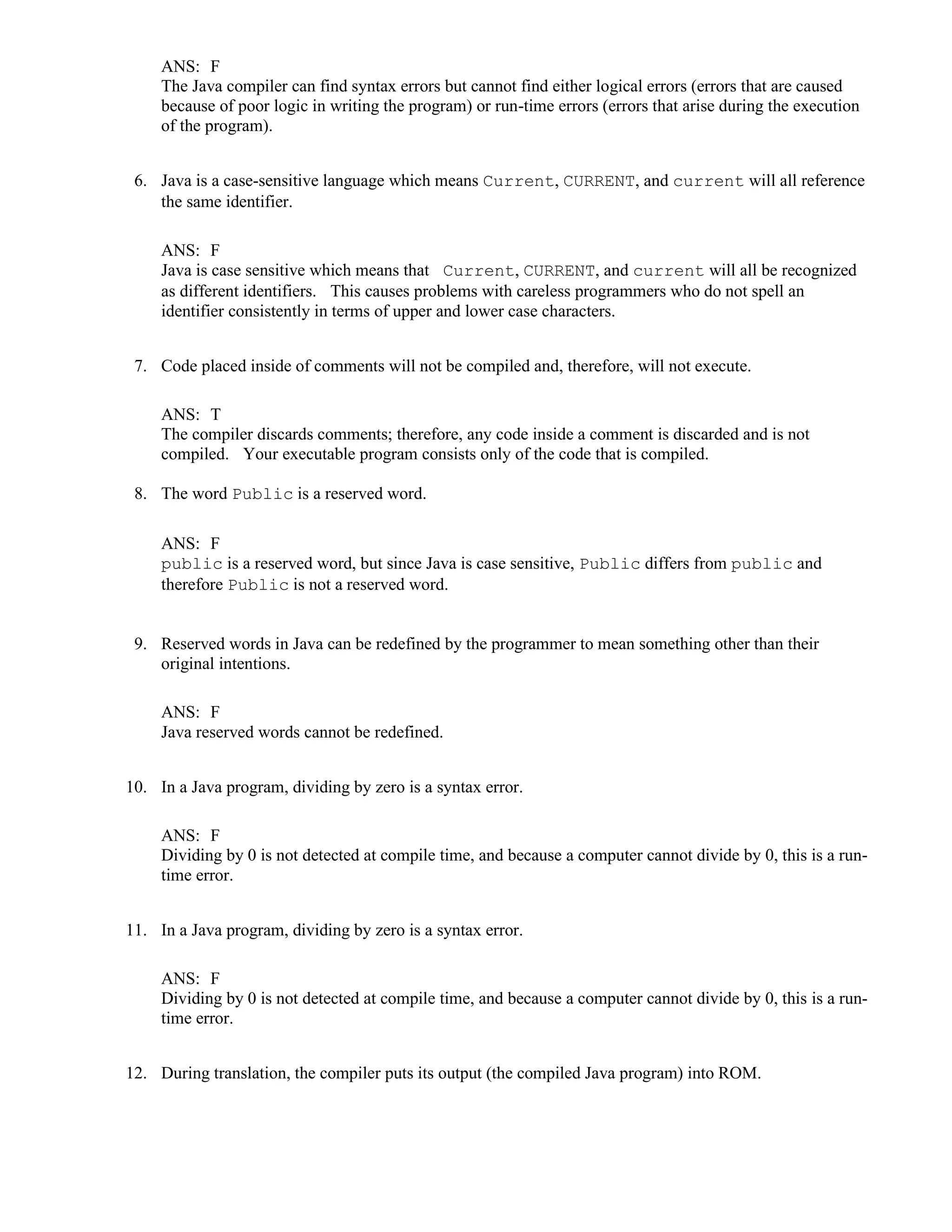
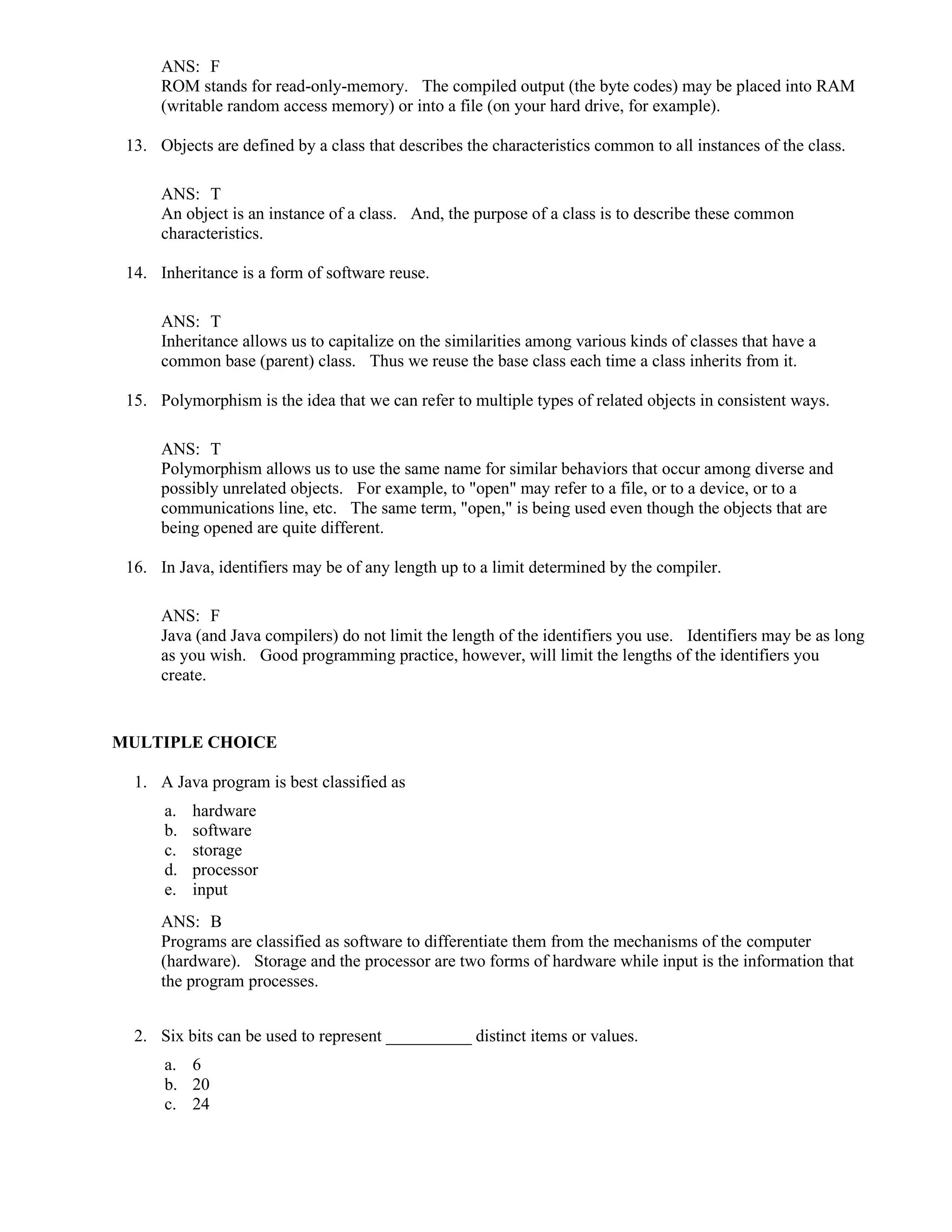
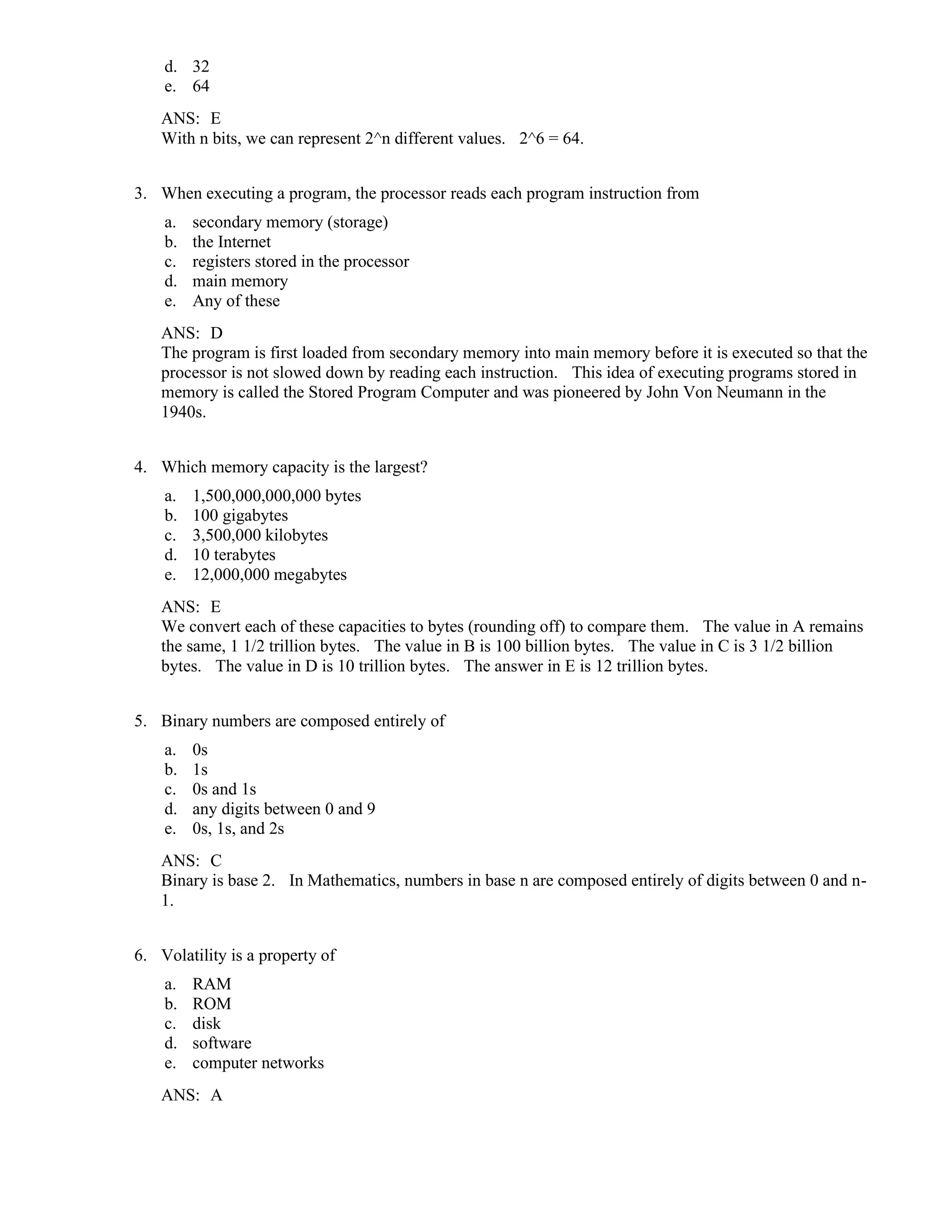
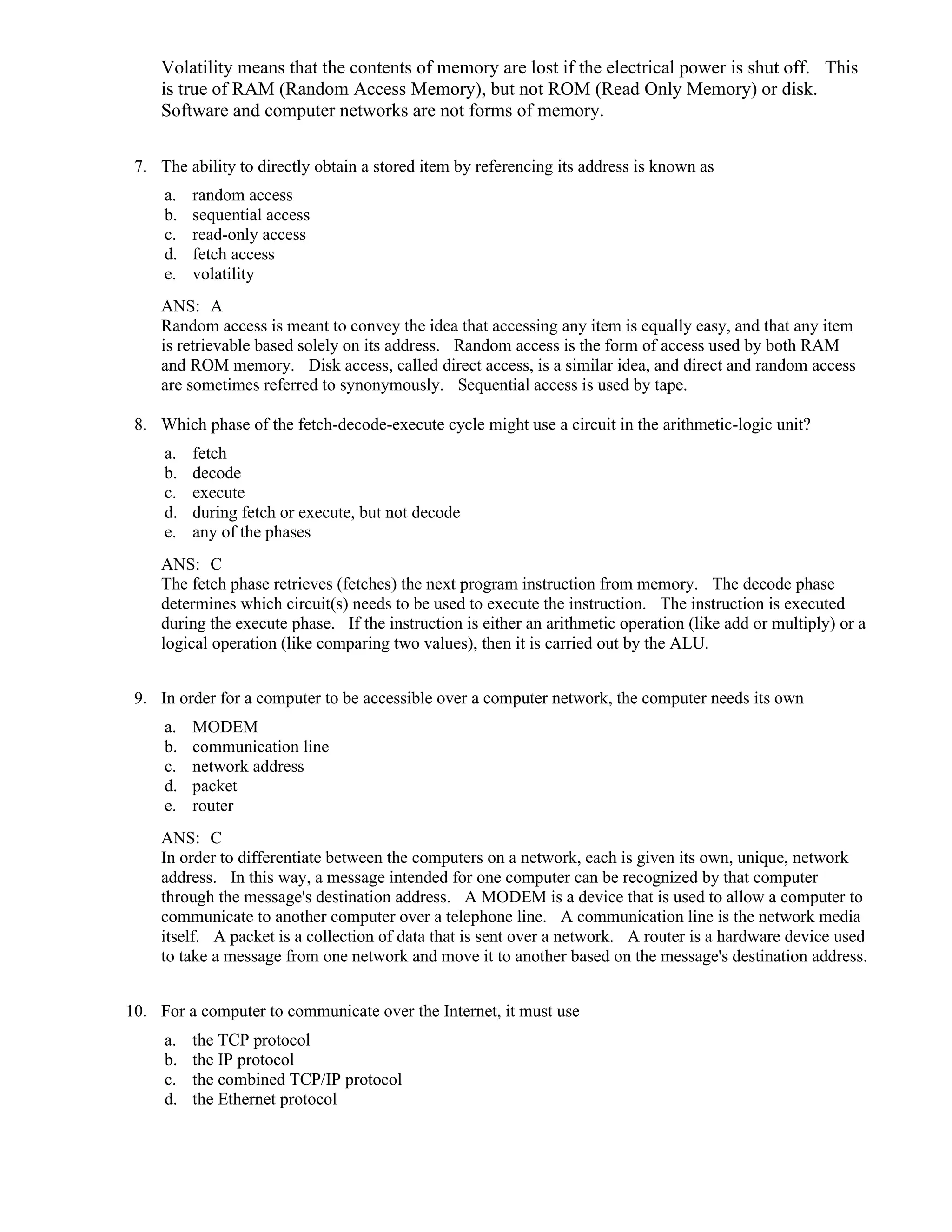
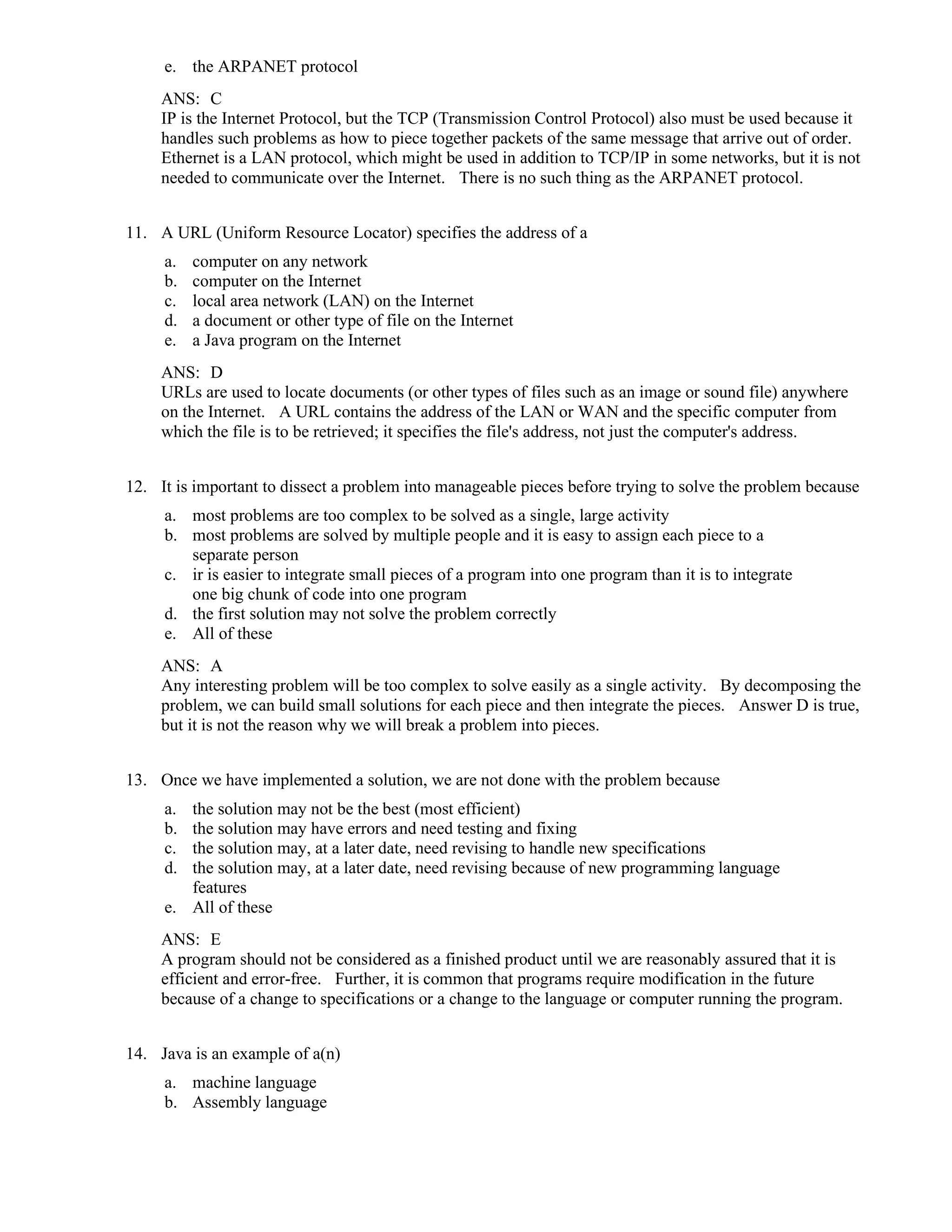
![c. high-level language
d. fourth generation language
e. both high-level and fourth generation language
ANS: E
While Java was created during the fourth generation, it is clearly also a high-level language. Machine
language is the executable language of a machine, with programs written in 1s and 0s only. Assembly
language uses mnemonics. Fourth generation languages are tools wrapped inside of programs so that
the user has the flexibility to write some code to executed from within the program.
15. Of the following, which statement is not true regarding Java as a programming language?
a. Java is a relatively recent language; it was introduced in 1995.
b. Java is a language whose programs do not require translating into machine language
before they are executed.
c. Java is an object-oriented language.
d. Java is a language that embraces the idea of writing programs to be executed with the
World Wide Web.
e. All of these are true
ANS: B
All languages require translation into machine language. The other statements are all true about Java.
16. Comments should
a. rephrase all the code to explain it in English
b. be insightful and explain the intention of an instruction or block of code
c. only be included with code that is difficult to understand
d. be used to define variables that have hard to understand names
e. All of these
ANS: B
Comments should not rephrase in English what an instruction says, but instead should explain what
that instruction is doing in relation to the program. Introductory programmers often have difficult
explaining their code and wind up stating the obvious in their comments. While answer D is partially
correct, it is not entirely true even though all variables should have comments that explain their use.
17. The main method for a Java program is defined by
a. public static main()
b. public static main(String[] args);
c. public static main(String[] args)
d. private static main(String[] args)
e. The main method could be defined by all of these except B
ANS: C
In A, the parameter is missing. The parameters are defined later in the text, but in effect, they allow
the user to run the program and include some initial arguments if the program calls for it. In B, the
semicolon at the end of the statement is not allowed. In D, private instead of public would
make the program non-executable by anyone and thus makes the definition meaningless.
18. What does the following line of Java code do?
//System.out.println("Hello");](https://image.slidesharecdn.com/43030-250321111607-2035fc0a/75/Test-Bank-for-Java-Software-Solutions-9th-Edition-John-Lewis-10-2048.jpg)
![a. nothing
b. cause Hello to be output
c. cause a syntax error
d. cause ("Hello") to be output
e. There is no way to tell without executing the code.
ANS: A
The characters // denote the beginning of a comment. The comment is not compiled and so, nothing
would happen when this code is executed.
19. What comment might be added to explain the following instruction?
System.out.println("Hello World");
a. // prints "Hello World" to the screen
b. //prints a message
c. //used to demonstrate an output message
d. //
e. // meaningless instruction
ANS: C
Comments in A and B state the obvious while the comments in D and E are meaningless. The
comment in C explains why the instruction appears in the program.
20. Which character belowis not allowed in an identifier?
a. $
b. _
c. 0
d. 1
e. ^
ANS: E
Java identifiers can consist of any letter, digit, $ or _ as long as the identifier starts with a letter or _.
^ is not a legal character.
21. Which of the following is not syntactically legal in Java?
a. System.out.println("Hi");
b. public class Foo
c. s t a t i c main(String[] args)
d. {}
e. only A is legally valid; all the others are illegal
ANS: C
The Java compiler would not recognize "s t a t i c" as "static" because the Java compiler
treats white space (blanks) as separators between entities. The other statements are all legal, including
"{}" which is a block that happens to have no statements within it.
22. Which of the following is a legal Java identifier?
a. i
b. class
c. 1likeclass!](https://image.slidesharecdn.com/43030-250321111607-2035fc0a/75/Test-Bank-for-Java-Software-Solutions-9th-Edition-John-Lewis-11-2048.jpg)
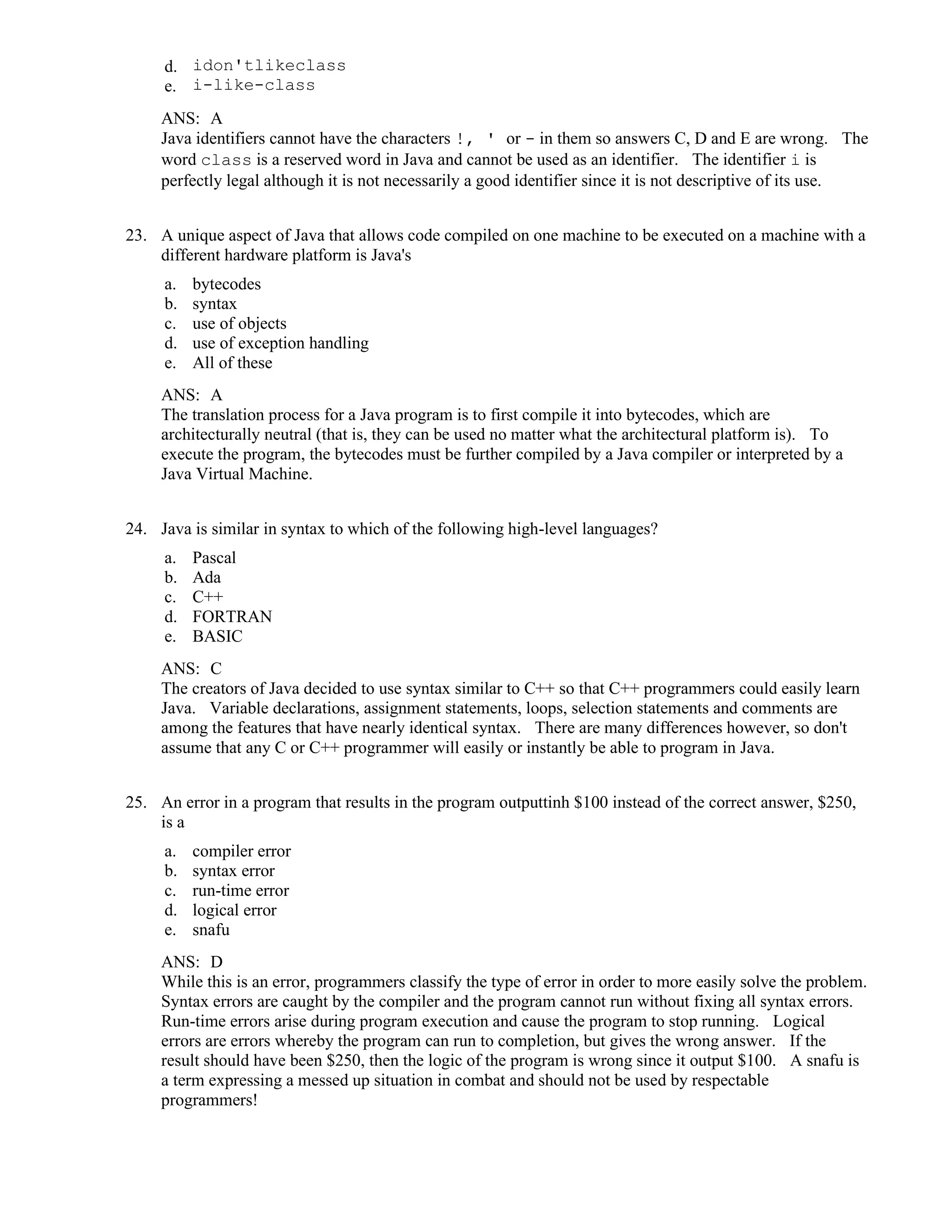
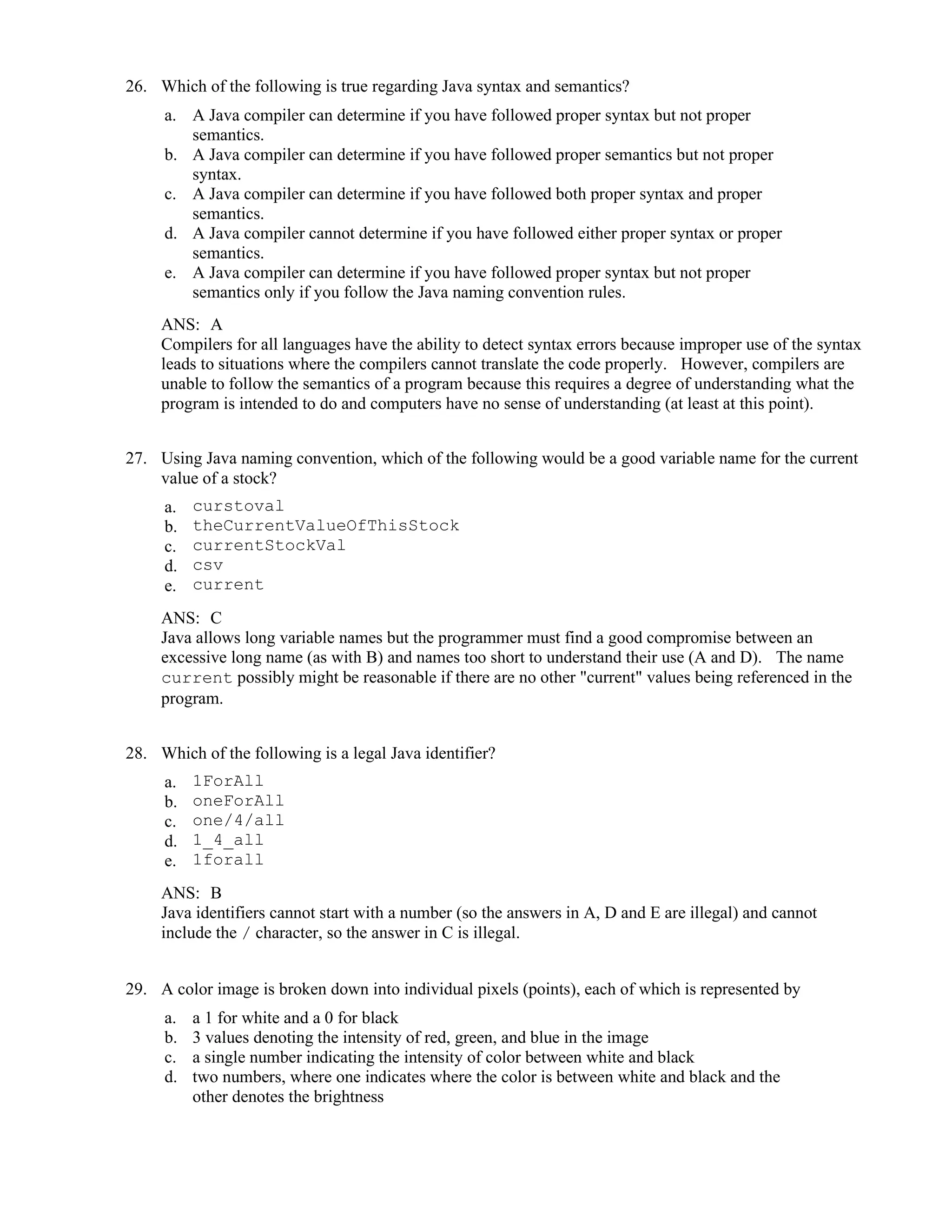
![e. None of these; it is not possible to represent color
ANS: B
Black and white images are stored using 0s and 1s while color images are stored using three values,
one each for the degree of red, the degree of blue, and the degree of green.
30. Which of the following characters does not need to have an associated closing character in a Java
program?
a. {
b. (
c. [
d. <
e. All of these require closing characters
ANS: D
{ is used to open a block, and so } is needed to close the block. ( is used to open an expression and
so ) is needed to close an expression. [ is used to start an array index so ] is needed to close the
array index. < is "less than" and > is "greater than" and these are not needed together, so < requires
no closing character.
31. Mistyping println as printn will result in
a. a syntax error
b. a run-time error
c. a logical error
d. no error
e. the statement being converted to a comment
ANS: A
If the Java compiler cannot make sense of a command, the compiler cannot convert it and responds
with a syntax error. While println is recognized as a command, printn is not, and so the
compiler provides a syntax error.
PROBLEM
1. What is wrong with the following class definition?
public class Program1
{
public static void main(String[ ] args)
{
System.out.println("My first Java program")
}
}
ANS:
The one executable statement in the main method is missing a ";" at the end of the line. Executable
statements end with ";".
2. What is wrong with the following class definition?
public class Program2](https://image.slidesharecdn.com/43030-250321111607-2035fc0a/75/Test-Bank-for-Java-Software-Solutions-9th-Edition-John-Lewis-14-2048.jpg)
![public static void main(String[] args)
{
System.out.println("My second Java program");
}
ANS:
The definition of a class is placed within {} statements, which are missing here.
3. Given the following class definition, what are the reserved words and what are the identifiers?
public class Program3
{
public static void main(String[] args)
{
System.out.println("My third Java program");
}
}
ANS:
The reserved words are public, class, static, void. The identifiers are main, String,
System.out, Program3, and args. main is the name of a method defined within the
Program3 class. string and System.out are classes already defined in Java and println is
a method of System.out. Program3 is a class, defined here, and args is a variable.
4. Provide a brief explanation of the role of main memory, the control unit, the arithmetic logic unit, and
registers. (Refer to figure 1.13 in the text)
ANS:
Main memory is used to store the currently executing processes along with their data. The control
unit performs the fetch-decode-execute cycle, which fetches an instruction from memory, decodes it
and determines how it is to be executed. The arithmetic logic unit comprises a number of circuits that
execute arithmetic and logic instructions. Registers are used to store values in the CPU temporarily
while the current instruction(s) need them.
5. What is the output of the following code when the main method is executed?
public class Question4
{
public static void main(String[] args)
{
System.out.println("hi there");
System.out.println(" ");
System.out.println("how are you doing today? ");
}
}
ANS:
hi there
how are you doing today?](https://image.slidesharecdn.com/43030-250321111607-2035fc0a/75/Test-Bank-for-Java-Software-Solutions-9th-Edition-John-Lewis-15-2048.jpg)
![Notice that while the Java compiler ignores "white space", blanks that appear in a println statement
inside of quote marks are retained and output in that manner.
6. What is wrong with the following println statement?
System.out.println("My fourth Java Program);
ANS:
It is missing a closing ". The compiler will look for a second " before the end of the statement. So,
like {}, (), and [], an initial " must have a corresponding closing ".
7. Provide identifier names that would be used to represent a person's social security number, income tax
withheld, and net pay.
ANS:
socialSecurityNumber, or ssn, incomeTaxWithheld or incomeTax, and netPay all
would be reasonable.
8. There are a number of reserved words in Java that have no current meaning (denoted with an * in
figure 1.18 in the text). Why?
ANS:
Java language designers anticipate introducing these statements in future versions, but have not yet
implemented them because they are lower priority, or it has not been decided how they will be
implemented or precisely what they will mean.
9. A document of text is 15 pages long. Each page contains approximately 200 words and the average
length of each word is 5 characters. Also assume one blank space between each word and no
punctuation. How many bytes will it take to store this document in memory or on disk using ASCII?
ANS:
A character is stored in ASCII using 8 bits or 1 byte. Therefore, 5 characters per word plus 1 blank
space between words take 6 bytes per word (except for the first). Each page stores 200 words and
there are 15 pages. So we need 15 * 200 * 6 - 1 (no blank space to start the text) = 17,999 bytes
which is 17.58 kilobytes, or nearly 18 Kbytes.
10. Provide a brief description of the roles of the following hardware elements (that is, what each is used
for):
a) CPU
b) Main memory
c) Secondary memory devices
d) Input/Output devices
ANS:
a) The CPU is the processor. It executes all program instructions. It does this through the fetch-
decode-execute cycle where the next program instruction is fetched from memory, decoded in the
CPU, and then executed by one or more circuits.
b) Main memory is stored on chips on the motherboard and is used for quick access to the current
program for the fetch-decode-execute cycle and to store data being used by this program.](https://image.slidesharecdn.com/43030-250321111607-2035fc0a/75/Test-Bank-for-Java-Software-Solutions-9th-Edition-John-Lewis-16-2048.jpg)
![c) Secondary memory devices are storage devices, used to store programs and data not currently
being used. Storage devices, such as the hard disk, also are used to store things for permanence and
archives.
d) Input/Output devices are used to communicate with the computer. Input devices, like the
keyboard, take commands and data from the user and output devices, like the monitor, display the
results of the process/computation.
11. Examine figure 1.7 before answering this question. What 8-bit value comes immediately before and
what 8-bit value comes immediately after 10010111?
ANS:
10010110 comes immediately before 10010111 and 10010100 comes immediately after
10010111.
12. Rewrite the following comment so that is can appear over multiple lines.
// This is one really enormously long comment that might run off
the page
ANS:
We can do this in two ways, preceding each line with // or by enclosing the comment in /* and */.
/* This is one really enormously
long comment that might run
off the page */
or
// This is one really enormously
// long comment that might run
// off the page
13. Rewrite the following program with better formatting to make it easier to read.
public
class
MyProgram
{ public static void
main(
String[]
args)
{ System.out.println(
"Wow, this is messed up!"
);
} }
ANS:
There are many ways this program might appear. The following would be very acceptable:
public class MyProgram
{
public static void main(String[] args)
{](https://image.slidesharecdn.com/43030-250321111607-2035fc0a/75/Test-Bank-for-Java-Software-Solutions-9th-Edition-John-Lewis-17-2048.jpg)
![System.out.println("Wow, this is messed up!");
}
}
14. Write a Java program that will output on two separate lines the names of the authors of this textbook.
ANS:
public class OutputNames
{
public static void main(String[] args)
{
System.out.println("John Lewis"); // 1st author's name
System.out.println("William Loftus");// 2nd author's name
}
}
15. Correct all the syntax errors in the following program.
Public Class Program A problem program
(
Public static voided main[Strings() args]
{
system.out.println('This program'); * oh, my... *
system.out.println('has several syntax errors'); *
lots of errors *
}
)
ANS:
public class Program // A problem program
{
public static void main(String[] args)
{
System.out.println("This program"); /* oh, my... */
System.out.println("has several syntax errors"); /*
lots of errors */
}
}
16. Write a Java program that will display the following three lines when it is run:
*
* * *
* * * * *
ANS:
public class Stars
{
public static void main(String[] args)
{
System.out.println(" *");
System.out.println(" * * *");
System.out.println("* * * * *");
}
}](https://image.slidesharecdn.com/43030-250321111607-2035fc0a/75/Test-Bank-for-Java-Software-Solutions-9th-Edition-John-Lewis-18-2048.jpg)