Java Software Solutions 8th Edition Lewis Test Bank
Java Software Solutions 8th Edition Lewis Test Bank
Java Software Solutions 8th Edition Lewis Test Bank
Java Software Solutions 8th Edition Lewis Test Bank
Java Software Solutions 8th Edition Lewis Test Bank
1.
Java Software Solutions8th Edition Lewis Test
Bank download
https://testbankdeal.com/product/java-software-solutions-8th-
edition-lewis-test-bank/
Explore and download more test bank or solution manual
at testbankdeal.com
2.
We have selectedsome products that you may be interested in
Click the link to download now or visit testbankdeal.com
for more options!.
Java Software Solutions 8th Edition Lewis Solutions Manual
https://testbankdeal.com/product/java-software-solutions-8th-edition-
lewis-solutions-manual/
Java Software Solutions 9th Edition Lewis Test Bank
https://testbankdeal.com/product/java-software-solutions-9th-edition-
lewis-test-bank/
Java Software Solutions 9th Edition Lewis Solutions Manual
https://testbankdeal.com/product/java-software-solutions-9th-edition-
lewis-solutions-manual/
Illustrated Microsoft Office 365 and Excel 2016
Intermediate 1st Edition Reding Solutions Manual
https://testbankdeal.com/product/illustrated-microsoft-office-365-and-
excel-2016-intermediate-1st-edition-reding-solutions-manual/
3.
Intercultural Communication Globalizationand Social
Justice 2nd Edition Sorrells Test Bank
https://testbankdeal.com/product/intercultural-communication-
globalization-and-social-justice-2nd-edition-sorrells-test-bank/
Organizational Behavior 18th Edition Robbins Solutions
Manual
https://testbankdeal.com/product/organizational-behavior-18th-edition-
robbins-solutions-manual/
Business and Administrative Communication 10th Edition
Locker Test Bank
https://testbankdeal.com/product/business-and-administrative-
communication-10th-edition-locker-test-bank/
Business Driven Information Systems 5th Edition Baltzan
Test Bank
https://testbankdeal.com/product/business-driven-information-
systems-5th-edition-baltzan-test-bank/
Plugged In 1st Edition Joel English Test Bank
https://testbankdeal.com/product/plugged-in-1st-edition-joel-english-
test-bank/
4.
BUSN Canadian 3rdEdition Kelly Test Bank
https://testbankdeal.com/product/busn-canadian-3rd-edition-kelly-test-
bank/
that there shouldbe an omission (on Friday) of returning thanks to the True
Benefactor. On the day of Thursday and on the day of Sunday I do not eat
meat. Not on Thursday, because it is the day of my auspicious accession,
and not on Sunday, because it is the birthday of my revered father, and he
greatly honoured and held dear the day. After some time I substituted opium
for filuniya. Now that my age has arrived at 46 solar years and 4 months, I
eat eight surkhs (a red berry used as a weight) of opium when five gharis of
day have passed, and six surkhs after one watch of night.
I gave a jewelled dagger to ʿAbdu-llah K͟ hān by the hand of Maqṣūd ʿAlī.
S͟ haik͟ h Mūsā, a relation of Qāsim K͟ hān, was dignified with the title of
K͟ hān, and promoted to the mansab of 800 personal and 400 horse, and was
allowed to go to Bengal. The mansab of Z̤ afar K͟ hān was increased to 500
personal and horse, and he was appointed to duty in Bangash. On the same
day Muḥammad Ḥusain, brother of K͟ hwāja Jahān, was given the
faujdārship of the Sarkar of Ḥiṣṣār and dismissed, his mansab being
increased by 200 horse to raise it to 500 personal and 400 horse, with the
gift of an elephant. On the 5th Bahman an elephant was conferred on Mīr
Mīrān. When the merchant ʿAbdu-l-Karīm left Iran for Hindustan, my
exalted brother S͟ hāh ʿAbbās sent me by his hand a rosary of cornelian from
Yemen and a cup of Venetian workmanship, which was very fine and rare.
On the 9th of the same month they were laid before me. On the 18th some
offerings of many kinds of jewelled ornaments, etc., which Sult̤ān Parwīz
had sent to me, were laid before me. On the 7th Isfandārmuẕ, Ṣādiq,
nephew of Iʿtimādu-d-daulah, who was permanently employed as Bakhshi,
was honoured with the title of K͟ hān. I had also conferred this title on
K͟ hwāja ʿAbdu-l-ʿAzīz. According to what was right, I called him by the
title of ʿAbdu-l-ʿAzīz K͟ hān and Ṣādiq by that of Ṣādiq K͟ hān. On the 10th,
Jagat Singh, son of Kunwar Karan, who had obtained leave to go to his
native country, when he took leave was presented with 20,000 rupees, a
horse, an elephant, a dress of honour, and a special shawl. Five thousand
rupees, a horse, and a dress of honour were also given to Haridās Jhālā, who
was one of the confidants of the Rānā and tutor to Karan’s son. By his hand
I also sent a mace of gold (s͟ has͟ hparī) for the Rānā.
23.
On the 20thof the same month, Rāja Sūraj Singh, son of Rāja Bāso, who on
account of the nearness of his dwelling-place to it had been sent with
Murtaẓā K͟ hān to capture the fort of Kāngra, came on my summons and
waited on me. The aforesaid K͟ hān had entertained certain suspicions with
regard to him, and on this account, considering him an undesirable
companion, had repeatedly sent petitions to the Court, and wrote things
about him until an order was received to summon him.
On the 26th, Niz̤ āmu-d-dīn K͟ hān came from Multan and waited on me. In
the end of this year news of victory and prosperity came in from all sides of
my dominions. In the first place, this was with regard to the disturbance of
Aḥdād, the Afghan, who for a long time past had been in rebellion in the
hill country of Kabul, and round whom many of the Afghans of that
neighbourhood had assembled, and against whom from the time of my
revered father until now, which is the 10th year after my accession, armies
have always been employed. He by degrees was defeated, and, falling into a
wretched state, a part of his band was dispersed and a part killed. He took
refuge for some time in Chark͟ h, which was a place on which he relied, but
K͟ hān Daurān surrounded it and closed the road for entry and exit. When
there remained no grass for his beasts or means of living for men in the
fortress, he at night brought down his animals from the hills and grazed
them on the skirts, and accompanied them himself, in order that he might
set an example to his men. At last this intelligence reached K͟ hān Daurān.
He then appointed a body of his leaders and experienced men to go into
ambush on an appointed night in the neighbourhood of Chark͟ h. That band
went and hid itself at night in places of refuge, and K͟ hān Daurān rode on
the same day in that direction. When those ill-fated ones brought out their
cattle and let them loose to graze, and the ill-conditioned Aḥdād himself
passed by the places of ambush with his own band, suddenly a dust rose in
front of him. When they enquired it became known that it was K͟ hān
Daurān. In a state of bewilderment he endeavoured to turn back, and the
scouts announced to the aforesaid K͟ hān that it was Aḥdād. The K͟ hān gave
his horse the reins and went at Aḥdād; the men who were in ambush also
blocked the road and attacked him. The fight lasted till midday in
consequence of the broken nature of the ground and the thickness of the
jungle; at last defeat fell on the Afghans and they betook themselves to the
24.
hill: about 300fighting men went to hell and 100 were taken prisoners.
Aḥdād could not regain the stronghold and hold on there. Necessarily he
turned his face towards Qandahar. The victorious troops entering Chark͟ h,
burnt all the places and houses of those ill-fortuned ones, and destroyed and
rooted them up from their foundations.
Another39 piece of news was the defeat of the ill-starred ʿAmbar and the
destruction of his unfortunate army. Briefly, a band of the influential leaders
and a body of Bargīs (Mahrattas), who are a hardy lot and who are the
centre of resistance in that country, becoming angry with ʿAmbar, showed
an intention to be loyal, and begging for quarter from S͟ hāh-nawāz K͟ hān,
who was in Bālāpūr with an army of royal troops, agreed to interview the
said K͟ hān, and being satisfied, Ādam K͟ hān, Yāqūt K͟ hān, and other leaders,
and the Bargīs Jādo40 Rāy and Bāpū Kāṭiyā, came and interviewed him.
S͟ hāh-nawāz K͟ hān gave each of them a horse, an elephant, money, and dress
of honour, according to their quality and condition, made them hot in duty
and loyalty, and marching from Balapur started against the rebel ʿAmbar in
their company. On the road they fell in with an army of the Dakhanis,
whose leaders were Maḥalldār,41 Dānis͟ h (Ātas͟ h?), Dilāwar, Bijlī, Fīrūz, and
others, and routed it.
“With broken arms and loosened loins,
No strength in their feet, no sense in their heads.”42
They reached the camp of that ill-starred one, and he from excessive pride
determined to fight with the victorious troops. Having collected those rebels
who were with him and ʿĀdil K͟ hān’s army and that of Qut̤bu-l-mulk
together, and preparing their artillery, he started to meet the royal troops
until a space of not more than 5 or 6 kos remained between. On Sunday, the
25th Bahman, the armies of light and darkness approached each other and
the scouts became visible. Three watches of day had passed when cannon
and rocket firing began. In the end Dārāb K͟ hān, who was in command of
the vanguard, with other leaders and zealous men such as Rāja Bīr Singh
Deo, Rāy Chand, ʿAlī K͟ hān the Tatar, Jahāngīr Qulī Beg Turkmān, and
other lions of the forest of bravery, drew their swords and charged the
vanguard of the enemy. Performing the dues of manliness and bravery, they
25.
scattered this armylike the Banātu-n-naʿs͟ h (‘Daughters of the Bier,’ i.e. the
Great Bear); and not stopping there they attacked the enemy’s centre.
Turning on the army opposed to them, such a hand-to-hand struggle took
place that the onlookers remained bewildered. For nearly two gharis this
combat went on. Heaps of the dead lay there, and the ill-starred ʿAmbar,
unable to offer further opposition, turned his face to flight. If darkness43
and gloom had not come on at the cry of those black-fortuned ones, not one
of them would have found the road to the valley of safety. The crocodiles of
the river of conflict followed the fugitives for 2 or 3 kos. When horses and
men could move no more and the defeated were scattered, they drew rein
and returned to their places. The whole of the enemy’s artillery, with 300
laden camels that carried rockets, war elephants, Arab and Persian horses,
weapons and armour beyond reckoning, fell into the hands of the servants
of the State, and there was no counting the slain and the fallen. A great
many of the leaders fell alive into their hands. The next day the victorious
troops, marching from the place of victory, proceeded to Karkī, which was
the nest of those owlish ones, and seeing no trace of them they encamped
there, and obtained news that they during that night and day had fallen
miserably in different places. For some days the victorious army, delayed at
Karkī, levelled with the dark earth the buildings and houses of the enemy,
and burnt that populous place. In consequence of the occurrence of certain
events, to describe which in detail would take too long here, they returned
from that place and descended by the Rohan Khanḍa Pass. In reward for
this service I ordered increases to be made in the mansabs of a number who
had shown zeal and bravery.
The third piece of news was the conquest of the province of Khokharā44
and the acquisition of the diamond mines, which were taken by the
excellent exertions of Ibrāhīm K͟ hān. This province is one of the
dependencies of the Subah of Behar and Patna. There is a river there from
which they procure diamonds. At the season when there is little water, there
are pools and water-holes, and it has become known by experience to those
who are employed in this work that above every water-hole in which there
are diamonds, there are crowds of flying animals of the nature of gnats, and
which in the language of India they call jhīngā(?).45 Keeping the bed of the
26.
stream in sightas far as it is accessible, they make a collection of stones
(sangchīn) round the water-holes. After this they empty the water-holes
with spades and shovels to the extent of a yard or 1½ yards and dig up the
area. They find among the stones and sand large and small diamonds46 and
bring them out. It occasionally happens that they find a piece of diamond
worth 100,000 rupees. Briefly, this province and this river were in
possession of a Hindu Zamindar of the name of Durjan Sāl, and although
the governors of the Subah frequently sent armies against him and went
there themselves, in consequence of the difficult roads and thickness of the
jungles they contented themselves with taking two or three diamonds and
left him in his former condition. When the aforesaid Subah was transferred
from Z̤ afar K͟ hān, and Ibrāhīm K͟ hān was appointed in his place, at the time
of his taking leave I ordered him to go and take the province out of the
possession of that unknown and insignificant individual. As soon as he
arrived in the province of Behar he assembled a force and went against that
Zamindar. According to former custom he sent some of his men with a
promise to give some diamonds and some elephants, but the K͟ hān did not
agree to this and entered impetuously into the province. Before the fellow
could collect his men he found guides and invaded it. Just when the
zamindar received this news, the hills and vales that are his abode were
beleaguered. Ibrāhīm sent men about to find him and they got hold of him
in a cave with several women, one of whom was his mother, while others
were also his father’s wives. They arrested him, and also one of his
brothers. They searched and took from them the diamonds they had with
them. Twenty-three male and female elephants also fell into Ibrāhīm’s
hands. In reward for this service the mansab of Ibrāhīm K͟ hān original and
increase, was made up to 4,000 personal and horse, and he was exalted with
the title of Fatḥ-jang. Orders were also given for an increase in the mansabs
of those who accompanied him on this service and had shown bravery. That
province is now in possession of the imperial servants of the State. They
carry on work in the bed of the stream, and bring to Court whatever
diamonds are found. A large diamond, the value of which has been
estimated at 50,000 rupees, has lately been brought from there. If a little
pains are taken, it is probable that good diamonds will be found and be
placed in the jewel-room.
27.
1
2
3
4
5
6
7
8
9
10
11
12
13
Should be 18th.See Elliot, vi, 341. I.O. 181 has 20th, and this is probably correct,
bīstam and has͟ htam being often mistaken for one another by the copyists. B.M. MS. Add.
26215 has dūs͟ hamba, Monday, instead of s͟ hamba, Saturday. ↑
Akbar used the word parm narm, ‘very soft,’ as a substitute for ‘shawl’ (Blochmann,
p. 90). ↑
According to Gladwin, 96 tanks = one sir. Four mashas make a tank, and a masha is
about 18 grains troy. ↑
Text چار كهيته, kheta chār. But the two B.M. MSS. which I have consulted have no yā,
and have khatta or ghatta chār. I think that the word must be घटा, ghaṭā, which in Sanskrit
means a troop of elephants assembled for war. I am not sure what the word chār means, but
perhaps it is only an affix. According to Abū-l-faẓl a herd of (wild) elephants is called sahn
(Blochmann, p. 122). ↑
Panj tuqūz, i.e. 9 by 5. The text has تاقور, tāqūr. ↑
The B.M. MSS. seem to have panch kunjar, ‘five elephants,’ i.e. equal to five
elephants(?). ↑
In Sarkār Delhi (Jarrett, ii, 287). ↑
The text does not expressly say that the dervish foretold two years before his death the
period of his death, but apparently Jahāngīr means this, for he goes on to speak of the time
mentioned for his delivery. See also Iqbāl-nāma, p. 81, where the dervish is called Ḥāfiz̤ ,
and where it is added that the whole population of Srinagar followed the bier. ↑
Lit. give it, for the Koran cannot be directly sold. ↑
Text pisar, ‘son of Buland Rāy.’ but from the B.M. MSS. it appears that pisar is a
mistake for Sar. ↑
Blochmann, p. 387. Possibly he was the part author of a translation of Bābar’s
Commentaries. ↑
The name is wrong. The Iqbāl-nāma, p. 84, has Ras͟ ht (Ras͟ hd), which is a well-known
town on the Caspian. ↑
According to the Iqbāl-nāma the true reading is sanjakī (see p. 84). But Olearius, who
gives a full account of the murder (p. 352 of English translation, ed. 1662), says Bihbūd
gave him two stabs with a chentze, which is a kind of poniard. ↑
28.
14
15
16
17
18
19
20
21
22
23
24
25
26
27
28
29
A Persian festivalin memory of a rain which fell on the 13th Tīr and put an end to a
famine (Bahār-i-ʿajam). ↑
Sangrām was Raja of Khurkpur in Behar, and was killed in battle with Jahāngīr Qulī
K͟ hān (Blochmann, p. 446, note). ↑
S͟ hakwāʾi-ṣāḥib-i-Sūba. I presume it means a complaint against the governor, and
perhaps one made by Kes͟ ho. ↑
The pearls are omitted in the MSS. ↑
It is phūl in MS. No. 181. ↑
Tak͟ htī, qu. a signet? No. 181 has a lāl tak͟ htī. ↑
Sir Thomas Roe’s friend. ↑
Text wrongly has 3 instead of 30. ↑
Apparently because born in Lahore (see Blochmann, p. 500). ↑
According to I.O. MS. 181 every zamindar took some money from Chīn Qilīj and sent
him out of his estate, and this seems to be the probable meaning, for we are told later on
that the zamindars plundered Chīn Qilīj. ↑
Tirhut. R.A.S. MS. has “It chanced that the zamindar of this place was with Jahāngīr
Qulī, and the latter sent him with some people to seize Chīn Qilīj.” I.O. MS. has the same,
and this seems correct. The text has “It chanced that the zamindar of that place was
spending some days in that neighbourhood(?).” Perhaps a negative has been omitted before
‘spending.’ I.O. MS. seems to have Johirhat as the name of the zamindar’s estate. ↑
Apparently the verse is quoted with reference to Jahāngīr Qulī’s failure to exact
retribution from the zamindars, There is an account of Chīn Qilīj in the Maʾās̤ ir, iii, 351. ↑
Gūnṭh, a breed of small horses or ponies. ↑
A farjī is a coat (see Blochmann, p. 89). ↑
Text īn rubāʿī, ‘this quatrain,’ which does not seem to make sense. Perhaps īn here
should be āyīn-i-rubāʿī, ‘the rules or the custom of a quatrain.’ Similarly, īn kitābat five
lines down may be āyīn-i-kitābat, ‘the rules of writing.’ ↑
His father was K͟ halīlu-llah, previously mentioned in the Tūzuk, and who had lately
died (Iqbāl-nāma, p, 84, and Tūzuk, pp. 62 and 69). T̤ ahmāsp gave Niʿmatu-llah’s daughter
in marriage to his own son Ismaʿīl. ↑
29.
30
31
32
33
34
35
36
K͟ hānis͟ hK͟ hānim in Maʾās̤ ir, iii, 339. ↑
Ishāl-i-kabd. ↑
Two I.O. MSS. and the R.A.S. MS. have 18 instead of 15. Elliot has “up to my
fourteenth” year. Jahāngīr was born in Rabīʿ, 977, or 31st August, 1569, and the beginning
of wine-drinking to which he refers must have taken place at earliest in January, 1586. He
tells us that it was after the death of Muḥammad Ḥakīm, and at the time when his father
was at Attock. Now Akbar arrived there on 15th Muḥarram, 994, according to Niz̤ āmu-d-
dīn, and on 12th Day, 994, according to Abū-l-faẓl, iii, 976, i.e. about the end of December,
1585, and at that time Jahāngīr was 17 years and 4 months of age, or in his 18th year. He
continued to drink heavily for nine years, i.e. till he was 26 (17 + 9), then he moderated for
seven years, i.e. till he was 33, and he kept to that for fifteen years more, i.e. till he was 48.
These years were lunar years, and he tells that at the time of writing he was 47 years and 9
months old, according to the lunar calendar. It seems to follow that the MSS. are right, and
that we should read 18. ↑
Elliot, vi, 341. ↑
The two good I.O. MSS. have, not murg͟ h or murg͟ hī, but tughdarī or tūg͟ hdarī, a
‘bustard,’ unless indeed the word be tag͟ haddī, ‘breakfast.’ But probably the word is
tughdarī, a bustard, and the reference is to the particular memorable day when he first
drank wine. His food that day, he says, was a bustard with bread and a radish (turb). ↑
Blochmann. Calcutta Review, 1869, has ‘turnips.’ ↑
Filūnīyā. The word is not given in ordinary dictionaries, but it is explained in Dozy’s
Supplement. It is stated there that it is a sedative electuary, and that the word is derived
from the Greek, being φιλωνια, which is the name of an antidote or drug invented by
Philon of Tarsus. There is an account of Philon and a reference to his drug in Smith’s
Classical Dictionary. Philon lived in or before the first century after Christ, and is referred
to by Galen and others. The word as given there is φιλωνειον. We are not told what it was
made of. In Price’s Jahāngīr, filuniya, misread there as Kelourica, is described by Jahāngīr
as brother’s son to tiryāq, i.e. theriaca (see Price, p. 6). Tiryāk or t̤iryāq is supposed to be a
Greek word (see Lane), and means an antidote against poison, etc. It is so used in the verse
from Avicenna quoted by Jahāngīr to his son S͟ hāh Jahān. See D’Herbelot, s.v. Teriak. But
it is also often used apparently as a synonym for opium. The mixing of wine with spirits
was intended to dilute the potation, for hitherto Jahāngīr had been taking raw spirit. A
mis̤ qāl is said to be 63½ grains troy, and so 18 misqals would be about 3 ounces, and the
30.
37
38
39
40
41
42
43
44
45
46
six cups wouldbe about 1½ lb. troy. In Elliot, Jahāngīr is made to say that he does not
drink on Thursdays and Fridays. But the s͟ hab-i-jumʿa, as Blochmann has pointed out
elsewhere, Āyīn translation, p. 171, n. 3, means Thursday night or Friday eve, and this is
clearly the case here, for Jahāngīr speaks of the eve’s being followed by a blessed day. It
should be noted that there is no connection in Jahāngīr’s mind between abstaining from
wine and abstaining from meat. He did not eat meat on Thursdays or Sundays because he
did not approve of taking life on these days, but he drank on both of them. ↑
Cf. Blochmann’s translation and Calcutta Review for 1869. ↑
I understand the two exceptions (dū chīz) to be that on Thursdays he drank in the
daytime, contrary to the general rule of only drinking at night, and that on Thursday
evenings he did not drink. ↑
Elliot, vi, 343. ↑
The MSS. have Jādūn Rāy and Bābā Chokanth (Jīū Kanth?). The Maʾās̤ iru-l-umarā, ii,
646, has Mālūjī Kāntiya. The text has Bābū Kāntiya. ↑
The text is corrupt. The Maʾās̤ ir, id., has Ātas͟ h instead of Dānis͟ h. ↑
The text is corrupt. In the second line of the verse the text has guft, which seems
meaningless, and two I.O. MSS. and B.M. MS. Add. 26,215 have jang, ‘battle.’ The R.A.S.
MS. has pāy, ‘feet,’ which seems to me the best reading. Possibly guft should be read kift,
‘shoulder.’ ↑
It will be remembered that Jahāngīr has called ʿAmbar’s army the army of darkness,
alluding perhaps to ʿAmbar’s being an Abyssinian. ↑
Elliot, vi, and Blochmann, p. 479, n. 3. ↑
Perhaps it should be phangā or feringha, a grasshopper, or it may be jhīngur, a
cockroach. Presumably the country was covered with thick jungle, and the cloud of insects
indicated where water was. Erskine’s MS. has chika. B.M. Or. 3276 has chika or jika.
Possibly the word is jhīngur, a cockroach (see Blochmann in J.A.S.B. for 1871, vol. xl). He
quotes a Hindustani Dict., which says that the jhīngā is what in Arabic is called the jarādu-
l-baḥr or water-locust. The river referred to by Jahāngīr is the Sankh of I.G., xii, 222. V.
Ball, Proc. A.S.B. for 1881, p. 42, suggests that the jhīngā may be thunder-stones! ↑
Compare Tavernier’s account of the searching for diamonds in Sambhalpur (vol. ii, p.
311, of ed. of 1676). ↑
32.
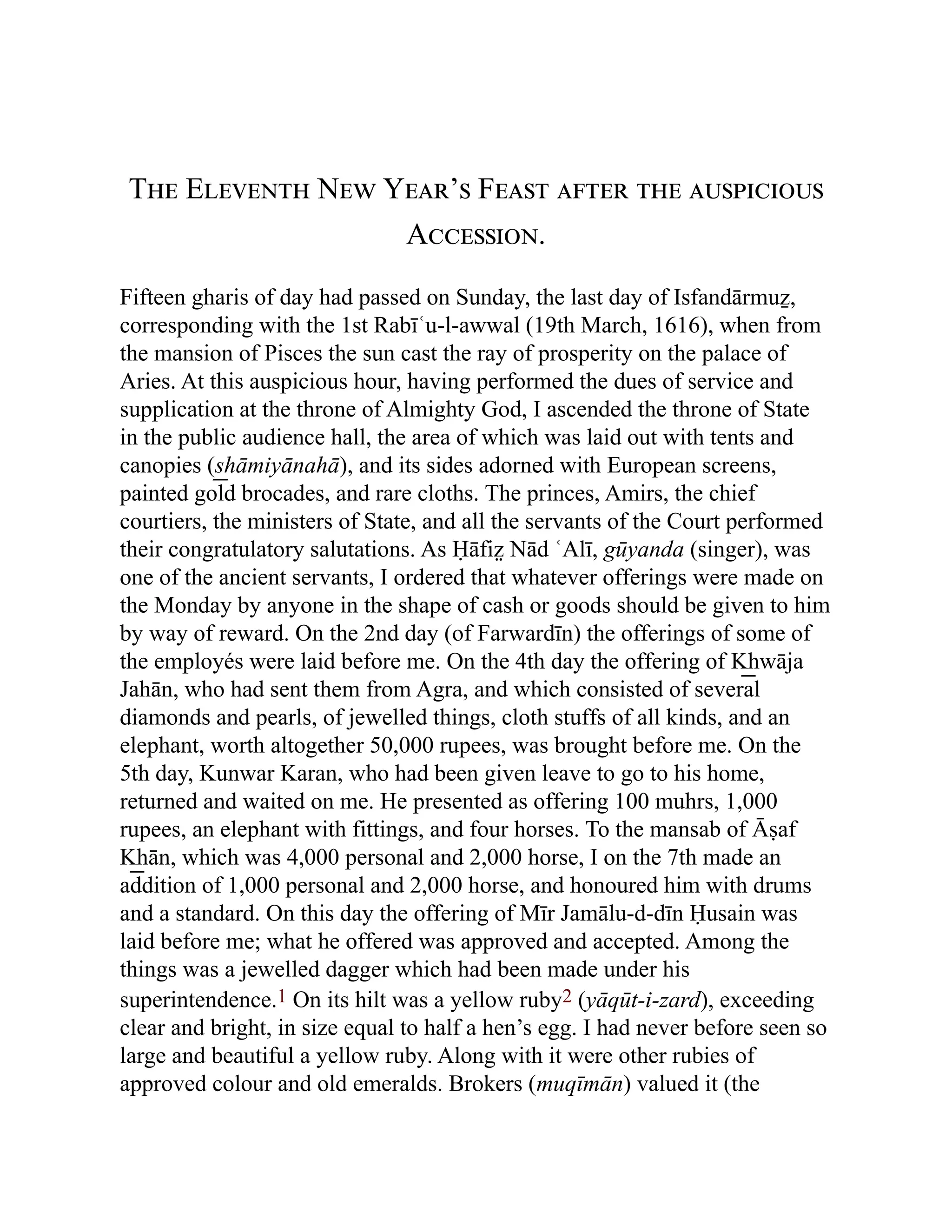
The Eleventh NewYear’s Feast after the auspicious
Accession.
Fifteen gharis of day had passed on Sunday, the last day of Isfandārmuẕ,
corresponding with the 1st Rabīʿu-l-awwal (19th March, 1616), when from
the mansion of Pisces the sun cast the ray of prosperity on the palace of
Aries. At this auspicious hour, having performed the dues of service and
supplication at the throne of Almighty God, I ascended the throne of State
in the public audience hall, the area of which was laid out with tents and
canopies (s͟ hāmiyānahā), and its sides adorned with European screens,
painted gold brocades, and rare cloths. The princes, Amirs, the chief
courtiers, the ministers of State, and all the servants of the Court performed
their congratulatory salutations. As Ḥāfiz̤ Nād ʿAlī, gūyanda (singer), was
one of the ancient servants, I ordered that whatever offerings were made on
the Monday by anyone in the shape of cash or goods should be given to him
by way of reward. On the 2nd day (of Farwardīn) the offerings of some of
the employés were laid before me. On the 4th day the offering of K͟ hwāja
Jahān, who had sent them from Agra, and which consisted of several
diamonds and pearls, of jewelled things, cloth stuffs of all kinds, and an
elephant, worth altogether 50,000 rupees, was brought before me. On the
5th day, Kunwar Karan, who had been given leave to go to his home,
returned and waited on me. He presented as offering 100 muhrs, 1,000
rupees, an elephant with fittings, and four horses. To the mansab of Āṣaf
K͟ hān, which was 4,000 personal and 2,000 horse, I on the 7th made an
addition of 1,000 personal and 2,000 horse, and honoured him with drums
and a standard. On this day the offering of Mīr Jamālu-d-dīn Ḥusain was
laid before me; what he offered was approved and accepted. Among the
things was a jewelled dagger which had been made under his
superintendence.1 On its hilt was a yellow ruby2 (yāqūt-i-zard), exceeding
clear and bright, in size equal to half a hen’s egg. I had never before seen so
large and beautiful a yellow ruby. Along with it were other rubies of
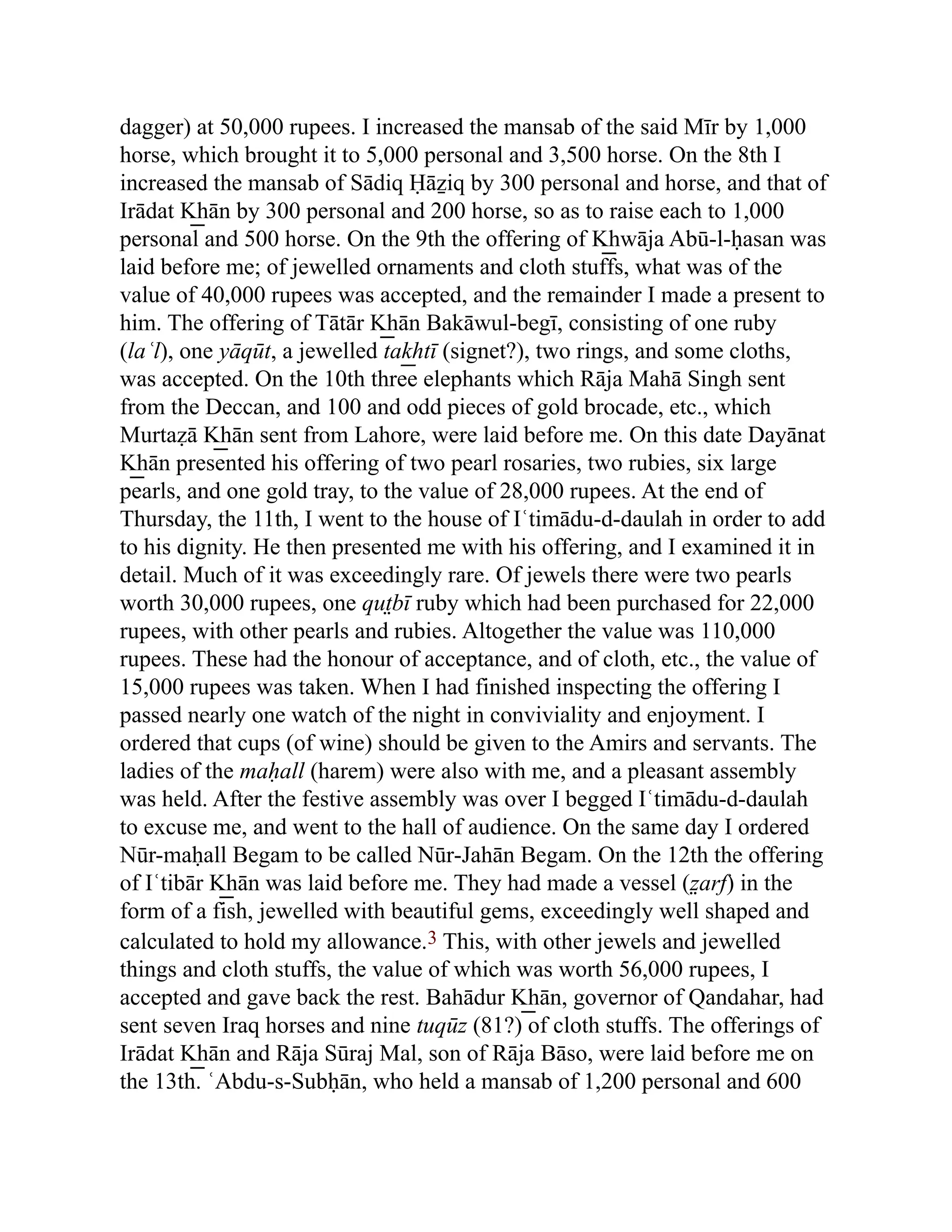
approved colour and old emeralds. Brokers (muqīmān) valued it (the
33.
dagger) at 50,000rupees. I increased the mansab of the said Mīr by 1,000
horse, which brought it to 5,000 personal and 3,500 horse. On the 8th I
increased the mansab of Sādiq Ḥāẕiq by 300 personal and horse, and that of
Irādat K͟ hān by 300 personal and 200 horse, so as to raise each to 1,000
personal and 500 horse. On the 9th the offering of K͟ hwāja Abū-l-ḥasan was
laid before me; of jewelled ornaments and cloth stuffs, what was of the
value of 40,000 rupees was accepted, and the remainder I made a present to
him. The offering of Tātār K͟ hān Bakāwul-begī, consisting of one ruby
(laʿl), one yāqūt, a jewelled tak͟ htī (signet?), two rings, and some cloths,
was accepted. On the 10th three elephants which Rāja Mahā Singh sent
from the Deccan, and 100 and odd pieces of gold brocade, etc., which
Murtaẓā K͟ hān sent from Lahore, were laid before me. On this date Dayānat
K͟ hān presented his offering of two pearl rosaries, two rubies, six large
pearls, and one gold tray, to the value of 28,000 rupees. At the end of
Thursday, the 11th, I went to the house of Iʿtimādu-d-daulah in order to add
to his dignity. He then presented me with his offering, and I examined it in
detail. Much of it was exceedingly rare. Of jewels there were two pearls
worth 30,000 rupees, one qut̤bī ruby which had been purchased for 22,000
rupees, with other pearls and rubies. Altogether the value was 110,000
rupees. These had the honour of acceptance, and of cloth, etc., the value of
15,000 rupees was taken. When I had finished inspecting the offering I
passed nearly one watch of the night in conviviality and enjoyment. I
ordered that cups (of wine) should be given to the Amirs and servants. The
ladies of the maḥall (harem) were also with me, and a pleasant assembly
was held. After the festive assembly was over I begged Iʿtimādu-d-daulah
to excuse me, and went to the hall of audience. On the same day I ordered
Nūr-maḥall Begam to be called Nūr-Jahān Begam. On the 12th the offering
of Iʿtibār K͟ hān was laid before me. They had made a vessel (z̤ arf) in the
form of a fish, jewelled with beautiful gems, exceedingly well shaped and
calculated to hold my allowance.3 This, with other jewels and jewelled
things and cloth stuffs, the value of which was worth 56,000 rupees, I
accepted and gave back the rest. Bahādur K͟ hān, governor of Qandahar, had
sent seven Iraq horses and nine tuqūz (81?) of cloth stuffs. The offerings of
Irādat K͟ hān and Rāja Sūraj Mal, son of Rāja Bāso, were laid before me on
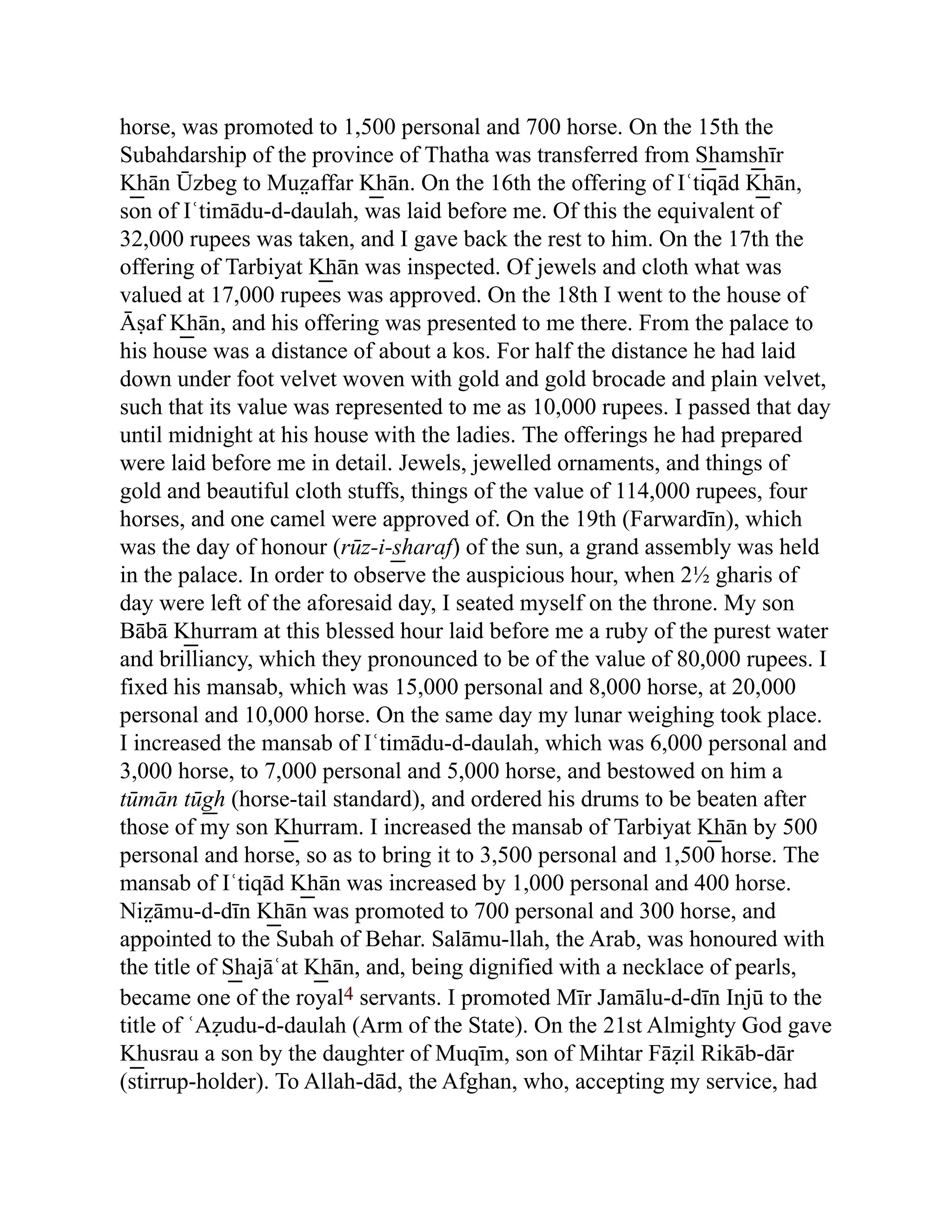
the 13th. ʿAbdu-s-Subḥān, who held a mansab of 1,200 personal and 600
34.
horse, was promotedto 1,500 personal and 700 horse. On the 15th the
Subahdarship of the province of Thatha was transferred from S͟ hams͟ hīr
K͟ hān Ūzbeg to Muz̤ affar K͟ hān. On the 16th the offering of Iʿtiqād K͟ hān,
son of Iʿtimādu-d-daulah, was laid before me. Of this the equivalent of
32,000 rupees was taken, and I gave back the rest to him. On the 17th the
offering of Tarbiyat K͟ hān was inspected. Of jewels and cloth what was
valued at 17,000 rupees was approved. On the 18th I went to the house of
Āṣaf K͟ hān, and his offering was presented to me there. From the palace to
his house was a distance of about a kos. For half the distance he had laid
down under foot velvet woven with gold and gold brocade and plain velvet,
such that its value was represented to me as 10,000 rupees. I passed that day
until midnight at his house with the ladies. The offerings he had prepared
were laid before me in detail. Jewels, jewelled ornaments, and things of
gold and beautiful cloth stuffs, things of the value of 114,000 rupees, four
horses, and one camel were approved of. On the 19th (Farwardīn), which
was the day of honour (rūz-i-s͟ haraf) of the sun, a grand assembly was held
in the palace. In order to observe the auspicious hour, when 2½ gharis of
day were left of the aforesaid day, I seated myself on the throne. My son
Bābā K͟ hurram at this blessed hour laid before me a ruby of the purest water
and brilliancy, which they pronounced to be of the value of 80,000 rupees. I
fixed his mansab, which was 15,000 personal and 8,000 horse, at 20,000
personal and 10,000 horse. On the same day my lunar weighing took place.
I increased the mansab of Iʿtimādu-d-daulah, which was 6,000 personal and
3,000 horse, to 7,000 personal and 5,000 horse, and bestowed on him a
tūmān tūg͟ h (horse-tail standard), and ordered his drums to be beaten after
those of my son K͟ hurram. I increased the mansab of Tarbiyat K͟ hān by 500
personal and horse, so as to bring it to 3,500 personal and 1,500 horse. The
mansab of Iʿtiqād K͟ hān was increased by 1,000 personal and 400 horse.
Niz̤ āmu-d-dīn K͟ hān was promoted to 700 personal and 300 horse, and
appointed to the Subah of Behar. Salāmu-llah, the Arab, was honoured with
the title of S͟ hajāʿat K͟ hān, and, being dignified with a necklace of pearls,
became one of the royal4 servants. I promoted Mīr Jamālu-d-dīn Injū to the
title of ʿAẓudu-d-daulah (Arm of the State). On the 21st Almighty God gave
K͟ husrau a son by the daughter of Muqīm, son of Mihtar Fāẓil Rikāb-dār
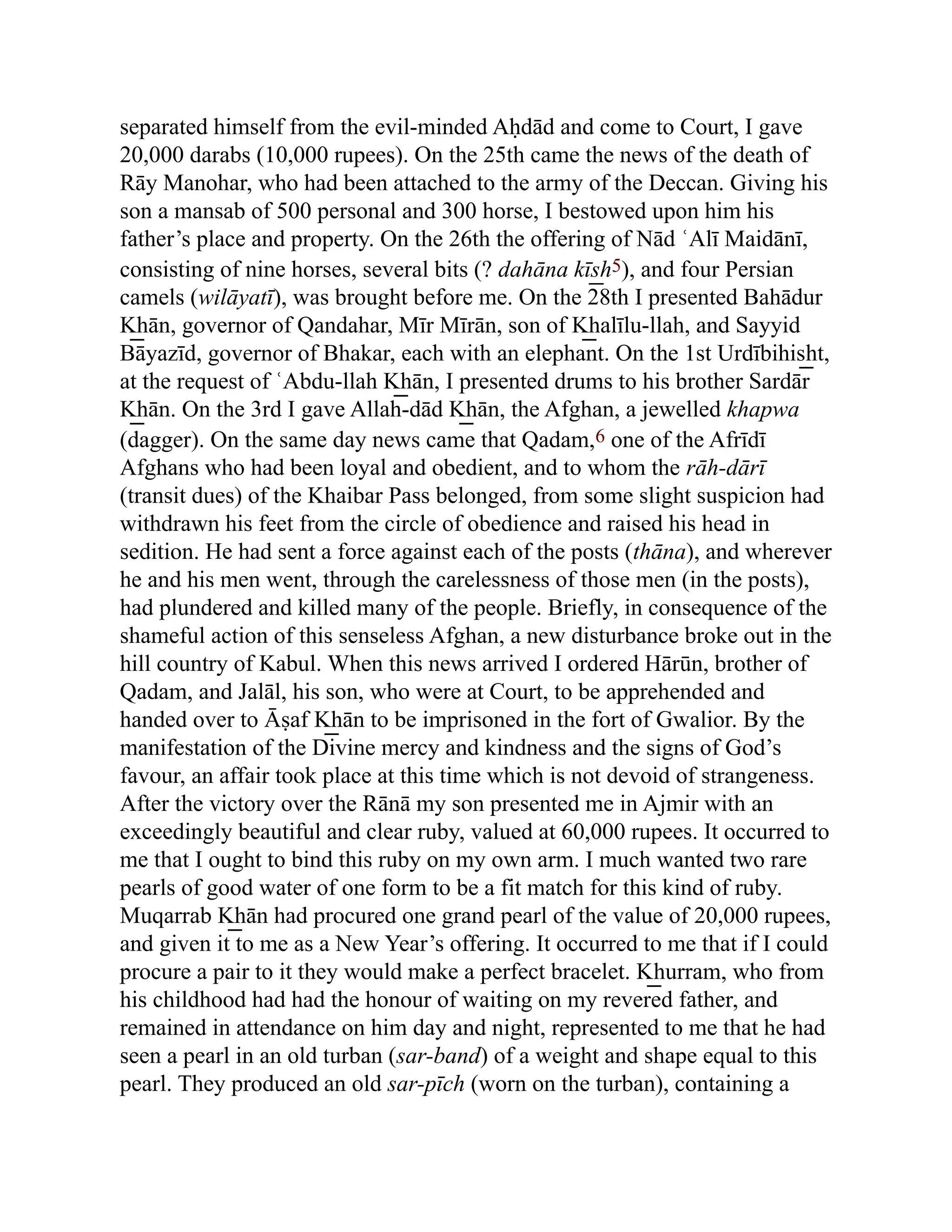
(stirrup-holder). To Allah-dād, the Afghan, who, accepting my service, had
35.
separated himself fromthe evil-minded Aḥdād and come to Court, I gave
20,000 darabs (10,000 rupees). On the 25th came the news of the death of
Rāy Manohar, who had been attached to the army of the Deccan. Giving his
son a mansab of 500 personal and 300 horse, I bestowed upon him his
father’s place and property. On the 26th the offering of Nād ʿAlī Maidānī,
consisting of nine horses, several bits (? dahāna kīs͟ h5), and four Persian
camels (wilāyatī), was brought before me. On the 28th I presented Bahādur
K͟ hān, governor of Qandahar, Mīr Mīrān, son of K͟ halīlu-llah, and Sayyid
Bāyazīd, governor of Bhakar, each with an elephant. On the 1st Urdībihis͟ ht,
at the request of ʿAbdu-llah K͟ hān, I presented drums to his brother Sardār
K͟ hān. On the 3rd I gave Allah-dād K͟ hān, the Afghan, a jewelled khapwa
(dagger). On the same day news came that Qadam,6 one of the Afrīdī
Afghans who had been loyal and obedient, and to whom the rāh-dārī
(transit dues) of the Khaibar Pass belonged, from some slight suspicion had
withdrawn his feet from the circle of obedience and raised his head in
sedition. He had sent a force against each of the posts (thāna), and wherever
he and his men went, through the carelessness of those men (in the posts),
had plundered and killed many of the people. Briefly, in consequence of the
shameful action of this senseless Afghan, a new disturbance broke out in the
hill country of Kabul. When this news arrived I ordered Hārūn, brother of
Qadam, and Jalāl, his son, who were at Court, to be apprehended and
handed over to Āṣaf K͟ hān to be imprisoned in the fort of Gwalior. By the
manifestation of the Divine mercy and kindness and the signs of God’s
favour, an affair took place at this time which is not devoid of strangeness.
After the victory over the Rānā my son presented me in Ajmir with an
exceedingly beautiful and clear ruby, valued at 60,000 rupees. It occurred to
me that I ought to bind this ruby on my own arm. I much wanted two rare
pearls of good water of one form to be a fit match for this kind of ruby.
Muqarrab K͟ hān had procured one grand pearl of the value of 20,000 rupees,
and given it to me as a New Year’s offering. It occurred to me that if I could
procure a pair to it they would make a perfect bracelet. K͟ hurram, who from
his childhood had had the honour of waiting on my revered father, and
remained in attendance on him day and night, represented to me that he had
seen a pearl in an old turban (sar-band) of a weight and shape equal to this
pearl. They produced an old sar-pīch (worn on the turban), containing a
36.
royal pearl ofthe same quality, weight, and shape, not differing in weight
even by a trifle, so much so that the jewellers were astonished at the matter.
It agreed in value, shape, lustre, and brilliance; one might say they had been
shed from the same mould. Placing the two pearls alongside of the ruby, I
bound them on my arm, and placing my head on the ground of supplication
and humility, I returned thanks to the Lord that cherished His slave, and
made my tongue utter His praise—
“Who succeeds with hand and tongue?
He who performs the dues of thanks.”
On the 5th (Urdībihis͟ ht) 30 Iraq and Turki horses that Murtazā K͟ hān had
sent from Lahore were brought before me, as also 63 horses, 15 camels,
male and female, a bundle of crane’s (kulang) plumes, 9 ʿāqirī(?),7 9
veined8 fish-teeth, 9 pieces of china from Tartary, 3 guns, etc., from K͟ hān
Daurān, which he had sent from Kabul, were accepted. Muqarrab K͟ hān
presented an offering of a small elephant from Abyssinia which they had
brought by sea in a ship. In comparison with the elephants of Hindustan it
presents some peculiarities. Its ears are larger than the ears of the elephants
of this place, and its trunk and tail are longer. In the time of my revered
father Iʿtimād K͟ hān of Cujarat sent a young elephant9 as an offering; by
degrees it grew up and was very fiery and bad-tempered. On the 7th a
jewelled dagger was given to Muz̤ affar K͟ hān, governor of Thatha. On the
same day news came that a band of Afghans10 had attacked ʿAbdu-s-
Subḥān, brother of K͟ hān ʿĀlam, who was stationed at one of the posts, and
had laid siege to his post. ʿAbdu-s-Subḥān, with certain other mansabdars
and servants who had been appointed to go with him had behaved valiantly.
But at last, in accordance with the saying—
“When gnats get wings they smite the elephant,”
those dogs overcame them, and elevated ʿAbdu-s-Subḥān with several of
the men of the post to the dignity of martyrdom.11 As a condolence for this
affair a gracious farman and a special dress of honour were sent to K͟ hān
ʿĀlam, who had been appointed ambassador to Iran (and was still in that
country). On the 14th the offering of Mukarram K͟ hān, son of Muʿazzam
37.
K͟ hān, camefrom Bengal. It consisted of jewels and articles procurable in
that province, and was brought before me. I increased the mansab of some
of the jagirdars of Gujarat. Of these, Sardār K͟ hān, whose mansab was that
of 1,000 personal and 500 horse, was raised to 1,500 personal and 30012
horse, and had a standard given to him as well. Sayyid Qāsim, son of
Sayyid Dilāwar Bārha, was raised to an original and increased mansab of
800 personal and 450 horse, and Yār Beg, nephew of Aḥmad Qāsim Koka,
to one of 600 personal with 250 horse. On the 17th there came the news of
the death of Razzāq of Merv, the Ūzbeg who belonged to the army of the
Deccan. He was well skilled in war, and one of the distinguished Amirs of
Māwarāʾa-n-nahr. On the 21st, Allah-dād, the Afghan, was honoured with
the title of K͟ hān, and his mansab, which was 1,000 personal and 600 horse,
was raised to 2,000 personal and 1,000 horse. Three hundred thousand
rupees out of the treasury of Lahore were ordered as a reward and for
expenses to K͟ hān Daurān, who had greatly exerted himself in the Afghan
disturbance. On the 28th, Kunwar Karan obtained leave to go home for his
marriage. I conferred on him a dress of honour, a special Iraq horse with a
saddle, an elephant, and a jewelled waist-dagger. On the 3rd of this month
(K͟ hūrdād) the news of the death of Murtaẓā K͟ hān came. He was one of the
ancients of this State. My revered father had brought him up and raised him
to a position of consequence and trust. In my reign also he obtained the
grace of noteworthy service, namely the overthrow of K͟ husrau. His mansab
had been raised to 6,000 personal and 5,000 horse. As he was at this time
Subahdar of the Panjab, he had undertaken the capture of Kāngra, to which
in strength no other fort in the hill country of that province or even in the
whole inhabited world can be compared. He had obtained leave to go on
this duty. I was much grieved in mind at this news; in truth, grief at the
death of such a loyal follower is only reasonable. As he had died after
spending his days in loyalty, I prayed to God for pardon for him. On the 4th
K͟ hūrdād the mansab of Sayyid Niz̤ ām was fixed, original and increase, at
900 personal and 650 horse. I gave Nūru-d-dīn Qulī the post of entertainer
to the ambassadors from all parts. On the 7th news came of the death of
Saif K͟ hān Bārha; he was a brave and ambitious young man. He had exerted
himself in an exemplary way in the battle with K͟ husrau. He bade farewell
to this perishable world in the Deccan through cholera (haiẓa). I conferred
38.
favours on hissons. ʿAlī Muḥammad, who was the eldest and most upright
of his children, was given the mansab of 30013 personal and 400 horse, and
his (ʿAlī Muḥammad’s) brother, by name Bahādur, that of 400 personal and
200 horse. Sayyid ʿAlī, who was his nephew, received an increase in rank
of 500 personal and horse. On the same day K͟ hūb-Allah, son of S͟ hāh-bāz
K͟ hān Kambū, received the title of Ran-bāz K͟ hān. On the 8th14 the mansab
of Hāshim K͟ hān, original and increase, was fixed at 2,500 personal and
1,800 horse. On this date I bestowed 20,000 darabs (10,000 rupees) on
Allah-dād K͟ hān, the Afghan. Bikramājīt, Raja of the province of Bāndhū,
whose ancestors were considerable zamindars in Hindustan, through the
patronage of my fortunate son Bābā K͟ hurram, obtained the blessing of
paying his respects to me, and his offences were pardoned. On the 9th,15
Kalyān of Jesalmīr, to summon whom Rāja Kishan Dās had gone, came and
waited on me. He presented 100 muhrs and 1,000 rupees. His elder brother
Rāwal Bhīm was a person of distinction. When he died he left a son 2
months old, and he too did not live long. In the time when I was prince I
had taken his daughter in marriage, and called her by the title of Malika-
Jahān16 (queen of the world). As the ancestors of this tribe had come of
ancient loyal people, this alliance took place. Having summoned the
aforesaid Kalyān, who was the brother of Rāwal Bhīm, I exalted17 him with
the tīka of Rāja and the title of Rāwal. News came that after the death of
Murtaẓā K͟ hān loyalty was shown by Rāja Mān, and that, after giving
encouragement to the men of the fort of Kāngra an arrangement had been
made that he should bring to Court the son of the Raja of that country, who
was 29 years old. In consequence of his great zeal in this service, I fixed his
mansab, which was 1,000 personal and 800 horse, at 1,500 personal and
1,000 horse. K͟ hwāja Jahān was promoted from his original and increased
mansab to that of 4,000 personal and 2,500 horse. On this date18 an event
occurred such that, although I was greatly desirous of writing it down, my
hand and heart have failed me. Whenever I took my pen my state became
bewildered, and I helplessly ordered Iʿtimādu-d-daulah to write it.
“An ancient sincere slave, Iʿtimādu-d-daulah, by order writes in this
auspicious volume19 that on the 11th20 K͟ hūrdād the traces of fever were
seen in the pure daughter21 of S͟ hāh K͟ hurram of lofty fortune, for whom His
39.
Majesty showed muchaffection as the early fruit of the garden of
auspiciousness. After three days pustules (ābila) appeared, and on the 26th
of the same month, corresponding with Wednesday, the 29th Jumādā-l-
awwal (15th June, 1616), in the year 1025, the bird of her soul flew from
her elemental cage and passed into the gardens of Paradise. From this date
an order was given that Chār-s͟ hamba (Wednesday) should be called Kam-
s͟ hamba (or Gum-s͟ hamba). What shall I write as to what happened to the
pure personality of the shadow of God in consequence of this heartburning
event and grief-increasing calamity? Inasmuch as it happened after this
manner to that soul of the world, what must be the condition of those
other22 servants whose life was bound up with that pure personality? For
two days the servants were not received in audience, and an order was
given that a wall should be built in front of the house which had been the
abode of that bird of paradise, so that it might not be seen. In addition to
this he did not adorn the gate of the hall of audience (did not come there).
On the third day he went in an agitated state to the house of the illustrious
prince, and the servants had the good fortune to pay their salutations and
found fresh life. On the road, however much the Ḥaẓrat (the Emperor)
desired to control himself, the tears flowed from the auspicious eyes, and
for a long time it was so that at the mere hearing of a word from which
came a whiff of pain, the state of the Ḥaẓrat became bewildered. He
remained for some days in the house of the prince of the inhabitants of the
world, and on Monday23 of Tīr, Divine month, he went to the house of Āṣaf
K͟ hān, and turned back thence to the Chas͟ hma-i-Nūr, and for two or three
days employed himself there. But as long as he was in Ajmir he could not
control himself. Whenever the word ‘friendship’ reached his ear, the tears
would drop from his eyes unrestrained, and the hearts of his faithful
followers were torn in pieces. When the departure of the cortège of fortune
to the Subah of the Deccan took place, he gained a little composure.”
On this date Prithī Chand, son of Rāy Manohar, obtained the title of Ray
and the mansab of 500 personal and 400 horse, and a jagir in his native
place. On Saturday, the 11th, I went from the Chas͟ hma-i-Nūr to the palace
at Ajmir. On the eve of Sunday, the 12th, after 37 seconds had passed, at the
time of the ascension of Sagittarius to the 27th degree, by the calculations
40.
of the Hinduastronomers, and the 15th degree of Capricorn, by the
calculations of the Greeks, there came from the womb of the daughter of
Āṣaf K͟ hān (wife of K͟ hurram) a precious pearl into the world of being. With
joy and gladness at this great boon the drums beat loudly, and the door of
pleasure and enjoyment was opened in the face of the people. Without delay
or reflection the name of S͟ hāh S͟ hajāʿat came to my tongue. I hope that his
coming will be auspicious and blessed to me and to his father. On the 12th a
jewelled dagger24 and an elephant were bestowed on Rāwal Kalyān of
Jesalmīr. On the same day arrived the news of the death of K͟ hawāṣṣ K͟ hān,
whose jagir was in the Sarkar of Qanauj. I gave an elephant to Rāy Kunwar,
Diwan of Gujarat. On the 22nd of the same month (Tīr) I added 500
personal and horse to the mansab of Rāja Mahā Singh, so as to make it one
of 4,000 personal and 3,000 horse. The mansab of ʿAlī K͟ hān Tatārī, who
before this had been exalted with the title of Nuṣrat K͟ hān, was fixed at
2,000 personal and 500 horse, and a standard was also conferred on him.
With a view to the accomplishment of certain purposes, I had made a vow
that they should place a gold railing with lattice-work at25 the enlightened
tomb of the revered K͟ hwāja. On the 27th of this month it was completed,
and I ordered them to take and affix it. It had been made at a cost of
110,000 rupees. As the command and leading of the victorious army of the
Deccan had not been carried out to my satisfaction by my son Sult̤ān
Parwīz, it occurred to me to recall him, and send Bābā K͟ hurram as the
advanced guard of the victorious army, inasmuch as the signs of rectitude
and knowledge of affairs were evident in him, and that I myself would
follow him, so that this important matter would be carried through in one
and the same campaign. With this object a farman had already been sent in
the name of Parwīz ordering him to start for the Subah of Allahabad, which
is in the centre of my dominions. Whilst I was engaged in the campaign, he
would be entrusted with the guarding and administration of that region. On
the 29th of the same month a letter came from Bihārī Dās, the news-writer
of Burhānpūr, that the prince on the 20th had left the city safely and well
and gone towards the aforesaid Subah. On the 1st Amurdād I bestowed a
jewelled turban on Mīrzā Rāja Bhāo Singh. An elephant was conferred on
the shrine of Kus͟ htīgīr. On the 18th, Las͟ hkar K͟ hān had sent four ambling
(rāhwār) horses, and they were brought before me. Mīr Mughal was
41.
appointed to thefaujdārship of the Sarkar of Sambal in the place of Sayyid
ʿAbdu-l-Wāris̤ , who had obtained the governorship of the Subah of Qanauj
in the place of K͟ hawāṣṣ K͟ hān. His mansab, in view of that duty, was fixed
at 500 personal and horse. On the 21st the offering of Rāwal Kalyān of
Jesalmīr was laid before me; it was 3,000 muhrs, 9 horses, 25 camels, and 1
elephant. The mansab of Qizil-bās͟ h K͟ hān was fixed original and increase,
at 1,200 personal and 1,000 horse. On the 23rd, S͟ hajāʿat K͟ hān obtained
leave to go to his jagir that he might arrange the affairs of his servants and
his territory, and present himself at the time agreed upon. In this year,26 or
rather in the 10th year after my accession, a great pestilence appeared in
some places in Hindustan. The commencement of this calamity was in the
parganahs of the Panjab, and by degrees the contagion spread to the city of
Lahore. Many of the people, Musulmans and Hindus, died through this.
After this it spread to Sirhind and the Dūʾāb, until it reached Delhi and the
surrounding parganahs and villages, and desolated them. At this day it had
greatly diminished. It became known from men of great age and from old
histories that this disease had never shown itself in this country27 (before).
Physicians and learned men were questioned as to its cause. Some said that
it came because there had been drought for two years in succession and
little rain fell: others said it was on account of the corruption of the air
which occurred through the drought and scarcity. Some attributed it to other
causes. Wisdom is of Allah, and we must submit to Allah’s decrees!
“What does a slave who bows not his neck to the order?”
On 5th S͟ hahrīwar 5,000 rupees towards her expenses were sent to the
mother of Mīr Mīrān, the daughter of S͟ hāh Ismaʿīl II, by merchants who
were proceeding to the province of Iraq. On the 6th a letter came from
ʿĀbid K͟ hān,28 bakhshi and news-writer of Ahmadabad, to the purport that
ʿAbdu-llah K͟ hān Bahādur Fīrūz-jang had quarrelled with him because he
had recorded among (current) events certain affairs that had been
unpleasing to him, and had sent a body of men against him, and had
insulted him by carrying him away to his house, and had done this and that
to him. This matter appeared serious to me, and I was desirous at once to
cast him out of favour and ruin him. At last it occurred to me to send
Dayānat K͟ hān to Ahmadabad to enquire into this matter on the spot from
42.
disinterested people tosee if it had actually occurred and if so, to bring
ʿAbdu-llah K͟ hān with him to the Court, leaving the charge and
administration of Ahmadabad to Sardār K͟ hān, his brother. Before Dayānat
K͟ hān started, the news reached Fīrūz-jang, and he in a state of great
perturbation confessed himself an offender and started for the Court on foot.
Dayānat K͟ hān met him on the road, and seeing him in a strange condition,
as he had wounded his feet with walking, he put him on horseback, and
taking him with him came to wait on me. Muqarrab K͟ hān, who is one of the
old servants of the Court, from the time when I was a prince had continually
wanted the Subah of Gujarat. It thus occurred to me that, as this kind of
action on the part of ʿAbdu-llah K͟ hān had come about, I might fulfil the
hope of an ancient servant and send him to Ahmadabad in the place of the
aforesaid K͟ hān. A fortunate hour was chosen in these days, and I appointed
him to be ruler of the Subah. On the 10th the mansab of Bahādur K͟ hān,
governor of Qandahar, which was 4,000 personal and 3,000 horse, was
increased by 500 personal.
S͟ hauqī, the mandolin player, is the wonder of the age. He also sings Hindi
and Persian songs in a manner that clears the rust from all hearts. I
delighted him with the title of Ānand K͟ hān: Ānand in the Hindi language
means pleasure and ease.
Mangoes29 used not to be in season in the country of Hindustan after the
month of Tīr (June–July), (but) Muqarrab K͟ hān had established gardens in
the parganah of Kairāna,30 which is the native place of his ancestors, and
looked after the mangoes there in such a manner as to prolong the season
for more than two months, and sent them every day fresh into the special
fruit store-house. As this was altogether an unusual thing to be
accomplished, it has been recorded here. On the 8th a beautiful Iraq horse
of the name of Laʿl Bī-bahā (priceless ruby) was sent for Parwīz by the
hand of S͟ harīf, one of his attendants.
I had ordered quick-handed stone-cutters to carve full-sized figures of the
Rānā and his son Karan out of marble. On this day they were completed and
submitted to me. I ordered them to be taken to Agra and placed in the
garden31 below the jharoka (exhibition-window). On the 26th the meeting
43.
for my solarweighing was held in the usual manner. The first weight came
to 6,514 tūlcha of gold. I was weighed twelve times against different things;
the second weighing was against quicksilver, the third against silk, the
fourth against various perfumes, such as ambergris and musk, down to
sandalwood, ʿūd, bān, and so on, until twelve weighings were completed.
Of animals, according to the number of years that I had passed, a sheep, a
goat,32 and a fowl (for each year) were given to fakirs and dervishes. This
rule has been observed from the time of my revered father up to the present
day in this enduring State. They divide after the weighing all these things
among the fakirs and those in need to the value of about 100,000 rupees.
This day a ruby which Mahābat K͟ hān had purchased at Burhanpur for
65,000 rupees from ʿAbdu-llah K͟ hān Fīrūz-jang was laid before me, and
was approved of. It is a ruby of beautiful form. The special mansab of K͟ hān
Aʿz̤ am was fixed at 7,000 personal, and an order was passed that the diwani
establishment should pay an equivalent to that in a tank͟ hwāh jāgīr. At the
request of Iʿtimādu-d-daulah, what had been deducted from the mansab of
Dayānat on account of former proceedings was allowed to remain as before.
ʿAẓudu-d-daulah, who had obtained the Subah of Malwa in jagir, took his
leave, and was dignified with the gift of a horse and a dress of honour. The
mansab of Rāwal Kalyān of Jesalmir was fixed at 2,000 personal and 1,000
horse, and it was ordered that that province (Jesalmir) should be given him
as tankhwah. As the (auspicious) hour of his departure was on that same
day, he took leave to depart for his province well pleased and exalted with
the gift of a horse, an elephant, a jewelled sword, a jewelled khapwa
(dagger), a robe of honour, and a special Kashmir shawl. On the 31st
Muqarrab K͟ hān took leave to go to Ahmadabad, and his mansab, which was
5,000 personal and 2,500 horse, was fixed at 5,000 personal and horse, and
he was honoured with a dress of honour, a nādirī (a kind of dress), a
takma33 of pearls, whilst two horses from my private stable, a special
elephant, and a jewelled sword were also bestowed on him. He went off to
the aforesaid Subah with delight and in a state of happiness. On the 11th of
Mihr, Jagat Singh, son of Kunwar Karan, came from his native place and
waited on me. On the 16th, Mīrzā ʿAlī Beg Akbars͟ hāhī came from the
province of Oudh, which had been given him in jagir, and waited on me. He
44.
presented as offerings1,000 rupees, and he produced before me an elephant
which one of the zamindars of that province possessed, and which he had
been ordered to take from him. On the 21st the offering of Qutbu-l-mulk,
the ruler of Golcondah, consisting of some jewelled ornaments, was
inspected by me. The mansab of Sayyid Qāsim Bārha was fixed, original
and increase, at 1,000 personal and 600 horse. On the eve of Friday, the
22nd, Mīrzā ʿAlī Beg, whose age had passed 75 years, gave up the deposit
of his life. Great34 services had been performed by him for this State. His
mansab rose by degrees to 4,000. He was one of the distinguished heroes of
this family (jawānān-i īn ulūs)35 and of a noble disposition. He left neither
son nor other descendants. He had the poetic temperament. As his inevitable
destiny had been fulfilled36 on the day on which he went to pay his
devotions at the venerated mausoleum of K͟ hwāja Muʿīnu-d-dīn, I ordered
them to bury him in the same blessed place.
At the time when I gave leave to the ambassadors of ʿĀdil K͟ hān of Bijapur,
I had requested that if in that province there were a wrestler, or a celebrated
swordsman, they should tell ʿĀdil K͟ hān to send him to me. After some
time, when the ambassadors returned, they brought a Mughal, by name S͟ hīr
ʿAlī, who was born at Bijapur, and was a wrestler by profession and had
great experience in the art, together with certain sword-players. The
performances of the latter were indifferent, but I put S͟ hīr ʿAlī to wrestle
with the wrestlers and athletes who were in attendance on me, and they
could none of them compete with him. One thousand rupees, a dress of
honour, and an elephant were conferred on him; he was exceedingly well
made, well shaped, and powerful. I retained him in my own service, and
entitled him “the athlete of the capital.” A jagir and mansab were given him
and great favours bestowed on him. On the 24th, Dayānat K͟ hān, who had
been appointed to bring ʿAbdu-llah K͟ hān Bahādur Fīrūz-jang, brought him
and waited on me, and presented as an offering 100 muhrs. On the same
date Rām Dās, the son of Rāja Rāj Singh, one of the Rajput Amirs who had
died on duty in the Deccan, was promoted to a mansab of 1,000 personal
and 500 horse. As ʿAbdu-llah K͟ hān had been guilty of faults, he made Bābā
K͟ hurram his intercessor, and on the 26th, in order to please him, I ordered
the former to pay his respects to me. He waited upon me with a face of
45.
complete shame, andpresented as offerings 100 muhrs and 1,000 rupees.
Before the coming of ʿĀdil K͟ hān’s ambassadors I had made up my mind
that, having sent Bābā K͟ hurram with the vanguard, I should myself proceed
to the Deccan and carry out this important affair, which for some reasons
had been put off. For this reason I had given an order that except the prince
no one should represent to me the affairs of the rulers of the Deccan. On
this day the prince brought the ambassadors and laid their representation
before me. After the death of Murtaẓā K͟ hān, Rāja Mān and many of the
auxiliary Sardars had come to Court. On this day, at the request of Iʿtimādu-
d-daulah, I appointed Rāja Mān as the leader in the attack on the fort of
Kāngṛa. I appointed all the men to accompany him, and according to the
condition and rank of each made him happy with a present—a horse, an
elephant, a robe of honour, or money—and gave them leave. After some
days I conferred on ʿAbdu-llah K͟ hān, at the request of Bābā K͟ hurram, a
jewelled dagger, as he was exceedingly broken-hearted and grieved in
mind, and an order was passed that his mansab should continue as it was
before, and that he should remain in attendance on my son among those
appointed for duty in the Deccan. On the 3rd Ābān I ordered the mansab of
Wazīr K͟ hān, who was in attendance on Bābā Parwiz, to be, original and
increase, 2,000 personal and 1,000 horse. On the 4th, K͟ husrau, who was in
the charge, for safe keeping, of Anīrāʾī Singh-dalan, for certain
considerations was handed over to Āṣaf K͟ hān. I presented him with a
special shawl. On the 7th (Ābān), corresponding with the 17th S͟ hawwāl
(28th October, 1616), a person of the name of Muḥammad Riẓā Beg, whom
the ruler of Persia had sent as his representative, paid his respects. After
performing the dues of prostration and salutation (kūrnis͟ h, sijda, taslīm), he
laid before me the letter he had brought. It was decided that he should
produce before me the horses and other presents he had brought with him.
The written and verbal messages sent were full of friendship, brotherhood,
and sincerity. I gave the ambassador on that same day a jewelled tiara (tāj)
and a dress of honour. As in the letter much friendliness and affection were
displayed, an exact copy is recorded in the Jahāngīr-nāma.37
On Sunday, the 18th S͟ hawwāl, corresponding to the 8th Ābān,38 the camp
equipage of my son Bābā K͟ hurram left Ajmir for the purpose of the
46.
conquest of theprovinces of the Deccan, and it was decided that my son
aforesaid should start by way of advanced guard, followed by the glorious
standards (of Jahāngīr). On Monday, the 19th, corresponding with the 9th
Ābān, when three gharis of day had passed, the auspicious palace moved in
the same direction in the like manner. On the 10th the mansab of Rāja Sūraj
Mal, who had been appointed to accompany the prince, was made up,
original and increase, to 2,000 personal and horse. On the night of the 19th
Ābān, after my usual custom, I was in the g͟ husul-k͟ hāna. Some of the Amirs
and attendants, and by chance Muḥammad Riẓā Beg, the ambassador of the
ruler of Persia, were present. When six gharis had passed, an owl came and
sat on top of a high terrace roof belonging to the palace, and was hardly
visible, so that many men failed to distinguish it. I sent for a gun and took
aim and fired in the direction that they pointed out to me. The gun, like the
decree of heaven, fell on that ill-omened bird and blew it to pieces. A shout
arose from those who were present, and involuntarily they opened their lips
in applause and praise. On the same night I talked with the ambassador of
my brother S͟ hāh ʿAbbās, and at last the conversation turned on the slaying
of Ṣafī Mīrzā, his (the Shah’s) eldest son. I asked him because this was a
difficulty in my mind. He represented that if his slaughter had not been
carried out at that time he would certainly have attempted the Shah’s life.
As this intention became manifest from his behaviour, the Shah was
beforehand with him and ordered him to be killed. On the same day the
mansab of Mīrzā Ḥasan, son of Mīrzā Rustam, was fixed, original and
increase, at 1,000 personal and 300 horse. The mansab of Muʿtamad
K͟ hān,39 who had been appointed to the post of paymaster of the army with
Bābā K͟ hurram, was settled at 1,000 personal and 250 horse. The time for
the leave-taking of Bābā K͟ hurram had been fixed as Friday, the 20th
(Ābān). At the end of this day he paraded before me the pick of his men
armed and ready in the public hall of audience. Of the distinguished favours
bestowed on the aforesaid son one was the title of S͟ hāh, which was made a
part of his name. I ordered that thereafter he should be styled S͟ hāh Sult̤ān
K͟ hurram. I presented him with a robe of honour, a jewelled chārqab, the
fringe and collar of which were decorated with pearls, an Iraq horse with a
jewelled saddle, a Turki horse, a special elephant called Bansī-badan,40 a
carriage, according to the English fashion,41 for him to sit and travel about
47.
in, a jewelledsword with a special pardala (sword-belt) that had been taken
at the conquest of the fort of Ahmadnagar and was very celebrated, and a
jewelled dagger. He started with great keenness. My trust in Almighty God
is that in this service he may gain renown (lit. become red-faced). On each
of the Amirs and mansabdars, according to his quality and degree, a horse
and an elephant were conferred. Loosening a private sword from my own
waist, I gave it to ʿAbdu-llah K͟ hān Fīrūz-jang. As Dayānat K͟ hān had been
appointed to accompany the prince, I gave the duty of ʿarẓ-mukarrir
(reviser of petitions) to K͟ hwāja Qāsim Qilīj K͟ hān. Previously42 to this a
band of thieves had carried off a certain sum of money from the royal
treasury in the kotwālī chabūtara (Police Office). After some days seven
men of that band, with their leader, of the name of Nawal, were caught, and
a portion of that money was recovered. It occurred to me that as they had
been guilty of such boldness I ought to punish them severely. Each was
punished in exemplary fashion, and I ordered Nawal, the leader of them all,
to be thrown under the feet of an elephant. He petitioned that if I would
give the order he would fight the elephant. I ordered it to be so. They
produced a very furious elephant. I bade them put a dagger into his hand
and bring him in front of the elephant. The elephant several times threw him
down, and each time that violent and fearless man, although he witnessed
the punishments of his comrades, got up again and bravely and with a stout
heart struck the elephant’s trunk with the dagger, so that the animal
refrained from attacking him. When I had witnessed this pluck and
manliness, I ordered them to inquire into his history. After a short time,
according to his evil nature and low disposition, he ran away in his longing
for his own place and abode. This annoyed me greatly, and I ordered the
jagirdars of that neighbourhood to hunt him up and apprehend him. By
chance he was caught a second time, and this time I ordered that ungrateful
and unappreciative one to be hanged. The saying of S͟ haik͟ h Muṣliḥu-d-dīn
Saʿdī accords with his case—
“In the end a wolf’s cub becomes a wolf,
Although he be brought up with man.”
On Tuesday,43 the 1st Ẕī-l-qaʿda (10th November, 1616), corresponding
with the 21st Ābān, after two watches and five gharis of the day had passed,
48.
in good conditionand with a right purpose I mounted the Frank carriage,
which had four horses attached to it, and left the city of Ajmir. I ordered
many of the Amirs to accompany me in carriages, and at about sunset
alighted at a halting-place about 1¾ kos distant, in the village of Deo Rāy
(Dorāī?).44 It is the custom of the people of India that if the movement of
kings or great men for the conquest of a country is towards the east they
should ride a tusked elephant, and if the movement is towards the west on a
horse of one colour; if towards the north in a palanquin or a litter
(singhāsan), and if towards the south, that is, in the direction of the Deccan
(as on this occasion), on a rath, which is a kind of cart (arāba) or bahal
(two-wheeled car). I had stayed at Ajmir for five days less than three
years.45 They consider the city of Ajmir, which is the place of the blessed
tomb of the revered K͟ hwāja Muʿīnu-d-dīn, to be in the second clime. Its air
is nearly equable. The capital of Agra is to the east of it; on the north are the
townships (district) of Delhi, and on the south the Subah of Gujarat. On the
west lie Multan and Deālpūr. The soil of this province is all sandy; water is
found with difficulty in the land, and the reliance for cultivation is on
moist46 soil and on the rainfall. The cold season is very equable, and the hot
season is milder than in Agra. From this subah in time of war 86,00047
horse and 304,000 Rajput foot are provided. There are two large lakes in
this city; they call one of these the Bīsal48 and the other the Ānāsāgar. The
Bīsal tank is in ruins and its embankment is broken. At this time I ordered it
to be repaired. The Ānāsāgar at the time that the royal standards were there
was always full of water and waves. This tāl is 1½ kos and 5 t̤anāb (lit.
tent-ropes) (in circumference?). Whilst at Ajmir I visited nine times the
mausoleum of the revered K͟ hwāja, and fifteen times went to look at the
Pushkar lake; to the Chashma-i-Nūr I went thirty-eight times. I went out to
hunt tigers, etc., fifty times. I killed 15 tigers, 1 cheetah, 1 black-ear (lynx),
53 nilgaw, 33 gazelle (gawazn), 90 antelope, 80 boars, and 340 water-fowl.
I encamped seven times at Deo Rāy (Deo Rānī) (Dorāī?). At this halt 5
nilgaw and 12 water-fowl were killed. Marching on the 29th from Deo Rāy,
my camp was pitched at the village of Dāsāwalī, 2 kos and 1½ quarters
distant from Deo Rāy. On this day I gave an elephant to Muʿtamad K͟ hān. I
stayed the next day at this village. On this day a nilgaw was killed, and I
sent two of my falcons to my son K͟ hurram. I marched from this village on
49.
the 3rd Āẕar,and pitched at the village of Bādhal (Māwal?), 2¼ kos distant.
On the road six water-fowl, etc., were killed. On the 4th, having gone 1½
kos, Rāmsar,49 which belongs to Nūr-Jahān Begam, became the place for
the alighting of honour and glory. A halt was made at this place for eight
days. In the place of K͟ hidmat-gār K͟ hān I here appointed Hidāyatu-llah mīr-
tūzak (master of ceremonies). On the 5th day 7 antelope, 1 kulang (crane),
and 15 fish were killed. The next day Jagat Singh, son of Kunwar Karan,
received a horse and a robe of honour and took leave for his native place. A
horse was also given to Kes͟ ho Dās Lālā and an elephant to Allah-dād K͟ hān
Afg͟ han. On the same day I killed a gazelle, 3 antelope, 7 fish, and 2 water-
fowl. On that day was heard the news of the death of Rāja Syām Singh, who
belonged to the army of Bangash. On the 7th day 3 antelope, 5 water-fowl,
and a qas͟ hqaldāg͟ h50 (coot) were killed. On Thursday and the eve of Friday,
as Rāmsar belongs to the jagir of Nūr-Jahān, a feast and entertainment were
prepared. Jewels, jewelled ornaments, fine cloths, sewn tapestry, and every
kind of jewellery were presented as offerings. At night on all sides and in
the middle of the lake, which is very broad, lamps were displayed. An
excellent entertainment was arranged. In the end of the said Thursday,
having also sent for the Amirs, I ordered cups for most51 of the servants. On
my journeys by land some boats are always taken along with the victorious
camp; the boatmen convey them on carts. On the day after this
entertainment I went to fish in these boats, and in a short time 208 large fish
came into one net. Half of these were of the species of rakū. At night I
divided them among the servants in my own presence. On the 13th Āẕar I
marched from Rāmsar, and hunting for 4 kos along the road, the camp was
pitched at the village of Balodā.52 Here I stayed for two days. On the 16th,
moving 3¼ kos, I alighted at the village of Nihāl.53 On the 18th the march
was one of 2¼ kos. On this day I gave an elephant to Muḥammad Riẓā Beg,
ambassador of the ruler of Persia. The village of Jonsā became the halting-
place of the tents of greatness and prosperity. On the 20th I marched to the
halting-place of Deogāon; I hunted along the road for a distance of 3 kos. I
stayed at this place for two days, and at the end of the day went out to hunt.
At this stage a strange affair was witnessed. Before the royal standards
arrived at this halting-place, an eunuch went to the bank of a large tank
there is in the village, and caught two young sāras, which are a kind of
50.
crane; at night,when we stopped at this halting-place, two large saras
appeared making loud cries near the ghusul-khana (parlour), which they had
placed on the edge of the tank, as if somebody were exercising oppression
on them. They fearlessly began their cries and came forward. It occurred to
me that certainly some kind of wrong had been done to them, and probably
their young had been taken. After enquiry was made the eunuch who had
taken the young saras brought them before me. When the saras heard the
cries of these young ones, they without control threw themselves upon
them, and suspecting that they had had no food, each of the two saras
placed food in the mouths of the young ones, and made much lamentation.
Taking the two young ones between them, and stretching out their wings
and fondling them, they went off to their nest. Marching on the 23rd 3¾
kos, I alighted at the village of Bahāsū (Bhālū?). Here there was a halt of
two days, and each day I rode to hunt. On the 26th the royal standards
moved and the halt was outside of the village of Kākal. A halt was made
after traversing 2 kos. On the 27th the mansab of Badīʿu-z-zamān, son of
Mīrzā S͟ hāhruk͟ h, original and increased, was fixed at 1,500 personal and
750 horse. Marching on the 29th 2¾ kos, a halt was made at the village of
Lāsā, near parganah Boda.54 This day corresponded with the festival of
Qurbān (19th December, 1616). I ordered them to observe the ordinances of
that day. From the date on which I left Ajmir up to the end of the aforesaid
month, viz. the 30th Āẕar, 67 nilgaw, antelope, etc., and 37 water-fowl etc.,
had been killed. A march was made from Lāsā on the 2nd Day, and I
marched and hunted for 3 kos 10 jarīb, and halted in the neighbourhood of
the village of Kānṛā. On the 4th a march of 3¼ kos was made to the village
of Sūraṭh. Marching 4½ kos on the 6th, a halt was made near the village of
Barora (Bardaṛā?). On the 7th, when there was a halt, 50 water-fowl and 14
qashqaldagh (coot) were killed. The next day was a halt as well. On this day
27 water-fowl became a prey. On the 9th a march of 4⅛ kos was made.
Hunting and overthrowing prey, I alighted at the halting-place of K͟ hūs͟ h
Tāl. At this stage a report came from Muʿtamad K͟ hān that when the
territory of the Rānā became the halting-place of S͟ hāh K͟ hurram, though
there had been no agreement to this effect (i.e. to the Rānā’s meeting him),
the fame and dignity of the victorious army had introduced a commotion
into the pillars of his patience and firmness, and he had come and paid his
51.
Welcome to ourwebsite – the perfect destination for book lovers and
knowledge seekers. We believe that every book holds a new world,
offering opportunities for learning, discovery, and personal growth.
That’s why we are dedicated to bringing you a diverse collection of
books, ranging from classic literature and specialized publications to
self-development guides and children's books.
More than just a book-buying platform, we strive to be a bridge
connecting you with timeless cultural and intellectual values. With an
elegant, user-friendly interface and a smart search system, you can
quickly find the books that best suit your interests. Additionally,
our special promotions and home delivery services help you save time
and fully enjoy the joy of reading.
Join us on a journey of knowledge exploration, passion nurturing, and
personal growth every day!
testbankdeal.com