Building Cognitive Applications
with Watson APIs
CON 3054
@sandhyakapoor9
@frankgreco
Background
 Chairman NYJavaSIG (javasig.com)
 Largest Java UG in NA 8k+ members
 First Java UG ever! Sept 1995
 mail: fgreco@javasig.com
 twitter: @frankgreco yell: “Hey Frank!”
 Developer Advocate – IBM Cloud
 Security Architect – WebSphere AS
 Mail: kapoor@us.ibm.com
 twitter: @sandhyakapoor9
To understand cognitive and machine learning
applications
Why are they important
How to enhance your apps with cognitive services
Review the Watson Java SDK, and discuss how to
enhance your apps with cognitive servives
Goal
What Are We Going to Cover?
 What Problems Are We Trying to Solve?
 Didn’t AI Try This Years Ago?
 Machine Learning
 Use Cases
 The Near Future
 Who are the Players
 What is Cognitive Computing?
 IBM Watson and Cognitive Computing
 Demos
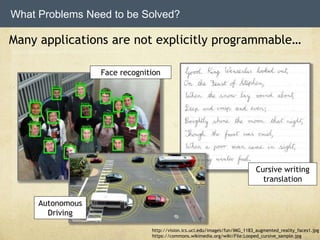
What Problems Need to be Solved?
Many applications are not explicitly programmable…
Cursive writing
translation
Autonomous
Driving
Face recognition
http://vision.ics.uci.edu/images/fun/IMG_1183_augmented_reality_faces1.jpg
https://commons.wikimedia.org/wiki/File:Looped_cursive_sample.jpg
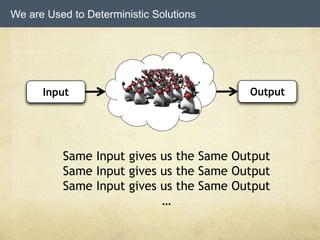
We are Used to Deterministic Solutions
Input Output
Same Input gives us the Same Output
…
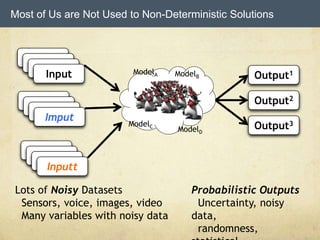
Most of Us are Not Used to Non-Deterministic Solutions
Output1
Input
Input
Input
Input
Input
InputInput
Imput
Input
Input
Input
Inputt
Output2
Output3
Lots of Noisy Datasets
Sensors, voice, images, video
Many variables with noisy data
Probabilistic Outputs
Uncertainty, noisy
data,
randomness,
ModelA ModelB
ModelC
ModelD
Artificial Intelligence – But Didn’t We Try This Already?
AI had very Broad Scope
“Intelligent agents, first-order logic,
knowledge ontologies, probabilistic
reasoning, learning theory, NLP, robotics,…”
Wha’ Happened?
Funding was erratic due to
lofty goals and missed milestones
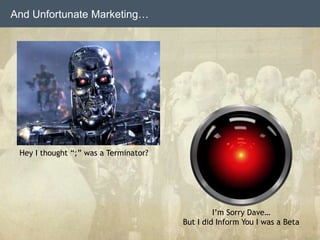
And Unfortunate Marketing…
Hey I thought “;” was a Terminator?
I’m Sorry Dave…
But I did Inform You I was a Beta
The Real Problem with AI
Much of historical AI was clever, but much of it
was just conventional programming techniques.
Systems still had to be explicitly programmed…
Machine Learning - ML
“Machine Learning” (1959) – Computers that
learn without being explicitly programmed
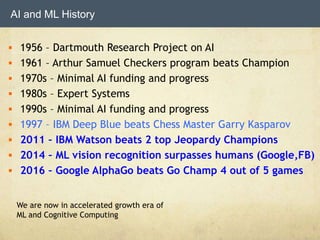
AI and ML History
 1956 – Dartmouth Research Project on AI
 1961 – Arthur Samuel Checkers program beats Champion
 1970s – Minimal AI funding and progress
 1980s – Expert Systems
 1990s – Minimal AI funding and progress
 1997 – IBM Deep Blue beats Chess Master Garry Kasparov
 2011 – IBM Watson beats 2 top Jeopardy Champions
 2014 – ML vision recognition surpasses humans (Google,FB)
 2016 – Google AlphaGo beats Go Champ 4 out of 5 games
We are now in accelerated growth era of
ML and Cognitive Computing
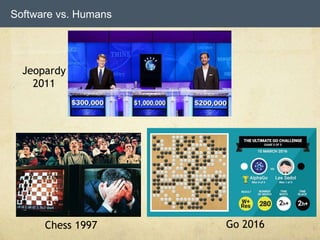
Software vs. Humans
Jeopardy
2011
Chess 1997 Go 2016
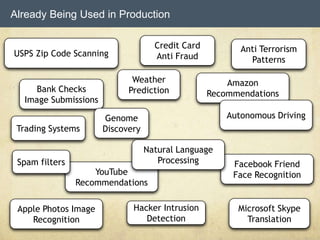
Already Being Used in Production
USPS Zip Code Scanning
Bank Checks
Image Submissions
Credit Card
Anti Fraud
YouTube
Recommendations
Spam filters Facebook Friend
Face Recognition
Apple Photos Image
Recognition
Amazon
Recommendations
Genome
Discovery
Microsoft Skype
Translation
Anti Terrorism
Patterns
Autonomous Driving
Weather
Prediction
Trading Systems
Natural Language
Processing
Hacker Intrusion
Detection
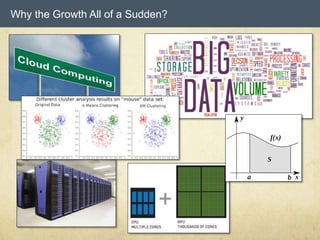
Why the Growth All of a Sudden?
We are in a Machine Learning “Spring”
No… not *that* Spring...
 Huge advances over the past 10-15 years
 Easy, cheap access to ML software via Services
 Access to OSS frameworks and engines
Watson SDKs, etc.
What’s in the Near Future
 More sophisticated computer vision and image detection
 Widespread video/media/et-al recommendation subsystems
 Separate of multiple voices in a crowd
 Musical instrument detection
 Brain, MRI and other medical pattern analysis
Over next 3-5 years,
ML techniques/skills will be in huge demand
Make existing apps more usable -> more usage
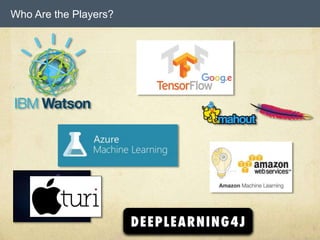
Who Are the Players?
Now… What is Cognitive Computing?
“Cognitive computing has been used to refer to
new hardware and/or software that mimics the
functioning of the human brain and helps to
improve human decision-making”
- Wikipedia
Cognitive Computing is Probabilistic
“Cognitive systems are probabilistic. They
generate not just answers to numerical
problems, but hypotheses, reasoned
arguments and recommendations about
more complex — and meaningful — bodies
of data.”
- Dr John E Kelly (IBM)
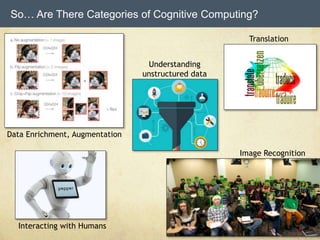
So… Are There Categories of Cognitive Computing?
Data Enrichment, Augmentation
Translation
Image Recognition
Understanding
unstructured data
Interacting with Humans
Btw, written mostly in Java…
IBM Watson and Cognitive Computing
Cognitive apps are built with Watson APIs
Watson APIs use NLP and various Machine Learning
models/algorithms “under the hood”
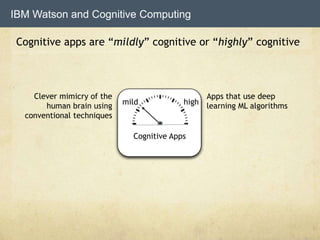
Cognitive apps are “mildly” cognitive or “highly” cognitive
IBM Watson and Cognitive Computing
Clever mimicry of the
human brain using
conventional techniques
Apps that use deep
learning ML algorithms
Cognitive Apps
mild high
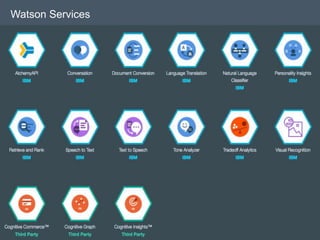
Watson Services
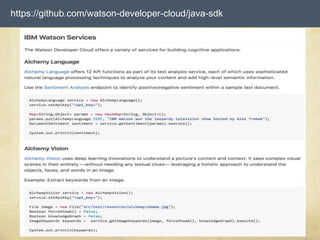
Java SDK for IBM Watson Services
The Moment You All
Have Been Waiting For…
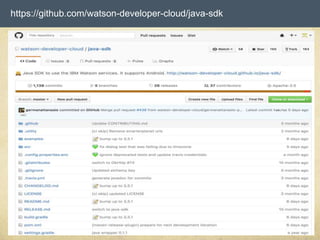
https://github.com/watson-developer-cloud/java-sdk
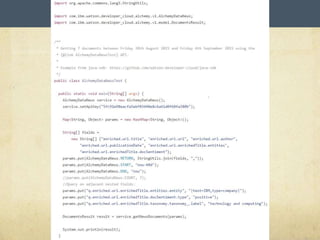
public class Frank {
public static void main(String[] args) {
ToneAnalyzer service =
new ToneAnalyzer(ToneAnalyzer.VERSION_DATE_2016_05_19);
service.setUsernameAndPassword(USER, PSWD);
service.setEndPoint(
"https://gateway.watsonplatform.net/tone-analyzer/api");
// Call the service and get the tone
ToneOptions options =
new ToneOptions.Builder().addTone(Tone.EMOTION)
.addTone(Tone.LANGUAGE)
.addTone(Tone.SOCIAL)
.build();
ToneAnalysis tone =
service.getTone(getInput(), options).execute();
System.out.println(tone);
}
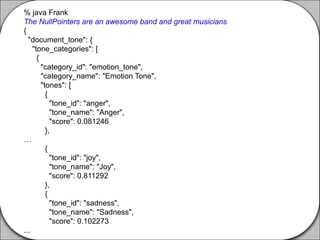
% java Frank
The NullPointers are an awesome band and great musicians
{
"document_tone": {
"tone_categories": [
{
"category_id": "emotion_tone",
"category_name": "Emotion Tone",
"tones": [
{
"tone_id": "anger",
"tone_name": "Anger",
"score": 0.081246
},
…
{
"tone_id": "joy",
"tone_name": "Joy",
"score": 0.811292
},
{
"tone_id": "sadness",
"tone_name": "Sadness",
"score": 0.102273
...
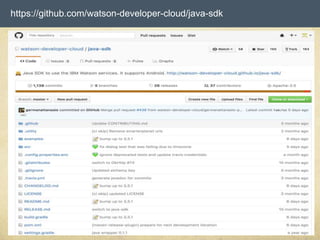
https://github.com/watson-developer-cloud/java-sdk
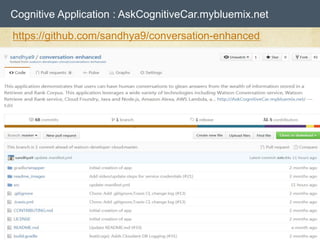
Cognitive Application : AskCognitiveCar.mybluemix.net
https://github.com/sandhya9/conversation-enhanced
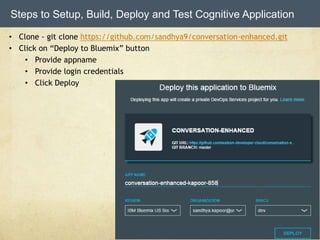
• Clone - git clone https://github.com/sandhya9/conversation-enhanced.git
• Click on “Deploy to Bluemix” button
• Provide appname
• Provide login credentials
• Click Deploy
Steps to Setup, Build, Deploy and Test Cognitive Application
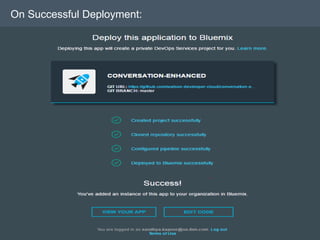
On Successful Deployment:
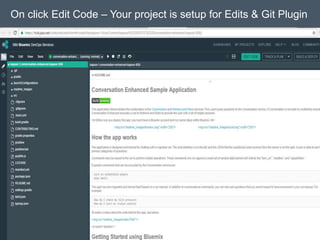
On click Edit Code – Your project is setup for Edits & Git Plugin
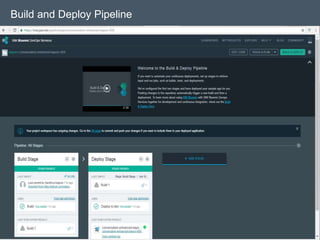
Build and Deploy Pipeline
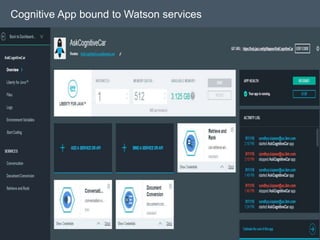
Cognitive App bound to Watson services
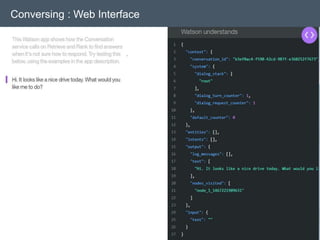
Conversing : Web Interface
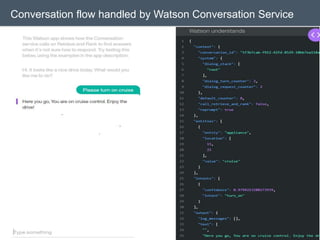
Conversation flow handled by Watson Conversation Service
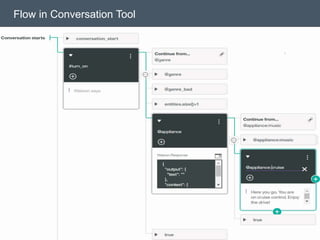
Flow in Conversation Tool
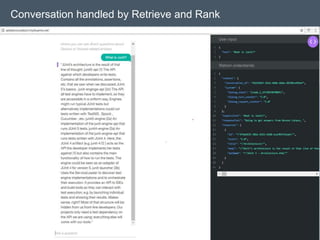
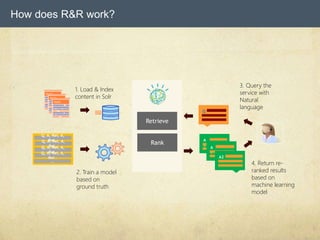
Conversation handled by Retrieve and Rank
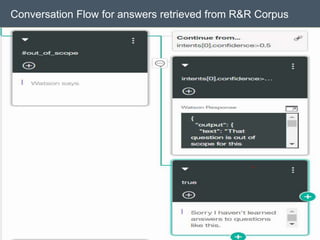
Conversation Flow for answers retrieved from R&R Corpus
Q, A, Rel, A,
Rel..Q, A, Rel, A,
Rel..Q, A, Rel, A,
Rel..Q, A, Rel, A,
Rel..
…
Retrieve
Rank
Q
A
3
A
7
A2
1. Load & Index
content in Solr
2. Train a model
based on
ground truth
3. Query the
service with
Natural
language
4. Return re-
ranked results
based on
machine learning
model
How does R&R work?
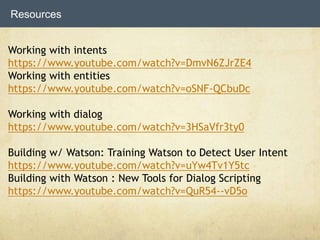
Resources
Working with intents
https://www.youtube.com/watch?v=DmvN6ZJrZE4
Working with entities
https://www.youtube.com/watch?v=oSNF-QCbuDc
Working with dialog
https://www.youtube.com/watch?v=3HSaVfr3ty0
Building w/ Watson: Training Watson to Detect User Intent
https://www.youtube.com/watch?v=uYw4Tv1Y5tc
Building with Watson : New Tools for Dialog Scripting
https://www.youtube.com/watch?v=QuR54--vD5o
Ask Technical Questions to NAO Robot and Amazon Echo
See AskDevoxxWatson Cognitive application in action at IBM’s
Keynote on Thursday 9 am – 10:45 am.
Thank You!
@sandhyakapoor9
@frankgreco

Java one2016 con3054-watsonap-is

  • 1.
    Building Cognitive Applications withWatson APIs CON 3054 @sandhyakapoor9 @frankgreco
  • 2.
    Background  Chairman NYJavaSIG(javasig.com)  Largest Java UG in NA 8k+ members  First Java UG ever! Sept 1995  mail: fgreco@javasig.com  twitter: @frankgreco yell: “Hey Frank!”  Developer Advocate – IBM Cloud  Security Architect – WebSphere AS  Mail: kapoor@us.ibm.com  twitter: @sandhyakapoor9
  • 3.
    To understand cognitiveand machine learning applications Why are they important How to enhance your apps with cognitive services Review the Watson Java SDK, and discuss how to enhance your apps with cognitive servives Goal
  • 4.
    What Are WeGoing to Cover?  What Problems Are We Trying to Solve?  Didn’t AI Try This Years Ago?  Machine Learning  Use Cases  The Near Future  Who are the Players  What is Cognitive Computing?  IBM Watson and Cognitive Computing  Demos
  • 5.
    What Problems Needto be Solved? Many applications are not explicitly programmable… Cursive writing translation Autonomous Driving Face recognition http://vision.ics.uci.edu/images/fun/IMG_1183_augmented_reality_faces1.jpg https://commons.wikimedia.org/wiki/File:Looped_cursive_sample.jpg
  • 6.
    We are Usedto Deterministic Solutions Input Output Same Input gives us the Same Output Same Input gives us the Same Output Same Input gives us the Same Output …
  • 7.
    Most of Usare Not Used to Non-Deterministic Solutions Output1 Input Input Input Input Input InputInput Imput Input Input Input Inputt Output2 Output3 Lots of Noisy Datasets Sensors, voice, images, video Many variables with noisy data Probabilistic Outputs Uncertainty, noisy data, randomness, ModelA ModelB ModelC ModelD
  • 8.
    Artificial Intelligence –But Didn’t We Try This Already? AI had very Broad Scope “Intelligent agents, first-order logic, knowledge ontologies, probabilistic reasoning, learning theory, NLP, robotics,…” Wha’ Happened? Funding was erratic due to lofty goals and missed milestones
  • 9.
    And Unfortunate Marketing… HeyI thought “;” was a Terminator? I’m Sorry Dave… But I did Inform You I was a Beta
  • 10.
    The Real Problemwith AI Much of historical AI was clever, but much of it was just conventional programming techniques. Systems still had to be explicitly programmed…
  • 11.
    Machine Learning -ML “Machine Learning” (1959) – Computers that learn without being explicitly programmed
  • 12.
    AI and MLHistory  1956 – Dartmouth Research Project on AI  1961 – Arthur Samuel Checkers program beats Champion  1970s – Minimal AI funding and progress  1980s – Expert Systems  1990s – Minimal AI funding and progress  1997 – IBM Deep Blue beats Chess Master Garry Kasparov  2011 – IBM Watson beats 2 top Jeopardy Champions  2014 – ML vision recognition surpasses humans (Google,FB)  2016 – Google AlphaGo beats Go Champ 4 out of 5 games We are now in accelerated growth era of ML and Cognitive Computing
  • 13.
  • 14.
    Already Being Usedin Production USPS Zip Code Scanning Bank Checks Image Submissions Credit Card Anti Fraud YouTube Recommendations Spam filters Facebook Friend Face Recognition Apple Photos Image Recognition Amazon Recommendations Genome Discovery Microsoft Skype Translation Anti Terrorism Patterns Autonomous Driving Weather Prediction Trading Systems Natural Language Processing Hacker Intrusion Detection
  • 15.
    Why the GrowthAll of a Sudden?
  • 16.
    We are ina Machine Learning “Spring” No… not *that* Spring...  Huge advances over the past 10-15 years  Easy, cheap access to ML software via Services  Access to OSS frameworks and engines Watson SDKs, etc.
  • 17.
    What’s in theNear Future  More sophisticated computer vision and image detection  Widespread video/media/et-al recommendation subsystems  Separate of multiple voices in a crowd  Musical instrument detection  Brain, MRI and other medical pattern analysis Over next 3-5 years, ML techniques/skills will be in huge demand Make existing apps more usable -> more usage
  • 18.
    Who Are thePlayers?
  • 19.
    Now… What isCognitive Computing? “Cognitive computing has been used to refer to new hardware and/or software that mimics the functioning of the human brain and helps to improve human decision-making” - Wikipedia
  • 20.
    Cognitive Computing isProbabilistic “Cognitive systems are probabilistic. They generate not just answers to numerical problems, but hypotheses, reasoned arguments and recommendations about more complex — and meaningful — bodies of data.” - Dr John E Kelly (IBM)
  • 21.
    So… Are ThereCategories of Cognitive Computing? Data Enrichment, Augmentation Translation Image Recognition Understanding unstructured data Interacting with Humans
  • 22.
  • 23.
    IBM Watson andCognitive Computing Cognitive apps are built with Watson APIs Watson APIs use NLP and various Machine Learning models/algorithms “under the hood”
  • 24.
    Cognitive apps are“mildly” cognitive or “highly” cognitive IBM Watson and Cognitive Computing Clever mimicry of the human brain using conventional techniques Apps that use deep learning ML algorithms Cognitive Apps mild high
  • 25.
  • 26.
    Java SDK forIBM Watson Services The Moment You All Have Been Waiting For…
  • 27.
  • 28.
  • 29.
    public class Frank{ public static void main(String[] args) { ToneAnalyzer service = new ToneAnalyzer(ToneAnalyzer.VERSION_DATE_2016_05_19); service.setUsernameAndPassword(USER, PSWD); service.setEndPoint( "https://gateway.watsonplatform.net/tone-analyzer/api"); // Call the service and get the tone ToneOptions options = new ToneOptions.Builder().addTone(Tone.EMOTION) .addTone(Tone.LANGUAGE) .addTone(Tone.SOCIAL) .build(); ToneAnalysis tone = service.getTone(getInput(), options).execute(); System.out.println(tone); }
  • 30.
    % java Frank TheNullPointers are an awesome band and great musicians { "document_tone": { "tone_categories": [ { "category_id": "emotion_tone", "category_name": "Emotion Tone", "tones": [ { "tone_id": "anger", "tone_name": "Anger", "score": 0.081246 }, … { "tone_id": "joy", "tone_name": "Joy", "score": 0.811292 }, { "tone_id": "sadness", "tone_name": "Sadness", "score": 0.102273 ...
  • 32.
  • 34.
    Cognitive Application :AskCognitiveCar.mybluemix.net https://github.com/sandhya9/conversation-enhanced
  • 35.
    • Clone -git clone https://github.com/sandhya9/conversation-enhanced.git • Click on “Deploy to Bluemix” button • Provide appname • Provide login credentials • Click Deploy Steps to Setup, Build, Deploy and Test Cognitive Application
  • 36.
  • 37.
    On click EditCode – Your project is setup for Edits & Git Plugin
  • 38.
  • 39.
    Cognitive App boundto Watson services
  • 40.
  • 41.
    Conversation flow handledby Watson Conversation Service
  • 42.
  • 43.
    Conversation handled byRetrieve and Rank
  • 44.
    Conversation Flow foranswers retrieved from R&R Corpus
  • 45.
    Q, A, Rel,A, Rel..Q, A, Rel, A, Rel..Q, A, Rel, A, Rel..Q, A, Rel, A, Rel.. … Retrieve Rank Q A 3 A 7 A2 1. Load & Index content in Solr 2. Train a model based on ground truth 3. Query the service with Natural language 4. Return re- ranked results based on machine learning model How does R&R work?
  • 46.
    Resources Working with intents https://www.youtube.com/watch?v=DmvN6ZJrZE4 Workingwith entities https://www.youtube.com/watch?v=oSNF-QCbuDc Working with dialog https://www.youtube.com/watch?v=3HSaVfr3ty0 Building w/ Watson: Training Watson to Detect User Intent https://www.youtube.com/watch?v=uYw4Tv1Y5tc Building with Watson : New Tools for Dialog Scripting https://www.youtube.com/watch?v=QuR54--vD5o
  • 47.
    Ask Technical Questionsto NAO Robot and Amazon Echo See AskDevoxxWatson Cognitive application in action at IBM’s Keynote on Thursday 9 am – 10:45 am.
  • 48.