Advanced Java Programming
Topic: Java Beans

By
Ravi Kant Sahu
Asst. Professor, LPU
Introduction


Every Java user interface class is a JavaBeans component.



Java Beans makes it easy to reuse software components.



Developers can use software components written by others
without having to understand their inner workings.

Ravi Kant Sahu, Asst. Professor @ Lovely Professional University, Punjab (India)
Java Beans


JavaBeans is a software component architecture that extends the
power of the Java language by enabling well-formed objects to
be manipulated visually at design time in a pure Java builder
tool.



It is a reusable software component.



A JavaBean is a specially constructed Java class written in the
Java and coded according to the JavaBeans API specifications.

Ravi Kant Sahu, Asst. Professor @ Lovely Professional University, Punjab (India)
Java Beans Specifications
1.
2.

3.

4.

5.

A bean must be a public class.
A bean must have a public no-arg constructor, though it can have
other constructors if needed.
public MyBean();
A bean must implement the Serializable interface to ensure a
persistent state.
It should provide methods to set and get the values of the
properties, known as getter (accessor) and setter (mutator)
methods.
A bean may have events with correctly constructed public
registration and deregistration methods that enable it to add and
remove listeners.
Ravi Kant Sahu, Asst. Professor @ Lovely Professional University, Punjab (India)
Java Beans Specification


The first three requirements must be observed, and therefore
are referred to as minimum JavaBeans component
requirements.



The last two requirements depend on implementations.



It is possible to write a bean component without get/set
methods and event registration/deregistration methods.

Ravi Kant Sahu, Asst. Professor @ Lovely Professional University, Punjab (India)
Java Beans Example
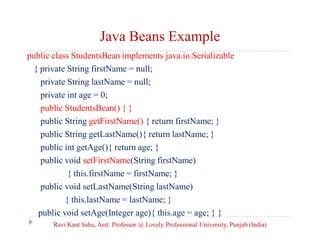
public class StudentsBean implements java.io.Serializable
{ private String firstName = null;
private String lastName = null;
private int age = 0;
public StudentsBean() { }
public String getFirstName() { return firstName; }
public String getLastName(){ return lastName; }
public int getAge(){ return age; }
public void setFirstName(String firstName)
{ this.firstName = firstName; }
public void setLastName(String lastName)
{ this.lastName = lastName; }
public void setAge(Integer age){ this.age = age; } }
Ravi Kant Sahu, Asst. Professor @ Lovely Professional University, Punjab (India)
Java Beans Component


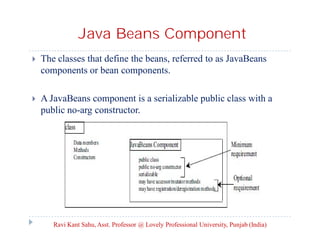
The classes that define the beans, referred to as JavaBeans
components or bean components.



A JavaBeans component is a serializable public class with a
public no-arg constructor.

Ravi Kant Sahu, Asst. Professor @ Lovely Professional University, Punjab (India)
Bean Properties


Properties are discrete, named attributes of a Java bean that can
affect its appearance or behavior.



They are often data fields of a bean.
For example, JButton component has a property named text.





Accessor and mutator methods are provided to let the user read
and write the properties.

Ravi Kant Sahu, Asst. Professor @ Lovely Professional University, Punjab (India)
Property-Naming Patterns


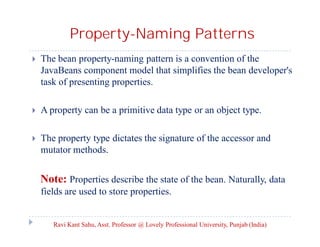
The bean property-naming pattern is a convention of the
JavaBeans component model that simplifies the bean developer's
task of presenting properties.



A property can be a primitive data type or an object type.



The property type dictates the signature of the accessor and
mutator methods.

Note: Properties describe the state of the bean. Naturally, data
fields are used to store properties.

Ravi Kant Sahu, Asst. Professor @ Lovely Professional University, Punjab (India)
Accessor Methods


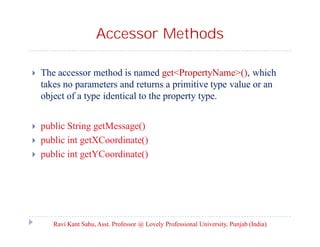
The accessor method is named get<PropertyName>(), which
takes no parameters and returns a primitive type value or an
object of a type identical to the property type.



public String getMessage()
public int getXCoordinate()
public int getYCoordinate()




Ravi Kant Sahu, Asst. Professor @ Lovely Professional University, Punjab (India)


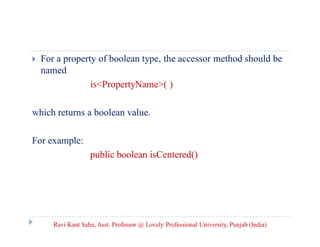
For a property of boolean type, the accessor method should be
named
is<PropertyName>( )

which returns a boolean value.
For example:
public boolean isCentered()

Ravi Kant Sahu, Asst. Professor @ Lovely Professional University, Punjab (India)
Mutator Methods


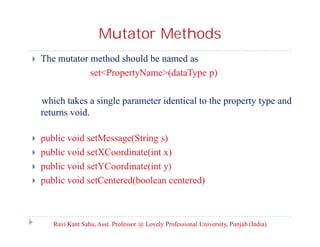
The mutator method should be named as
set<PropertyName>(dataType p)
which takes a single parameter identical to the property type and
returns void.






public void setMessage(String s)
public void setXCoordinate(int x)
public void setYCoordinate(int y)
public void setCentered(boolean centered)

Ravi Kant Sahu, Asst. Professor @ Lovely Professional University, Punjab (India)
Java EvEnt ModEl

Ravi Kant Sahu, Asst. Professor @ Lovely Professional University, Punjab (India)
Event Delegation Model


The Java event delegation model provides the foundation for
beans to send, receive, and handle events.



The Java event model consists of the following three types of
elements:
The event object: An event object contains the information that



describes the event.


The source object: A source object is where the event originates.
When an event occurs on a source object, an event object is created.



The event listener object: An object interested in the event handles
the event. Such an object is called a listener.

Ravi Kant Sahu, Asst. Professor @ Lovely Professional University, Punjab (India)
Event classes and Event Listener interfaces


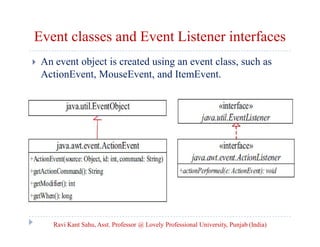
An event object is created using an event class, such as
ActionEvent, MouseEvent, and ItemEvent.

Ravi Kant Sahu, Asst. Professor @ Lovely Professional University, Punjab (India)
Source Components


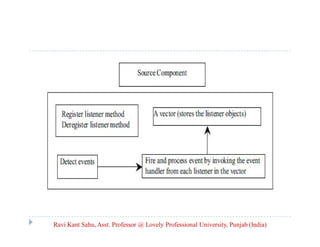
The source component contains the code that detects an
external or internal action that triggers the event.



Upon detecting the action, the source should fire an event
to the listeners by invoking the event handler defined by
the listeners.



The source component must also contain methods for
registering and deregistering listeners.

Ravi Kant Sahu, Asst. Professor @ Lovely Professional University, Punjab (India)
Listener Components


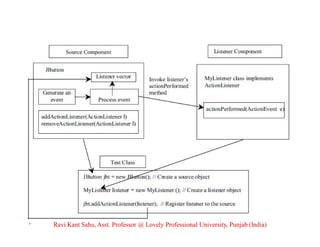
A listener component for an event must implement the event
listener interface.



The object of the listener component cannot receive event
notifications from a source component unless the object is
registered as a listener of the source.



A listener component may implement any number of listener
interfaces to listen to several types of events.



A source component may register many listeners. A source
component may register itself as a listener.
Ravi Kant Sahu, Asst. Professor @ Lovely Professional University, Punjab (India)
Creating Custom Source Components


A source component must have the appropriate
registration and deregistration methods for adding and
removing listeners.



Events can be unicasted (only one listener object is
notified of the event) or multicasted (each object in a
list of listeners is notified of the event).

Ravi Kant Sahu, Asst. Professor @ Lovely Professional University, Punjab (India)
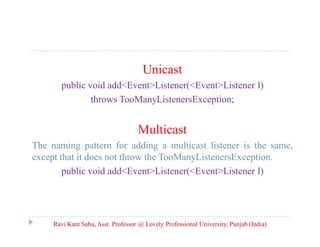
Unicast
public void add<Event>Listener(<Event>Listener l)
throws TooManyListenersException;

Multicast
The naming pattern for adding a multicast listener is the same,
except that it does not throw the TooManyListenersException.
public void add<Event>Listener(<Event>Listener l)

Ravi Kant Sahu, Asst. Professor @ Lovely Professional University, Punjab (India)
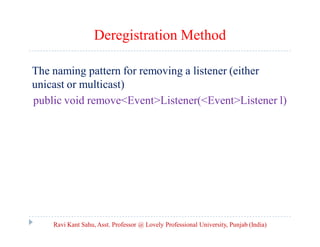
Deregistration Method
The naming pattern for removing a listener (either
unicast or multicast)
public void remove<Event>Listener(<Event>Listener l)

Ravi Kant Sahu, Asst. Professor @ Lovely Professional University, Punjab (India)
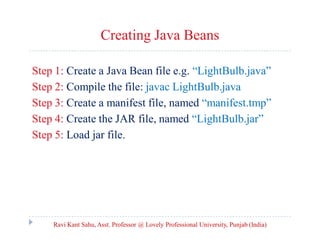
Creating Java Beans
Step 1: Create a Java Bean file e.g. “LightBulb.java”
Step 2: Compile the file: javac LightBulb.java
Step 3: Create a manifest file, named “manifest.tmp”
Step 4: Create the JAR file, named “LightBulb.jar”
Step 5: Load jar file.

Ravi Kant Sahu, Asst. Professor @ Lovely Professional University, Punjab (India)
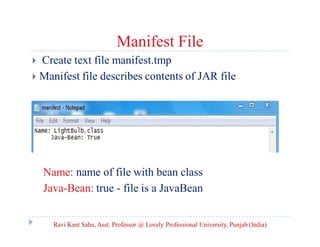
Manifest File
Create text file manifest.tmp
 Manifest file describes contents of JAR file


Name: name of file with bean class
Java-Bean: true - file is a JavaBean
Ravi Kant Sahu, Asst. Professor @ Lovely Professional University, Punjab (India)
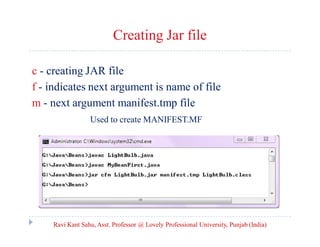
Creating Jar file
c - creating JAR file
f - indicates next argument is name of file
m - next argument manifest.tmp file
Used to create MANIFEST.MF

Ravi Kant Sahu, Asst. Professor @ Lovely Professional University, Punjab (India)
.

.

Java beans

  • 1.
    Advanced Java Programming Topic:Java Beans By Ravi Kant Sahu Asst. Professor, LPU
  • 2.
    Introduction  Every Java userinterface class is a JavaBeans component.  Java Beans makes it easy to reuse software components.  Developers can use software components written by others without having to understand their inner workings. Ravi Kant Sahu, Asst. Professor @ Lovely Professional University, Punjab (India)
  • 3.
    Java Beans  JavaBeans isa software component architecture that extends the power of the Java language by enabling well-formed objects to be manipulated visually at design time in a pure Java builder tool.  It is a reusable software component.  A JavaBean is a specially constructed Java class written in the Java and coded according to the JavaBeans API specifications. Ravi Kant Sahu, Asst. Professor @ Lovely Professional University, Punjab (India)
  • 4.
    Java Beans Specifications 1. 2. 3. 4. 5. Abean must be a public class. A bean must have a public no-arg constructor, though it can have other constructors if needed. public MyBean(); A bean must implement the Serializable interface to ensure a persistent state. It should provide methods to set and get the values of the properties, known as getter (accessor) and setter (mutator) methods. A bean may have events with correctly constructed public registration and deregistration methods that enable it to add and remove listeners. Ravi Kant Sahu, Asst. Professor @ Lovely Professional University, Punjab (India)
  • 5.
    Java Beans Specification  Thefirst three requirements must be observed, and therefore are referred to as minimum JavaBeans component requirements.  The last two requirements depend on implementations.  It is possible to write a bean component without get/set methods and event registration/deregistration methods. Ravi Kant Sahu, Asst. Professor @ Lovely Professional University, Punjab (India)
  • 6.
    Java Beans Example publicclass StudentsBean implements java.io.Serializable { private String firstName = null; private String lastName = null; private int age = 0; public StudentsBean() { } public String getFirstName() { return firstName; } public String getLastName(){ return lastName; } public int getAge(){ return age; } public void setFirstName(String firstName) { this.firstName = firstName; } public void setLastName(String lastName) { this.lastName = lastName; } public void setAge(Integer age){ this.age = age; } } Ravi Kant Sahu, Asst. Professor @ Lovely Professional University, Punjab (India)
  • 7.
    Java Beans Component  Theclasses that define the beans, referred to as JavaBeans components or bean components.  A JavaBeans component is a serializable public class with a public no-arg constructor. Ravi Kant Sahu, Asst. Professor @ Lovely Professional University, Punjab (India)
  • 8.
    Bean Properties  Properties arediscrete, named attributes of a Java bean that can affect its appearance or behavior.  They are often data fields of a bean. For example, JButton component has a property named text.   Accessor and mutator methods are provided to let the user read and write the properties. Ravi Kant Sahu, Asst. Professor @ Lovely Professional University, Punjab (India)
  • 9.
    Property-Naming Patterns  The beanproperty-naming pattern is a convention of the JavaBeans component model that simplifies the bean developer's task of presenting properties.  A property can be a primitive data type or an object type.  The property type dictates the signature of the accessor and mutator methods. Note: Properties describe the state of the bean. Naturally, data fields are used to store properties. Ravi Kant Sahu, Asst. Professor @ Lovely Professional University, Punjab (India)
  • 10.
    Accessor Methods  The accessormethod is named get<PropertyName>(), which takes no parameters and returns a primitive type value or an object of a type identical to the property type.  public String getMessage() public int getXCoordinate() public int getYCoordinate()   Ravi Kant Sahu, Asst. Professor @ Lovely Professional University, Punjab (India)
  • 11.
     For a propertyof boolean type, the accessor method should be named is<PropertyName>( ) which returns a boolean value. For example: public boolean isCentered() Ravi Kant Sahu, Asst. Professor @ Lovely Professional University, Punjab (India)
  • 12.
    Mutator Methods  The mutatormethod should be named as set<PropertyName>(dataType p) which takes a single parameter identical to the property type and returns void.     public void setMessage(String s) public void setXCoordinate(int x) public void setYCoordinate(int y) public void setCentered(boolean centered) Ravi Kant Sahu, Asst. Professor @ Lovely Professional University, Punjab (India)
  • 13.
    Java EvEnt ModEl RaviKant Sahu, Asst. Professor @ Lovely Professional University, Punjab (India)
  • 14.
    Event Delegation Model  TheJava event delegation model provides the foundation for beans to send, receive, and handle events.  The Java event model consists of the following three types of elements: The event object: An event object contains the information that  describes the event.  The source object: A source object is where the event originates. When an event occurs on a source object, an event object is created.  The event listener object: An object interested in the event handles the event. Such an object is called a listener. Ravi Kant Sahu, Asst. Professor @ Lovely Professional University, Punjab (India)
  • 15.
    Event classes andEvent Listener interfaces  An event object is created using an event class, such as ActionEvent, MouseEvent, and ItemEvent. Ravi Kant Sahu, Asst. Professor @ Lovely Professional University, Punjab (India)
  • 16.
    Source Components  The sourcecomponent contains the code that detects an external or internal action that triggers the event.  Upon detecting the action, the source should fire an event to the listeners by invoking the event handler defined by the listeners.  The source component must also contain methods for registering and deregistering listeners. Ravi Kant Sahu, Asst. Professor @ Lovely Professional University, Punjab (India)
  • 17.
    Ravi Kant Sahu,Asst. Professor @ Lovely Professional University, Punjab (India)
  • 18.
    Listener Components  A listenercomponent for an event must implement the event listener interface.  The object of the listener component cannot receive event notifications from a source component unless the object is registered as a listener of the source.  A listener component may implement any number of listener interfaces to listen to several types of events.  A source component may register many listeners. A source component may register itself as a listener. Ravi Kant Sahu, Asst. Professor @ Lovely Professional University, Punjab (India)
  • 19.
    Ravi Kant Sahu,Asst. Professor @ Lovely Professional University, Punjab (India)
  • 20.
    Creating Custom SourceComponents  A source component must have the appropriate registration and deregistration methods for adding and removing listeners.  Events can be unicasted (only one listener object is notified of the event) or multicasted (each object in a list of listeners is notified of the event). Ravi Kant Sahu, Asst. Professor @ Lovely Professional University, Punjab (India)
  • 21.
    Unicast public void add<Event>Listener(<Event>Listenerl) throws TooManyListenersException; Multicast The naming pattern for adding a multicast listener is the same, except that it does not throw the TooManyListenersException. public void add<Event>Listener(<Event>Listener l) Ravi Kant Sahu, Asst. Professor @ Lovely Professional University, Punjab (India)
  • 22.
    Deregistration Method The namingpattern for removing a listener (either unicast or multicast) public void remove<Event>Listener(<Event>Listener l) Ravi Kant Sahu, Asst. Professor @ Lovely Professional University, Punjab (India)
  • 23.
    Creating Java Beans Step1: Create a Java Bean file e.g. “LightBulb.java” Step 2: Compile the file: javac LightBulb.java Step 3: Create a manifest file, named “manifest.tmp” Step 4: Create the JAR file, named “LightBulb.jar” Step 5: Load jar file. Ravi Kant Sahu, Asst. Professor @ Lovely Professional University, Punjab (India)
  • 24.
    Manifest File Create textfile manifest.tmp  Manifest file describes contents of JAR file  Name: name of file with bean class Java-Bean: true - file is a JavaBean Ravi Kant Sahu, Asst. Professor @ Lovely Professional University, Punjab (India)
  • 25.
    Creating Jar file c- creating JAR file f - indicates next argument is name of file m - next argument manifest.tmp file Used to create MANIFEST.MF Ravi Kant Sahu, Asst. Professor @ Lovely Professional University, Punjab (India)
  • 26.
    Ravi Kant Sahu,Asst. Professor @ Lovely Professional University, Punjab (India)
  • 27.