JAVA BASED RFID ATTENDANCE
MANAGEMENT SYSTEM
A graduation project for the future..
Supervised by
Faisal Khaleel
AA Technologies
AGENDA
● Introduction
●
●
●
● A problem to solve and a solution.
System purpose
System features.
Where?
● Used tools
● Phases
●
●
●
● Planning, gathering information phase
Design, Application and Database Design
Implementation
Testing
● Future applicable extensions
● A Thank you! Word and Questions
Introduction
Mubeen Arshad
INTRODUCTION: SYSTEM
PURPOSE
●The purpose of this project is to develop an
automated class attendance checking system
for each and every lecture room in the
university.
INTRODUCTION:
WHERE?
INTRODUCTION: KEY
TECHNOLOGY
●The primary technology to be used is Radio
Frequency Identification technology or RFID
●A system of identification wherein an electronic
device that uses radio frequency or magnetic
field variations to communicate is attached to
an item.
●Why RFID?
1.Alignment is not necessary.
2. High inventory speeds.
3. Variety of form factors.
4. Item-level tracking.
5.Rewritability (This depends on the type of
the Tag).
INTRODUCTION: USED
TOOLS
● RFID, The Key Technology
● Linux, The Base Operating System
● JAVA, Application logic and the middle-ware
● MySQL, The Back-end Database
● GWT, Google Web Toolkit
Planning & Analysis
Iqra Munir
We believe that the best way to get a good working
application is to give enough time for planning and
designing.
In our planning phase,we passed through the
following..
PLANNING
●
●
KNOW THE SCALE AND WORKING
ENVIRONMENT
●
●
●
large number of students ,class rooms and teaching
stuff.
Limited resources.
Searching for suitable RFID-Reader to work
efficiently with minimum cost.
System has to be scalable
- H/W requirements:
– RFID-Readers
– Tags
– Server machine
- S/W requirements:
– Linux Operating System
– Database
– Apache web server
- Who uses the system:
– Students
– Teachers
– Professors
ANALYSIS:
TECHNICAL
The system should be divided into 3 modules
- The RFID module
for using the RFID-Reader.
- The Database module
for recording the attendance.
- The View module
to view recorded attendance.
SYSTEM
ANALYSIS
● Initial costs
●
●
RFID-Reader: 500 EGP for each Classroom
RFID-Tag for each student
● Running costs
●
●
Electricity cost
Maintenance cost
ANALYSIS:
ECONOMIC
Application & Database Design
Salman Rafique
As in the planning phase we have 3
modules
- The RFID module
- The Database module
- The View module
DESIGN
RFID
Designing Java classes which function is:
●
●
When students pass through the
RFID-Reader with their ID-cards,The RFID-
Reader reads the ID of each student
passes and sends it to the server for
processing .
The server takes the ID of the student,
process it and record the attendance in the
database.
● Included two phases:
1- Designing the Database
–
– creating tables that mirrors the structure of the
environment and the relations between these
tables.
Normalizing tables.
2- Designing Database Java classes:
–
– Classes that records the attendance data in the
database.
Classes that retrieves the attendance data to view
it using the systems' GUI.
DATABASE
● Designing login form to check authentication.
● Designing needed forms for possible users of the
system depending on the permissions given to
each type of users (professor,TA,student).
VIEW
THE ENVIRONMENT
Jawerya Sultan
THE
ENVIRONMENT:
LINUX
● We use Linux as the base OS for our server
● In spite of that , Our Software is tested under
Microsoft Windows. And can be deployed on
any other platform that supports Java
• Mainly , It is free
– FREE of charge.
– FREE source
– Rapid development
– More Secure.
• Security
–User Privileges
–No Executables
–No Registry
• Stability.
• Multi-User , Networked OS
THE ENVIRONMENT:
WHY LINUX?
• Java is an Open Source Object Oriented
Programming Language.
• Platform independent
• Secure
• Simple
• Multi-Threaded
• Distributed
THE ENVIRONMENT:
JAVA
database management system• Relational
(RDBMS)
multiuser access to a number of• Providing
databases
• Works on many different system platforms
THE ENVIRONMENT:
MYSQL
•A JAVAto JavaScript cross-compiler
•It takes Java code and compiles it into JavaScript
to be run in a browser with AJAX style
•GWT-RPC : A technology used toremotely
invoke code component from remote server
THE ENVIRONMENT:
GWT GOOGLE WEBTOOLKIT
Implementation
Qamar Shahzad
●
We create a class that will listen to the
reader and if the reader read a tag it
will capture this ID and the time of
Attendance
IMPLEMENTATION:
READER API
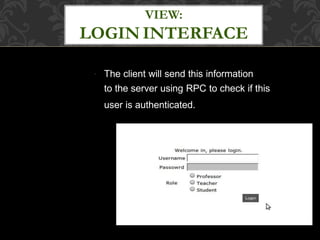
● The client will send this information
to the server using RPC to check if this
user is authenticated.
VIEW:
LOGIN INTERFACE
●
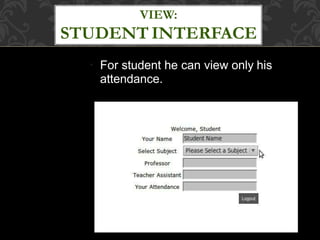
For student he can view only his
attendance.
VIEW:
STUDENT INTERFACE
●
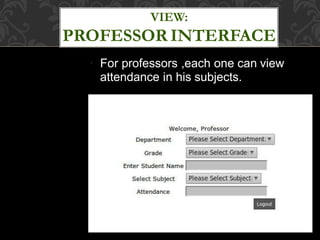
For professors ,each one can view
attendance in his subjects.
VIEW:
PROFESSOR INTERFACE
●
●
●
Switch on/off interface
View student attendance
View section attendance
VIEW:
TEACHER INTERFACE
●
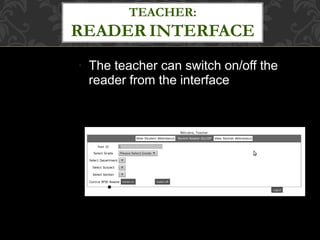
The teacher can switch on/off the
reader from the interface
TEACHER:
READER INTERFACE
● We create number of classes that will
execute the query on the database
and return the required data.
MODEL
●
●
Google Web Toolkit
provides us with some of tools like RPC package.
We used this package to connect the view with the model
CONTROLLER
Future Extensions
Ibrahim Rahi
FUTURE EXTENSIONS
●
●
●
●
●
●
Email integration and notification
SMS integration and cooperation
Cooperation with university's current
system, proxy and email accounts
Bullet-in boards, forums and
presentations views.
Classes Assignments
Sections Cancellation
QUESTION?
THANKS!
Its Effort For Student of
RFID’s by AA Technologies

Java based rfid attendance management system

  • 1.
    JAVA BASED RFIDATTENDANCE MANAGEMENT SYSTEM A graduation project for the future.. Supervised by Faisal Khaleel AA Technologies
  • 2.
    AGENDA ● Introduction ● ● ● ● Aproblem to solve and a solution. System purpose System features. Where? ● Used tools ● Phases ● ● ● ● Planning, gathering information phase Design, Application and Database Design Implementation Testing ● Future applicable extensions ● A Thank you! Word and Questions
  • 3.
  • 4.
    INTRODUCTION: SYSTEM PURPOSE ●The purposeof this project is to develop an automated class attendance checking system for each and every lecture room in the university.
  • 5.
  • 6.
    INTRODUCTION: KEY TECHNOLOGY ●The primarytechnology to be used is Radio Frequency Identification technology or RFID ●A system of identification wherein an electronic device that uses radio frequency or magnetic field variations to communicate is attached to an item. ●Why RFID? 1.Alignment is not necessary. 2. High inventory speeds. 3. Variety of form factors. 4. Item-level tracking. 5.Rewritability (This depends on the type of the Tag).
  • 7.
    INTRODUCTION: USED TOOLS ● RFID,The Key Technology ● Linux, The Base Operating System ● JAVA, Application logic and the middle-ware ● MySQL, The Back-end Database ● GWT, Google Web Toolkit
  • 8.
  • 9.
    We believe thatthe best way to get a good working application is to give enough time for planning and designing. In our planning phase,we passed through the following.. PLANNING ● ●
  • 10.
    KNOW THE SCALEAND WORKING ENVIRONMENT ● ● ● large number of students ,class rooms and teaching stuff. Limited resources. Searching for suitable RFID-Reader to work efficiently with minimum cost. System has to be scalable
  • 11.
    - H/W requirements: –RFID-Readers – Tags – Server machine - S/W requirements: – Linux Operating System – Database – Apache web server - Who uses the system: – Students – Teachers – Professors ANALYSIS: TECHNICAL
  • 12.
    The system shouldbe divided into 3 modules - The RFID module for using the RFID-Reader. - The Database module for recording the attendance. - The View module to view recorded attendance. SYSTEM ANALYSIS
  • 13.
    ● Initial costs ● ● RFID-Reader:500 EGP for each Classroom RFID-Tag for each student ● Running costs ● ● Electricity cost Maintenance cost ANALYSIS: ECONOMIC
  • 14.
    Application & DatabaseDesign Salman Rafique
  • 15.
    As in theplanning phase we have 3 modules - The RFID module - The Database module - The View module DESIGN
  • 16.
    RFID Designing Java classeswhich function is: ● ● When students pass through the RFID-Reader with their ID-cards,The RFID- Reader reads the ID of each student passes and sends it to the server for processing . The server takes the ID of the student, process it and record the attendance in the database.
  • 17.
    ● Included twophases: 1- Designing the Database – – creating tables that mirrors the structure of the environment and the relations between these tables. Normalizing tables. 2- Designing Database Java classes: – – Classes that records the attendance data in the database. Classes that retrieves the attendance data to view it using the systems' GUI. DATABASE
  • 18.
    ● Designing loginform to check authentication. ● Designing needed forms for possible users of the system depending on the permissions given to each type of users (professor,TA,student). VIEW
  • 19.
  • 20.
    THE ENVIRONMENT: LINUX ● We useLinux as the base OS for our server ● In spite of that , Our Software is tested under Microsoft Windows. And can be deployed on any other platform that supports Java
  • 21.
    • Mainly ,It is free – FREE of charge. – FREE source – Rapid development – More Secure. • Security –User Privileges –No Executables –No Registry • Stability. • Multi-User , Networked OS THE ENVIRONMENT: WHY LINUX?
  • 22.
    • Java isan Open Source Object Oriented Programming Language. • Platform independent • Secure • Simple • Multi-Threaded • Distributed THE ENVIRONMENT: JAVA
  • 23.
    database management system•Relational (RDBMS) multiuser access to a number of• Providing databases • Works on many different system platforms THE ENVIRONMENT: MYSQL
  • 24.
    •A JAVAto JavaScriptcross-compiler •It takes Java code and compiles it into JavaScript to be run in a browser with AJAX style •GWT-RPC : A technology used toremotely invoke code component from remote server THE ENVIRONMENT: GWT GOOGLE WEBTOOLKIT
  • 25.
  • 26.
    ● We create aclass that will listen to the reader and if the reader read a tag it will capture this ID and the time of Attendance IMPLEMENTATION: READER API
  • 27.
    ● The clientwill send this information to the server using RPC to check if this user is authenticated. VIEW: LOGIN INTERFACE
  • 28.
    ● For student hecan view only his attendance. VIEW: STUDENT INTERFACE
  • 29.
    ● For professors ,eachone can view attendance in his subjects. VIEW: PROFESSOR INTERFACE
  • 30.
    ● ● ● Switch on/off interface Viewstudent attendance View section attendance VIEW: TEACHER INTERFACE
  • 31.
    ● The teacher canswitch on/off the reader from the interface TEACHER: READER INTERFACE
  • 32.
    ● We createnumber of classes that will execute the query on the database and return the required data. MODEL
  • 33.
    ● ● Google Web Toolkit providesus with some of tools like RPC package. We used this package to connect the view with the model CONTROLLER
  • 34.
  • 35.
    FUTURE EXTENSIONS ● ● ● ● ● ● Email integrationand notification SMS integration and cooperation Cooperation with university's current system, proxy and email accounts Bullet-in boards, forums and presentations views. Classes Assignments Sections Cancellation
  • 36.
  • 37.
    THANKS! Its Effort ForStudent of RFID’s by AA Technologies